PART 2: We Found Seven Newborn Puppies Crying in a Narrow Gap—Their Mother Was Barely Conscious Beside Them
PART 2
“What do you mean?”
Dr. Moreno looked back at Isadora.
“She’s working too hard to breathe.”
I could see it once she said it.
Her sides were moving too fast.
Not violently.
Just relentlessly.
Every breath looked like work.
“Pneumonia?”
“Possibly. Infection. Fluid. Severe anemia can also make breathing harder because the blood isn’t carrying oxygen efficiently.”
She glanced at the puppies, now bundled together in a warmed enclosure nearby.
“And nursing seven puppies in this condition is draining what little reserve she has left.”
My stomach tightened.
“Can she keep nursing them?”
“For now, maybe. But we may need to supplement them.”
“Separate them?”
“As little as possible.”
That mattered.
Everything about Isadora told us that those puppies were the only thing she trusted.
When one cried, her eyes opened.
When a technician lifted one to weigh it, Isadora tried to raise her head.
She barely had enough strength to move, but she tracked every tiny body.
Dr. Moreno ordered additional bloodwork, imaging, testing for tick-borne disease, and supportive care.
Then she said something I did not want to hear.
“She needs oxygen.”
“Can the puppies stay with her?”
“We’ll arrange it.”
“How bad is the anemia?”
“Bad.”
“How bad?”
Dr. Moreno paused.
“Bad enough that I’m watching her numbers very closely.”
I nodded.
That was veterinary language I had learned to fear.
Not hopeless.
But dangerous.
We named her Isadora that afternoon because continuing to call her “the mother dog” felt wrong.
The puppies were given temporary identification bands so we could tell them apart.
Four females.
Three males.
At that age, they looked so similar that without the bands, even experienced rescuers could mix them up.
One of the males was smaller than the rest.
We called him Igor.
He had the same determined habit every time we picked him up: tiny paws pushing against our fingers as if he were outraged by the inconvenience.
“He’s feisty,” Elena said.
“He weighs almost nothing.”
“He doesn’t know that.”
None of them knew how fragile they were.
That was probably a blessing.
Their entire world consisted of warmth, milk, their mother’s body, and the occasional human hand moving them from one towel to another.
Isadora knew more.
She knew people.
And whatever she knew frightened her.
The first evening, three staff members entered the treatment area at once.
Her reaction was immediate.
Her head lifted.
Her eyes widened.
Her muscles tightened.
Then she began to shake.
Not from cold.
Fear.
The room was warm.
I asked two people to step out.
The trembling slowed.
I sat several feet away.
No reaching.
No staring.
No coaxing.
Just presence.
After a few minutes, Isadora lowered her head again.
“She’s expecting something,” Elena whispered.
“I know.”
“What?”
“I don’t know.”
That was the worst part.
A dog cannot explain history.
She can only show you the shape it left behind.
Isadora’s shape was fear.
Someone approaching too quickly.
Too many people.
A hand reaching over her head.
A sudden sound behind her.
Every one of those things tightened her body.
And yet she never tried to bite.
Not once.
When we handled the puppies, she watched intensely.
When the veterinarian examined her abdomen, she trembled.
When blood was drawn, she turned her face away.
But no growl.
No snap.
No attempt to fight.
It was not because she lacked the instinct to protect herself.
It felt more like she had learned resistance did not help.
That thought stayed with me.
The next twenty-four hours were mostly numbers.
Temperature.
Respiratory rate.
Packed cell volume.
Weight.
Fluid intake.
Milk production.
Puppy weights.
We wrote everything down.
The puppies needed to gain.
Isadora needed simply not to lose more.
She was given carefully managed nutrition because severely malnourished animals cannot always be fed aggressively right away.
Her body had been deprived too long.
She needed calories, but she needed them safely.
The puppies received supplemental feeding when they could not get enough from her.
They hated it.
One female squealed so dramatically during bottle feeding that Elena stared at her.
“You are not dying.”
The puppy squealed louder.
“You are literally being fed.”
I laughed for the first time all day.
Isadora opened one eye.
“She agrees with the puppy,” I said.
“No, she thinks we’re incompetent.”
“Also possible.”
The humor disappeared when Dr. Moreno returned with more results.
Isadora had tested positive for ehrlichiosis.
I knew the name.
A tick-borne disease.
I also knew severe cases could affect blood cells and contribute to anemia.
“So that explains some of it?”
“Some.”
Dr. Moreno sat down beside me.
“The anemia may be multifactorial. Malnutrition. Parasitic disease. Reproductive stress. Ehrlichiosis.”
“And her lungs?”
“We’re still monitoring.”
“Could she die?”
She looked directly at me.
“Yes.”
I hated her for answering.
I respected her for not lying.
“What do we do?”
“We treat what we can treat.”
That became our plan.
Ehrlichiosis treatment.
Supportive care.
Nutrition.
Respiratory support.
Monitoring.
Rest.
And protecting the bond between Isadora and her puppies without allowing the puppies to drain her beyond recovery.
That balance was difficult.
Whenever we removed them for supplemental feeding, Isadora watched.
If they cried, she tried to follow.
One morning she actually stood.
Only for a few seconds.
Her legs shook so badly that Elena reached forward instinctively.
Isadora flinched.
Elena froze.
“Sorry.”
She backed away.
Isadora stood there, swaying.
Then took one step toward the puppy enclosure.
Another.
Her legs folded.
I caught the blanket beneath her before she hit the floor.
“Easy.”
She panted heavily.
Her eyes remained on the puppies.
Dr. Moreno entered.
“What happened?”
“She tried to get to them.”
“Because?”
“One was crying.”
The veterinarian looked at Isadora for several seconds.
Then at me.
“She is using energy she does not have.”
“I know.”
“We have to reduce stress.”
“How?”
“Keep the puppies closer when they’re being handled. Let her see them.”
We rearranged the treatment space.
It was such a small adjustment.
But the next time we weighed the puppies, their carrier stayed beside Isadora.
She watched.
She did not try to stand.
Sometimes saving an animal was not dramatic medicine.
Sometimes it was moving a carrier three feet.
On day three, something happened that felt enormous.
Isadora ate.
On her own.
No coaxing.
No hand-feeding.
No syringe.
I had put a small bowl of soft food near her and moved away.
For several minutes she ignored it.
Then she smelled it.
Raised her head.
Took one bite.
Stopped.
I held my breath.
She took another.
Then another.
Elena walked in.
I raised one finger to my lips so quickly she nearly laughed.
We stood there like two people watching a bomb technician work.
Isadora ate perhaps a quarter of the meal.
When she stopped, Elena whispered, “That’s it?”
“That’s everything.”
I took a photograph of the bowl.
Not of Isadora.
The bowl.
Partially empty.
That picture mattered to us.
It was proof that her body had made a decision.
Not surrender.
Food.
The next morning, she ate more.
Her eyes seemed slightly brighter.
Her temperature was better.
The puppies’ weights stabilized.
One of the girls gained enough overnight that Elena checked the scale twice.
“I think she cheated.”
“How does a four-day-old puppy cheat at weight?”
“I don’t know. Hidden snacks.”
We began seeing tiny improvements.
The puppies cried less.
They slept more deeply after feeding.
Their bellies became rounder.
Their movements grew stronger.
When I placed my hand inside their bedding, tiny paws pushed against my fingers.
Isadora still frightened easily.
But she began watching us differently.
At first, every approach caused tension.
Then only quick approaches.
Then unfamiliar people.
She learned Elena.
She learned me.
She learned Dr. Moreno.
When I entered in the morning, her eyes followed me but her body did not immediately contract.
One afternoon I sat beside her while she nursed.
I stayed far enough away that she had room.
After nearly ten minutes, she shifted.
Her front paw moved toward me.
Not deliberately, maybe.
It rested near my shoe.
I did not touch her.
I wanted to.
Instead I let the moment belong to her.
Day five brought another problem.
Igor was not gaining enough.
He still fought the bottle.
Still pushed with those absurd little paws.
But his weight stalled.
Dr. Moreno listened to his chest.
Checked his mouth.
Temperature.
Hydration.
“He needs closer supplementation.”
“Is something wrong?”
“Maybe nothing beyond competition.”
Seven puppies fighting for milk from a severely depleted mother meant the smallest could lose.
We increased his feeds.
Then we noticed one of the females was also slowing.
Every success seemed to reveal another thing we might lose.
By day seven, Isadora remained dangerously weak.
She could eat.
She could stand.
She could take several steps.
But nursing exhausted her.
After the puppies fed, she sometimes lay on her side panting, her entire abdomen moving with each breath.
I sat beside Dr. Moreno while she reviewed new chest images.
“What do you see?”
“Persistent lung changes.”
“Better?”
“Not enough.”
My chest tightened.
“Worse?”
“Not dramatically.”
“That sounds like a veterinarian answer.”
“It is.”
She pointed at the image.
“There are areas I want to keep watching. Her respiratory effort is improving overall, but this is not resolved.”
“And the ehrlichiosis?”
“Treating.”
“Anemia?”
“Improving slowly.”
“So she’s getting better?”
“She is.”
I smiled.
Then Dr. Moreno added, “She’s still sick.”
The smile disappeared.
“I need you to understand both things can be true.”
I did.
Hope had become dangerous because it made us want to declare victory too early.
Isadora had survived a week.
That did not guarantee a second.
We continued.
The puppies began opening their eyes more fully.
That changed everything about them.
Suddenly they were not simply warm little bodies.
They looked back.
One female stared at me during feeding with an expression of profound suspicion.
Another slept through almost everything.
Igor remained determined to climb wherever he was not supposed to go.
Their personalities emerged before their legs worked properly.
Watching them grow was joyful.
Watching Isadora watch them was something else.
She seemed happiest when they were together.
She would clean their faces.
Nudge them closer.
Count them in her own way whenever one was returned after examination.
If six were against her and one remained in our hands, her eyes stayed on that seventh puppy.
The moment it was placed down, she relaxed.
That was how I knew she knew every one of them.
Around the second week, residents near the rescue site started giving us more information.
At first, nobody had wanted to say much.
People often hesitate when they think questions may lead to conflict.
One woman told us she had seen Isadora wandering while visibly pregnant.
Another said the dog occasionally stayed near one particular house.
“How near?” I asked.
“Right there.”
She pointed.
Only a few houses from the narrow gap.
I looked at Elena.
“Did she belong there?”
The woman hesitated.
“I think so.”
“You think?”
“I saw her in the yard.”
“How often?”
“Before she got pregnant? A lot.”
My stomach tightened.
“Did she get loose?”
The woman looked away.
“I don’t know.”
That answer did not feel like an answer.
We began asking carefully.
Not accusing.
Just gathering.
One neighbor remembered Isadora behind a gate months earlier.
Another remembered a man feeding her.
A third said she disappeared from the yard before giving birth.
“Maybe she ran away,” Elena said as we drove back to the clinic.
“Maybe.”
“You don’t believe that.”
“I don’t know what I believe.”
That was true.
We had pieces.
Not facts.
I refused to turn suspicion into certainty simply because anger was easier than uncertainty.
But the location bothered me.
Why would a terrified, pregnant dog hide only a few houses from somewhere she had apparently lived?
Why not go home?
Unless home was no longer open to her.
On day seventeen, Dr. Moreno gave us the news we had been waiting for.
“They can leave.”
I stared at her.
“All of them?”
“All eight.”
My eyes filled immediately.
“Don’t make this emotional,” she said.
“You just discharged eight patients.”
“I discharged eight extremely high-maintenance patients.”
“That is emotional.”
She pointed at the instructions.
“Isadora is still on medication. She still needs monitoring. The puppies are transitioning to solid food. I want weight logs.”
“Yes.”
“And if breathing worsens—”
“We come back.”
“If appetite drops—”
“We call.”
“If one puppy becomes lethargic—”
“We call.”
“If Igor convinces you he is starving ten minutes after eating—”
“We ignore his lies.”
Dr. Moreno smiled.
“Now you’re ready.”
The foster home we had prepared was quiet.
A spare room.
Washable bedding.
A low bed for Isadora.
A puppy pen.
No unnecessary visitors.
No crowding.
The first time Isadora stepped inside, she froze.
I held the leash loosely.
No pulling.
She smelled the floor.
The wall.
A blanket.
The puppies were behind us in a carrier.
One squeaked.
Isadora looked back.
Then walked into the room.
We opened the carrier.
Seven puppies tumbled awkwardly toward her.
Her tail moved.
Barely.
One slow sweep.
Then another.
It was the first unmistakable wag I had seen from her.
Elena covered her mouth.
“Did you see that?”
“I saw it.”
Isadora lay down.
The puppies climbed over her.
One tried to chew her ear.
Another buried its face under her front leg.
Igor stepped directly into the water dish.
I laughed so hard I had to sit down.
This was the same family we had carried from a dark gap seventeen days earlier.
Only now the puppies were round.
Warm.
Loud.
Curious.
Alive.
And their mother, though still thin, could stand.
Could eat.
Could breathe without respiratory support.
Could walk across a room.
Her fear had not vanished.
But now she had a door that closed against danger instead of trapping her inside it.
The puppies began eating softened solid food.
The process was chaos.
Seven puppies and one shallow dish produced less eating than climbing.
One stood inside the food.
Another licked its sibling’s face instead of the bowl.
Igor attempted to drag a piece of softened kibble into a blanket like he had hunted it himself.
Isadora watched from her bed.
For the first time, nursing was no longer carrying the full burden of keeping them alive.
That helped her recover faster.
Her body finally had permission to spend calories on itself.
Her coat improved.
Her gums became less pale.
Her stamina increased.
She began walking outside for short periods.
Grass confused her.
The puppies loved it immediately.
Their first outdoor session lasted less than ten minutes.
Seven little bodies spread across the yard in seven different directions.
“Elena!”
“I have three!”
“I have two!”
“Where’s Igor?”
We both froze.
Then a tiny head appeared behind Isadora.
He had followed his mother.
Of course he had.
“You,” I said.
Igor wagged.
The puppies’ tails had discovered movement by then.
Everything caused wagging.
Food.
Grass.
People.
Each other.
A plastic toy.
An empty cardboard box.
One puppy barked at her reflection in a stainless-steel bowl and then ran away from herself.
Isadora watched all of it.
Sometimes she even played.
At first, the play was only a bow.
Then a quick sideways step.
Then she began gently nudging the puppies with her nose.
Each time I saw it, I remembered the dog who could not stand.
Recovery can make the past feel impossible.
That was when the truth about Isadora finally became harder to deny.
One of the residents called us.
“I found the man.”
“What man?”
“The one who had the dog.”
I sat down.
“Are you sure?”
“She lived there.”
“Can you prove it?”
“There are photos.”
My hand tightened around the phone.
“What photos?”
“From before. In his yard.”
We met the resident away from the property.
She showed us pictures taken months earlier during a neighborhood gathering.
In the background, behind a low fence, was Isadora.
Same face.
Same markings.
Healthier.
Not pregnant yet.
A second photograph showed her lying near the front steps.
There was no reasonable question anymore.
She had lived there.
The house was only a few doors from the gap.
The resident told us the owner had complained after Isadora became pregnant.
According to what neighbors later reported, he did not want a litter.
Then the dog disappeared from the yard.
The explanation we eventually received was brutally simple.
He could not care for that many dogs.
I remember staring at the message after it was relayed to us.
Seven puppies.
As though the puppies had appeared fully formed.
As though Isadora had chosen pregnancy to inconvenience him.
As though inability to care somehow explained leaving a pregnant dog outside to solve the problem alone.
I was angry.
Elena was angrier.
“He knew she was pregnant.”
“Yes.”
“He knew she was out there.”
“We don’t know exactly what he knew after she left.”
“He lived four houses away.”
“I know.”
“He never looked?”
“I don’t know.”
She turned toward me.
“How are you calm?”
“I’m not.”
My hands were shaking.
“I’m trying not to make claims we can’t prove.”
Local authorities were notified.
We provided the information we had.
Photographs.
Witness statements.
Veterinary records documenting Isadora’s condition when she arrived.
Her severe malnutrition.
Anemia.
Ehrlichiosis.
Respiratory compromise.
The location where she had been found.
What consequences would ultimately follow was no longer ours to decide.
That was frustrating.
Rescue work teaches you that justice and recovery do not move at the same speed.
Sometimes they do not arrive in the same form at all.
But Isadora could not spend her recovery waiting for a human being to answer for what had happened.
She had seven puppies to raise.
So we returned our attention to them.
Vaccinations began when they were old enough.
More deworming.
More weight checks.
More cleaning than I believed physically possible.
Seven puppies can destroy a clean room in less time than it takes to make coffee.
One morning I arrived twenty minutes after Elena had changed every blanket.
The room looked as though nobody had cleaned it in a week.
She stood in the middle holding a roll of paper towels.
“I quit.”
Igor ran across her shoe.
“No, you don’t.”
“I am opening a rescue for animals that use toilets.”
“Good luck.”
Isadora lay nearby watching us.
Her tail moved.
“I think she’s laughing.”
“She should help.”
By then, she trusted us enough to accept touch.
Not from everyone.
Not immediately.
But with people she knew, she began approaching.
The first time she deliberately placed her head under my hand, I almost missed it.
I was sitting on the floor answering messages.
She walked over.
Stopped beside me.
Then pushed her forehead beneath my palm.
I froze.
“Isadora?”
She stayed.
I rubbed gently between her ears.
Her eyes closed.
No trembling.
No flinch.
Just contact.
I said nothing.
There was nothing useful to say.
Trust is quieter than rescue.
No sirens.
No urgent phone calls.
No dramatic medical equipment.
Just a frightened dog discovering that a hand can touch her and nothing bad follows.
The puppies reached adoption age before we were emotionally ready.
They were ready.
That distinction mattered.
Their histories belonged to us more than to them.
They did not remember the narrow gap.
They did not remember hunger.
They did not remember crying against a mother too weak to stand.
Their memories were foster rooms.
Grass.
Food bowls.
Toys.
Hands.
That was exactly what we wanted.
Applications began arriving.
We screened them carefully.
Having survived did not mean they had to accept whatever home appeared first.
One female went to a family with two older children and a fenced yard.
They arrived with a tiny collar.
“This might be too big,” the father said.
The puppy immediately tried to eat it.
“I think she approves.”
Another went to a woman who had recently lost her elderly dog.
She held the puppy and started crying.
“I told myself I wouldn’t do this.”
“Adopt?”
“Cry.”
The puppy licked her chin.
“That plan failed.”
One of the boys went home with a young couple who had spent weeks preparing.
Baby gates.
Crate.
Veterinarian appointment.
Training class already booked.
Elena looked through their photographs afterward.
“They bought him four beds.”
“He needs options.”
“He sleeps on the floor.”
“He has standards.”
One by one, the puppy pen emptied.
That was harder than I expected.
A room with seven puppies feels impossibly crowded.
Then suddenly five is quiet.
Three feels empty.
Two feels wrong.
Isadora noticed too.
After each adoption, she checked the room.
Smelled the bedding.
Looked toward the door.
I worried she might become distressed.
Instead, after a while, she seemed to relax.
Motherhood had nearly killed her.
Watching her babies become independent was not only loss.
It was release.
No more feeding seven bodies from her own.
No more waking at every cry.
No more trying to protect them while starving herself.
She could finally become Isadora instead of only “Mom.”
We began learning who she was without puppies.
She loved soft bedding.
She hated crowded rooms.
She liked quiet women first, then calm men if given time.
She enjoyed chicken.
She considered baths a personal betrayal.
She liked lying where she could see the doorway.
She did not like people reaching suddenly over her head.
She loved slow walks.
And once she trusted someone, she followed them from room to room with almost embarrassing devotion.
“She’s a shadow,” her foster told me.
“A nervous shadow?”
“Less every week.”
The medical rechecks continued.
Her blood values improved.
Treatment for ehrlichiosis did its job.
Her lungs stabilized.
The frightening respiratory condition that had once made every breath something we counted became part of her medical history instead of her daily crisis.
Dr. Moreno compared her first laboratory results with the new ones.
“You remember these?”
“I try not to.”
“She was incredibly sick.”
“I remember that part.”
The veterinarian looked through the window at Isadora standing beside her foster.
“She shouldn’t have been nursing seven puppies in that condition.”
“She didn’t have a choice.”
“No.”
Dr. Moreno closed the chart.
“But she did it.”
I looked at Isadora.
“No. She survived doing it.”
There was a difference.
We had to be careful not to romanticize suffering simply because she survived.
Isadora had been a devoted mother.
That did not make what happened acceptable.
Her loyalty to the puppies did not excuse the human failure that put all eight animals in danger.
Eventually, most of the puppies were adopted.
Two remained.
Igor was one.
Nobody could understand why.
He was healthy.
Funny.
Social.
Ridiculously expressive.
Perhaps the right application simply had not arrived.
The other remaining puppy stayed close to Isadora, and the three of them developed a new routine.
They played in the yard.
Slept in ridiculous positions.
Argued over toys.
Sometimes Isadora corrected them with a look.
Sometimes she joined them.
The frightened mother we had found barely conscious now ran short bursts through grass while two growing puppies chased her.
The first time I saw that, I stopped walking.
Elena nearly bumped into me.
“What?”
I pointed.
Isadora sprinted across the yard.
Igor chased her.
The other puppy cut across in front.
Isadora turned sharply and ran the other direction.
Her mouth was open.
Her tail high.
Playing.
Elena stood beside me.
“She looks like a different dog.”
I watched Isadora slow down, then turn back toward her puppies.
“No.”
Elena looked at me.
“What?”
“I think this is the same dog.”
The sick one had been Isadora too.
The frightened one.
The exhausted mother.
The dog who trembled when three people entered a room.
But trauma had occupied so much of her body that there had been no space for anything else.
Now we were seeing what had been underneath it.
Not a different dog.
A dog with room to live.
The case involving her former owner remained with local authorities.
We provided whatever information was requested.
There were conversations I was not present for and outcomes outside our control, so I stopped trying to turn that part of Isadora’s life into the center of her story.
The most important consequence had already happened.
She would never return there.
None of her puppies would either.
Their future was no longer tied to the person who had decided there were too many of them.
Months after the rescue, I visited one of the adopted puppies.
She was almost unrecognizable.
Long legs.
Healthy coat.
Bright eyes.
Her family had renamed her Daisy.
She ran to the door carrying a stuffed rabbit.
“This is the tiny puppy?” I asked.
Her adopter laughed.
“Tiny?”
Daisy jumped against my knees.
“Apparently not.”
“She sleeps upside down.”
“That sounds genetic.”
“Does her mother do that?”
“Her brothers definitely do.”
I showed them a photograph from the rescue.
Seven newborn puppies pressed against Isadora in the narrow space.
The adopter stared.
“That’s her?”
I pointed.
“Right there.”
She covered her mouth.
“I can’t even tell.”
“That’s good.”
“What do you mean?”
“She can’t either.”
Daisy dropped the toy at my feet.
She wanted to play.
No memory of hunger.
No memory of cold.
No memory of a mother struggling to breathe beside her.
That was not ignorance.
That was success.
We received similar updates from the other homes.
A puppy asleep beside a child.
One sitting badly in a beginner obedience class.
One stealing a sock.
One stretched across a bed clearly purchased for a human being.
Vaccination records.
Weight updates.
Birthday photographs.
Ordinary life.
Each one felt extraordinary to us.
Isadora’s own future took longer.
That was okay.
Adult dogs with medical histories and fear often wait longer than puppies.
We refused to rush her.
She had already spent too much of her life having choices made for her.
Potential adopters met her slowly.
Some were not right.
One family loved her but hosted large gatherings every weekend.
Too stressful.
Another had energetic young children who immediately wanted to hug her.
Not fair to Isadora.
A third seemed perfect until they admitted they expected her to “get over” her fear quickly.
No.
Trust does not work on deadlines.
Each time an application failed, I reminded myself that waiting safely is not the same as waiting abandoned.
That distinction was everything.
Igor kept waiting too.
He grew.
His legs became long before the rest of him caught up.
His ears seemed undecided about where to stand.
He remained convinced every person existed specifically to admire him.
One afternoon, a couple came to meet him.
He ran toward them.
Stopped.
Sat.
Then tipped over sideways because he had not fully mastered braking.
The woman laughed so hard she cried.
Igor climbed into her lap.
Her partner looked at me.
“I think we’re done here.”
“You haven’t asked any questions.”
He pointed at Igor.
“Does that look like we have a choice?”
“You have many questions to answer.”
He sighed.
“Fine.”
We completed the entire process.
Home check.
Veterinary reference.
Adoption discussion.
Everything.
And for a while it looked as though Igor would leave too.
But circumstances changed before the adoption was finalized, and the family had to withdraw.
I expected disappointment.
Not from Igor.
He had no idea.
From us.
Elena stared at the message.
“I hate this part.”
“They didn’t do anything wrong.”
“I know.”
“That matters.”
“I still hate it.”
Igor ran past carrying a piece of cardboard.
“He appears devastated.”
“Idiot.”
She smiled.
So he stayed with Isadora a little longer.
Safe.
Fed.
Vaccinated.
Loved.
Waiting.
The other remaining puppy waited too.
There was no desperation now.
No deadline.
No narrow concrete gap.
If the right family took another week, we waited.
If it took another month, we waited.
We had learned what rushing looked like in Isadora’s life.
We did not intend to repeat it.
On one of my last visits that season, I found Isadora lying in the afternoon sun.
Igor was asleep with his head across her front leg.
The other puppy was upside down beside them.
I sat several feet away.
Isadora opened her eyes.
Months earlier, that would have made her tense.
Now her tail tapped the ground.
Once.
Twice.
I moved closer.
She lifted her head.
Then rested it in my lap.
I ran my fingers gently over her ears.
Her body was no longer skeletal.
Her breathing was quiet.
No respiratory support.
No monitor.
No frantic puppies crying from hunger.
Just warm sunlight.
Igor woke and began chewing on my shoelace.
“Your son is committing crimes.”
Isadora closed her eyes.
“Excellent parenting.”
The foster laughed from the doorway.
I looked down at her.
There were moments from the rescue I would probably never forget.
The flashlight finding seven tiny bodies in the dark.
Isadora trying and failing to stand.
The first oxygen support.
The frightening blood results.
The abnormal discharge that had made us fear yet another infection.
The first quarter-bowl of food she ate by herself.
Seven identification bands.
Seven puppies gaining weight by grams.
The first tail wag.
The first steps into grass.
And then the photographs proving her former home had been only a few houses away.
I had spent a long time angry about that distance.
A few houses.
So close.
Close enough that help should have been possible.
Close enough that abandonment felt even harder to understand.
But sitting there with Isadora’s head in my lap, the distance that mattered was no longer measured in houses.
It was the distance between the dog we found and the dog resting against me.
Between starving and fed.
Between terrified and trusting.
Between seven newborn puppies crying in darkness and those same puppies sleeping in homes where somebody knew their names.
Most of Isadora’s babies were already gone to families of their own.
Two still remained with her for the moment, including Igor.
Their future was not completely written.
Neither was hers.
But for once, unfinished did not mean dangerous.
They could wait.
That was the gift.
They had food while they waited.
Medicine while they needed it.
Grass beneath their paws.
Warm beds at night.
People who did not disappear when care became inconvenient.
Igor woke fully and climbed across Isadora to reach me.
She opened one eye but did not move.
I scratched his chest.
“You nearly died before you even knew what the world was.”
He attacked my shoelace again.
Clearly unimpressed.
Isadora lifted her head.
For a second, mother and son looked at each other.
Then she licked the side of his face.
Igor squirmed away and ran across the yard.
Isadora watched him go.
No trembling.
No frantic checking.
No fear that if he moved too far away, she would lose him.
She knew where he was.
She knew he was safe.
After a moment, she stood and followed him into the grass.
The other puppy ran after them.
Three healthy dogs crossed the yard together beneath the afternoon sun.
The last time I had seen all three pressed together, they had been fighting to survive in a space so narrow we could barely reach them.
Now there was nothing around them but open ground.
And Isadora did not hide.
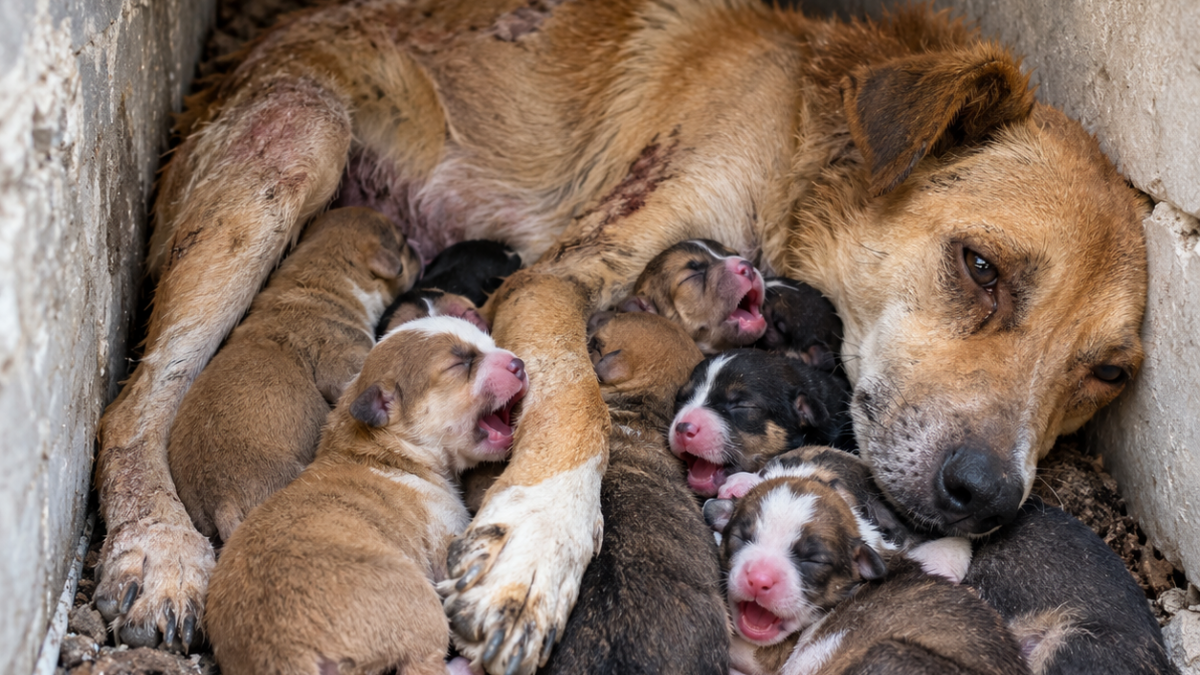
By the time I crawled far enough into the narrow gap to see them clearly, seven newborn puppies were crying against a mother who looked too weak to lift her own head, and for several terrifying seconds I could not tell whether she was still breathing.
The puppies were so young their eyes were barely open, yet they were already fighting hunger, cold, and exhaustion while the only thing keeping them alive was a mother whose body appeared to be shutting down in front of us.
What frightened me most was that this little family had been hidden only a few yards from people’s homes, close enough to hear the puppies crying, yet far enough out of sight that all eight of them could have disappeared without anyone ever knowing what happened.
We had received the call earlier that morning from a woman who said she kept hearing small animals crying behind a row of houses.
At first, she thought kittens were trapped somewhere.
Then the crying became louder.
More desperate.
She followed the sound toward a narrow passage between two concrete structures and finally saw movement deep inside.
That was when she called us.
When we arrived, I knelt at the entrance and shined my flashlight into the darkness.
The gap was barely wide enough for a person to squeeze through sideways.
Broken wood, pieces of plastic, old leaves, and bits of trash covered the ground.
For several seconds, all I could see were shadows.
Then two tiny faces appeared in the beam of my flashlight.
A third moved behind them.
Then another.
“Oh God,” I whispered.
My teammate Elena crouched behind me.
“How many?”
“I can’t tell yet.”
I shifted forward carefully, trying not to make too much noise.
That was when my light reached the very back.
I saw the mother.
She was curled around the puppies as tightly as her body allowed, a thin tan dog with every rib visible beneath her coat.
Her eyes opened when the light touched her face.
She tried to lift her head.
It came up maybe an inch.
Then dropped again.
“She’s alive,” I said.
Elena exhaled.
“Can she stand?”
“I don’t think so.”
The puppies began crying louder when they heard our voices.
Seven.
We eventually counted seven tiny bodies packed against her belly.
Some tried to nurse.
Others simply pressed themselves into the warmth of her body.
Their stomachs looked too empty.
Their movements were weak.
One puppy kept pushing desperately against her with both front paws, trying to find milk.
The mother barely reacted.
I moved closer.
Her eyes followed me immediately.
Wide.
Alert.
Terrified.
“Easy,” I whispered. “We’re here to help.”
Her body began trembling.
Not a slight tremor.
Her entire frame shook.
I stopped.
Elena touched my shoulder.
“Back up.”
We both moved a little farther away.
Almost immediately, the shaking eased.
That told us more than any bark could have.
She feared people.
But she did not threaten us.
No growling.
No teeth.
No attempt to lunge.
She simply watched.
Too weak to protect herself.
Still trying to protect seven puppies.
A resident standing nearby told us the dog had been seen around the neighborhood for several days.
“Was she always this thin?” I asked.
He shrugged.
“I don’t know. People noticed her after the puppies started crying.”
“Did anyone feed her?”
“Somebody left food.”
“When?”
He looked uncertain.
“Yesterday, maybe.”
I looked back at the dog.
If she had eaten recently, her body showed no sign of it.
I pushed a shallow bowl of water slowly toward her.
She smelled it.
Took a few weak laps.
Then stopped and lowered her head again.
My stomach tightened.
“Elena.”
“I know.”
We had to move.
The puppies went first.
We lined a carrier with warm towels and carefully lifted them one by one.
Every time a puppy left her side, the mother raised her head.
Her breathing became faster.
“It’s okay,” I said.
I kept the carrier close enough for her to smell them.
“We’re not separating you.”
When we tried helping her stand, her legs folded underneath her.
Elena caught her before she hit the ground.
“She’s worse than she looks.”
And she already looked terrible.
We slid a blanket beneath her and carried her out.
The moment sunlight touched her face, she squinted and turned her head.
Several people had gathered.
Too many.
Her body started shaking again.
“Please step back,” I said.
Someone asked what was wrong with her.
I had no answer yet.
At the clinic, we started getting them.
And every answer seemed worse than the one before.
Severe malnutrition.
Severe anemia.
Extreme dehydration.
Profound exhaustion.
An abnormal discharge that immediately made the veterinarian concerned about a possible reproductive infection.
And then there was her breathing.
The veterinarian placed a stethoscope against her chest.
Her expression changed.
“Respiratory support.”
A technician moved quickly.
I watched oxygen equipment being set up while another technician checked blood pressure and temperature.
The puppies were moved into a warm enclosure nearby.
One began crying.
The mother’s eyes opened instantly.
Even while struggling to breathe, she turned her head toward them.
That was when we named her Isadora.
Calling her “the mother dog” no longer felt acceptable.
She had spent however long keeping seven newborn puppies alive while her own body collapsed.
She deserved a name.
The bloodwork came back ugly.
Almost everything seemed abnormal.
Her red blood cell count was dangerously low.
Protein levels were poor.
Inflammatory markers were elevated.
Her body had been deprived for far too long.
Then additional testing showed she was positive for ehrlichiosis, a tick-borne disease that can worsen anemia and weaken an already fragile dog.
Dr. Moreno sat beside me.
“She is very sick.”
“How sick?”
She looked directly at me.
“Sick enough that I can’t promise she survives.”
I stared through the glass at Isadora.
“What do we do?”
“Treat what we can treat.”
That became our entire plan.
Nutrition.
Fluids.
Medication.
Treatment for ehrlichiosis.
Respiratory support.
Monitoring.
And somehow keeping seven puppies alive without allowing them to drain the last strength from their mother.
The puppies were given tiny identification bands because they looked almost identical.
Four girls.
Three boys.
One male was noticeably smaller than the others.
We called him Igor.
He was tiny, but nobody had told him that.
Every time we picked him up, he pushed against our fingers with absurd determination.
Elena smiled.
“He thinks he’s enormous.”
“He weighs almost nothing.”
“He disagrees.”
The puppies needed supplemental feeding.
Isadora was producing milk, but not enough.
Her body simply did not have the resources.
We kept them close whenever possible.
That mattered.
If we carried a puppy too far away and it cried, Isadora would try to lift her head.
Sometimes she attempted to stand.
The first time, her legs folded underneath her.
I remember seeing her chest heaving afterward.
She had spent nearly everything she had just trying to reach one crying puppy.
Dr. Moreno looked at me.
“She cannot keep doing that.”
“She thinks she has to.”
“Then we change the environment.”
We moved the puppies’ carrier closer during every examination.
When one needed supplemental feeding, Isadora could see it.
When they were weighed, she could smell them.
When they came back, we placed them beside her immediately.
It sounds like nothing.
Moving a carrier three feet.
But rescue is often built from small decisions like that.
Isadora began conserving energy.
Still, she frightened easily.
If too many people entered the room, she trembled.
If someone approached too quickly, her eyes widened.
A hand reaching over her head made her shrink toward the floor.
At first I assumed she might eventually snap.
She never did.
Not once.
Even when we examined the puppies.
Even when we cleaned her wounds.
Even during blood draws.
She would tremble.
Turn her face away.
Sometimes flatten herself against the bedding.
But she never tried to bite.
That scared me in another way.
Some frightened dogs resist.
Isadora seemed to believe resistance would not help.
We did not know her past yet.
But whatever had happened had taught her that people were something to endure.
So we slowed down.
We stopped crowding her.
We stopped trying to force affection.
I spent long periods sitting several feet away without touching her.
Sometimes I read messages on my phone.
Sometimes I spoke quietly.
Sometimes I said nothing.
She watched.
That was enough.
On day three, I walked into the treatment room and noticed something different.
The food bowl beside her had moved.
I crouched.
Some of the food was gone.
“Elena.”
She came in.
“What?”
I pointed.
“She ate.”
Elena looked at the bowl.
“That much?”
“On her own.”
We stood there smiling over a quarter-empty bowl like we had won a championship.
It was not much food.
But it meant her body was making a choice.
Eat.
Stay.
Try.
The next morning she ate more.
Then more again.
Her eyes looked slightly brighter.
Her temperature improved.
The puppies’ weights began moving in the right direction.
Not dramatically.
But enough.
The crying changed too.
Those first nights, it had been constant.
Hungry puppies cry differently.
There is urgency in it.
A sharp, repetitive sound that makes your whole body tense.
Now they cried mainly when hungry or annoyed.
They began sleeping longer.
Their bellies became rounder.
Their paws grew stronger.
Little by little, they stopped looking like animals barely holding on.
They began looking like puppies.
Isadora improved too, but recovery exhausted her.
Every nursing session cost her.
After feeding the litter, she often lay on her side panting.
Her muscles shook.
Sometimes it took several minutes before her breathing settled.
At one week, Dr. Moreno repeated imaging.
I stood beside her.
“What do you see?”
“Her lungs are still concerning.”
“Worse?”
“Not clearly.”
“Better?”
“Not enough.”
I hated answers like that.
“She is improving,” Dr. Moreno said.
I looked at her.
“But?”
“She is still sick.”
Both things could be true.
That became important for us to remember.
Hope can make people careless.
Once an animal eats, wags, or stands, everyone wants to declare victory.
Isadora was not there yet.
She was still fighting ehrlichiosis.
Still anemic.
Still recovering from extreme malnutrition.
Still nursing seven babies.
Still carrying something inside her that had nothing to do with blood tests.
Fear.
Around the second week, the puppies’ eyes began opening fully.
That changed them overnight.
Suddenly they looked back at us.
One female watched every movement as if she expected an explanation.
Another slept through nearly everything.
Igor became an explorer.
His legs barely worked, but that did not stop him from attempting to climb out of whatever we placed him inside.
“He’s going to be trouble,” Elena said.
“He already is.”
Isadora watched all seven.
She knew them.
I became certain of that.
Whenever one puppy was away from the group, her eyes stayed on it.
Six against her body was not enough.
She waited for seven.
When the last one returned, her posture softened.
By day seventeen, something happened I had been afraid to hope for.
Dr. Moreno walked into the room holding the discharge instructions.
“They can leave.”
“All of them?”
“All eight.”
I stared at her.
“Are you sure?”
“No, I enjoy filling out discharge paperwork for fun.”
I laughed.
Then cried.
Elena cried too.
Dr. Moreno pretended not to notice.
Isadora still needed treatment.
Still needed medication.
Still needed monitoring.
But she no longer required hospitalization.
The puppies were beginning to transition toward solid food.
Their weights were improving.
Their bodies were stronger.
The foster home we prepared was quiet.
No unnecessary visitors.
No noise.
No crowded rooms.
Just a warm spare room, washable bedding, a low bed for Isadora and a large puppy pen.
When she arrived, Isadora froze in the doorway.
I kept the leash loose.
She smelled the floor.
The wall.
A blanket.
One puppy squeaked from the carrier.
Isadora turned.
Then walked inside.
We opened the carrier.
Seven puppies poured out in a chaotic little wave.
One climbed over another.
Igor stepped directly into the water bowl.
Elena laughed.
Then Isadora did something I had never seen her do.
Her tail moved.
Slowly.
Once.
Then again.
A real wag.
Elena covered her mouth.
“Did you see that?”
“I saw it.”
Isadora lay down.
The puppies climbed over her.
One chewed her ear.
Another pushed under her front leg.
For the first time, I could see a future beyond survival.
The puppies began eating softened food.
It was complete chaos.
One walked through the bowl.
Another licked food from a sibling’s head.
Igor dragged a piece onto the blanket like he had hunted it himself.
Isadora watched from her bed.
Now that the puppies were eating more solid food, the burden on her body finally began decreasing.
And once that happened, she improved faster.
Her gums became less pale.
Her coat started to look healthier.
She gained strength.
We began taking her outside for short periods.
The puppies followed once they were old enough.
Their first experience with grass was ridiculous.
Seven puppies moved in seven directions.
One barked at a leaf.
Another tripped over nothing.
Igor disappeared behind Isadora.
I panicked for half a second.
Then his head appeared beside her leg.
Of course he had followed his mother.
Weeks earlier, she could barely stand.
Now she walked through grass with puppies chasing behind her.
Then the questions about her past finally began producing answers.
Residents near the place where we found her started talking.
One woman said she had seen Isadora in a nearby yard months earlier.
Another remembered her behind a gate.
Someone else said she had been visibly pregnant before she disappeared.
“How nearby?” I asked.
The woman pointed.
Only a few houses away.
I remember staring at the house.
“That’s where she lived?”
“I’m almost sure.”
Later, we received photographs.
There was no doubt anymore.
Isadora was in them.
Healthier.
Standing behind the fence.
Lying near the front steps.
The house belonged to a man who had apparently cared for her before she became pregnant.
According to people in the neighborhood, he did not want the responsibility of a litter.
The explanation that eventually reached us was simple.
He could not care for so many dogs.
I stared at that sentence for a long time.
He could not care for so many dogs.
As though that explained leaving one pregnant dog to fend for herself.
As though seven puppies had been her choice alone.
As though being overwhelmed erased responsibility.
Local authorities were notified.
We provided photographs.
Veterinary records.
Witness information.
Everything we had.
I was angry.
Elena was angrier.
“He lived a few houses away.”
“I know.”
“He had to know she was around.”
“We can’t prove exactly what he knew.”
“How can you defend him?”
“I’m not.”
My hands were shaking.
“I’m trying not to turn anger into facts.”
The authorities would decide what happened next.
Our responsibility was Isadora.
And the future in front of her.
The puppies received vaccinations.
They became stronger.
Louder.
Faster.
They discovered toys.
They discovered sunlight.
They discovered that humans often carried food.
Their tails never seemed to stop moving.
One of them barked at her reflection in a metal bowl and ran away.
Another fell asleep halfway into a food dish.
Igor became convinced every shoelace existed for him.
And Isadora changed too.
The fear did not disappear overnight.
Crowds still made her uncomfortable.
Fast movement still caused her to flinch.
But with familiar people, she began approaching.
One afternoon, I was sitting on the floor answering messages when she walked over.
I barely noticed until her head touched my hand.
I froze.
Isadora pushed her forehead under my palm.
She wanted me to pet her.
I looked down.
“Are you sure?”
She stayed.
I rubbed gently between her ears.
Her eyes closed.
No shaking.
No retreat.
That quiet moment affected me more than almost anything else.
Pulling her from the narrow gap had saved her body.
This was something different.
This was trust returning.
Eventually, the puppies reached adoption age.
Applications came in.
Families visited.
One by one, the puppies left.
A little girl carried one female out in a blanket.
A young couple adopted one of the boys.
Another puppy went to a family who had already bought four dog beds before bringing him home.
Every goodbye was happy.
And painful.
After each adoption, Isadora checked the room.
She smelled the bedding.
Looked toward the door.
Then settled again.
At first, I worried losing the puppies would hurt her.
Then I realized motherhood had nearly destroyed her body.
Watching them become independent was also freedom.
For the first time, we got to know Isadora when she was not simply “the mother.”
She loved quiet walks.
She hated baths.
She loved chicken.
She liked soft beds.
She preferred sitting where she could see the door.
She remained cautious with strangers.
She especially disliked anyone reaching suddenly over her head.
But once she trusted someone, she followed them everywhere.
Most of the puppies found homes.
Two remained.
Igor was one.
Nobody could understand why.
He was healthy.
Funny.
Social.
His legs grew faster than the rest of him, giving him an awkward teenage look.
His ears seemed unable to agree on which direction to point.
He loved everyone.
One couple nearly adopted him, but circumstances changed before everything was finalized.
Elena read the message.
“I hate this.”
“They didn’t do anything wrong.”
“I know.”
Igor ran past us carrying cardboard.
“He looks devastated.”
She laughed.
“Idiot.”
So he stayed.
Safe.
Fed.
Loved.
Waiting.
Isadora stayed too.
Her recovery continued.
Her bloodwork improved.
Treatment for ehrlichiosis worked.
Her breathing became normal.
The frightening lung condition that had once made us count every breath slowly became something we discussed in the past tense.
Dr. Moreno compared her original lab results with the new ones.
“She was incredibly sick.”
“I remember.”
“She should not have been nursing seven puppies in that condition.”
“She didn’t have a choice.”
“No.”
Dr. Moreno looked through the window at Isadora.
“But she survived.”
I watched her.
“Barely.”
That distinction mattered to me.
People love turning suffering into something beautiful because an animal survives.
I did not want to do that.
Isadora’s devotion was beautiful.
Her abandonment was not.
Her courage did not excuse what happened.
Her survival did not make the suffering necessary.
Eventually, most of her puppies were thriving in new homes.
We received updates constantly.
One sleeping beside a child.
One stealing socks.
One attending obedience class and behaving terribly.
One stretched across a human bed as though rent were his responsibility.
Those photographs became proof that the puppies had escaped their beginning.
They did not remember the narrow gap.
They did not remember hunger.
They did not remember their mother panting beside them because her body was too weak to continue.
Their memories were food bowls.
Toys.
Grass.
Families.
That was exactly what we wanted.
Isadora’s adoption would take longer.
Adult dogs with fear need different homes.
We refused to rush her.
One family seemed interested but held loud parties every weekend.
Not right.
Another had small children who immediately tried hugging her.
Not fair.
Another adopter said Isadora would “get over” her fear once she realized nothing bad was happening.
We said no.
Trust does not operate on somebody else’s schedule.
She had spent too long having decisions forced on her.
Now she could wait safely.
That was the difference.
One afternoon, months after the rescue, I found her lying in the sun.
Igor was asleep with his head across her front leg.
The other remaining puppy lay upside down beside them.
I sat nearby.
Isadora opened her eyes.
Her tail tapped the ground.
Once.
Twice.
I moved closer.
She lifted her head and placed it in my lap.
I ran my fingers across her ears.
Her body felt completely different from the dog we had carried out on a blanket.
No sharp ribs beneath thin skin.
No frantic breathing.
No trembling every time someone entered.
Igor woke up and immediately started chewing my shoelace.
“Your son is committing crimes,” I told her.
Isadora closed her eyes again.
The foster laughed.
“Excellent parenting.”
I looked at them.
There were things from that first day I would probably never forget.
The flashlight finding seven puppies in the dark.
The sound of their crying.
Isadora trying to stand and collapsing.
The oxygen.
The blood results.
The first bowl she ate from.
The first tail wag.
The first time she walked through grass.
And the photographs that proved her former home had been just a few houses away.
For a long time, that distance made me angry.
Only a few houses.
So close to help.
So close to someone who had once known her name.
Yet she had given birth alone in a narrow gap, starving while she tried to keep seven babies alive.
But sitting there with Isadora’s head in my lap, another distance mattered more.
The distance between the dog we found and the dog beside me.
Between starving and fed.
Between terrified and trusting.
Between seven newborn puppies crying in darkness and those same puppies sleeping safely in homes.
Igor suddenly jumped up.
He ran across the grass.
The other puppy followed.
Isadora lifted her head.
Months earlier, she would have panicked when one moved away.
Now she watched.
Calm.
Certain.
She knew where they were.
She knew they were safe.
After a moment, she stood.
Her tail lifted.
Then she ran after them.
Not fast at first.
Then faster.
Igor turned and chased her.
The second puppy joined.
Three dogs raced across the yard.
Isadora changed direction suddenly and the puppies followed, tails flying behind them.
I stood there watching.
The last time I had seen those three bodies pressed together, they had been hiding from the world in a space barely wide enough for them to survive.
Now there was nothing around them but open grass.
No concrete walls.
No hunger.
No cold.
No one forcing Isadora to hide.
She ran across the yard with her puppies behind her.
And for the first time since I had known her, there was nowhere she needed to escape from.
[END OF STORY]








