PART 2: We Found Norita Bleeding Out on the Cold Ground—Then the Vet Told Me She Had Only One Kidney Left
PART 2
I stayed in that hallway because there was nowhere else for me to go.
People moved around me carrying clipboards, IV bags, folded blankets, syringes, pieces of equipment I did not understand. Every time the emergency-room doors opened, I tried to see Norita.
Most of the time, I saw only backs.
Blue scrubs.
Gloves.
The edge of a metal table.
Once, I caught sight of her face.
Her eyes were closed.
For a terrible second, I thought that meant she was gone.
Then the door swung shut.
Elena stood beside me with her arms folded tightly across her chest.
“You need to sit.”
“I’m fine.”
“You’re shaking.”
“I’m cold.”
“You’re inside.”
I looked at my hands.
She was right.
They were trembling.
There are rescue calls that stay practical.
You find an animal.
You secure it.
You transport it.
You hand the case to people trained to do what comes next.
Then there are cases where something changes before you even understand it has happened.
Norita had placed her head against my wrist outside.
She had not known me.
Maybe she had not even been fully conscious.
But from that moment, leaving felt impossible.
A technician came out carrying an empty blood-product bag.
I stood.
“How is she?”
“Still critical.”
“Did the transfusion work?”
“It’s still working. That bag was the first unit.”
“First?”
She nodded.
“Dr. Reyes will talk to you.”
I hated how carefully everyone chose words.
Still critical.
For now.
A chance.
Nothing definite.
Nothing safe.
Another twenty minutes passed.
Then Dr. Reyes came back.
His surgical mask hung loose below his chin.
“We got her blood pressure up enough to proceed.”
“So you’re operating?”
“Yes.”
“Now?”
“Now.”
I looked toward the doors.
“Do whatever you need.”
“We need consent from the rescue.”
Elena had already pulled out her phone.
Our organization’s director answered on the second ring.
She did not argue about cost.
She did not ask whether Norita was “worth” it.
She asked one question.
“Does the veterinarian believe surgery gives her a reasonable chance?”
I repeated it to Dr. Reyes.
He nodded.
“Yes.”
I told her.
“Then authorize it.”
The paperwork was signed electronically within minutes.
Dr. Reyes explained the procedure.
The remaining damaged portion of Norita’s lower hind limb had to be removed and the wound cleaned aggressively. The tissue was contaminated, and part of what remained was no longer viable.
“How high do you have to amputate?”
“We’re going to preserve as much healthy tissue as we safely can.”
“Why not remove the whole leg now?”
“Because I want the shortest possible anesthetic event tonight.”
He pointed toward the laboratory values.
“She does not have the physiologic reserve for a long procedure.”
That phrase stayed with me.
Physiologic reserve.
In normal language, it meant Norita had nothing left to spend.
No margin.
No cushion.
No second tank.
Her body had already used almost everything keeping her heart beating.
They wheeled her toward surgery.
I stepped close before the doors closed.
Norita’s eyes were open.
Barely.
I touched her forehead.
“I’m right here.”
Her gaze shifted slightly.
Maybe toward me.
Maybe not.
I told myself it was toward me.
Then she disappeared.
The surgery began at 2:36 p.m.
I know because I wrote the time in my phone.
I do not know why.
Perhaps I needed to make something measurable.
At 3:10, nobody came out.
At 3:42, nothing.
At 4:05, I asked the receptionist whether silence was good.
She gave me the kindest answer she could.
“Silence usually means everyone is busy doing their job.”
I nodded.
At 4:28, I stopped checking the clock.
At least I tried.
Elena went out and returned with coffee.
I held mine until it became cold.
“You have to drink something,” she said.
“I will.”
“You said that twenty minutes ago.”
“I’m not thirsty.”
“Norita has an entire medical team. You passing out won’t improve the situation.”
I took a drink mostly to stop the conversation.
It tasted terrible.
At 5:17, the operating-room door opened.
Dr. Reyes walked toward us.
I could not read his face.
“Is she alive?”
“Yes.”
My knees weakened.
He kept talking.
“The surgery itself went well. We removed the destroyed tissue, controlled the bleeding, cleaned the wound, and closed what we safely could.”
“So she made it.”
“She made it through surgery.”
The distinction mattered.
“What happens now?”
“The next twelve to twenty-four hours are extremely important.”
“Because of the kidney?”
“That. The anemia. Infection risk. Hypothermia. Blood pressure.”
He pulled a chair toward us and sat.
“There’s something else you need to understand.”
I braced myself.
“The fact that she survived anesthesia does not mean she’s stable. Her body may still decompensate. Her remaining kidney has been exposed to prolonged low blood pressure. If renal function worsens significantly, we could lose her even with the leg controlled.”
I looked at the floor.
“What can you do?”
“Support her. Fluids carefully. Monitor urine production. Repeat blood work. Antibiotics. Pain control. More blood if needed.”
“More blood?”
“Possibly.”
He leaned forward.
“She came in with almost no reserve.”
There was that phrase again.
Almost no reserve.
I looked toward recovery.
“Can I see her?”
“For a minute.”
Norita lay inside a heated recovery enclosure.
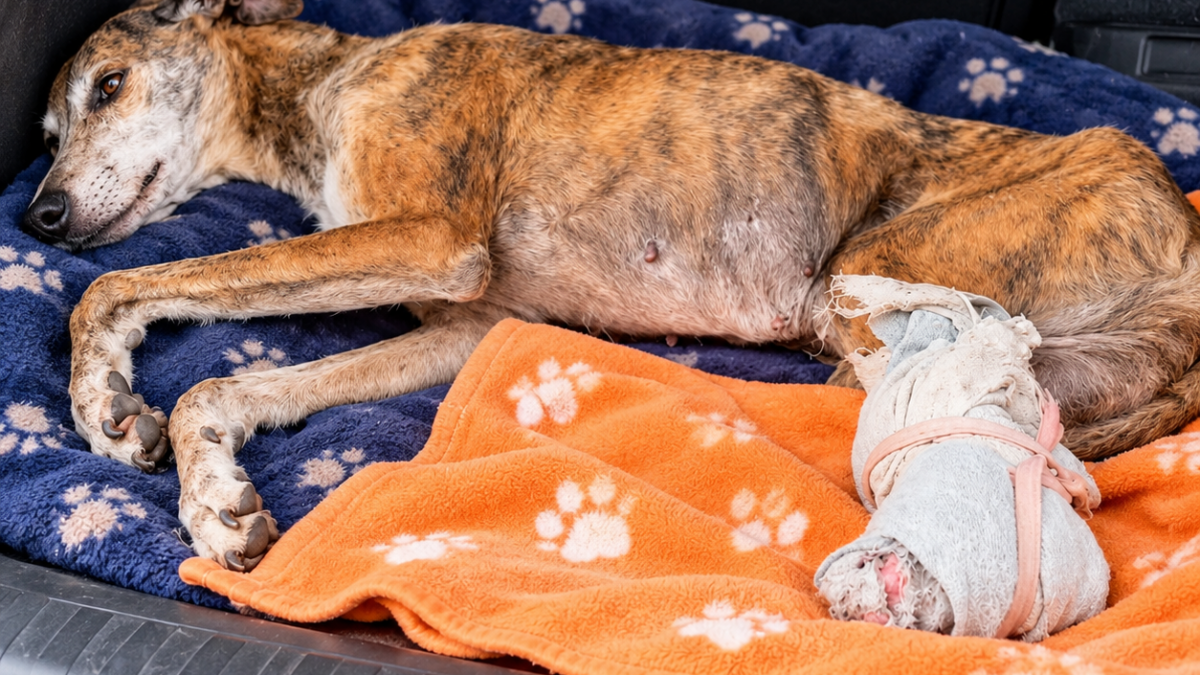
The lower half of one hind leg was wrapped heavily.
Her face looked smaller without dirt and dried blood around it.
A catheter entered one front leg.
Another line disappeared beneath the blanket.
She looked nothing like a dog who had survived something.
She looked like a dog still standing at the edge of it.
I crouched near the door.
“Hey, Norita.”
We had named her while she was in surgery.
The rescue director suggested it because one of the clinic technicians had called her *señorita* while cleaning her wounds, then shortened it without thinking.
Norita.
It fit.
Her ear moved faintly when I said it.
I pressed my fingertips against the clear panel.
“You did your part.”
Her breathing was slow.
“Now let them do theirs.”
That night, the hospital called at 11:08.
I was awake.
I had not even changed clothes.
Dr. Reyes was on the phone.
“She needs another transfusion.”
I sat upright.
“Why?”
“Her packed cell volume dropped again.”
“Is she bleeding?”
“Not visibly. Some decline can happen after fluid resuscitation because the blood becomes less concentrated. But given where she started, I don’t want her lower.”
“Do it.”
“The rescue already approved blood products. I just wanted you updated.”
“How is the kidney?”
“No worse.”
I held onto those words.
No worse.
Not good.
Not healed.
No worse.
That became enough.
I asked, “Is she awake?”
“Intermittently.”
“Has she eaten?”
“No.”
“Is that bad?”
“Not yet.”
He paused.
“Go to sleep.”
I almost laughed.
“You know that’s not happening.”
“I suspected.”
The second transfusion began before midnight.
At 6:30 the next morning, I was back at the hospital.
Norita was awake.
That word meant more than I expected.
Not standing.
Not eating.
Not even lifting her head.
But when I entered the room, her eyes opened and remained open.
I crouched.
“Morning.”
Her gaze moved toward my voice.
Dr. Reyes came in behind me.
“Her temperature is normal.”
I looked at him.
“Normal?”
“Low-normal, but yes.”
“Blood pressure?”
“Acceptable.”
“Kidney?”
He handed me the new results.
Numbers meant very little to me then, but I learned quickly.
Her creatinine was elevated.
So was another kidney marker.
But neither had dramatically worsened overnight.
“She’s making urine,” he said. “That matters.”
“How much?”
“Enough that I’m cautiously encouraged.”
I hated and loved the word cautiously.
It gave hope while refusing to promise anything.
“What about the anemia?”
“Better after transfusion.”
“So we’re improving?”
He gave me a look.
“One step.”
“I’ll take one.”
That morning, Norita refused food.
Chicken.
Prescription recovery diet.
Warm meat.
Nothing.
A technician placed a tiny amount against her lip.
Norita turned her head away.
At noon, same thing.
At three, same thing.
Dr. Reyes was not surprised.
I was.
“She has to eat.”
“Yes.”
“Then why isn’t she?”
“Pain. Nausea. Anesthesia. Critical illness. Stress.”
“Can you make her?”
“We can support nutrition if needed.”
Every answer opened another problem.
At 5:00, Norita lifted her head for approximately three seconds.
I saw it.
So did the technician.
We both froze as if witnessing something enormous.
Norita’s neck trembled.
Her head lowered.
The technician smiled.
“That’s good.”
“It was three seconds.”
“Yesterday she couldn’t do it.”
That was when I began learning how differently recovery is measured when you start near death.
A normal dog standing up means nothing.
Norita moving her head meant progress.
A normal dog eating half a meal might concern you.
Norita licking food from a finger would become celebration.
A normal dog wagging its tail is ordinary.
Weeks later, Norita’s first wag made three grown adults cry.
But we were not there yet.
Day two brought another setback.
Her blood count dropped again.
Not to the original level.
Low enough.
A third transfusion was recommended.
I stared at Dr. Reyes.
“How much blood can one dog need?”
“As much as her body requires until it begins producing and maintaining enough of its own.”
“Why does it keep dropping?”
“There are several possibilities. Original blood loss. Fluid dilution. Ongoing inflammation. Her body is severely stressed.”
“Internal bleeding?”
“We’ve checked. We don’t see evidence of a major ongoing internal hemorrhage.”
That should have comforted me.
Instead, I looked at Norita.
She seemed even smaller beneath the blanket.
“How many transfusions is too many?”
“There isn’t a useful number like that. We transfuse based on need, signs, laboratory values, and risks.”
“Can she react to the blood?”
“Yes.”
He explained transfusion reactions.
Monitoring.
Compatibility.
Temperature.
Heart rate.
Breathing.
For the next several hours, I watched a clear line carrying somebody else’s donated blood into Norita’s vein.
Somewhere, another dog had given that blood.
A healthy donor dog that would never meet Norita.
That detail affected me.
Rescue often looks like one person finding one animal.
In reality, survival can be built by strangers who never know one another.
The person who made the phone call.
The rescuers.
The hospital.
The donor dog.
The lab technician.
The volunteer who drove blood products from another clinic.
A chain.
Break one link and the outcome changes.
The third transfusion went smoothly.
That night, Norita licked food from Camille’s finger.
Camille was one of the overnight technicians.
She called me the next morning as if reporting a miracle.
“She ate.”
“How much?”
“Maybe a teaspoon.”
“That counts?”
“It absolutely counts.”
I arrived with chicken.
Dr. Reyes saw the container.
“No.”
“What?”
“Too rich.”
“She needs calories.”
“She needs calories that do not upset her stomach.”
I looked at Norita.
She looked at the chicken.
For the first time, her eyes looked interested in something.
“You’re cruel,” I told Dr. Reyes.
He smiled.
“I get that a lot.”
We compromised with the hospital diet.
Norita ate three bites.
Then four.
Then stopped.
I was absurdly happy.
Her fourth day brought the first real sign of personality.
A technician tried to clean around an IV catheter.
Norita pulled her paw away.
The technician tried again.
Norita pulled harder.
Then gave a tiny, hoarse growl.
The technician laughed.
I looked at her.
“Why is that funny?”
“She disagrees with me.”
“She growled.”
“Exactly.”
Norita stared at both of us.
The technician nodded.
“Yesterday she didn’t have enough energy to complain.”
I understood.
“Good girl,” I told Norita.
Her eyes narrowed.
Maybe I imagined that too.
By the end of the first week, her temperature had remained stable.
She was eating small meals.
Her kidney values had stopped worsening.
The incision looked acceptable.
Her blood count was low but holding.
The hospital began talking about transferring her from intensive care to a quieter recovery ward.
That was the first time anyone used the word recovery.
I noticed immediately.
“So you think she’s going to make it?”
Dr. Reyes stopped.
He had learned to be careful around me.
“I think she is moving in the right direction.”
“That is not what I asked.”
“No.”
He leaned against the counter.
“But I am more optimistic than I was seven days ago.”
I accepted that.
Norita transferred to recovery the next morning.
She had her own padded kennel.
A blanket.
Food dish.
A small stuffed animal someone donated.
The first thing she did was ignore all of it and sleep for almost six hours.
When she woke, she looked confused.
The ICU had been noisy.
Monitors.
Footsteps.
People constantly touching her.
The recovery room was quiet.
Norita raised her head.
Looked around.
Then let it fall again.
I sat beside the kennel.
“You’re allowed to be tired.”
Her eyes closed.
“You’ve earned that.”
For the first two weeks, Norita conserved energy as if she understood exactly how little she had.
She rarely wasted movement.
She ate.
Slept.
Drank.
Accepted medications.
Allowed wound care.
Then slept again.
We did not push.
Her body was doing work we could not see.
Producing blood cells.
Repairing tissue.
Recovering from shock.
Adapting to a changed limb.
Protecting one damaged kidney.
Every blood test became a report card.
Kidney values slightly down.
Good.
Red-cell count slightly up.
Excellent.
Weight gained twelve ounces.
Celebration.
Then one morning, her kidney values rose again.
I arrived to find Dr. Reyes staring at a monitor.
“What happened?”
“Could be dehydration overnight. Could be medication effects. Could be renal disease showing itself again.”
“What do we do?”
“Adjust.”
That word defined the next week.
Adjust fluids.
Adjust pain medications to reduce renal burden.
Adjust diet.
Repeat blood work.
Monitor urine.
Wait.
Norita did not care about laboratory charts.
She cared that the technician named Camille had discovered she liked soft canned food warmed slightly above room temperature.
She cared that I scratched the base of her right ear.
She cared that blankets fresh from the dryer were warm.
Small preferences began appearing.
They were proof of life.
Animals close to death have few preferences.
Survival reduces the world to breath, warmth, circulation.
A recovering animal becomes particular.
Norita disliked cold food.
Loved fleece.
Hated having her temperature taken.
Preferred women with quiet voices.
Tolerated me because I brought food.
At least that was my interpretation.
Three weeks after rescue, we reached a milestone that nobody had announced in advance.
I entered the recovery room.
Norita was awake.
Normally she would remain lying down.
That morning, she raised her head before I spoke.
Her eyes followed me.
Actually followed.
I moved left.
Her gaze moved left.
I moved right.
Right.
“Hey.”
Her ears lifted.
I looked toward Camille.
“Did you see that?”
“She’s been doing it since six.”
“You didn’t call me?”
“It’s called progress. We don’t call you every time she blinks.”
“You should.”
Camille laughed.
I crouched near Norita.
She looked directly at me.
The clouded, distant expression that had frightened me from the beginning was disappearing.
There was somebody behind those eyes now.
A dog noticing the world.
I held out food.
Norita leaned forward and ate it.
Then she ate another piece.
And another.
That afternoon, she lifted her front half into a sitting position.
Her body shook violently.
Camille placed one hand near her chest without supporting unless necessary.
Norita held herself upright for five seconds.
Ten.
Then collapsed gently back onto the bedding.
I felt ridiculous tears in my eyes.
Camille caught me.
“You crying?”
“No.”
“You rescue people are terrible liars.”
“We had dust.”
“In the medical ward.”
“Very dusty.”
She handed me a tissue.
Almost a month had passed since the day we found Norita.
That was when the wound changed.
At first, it was subtle.
More swelling near the upper portion of the remaining limb.
Then drainage.
Then tenderness.
Norita, who had tolerated cleaning quietly, snapped her head around when Camille touched one area.
She did not bite.
But she made her opinion clear.
Dr. Reyes examined it.
His expression tightened.
“What?”
“I don’t like this.”
Those words still scare me.
He ordered imaging.
Blood tests.
A culture.
We waited.
The results suggested deeper infection and compromised tissue farther up the limb than anyone had hoped.
I sat in his office.
“You removed the dead part during the first surgery.”
“We removed what was clearly nonviable at that time.”
“And now more is dying?”
“Not exactly. Some tissue may have had marginal circulation and failed to heal. Infection can also track deeper.”
“What does that mean for her?”
He put an image on the screen.
“The safest option is another surgery.”
I already knew the answer before asking.
“How much?”
“Higher.”
He pointed to the remaining damaged section of the thigh.
“We need to remove the rest of the limb.”
I stared at the image.
“Entire leg?”
“Yes.”
“Why didn’t you do that the first time?”
“Because the first night she might not have survived the extra surgical time, and preserving healthy tissue was reasonable then.”
There was no defensiveness in his voice.
Just fact.
I knew he was right.
Still, the idea felt like betrayal.
Norita had fought for almost a month.
She had survived the first surgery.
Three transfusions.
Kidney instability.
Infection.
Starvation.
Now we were going to take more from her.
Dr. Reyes seemed to read my face.
“Dogs do extremely well on three legs.”
“People always say that.”
“Because it’s often true.”
“Her other kidney—”
“One kidney.”
“Right.”
I rubbed my forehead.
“Can she handle surgery now?”
“Much better than she could the first time.”
“Risk?”
“There is always risk. Hers is higher because of renal disease, but her anemia is significantly improved, her temperature is stable, and her nutritional status is better.”
“Will removing the leg improve her chances long-term?”
“Yes.”
“Then do it.”
The second operation occurred the next morning.
Norita knew something was happening.
I am convinced of that.
Dogs read patterns.
No breakfast.
Different staff movements.
IV preparation.
My presence earlier than usual.
She became restless.
When the technician came to take her, Norita pressed backward against the kennel.
That was the first time she had resisted being moved.
I crouched.
“Hey.”
Her eyes met mine.
“I know.”
Of course I did not know what she was thinking.
But I knew fear.
I knew what it looked like when a dog had finally regained enough strength to be afraid of losing control again.
I put my hand near her chest.
“You’re coming back.”
She smelled my fingers.
Then leaned her forehead against them.
The technician took the leash.
Norita walked three steps.
Stopped.
Looked back.
My throat tightened.
“Go.”
She went.
The second surgery felt longer than the first even though it was not.
This time, I knew Norita.
That was the difference.
The first operation had been about saving an unknown dog.
The second was about Norita.
The dog who liked warm food.
The dog who hated thermometers.
The dog who knew Camille’s footsteps.
The dog whose eyes now tracked me across a room.
Attachment makes waiting worse.
Dr. Reyes came out shortly after noon.
“It’s done.”
“How did she handle anesthesia?”
“Very well.”
“Kidney?”
“Blood pressure remained stable.”
“Infection?”
“We removed the affected tissue. I’m much happier with the margins this time.”
I exhaled.
“She’s a tripod now.”
“Yes.”
I tried to smile.
“Think she knows?”
“Not yet.”
She knew later.
The first time Norita tried to stand after the second surgery, she shifted toward the limb that was no longer there.
Her body tilted.
A rehabilitation technician caught her immediately.
Norita froze.
Looked down.
Then tried again.
Same mistake.
The technician lowered her.
“That’s enough today.”
Norita disagreed.
She tried pushing up again.
“Stubborn,” I said.
The technician smiled.
“Good.”
We gave her two days before more structured standing work.
Pain control was careful because of her kidney.
Hydration was monitored closely.
Blood pressure.
Urine.
Appetite.
Everything still mattered.
But compared with the first surgery, recovery was different.
Norita was participating.
That changed everything.
When food arrived, she ate.
When staff entered, she watched.
When we supported her chest and abdomen with a sling, she pushed through her remaining legs.
The first time she stood independently lasted less than four seconds.
Three legs.
Shaking.
Back curved awkwardly.
Head low.
Then she sat.
I clapped once without thinking.
Norita startled.
I immediately felt guilty.
“Sorry.”
Camille laughed.
“She’s going to think standing makes humans lose their minds.”
“It kind of does.”
The next attempt lasted seven seconds.
Then ten.
A week later, Norita took one step.
It was ugly.
She moved both front legs, then tried to place the missing rear leg, lost balance, and sat abruptly.
She looked offended.
Camille crouched.
“Try again.”
Norita did.
Front paws.
Rear paw.
Shift weight.
Pause.
Another step.
Three total.
Then rest.
That evening, I wrote the number in my phone.
Three steps.
The same place I had once written surgery time.
Progress had become measurable again.
Three steps became six.
Six became across the rehabilitation room.
At first she needed a sling.
Then only a hand near her side.
Then nothing.
Her body learned faster than I expected.
Dogs do not spend years mourning the geometry they used to have.
They adjust to the body they have now.
Norita developed a hopping rhythm.
Front.
Front.
Rear.
Balance.
Repeat.
Within two weeks, she could cross the room.
Within three, she could turn without falling.
Then came the tail.
It happened during breakfast.
I was opening a container of food.
Norita stood behind a low gate.
Her eyes followed the container.
I said, “You hungry?”
Her tail moved.
Once.
So slightly I thought I imagined it.
Then again.
Camille saw it.
“Was that—”
“Yes.”
Norita wagged harder.
Maybe three inches.
No dramatic helicopter tail.
Just a weak movement.
I put the food down and crouched.
“You did that on purpose.”
Another wag.
I cried.
Camille did too.
Nobody blamed dust this time.
From there, Norita changed quickly.
Not medically.
Emotionally.
She discovered affection.
At first, human touch had been something she endured because she had no choice.
Then she began leaning.
A technician scratched her shoulder.
Norita shifted closer.
I sat beside her.
She rested her head against my knee.
Camille entered.
Norita’s ears lifted.
She began recognizing people before they touched her.
Then she started seeking them.
That mattered more than almost anything.
Pain had not taught Norita that all hands were dangerous.
Somehow, after everything, she remained willing to revise her opinion of people.
We never discovered exactly how she had been injured.
There were theories.
Vehicle trauma.
Industrial machinery.
A trap.
An untreated accident.
But no witness.
No surveillance video.
No reliable history.
We refused to invent one.
What happened to Norita was bad enough without creating a villain we could not prove existed.
The facts were simple.
Someone found her.
She had already lost part of a limb.
She had severe blood loss.
She had fleas.
She was hypothermic.
She had one compromised kidney.
And she survived.
That was enough.
By the time Norita left the hospital for the animal-care center, she had been there nearly seven weeks.
The staff lined the hallway.
Not officially.
Nobody planned it.
People simply knew what time she was leaving.
Receptionists.
Technicians.
Assistants.
Dr. Reyes.
Camille.
Norita walked out on three legs.
Slowly.
No sling.
No stretcher.
No blankets covering her face.
When she reached the automatic door, it opened suddenly.
She stopped.
Looked at it.
Then at me.
“Outside.”
Her nose lifted.
Sunlight touched her face.
For the first time since I had found her, Norita stood outdoors without bleeding into the ground.
She took one step.
Then another.
Grass seemed to confuse her.
She smelled it for almost a full minute.
Then she lowered herself onto it.
I sat beside her.
Dr. Reyes stood near the entrance.
“You realize she’s supposed to be leaving.”
“She is leaving.”
“She appears to have stopped.”
“Technical delay.”
Norita rolled partly onto one side.
Sun on her stomach.
Camille laughed.
“I think she’s on strike.”
Eventually, we convinced her to continue.
At the animal-care center, Norita had a quiet recovery room.
Soft bedding.
Non-slip flooring.
Raised food bowls.
Direct access to a small fenced yard.
The plan was rehabilitation first.
Adoption later.
Nobody rushed.
Her kidney required ongoing monitoring.
That became our biggest long-term concern.
She could live normally with one kidney.
Many animals do.
But Norita’s remaining kidney had already suffered.
We adjusted her diet based on veterinary recommendations.
Maintained hydration.
Repeated blood work.
Watched blood pressure.
Monitored urine concentration.
I became annoyingly familiar with renal values.
Dr. Reyes would call.
“Creatinine is stable.”
I would ask, “Stable good or stable concerning?”
“Stable good.”
“Say that first.”
Norita gained weight.
Slowly.
Her coat changed.
At intake, it had been dull and sparse, full of flea dirt.
Months later it became smooth.
She developed muscle in the remaining rear leg.
Her shoulders strengthened too because three-legged movement asks more of the front limbs.
Rehabilitation became exercise rather than survival.
Short walks.
Controlled turns.
Balance work.
Low obstacles.
No slippery floors.
Norita treated therapy as a negotiation.
Food increased cooperation dramatically.
Without treats, she considered physical rehabilitation optional.
Camille accused me of creating the problem.
“You bribed her.”
“It’s positive reinforcement.”
“You’re holding roast chicken.”
“Very positive reinforcement.”
Norita stared at the chicken.
She completed the exercise perfectly.
Trust became another kind of rehabilitation.
At first, Norita slept curled tightly.
Head tucked.
Body protecting itself.
Several months later, I found her on her back.
Belly exposed.
Three legs pointing in completely different directions.
She looked ridiculous.
I took a photograph.
When I showed Dr. Reyes, he smiled.
“That’s a comfortable dog.”
“She snores.”
“Even better.”
Norita’s first encounter with stairs terrified me more than her.
The care center had three shallow steps leading to a garden.
We had a ramp.
Norita ignored the ramp.
She stood at the steps.
I blocked her.
“No.”
She moved left.
I moved left.
“Ramp.”
She moved right.
“So this is how it’s going to be?”
Her tail wagged.
A rehabilitation specialist stood behind me laughing.
“Let her assess.”
“She has three legs.”
“She knows.”
I stepped aside.
Norita smelled the first step.
Lowered one front paw.
Then the second.
Shifted her weight.
Brought the rear leg down.
Stopped.
Looked back.
I was holding my breath.
Second step.
Then third.
She reached the grass.
Tail wag.
The specialist looked at me.
“Who needed therapy there?”
“Not discussing it.”
Norita walked back toward us.
Up the ramp.
Of course.
She had proved her point.
Months passed.
She became a favorite at the care center.
Not because her story was tragic.
People who met her after recovery did not see tragedy.
They saw attitude.
Norita learned when meals were served.
She learned which volunteers carried treats.
She learned that one office chair gave her the perfect angle to rest her chin on somebody’s knee until they surrendered food.
She disliked rain.
Loved sunlight.
Barked at delivery carts.
Tried to chase pigeons despite having no realistic plan once she reached them.
She developed a special relationship with a volunteer named Grace.
Grace was seventy-one.
Retired teacher.
Soft voice.
Bad knees.
She walked slowly.
That suited Norita.
Every Tuesday and Thursday, Grace arrived at nine.
By 8:50, Norita waited near the office door.
The first time I noticed, I thought it was coincidence.
The next week, same thing.
At 9:03, Grace entered.
Norita’s tail went wild.
Grace laughed.
“I see I’m late.”
“Three minutes.”
“Apparently unacceptable.”
They became walking partners.
Short routes.
Lots of stopping.
Norita moved faster than Grace physically could, so she learned to match pace.
That fascinated me.
With younger volunteers, Norita charged ahead.
With Grace, she waited.
Sometimes she would take three steps, look back, then continue only when Grace caught up.
“She’s taking care of me,” Grace said.
“Don’t encourage her ego.”
Grace rubbed Norita’s ears.
“Too late.”
An adoption application came at month five.
A family with two children.
Large yard.
Previous dog experience.
Everything looked good on paper.
They visited.
Norita liked the children.
Especially the younger boy, who sat on the floor and let her approach.
The parents asked intelligent questions about kidney care.
Tripod mobility.
Future costs.
We were optimistic.
Then they mentioned their house.
Three stories.
Hardwood floors.
Long staircase to every bedroom.
No easy way to confine Norita to one level without isolating her.
Not impossible.
But not ideal.
The family went home to think.
The next day, they withdrew.
“I feel terrible,” the mother said.
“You shouldn’t.”
“We love her.”
“Then making the right decision is part of that.”
I meant it.
Another application came.
A retired couple.
Excellent home.
Then they met Norita and realized their much older dog was frightened by her hopping gait.
No one’s fault.
Not a fit.
A third applicant wanted a “special-needs dog” because her social-media account focused on rescue animals.
That conversation lasted ten minutes.
We declined.
Norita did not need to become anybody’s content strategy.
Months turned into a year.
Some people began asking whether the care center had become her permanent home.
I resisted that idea.
Norita loved us.
She was safe.
But a center is still a center.
Doors.
Schedules.
Staff changes.
Other animals.
She deserved a home if the right one existed.
Then Grace asked a question after their Thursday walk.
“What would disqualify someone from adopting her?”
I looked at her.
“That depends.”
“Age?”
“Not automatically.”
“Knees?”
I smiled.
“Now I know where this is going.”
Grace sat on a bench.
Norita lay at her feet.
“I’m serious.”
“You’re seventy-one.”
“Excellent arithmetic.”
“You live alone.”
“So?”
“You told me your back hurts.”
“Everyone’s back hurts.”
“You have steps.”
“Two into the house. I already have a ramp for groceries.”
I stared.
“You’ve thought about this.”
“For months.”
Norita rested her head on Grace’s shoe.
“I wasn’t going to ask if I thought I couldn’t care for her.”
“Kidney monitoring.”
“I know.”
“Medications someday.”
“I know.”
“Possible expensive emergencies.”
“I have pet insurance options and savings.”
“Weight management.”
Grace looked at Norita.
“That one may be our biggest conflict.”
I laughed.
“Why now?”
She became quiet.
“Because I kept waiting for somebody younger, stronger, more perfect to want her.”
Her hand rested on Norita’s shoulder.
“Then I realized she’s been choosing me twice a week for almost a year.”
That was difficult to argue with.
We still did the full process.
Home visit.
Financial discussion.
Veterinary planning.
Emergency backup.
Grace’s daughter lived fifteen minutes away and agreed to help.
The house was single-level inside.
Rugs covered the floors.
A fenced courtyard opened from the kitchen.
Two steps at the entrance.
Ramp ready.
Norita entered for the home trial.
Smelled every room.
Found the kitchen.
Important.
Found the sunny window.
More important.
Then found Grace’s recliner.
Most important.
She lay beside it.
Grace looked at me.
“Do I pass?”
“We’ll see.”
The trial lasted two weeks.
I called too often.
Day one.
“How did she sleep?”
Grace sighed.
“Better than I did.”
“Why?”
“She stole half the bed.”
“She can’t jump onto your bed.”
“I bought stairs.”
I closed my eyes.
“Of course you did.”
Day three.
“Eating?”
“Everything.”
“Drinking?”
“Fine.”
“Urination?”
“Do you ask all your friends these questions?”
“Only the interesting ones.”
Day seven.
Norita had discovered the mail carrier.
She objected strongly to his existence.
Grace worked on it.
Treats.
Distance.
Calm.
Day ten.
Norita refused to walk in rain.
Grace also refused.
They reached an agreement.
Day fourteen, I arrived with paperwork.
Norita greeted me enthusiastically.
For thirty seconds.
Then she returned to Grace.
That answered the only question I still had.
I sat at the kitchen table.
Grace signed.
Norita became hers.
The care center felt wrong without her.
Her room was too clean.
The raised bowls were gone.
No one waited at the office door at 8:50.
Camille found me staring at the empty space.
“You okay?”
“Yep.”
“You look miserable.”
“She’s adopted.”
“That is generally the objective.”
“I’m aware.”
“She lives twelve minutes away.”
“I’m aware.”
“You can visit.”
“I’m aware.”
Camille smiled.
“You’re terrible at successful outcomes.”
She was right.
I visited three weeks later.
Norita looked incredible.
Not medically incredible.
Comfortably ordinary.
That was better.
She had a bed near the window.
Toys.
A water bowl in three different rooms because Grace worried about her kidney.
Her own blanket.
A basket containing medications and records organized better than most human medical files.
Norita showed me the courtyard.
She ran.
Actually ran.
Tripod dogs do not run the way four-legged dogs do.
There is a rhythm.
Front legs reach.
Rear leg powers.
The spine compensates.
Norita had perfected it.
She circled the courtyard.
Turned.
Came back.
Her ears flew.
Tail high.
Nothing in her movement looked like tragedy.
I crouched.
She slammed into me with enough force to make me sit down.
Grace laughed.
“Careful.”
“You taught her that?”
“She taught herself.”
The kidney remained stable for years.
That surprised even Dr. Reyes.
At annual checks, we waited for numbers.
Some values fluctuated.
Diet changed slightly.
Blood pressure medication was eventually added.
But the remaining kidney kept doing its job.
One organ carrying a workload meant for two.
I thought about that sometimes.
The way bodies compensate.
The way animals adapt without ever being told the odds.
At age five—or what we estimated was five—Norita developed a urinary infection.
Routine for many dogs.
With one kidney, nothing felt routine.
Grace called me from the clinic.
“I’m trying not to panic.”
“What did Reyes say?”
“Treatable.”
“Then don’t panic.”
“You’re telling me that?”
Fair point.
Antibiotics worked.
Kidney values returned to baseline.
Norita continued.
At six, arthritis developed in her remaining rear leg.
That was predictable.
Tripod dogs often load that limb heavily.
We started joint support.
Weight control became stricter.
Grace apologized every time she refused treats.
Norita responded by asking neighbors.
Manipulation evolved.
One afternoon I visited and found Norita visibly rounder.
I stared at Grace.
“What happened?”
“Nothing.”
“She gained weight.”
“Maybe winter coat.”
“She has short fur.”
Grace looked guilty.
“Mr. Donnelly next door gives her biscuits.”
“How many?”
“I don’t know.”
Norita refused to testify.
We spoke to Mr. Donnelly.
Treat allocation was reduced.
Norita lost four pounds.
She considered the intervention unjust.
At seven, Grace had hip surgery.
That created the first serious question about whether she could continue caring for Norita.
Her daughter offered to take the dog temporarily.
Norita spent three weeks there.
Safe.
Loved.
But unsettled.
She waited near the front door every afternoon.
When Grace returned home using a walker, Norita’s reaction was extraordinary.
She started toward her at full speed.
Then stopped.
Grace was unstable.
Walker.
Slow steps.
Norita looked.
Changed pace.
Approached carefully.
Pressed her shoulder against Grace’s knee.
No jumping.
No frantic movement.
Just contact.
Grace cried.
I did too.
“You see?” Grace said.
“What?”
“She’s smarter than all of us.”
I did not argue.
They rehabilitated together.
Grace doing physical therapy.
Norita doing joint exercises.
Slow walks.
Short distances.
Rest.
Increase gradually.
Neighbors joked they were running a recovery clinic.
There was truth in it.
Norita had once needed a sling to stand.
Now she waited while Grace relearned strength.
Years passed.
The original rescue photographs became difficult to reconcile with the dog in front of us.
I had one image from the first day.
Norita on the ground.
Eyes unfocused.
Blood beneath her.
I rarely looked at it.
Not because I wanted to erase the past.
Because that image had stopped representing who she was.
Grace preferred another photo.
Norita sitting in the courtyard, chest out, three legs planted confidently, head tilted toward sunlight.
That was the photograph she framed.
Underneath, she wrote one word.
**Still.**
I asked what it meant.
Grace shrugged.
“Still here.”
Norita reached ten.
For a dog with her medical history, every year felt borrowed.
But borrowed implies it belongs to someone else.
Those years belonged completely to her.
She spent them badly, in the best way.
Stealing food.
Barking at trucks.
Sleeping too much.
Refusing rain.
Demanding attention.
Chasing squirrels she could never catch.
Ordinary dog things.
That was what everyone had fought for.
Not an inspirational story.
A life.
At eleven, her kidney disease began progressing.
Slowly at first.
More thirst.
More urination.
Weight loss.
Blood tests confirmed what we feared.
Chronic kidney disease had moved to a more advanced stage.
Grace called.
Her voice was steady.
“What do we do?”
“Whatever Dr. Reyes says.”
“He wants fluids under the skin at home.”
“You can learn.”
“I hate needles.”
“Norita hates thermometers. Everyone has struggles.”
Grace laughed.
She learned.
The first home fluid session took forty minutes.
Norita kept moving.
Grace dropped the cap.
The line tangled.
I received three phone calls.
By the fifth session, they had a system.
Treat.
Needle.
Fluids.
More treat.
Rest.
Kidney diet.
Medication.
Repeat.
Norita responded well for almost a year.
Then age and disease began collecting debts.
Arthritis worsened.
Her front shoulders tired.
The remaining rear leg weakened.
We added more rugs.
A harness with support handles.
A low ramp to the courtyard.
Grace, now in her eighties, could no longer lift Norita safely.
Her daughter helped.
So did I.
So did neighbors.
The network returned.
Like the first night.
Different people.
Same idea.
No one person had to carry everything.
Norita had taught us that long ago.
Her final crisis came quietly.
Not bleeding.
Not cold.
Not dramatic.
She simply stopped eating.
Grace tried warm food.
Chicken.
Rice.
Her favorite soft treats.
Norita smelled them.
Turned away.
Dr. Reyes had retired two years earlier, but the clinic still had all her records.
Dr. Patel examined her.
Kidney values had risen dramatically.
She was nauseated.
Dehydrated despite fluids.
Weak.
We hospitalized her for twenty-four hours.
IV fluids.
Anti-nausea medication.
Supportive care.
Norita improved slightly.
Enough to eat a few bites.
Grace looked at me.
“She’s coming back.”
I wanted to believe that.
Dr. Patel was careful.
“This may be temporary.”
“How temporary?” Grace asked.
“We don’t know.”
Norita came home.
For six days, she ate.
Walked outside.
Slept in the sun.
Day seven, she refused breakfast again.
Day eight, she could not stand without help.
Grace called me before sunrise.
“I think she’s tired.”
I drove over.
Norita lay on her bed near the window.
Morning light touched the gray around her muzzle.
She lifted her head when I entered.
Tail moved once.
Even after all those years, that tiny wag pulled me back to the first one.
The recovery ward.
Breakfast.
A weak tail moving because food existed.
I sat beside her.
“Hey.”
She rested her head against my leg.
Grace sat opposite us.
Neither of us spoke for a while.
Finally she said, “I promised her I wouldn’t make her stay for me.”
I looked at her.
“That’s a good promise.”
“It doesn’t feel good.”
“No.”
She stroked Norita’s face.
“She fought so hard.”
“Yes.”
“How do you know when fighting becomes suffering?”
There is no perfect answer.
People want one.
A number.
A test.
A moment when certainty arrives.
Sometimes it does.
Often it does not.
We looked at what Norita could still enjoy.
Food?
No.
Walking?
Barely.
Comfort?
Some.
Rest?
Interrupted.
Interest?
Fading.
Pain?
Manageable but increasingly present.
Nausea?
Persistent.
The balance had changed.
Grace called the veterinarian.
We chose home.
That mattered.
Norita had entered our lives on cold ground surrounded by strangers.
She would leave on her own bed with sunlight on her face.
Dr. Patel arrived that afternoon.
Camille came too.
She had moved to another clinic years earlier, but Norita remained one of those animals nobody forgot.
I sat on the floor.
Grace sat beside Norita’s head.
Her daughter knelt behind her.
Norita looked around at all of us.
Weak.
But present.
Dr. Patel placed the catheter.
Norita barely reacted.
Grace offered chicken.
Norita smelled it.
Then surprised us by taking one tiny piece.
Everyone laughed.
Of course.
One final act of contradiction.
Grace leaned close.
“You just had to prove me wrong once more.”
Norita’s tail moved.
Very faintly.
Dr. Patel gave the sedative.
Norita relaxed.
Her breathing slowed.
I placed my hand on her shoulder.
Grace whispered into her ear.
“You don’t have to work anymore.”
That sentence nearly broke me.
Because Norita’s body had been working since the moment we met.
Working to stay warm.
Working to replace blood.
Working with one kidney.
Working around three legs.
Working around pain.
Working through age.
Working for years beyond what anyone expected.
Now there was nothing left she needed to prove.
The final medication was given.
Norita exhaled.
Her head became heavy in Grace’s hands.
Her heart stopped peacefully.
No cold ground.
No panic.
No blood.
No race against time.
Just quiet.
Grace remained beside her for almost an hour.
When I finally stood, my knees hurt.
I looked at the photograph on the wall.
Norita in sunlight.
Three legs.
Head high.
**Still.**
Grace followed my eyes.
“She was.”
I nodded.
“For a long time.”
Afterward, Grace kept Norita’s harness hanging near the back door.
Not forever.
A few months.
Then one morning she called.
“I put it away.”
“How was that?”
“Terrible.”
“Good.”
“Good?”
“You did it anyway.”
She laughed.
“That sounds like something you’d say about Norita.”
Maybe.
The care center placed a photograph of her in the rehabilitation room.
Not the rescue photograph.
Never that one.
The standing photograph.
Under it, no long story.
Just:
**NORITA**
**First stood here after learning to live on three legs.**
New volunteers asked about her.
We told them.
Not as a miracle.
Not as proof that every critically injured animal survives.
They do not.
That matters.
Sometimes medicine loses.
Sometimes rescue arrives too late.
Sometimes a body cannot come back no matter how badly people want it to.
Norita’s story mattered precisely because survival was never guaranteed.
She had one chance.
Then another.
A transfusion.
Another.
Another.
Surgery.
Recovery.
Setback.
Second surgery.
Three steps.
A tail wag.
A home.
Years.
None of those erased what came before.
They built something after it.
Several years after Norita died, I was called to another rescue.
A young dog.
Roadside.
Severe trauma.
Different injury.
Different circumstances.
The new volunteer with me looked at the dog and whispered, “Do you think he can make it?”
I almost said what rescuers often say.
I don’t know.
Because I did not.
Then I remembered Norita lying on cold ground.
I remembered asking Dr. Reyes the same question.
Can you save her?
His answer had been:
With surgery, she gets a chance.
So I told the volunteer the same thing.
“I don’t know if he’ll make it.”
She looked at me.
“Then what do we do?”
“We give him the chance.”
We lifted the dog.
As we drove toward the hospital, I thought about Norita.
Not the beginning.
Not even the end.
The moment in the middle.
The first morning she lifted her head.
Such a small movement.
No audience.
No dramatic music.
Just a dog deciding—or perhaps simply finding herself physically able—to raise her face from a blanket and look at the people around her.
That had been the real turning point.
Before that, everyone else was fighting for Norita.
After that, it began to feel as if she was fighting with us.
Years have passed, but I can still see the progression as clearly as photographs laid across a table.
Norita on the cold ground.
Norita beneath warming blankets.
Norita receiving blood.
Norita after surgery.
Norita lifting her head.
Norita eating.
Norita standing.
Norita wobbling.
Norita stepping.
Norita wagging.
Norita running through Grace’s courtyard on three legs as if nobody had ever told her she was supposed to be fragile.
People sometimes say Norita lost a leg.
That is true.
But when I think of her, the missing leg is rarely what I remember.
I remember the head against my wrist.
The first growl at a technician.
The warm food.
The three steps.
Grace arriving three minutes late and being judged for it.
The refusal to walk in rain.
The impossible talent for locating anyone carrying biscuits.
The way she slowed herself when Grace got older.
The last piece of chicken.
And that tail.
A tiny movement from a dog whose body once had almost nothing left.
The first day I met Norita, I believed I was looking at the end of a life.
I was wrong.
I was looking at the narrowest doorway into the rest of it.
And somehow, against anemia, hypothermia, catastrophic injury, repeated transfusions, two surgeries, one damaged kidney, and every reason her body had to stop, Norita made it through.
Not all at once.
One breath.
One meal.
One step.
One wag.
One ordinary day at a time.
[END OF STORY]








