PART 2: We Almost Fed an Old Mattress Into a Trash Compactor—Then a Chain Moved Beneath It
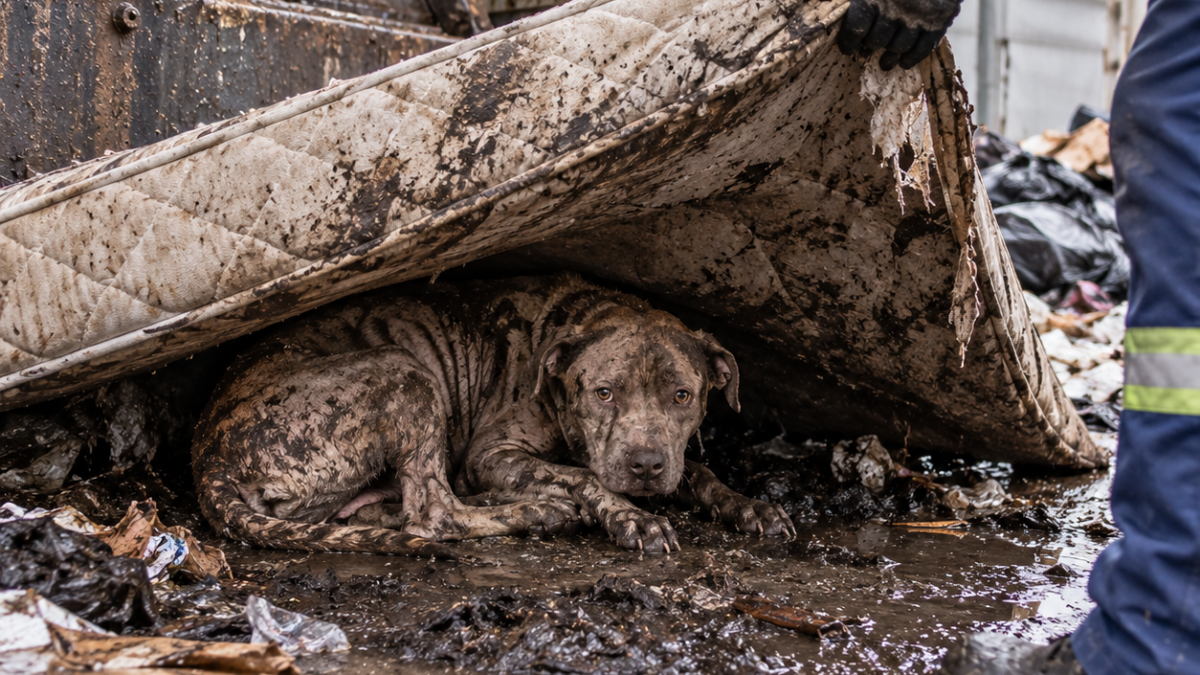
PART 2
“Nobody touches the chain until animal control gets here,” I said.
The worker closest to me nodded.
His name was Carl, and he’d spent most of the morning operating a skid steer. He had the kind of hands that looked permanently stained with oil and dirt.
He looked at the dog.
Then at the pipe.
“You think it’s grown into him?”
“I don’t know.”
“It looks like it.”
“I know.”
That was exactly why I didn’t want anybody improvising.
The dog had already reacted violently when the chain tightened. One wrong pull could tear damaged tissue or make a frightened animal defend himself.
Carl stepped away.
“What can we do?”
“Keep everything quiet.”
That meant turning off equipment.
Moving workers away.
No shouting.
No standing over him.
The whole atmosphere of the yard changed.
Ten minutes earlier, men had been tossing debris and calling jokes across the property.
Now everyone spoke quietly.
One worker found a clean tarp and held it up to block the wind without moving too close.
Another found a shallow plastic container for water.
I gave the dog only a little at a time.
Every time I pulled the container away, his eyes followed it.
“I’m bringing it back.”
I set it down again.
He drank more slowly.
Good.
The mattress remained partly beside him.
I hated it.
But I also realized it might have become his only shelter.
Taking everything familiar away at once could make him more afraid.
So we left part of it where it was until professionals arrived.
I sat on an overturned bucket.
The dog watched me.
Not continuously.
He’d look.
Look away.
Look again.
His ears stayed pinned back.
His body never fully relaxed.
I tried to judge his age.
Hard.
He was clearly an adult.
Not elderly.
Three?
Four?
Five?
Malnutrition can make animals look older and younger at the same time.
His muzzle wasn’t gray.
His teeth, what little I could see, weren’t worn badly.
But his body was depleted.
Sharp shoulders.
Deep waist.
Hips like corners beneath the coat.
One patch near his rear leg had lost hair.
His nails were long.
His white chest was stained brown from dirt.
Carl crouched several yards away.
“How long can a dog survive like that?”
“I don’t know.”
“He had to be getting water somehow.”
“Maybe rain.”
Carl looked toward the house.
The roof overhang had collapsed in one section.
A gutter hung sideways.
There were puddles in the yard.
Maybe.
Or maybe someone had occasionally brought water.
Again, we didn’t know.
That phrase became the entire morning.
We didn’t know how long he’d been chained.
Didn’t know when he’d last eaten.
Didn’t know who owned him.
Didn’t know whether someone planned to return.
Didn’t know whether the house had been empty for days or whether people had been coming and going after the utilities were shut off.
And we couldn’t let anger fill the gaps with invented answers.
Not yet.
The dog shifted his front paws.
The chain scraped.
He froze.
So did I.
“You’re okay.”
His eyes met mine.
I didn’t move.
After a few seconds, his breathing slowed slightly.
The animal-control vehicle arrived fourteen minutes after the call.
I knew because I’d checked my watch repeatedly.
Officer Elena Ramirez stepped through the gate carrying equipment.
She had been with the county for years.
I’d seen her at hoarding cases, loose-dog calls, neglect complaints and the occasional situation where someone insisted a raccoon in their attic was “definitely somebody’s pet.”
The second she saw the pit bull, her pace changed.
No rushing.
No direct approach.
She set the catch pole down beside the truck instead of bringing it near him.
“Has he tried to bite anyone?”
“No.”
“Growl?”
“No.”
“Can he stand?”
“Not for long.”
“Water?”
“Some. Slowly.”
She nodded.
“Good.”
Then she crouched.
“Hey, sweetheart.”
The dog’s ears shifted.
She stayed far enough away that he didn’t have to react.
“What do we know?”
“Nothing useful.”
I told her what we’d seen.
The chain.
The mattress.
The collapse.
The neck.
Elena listened without interrupting.
When I finished, she studied him.
“That chain has to come off at a clinic.”
“That’s what I thought.”
“We still need to free him from the pipe.”
Carl said, “I’ve got bolt cutters.”
Elena nodded.
“Bring them, but don’t walk straight at him.”
Carl moved slowly.
The sound of metal touching metal made the dog jerk backward.
The chain pulled tight.
He cried out.
Not loud.
That somehow made it worse.
A short, strained sound.
Everyone stopped.
Elena raised a hand.
“Wait.”
The dog panted.
I lowered myself closer to the ground.
“Easy.”
He looked at me.
“I know.”
I had no idea whether tone mattered.
Maybe.
Maybe not.
I kept talking anyway.
“No one’s pulling it.”
Elena moved the bolt cutters where he could see them.
Put them down.
Waited.
Then shifted them a few inches.
Waited.
Everything took time.
That was good.
People love dramatic rescue videos where someone cuts a chain in one motion and a dog instantly jumps into their arms.
Real fear doesn’t work that way.
Our goal wasn’t to create a beautiful moment.
Our goal was to avoid creating another bad one.
Elena used a towel to stabilize the portion of chain near the pipe.
Carl positioned the cutters several feet from the dog’s neck.
“Ready?”
“Do it.”
The handles closed.
The chain snapped.
The sound was sharp.
The pit bull flinched.
But the pull against his neck disappeared.
The broken length of chain dropped into the dirt.
For the first time since we had uncovered him, nothing physically connected him to the pipe.
He didn’t move.
That hit me unexpectedly.
I had imagined freedom would cause some visible reaction.
A step.
A crawl.
Anything.
Instead, he remained inside the exact radius the chain had allowed.
Elena noticed too.
“Give him a minute.”
We did.
The dog looked at the open space beyond the pipe.
He could move there now.
His body didn’t seem to know that.
Elena prepared a soft slip lead positioned to avoid the worst of his neck.
The dog stiffened as she approached.
She stopped.
“Good boy.”
Carl whispered, “Good?”
“Yes.”
“He looks terrified.”
“He is. But he’s warning us with his body. That’s communication.”
Eventually, Elena got the lead in place.
“Let’s see if he’ll stand.”
The smallest pressure.
The dog tried.
His front legs pushed up.
His rear legs followed.
For a moment, he stood completely.
I could see every rib.
Then one back leg trembled.
The other folded.
He dropped.
“That’s enough,” Elena said. “We’re carrying him.”
Carl and another worker brought a rigid transport board.
The moment it slid across the dirt, the dog growled.
Low.
For the first time.
Nobody punished him.
Nobody told him no.
Elena stopped.
“Good. We hear you.”
She backed the board away.
The growl ended.
I looked at her.
“What now?”
“We make it less scary.”
We placed a towel over the board.
Moved it closer in stages.
I sat where the dog could see me.
At one point, I put my palm on the dirt.
Not reaching.
Just there.
He stared at it.
Then at my face.
Back to the hand.
A minute passed.
Maybe more.
He leaned forward.
Only an inch.
Then another.
His nose touched my knuckles.
Briefly.
His nose was dry.
Warm.
I didn’t move.
“That’s it.”
Elena whispered, “Now.”
We slid the board beneath him with as little lifting as possible.
His body tensed.
No bite.
No snap.
Just shaking.
Carl took one side.
I took another.
Elena stabilized his head and chain.
We lifted.
The dog made one small sound.
“Almost there.”
The animal-control truck had been prepared with blankets.
We placed him inside.
He immediately curled as tightly as his body allowed.
The broken chain lay beside him.
Elena closed the door gently.
“Emergency vet?”
“Already called.”
I nodded.
She looked at me.
“You need to stay for the property photos.”
“I know.”
“You can’t ride with him.”
“I know.”
“You’re going to follow us anyway.”
I looked at her.
“Probably.”
She smiled slightly.
“Thought so.”
I stayed long enough to make sure the cleanup scene was documented.
Chain anchor.
Mattress.
Waterless area.
Food containers.
The worn dirt around the pipe.
Photographs.
Measurements.
The broken chain section.
The location of the mattress relative to the compactor.
All of it mattered.
If anyone later tried to reconstruct what had happened, memories wouldn’t be enough.
When we finished, I drove to the veterinary hospital.
By then, the adrenaline had dropped.
That’s when anger arrived.
At the property, I had been useful.
Stop machine.
Get water.
Call animal control.
Document.
At the clinic, there was nothing for me to do.
So my mind started creating images.
Someone fastening the chain.
Someone walking away.
The dog waiting.
Rain.
Heat.
Cold.
Hunger.
I stopped myself.
Elena was sitting in the waiting area filling out intake forms when I entered.
She looked up.
“You came.”
“I said I would.”
She nodded toward a chair.
“Sit.”
I sat.
The broken chain was sealed inside an evidence bag on the floor.
I stared at it.
Elena noticed.
“Don’t do that.”
“Do what?”
“Build the whole crime in your head.”
“I wasn’t.”
“You were.”
I looked at her.
She tapped the paperwork with her pen.
“Facts first.”
“I know.”
“Do you?”
I didn’t answer.
She leaned back.
“We know he was chained. We know he was severely underweight. We know the chain injured his neck. We know there was no accessible food or water when we found him.”
“That’s enough.”
“For concern? Absolutely.”
“For anger too.”
“Sure.”
“But we don’t know who did what, when, or whether more than one person failed him.”
I stared toward the treatment doors.
“Somebody knew.”
“Probably.”
“Somebody left him.”
“Maybe.”
“Elena.”
She met my eyes.
“I’m not defending anyone. I’m telling you the case has to be better than our anger.”
I knew that.
I’d worked enough county cases to know the difference between what looked obvious and what could be documented.
Still, I hated it.
Forty minutes passed before the veterinarian came out.
Dr. Patel.
She had a calm face and the tired eyes of someone pulled into too many emergencies.
“Are you with animal control?”
Elena stood.
“Yes.”
Dr. Patel looked at me.
“And you?”
“Code enforcement. I found him with the crew.”
“All right.”
She sat.
“He’s stable.”
My shoulders dropped slightly.
“That’s the good part,” she added.
Of course.
“He’s severely underweight. Dehydrated. Anemic. There is significant muscle wasting.”
“His neck?”
“We sedated him enough to safely remove the remaining chain and examine the wound.”
“Was it embedded?”
“Partially. The skin had swollen around several contact points. There is infection and pressure damage.”
I swallowed.
“Airway?”
“Not compromised.”
“Good.”
“Very good.”
“Will he need surgery?”
“Possibly minor debridement depending on how the tissue declares itself over the next day or two. Right now, we’ve cleaned the area, started antibiotics, pain management, fluids and nutritional support.”
“Can he walk?”
“His weakness appears mostly systemic and muscular at this stage. I don’t see an obvious fracture or acute spinal injury, but we’ll reassess.”
“How long was he starving?”
Dr. Patel shook her head.
“We can’t answer that.”
“His condition—”
“Tells us he has been undernourished for a significant period. It doesn’t tell us where every day of that period occurred.”
Elena glanced at me.
Facts first.
I understood.
“Is he going to live?”
Dr. Patel paused.
“He has a reasonable chance.”
Not a guarantee.
Enough.
“Can I see him?”
She looked at Elena.
Elena said, “He’s county custody.”
Dr. Patel considered.
“Five minutes. Stay outside the kennel.”
The dog was asleep beneath a blanket.
No chain.
His neck was shaved and wrapped with a clean bandage.
An IV catheter had been placed in one front leg.
Without dirt and metal covering him, he looked smaller.
Almost fragile.
His brown coat had a reddish tone beneath the grime.
The white marking on his chest continued up toward his throat.
I stood outside.
“Hey.”
One eye opened.
Then the other.
He looked directly at me.
No panic.
Maybe medication.
Maybe exhaustion.
His nose moved.
Then his eyes closed again.
A technician adjusted the blanket.
“He’s been very gentle.”
“Even when you removed the chain?”
“Scared. Very scared. But no attempt to bite.”
I nodded.
The intake card said:
MALE PIT BULL TYPE — STRAY/SEIZED.
I hated it.
“Does he have a name?”
The technician looked at the chart.
“Not officially.”
I stared at him.
He looked like a Hank.
I don’t know why.
Maybe because Hank sounded solid.
Ordinary.
Like a dog who should be lying under a kitchen table waiting for somebody to drop bacon.
“Hank.”
The technician smiled.
“Hank?”
“Temporary.”
“Sure.”
His ear moved.
“Hank it is.”
I returned to the property afterward.
The crew had finished the front yard but hadn’t touched the area around the pipe.
Carl was waiting.
“Dog alive?”
“Yes.”
“Good.”
“Still serious.”
He nodded.
We stood in the backyard.
With Hank gone, the little circle around the chain looked worse.
The pipe sat near the foundation.
The chain had allowed roughly six feet of movement.
Enough to reach the mattress.
Not enough to reach the shade beneath a tree ten feet away.
Not enough to reach the broken patio where rainwater sometimes collected.
Near the fence, I found a cracked plastic bowl partly buried under leaves.
Too far away.
Maybe it had once belonged to Hank.
Maybe not.
We photographed it.
A woman from the neighboring property approached.
She looked about seventy.
“You found the dog?”
“You knew about him?”
Her face tightened.
“I heard barking.”
“When?”
“A while back.”
“How long?”
She thought.
“Off and on. Weeks maybe.”
Weeks.
“Did you see him?”
“Once. Brown dog in the yard.”
“Before the house was empty?”
“I think so.”
“Who lived here?”
“A man and a woman. Younger couple. Lots of people coming around.”
“Names?”
She knew first names.
Maybe.
Nothing she wanted to swear to.
“Did you see anyone feeding the dog?”
“No.”
“Water?”
“No.”
“Did you call anyone?”
Her face changed.
Defensive now.
“I didn’t know he was chained.”
“I didn’t say you did.”
“I figured if there was a dog, somebody was coming back.”
I felt anger flare.
But she was already ashamed.
Adding more wouldn’t help.
“Did you hear him recently?”
“Not much.”
That answer made my stomach drop.
Not because silence meant death.
Because weak animals often become quieter.
We took her statement.
Later, property records gave us the owner.
The owner had rented the house to tenants who had stopped paying months earlier.
An eviction process followed.
Utilities shut off.
Notices posted.
The landlord said he had only performed exterior inspections.
He insisted he had never seen a dog during the final visits.
A property-management subcontractor had entered the front room after the tenants left but claimed never to have gone into the backyard because of debris.
The timeline became complicated fast.
Different people had access.
Different people assumed someone else was responsible.
No single neat explanation.
That frustrated me.
But Hank’s immediate life was simpler.
Eat.
Heal.
Stand.
Trust.
I called the clinic the next morning before work.
“How’s Hank?”
Reception paused.
“Hank?”
“The pit bull from county intake.”
“Oh.”
Typing.
“Stable. Ate overnight.”
“On his own?”
“Yes.”
“Did he keep it down?”
“Yes.”
“Temperature?”
“Normalizing.”
“Can I visit?”
“I’ll ask.”
Elena called thirty minutes later.
“You know you don’t technically have visitation rights.”
“I know.”
“You named him.”
“Temporary.”
She laughed.
“Clinic says after five.”
I arrived at five-ten.
Hank was awake.
He didn’t stand.
His eyes followed me.
I crouched outside.
“Hey.”
No reaction.
I put my fingers near the lower opening.
He sniffed.
Then turned his head away.
That was okay.
I sat on the floor.
Ten minutes.
A technician entered carrying food.
Hank’s head lifted immediately.
“Somebody’s hungry.”
She placed the bowl inside.
Hank looked at me.
Then at the food.
He hesitated.
“I can go.”
“Stay.”
The technician stepped back.
Hank lowered his head.
Ate.
Slowly at first.
Then faster.
She removed the bowl halfway through.
Hank stared at her.
The expression was so clearly offended that I laughed.
His head snapped toward me.
For one second, his eyes looked different.
Less flat.
More present.
“Good.”
The technician smiled.
“What?”
“He’s annoyed.”
“Yes.”
“That’s good.”
“Usually.”
His body was remembering that things mattered.
Food mattered.
People mattered.
The bowl leaving mattered.
Anger, annoyance, curiosity—those require energy.
Over the next week, I measured progress through tiny updates.
Hank stood for several seconds.
Then fifteen.
Then walked three steps.
His hydration normalized.
Bloodwork improved.
The wound around his neck began forming healthier tissue.
The infection responded.
His appetite became enthusiastic enough that portions had to be controlled carefully.
Refeeding a severely undernourished dog isn’t just pouring food into a bowl.
The veterinary team increased nutrition in stages.
Hank disagreed with all stages.
Every empty bowl seemed like a personal betrayal.
One afternoon, Dr. Patel called me.
“He’s gaining.”
“How much?”
She gave me the number.
I smiled.
“Good.”
“Very.”
“Neck?”
“Better.”
“Surgery?”
“We did a limited debridement. Nothing extensive. Healing looks promising.”
“Will fur grow back?”
“Some. Maybe not all.”
“Doesn’t matter.”
“No.”
“What about walking?”
“Improving. Muscle loss is significant, but neurologically he looks encouraging.”
“So rehabilitation?”
“Yes.”
“Pain?”
“Controlled.”
“Fear?”
She paused.
“That may take longer.”
I knew.
Medical wounds have charts.
Fear doesn’t.
By day nine, Hank wagged his tail.
Elena texted me a video.
A technician entered with food.
Hank’s tail moved once.
Then twice.
Small.
Tentative.
I watched it six times.
I replied:
Good.
Elena:
Your dog is improving.
Me:
Not my dog.
Elena:
Right.
When Hank was stable enough to leave emergency care, a local foster rescue stepped in.
The county shelter could house him, but everybody agreed a quieter environment would be better for his rehabilitation.
The rescue coordinator, Angela, asked questions.
“Any aggression?”
“None observed.”
“Dog-dog behavior?”
“Unknown.”
“Cats?”
“Unknown.”
“House trained?”
“Unknown.”
“Food guarding?”
“Not observed in clinic.”
“Men?”
I paused.
“He tolerates me.”
“That’s not the same as comfortable.”
“No.”
“Women?”
“Seems slightly easier with female staff, but not enough data.”
“Leash?”
“Anything near the neck frightens him.”
“Understandable.”
“Harness?”
“Need to condition it slowly.”
Angela sighed.
“He needs an experienced foster.”
She found one.
Melissa Hart.
She lived alone except for a thirteen-year-old mixed-breed female named Daisy.
Fenced backyard.
Quiet street.
No young children.
Years of fostering dogs from neglect cases.
When I met Melissa at the clinic, she didn’t approach Hank.
That told me immediately she’d done this before.
She stood several feet away.
Looked at him.
“Hi, handsome.”
Hank backed toward the kennel wall.
Melissa nodded.
“Okay.”
No baby talk.
No reaching.
No insistence that he understand her intentions.
She spoke with Dr. Patel about his wound care.
Medication.
Nutrition.
Exercise.
Harnessing.
Triggers.
Then looked at me.
“You found him?”
“Me and a cleanup crew.”
“Under the mattress?”
“Yes.”
She glanced at Hank again.
“You coming to the house?”
“I wasn’t planning to.”
“He knows you.”
“I don’t think he knows anybody.”
She smiled.
“He watches you.”
I looked.
Hank’s eyes were on me.
Then he looked away.
Melissa laughed.
“See?”
I followed.
The first hour in her home taught me how far Hank still had to go.
The transport crate sat open in the recovery room.
Hank refused to come out.
No one pulled.
No one reached inside.
Melissa sat on the floor reading paperwork.
I sat against the opposite wall.
Daisy remained elsewhere behind a closed door.
Ten minutes.
Twenty.
Thirty.
At thirty-seven, Hank’s nose appeared.
Melissa kept reading.
One front paw.
Then another.
He stepped onto the rug.
Immediately froze.
New smells.
New room.
New people.
No chain.
Unlimited movement.
All of it seemed overwhelming.
He walked to the farthest wall and turned so he could watch both of us.
Melissa spoke without looking directly at him.
“That’s your bed.”
A thick mattress lay in one corner.
I almost laughed at the irony.
This mattress was clean.
Blue cover.
Soft.
Completely his.
Hank didn’t go near it.
Instead he lay on the floor.
“Of course,” Melissa said.
“What?”
“They always ignore what you buy.”
I liked her.
The first nights were quiet.
Hank ate only when alone.
He’d wait for Melissa to leave.
Then the bowl emptied.
Bathroom trips were difficult because the harness terrified him.
Melissa began conditioning him without touching.
Harness on floor.
Treat several feet away.
Harness closer next meal.
Treat on one side.
No pressure.
No clipping.
No forcing his head through anything.
By day five, Hank sniffed it.
Day seven, he ate with it beside the bowl.
Day ten, Melissa touched it to his shoulder for one second.
Then treat.
End session.
Slow.
Almost painfully slow.
Exactly right.
I visited at the end of the first week.
Hank stood behind a baby gate.
He saw me.
Didn’t retreat.
Melissa noticed.
“That’s different.”
“What?”
“He usually backs up when someone enters.”
I crouched.
“Hey, Hank.”
His ears shifted.
I stayed where I was.
Eventually, he came forward.
Not close.
Four feet.
Then three.
Stopped.
Melissa brought coffee.
We talked about normal things.
The property case.
Weather.
Daisy.
Nothing about Hank directly.
Twenty minutes later, something touched my shoe.
His nose.
I looked down.
Hank sniffed once.
Then moved away.
My throat tightened.
Melissa whispered, “First visitor he’s approached.”
“Don’t make it a big deal.”
“I’m not.”
“Good.”
Hank circled.
Came back.
Sniffed again.
Tiny progress.
The next week seemed better.
He began eating with Melissa in the room.
Accepted the harness briefly.
Walked into the yard.
Then a delivery truck slammed its door outside.
The sound cracked through the house.
Hank bolted.
He hit the recovery-room doorway hard enough to knock over a water bowl.
For hours he hid in the corner.
Wouldn’t eat.
Wouldn’t approach.
Melissa called me that evening.
“I ruined him.”
“No.”
“We were doing so well.”
“You didn’t close the truck door.”
“I should have anticipated delivery time.”
“You can’t control the world.”
“I brought him into a house where that happened.”
I heard the frustration in her voice.
Not with Hank.
With herself.
“I hate this.”
“I know.”
“I hate that one noise puts him back there.”
“We don’t know where it puts him.”
“You know what I mean.”
I did.
Fear makes humans impatient with healing.
We want trust to be cumulative.
One good day plus one good day should equal permanent improvement.
Animals don’t work like spreadsheets.
Neither do people.
A trigger can reopen old reactions.
That doesn’t erase previous progress.
Hank stayed hidden most of the next day.
On the second morning, he ate.
On the third, he came into the hallway.
On the fourth, he lay in the living room.
A week later, another delivery truck stopped outside.
The door slammed.
Hank jumped.
Then barked.
One deep bark.
He stayed where he was.
The truck drove away.
Hank looked toward Melissa.
She laughed.
“You did it.”
He barked again.
“Very scary.”
She sent me the video.
I watched it at my desk.
The dog under the mattress had barely had enough energy to moan.
This one believed he could defeat delivery trucks.
Progress.
Daisy became Hank’s next teacher.
Their introduction was planned carefully.
Parallel walk outside.
Distance.
Separate handlers.
No forced greeting.
Daisy was thirteen and had no interest in proving anything.
She sniffed grass.
Hank watched.
She peed near a tree.
Hank watched.
She ignored him.
That seemed to confuse him.
On the second walk, they were closer.
Third, brief mutual sniff.
Then separation.
Fourth, they shared the yard.
Daisy walked toward a sunny spot and lay down.
Hank stood ten feet away.
After several minutes, he lay down too.
Melissa sent me a picture.
Two dogs.
No touching.
No drama.
A week later, the distance between them shrank.
Then one evening, Daisy chose Hank’s blue bed.
Hank walked in.
Stopped.
Looked at her.
Melissa held her breath.
Hank turned.
Lay on the rug.
No conflict.
The next afternoon, Melissa found both dogs on the same rug.
Daisy asleep.
Hank awake.
His head resting near her back.
She took the picture from the doorway.
I stared at it for a long time.
“He’s learning how to dog,” she wrote.
Yes.
That was exactly it.
Until then, Hank’s behavior had revolved around safety.
Where is the exit?
Where is the person?
Will this touch hurt?
Is the bowl disappearing forever?
Is the door slamming a threat?
Daisy showed him boredom.
Boredom is underrated.
Sleep.
Stretch.
Ignore mail carrier.
Drink water.
Find sun.
Repeat.
Hank discovered couches next.
Melissa called me.
“You need to come see this.”
“What happened?”
“Nothing.”
“Then why—”
“Just come.”
I arrived after work.
She opened the door.
Hank was upside down on the couch.
Completely upside down.
White chest exposed.
One back leg stretched into the air.
Head wedged against a cushion.
For a second, I didn’t recognize him.
Melissa whispered, “Look at his stomach.”
Not medically.
The posture.
Exposed.
The dog found beneath a mattress had once used garbage as cover.
Now he slept without protecting anything.
I crouched near the couch.
Hank opened one eye.
Tail thump.
Then eye closed.
“Unbelievable.”
Melissa smiled.
“Your dog.”
“Stop.”
“Your emotional-support foster dog.”
“He’s yours.”
She went quiet.
That should have warned me.
The legal investigation continued in the background.
Property records.
Witness statements.
Former tenants.
Landlord.
Photographs.
Veterinary reports.
Access logs.
Utility dates.
We eventually located one former tenant, a man named Travis.
He denied ownership.
“That dog wasn’t mine.”
“Whose was he?”
“A guy who came around.”
“Name?”
“Don’t know.”
“You let an unknown person keep a dog chained in your yard?”
“I didn’t say he kept it there.”
“Was the dog there when you moved out?”
“I don’t remember.”
“You don’t remember a pit bull chained behind the house?”
He became defensive.
“I had bigger problems.”
Maybe he did.
Job loss.
Eviction.
Relationship breakdown.
People under pressure can become careless, selfish, avoidant.
Understanding that doesn’t make neglect acceptable.
It does make reality more complicated than villainy.
Another former occupant said Hank had belonged to Travis’s cousin.
The cousin denied it.
The landlord claimed nobody disclosed an animal.
A neighbor insisted she had seen Travis feeding Hank months earlier.
Dates didn’t align cleanly.
Some witnesses remembered details only after hearing others.
The investigator separated what could be documented from what could not.
That frustrated me deeply.
I wanted one person.
One name.
One answer.
Who fastened the chain?
Who knew it was injuring him?
Who left?
Who stopped bringing water?
The law wanted proof.
The story in my head wanted certainty.
Those are not the same thing.
Eventually, the county obtained full legal custody after the required holding and investigation process.
No legitimate owner came forward to reclaim Hank.
That was the most important legal outcome for his future.
The neglect case produced citations and penalties where evidence supported them.
It never produced the dramatic confession I wanted.
For a while, that bothered me more than it should have.
Then I visited Melissa.
Hank met me in the yard carrying a tennis ball.
That was new.
He had discovered tennis balls two weeks earlier.
Obsessed.
Melissa threw.
Hank chased.
He turned too fast.
His hindquarters slid slightly.
He corrected.
Ran back.
Dropped the ball three feet from us.
“Still working on retrieval.”
“Apparently.”
I threw again.
Hank sprinted.
Strong.
Healthy.
Muscle now covered the sharp hips.
His chest had widened.
His coat shone.
The neck scar remained.
A pale uneven band where fur grew thin.
Melissa stood beside me.
“You’re thinking about the case.”
“How do you know?”
“Your jaw.”
I threw the ball again.
“Somebody should answer.”
“Maybe.”
“Maybe?”
“Yes. Maybe the evidence will never tell you exactly what you want.”
“That’s not good enough.”
“For you?”
“For him.”
Melissa looked at Hank running through the grass.
“He isn’t waiting for that answer.”
I didn’t reply.
Hank returned.
Pushed the ball against my shoe.
I bent and picked it up.
Melissa was right.
Accountability mattered.
But I had begun acting as though Hank couldn’t move forward until the past became fully explained.
He already had.
Applications for adoption began once the rescue considered him ready.
The first wave taught us how many people fall in love with a story instead of an animal.
“I saw his before picture.”
“I cried when I saw the chain.”
“I need to save him.”
He didn’t need saving anymore.
He needed compatibility.
One applicant wanted an outdoor protection dog.
Rejected.
Another wrote that pit bulls required “dominance.”
Rejected.
A young couple seemed kind but worked twelve-hour shifts and expected Hank to adjust quickly to being alone.
Not ideal.
A family with three small children wanted to hug him immediately during the meet-and-greet.
Melissa stopped them politely.
Hank retreated behind her.
Wrong home.
Another person wanted him because his rescue had received attention online.
“I think his story could inspire people.”
Melissa looked at me after the call.
“Hank doesn’t need a publicist.”
I laughed.
“He needs dinner.”
“He needs a couch.”
“Already has one.”
“Exactly.”
Weeks turned into months.
Hank’s profile was rewritten to sound less dramatic and more honest.
Adult pit bull mix.
Gentle once comfortable.
Needs patient introductions.
Sensitive to loud noises and pressure around the neck.
Harness trained.
Lives successfully with calm senior dog.
House trained.
Food motivated.
Loves tennis balls.
Enjoys sleeping on furniture despite owning expensive beds.
Will follow trusted people from room to room.
That last line became truer every day.
Hank followed Melissa everywhere.
Kitchen.
Laundry.
Backyard.
Garage.
Bathroom door.
One afternoon, she sent me a picture.
Only Hank’s nose visible beneath the closed bathroom door.
Caption:
The concept of privacy remains under review.
I laughed.
A dog once unable to move more than six feet now objected to two inches of door.
There was something almost funny about that.
Almost.
Then Melissa called.
“I have a problem.”
I was driving home.
“Hank sick?”
“No.”
“Daisy?”
“No.”
“What?”
“I can’t do the adoption event Saturday.”
“Why?”
“Because I’m not taking him.”
I pulled into a parking lot.
“What?”
“I can’t send him.”
There it was.
The foster failure.
Rescue people use that phrase jokingly.
Failure.
Actually, it’s usually love colliding with logistics.
Melissa had fostered twelve dogs before Hank.
Every one adopted elsewhere.
She understood letting go.
But Hank had attached differently.
So had she.
“I’ve been trying to convince myself another house could be better.”
“Could one?”
“Maybe.”
“That’s not the question.”
“I know.”
“What do you want?”
Silence.
Then:
“I want him here.”
Daisy was old.
Melissa worried that keeping Hank would reduce her ability to foster later.
One permanent dog can change space.
Finances.
Transport capacity.
Dynamics.
She wasn’t romantic about it.
That made me trust the decision more.
“Hank needs stability,” she said.
“Yes.”
“He has it.”
“Yes.”
“If I send him away because I feel obligated to keep fostering, I’m treating him like a slot.”
I said nothing.
She continued.
“I love him.”
“Then keep him.”
Another pause.
“That simple?”
“No. But the answer might be.”
The rescue approved the adoption after normal checks.
Melissa signed papers at her kitchen table.
Hank slept underneath it.
She looked down.
“You’re officially stuck with me.”
His tail tapped once.
She looked at me.
“Did you see that?”
“Coincidence.”
“Absolutely not.”
Hank’s tag arrived a week later.
HANK.
Phone number.
Address.
A small piece of metal.
I held it in my palm.
Months earlier, metal around his neck had meant pain and confinement.
Now this metal meant identity and return.
Melissa clipped the tag to his harness.
No collar against the scar.
Hank sniffed it.
Then walked toward the couch.
Life continued.
The investigation faded.
Hank didn’t.
Daisy’s health declined the next year.
Thirteen became fourteen.
Arthritis worsened.
Kidneys.
Age.
Melissa adjusted.
More vet visits.
Rugs on slippery floors.
Shorter walks.
Hank changed around Daisy.
He stopped trying to engage her in play.
Walked more slowly beside her.
Sometimes lay near her bed.
The night Daisy died, Hank was in another room.
The veterinarian came to the house.
Peaceful.
Quiet.
Afterward, Hank searched.
He checked the hallway.
Her bed.
The yard.
Then the hallway again.
For two days, he ate less.
Melissa called me.
“He doesn’t understand.”
“Maybe he understands more than we think.”
“I don’t know what to do.”
“Keep routine.”
“I left her bed.”
“That’s okay.”
On the third afternoon, Hank climbed into Daisy’s bed.
He had never done that while she was alive.
He turned twice.
Curled.
Slept.
Melissa sent me the picture without text.
I didn’t reply for a while.
Then:
Let him have it.
She did.
Months later, Melissa fostered again.
A nervous brindle female named Winnie.
The irony wasn’t lost on us.
Hank—the dog who once couldn’t cross his own chain radius—became the stable resident dog.
Winnie feared doorways.
Would stop at thresholds.
Hank walked through.
Back.
Through again.
No pressure.
Winnie watched.
Eventually followed.
Melissa sent video.
“Look who’s teaching confidence.”
Hank trotted into the kitchen.
Winnie followed two steps behind.
The sight did something to me.
Recovery had become transferable.
Not literally.
Hank wasn’t giving therapy.
But his normal behavior became evidence.
This house is safe.
This person is safe.
This doorway doesn’t trap you.
Dogs notice each other.
Hank had learned from Daisy.
Winnie learned from Hank.
Care moves like that.
Not as speeches.
As routine.
Three years after the cleanup, I returned to the old property.
A drainage complaint next door.
Different owner.
Renovated house.
New fence.
Cut grass.
The backyard looked nothing like the place where we’d found Hank.
The pipe was gone.
The rotting mattress gone.
The entire dirt patch had become a garden.
Tomatoes.
Basil.
Peppers.
A child’s plastic watering can.
I stood there longer than necessary.
The new homeowner noticed.
“Everything okay?”
“Yeah.”
“You look like you’ve seen something.”
“I used to work a case here.”
“Bad?”
I looked at the garden.
“At first.”
I didn’t tell the whole story.
It didn’t belong to the new family.
The property didn’t have to remain a memorial to suffering.
That thought surprised me.
For years, I had wanted the world to remember what happened to Hank.
Now I found relief in the fact that the place had forgotten.
I stopped at Melissa’s afterward.
Hank met me at the gate.
Full-grown.
Healthy.
Thick shoulders.
Shiny brown coat.
White chest.
Scar visible if you knew where to look.
He barked.
Then recognized me.
His body softened.
Tail wagging.
“Hey, buddy.”
I crouched.
Hank pressed his shoulder into me.
Melissa came outside.
“You’re early.”
“I was nearby.”
She looked at my face.
“The house?”
“Yeah.”
“Still terrible?”
“No.”
I told her about the garden.
She smiled.
“Good.”
“That’s it?”
“What do you want there?”
I thought.
“Nothing.”
“Exactly.”
Hank brought a tennis ball.
I threw.
He chased.
Melissa said, “He doesn’t live there anymore.”
Simple.
True.
Time passed.
Hank’s scar faded beneath fur.
His habits became more important than his history.
Breakfast at 6:30.
Not 6:31.
If Melissa overslept, Hank stood beside the bed breathing dramatically.
No barking.
Just presence.
“Go away.”
No movement.
“Hank.”
Heavy exhale.
“You’re ridiculous.”
Tail wag.
Breakfast happened.
He hated rain.
That made me laugh.
The dog once exposed to weather beneath a mattress now stood at the back door and refused to step onto wet grass.
Melissa would say, “You survived outside.”
Hank stepped backward.
“Apparently we’ve erased resilience.”
Eventually he went.
Quick bathroom break.
Straight back.
Towel.
Couch.
He also hated cold.
At sixty-eight degrees, he could apparently die.
Melissa bought blankets.
Then more.
One winter photo showed only his nose.
Three blankets covered everything else.
Caption:
Emergency. House briefly below tropical temperature.
Good.
Let discomfort become dramatic now.
The annual veterinarian visits changed from recovery to maintenance.
Vaccines.
Dental checks.
Weight.
Bloodwork.
Later, senior panels.
Dr. Patel saw him years after the original rescue.
She entered the exam room.
Stopped.
“Is this Hank?”
Melissa smiled.
“Same one.”
Dr. Patel approached.
Hank sniffed her.
Then leaned against her leg.
She touched his neck.
The scar remained.
“Wow.”
“What?”
“He looks completely different.”
I said, “Not completely.”
She glanced at me.
“No.”
Hank sat.
Stared at the treat jar.
Dr. Patel laughed.
“Still starving?”
“Apparently.”
She gave him one.
Exam.
Heart good.
Lungs good.
Some early joint stiffness.
Expected.
“Keep him lean.”
Melissa looked at Hank’s broad chest.
“He’ll file a complaint.”
“He can.”
Hank accepted another treat.
Nobody in that room could have joked about starvation during the first week.
Years had created enough distance.
Distance isn’t forgetting.
It’s healing.
Hank entered senior years gradually.
Gray appeared around his muzzle.
Runs became trots.
Tennis-ball sessions shortened.
At first, he still chased full speed.
Then he started stopping halfway.
Eventually, he preferred carrying the ball around rather than retrieving.
Melissa called it retirement.
He developed arthritis.
Medication helped.
Rugs appeared on slippery floors.
A low ramp beside the couch.
Hank refused the ramp.
Naturally.
He stood beside the couch.
Looked at Melissa.
She pointed.
“Ramp.”
Hank stared.
“Use it.”
Nothing.
She walked away.
Hank whined once.
Melissa returned.
Helped him up.
He settled.
She sent me the video.
I replied:
Training successful.
She wrote:
Yes. He trained me.
His hearing faded slowly.
The first time he slept through Melissa coming home, she panicked.
“Hank?”
Nothing.
She touched his shoulder.
He woke.
Looked annoyed.
Tail wagged.
She called me afterward.
“I thought he was dead.”
“He’s old.”
“I know.”
“I say that as someone who has also checked breathing on a sleeping dog.”
She laughed once.
Then cried.
Old animals make us behave strangely.
Every nap becomes precious and frightening.
Every skipped meal becomes a crisis.
Every good morning becomes a gift we pretend is ordinary.
I visited more.
Not because anyone asked.
Because I knew.
Time was becoming visible.
Hank still recognized my car.
Mostly.
He’d stand when I arrived.
Later, just lift his head.
Tail.
One wag.
Two.
Enough.
I sat beside him.
“Hey, old man.”
He put his head on my shoe.
The first time we’d touched, his nose had barely reached my knuckles in dirt.
Now my foot was furniture.
Melissa brought coffee.
We sat in the yard.
Hank slept.
I asked her something I hadn’t asked in years.
“Do you still think about who did it?”
“Who chained him?”
“Yeah.”
“Sometimes.”
“Do you want to know?”
She looked at Hank.
“Not the way I used to.”
“Why?”
“Because if you called tomorrow and gave me a name, what changes for him?”
“Nothing.”
“Exactly.”
I understood.
Legal accountability mattered.
We had pursued what evidence supported.
But emotionally, I had imagined the missing answer as a final piece.
It wasn’t.
Hank’s life had become complete without it.
That doesn’t excuse whoever failed him.
It just means they no longer get to be the center of his story.
One afternoon, I dropped a short length of old chain from my toolbox while helping Melissa repair a fence.
Metal struck concrete.
Clink.
Hank’s head came up immediately.
His body stiffened.
Years disappeared from his posture.
I froze.
So did Melissa.
I picked the chain up.
Put it away.
No exposure exercise.
No “show him it’s safe.”
No reason.
Hank stared at the place where it had landed.
I sat several feet away.
After a minute, his shoulders lowered.
He walked to me.
Leaned against my leg.
That moment taught me something I hadn’t understood.
Recovery didn’t mean his body forgot.
It meant memory no longer organized his entire life.
A sound could still reach backward.
But it couldn’t keep him there.
We didn’t need to erase every fear.
We needed to respect the ones that remained.
As Hank aged, the neck scar mattered less than his joints.
Arthritis medication.
Weight.
Nail trims.
Comfort.
Walks became slow neighborhood loops.
Then half-loops.
Then just the end of the block.
Eventually, the yard.
Melissa worried.
Dr. Patel asked the questions senior-dog owners learn to fear.
Eating?
Yes.
Drinking?
Yes.
Interested in people?
Yes.
Can he get comfortable?
Yes.
More good days than bad?
Yes.
Then keep living.
So they did.
Hank still loved food.
That reassured everyone.
One evening I visited during dinner.
Melissa put down the bowl.
Hank rose slowly.
Walked over.
Ate.
Then looked at her.
“That’s all.”
He stared.
“You have arthritis, not amnesia.”
I laughed.
Hank looked at me.
“Don’t recruit him.”
He came to me anyway.
I gave him nothing.
He leaned against my knee.
“Manipulation.”
Melissa smiled.
“He’s had years to practice.”
Years.
That word still amazed me.
Under the mattress, we had been hoping for hours.
Then days.
Now years had accumulated quietly.
That is what rescue really gives when it works.
Not just survival.
Time for personality to become larger than trauma.
Time for habits.
Relationships.
Loss.
Aging.
Boredom.
Bad weather.
Favorite food.
Annoying routines.
Time to become ordinary.
One cold evening, Melissa called.
“Can you come over?”
I knew from her voice.
I drove there.
Hank lay on his blue orthopedic bed.
The same color as the first foster bed, though not the same bed.
A blanket covered his back.
Gray muzzle.
Cloudier eyes.
His breathing slow.
Melissa sat on the floor.
“I took him in today.”
I nodded.
She explained.
Age-related decline had accelerated.
Arthritis.
Organ changes.
Weakness.
No dramatic single catastrophe.
Just an old body becoming tired.
Dr. Patel had adjusted supportive care.
The conversation was now about comfort.
Quality.
Watching.
I sat beside Hank.
He opened his eyes.
I placed my hand near his nose.
He sniffed.
Then rested his head across my wrist.
Heavy.
Warm.
No hesitation.
Melissa touched his back.
“Do you remember how hard the ground was?”
I knew exactly what she meant.
“Yeah.”
“I keep thinking about it.”
I looked at the bed.
“He’s not there now.”
She nodded.
Tears.
“No.”
We sat quietly.
No need to fill every second with words.
Years earlier, machines had surrounded Hank.
Workers.
Metal.
Shouting.
The sound of a chain snapping.
His final old age was quiet.
That mattered.
In the weeks that followed, he had good days.
Ate breakfast.
Walked into the sun.
Even carried the tennis ball once.
Melissa sent me a picture.
Hank sleeping with the ball against his front paws.
Caption:
Retired athlete.
Then harder days.
Less appetite.
More assistance standing.
Longer sleep.
The veterinarian stayed involved.
Melissa kept notes.
Medication.
Meals.
Bathroom.
Comfort.
The same careful attention that had rebuilt Hank once now protected him from suffering at the other end of life.
There is a painful symmetry in rescue.
At the beginning, we ask:
Can we keep him alive?
At the end:
Are we keeping him comfortable?
Both require love.
Neither gives absolute control.
When the final decision came, it was not sudden.
It was discussed.
Measured.
Reconsidered.
Then accepted.
I won’t make that day into spectacle.
Hank had spent enough of his early life as evidence of what people could do wrong.
His last day should remain evidence of what Melissa did right.
She stayed.
Her hand on him.
His favorite blanket.
Dr. Patel.
Quiet.
No chain.
No mattress.
No garbage.
No fear.
Afterward, Melissa left his bed in the living room.
Weeks.
Nobody moved it.
Daisy’s old bed had once remained there for Hank.
Now Hank’s bed remained for Melissa.
Grief needs objects before it can tolerate empty space.
Eventually, she washed the cover.
Folded it.
Stored it.
She kept his ID tag.
HANK.
Address.
Phone number.
The little piece of metal that had meant home.
I didn’t keep anything physical.
For a while, that felt wrong.
I had been there at the beginning.
Shouldn’t I have something?
Chain link?
Photograph?
Tag copy?
Then I realized Hank had already left something practical.
After his rescue, I changed our cleanup procedures.
Nothing dramatic.
No press release.
No “Hank’s Law.”
Just a checklist.
Before compactors operated at abandoned properties, crews had to visually inspect mattresses, recliners, sheds, crawl spaces, tarps, debris piles and enclosed furniture.
Animals use garbage as shelter.
Cats climb inside couches.
Dogs hide beneath mattresses.
Wildlife gets trapped in sheds.
It was obvious after Hank.
Not before.
Months later, another cleanup crew called me.
“You’re going to like this.”
“What?”
“We found kittens.”
Three kittens had been inside a torn recliner scheduled for disposal.
The crew followed the checklist.
Lifted carefully.
Heard movement.
Stopped.
All three were alive.
A rescue took them.
I stood beside the old chair looking at three furious kittens inside a carrier.
One hissed.
“Good.”
The worker laughed.
“Good?”
“Loud is good.”
I thought of Hank.
No memorial needed.
That was enough.
Melissa fostered again eventually.
A scared young dog slept on Hank’s old blue blanket.
She sent me a photo.
I stared.
The blanket had moved from one dog to another.
That felt right.
Care shouldn’t end because one life does.
Years after Hank’s rescue, I drove past the old property one last time.
The abandoned house had been demolished.
A new home stood there.
Fresh siding.
Clean porch.
New fence.
A child rode a bicycle in the driveway.
Behind the fence, a brown dog slept in the grass.
Near him was a full stainless-steel water bowl.
I slowed.
Not enough for anyone to notice.
Then kept driving.
I didn’t need to stop.
The place had become ordinary.
No rotten mattress.
No pipe.
No chain.
No need to preserve the horror.
Hank didn’t live there anymore.
That sentence had finally become mine.
When people later asked me about the worst part of finding him, they expected me to say the neck injury.
Or starvation.
Or how close the mattress had been to the compactor.
Those were terrible.
But the thing I remembered most was his lack of expectation.
That first look.
The way he watched us as if help wasn’t a category he understood anymore.
The chain was physical.
That look felt deeper.
And the best part of his recovery wasn’t weight gain.
Not the healed wound.
Not even adoption.
It was expectation returning.
Hank learned breakfast came every morning.
Learned Melissa came back through the door.
Learned rain meant a towel.
Learned the couch would still be there tomorrow.
Learned Daisy’s presence.
Learned tennis balls.
Learned visitors could be safe.
Learned an open yard didn’t mean he had to run.
Learned a hand could reach toward him without pain.
By the time he was old, Hank expected things constantly.
Dinner.
Blankets.
Help onto the couch.
Treats at the veterinarian.
Melissa’s return.
That transformation mattered more than scars.
His body healed enough to age.
His mind healed enough to assume tomorrow.
That’s what I carry.
Not the chain.
One small moment.
The chain had been cut.
Hank still lay within its old radius.
I put my hand on the dirt.
He leaned forward.
His nose touched my knuckles.
One second.
Maybe less.
At the time, I thought he was asking a question.
Are you safe?
Years later, old and gray, Hank rested his head across that same hand and fell asleep without checking anything first.
By then, he already knew the answer.
[END OF STORY]
:::








