PART 2: Two Days After Our Wedding, My Husband Took My Blind 15-Year-Old Cat to a Shelter—Without Telling Me
PART 2
For a moment, I couldn’t speak.
“Yes,” I finally whispered. “Yes. His name is Marius.”
The woman asked me to confirm a few details—his age, his coloring, the tiny notch in his left ear from an old injury, the white hairs beginning to spread beneath his chin.
Every answer made my heart beat faster.
“I think he’s here,” she said.
“I’m coming.”
“Ma’am, we’re open until—”
“I’m already coming.”
I ended the call, pushed through the café door, and nearly dropped my keys trying to unlock the car.
The shelter was on the other side of Angers.
Under normal circumstances, the drive wouldn’t have felt long. That afternoon, every red light seemed personal.
I kept imagining Marius trying to understand where he was.
When his eyesight first began failing two years earlier, the veterinarian had warned me that sudden changes to his environment could frighten him. Cats compensate beautifully when they know their surroundings. Smell, whiskers, hearing, memory—Marius had built an invisible map of our apartment.
Move a chair six inches, though, and he could bump into it.
Leave a shopping bag in the hallway, and he would stop, tap it cautiously with one paw, then back away.
I had learned not to rearrange furniture without guiding him afterward.
Now Didier had taken him from the only map he knew and dropped him into a building full of barking dogs, unfamiliar voices, metal doors, disinfectant, and strange animals.
I gripped the steering wheel harder.
At one light, my phone rang.
Didier.
I stared at his name until the call stopped.
Thirty seconds later, it rang again.
This time I answered.
“Where are you?” he asked.
“Going to get Marius.”
“You found him?”
“No thanks to you.”
“Corinne, please. I know you’re angry.”
“Angry?”
“I handled it badly.”
“You removed a blind animal from his home while I was at work.”
“He’s not completely blind.”
The sentence was so absurd that I went silent.
Didier seemed to realize it too.
“That came out wrong,” he said.
I looked at the traffic light.
“You don’t even know what shelter you took him to.”
“I was stressed.”
“You drove him there.”
“Yes.”
“You spoke to someone.”
“Yes.”
“You handed him over.”
“Corinne—”
“And now you can’t remember where?”
“I found several places online this morning. I don’t know the city well enough yet.”
That much was true. Didier had moved into my apartment only recently. He had kept his old place through the wedding because his lease had not yet ended.
A month earlier, I’d thought that was fortunate. It gave us time to move his things gradually.
Now the thought of his old apartment felt like a door I might need.
“Why today?” I asked.
“What?”
“Why couldn’t you wait until tonight and talk to me?”
He hesitated.
“I knew what you’d say.”
That answer cut through every excuse he’d given me.
The fur.
The nighttime wandering.
The sleep.
The fresh start.
None of those things explained why he hadn’t asked.
This did.
He hadn’t asked because he knew I would say no.
I said, “I’ll talk to you when I get home.”
“Can we please not turn this into something bigger than it is?”
The light changed.
I ended the call.
That sentence stayed with me for the rest of the drive.
Something bigger than it is.
I wondered how small he thought it was.
Marius had entered my life fifteen years earlier almost by accident.
My first husband, Michel, was still alive then.
A neighbor had found a thin gray kitten behind a row of garages during a cold spell. She couldn’t keep him because her daughter was allergic. Michel had come home carrying a cardboard box with two air holes cut into the side.
“There seems to be a problem,” he’d announced.
I’d looked inside.
Two enormous yellow eyes stared back at me.
“What problem?”
“He followed me home.”
“He’s inside a box.”
“Yes. Very determined animal.”
Michel could never tell a lie with a straight face.
Marius wasn’t supposed to stay.
By that evening, he had a bowl.
By the next morning, he had a name.
By the end of the week, Michel had built him a little platform beside the living room window.
Years later, when Michel became sick, Marius spent hours on the blanket beside his legs.
When the treatments left Michel too tired to get out of bed, that cat somehow understood that he shouldn’t jump onto his chest. He settled near his feet instead.
After Michel died, people filled my apartment for days.
Family. Friends. Neighbors.
Then, little by little, they went home.
The flowers wilted.
The dishes stopped arriving.
The phone rang less often.
The apartment became enormous.
Marius was the only living thing that still behaved as though our ordinary life continued.
At nine in the evening, he climbed onto the chair beside mine.
At six in the morning, he demanded breakfast.
When I cried, he didn’t try to make sense of it. He simply stayed nearby.
Years passed.
My daughter, Élodie, grew older and eventually moved to Lyon for work. I was proud of her. We spoke often and visited whenever schedules allowed.
But there were evenings when I came home, sliced bread, added cheese, ate standing beside the kitchen counter, and didn’t speak aloud again until the next morning.
Except to Marius.
“Move over.”
“Not that chair.”
“Stop pretending I didn’t feed you.”
“Come on, old man.”
Ridiculous little conversations.
The kind nobody remembers until the house goes silent.
I pulled into the shelter parking lot and sat for perhaps three seconds before getting out.
A woman in her forties met me at the desk.
“Corinne?”
“Yes.”
“I’m Anne. We spoke on the phone.”
“Where is he?”
“Come with me.”
She must have seen something in my face because she didn’t make me wait through a long explanation.
As we walked down the corridor, barking erupted somewhere behind a closed door.
I flinched.
Anne noticed.
“The cats are in a quieter section,” she said. “But he was very frightened when he came in.”
“How long has he been here?”
“Since late morning.”
“Did he eat?”
She didn’t answer immediately.
That frightened me more than if she’d simply said no.
We went through another door.
The smell changed—cleaning solution, dry food, warm animal fur.
A few cats meowed as we passed.
Then Anne stopped.
“He’s there.”
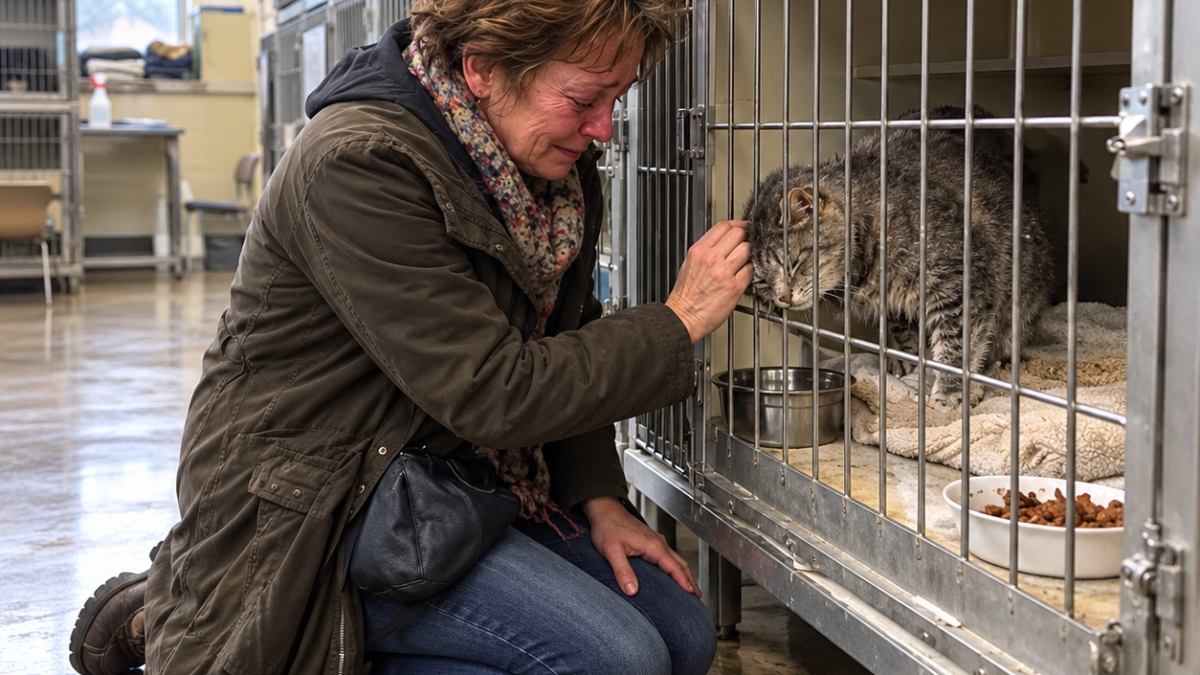
I looked into the enclosure.
And for one terrible second, I barely recognized him.
Marius was pressed against the back wall.
His body seemed smaller than it had that morning.
He wasn’t sleeping. He was crouched low, paws tucked beneath him, head angled downward as if even lifting it required too much courage.
A bowl of food sat untouched a short distance away.
His water didn’t look disturbed either.
I put my hand over my mouth.
“Oh, Marius.”
Anne touched my arm gently.
“You can go closer.”
I entered.
I didn’t rush toward him.
With his eyesight, a sudden shape moving in his direction could scare him. I crouched several feet away.
“Marius.”
His ears moved.
I swallowed.
“It’s me.”
His head lifted.
Not much.
Just enough.
“I’m here, sweetheart.”
He froze.
I could see his nose moving.
Smelling.
Listening.
Remembering.
For several seconds, nothing happened.
Then he stood.
His legs looked stiff.
He took one slow step.
Stopped.
Another.
His shoulder brushed the side wall.
He corrected himself.
I held out my hand but didn’t reach for him.
“That’s it.”
Another step.
When he reached me, his nose touched my fingers.
Then he pressed his forehead into my palm.
Something inside me gave way.
I sat on the floor.
I didn’t care who could see me.
I put one hand behind his shoulders, and Marius leaned against my chest while I cried into the fur between his ears.
“I’ve got you,” I kept saying. “I’ve got you. I’m sorry. I’m so sorry.”
He began to purr.
Very softly.
That sound nearly broke me again.
Anne waited by the door.
After a while, she said, “He reacted when you spoke before he could see you.”
I wiped my face.
“He knows my voice.”
“Yes.”
I looked down at him.
“He knows home.”
The paperwork took less time than I’d feared.
Marius was microchipped in my name, and I had veterinary records on my phone. Didier apparently had described himself as my husband and said we could no longer care for the cat.
That detail stopped me.
“What exactly did he tell you?”
Anne hesitated.
“I wasn’t the person at the front desk when he arrived.”
“Can you find out?”
She left for a few minutes.
When she returned, another employee came with her, a younger man named Julien.
“I checked the intake notes,” Julien said. “The person who brought him said there had been a change in the household and the cat was no longer manageable.”
I stared at him.
“Unmanageable?”
“He mentioned nighttime behavior, age-related issues, and allergies.”
“Allergies?”
“That is what the notes say.”
Didier wasn’t allergic to cats.
Not mildly.
Not secretly.
Not at all.
He had lived with Marius for months.
I felt my anger change shape.
Until then, some part of me had still been trying to interpret what Didier had done as a terrible impulsive decision.
Now I saw planning.
He had looked up shelters.
He had waited until I went to work.
He had put Marius in a carrier.
He had driven him across town.
He had constructed reasons that made giving away a fifteen-year-old nearly blind cat sound responsible.
Then he had come home and waited for me.
I asked Julien, “Did he say I agreed?”
Another hesitation.
“He said it was a household decision.”
I closed my eyes.
There it was.
Not a misunderstanding.
Not poor communication.
A lie.
I thanked them, signed what I needed to sign, and placed Marius into his carrier.
Normally, he complained the moment the door closed.
That afternoon he made no sound.
He curled against the towel inside.
Before I left, Anne crouched near the carrier.
“He’ll probably be unsettled tonight,” she said. “Keep everything familiar. Food, water, litter tray, furniture. Don’t change his environment.”
“I won’t.”
“If he refuses food or seems disoriented, call your veterinarian.”
“I will.”
She looked at me for a moment.
Then she said quietly, “He’s lucky you found him quickly.”
I looked down at Marius.
I knew what she meant.
Old cats were harder to place.
Old cats with disabilities were harder still.
I didn’t ask how long he might have stayed there if I hadn’t found him.
I couldn’t.
The drive home was quieter.
I kept the carrier buckled into the passenger seat.
At one red light, I put my fingers against the mesh.
Marius moved his head until his cheek touched them.
“Almost home,” I told him.
My phone buzzed twice.
Didier.
Then Élodie.
That surprised me.
I answered my daughter.
“Mom?”
“Hi.”
“What happened?”
I glanced at the carrier.
“What do you mean?”
“Didier called me.”
I laughed once, but there was no humor in it.
“Of course he did.”
“He said you two had a huge fight about Marius and you drove off.”
“He took Marius to a shelter.”
Silence.
Then:
“He what?”
“He gave him away while I was at work.”
Another silence, longer this time.
“Without telling you?”
“Yes.”
“Where is Marius now?”
“Beside me.”
Her exhale filled the phone.
“Thank God.”
I hadn’t realized how badly I needed someone else to say that.
Élodie’s voice changed.
“What did Didier tell me? He said he made a decision about the cat because things were becoming difficult at home.”
“He told the shelter Marius was unmanageable and that there were allergy problems.”
“What allergy problems?”
“There aren’t any.”
“Oh, Mom.”
I drove another block before saying, “He told them it was a household decision.”
Élodie swore under her breath.
She almost never did that around me.
“Are you going back there?”
“It’s my home.”
“You know what I mean.”
“Yes.”
“Do you want me to come?”
“From Lyon? No.”
“I can get a train.”
“No. Marius is safe. I need to handle Didier.”
She was quiet.
Then she said something that stayed with me.
“Don’t let him make you argue about whether Marius is difficult.”
I frowned.
“What?”
“That’s not the issue. He’ll try to make it the issue. Whether Marius wakes him up, whether there’s fur, whether he’s old. Don’t argue about any of that.”
My daughter knew conflict better than I sometimes gave her credit for.
“What is the issue, then?” I asked, though I already knew.
“He knew you’d say no, so he did it while you weren’t there.”
I looked through the windshield.
“Yes.”
“That’s the issue.”
When I reached the apartment, Didier’s car was still outside.
I sat with the engine off.
Through the carrier mesh, Marius gave one small, tired meow.
“All right,” I whispered. “Let’s go home.”
The moment I opened the apartment door, Marius’s body changed.
His head lifted.
His nose moved rapidly.
I placed the carrier in the hallway and opened it.
He didn’t come out immediately.
I waited.
Finally, one gray paw appeared.
Then another.
He stepped onto the familiar floor.
Stopped.
Turned his head toward the kitchen.
Then he began walking.
Slowly.
Seven little steps.
He reached his water bowl.
I covered my mouth again.
He drank.
Behind me, Didier said, “I’m glad you found him.”
I hadn’t heard him approach.
Marius froze at his voice.
That mattered to me.
Maybe it shouldn’t have.
But it did.
I picked Marius up carefully and carried him into the living room.
Didier followed.
Two plates were set on the table.
There was bread in a basket.
A bottle of wine.
For one surreal second, it looked like any dinner we might have shared during the months before our wedding.
“I made something,” he said.
I stared at the plates.
“You thought we were having dinner?”
“I thought we needed to sit down.”
I lowered Marius beside his bed.
He sniffed it twice, stepped in, circled once, and collapsed onto the blanket.
Only then did I turn around.
Didier looked exhausted.
He also looked genuinely sorry.
That was the hardest part.
If he’d been laughing or cruel, my decision might have been easier to explain.
Instead, he looked like a man who had made a terrible choice and wanted desperately to control the size of its consequences.
“I’m sorry,” he said.
I said nothing.
“I mean it.”
“You told the shelter we agreed.”
His eyes shifted.
“They needed a reason.”
“You told them there were allergies.”
“I didn’t know what they would ask.”
“So you lied.”
“I panicked.”
“You panicked before or after you searched for the shelter?”
His jaw tightened.
“Corinne.”
“Before or after you put Marius in the car?”
“Please don’t interrogate me.”
“Before or after you signed him over?”
“I said I’m sorry.”
“And I’m asking what happened.”
He pulled out a chair.
I remained standing.
He sat, then looked up at me.
“I haven’t been happy here.”
The sentence surprised me.
Not because I couldn’t imagine it, but because it was the first honest thing he’d said since I came home.
I waited.
He rubbed both hands over his face.
“I feel like I moved into a life that was already finished.”
I glanced toward Marius.
“What does that mean?”
“This place. The furniture. The routines. Your things. Michel’s things.”
My chest tightened.
There were very few of Michel’s belongings left visible after all these years. A framed photograph in the hallway. His old wooden desk. A blue ceramic bowl he’d bought on a holiday.
Nothing resembling a shrine.
But suddenly I understood that Didier had noticed every piece.
He continued.
“Sometimes I feel like I’m a guest here.”
“You never told me that.”
“I tried.”
“No. You complained about closet space. You said the mattress was too soft. You said Marius woke you up. That isn’t the same conversation.”
“I didn’t know how to say it.”
“So you chose the cat.”
He looked toward the living room.
“He was part of it.”
“Part of what?”
“The feeling that there wasn’t room for me.”
I stared at him.
Marius was sleeping ten feet away, his ribs rising and falling beneath gray fur.
“He weighs five kilos.”
“You know that’s not what I mean.”
“No. I don’t think I do.”
Didier stood.
“I wanted something that was ours.”
“We got married two days ago.”
“Exactly.”
“And your first act as my husband was to remove something that was mine.”
“That isn’t fair.”
I almost laughed.
“Fair?”
“I thought once it was done, you’d be upset, yes, but then we’d work through it.”
There it was.
He had expected anger.
Tears, maybe.
A fight.
But he had also expected me to accept the irreversible fact he’d created.
Marius gone.
Decision made.
Nothing left to discuss except how quickly I would forgive him.
“You knew I wouldn’t agree,” I said.
He looked away.
“Didier.”
“I knew you’d have trouble letting go.”
“Letting go?”
“He’s fifteen.”
I felt myself become very still.
“Finish that sentence.”
He looked at me.
“I didn’t mean—”
“Finish it.”
“He’s old, Corinne.”
“Yes.”
“He’s nearly blind.”
“Yes.”
“And you organize your whole life around him.”
“He eats twice a day and sleeps eighteen hours.”
“You know what I mean.”
“No, I don’t.”
“You worry about him constantly. You don’t want furniture moved. You don’t like staying away overnight. You make decisions based on whether he’ll be comfortable.”
“Because he’s an elderly animal who depends on me.”
“And where do I fit?”
The room went quiet.
I looked at the man I’d married.
Suddenly the argument wasn’t about Marius anymore.
Maybe it had never been.
“Is that what this was?” I asked. “A test?”
“No.”
“Were you trying to see whether I’d choose you?”
“That’s not what I said.”
“You didn’t give me a choice. You made it for me.”
“I wanted us to start fresh.”
I repeated his words slowly.
“Start fresh.”
“Yes.”
I looked around the apartment.
The framed photographs.
The old desk.
My books.
The rug Marius knew by touch.
The hallway where Élodie had once left muddy school shoes.
A home built from years I had actually lived.
“And who decides what has to disappear for us to start fresh?”
He opened his mouth.
Nothing came out.
That silence told me more than any answer could have.
I walked into the bedroom.
Didier followed me halfway down the hall.
“Where are you going?”
I opened the small jewelry box on my dresser.
My wedding ring caught the light.
For two days, I had kept noticing it.
While making coffee.
While typing at work.
While washing my hands.
A bright new object that was supposed to represent permanence.
I slid it off.
My finger looked oddly bare beneath it.
When I returned to the dining room, Didier was still standing beside the table.
I placed the ring between the two dinner plates.
The tiny metallic sound it made seemed impossibly loud.
His face changed.
“Don’t do this.”
“I already did.”
“Corinne.”
“I can’t live with someone who takes something I love and decides alone that it should disappear.”
“You’re ending our marriage over a cat?”
“No.”
“You just put your ring on the table because of a cat.”
“I put my ring on the table because my husband waited until I left for work, removed a dependent animal from my home, lied to a shelter about my consent, lied about allergies, came back here, and expected me to adjust.”
“I said I was sorry.”
“I know.”
“What else do you want?”
That question hurt more than he intended.
Because he really didn’t know.
“I wanted you to ask me before you did it.”
“I can’t undo that.”
“No.”
“I can apologize.”
“Yes.”
“I can promise it won’t happen again.”
I looked toward Marius.
“How would I ever know?”
Didier stared at me.
His eyes filled.
That was the first moment I felt my resolve weaken.
We had not married on a whim.
We had known each other almost three years.
There had been dinners and weekends away. Quiet mornings. Birthdays. Arguments resolved without cruelty. He had sat beside me in a hospital waiting room when Élodie had surgery. I had helped him empty his mother’s house after she died.
He wasn’t a stranger.
That made what he’d done worse, not better.
I sat down because my knees suddenly felt weak.
Didier took the chair opposite me.
For a while neither of us spoke.
Finally he said, “I was jealous.”
I looked up.
“Of Marius?”
“Of everything.”
His voice was lower now.
“Your history. Michel. This apartment. Your routines. Élodie calling and knowing exactly what you’re thinking before I do. Even that damn cat knowing where everything is.”
I frowned.
He gave a miserable little laugh.
“I know how stupid that sounds.”
“It sounds honest.”
He nodded.
“I thought marriage would make me feel like I belonged. Then I moved in and felt more like an outsider.”
“Why didn’t you tell me?”
“Pride, probably.”
“And Marius was easier to move than a conversation.”
He looked at the table.
“Yes.”
That answer softened something in me.
But it did not repair what mattered.
I said, “We could have moved furniture.”
His eyes rose.
“Not for Marius.”
“Some of it. Slowly. I could have shown him the new layout.”
I gestured toward the apartment.
“We could have made space for your books. Replaced the dining table. Bought a new bed. Put some of Michel’s things away. We could have found a compromise about the bedroom. We could have talked to the vet about Marius wandering at night.”
“I know.”
“We could even have discovered we weren’t ready to live together.”
He flinched.
“But every one of those things required you to talk to me.”
“I know.”
“You didn’t.”
“No.”
“You decided that if you created the result first, I’d have to accept it.”
He didn’t argue.
That was the truth.
After a minute he asked, “What happens now?”
“I think you should go back to your apartment tonight.”
“Tonight?”
“Yes.”
“Can we sleep on this?”
I looked at Marius.
He had lifted his head at our voices.
“No.”
Didier followed my gaze.
“I would never hurt him.”
“You already did.”
“I mean physically.”
“That isn’t the standard.”
He leaned back.
For the first time since I’d known him, he looked old to me.
Not elderly.
Just tired in a way I’d never noticed.
“This is insane,” he whispered.
“Maybe.”
“Two days.”
“Yes.”
“We’ve been married two days.”
“I know.”
He looked at the ring between us.
“And that’s it?”
I thought of Tuesday.
My blue dress.
Élodie adjusting a loose strand of my hair.
Didier taking my hands.
Friends smiling.
A simple lunch afterward.
The photographs still waited on my phone.
I had been happy.
That fact didn’t vanish just because Thursday happened.
Which was precisely why Thursday hurt so much.
“I don’t know what happens legally yet,” I said. “I don’t know what happens next month. I don’t even know what I’ll think next week.”
His eyes lifted with a flicker of hope.
“But tonight,” I continued, “I know I don’t want you sleeping here.”
That hope disappeared.
He packed a bag.
Not dramatically.
No shouting.
No slammed doors.
That almost made it sadder.
I sat beside Marius while Didier moved through the bedroom and bathroom collecting clothes, toiletries, his charger, the book he’d been reading.
At one point he came into the living room carrying a sweater.
He looked at Marius.
Marius did not move.
“I’m sorry, old man,” Didier said quietly.
I couldn’t tell whether the apology was for the cat, for me, or for himself.
Maybe all three.
At the door, Didier stopped.
“Can I call you tomorrow?”
I wanted to say no.
Instead I said, “Not in the morning.”
He nodded.
Then he left.
The lock clicked.
I stood in the hallway for a long time.
Two days earlier, I’d entered the same apartment as a newly married woman.
Now my husband was gone, my ring was on the dining table, and my fifteen-year-old cat was sleeping after being surrendered to a shelter.
I expected to feel furious.
Instead I felt tired.
I locked the door.
Then I checked it twice.
That night, Marius didn’t wander.
He slept beside my chair until nearly midnight.
When I finally went to bed, I left the bedroom door open.
Around three in the morning, I woke to a faint sound.
Tap.
Pause.
Tap.
Marius’s claws against the floor.
I sat up.
He was moving down the hall slowly.
I switched on the bedside lamp, though it made little difference to him.
“Marius?”
He stopped.
His ears turned toward me.
“I’m here.”
He walked into the room.
I lowered my hand beside the bed.
He followed my voice until his whiskers touched my fingers.
Then he curled on the rug.
I lay awake listening to him breathe.
The next morning, I called in late to work and took him to our veterinarian.
Dr. Lefèvre had treated Marius for almost eight years.
She examined his eyes, listened to his heart, checked his hydration, and asked what happened.
I told her.
Not everything.
Just enough.
She stopped writing.
“Someone surrendered him?”
“My husband.”
She knew I’d gotten married.
I watched the realization move across her face.
“Oh.”
“Yes.”
“When?”
“Yesterday morning. I found him yesterday afternoon.”
She crouched beside Marius.
“He’s stressed, but physically he seems all right.”
“Is there anything I should watch for?”
“Eating, drinking, litter habits, hiding, unusual vocalization. Keep his environment stable.”
“I will.”
She looked at me.
“Corinne, older cats can be resilient, especially when they return to familiar surroundings quickly.”
I nodded.
Then, embarrassingly, my eyes filled again.
Dr. Lefèvre handed me a tissue.
“I keep thinking about if I hadn’t found him.”
“But you did.”
“I called five places.”
“You found him.”
“What if I’d started later?”
She didn’t give me false reassurance.
Instead she said, “Then it’s good that you didn’t.”
I appreciated that.
On the way home, I bought Marius the expensive wet food he liked and pretended it was for medical reasons.
When we entered the apartment, he walked directly to his bed.
I had barely removed my coat when my phone rang.
My sister, Nathalie.
I stared at the screen.
There was only one reason my sister would be calling before noon on a Friday.
Didier had started talking.
“Hello?”
“What happened?”
“Good morning to you too.”
“Corinne.”
I sighed and sat down.
“What did he tell you?”
“That you threw him out because he took Marius to a shelter.”
“That’s the short version.”
“He sounds devastated.”
“So was the cat.”
“I’m not defending what he did.”
Whenever someone says that sentence, a defense usually follows.
Sure enough:
“But aren’t you moving a little fast?”
“He moved fast.”
“I mean with the marriage.”
I rubbed my forehead.
“Nathalie, he gave away my cat without telling me.”
“I know, and that was wrong.”
“He lied to the shelter and said I agreed.”
Silence.
“He what?”
“Didier told them it was a household decision. He also said there were allergies.”
“Is Didier allergic?”
“No.”
Another pause.
“Well. He didn’t mention that.”
“I imagine he didn’t.”
Nathalie exhaled.
“Still, marriages survive terrible mistakes.”
“Yes.”
“You’ve been together three years.”
“I know.”
“You love him.”
That was the problem.
I did.
I hadn’t stopped loving him somewhere between the empty cat bed and the shelter.
Love doesn’t operate that neatly.
“I do,” I said.
“Then maybe don’t make a permanent decision while you’re angry.”
“I haven’t filed anything. I asked him to leave.”
“That’s not what he thinks.”
I went still.
“What does he think?”
“He thinks you’re done.”
I glanced at my ring.
It was still on the table.
“Maybe I am.”
Nathalie lowered her voice.
“Over Marius?”
I closed my eyes.
“Don’t say it that way.”
“What way?”
“Like I’m choosing between a man and a cat.”
“I’m not.”
“Yes, you are.”
“Corinne—”
“He didn’t come to me and say, ‘I can’t live with Marius. Something has to change.’ If he had, we would have had a painful conversation. Maybe he would have moved out. Maybe we would have found another solution. Maybe we’d have discovered before the wedding that this marriage couldn’t work.”
I looked toward Marius.
“He waited until I was gone and made sure there was nothing left for me to decide.”
Nathalie was quiet.
Then she said, “That’s different.”
“Yes.”
“I understand.”
I wasn’t sure she fully did.
But she was trying.
That afternoon Didier sent me a message.
I didn’t open it for twenty minutes.
When I finally did, it was long.
He apologized again. He admitted he’d been resentful about moving into my apartment. He said he had convinced himself Marius would be cared for and perhaps adopted by someone with more patience.
That line made me put the phone down.
More patience.
As if fifteen years of caring for him had become a burden I simply didn’t recognize.
I walked to the living room window.
Marius was asleep in a patch of weak afternoon sunlight.
When I picked up my phone again, I finished reading.
Didier wrote that he had acted out of insecurity, not cruelty.
I believed him.
That distinction mattered.
It just didn’t absolve him.
Cruel things are not always done by cruel people.
Sometimes they’re done by frightened people who decide their fear matters more than another person’s right to choose.
He asked whether we could meet on Sunday.
I typed three different answers.
Deleted all three.
Finally I wrote:
We can talk Sunday afternoon. Not at the apartment.
He answered immediately.
Thank you.
I chose a café near the Maine River where we had gone during our first year together.
Neutral ground.
Sunday arrived gray and cold.
Didier was already there.
He stood when I approached.
For half a second, instinct took over and I almost leaned forward to kiss his cheek.
I stopped myself.
He noticed.
We sat.
His wedding ring was still on.
Mine was in the small zippered pocket of my handbag.
“How’s Marius?” he asked.
“Better.”
“Eating?”
“Yes.”
He nodded.
“I’ve been worried.”
I almost said, You lost the right.
But that would have turned the conversation into punishment.
I didn’t want punishment.
I wanted clarity.
Didier wrapped both hands around his coffee cup.
“I called the shelter.”
My spine stiffened.
“Why?”
“To apologize.”
“To them?”
“To them too.”
“What did you say?”
“The truth.”
I waited.
“That you hadn’t agreed. That I lied about the allergy.”
“And?”
“They weren’t happy.”
“I imagine not.”
He nodded.
“I wasn’t trying to hurt him.”
“I know.”
He looked surprised.
“You do?”
“Yes.”
That seemed to relieve him.
Then I added, “But you were willing to frighten him if it solved a problem for you.”
The relief disappeared.
“That’s harsh.”
“Is it inaccurate?”
He didn’t answer.
I continued.
“You saw Marius as something standing between you and the life you wanted.”
“I suppose.”
“And because you thought I’d protect him, you removed my ability to protect him.”
He stared at his coffee.
“I’ve replayed it a hundred times.”
“So have I.”
“I don’t even know why I thought you’d accept it.”
“You thought I’d have to.”
He looked up.
I saw the answer in his face before he spoke.
“Maybe.”
That single word mattered more to me than all his apologies.
Because it was true.
I said, “That is what scares me.”
“I understand.”
“Do you?”
“Yes.”
He leaned forward.
“I was angry that I didn’t feel at home. And instead of admitting that I felt insecure, I kept collecting evidence that you cared more about your old life than our new one.”
I listened.
“The cat. Michel’s desk. Your routines. Even where you keep the coffee.”
I almost smiled.
“The coffee?”
“Left cabinet.”
“It’s been there twenty years.”
“Exactly.”
For a moment, absurdly, we both smiled.
Then Didier’s face fell again.
“I wanted something to change because of me.”
There it was.
Not a monster.
Not a villain.
A man who had entered a fully formed life and wanted proof that his presence mattered.
I could understand that.
What I could not accept was how he had sought that proof.
“You should have told me,” I said.
“Yes.”
“I would have changed things.”
“I know that now.”
“You knew it then.”
He frowned.
“No.”
“You knew me.”
“That isn’t the same.”
“It should have been.”
He looked out the window.
After a while, he asked, “Is there any way back from this?”
I had been asking myself that question since Thursday.
By then my anger had cooled enough for the harder feelings to surface.
Grief.
Embarrassment.
Doubt.
A strange sense of failure.
I had married at fifty-seven believing I was old enough to know what I was doing.
Now, after forty-eight hours, I had taken off my ring.
Part of me feared people would think I was ridiculous.
Another part wondered if maybe they were right.
Had I overreacted?
Had shock made the decision for me?
Marriage was supposed to involve forgiveness.
Compromise.
Patience.
People make mistakes.
Didier had made one enormous mistake.
Was a marriage supposed to end because of one act?
I had no perfect answer.
So I told him the only thing I knew.
“I don’t trust you in my home.”
He flinched.
I continued.
“Not because I think you’ll steal something. Not because I think you’ll hurt me. But because I came home Thursday and something living that depended on me was gone because you decided it should be.”
“I would never do that again.”
“Maybe not with Marius.”
“With anything.”
“How do I know where your line is?”
He looked at me helplessly.
“I don’t know how to prove it.”
“Neither do I.”
He reached across the table.
His hand stopped halfway between us.
I didn’t take it.
After several seconds, he withdrew it.
“Do you want a divorce?”
Hearing the word aloud made my throat tighten.
“I think so.”
He closed his eyes.
The café continued around us.
Cups clinked.
A child laughed somewhere behind me.
The espresso machine hissed.
Ordinary sounds while a marriage ended at a little wooden table.
“I thought you’d calm down,” Didier said eventually.
I stared at him.
He winced.
“That’s not how I mean it.”
“How do you mean it?”
“Thursday night, I thought you were reacting from shock. Yesterday I thought we’d talk and you’d see that I understood what I did.”
“I do see that.”
“And it doesn’t matter?”
“It matters.”
“Then why isn’t it enough?”
I searched for words.
“Because understanding why you broke something doesn’t automatically repair it.”
He looked away.
We sat another hour.
There was no spectacular confrontation.
No screaming.
No public humiliation.
At one point Didier cried.
So did I.
I told him I loved him.
That was the most painful thing I said all afternoon.
He nodded.
“I love you too.”
“I know.”
“Then why does this feel so impossible?”
“Because love wasn’t the part that failed.”
He stared at me.
I didn’t explain further.
I didn’t need to.
When we left, he walked me to my car.
“Can I see you again?”
“I don’t know.”
“Can I call?”
“Give me a few days.”
He nodded.
Then he said, “Tell Marius I’m sorry.”
I almost replied that Marius wouldn’t understand.
But maybe that wasn’t true.
Animals understand tone.
Absence.
Safety.
Fear.
Return.
I simply said, “I will.”
The next few weeks were quiet.
Didier remained in his old apartment.
We spoke twice by phone.
The practical matters began slowly.
His belongings still filled one side of my wardrobe.
His coffee mug remained in the cupboard.
His razor sat beside my sink for three days before I finally put it in a box.
Each object made the separation feel simultaneously more real and more ridiculous.
A pair of shoes.
A charger.
Three books.
The blue scarf I’d bought him.
How could a marriage become boxes so quickly?
At work, I told only my manager at first.
She needed to know because I’d taken time off.
Eventually colleagues noticed my wedding ring was gone.
Most were tactful.
Some weren’t.
One woman from another department cornered me near the coffee machine.
“I heard you and Didier separated.”
I looked at her.
“News travels.”
“I’m sorry.”
“Thank you.”
Then came the question.
“Was it really because of the cat?”
I hated that question.
Not because it offended me.
Because I could understand why people asked it.
Compressed into one sentence, the situation sounded absurd.
Married Tuesday.
Husband gives away cat Thursday.
Wife ends marriage.
People like simple equations.
But life wasn’t the equation.
It was the reasoning behind it.
“He gave Marius to a shelter without telling me,” I said.
She grimaced.
“That’s awful.”
“Yes.”
“But a marriage…”
She stopped.
I waited.
She looked embarrassed.
“Sorry. None of my business.”
“No, it isn’t.”
That evening, I wondered whether I had been too sharp.
Then I came home.
My key touched the lock.
Before I opened the door, I heard a faint scratch on the other side.
I smiled.
Marius.
I stepped inside.
He was waiting in the entrance again.
For the first time since the shelter, he’d returned to his old routine.
I crouched.
“There you are.”
He bumped his head against my knee.
The question from work stopped bothering me.
Over the next month, Didier and I had several difficult conversations.
One happened when he came to collect the rest of his belongings.
I made sure Marius was in the bedroom with food and water before Didier arrived.
Not because I thought Didier would do anything.
Because I didn’t want Marius disturbed.
Didier noticed the closed door.
“He’s in there?”
“Yes.”
“Because of me?”
“Because moving boxes around will confuse him.”
It was partly true.
Didier accepted it.
We packed quietly.
Halfway through, he found an old photograph tucked behind books on a shelf.
Michel and me, twenty years younger, sitting outside a restaurant.
Didier held it for a few seconds.
“I hated these.”
I looked at the picture.
“I didn’t know.”
“I know.”
“You could have told me.”
He handed it to me.
“I know.”
That had become the sentence between us.
I know.
Too late for some things.
Useful for others.
He sat on the edge of the sofa.
“I used to look around this apartment and think there was no evidence I’d ever been here.”
I glanced at the boxes.
“There was.”
“Not enough for me.”
“That sounds like something we could have fixed.”
He nodded.
“I know.”
I sat across from him.
“Did you really think getting rid of Marius would make you feel at home?”
“No.”
“You did it anyway.”
He rubbed his palms together.
“I think I wanted you to prove I came first.”
I felt something cold move through me.
“How?”
“By accepting it.”
There was the deepest truth yet.
Not that he hated Marius.
Not that he couldn’t tolerate fur.
He had wanted evidence that marriage had rearranged my loyalties.
And he had created a test I didn’t know I was taking.
“What would have happened if I’d come home and said nothing?” I asked.
He stared at the floor.
“I don’t know.”
“Would you have felt better?”
“No.”
“Would you have respected me?”
His head lifted.
“Of course.”
“Really?”
He looked away again.
That was answer enough.
I stood.
“We should finish packing.”
After he left, I opened the bedroom door.
Marius stood just inside.
He sniffed the air.
Then he walked past the stack of boxes toward the living room.
One box had been left partly in his usual path.
He stopped.
His whiskers touched the cardboard.
He backed up.
I immediately moved it.
“There.”
He tried again.
This time he continued.
Such a tiny thing.
An obstacle.
A correction.
Space restored.
I stood there longer than necessary, looking at the clear path.
A few days later, Élodie came from Lyon.
She arrived carrying pastries and enough food for a family of six.
“You look tired,” she said.
“Hello to you too.”
“You do.”
“You look bossy.”
“I inherited it.”
She hugged me.
Marius recognized her voice and emerged from the bedroom.
Élodie dropped immediately to the floor.
“My handsome old man.”
Marius sniffed her fingers.
Then he turned away.
She looked offended.
“Fifteen years and that’s all I get?”
“He has standards.”
That night we ate at the kitchen table.
Élodie waited until after dessert before asking about Didier.
“Do you miss him?”
“Yes.”
She seemed surprised by the speed of my answer.
“I thought you’d say no.”
“Why?”
“Because you’re the one ending it.”
“That doesn’t mean I stopped missing him.”
She pushed crumbs around her plate.
“Do you regret marrying him?”
I thought about it.
“No.”
“Really?”
“No.”
She frowned.
“I regret what happened. I regret that we didn’t see the problem before. But I was happy when I married him.”
“That’s sad.”
“Yes.”
She reached across the table.
“Mom, can I ask something without you getting mad?”
“Unlikely, but go ahead.”
“Are you sure you’re not deciding too fast?”
There it was again.
But from Élodie, I could hear it differently.
She wasn’t minimizing Marius.
She was checking whether I had examined my own decision.
“I ask myself every day.”
“And?”
“I keep coming back to Thursday.”
“Because he took Marius.”
“Because of how.”
She nodded slowly.
I continued.
“If Didier had told me before the wedding that living with Marius was unbearable, I would have had to make a decision. It would have hurt. Maybe we would have delayed moving in. Maybe the marriage wouldn’t have happened.”
“But he didn’t.”
“No. He waited until my decision was inconvenient and removed it.”
Élodie looked toward the living room.
“So it really isn’t about the cat.”
“It is about the cat.”
She looked back at me.
I smiled sadly.
“That’s what people get wrong. It can be about Marius and also about something bigger. I don’t have to pretend the cat doesn’t matter in order for the principle to matter.”
She considered that.
“I like that.”
“I don’t need you to like it.”
“There. That’s the mother I know.”
We both laughed.
Later, after Élodie went to sleep, I sat beside Marius.
His eyes had become cloudy with age.
One reflected light strangely.
I stroked his back.
“You caused quite a scandal.”
His ear twitched.
“I hope you’re satisfied.”
He began purring.
For the first time in weeks, I laughed without sadness following immediately behind it.
The administrative end of my marriage was much less dramatic than the emotional one.
There were appointments.
Documents.
Questions.
A surprising amount of waiting.
Didier and I kept things civil.
There was no house to divide because the apartment had always been mine.
No children together.
No shared business.
No complicated finances.
What we had to divide was mostly expectation.
At one meeting, we sat side by side in a hallway while waiting to speak with someone.
Didier looked at my left hand.
“You never put it back on.”
“No.”
He nodded.
“I kept mine on longer than I should have.”
I looked at his hand.
His ring was gone too.
That hurt.
It also felt honest.
He said, “I’ve started seeing someone.”
My stomach dropped.
Then he added quickly, “A therapist.”
I stared at him.
He smiled faintly.
“Your face.”
“I thought you meant—”
“I know.”
I shook my head.
“You could have said therapist first.”
“Probably.”
We were quiet.
Then I asked, “Is it helping?”
“Yes.”
“Good.”
He looked at the floor.
“I’ve been thinking a lot about control.”
I didn’t respond.
He continued anyway.
“My father made every decision in our house. My mother complained, but eventually she always gave in. I used to hate watching that.”
I turned toward him.
“And then?”
“And then apparently I learned more from it than I thought.”
His voice held no self-pity.
That mattered.
“I don’t say that as an excuse,” he added.
“I know.”
“I think I believed making decisions meant taking responsibility.”
“Sometimes it does.”
“Yes. But not decisions that belong to two people.”
I nodded.
The door opened, and our names were called.
That conversation stayed with me.
Not because it changed my decision.
Because it allowed me to stop needing Didier to be the villain.
For a while, anger had made everything simpler.
He was wrong.
I was right.
He betrayed me.
I left.
But people are rarely that clean.
Didier loved me.
He also tried to control something he had no right to control.
He felt insecure.
He also lied.
He regretted it.
The regret was real.
So were the consequences.
Both things could exist at once.
That realization let me grieve the marriage without rewriting all three years before it as fake.
There had been good things.
I kept them.
I just didn’t use them to excuse the bad one.
Marius recovered faster than I did.
Within a month, he was again waiting near the entrance most evenings.
His appetite returned.
He resumed his nighttime wandering.
At 2:00 a.m., I sometimes heard the familiar click of claws moving through the hallway.
Instead of annoying me, the sound made me smile.
Once, I caught myself wondering whether Didier had been right about how loud it was.
Then I laughed quietly into my pillow.
“All this trouble,” I whispered.
From the hall came one offended meow.
Winter passed.
Spring returned to Angers.
One Saturday morning, Nathalie visited to help me clean.
She was the sort of person who couldn’t sit in my apartment for twenty minutes without reorganizing something.
She moved a lamp.
I put it back.
She shifted a small table.
I moved it back.
Finally she put both hands on her hips.
“Am I allowed to touch anything?”
“Not if Marius uses it as a landmark.”
“He uses the lamp as a landmark?”
“He might.”
“You’ve become impossible.”
“I’ve always been impossible.”
“That is true.”
We cleaned around Marius while he slept through most of it.
Then Nathalie pushed his old armchair several inches to vacuum beneath it.
Neither of us thought anything of it.
That evening, long after she’d left, I sat reading.
Around nine, Marius woke.
Nine o’clock had always been his hour.
Even when he was young, he liked to climb onto the chair beside mine after dinner.
Now, because his sight was so poor, he approached in stages.
He walked to the edge of the rug.
Turned.
Took three steps.
Reached forward with one paw until he touched the wooden leg.
Then he knew exactly where to jump.
That night, he reached the spot.
Extended his paw.
Found nothing.
He tried again.
Nothing.
His head moved from side to side.
I watched him.
For perhaps two seconds, I didn’t understand.
Then I saw the chair.
Six inches out of place.
That was all.
Six inches.
To me, almost nothing.
To Marius, part of the world had vanished.
I stood.
“Wait.”
He heard my voice and stopped moving.
I pulled the chair back to its exact place.
The leg settled onto the old marks in the rug.
“There.”
Marius stretched his paw again.
Touched wood.
His body relaxed immediately.
He sniffed the chair, turned twice, and climbed onto the cushion.
Then he curled into himself and closed his eyes.
I remained standing beside him.
Six inches.
I thought of Thursday.
The empty bed.
The silent hallway.
The shelter.
Marius crouched against the back wall because every familiar landmark had disappeared at once.
Then I thought of Didier.
His complaint that he’d entered a life where everything already had a place.
For the first time, I saw both things together without confusing them.
Didier had needed room.
That need had been real.
Marius had needed stability.
That need had been real too.
There had been solutions.
A hundred ordinary solutions.
A new chair.
A different bedroom arrangement.
A slow reorganization.
A conversation about Michel.
A conversation about grief.
A conversation about belonging.
Maybe counseling before marriage.
Maybe separate homes for longer.
Maybe an honest acknowledgment that love did not automatically make us compatible.
Every one of those possibilities had required us to tolerate uncertainty long enough to talk.
Instead, Didier had tried to solve his discomfort by making my choice disappear.
That was the part I could never return from.
Months after our separation became final, Didier asked to meet once more.
We walked beside the river.
There was no argument left between us.
At one point he said, “I wish I’d done almost everything differently.”
I smiled sadly.
“So do I.”
“Do you ever think we could have made it?”
“Yes.”
He looked surprised.
“I thought you’d say no.”
“I think that’s why it hurts.”
He nodded.
We walked another hundred yards.
Then he asked, “How’s Marius?”
“Old.”
“That hasn’t changed.”
“Older.”
“Still waking people at night?”
“Only me.”
He smiled.
“I deserved that.”
“I wasn’t trying to punish you.”
“I know.”
He shoved his hands into his coat pockets.
“I’m glad you found him.”
“So am I.”
“Do you hate me?”
I stopped walking.
“No.”
He searched my face.
“Not even a little?”
“Some days I did.”
“Fair.”
“But no. I don’t hate you.”
“That’s something.”
“Yes.”
We started walking again.
At the corner where our paths separated, he hugged me.
I let him.
It was not romantic.
It was goodbye.
“Take care of yourself, Corinne.”
“You too.”
He turned away.
After a few steps, I called his name.
He looked back.
“I hope your next home feels like yours.”
His expression changed.
“Thank you.”
Then he left.
When I got home, I put my key in the lock.
Before I could turn it, I heard a familiar movement inside.
Scratch.
Pause.
Scratch.
The door opened.
Marius stood in the hallway.
He was thinner now.
Grayer.
His cloudy eyes looked somewhere slightly to the left of me.
But his ears were pointed directly toward my voice.
“Hello, old man.”
He walked forward.
One step.
Another.
Then his forehead touched my ankle.
I put my bag down and crouched beside him.
For fifteen years, Marius had learned the geography of my life through repetition.
The position of a bowl.
The edge of a rug.
The leg of a chair.
The sound of my key.
The direction of my voice.
He needed very little from me.
Food.
Warmth.
A familiar path.
And the simple certainty that the world he depended on would not disappear while he wasn’t looking.
I picked him up.
He protested immediately, because he had always hated being carried longer than necessary.
“There you are,” I said, laughing.
I set him down.
He walked toward the living room.
At the edge of the rug, he turned exactly where he always had.
Three careful steps later, he reached forward.
His paw found the wooden leg of his chair.
He climbed onto the cushion, circled twice, and settled down.
I switched on the lamp beside him.
He couldn’t really see the light anymore.
I left it on anyway.
Then I sat in my own chair.
For a long time, neither of us moved.
Marius could barely see.
But he still knew exactly where his home was.
And after that Thursday, so did I.
[END OF STORY]








