PART 2: Trapped Underground for Four Days, His Body Was Failing—But His Heart Refused to Stop
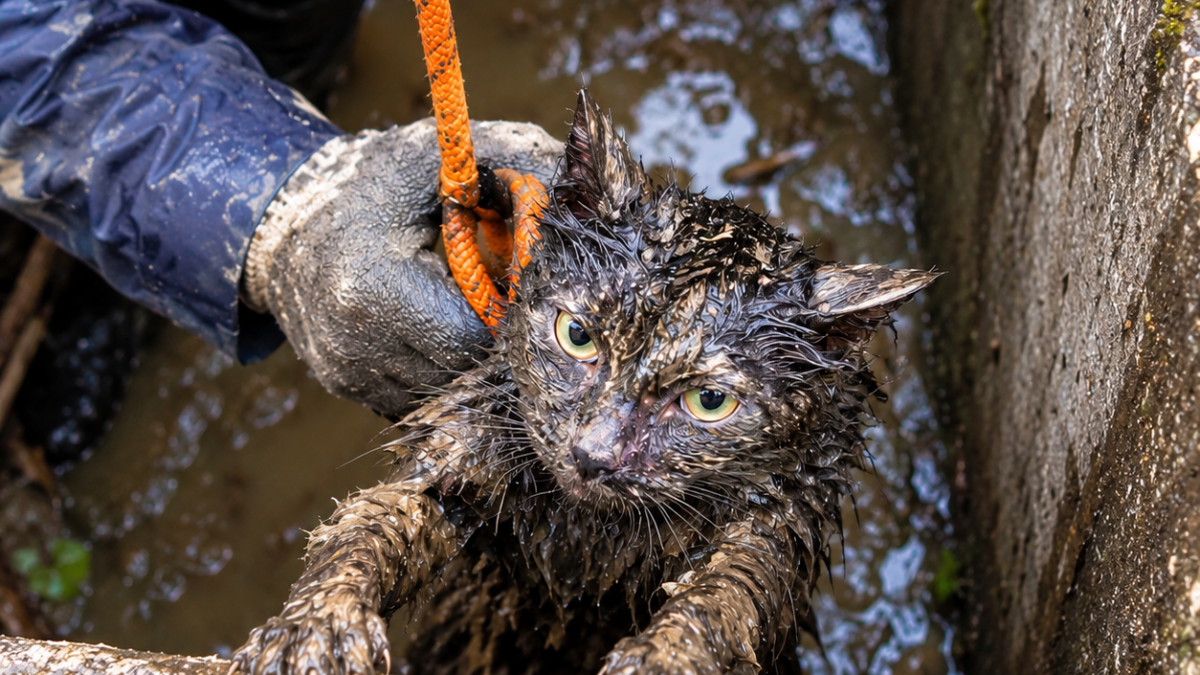
For four days, that cat had been trapped nearly thirteen feet underground in filthy storm water, and by the time I found him, part of his crushed hind leg had already begun to die while the rest of his body was quietly shutting down around it.
He was so weak that he no longer tried to climb, hiss, or even cry for help—he simply stared into my flashlight and rested his head in my hand when I finally managed to reach him.
But when we lifted him into daylight and the veterinarian listened to his chest, she looked at me with an expression I had never seen before and said there was something about his condition she could not explain.
I heard him before I knew where he was.
I have worked for the city’s public works department for almost fifteen years, and after heavy storms, checking clogged drains is routine. That morning, branches, plastic bags, and mud covered half the old storm-sewer opening near a low section of road.
I was pulling debris away when I heard something.
Soft.
Thin.
Almost lost beneath the sound of running water.
I stopped.
There it was again.
A meow.
“Hello?”
Nothing.
I knelt beside the opening and shined my flashlight down the shaft.
Dirty water moved along the bottom. Wet concrete reflected the light. The shaft dropped nearly thirteen feet before connecting to a horizontal drain.
At first I saw nothing alive.
Then two eyes reflected from the far corner.
I froze.
“Oh, buddy.”
The cat did not move toward me.
He did not even cry again.
He just watched.
I called two coworkers, Mike and Carlos.
“There’s a cat down there.”
Mike looked over the edge.
“How the hell did he get in?”
“No idea.”
We tried lowering a rope with a loose loop.
Nothing.
A net.
Nothing.
The cat barely lifted his head.
That was when I understood this was not a frightened animal refusing rescue.
He physically could not come to us.
Carlos brought a telescoping ladder from the truck.
“You’re not going all the way down,” he warned.
“I know.”
The walls were slick, the water was rising slowly, and confined drainage systems are not places you enter casually.
I descended only far enough to get closer.
Then the smell reached me.
Mud.
Rotting leaves.
Sewage.
And underneath it, unmistakably, dying tissue.
My flashlight moved across the cat.
His spine showed through his soaked coat. One hind leg lay at an unnatural angle, swollen around the upper portion and blackened farther down. Open tissue had been soaking in contaminated water.
“Oh, God.”
Mike called from above.
“What?”
“His leg.”
The cat looked at me.
I extended my hand slowly.
Any injured cat can bite when terrified, and I expected him to recoil.
He didn’t.
My fingers touched his cheek.
His eyes closed.
Then, with the last bit of strength he seemed to have, he lowered his head into my palm.
That broke something in me.
“I’ve got you.”
We could not safely carry him up the ladder in our arms, so Carlos lowered a heavy canvas utility bag lined with towels. I eased the cat into it while Mike controlled the rope from above.
He weighed almost nothing.
When the bag reached the surface, I climbed out after him.
The cat lay wrapped in a towel on the pavement.
For several seconds, sunlight hit his face and he did not react.
Mike crouched beside him.
“Is he breathing?”
“Yes.”
Barely.
We put him in the cab and drove to the nearest emergency veterinary hospital.
I called ahead.
“Severe leg trauma, hypothermia, dehydration. Possibly septic.”
The receptionist asked how long he had been trapped.
“We don’t know.”
Later, based on the storm, witness reports, and the condition of the injury, the veterinarian would estimate nearly four days.
Four days underground.
No food.
No clean water.
No dry place to lie down.
When we carried him through the clinic doors, a veterinary technician immediately took him from me.
Within minutes, oxygen tubing, warming blankets, IV lines, and monitors surrounded him.
A veterinarian named Dr. Amelia Grant listened to his chest.
Then she listened again.
She looked at the monitor.
Then back at him.
“What?” I asked.
She did not answer immediately.
Finally she said, “His temperature is dangerously low, his blood pressure is barely measurable, and that leg is severely necrotic.”
“Can you save him?”
Dr. Grant kept her stethoscope against his chest.
“I don’t know.”
Then she looked directly at me.
“But considering what his body is doing right now, I also don’t understand how his heart is still beating this strongly.”
PART 2
I stared at her.
“What does that mean?”
“It means he is much sicker than he looks.”
I almost laughed.
That seemed impossible.
The cat lying beneath the warming blanket looked as close to death as any living animal I had ever seen.
Dr. Grant must have seen the confusion on my face.
“His heart rhythm is surprisingly organized,” she explained. “That’s good. But the rest of him is in serious trouble. His temperature is only ninety-three degrees. His gums are pale. He’s profoundly dehydrated. And I’m very concerned about infection from that leg.”
“Can you amputate it?”
“Not yet.”
“Why?”
“Because anesthesia could kill him right now.”
That was the first time the situation became clear in a way I could not avoid.
Getting him out of the storm drain had not saved him.
It had only given him a chance to begin the next fight.
A technician clipped away the soaked fur around his injured leg.
I had seen enough injuries in fifteen years of city work—traffic accidents, falls, machinery incidents—to know when something was beyond repair.
The lower portion of the cat’s hind leg was cold and dark.
There was almost no response when Dr. Grant touched it.
“The tissue is dead,” she said quietly. “The question is how far the damage extends.”
Another technician drew blood.
They placed a second IV catheter because his circulation was so poor.
Warm fluids began running.
They wrapped him in a forced-air warming blanket.
Oxygen flowed near his face.
The cat opened his eyes once.
They found me standing beside the table.
I stepped closer.
“Hey.”
His eyes closed again.
Dr. Grant looked at me.
“Do you know who owns him?”
“No.”
“Collar?”
“Nothing.”
“Microchip?”
“They haven’t checked yet.”
One of the technicians brought the scanner.
She passed it over his shoulders.
A beep sounded.
Everyone stopped.
“He’s chipped.”
That changed the room.
The technician scanned again and wrote down the number.
“I’ll call the registry.”
For the first time since finding him, I imagined someone somewhere looking for him.
Maybe a family had been walking the neighborhood every night.
Maybe a child had been crying over an empty food bowl.
Maybe there was an explanation for how a cat ended up thirteen feet underground with a shattered leg.
Ten minutes later, the technician returned.
“The chip is registered.”
“To who?”
She hesitated.
“The phone number is disconnected.”
The address was several years old.
A rental property on the other side of town.
Dr. Grant looked at me.
“We’ll keep trying.”
I nodded.
“What does he need right now?”
“Time.”
I hated that answer.
Time was what he had already spent too much of in the dark.
Dr. Grant showed me the first blood-test results.
His white-cell count was severely abnormal.
His kidney values were elevated.
His blood sugar was low.
His red-cell count was borderline.
There were signs of severe systemic inflammation.
“Sepsis?” I asked.
“Possibly. At minimum, he has a significant infection.”
“From the leg.”
“Most likely.”
She pointed to another value.
“This worries me too.”
“What?”
“His kidneys have taken a hit.”
“Permanent?”
“We don’t know yet. Severe dehydration can raise these numbers. Infection can too. If we restore circulation and hydration, they may improve.”
“If they don’t?”
She did not soften the answer.
“Then we have another major problem.”
The clinic started broad-spectrum antibiotics.
Pain medication.
Warmed IV fluids.
Glucose.
The staff cleaned what they safely could around the damaged limb without stressing him further.
I was supposed to return to work.
Instead, I called my supervisor.
“You find the blockage?” he asked.
“Yeah.”
Technically true.
Then I told him about the cat.
There was a pause.
“You staying there?”
“For a little while.”
He sighed.
“I figured.”
“I’ll make up the time.”
“Don’t worry about it.”
That surprised me.
My supervisor, Dennis, was not known for sentimental speeches.
Then he added, “Just let me know if the little guy makes it.”
That was the beginning of what eventually became half the public works department asking me about a cat none of them had met.
For the first two hours, almost nothing visibly improved.
His temperature rose one degree.
Then another half.
His blood pressure became detectable without repeated attempts.
But he remained motionless.
Around noon, Dr. Grant came to find me.
“We need to talk about the leg.”
I followed her into a consultation room.
She pulled up X-rays.
The femur was intact.
The lower hind limb was not.
The bones below the knee had suffered severe trauma.
There were fractures and soft-tissue destruction consistent with either a fall or being caught violently against something during the storm.
“We can’t save it,” she said.
“I understand.”
“The dead tissue is also acting as an infection source. If we can stabilize him enough, amputation gives him his best chance.”
“When?”
“Maybe tonight. Maybe tomorrow morning.”
“That soon?”
“If his blood pressure improves enough.”
“And if it doesn’t?”
She met my eyes.
“We may have to choose between extremely risky surgery and allowing the infection to continue spreading.”
Neither option sounded like a choice.
I looked through the glass wall into treatment.
The cat was barely visible beneath blankets.
“What would you do?”
Dr. Grant took a second before answering.
“If his heart remains stable and his temperature keeps improving, I would operate.”
“Even with the risk?”
“Yes.”
I nodded.
“Then give him the chance.”
She looked at me carefully.
“Are you taking financial responsibility?”
I had not even thought about money.
That sounds foolish now.
Emergency hospitalization, surgery, diagnostics, medication—it adds up quickly.
“How much?”
She gave me an estimate.
I swallowed.
It was more than I had expected.
A lot more.
I lived alone.
I had a mortgage.
A truck payment.
A daughter in college.
I could not pretend the number meant nothing.
Dr. Grant seemed to understand.
“We can contact local rescue groups.”
“How long will that take?”
“Possibly a few hours.”
“Will delaying surgery for money hurt him?”
“We are not operating this minute regardless. He needs stabilization.”
That gave us time.
I called a rescue organization I knew from previous city animal calls.
Then another.
The first had no emergency fund available.
The second said they could contribute part of the cost if the cat became medically stable enough to transfer later.
Mike called while I was making the third call.
“How’s Drain Cat?”
“Drain Cat?”
“We had to call him something.”
“He’s alive.”
“That doesn’t sound encouraging.”
“His leg has to come off.”
Mike went quiet.
“Damn.”
“Yeah.”
“How much?”
I told him.
Another pause.
“I’ll send you something.”
“You don’t have to.”
“I know.”
Twenty minutes later, fifty dollars appeared in my payment app.
Carlos sent fifty too.
Dennis sent one hundred with the message:
*For the toughest employee we’ve found all year.*
By two that afternoon, word had spread through our department.
People I barely spoke to sent ten dollars.
Twenty.
Five.
A sanitation driver sent thirty.
One parks employee sent fifteen and wrote:
*I have three cats. Don’t let him die over money.*
The rescue agreed to cover the remaining portion of the surgery fund.
I stood in the clinic lobby looking at my phone.
Dr. Grant walked by.
“You okay?”
“Apparently the entire city maintenance department adopted him.”
She smiled.
“Good.”
At three-thirty, his temperature passed ninety-seven degrees.
At four, he lifted his head.
A technician called me over.
“Look.”
The cat was awake.
Not fully alert.
But awake.
His eyes followed movement.
I approached.
“Hey, Drain Cat.”
One ear twitched.
“That’s a terrible name.”
Another tiny ear movement.
The technician laughed.
“He agrees.”
I reached toward him.
He sniffed my fingers.
Then, almost invisibly, his throat vibrated.
I looked at the technician.
“Is he—”
“Purring.”
It made no sense.
He was septic.
Half frozen.
Starving.
Missing circulation to most of one leg.
And he was purring.
Dr. Grant heard it too.
“Cats are strange,” she said. “They purr when comfortable, but sometimes also when stressed or painful.”
“So I shouldn’t take this personally.”
“You can take a little credit.”
I scratched carefully behind his ear.
The purr became louder.
That was the moment he stopped being “the cat from the drain” to me.
He needed a name.
“What about Murphy?” Mike suggested when I called him.
“Why Murphy?”
“Because anything that could go wrong apparently did.”
“No.”
“Lucky?”
“Too obvious.”
Carlos suggested Storm.
Dennis suggested Sewer.
I rejected that immediately.
Finally, one of the technicians said, “What about Milo?”
I looked at the cat.
“Milo?”
His eyes opened.
The technician smiled.
“He voted.”
So Milo it was.
By six that evening, his blood pressure had improved enough that Dr. Grant began discussing surgery.
The repeat blood work was slightly better.
Not good.
Better.
She came to me in the waiting room.
“I think waiting until morning gives the infection too much time.”
My stomach tightened.
“You want to operate tonight.”
“Yes.”
“How risky?”
“High.”
“Can you put a number on it?”
“No.”
I appreciated that she did not invent one.
“What are you most worried about?”
“His blood pressure crashing under anesthesia. Cardiac instability. Kidney injury. We also don’t know how far the infection has spread beyond the leg.”
“But leaving it—”
“Is also dangerous.”
I rubbed both hands across my face.
“What happens if I say no?”
“Then we continue antibiotics and supportive care, but I think the necrotic tissue will keep working against us.”
I looked through the treatment-room window.
Milo was asleep.
One front paw extended outside the blanket.
Four days earlier, he had probably been a perfectly ordinary cat.
Walking somewhere.
Exploring.
Maybe chasing something.
Then one wrong step.
One fall.
One storm.
And now a stranger he had met that morning was being asked to make a decision about whether he underwent surgery that might kill him.
“I say yes.”
Dr. Grant nodded.
“We’ll take good care of him.”
“When?”
“About thirty minutes.”
I went to the treatment table before they prepared him.
Milo lifted his head.
“Listen.”
His eyes were half closed.
“You already did the hard part.”
I knew that was a lie.
“Now they’re going to fix what they can.”
He blinked.
I stroked the top of his head.
“You’re coming back.”
That was another promise I had no right to make.
But I made it anyway.
They took him into surgery at 6:47 p.m.
I know the exact time because I stared at the clock so often that night I can still see it.
The waiting room emptied gradually.
A family left with a limping Labrador.
A woman carried out a rabbit in a blue carrier.
A man came in with a vomiting terrier.
Life continued around me.
At 7:30, no update.
At 8:00, nothing.
At 8:19, a technician came through the doors.
I stood.
“Milo?”
“He’s stable.”
My knees almost gave out.
“Still operating?”
“Yes.”
“How much longer?”
“I don’t know.”
She saw my expression.
“Stable is good.”
I nodded.
“Stable is good.”
She disappeared again.
At 9:06, Dr. Grant came out.
Her surgical cap covered most of her hair.
There was fatigue in her face.
But she smiled.
“He made it through.”
I sat back down.
Not deliberately.
My body simply stopped holding me up.
“The leg?”
“Removed.”
“The infection?”
“We removed all visibly compromised tissue. We’ll culture samples. The next twenty-four hours are critical.”
“But he’s alive.”
“He’s alive.”
I laughed once.
It sounded strange.
Dr. Grant sat across from me.
“The damage was worse than the X-rays showed. If he had stayed down there another day, maybe even another several hours, I don’t think we would be having this conversation.”
That hit harder than I expected.
I thought about the sound beside the drain.
The meow I nearly dismissed as water moving through debris.
“What if I hadn’t stopped?”
Dr. Grant shook her head.
“Don’t do that to yourself.”
“But if—”
“You did stop.”
That was true.
Sometimes one fact is enough.
Milo woke around midnight.
I was not there.
Dr. Grant had finally ordered me home.
I slept for maybe three hours.
At 5:40 the next morning, I called the clinic.
The overnight technician answered.
“He’s alive.”
Those were the first words she said.
I gripped the phone.
“How is he?”
“He’s actually sitting upright.”
“Sitting?”
“Not elegantly.”
I laughed.
“Has he eaten?”
“Not yet.”
“Can I come?”
“We open regular visiting at seven.”
I arrived at 6:52.
No one commented.
Milo looked terrible.
But he looked terrible in a completely different way.
The injured leg was gone.
His hip and surgical site were bandaged.
He was still thin enough that every bone showed.
But his eyes were brighter.
When I walked toward the kennel, he lifted his head.
“Morning.”
He gave me the smallest possible meow.
I stared at him.
“You found your voice.”
Another meow.
A technician handed me a shallow dish of food.
“Try.”
I placed it in front of him.
He smelled it.
Turned away.
My heart dropped.
“Is that bad?”
“Not unexpected.”
We warmed the food.
Added something stronger-smelling.
Nothing.
Dr. Grant arrived.
“Don’t panic.”
“I’m not.”
“You look panicked.”
“He needs to eat.”
“He needs many things. Eating is one.”
The repeat blood work showed another concern.
His kidney numbers had worsened overnight.
That possibility had been sitting in the background from the beginning.
Now it moved to the front.
“Acute kidney injury?” I asked.
“Yes.”
“From dehydration?”
“Possibly dehydration, low blood pressure, infection, or all three.”
“Can he recover?”
“Yes.”
“Can?”
“Yes.”
There was that word again.
Can.
Not will.
They continued IV fluids carefully.
Too little would not support his kidneys.
Too much could create other problems.
Urine output was monitored.
Electrolytes checked.
By noon, Milo still had not eaten.
By three, he licked a little food from my finger.
The technician smiled.
“Again.”
I offered another tiny amount.
He swallowed.
Then another.
Five licks.
That was all.
We celebrated as if he had eaten Thanksgiving dinner.
That night, his temperature rose.
Not dangerously.
But enough to worry everyone.
The surgical site remained clean.
His blood pressure was stable.
Cultures were pending.
Antibiotics continued.
I went home convinced the phone would ring overnight.
It did.
At 1:14 a.m.
I sat upright before answering.
“Hello?”
It was the emergency technician.
My heart pounded.
“Milo’s okay.”
I closed my eyes.
“You need to start with that.”
“I just did.”
“Right.”
“We wanted permission to place a feeding tube if he continues refusing enough calories.”
“Yes.”
She paused.
“You don’t want to speak to the veterinarian first?”
“Does he need it?”
“Probably.”
“Then yes.”
“Okay.”
“Is that why you called?”
“Also his kidney values are stable.”
I nearly laughed.
“You could’ve started with that too.”
“They’re not improved. Just not worse.”
At that stage, “not worse” felt beautiful.
By the third day, Milo began eating voluntarily.
Tiny amounts.
Then a little more.
His urine output improved.
His creatinine dropped slightly.
His white-cell count began moving toward normal.
Every number felt personal.
I learned laboratory values I had never wanted to know.
BUN.
Creatinine.
Packed cell volume.
Neutrophils.
Electrolytes.
Dr. Grant would show me the chart and I would stare at it like an investor reading stock prices.
“Better?”
“Slightly.”
“How slight?”
“Enough.”
That became another favorite word.
Enough.
Enough to continue.
Enough to wait.
Enough to hope.
On the fourth day after surgery, Milo tried to stand.
He forgot he had three legs.
The first attempt was awful.
He pushed up.
His body shifted toward the missing limb.
He toppled sideways.
I jumped.
The technician caught him before he hit the kennel wall.
Milo looked offended.
Not frightened.
Offended.
The technician smiled.
“That attitude is new.”
“Good sign?”
“Excellent sign.”
The second attempt lasted three seconds.
The third lasted five.
By evening, he could stand.
Walking was another matter.
Cats adapt remarkably well to three legs, but Milo had been critically ill and severely weak.
His remaining hind leg had lost muscle.
His front legs trembled.
Physical rehabilitation began with movements so small they barely looked like therapy.
Supported standing.
Gentle range-of-motion exercises.
A few steps on a padded surface.
Rest.
Repeat.
He hated the harness.
That was good too.
A cat with enough energy to complain is a very different patient from one who rests his head in a stranger’s palm because resistance is impossible.
On day five, Milo hissed at a technician.
She walked into the hallway smiling.
“He hissed at me.”
I looked at her.
“Why are you happy?”
“He has opinions.”
She was right.
A week earlier, he had none left.
The hissing did not last.
Milo turned out to be remarkably gentle.
Once he realized nobody was hurting him, he tolerated almost everything.
Bandage checks.
Blood draws.
Medication.
He would growl occasionally when someone touched near the surgical site, but that was understandable.
By the sixth day, he was grooming his front paw.
By the seventh, he ate almost a full meal.
His kidney values improved again.
Dr. Grant looked at me over the chart.
“I think we’re past the worst part.”
I did not let myself smile yet.
“You think?”
“I think.”
“When can he leave?”
“Soon.”
“Define soon.”
“Two or three days.”
I stared at Milo.
Then a problem occurred to me.
“Leave for where?”
Dr. Grant raised an eyebrow.
“I assumed with you.”
“I work ten-hour days.”
“You have a house?”
“Yes.”
“Other animals?”
“No.”
“Children?”
“My daughter’s in college.”
“Quiet?”
“Usually.”
She smiled.
“Sounds terrible.”
“I never said I was adopting him.”
“No one said adopting.”
“It was in your face.”
“My face said foster.”
“Your face is lying.”
She walked away before I could answer.
The rescue group technically held responsibility for Milo once the city confirmed he had no reachable registered owner.
We continued trying to trace the microchip.
The old address belonged to a landlord named Mr. Reeves.
When I called him, he remembered the cat immediately.
“Gray tabby?”
“Yes.”
“Name might be Jasper.”
My hand tightened around the phone.
“You know him?”
“He belonged to a tenant. Woman named Lauren Bishop.”
“When?”
“Three years ago.”
“Do you have contact information?”
He searched old records.
The number he had was also disconnected.
“Did she take the cat when she moved?”
“I assume so.”
“You didn’t see?”
“No. She left in a hurry.”
That phrase bothered me.
“Why?”
“Personal stuff. I don’t remember.”
He gave me an old email address.
I wrote.
No answer.
The rescue searched public lost-pet posts.
Nothing recent matched Milo.
If his original name had been Jasper, he showed no obvious response to it.
“Milo,” however, made his head turn almost every time.
That settled the matter for me.
On day nine, Dr. Grant discharged him.
His instructions covered two pages.
Antibiotics.
Pain medication.
Surgical-site monitoring.
Kidney rechecks.
Restricted activity.
Special food.
Hydration.
Follow-up appointment.
I read everything twice.
Dr. Grant watched me.
“You know he’s a cat, not a nuclear reactor.”
“I work with infrastructure. Instructions matter.”
“He will ignore most of your plans.”
“That seems inefficient.”
“You’ll learn.”
I brought a borrowed crate to the clinic.
Milo walked into it voluntarily.
Three-legged.
Thin.
Shaved.
Bandaged.
Alive.
When I carried him through my front door that evening, he became the first animal to live in my house since my daughter’s childhood dog had died four years earlier.
I set up a small room downstairs.
Low litter box.
Food.
Water.
Blankets.
No furniture he could try to jump onto.
I opened the crate.
Milo stared out.
I sat several feet away.
“Take your time.”
For twenty minutes he did nothing.
Then he stepped out.
His first three-legged walk across my floor was clumsy.
He leaned too far one way.
Corrected.
Stopped.
Took another step.
Then another.
He reached the blanket.
Turned in a circle.
Lay down.
I smiled.
“Show-off.”
That night, I checked on him six times.
At 2:30 a.m., I found him sitting beside the closed door.
“What?”
He meowed.
“You need something?”
Another meow.
I opened the door cautiously.
He walked past me.
“Absolutely not.”
He continued down the hallway.
“Milo.”
He ignored me.
Three legs had not affected his ability to disobey.
I followed him to the kitchen.
He smelled the cabinets.
Then sat beside the refrigerator.
“You ate an hour ago.”
He meowed.
I started laughing.
The dying cat from the drain had apparently become a food criminal.
I gave him a teaspoon of wet food.
He finished it.
Then looked at me.
“No.”
He meowed.
“No.”
A louder meow.
“You were silent for four days underground and now you’ve decided to argue?”
He stared.
I gave him another spoonful.
That was my first mistake.
Within a week, Milo had learned that persistence worked.
His recovery accelerated at home.
At first, moving across smooth flooring was difficult, so I put down inexpensive rugs and runners.
Within days, he could move quickly.
Within two weeks, he could jump onto a low chair.
I nearly had a heart attack.
He appeared pleased with himself.
At his two-week follow-up, Dr. Grant examined the incision.
“Beautiful.”
I looked.
“I wouldn’t use that word.”
She laughed.
“Medically beautiful.”
His kidney values were nearly normal.
Not perfect.
Near enough that Dr. Grant looked genuinely surprised.
“The kidneys recovered?”
“They’re recovering very well.”
“What about infection?”
“White count is normalizing. No fever. Wound looks excellent.”
I finally asked the question I had avoided.
“Is he going to live?”
Dr. Grant looked at Milo.
Then back at me.
“Yes.”
One word.
No qualification.
No maybe.
Yes.
I sat down.
She smiled.
“That hit you harder than I expected.”
“I’ve spent two weeks expecting the opposite.”
“You can stop.”
It took longer than that.
For weeks, every unusual sound woke me.
If Milo skipped part of a meal, I panicked.
If he slept too deeply, I checked whether his chest was moving.
If he stumbled, I imagined internal problems.
Eventually, he began showing me that he was not fragile.
He was simply adapting.
A month after surgery, he climbed onto the couch by himself.
Two days later, he discovered the back of the couch.
A week after that, I found him on the windowsill.
I stood in the doorway.
“How?”
He looked at me.
Three legs.
No explanation.
My daughter, Emma, came home from college that weekend.
She walked into the living room.
Milo was asleep on the couch.
She stopped.
“You got a cat?”
“I’m fostering.”
She turned slowly toward me.
“You?”
“Temporarily.”
She started laughing.
“What?”
“Dad, you don’t foster.”
“Apparently I do.”
“You once returned a houseplant to me because watering it was ‘an unnecessary dependency.’”
“That was different.”
“Milo is sleeping on your sweatshirt.”
I looked at him.
He was.
Emma crouched beside the couch.
Milo opened his eyes.
She offered her hand.
He sniffed it.
Then pushed his head into her fingers.
Emma looked at me.
“You’re keeping him.”
“I didn’t say that.”
“You don’t have to.”
She was annoyingly confident.
Milo climbed into her lap.
Traitor.
That night, Emma found the donation messages from my coworkers still open on my tablet.
“They paid for his surgery?”
“Part of it.”
“That’s actually really sweet.”
“Don’t tell them.”
“Why?”
“Most of those guys have reputations.”
She laughed.
The next Monday, I brought printed photographs of Milo to work.
Mike taped one inside our break room.
Under it he wrote:
**DRAIN INSPECTOR — THREE-LEGGED DIVISION**
Dennis pretended to hate it.
He left it up for three years.
Two months after the rescue, I received an email from Lauren Bishop.
The woman connected to Milo’s microchip.
Her message contained only five words.
*Is Jasper still alive?*
I stared at the screen.
I called the rescue coordinator before answering.
“Someone responded.”
“The owner?”
“Maybe.”
That word changed everything again.
We had spent weeks assuming Milo was effectively ownerless.
If Lauren could establish ownership, the situation became more complicated.
The rescue advised me not to argue or make promises.
Just gather information.
I wrote back:
*Yes. Please call me.*
She called ten minutes later.
Her voice sounded strained.
“Where did you find him?”
I told her.
There was silence.
“That’s almost four miles from where I live.”
“So he is your cat?”
“He was.”
Was.
I did not like that word.
“What does that mean?”
Lauren exhaled.
“I had to leave my old apartment three years ago. My ex kept him.”
“Your ex?”
“Daniel.”
“Last name?”
She gave it.
“Did Daniel still have Jasper recently?”
“I thought so.”
“When did you last see the cat?”
“About a year ago.”
My stomach tightened.
“You haven’t spoken to your ex?”
“Not unless I have to.”
There was something in her tone that stopped me from pushing carelessly.
“Do you know how Milo—Jasper—ended up outside?”
“No.”
“Was he an indoor cat?”
“Always.”
I looked toward Milo.
He was sleeping in a patch of sunlight.
“Can you send me photos?”
Lauren did.
The markings matched.
Same pale patch beneath the chin.
Same dark stripe beside one eye.
Same unusual white hairs near the left shoulder.
It was him.
Or had been.
She called him Jasper.
She sent a kitten picture.
I stared at it for a long time.
Milo had once been round and bright-eyed, sitting on a blue blanket.
No drain.
No injury.
No starvation.
A life existed before the morning I found him.
The rescue contacted Daniel.
At first, he did not respond.
Then he claimed Jasper had escaped “months ago.”
No missing report had been filed.
No shelter notification.
No online search we could find.
When asked for a date, his answers changed.
First two months.
Then maybe six weeks.
Then “sometime over summer.”
The storm that likely carried Milo into the drain had happened only four days before I found him.
That discrepancy bothered everyone.
But there was no evidence Daniel had injured him.
Cats can escape.
People delay reporting.
Memory can be poor.
We refused to invent wrongdoing.
The legal question became easier when Daniel signed a surrender form through the rescue.
He did not want Milo back.
I should have felt relieved.
Instead, I felt angry.
The rescue coordinator reminded me:
“You don’t know the whole history.”
“I know he didn’t want him.”
“You also know nothing about Daniel’s circumstances.”
“I know the cat was four miles away dying in a sewer.”
“And we don’t know how he got there.”
Again, truth.
Annoying, necessary truth.
Lauren asked whether she could visit.
That surprised me.
“Do you want him back?”
She became quiet.
“I live in a small apartment with two cats now. My lease only allows two.”
I said nothing.
“I’m not asking you to give him to me.”
“Then why visit?”
“Because I thought he was gone.”
That answer I understood.
We arranged the meeting at my house.
Lauren arrived carrying no carrier.
No leash.
Just a small bag.
She sat on the couch.
Milo was upstairs.
I brought him down.
The moment he saw her, he froze.
Lauren covered her mouth.
“Jasper.”
His ears moved.
She crouched.
“It’s me.”
Milo stared.
For several seconds, nothing happened.
Then he walked toward her.
Slowly.
Three-legged.
Lauren began crying before he reached her.
He smelled her hand.
Then her jeans.
Then the little bag.
She laughed through tears.
“I brought the stupid treats you used to like.”
Milo pushed his head into her palm.
I looked away.
Some reunions feel too private even when they happen in your living room.
Lauren sat on the floor.
Milo climbed partly into her lap.
He purred.
She scratched beneath his chin.
“I’m sorry.”
Those words were not for me.
After a while, she told me more.
Her relationship with Daniel had become volatile.
When she left, she could not take Jasper immediately.
Daniel promised to keep him until she found pet-friendly housing.
Then communication deteriorated.
By the time she was ready, Daniel claimed the cat was “fine” and that moving him again would be unfair.
She eventually stopped fighting because every contact with Daniel became another argument.
“I thought Jasper had a house,” she said.
“He probably did for a while.”
“I should’ve checked.”
I did not tell her she should or should not have.
Regret does not need assistance.
She stayed almost two hours.
Before leaving, she put her hand on Milo’s head.
“You like it here?”
Milo purred.
She looked at me.
“He does.”
“I think so.”
“Keep him.”
I hesitated.
“The rescue technically—”
“I’ll sign anything.”
She already understood what I had not admitted aloud.
Milo was home.
The rescue finalized the adoption three weeks later.
Emma came home just to witness me sign.
She took a picture.
“This is blackmail material.”
“For what?”
“Any time you claim you’re not sentimental.”
“I rescued an injured animal.”
“You bought him a heated bed.”
“He has circulation issues.”
“The veterinarian said he does not.”
“Preventive.”
She looked at Milo.
He was lying in the expensive heated bed.
“Sure.”
The months after adoption became ordinary.
That was the greatest gift.
Milo stopped being a medical case.
He became annoying.
He woke me at 5:20 every morning.
Not 5:15.
Not 5:30.
5:20.
If I ignored him, he tapped my face with one paw.
If I continued ignoring him, he knocked something from the nightstand.
Usually my glasses.
Once my phone.
He learned to run on three legs faster than some cats move on four.
He hunted dust.
Attacked shoelaces.
Despised closed doors.
Loved cardboard boxes more than every bed I bought him.
His amputated side never seemed to bother him after full recovery.
Dr. Grant warned me about keeping his weight down because extra pounds are harder on tripod animals.
Milo considered this policy abusive.
At every appointment, he attempted to climb into the treat cabinet.
One year after the rescue, I brought him to the clinic for blood work.
His kidney values were normal.
Dr. Grant stared at the results.
“I remember telling you I didn’t understand why his heart was still going.”
“I remember.”
She scratched Milo’s cheek.
“He apparently took that personally.”
Milo bit the corner of her chart.
“Strong medical opinion.”
She laughed.
We took a photograph together.
Milo on the examination table.
Dr. Grant beside him.
Me on the other side.
That picture ended up beside the original one from his first hospitalization.
In the first, he looked barely alive.
In the second, he looked offended because someone had interrupted breakfast.
I preferred the second.
The drain where I found him was modified the following year.
I had filed an incident report after the rescue.
Not because the city had clearly done anything wrong—the system met the standards from the era in which it had been built—but because the opening design allowed small animals to enter or fall through under certain debris conditions.
Engineering reviewed it.
A new grate configuration was approved for several similar storm drains.
Mike teased me.
“You changed municipal infrastructure because of a cat.”
“Risk mitigation.”
“You changed municipal infrastructure because of your cat.”
“Still risk mitigation.”
He pointed toward the photograph in the break room.
“Milo has more influence than the city council.”
Possibly true.
Two years after his rescue, another storm hit.
A major one.
Rain hammered the windows all night.
At 3:00 a.m., thunder woke me.
Then another sound.
A meow.
I sat up instantly.
For one second, I was back beside the drain.
Dark water.
Weak crying.
Two eyes.
Then Milo jumped onto the bed.
He had learned to make the jump from a low bench I placed beside it.
He walked across my chest.
“Seriously?”
He sat directly beneath my chin.
Thunder rolled.
Milo did not seem afraid.
He wanted breakfast.
“It’s three in the morning.”
Meow.
“No.”
Meow.
“You survived a sewer. That does not entitle you to unlimited food.”
He stepped on my throat.
Apparently he disagreed.
I got up.
Of course I did.
The years moved faster than I expected.
Emma graduated.
Changed jobs.
Moved to another state.
Milo remained.
Every time she visited, he remembered her.
He would run toward her before she had both bags inside.
She insisted he loved her more.
I pointed out that I supplied food.
She said that proved her argument.
Lauren sent a message every few months.
Sometimes I sent a photograph.
Milo in a box.
Milo on a windowsill.
Milo stealing chicken.
Milo sleeping with one paw over his face.
She never tried to reclaim him.
But she never forgot him either.
On the fourth anniversary of the rescue, she visited again.
Milo was slower to recognize her.
He smelled her shoes.
Her hands.
Then rubbed against her leg.
Lauren smiled.
“That’s enough.”
I understood.
Sometimes enough really is enough.
By then, Milo was estimated to be eight or nine.
His exact age remained uncertain.
The microchip records were incomplete.
He began developing arthritis in his remaining hind leg.
That worried me more than it probably should have.
Dr. Grant explained that tripod cats can place additional mechanical stress on the remaining limbs.
We changed his environment.
More rugs.
Lower furniture.
A second step beside the couch.
Joint-support medication.
Weight control.
Milo hated the weight-control portion.
He had become a solid eleven pounds.
A long way from the under-two-kilogram animal I lifted from the drain.
Dr. Grant looked at the scale.
“He’s getting chunky.”
“He almost starved.”
“That was four years ago.”
“He remembers.”
“His stomach remembers.”
Milo meowed.
Dr. Grant pointed.
“See? Manipulative.”
I defended him anyway.
Then came the first serious scare since his original rescue.
One winter morning, Milo did not come for breakfast.
That had never happened.
I found him under the dining table.
He looked at me.
Did not move.
My chest tightened instantly.
“Milo?”
I set food near him.
He smelled it.
Turned away.
Within thirty minutes, we were at the clinic.
Dr. Grant examined him.
Temperature normal.
Heart normal.
Abdomen slightly tense.
Blood work mostly normal.
X-rays showed constipation.
I stared at her.
“That’s it?”
“That’s it.”
“He skipped breakfast because he’s constipated?”
“He feels terrible.”
“I thought he was dying.”
Dr. Grant smiled.
“This is what happens when you spend years expecting disaster.”
She was right.
I had never completely stopped.
Even after Milo became healthy, some part of me still saw the dying animal underground.
It took time to accept that surviving something terrible does not mean every quiet day is a prelude to the next emergency.
Milo recovered from his digestive crisis and immediately demanded twice the food he had refused.
Life returned to normal.
Then, when he was around eleven, Dr. Grant heard a heart murmur.
I froze.
“What?”
“Mild.”
“Mild what?”
“Murmur.”
“Heart disease?”
“Possibly age-related change. We’ll investigate.”
The echocardiogram showed early hypertrophic cardiomyopathy.
Not severe.
Not immediately life-threatening.
Monitor.
Medication later if needed.
I sat beside Milo after the appointment.
“You know, that heart has already done more than anybody expected.”
He licked his paw.
“Could you maybe not make this dramatic?”
He ignored me.
His heart disease progressed slowly.
For another two years, very little changed.
Then Dr. Grant retired.
Her last week at the clinic, I brought Milo.
She sat on the floor of the exam room.
Milo walked directly toward her.
She rubbed his head.
“You were supposed to die on my first shift with you.”
I looked at her.
“That’s cheerful.”
“It’s true.”
Milo purred.
Dr. Grant’s eyes became wet.
I pretended not to notice.
She opened a drawer.
“I kept something.”
She handed me a sealed plastic sleeve.
Inside was Milo’s first hospital identification card.
A small photograph had been printed on it.
He was wrapped in towels.
Eyes barely open.
Under the photo:
**UNKNOWN MALE CAT — STORM DRAIN RESCUE**
I stared at it.
“I forgot this.”
“I didn’t.”
She looked at Milo.
“He taught half our younger staff more about critical care than some textbooks.”
“You mean he was expensive.”
“That too.”
I laughed.
Dr. Grant touched Milo’s chest.
“The first night, every time I checked him, I thought his heart would finally slow.”
“But it didn’t.”
“No.”
She smiled.
“Stubborn little thing.”
That was Milo.
Stubborn.
Hungry.
Three-legged.
Alive.
His final year came quietly.
He slept more.
Jumped less.
Used the steps I had once bought “temporarily.”
His heart disease required medication.
Kidney values crept upward with age.
Nothing catastrophic.
Just time doing what time does.
I learned to hide pills in small amounts of food.
Milo learned to eat the food and spit the pill onto the floor.
We escalated.
I changed foods.
He adapted.
I bought pill pockets.
He extracted the pill.
Emma visited and watched the entire process.
“He’s smarter than you.”
“He’s unemployed and spends twelve hours a day sleeping.”
“Still smarter.”
Eventually, a compounding pharmacy turned his medication into flavored liquid.
Milo hated that too, but less successfully.
One morning in early spring, I found him sitting by the back door.
He had never been an outdoor cat after the rescue.
I would not risk it.
But I had built a screened porch several years earlier, mostly for him.
I opened the door.
He walked onto the porch.
Sunlight fell across the floor.
Milo lay down in it.
I sat beside him with coffee.
For years, I had imagined his first four days underground whenever I looked at him in sunlight.
The contrast was impossible to ignore.
Cold water.
Dark concrete.
Then this.
Warm boards.
Birds.
My house.
My ridiculous expensive cat bed inside.
He closed his eyes.
I put one hand against his side.
His heart beat beneath my palm.
Steady.
Not young.
Not perfect.
Still there.
A few months later, that changed.
Milo began breathing faster at rest.
I noticed because I had spent years unconsciously counting.
Dr. Grant had taught me how during his heart diagnosis.
Normal sleeping respiratory rate.
What to watch for.
When to worry.
That morning, I counted thirty-eight.
Then forty-two.
We went to the emergency clinic.
Fluid had begun accumulating around his lungs.
Congestive heart failure.
The words landed heavily.
They gave him oxygen.
Diuretics.
He improved.
We started new medications.
The veterinarian told me some cats live months.
Some longer.
Some less.
I knew the language by then.
No guarantees.
I took him home.
For three months, he did well.
Very well, actually.
He ate.
Argued.
Sat in the sun.
Knocked my glasses off the nightstand.
I began believing we had beaten another impossible thing.
Then one evening, he refused dinner.
I sat beside him.
“Come on.”
Nothing.
I offered chicken.
He smelled it.
Turned away.
His breathing was not dramatically fast.
But something in his eyes was different.
Tired.
The next morning, the clinic confirmed that his heart disease had advanced.
His kidneys were also struggling under the medication needed to control the fluid.
Treat one problem, worsen another.
A balance that could no longer be held indefinitely.
The veterinarian gave me options.
Hospitalization.
Medication adjustment.
Oxygen.
More testing.
I agreed.
For two days, Milo stayed in the hospital.
He improved enough to come home.
But not to be the same.
He walked slowly.
Ate only from my hand.
Slept beside me instead of on the windowsill.
Emma flew in.
Lauren came too.
That surprised me.
She sat on the floor.
Milo smelled her fingers.
Then rested his head against them.
Lauren whispered, “Hey, Jasper.”
His ear moved.
I had not heard anyone call him that in years.
For a moment, he was both cats.
Jasper, the kitten on the blue blanket.
Milo, the survivor from the drain.
Same animal.
Different lives.
Lauren stayed an hour.
Before leaving, she kissed the top of his head.
“Thank you.”
I did not know whether she meant me or him.
Probably both.
Three days later, Milo stopped eating completely.
I knew.
I did not want to know.
But I knew.
The veterinarian came to my house.
I chose the screened porch.
Milo’s favorite place.
The sun was out.
I placed his blanket in the warmest patch.
Emma sat beside me.
Milo rested between us.
His breathing was shallow.
Not panicked.
Just tired.
I offered a small piece of chicken.
He licked it once.
That was enough.
The veterinarian explained every step.
I barely heard.
My hand rested against Milo’s cheek.
“You remember where we met?”
Emma started crying.
I continued.
“You were terrible company.”
Milo’s eyes remained half open.
“You didn’t even say hello.”
His whiskers moved.
I laughed once.
Then my voice failed.
For a while, I just stroked his head.
Eventually I said, “You can stop now.”
Those words hurt more than anything I had ever said to him.
Because the first day, underground, everything had been about refusing to let him stop.
Warm him.
Treat him.
Operate.
Feed him.
Make his heart keep going.
Now love required the opposite.
The sedative relaxed him.
His body softened beneath my hand.
I placed my palm against his chest.
That heart.
The heart Dr. Grant had not understood.
The heart that kept beating when his temperature was dangerously low.
When infection spread.
When tissue died.
When he had no food.
When he lay alone in black water for four days.
It slowed.
Emma put her hand over mine.
The veterinarian administered the final medication.
Milo took one breath.
Then another.
Then his heart stopped.
Quietly.
No struggle.
No fear.
Sunlight remained across the blanket.
I kept my hand against his chest long after there was nothing left to feel.
For several weeks, I woke at 5:20 every morning.
Exactly.
No cat.
No paw on my face.
No glasses hitting the floor.
My body had learned his schedule better than any alarm clock.
The first morning I slept until six, I woke feeling guilty.
Grief does ridiculous things.
At work, Mike removed the old photograph from the break-room wall.
I saw him holding it.
“Why are you taking that down?”
He stopped.
“I thought—”
“Put it back.”
He did.
Under **DRAIN INSPECTOR — THREE-LEGGED DIVISION**, Carlos added a smaller line:
**RETIRED AFTER 13 YEARS OF SERVICE**
I pretended to be annoyed.
I was grateful.
A month after Milo died, the city completed another round of storm-drain upgrades.
I went to inspect the same location where I had found him.
The old opening had been replaced years earlier, but I had not stood there alone since.
The road was ordinary.
Cars passed.
Water moved quietly below.
I knelt beside the new grate.
Nothing meowed.
Of course nothing meowed.
I still listened.
That bothered me.
Then I realized I would probably listen beside every storm drain for the rest of my life.
Maybe that was not a bad thing.
Several weeks later, Dr. Grant mailed me a card.
Inside was a copy of Milo’s first X-ray and one sentence:
*Some patients survive because medicine works; some survive because they decide we have not seen the last of them yet.*
I put it beside his hospital identification card.
I am not sure I believe animals make decisions about survival in the way we do.
I saw too many injuries in public works to romanticize suffering.
Milo lived because people found him.
Because veterinarians knew what to do.
Because antibiotics worked.
Because surgery worked.
Because his kidneys recovered.
Because dozens of small things went right after four terrible days when everything had gone wrong.
But I also cannot forget his heart.
The monitor showing a rhythm stronger than anyone expected.
Dr. Grant listening twice.
Then a third time.
Her saying, “I don’t understand how this heart is still doing this.”
Neither do I.
Maybe there was nothing mysterious about it.
Maybe physiology sometimes gives us outcomes we cannot predict from appearance alone.
Maybe Milo was simply luckier than he looked.
Whatever the explanation, that heart gave us thirteen more years.
Thirteen years of waking me before dawn.
Thirteen years of shedding on furniture.
Thirteen years of arguments over food.
Thirteen years of three-legged races down my hallway.
Thirteen years that almost ended beneath a road before I even knew he existed.
The following spring, Emma visited with a small wooden box.
“What’s that?”
She handed it to me.
Inside was a custom plaque.
A simple engraving.
**MILO**
**FOUND BELOW. LIVED ABOVE.**
I stared at it.
“That’s corny.”
“You’re crying.”
“I’m not.”
“Dad.”
“Fine.”
We mounted it on the screened porch.
Right above the place where he used to sleep in the sun.
Years have passed since then.
I still work for the city, though retirement is close now.
I still inspect drains after major storms when staffing gets tight.
And every time I hear something strange beneath a road, I stop.
Always.
Most of the time, it is water.
Sometimes a frog.
Once, a raccoon that did not appreciate my concern.
But I stop anyway.
One afternoon, a new employee named Tyler was riding with me.
He was twenty-two.
Had been on the job three weeks.
We were clearing debris after a storm when I suddenly held up my hand.
“What?” he asked.
“Listen.”
We stood beside the road.
Water moved beneath us.
A faint sound came from somewhere in the drainage ditch.
Tyler shrugged.
“Probably nothing.”
I looked at him.
“Nothing can wait two minutes.”
We checked.
It was a kitten.
Healthy.
Wet.
Very angry.
Sitting inside a shallow runoff pipe.
Tyler laughed when it hissed at him.
I reached in with gloves and lifted it out.
“See?” I said.
He stared at the little animal.
“Has this happened before?”
I looked down at the kitten.
Then toward the storm drain farther up the road.
“Once.”
He did not ask for the story.
Not then.
We carried the kitten to the truck.
It bit Tyler’s glove.
He cursed.
I laughed.
“That’s good.”
“What’s good about getting bitten?”
“It has enough energy to complain.”
He had no idea why that sentence mattered to me.
But I did.
Because the first cat I pulled from underground did not hiss.
He did not fight.
He did not bite.
He had already spent almost everything he had.
All that remained was a faint meow, two eyes in the dark, and a heart that kept doing a job the rest of his body seemed ready to abandon.
I can still feel his head settling into my palm.
Light as nothing.
Trusting a stranger because he no longer had enough strength to be afraid.
For years, I thought that was the moment I saved Milo.
I was wrong.
The real moment came seconds earlier, when I heard a sound so weak I could easily have dismissed it and kept working.
I stopped.
I listened.
And somewhere thirteen feet beneath me, a dying cat found enough strength to call out one more time.
That was all he had left to give.
Fortunately, one more time was enough.
[END OF STORY]








