PART 2: They Walked Past a Starving Pregnant Dog Lying in Filthy Water—But When I Tried to Save Her, I Discovered How Close She Was to Losing Everything
PART 2
The First Sign That Something Was Terribly Wrong
Rachel arrived twenty minutes later with a rescue carrier, clean towels, and her husband, Daniel.
The moment she saw the dog, she stopped.
“Oh, my God.”
I shook my head.
“She’s been like this the whole time.”
Rachel knelt beside me.
“Has she tried to bite?”
“No. She barely has the strength to lift her head.”
Daniel placed the carrier on the sidewalk.
Rachel gently examined the dog’s gums.
Her expression tightened.
“She’s severely dehydrated.”
“Can we move her?”
“We have to get her to a veterinarian immediately.”
Rachel removed a towel from her bag and folded it beneath the dog’s head.
The little mother opened her eyes.
For the first time since I’d found her, she made a sound louder than a whimper.
A low, frightened cry.
“It’s okay,” Rachel said. “We’re helping you.”
Daniel went around to the other side.
Together, we carefully slid a clean blanket beneath her, keeping her body supported.
I expected her to struggle.
She didn’t.
But as we lifted her, something happened.
Her back legs stiffened.
Her breathing accelerated.
And she twisted her head toward the street.
“What is it, sweetheart?” I asked.
She tried to turn her body.
Rachel frowned.
“Easy, girl.”
The mother gave another weak cry.
Then she stared toward the row of garbage bins behind the nearby convenience store.
I followed her gaze.
There was nothing unusual there.
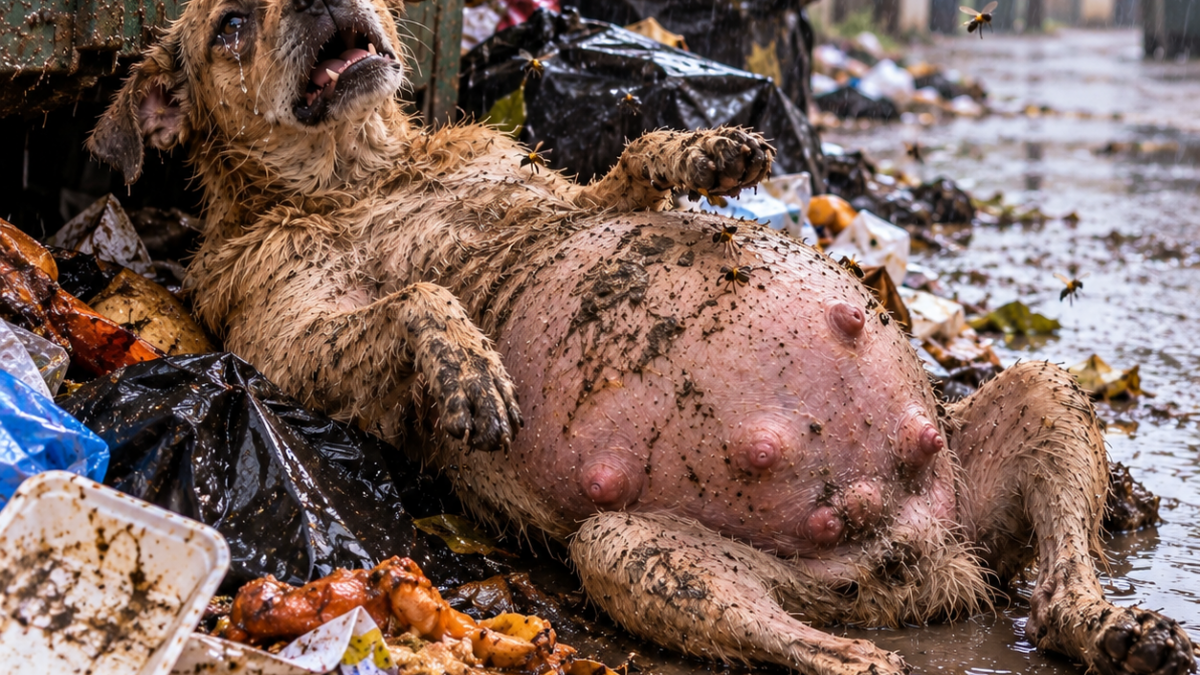
Just wet cardboard, broken crates, and black garbage bags piled against a wall.
“She’s scared,” Daniel said.
“Maybe,” Rachel answered. “Or she’s in pain.”
We carefully placed her inside the carrier.
She kept looking toward the bins.
Even when Daniel lifted the carrier toward the vehicle, her eyes remained fixed on that corner.
I couldn’t explain why it bothered me.
Pregnant dogs can become restless when they’re searching for shelter. A frightened, exhausted animal might fixate on any place that feels familiar.
But something about her reaction felt desperate.
Like she didn’t want to leave.
I glanced at the garbage pile one more time.
Then Rachel called my name.
“We need to go. Now.”
I climbed into the back seat beside the carrier.
As Daniel pulled away, I watched the abandoned corner disappear through the rear window.
The dog let out a soft, broken whine.
I placed my palm against the outside of the carrier.
“I’m here,” I whispered.
She pressed her nose against the bars.
And for the rest of the drive, I kept talking to her.
About nothing.
About everything.
About how warm blankets felt.
About how good chicken smelled when it came out of the oven.
About how there were homes where dogs slept on couches and never had to wonder where their next meal was coming from.
I told her she was going to have that kind of life.
I didn’t know whether I could keep that promise.
But I wanted her to hear someone make it.
The veterinary clinic was waiting when we arrived.
Two technicians met us at the side entrance with a stretcher.
Dr. Melissa Carter, the veterinarian on duty, took one look at her and ordered an immediate examination.
“How long has she been down?”
“We don’t know,” Rachel replied. “She was found in standing water.”
“Any known trauma?”
“Nothing obvious.”
“Has she eaten?”
“We haven’t fed her.”
“Good. Let’s assess her first.”
They took the mother into the treatment area.
I tried to follow.
A technician gently stopped me.
“Give us a few minutes.”
I stood in the hallway, soaked from the knees down, holding the dirty towel that had been under her head.
Rachel touched my shoulder.
“You did the right thing.”
I nodded.
But I couldn’t stop picturing her eyes.
The way she’d watched strangers pass.
The way she’d tried to lift her head.
The way she’d twisted toward those garbage bins.
After what felt like an eternity, Dr. Carter came through the door.
She removed her gloves.
“She’s alive,” she said.
My knees almost gave out.
“But she’s in very serious condition.”
I swallowed.
“How serious?”
“She is severely underweight, dehydrated, and anemic. Her body temperature was below normal, and she’s carrying a significant parasite burden. We’re also evaluating an infection. Her pregnancy is advanced, but we need an ultrasound to assess the puppies.”
“Can she survive?”
Dr. Carter looked at me carefully.
“We’re going to give her every chance.”
It wasn’t the reassurance I’d hoped for.
“Are the babies alive?”
“We’ve detected fetal heartbeats. That’s encouraging, but it doesn’t guarantee they’ll all survive.”
I pressed my lips together.
“Can I see her?”
“Once she’s stabilized.”
Rachel asked about treatment.
The veterinarian explained that they were warming her gradually, carefully restoring fluids, checking bloodwork, and monitoring the pregnancy.
Then Dr. Carter asked a question.
“Does she have a name?”
I looked toward the treatment room.
“No.”
“Would you like to give her one?”
I thought about the rain.
The garbage.
The way she’d kept looking at me even when she couldn’t move.
“Hope,” I said.
Rachel smiled sadly.
“Hope?”
I nodded.
“Because that’s the only thing she had left.”
The Empty Food Bowl
Hope spent her first night at the clinic.
I went home after midnight.
My clothes smelled like dirty water, and there was mud beneath my fingernails. I showered, changed, and tried to eat something, but every bite felt wrong.
All I could think about was her empty stomach.
I kept seeing that swollen belly.
Her body was trying to nourish her babies when she barely had enough energy to keep her own heart beating.
At two in the morning, I checked my phone.
No message.
At three, I checked again.
Still nothing.
At four-thirty, I finally called the clinic.
The overnight technician answered.
“Hope is resting,” she said. “Her temperature is improving. She’s still very weak, but she’s responding to treatment.”
“Has she eaten?”
“A little. We offered a carefully measured amount after the veterinarian cleared it.”
I closed my eyes.
“Did she keep it down?”
“Yes.”
That one word carried me through the morning.
When I arrived at the clinic, Hope was lying on a clean fleece blanket inside a quiet treatment enclosure.
She looked smaller without the mud.
Her coat was a dull golden brown beneath the grime, with white patches along her chest and front paws.
She had floppy ears and a narrow face.
And she was beautiful.
Not because she had suddenly become healthy.
She hadn’t.
Her hip bones still protruded. Her fur was patchy. Her muscles were painfully wasted.
But she was clean.
Warm.
Safe.
For the first time, she was surrounded by people who knew she mattered.
“Good morning, Hope.”
Her ears lifted.
Dr. Carter looked up from the chart.
“She recognizes your voice.”
“Really?”
“She’s been pretty quiet. That’s the most interest she’s shown in anything this morning.”
I approached slowly.
Hope raised her head.
Then her tail moved.
Just once.
A small, exhausted tap against the blanket.
I covered my mouth.
“Oh, sweetheart.”
She lowered her head again, but her eyes followed me.
Dr. Carter explained the ultrasound findings.
Hope was close to giving birth.
They could identify several puppies, though the exact count and their condition would become clearer with continued monitoring and imaging.
The puppies’ heartbeats were present, but the pregnancy was high-risk because of her severe malnutrition and overall condition.
“She’s spent a long time in survival mode,” Dr. Carter said. “Pregnancy dramatically increases the nutritional demands on a dog. Her body has been depleted.”
I stared at Hope.
“How long do you think she’s been hungry?”
“There’s no reliable way to know. Her condition suggests prolonged inadequate nutrition, possibly complicated by parasites or illness.”
I thought of the people walking past her.
The man warning me not to bring her near his store.
The cars spraying dirty water across the pavement.
“How does an animal get this bad without anyone helping?”
Dr. Carter was quiet.
Then she said, “Sometimes people see a problem so often that they stop recognizing it as an emergency.”
That sentence stayed with me.
After the examination, I was allowed to sit beside Hope for a few minutes.
She watched me as I pulled a chair closer.
“You really scared me yesterday.”
Her tail moved again.
“Don’t do that anymore.”
She blinked.
I laughed through tears.
“All right. I know. You weren’t exactly given a choice.”
I stayed until she fell asleep.
Before leaving, I asked Dr. Carter whether Hope might have an owner.
They had scanned her for a microchip.
Nothing.
No collar.
No identification.
No missing-dog report matching her description had been found yet.
But Rachel had agreed to help me file a found-dog report and follow the appropriate local stray-hold process, while ensuring Hope received emergency medical care.
That afternoon, I returned to the place where I’d found her.
I told myself I wanted to understand where she’d been living.
Maybe there was a shelter nearby.
Maybe someone had been leaving food.
Maybe there were clues about how long she’d been wandering.
But I also remembered her desperate stare toward the garbage bins.
And I couldn’t shake the feeling that I had missed something.
The Corner She Wouldn’t Stop Looking At
The street looked different without Hope.
People moved around the same stores. Cars crowded the intersection. The garbage had been partially collected, though wet cardboard remained along the wall.
I stood beside the puddle where she had been lying.
Her outline was gone.
Only a few muddy pawprints remained near the curb.
I walked toward the garbage bins.
A woman came out of the convenience store carrying a broom.
“Can I help you?”
“I’m looking for information about a pregnant dog. Golden brown, very thin. She was lying near the curb yesterday.”
The woman stopped sweeping.
“Oh. That poor thing.”
“You saw her?”
“Of course. She’d been around for a while.”
“How long?”
“Maybe a couple of weeks. I don’t know exactly.”
My stomach tightened.
“Did anyone feed her?”
“Sometimes somebody threw scraps near the trash.”
“Did you?”
The woman looked uncomfortable.
“I put water out once.”
I nodded.
“Do you know where she slept?”
She pointed toward the space behind the bins.
“Back there, I think. She used to crawl under that loading platform.”
I walked around the corner.
The platform was barely two feet above the ground.
Beneath it was a narrow space lined with damp cardboard and torn plastic.
There were scraps of food packaging, an old rag, and a crushed paper cup.
Nothing else.
But then I noticed something.
A shallow plastic bowl sat beneath the platform.
It was cracked and covered in dirt.
Completely empty.
I crouched beside it.
Someone had once tried to feed her.
Or perhaps Hope had dragged it there herself after finding it in the garbage.
I didn’t know.
What I did know was that she’d been sleeping on wet concrete while carrying puppies.
There was no warm bed.
No shelter from driving rain.
No clean drinking water.
Just a cracked bowl and a space beneath a loading dock.
I reached for the bowl.
A voice behind me said, “That dog used to wait there every night.”
I turned.
An older man stood near the alley entrance, holding a folded umbrella.
He wore a faded work jacket and carried a small shopping bag.
“Did you know her?” I asked.
He shook his head.
“Not really. I saw her when I came through here after work.”
“Was she always pregnant?”
“Her belly got bigger recently. Before that, she just looked hungry.”
“Did she let people approach?”
“Not most people.”
He stepped closer.
“She was scared of sudden movements. A delivery truck backfired one night, and she ran all the way down the alley.”
I looked at the narrow shelter.
“Did anyone try to rescue her?”
The man sighed.
“I called the city once. They said they’d send somebody when they could. I didn’t see anyone come.”
“Did you feed her?”
He raised the shopping bag.
“Sometimes. Mostly bread or whatever I had left.”
He looked ashamed.
“I know it wasn’t enough.”
I stood.
“You were trying.”
He nodded toward the curb.
“Is she still alive?”
“Yes. She’s at a veterinary clinic.”
His shoulders dropped.
“Thank God.”
I told him about her condition.
He listened silently.
Then he reached into his jacket pocket and pulled out a folded twenty-dollar bill.
“Can you put this toward her care?”
I shook my head.
“You don’t have to.”
“Please.”
His hand trembled slightly.
“I saw that dog every day, and I kept thinking somebody with more money or more time would help her properly.”
I looked at the bill.
“What’s your name?”
“Frank.”
“Frank, you don’t need to feel guilty.”
He stared at the empty bowl.
“Maybe not. But I should’ve done more.”
I understood what he meant.
Not because I blamed him.
Because the same thought had been running through my own head since the moment I found Hope.
What if I’d taken a different street?
What if I’d been looking at my phone?
What if I’d assumed someone else would help?
I accepted the money.
“I’ll tell her it’s from you.”
He gave a small smile.
Then he looked toward the platform.
“She always watched the people going into the store. Every time the door opened, her ears went up.”
“Maybe she thought somebody would feed her.”
“Maybe.”
He paused.
“Or maybe she remembered belonging somewhere.”
That thought hurt more than I expected.
Because an animal doesn’t understand abandonment the way humans explain it.
A dog doesn’t know why a familiar hand stops reaching down.
Why a door never opens again.
Why the person she trusted disappears.
She only knows she’s alone.
The Woman Who Said Hope Wasn’t Worth Saving
By the third day, Hope had made enough progress to stand with support.
I arrived at the clinic just as a technician was helping her take a few steps on a nonslip mat.
Her legs shook.
Her paws spread awkwardly.
She looked exhausted after only three steps.
But she was standing.
“Look at you,” I whispered.
Hope turned toward me.
Her tail moved.
This time, it wagged twice.
I laughed.
Rachel, who had joined me, wiped her eyes.
“She’s fighting.”
“She really is.”
Dr. Carter cautioned us that Hope still faced significant risks.
Her blood values had improved somewhat, but she remained anemic and severely underweight. Her appetite was slowly returning, and the clinic was carefully managing her nutrition.
The pregnancy complicated everything.
Hope needed strength to give birth.
But her body had almost none to spare.
The ultrasound also suggested she was close to delivery.
“Could she go into labor any day?” I asked.
“Yes. We need to remain prepared.”
I looked at Hope.
She had finally reached her food bowl and was carefully eating a small portion of her prescribed meal.
“She deserves more time.”
Dr. Carter nodded.
“We’re doing everything medically appropriate to give her that.”
Later that afternoon, I stopped by the convenience store to ask whether anyone had responded to the found-dog notices.
The woman with the broom recognized me.
“How’s the dog?”
“Getting stronger.”
A customer standing near the counter overheard.
“You’re talking about that skinny dog outside?”
I nodded.
She was a woman in her fifties, with neatly styled hair and a large handbag tucked beneath her arm.
“Someone finally took it away?”
“Her,” I corrected. “She’s at the veterinarian.”
The woman made a face.
“I don’t understand why people waste money on animals like that.”
The store went quiet.
I stared at her.
“Excuse me?”
“Stray dogs are everywhere. You save one, and another shows up tomorrow.”
I felt heat rise into my face.
“She’s a living animal.”
“And she’s probably going to die anyway. Look at how sick she was.”
For a second, I couldn’t speak.
Not because I couldn’t think of a response.
Because I was trying to keep my voice steady.
“She was lying in the street,” I said. “Pregnant, starving, and too weak to stand.”
The woman shrugged.
“That’s nature.”
“No,” I replied. “That’s suffering.”
She rolled her eyes.
“You’re being emotional.”
“Yes,” I said. “I am.”
The word came out louder than I’d intended.
“Because I sat beside her while she struggled to breathe. I watched her try to lift her head and fail. I saw her look at every stranger who walked past, and I know she would’ve stayed there until she died if nobody stopped.”
The woman looked away.
I lowered my voice.
“You don’t have to help every animal you see. But please don’t tell me her life isn’t worth saving.”
I left before she could answer.
Outside, my hands were shaking.
I wasn’t proud of how angry I felt.
But I couldn’t understand how anyone could see an animal in that condition and respond with indifference.
Rachel called while I was walking to my car.
“Are you okay?”
I told her what had happened.
She listened.
Then she said, “Don’t let one person’s cruelty erase what everyone else is doing.”
I leaned against the car door.
“She said Hope would probably die anyway.”
Rachel paused.
“Maybe she’s wrong.”
“And if she’s right?”
“Then Hope will spend whatever time she has warm, fed, and loved. That still matters.”
I looked toward the veterinary clinic across town.
Rachel was right.
We couldn’t control every outcome.
But we could control whether Hope faced it alone.
The Night Hope Stopped Eating
The first serious setback came on the fourth night.
I was at home, washing the towels I’d used during Hope’s rescue, when my phone rang.
Dr. Carter’s name appeared on the screen.
My stomach dropped.
“Hello?”
“Hope has become restless, and she’s showing signs that labor may be beginning.”
I gripped the edge of the kitchen counter.
“Is she okay?”
“We’re monitoring her closely. Her condition makes this a high-risk delivery.”
“Should I come?”
“If you’d like to be here, yes.”
I was in my car within five minutes.
By the time I arrived, Hope was panting heavily.
She shifted from one side to the other, unable to get comfortable.
A technician had prepared a clean, quiet area for her.
Dr. Carter was checking her vital signs.
Hope looked up when she heard my voice.
“Hey, girl.”
She tried to stand.
“Easy,” the technician said.
I knelt outside the whelping area.
“I’m here.”
Hope lowered herself again.
Her breathing was fast.
I could see her abdomen tighten with contractions.
Dr. Carter explained that they were assessing whether labor was progressing normally and watching carefully for fetal distress.
Hope’s weakness was a major concern.
“She’s been through too much,” I whispered.
The veterinarian glanced at me.
“She’s been through a lot. But we’re not going to assume she can’t get through this.”
For the next hour, Hope labored.
She panted.
Rested.
Shifted positions.
She refused food and barely acknowledged the water offered to her.
Every time a contraction passed, her body seemed to sink deeper into the blanket.
I sat nearby, talking softly.
“You made it this far.”
Hope’s ears moved.
“You don’t have to do this alone.”
Another contraction came.
She whined.
I wanted to reach out and take the pain away.
There was nothing I could do except remain beside her while the veterinary team monitored and supported her.
Time slowed.
Every minute felt longer than the last.
Then Dr. Carter’s expression changed.
She looked at the monitor.
Asked the technician to reposition the ultrasound probe.
Listened.
And checked again.
“What’s wrong?” I asked.
She didn’t answer immediately.
That silence frightened me more than any words could have.
Finally, she turned.
“One of the puppies is showing signs of distress. Hope’s labor isn’t progressing the way we need it to.”
My throat tightened.
“What does that mean?”
“We may need to intervene surgically.”
I looked at Hope.
She was lying with her head against the blanket, her eyes half-closed.
“Can she survive surgery?”
Dr. Carter answered carefully.
“Anesthesia carries increased risk in an animal this debilitated. But continuing without intervention could be more dangerous. We need to act based on her condition and the puppies’ heart rates.”
I pressed a hand against my mouth.
For days, I’d imagined Hope delivering her puppies safely, curling around them in a warm room, finally experiencing motherhood without hunger or fear.
Now that future seemed to be slipping away.
Dr. Carter described the options, the risks, and the urgency.
Because Hope was still under the rescue’s medical custody during the required hold period, the authorized rescue representative had to approve treatment. Rachel was already on her way, and the clinic had emergency-care authorization in place.
I called her.
“Rachel.”
“I’m parking.”
“They think she may need surgery.”
“I know. Dr. Carter called me.”
My voice broke.
“She’s so weak.”
Rachel’s reply was immediate.
“Then we’re going to give her the best chance we can.”
She came through the door moments later.
Together, we watched as Dr. Carter repeated the examination.
The fetal heart rate had not recovered sufficiently.
Hope was exhausted.
There was no longer time to wait.
Rachel signed the necessary consent.
The technicians prepared the operating room.
I leaned toward Hope one last time.
Her eyes opened.
I brushed the fur between her ears.
“You hear me, girl?”
Her gaze settled on mine.
“You are not going back to that street.”
She gave a faint movement of her tail.
“Whatever happens next, you’re loved.”
Then they wheeled her away.
And the door closed.
The Longest Hour of My Life
I had never realized how loud a quiet waiting room could be.
The air conditioner hummed.
A clock ticked above the reception desk.
Somewhere in the back, metal instruments clinked.
I sat beside Rachel with my hands clasped so tightly that my fingers hurt.
Daniel arrived with coffee.
Neither of us drank it.
Frank, the older man from the alley, called after Rachel told him Hope was in surgery.
“How’s our girl?”
I looked down at my phone.
“She’s having trouble delivering.”
He was silent.
Then he said, “Tell those doctors to do whatever they need to do.”
“They are.”
He cleared his throat.
“She’s a good dog.”
I smiled through tears.
“You know that?”
“I don’t need to know much about a dog to know she’s been trying awfully hard.”
After we hung up, I stared at the operating-room doors.
I thought about all the times I’d seen videos of rescued animals recovering.
The happy endings.
The first tail wags.
The puppies nursing.
The dogs running through green grass months later, healthy and shining.
Those moments were real.
But waiting outside a surgical room was something different.
There were no guarantees.
No perfect soundtrack.
No promise that kindness would be rewarded with the outcome we wanted.
There was only hope.
And the terrible possibility that it might not be enough.
Rachel put her hand over mine.
“Do you remember the first dog we transported together?”
I nodded.
“Murphy.”
“He bit your jacket.”
“He destroyed my jacket.”
She laughed softly.
“You said you’d never foster another dog.”
“And then I fostered four.”
“Five.”
“Right. Five.”
Her smile faded.
“Animals surprise us.”
I looked at the door.
“She needs to surprise us now.”
More time passed.
A technician briefly came into the hallway.
My heart jumped.
But she only told us the team was still working.
I nodded.
Tried to breathe.
Waited.
Then, finally, the doors opened.
Dr. Carter stepped out.
Her surgical cap was still on.
I stood so quickly that my chair scraped across the floor.
“Is she alive?”
The veterinarian nodded.
“Hope made it through the surgery.”
I covered my face.
Rachel whispered, “Thank God.”
Dr. Carter continued.
“She’s still in recovery, and we’re watching her very closely. Her condition means the next twenty-four to forty-eight hours are critical.”
I nodded through tears.
“And the puppies?”
Her expression softened.
“Three puppies are alive.”
Three.
I repeated the number silently.
Three babies.
“Are they okay?”
“They’re premature and weak, but they’re breathing. We’re providing supportive care and monitoring them closely.”
Then she paused.
“Unfortunately, one puppy did not survive.”
The relief inside me collided with grief.
I lowered myself back into the chair.
“I’m sorry,” I whispered.
Dr. Carter sat beside us for a moment.
“We did everything we could.”
I believed her.
Still, I pictured Hope carrying four tiny lives through the rain.
Sleeping beneath that loading platform.
Going hungry so long her body had begun consuming itself.
And I wished I could have reached her sooner.
I didn’t know whether the lost puppy could have survived under different circumstances.
No one could tell me that.
But grief rarely waits for certainty before it finds somewhere to settle.
Rachel squeezed my shoulder.
“Three babies are here,” she whispered. “And Hope is still here.”
I nodded.
Three babies.
One mother.
Four fragile lives.
And a future we weren’t ready to surrender.
A Mother Who Didn’t Know She Was Safe
Hope was still groggy when they finally allowed us to see her.
A soft blanket surrounded her body.
An IV line ran into her front leg.
Her breathing was steady, though she barely responded when I spoke.
The puppies were receiving separate supportive care while the veterinary team assessed when it would be safe to reunite them with their mother.
I approached quietly.
“Hi, Hope.”
Her ear twitched.
“You did it, sweetheart.”
I rested my hand near her shoulder.
“You made it.”
She blinked.
Her eyes closed again.
I stayed only a few minutes.
She needed rest.
Later that night, the staff showed me the three puppies.
They were tiny.
Two had golden coats with pale markings. The third was darker, with a little white patch beneath her chin.
Their bodies looked impossibly small beneath the warming equipment.
One made a faint squeaking sound.
My eyes filled.
“Hello, babies.”
The technician smiled.
“They’re fighters.”
I watched their little chests rise and fall.
I thought of the filthy puddle where I’d found their mother.
The trash floating beside her.
The muddy water soaking her fur.
I could barely comprehend the distance between that street corner and this clean, warm room.
The puppies didn’t know anything about rescue.
They didn’t understand that strangers had worked through the night to save them.
They only knew warmth.
Breathing.
The beginning of life.
And I wanted desperately for them to know their mother.
The next day, Hope woke more fully.
Her temperature was stable.
Her recovery was progressing as well as the doctors could reasonably expect.
When I walked into the room, she lifted her head.
I nearly cried again.
“There’s my girl.”
Her tail tapped the blanket.
Then she looked around the room.
Her ears lifted.
She sniffed the air.
And began to whine.
At first, I thought she was uncomfortable.
But when a technician entered carrying one of the puppies for a supervised introduction, Hope changed completely.
Her head came up.
Her body shifted.
Her nose reached forward.
She made a soft, urgent sound.
Not a bark.
Not a growl.
Something quieter.
Something that seemed to come from the deepest part of her.
The technician placed the puppy close enough for Hope to smell while carefully supporting it.
Hope sniffed.
Then gently licked the puppy’s head.
Once.
Twice.
Her eyes softened.
She rested her nose beside the tiny body.
I turned away.
I couldn’t hold back the tears.
Because the same dog who had barely been able to lift her head from dirty water was now trying to comfort her baby.
Even after everything she’d survived, her first instinct was still to care for someone smaller than herself.
“She knows,” I whispered.
Dr. Carter stood beside me.
“She knows it’s her puppy.”
Over the next several days, supervised time with the puppies gradually increased as their condition and Hope’s recovery allowed. The team carefully checked whether they could nurse safely and made sure each puppy received adequate nutrition.
Hope was exhausted, and the medical staff wouldn’t allow her to overexert herself.
But whenever the puppies were nearby, she watched them constantly.
If one squeaked, her ears rose.
If a technician lifted one for examination, her eyes followed.
If the puppies settled beside her, she relaxed.
The transformation wasn’t sudden.
She was still weak.
Still healing.
Still terribly thin.
But something had changed in her expression.
For the first time, she had something besides survival to focus on.
Her babies were alive.
And she could finally rest without having to protect them from the street.
The Bill That Almost Changed Everything
I knew Hope’s treatment would be expensive.
Emergency care rarely comes cheaply, especially when intensive monitoring, surgery, and neonatal support are involved.
But I hadn’t allowed myself to think about the cost while her life was hanging in the balance.
Then Rachel called me into the rescue office.
She had a folder open on the desk.
“We need to talk about Hope’s ongoing care.”
I sat across from her.
“What’s wrong?”
“Nothing new medically. But the costs are adding up, and we’re going to need a longer-term plan.”
She showed me the veterinary estimate.
I stared at the total.
It was more than I could comfortably pay from my savings.
The rescue had already committed funds, but there were other animals depending on the same limited budget.
Hope and her puppies might need weeks of support before they were ready to leave veterinary supervision.
I looked at Rachel.
“Are we going to stop treatment?”
“No.”
Her answer was firm.
“We’ll speak with the clinic about a payment plan and look for additional funding. But we need to be realistic.”
I swallowed.
“I can contribute.”
“I know.”
“I have some savings.”
“Please don’t promise money you need for rent or emergencies.”
I looked down at the folder.
Rachel leaned forward.
“Listen to me. Loving an animal doesn’t mean you have to personally pay for everything. We have a network. Let’s use it.”
So we did.
We contacted local rescue supporters, previous adopters, and people who had helped with emergency cases before.
Rachel prepared a factual account of Hope’s condition and treatment needs, with photographs taken during her rescue and recovery.
We didn’t use the most distressing images.
We didn’t need to.
One picture showed Hope lying on a clean blanket, her ribs still visible, looking toward the camera.
Another showed her gently touching one of her puppies with her nose.
That was enough.
People responded.
A retired teacher donated twenty dollars.
A veterinary technician from another clinic offered neonatal supplies.
A local pet shop contributed puppy pads and specialized food.
Frank arrived at the rescue office carrying a small envelope.
He handed it to Rachel.
“What’s this?” she asked.
“Something toward the bill.”
Inside was seventy-three dollars.
Rachel looked up.
“Frank, you’ve already helped.”
He shrugged.
“I picked up some extra work.”
I stared at him.
“You didn’t have to do that.”
He looked embarrassed.
“Well, I got to thinking about that dog sleeping behind the store while I went home every night.”
He rubbed the back of his neck.
“Figured she could use a little more help now.”
I hugged him before he could object.
He laughed awkwardly.
“All right, all right. Don’t make a fuss.”
But his eyes were wet.
Over the following week, contributions and in-kind support helped cover a meaningful portion of Hope’s care.
The clinic also worked with the rescue on the treatment plan and payment schedule.
No single person saved Hope.
It took a veterinarian willing to work through a difficult emergency.
Technicians who checked fragile puppies throughout the night.
Volunteers who cleaned blankets and arranged supplies.
Neighbors who gave what they could.
A man who had once shared scraps of food with a stray dog.
And a little mother who refused to stop fighting.
I began to understand something.
The opposite of indifference wasn’t always a grand act of heroism.
Sometimes it was twenty dollars.
A clean towel.
A phone call.
A ride to a clinic.
A person choosing to stop.
The Day Hope Finally Ate Without Fear
Two weeks after the surgery, Hope had begun gaining weight.
Slowly.
Carefully.
Her appetite improved, and her bloodwork showed encouraging progress.
Her surgical incision was healing.
The puppies were growing, though each one required close attention.
But Hope had developed one behavior that concerned me.
She ate as though the food might disappear.
Every time a bowl arrived, she became tense.
Her head lowered.
Her body shifted protectively.
She swallowed quickly, then checked the empty bowl over and over.
At first, I assumed she was simply hungry.
Dr. Carter explained that food insecurity could contribute to the behavior, though pain, stress, and other factors also needed consideration.
“Give her consistency,” she advised. “Quiet feeding times. Appropriate portions. No competition. Let her learn that meals will keep coming.”
So that became our routine.
When Hope was cleared to move into a medical foster home, Rachel helped arrange a quiet room at my house.
There was a low bed.
Clean blankets.
A gated area for the puppies.
Fresh water.
Food prepared according to the veterinarian’s instructions.
No loud television.
No crowds of visitors.
Just space to heal.
The first time Hope entered the room, she stopped at the doorway.
She sniffed the floor.
Looked toward the windows.
Then toward the bed.
I sat on the rug.
“It’s yours, sweetheart.”
She didn’t move.
I placed a small treat on the edge of the bed.
She approached cautiously.
Sniffed it.
Ate it.
Then stepped back.
I waited.
After several minutes, she placed one paw on the blanket.
Then another.
Finally, she climbed onto the bed.
She turned around three times.
Lowered herself carefully.
And rested her chin on the edge.
I smiled.
“Good girl.”
Her eyes remained open.
Watching.
Listening.
As if she expected someone to tell her to get down.
I pulled a chair beside the bed.
“You’re allowed to sleep here.”
She blinked.
“Nobody’s going to chase you away.”
That night, I checked on her every hour.
The first few times, she was awake.
When I entered the room, she lifted her head immediately.
Sometimes she tried to stand.
I would sit beside her and speak softly until she settled.
The puppies slept together in their warm, secure area.
Hope could see and reach them safely when supervised, according to the veterinary team’s instructions.
Around three in the morning, I found her sleeping with one paw stretched toward her babies.
Her breathing was deep and even.
I sat on the floor.
For the first time since her rescue, she didn’t wake when I entered.
She felt safe enough to sleep.
I stayed there for almost an hour.
Watching her rest.
It was one of the most beautiful things I’d ever seen.
Not dramatic.
Not extraordinary to anyone else.
Just a tired mother dog asleep in a warm room.
But I knew what that meant.
For days, maybe weeks, sleep had meant exposure.
Cold water.
Traffic.
People.
Noise.
Danger.
Now sleep meant comfort.
And for Hope, that was an entirely new world.
The First Time She Tried to Play
Recovery wasn’t a straight line.
There were difficult mornings.
Days when Hope seemed tired.
Appointments that reminded us how serious her condition had been.
Moments when I worried over every little change in her appetite or movement.
But slowly, the frightened dog from the street began to show us who she was beneath the exhaustion.
She liked soft blankets.
She preferred chicken-flavored treats.
She disliked the vacuum cleaner.
She had a habit of carrying her favorite towel from one side of the room to the other, then lying on top of it as though she’d claimed an important treasure.
And she loved watching her puppies.
We named them Sunny, River, and Daisy.
Sunny was the largest, a golden male who seemed determined to climb over everything.
River had darker ears and a quiet temperament.
Daisy, the smallest, wore a little white mark beneath her chin.
The puppies gradually grew stronger.
Their eyes opened.
Their movements became more coordinated.
And their mother watched every discovery with enormous patience.
One afternoon, I was sitting on the floor folding clean towels when Sunny stumbled toward Hope’s front paw.
He bumped into it.
Lost his balance.
And rolled onto his side.
Hope lowered her head.
Sniffed him.
Then gently nudged him upright.
Sunny tried again.
This time he climbed over her paw.
Hope watched him.
Then, very carefully, she moved her paw.
Sunny toppled into the blanket.
I laughed.
“Hope!”
She looked at me.
Her ears lifted.
I could have sworn she was pleased with herself.
Sunny scrambled upright and climbed onto her paw again.
Hope moved it just enough to make him wobble.
And then something happened that I hadn’t seen before.
Her tail began to wag.
Not one exhausted tap.
Not a hesitant movement.
A real wag.
Back and forth.
Back and forth.
I reached for my phone, then stopped.
For a moment, I didn’t want to record anything.
I simply wanted to watch.
Because this was the same dog who had once been too weak to stand.
Now she was playing with her son.
A few days later, Hope surprised me again.
I was sitting in the kitchen when I heard a soft noise from the hallway.
I turned.
Hope stood near the doorway with a worn plush toy in her mouth.
It was a little fabric rabbit I’d placed in her room.
She looked at me.
I smiled.
“What’s that?”
She took two steps closer.
Dropped the toy.
Then nudged it toward me with her nose.
I stared.
“Do you want to play?”
Her tail moved.
I picked up the rabbit and gently slid it across the floor.
Hope walked after it.
Picked it up.
Carried it back.
And dropped it at my feet.
I laughed so hard I started crying.
“You’re kidding.”
She nudged the toy again.
I slid it a second time.
She retrieved it.
Then sat down, panting lightly, looking very proud.
I thought about the woman at the convenience store who had called her a waste of money.
I wished she could see this moment.
Not because I wanted an argument.
Because I wanted her to understand what had almost been lost.
Hope wasn’t an object someone had rescued.
She was a living creature with preferences, fears, affection, and joy.
There had always been a whole dog beneath the mud.
She just hadn’t been given the chance to show anyone.
The Stranger at My Front Door
About a month after Hope’s rescue, a man came to my house.
I had just finished cleaning the puppies’ area when I heard the doorbell.
Through the window, I saw a man in a dark jacket standing on the porch.
He looked to be in his forties.
His hands were shoved into his pockets.
When I opened the door, he glanced nervously toward the driveway.
“Are you the person who rescued that pregnant dog near the convenience store?”
My stomach tightened.
“Who are you?”
“My name’s Thomas.”
He hesitated.
“I think I might know where she came from.”
I kept the screen door closed.
“What do you mean?”
He looked down.
“I saw the photos.”
“Okay.”
“And I recognized her.”
I felt a cold sensation move through my chest.
“Is she your dog?”
“No.”
His answer came quickly.
Then he added, “Not exactly.”
I didn’t like the sound of that.
“Explain.”
He rubbed his forehead.
“She used to stay behind a rental house a few blocks from that store. I did maintenance work there.”
“Who owned her?”
“I’m not sure anybody legally owned her. A tenant started feeding her after she showed up. She stayed around the yard for a while.”
I watched his face.
“What happened?”
“The tenant moved.”
“And the dog?”
He swallowed.
“She stayed.”
I felt anger rising.
“Was she pregnant?”
“I think so. She was getting bigger.”
“Did anybody arrange care for her?”
He shook his head.
“The landlord didn’t want stray animals on the property.”
“What did he do?”
Thomas looked away.
“He told us to close off the back access because people were complaining about her being there.”
I stared at him.
“So she lost her shelter.”
“I guess.”
“You guess?”
He flinched.
“I didn’t come here to fight.”
“Then why did you come?”
“Because I saw the pictures. I didn’t know she got that bad.”
I took a slow breath.
“Did you ever see anyone hurt her?”
“No. Not physically. I didn’t see anything like that.”
“Do you know if she had a previous owner?”
“No.”
I studied him.
There was a difference between what he knew and what I feared.
I couldn’t turn assumptions into facts.
But hearing that Hope had once had a place to shelter, however temporary, made the image of her lying in dirty water even harder to bear.
“Why didn’t someone call a rescue?”
Thomas looked miserable.
“I don’t know.”
I waited.
He finally said, “Everybody thought she’d leave.”
I looked through the hallway toward Hope’s room.
“She did leave. She ended up starving beside a street.”
He lowered his head.
“I know.”
For several seconds, neither of us spoke.
Then he said, “Is she okay?”
“She’s recovering.”
“And the puppies?”
“Three survived.”
He closed his eyes.
“I’m sorry.”
I believed that he was sorry.
But sorrow after the fact couldn’t erase what had happened.
I asked him to share the rental property’s address and anything else he remembered.
He gave me the information.
Then he reached into his wallet.
“I’d like to help with the vet bill.”
I shook my head.
“Donate directly to the rescue if you want to help.”
He nodded.
“Okay.”
As he turned to leave, he paused.
“Can I ask you something?”
“What?”
“Does she still act scared?”
I thought about Hope carrying her plush rabbit to me.
About her sleeping with one paw beside her babies.
About her wagging tail.
“Sometimes,” I said. “But less every day.”
He looked relieved.
“Good.”
Then he walked away.
I closed the door and stood there for a long time.
I was angry.
Not because one person had confessed to deliberately hurting Hope.
He hadn’t.
I was angry because the story sounded so ordinary.
A stray appears.
Someone feeds her occasionally.
A property changes hands.
People complain.
Access gets closed.
Nobody takes responsibility.
And an animal simply disappears from everyone’s daily concerns.
Until she reappears, starving, pregnant, and nearly dead.
I sent the information to Rachel.
She documented it alongside the found-dog report and shared the relevant facts with the appropriate local animal welfare office, without making accusations we couldn’t substantiate.
There was no evidence at that stage that Hope had been deliberately abandoned by an identifiable owner.
But we hoped the information might help clarify her history.
Then I went to see Hope.
She was lying beside the puppies.
When I entered, she lifted her head.
Her tail wagged.
I sat beside her.
“You know what, girl?”
She pressed her nose against my knee.
“I think you’ve spent enough time being somebody else’s problem.”
I scratched behind her ear.
“From now on, you’re going to be somebody’s family.”
The Day the Puppies Opened the Door to Hope’s Future
As the weeks passed, Hope became stronger.
Her weight increased steadily.
Her coat began to shine.
The patches of irritated skin improved with treatment.
Her eyes, once dull and exhausted, became bright and alert.
She started greeting me at the door every morning.
Sometimes with her plush rabbit.
Sometimes with a towel.
Once, inexplicably, with one of my slippers.
I couldn’t remember the last time a stolen slipper had made me so happy.
The puppies developed their own personalities.
Sunny was bold and impatient.
River preferred to observe before joining a game.
Daisy followed her brothers everywhere, even when their adventures ended with all three tumbling into the same pile of blankets.
Hope kept them clean.
Watched them play.
Corrected them gently when they became too rough.
And as they grew older, she gradually became more comfortable spending time away from them.
She began enjoying short walks.
At first, she stopped whenever a truck passed.
The rumble of engines seemed to frighten her.
I’d kneel beside her and offer reassurance.
“We’re okay.”
She would look toward the road.
Then back at me.
Sometimes we’d wait a minute before moving.
Sometimes we’d turn around and go home.
I never forced her to confront more than she could handle.
Progress came in small increments.
One day, she walked past a parked delivery truck without stopping.
Another day, she accepted a treat from Daniel.
Then she allowed Frank to sit beside her on the porch.
That afternoon was special.
Frank had been asking about Hope for weeks.
He had seen pictures and received updates, but this was the first time he’d met her since the rescue.
When he arrived, he stood awkwardly at the gate.
“Think she’ll remember me?”
“I don’t know,” I admitted. “But we’ll let her decide whether she wants to say hello.”
Hope approached slowly.
She sniffed the air.
Frank crouched, careful not to lean over her.
“Hey there, little lady.”
Hope stopped.
Looked at him.
Then stepped closer.
She sniffed his hand.
Frank didn’t move.
After a moment, she lowered her head and pressed it gently against his fingers.
His face changed.
He swallowed.
“Well, would you look at that.”
I smiled.
“She likes you.”
He rubbed her ear.
“You’re looking a whole lot better than the last time I saw you.”
Hope wagged her tail.
Frank wiped his eyes with the back of his sleeve.
“Sure is nice seeing you standing up.”
I understood.
Frank had watched her scavenging for food behind the store.
He’d seen her frightened and hungry.
Now she stood on a sunny porch, wearing a soft collar, her body finally beginning to look healthy.
She wasn’t fully recovered yet.
But she was alive.
And she was happy.
Frank sat with us for nearly two hours.
Before he left, he placed a new plush toy beside Hope.
It was a small yellow duck.
“I thought she might like it.”
Hope sniffed the duck.
Picked it up.
And carried it inside.
Frank grinned.
“Well, I guess that’s a yes.”
The Decision I Was Afraid to Make
By the time the puppies were old enough to begin preparing for adoption, Hope had become part of my daily life.
I woke up thinking about her breakfast.
I planned my schedule around her walks and veterinary appointments.
I knew exactly how she liked her blankets arranged.
I knew she preferred to sleep with her head near the doorway, where she could see me pass.
I knew she didn’t like being alone during thunderstorms.
And I knew that whenever I cried, she somehow sensed it.
She would approach quietly.
Rest her chin on my knee.
And wait.
It was difficult to remember that she’d once been a stranger lying in a puddle.
But fostering an animal meant understanding that love didn’t always require keeping them.
Sometimes it meant preparing them for another home.
A home that could offer more than I could.
I had fostered animals before.
I’d said goodbye.
I’d watched families drive away with dogs who had once slept beside my bed.
And even though every goodbye hurt, I understood why it mattered.
So when Rachel called to discuss adoption plans, I tried to sound cheerful.
“The puppies are going to have people fighting over them,” I said.
“They’re getting lots of interest.”
“And Hope?”
Rachel hesitated.
“That’s what I wanted to talk about.”
My chest tightened.
“What about her?”
“We’ve had inquiries.”
“Good.”
“But we need to make sure she goes somewhere that understands her history.”
I looked toward the living room.
Hope was sleeping on the rug with her yellow duck tucked beneath one paw.
“Of course.”
Rachel continued.
“She’s doing well, but she may still need patience with new environments, loud noises, and being left alone. The right adopter has to understand that.”
I nodded.
“Right.”
“Are you okay?”
“Yes.”
Rachel was silent.
Then she said, “You know you can apply to adopt her.”
I stared at Hope.
“I know.”
“You don’t have to decide today.”
“I know.”
After we hung up, I sat on the couch.
Hope woke and walked toward me.
She rested her head on my knee.
I stroked her ears.
“Someone’s going to want you, baby.”
Her tail wagged.
“Someone with a nice yard. Maybe another dog. Maybe a family who spends all day at home.”
She looked up at me.
I swallowed.
“You’re going to have a wonderful life.”
Then I began crying.
Hope climbed closer and pressed her nose against my cheek.
I laughed weakly.
“You’re not making this easy.”
She settled beside me.
And I sat there wondering whether loving her meant letting her go.
The Family Who Wanted a Perfect Dog
The first serious adoption inquiry came from a couple who lived outside town.
They had a fenced yard, experience with dogs, and good references.
On paper, they seemed promising.
We arranged a meeting at the rescue.
I brought Hope after getting confirmation that she was medically ready for a controlled introduction.
The couple arrived on time.
The woman, Amanda, was friendly and enthusiastic.
The man, Paul, was quieter.
They sat with Hope in the meeting room.
Amanda offered a treat.
Hope accepted it gently.
“She’s adorable,” Amanda said.
I smiled.
“She’s come a long way.”
Paul examined Hope’s thin patches of regrowing fur.
“Will her coat ever look normal?”
“The veterinarian expects further improvement, though we can’t promise exactly how it will look.”
He nodded.
“Does she shed much?”
“Some.”
“Housebroken?”
“Yes, with a consistent routine.”
Amanda scratched Hope’s shoulder.
“Does she play fetch?”
“She likes soft toys, but she’s not very interested in chasing balls.”
Paul frowned.
“What about running?”
“She enjoys walks. We haven’t pushed her into strenuous activity while she’s recovering.”
He leaned back.
“We were hoping for a dog that could go jogging.”
I glanced at Rachel.
“Hope might enjoy more activity once she’s fully conditioned, but we can’t guarantee she’ll be a running partner.”
Amanda smiled uncertainly.
“She’s sweet, though.”
Hope moved toward me and sat beside my chair.
Paul watched her.
“Is she always that clingy?”
The question stung.
“She looks to familiar people for reassurance,” I said. “Especially in new environments.”
He nodded slowly.
“We just don’t want a dog with a lot of problems.”
The room went quiet.
Rachel responded professionally.
“There’s nothing wrong with knowing what you can realistically provide. Hope needs a patient home that suits her temperament and recovery.”
Amanda looked down at her hands.
“We’ll think about it.”
They left without applying.
I sat beside Hope after the door closed.
She leaned against me.
Rachel sighed.
“They weren’t the right match.”
“I know.”
“But?”
I looked at Hope.
“I hate that people keep seeing what she’s been through as something wrong with her.”
Rachel sat across from me.
“Some adopters want a dog whose needs match their lifestyle. That’s fair. What matters is finding a family who sees Hope clearly and still wants her.”
I nodded.
Still, the meeting reopened a familiar wound.
Hope had already spent too long being unwanted.
I didn’t want her to experience that again.
Over the next two weeks, we received more inquiries.
One family had small children and a very active household.
Another wanted an outdoor guard dog.
A third hoped for a young dog with no medical history.
None was the right fit.
I continued caring for Hope.
And every night, when she curled beside the couch with her yellow duck, I felt myself growing less capable of imagining the house without her.
The Day Daisy Went Home
The puppies’ adoption process moved faster.
Sunny found a family with a spacious yard and an older, gentle dog.
River was matched with a retired couple who had recently lost their beloved companion.
Daisy, the smallest, attracted the attention of a young schoolteacher named Emily.
Emily arrived at the rescue carrying a folder of questions.
She wanted to know about vaccination schedules, socialization, training, nutrition, and veterinary care.
She had already puppy-proofed her apartment.
She’d arranged time off work for the transition.
She had thought about the responsibilities.
Not just the cute photographs.
I liked her immediately.
When Emily met Daisy, the little puppy climbed into her lap and promptly fell asleep.
Emily laughed.
“Well, that was quick.”
I smiled.
“She’s a professional heart thief.”
Over the following days, the rescue completed the adoption checks and paperwork.
When the time came for Daisy to leave, I brought Hope into the room for a calm farewell.
I wasn’t sure how she would react.
Dogs don’t understand adoption agreements.
They don’t know why puppies who have grown beside them suddenly leave with strangers.
But by then, Daisy was developmentally ready to be separated, and Hope had already been gradually weaning and spending more time independently.
Emily knelt beside her.
“Hi, Mama Hope.”
Hope sniffed her hand.
Then Daisy approached.
She stumbled between Hope’s front paws and began licking her mother’s chin.
Hope lowered her head.
Gently cleaned Daisy’s face.
Then rested her nose against the puppy’s back.
For a few moments, I watched without speaking.
I thought about the puddle.
The surgery.
The tiny newborn lying beneath warming equipment.
Now Daisy was healthy, strong, and about to go home with someone who had prepared a safe place for her.
I reached down and touched Hope’s shoulder.
“You did such a good job.”
Hope looked at me.
Her tail moved slowly.
Emily lifted Daisy into her arms.
I hugged her.
“Take care of our girl.”
“I will,” she promised.
Then she carried Daisy outside.
Hope watched the door.
She stood there for a moment.
Sniffed the floor.
Then returned to me.
I sat beside her.
“She’s safe, sweetheart.”
Hope rested her head against my knee.
“I promise.”
A week later, Sunny went home.
Then River.
Each goodbye hurt.
Each one also felt like a victory.
Three puppies who might never have taken a breath outside their mother’s body were going to sleep in warm homes.
They would have toys.
Veterinary care.
Food bowls that never stayed empty.
Families who knew their names.
When the last puppy left, Hope wandered through the quiet room.
She sniffed the blankets.
Checked the corner where the puppies had played.
Then returned to her bed.
She looked at me.
I sat down beside her.
“It’s just us now.”
She climbed onto the blanket.
Rested her head in my lap.
And sighed.
The Storm That Brought Everything Back
The next major test came during a summer thunderstorm.
The weather had been warm and humid all afternoon.
Dark clouds gathered over the neighborhood.
By evening, rain began pounding against the windows.
At first, Hope seemed merely alert.
She lifted her head when thunder rolled in the distance.
Then a louder crack shook the house.
Hope jumped.
Her body stiffened.
She ran toward the hallway.
“Hope?”
Another rumble followed.
She began pacing.
Her tail tucked between her legs.
She moved toward the back door, then away from it, unable to settle.
I remembered the day I’d found her.
The cold water.
The garbage.
The rain.
I didn’t know whether Hope associated storms with those experiences, or whether she had been frightened by thunder long before we met.
But her fear was unmistakable.
I closed the curtains.
Turned on a fan for gentle background noise.
And sat on the floor near her bed.
“It’s okay, sweetheart.”
Hope looked toward the windows.
Another thunderclap sounded.
She flinched.
I resisted the urge to grab her.
Instead, I allowed her to choose whether to approach me.
She paced twice more.
Then came closer.
I extended my hand.
She sniffed it.
Finally, she leaned against my side.
I stroked her shoulder.
“You’re inside.”
Rain hammered against the roof.
“You’re warm.”
Hope trembled.
“Your babies are safe. You’re safe.”
She pressed harder against me.
I stayed there for more than an hour.
At one point, the electricity flickered.
Hope lifted her head.
I felt her heartbeat quicken beneath my hand.
But she didn’t run.
She stayed beside me.
When the storm finally moved away, she was exhausted.
I helped her settle onto her bed.
She tucked her nose beneath the yellow duck Frank had given her.
Then she fell asleep.
I sat nearby, thinking about how healing worked.
I’d once imagined recovery as a destination.
A point at which Hope would be healthy and the past would stop mattering.
But that night reminded me that recovery could mean learning to feel safe despite remembering fear.
She didn’t need to become fearless.
She needed to know she wouldn’t face frightening things alone.
The Adoption Application I Couldn’t Ignore
A few days after the thunderstorm, Rachel called.
“We have another inquiry about Hope.”
I felt my stomach sink.
“Okay.”
“This one looks promising.”
“Tell me.”
“A woman named Margaret. She’s sixty-two, recently retired, lives alone, has a fenced yard, and lost her senior dog last year.”
I listened.
“She’s had rescue dogs before,” Rachel continued. “She’s comfortable with animals who need a slower adjustment.”
I looked toward Hope.
She was chewing gently on her yellow duck.
“That sounds good.”
“She’d like to meet her.”
I closed my eyes.
“Okay.”
Rachel was quiet for a moment.
“Are you sure?”
“Of course.”
“You don’t sound sure.”
I looked at Hope again.
“She deserves the best possible home.”
“Yes.”
“And I need to make sure I’m not keeping her just because I’m afraid of saying goodbye.”
Rachel’s voice softened.
“That’s a good question to ask.”
We scheduled the meeting.
Margaret arrived wearing jeans, sneakers, and a pale blue sweater.
She brought no elaborate gifts.
No promises about spoiling Hope.
She simply sat on the floor and waited.
Hope approached cautiously.
Margaret didn’t reach for her.
Instead, she spoke softly.
“Hello, beautiful.”
Hope sniffed her shoes.
Then her hand.
Margaret smiled.
“Well, aren’t you something.”
I watched from a chair.
Hope accepted a treat and sat beside Margaret.
They spent nearly an hour together.
Margaret asked thoughtful questions.
How did Hope behave around loud noises?
Did she enjoy visitors?
Could she tolerate being alone for short periods?
What was her current medical status?
What did she find comforting?
When I mentioned the yellow duck, Margaret laughed.
“My old dog had a stuffed carrot he carried everywhere.”
Hope rested her chin on Margaret’s knee.
The sight made my heart ache.
After the meeting, Rachel stepped outside with Margaret to discuss the next steps.
I remained with Hope.
She came back to me, laid her head in my lap, and closed her eyes.
I stared down at her.
“She seems nice.”
Hope sighed.
“Really nice.”
I scratched behind her ear.
“She could give you a good life.”
Hope opened one eye.
I laughed sadly.
“Don’t look at me like that.”
Then I felt tears spill down my face.
Because I knew what I wanted.
I had known for weeks.
I wanted Hope to stay.
I wanted her bed in my hallway.
Her little paws tapping across my kitchen floor.
Her yellow duck beside the couch.
Her warm body sleeping safely through the night.
But wanting something wasn’t the same as being able to provide it.
I needed to think about my finances.
My schedule.
My responsibilities.
The long-term commitment.
Hope wasn’t a symbol of a rescue story.
She was a dog who would need daily care for the rest of her life.
I owed her a decision based on that reality.
That evening, I made a list.
I examined my budget.
I talked with my veterinarian about her future needs.
I considered work hours, emergency expenses, travel arrangements, and the support network available if I became ill.
I spoke with Rachel.
Then I called Margaret.
I told her the truth.
“I think I want to adopt Hope myself.”
There was a brief silence.
Then Margaret said, “I was wondering when you’d realize that.”
I blinked.
“What?”
She laughed gently.
“The way she watched you during our meeting… and the way you watched her. I had a feeling.”
“I’m sorry.”
“Don’t apologize.”
“She would have been lucky with you.”
“Maybe,” Margaret said. “But there are other dogs who need homes. And I think this one already knows where hers is.”
I started crying.
Margaret’s voice softened.
“Give that sweet girl a hug for me.”
“I will.”
After we hung up, I sat beside Hope.
She looked up.
I smiled through tears.
“Well, sweetheart.”
Her tail moved.
“I think it’s time we made something official.”
The Day Hope Finally Belonged Somewhere
The adoption paperwork took place at the rescue office.
Rachel sat across from me with a stack of forms.
She looked unusually pleased with herself.
“Name of animal?”
“Hope.”
“Species?”
“Dog.”
“Adopter?”
I told her to stop teasing me.
She laughed.
“Sorry. I’ve been waiting for this.”
I signed the forms.
Confirmed the veterinary care plan.
Reviewed her medical records.
Agreed to the responsibilities that came with adopting her.
And when Rachel handed me the completed paperwork, I stared at it.
For the first time, Hope had a permanent home.
Not a temporary shelter.
Not a loading platform.
Not a rescue kennel.
A home.
Mine.
I looked down at her.
She was sitting beside my chair with her yellow duck in her mouth.
“Guess what, girl?”
Her ears lifted.
“You’re staying.”
She wagged her tail.
Rachel began crying.
Then I began crying.
Then Daniel, who had come along to witness the adoption, shook his head and said, “I knew I should’ve brought tissues.”
We took a photograph outside.
Hope stood between us, her coat shining in the afternoon sun.
She looked nothing like the dog I’d found in the puddle.
Her ribs were no longer sharply visible.
Her legs were stronger.
Her eyes were bright.
And her tail wouldn’t stop moving.
Frank came to visit that weekend.
When I told him Hope was officially mine, he grinned.
“About time.”
I laughed.
“You knew too?”
“Everybody knew.”
He crouched beside her.
“Well, young lady, looks like you finally found your people.”
Hope licked his hand.
Frank smiled.
Then he reached into his bag.
“I brought something.”
It was a new stainless-steel food bowl.
Simple.
Sturdy.
With a rubber base so it wouldn’t slide across the floor.
He placed it on the kitchen mat.
Hope approached and sniffed it.
Frank watched her.
“Remember that cracked plastic bowl behind the store?”
I nodded.
His eyes filled.
“I never liked thinking of her eating out of that thing.”
I swallowed.
“She doesn’t have to anymore.”
He rested his hand on Hope’s head.
“No,” he whispered. “She sure doesn’t.”
The Return to the Street Where I Found Her
Several months later, I returned to the street where Hope had nearly died.
This time, I didn’t go alone.
Hope came with me.
Before the trip, I’d asked our veterinarian whether she was healthy enough for a short walk in a familiar but potentially stressful area.
She was.
I still didn’t know how she would react.
I didn’t want to force her to revisit somewhere frightening.
So I planned a brief visit, with plenty of distance from traffic and the option to leave immediately.
The weather was clear.
The pavement was dry.
The same convenience store stood on the corner.
The same loading platform remained behind the building.
But the garbage had been cleared.
The puddle where I’d first seen Hope was gone.
I parked nearby and clipped her leash to her harness.
“Ready, girl?”
She stepped out of the car.
Sniffed the sidewalk.
Looked around.
Her ears moved toward the sound of passing vehicles.
For a moment, she seemed uncertain.
I knelt beside her.
“We can go home whenever you want.”
Hope looked at me.
Then took a step.
We walked slowly along the sidewalk.
As we approached the store, the woman who had once been sweeping outside came through the door.
She looked at Hope.
Then at me.
“Is that her?”
I smiled.
“It is.”
The woman stopped.
“Oh, my goodness.”
Hope stood beside me, her tail gently moving.
The woman crouched.
“She’s beautiful.”
“She’s doing really well.”
“I almost didn’t recognize her.”
I understood.
The dog she remembered had been skeletal, muddy, and barely able to move.
The dog standing before her now was healthy enough to walk comfortably, with bright eyes and a glossy coat.
The woman reached out slowly.
Hope sniffed her fingers.
Then allowed a gentle scratch beneath her chin.
“Look at you,” the woman whispered.
Her eyes grew wet.
“I wish I’d done more for you back then.”
I didn’t know what to say.
Finally, I answered, “You can always help the next one.”
She nodded.
“You’re right.”
We continued around the corner.
Hope stopped near the loading platform.
She sniffed the ground.
I watched closely.
Her tail lowered slightly.
She turned her head toward the narrow space beneath the platform.
For one second, I wondered whether she remembered sleeping there.
Perhaps it was simply an unfamiliar smell.
Perhaps she recognized the location.
There was no way for me to know.
But I knew what it meant to me.
I saw that dark little opening and imagined her curled inside.
Pregnant.
Hungry.
Listening to rain strike the concrete.
I knelt beside her.
“You don’t live here anymore.”
Hope looked at me.
I touched her shoulder.
“You never have to sleep here again.”
She stepped closer.
Pressed her body against my leg.
Then turned toward the car.
I smiled.
“Ready to go home?”
Her tail wagged.
We walked away together.
This time, she didn’t have to watch anyone leave her behind.
A Phone Call I Never Expected
A few weeks after that visit, Rachel called with news from the animal welfare office.
The information Thomas had provided had helped them locate people familiar with Hope’s earlier circumstances.
They hadn’t established that she belonged to a particular owner or uncovered sufficient evidence for a cruelty case against an identifiable person.
Her history remained incomplete.
I was disappointed.
Part of me had wanted a clear explanation.
Someone to answer for her suffering.
Someone to explain why a pregnant dog had ended up alone in filthy water, too weak to rise.
But life doesn’t always provide that kind of resolution.
Not every tragedy has a single villain.
Sometimes the harm comes from a long sequence of failures.
A missed opportunity.
A person assuming someone else will help.
A shelter closed.
A frightened animal pushed farther from safety.
A bowl left empty.
By the time anyone recognizes the crisis, the damage is already severe.
I asked Rachel whether the office had learned anything else.
“Nothing that changes Hope’s situation,” she said. “But they documented the information, and they reminded the property managers involved of the appropriate steps for reporting animals in distress.”
I sighed.
“I wanted more.”
“I know.”
“It feels like nobody is responsible.”
Rachel was quiet.
Then she said, “You can’t make the past give you answers it doesn’t have.”
I looked across the room.
Hope was sleeping on the couch.
Her yellow duck rested beside her.
“Then what do I do with all this anger?”
Rachel replied, “Use it to help the next animal before things get that bad.”
I thought about that for a long time.
Because Hope had survived.
But I knew others hadn’t.
Not every hungry dog would be found in time.
Not every pregnant stray would reach a veterinarian.
Not every puppy would survive birth.
Hope’s happy ending couldn’t change those facts.
But perhaps it could change what I did next.
The Bowl Project
I started small.
I contacted the convenience store and asked whether the owner would allow a protected water station on the property, away from traffic and customers.
He agreed, as long as it was maintained properly.
Rachel helped me coordinate with local animal welfare volunteers.
We arranged clean water bowls at a few approved locations where stray animals had been reported.
More importantly, we established a simple procedure for reporting animals in distress and contacting appropriate rescue resources.
We didn’t encourage people to approach frightened or injured animals recklessly.
We encouraged them to observe safely, document the location, and contact people trained to help.
We also worked with a local low-cost spay-and-neuter program to share information about preventing unwanted litters.
The project was modest.
It didn’t solve every problem.
But it gave people a clearer way to act when they saw an animal struggling.
Frank became one of our most reliable volunteers.
Every morning, he checked the water station near the convenience store.
He cleaned the bowls.
Refilled them.
And let us know if he saw any animals that appeared sick or injured.
One afternoon, he called me.
“You’re not going to believe this.”
“What happened?”
“Remember that lady who said saving Hope was a waste of money?”
I froze.
“What about her?”
“She came into the store while I was filling the water.”
I braced myself.
“Did she complain?”
“No.”
Frank sounded almost amused.
“She brought a bag of dog food.”
I sat up.
“What?”
“Said she wanted to leave something for the rescue.”
I was speechless.
Frank continued.
“She asked about Hope.”
“What did you tell her?”
“That she’s healthy, happy, and living with you.”
He paused.
“Then she said something strange.”
“What?”
“She said she’d thought about what you told her that day.”
I leaned back in my chair.
Frank cleared his throat.
“She said she hadn’t realized how cruel she sounded until she heard someone describe that dog trying to breathe.”
For a moment, I couldn’t speak.
“Did she say anything else?”
“She asked whether we could use more supplies.”
I looked across the room.
Hope lifted her head.
Her tail began to wag when she heard my voice.
I smiled.
“Tell her thank you.”
Frank chuckled.
“Already did.”
After we hung up, I sat quietly.
I didn’t know whether that woman’s views had changed permanently.
I didn’t know what she’d do the next time she saw an animal in need.
But she had made one different choice.
And sometimes change begins there.
One Year Later
A year after I found Hope, I woke to the sound of paws moving across the bedroom floor.
I opened my eyes.
Hope stood beside the bed holding her yellow duck.
Her tail wagged.
I laughed.
“Good morning to you, too.”
She dropped the toy onto my blanket.
Then rested her chin on the mattress.
“Five more minutes.”
Her tail continued moving.
I sighed dramatically.
“Fine. You win.”
Hope followed me into the kitchen.
While I prepared breakfast, she settled onto her favorite rug.
Her stainless-steel bowl stood beside the refrigerator.
Clean.
Full of fresh water.
And waiting for her meal.
I looked at it and remembered the cracked plastic bowl beneath the loading platform.
The contrast still caught me off guard sometimes.
Hope was no longer emaciated.
She was a healthy weight under veterinary supervision, with a strong body, a glossy coat, and an appetite that no longer seemed driven by panic.
She had learned to wait calmly for meals.
She could sleep through most ordinary household noises.
She enjoyed car rides to quiet parks.
She loved Frank.
She adored Rachel.
And she still carried her yellow duck almost everywhere.
Some fears lingered.
Thunderstorms could still unsettle her.
A sudden engine noise sometimes made her freeze.
But she recovered more quickly now.
She looked toward me for reassurance.
And when she found it, she kept walking.
The puppies were thriving too.
Emily regularly sent photographs of Daisy asleep beside stacks of school papers.
Sunny had become an energetic, affectionate dog who loved exploring his family’s backyard.
River spent his afternoons walking with his retired owners and sleeping beneath their kitchen table.
Three little lives.
Three homes.
Three futures that almost never existed.
On the anniversary of Hope’s rescue, we invited everyone who had helped her to a small gathering in the backyard.
Rachel arrived with Daniel.
Dr. Carter stopped by after her shift.
Frank brought a new toy.
Emily came with Daisy.
Sunny and River’s families shared updated photographs, though they couldn’t attend in person.
We kept the gathering quiet and manageable for Hope, and allowed her to choose when to interact.
She spent most of the afternoon moving between familiar people.
Accepting gentle scratches.
Sniffing treats.
Occasionally checking whether anyone had dropped food.
At one point, Daisy approached her.
The young dog was nearly grown.
She sniffed Hope’s face.
Hope sniffed back.
Then Daisy playfully bowed.
Hope wagged her tail and stepped forward.
They moved around the grass together.
Not wildly.
Not for long.
Just a brief, joyful exchange.
Everyone watched.
Frank stood beside me.
“Hard to believe that’s the same dog.”
I nodded.
“I know.”
He looked toward Hope.
“Remember how she used to lie behind that store?”
“Every day.”
“She wouldn’t let me get too close. I’d leave food and back away.”
I glanced at him.
“She knows you now.”
He smiled.
“Guess she does.”
For a while, we watched Hope move across the lawn.
Her tail was high.
Her steps were confident.
Her fur shone beneath the afternoon sky.
There was nothing remarkable about the way she walked.
And that was what made it remarkable.
She was simply a dog enjoying her life.
No longer fighting to survive every hour.
No longer lying in cold water while people stepped around her.
No longer carrying hungry puppies inside a body that had almost nothing left to give.
She had food.
Water.
Shelter.
Medical care.
And people who loved her.
The things she should have had all along.
The Photograph I Couldn’t Throw Away
That evening, after everyone had gone home, I sat at the kitchen table and opened the folder containing Hope’s medical records.
Inside was the first photograph I’d taken of her.
I almost never looked at it.
I had taken it while waiting for Rachel on the day of the rescue, partly to document her condition and location.
In the picture, Hope lay in the dirty puddle.
Her body was curled against the pavement.
Mud covered her fur.
Her swollen belly rested against the wet ground.
Her ribs stood out sharply.
And her eyes looked directly at the camera.
I stared at the photograph.
For a moment, I was back on that street.
I could smell the garbage.
Hear the cars.
Feel the cold water soaking through my jeans.
I remembered the way she’d tried to lift her head.
The weak whimper.
The strangers walking past.
I remembered how frightened I’d been when she stopped moving for a moment.
I placed the photograph beside a new one taken that afternoon.
In the second picture, Hope stood on green grass.
Her tail was mid-wag.
Daisy was beside her.
Frank was laughing in the background.
And Hope looked happy.
Not because she knew how far she’d come.
Not because she understood that people considered her story extraordinary.
She was happy because she was safe.
I looked from one photograph to the other.
And I cried.
Not only for what Hope had endured.
But for how easily her story could have ended differently.
A few more hours in the rain.
Another night without food.
Another day of being ignored.
And perhaps there would have been no second photograph.
No puppies growing into healthy dogs.
No yellow duck.
No morning greetings.
No warm body sleeping beside my bed.
I thought of the mother I’d first met.
A dog whose body was so depleted she couldn’t stand.
Yet somehow, she had carried her puppies as far as she could.
She had found scraps of shelter.
Endured the cold.
Watched people come and go.
And kept breathing.
Until the day someone stopped.
The Last Thing Hope Taught Me
Later that night, I took Hope outside.
The air was cool.
The neighborhood was quiet.
A few stars shone above the trees.
Hope walked beside me, sniffing the grass and pausing occasionally to investigate something interesting.
When we reached the porch, she stopped.
She looked toward the street.
For a moment, I watched her.
I thought about all the roads she’d traveled before I found her.
The nights she must have spent searching for somewhere dry.
The empty stomach.
The frightening noises.
The people who never stopped.
I wondered whether she remembered any of it.
Maybe she did.
Maybe she didn’t.
I hoped the good days were beginning to outnumber the bad ones in whatever way dogs experience memory.
Hope turned toward me.
Her tail wagged.
I smiled.
“Come on, sweetheart. Let’s go inside.”
She followed me through the door.
Straight to her bed.
She picked up her yellow duck, turned around twice, and settled beneath her blanket.
I switched off the light.
Then I heard a soft thump.
Her tail against the floor.
I laughed quietly.
“Good night, Hope.”
Another thump.
I stood in the doorway for a moment.
Watching her.
When I first found her, I thought I was rescuing a starving mother dog.
I thought the story was about feeding her, warming her, getting her medical care, and helping her deliver her puppies.
And those things mattered.
They mattered desperately.
But over time, I understood that Hope had changed something in me too.
Before that day, I had walked past suffering more often than I wanted to admit.
Not because I didn’t care.
Sometimes because I was busy.
Sometimes because I was afraid I couldn’t help.
Sometimes because I assumed someone else had already made a call.
Hope taught me to question those assumptions.
She taught me that helping doesn’t always mean having every answer.
Sometimes it begins with recognizing an emergency and contacting someone equipped to respond.
Sometimes it means giving an animal a safe chance to trust again.
And sometimes it means staying beside a frightened creature long enough for her to realize that this time, no one is leaving.
I used to think the saddest part of Hope’s story was the photograph of her lying in dirty water.
Now I think the saddest part was everything that happened before the photograph.
The days nobody recorded.
The nights nobody saw.
The hunger nobody counted.
The moments when she tried to find shelter and couldn’t.
The people who noticed her but didn’t know what to do.
And the ones who decided not to care.
But that isn’t where her story ends.
It ends here.
With a warm kitchen.
A clean bowl.
Three healthy puppies growing up in loving homes.
A yellow stuffed duck with one ear nearly chewed off.
And a mother dog sleeping peacefully because she knows that tomorrow morning, someone will still be there.
Every time I look at Hope now, I remember the question I imagined in her eyes that first afternoon.
Will someone please notice me?
I wish I could go back to that muddy street and answer her sooner.
I wish I could kneel beside the exhausted mother she was and tell her what was coming.
That the cold water wouldn’t be her final resting place.
That she would survive the terrifying night at the veterinary hospital.
That three of her babies would grow strong enough to run and play.
That her empty stomach would become a memory.
That she would discover toys, blankets, sunshine, and people who spoke to her gently.
That one day, she would fall asleep with her head in my lap while I stroked her ears.
And that when she woke up, I would still be there.
I can’t change what happened before I found her.
I can’t return the days she spent alone.
I can’t bring back the puppy we lost.
But I can give her every good day that comes next.
Tonight, Hope isn’t lying in the rain.
She isn’t waiting beside a garbage bin for scraps.
She isn’t too weak to raise her head.
She’s stretched across her favorite bed, warm and comfortable, her little yellow duck tucked safely between her paws.
And when I walk past her, she opens one eye, wags her tail, and goes back to sleep.
Because she doesn’t have to beg for anyone’s attention anymore.
She doesn’t have to wonder when she’ll eat again.
She doesn’t have to search for somewhere to hide from the storm.
She was once a starving mother nobody wanted to stop for. Now she’s a beloved dog who will never have to wonder whether someone is coming back for her.
And tomorrow morning, when she hears my footsteps, she’ll lift her head, grab that battered yellow duck, and come running.
I’ll fill her bowl.
I’ll tell her she’s a good girl.
Then we’ll go outside together, just as we do every morning.
Because the greatest thing I could give Hope wasn’t one dramatic moment of rescue.
It was a lifetime in which she would never have to fight to be loved again.