PART 2: They Waited Six Months for a Family—Then Got Returned After Just 72 Hours for Being “Too Difficult”
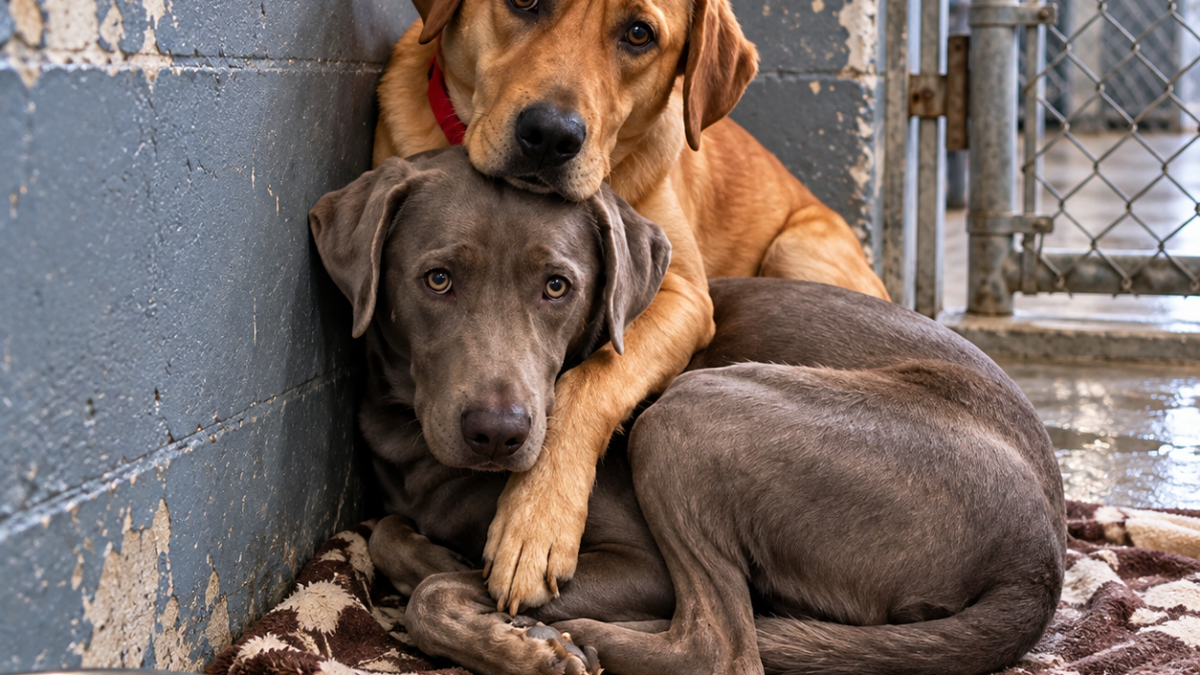
PART 2
“Decide what?” I asked.
For a moment, all I could hear was the traffic outside my apartment.
Then Renee sighed.
“We’re completely full, Josh.”
I sat down on the edge of my bed.
“What does that mean for Reddy and Blue?”
“County services called this morning. They’re reviewing transfers to partner facilities on Friday.”
I stared at the wall.
“Transfers?”
“Yes.”
“Together?”
Another pause.
And somehow, that pause told me everything.
“Renee.”
“There’s no guarantee a partner facility will have space for both.”
I stood up.
“No.”
“Josh—”
“No. We’ve been through this. They can’t just be separated.”
“I know they’re strongly bonded.”
“Blue shuts down without Reddy.”
“I remember.”
“And Reddy panics when he can’t find Blue.”
“I know.”
I was pacing now.
“Then why are we even discussing it?”
“Because we have thirty-eight dogs in a building designed to hold twenty-six.”
Her voice sounded exhausted.
“We have animals coming in every day, and we’re trying to make safe placements for all of them.”
I stopped moving.
I knew Renee wasn’t the enemy.
She had spent twelve years running a municipal shelter with too little money, too few employees, and more abandoned animals than anyone wanted to admit existed.
She had slept in her office during winter emergencies.
She had paid for medication out of her own pocket.
She had cried when older dogs died before finding homes.
But none of that made her words easier to hear.
“What happens Friday?” I asked.
“The placement team reviews their files. If an approved foster or adoptive home isn’t available, we’ll have to evaluate the transfer options.”
“Do they know they’re bonded?”
“Yes.”
“Will you tell them they should stay together?”
“Of course.”
I pressed my hand against my forehead.
“That’s not enough.”
“I know.”
For the first time, her voice cracked.
“I wish I could give you a better answer.”
I looked at the assignment lying on my kitchen table.
The promise I’d written at two in the morning.
Then I looked at the calendar on my phone.
Tuesday.
Three days.
“Tell me what an emergency foster needs,” I said.
Renee went quiet.
Then she asked, “What are you thinking?”
“I don’t know yet.”
“Josh…”
“Just tell me.”
She explained the requirements.
An approved home.
A safe environment.
A realistic plan for caring for two large dogs.
Someone able to manage their behavioral needs.
A veterinarian of record.
And an agreement with the shelter.
I wrote everything down.
My hand was shaking.
When she finished, I asked one last question.
“If I find somebody, will you keep them together?”
“Yes,” she said. “If it’s a suitable placement.”
I closed my eyes.
“Okay.”
“Josh, please don’t put yourself in an impossible position.”
I looked at the promise on the table.
“I already am.”
I missed the first fifteen minutes of class that morning.
My professor, Dr. Bennett, gave me a look when I entered.
I mouthed an apology and slipped into the back row.
But I couldn’t concentrate.
The lecture might as well have been delivered in another language.
All I could see was Reddy standing behind the shelter door.
And Blue lying beside him.
Green collar.
Orange collar.
Three days.
I opened my notebook.
Instead of taking notes, I began writing names.
My landlord.
My mother.
Megan, a friend from school.
Ray, my supervisor at the shipping store.
A former shelter volunteer who had fostered older dogs.
Two rescue organizations.
Every person I could think of who might know someone with a fenced yard.
By the end of class, I had a list of twenty-three people.
By lunchtime, fourteen had already said no.
Not cruelly.
Not carelessly.
Most had good reasons.
Apartments that didn’t allow dogs.
Young children.
Existing pets with complicated needs.
Long work hours.
Medical expenses.
Travel plans.
One woman had recently undergone knee surgery.
Another lived beside a busy road with no secure fence.
I thanked each person.
Then crossed out another name.
At two o’clock, my mother called.
“Joshua, why did you leave me three messages about dog-friendly rentals?”
I closed my eyes.
“Mom.”
“Are you moving?”
“Maybe.”
“Why?”
I told her everything.
The adoption.
The return.
The collars.
The upcoming transfer review.
When I finished, she was quiet.
Then she said, “Honey, you can’t adopt two dogs just because somebody else gave up.”
“I know.”
“Do you?”
I stared at the parking lot outside my campus library.
“I’m trying to find them a home.”
“Good.”
“Somewhere they’ll stay together.”
“Also good.”
“But if I can’t…”
She sighed.
“Josh.”
“What?”
“You’re twenty-one.”
“I know how old I am.”
“You’re finishing school. You’re working two jobs.”
“I know.”
“You barely sleep.”
“I know.”
“And you rent an apartment where animals aren’t allowed.”
I squeezed my eyes shut.
“I know.”
She softened her voice.
“I’m not telling you to abandon them.”
“Then what are you saying?”
“I’m saying saving them shouldn’t mean destroying your own life.”
I swallowed.
That was the problem.
I knew she was right.
But I also remembered being eight years old.
Waiting for my father’s car.
And I couldn’t stop thinking that the dogs had already heard the same promise.
I’ll be back.
I went to the shelter after class.
Reddy was standing when I entered.
Blue was lying behind him.
Neither barked.
Normally, Reddy would grab his rope toy and shake it when he saw me.
That afternoon, he simply watched.
I crouched outside the kennel.
“Hey, boys.”
Reddy approached.
His nose touched my fingers through the bars.
Blue lifted his head.
I opened the door.
Reddy stepped toward me.
Then turned around.
He walked back to Blue.
Nudged his shoulder.
Blue rose slowly.
They came toward me together.
I sat on the floor.
Reddy placed his head against my chest.
Blue leaned into my side.
And for a moment, I felt the weight of both dogs holding me in place.
“You know,” I whispered, “you’re making this incredibly difficult.”
Reddy’s tail moved once.
I laughed weakly.
“Yeah. I know.”
I stayed there until Renee came down the hallway.
She leaned against the doorway.
“Any luck?”
“Not yet.”
She nodded.
Then watched the dogs.
“Have you talked to Maya?”
I looked up.
“Maya?”
“Maya Ellis. The behavior consultant who helped with the shepherd mix last month.”
I remembered her.
She specialized in fearful and reactive shelter dogs and used reward-based training methods.
“Why?”
“Because these two need more than somewhere to sleep.”
I looked down at Blue.
His head rested against my leg.
Renee continued.
“If we find them a foster home, we need a plan that gives them the best chance of staying there.”
I nodded.
She was right.
The dogs had already been returned once.
We couldn’t put them through another failed placement simply because everyone was desperate.
“Can she come?”
“I called her.”
I looked up.
Renee smiled faintly.
“Tomorrow morning.”
Maya arrived carrying a bag of treats, a notebook, and the kind of calm expression that made you feel she had seen much worse than whatever problem you were about to describe.
She was in her thirties, with dark curls tied behind her head.
Before approaching the kennel, she watched the dogs from a distance.
Reddy stood near the door.
Blue stayed farther back.
Maya didn’t call them.
Didn’t bend over them.
Didn’t reach through the bars.
She simply watched.
After several minutes, she turned toward me.
“Tell me what happened in the adoptive home.”
I explained what Renee knew.
The excitement.
The accidents.
The children becoming nervous.
The return after three days.
“Any bites?”
“No.”
“Any reported attempts to bite?”
“None documented.”
“Resource guarding?”
“Not in the shelter.”
“Destructive behavior?”
“Reddy chews toys. Sometimes blankets when he’s overstimulated.”
“House training history?”
“Unknown.”
She nodded.
“And separation?”
“Terrible.”
I described the time we’d moved Blue to another room.
Maya listened carefully.
Then she looked at the two dogs.
“Okay.”
I waited.
Finally, I asked, “Are they too difficult?”
She turned toward me.
“For what?”
I frowned.
“For a family.”
“That depends on the family.”
I stared.
She continued.
“Two large dogs who spent six months in a shelter aren’t necessarily going to walk into a busy house and behave like dogs who’ve lived there for five years.”
I nodded slowly.
“They don’t know the rules.”
“No.”
“They don’t know the schedule.”
“No.”
“They don’t know whether strangers are safe.”
I looked toward Blue.
“And they certainly don’t know whether the next door they walk through means they’re finally staying.”
Something tightened in my chest.
Maya crouched a safe distance from the kennel.
“Let’s find out what they actually need.”
The evaluation took nearly two hours.
Maya observed them together.
Then during carefully structured exercises.
Reddy had trouble controlling his excitement.
When he saw a toy, he sometimes lunged toward it without thinking.
When a door opened, he wanted to rush through.
When someone moved quickly, he became highly alert.
Blue was different.
He hesitated.
Watched.
Often froze when he wasn’t sure what was expected.
Sometimes Reddy’s energy overwhelmed him.
Other times, Reddy’s presence helped him feel secure.
Maya took notes.
Then she sat beside me in the shelter’s small training room.
“Well?” I asked.
She looked at her notebook.
“Neither dog has shown aggression toward us during this assessment.”
I exhaled.
“But they aren’t easy.”
I looked down.
She continued.
“Reddy needs structure, exercise appropriate to his health, and help learning to settle. Blue needs predictability and time to develop confidence.”
“And together?”
“They’re strongly attached.”
I nodded.
“I know.”
“But attachment doesn’t mean we should assume every behavior they show is healthy or permanent.”
I looked at her.
“What does that mean?”
“It means we need to help both dogs feel secure. Together, yes, but also as individuals.”
I thought about the shelter examination months earlier.
Blue freezing.
Reddy pacing.
“So you’re saying we should separate them?”
“No.”
She shook her head.
“I’m saying we shouldn’t confuse protecting their bond with preventing them from learning.”
I considered that.
“Can they get better?”
She smiled.
“They can learn. We can help them. But whoever takes them needs realistic expectations.”
I looked toward the kennel.
“How long?”
“There’s no magic number.”
She closed her notebook.
“Three days wasn’t enough to know what kind of companions they could become.”
By Wednesday evening, I had contacted twenty-nine people.
Twenty-seven had declined.
One hadn’t answered.
And one had agreed to meet the dogs.
Her name was Ruth Callahan.
She was sixty-four, retired from teaching elementary school, and lived alone in a small house on the edge of town.
She had a fenced backyard.
No other pets.
Experience with rescue dogs.
And an almost alarming willingness to tell me when I was being foolish.
We met at a diner near the shelter.
Ruth arrived wearing a red cardigan and carrying a notebook.
She sat opposite me.
“You’re Joshua?”
“Yes, ma’am.”
“Don’t call me ma’am.”
I smiled nervously.
“Okay.”
She opened her notebook.
“Tell me about these boys.”
For nearly an hour, I told her everything.
Their six months at the shelter.
Their bond.
The failed adoption.
Maya’s assessment.
Their individual challenges.
Their need for patience.
Ruth listened.
Then asked a question I hadn’t expected.
“Do you have any idea what happened to them before they came to the shelter?”
“Not much.”
“Nothing?”
“They were found wandering together near a highway. No microchips. Nobody came forward to claim them.”
She nodded.
“And the shelter kept them together?”
“Yes.”
“Good.”
She looked down at her notes.
Then back at me.
“Now tell me what you haven’t told me.”
I froze.
“What?”
“Joshua.”
Her voice was gentle.
“You’ve spent an hour telling me why they’re wonderful. Tell me why somebody might struggle with them.”
I swallowed.
Then told her the truth.
Reddy jumped when excited.
Blue sometimes shut down in unfamiliar places.
Neither had a reliable history of living in a house.
There could be accidents.
There could be barking.
There could be chewed belongings.
They needed training.
They might need weeks or months to settle.
Ruth listened without interrupting.
When I finished, she closed her notebook.
“Better.”
I stared.
“Better?”
“Now I know what I’m considering.”
I felt a flicker of hope.
“Would you meet them?”
She nodded.
“Yes.”
The meeting was scheduled for Thursday morning.
By then, I was operating on coffee, anxiety, and about four hours of sleep.
Ruth arrived ten minutes early.
Maya was there to help.
We brought the dogs into a quiet outdoor area.
Reddy noticed Ruth immediately.
He moved toward her.
Then stopped when Maya redirected him to a calmer greeting.
Ruth waited.
“Hello, handsome.”
Reddy sniffed her hand.
Then wagged his tail.
Blue remained several feet away.
Ruth didn’t pursue him.
She sat on a bench.
For ten minutes, he watched.
Then he moved closer.
One step.
Another.
He sniffed her shoe.
Then her hand.
Ruth smiled.
“Well, hello to you too.”
Blue lowered his head slightly.
She scratched his chest.
His tail moved.
I felt my throat tighten.
After another half hour, both dogs were lying near the bench.
Reddy had brought his rope toy to Ruth.
Blue rested beside her leg.
I watched her expression.
She seemed thoughtful.
Finally, she looked at me.
“They’re lovely.”
My heart lifted.
“Really?”
“Yes.”
Then she added, “And they’re a lot of dog.”
I nodded.
“I know.”
She looked toward Reddy.
“I can see why a family without experience might get overwhelmed.”
I swallowed.
“But?”
Ruth smiled faintly.
“But being overwhelmed doesn’t mean the dogs are bad.”
I almost cried.
She continued.
“I’d be willing to discuss fostering them.”
I stared.
“Both?”
“Both.”
I couldn’t speak.
Maya smiled beside me.
Ruth held up one hand.
“Don’t celebrate yet.”
I froze.
“I want to review the arrangements. I’m retired, but I still have a life. And I won’t promise something I can’t do.”
I nodded quickly.
“Of course.”
She looked at Blue.
Then at Reddy.
“But I think we should try.”
That afternoon, everything nearly fell apart.
Renee called while I was at work.
“Josh, I need you to come in.”
My stomach tightened.
“What happened?”
“There’s been a complaint.”
“About what?”
“Reddy and Blue.”
I gripped the phone.
“From who?”
“The family that returned them.”
My chest went cold.
“What now?”
Renee sighed.
“They’ve been telling people the dogs are aggressive.”
I stared at the shipping labels in front of me.
“What?”
“Someone sent us a post in a local neighborhood group.”
“Did they say the dogs bit someone?”
“The post implies they’re dangerous around children.”
I closed my eyes.
“But the return form says disruptive behavior.”
“I know.”
“No bite report.”
“I know.”
“Maya evaluated them.”
“Josh, I know.”
I lowered my voice.
“What’s happening?”
“Ruth saw the post.”
For a moment, the entire room seemed to tilt.
“What did she say?”
“She wants to talk before making a decision.”
I felt my heart sink.
Thirty-one contacts.
A possible home.
Less than twenty-four hours before the placement review.
And now this.
I drove to the shelter after my shift.
Renee showed me the post.
The family’s name was Whitaker.
Mark and Beth Whitaker.
They had adopted Reddy and Blue on Friday.
Returned them Sunday.
Now Mark had written that the shelter had failed to explain how difficult the dogs were.
He described them as uncontrollable.
Claimed the children had been frightened.
Suggested other families should avoid them.
The wording was careful enough that he hadn’t explicitly described a bite.
But several comments had interpreted it that way.
One person wrote:
Sounds like dangerous dogs.
Another:
Those dogs shouldn’t be adopted together.
Another:
No wonder nobody wanted them.
I stared at the screen.
Six months.
They had waited six months.
Three days in a home.
And now strangers who had never met them were deciding they were hopeless.
My face burned.
“I want to answer.”
Renee shook her head.
“Not publicly, Josh.”
“Someone needs to tell the truth.”
“We will provide accurate information through the shelter’s official channels.”
“He’s making people afraid of them.”
“I understand.”
I looked at her.
“Does he understand what he’s doing?”
Renee remained quiet.
Then said, “Anger won’t help their adoption chances.”
I stared at her.
“What will?”
“Documentation.”
I looked down.
Maya’s evaluation.
The return form.
The veterinary records.
Our daily behavioral notes.
The evidence we had spent months collecting.
Renee continued.
“We’ll make sure any prospective foster or adopter has the real information. We won’t publicly attack the family.”
I swallowed.
“And Ruth?”
“I asked her to come tomorrow morning.”
I stared at the calendar.
Friday.
The deadline.
I barely slept.
At two in the morning, I was sitting at my kitchen table again.
The same spot where I’d made the promise.
My notebooks were scattered around me.
College assignments.
Work schedules.
Apartment listings.
Shelter forms.
I had spent the entire week trying to save two dogs.
And now I was afraid I had made everything worse.
My mother called.
She worked late shifts at a medical office and knew I’d still be awake.
“Josh?”
“Hey.”
“You sound awful.”
I laughed bitterly.
“Thanks.”
“What happened?”
I told her about the post.
Ruth.
The deadline.
The possibility that the dogs would be transferred separately.
When I finished, she was quiet.
Then she asked, “Do you remember what I told you when you were little?”
I rubbed my eyes.
“Mom, not now.”
“Please.”
I sighed.
“What?”
“When your father left.”
My chest tightened.
I looked toward the window.
My father had been gone for thirteen years.
I still remembered the sound of his car pulling away.
The promise.
The waiting.
I swallowed.
“What did you tell me?”
“That somebody leaving doesn’t mean you’re the one who failed.”
I closed my eyes.
“Mom…”
“You were eight, Joshua. You spent weeks asking what you could have done differently.”
I stared at the table.
She continued.
“You thought if you’d been quieter, or better at school, or helped more around the house, he might have stayed.”
I couldn’t answer.
“But you were a child.”
Her voice softened.
“And he was the adult who made the decision.”
Tears filled my eyes.
I thought about Reddy and Blue.
The accidents.
The nervousness.
The jumping.
The three days.
“Those dogs didn’t fail that family,” I whispered.
“I know.”
“They didn’t even have time to learn.”
“I know.”
I covered my face.
My mother waited.
Then she said, “You can’t make everyone stay, sweetheart.”
I closed my eyes.
“But you can make sure the people who do stay are prepared.”
Friday arrived gray and cold.
I went to the shelter before sunrise.
Reddy was sleeping.
Blue lay beside him.
Their backs touched.
For a moment, I simply watched.
I had spent four days fighting for them.
Calling people.
Arguing with reality.
Trying to solve problems too large for my bank account.
And there they were.
Sleeping.
Unaware that adults were about to make another decision about their future.
I opened the kennel quietly.
Reddy lifted his head.
“Morning, buddy.”
His tail moved.
Blue opened one eye.
I sat beside them.
For several minutes, neither dog moved.
Then Reddy placed his head against my leg.
Blue shifted closer.
I looked down.
“Today.”
Reddy watched me.
“Today’s the day.”
I swallowed.
“I don’t know what’s going to happen.”
His ears moved.
“But I’m going to do everything I can.”
Then I heard footsteps behind me.
Renee stood in the doorway.
“Josh.”
I looked up.
“Is Ruth here?”
She nodded.
“And Maya.”
I exhaled.
“Okay.”
Renee hesitated.
“There’s something else.”
My stomach dropped.
“What?”
“The county placement team is coming earlier than expected.”
I stared.
“How much earlier?”
“An hour.”
I looked toward the dogs.
Reddy was still resting against my leg.
Blue had closed his eyes.
I stood slowly.
“Then we’d better get started.”
Ruth sat in the meeting room with Maya and Renee.
Her red cardigan was buttoned all the way up.
She had her notebook open.
But her expression was serious.
I stopped in the doorway.
“Ruth.”
She looked up.
“Joshua.”
I swallowed.
“Did you see the post?”
“Yes.”
“Can I explain?”
She held up one hand.
“I came here to listen.”
I nodded.
Renee placed the return paperwork on the table.
Maya brought her evaluation notes.
We discussed everything carefully.
The dogs’ actual behavior.
Their shelter history.
The short adoption.
The lack of documented biting.
The likelihood of stress-related behavior during the first days in a new home.
The need for gradual introductions and management.
Ruth listened.
Then asked a question.
“Were the children hurt?”
Renee answered.
“No injury was reported to the shelter.”
Ruth looked toward Maya.
“Have they shown aggressive behavior during your assessment?”
“No. But no assessment can guarantee how a dog will behave in every situation.”
Ruth nodded.
“I understand.”
Then she turned to me.
“Joshua, why do you want these two together so badly?”
I looked at her.
“Because they’re bonded.”
“I know that.”
She leaned forward.
“Why does it matter so much to you?”
For a moment, I couldn’t speak.
Then the truth came out.
“Because they’ve already lost too much.”
Ruth watched me.
“They spent six months waiting.”
I swallowed.
“Someone finally took them home.”
My voice shook.
“And after three days, they were standing behind the same door.”
Ruth’s expression softened.
I continued.
“I know they’re not easy.”
Tears filled my eyes.
“I know they’ll chew things. I know Reddy gets excited. I know Blue gets scared.”
I looked toward the hallway.
“But they deserve somebody who doesn’t decide they’re worthless because the first three days are hard.”
The room became quiet.
I took a breath.
“And if I’m being selfish, it’s because I remember what it feels like to wait for someone who said they’d come back.”
I looked down.
“I’m sorry.”
Nobody spoke.
Then Ruth closed her notebook.
“Don’t apologize.”
I looked up.
She smiled gently.
“I asked because I wanted to know whether you understood the commitment.”
I stared.
“And?”
She took a breath.
“I think you do.”
My heart began pounding.
Ruth turned toward Renee.
“If the shelter approves me, I’ll foster them together.”
I stopped breathing.
Maya smiled.
Renee leaned forward.
“Are you certain?”
Ruth nodded.
“I’ve read the assessment. I understand they may need considerable work. I’m not expecting two perfectly trained dogs.”
I stared at her.
She continued.
“I have a fenced yard. I have time. And I have room.”
My eyes filled.
Then Ruth looked directly at me.
“But Joshua?”
“Yes?”
“You’re going to help.”
I nodded so quickly I almost laughed.
“Every day.”
She smiled.
“Then let’s give these boys a chance.”
The county representative arrived twenty minutes later.
I sat outside the office while Renee reviewed the foster arrangement.
Every passing minute felt enormous.
Finally, the door opened.
Renee stepped into the hallway.
She saw me standing.
And smiled.
“Approved.”
For a moment, I couldn’t move.
“What?”
“Ruth is approved for temporary foster placement. Both dogs stay together.”
I stared.
“Both?”
“Both.”
I covered my mouth.
Then laughed.
Then cried.
Renee stepped forward and hugged me.
“You did it.”
I shook my head.
“No.”
She looked confused.
I glanced toward the training room.
Ruth was sitting on the floor beside Blue.
Reddy rested near her feet.
“We did.”
The move to Ruth’s house happened that afternoon.
I drove behind her car, feeling as though I was escorting something fragile and priceless.
Ruth lived in a quiet neighborhood near the edge of town.
Her house was small.
White siding.
Blue shutters.
A covered porch.
A backyard enclosed by a sturdy wooden fence.
There were flower beds along the walkway and a bird feeder beneath a maple tree.
Nothing fancy.
Nothing enormous.
But as I stepped through the gate, I felt a strange sense of relief.
It looked like somewhere dogs could learn to be dogs.
Ruth opened the back door.
“Come on, boys.”
Reddy approached first.
He sniffed the threshold.
Then rushed inside.
Maya gently redirected him into a calmer entry.
Blue stopped.
He stared at the doorway.
Ruth didn’t pull him.
Didn’t urge him forward.
She simply waited.
After a moment, Blue stepped closer.
Then another step.
Finally, he crossed the threshold.
Reddy turned around.
Saw him.
And wagged his tail.
I smiled.
“Together.”
Ruth looked back at me.
“Together.”
The first evening was not magical.
I want to be clear about that.
Reddy did not walk into Ruth’s house and instantly become the perfect companion.
Blue did not suddenly stop being afraid.
There were no dramatic transformations.
Reddy investigated every room at high speed.
He nearly knocked over a small table.
He grabbed a dish towel from the kitchen.
He barked at his reflection in a glass door.
Blue stayed near the hallway, uncertain where he should go.
When Ruth moved a chair, Blue startled.
When the refrigerator compressor started, his ears lifted.
When Reddy became too excited, Blue retreated behind the couch.
Maya helped us settle them into a quiet area.
We set up separate feeding spaces.
Provided water.
Prepared beds.
Made sure they had somewhere comfortable to retreat.
Ruth watched everything carefully.
Then looked at me.
“Well.”
My stomach tightened.
“Well?”
She smiled.
“They’re definitely dogs.”
I stared.
Then laughed so hard I nearly cried.
At eight-thirty that evening, Reddy had an accident on the kitchen floor.
I froze.
It was exactly the kind of problem the Whitakers had complained about.
Ruth looked down.
Then at Reddy.
He lowered his head.
For one terrible moment, I thought the whole thing was about to end.
I rushed toward the cleaning supplies.
“I’m sorry.”
Ruth turned.
“For what?”
“He—”
“I can see what happened.”
“I’ll clean it.”
“Of course.”
She handed me paper towels.
I knelt.
My heart was pounding.
Ruth crouched beside me.
“Joshua.”
I looked up.
“Yes?”
“He doesn’t know my house rules yet.”
I stared at her.
“He’ll learn.”
I swallowed.
She continued.
“And if we need help, we’ll ask Maya.”
I looked toward Reddy.
He was standing near the doorway, uncertain.
Ruth smiled.
“Three days isn’t long enough to teach a dog that a new house is home.”
I lowered my head.
Because that was the first time I understood the difference between accepting an animal and committing to one.
Acceptance was easy when everything went well.
Commitment began when something went wrong.
At ten that night, Ruth sent me a photograph.
Reddy and Blue were lying on separate beds placed close together.
They were not touching.
But both appeared relaxed.
The message read:
First evening survived. One stolen towel, one accident, no disasters. They ate dinner and are settling down.
I laughed.
Then stared at the photograph.
For the first time in days, neither dog was watching a shelter entrance.
They were resting inside a home.
Not a permanent one yet.
But a real home.
I typed:
Thank you.
Ruth replied:
Go to sleep, Joshua.
I smiled.
For once, I listened.
The next morning, Ruth called at seven.
My stomach dropped when I saw her name.
“Hello?”
“Good morning.”
Her voice sounded cheerful.
I sat up.
“Everything okay?”
“Yes.”
I exhaled.
“Thank God.”
She laughed.
“Although I have discovered something.”
“What?”
“Reddy snores.”
I stared.
Then laughed.
“Really?”
“Like a lawn mower.”
I fell back against my pillow.
“And Blue?”
“Blue is a gentleman.”
I smiled.
“Of course he is.”
“Except he stole my slipper.”
I sat up.
“He what?”
She laughed again.
“I found it in his bed.”
“Oh, no.”
“Don’t worry.”
She paused.
“He didn’t chew it. He just wanted it.”
I smiled.
“Maybe it smelled like you.”
Ruth became quiet.
Then she said softly, “I wondered that.”
For a moment, neither of us spoke.
Then she continued.
“They slept through the night.”
My chest tightened.
“Both?”
“Yes.”
I closed my eyes.
“That’s wonderful.”
Ruth smiled through the phone.
“It really is.”
The first week at Ruth’s house was difficult.
There were accidents.
There was barking.
Reddy struggled to settle when visitors arrived.
Blue sometimes refused to enter unfamiliar rooms.
Both dogs became restless when their routine changed.
Maya helped us develop a plan.
Predictable feeding times.
Regular outdoor breaks.
Short, manageable training sessions.
Rewarding calm behavior.
Giving Blue choices rather than forcing interactions.
Providing appropriate physical and mental enrichment for Reddy.
And protecting the dogs from situations that overwhelmed them.
No shouting.
No punishment for fear.
No expectation that progress would happen on a schedule convenient for humans.
Some days went well.
Other days did not.
One afternoon, I arrived to find Ruth sitting on the back porch.
Reddy lay beside her.
Blue was resting beneath a small table.
Ruth looked tired.
I stopped.
“Bad day?”
She smiled weakly.
“Interesting day.”
My stomach tightened.
“What happened?”
“Reddy discovered the laundry basket.”
I looked toward the yard.
Several socks lay scattered across the grass.
I stared.
Then started laughing.
Ruth raised an eyebrow.
“You think that’s funny?”
I tried to stop.
“I’m sorry.”
She pointed toward the socks.
“He carried them out one at a time.”
I laughed harder.
“And when I collected them, he brought out another.”
I crouched beside Reddy.
“Buddy.”
His tail moved.
I shook my head.
“You are not helping your reputation.”
Ruth laughed.
Then sighed.
“He’s exhausting.”
I looked at her.
My smile faded.
“I know.”
She watched me.
Then said, “And he’s worth the effort.”
I swallowed.
There it was again.
The sentence I’d been desperate to hear.
Not that they were easy.
That they were worth staying for.
My own life was becoming harder.
I’d missed an assignment.
Then another.
My work hours were falling behind.
I spent every free moment visiting Ruth, helping with the dogs, or searching for a permanent home.
At first, I told myself I could manage everything.
College.
Two jobs.
The shelter.
The dogs.
The housing search.
But by the second week, I was exhausted.
I fell asleep during a lecture.
Forgot to submit a project.
And missed a scheduled shift at the campus bookstore.
My supervisor there called me into her office.
“Joshua, this can’t keep happening.”
I looked down.
“I know.”
“You’ve been late twice this month.”
“I’m sorry.”
“And you missed Saturday.”
I closed my eyes.
“I know.”
She sighed.
“You’re a good employee. But we need reliability.”
I nodded.
She continued.
“If this happens again, I’ll have to reconsider your schedule.”
I swallowed.
“Understood.”
When I left, I sat on a bench outside.
My phone buzzed.
A photograph from Ruth.
Reddy lying upside down in the grass.
Blue resting beside him.
The caption read:
They’ve discovered sunshine.
I smiled.
Then looked at the warning from my supervisor.
For the first time, I wondered whether my mother had been right.
Maybe I was trying to save two dogs by sacrificing everything else.
And maybe that wasn’t fair to anyone.
Not even them.
That evening, I went to Ruth’s house and sat on the porch steps.
Reddy approached immediately.
He pushed his head into my hands.
Blue followed.
I scratched both dogs.
Then Ruth came outside carrying two mugs of tea.
She sat beside me.
“You look terrible.”
I laughed weakly.
“Thank you.”
She handed me a mug.
“Talk.”
So I did.
I told her about the missed assignment.
The work warning.
The exhaustion.
The housing search.
The fear that I would never find them a permanent home.
When I finished, Ruth remained quiet.
Then she asked, “Do you think these dogs need you to be miserable?”
I looked at her.
“What?”
“Do you think they benefit when you stop sleeping?”
I stared at the yard.
“No.”
“Or when you lose your job?”
“No.”
“Or fail your classes?”
I lowered my head.
“No.”
She took a sip of tea.
“Then why are you acting as though suffering proves you’re committed?”
The question struck harder than I expected.
I stared at my hands.
Ruth continued gently.
“Joshua, love isn’t measured by how much of yourself you destroy.”
I couldn’t answer.
She looked toward the dogs.
“They need reliable people.”
I nodded.
“And reliable people need food, sleep, income, and a place to live.”
I swallowed.
She touched my shoulder.
“You can love them without carrying every part of this alone.”
For the first time in weeks, I felt myself breathe properly.
We changed the plan.
Ruth handled most of the daily foster routine.
Maya continued the behavioral support.
I visited on a schedule that worked around my classes and jobs.
Other approved shelter volunteers helped when needed.
Renee took charge of the permanent adoption search.
And I finally started sleeping more than four hours a night.
It felt strange.
At first, I felt guilty.
Every evening I wasn’t at Ruth’s house, I imagined the dogs wondering where I had gone.
Then Ruth sent photographs.
Reddy sleeping.
Blue eating dinner.
Both dogs relaxing in the garden.
They were okay.
The world did not collapse because I spent an evening studying.
That lesson was difficult.
But important.
I wasn’t their only source of safety.
And I didn’t need to be.
A month passed.
Reddy became easier to manage around doors.
He still grew excited.
But with consistent training, he began learning to wait.
Blue started exploring the house more confidently.
He discovered the kitchen.
Then the living room.
Then the sunny patch near Ruth’s bedroom.
His favorite place became a rug beside the window.
Ruth joked that he liked watching the neighborhood better than she did.
One morning, she sent me a video.
Blue was lying on the rug.
A delivery truck passed outside.
He lifted his head.
Watched it.
Then settled again.
I stared.
That was all.
A dog watching a truck.
But I remembered the shelter.
Blue freezing when doors opened.
His body trembling in unfamiliar rooms.
Now he could hear a vehicle and remain comfortable.
That was progress.
Quiet.
Ordinary.
Enormous.
Reddy’s progress was more visible.
He learned to sit when visitors arrived.
Not always.
Sometimes his excitement still won.
But he tried.
He learned that toys were for chewing, not Ruth’s slippers.
Mostly.
He learned the sound of his name.
He learned that calm behavior brought attention.
And he learned that the front door opening did not mean he needed to rush through it.
One afternoon, I arrived while Ruth was practicing.
She opened the door slightly.
Reddy remained on his mat.
His tail moved.
Ruth smiled.
“Good boy.”
She rewarded him.
Then opened the door a little wider.
He stayed.
I froze.
“Ruth.”
She looked toward me.
“What?”
“Look at him.”
She smiled.
“I am.”
Reddy remained on the mat.
His entire body seemed to vibrate with the effort of waiting.
But he waited.
I crouched.
“Buddy, you’re doing it.”
He wagged his tail.
Then, when released, rushed toward me with so much enthusiasm that I nearly fell backward.
Ruth laughed.
“Still a work in progress.”
I laughed too.
“Perfect.”
The first serious setback happened during a thunderstorm.
It was late November.
The weather had turned cold.
Wind shook the trees behind Ruth’s house.
Rain struck the windows.
Reddy became restless.
Blue retreated to his favorite spot near the hallway.
Ruth followed the plan we’d developed for storms.
A quiet room.
Soft bedding.
Familiar sounds.
A calm environment.
But that evening, something went wrong.
A strong gust blew open the outer porch door while a neighbor was delivering a package.
Reddy startled.
Then bolted through the opening.
It happened in seconds.
One moment he was near the hallway.
The next, he was outside.
Ruth rushed toward the door.
“Reddy!”
He disappeared into the darkness.
Blue ran to the threshold.
Then stopped.
He stared into the rain.
Ruth grabbed her phone.
Her hands were shaking.
She called me.
I answered immediately.
“Hey, Ruth.”
Her voice broke.
“Joshua.”
I sat upright.
“What happened?”
“Reddy got out.”
For a moment, I couldn’t speak.
“What?”
“The storm. The door. He ran.”
My heart began pounding.
“Where’s Blue?”
“Inside. He’s safe.”
I grabbed my keys.
“I’m coming.”
The drive to Ruth’s house took twelve minutes.
I remember every one.
Rain battered the windshield.
Lightning flashed over the trees.
Traffic lights reflected in the flooded road.
All I could think about was Reddy.
His golden coat.
His green collar.
His fear.
His habit of rushing forward when startled.
What if he reached the highway?
What if a car didn’t see him?
What if he became trapped somewhere?
I called Maya.
She answered on the second ring.
“Josh?”
“Reddy’s loose.”
She became serious immediately.
“Where?”
I explained.
She began giving instructions.
Don’t chase him if spotted.
Keep voices calm.
Use familiar scents and food.
Search likely hiding places near the home first.
Notify the appropriate local lost-pet contacts.
I listened.
Then called Renee.
Within minutes, several people were helping coordinate the search.
Not dozens of strangers running around and frightening the dog.
A small group.
Careful.
Organized.
Focused.
When I reached Ruth’s house, she was standing beneath the porch roof.
Blue was inside behind a closed door.
He looked toward me through the glass.
His orange collar caught the light.
I approached Ruth.
“Where did Reddy go?”
She pointed toward the back fence.
“He ran that way.”
I looked into the darkness.
Beyond the yard was a narrow service lane and a drainage ditch.
My stomach tightened.
Rainwater was running along the curb.
I turned toward Maya, who had just arrived.
“We start close.”
She nodded.
“Quietly.”
For nearly an hour, we searched.
We checked beneath parked cars.
Behind sheds.
Along the edge of the service lane.
Near the fence.
We used flashlights carefully.
Called softly.
Then stopped to listen.
I kept imagining Reddy running farther away.
Every minute made the fear worse.
At one point, I stood beside the drainage ditch and stared into the darkness.
Rain rushed along the concrete channel.
My chest tightened.
“Maya.”
She came closer.
“What?”
I pointed.
“Could he get down there?”
She looked.
“Possibly.”
We moved carefully along the safe public access path beside the drainage area, keeping away from the water.
Then I heard something.
A faint sound.
Not a bark.
More like a whine.
I stopped.
“Did you hear that?”
Maya raised one hand.
We listened.
Another sound.
From beneath a low concrete overhang near the far end of the ditch.
My heart jumped.
“Reddy?”
A movement.
Two eyes reflected in the flashlight.
Golden fur.
A green collar.
I nearly collapsed.
“There!”
Maya caught my arm.
“Don’t rush.”
I stopped.
Reddy was crouched beneath the overhang, frightened but apparently able to move.
The water was several feet away.
He had found a sheltered patch of ground.
I lowered myself slowly.
“Hey, buddy.”
His ears lifted.
“It’s me.”
He stared.
I didn’t approach further.
I placed a familiar blanket and some food where he could smell them.
Then waited.
The rain continued.
My jeans were soaked.
My hands were freezing.
But I barely noticed.
Reddy sniffed.
Moved forward a little.
Stopped.
I kept my voice low.
“Good boy.”
Another step.
Then another.
Finally, he came close enough for Maya to help secure him safely.
The moment I knew he couldn’t run into danger again, I sat down on the wet pavement and began crying.
Reddy pressed against me.
His entire body trembled.
I wrapped my arms around him carefully.
“You scared me.”
His tail moved once.
I laughed through tears.
“You scared me so badly.”
Maya crouched beside us.
“Let’s get him checked.”
I nodded.
And together, we brought him home.
Blue heard Reddy before he saw him.
The moment we entered Ruth’s house, Blue lifted his head.
Then rushed toward the hallway.
He stopped several feet away.
Stared.
And moved forward.
Reddy approached him.
Their noses touched.
Blue sniffed Reddy’s face.
Then his neck.
Then his shoulders.
Reddy leaned against him.
For several seconds, they stood together.
Nobody spoke.
Then Blue pressed his body against Reddy’s side.
Reddy lowered his head.
And they both settled.
Ruth began crying.
I looked at them.
Then at her.
“Are you okay?”
She shook her head.
“No.”
I stepped toward her.
She covered her face.
“I was so scared.”
“I know.”
“What if we hadn’t found him?”
I swallowed.
“But we did.”
She looked toward the dogs.
Reddy was already lying on his bed.
Blue rested beside him.
Their backs touched.
Just like they had at the shelter.
Ruth wiped her eyes.
Then looked at me.
“Joshua?”
“Yes?”
“I need you to understand something.”
My stomach tightened.
“What?”
She looked toward the dogs.
“These boys are not easy.”
I nodded.
“I know.”
She continued.
“They’re going to scare us sometimes.”
“Yes.”
“They’re going to make mistakes.”
“Yes.”
“And I’m probably going to have another terrible day like this.”
I swallowed.
Then Ruth smiled through tears.
“But I’m not sending them back.”
I stared.
She reached for my hand.
“Not because of one hard night.”
And that was the moment I understood what the Whitakers had never given these dogs.
Time.
The next morning, Reddy received a veterinary check.
He was tired but had no apparent serious injury from his escape.
We reviewed the incident and improved the safety arrangements at Ruth’s home.
The porch door needed better securing.
Visitors needed clear instructions.
Management around storms needed extra attention.
We didn’t blame the dog for panicking.
We changed the environment to reduce the risk.
That afternoon, I sat beside Reddy in the garden.
The storm had passed.
Sunlight touched the grass.
Blue rested nearby.
I scratched Reddy’s ears.
“You know something?”
He looked at me.
“I used to think promises were about saying the right words.”
His ears moved.
I smiled sadly.
“But they’re not.”
Reddy rested his head against my knee.
“They’re about what happens when things go wrong.”
I looked toward Blue.
He was sleeping.
“For three days, somebody called you family.”
My throat tightened.
“Then things got hard.”
I stroked Reddy’s cheek.
“And they stopped.”
He looked up.
I smiled.
“We’re not doing that.”
By December, my college grades had improved.
I had caught up on assignments.
Ray had offered me additional hours at the shipping company during winter break.
I was still working at the bookstore, but I’d rearranged my schedule to avoid the constant conflicts.
For the first time in months, my life felt manageable.
Then Ruth called with another problem.
Not an emergency.
But serious.
Her doctor had scheduled knee replacement surgery for early spring.
She would need recovery time.
And she wouldn’t be able to manage two energetic dogs alone during the first weeks afterward.
I stared at the phone.
“When?”
“March.”
I looked at my calendar.
Three months.
Ruth continued.
“I’m telling you now because I don’t want another last-minute crisis.”
I swallowed.
“Of course.”
“We need a plan.”
I looked toward the apartment listings I’d been collecting.
Most were too expensive.
Others didn’t allow dogs.
One allowed a single animal under thirty pounds.
Another required a fenced yard I couldn’t afford.
“Okay,” I said.
“We’ll make one.”
After we hung up, I sat quietly for a long time.
Three months.
Another deadline.
Another reason the dogs might need to move.
I was tired of moving them.
Tired of uncertainty.
Tired of watching people decide whether there was room.
And somewhere deep inside me, an idea that had been growing for months finally became impossible to ignore.
What if I stopped looking for someone else to adopt them?
What if the home I’d promised them was supposed to be mine?
I called my mother.
She answered cheerfully.
“Hi, sweetheart.”
“Mom?”
Her voice changed.
“What happened?”
“Nothing bad.”
“Joshua.”
I laughed weakly.
“Okay. Something complicated.”
I told her about Ruth’s surgery.
The approaching deadline.
The housing search.
Then I took a breath.
“I want to adopt Reddy and Blue.”
Silence.
I stared at the kitchen wall.
Finally, she asked, “Both?”
“Yes.”
“Permanently?”
“Yes.”
She exhaled.
“Josh.”
“I know.”
“Do you?”
“I’ve thought about it for months.”
She was quiet.
I continued.
“I know they’re expensive.”
“Yes.”
“I know I need housing.”
“Yes.”
“I know I have to finish college.”
“Yes.”
“And I know loving them isn’t enough if I can’t provide for them.”
She didn’t answer.
I swallowed.
“But I think I can build a plan.”
My mother took a breath.
“Then show me.”
I blinked.
“What?”
“Show me the plan.”
I sat down.
She continued.
“Not a promise written at two in the morning. A real plan.”
I looked at the notebook in front of me.
Housing.
Income.
Veterinary care.
Food.
Training.
Emergency savings.
Time.
She waited.
“Can you do that?”
I swallowed.
“Yes.”
“Good.”
Then she said something that made me cry.
“If the plan works, I’ll help you figure out the rest.”
I spent the next two weeks making the most serious budget of my life.
I calculated my current income.
Projected my earnings after graduation.
Estimated rent.
Utilities.
Groceries.
Transportation.
Dog food.
Veterinary expenses.
Preventive care.
Training.
Insurance.
Emergency savings.
Everything.
I discovered something quickly.
Emotion didn’t pay bills.
Neither did good intentions.
If I wanted Reddy and Blue permanently, I needed stability.
So I began working toward it.
I met with my academic advisor.
Reviewed what remained before graduation.
Asked about employment opportunities connected to my degree.
Then I spoke with Ray.
He listened while I explained everything.
When I finished, he leaned back in his chair.
“You want to keep the dogs.”
“Yes.”
“Both.”
“Yes.”
“And you need a better job.”
I laughed weakly.
“Basically.”
Ray looked thoughtful.
Then asked, “When do you graduate?”
“May.”
He nodded.
“We’re expanding our shipping contracts this summer.”
I stared at him.
“What?”
“The company needs someone to coordinate scheduling, inventory, and customer accounts.”
My heart began pounding.
“Okay.”
“You’ve worked here long enough to know the operation.”
I leaned forward.
“Ray…”
He held up one hand.
“I’m not offering you a job just because you love dogs.”
I smiled.
“I know.”
“I’m saying there’s an opening coming. Apply. Interview. Earn it.”
I nodded quickly.
“I will.”
He pointed at me.
“And finish school.”
I laughed.
“Yes, sir.”
He smiled.
“Good.”
The job application was terrifying.
I prepared for the interview more carefully than I’d prepared for some exams.
I researched the company.
Reviewed the job responsibilities.
Practiced answering questions.
Asked my professor to look over my résumé.
For once, I didn’t let myself imagine everything collapsing.
I focused on what I could control.
The interview happened in February.
Three managers sat across from me.
One asked about handling difficult customers.
Another asked about organizing competing deadlines.
A third asked how I responded when a plan failed.
I thought about Reddy.
The thunderstorm.
The drainage ditch.
The months of training.
Then I answered.
“I think the first thing is to stop pretending the original plan still works.”
The manager nodded.
I continued.
“You assess what changed, identify what needs attention, and build a better plan.”
I swallowed.
“And you don’t blame the people—or animals—involved for needing help.”
One manager smiled.
I realized what I’d said.
Then laughed nervously.
“Sorry. I’ve been volunteering at an animal shelter.”
The room relaxed.
The questions continued.
When I left, I felt exhausted.
But proud.
I had done my best.
Now I had to wait.
The phone call came eleven days later.
Ray asked me to stop by his office after my shift.
I knew immediately.
Either I had the job.
Or I didn’t.
He closed the door.
Sat down.
And looked at me.
“Joshua.”
I swallowed.
“Yes?”
“The team reviewed your application.”
I nodded.
“And?”
He smiled.
“We’d like to offer you the position after graduation.”
For a moment, I didn’t move.
“What?”
“Full-time operations coordinator. Salary and benefits.”
I stared.
Ray continued discussing the details.
Start date.
Responsibilities.
Training.
Probationary period.
But I barely heard him.
Because all I could think about was two dogs sleeping in Ruth’s house.
Green collar.
Orange collar.
Six months behind a shelter door.
Three days in a family that gave up.
I looked at Ray.
“Are you serious?”
He laughed.
“Very.”
I covered my mouth.
Ray smiled.
“Congratulations.”
And for the first time, the dream stopped looking impossible.
Housing remained the problem.
I had a job offer.
A realistic income plan.
A growing emergency fund.
But no place where two large dogs could live.
I searched constantly.
Every evening.
Every weekend.
During lunch breaks.
Between classes.
Some apartments were too expensive.
Others allowed only one pet.
Several had weight restrictions.
One landlord laughed when I mentioned two Labrador mixes.
“Absolutely not.”
I thanked him.
Hung up.
And crossed out another listing.
Then, one afternoon, Ruth called.
“Joshua, can you come over?”
My stomach tightened.
“Are the dogs okay?”
She laughed.
“Yes.”
“Then what happened?”
“Just come.”
When I arrived, she was standing beside a small detached building behind her house.
It had once been a garage apartment.
Her late husband had used it as a workshop.
Over the years, they’d converted part of it into a legal rental unit.
It had a small living room.
A kitchenette.
A bedroom.
A bathroom.
And its own entrance.
I stared.
“Ruth…”
She smiled.
“I’ve been thinking.”
I looked around.
The place needed cleaning.
Some repairs.
A fresh coat of paint.
But the structure was sound.
And beyond the windows was the fenced garden.
The same garden where Reddy and Blue had learned to feel safe.
I turned toward her.
“What are you saying?”
She held out a folder.
“I’m saying I have a rental unit.”
My heart began pounding.
“And I know a young man looking for somewhere to live.”
I stared at her.
“Ruth…”
She opened the folder.
Inside was a proposed lease.
The rent was modest but realistic.
Not free.
Not a gift disguised as a home.
A proper agreement.
She had already checked the repairs and permits needed to make the unit ready.
I looked at the numbers.
Then back at her.
“Why?”
Ruth glanced toward the yard.
Reddy was chasing a ball.
Blue followed him at a slower pace.
She smiled.
“Because I like having them here.”
My throat tightened.
“And I think they’d like having you here too.”
I didn’t say yes immediately.
I wanted to.
More than anything.
But Ruth had taught me something important.
Good intentions weren’t enough.
So we reviewed the lease carefully.
Rent.
Utilities.
Maintenance.
Parking.
Pet provisions.
Use of the shared yard.
Responsibility for gates and fencing.
The arrangements if either of us moved.
Everything.
My mother reviewed it too.
She came to see the apartment.
Walked through the rooms.
Checked the windows.
Asked Ruth questions.
Then stood in the garden watching Reddy and Blue play.
I joined her.
For several minutes, neither of us spoke.
Then she said, “You really love them.”
I smiled.
“Yes.”
She watched Reddy drop his rope toy at my feet.
Blue came beside him.
My mother looked toward the apartment.
“And you’ve done the work.”
I swallowed.
“I’ve tried.”
She turned toward me.
“I’m proud of you.”
The words hit me harder than I expected.
I looked down.
Then my mother hugged me.
“You didn’t just make a promise, Josh.”
She smiled through tears.
“You built a way to keep it.”
Graduation arrived in May.
I wore a borrowed gown.
The cap didn’t fit properly.
My mother cried before the ceremony even began.
Ray came.
Megan came.
Ruth came.
Renee sent a message from the shelter.
Maya sent one too.
And when I walked across the stage, I thought about the year behind me.
The exams.
The missed sleep.
The work shifts.
The kennel hallway.
The return form.
The transfer deadline.
The foster home.
The storm.
The job interview.
The lease.
Everything that had brought me to that moment.
Afterward, my mother hugged me.
Then Ray shook my hand.
Then Ruth approached carrying a small envelope.
I opened it.
Inside was a photograph.
Reddy and Blue lying in her garden.
Their backs touching.
On the back, she’d written:
Two boys waiting for their graduate.
I laughed.
Then cried.
Again.
Ruth smiled.
“You’re becoming predictable.”
I wiped my eyes.
“I know.”
She hugged me.
“Now finish moving into your apartment.”
The adoption paperwork was scheduled for the following Friday.
Almost exactly a year after Reddy and Blue had first left the shelter with the Whitaker family.
I hadn’t planned the date.
It simply worked out that way.
But when Renee pointed it out, we both became quiet.
“Do you remember that Friday?” she asked.
I nodded.
“Every second.”
She looked toward the kennel hallway.
“The green and orange collars.”
I swallowed.
“Yes.”
She smiled.
“Funny how things happen.”
I looked at her.
“What?”
“You spent so long looking for someone who would choose them.”
I nodded.
“And now here you are.”
I smiled.
“Yeah.”
Then Renee became serious.
“Josh, adopting them permanently means accepting the parts that are still hard.”
“I know.”
“Reddy still needs structure.”
“Yes.”
“Blue still has moments of fear.”
“Yes.”
“They may need veterinary care, training, and patience for the rest of their lives.”
“I know.”
She looked directly at me.
“And you’re not adopting them because you think they’ll become perfect?”
I shook my head.
“No.”
“Then why?”
I thought about the shelter door.
The collars.
My father.
The waiting.
Then I answered.
“Because I know who they are.”
Renee smiled.
“And?”
I looked toward the yard.
Reddy was lying in the sun.
Blue rested beside him.
“Because I want to be there for the rest.”
The adoption day was quiet.
No cameras.
No crowd.
No dramatic speeches.
Just paperwork.
A veterinarian’s records.
An adoption agreement.
A careful review of their needs.
And two dogs waiting in a familiar room.
I signed my name.
Joshua Hayes.
Then I signed again.
One form for Reddy.
One for Blue.
Renee collected the paperwork.
She looked at the signatures.
Then smiled.
“Congratulations.”
I stared at her.
“That’s it?”
She laughed.
“That’s it.”
“They’re mine?”
“They’re your responsibility now.”
I looked toward the dogs.
Reddy lifted his head.
Blue looked at me.
I crouched.
“Hey, boys.”
Reddy approached.
He pressed his nose against my chest.
Blue came beside him.
I scratched both dogs.
“You’re coming home.”
Reddy wagged his tail.
I laughed through tears.
“Not for three days.”
Blue leaned closer.
“Not until someone decides you’re inconvenient.”
I swallowed.
“For real.”
The green and orange collars were still around their necks.
They’d worn them through the return.
Through the shelter.
Through Ruth’s foster home.
Through training.
Through the thunderstorm.
Through everything.
Before we left, Renee handed me two new identification tags.
Reddy’s tag had his name and my phone number.
Blue’s had the same.
I fastened them carefully.
Then looked at the old collars.
For a moment, I thought about replacing them.
Starting fresh.
Leaving those first seventy-two hours behind.
But then I looked at the dogs.
Reddy’s green collar had faded slightly.
Blue’s orange collar had a small worn patch near the buckle.
They were comfortable.
Familiar.
And they no longer belonged to the people who’d bought them.
I smiled.
“We’ll keep them.”
Renee looked at me.
“Really?”
I nodded.
“They’ve been through enough changes.”
She smiled.
“Fair point.”
I touched Reddy’s collar.
Then Blue’s.
“They’re just collars now.”
And for the first time, that felt true.
The drive to my new apartment took fifteen minutes.
Reddy sat securely beside Blue in the back.
They watched the passing streets.
Neither seemed particularly concerned.
They had been to Ruth’s house many times.
The new apartment was just beyond the garden.
A short walk.
A familiar place.
But I had prepared everything.
Two beds.
Separate feeding spaces.
Toys.
Water.
A quiet resting area.
A photograph of the dogs beside my graduation picture.
And the battered rope toy Reddy had carried toward the Whitakers nearly a year earlier.
I had kept it.
Not because it was beautiful.
It wasn’t.
The rope was frayed.
The color had faded.
One end had been repaired.
But it reminded me of the afternoon Reddy had offered a stranger the one thing he loved most.
He had been trying to make a friend.
And now I wanted that old toy to be waiting when he entered his real home.
When I opened the apartment door, Reddy stepped inside first.
He sniffed the floor.
Then the wall.
Then the couch.
Blue followed.
He stopped in the doorway.
For a moment, my heart tightened.
I remembered the shelter examination.
The way he’d frozen when separated from Reddy.
But Reddy turned around.
Waited.
Blue looked at him.
Then stepped forward.
Together, they explored.
Slowly.
Carefully.
Reddy found his rope toy.
Picked it up.
Carried it toward me.
And dropped it at my feet.
I laughed.
“Really?”
He wagged his tail.
I picked it up.
“First day home and you’re already making demands?”
He bounced slightly.
Blue came closer.
Then rested beside my leg.
I looked at them.
And suddenly, I was twenty-one years old, standing in an apartment that wasn’t particularly impressive, holding a battered rope toy while two dogs looked at me as though I was the most important person in the world.
I sat down on the floor.
And cried.
The first night was not perfect.
Reddy became excited during dinner and knocked over a water bowl.
Blue hesitated near the bedroom.
There was barking when a car alarm sounded outside.
And at two in the morning, Reddy decided he needed to investigate the hallway.
I barely slept.
But when I finally woke around six, both dogs were lying on their beds.
Their backs touched.
Sunlight entered through the window.
Reddy’s head rested near Blue’s shoulder.
Blue’s eyes were closed.
I stood quietly.
For a moment, I thought about the shelter.
The concrete floor.
The fluorescent lights.
The metal door.
The same two dogs sleeping together because each was the only familiar thing the other had.
Now they were sleeping together because they wanted to.
In a warm apartment.
With full stomachs.
And someone who would be there when they woke.
I smiled.
“Good morning, boys.”
Reddy lifted his head.
Blue opened one eye.
Then both stood and walked toward me.
Together.
Life with Reddy and Blue was wonderful.
It was also messy.
And expensive.
And occasionally exhausting.
Reddy learned how to open the kitchen trash cabinet.
Blue developed a habit of stealing one specific pillow from the couch.
Neither seemed remotely concerned about my furniture preferences.
One afternoon, I came home from work to find a trail of paper towels across the living room.
Reddy stood in the middle.
Looking very proud.
Blue sat beside the couch.
I stared.
“Gentlemen.”
Reddy wagged his tail.
I looked at the shredded towels.
“Would either of you like to explain?”
Blue lowered his head.
Reddy picked up the empty cardboard tube.
I sighed.
Then laughed.
“Of course.”
I cleaned up.
Secured the cabinet better.
And added another management strategy to our routine.
Because that’s what living with dogs meant.
Not expecting perfection.
Learning.
Adjusting.
Helping them succeed.
There were setbacks.
Blue sometimes became anxious during thunderstorms.
Reddy occasionally barked when visitors arrived.
Both needed continued practice with routines.
We worked with Maya as needed.
We made progress.
Then encountered another challenge.
Then adjusted.
The difference was that nobody was counting down seventy-two hours.
Nobody was standing over them with an invisible stopwatch.
Nobody was deciding whether they deserved to stay based on the first mistake.
We had time.
That changed everything.
One afternoon, several months after the adoption, I took the dogs to a quiet park.
Reddy carried his rope toy.
Blue walked beside me.
We stopped near a bench.
The weather was warm.
Birds moved through the grass.
Children played at a nearby playground.
Reddy settled beside my feet.
Blue lay down next to him.
I looked at them.
Healthy.
Relaxed.
Content.
Then I heard a familiar voice.
“Joshua?”
I turned.
Beth Whitaker stood several feet away.
The mother who had adopted Reddy and Blue.
The woman who had chosen their collars.
For a moment, neither of us spoke.
Then she looked toward the dogs.
“Oh.”
Her face changed.
“Are those…”
I nodded.
“Reddy and Blue.”
She stared.
“They look different.”
I looked down.
Reddy lifted his head.
Blue remained relaxed.
I smiled slightly.
“They’ve had time.”
Beth looked uncomfortable.
“I heard someone adopted them.”
“Yes.”
“Both?”
“Yes.”
She looked toward me.
“Was it you?”
I nodded.
Her eyes filled.
For a moment, she seemed unsure what to say.
Then she whispered, “I’m glad.”
I didn’t answer.
Beth looked toward the dogs again.
“They were so overwhelming when we brought them home.”
I nodded.
“I know.”
“The children were frightened.”
“I understand.”
“We weren’t prepared.”
I looked at her.
“That was the problem.”
She swallowed.
“I know.”
For a while, neither of us spoke.
Then she asked, “Are they good dogs now?”
I looked down.
Reddy was chewing his rope toy.
Blue rested beside him.
I smiled.
“They were good dogs then.”
Beth lowered her eyes.
I continued.
“They needed help learning how to live in a home.”
She nodded slowly.
“And you gave them that.”
“Yes.”
She wiped her cheek.
“I wish we’d understood.”
I looked toward the playground.
Then back at her.
“So do I.”
Beth didn’t ask to touch them.
I appreciated that.
She simply stood for a moment, looking at the dogs she’d returned.
Then she said something unexpected.
“My youngest still talks about Blue.”
I looked at her.
“He does?”
She nodded.
“He thought Blue was scared because of him.”
My chest tightened.
Beth continued.
“He cried when we brought them back.”
I stared.
“I didn’t know.”
“He wanted to keep them. But everything happened so fast.”
She looked down.
“I think we were trying to make a decision before we’d understood what we’d agreed to.”
I nodded.
“That happens.”
She looked toward Reddy.
“He knocked over a chair.”
I glanced at the dog.
He was lying peacefully beside my feet.
“He does that sometimes.”
Beth smiled faintly.
“Really?”
“Yes.”
“And Blue had accidents.”
“He had a few here too.”
She stared.
“But you kept them.”
I looked at her.
“Yes.”
“Even when they were difficult?”
I smiled sadly.
“Especially then.”
Beth looked away.
For a moment, I saw genuine regret on her face.
Then she whispered, “I’m sorry.”
I didn’t know whether she meant the dogs.
The children.
The shelter.
Or herself.
Maybe all of it.
I nodded.
“Thank you.”
And let the apology be what it was.
It couldn’t undo the return.
But it was better than another excuse.
After Beth left, I stayed on the bench for a while.
Reddy rested beside me.
Blue stretched out in the grass.
I thought about the way I’d imagined that confrontation.
For months, I’d pictured running into the people who had returned them.
I imagined telling them everything they’d missed.
The training.
The setbacks.
The nights.
The time.
The love.
I imagined making them understand what it felt like to see two dogs returned after only three days.
But when the moment came, I didn’t need to shout.
The dogs were right there.
Healthy.
Loved.
Relaxed.
Reddy lifted his head.
Looked at me.
Then placed his rope toy against my knee.
I laughed.
“You really don’t care about dramatic moments, do you?”
His tail moved.
I picked up the toy.
And threw it a short distance across the grass.
He ran after it.
Blue followed.
And suddenly, the entire world felt lighter.
A year after their permanent adoption, the shelter invited us to a small volunteer appreciation gathering.
Renee wanted to recognize several people who had helped place difficult-to-rehome animals.
I agreed to bring the dogs.
But I was nervous.
The shelter had once been their entire world.
Would they remember?
Would returning upset them?
Maya helped us plan a brief, positive visit.
We would keep the experience calm.
Avoid overcrowding.
And leave if either dog showed signs of distress.
When we arrived, Reddy stepped out of the car.
He sniffed the air.
His ears lifted.
Blue followed.
For a moment, they stood together in the parking lot.
I looked toward the entrance.
The same glass doors.
The same building.
The same place where I’d watched them wait for six months.
I swallowed.
“You boys ready?”
Reddy wagged his tail.
Blue leaned against him.
I smiled.
“Okay.”
We walked inside.
Renee was waiting.
The moment she saw them, she covered her mouth.
“Oh, my goodness.”
Reddy recognized her immediately.
He wagged his tail.
Blue approached more cautiously.
Then leaned toward her hand.
Renee crouched.
“Hello, boys.”
Her eyes filled.
“Look at you.”
I smiled.
“They’re doing well.”
She stood.
“That’s an understatement.”
We walked down the hallway.
Past the adoption rooms.
Past the kennels.
Past the place where I’d spent so many mornings cleaning floors and filling water bowls.
Then we reached their old kennel.
The door was open.
Empty.
Reddy stopped.
He looked inside.
Blue approached beside him.
For a moment, neither dog moved.
I held my breath.
Reddy sniffed the doorway.
Then looked toward me.
Blue remained beside my leg.
I crouched.
“Hey.”
Reddy approached.
I scratched his ears.
“You don’t live here anymore.”
His tail moved.
I smiled.
“Remember?”
He pressed against me.
“We’re just visiting.”
Blue moved closer.
Then both dogs turned away from the kennel.
Together.
And walked toward the exit.
I felt tears gathering.
Because this time, they weren’t watching the door.
They were walking through it.
With me.
At the gathering, Renee spoke briefly about the shelter’s work.
The challenges.
The overcrowding.
The importance of prepared adopters.
The need for honest assessments and post-adoption support.
Then she looked toward me.
“Joshua, would you like to say a few words?”
I froze.
Ruth laughed from her chair.
“Go on.”
I stood reluctantly.
Reddy and Blue were resting beside me.
I looked around.
Volunteers.
Staff.
Foster families.
People who had spent countless hours helping animals most of the world never noticed.
I cleared my throat.
“I don’t really have a speech.”
Everyone laughed.
I smiled nervously.
“Most of you know Reddy and Blue.”
Several people nodded.
“They were here for six months.”
I looked down.
“Then they were adopted.”
My throat tightened.
“And returned after three days.”
The room became quiet.
I continued.
“For a long time, I was angry about that.”
I took a breath.
“I still think they deserved more patience.”
Reddy shifted beside me.
I smiled.
“But I’ve learned something.”
I looked toward Ruth.
“Good homes aren’t built on never having difficult days.”
She nodded.
“They’re built on people who know what they’ll do when those days come.”
I looked at Maya.
“Training helped.”
Then Renee.
“Honest assessments helped.”
Then Ruth.
“Fostering helped.”
My voice broke.
“And a whole lot of people refusing to give up helped.”
I crouched beside the dogs.
Reddy placed his head against my chest.
Blue leaned into my shoulder.
I smiled through tears.
“These aren’t perfect dogs.”
A few people laughed softly.
“Reddy still steals things.”
More laughter.
“Blue still gets scared sometimes.”
I scratched his ears.
“But they’re home.”
The room became very quiet.
I swallowed.
“And they’re staying.”
After the gathering, Renee showed me something new.
A small folder near the adoption desk.
Inside were updated materials for prospective adopters.
Information about the first days in a new home.
Stress.
House training.
Introducing children.
Managing excitement.
Understanding fearful behavior.
When to contact a trainer or veterinarian.
How to ask for support before problems became overwhelming.
I looked at the folder.
“What’s this?”
Renee smiled.
“We’ve been improving our adoption counseling.”
I nodded.
She continued.
“We learned from cases like Reddy and Blue.”
I stared.
“Really?”
“Yes.”
She pointed toward a page.
“We’re spending more time making sure families understand that animals need adjustment periods.”
I looked at the words.
Then toward the dogs.
Reddy was resting beside Blue.
My throat tightened.
“That matters.”
Renee nodded.
“It does.”
She looked at me.
“Not every returned animal will find the same outcome.”
“I know.”
“But we can do better.”
I smiled.
“Yes.”
“We can.”
Life continued.
I settled into my full-time job.
My apartment slowly began looking less like temporary student housing.
I bought a better couch.
Then a bookshelf.
Then a small dining table.
The washing machine I’d once postponed replacing finally broke completely.
Ruth laughed when I told her.
“Of course it did.”
I sighed.
“Perfect timing.”
She smiled.
“Welcome to adulthood.”
I replaced it.
Made another budget.
Kept working.
Kept caring for the dogs.
Nothing about life became magically easy.
But it became stable.
And for the first time, stability felt like something I had built rather than something I was waiting for someone else to give me.
Reddy and Blue continued changing.
Reddy became calmer.
Not quiet.
Never quiet.
He was still the kind of dog who believed every walk was a celebration.
But he could settle.
He could wait.
He could greet people without launching himself toward them.
Most of the time.
Blue grew more confident.
He began enjoying visits from familiar friends.
He explored new places cautiously.
Then with increasing curiosity.
He still looked toward Reddy when uncertain.
But he no longer froze at every unfamiliar sound.
The biggest change happened gradually.
So gradually that I almost missed it.
One evening, I came home from work.
I opened the apartment door.
Both dogs greeted me.
Reddy wagged his tail.
Blue approached and rested his head against my hand.
I bent down.
“Hey, boys.”
Then I noticed something.
Neither dog looked past me.
Neither stared toward the hallway.
Neither seemed worried that I might disappear again.
They greeted me.
Then turned toward the living room.
As though my return was entirely expected.
I stood there for several seconds.
And realized they had stopped waiting for someone to come back.
They simply knew I would.
One summer afternoon, my mother visited.
She sat in the garden with Ruth while Reddy and Blue played nearby.
I brought out lemonade.
My mother watched the dogs.
Then looked at me.
“You remember that phone call?”
I smiled.
“Which one?”
“The one where you told me you wanted to adopt them.”
I nodded.
“Yes.”
“I thought you were going to ruin your life.”
I laughed.
“You weren’t subtle.”
She smiled.
“I was scared for you.”
“I know.”
She looked toward the apartment.
“You were so young.”
“I still am.”
She laughed.
“Unfortunately.”
Then she became serious.
“But you didn’t just rush into something.”
I looked toward the dogs.
“No.”
“You planned.”
“Yes.”
“You worked.”
“Yes.”
“You asked for help.”
I smiled.
“That was the hardest part.”
She nodded.
Then her eyes filled.
“You became the kind of man who stays.”
I stopped breathing.
For a moment, I was eight years old again.
Standing at the living-room window.
Waiting for a car that never returned.
I looked down.
“Mom…”
She reached for my hand.
“Your father leaving never had to decide who you’d become.”
I swallowed.
Tears filled my eyes.
She smiled.
“And it didn’t.”
That evening, after my mother left, I sat on the porch.
Reddy rested beside me.
Blue lay near my feet.
The sun was setting.
A breeze moved through the trees.
I looked toward Ruth’s garden.
The place where the dogs had learned to feel safe.
The yard where Reddy had chased socks.
The porch where Ruth had told me that love wasn’t measured by how much I destroyed myself.
The fence we’d strengthened after the storm.
The apartment where I now lived.
I smiled.
Everything that had once seemed impossible was now ordinary.
A home.
A job.
Two dogs.
A routine.
A future.
I reached toward Reddy.
He placed his head beneath my hand.
Blue moved closer.
I scratched both dogs.
“You know something?”
Reddy looked up.
“You two nearly ruined me.”
His tail moved.
I laughed.
“Emotionally. Financially. Academically.”
Blue rested his head against my knee.
I smiled.
“And somehow, you also helped me figure out who I wanted to be.”
The following winter, Ruth had another surgery.
Nothing unexpected.
A procedure that required several weeks of rest.
This time, we were prepared.
I handled the dogs’ outdoor routines.
Helped with groceries.
Checked on Ruth.
Made sure everything was organized.
She hated accepting help.
Absolutely hated it.
One afternoon, I brought her lunch.
She looked at me.
“You don’t have to keep doing this.”
I smiled.
“I know.”
“Joshua.”
“Ruth.”
She sighed.
“You’re impossible.”
I set the tray down.
“Learned from the dogs.”
She laughed.
Then looked toward the window.
Reddy and Blue were sleeping in the garden.
Her expression softened.
“You know, when I agreed to foster them, I thought I’d be helping two dogs for a few weeks.”
I smiled.
“Sorry about that.”
She shook her head.
“Don’t be.”
I looked at her.
She continued.
“They brought you into my life.”
My throat tightened.
“And I needed that more than I realized.”
I sat beside her.
For a while, neither of us spoke.
Then she smiled.
“Besides, I like being their grandmother.”
I laughed.
“They definitely think you are.”
Five years after the failed adoption, I found the old photograph.
It was buried in a folder on my computer.
Reddy and Blue standing in front of the shelter.
Green collar.
Orange collar.
The afternoon they’d been adopted by the Whitakers.
Both dogs looked hopeful.
Excited.
Uncertain.
I stared at the image for a long time.
Then opened another photograph.
Taken that morning.
Reddy and Blue sleeping in our living room.
Their bodies were older.
Reddy had gray fur around his muzzle.
Blue’s silver coat had become lighter near his eyes.
Both were stretched across their beds.
Their backs touching.
I placed the photographs side by side.
Then I found a third.
The Monday morning after they’d been returned.
Reddy staring through the kennel door.
Blue lying beside him.
I looked at those three photographs.
The departure.
The return.
The home.
And suddenly, I understood how much had happened between them.
A returned adoption wasn’t the end of their story.
It was the beginning of a different one.
That night, I sat beside them.
Reddy was chewing a toy.
Blue rested against my leg.
The television played quietly.
Outside, rain tapped against the windows.
I looked down.
“Remember when you two were called difficult?”
Reddy lifted his head.
I smiled.
“You still are.”
His tail moved.
Blue looked up.
I laughed.
“Sometimes.”
I scratched their ears.
“But that’s okay.”
Reddy rested his head against my knee.
Blue moved closer.
I looked toward the front door.
The same door I’d opened every evening for years.
Then I remembered the shelter.
The metal bars.
The fluorescent lights.
The two dogs waiting for a family that wasn’t coming back.
I swallowed.
“You don’t have to watch doors anymore.”
Reddy blinked.
Blue closed his eyes.
I smiled.
“I’m right here.”
There were still difficult days.
Reddy developed stiffness as he aged.
Blue needed extra reassurance during thunderstorms.
Veterinary appointments became more frequent.
I adjusted our walks.
Made sure they had comfortable beds.
Managed their care with our veterinarian.
Sometimes I came home exhausted and discovered someone had tracked mud across the floor.
Sometimes a toy mysteriously disappeared.
Sometimes Reddy decided four in the morning was an excellent time to bark at a squirrel.
Nothing about living with them was perfect.
But it had never needed to be.
I hadn’t promised them a life without hard days.
I’d promised them a home where hard days wouldn’t be an excuse to send them away.
That was a promise I could keep.
One evening, I received an unexpected email from Beth Whitaker.
We hadn’t spoken in years.
The subject was simple.
Reddy and Blue.
I opened it.
She wrote that her youngest son was now a teenager.
He had recently started volunteering at an animal rescue.
Apparently, he’d never forgotten the dogs.
She said the experience had changed the way their family thought about adopting animals.
They’d eventually adopted an older, calmer dog after working with the shelter to find a more suitable match.
They had taken training classes.
Prepared their home.
Learned about adjustment periods.
And made a commitment they understood.
Then she wrote something that made me sit very still.
I used to tell myself Reddy and Blue were too difficult. The truth is, we weren’t prepared to give them what they needed.
I stared at the words.
She continued.
We made a promise we didn’t understand, and the dogs paid for it.
Then:
I’m glad they found you. I hope they’re happy.
I read the email twice.
Then looked toward the living room.
Reddy was sleeping.
Blue rested beside him.
I smiled.
And wrote back.
They are.
That was all.
Nothing more was needed.
I used to think revenge meant making someone regret what they’d done.
Sometimes I imagined confronting the Whitakers with everything they’d missed.
The training.
The progress.
The years of love.
The way Reddy learned to wait calmly at doors.
The way Blue discovered he could trust unfamiliar places.
The way they slept beside me during storms.
The way they greeted me every evening.
But by the time Beth wrote that email, I didn’t need revenge against her family.
They had already learned something.
And Reddy and Blue had something far more valuable than an apology.
They had a home.
A real one.
A place where someone understood that affection was only the beginning of responsibility.
Where the difficult days counted as part of the commitment.
Not evidence that the commitment had been a mistake.
The greatest change was in me.
When I was eight, my father left.
He told me he’d come back.
I believed him.
For weeks, I watched the window.
I learned to recognize cars by sound.
I learned what time the mail arrived.
I learned how long an afternoon could feel when you were waiting for someone.
Eventually, I stopped asking my mother when he would return.
But I never completely stopped listening.
Some part of me kept believing that if I became successful enough, responsible enough, or good enough, maybe one day he’d realize what he’d left behind.
Then Reddy and Blue came into my life.
Two dogs who had trusted a family.
Two dogs who had been returned because the first few days were hard.
Two dogs who stood behind a metal door wearing collars that still smelled like people who had walked away.
I recognized something in them.
The waiting.
The confusion.
The hope that someone might return.
At first, I wanted to rescue them because I couldn’t bear seeing that pain again.
But somewhere along the way, they taught me something I hadn’t understood as a child.
I couldn’t control who stayed.
I couldn’t make my father return.
I couldn’t force the Whitakers to keep their promise.
But I could decide what kind of person I wanted to become.
I could be someone who stayed.
Not perfectly.
Not without mistakes.
But deliberately.
Every day.
Years later, when people asked why I adopted two dogs nobody wanted to keep, I usually smiled.
I told them the simple version.
“They were bonded. They needed a home. I had room.”
That was true.
But it wasn’t the whole truth.
The whole truth was that those dogs had taught me how to turn a promise into a life.
Not just words.
Not just a dramatic moment.
A lease.
A budget.
A job.
Training.
Veterinary care.
Patience.
A thousand ordinary evenings.
And the willingness to keep choosing them long after the excitement of rescue had faded.
That’s what love became.
Something steady.
Something built.
Something that remained when nobody was watching.
The final time I visited the shelter with both dogs, Renee had recently retired.
A younger manager was running the facility.
The building looked different.
New paint.
Updated kennels.
A better outdoor exercise area.
But some things hadn’t changed.
Dogs still barked.
Volunteers still carried bowls.
Families still walked down the hallway hoping to find someone to love.
Reddy and Blue entered beside me.
They were older now.
Both moved more slowly.
But they still walked together.
Near the adoption desk, I saw a photograph mounted on the wall.
Two dogs.
One golden.
One silver-gray.
Green collar.
Orange collar.
It was Reddy and Blue.
Underneath, a small caption read:
Adoption takes patience. A returned dog is not a failed dog.
I stopped.
The manager noticed.
“Do you know them?”
I looked at the photograph.
Then down at the two dogs standing beside me.
I smiled.
“Yeah.”
She followed my gaze.
Her eyes widened.
“Oh, my goodness.”
I laughed.
“They’re a little older now.”
She crouched.
Reddy approached her.
Blue waited beside me.
The manager looked up.
“They’re beautiful.”
I nodded.
“They always were.”
We walked past their old kennel one last time.
A young black-and-white dog was resting inside.
He looked nervous.
His ears were down.
His eyes followed everyone walking past.
I stopped.
For a moment, I could almost see Reddy standing there years earlier.
Blue beside him.
Two new collars.
Two dogs watching the entrance.
I crouched near the kennel.
The young dog lifted his head.
“Hey, buddy.”
He watched me.
I didn’t reach toward him.
I simply sat quietly for a moment.
Then Reddy approached beside me.
Blue followed.
The young dog looked toward them.
His ears lifted.
For a few seconds, the three dogs watched one another through the barrier.
Then the young dog wagged his tail.
Just once.
I smiled.
“There you go.”
I looked at Reddy.
Then Blue.
“You two remember this place?”
They sniffed the floor.
Then turned toward the exit.
I stood.
“Okay, boys.”
We walked down the hallway together.
Past the kennels.
Past the reception desk.
Toward the doors.
And when the doors opened, neither dog hesitated.
They stepped outside.
Into the sunlight.
With me.
That evening, we returned home.
Ruth was sitting on her porch.
She waved.
Reddy wagged his tail.
Blue lifted his head.
I opened the apartment door.
Both dogs walked inside.
Reddy went toward his bed.
Blue followed.
They circled once.
Then settled.
Their backs touched.
I stood in the doorway watching them.
The green collar.
The orange collar.
The gray around their muzzles.
The quiet confidence of animals who knew where they belonged.
I thought about the morning I’d found them behind the shelter door.
And the question I’d asked myself.
How do you explain to a dog that someone has given up on him?
I still didn’t know the answer.
But I had learned something better.
You don’t always need to explain why somebody left.
Sometimes you can show them what staying looks like.
I turned off the living room light.
Then stopped.
Reddy had lifted his head.
He was watching me.
Blue opened one eye.
I smiled.
“I’m just going to bed.”
Reddy’s tail moved.
I laughed softly.
“Relax.”
Then I walked toward the bedroom.
Behind me, I heard paws against the floor.
Reddy.
Then Blue.
I looked back.
Both dogs were following me.
I smiled.
Of course they were.
For years, they had followed each other.
Now they followed me too.
Not because they were afraid of losing someone at every moment.
But because we were a family.
And families move through life together.
Sometimes I still think about those seventy-two hours.
Three days.
That’s all the Whitakers gave them.
Three days to understand a new house.
Three days to learn unfamiliar rules.
Three days to adjust to strangers.
Three days to prove they deserved to stay.
And when they couldn’t do it quickly enough, they were sent back.
I can’t change that.
But I can tell you what happened afterward.
Reddy learned to settle beside the window.
Blue learned to sleep through ordinary household noises.
Both learned that food arrived every day.
That walks happened.
That people came home.
That mistakes didn’t mean abandonment.
They learned that a door closing didn’t always mean goodbye.
And that someone could leave for work in the morning and return in the evening.
Again.
And again.
And again.
Until waiting became trust.
The hardest part of their story wasn’t finding a home.
It was learning to believe that home would last.
And the most important thing I gave them wasn’t a bed.
Or a yard.
Or a collar.
Or a toy.
It was time.
Time to make mistakes.
Time to learn.
Time to be frightened.
Time to become confident.
Time to grow older.
Time to love.
Time to understand that difficult didn’t mean disposable.
On their final adoption anniversary before both dogs reached their senior years, I bought two new beds.
Nothing extravagant.
Just comfortable, supportive beds for aging dogs.
I placed them beside each other in the living room.
Reddy inspected his immediately.
Blue sniffed his.
Then both walked away.
I laughed.
“Seriously?”
I had spent half an afternoon choosing those beds.
And they ignored them.
For nearly an hour, they slept on the old rug instead.
I shook my head.
“You two are impossible.”
Later that evening, Reddy finally settled onto one of the new beds.
Blue approached.
Sniffed the second.
Then lay down.
Their backs touched across the narrow space between the beds.
I smiled.
“There you go.”
They closed their eyes.
And the room became quiet.
I sat beside them.
Reddy was breathing peacefully.
Blue’s chest rose and fell in a slow, comfortable rhythm.
I looked toward the front door.
The same door I’d opened thousands of times.
The same door they’d learned to trust.
And I thought about the little boy I’d once been.
Standing at a window.
Waiting for a car.
Believing every passing set of headlights might mean someone had finally kept a promise.
I wished I could go back and sit beside him.
I wished I could tell him that one day he’d stop measuring his worth by who stayed and who left.
That one day he’d have a home filled with quiet breathing and muddy paw prints.
That he’d learn to love without believing love always ended in abandonment.
And that two unwanted dogs would help teach him how.
I looked down at Reddy and Blue.
Their bodies were relaxed.
Their eyes closed.
Their collars faded from years of use.
I smiled.
“You did it, boys.”
Reddy’s ear moved.
I scratched his head.
“You finally stopped waiting.”
Blue shifted closer.
“And so did I.”
People once called them too difficult.
Too energetic.
Too nervous.
Too much work.
They had lived with one family for seventy-two hours and been returned as though those three days revealed everything anyone needed to know.
But the people who gave up never saw the whole story.
They didn’t see Reddy learning to wait at the door.
They didn’t see Blue approaching a stranger for the first time without trembling.
They didn’t see Ruth sitting patiently through the accidents and barking.
They didn’t see the storm.
The search.
The fear.
The reunion.
They didn’t see the classes I finished, the job I earned, or the apartment I found so they could stay together.
They didn’t see the hundreds of ordinary days when nothing dramatic happened.
And they didn’t understand that those ordinary days were the entire point.
Reddy and Blue never became perfect dogs.
They became loved dogs.
Safe dogs.
Dogs with routines.
Dogs with a home.
Dogs who grew older beside someone who understood that commitment didn’t end when life became inconvenient.
And the boy who once watched his father disappear grew into a man who made sure two abandoned animals would never have to wonder whether they’d been left behind again.
That was the victory.
Not humiliating the family that returned them.
Not proving every stranger wrong.
Not becoming famous.
Not receiving an apology.
The victory was opening the front door after a long day at work and seeing two tails begin to move.
The victory was cleaning up a mess without threatening to send anyone away.
The victory was sitting through a thunderstorm until Blue felt safe.
The victory was giving Reddy another chance when he forgot his training.
The victory was growing older together.
One year.
Then another.
Then another.
Until the green and orange collars became faded reminders of a day that no longer had any power over their lives.
That night, I stood to turn off the last lamp.
Reddy lifted his head.
Blue opened his eyes.
I smiled.
“Good night, boys.”
Their tails moved softly against their beds.
I walked toward the bedroom.
A moment later, I heard their footsteps following me.
The familiar rhythm.
Reddy first.
Blue close behind.
I looked back and laughed.
“You know I’m not going anywhere, right?”
They followed anyway.
I opened the bedroom door.
Both walked inside.
And for a moment, I stood there thinking about the two dogs who had once pressed themselves against a cold shelter door, desperately watching for a family that wasn’t coming back.
Now they didn’t need to watch.
They knew where home was.
They knew who would feed them in the morning.
They knew whose footsteps they’d hear at the end of every workday.
They knew there would be another walk.
Another meal.
Another evening.
And another chance to get things right.
I knelt between them.
Placed one hand on Reddy’s golden head.
The other on Blue’s silver-gray neck.
And whispered the words I wished someone had said to me when I was eight.
“You don’t have to be perfect to deserve someone who stays.”
Reddy leaned into my hand.
Blue rested his head against my knee.
I smiled through tears.
They had waited six months for a family.
They had been returned after just three days because somebody decided they were too difficult.
But they spent the rest of their lives proving that three difficult days could never define a lifetime of love.
And the greatest revenge against everyone who had given up on them was wonderfully simple.
Reddy and Blue were finally home.
Together.
Loved.
And this time, nobody was counting the days until they had to leave.








