PART 2: They Told Me the Little Spaniel Wouldn’t Survive the Night—But She Was Still Waiting for Someone to Choose Her
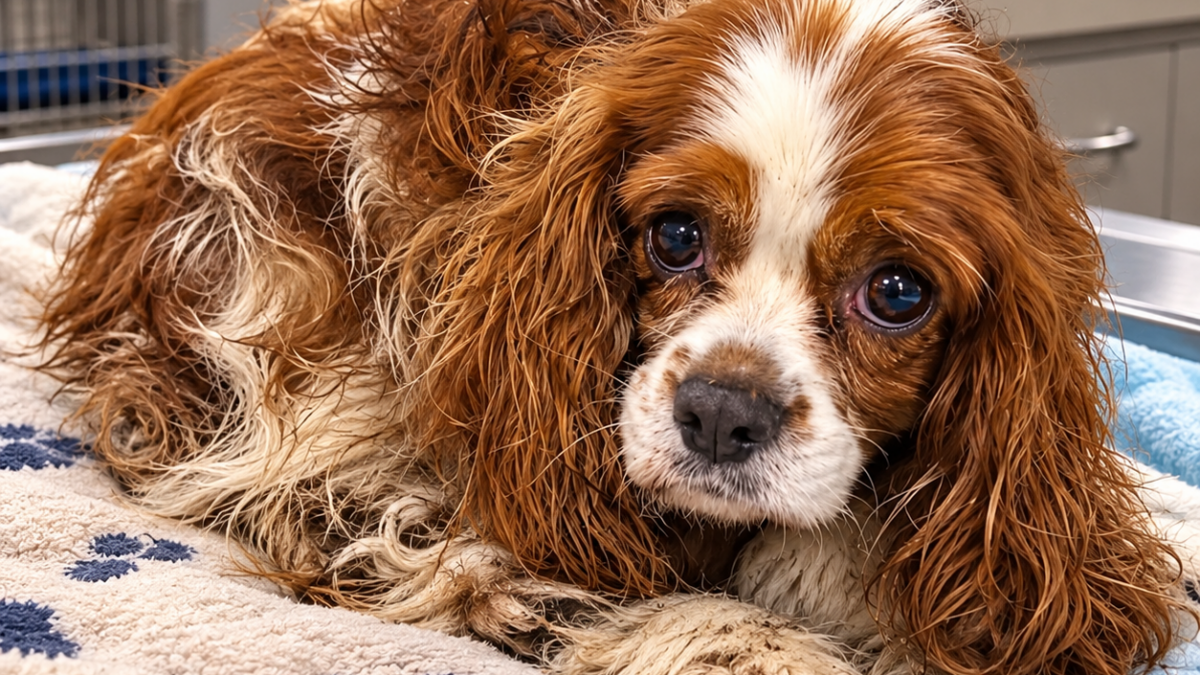
PART 2
“Willow Creek.”
I looked at him.
“What’s Willow Creek?”
Melissa held the evidence bag beneath the fluorescent light.
The strip was barely three inches long. One side had been torn cleanly; the other was frayed into threads. Under the embroidered words was the beginning of a phone number.
Local.
“It could be part of a collar,” Melissa said. “Or a kennel tag.”
Dr. Harris kept staring at it.
“I know that name.”
My hand was still resting beside the spaniel’s paw.
“From where?”
“There used to be a boarding and breeding kennel north of here. Willow Creek Kennels.”
“Used to be?”
“It closed last year.”
Melissa had already moved to the computer.
A few seconds later she said, “Found it.”
She turned the monitor toward us.
An old business listing filled the screen.
WILLOW CREEK KENNELS
BOARDING — GROOMING — FAMILY-RAISED SPANIELS
There was a photograph of a white farmhouse with a long low kennel building behind it.
The listing said the business was permanently closed.
The owner’s name was Margaret Ellis.
I glanced at the dog.
“Could she have come from there?”
Dr. Harris shook his head slightly.
“Could have. Could also be an old collar somebody reused.”
He was right.
One piece of fabric was not a life story.
And right then, the little dog’s life was measured in minutes, not history.
Her body trembled harder.
Dr. Harris crouched.
“Her temperature is dropping again.”
That ended the conversation.
For the next three hours, all of us worked around one question.
Could she make it until morning?
They warmed her carefully.
Not too fast.
Dr. Harris explained that a severely hypothermic animal could become unstable if warmed aggressively.
She received warmed fluids.
A little glucose.
Medication for nausea.
Antibiotics because her bloodwork and skin condition suggested infection.
He did not want to force food yet.
Every few minutes, one of us checked her gums.
Every time someone moved too quickly, she flinched.
Metal instruments clinked in a tray and her eyes snapped open.
A cabinet door closed.
Her body tightened.
Someone rolled a stool across the floor.
She tried to crawl backward.
I stayed low.
“Nothing is happening to you,” I whispered. “Nobody’s taking you anywhere.”
I had no idea whether she understood the words.
But she understood tone.
At ten-forty that night, Dr. Harris looked at the chart.
“We need something to call her.”
“For the records?”
“For everybody.”
I studied her for a moment.
“Lucy.”
Melissa smiled.
“Lucy?”
“I don’t know. She looks like a Lucy.”
Dr. Harris wrote it.
LUCY.
The little spaniel’s ear twitched.
“That’s settled,” Melissa said.
At ten fifty-two, Lucy lifted her head for the first time.
Only an inch.
Then another.
The effort made her shake.
I slid a shallow bowl toward her.
Dr. Harris put out a hand.
“Very little.”
Lucy sniffed.
For several seconds, nothing happened.
Then her tongue touched the water.
Once.
Again.
A third time.
“That’s enough for now.”
I removed the bowl.
Lucy watched it disappear.
“I know,” I told her. “I’m terrible.”
Her eyes moved back to my face.
It was the first moment I felt she was actually looking at me instead of through me.
Around midnight, the clinic was officially closed.
Nobody left.
Melissa finished paperwork behind the reception desk.
Dr. Harris checked Lucy every twenty minutes.
I sat on the floor with my back against a cabinet.
At 12:17, my phone vibrated.
My supervisor at the public library was calling.
I had texted earlier saying I probably would not be in the next morning.
“You okay?” Carol asked.
“I found a dog.”
A pause.
Then a sigh.
“Of course you did.”
“I didn’t technically find her.”
“Is she already living at your house?”
“She may not survive the night.”
Carol’s voice changed.
“Oh.”
“Yeah.”
“You need tomorrow?”
“Yes.”
“Take it.”
“Thank you.”
“And Laura?”
“What?”
“Don’t apologize for caring about something.”
I ended the call.
Lucy was watching me.
“You heard that?”
No movement.
But she did not close her eyes.
At 1:06, she vomited.
At 1:19, her temperature dropped again.
At 1:31, Dr. Harris called the emergency specialty hospital in Latham.
At 1:48, we decided to transfer her.
“She needs continuous monitoring,” he said. “Blood products may become necessary. We can’t provide that overnight here.”
“I’m going.”
He looked at me as if there had never been another possibility.
“I know.”
Melissa found another blanket.
Dr. Harris lifted Lucy gently.
The dog’s head hung against his arm.
My stomach turned.
“Is she getting worse?”
“She’s exhausted.”
“That isn’t an answer.”
“No,” he said quietly. “She isn’t improving enough.”
Outside, the rain had changed to sleet.
Dr. Harris laid Lucy across the back seat of my SUV.
I climbed behind the wheel.
“Laura.”
I looked at him.
“If she stops responding, pull over and call the emergency hospital immediately. Do not try to make her drink.”
“Okay.”
“And drive carefully.”
“I will.”
He closed the door.
I pulled away.
The hospital was normally twenty-eight minutes from the clinic.
That night it felt like two hours.
Every red light seemed personal.
Every pothole sounded too loud.
I kept looking into the rearview mirror.
At one point Lucy made a small noise.
I pulled onto the shoulder.
“Lucy?”
Her eyes opened.
I reached backward.
Two fingers touched her paw.
Her toes closed around them.
Weakly.
But deliberately.
“All right,” I whispered. “We’re still doing this.”
At the emergency hospital, technicians took her from me immediately.
I was left in the waiting room with wet hair, dried mud on my jeans, and Lucy’s smell on my coat.
The clock on the wall seemed louder than every other sound.
2:34.
2:47.
3:01.
A young veterinary technician brought me coffee at 3:12.
“You’re the foster?”
“I guess.”
“She’s lucky.”
I looked toward the treatment doors.
“I’m not sure she would agree yet.”
The technician smiled sadly.
“She might later.”
At 3:46, a veterinarian came through the doors.
She introduced herself as Dr. Priya Shah.
She sat across from me.
“Lucy is stable for the moment.”
I hated the phrase immediately.
“For the moment?”
“Yes.”
“What does that mean?”
“She’s profoundly malnourished. Her anemia is significant. Her body temperature is low, but we’re bringing it up. Her blood pressure is improving.”
“Can she survive?”
Dr. Shah leaned forward.
“She can.”
My chest loosened.
“But?”
“She has to make it through the next twenty-four to forty-eight hours.”
“What can I do?”
“Right now? Nothing.”
“I hate that answer.”
“I know.”
She slid a sheet of paper toward me.
“There is one thing you should know.”
My eyes dropped to it.
It was a microchip scan report.
“You found a chip?”
“Yes.”
“The first clinic couldn’t.”
“It migrated. It was low near the shoulder instead of between the shoulder blades.”
“Is it registered?”
“Yes.”
“To who?”
Dr. Shah paused.
I felt my heart speed up.
“To Margaret Ellis.”
I looked at the name.
“Willow Creek.”
“You know it?”
“We found part of a Willow Creek tag under her mats.”
Dr. Shah’s eyebrows lifted.
“We called the number in the microchip database.”
“And?”
“Disconnected.”
“I have an address.”
“Laura.”
“What?”
“It’s almost four in the morning.”
I looked at the clock.
She was right.
“You are exhausted.”
“Yes.”
“You’re not going to solve her history before sunrise.”
“No.”
She waited.
I looked through the glass toward the treatment area.
“I just don’t want to lose her before we figure out who she belongs to.”
Dr. Shah’s voice softened.
“Right now, she belongs to the next hour.”
That stayed with me.
I left at 4:30.
I slept for ninety minutes.
At 7:15, I was back.
Lucy was alive.
That became the rhythm of the next two days.
Still alive.
Still fighting.
Still fragile.
Every small improvement felt enormous.
Her temperature stabilized.
Her blood pressure improved.
She licked a little food from Dr. Shah’s finger.
Then she took two bites from a spoon.
She stood for four seconds.
Later, six.
The first time she managed three steps, a technician clapped without thinking.
Lucy froze instantly.
Every person in the room went silent.
The technician whispered, “Sorry.”
I crouched.
“It’s okay.”
Lucy looked at me.
Then took another step.
By the third day, Dr. Shah moved her out of intensive care.
That was when I finally returned to Willow Creek.
I did not go alone.
Susan Price, the rescue director, insisted on coming with me.
Susan was sixty-one, sharp-eyed, practical, and had spent twenty-three years rescuing animals. She distrusted emotional conclusions almost as much as she distrusted men who said, “That dog just showed up.”
The old kennel sat behind a faded farmhouse on twelve acres outside Ballston Spa.
The sign remained beside the driveway.
WILLOW CREEK KENNELS.
Several letters had peeled.
Leaves covered the gravel.
The place looked empty.
We knocked.
No answer.
I knocked again.
A car slowed on the road behind us.
Then stopped.
An older man rolled down his window.
“You looking for Maggie?”
“Yes.”
He studied us.
“Who are you?”
Susan answered.
“We’re with an animal-rescue group. We found a dog registered to her.”
His face changed.
“What dog?”
“A spaniel.”
“What color?”
“Chestnut and white.”
He shut off his engine.
Then climbed out.
He was in his seventies, broad-shouldered despite his age, wearing a faded baseball cap and heavy work coat.
“My name’s Frank Dorsey. I lived next door to Maggie thirty years.”
“Do you know where she is?”
He stopped.
“You really don’t know?”
“No.”
His face softened.
“Maggie died in January.”
The words landed heavily.
“January?”
“Pancreatic cancer.”
Susan glanced toward me.
“What happened to the dogs?”
“Most were placed. Family came. Rescue folks helped. Her nephew handled the rest.”
“What’s his name?”
“Caleb.”
“Caleb Ellis?”
“Yes.”
I took out my phone.
“What about a little spaniel named Lucy?”
Frank went very still.
“That dog is alive?”
My pulse jumped.
“You know her?”
“Of course I know her.”
I showed him the intake photograph.
His face collapsed.
“Oh, Lord.”
“You’re sure?”
“That’s Lucy.”
He enlarged the image with two fingers.
“That white streak on her nose. Her left ear always hung lower. That’s her.”
“What was she to Margaret?”
Frank handed the phone back slowly.
“She wasn’t kennel stock.”
“No?”
“That dog was Maggie’s shadow.”
He pointed toward the porch.
“Maggie drank coffee out there every morning. Lucy would sit right in her lap even after she got too big for it.”
“How old is she?”
“Nine. Maybe ten.”
“Was she healthy?”
“Before Maggie got sick, yes.”
“What happened afterward?”
Frank looked toward the empty kennel building.
“When Maggie went into hospice, Caleb stayed here on and off.”
“He was supposed to care for Lucy?”
“That’s what Maggie told me.”
“Did you see Lucy after Margaret died?”
“For a while.”
“How long?”
“Couple months.”
“And then?”
Frank removed his cap.
“She disappeared.”
“When?”
“Spring.”
“Did you ask Caleb?”
“Yes.”
“What did he tell you?”
Frank’s jaw tightened.
“Said she got adopted.”
Susan’s voice was careful.
“Did he say by whom?”
“No.”
“And you believed him?”
Frank looked embarrassed.
“I wanted to.”
That sentence struck me harder than I expected.
Wanted to.
Not believed.
Wanted to.
We asked permission to look around outside.
Frank had access to part of the property because some fencing and drainage crossed the boundary.
Behind the kennel building, empty runs stood with gates hanging open.
Old food bowls were stacked beside a wall.
There was a faded photograph pinned inside the office window.
Margaret kneeling in grass surrounded by spaniels.
One dog sat pressed against her leg.
Chestnut coat.
White chest.
Long ears.
Lucy.
Even from outside, I knew.
Frank noticed where I was looking.
“Maggie adored her.”
“Then why would she leave her with Caleb?”
Frank’s expression became complicated.
“She trusted family.”
Susan looked at him.
“That doesn’t answer the question.”
“No.”
He sighed.
“Maggie got sick fast. At first everybody thought treatment might work. Then suddenly she was making plans for things nobody wanted to talk about.”
“Did Caleb have experience with dogs?”
“Not much.”
“Did he like Lucy?”
Frank gave a humorless laugh.
“Caleb didn’t like anything that interrupted his plans.”
That was the first time someone had spoken badly about him.
Susan did not react.
“What plans?”
“Selling the property.”
“Was Margaret okay with that?”
“She knew it would probably happen.”
“What about the kennel?”
“Closed.”
“And Lucy?”
Frank looked at the ground.
“She said Lucy would be taken care of.”
We left with more questions.
Susan waited until we were back in my car.
“Don’t decide he abandoned her yet.”
“I haven’t.”
“Yes, you have.”
“I think he lied.”
“That is not the same thing.”
“He told Frank she was adopted.”
“Maybe she was.”
“Then how did she end up by a garage?”
Susan buckled her seat belt.
“That’s what evidence is for.”
I hated it when she was right.
The rescue contacted animal control.
Everything became formal.
Microchip records.
Veterinary documentation.
Photographs.
Frank’s statement.
The Willow Creek tag.
We did not call Caleb ourselves.
An officer did.
His story was simple.
He claimed Lucy had been adopted by a family in May.
Their name?
He could not remember the last name.
Where did they live?
“Somewhere near Troy.”
Phone number?
He no longer had it.
Adoption contract?
None.
Payment?
None.
Messages?
Deleted.
When did he last see Lucy?
May.
The officer wrote everything down.
If Caleb had stopped there, the case might have become difficult.
Instead, Frank called us two days later.
“I forgot about the camera.”
Susan put him on speaker.
“What camera?”
“My driveway camera. Had it installed after somebody stole a catalytic converter.”
“Does it show Willow Creek?”
“Part of the shared driveway.”
“How long are recordings stored?”
“I don’t know. It’s one of those cloud things my son set up.”
We went back that afternoon.
Frank’s son helped access the account.
The system retained clips triggered by motion.
We searched May.
Nothing useful.
June.
Nothing.
July.
Several deer.
A delivery truck.
Frank arguing with a raccoon near his trash cans.
“I won,” he said.
Susan stared at him.
“The raccoon may tell it differently.”
We kept searching.
August 22.
The screen showed Caleb’s pickup pulling into Willow Creek.
The passenger door opened.
For several seconds, nothing happened.
Then a small chestnut dog jumped down.
Lucy.
Not skeletal.
Not healthy either.
She looked thin.
But she walked.
She sniffed the grass.
Then followed Caleb toward the house.
I leaned closer.
“What time?”
Frank pointed.
6:14 p.m.
Three months after Caleb claimed he had given her away.
Susan folded her arms.
“That’s a problem.”
Frank swore under his breath.
“I knew that boy was lying.”
Susan looked at him.
“No. You suspected.”
Frank grumbled.
“He lied.”
“Yes.”
“Can I say it now?”
“Now you can say it.”
The footage changed everything.
Caleb was interviewed again.
This time, he said the adoption had failed.
The family returned Lucy.
Who were they?
He still could not remember.
How did they contact him?
Phone.
Which number?
He had changed phones.
Why did he tell Frank she was still adopted?
He shrugged.
“Didn’t want to explain.”
Then animal control asked when Lucy disappeared.
“Late September.”
“How?”
“She got out.”
“From where?”
“The house.”
“Through what door?”
“Back.”
“Was the yard fenced?”
“Yes.”
“How did she get through the fence?”
“Gate was open.”
“Who left it open?”
“I don’t know.”
“Did you search?”
“Yes.”
“Where?”
“Neighborhood.”
“Did you report her missing?”
“No.”
“Why not?”
“She wasn’t technically mine.”
That answer led investigators to Margaret’s attorney.
Her name was Diane Walker.
She agreed to meet us after animal control contacted her.
Her office was small and orderly.
She brought out a thick estate file.
“Margaret was very specific about Lucy,” she said.
“Specific how?”
“She worried about what would happen to the dog.”
“Why?”
Diane removed a document.
“Because Lucy had been with her almost ten years.”
I read the page.
It was part of Margaret’s will.
There was a separate provision for Lucy.
Fifteen thousand dollars had been set aside for her lifetime care.
Susan leaned forward.
“A pet trust?”
“Yes.”
“Who was caretaker?”
“Caleb Ellis.”
“And if Caleb couldn’t care for her?”
“Frank Dorsey.”
I looked up.
“Frank didn’t know.”
“He knew generally that Margaret wanted him as backup, but I don’t think he knew details.”
Susan pointed to the document.
“If Caleb transferred Lucy, what happened to the remaining money?”
“It followed the dog.”
“So if Lucy went to Frank, Caleb lost control of the fund.”
“Yes.”
The room went quiet.
Diane opened another folder.
“There’s more.”
Of course there was.
Caleb had submitted expense records to the trust.
Food.
Grooming.
Veterinary care.
Medication.
Boarding.
Month after month.
Even after he supposedly gave Lucy away.
“Wait,” I said. “He was reimbursing himself?”
“In part.”
“For care he said somebody else was providing?”
Diane nodded.
“Some reimbursements were described as payments he made on Lucy’s behalf.”
“Do you have receipts?”
“Yes.”
She spread them across the table.
One came from a veterinary clinic.
Another from a groomer.
Another from Willow Creek Kennels.
Susan picked that one up.
“Willow Creek was closed.”
“Yes.”
“Who issued this?”
“That’s one of the questions.”
I felt anger moving up my chest.
Susan saw it.
“Laura.”
“I’m fine.”
“No, you’re not.”
“No.”
Diane looked at me.
“You’re fostering Lucy?”
“Not yet. She’s still hospitalized.”
Diane’s expression softened.
“I met her years ago.”
“You did?”
“Margaret brought her to meetings.”
I stared.
“To legal meetings?”
“She refused to leave her home.”
Despite everything, I almost smiled.
“That sounds like Lucy.”
Diane looked at the intake photograph.
Then turned it facedown.
“I don’t want to see that again.”
Neither did I.
Investigators verified the receipts.
Several were false.
One veterinary clinic had not treated Lucy in over a year.
Invoice numbers had been copied from older bills.
The grooming receipt came from a business that had closed months before the date shown.
Willow Creek’s own invoices were meaningless because the business no longer operated.
The case was no longer about an abandoned dog.
It was also about money.
Caleb had allegedly been drawing from Lucy’s care fund while providing less and less care.
Investigators obtained bank records through proper legal process.
The money trail was messy but revealing.
Withdrawals labeled DOG CARE.
Cash purchases with no matching receipts.
Transfers into Caleb’s personal account.
Payments for vehicle repairs.
A credit-card bill.
Nothing enormous individually.
Together, they formed a pattern.
Then investigators found text messages.
Caleb had replaced his phone, but some data existed in cloud backups.
A friend named Ryan had messaged him months earlier.
RYAN: Still stuck with Maggie’s dog?
CALEB: Unfortunately.
RYAN: Thought that thing was old.
CALEB: Not old enough.
Weeks later:
RYAN: Why not give her away?
CALEB: Because then the money goes with her.
The words sat on the screen.
I read them twice.
Susan was beside me.
Neither of us spoke.
Another message, sent four days before Lucy was found:
CALEB: Need to get rid of the spaniel. Know somewhere nobody checks?
Ryan replied:
Old Harwood garage maybe. Nobody uses it except storage.
The abandoned garage.
Lucy had not wandered there.
She had not escaped.
She had been taken.
The next search of Caleb’s property found more.
Lucy’s old food bowl.
Medication prescribed years earlier.
A grooming brush with chestnut hair caught in the bristles.
None of those things proved abandonment by themselves.
Then officers found a blanket in the garage of his truck.
Veterinary testing could not establish some dramatic perfect match, but hair consistent with a chestnut spaniel was collected.
More important was what a traffic camera had recorded.
On the night Lucy was likely abandoned, Caleb’s truck traveled toward the Harwood property at 10:48 p.m.
It returned toward his house at 11:23.
The distance matched.
Caleb changed his story again.
He admitted driving there.
He claimed he went to check stored equipment.
Was Lucy with him?
He could not remember.
The investigator repeated the question.
Caleb said no.
Then maybe.
Then he asked for his attorney.
That was the end of the interview.
Meanwhile, Lucy’s body was doing something none of us had expected that first night.
It was recovering.
Slowly.
She began eating small meals.
Her temperature held.
The worst of the anemia improved without transfusion.
She stood longer.
Her eyes became more focused.
Dr. Shah called me one afternoon.
“She can leave tomorrow.”
I sat up so fast I knocked over my coffee.
“Leave the hospital?”
“Yes.”
“Where?”
“That depends on the rescue.”
“I’ll take her.”
Dr. Shah laughed.
“I assumed.”
I had fostered difficult animals before.
I thought I understood what I was agreeing to.
I did not.
Lucy came home on a Thursday.
Susan followed me with supplies.
Crate.
Food.
Medication.
Pee pads.
A soft bed.
Two blankets.
Baby gates.
A written schedule long enough to qualify as a legal document.
“No stairs,” she said.
“I know.”
“Small meals.”
“I know.”
“Medication at seven and seven.”
“I know.”
“Call if she refuses food for more than—”
“I know.”
Susan looked at me.
“You’re terrified.”
“No.”
“You cleaned your entire house twice.”
“That’s hygiene.”
“You bought three different dog beds.”
“I didn’t know what shape she’d like.”
“You color-coded the medication.”
“That was practical.”
She smiled.
“You’re terrified.”
Lucy stood in the entryway.
Her nails touched the hardwood.
She froze.
The refrigerator clicked.
Her whole body jerked.
“Okay,” I whispered. “We’re going slow.”
She would not cross into the kitchen.
Would not approach the couch.
Would not step onto the dog bed.
When I moved toward her, she backed away.
When I turned away, she followed.
Not close.
Just enough to keep me in sight.
Susan watched from the doorway.
“That’s attachment.”
“She doesn’t trust me.”
“She’s deciding whether she can.”
Lucy eventually chose the corner behind an armchair.
I placed a blanket there.
She lay down.
That became her first safe place.
At dinner, I set food several feet away.
She stared at it.
Then at me.
I sat across the room.
Nothing.
I moved farther away.
She sniffed.
One bite.
Then another.
I did not look directly at her.
Twenty minutes later, the bowl was empty.
I nearly celebrated.
Instead, I whispered, “Good girl.”
Her tail did not move.
That night I slept on the couch.
At 2:03 a.m., I woke because I heard nails on wood.
Lucy stood beside me.
She looked at my hand hanging over the edge.
I lowered it slowly.
She sniffed my fingers.
Then walked away.
The next night, she came back.
This time she stayed.
By day five, she slept on the rug beside the couch.
By day eight, she accepted chicken from my palm.
By day twelve, she walked into the kitchen without freezing.
By day sixteen, her tail moved when I came home.
One wag.
Then another.
I stood in the doorway staring at her.
“That was a wag.”
Lucy looked confused.
“That absolutely counted.”
Her tail moved again.
I sat on the floor.
She came toward me.
Slowly.
Then leaned her shoulder against my knee.
I cried.
Not dramatically.
No sobbing.
Just quiet tears while she stood there.
The investigation continued in the background.
Caleb’s attorney argued that the financial records had innocent explanations.
Some expenses, he said, related to multiple animals.
Some receipts had been reconstructed after Margaret’s death.
Some withdrawals were advances later repaid.
The defense also argued that Lucy’s physical deterioration might have occurred after she supposedly escaped.
Dr. Shah rejected that.
Not emotionally.
Clinically.
“Her condition reflects prolonged neglect,” she explained in a report. “The degree of muscle wasting, dental disease, chronic ear infection, skin inflammation, and low body weight would not reasonably develop solely over several days.”
That mattered.
Lucy had not merely suffered outside the garage.
She had been declining for weeks or months.
Then another witness appeared.
Her name was Marissa Cole.
She had worked part-time at Willow Creek during Margaret’s illness.
“I thought Lucy went with Margaret’s sister,” she told investigators.
“She didn’t.”
Marissa looked shocked.
“Then Caleb lied to me too.”
“What did he tell you?”
“That he wasn’t keeping any personal dogs.”
“When?”
“February.”
“Did you see Lucy after that?”
Marissa thought.
“Yes.”
“Where?”
“At Willow Creek in April.”
That contradicted another of Caleb’s statements.
“What condition was she in?”
“Thin.”
“How thin?”
“Enough that I noticed.”
“Did you say something?”
“Yes.”
“What did Caleb say?”
“He said she was old and picky.”
“Was she eating?”
“When I was there, she ate canned food.”
“Did she seem afraid of him?”
Marissa hesitated.
“She avoided him.”
“How?”
“If he came into the room, she left.”
I knew that was not proof of abuse.
Dogs avoid people for many reasons.
But it fit too well with Lucy’s behavior.
Marissa had something else.
A photograph.
Taken accidentally while she photographed equipment she might buy from the closing kennel.
Lucy appeared in the background.
Date: April 18.
Chestnut ears.
White chest.
Visible ribs.
Not yet skeletal.
But declining.
The timeline became clearer.
Margaret died in January.
By April, Lucy was thin.
By August, the driveway camera still showed her at Willow Creek.
By October, she was abandoned.
Month by month, she disappeared in plain sight.
That knowledge affected me more than finding her had.
At least abandonment was an event.
This was a process.
She had lost weight slowly.
Become dirtier slowly.
Become sicker slowly.
Someone had watched.
Every day.
One night, I sat at my kitchen table reading the veterinary report.
Lucy slept behind the armchair.
I could see one white paw.
I imagined Margaret sitting at the Willow Creek porch with coffee while Lucy rested on her lap.
Then I imagined Caleb passing the dog each morning as she became thinner.
How do you stop seeing a living creature?
Maybe you do not stop seeing.
Maybe you rename what you see.
Expensive.
Annoying.
Old.
Difficult.
Problem.
Once something becomes a problem instead of a life, cruelty becomes easier to explain to yourself.
My phone rang.
Susan.
“You sound terrible.”
“I said hello.”
“You said it like somebody died.”
“Sorry.”
“What are you doing?”
“Reading Lucy’s records.”
“Stop.”
“I’m trying to understand.”
“No. You’re trying to invent a moment where this makes sense.”
I said nothing.
Susan knew me too well.
“You won’t find one.”
“I hate that.”
“Yes.”
“If Margaret trusted him—”
“She did.”
“And he knew she trusted him.”
“Yes.”
“That’s worse.”
“Yes.”
Lucy shifted in her sleep.
Susan continued.
“Laura, you don’t help her by spending every night inside his head.”
“I know.”
“You help her tomorrow morning.”
“How?”
“Breakfast. Medicine. Walk. Same as today.”
That sounded too small.
It was not.
Recovery happened in small things.
Lucy gained two pounds.
Then four.
The chronic ear infection improved.
Her gums became pinker.
Her coat began to shine.
The first grooming session took almost three hours because the groomer refused to rush.
Her name was Jenna.
She worked on the floor.
No table at first.
No restraints unless necessary.
Snip a mat.
Pause.
Treat.
Another mat.
Pause.
Lucy trembled through the first twenty minutes.
Then stopped.
When the worst mats came away, the shape of her body became clearer.
So did old irritation around her neck.
A narrow band of damaged fur.
Jenna touched it gently.
“Collar?”
“Probably.”
“Too tight?”
“Maybe.”
Jenna’s mouth tightened.
She kept working.
When Lucy finally emerged, her ears were shorter but clean.
Her chestnut coat looked uneven.
Her tail had been trimmed.
She was still thin.
She was also beautiful.
Jenna tied a soft blue bandanna around her neck.
Lucy strutted through the lobby.
I laughed.
“You know you look good.”
Her tail wagged.
That afternoon she saw a squirrel.
She froze.
Her ears lifted.
The squirrel ran.
Lucy took three uncertain steps.
Then something happened.
She ran.
Not far.
Maybe six yards.
Clumsy.
Too slow.
But running.
The squirrel vanished up a maple tree.
Lucy stopped beneath it.
Looked up.
Then looked at me.
She seemed offended.
I laughed so loudly she startled.
“Sorry.”
She walked back.
Her tail wagged.
“Next time.”
There was a next time.
And another.
She never caught one.
She never stopped trying.
By December, Lucy no longer hid behind the armchair.
She slept beside the couch.
Then on the rug in the bedroom.
Then one night I woke at 3:00 a.m. because something touched my hand.
Lucy stood beside the bed.
“What?”
She looked at the mattress.
“No.”
She looked at me.
“You have your bed.”
Another look.
“I mean it.”
She put one paw against the mattress.
“Lucy.”
Second paw.
“You are manipulative.”
I lifted her.
She circled twice.
Then lay against my legs.
That was the end of another rule.
The case against Caleb moved slowly.
Legal systems do not operate at the speed anger wants.
There were document requests.
Financial analysis.
Witness interviews.
Veterinary opinions.
Arguments over admissibility.
The trust issue was reviewed separately from the animal-cruelty case.
Meanwhile, Caleb’s family became divided.
His younger sister, Erin, contacted investigators.
She had defended him at first.
Then she saw Lucy’s photograph.
“I thought people were exaggerating,” she told them.
“What did Caleb tell you?”
“That Lucy ran away.”
“When?”
“October.”
“Did you believe him?”
“Yes.”
“Do you still?”
“No.”
“Why not?”
Erin produced text messages.
Three months before Lucy’s abandonment, she had asked Caleb whether he wanted her to take the dog.
ERIN: If you’re tired of dealing with Lucy, I can probably take her for a while.
CALEB: No.
ERIN: Why not?
CALEB: Because Aunt Maggie left money for her and it becomes a headache if she changes homes.
ERIN: That’s stupid.
CALEB: You don’t understand the paperwork.
Investigators asked why she had offered.
“Because I saw Lucy in July. She looked bad.”
“Did you confront him?”
“I said she was too thin.”
“What did he say?”
“That she wouldn’t eat.”
“Did you believe that?”
“At first.”
Then Erin’s voice broke.
“I should have taken her anyway.”
Another person with the same sentence.
I should have.
Frank.
Erin.
Marissa.
Me, imagining if I had arrived later.
Guilt grows easily around suffering because everyone can find an earlier moment where they wish they had acted differently.
But guilt and responsibility are not identical.
Eventually, I had to learn that.
Lucy taught me more effectively than any therapist could have.
She did not spend her days mourning all the people who had failed her.
She spent them learning where sunlight appeared on my floor.
Christmas came.
I bought her a ridiculous red sweater.
She hated it.
I took it off.
I bought her a stuffed duck.
She destroyed it in seventeen minutes.
“That was twelve dollars.”
Lucy pulled out more stuffing.
“Worthless gratitude.”
She sneezed.
On Christmas morning, she climbed onto the couch without permission.
I looked at her.
She looked back.
“You know that’s not allowed.”
She lay down.
The rule died quietly.
We watched an old movie.
Halfway through, her head settled on my thigh.
I looked down.
Her eyes were closed.
Her breathing was deep.
Relaxed.
I stopped watching the movie.
There are moments in rescue where nothing dramatic happens and you realize you are witnessing the real miracle.
Not the emergency room.
Not the first meal.
Sleep.
A frightened animal sleeping deeply because somewhere inside her body, she finally believes nobody will hurt her while her eyes are closed.
I stayed still until my leg went numb.
Two days later, Caleb came to my house.
I knew who he was before he introduced himself.
Lucy knew something too.
The moment the knock sounded, she barked once.
Sharp.
Then she backed behind me.
I opened the inner door but kept the storm door locked.
A man in his late thirties stood outside.
Dark jacket.
Unshaven.
Tired.
“You’re Laura Bennett?”
“Yes.”
“I’m Caleb Ellis.”
My hand tightened around the doorknob.
“What do you want?”
“My aunt’s dog.”
“No.”
His face hardened.
“You don’t know what I’m here to say.”
“I know you’re not taking her.”
“She legally belongs to the estate.”
“No, she doesn’t.”
“My lawyer says—”
“Your lawyer can contact the rescue’s attorney.”
Lucy pressed against my calf.
Caleb saw her.
For the first time, his expression changed.
Recognition.
Then something that might have been shame.
“She looks better.”
“Don’t.”
“What?”
“Don’t compliment her recovery.”
His jaw tightened.
“I fed that dog for months.”
“With money your aunt left for her.”
“You think fifteen thousand dollars is a fortune?”
“No.”
“Do you know how much that property cost me? Taxes, utilities, repairs, medical bills, cleaning out that kennel?”
“Those things have nothing to do with leaving Lucy outside.”
“I didn’t leave her to die.”
“You left her beside an abandoned garage in October.”
“I thought somebody would find her.”
The words came quickly.
Then silence.
I stared at him.
Lucy trembled against my leg.
“You thought somebody would find her.”
“That’s not what I meant.”
“It’s exactly what you said.”
“I was angry.”
“That doesn’t make it better.”
“My aunt dumped everything on me.”
“She trusted you.”
“You think I wanted that?”
His voice rose.
Lucy flinched.
My anger disappeared.
I crouched beside her.
“Hey. It’s okay.”
She pressed her face against my knee.
I stood again.
“You need to leave.”
Caleb stared at Lucy.
“She always liked women better.”
“Leave.”
“She snapped at me.”
I did not answer.
“She was difficult.”
“So you stopped caring for her?”
“No.”
“She was sick.”
“I know.”
“You didn’t take her to a vet.”
“I had enough bills.”
“She had her own care fund.”
“That fund wasn’t endless.”
“You submitted fake invoices.”
His face changed.
I knew immediately I had said too much.
The investigation details were not mine to discuss.
I stopped.
“Your attorney can deal with everything else.”
He gripped the porch railing.
“You people think I’m some monster.”
“I don’t know what you are.”
“I was overwhelmed.”
“I believe you.”
That surprised him.
I continued.
“I believe you were angry. I believe you had bills. I believe you resented being responsible for her. None of that put Lucy beside that garage.”
His eyes shifted toward the driveway.
“I didn’t think she’d get that weak.”
That sentence was quieter.
More dangerous.
“What did you think would happen?”
He looked back at me.
For several seconds, neither of us moved.
Then he stepped away.
“I shouldn’t have come.”
“No.”
He walked to his truck.
I closed the door.
My hands started shaking afterward.
Lucy stood beside me.
I sat on the floor.
She climbed into my lap.
“All right,” I whispered. “That was terrible.”
She licked my chin.
I reported Caleb’s visit immediately.
Investigators documented what he had said.
His attorney was furious.
Susan was worse.
“What were you thinking letting him stand there?”
“He showed up.”
“You should have closed the door.”
“I know.”
“He could have been dangerous.”
“I know.”
“Laura.”
“I know.”
She stopped.
Then her voice softened.
“You okay?”
“Yes.”
“Lucy?”
“She’s here.”
“Did he scare her?”
“Yes.”
Susan exhaled.
“That’s what matters.”
I looked down.
Lucy was asleep against my leg.
“No,” I said. “What matters is he left.”
Susan paused.
“That too.”
A week later, I signed Lucy’s adoption papers.
Susan pushed the folder across her desk.
“You’re sure?”
“No.”
She smiled.
“That’s the correct answer.”
“What?”
“People who are absolutely sure usually haven’t thought hard enough.”
I looked at Lucy.
She was asleep beneath Susan’s desk.
“Then yes.”
I signed.
January 14.
Almost exactly one year after Margaret Ellis died.
Diane Walker noticed the date.
“That feels appropriate.”
“I didn’t plan it.”
“Maybe Maggie did.”
I looked at her.
She smiled.
“I’m an attorney. I’m allowed one sentimental statement per quarter.”
Then she handed me an envelope.
Inside was a photograph.
Margaret sitting on the Willow Creek porch.
A younger Lucy was curled in her lap.
Margaret had silver hair, glasses, and the kind of smile that made you immediately understand why a dog might spend her life waiting for her.
On the back, in blue ink:
MY BEST GIRL.
I sat in my car afterward.
Lucy occupied the passenger seat.
I showed her the photograph.
“Remember her?”
Lucy sniffed.
Then stared out the window.
She did not need the photograph.
I did.
The adoption changed something in me.
Until then, part of my mind had been protecting itself.
Foster.
Temporary.
Helping.
Those words create distance.
Adopted removed the distance.
Lucy was mine.
Which meant one day, I would lose her.
That terrified me.
But fear of losing something is a terrible reason not to love it while it is here.
Lucy had already learned that lesson better than I had.
The court case took almost a year.
Caleb’s attorney fought several aspects of the financial allegations.
Some expenses were legitimate.
That mattered.
The truth was not that every dollar had been stolen.
The truth was worse because it was more believable.
Caleb had initially cared for Lucy.
He bought food.
He paid for some medication.
He used some trust money properly.
Then resentment grew.
Margaret’s property became harder to manage.
Bills accumulated.
The kennel sale fell through.
Caleb lost work for several weeks after injuring his back.
At some point, Lucy stopped being his aunt’s beloved dog and became one more obligation he believed was ruining his life.
He cut corners.
Then more.
Then he began using the trust money for himself.
After that, giving Lucy away would expose what he had done.
So he kept her.
But keeping her cost money.
The trap was one he created himself.
When she became sick, he faced a choice.
Admit everything.
Or remove the evidence.
He chose the second.
Understanding that did not excuse him.
It made the story more frightening.
Most cruelty does not begin with someone waking up and deciding to become cruel.
It begins with one compromise.
Then another.
Then a lie needed to protect the first lie.
By the time you reach the terrible act, the person committing it has often spent months explaining themselves to themselves.
The courtroom was smaller than I expected.
No dramatic gallery.
No television cameras.
No pounding gavel.
Just lawyers, files, benches, fluorescent lights, and Lucy’s intake photograph on a large monitor.
I hated seeing that picture.
The prosecutor asked me about the first night.
“Describe Lucy’s condition when you arrived.”
“She was curled on a blanket. She was extremely thin. Her coat was matted. She was trembling.”
“Did she approach you?”
“No.”
“What happened when you reached toward her?”
“She tried to move away.”
“Could she stand?”
“Not properly.”
“What did she do when you stopped reaching?”
I swallowed.
“She closed her eyes.”
“Why did that matter to you?”
“Because she wasn’t relaxing.”
“What was she doing?”
I looked at Caleb.
He was staring at the table.
“She was bracing.”
The courtroom became very quiet.
The prosecutor waited.
“For what?”
“For whatever she thought my hand was going to do.”
Caleb’s attorney objected to speculation.
The judge sustained it.
I corrected myself.
“I can only say what I observed. She flattened her ears, moved away, then closed her eyes while her body remained tense.”
That was better.
Facts mattered.
Later, Caleb’s attorney questioned me.
“You became emotionally attached to Lucy, correct?”
“Yes.”
“Very attached?”
“Yes.”
“You eventually adopted her.”
“Yes.”
“You have publicly supported animal rescue for years.”
“Yes.”
“So you had strong feelings about this case.”
“Yes.”
He seemed surprised by how quickly I agreed.
“Would you consider yourself impartial?”
“I’m impartial about what I saw.”
“What does that mean?”
“It means loving her now does not change her weight that night. It does not change her temperature. It does not change her bloodwork. It does not change where she was found.”
He paused.
“Did you personally see Mr. Ellis abandon Lucy?”
“No.”
“Did you see him mistreat her?”
“No.”
“Then you cannot testify about what happened before she reached the clinic.”
“No.”
I looked toward the monitor.
“But I can testify about what arrived.”
He stopped questioning me soon after.
Frank testified.
His anger was visible, but he stayed controlled.
“Did you believe Lucy had been adopted?”
“Yes.”
“Why?”
“Caleb told me.”
“Did you verify it?”
“No.”
“Why not?”
Frank looked toward Caleb.
“Because Margaret trusted him, and I thought that meant I could.”
Diane testified about the trust.
Marissa testified about seeing Lucy thin months before abandonment.
Erin testified about offering to take her.
The veterinarians testified about prolonged neglect.
Then came the financial records.
Some legitimate.
Some false.
Then the text messages.
Still stuck with Maggie’s dog?
Unfortunately.
Why not give her away?
Because then the money goes with her.
The room shifted after that.
Caleb’s attorney knew it.
Everyone knew it.
The final blow was the message naming the Harwood garage.
Need to get rid of the spaniel.
The prosecutor put the traffic-camera timeline beside it.
Caleb’s truck traveled toward that property.
Twenty-five minutes later, it traveled back.
No dog was visible.
No perfect video showed him carrying Lucy from the truck.
Real cases rarely offer perfect evidence.
Instead, there were dozens of pieces.
The trust.
The lies.
The witnesses.
The changing story.
The location.
The messages.
The timeline.
The medical condition.
Together, they formed something difficult to escape.
Caleb eventually testified.
His attorney tried to make sense of what happened without pretending he had done nothing wrong.
That surprised me.
He talked about Margaret’s illness.
His own finances.
The pressure of closing the kennel.
His back injury.
The property taxes.
The resentment.
Then he said something I had never heard him say before.
“I hated that dog.”
The prosecutor paused.
“You hated Lucy?”
“I hated what she represented.”
“What did she represent?”
“My aunt still controlling my life after she was dead.”
I looked at Diane.
Her face tightened.
The prosecutor continued.
“So why not give Lucy to Mr. Dorsey, as the trust allowed?”
“Because I’d already used some money.”
“How much?”
“I don’t know.”
“You knew enough to submit false receipts.”
Caleb looked toward his attorney.
“Answer the question,” the judge said.
“Yes.”
“So transferring Lucy would have required an accounting.”
“Yes.”
“And an accounting would have revealed the missing money.”
“Yes.”
The silence that followed was heavy.
“What happened when Lucy became ill?”
Caleb rubbed his hands together.
“She stopped eating.”
“Did you take her to a veterinarian?”
“No.”
“Why?”
“I didn’t want more records.”
There it was.
Not rage.
Not cruelty for pleasure.
Fear of exposure.
The prosecutor let several seconds pass.
“What did you do instead?”
Caleb looked down.
“I drove her out there.”
My chest tightened.
“Where?”
“The garage.”
“Why there?”
“My friend said nobody used it.”
“What did you leave with her?”
“Nothing.”
“Food?”
“No.”
“Water?”
“No.”
“Blanket?”
“No.”
“You knew temperatures were near freezing?”
“I wasn’t thinking.”
“You drove eleven miles at night to a secluded property, but you weren’t thinking?”
Caleb’s attorney objected.
The judge allowed the prosecutor to rephrase.
“Did you expect Lucy to survive?”
Caleb looked toward me.
Then away.
“I thought someone might find her.”
“How?”
“I don’t know.”
“Who?”
“I don’t know.”
“When?”
“I don’t know.”
“You left her where, according to your own message, ‘nobody checks.’”
Caleb said nothing.
The prosecutor sat down.
That was the climax I thought I wanted.
A confession.
The truth.
The person responsible finally forced to say it in a room where he could no longer rewrite the story.
I expected satisfaction.
What I felt was exhaustion.
The sentence came weeks later.
There were penalties associated with animal abandonment and cruelty, restitution requirements, probationary conditions, restrictions on owning animals, and consequences tied to the misuse of Lucy’s trust.
The financial case required repayment and additional penalties.
Caleb lost his role in administering Margaret’s remaining estate matters.
He was not dragged away for decades.
Nobody applauded.
Real consequences were quieter.
He paid.
He lost control.
He lost reputation.
He lost relationships.
Erin stopped speaking to him for almost a year.
Frank never did again.
More than anything, he lost the story he had told himself.
That Lucy was an inconvenience.
That the money was practically his.
That nobody would care.
That leaving a little dog beside a garage was only one desperate decision in a difficult year.
Court records turned those explanations into facts.
And facts were much less forgiving.
Afterward, I went home.
Lucy was asleep on the couch.
The couch she had once been forbidden to use.
I sat beside her.
She opened one eye.
“That’s it.”
Her tail tapped.
“He admitted it.”
Another tap.
“I thought I’d feel better.”
Lucy lifted her head.
Then put it on my leg.
I scratched behind her ear.
“This is better.”
Life got quieter after the trial.
Lucy no longer woke at every sound.
She learned the refrigerator was harmless.
She tolerated the vacuum cleaner from another room.
She loved chicken.
Hated rain.
Despised ducks.
She discovered that if she sat near Frank’s chair long enough, he would eventually drop food.
Frank visited often after that first reunion.
The first time Lucy saw him in my yard, she froze.
He crouched.
“Hey, Luce.”
Her ears lifted.
“Come here, old girl.”
She walked toward him.
Slowly.
Then faster.
Frank dropped to both knees.
Lucy pressed against his chest.
He buried his face in her ears.
I went inside.
Some reunions do not need witnesses.
When I came back, Frank was sitting on the porch.
Lucy sat beside him.
“She remembers.”
“Of course she does.”
“Maggie always said she remembered anybody who gave her a cookie.”
“That sounds accurate.”
Frank laughed.
Then his expression changed.
“I should’ve checked.”
“When?”
“When Caleb said she was adopted.”
“You believed him.”
“I wanted to.”
“That isn’t the same thing.”
“No.”
He looked at Lucy.
“I should’ve checked.”
I sat beside him.
“The problem with hindsight is every warning sign becomes obvious.”
“He lied badly.”
“Not badly enough.”
Frank looked at me.
“You ever do that?”
“What?”
“Think about the moment you could’ve stopped something earlier?”
“All the time.”
“Does it help?”
“No.”
“Good.”
I laughed.
“Why good?”
“Means I can stop trying.”
He handed me a small box.
Inside was a worn blue leather collar.
Brass tag.
LUCY.
I turned it over.
Willow Creek’s old phone number.
“This was Maggie’s.”
“Where’d you find it?”
“Desk drawer.”
The faded fabric strip found beneath Lucy’s mats had probably once covered part of the collar.
“Do you want it?”
Frank shook his head.
“Belongs with her.”
I never put it on Lucy.
I hung it beside Margaret’s photograph.
Lucy wore a new collar.
My address.
My phone number.
That was enough.
Spring came.
Lucy discovered sunlight.
Every morning, she followed patches of it across the living-room floor.
At eight, she slept near the window.
At ten, beside the bookcase.
At noon, directly where I needed to walk.
“You’re a hazard.”
No reaction.
“You know that?”
She rolled onto her back.
I stepped over her.
Her appetite became excellent.
Too excellent.
At the clinic, Dr. Shah finally said the words I had never expected.
“She could lose a pound.”
I stared.
“You’re telling me Lucy is overweight?”
“A little.”
I laughed.
Dr. Shah smiled.
“This is a good problem.”
It was.
We reduced treats.
Frank ignored the plan completely.
Lucy aged.
Her muzzle whitened.
Arthritis appeared in her hips.
She still tried to chase squirrels but eventually decided barking from the porch was more efficient.
The ducks remained enemies.
One afternoon, a pair landed near the back fence.
Lucy charged five steps.
Stopped.
Looked at them.
Then looked at me.
“Exactly,” I said. “Waste of energy.”
She barked once.
The ducks ignored her.
“Humiliating.”
Tail wag.
Three years after the rescue, Dr. Harris invited us to a fundraiser.
I almost declined.
Lucy disliked crowds.
But the event was small.
We went.
Dr. Harris knelt when he saw her.
“Well, look at you.”
Lucy sniffed him.
Then licked his hand.
He laughed.
“She remembers.”
“I think so.”
He looked at me.
“You know what I remember?”
“The bloodwork?”
“No.”
“What?”
“You sitting on my floor saying, ‘What if we try one more time?’”
“I was being difficult.”
“Yes.”
“Sorry.”
“I didn’t say it was bad.”
He rubbed Lucy’s ear.
“I thought she might die.”
“So did I.”
“Honestly, I thought there was a good chance she would.”
I looked at Lucy.
She had become impatient and was sniffing a table where someone had left cheese.
“She disagreed.”
Dr. Harris smiled.
“Apparently.”
The fundraiser raised enough money to cover several emergency cases that winter.
Susan later joked Lucy had finally earned her medical bills back.
“She did not owe anybody anything,” I told her.
“I know.”
“Then don’t say it.”
Susan laughed.
“You’re unbearable.”
Lucy wagged.
“She agrees with me.”
“No, she thinks I have crackers.”
That was also true.
Around that time, I began volunteering differently.
Before Lucy, I took animals into my home.
After Lucy, I started helping build a small emergency medical fund for abandoned senior dogs.
Older dogs often arrived with the same problem.
Nobody wanted to invest in them.
Too expensive.
Too little time.
Too many medical issues.
I understood the arithmetic.
I hated it.
The first dog helped by the fund was a twelve-year-old beagle named Otis with infected teeth.
The second was a shepherd mix with a broken leg.
The third was a blind terrier whose owner died.
We called the fund Maggie’s Promise.
I chose the name.
Not Lucy’s.
Margaret had tried to protect her dog after death.
The promise failed because one person betrayed it.
I wanted the name attached to something that worked.
Diane donated first.
Frank second.
Dr. Harris waived part of his fees.
Dr. Shah arranged discounted specialty care.
Susan pretended she had allergies when I showed her the first annual report.
The fund grew.
Lucy attended exactly one meeting.
She slept through it.
Years passed.
The old Willow Creek property was sold.
A young couple bought it and converted the kennel building into a workshop.
Before the sale closed, Frank asked if I wanted anything from the property.
I said no.
Then changed my mind.
The porch board.
One board from where Margaret used to sit with Lucy.
The new owners let Frank remove a short section that was being replaced anyway.
He gave it to me.
“What am I supposed to do with this?”
“I don’t know.”
“Helpful.”
I eventually turned it into a small shelf.
Margaret’s photograph sat on it.
Lucy’s old collar.
A ceramic paw print from the clinic.
Nothing dramatic.
Just evidence that she had been loved before me.
That mattered.
I never wanted to become the hero of Lucy’s story.
Margaret loved her first.
The rescue workers helped.
The veterinarians saved her medically.
Neighbors spoke.
Frank remembered.
Erin came forward.
Marissa kept a photograph.
Investigators followed records.
Diane preserved paperwork.
Susan kept me from making stupid emotional decisions.
Lucy’s survival was not one person arriving at the perfect moment.
It was a chain of people finally doing what the person responsible had stopped doing.
Showing up.
The irony was not lost on me.
When Lucy was twelve, her heart murmur worsened.
Dr. Shah recommended medication.
“Is she suffering?”
“No.”
“Will she?”
“Eventually.”
I hated that word.
Eventually.
It is a promise none of us want and all of us receive.
Lucy took the pills hidden in cream cheese.
For months, nothing seemed different.
Then she slowed.
Walks became shorter.
She slept more.
One morning she stopped halfway down the porch steps.
I lifted her.
She tolerated that indignity poorly.
“You’re welcome.”
She glared.
“You weigh twenty-four pounds. This is not a tragedy.”
Another glare.
I carried her anyway.
At thirteen, her hearing faded.
The first sign was that she stopped meeting me at the door.
I came home one afternoon.
Silence.
My stomach dropped.
“Lucy?”
Nothing.
I rushed through the house.
She was asleep in sunlight beside the bookcase.
I touched her.
She woke with a start.
Then wagged.
“You couldn’t hear me.”
I sat beside her.
She licked my wrist.
After that, I began stomping lightly before approaching while she slept so she could feel vibration.
Her vision stayed good.
Her nose stayed better.
She could detect chicken from another floor.
Frank came one Sunday with roast beef.
“You’re ruining her diet.”
“She’s thirteen.”
“That doesn’t make calories fictional.”
Frank tore off a piece.
Lucy sat instantly.
“Look at that posture.”
“She manipulates you.”
“Good dog.”
“You’re impossible.”
He fed her the meat.
Lucy swallowed.
Then sat again.
Frank looked delighted.
“She remembers.”
“Food?”
“Everything.”
Maybe he was right.
As she got older, I thought more often about the first person Lucy remembered.
Margaret.
I had never met her.
Yet her presence existed throughout my house.
Her handwriting.
Her photograph.
The fund named after her.
Her dog.
Sometimes I wondered what she would have said if she knew what happened after she died.
Would she blame herself for choosing Caleb?
Probably.
People do that.
Would she be angry?
Certainly.
Would she be grateful?
I hoped so.
Mostly, I hoped she would see Lucy sleeping safely and understand that the final chapter was not the garage.
That mattered to me more than Caleb’s punishment.
One October evening, seven years after the rescue, Lucy did not finish dinner.
She had never refused chicken voluntarily in her life.
I called Dr. Shah.
“Bring her tomorrow.”
We went early.
Bloodwork.
X-rays.
Ultrasound.
I watched Dr. Shah’s face before she spoke.
I knew.
“Her heart has progressed.”
“How much time?”
“I can’t give you a date.”
“Weeks?”
“Possibly.”
“Months?”
“Possibly.”
“Years?”
She did not answer.
I looked at Lucy.
She was sniffing the trash can.
“She doesn’t know.”
“No.”
“Good.”
Dr. Shah sat beside me.
“We can adjust medication.”
“Will it make her comfortable?”
“Yes.”
“Then do that.”
The next months were gentle.
That is the word I remember.
Gentle.
Short walks.
Long naps.
Warm blankets.
She no longer climbed onto the couch herself, so I lifted her.
She no longer chased squirrels.
She watched them.
She still barked at ducks.
Respect.
Her appetite returned for a while.
Then faded again.
I cooked chicken and rice.
Frank brought roast beef.
Susan accused us of turning her into royalty.
“We’re late,” I said.
“For what?”
“She’s been royalty for years.”
Lucy sneezed.
“See?”
One winter morning, snow covered the yard.
Lucy stood at the door.
“You sure?”
She looked outside.
I put on her coat.
We walked slowly.
She took six steps into the snow.
Stopped.
Sniffed.
Then pushed her nose into it.
When she lifted her head, snow covered her muzzle.
I laughed.
She looked offended.
“That’s the last time I laugh at you.”
It was not.
She slipped trying to climb back onto the porch.
I caught her.
For a second, I held her against my chest.
She rested her chin on my shoulder.
Exactly as she had begun to do years earlier whenever she was tired.
I whispered, “I’ve got you.”
That became something I said often.
Not because she needed the words.
Because I did.
The final morning came in March.
Sunlight was already moving across the floor when I realized Lucy had not gotten out of bed.
“Breakfast.”
Nothing.
I crouched.
Her eyes opened.
Tail moved once.
I knew.
There are moments when your mind tries to negotiate with what your body understands instantly.
Maybe tired.
Maybe medication.
Maybe later.
Maybe tomorrow.
I called Dr. Shah.
My voice broke before I finished the sentence.
She came to the house that afternoon.
Frank came first.
Susan too.
I almost said no.
Then I realized Lucy’s life had never belonged only to me.
Frank sat beside her.
“Hey, Luce.”
Her tail moved.
He cried.
He did not hide it.
Susan kissed Lucy’s forehead.
“I knew you were trouble.”
Lucy breathed slowly.
Then they left.
Dr. Shah arrived carrying a small bag.
The same veterinarian who had told me years earlier that Lucy had to survive the next twenty-four hours.
Now she sat on my living-room floor.
“You ready?”
“No.”
She nodded.
“That’s okay.”
Lucy lay on her favorite blanket.
Sunlight reached her front paws.
I placed Margaret’s photograph on the table beside us.
Not because Lucy understood photographs.
Because I wanted both parts of her life in the room.
The woman who loved her first.
The woman lucky enough to love her last.
I touched her ear.
“Hey, sweetheart.”
Her eyes opened.
“Remember our deal?”
She looked at me.
“I leave.”
Her tail moved once.
“And I come back.”
Another shallow breath.
“Every time.”
I put my hand beneath her cheek.
Dr. Shah administered the sedative.
Lucy relaxed.
Her breathing slowed.
For the first time since the night I met her, I saw her close her eyes without tension anywhere in her body.
No bracing.
No fear.
Just sleep.
I cried then.
Hard.
I pressed my forehead against hers.
“I’m here.”
Her chest rose.
Fell.
Rose again.
I whispered, “You can stop waiting.”
The final injection went in.
Lucy exhaled softly.
Then nothing.
I kept my hand beneath her head.
I do not know how long.
Dr. Shah did not rush me.
Eventually she touched my shoulder.
“She’s gone.”
The room became impossibly quiet.
For weeks afterward, I still announced when I left the house.
“I’m going to work.”
Then silence.
I would stand there with my keys and remember.
Coming home was worse.
No bark.
No nails on hardwood.
No ridiculous spaniel ears appearing around the corner.
The sunlight patches on the floor looked empty.
I kept her blue Willow Creek collar beside Margaret’s photograph.
Her newer collar went beneath it.
One from before.
One from after.
Months later, the Harwood garage where Lucy had been found was scheduled for demolition.
I drove there.
I had avoided the place all those years.
I did not know what I expected.
Maybe something dramatic.
There was nothing.
Cracked pavement.
Weeds.
A rusted door.
Broken guttering.
I stood where the animal-control report said Lucy had been found.
Cold October rain had once blown through that space.
She had waited there.
Hungry.
Weak.
Listening every time a car passed.
Probably expecting familiar footsteps.
Maybe Margaret’s.
Maybe even Caleb’s.
Dogs do not understand betrayal the way people do.
They understand absence.
Then presence.
Pain.
Then safety.
Hands that hurt.
Hands that feed.
Doors that close.
Doors that open again.
I stood beside that old garage and realized I had spent years thinking of it as the place Lucy’s story nearly ended.
It was not.
It was only the place one chapter ended.
The important parts came later.
Her first tail wag.
Her first squirrel chase.
Frank kneeling in my yard.
Sleeping on my couch.
Barking at ducks.
Cream cheese around heart pills.
Snow on her nose.
Sunlight across old paws.
The rescue fund.
The people she connected.
The house she filled.
I left the garage without taking anything.
There was nothing there I wanted.
At home, I placed one final photograph on the little shelf made from the Willow Creek porch.
Not Lucy’s intake photograph.
Not the courtroom image.
Not the picture of Margaret holding her.
My favorite.
Lucy stood in my backyard at eleven years old, ears blowing sideways in the wind, eyes half closed, mouth open in what looked unmistakably like a smile.
Beside it sat a newer photograph.
The first senior dog saved through Maggie’s Promise that year.
Then another.
Then another.
The fund had helped thirty-eight dogs by then.
Later, fifty.
Then more.
Every time I approved an emergency grant, I thought about a tiny spaniel lying beneath an examination table while Dr. Harris told me she might not make it to morning.
People sometimes ask why I chose her.
I never know how to answer because the question is wrong.
I did not choose Lucy in some grand heroic moment.
I was sitting on a clinic floor.
She was terrified.
I reached toward her.
She tried to crawl away.
So I stopped.
Then she opened her eyes.
Moved one trembling paw across the blanket.
And touched my finger.
That was all.
A dog who had every reason to be finished with people made one small decision to try again.
So I tried too.
Years later, after the court case, after the new home, after the squirrels and ducks and medication and gray fur, that remained the moment I remembered most clearly.
Not because I saved her.
Because before I had done anything to deserve it, Lucy offered one last piece of trust.
And for the rest of her life, I tried to make sure she never had to regret it.
[END OF STORY]








