PART 2: They Tied Him to a Collapsing Doghouse and Left Him to Di3—But One Detail Exposed Everything
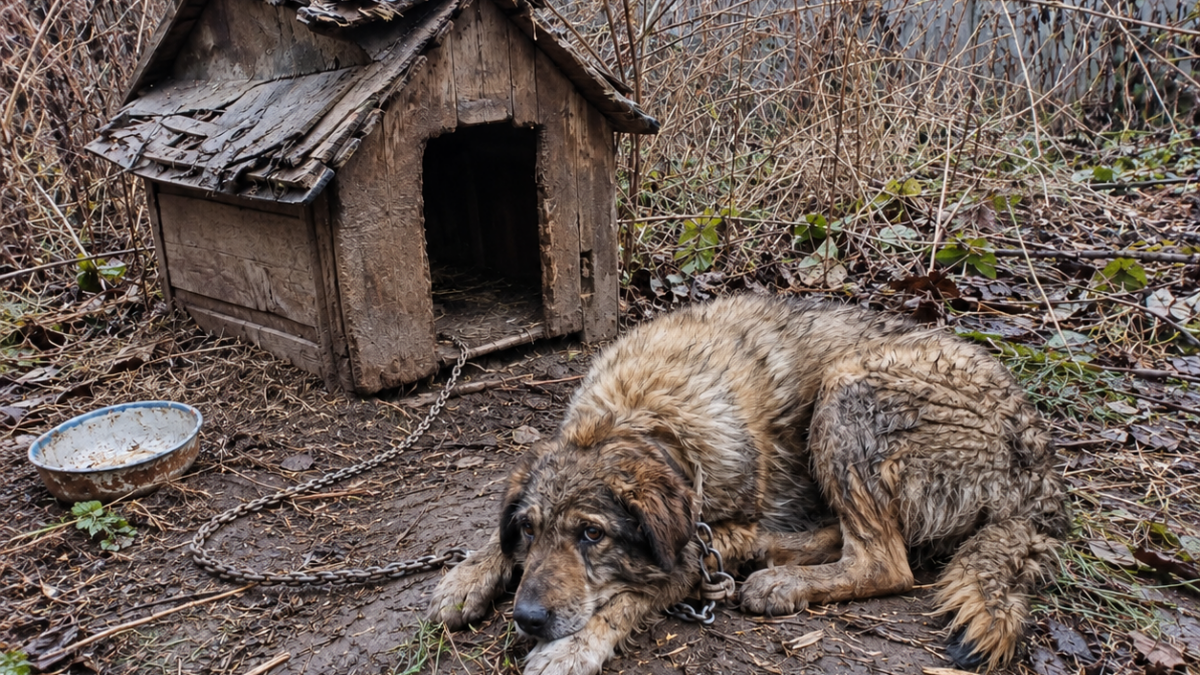
PART 2
She placed a small metal object in my hand.
At first I thought it was part of the collar buckle.
Then I turned it over.
There were three letters scratched into the back.
**R.H.K.**
“Was this attached to him?” I asked.
“To the rope. Not the collar.”
Dr. Harris came closer.
The little metal plate was rectangular, about the size of my thumbnail. Rust had collected around one corner, but the letters had been deliberately carved into it.
Linda looked over my shoulder.
“Could it be a name?”
“Maybe initials.”
“Owner?”
I looked toward Bruno.
His head rested on a folded towel while a technician connected his IV.
“I don’t know.”
At that moment, finding whoever had left him felt secondary.
First, Bruno had to live.
Dr. Harris warned me that recovery would not be simple. Bruno’s starvation was severe enough that feeding him too aggressively could cause dangerous metabolic complications. His kidneys were stressed. He was anemic. His skin was inflamed in several places. The wound around his neck required cleaning and antibiotics, but even that had to be done slowly because Bruno shut down whenever hands came too close to his face.
He never snapped.
That almost made it worse.
When frightened dogs growl, they are communicating.
Bruno simply became still.
On his first night, a technician reached to adjust his blanket.
He closed his eyes.
His shoulders tightened.
And he waited.
The technician stopped.
Later she told me, “He acts like he learned that fighting back only makes things worse.”
I went home at almost midnight.
I didn’t sleep.
Every time I closed my eyes, I saw Bruno beside that doghouse.
Not starving.
Not even the rope.
His eyes.
That resignation.
At six the next morning, I was back at the clinic.
Dr. Harris met me in the hallway.
“He made it through the night.”
My breath came out before I realized I had been holding it.
“Is he better?”
“Stable isn’t better.”
“But stable is something.”
He nodded.
“Stable is something.”
Bruno slept most of that day.
He drank small amounts.
He accepted medication.
When we placed a measured portion of food in front of him, he stared at the bowl for almost a full minute.
“It’s yours,” I told him.
Nothing.
I moved the bowl a little closer.
“You can eat.”
Bruno looked at me.
Then at the food.
He lowered his head, took one bite, and immediately backed away.
I waited.
Eventually, he returned.
Two bites.
Then three.
When he finished the small portion, he licked the inside of the bowl as though expecting someone to take it away.
That was the moment I had to leave the room for a minute.
I had dealt with neglect before.
Starved dogs.
Dogs found chained in yards.
Dogs thrown from cars.
But something about Bruno was different.
He behaved like an animal who had stopped believing anything belonged to him.
Not food.
Not space.
Not safety.
Not even his own body.
Over the next several days, our rescue organization began asking questions about the abandoned property.
The land belonged to a man named Richard Keller.
When I saw the name, I pulled the metal plate from the evidence bag where we had placed it.
**R.H.K.**
Richard Henry Keller.
The initials matched.
I called Linda.
“Do you know Keller?”
There was silence.
“Not personally.”
“You know who he is?”
“Everybody around here does.”
That answer made my stomach tighten.
Richard Keller had owned several rental properties around the county. He had also operated a small landscaping and construction business for almost twenty years.
I had seen his trucks.
White pickups with green lettering.
**KELLER PROPERTY SERVICES.**
I looked at the photograph I had taken of the rope.
Thick orange contractor rope.
Nothing unusual.
But it was exactly the type of thing a landscaping company might carry.
I called animal control.
Officer Sam Ortega met me at the property that afternoon.
He had already photographed the doghouse and collected what evidence remained, but I showed him the plate.
“Could be nothing,” he said.
“It matches the owner’s initials.”
“Could still be nothing.”
I knew what he meant.
Proof mattered.
Not suspicion.
“When can you talk to Keller?”
“Already called him.”
“And?”
“He says he hasn’t been on this property in six months.”
I looked around.
The rope was new enough that parts of it still had bright orange color beneath the mud.
“What about the dog?”
“Says he’s never owned one matching the description.”
I folded my arms.
“You believe him?”
Ortega gave me a tired look.
“My job isn’t believing people.”
“What is it?”
“Finding what survives after they stop talking.”
I liked him immediately.
The problem was that almost nothing around the doghouse clearly identified Bruno.
No food bag.
No mail.
No leash.
No medication bottle.
No tag.
No chip.
Whoever had left him had not left much behind.
Three days passed.
Bruno remained stable.
On the fourth morning, he stood.
Only for two seconds.
His legs shook violently, then he collapsed back onto the padded floor.
But he had stood.
“Did you see that?”
The technician laughed.
“I saw.”
“Do it again, Bruno.”
He looked at me as if I were being unreasonable.
“All right. Tomorrow.”
The next day he managed four seconds.
Two days later, he walked from one side of the recovery room to the other.
Eight steps.
I counted every one.
The entire clinic celebrated like he had won a marathon.
Bruno didn’t understand.
He reached the water bowl and drank.
That was all he had wanted.
By the end of the second week, his bloodwork had improved enough that Dr. Harris allowed him short periods outside in the enclosed clinic yard.
The first time I opened the door, Bruno stopped at the threshold.
Sunlight fell across his face.
He backed up.
“Come on.”
He stared outside.
I stepped onto the grass and sat down.
He knew this routine by then.
When Bruno was frightened, sitting helped.
It told him I wasn’t going to pull.
“Whenever you’re ready.”
He stood there for almost five minutes.
Then one paw crossed the doorway.
Another.
His body followed.
He walked onto the grass.
The breeze moved through his coat.
Bruno froze.
He lifted his nose.
For the first time since I met him, he looked curious.
Not afraid.
Curious.
He smelled the grass.
A tree.
The corner of the fence.
Then he stood in the sunlight and closed his eyes.
I sat a few feet away watching him.
That quiet moment remains one of my favorite memories of Bruno.
Nobody cheered.
Nobody took photographs.
There was no dramatic music.
A dog simply stood outside without a rope attached to him.
And that was enough.
The investigation, meanwhile, seemed to stall.
Richard Keller produced business records showing he had spent much of the previous month working on a commercial project thirty miles away.
He claimed other people had access to the abandoned property.
Teenagers sometimes trespassed.
Former tenants knew the gate code from years ago.
Construction workers had stored materials there.
His lawyer sent animal control a formal letter telling them to stop implying Keller was connected to Bruno without evidence.
When I heard that, I became frustrated.
“So he just walks away?”
Officer Ortega shook his head.
“I didn’t say that.”
“You said you can’t prove he was there.”
“Yet.”
That word mattered.
Yet.
The first real break came from a woman named Joanne Mills.
She called the rescue after seeing a photograph of Bruno online.
I met her at a coffee shop.
She kept looking over her shoulder.
“You’re Megan?”
“Yes.”
“You’re the one who found that dog?”
“I helped find him.”
She placed her phone on the table.
“I think I know him.”
My hand froze around my coffee.
“What?”
“I’m not sure.”
She opened a photograph.
The dog in the image was heavier, healthier, with a dark coat and the same broad face.
I leaned closer.
There was a white patch beneath the chest.
Bruno had the same one.
“Where did you get this?”
“My brother worked for Keller.”
I looked at her.
“Richard Keller?”
She nodded.
“This picture was taken at his equipment yard about two years ago.”
The dog in the photo stood beside a stack of landscaping stones.
A man’s hand rested on his head.
“Who owned him?”
“Richard’s son.”
The name was Cody Keller.
Twenty-nine years old.
He worked for his father intermittently.
Joanne explained that her brother, Marcus, had been a mechanic for Keller Property Services. Bruno—though at the time he was called **Bear**—belonged to Cody.
“Bear?”
“That’s what they called him.”
I felt something strange when she said it.
Bruno had already become Bruno to us.
But somewhere in his past, he had had another name.
“How was he treated?”
Joanne hesitated.
“That’s why I wanted to meet.”
My stomach tightened.
“My brother hated the way Cody treated him.”
“What did he do?”
“Left him chained behind the shop all day. Forgot water. Hit him.”
My fingers tightened around the phone.
“Did your brother report it?”
“He threatened to.”
“What happened?”
“Keller fired him.”
“Because of the dog?”
“Not officially.”
Of course not.
She scrolled to another image.
It showed the same dog tied near a garage door.
Orange rope.
I stared.
The rope looked identical.
“Send this to me.”
“I already sent copies to animal control.”
For the first time, we had more than initials.
We had a history.
Officer Ortega interviewed Marcus Mills that same week.
Marcus confirmed the dog had belonged to Cody.
He identified Bruno from photographs.
He also described an incident six months earlier when Bruno—Bear—had bitten Cody.
My heart sank when I heard that.
“A bite?”
Ortega nodded.
“How bad?”
“Minor. Hand injury.”
“Why?”
“Marcus says Cody was kicking him.”
I closed my eyes.
Of course.
“What happened afterward?”
“Dog disappeared.”
“Six months ago?”
“Yes.”
That lined up with Richard Keller’s claim that he had not visited the abandoned property in six months.
Too neatly.
Almost exactly.
We checked Bruno for a bite history scar or county record.
Nothing.
Apparently the injury had never been reported.
But there was another problem.
If Bruno had disappeared six months earlier, had he spent six months tied at that doghouse?
Dr. Harris said no.
He would not have survived that long under the conditions we found.
Someone had moved him there more recently.
Where had he been before?
Marcus gave us an answer.
“Keller has another property,” he told Officer Ortega.
An equipment barn outside town.
The next day, officers obtained consent from the owner of neighboring land to view the exterior.
Behind the barn were three chain anchors embedded in concrete.
One still had orange rope tied to it.
And beside the building sat a dented metal dog bowl.
The same brand as the bowl found beside Bruno.
Now the story began taking shape.
Bruno had lived at the equipment yard.
When complaints started—or when his condition became too obvious—someone moved him.
The abandoned Keller property offered isolation.
Nobody was supposed to notice him there.
They almost succeeded.
Officer Ortega still needed direct evidence of who moved him.
Then Linda remembered something.
Her neighbor, Mr. Boyd, had a trail camera.
He used it because deer crossed the back of his property.
The camera faced a narrow service road running behind Keller’s abandoned lot.
Mr. Boyd had not checked it in months.
We stood in his garage while he inserted the memory card into an old laptop.
There were hundreds of images.
Deer.
Raccoons.
A coyote.
A delivery van on the distant road.
Then we reached the week before Bruno was found.
A white pickup appeared.
Green lettering on the door.
**KELLER PROPERTY SERVICES.**
My pulse jumped.
“Keep going.”
The next image had been taken forty-three seconds later.
The truck’s tailgate was visible.
A man stood behind it.
Cody Keller.
And beside his leg was a dog.
Thin.
Gray-black.
Broad-headed.
A rope around his neck.
Nobody spoke.
Mr. Boyd removed his glasses.
“That your dog?”
My eyes stayed on the screen.
“That’s Bruno.”
The next image showed Cody pulling him toward the abandoned property.
The final image showed Cody returning alone.
Officer Ortega took the memory card into evidence.
I thought that was the end of the mystery.
It wasn’t.
Because when police confronted Cody with the photographs, he blamed his father.
Cody claimed Richard ordered him to get rid of the dog.
Richard claimed Cody acted alone.
Father and son immediately turned on each other.
And somewhere between those two stories lay months of cruelty.
Cody was questioned first.
According to the report, he admitted Bruno had belonged to him.
He said Bruno became “aggressive” after biting him.
He insisted he had tried to rehome him.
Nobody wanted an adult dog with behavior problems.
So he kept Bruno at the equipment yard.
When asked why Bruno was emaciated, Cody blamed the dog.
“He stopped eating.”
“Did you take him to a veterinarian?”
“No.”
“Why?”
“Didn’t think it was necessary.”
“Did you tell anyone?”
“My dad knew.”
Then investigators asked why he moved Bruno to the abandoned property.
Cody said Richard ordered him to clear the equipment yard before an insurance inspection.
Richard denied it.
The two stories collided quickly.
Text messages settled part of it.
Cody had not deleted everything.
Three weeks before Bruno was found, he wrote to his father:
**What do you want me to do with Bear before inspection?**
Richard replied:
**Get him off company property.**
Cody:
**Where?**
Richard:
**Not my problem.**
Two days later:
**He looks bad. Someone sees him we’re screwed.**
Richard’s answer:
**Then make sure nobody sees him.**
When I read that exchange, the room around me seemed to go quiet.
There are moments when anger arrives hot.
This wasn’t one of them.
Mine became cold.
Controlled.
Because by then Bruno had started doing something new.
Trusting me.
Every morning when I entered the clinic, he lifted his head.
Sometimes his tail moved.
One afternoon, after almost a month of treatment, I sat beside him on the floor while answering emails.
Bruno stood from his bed.
I barely noticed at first.
Then he walked toward me.
Not toward food.
Not toward the door.
Toward me.
He stopped beside my shoulder.
I stayed still.
Bruno lowered himself.
Then rested his head across my lap.
My hands froze above the laptop.
“Hey.”
His eyes closed.
I touched the top of his head.
He didn’t flinch.
That was the moment the clinic went silent.
One technician saw us through the doorway.
She called Dr. Harris.
Within seconds, three people were standing there pretending not to cry.
For Bruno, it was probably just a comfortable place to sleep.
For us, it meant something enormous.
The dog who used to close his eyes whenever a hand approached had chosen contact.
He had made the first move.
I scratched gently behind his ear.
“You know what?”
One eye opened.
“You’re going to be okay.”
That afternoon, Officer Ortega called.
“We’re filing charges.”
Against Cody.
And against Richard.
The exact charges differed.
Cody faced direct cruelty and neglect allegations related to Bruno’s care and abandonment.
Richard faced charges connected to knowingly allowing the neglect, directing concealment of the dog from the business property, and other violations uncovered during the investigation.
Their attorney immediately went public.
He called the case “an emotional overreaction driven by social media.”
That phrase made me furious.
Bruno was still receiving treatment.
His neck still carried a healing wound.
But apparently concern over that was an emotional overreaction.
The Kellers began fighting the case aggressively.
Their company released a statement saying Bruno had been “a difficult, dangerous animal with longstanding behavioral problems.”
I read that line twice.
Dangerous.
The dog who had not once tried to bite any of us.
The dog who froze instead of fighting.
The dog sleeping with his head in my lap.
I took the statement to Dr. Harris.
He shook his head.
“Behavior after rescue doesn’t prove his entire history.”
“I know.”
“But neither does one defensive bite prove he was dangerous.”
“What do we do?”
He looked at me.
“Document everything.”
So we did.
Every medical treatment.
Every weight gain.
Every behavioral evaluation.
Every interaction.
A certified canine behaviorist assessed Bruno.
Her report described him as fearful, inhibited, highly responsive to calm handling, and showing no unprovoked aggression.
She also noted his extreme sensitivity to raised hands and sudden movements.
Someone had taught Bruno fear.
The Kellers tried to use the bite incident anyway.
Their attorney claimed Cody’s treatment of Bruno became more restrictive only because he feared another attack.
Then Marcus Mills provided something nobody knew he had.
Video.
He had recorded the incident on his phone.
Not intentionally.
He had been filming a broken hydraulic unit to show a supplier when Cody appeared in the background with Bruno.
The footage lasted only thirty-eight seconds.
It was enough.
Cody yelled at Bruno for knocking over a bucket.
Bruno crouched.
Cody kicked toward him.
Bruno backed against the wall.
Cody grabbed his collar.
Bruno twisted.
Cody struck him.
Only then did Bruno snap.
The bite lasted less than a second.
A defensive reaction.
Not an attack.
Marcus’s voice could be heard shouting:
“Get off him, Cody!”
The footage changed the entire tone of the case.
The company’s statement about a dangerous dog suddenly looked very different.
Richard Keller reacted badly.
He came to the rescue center.
I was in the front office when his truck pulled into the parking lot.
I recognized him immediately from photographs.
He walked inside without knocking.
“You Megan?”
I stood.
“Yes.”
“We need to talk.”
“No, we don’t.”
His jaw tightened.
“You’re ruining my son’s life.”
I stared at him.
“Your son left a starving dog tied to a collapsing doghouse.”
“He made a mistake.”
“A mistake is forgetting an appointment.”
“You don’t know our situation.”
“I know what Bruno looked like when I found him.”
“That dog bit Cody.”
“I saw why.”
His expression changed.
So he knew about the video.
Richard stepped closer.
“You people post half a story online, everybody becomes judge and jury.”
“I haven’t posted your name.”
“Doesn’t matter. People know.”
“Then maybe ask why.”
His face reddened.
“You think you’re some hero?”
“No.”
I kept my voice low.
“I think I found what your family hoped nobody would.”
He stared at me.
Behind him, the rescue director entered.
“Mr. Keller, you need to leave.”
Richard pointed at me.
“You keep pushing this, that dog gets put down.”
My stomach tightened.
“What?”
“He has a bite history. You think the county wants the liability?”
I stepped forward before the director blocked me.
“Get out.”
Richard smiled.
Not because anything was funny.
Because he thought he had found the thing that frightened me.
Bruno.
“You heard me.”
I held his stare.
“And you heard me.”
He left.
The threat wasn’t legally meaningful by itself.
But it told us something about Richard.
He still believed Bruno was leverage.
A thing.
A problem.
Something whose life could be used to scare people into silence.
I told Officer Ortega exactly what happened.
Two days later, Keller’s attorney contacted the county requesting that Bruno be designated dangerous because of his prior bite.
The move was transparent.
But it created a real complication.
Until the matter was reviewed, our adoption process had to pause.
I hated that.
Bruno had already spent enough of his life waiting because of the Kellers.
Now they were trying to control him again through paperwork.
The hearing took place six weeks later.
Cody’s attorney described Bruno as unpredictable.
Then our behaviorist testified.
Dr. Harris testified.
Marcus testified about the recorded bite.
Finally the video played.
The room watched Cody kick toward Bruno.
Watched Bruno retreat.
Watched Cody grab him.
Watched Bruno defend himself.
The officer overseeing the dangerous-dog determination asked one question.
“How many aggressive incidents has Bruno had in rescue custody?”
“None,” the behaviorist replied.
“How many documented unprovoked bites?”
“None.”
The designation request was denied.
I walked outside and cried against the side of my truck.
Not because we had won something dramatic.
Because Bruno remained Bruno.
Not an official label.
Not a dangerous animal on paper.
Just a dog.
When I reached the clinic afterward, he was asleep.
I crouched beside him.
“They tried.”
His eyes opened.
“They lost.”
Tail thump.
“Don’t look so impressed. You did most of the work by being nicer than they said you were.”
His tail moved again.
By then Bruno weighed almost twenty pounds more than when we found him.
His coat had begun filling in.
The scars remained.
They always would.
But his body was becoming powerful again.
Then came the question everyone had been avoiding.
Where would Bruno go?
He could not remain at the clinic forever.
Several foster homes volunteered.
A few adoption applications arrived after his story spread.
Good families.
Large yards.
People with experience handling big dogs.
I reviewed them.
And hated every one.
Dr. Harris noticed.
“You know what this is called?”
“Don’t.”
“Foster failure before fostering.”
“I haven’t even taken him home.”
“You drive here twice a day.”
“That’s different.”
“You bought him a bed.”
“The clinic needed one.”
“You put your last name on the tag.”
I looked at him.
He smiled.
I looked down at Bruno.
He was leaning against my leg.
“You planned this.”
Dr. Harris laughed.
The first night Bruno came home with me, he refused to enter the house.
I opened the door.
He stood on the porch.
“Come on.”
Nothing.
I stepped inside.
Bruno backed away.
I remembered what the behaviorist taught me.
Never force him when avoidance was safe.
I sat on the floor inside the doorway.
“You can stay out there if you want.”
Ten minutes passed.
Then Bruno put his front paws inside.
He smelled the mat.
The wall.
My shoe.
He stepped back outside.
Five minutes later, he tried again.
This time his entire body crossed the doorway.
He stood in the hall.
No rope.
No shouting.
No one grabbed his collar.
I closed the door softly.
He flinched.
Then looked at me.
“It’s okay.”
He spent the first night sleeping beside the front door.
Not on the bed I bought.
Not on the blankets.
Beside the door.
As though he needed to know where the escape route was.
On the third night, he moved halfway down the hall.
A week later, he slept in the living room.
Two weeks later, I woke at 2:00 a.m. because eighty pounds of recovering dog had somehow climbed onto the end of my bed.
“Bruno.”
His eyes opened.
“You have your own bed.”
Nothing.
“You know that, right?”
He put his head down.
I sighed.
“Fine.”
His tail hit the mattress once.
That was how temporary fostering ended.
I signed the adoption papers a month later.
The criminal case took much longer.
Richard Keller had money.
Money buys lawyers.
Lawyers create delays.
Cody accepted no responsibility.
His attorney argued that he had been under pressure from his father and genuinely feared Bruno after the bite.
Richard’s attorney argued that Richard never ordered abandonment.
The texts said to get the dog off company property.
They did not explicitly say:
**Tie him to a doghouse and leave him to die.**
That distinction mattered legally.
Morally, it meant less to me.
But courts require more than moral disgust.
So prosecutors built the case carefully.
They obtained business records showing Richard knew Bruno had been kept at the equipment yard.
They found messages from employees complaining about the dog’s condition.
One message from a foreman read:
**Bear needs a vet. His neck looks bad.**
Richard replied:
**Cody’s dog, Cody’s problem.**
Another employee wrote:
**Insurance guy comes next month. Dog can’t be here like this.**
Richard answered:
**He won’t be.**
The most damaging evidence came from the company’s own security system.
Richard claimed cameras at the equipment yard had stopped working months earlier.
A former IT contractor testified otherwise.
Cloud storage still existed.
Investigators obtained the footage.
There was Bruno.
Day after day.
Tied behind the barn.
Sometimes with water.
Sometimes without.
Cody came and went.
Other employees occasionally gave him food.
Richard walked past him repeatedly.
Once, Bruno approached the end of his chain.
Richard kicked dirt toward him and continued walking.
He knew.
There was no longer any believable argument that he had no idea what condition Bruno was in.
The trial began almost nine months after the rescue.
By then Bruno looked like a different dog.
Strong shoulders.
Healthy weight.
Clean coat.
The scar around his neck remained visible if you knew where to look.
He had also become absurdly attached to tennis balls.
I discovered this accidentally when a neighbor’s child threw one over my fence.
Bruno stared at it.
Then at me.
Then exploded across the yard.
I had never seen him run.
Really run.
He grabbed the ball and came back so fast I laughed.
“Where was that speed when physical therapy was trying to make you walk?”
Bruno shoved the ball into my knee.
Apparently recovery included extortion.
Throw it.
Again.
And again.
That dog would chase a tennis ball until my arm hurt.
On the first morning of Cody’s trial, I sat on my kitchen floor with Bruno.
“I wish you understood how much trouble you caused.”
He chewed his ball.
“Actually, no. I hope you never understand.”
I left him with Linda.
The woman who heard him first.
She had become one of his favorite people.
The courthouse was packed.
Bruno’s case had become well known locally, though the judge made sure emotion did not replace evidence.
Cody looked smaller than I remembered.
Maybe because the last time I had seen him in photographs he was standing over a frightened dog.
In court he was simply a man in a suit.
That bothered me.
Cruel people should look different.
They rarely do.
I testified about finding Bruno.
The prosecutor showed photographs.
The doghouse.
The rope.
The empty bowl.
Bruno’s body.
His neck.
Cody looked down.
His attorney asked whether I personally saw Cody tie Bruno there.
“No.”
“Did you see Mr. Keller starve the dog?”
“No.”
“Did you ever meet my client before this investigation?”
“No.”
“So your opinion about what happened is based partly on assumptions.”
“My description of what I found isn’t an assumption.”
“That wasn’t my question.”
“I know.”
He frowned.
“Please answer only what I ask.”
The prosecutor objected to the tone.
The judge told both of us to slow down.
The defense attorney tried another angle.
“You became emotionally attached to Bruno, correct?”
“Yes.”
“So you’re not unbiased.”
“I found him dying.”
“That doesn’t answer—”
“Yes,” I interrupted. “I became attached.”
He paused.
I continued before he could stop me.
“But my feelings didn’t put your client on the trail camera.”
The courtroom went still.
The judge told me again to answer only the question.
“Sorry, Your Honor.”
I wasn’t very sorry.
Dr. Harris testified about Bruno’s physical condition.
The defense suggested underlying disease could cause weight loss.
Dr. Harris agreed.
Then explained that tests found no disease capable of explaining Bruno’s condition.
“Could a dog voluntarily refuse food?” the attorney asked.
“Yes.”
“For weeks?”
“In severe illness or stress.”
“So starvation does not automatically prove food was withheld.”
“No.”
The attorney seemed pleased.
Then Dr. Harris added:
“But the dog was also severely dehydrated, untreated, tether-injured, and housed without adequate shelter.”
The attorney stopped smiling.
Marcus testified.
His video played.
Cody striking Bruno.
Bruno retreating.
The bite.
One juror looked directly at Cody afterward.
The trail-camera photographs came next.
Cody arriving with Bruno.
Cody leaving without him.
Then investigators introduced the equipment-yard footage.
Months of neglect condensed into clips.
Not every day.
Enough.
Bruno tied out.
Bruno lying beside an empty bowl.
Bruno scratching at his neck.
Bruno watching workers leave.
The prosecutor played one final clip.
Cody walked outside carrying food.
Bruno stood.
His tail moved.
Cody passed him.
Got into his truck.
Drove away.
Bruno remained standing at the end of the rope, watching.
I had to look down.
That image hurt more than the doghouse.
Because Bruno still expected something.
Even then.
Cody testified.
His attorney asked why he kept Bruno tied.
“He was aggressive.”
“Were you afraid of him?”
“Yes.”
“Did you try to find him another home?”
“Yes.”
“Did anyone accept him?”
“No.”
“Why did you bring him to the Keller property?”
“I panicked.”
“Did you intend to kill him?”
“No.”
“Did your father tell you to move him?”
“Yes.”
“Did he tell you where?”
“No.”
“Were you planning to return?”
“Yes.”
The prosecutor stood for cross-examination.
“When?”
Cody hesitated.
“What?”
“When were you planning to return to Bruno?”
“I don’t remember.”
“You left him Tuesday.”
“Yes.”
“He was found Friday.”
“I know.”
“When were you going back?”
“I said I don’t remember.”
She lifted a document.
“Your phone calendar shows you were scheduled to fly to Florida Friday afternoon.”
Cody stared.
“Business trip.”
“For six days.”
“My friend was supposed to check him.”
“What friend?”
Silence.
“Name?”
“I don’t want to involve him.”
“Convenient.”
His lawyer objected.
Sustained.
The prosecutor changed direction.
“How much food did you leave?”
“A bag.”
Investigators had found no bag.
“Where?”
“Inside the doghouse.”
Photographs showed the doghouse interior.
No food.
“Water?”
“A bucket.”
No bucket had been there either.
“Did you take a photograph?”
“No.”
“Tell anyone?”
“No.”
“Ask anyone to verify?”
“No.”
The prosecutor walked back to the table.
Then turned.
“When you drove away, did Bruno have any way to free himself from that rope?”
“No.”
“Any way to reach another water source?”
Cody said nothing.
“Mr. Keller?”
“No.”
“Any way to find food?”
“No.”
“Any way to seek shelter somewhere else?”
“No.”
She stopped.
“So whether he lived depended entirely on you coming back.”
Cody looked toward his attorney.
The prosecutor waited.
“Yes.”
“And you booked a six-day trip.”
Silence.
“Yes.”
That was the moment the case changed.
You could feel it.
Cody had spent months calling Bruno unpredictable.
Dangerous.
Difficult.
But the jury was now looking at something simple.
He had tied an already neglected dog where the dog could not save himself.
Then planned to leave town.
The jury returned a guilty verdict on the central cruelty and abandonment charges.
Cody’s face went blank.
I expected joy.
Instead, I thought of Bruno sitting at home with Linda.
He had no idea.
That was probably best.
Richard’s case began later because the charges against him were different and more complicated.
His attorneys fought harder.
They argued he had never instructed Cody to abandon Bruno.
That was technically true.
They argued adult sons make their own decisions.
Also true.
Then prosecutors showed the messages.
**He looks bad. Someone sees him we’re screwed.**
**Then make sure nobody sees him.**
Richard’s attorney argued that meant move Bruno away from the commercial property, not harm him.
Then came the employee complaints.
The security footage.
Richard walking past Bruno.
Richard knew the dog was suffering.
He did nothing.
Finally, prosecutors played a recorded conversation between Richard and Cody from after investigators first made contact.
Cody had recorded his father without telling him.
I still don’t know whether he did it to protect himself or because he was angry.
Either way, Richard’s voice filled the courtroom.
Cody said:
“You told me to move him.”
Richard answered:
“I told you to get the dog out of there, not get caught dumping him.”
The entire room changed.
Not get caught.
Richard’s lawyer stood immediately.
There were arguments about context.
About what Richard meant.
About whether “dumping” referred to abandonment or simply moving the dog.
But then Cody asked:
“What was I supposed to do with him?”
Richard replied:
“Not make him my problem.”
That phrase had followed Bruno from the beginning.
Not my problem.
Cody’s dog.
Cody’s problem.
Insurance problem.
Business problem.
Dangerous dog problem.
Nobody had treated him like a living animal until Linda heard him.
The jury ultimately found Richard guilty on several counts related to neglect and his role in facilitating and concealing the circumstances, while other allegations did not result in convictions.
Justice was not as clean as people imagine.
Not every accusation sticks.
Not every bad act fits neatly into a criminal statute.
Not every cruel decision creates the exact legal consequence we wish it did.
But the consequences were real.
Cody received a custodial sentence allowed under the convictions, probation requirements, restitution, mandatory restrictions involving animal ownership, and court-ordered conditions.
Richard received penalties, restitution obligations, supervision, and a lengthy prohibition on possessing animals.
The company suffered separately.
Once the footage became public through court proceedings, several major commercial clients dropped Keller Property Services.
The insurance contract that had supposedly made Bruno inconvenient was terminated anyway.
Former employees filed complaints about unrelated wage and safety issues.
State inspectors discovered violations.
Richard eventually sold most of the business equipment.
Some people called that revenge.
I didn’t.
Revenge would have been me inventing suffering for them.
This was simpler.
They had spent years assuming the things they did out of sight would stay out of sight.
Then their own messages, cameras, employees, and records told the story.
Their consequences came from things they created themselves.
Bruno did not care.
The day Cody was sentenced, I came home emotionally exhausted.
Bruno met me at the door with a tennis ball.
“Really?”
Ball pushed against my hand.
“You know where I’ve been?”
Tail wag.
“No, obviously.”
Ball again.
I stepped into the backyard.
“All right.”
I threw it.
Bruno ran.
For several minutes, I watched him move across the grass.
Strong.
Fast.
Free.
I realized that was the only verdict I actually needed.
Months passed.
Bruno became part of my life so completely that I stopped remembering what the house felt like without him.
He followed me to the kitchen.
Slept near my office door.
Hated thunderstorms.
Loved riding in the truck.
He learned that the rescue center kept treats in the second drawer of the front desk and would sit beside it staring until someone gave in.
He remained cautious around raised voices.
If two people argued near him, Bruno left the room.
So I learned something from him.
Volume did not make a point stronger.
Sometimes it only made someone frightened.
His biggest breakthrough came almost a year after I found him.
A volunteer named Jake accidentally dropped a metal water bowl.
It hit the floor with a violent crash.
Bruno jumped.
Months earlier he would have flattened himself against a wall.
This time he looked at the bowl.
Looked at Jake.
Then walked over and sniffed it.
Jake picked it up slowly.
“Sorry, buddy.”
Bruno wagged.
I cried again.
I cried ridiculous amounts because of that dog.
His first bark at a squirrel.
His first time rolling onto his back for a belly rub.
His first stolen sandwich.
Yes, after everything he had survived, Bruno turned out to be a thief.
I left a turkey sandwich on the coffee table.
I walked into the kitchen for perhaps thirty seconds.
When I returned, the plate was empty.
Bruno lay on his bed facing the wall.
“Bruno.”
No movement.
“Where’s my sandwich?”
Tail.
One wag.
“Look at me.”
He refused.
I started laughing.
The dog who once looked at food as though he needed permission to eat had stolen my lunch.
I couldn’t even be angry.
“That was mayonnaise.”
Tail wag.
“You’re going to regret that.”
He did.
But that is another story.
Two years after the rescue, Linda called me.
“They’re selling the old Keller place.”
“The abandoned one?”
“Yes.”
A developer had purchased the land.
The house, shed, and doghouse were going to be demolished.
I didn’t know how I felt about that.
Part of me was relieved.
Part of me felt strange.
That place had almost killed Bruno.
But it was also where his second life started.
Linda asked:
“Do you want the doghouse?”
“No.”
I answered too quickly.
Then laughed.
“Absolutely not.”
The developer eventually invited us to visit before demolition because local reporters had asked about the property’s history.
I refused the reporters.
But I considered bringing Bruno.
Dr. Harris told me not to romanticize it.
“Dogs don’t need closure the way humans do.”
“I know.”
“If he seems stressed, leave.”
“I know.”
“You’re doing this for you.”
“I know.”
At least he was honest.
We went early one morning.
Bruno jumped from my truck.
The property had changed.
The weeds were shorter.
Red demolition markings covered the building.
The doghouse remained.
When Bruno saw it, he stopped.
My chest tightened.
His ears went forward.
He smelled the air.
I loosened his leash.
“We can leave.”
Bruno took one step.
Then another.
He walked toward the doghouse.
I followed.
His body remained calm.
He sniffed the dirt.
The broken roof.
The post.
The place where the rope had been tied.
I watched his face for signs of fear.
Nothing dramatic happened.
No shaking.
No crying.
No sudden collapse into memory.
Bruno simply smelled an old place.
Then he lifted his leg and urinated on the doghouse.
Linda laughed so suddenly she startled a bird out of the weeds.
I covered my face.
“Bruno.”
He looked completely satisfied.
The developer standing nearby started laughing too.
“Well,” he said, “I think that answers whether he wants it preserved.”
I knelt beside Bruno.
“You waited two years to review the accommodations?”
Tail wag.
“One star?”
Another wag.
We left.
Bruno never looked back.
The doghouse was demolished the following week.
The rope had already been stored as evidence and later released for disposal.
I did not keep it.
Some people preserve every artifact from traumatic events.
I didn’t want Bruno’s home filled with objects from the worst part of his life.
I kept one thing.
His first collar.
After Dr. Harris removed it safely during treatment, he gave it to me months later.
It was cracked.
Stained.
Too tight.
I placed it in a box.
Not because I wanted to remember cruelty.
Because sometimes I needed to see how far Bruno had come.
Years passed.
His face slowly turned gray.
He became less interested in chasing squirrels and more interested in sleeping in patches of sunlight.
The tennis balls remained sacred.
By age ten, Bruno would chase them only four or five times before lying down with the ball between his paws.
“Retired?”
He looked at me.
“Understandable.”
His hips became stiff.
Arthritis.
Dr. Harris prescribed medication.
I bought ramps.
Bruno initially refused to use them.
He would stand beside the ramp and look at the stairs.
“Use the ramp.”
He chose the stairs.
“You know I bought that for you?”
Stairs.
“It cost two hundred dollars.”
No concern.
Eventually, after slipping once, he reconsidered.
The ramp became acceptable.
Age changed Bruno, but it didn’t diminish him.
He became softer.
More affectionate.
The dog who once moved away from hands now pushed his enormous head beneath them.
If I stopped petting too soon, he nudged my elbow.
Sometimes I thought about the first day.
How he closed his eyes before I touched him.
I wished I could somehow show that terrified dog what was coming.
A couch.
Tennis balls.
Truck rides.
Friends.
Stolen sandwiches.
A bed near my window.
Hands that reached down only to help.
But perhaps Bruno already understood in the only way that mattered.
His body had stopped expecting pain.
When Bruno was twelve, Linda became ill.
Cancer.
She had surgery followed by months of treatment.
During that period, Bruno visited her whenever she felt strong enough.
The first time I brought him to her house after chemotherapy, Linda sat on the couch wearing a knit cap over her head.
Bruno walked inside.
He stared at her for a second.
Then went straight to her.
She started crying.
“You remember me?”
Bruno put his head in her lap.
Linda laughed through tears.
“You remember the crazy lady in the weeds?”
I sat across from them.
“He remembers.”
She rubbed his ears.
“I almost didn’t go looking.”
I knew this story.
She had told it before.
Still, that day it sounded different.
“The whining was so quiet,” she said.
“I told myself it was nothing.”
Bruno closed his eyes.
“Then the next morning I heard it again.”
She looked at me.
“What if I had ignored it?”
“Don’t.”
“I think about that.”
“Don’t.”
She looked down at Bruno.
“Sometimes the difference between somebody living and dying is another person deciding a sound matters.”
I never forgot that.
Linda recovered.
Bruno aged.
Then came the morning everything changed.
He didn’t get up when I opened the refrigerator.
That sounds ridiculous unless you knew Bruno.
Food mattered to him.
Not with desperation anymore.
With joy.
Breakfast was a ceremony.
The refrigerator opened.
Bruno arrived.
Every morning.
That day, nothing.
I found him on his bed.
“Hey.”
Tail wag.
But he did not stand.
I crouched.
“Come on.”
He tried.
His back legs failed.
I felt fear immediately.
We went to Dr. Harris.
Bloodwork.
X-rays.
Ultrasound.
Bruno rested his head on my foot while we waited.
Dr. Harris entered the room.
He didn’t sit.
Doctors who bring good news usually sit differently.
“What?”
He pulled the stool closer.
“There’s a mass on his spleen.”
I looked at Bruno.
“Cancer?”
“Possibly.”
“What do we do?”
“There are options.”
That phrase can mean hope.
It can also mean decisions.
Further testing confirmed aggressive cancer that had already spread.
Surgery might buy time.
Maybe weeks.
Possibly months.
It would also mean anesthesia, hospitalization, recovery, pain.
Bruno was nearly thirteen.
I asked the question I hated.
“If he were yours?”
Dr. Harris looked at him for a long time.
“I’d take him home.”
My face folded.
Dr. Harris put a hand on my shoulder.
“You saved him from suffering once.”
I shook my head.
“This feels different.”
“It is.”
“I fought so hard to keep him alive.”
“I know.”
“How am I supposed to stop?”
He crouched beside Bruno.
“By remembering what you were actually fighting for.”
I looked at him.
“Not days,” he said. “A life worth living.”
That hurt because it was true.
I took Bruno home.
Linda came that evening.
She sat on the floor with him.
“You look terrible, big guy.”
Tail wag.
“Still handsome.”
Another wag.
For ten days, Bruno had more good hours than bad.
We drove to his favorite park.
He ate grilled chicken.
We sat outside.
I stopped worrying about what food was nutritionally perfect.
At nearly thirteen with terminal cancer, Bruno could have whatever he wanted.
One morning I made scrambled eggs.
He ate them.
Then stared at me.
“More?”
Tail.
“Your doctor would arrest me.”
More eggs.
Another day, we drove past the rescue clinic.
Bruno became alert immediately.
I pulled in.
The staff came outside.
Some had known him from the first day.
One technician, Sarah, knelt.
“Look at you.”
Bruno leaned into her.
She cried.
“You remember when you wouldn’t let me touch you?”
He licked her chin.
“Okay. That’s disgusting.”
She hugged him anyway.
Dr. Harris came outside last.
He didn’t say much.
He crouched beside Bruno.
Bruno placed one paw on his knee.
Harris looked at me.
“He had a good run.”
“No.”
I wiped my face.
“He had a great run.”
The final morning arrived sooner than I wanted.
Bruno refused water.
His breathing had changed.
He tried to stand once and fell.
I knew.
You can deny many things.
Not that.
I called Dr. Harris.
He offered to meet us at the clinic.
I asked:
“Can you come here?”
“Yes.”
Linda came too.
Bruno lay on his bed near the living-room window.
Sunlight touched the gray fur around his muzzle.
I sat beside him.
He put his head in my lap.
That nearly destroyed me.
Years earlier, the first time he did that at the clinic, everyone had celebrated because he finally chose human contact.
Now he had chosen the same place.
My hands.
My lap.
I rubbed his ears.
“You know what you did to me?”
One eye opened.
“I had a perfectly organized life before you.”
Tail movement.
“Then you showed up.”
Another tiny wag.
Linda sat beside his front paws.
“You didn’t show up,” she said.
“We found him.”
I looked at her.
“No.”
I smiled through tears.
“He hung on until we got there.”
Dr. Harris arrived carrying his bag.
Bruno watched him enter.
No fear.
That mattered.
The dog who once shut his eyes when people approached now recognized a man carrying medical equipment and remained calm.
Because Dr. Harris had never hurt him.
Trust is built in repetitions.
Tiny ones.
Day after day.
Hand after hand.
Bruno had learned.
Dr. Harris gave the sedative first.
I kept my hand beneath Bruno’s cheek.
His breathing slowed.
“You remember that doghouse?”
My voice broke.
Linda cried quietly.
“I told you I wouldn’t leave you there.”
Bruno exhaled.
“You came home with me.”
His eyes became heavy.
“You learned to steal sandwiches.”
Linda laughed through tears.
“You destroyed three tennis balls in one afternoon.”
His tail moved faintly.
“You peed on that doghouse.”
Dr. Harris smiled.
I bent close.
“You got old.”
That was the greatest victory.
Not the court case.
Not Keller losing contracts.
Not guilty verdicts.
Bruno got old.
The dog who had been days from death grew gray in a home.
I kissed his forehead.
“You weren’t supposed to get those years.”
My tears fell into his fur.
“But you took every one.”
His eyes closed.
I whispered:
“You don’t have to fight anymore.”
Dr. Harris administered the final medication.
Bruno’s breathing became slower.
Then softer.
Then stopped.
His head remained in my lap.
Nobody moved.
Finally Linda whispered:
“He isn’t scared.”
I looked at Bruno’s face.
For once, no muscles were tense.
His eyes were closed.
But not the way they had been when I first reached toward him.
That day, he had closed them because he expected pain.
Now he closed them because he knew there would be none.
I stayed beside him until I was ready.
Which was a long time.
Bruno was cremated.
Most of his ashes remain with me.
A small amount went somewhere else.
Not the abandoned property.
That place was gone.
A neighborhood had been built there, with new houses and young trees.
Instead, I chose a maple tree beside the rescue clinic.
It stood near the patch of grass where Bruno first walked outside after treatment.
The clinic gave me permission to place a small stone.
I considered writing his entire story.
There wasn’t enough room.
And eventually I realized there shouldn’t be.
Bruno was not the doghouse.
He was not the rope.
He was not Cody Keller.
He was not Richard Keller.
He was not cruelty.
Those things happened to him.
They were not him.
So the stone reads:
**BRUNO**
**HE LEARNED TO TRUST AGAIN.**
Below that:
**AND HE WAS NEVER LEFT BEHIND AGAIN.**
Sometimes new volunteers ask about the stone.
I tell them.
But I keep the story shorter now.
Not because I forgot.
Because I finally learned which parts matter most.
Yes, someone tied Bruno to a collapsing doghouse.
Yes, they left him without enough food, water, shelter, or care.
Yes, he almost died.
Yes, people responsible for what happened eventually faced consequences.
But when I remember Bruno, that isn’t the first image anymore.
I remember an old dog lying in a patch of sunlight.
I remember tennis balls.
A stolen turkey sandwich.
His huge body taking up most of my bed.
Linda laughing while he tried to climb onto her couch.
His nose pressed against the truck window.
The day he peed on the doghouse.
The first time he placed his head in my lap.
And his last.
The collar he wore when we found him is still inside a box in my closet.
A few months after Bruno died, I opened it.
I picked up that collar.
For years, I had kept it as proof of how badly people failed him.
That afternoon, I saw it differently.
I remembered holding Bruno on the clinic floor.
The rope falling away.
His legs collapsing.
His head resting against my chest.
I remembered whispering:
“No one’s leaving you.”
At the time, I didn’t know if he would survive the night.
I didn’t know whether we would identify the people responsible.
I didn’t know he would become my dog.
I didn’t know he would live long enough to turn gray.
All I knew was that I could make one promise for that moment.
I would stay.
So I put the collar back in the box.
Not as evidence.
Not anymore.
As a reminder.
Sometimes rescue begins with medicine.
Sometimes with police reports.
Sometimes with courtrooms.
But sometimes it begins with something much smaller.
A woman hears a sound and decides to investigate.
A stranger sits beside a frightened animal instead of reaching too fast.
Someone places food in a bowl and waits.
Someone returns the next morning.
And the next.
Until one day the animal who used to close his eyes when a hand came near walks across a room and places his head in that hand by choice.
That was Bruno’s real victory.
The Kellers lost money.
They lost reputation.
They lost the right to own animals for years.
Their own messages and cameras exposed what they had tried to hide.
People called that justice.
Maybe it was.
But the best thing that happened had nothing to do with them.
The best thing was that after everything they had taught Bruno about people, they did not get the final word.
We did.
Linda did when she followed the sound.
Dr. Harris did every time he touched Bruno gently.
The technicians did every time they waited instead of forcing him.
I did every morning I came back.
And Bruno did when he finally decided to believe us.
On the last anniversary of the day we found him, I went to the maple tree beside the clinic.
The sun was low.
The grass moved in the wind.
A young volunteer was walking a frightened rescue dog nearby.
The dog stopped.
Refused to move.
The volunteer tugged gently.
Nothing.
Then she remembered something from training.
She stopped pulling.
She crouched.
She waited.
The dog stared at her.
After a while, it took one step.
Then another.
I stood beside Bruno’s stone watching.
And for just a second, I could see him again.
Not old.
Not sick.
Not tied.
Bruno crossing the clinic threshold for the first time.
One cautious paw into the sunlight.
Then another.
No rope behind him.
No one forcing him forward.
Only open grass.
I touched the top of his stone.
“Good boy.”
Then I walked away.
This time, I knew he wasn’t being left behind.
He had already come home.
[END OF STORY]








