PART 2: They Tied a Four-Month-Old Puppy to a Radiator Before Moving Out—But He Still Waited by the Door for Them
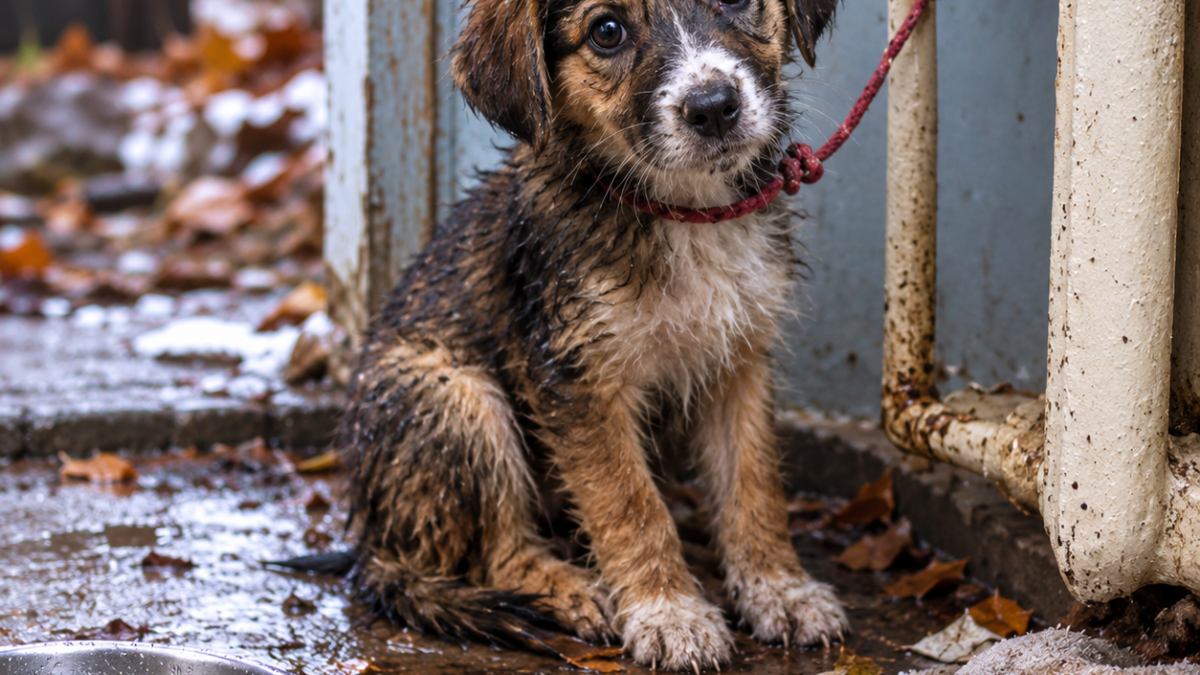
By the time I found the four-month-old puppy tied to a radiator in an empty apartment, his water bowl was dry, his neck was rubbed raw, and he was still wagging his whole body every time footsteps passed in the hallway as though he believed the people who had abandoned him were finally coming back.
The rope was short enough that he could reach the cold tile, the empty bowl, and an old towel, but not the front door he had spent days staring at, scratching toward, and crying behind.
What I didn’t understand yet was why the apartment had been left so completely empty except for him—and why, less than an hour after we carried him out, someone would call demanding that we bring him back.
I was volunteering with a rescue group that worked with animal control when the building manager called on a gray Tuesday morning. Tenants had been hearing a puppy cry behind a locked third-floor apartment for several days. At first they assumed the owners were at work. Then they realized no one had seen them since a moving truck pulled away over the weekend.
“Please get here,” the manager said. “I opened the unit. There’s a dog tied to the heat pipe.”
My partner, Denise, looked at me across the rescue van.
When we reached the apartment, the first thing I noticed was the cold. The heat had been turned down, and the rooms had that hollow, abandoned smell—dust, old cooking grease, bare walls. The living room was empty except for a stained towel, a plastic bowl, and the radiator.
The puppy was tucked beside it.
He was tiny, mostly tan with a black muzzle and soft folded ears. His paws looked too big for him. A thin nylon cord ran from his collar to the radiator pipe, leaving him maybe three feet of movement.
“Oh, sweetheart,” Denise whispered.
His head snapped up.
For half a second he froze. Then his tail started.
Not a cautious wag. His whole body rocked. He scrambled up, slipped, recovered, and pulled toward us until the cord tightened around his neck.
“Easy,” I said, dropping to my knees. “We’re coming to you.”
He licked my fingers the moment I reached him.
Then he looked over my shoulder at the open door.
That was the part that stayed with me.
He kept checking it.
Me. Door. Denise. Door.
As if he was certain the people he knew were right behind us.
The manager stood in the hallway. “They moved out Saturday,” he said quietly.
“Saturday?” I turned. It was Tuesday.
He nodded. “One neighbor heard scratching that night. Another heard whining Sunday morning. Nobody knew they’d left the dog.”
I looked at the bowl. Bone dry.
Denise slid two fingers beneath the puppy’s collar. “There’s irritation here.”
I cut the nylon with the rescue shears. The severed end fell to the floor.
He just stood there.
For a strange moment, freedom seemed to confuse him.
Then he walked to the front door and sat down.
Not beside me. Not beside Denise. Beside the door.
I carried him back gently. He weighed almost nothing. I could feel every rib under his fur.
“You don’t have to wait here anymore,” I murmured.
He rested his chin against my shoulder, but his eyes stayed fixed on the hallway.
At the veterinary clinic, the exam showed dehydration, an empty stomach, and a raw band of skin beneath the collar. No broken bones. No severe infection. He was exhausted and hungry, but the veterinarian believed we had found him in time.
The technician scanned him for a microchip.
The machine beeped.
“Got one,” she said.
I felt relief for exactly two seconds.
Then she pulled up the registration information and frowned.
“There’s a phone number.”
She dialed it on speaker while I held the puppy against my chest.
A man answered on the fourth ring.
The technician identified the clinic and said we had found a young dog registered under his name.
There was a pause.
Then the man said, “Where is he?”
The puppy lifted his head at the voice.
His tail began thumping against my arm.
The technician looked at me.
And then the man said, “Don’t give him to anybody. I’m coming to get my dog.”
PART 2
For a second, nobody in the exam room moved.
The puppy’s tail kept beating against my forearm.
Thump.
Thump.
Thump.
The voice coming through the phone clearly meant something to him.
The veterinary technician, Claire, glanced toward Dr. Patel and then back at the phone.
“Sir,” she said carefully, “before anything happens, I need to explain that the dog was brought in under concerning circumstances.”
“What circumstances?”
“He was found tied inside a vacant apartment.”
Another pause.
Then his tone changed.
“I know where my dog was.”
Dr. Patel’s eyes narrowed.
Claire said, “Were you aware that he had no water when he was found?”
“I left water.”
“The bowl was empty.”
“He probably drank it.”
“Do you know how long he was alone?”
“I said I’m coming to get him.”
The puppy squirmed in my arms at the sound of the man’s voice and looked toward the door.
I tightened my hold without meaning to.
Claire glanced at me.
“Sir, animal control has been contacted. You’ll need to speak with them before the dog can be released.”
His voice sharpened immediately.
“No. You don’t understand. That’s my property.”
Something about the word made my stomach turn.
Not because animals aren’t legally treated as property in many situations. I knew that.
It was the way he said it.
Not my puppy.
Not Is he okay?
Not Was he hurt?
Not even What happened?
My property.
“Sir,” Claire said, “we’re not making a custody determination. We’re telling you an animal-control officer is on the way.”
“I’ll be there in twenty minutes.”
The line went dead.
Nobody spoke until Dr. Patel quietly said, “Document everything.”
That snapped us back into motion.
She photographed the raw skin under the puppy’s collar. Claire recorded his weight, hydration status and body condition. Denise called our rescue director. I contacted the building manager and asked him not to clean the apartment yet.
Then Claire looked at the microchip registration again.
“He has a name.”
I looked down.
The puppy was licking a smear of canned food from my thumb.
“What is it?”
“Milo.”
“Milo,” I repeated.
His ears moved.
I tried it again.
“Milo?”
His head came up.
That was enough.
So Milo had a name.
And somewhere in his short four months of life, somebody had said it often enough that he had learned to answer.
That somehow hurt worse.
Twenty-three minutes later, a man came through the clinic doors fast enough to make the bell above them slam against the glass.
He looked to be in his early thirties. Dark jacket, work boots, keys clenched in one hand. A woman followed several steps behind him.
“I’m Derek Hale,” he told the receptionist. “You have my dog.”
I was sitting in the corner of the waiting room with Milo wrapped in a blanket.
The moment Milo heard him, everything changed.
He exploded out of my lap.
I barely caught the blanket before it fell.
Milo scrambled across the tile toward Derek, nails slipping beneath him, tail moving so violently his hips swung sideways.
He made a sound I hadn’t heard from him before—a high, breathless cry of pure excitement.
Derek looked down.
For one second I expected him to kneel.
He didn’t.
He simply said, “There he is.”
Milo jumped against his shin.
Derek pushed him down with one hand.
“Stop.”
The puppy jumped again.
The woman behind Derek covered her mouth.
Her eyes were red.
“Milo,” she whispered.
This time he ran toward her.
She crouched automatically, and Milo climbed against her chest, licking her chin.
She held him for perhaps three seconds.
Then Derek said, “Kara.”
She froze.
Slowly, she put Milo down.
That tiny interaction told me more than either of them realized.
Dr. Patel came into the waiting room with Claire.
“Mr. Hale?”
“Yeah.”
“I’m Dr. Patel. Milo was brought to us dehydrated and underweight after being found restrained in an apparently vacant apartment.”
“He’s fine.”
Dr. Patel stared at him.
“He is fortunate.”
“I told you, I left food and water.”
“For how long?”
Derek looked toward the reception desk.
“A day.”
I stood.
“No.”
His head turned toward me.
“Excuse me?”
“The building manager says you moved Saturday. Today is Tuesday.”
“I wasn’t talking to you.”
“I’m the volunteer who found him.”
“Then thanks. You did your part.”
He reached for Milo’s leash.
I didn’t move.
Derek’s jaw tightened.
“Give me my dog.”
Before anyone could answer, the clinic door opened again.
Officer Ramirez from county animal control walked in carrying a tablet and a small evidence bag.
He had been doing animal-control work long enough that almost nothing showed on his face anymore.
Almost.
He looked at Milo.
Then at Derek.
“Mr. Hale?”
“Finally. Tell these people to give me my dog.”
Ramirez didn’t raise his voice.
“I need to ask you a few questions first.”
“There’s nothing to ask.”
“There’s plenty to ask.”
Derek laughed once without humor.
Kara stared at the floor.
Ramirez turned slightly toward her.
“And you are?”
“Kara Benson.”
“You lived at the apartment?”
She hesitated.
Derek answered for her.
“Yes.”
Ramirez looked back at Kara.
“I asked her.”
Derek’s mouth tightened.
Kara nodded.
“Yes.”
“All right. I’m going to speak with each of you separately.”
Derek stepped forward.
“No, you’re not. We moved. We had a problem with the new building. We were coming back for the dog.”
Ramirez studied him.
“When?”
“Today.”
“What time?”
“I don’t know.”
“You moved Saturday.”
“Yes.”
“And you were returning Tuesday?”
Derek crossed his arms. “That was the plan.”
“For a four-month-old puppy?”
“We left food.”
“Where?”
“In his bowl.”
“There was no food in the apartment when it was entered.”
“Then he ate it.”
Ramirez tapped something into his tablet.
“And water?”
“Same thing.”
“You restrained him?”
Derek’s eyes flickered.
“So he wouldn’t destroy the place.”
I felt Denise move beside me.
Ramirez’s voice remained calm.
“What did you restrain him with?”
“A leash.”
I looked at Denise.
She looked at me.
It had not been a leash.
Ramirez apparently knew that too.
He lifted the evidence bag.
Inside was the thin nylon cord I had cut from the radiator.
“This?”
For the first time, Derek didn’t have an immediate answer.
Kara looked up.
The waiting room went silent.
“That’s not—” Derek started.
Ramirez waited.
Derek tried again.
“I tied a leash to that.”
“No leash was attached when the dog was found.”
“Then it came off.”
“The cord was tied directly to his collar.”
Derek looked at me.
There was accusation in his face, as though I had arranged the entire scene merely to embarrass him.
“You people went through my apartment.”
“The property manager entered after tenants reported an animal in distress,” Ramirez said. “The rescue volunteers entered with his permission.”
Derek pointed at Milo.
“He’s alive, isn’t he?”
The sentence landed harder than shouting would have.
Kara closed her eyes.
Dr. Patel’s expression changed.
Ramirez stopped typing.
“Yes,” he said. “He is.”
Derek seemed to realize, a second too late, how the words had sounded.
“That’s not what I meant.”
Ramirez nodded toward a hallway.
“Let’s talk privately.”
“I’m not going anywhere without Milo.”
“For the moment, Milo is being placed on a protective hold while we investigate the circumstances in which he was found.”
“You can’t do that.”
“I can.”
“I have paperwork.”
“You can provide it.”
“I paid for him.”
Ramirez’s voice stayed level.
“Ownership is one issue. Neglect is another.”
Derek’s face reddened.
Kara whispered, “Derek, just stop.”
He turned on her so quickly Milo flinched.
“What?”
“I said stop.”
“You wanted him too.”
She looked as if he had slapped her.
“I didn’t want this.”
“Don’t start.”
“I told you we couldn’t leave him there.”
Derek’s eyes hardened.
“Kara.”
Ramirez lifted one hand.
“Ms. Benson, don’t say anything else right now. I want to take your statement separately.”
Derek stared at her.
She stared back.
And for the first time since he walked through the clinic door, he seemed less angry than afraid.
That was when I realized there was more to what happened in that apartment than a bad decision made during a rushed move.
There had been an argument.
Maybe several.
And Milo had been caught in the middle of it.
Ramirez spoke with Derek first.
I couldn’t hear most of the conversation through the closed consultation-room door, but I heard Derek’s voice rise twice.
The second time, the words carried clearly.
“I was going back!”
A few minutes later, the door opened.
Derek came out pale and furious.
He pointed at Kara.
“Don’t let them twist this.”
Ramirez stepped into the doorway behind him.
“Mr. Hale, wait in the lobby.”
“You think I’m stupid?”
“I think I asked you to wait in the lobby.”
Derek paced toward the window.
Kara followed Ramirez into the room.
She looked at Milo before the door closed.
He looked back.
His ears lifted.
For the next half hour, I sat on the floor beside him.
Every time Derek moved, Milo noticed.
Every time Derek spoke, Milo’s tail twitched.
That was the awful contradiction I kept struggling with.
Milo loved him.
Whatever Derek had done, Milo didn’t understand it.
To Milo, the voice belonged to home.
At some point Derek sat down and began scrolling angrily through his phone.
Milo crept toward him.
I let the leash extend a little because I wanted to see what Derek would do.
Milo reached his boot and sat.
Derek never looked down.
The puppy waited.
Thirty seconds.
A minute.
Then two.
Finally Milo placed one paw on Derek’s shoe.
Derek pulled his foot away.
That was when I shortened the leash.
“Come here, buddy.”
Milo returned to me.
He curled against my leg, but kept watching Derek.
Kara came out nearly forty minutes later.
She had been crying.
Derek stood.
“What did you say?”
Ramirez moved between them.
“Mr. Hale.”
“What did she say?”
“Back up.”
Kara shook her head.
“I told the truth.”
Derek stared at her.
Then he laughed.
It was a small, ugly sound.
“The truth?”
She wiped her face.
“I told you not to tie him there.”
“You left too.”
“I thought you called your brother.”
“You knew he couldn’t come.”
“You told me he was coming Sunday morning.”
A quiet settled over the clinic.
Even the receptionist had stopped typing.
Derek glanced around and realized everyone had heard.
“Kara, shut up.”
“No.”
It was the first firm word I’d heard from her.
Her hands were shaking, but she said it again.
“No.”
Ramirez stepped closer.
Derek grabbed his keys from the chair.
“This is ridiculous.”
“You’re free to leave,” Ramirez told him. “Do not attempt to take the dog.”
“My lawyer will be calling.”
“That’s your right.”
Derek looked at me.
“You better not get attached.”
Then he walked out.
Milo lunged after him.
Not aggressively.
Desperately.
His paws scrabbled against the tile, and a sharp cry tore out of him as the glass door closed behind Derek.
He pulled so hard I had to kneel and hold him against my chest.
“It’s okay,” I whispered, though I knew it wasn’t.
Outside, Derek crossed the parking lot without looking back.
Milo watched until he disappeared.
Then he sat beside the clinic door.
Again.
That night Milo came home with me.
It wasn’t supposed to be permanent.
I told myself that three times while putting a crate in my spare bedroom.
Our rescue had foster homes, but we were always short on emergency placements. Because I had already handled him and because his condition was stable, our director asked whether I could keep him during the protective hold.
“A few days,” she said.
“Fine.”
“Maybe longer.”
“How much longer?”
She paused.
“You know how these things go.”
I sighed.
“I know.”
At home, Milo refused to explore.
I opened the crate.
He sniffed it, then walked away.
I showed him the water bowl.
He drank until I stopped him because Dr. Patel had warned me not to let him gulp too much at once.
I offered him a small meal.
He ate as though another dog might appear and steal it.
Then he walked to my front door.
And sat.
I stood in the hallway behind him.
“Milo.”
He looked over his shoulder.
I patted the rug beside the couch.
“Come on.”
He remained by the door.
For the next two hours, that was where he stayed.
When a neighbor walked through the hall outside my apartment, Milo jumped up.
When the elevator doors opened down the corridor, his ears rose.
When someone’s keys jingled, he whined.
Each time, he expected something.
Each time, nothing happened.
At eleven that night I carried his blanket into my bedroom.
He dragged it back to the front door.
I let him keep it there.
At 2:17 in the morning, I woke to scratching.
For one sick second, I thought he was chewing something.
Then I realized the sound was coming from the entryway.
Milo was pawing softly at the door.
Scratch.
Pause.
Scratch.
Pause.
I sat beside him.
He leaned against my leg without looking at me.
I stayed there until almost four.
The next morning, Ramirez called.
“I reviewed the manager’s statement and Ms. Benson’s statement,” he said. “We’re requesting the apartment’s hallway footage.”
“What did Kara tell you?”
“I can’t give you her entire statement.”
“Can you tell me whether Derek was actually coming back for Milo?”
There was a pause.
“Based on what we have right now, I wouldn’t assume that.”
I closed my eyes.
Milo was chewing the corner of a rubber toy at my feet.
“What happens next?”
“We document. We investigate. We determine whether citations or charges are appropriate. Ownership and custody may take time.”
“Could Milo be returned to him?”
“I’m not going to promise you an outcome.”
That answer scared me more than I expected.
Ramirez must have heard it in my silence.
“What I can tell you,” he added, “is that the dog stays under protective hold while we sort it out.”
I looked at Milo.
He had fallen asleep with the toy between his paws.
“Okay.”
“Rachel?”
“Yeah?”
“Don’t make promises to him you may not legally be able to keep.”
I almost laughed.
“He’s four months old.”
“You know what I mean.”
I did.
I hated that I did.
The building manager, Tom Cole, sent the security footage later that afternoon.
I watched it with Ramirez at the animal-control office.
The camera covered the third-floor hallway and elevator.
Saturday, 10:42 a.m.
Derek appeared carrying two boxes.
Kara came behind him with a lamp.
They disappeared into the elevator.
Over the next hour, they made seven trips.
Furniture.
Bags.
A television.
Kitchen boxes.
Clothes.
At 12:16 p.m., Kara stepped into the hall alone.
She was crying.
Even on grainy footage, I could tell.
She walked back into the apartment.
Three minutes later, Derek came out carrying a duffel bag.
Kara followed.
She turned toward the apartment door.
Derek took her arm.
There was no audio, but their body language was unmistakable.
She pulled away.
He pointed toward the elevator.
She said something.
He answered.
Then Kara took one step back toward the apartment.
Derek blocked her.
Finally she walked to the elevator.
Before she entered, she looked at the apartment door one last time.
The elevator closed.
Neither of them returned.
Not Saturday.
Not Sunday.
Not Monday.
Ramirez fast-forwarded through hours of empty hallway.
“Stop,” I said.
Sunday morning, 7:31.
An older woman in a robe came into the hall.
She stood outside Milo’s door.
Bent down.
Listened.
Knocked.
Then she went downstairs.
“That’s Mrs. Alvarez,” Tom said. “She lives across the hall.”
We interviewed her that afternoon.
She was seventy-two and so angry she could barely keep her voice steady.
“I heard that baby all night,” she told us. “I thought somebody was home. He would cry, then stop, then cry again.”
“Why didn’t you call sooner?” she asked herself before any of us could.
Her mouth trembled.
“I should have.”
“You didn’t know,” I said.
“I knocked Sunday. Nobody answered. I knocked again Monday.”
She pressed a tissue to her mouth.
“I put my ear to the door and heard scratching.”
Ramirez asked, “Did Mr. Hale or Ms. Benson tell you someone would be checking on the dog?”
“No.”
“Did you see anyone enter the apartment after they left?”
“No.”
Tom confirmed it.
The building used electronic access at the main entrance.
There was no record of Derek’s key fob returning after Saturday afternoon.
Derek’s claim that someone had been checking Milo was getting harder to believe.
Then Tom gave Ramirez something else.
A copy of the move-out inspection.
Derek had formally surrendered the apartment Monday morning by email.
“He told management the unit was empty,” Tom said.
Ramirez looked up.
“Empty?”
“That’s the word he used.”
He showed us the message.
Unit cleared. No personal property remaining. Keys left in drop box.
I read it twice.
No personal property remaining.
I thought of Milo sitting beside that radiator.
For days I had been trying to understand how somebody could walk away from a puppy who would have followed them happily anywhere.
Now I understood something worse.
Derek hadn’t forgotten him.
You forget a jacket.
You forget a charger.
You forget the carton of milk in the refrigerator.
You don’t tie a living animal to a pipe before you leave.
By the fourth night, Milo had learned where I kept the food.
By the sixth, he understood that my kitchen floor was slippery and stopped trying to sprint across it.
By the eighth, he discovered the couch.
But the door remained his obsession.
If I took out the trash, he panicked.
I could hear him whining before I reached the elevator.
If I went to the mailbox, he scratched.
If I stepped into the hallway and closed the door for ten seconds, he cried.
So we started over.
One second.
Door closes.
Door opens.
I come back.
Five seconds.
Door closes.
Door opens.
I come back.
Ten seconds.
Thirty.
A minute.
Each time I returned calmly.
No big reunion.
No dramatic goodbye.
Just repetition.
I leave.
I return.
I leave.
I return.
At first Milo couldn’t handle even thirty seconds.
After two weeks, he could manage five minutes.
Then ten.
The first time I came back from a fifteen-minute grocery run and found him asleep instead of waiting against the door, I stood in the hallway holding a paper bag and nearly cried.
Denise teased me.
“You’re done for.”
“I’m fostering.”
“Sure.”
“I am.”
“Rachel, you bought him a memory-foam dog bed.”
“He had neck irritation.”
“You bought him a raincoat.”
“It was raining.”
“He weighs twelve pounds.”
“He gets cold.”
She raised an eyebrow.
“I’m fostering.”
Denise smiled.
“Of course you are.”
I refused to admit anything.
Partly because I didn’t know whether I would be allowed to keep him.
Derek had hired an attorney.
The first letter arrived at the rescue twelve days after Milo was found.
It demanded his immediate return and accused the rescue of unlawfully withholding property.
Our director, Ellen, read it at the office while I sat across from her.
“What does this mean?”
“It means he wants the dog back.”
“I understand the English, Ellen.”
She set the letter down.
“It means we don’t make emotional decisions. Animal control has the case. We follow the process.”
“He left Milo tied to a radiator.”
“I know.”
“For three days.”
“I know.”
“He told management the apartment was empty.”
“I know.”
“Then how can this even be a question?”
“Because procedure matters.”
I hated that answer.
Later, I understood it.
If we wanted Milo protected permanently, we needed a decision that couldn’t be undone because somebody skipped a step.
At the time, all I heard was uncertainty.
That night I sat on my kitchen floor while Milo slept with his head across my ankle.
I touched the soft fur behind his ear.
“What happens if they make me give you back?”
He sighed.
I immediately felt ridiculous for asking.
Then someone dropped something in the hallway outside.
Milo woke instantly.
His head snapped toward the door.
The old fear returned to his eyes.
And suddenly I wasn’t asking a ridiculous question anymore.
Three days later, Kara called the rescue.
Ellen put the call through to me because Kara specifically asked for “the woman who carried Milo out.”
“Rachel?”
“Yes.”
“It’s Kara.”
I stood up from my desk.
“Is everything okay?”
“I don’t know.”
Her voice was barely above a whisper.
“I just wanted to ask… is Milo okay?”
I looked through the office window.
Milo was in the playroom trying unsuccessfully to carry a tennis ball and a rope toy at the same time.
“He’s healing.”
“Does he eat?”
“Yes.”
“Does he still sleep by the door?”
The question caught me off guard.
“How did you know?”
She was quiet.
“He always did that.”
“Before you left?”
“Yes.”
I waited.
Kara began crying.
“He slept by our bedroom door every night. Derek used to complain because we’d trip over him.”
I sat down.
“Kara, why are you calling?”
“I can’t stop thinking about him.”
“Then help me understand.”
“I already gave animal control a statement.”
“I’m not asking about the investigation.”
Maybe that wasn’t entirely true.
“What happened that Saturday?”
Silence.
I thought she might hang up.
Then she said, “Our new apartment didn’t allow dogs over twenty pounds.”
“Milo wasn’t twenty pounds.”
“He was going to be.”
“So?”
“Derek knew. He signed the lease anyway.”
I closed my eyes.
“When did you find out?”
“Friday night.”
“The night before you moved?”
“Yes.”
“What did Derek say?”
“That we’d find Milo another home.”
“And did you?”
“No.”
“What was the plan?”
“There wasn’t one.”
Her breathing turned uneven.
“We started moving Saturday morning. Milo kept running to the door every time we carried something out. He thought he was coming with us.”
I pictured the oversized paws sliding over the apartment floor.
“Kara…”
“I tried putting him in the bedroom. He screamed. Derek got angry because the movers were waiting.”
“What happened?”
“He tied him to the radiator.”
My fingers tightened around the phone.
“With the nylon cord?”
“Yes.”
“Why?”
“So he couldn’t follow us.”
There it was.
The detail I had suspected from the first moment.
“He told me his brother would pick Milo up that afternoon,” Kara continued. “I believed him.”
“Did you call the brother?”
“Not until Sunday.”
“And?”
“He said Derek never asked him.”
I stared at the wall.
“Why didn’t you go back?”
“I wanted to.”
“But you didn’t.”
“No.”
There was no point softening it.
“Why?”
Kara cried quietly for several seconds.
“Because Derek said if I went back, I shouldn’t come to the new apartment.”
I didn’t know what to say.
It explained something.
It didn’t excuse it.
“So you chose the apartment.”
“Yes.”
Her answer was immediate.
No defense.
No elaborate justification.
Just yes.
“I’m sorry,” she whispered.
I looked through the glass again.
Milo had finally abandoned the rope toy and was racing in circles around Denise.
“You’re not the person who needs my apology.”
“I know.”
“Then why are you telling me this?”
“Because Derek’s lawyer says I should change my statement.”
My entire body went still.
“What?”
“He wants me to say we arranged for his brother to feed Milo.”
“Did you?”
“No.”
“Has his lawyer spoken to you directly?”
“No. Derek told me that’s what we should say.”
“Do not discuss this with me anymore.”
She stopped crying.
“What?”
“Call Officer Ramirez.”
“I already did.”
“Good.”
“And Rachel?”
“Yes?”
“If they ask me in court, I’ll tell them.”
I leaned back in my chair.
“The truth?”
“The truth.”
When the call ended, I sat there for a long time.
Denise came in with Milo under one arm.
“What happened?”
I looked at her.
“Kara just stopped being the weak point in their story.”
Three weeks after Milo was found, the county scheduled a hearing to determine whether Derek should retain ownership while the neglect case moved forward.
I had never been inside that type of hearing before.
It wasn’t dramatic in the way television makes courtrooms dramatic.
No shouting attorneys pacing in front of a jury.
No sudden gasps.
Mostly paperwork.
Photographs.
Dates.
Questions.
But when you know an animal’s future depends on those quiet details, a date can feel like a loaded weapon.
Derek arrived in a navy blazer.
He looked polished.
Calm.
Nothing like the man who had stormed into the clinic.
His attorney argued that Derek had never intended to abandon Milo.
There had been, he said, a “temporary breakdown in care arrangements during a complicated residential move.”
Temporary breakdown.
I wrote the phrase on my notepad because I was afraid I might later convince myself I had imagined it.
The county presented the photographs first.
Empty bowl.
Radiator.
Cord.
Red mark around Milo’s neck.
Then Dr. Patel testified about dehydration and weight.
She did not exaggerate.
That made her testimony stronger.
“Was the puppy near death?” the county attorney asked.
“No.”
“Did he require emergency surgery?”
“No.”
“Was he in good condition?”
“No.”
“What would have happened if he remained without water?”
Dr. Patel looked toward Derek.
“Eventually, the situation could have become life-threatening. Puppies can deteriorate quickly.”
Derek’s lawyer asked whether Milo could have emptied the bowl himself.
“Yes.”
“Could he have eaten food left for him?”
“Yes.”
“So you cannot testify that my client left the puppy without food or water.”
“I can testify that when Milo arrived, he was dehydrated, hungry, and underweight.”
The attorney nodded as though he had scored a point.
Then Tom Cole testified.
He brought the move-out email.
The county attorney enlarged it on the monitor.
Unit cleared. No personal property remaining.
Keys left in drop box.
Derek shifted in his chair.
His attorney objected to the interpretation.
The hearing officer allowed the document.
Then came the hallway footage.
We watched Derek and Kara carry their belongings away.
We watched Kara hesitate at the apartment.
We watched Derek block her path.
We watched the elevator close.
Then the time stamp jumped.
Saturday evening.
Sunday morning.
Sunday night.
Monday morning.
No return.
Derek’s attorney tried another explanation.
“Is it possible someone entered the building without using Mr. Hale’s key fob?”
Tom answered, “Possible.”
“Is it possible Mr. Hale arranged for another person to care for the dog?”
“I can’t know what he arranged.”
“Exactly.”
For several minutes I felt the case slipping into that uncomfortable space between what everyone knew and what could be proven.
Then the attorney said something I didn’t expect.
“Mr. Hale’s brother was supposed to retrieve the puppy.”
I saw Ramirez look up.
The county attorney did too.
“Is Mr. Hale’s brother here?”
“No.”
“Do you have a written statement from him?”
“No.”
“A text message showing the arrangement?”
Derek leaned toward his attorney.
The attorney’s expression changed slightly.
“No.”
“Phone records?”
“No.”
“So the only evidence of this arrangement is Mr. Hale’s statement?”
“Yes.”
The county attorney picked up a folder.
“Then I’d like to call Kara Benson.”
Derek turned around.
Kara was sitting two rows behind him.
I had not seen her enter.
For the first time that morning, the calm left Derek’s face.
She walked to the witness table.
Her hands shook when she raised one to swear that she would tell the truth.
The county attorney asked how long she had lived with Derek.
Two years.
How long had they owned Milo?
A little over two months.
Whose idea had it been to get him?
Both of theirs.
When had she learned the new apartment prohibited a dog of Milo’s expected adult size?
The night before the move.
“Did you have a confirmed new home for Milo when you left the old apartment?”
“No.”
“Had Mr. Hale’s brother agreed to collect him?”
“No.”
Derek’s attorney stood.
“Objection.”
The hearing officer looked at him.
“On what basis?”
The lawyer paused.
Then sat down.
The county attorney continued.
“Ms. Benson, did you personally see Mr. Hale restrain Milo before you left?”
Kara swallowed.
“Yes.”
“How?”
“With a nylon cord attached to his collar and tied to the radiator pipe.”
“Why?”
“Because Milo kept trying to run out the door after us.”
Nobody moved.
The county attorney let the silence sit.
“What did Mr. Hale tell you would happen to Milo?”
“He said his brother would get him.”
“When did you learn that wasn’t true?”
“Sunday.”
“What did you do?”
Kara’s eyes filled.
“Nothing.”
“Why not?”
“Because I was afraid Derek would throw me out.”
Her voice broke.
“I know that doesn’t make it okay.”
The hearing officer looked down at his notes.
The county attorney asked, “Did Mr. Hale later ask you to change your statement?”
Derek stood.
“That’s a lie.”
His lawyer grabbed his sleeve.
“Sit down.”
“She’s lying.”
“Mr. Hale,” the hearing officer said sharply.
Derek remained standing.
Kara looked at him.
For a second I saw the same frightened woman from the clinic.
Then something changed.
She straightened.
“You told me to say your brother was supposed to feed him.”
“No, I didn’t.”
“You texted me.”
Derek stopped.
So did his lawyer.
Kara reached into her bag.
The county attorney said, “Ms. Benson, have those messages already been provided to Officer Ramirez?”
“Yes.”
Ramirez handed over printed copies.
Derek sat down.
The hearing officer read silently.
I couldn’t see the page.
But I could see Derek’s lawyer.
His shoulders slowly dropped.
The county attorney read one message aloud.
It was from Derek.
Just say Matt was supposed to get the dog. They can’t prove he wasn’t.
The room became completely still.
Derek whispered something to his attorney.
His attorney didn’t answer.
Another message followed.
If you stick to the story, this goes away.
I looked at Kara.
She wasn’t crying anymore.
The hearing officer asked Derek’s attorney whether he wanted a recess.
“Yes.”
We waited in the corridor.
I found Kara alone beside a vending machine.
I didn’t know whether I should approach her.
She noticed me first.
“How’s Milo?”
“Better.”
She nodded.
“Good.”
For a moment, neither of us knew what else to say.
Then she whispered, “I should’ve gone back.”
I could have told her yes.
Part of me wanted to.
Instead I said, “Why didn’t you tell someone Sunday?”
“I kept thinking Derek would fix it.”
“And Monday?”
“I knew he wouldn’t.”
She rubbed her palms against her pants.
“That’s the part I can’t explain.”
“Maybe you can.”
She looked at me.
“I was a coward.”
There was no self-pity in her voice.
Just recognition.
“I loved that puppy, and I still left.”
The hallway door opened.
Derek emerged with his attorney.
When he saw Kara talking to me, his expression hardened.
“You happy now?”
Kara went pale.
I stepped between them without thinking.
His lawyer immediately said, “Derek, don’t.”
He ignored him.
“You blew up our life over a dog.”
Kara stared at him.
“No.”
Her voice was quiet.
“You did.”
Derek laughed.
“You left him too.”
“I know.”
That answer stopped him.
She stepped closer.
“I’m going to have to live with that.”
He opened his mouth.
She continued.
“But I’m not going to lie so you don’t have to live with what you did.”
The hearing resumed fifteen minutes later.
The decision came that afternoon.
Milo would not be returned to Derek.
Custody remained with animal control pending formal disposition of the neglect case, and the county was authorized to continue placement through our rescue.
I closed my eyes when I heard it.
Not because the story was over.
It wasn’t.
But for the first time since I cut that cord, I knew Milo would not be forced back through the same door he had waited beside for three days.
When I got home, Milo was asleep on the couch with Denise.
She sat up.
“Well?”
I held up the paperwork.
“He stays.”
Denise covered her face with both hands.
Milo woke at the sound of my voice.
He jumped off the couch and raced toward me.
I dropped to my knees.
He hit my chest hard enough to knock me backward.
“You stay,” I said into his fur.
He licked my nose.
“You hear me?”
His tail pounded against the floor.
“You stay.”
That night he slept beside my bed.
Not by the front door.
It lasted forty-three minutes.
Then I heard his paws crossing the hallway.
A moment later he settled against the entry rug.
I stared at the ceiling and smiled.
Healing, I was learning, didn’t care about court orders.
Milo improved in small pieces.
His neck healed first.
Then his weight.
Then his coat became softer.
The frightened urgency around food took longer.
For weeks, he inhaled every meal.
I bought a slow-feeder bowl.
He figured out how to tip it over.
I bought a heavier one.
He carried it across the kitchen.
Denise called him an engineering prodigy.
I called him a criminal.
He became obsessed with socks.
He hated the vacuum cleaner.
He loved old men.
He distrusted people wearing motorcycle helmets.
He learned “sit” in two days and pretended not to understand “leave it” for nearly a month.
Most importantly, he learned that doors did not always mean abandonment.
I practiced constantly.
I walked outside.
I returned.
I closed the bathroom door.
I returned.
I left him with Denise.
I returned.
Sometimes the progress disappeared.
Once, about six weeks after his rescue, I packed an overnight bag for a rescue conference.
The moment Milo saw the suitcase, he changed.
His ears lowered.
His tail stopped.
He walked directly to the front door and lay across it.
I stared at him.
The bag slipped from my hand.
Of course.
He remembered luggage.
Boxes.
People carrying things out.
Doors closing.
I sat beside him.
“I’m not leaving you.”
He pressed closer to the floor.
Technically, I was leaving him for one night.
Denise was going to stay with him.
But he couldn’t understand technicalities.
So I unpacked the bag in front of him.
Every shirt.
Every sock.
Everything.
Then I repacked while tossing treats across the room.
Suitcase.
Treat.
Zipper.
Treat.
Bag lifted.
Treat.
It took forty minutes before his body relaxed.
At the conference, I called Denise four times.
“He’s fine.”
“Did he eat?”
“Yes.”
“Is he by the door?”
“No.”
“You’re lying.”
“I’m looking at him.”
“Send a picture.”
“You need therapy.”
“Picture.”
She sent one.
Milo was upside down on my couch, all four paws in the air.
I stared at the photo for probably a full minute.
That became one of my favorite pictures of him.
Not because it was cute.
Because an animal who believes he must stay alert for the people who might disappear does not sleep like that.
The formal neglect case was resolved two months later.
Derek ultimately accepted a plea under the county’s animal-neglect ordinance rather than take the case to trial.
He was ordered to reimburse Milo’s veterinary expenses and the county’s boarding costs, complete a humane-treatment program, serve probation, and obey a temporary prohibition on owning animals.
Kara received a lesser citation related to the abandonment but cooperated fully with the investigation.
I learned those details from Ramirez.
I didn’t attend Derek’s final hearing.
By then, I realized something important.
I did not need to watch him lose.
His punishment was not the center of Milo’s story.
Milo was.
There was still one issue left.
Permanent placement.
The day Ellen called me about it, Milo was nearly seven months old.
“His legal hold is cleared.”
I gripped the phone.
“So he can be adopted?”
“Yes.”
A strange silence followed.
Ellen knew exactly what she was doing.
I knew exactly what she was doing.
Neither of us said it.
Finally she asked, “Should I put him on the website?”
I looked across my living room.
Milo was asleep with his head hanging off the couch.
His favorite tennis ball was tucked beneath one paw.
There was a chew mark on my coffee table.
A half-destroyed sock was sticking out from under his bed.
I had spent three months teaching him that when I left, I came back.
And suddenly I was being asked whether I intended to be the next person who disappeared from his life.
“I don’t know,” I said.
Ellen laughed.
“You’re unbelievable.”
“I’m serious.”
“No, you’re scared.”
That irritated me because it was true.
Fostering was something I understood.
You helped.
You stabilized.
You loved them carefully.
Then somebody else took over.
Adoption was different.
Adoption meant responsibility when the story stopped being dramatic.
It meant vet bills when nobody was watching.
Training when you were tired.
Canceled plans.
Mud.
Hair.
Years.
Eventually, loss.
I had fostered fourteen dogs before Milo.
I had loved every one of them.
I had let every one of them go.
“I need a day,” I said.
Ellen sighed.
“One day.”
That evening I took Milo to the park.
It was October again, cold enough that the leaves scraped dryly across the path.
He had grown.
The awkward paws finally matched his body.
His tan coat had darkened along his back, and his ears still folded in different directions when he was concentrating.
We sat on a bench near the playground.
A family passed us.
A little girl asked if she could pet him.
“Sure.”
Milo leaned against her knees while she rubbed his ears.
The girl’s mother smiled.
“He’s wonderful.”
“Most of the time.”
“How old?”
“About seven months.”
“He yours?”
The answer should have been simple.
Instead I hesitated.
“I’m fostering him.”
The mother nodded.
“I don’t know how you do that.”
“Do what?”
“Give them up.”
I looked down at Milo.
“So far, I do it badly.”
She laughed and walked away.
Milo watched them for a moment.
Then he looked back at me.
There was no dramatic sign.
No magical understanding.
He didn’t put his paw on my hand at exactly the right moment.
He simply leaned against my shin.
Warm.
Heavy.
Familiar.
And I realized I had been thinking about the wrong question.
I kept asking whether I was ready to adopt him.
But Milo had already built his life around mine.
His bowl was in my kitchen.
His leash hung beside my coat.
His toys were under my furniture.
He knew which cabinet contained treats.
He knew the sound of my car in the parking lot.
He knew my morning alarm.
He knew Denise would sneak him cheese if he stared long enough.
Most of all, he had learned one simple thing from me through hundreds of repetitions.
I come back.
I took out my phone and called Ellen.
She answered with, “Well?”
“Don’t put him on the website.”
“Why?”
“You know why.”
“I want to hear you say it.”
“You’re annoying.”
“Rachel.”
I looked at Milo.
“I want to adopt him.”
Ellen was silent for two seconds.
Then she said, “Finally.”
The adoption itself was almost comically ordinary.
Paperwork.
Signatures.
A fee our director tried to waive and I insisted on paying.
Updated microchip information.
Medical records.
A new tag.
Rachel Miller.
Milo.
My phone number.
My address.
When Claire at the veterinary clinic updated the chip registration, she looked at the screen and smiled.
“There.”
“What?”
“He belongs to you now.”
I looked down at Milo.
“No,” I said.
Claire raised an eyebrow.
I rubbed his ear.
“I think we belong to each other.”
She groaned.
“That was terrible.”
“I know.”
“Absolutely terrible.”
“Please finish the paperwork.”
A week later, Kara emailed the rescue.
She asked for nothing.
No visit.
No photos.
No attempt to claim Milo.
Just a message.
Ellen forwarded it to me.
There were only a few lines.
She said she had left Derek.
She was staying with her sister.
She had started counseling.
She knew she had failed Milo.
She did not expect forgiveness.
She only wanted to know whether he had found a permanent home.
I read the message twice.
Then I looked at Milo.
He was asleep in a square of afternoon sunlight.
I thought about ignoring it.
Then I wrote back through the rescue.
He has a permanent home.
That was all.
I didn’t send my address.
I didn’t send my phone number.
I didn’t invite her to visit.
But I attached one photograph.
Milo asleep upside down on the couch.
Weeks passed.
Winter came.
Milo discovered snow and became convinced it had been created specifically for him.
He buried his face in it.
He jumped into drifts.
He tried to eat snowballs.
One morning he dragged me halfway down the sidewalk because a plastic grocery bag blew across the street.
I laughed so hard I had to sit on a neighbor’s steps.
A man walking past looked at me like I was insane.
Maybe I was.
I didn’t care.
By spring, Milo no longer slept at the front door.
I noticed it gradually.
First he moved his blanket six feet away.
Then into the hallway.
Then beside my bedroom.
One night I woke and realized he was stretched across the foot of my bed.
I lay there in the darkness listening to him breathe.
It had been almost six months since the apartment.
Six months since the radiator.
Six months since I cut the cord.
I remembered the way he had stood motionless after being freed, as if his body didn’t understand the absence of restraint.
Then the way he had walked immediately to the door.
Waiting.
Always waiting.
Now his back paws twitched in sleep.
I reached down and touched one.
He didn’t wake.
The anniversary of his rescue arrived on a rainy Tuesday.
I hadn’t planned to mark it.
Then Tom Cole, the old building manager, called.
“I’m retiring,” he said.
“Congratulations.”
“About time.”
He sounded exactly the same.
Then his voice softened.
“How’s that little dog?”
I smiled.
“Not little anymore.”
“He okay?”
“He’s great.”
“I think about him sometimes.”
“So do Mrs. Alvarez and the others.”
“Mrs. Alvarez still there?”
“Still running the third floor like she owns it.”
I laughed.
Tom hesitated.
“There’s something here you might want.”
“What?”
“Maintenance finally replaced that old radiator during the renovation.”
My smile disappeared.
“Oh.”
“I know this sounds strange, but I found something behind it.”
I sat down.
“What?”
“A little blue rubber ball.”
For a moment I couldn’t speak.
“He must’ve knocked it back there,” Tom said. “Couldn’t reach it because of the cord, I guess.”
I remembered the three-foot circle Milo had lived inside.
The empty bowl.
The old towel.
The radiator.
The unreachable door.
Now I imagined a toy just inches beyond his reach.
“Throw it away,” I said.
Tom was quiet.
“You sure?”
I looked across the room.
Milo was wrestling with a stuffed dinosaur.
“Yeah.”
I smiled.
“He has enough toys.”
That evening, I took him for our usual walk.
Rain tapped gently against my jacket.
Milo stopped at every tree as though conducting a criminal investigation.
When we returned to the apartment building, I unclipped my keys.
For a second I remembered the first night he had spent there.
The scratching.
The whining.
The desperate reaction to footsteps.
Milo sat beside me while I unlocked the door.
“Ready?”
His tail moved.
I opened it.
He ran inside.
Not because he expected to find someone waiting.
Because he knew exactly where he was.
Home.
About a year after his rescue, I had to leave town for three days for my sister’s wedding.
It would be the longest I had ever been away from Milo.
The old fear came back—not his.
Mine.
I packed slowly.
Milo watched from the bed.
Suitcase open.
No panic.
Clothes packed.
No pacing.
Zipper closed.
He lifted his head, then went back to chewing a toy.
“You’ve got to be kidding me.”
He ignored me.
Denise arrived ten minutes later.
“Your son is ready for his weekend with Aunt Denise.”
“Please don’t call him my son.”
“You made me an emergency contact at the vet.”
“That’s practical.”
“You have his picture on your phone lock screen.”
“That means nothing.”
She looked at the suitcase.
Then at Milo.
Then at me.
“Who has separation anxiety now?”
I pointed at the door.
“Get out.”
She laughed.
I knelt in front of Milo.
He licked my chin.
“I’ll be back Sunday.”
No response.
“Do you hear me?”
He sniffed my pocket for treats.
“Very emotional.”
I stood.
At the door, I looked back.
For a moment I expected him to follow.
He didn’t.
He was standing beside Denise.
Watching me.
Calm.
I closed the door.
No scratching followed.
I waited.
Nothing.
I walked toward the elevator.
Still nothing.
And instead of feeling hurt, I felt something in my chest loosen.
Sunday evening, I came home exhausted.
I dragged my suitcase down the hallway and put my key into the lock.
Before I turned it, I heard movement inside.
Then paws.
Fast.
The door opened.
Milo hit me like a tan-and-black missile.
I dropped the suitcase and laughed as he jumped against me.
“All right. All right. I missed you too.”
Denise appeared behind him.
“He was perfectly behaved.”
“Of course.”
“He slept on your bed.”
“Of course.”
“He stole half my sandwich.”
“That sounds more accurate.”
Milo ran in a circle, grabbed his tennis ball, and brought it to me.
I looked at the suitcase lying outside the door.
A year earlier, people carrying bags toward a doorway had meant something terrible to him.
Now I had left with one.
And come back with one.
Maybe that was why the moment mattered so much.
Not because Milo remembered the radiator exactly as I did.
I’ll never know what pieces of that apartment remained in his mind.
But dogs remember patterns.
Sounds.
Smells.
Expectations.
And somewhere along the way, we had replaced one pattern with another.
Doors could close.
People could leave.
Suitcases could disappear down hallways.
And the world did not necessarily end.
Months later, I ran into Officer Ramirez at an adoption event.
He was standing beside a booth explaining county licensing rules to a couple with a beagle.
When he saw Milo, he stared.
“That’s him?”
I smiled.
Milo was nearly seventy pounds.
“That’s him.”
Ramirez crouched.
Milo sniffed his badge and sneezed.
“You got huge, buddy.”
“He thinks he’s twelve pounds.”
“Most big dogs do.”
Ramirez scratched his chest.
Then he looked at me.
“How’s he doing?”
“Good.”
“Door thing?”
“Mostly gone.”
“Food?”
“Still believes starvation is twelve minutes away.”
Ramirez smiled.
Then his expression became thoughtful.
“I’ve handled a lot of abandonment cases.”
“I imagine.”
“The young ones sometimes surprise you.”
“How?”
“They don’t forget everything. But they build new expectations fast if you give them enough consistency.”
I watched Milo lean his entire weight against Ramirez’s legs.
“That sounds right.”
Ramirez stood.
“You did good with him.”
I shook my head.
“A lot of people did.”
That mattered to me.
Because it would have been easy to tell Milo’s story as though one rescuer had swept in and fixed everything.
That wasn’t what happened.
Mrs. Alvarez listened through a wall when something sounded wrong.
Tom opened the apartment.
Denise came with me.
Dr. Patel treated him.
Claire found the microchip.
Ramirez built the case.
Kara finally told the truth even though she should have done it sooner.
Ellen fought through the paperwork.
Dozens of people touched one small part of Milo’s life.
His rescue was not a miracle.
It was a chain of people deciding not to look away.
That afternoon at the adoption event, a little boy approached us.
“Can I pet your dog?”
“Absolutely.”
Milo sat automatically.
The boy rubbed both sides of his face.
“What’s his name?”
“Milo.”
“He’s nice.”
“He is.”
“Did you get him here?”
“Sort of.”
The boy looked confused.
I smiled.
“He had a different home before mine.”
“Oh.”
He considered that.
“Did he like his old home?”
The question surprised me.
I looked at Milo.
“I think he loved the people there.”
“Then why’d he leave?”
I could have given him the whole ugly explanation.
Instead I said, “Sometimes loving someone doesn’t mean they know how to take care of you.”
The boy nodded with the solemn seriousness children sometimes give answers they only partly understand.
Then his mother called him.
He ran off.
Milo watched him go.
I scratched behind Milo’s ear.
“Come on.”
He followed me without hesitation.
Two years after I first found him, Milo and I moved to a small house.
The day terrified me.
Not because of the mortgage.
Not because of the boxes.
Because I knew what moving once meant to him.
For weeks, I prepared.
Boxes appeared gradually.
Treats went into boxes.
Toys came out of boxes.
Meals happened beside boxes.
Nothing bad followed.
On moving day, Denise took Milo to the park while the furniture was loaded.
When she brought him back, the apartment was nearly empty.
He stopped in the doorway.
His entire body changed.
Tail down.
Ears back.
I saw the old fear return so suddenly it felt like being thrown two years backward.
“Milo.”
He looked at me.
I crouched.
“I’m right here.”
He walked through the empty living room.
Sniffed the wall.
Looked toward the spot where his bed used to be.
Then at the door.
I clipped on his leash.
“Come with me.”
He did.
No radiator.
No cord.
No closed door between us.
He walked beside me down the hallway, into the elevator, through the lobby, and out to my car.
I opened the back door.
He jumped in.
At the new house, I let him enter first.
His bed was already there.
So were his bowls.
His dinosaur.
His tennis balls.
My couch.
My blankets.
Everything that smelled like us.
Milo ran from room to room.
Kitchen.
Bedroom.
Hallway.
Backyard.
Then he raced back to me.
I sat on the floor.
He climbed halfway into my lap despite being far too large.
I wrapped both arms around him.
That was the moment I finally understood what had bothered me most about the apartment where I found him.
It wasn’t simply that somebody had moved away.
People move.
Plans fall apart.
Relationships end.
Money gets tight.
Housing rules can become complicated.
Life can corner people.
But Milo had been willing to follow them.
That was all he had wanted.
He would have climbed into their car.
Slept on the floor.
Waited in somebody’s kitchen.
Gone to a friend.
A relative.
A shelter.
Anywhere.
Instead, they had tied him down so he could not follow.
I looked at the leash lying loose across my new living-room floor.
Then I looked at Milo.
“You made this move, buddy.”
His tail thumped.
“See?”
I kissed the top of his head.
“We moved together.”
That night, he had access to an entire house.
A bedroom.
A hallway.
A living room.
A dog bed beside the couch.
Another one I had stupidly bought for the bedroom.
He chose the floor beside my bed.
Before turning out the light, I reached down.
My fingers found his ear in the darkness.
He sighed.
I thought about the puppy I had carried out of that empty apartment—the one who could barely understand that the cord had been cut.
For years afterward, people who heard his story often focused on the same question.
How could anyone do that?
I never found an answer that satisfied me.
Derek had explanations.
The new lease.
The rushed move.
The dog getting too big.
The assumption somebody else would deal with it.
Anger.
Money.
Convenience.
None of those explanations changed what happened.
Kara had her own explanation.
Fear.
Dependence.
Cowardice, as she called it.
That did not change what happened either.
But somewhere along the way, I stopped needing an answer.
Milo certainly didn’t need one.
He needed breakfast.
Walks.
Training.
Vaccines.
A ridiculous number of tennis balls.
He needed someone to come back through the door.
So I did.
Again and again.
Years have passed now.
Milo’s muzzle has started to gray around the edges.
He still sleeps in impossible positions.
He still steals socks.
He still acts as though meals are a shocking gift he never expected to receive.
And every evening, when my car turns into the driveway, I can see him through the front window.
He hears the engine.
His head appears.
Then his whole body.
By the time I reach the porch, he is already waiting on the other side of the door.
But he doesn’t scratch.
He doesn’t cry.
He doesn’t panic.
He just waits, tail moving, because somewhere during all those ordinary years, waiting stopped meaning that someone had abandoned him.
Now it means something entirely different.
It means he knows the door is going to open.
And when I step inside, he grabs whatever toy is closest and races toward me like I have been gone for months instead of eight hours.
I kneel.
He leans his entire weight against me.
And sometimes, when I feel the old scar hidden beneath the fur around his neck, I remember a cold empty apartment, a dry bowl, a thin nylon cord, and a four-month-old puppy who kept staring at the door because he believed the people he loved would return.
They never did.
But every day since then, someone has.
[END OF STORY]








