PART 2: They Thought She Was About to Give Birth—But What the Vet Found Inside Her Belly Left Everyone Speechless
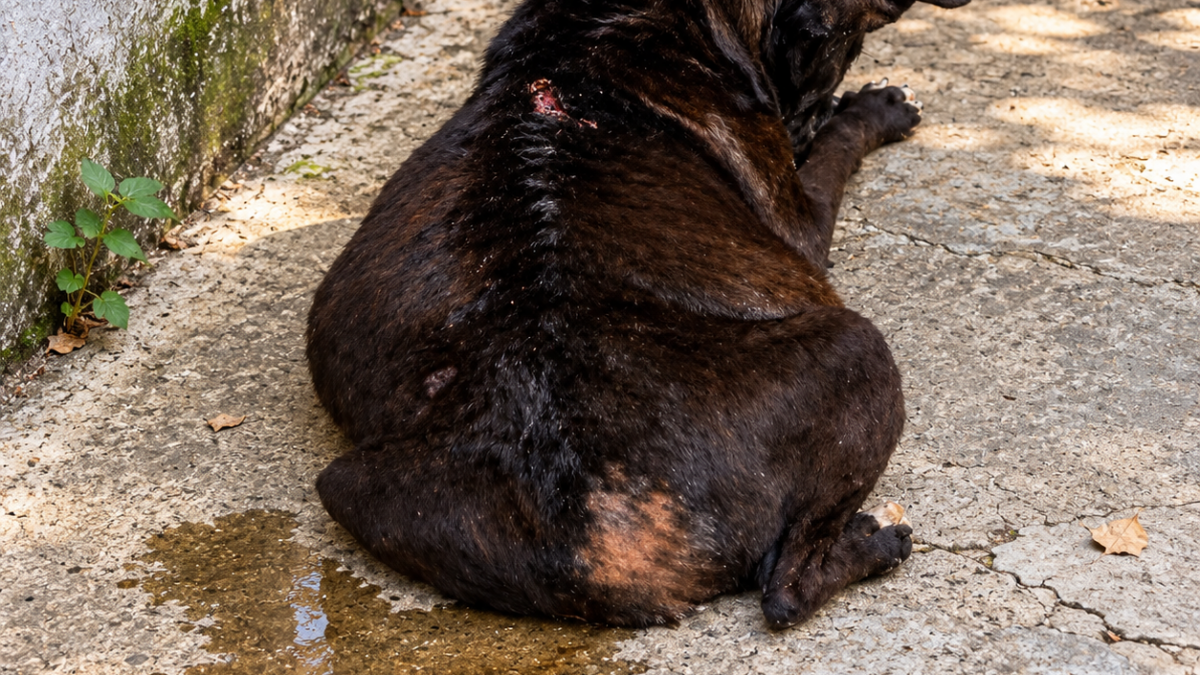
PART 2
The veterinarian looked at the ultrasound screen one more time.
Then he turned toward the technician.
“Prepare her for the procedure.”
His voice was calm.
Too calm for the way my heart was pounding.
I stood beside the examination table while Eduarda stroked the blanket near the dog’s head.
The animal barely moved.
Her abdomen looked painfully tight beneath her thin body.
I had never seen anything quite like it.
The swelling was so extreme that it distorted her entire shape.
Her chest seemed small compared with the enormous roundness of her belly.
Every breath looked difficult.
“Doctor,” I asked, “how much fluid is inside her?”
“We won’t know the total amount until we assess and drain it.”
“Could it really make her this big?”
“Yes.”
I stared at him.
“But how?”
“Ascites is a symptom. Something has caused fluid to collect in her abdomen. We need to determine the underlying problem.”
I looked toward the dog.
“And until then?”
“We stabilize her.”
He explained that draining a large volume of fluid had to be done carefully.
Removing too much too quickly could create complications.
Her circulation needed monitoring.
Her breathing.
Her blood pressure.
Her overall condition.
There would be no reckless attempt to empty her abdomen all at once.
Everything had to be controlled.
I nodded as though I understood every word.
The truth was that I only understood one thing.
She was in danger.
And for the first time since finding her, I realized how easily we could still lose her.
***
The technician began preparing the equipment.
Eduarda looked at me.
“Do you want to step outside?”
“No.”
“You look pale.”
“I’m fine.”
She raised an eyebrow.
“You don’t look fine.”
I glanced toward the table.
The dog was watching us.
Her eyes followed Eduarda’s movements.
“No,” I said quietly. “I’m staying.”
The veterinarian gave us space while the medical team worked.
We weren’t allowed to interfere.
So we stood where instructed and watched.
At first, the amount of fluid removed seemed small.
A measured amount collected in the container.
Then more.
And more.
I stared at it.
That fluid had been inside her.
Pressing against her organs.
Stretching her abdomen.
Making every movement difficult.
The technician adjusted the equipment.
The veterinarian checked her condition.
Everything proceeded gradually.
I looked at Eduarda.
“How did she survive like that?”
Eduarda shook her head.
“I don’t know.”
Neither of us spoke for a while.
The amount continued increasing.
One liter.
Then another.
The veterinarian monitored her carefully.
Her body was fragile.
She was not a healthy dog undergoing an ordinary procedure.
She had an infected wound.
A serious abdominal condition.
And an unknown history.
I kept thinking about the people who walked past her.
The ones who assumed her swollen belly meant puppies.
I had almost made the same mistake.
From a distance, the conclusion seemed obvious.
A pregnant stray.
A dog waiting to give birth.
Something unfortunate but not necessarily urgent.
But the reality was entirely different.
She wasn’t carrying puppies.
She was carrying fluid that had accumulated inside her body.
And nobody knew how long she had been suffering.
As the procedure continued, I looked at her face.
Something was changing.
The tension around her eyes seemed to soften.
Her breathing appeared less strained.
She was still weak.
Still exhausted.
But the rigid expression I had seen beside the road was beginning to disappear.
The veterinarian checked her again.
“She’s tolerating it.”
I exhaled.
“How much so far?”
He told me.
Nearly three liters.
I stared.
Three liters.
Inside one dog.
I couldn’t comprehend how her body had endured the pressure.
The procedure continued.
Carefully.
Under constant observation.
Eventually, the total approached four liters.
The veterinarian decided how much could safely be removed.
When the immediate drainage was complete, everyone continued monitoring her.
No one celebrated yet.
No one declared her cured.
There was still too much we didn’t know.
But I saw something I will never forget.
She took a slow breath.
Then another.
Her body seemed to settle against the table.
The tightness around her abdomen had visibly decreased.
Her eyes closed.
Not in panic.
Not in fear.
She simply rested.
I covered my mouth.
Eduarda looked at me.
“Are you crying?”
I nodded.
“I think she can finally breathe more comfortably.”
Eduarda wiped her own eyes.
The veterinarian checked her again.
“She appears more comfortable. But we’re not finished.”
I understood.
The fluid had been drained.
The danger had not disappeared.
***
The next concern was her tail.
During the examination, the veterinarian had already determined that the wound needed urgent attention.
Part of the tail was missing.
The remaining tissue was infected.
Fly larvae had invaded the exposed area.
The smell that had surrounded her beside the road came from damaged and infected tissue.
I hated thinking about how long she might have carried that injury.
The veterinarian carefully cleaned the wound and removed the infestation.
He assessed which tissue remained viable and what further treatment would be needed.
The procedure was delicate.
The infected area was painful.
Her condition made every decision more complicated.
I watched from a distance.
Eduarda stood beside me.
“Do you think somebody did this to her?”
I knew what she meant.
The missing part of the tail.
The open wound.
The terrible damage.
I wanted to answer.
I wanted to say yes.
I wanted a person to blame.
Someone whose face I could imagine.
Someone who could be held responsible for allowing a living animal to suffer like this.
But we didn’t know exactly how the injury happened.
We knew the tail had been severely damaged and left without adequate treatment.
We knew the wound had become infected.
We knew no one had intervened before we found her.
The cause remained uncertain.
“I don’t know,” I said.
Eduarda looked toward the treatment table.
“It’s horrible.”
“Yes.”
“She couldn’t even run away.”
I swallowed.
“I know.”
For a while, neither of us spoke.
Then Eduarda said something I would remember for a long time.
“The worst part isn’t that she didn’t run.”
I looked at her.
“What?”
“It’s that she didn’t seem to expect anyone to help.”
I turned toward the dog.
She was lying quietly while the veterinarian worked.
Eduarda was right.
There had been no struggle when we approached her.
No attempt to escape.
No defensive growl.
Just a tired animal standing beside the road while the world passed her by.
It was impossible to know what she was thinking.
But I couldn’t escape the feeling that she had been waiting for someone to notice her for a very long time.
***
By the time the initial procedures were completed, the day had almost disappeared.
The veterinarian brought us into a consultation room.
There were photographs on the screen.
Test results.
Ultrasound images.
Notes about the wound.
He explained the next steps.
The ascites required further investigation because fluid accumulation could have several underlying causes.
The team would evaluate her overall health, test results, and response to treatment.
They would also continue caring for the tail injury and watch closely for infection-related complications.
Her nutrition needed attention.
Her hydration and circulation needed monitoring.
Pain control was essential.
And her recovery could not be rushed.
“Is she going to live?” I asked.
The veterinarian looked at me.
“We have reason to hope.”
I waited.
He continued.
“But she’s seriously ill. I don’t want to promise an outcome we can’t guarantee.”
I looked down.
I hated those words.
Reason to hope.
Not a promise.
Not certainty.
Just hope.
But I had worked with enough rescued animals to know that hope sometimes had to be enough.
“What can we do?” Eduarda asked.
“Give us time to stabilize her.”
“And after that?”
“We’ll reassess each day.”
I nodded.
One day at a time.
That was how her recovery would begin.
Not with a miracle.
With another morning.
Another examination.
Another small sign that her body was responding.
***
That evening, we were finally allowed to see her resting comfortably.
A clean blanket covered the bed.
The damaged tail had been treated and protected.
Her abdomen was visibly smaller.
She looked completely different from the dog we had found beside the road.
Not healthy.
Not yet.
But no longer stretched into that painful, unnatural shape.
I walked closer.
Her eyes opened.
“Hey, sweetheart.”
She watched me.
I placed my hand near her face.
She didn’t move toward it.
But she didn’t turn away either.
Eduarda came beside me.
“She needs a name.”
I looked at her.
“You’re thinking about names now?”
“Yes.”
“She’s barely through the first day.”
“Exactly.”
I looked down at the dog.
Something about her face had softened.
The exhaustion was still there.
But beneath it, I could see a gentleness that had been almost invisible earlier.
“What are you thinking?” I asked.
Eduarda smiled.
“Isabela.”
I repeated it.
“Isabela.”
The dog moved one ear.
Eduarda laughed quietly.
“She approves.”
I smiled.
“That’s a very generous interpretation.”
“It’s the only one I’m accepting.”
I looked at the dog again.
“Isabela.”
Her eyes remained on my face.
“Well, Isabela,” I whispered, “we have a long road ahead.”
She closed her eyes.
And for the first time that day, I allowed myself to imagine that she might actually get to travel that road with us.
***
The first night was difficult.
Isabela needed close medical observation.
Her body had endured an enormous amount of stress.
The infected tail wound required continued attention.
The abdominal swelling had been reduced, but the underlying cause still needed evaluation.
Nobody knew whether fluid would accumulate again.
Nobody knew how quickly her body would recover.
I tried to go home.
I really did.
Eduarda stood beside the clinic entrance holding my car keys.
“You need sleep.”
“I know.”
“You’ve been here all day.”
“I know.”
“The doctors are watching her.”
“I know.”
She handed me the keys.
“Then go home.”
I looked through the glass doors.
Inside, a technician was checking Isabela.
Her small head rested against the blanket.
She looked so quiet.
Too quiet.
“What if something happens?”
“The clinic will call.”
“What if—”
Eduarda interrupted me.
“You can’t keep her alive by staring at her.”
I knew she was right.
I hated that she was right.
I took the keys.
Then I walked back inside.
Eduarda sighed.
“Seriously?”
“One minute.”
I approached Isabela’s bed.
She opened her eyes.
I crouched.
“I’m leaving for a little while.”
She watched me.
“I don’t know whether you understand any of this.”
Her breathing was slow.
“But someone will be here.”
I touched the blanket.
“Every time you wake up, someone will be here.”
I stood.
Then stopped.
Because I had just realized something.
We didn’t know whether anyone had ever made that promise to her before.
And for the first time, I understood how much it mattered.
***
I barely slept.
At two in the morning, I checked my phone.
Nothing.
At three, I checked again.
Nothing.
At four-thirty, I gave up pretending to sleep.
By six, I was dressed.
The clinic opened its doors to visitors later that morning.
I arrived early enough that the receptionist looked surprised.
“She’s still being monitored,” she said.
“I know.”
“Would you like an update?”
“Please.”
A technician came out.
“She’s stable.”
I exhaled.
The word felt enormous.
Stable.
Not cured.
Not out of danger.
But stable.
“Did she eat?”
“A little.”
“Did she drink?”
“We’re managing her fluids carefully.”
“How’s her breathing?”
“More comfortable than when she arrived.”
I nodded.
The technician smiled.
“She had a quieter night than we expected.”
I looked toward the treatment area.
“Can I see her?”
“Briefly.”
When I walked in, Isabela was awake.
She lifted her head slightly.
I stopped.
“Good morning.”
Her ears moved.
I smiled.
“You’re still here.”
She lowered her head.
I sat beside her.
For several minutes, I said nothing.
I simply watched her breathe.
There are moments in rescue when ordinary things become extraordinary.
A dog eating.
A dog sleeping.
A dog lifting her head.
A dog waking up the next morning.
Isabela had already taught me that.
***
The days that followed were exhausting.
The veterinary team continued evaluating her condition.
Blood tests.
Physical examinations.
Monitoring her abdomen.
Checking the wound.
Reviewing her response to treatment.
We learned to celebrate tiny improvements without assuming they guaranteed the next one.
One morning, her appetite improved.
The next afternoon, she seemed unusually tired.
One day, the tail wound looked cleaner.
The next day, she needed additional attention because the surrounding tissue remained sensitive.
Recovery was uneven.
I had expected that.
I still found it difficult.
Eduarda noticed.
“You’re doing it again.”
“What?”
“Looking at her like every bad hour means we’re losing her.”
I sighed.
“I know.”
“She was extremely sick.”
“I know.”
“She isn’t going to become healthy overnight.”
I looked at Isabela.
She was resting with her chin on a folded towel.
“I just want her to feel better.”
Eduarda sat beside me.
“So do I.”
For a while, we watched her quietly.
Then Eduarda said, “Do you remember when we first approached her?”
I nodded.
“She didn’t move.”
“No.”
“Now look.”
Isabela lifted her head toward the sound of our voices.
Her eyes moved between us.
Then she settled again.
Eduarda smiled.
“She knows we’re here.”
Maybe she did.
Maybe she was simply becoming more aware as her condition improved.
Either way, something was changing.
Isabela was no longer standing alone beside a road.
She was surrounded by people who noticed every small movement she made.
***
The first real setback came several days after her initial treatment.
I arrived at the clinic and found the veterinarian studying her latest examination results.
He looked serious.
My stomach tightened.
“What’s wrong?”
“We’re continuing to monitor the abdominal fluid.”
“Is it coming back?”
“There are changes we need to assess.”
My heart began pounding.
“But you drained almost four liters.”
“Yes.”
“Then why would there be more?”
He turned toward me.
“Because drainage relieves the accumulation. It doesn’t necessarily remove the underlying cause.”
I stared at him.
I had understood that during our first consultation.
But hearing it again was different.
Some part of me had secretly believed that removing the fluid meant the worst was over.
Now I realized how fragile that hope had been.
“What happens next?”
“We continue investigating and manage her condition based on the findings.”
“Could she need another procedure?”
“Possibly. We’ll make that decision based on her comfort and clinical condition.”
I looked toward Isabela.
She was sleeping.
Her abdomen was much smaller than before.
But I was suddenly frightened all over again.
The veterinarian seemed to understand.
“She’s responding to care in several important ways.”
I looked at him.
“Really?”
“Yes.”
“Then why do I feel like we’re starting over?”
He paused.
“Because you want certainty.”
I didn’t answer.
“And I can’t give you that yet.”
I looked down.
He continued gently.
“But uncertainty isn’t the same as failure.”
That sentence stayed with me.
Uncertainty wasn’t failure.
It was simply part of caring for a seriously ill animal.
***
That afternoon, I sat beside Isabela longer than usual.
She had eaten part of her meal.
Her eyes looked brighter.
But I couldn’t stop thinking about the possibility that her abdomen might swell again.
I watched her chest rise and fall.
“Do you know how much trouble you’re causing?” I whispered.
Her ears moved.
“Everyone here is worried about you.”
She looked at me.
“Especially me.”
I reached toward her.
Then stopped.
I still remembered how little she had reacted when we first found her.
She had accepted our help, but I didn’t know whether she truly trusted us yet.
So I placed my hand beside her.
Close enough for her to smell.
Far enough that she could choose whether to approach.
For almost a minute, nothing happened.
Then Isabela moved her head.
Slowly.
Carefully.
Her nose touched my fingers.
I froze.
She sniffed.
Then rested her chin against my hand.
I stopped breathing.
“Isabela?”
She closed her eyes.
I felt tears filling mine.
The dog who had stood motionless beside the road was now choosing human contact.
Not because she was too exhausted to resist.
Because she wanted it.
I gently stroked beneath her chin.
She leaned closer.
I laughed through tears.
“There you are.”
That was the first time I felt I was meeting Isabela rather than simply treating her injuries.
***
As the days passed, her appetite gradually returned.
At first, she needed encouragement.
She would sniff the food.
Look away.
Then try again.
Sometimes she ate only a little.
Sometimes she surprised us by finishing more than expected.
We followed the veterinary team’s feeding plan carefully.
Her body needed nutrition.
But her condition required thoughtful management.
No one wanted to overwhelm a dog who had already endured so much.
Eduarda discovered that Isabela preferred eating when someone sat nearby.
Not too close.
Just close enough.
One morning, I walked into the recovery area and found Eduarda sitting on the floor beside her.
“What are you doing?”
“Breakfast.”
I looked at Isabela.
She was eating from a bowl.
Then I looked at Eduarda.
She had a sandwich.
“You’re having breakfast together?”
“Yes.”
I laughed.
“Of course you are.”
Eduarda looked offended.
“She has excellent table manners.”
Isabela lifted her head.
A tiny piece of food clung to the side of her mouth.
I raised an eyebrow.
“Clearly.”
Eduarda wiped Isabela’s muzzle gently.
The dog accepted the touch.
Then returned to eating.
I stood there smiling.
There was something extraordinary about seeing her enjoy something as ordinary as breakfast.
For so long, her body had been consumed by discomfort.
Now there was room for appetite.
For curiosity.
For small pleasures.
That was the beginning of life returning.
***
Her tail wound required persistent care.
Even after the infestation had been removed, the damaged area needed time to heal.
The veterinarian continued assessing the tissue.
The staff cleaned and protected the wound according to the treatment plan.
We monitored for signs of further infection.
Some days were better than others.
Isabela didn’t always enjoy the procedures.
Who could blame her?
The injured area was sensitive.
Certain movements were uncomfortable.
And being handled repeatedly could be stressful.
But her reaction began changing.
At first, she simply endured the treatment.
She lay quietly while the team worked.
Later, she began watching the technicians.
Then she started recognizing them.
A familiar voice could make her lift her head.
A gentle hand could help her settle.
The procedures weren’t suddenly pleasant.
But she was learning what came afterward.
Relief.
A clean blanket.
Food.
Rest.
Someone remaining beside her.
One afternoon, the technician finished caring for her wound and stepped away.
Isabela lifted her head.
The technician turned back.
“What is it, sweetheart?”
Isabela looked at her.
Then slowly leaned forward.
Her nose touched the technician’s wrist.
The woman froze.
I smiled.
“She wants you.”
The technician crouched.
“Hello, beautiful.”
Isabela pressed her head into her hand.
The woman laughed softly.
“Oh, you sweet girl.”
I looked away.
Because the word beautiful had struck me harder than I expected.
Beautiful.
The same dog people had walked past because they thought she was just another pregnant stray.
The same dog who had been standing with a rotting wound.
Now someone was looking at her as though she was precious.
And she was.
She always had been.
***
Around the second week, Isabela began showing us more of her personality.
She was gentle.
Quiet.
Observant.
She loved soft bedding.
If a blanket was folded unevenly, she would sometimes nudge it with her nose until she found a comfortable position.
She liked hearing familiar voices.
She seemed especially attentive whenever Eduarda entered.
And she had a habit that made everyone smile.
Whenever someone sat beside her for a while, she would gradually move closer.
Not suddenly.
Not dramatically.
Just an inch.
Then another.
Until part of her body rested against them.
One afternoon, Eduarda was sitting beside her bed answering messages on her phone.
Isabela moved closer.
Eduarda kept typing.
Another inch.
Then another.
Finally, Isabela rested her head against Eduarda’s leg.
Eduarda looked down.
“Well, hello.”
Isabela closed her eyes.
Eduarda smiled.
“You could have just asked.”
I laughed from the doorway.
“She did.”
Eduarda looked at me.
“She has excellent communication skills.”
I nodded.
“Very subtle.”
We watched Isabela fall asleep.
And for a moment, the entire clinic felt peaceful.
No emergency.
No panic.
No terrible uncertainty.
Just a dog sleeping beside someone she trusted.
I wanted that moment to last forever.
***
But there was something I couldn’t stop thinking about.
The people who had walked past her.
I remembered the voices.
“She’s pregnant.”
“She’s probably looking for somewhere to give birth.”
“Better leave her alone.”
No one had understood what was happening.
Some may have genuinely believed she was simply a stray carrying puppies.
Others may have noticed she was sick but felt uncertain about helping.
We couldn’t know what each person had thought.
But the result was undeniable.
Isabela had been left standing there until her condition became an emergency.
I wanted to understand why.
So I returned to the area where we had found her.
The roadside looked ordinary.
Cars passed.
People walked between shops and nearby homes.
There was no visible reminder of the dog who had stood trembling there.
I stopped at the exact place.
For a moment, I could almost see her again.
The swollen belly.
The flies.
The lowered head.
The way her body swayed.
Then a woman nearby approached.
“Are you looking for the dog?”
I turned.
“Yes.”
“She isn’t here anymore?”
“We took her to a veterinary clinic.”
The woman looked relieved.
“Oh, good.”
I studied her face.
“Did you see her before?”
“Yes.”
“How long?”
She hesitated.
“A few days.”
My chest tightened.
“A few days?”
“I thought she was pregnant.”
I didn’t answer immediately.
The woman looked uncomfortable.
“She was standing there with that enormous stomach.”
“Yes.”
“I thought someone would help when she gave birth.”
I swallowed.
“She wasn’t pregnant.”
The woman’s expression changed.
“What?”
“There were no puppies.”
She stared at me.
“Then why was her belly like that?”
“Fluid had accumulated inside her abdomen. She was very sick.”
The woman covered her mouth.
“Oh, my God.”
I continued.
“She also had a severe infected wound near her tail.”
The woman’s eyes filled.
“I didn’t know.”
I looked toward the roadside.
“Neither did we until we got close.”
The woman remained silent.
Then she whispered, “I should have stopped.”
I didn’t know what to say.
Because part of me wanted to agree immediately.
Another part remembered how easy it was to misread an animal from a distance.
I had initially thought Isabela was pregnant too.
The difference was that we had moved closer.
We had checked.
We had acted.
Finally, I said, “Next time, call someone.”
She nodded.
“If an animal looks like that, don’t assume it’s okay.”
“I won’t.”
I hoped she meant it.
***
When I returned to the clinic, Isabela was awake.
I sat beside her.
“You caused quite a misunderstanding.”
She looked at me.
“Everybody thought you were going to have puppies.”
Her ears moved.
I smiled sadly.
“But you were the one who needed someone to take care of you.”
She lowered her head toward my hand.
I stroked her gently.
“You know something?”
She watched me.
“I think we’re going to make sure people remember that.”
It wasn’t revenge in the dramatic sense.
There was no person we could confidently identify as responsible for every injury.
No confrontation that could undo the suffering.
No punishment that would make the past disappear.
But there was something we could do.
We could make sure Isabela’s story changed the way people looked at the next suffering animal.
That mattered.
And the more I thought about it, the more determined I became.
***
We began documenting her recovery carefully.
The medical team already had clinical records.
Photographs.
Measurements.
Examination findings.
Images showing the abdominal fluid.
Notes about the tail injury.
We preserved the information that could be shared responsibly without interfering with her care.
Not because Isabela needed public attention.
She didn’t.
She needed rest.
But because her condition illustrated something important.
A swollen belly doesn’t always mean pregnancy.
An animal standing quietly isn’t necessarily healthy.
Silence doesn’t mean the absence of pain.
And a stray dog who doesn’t run away from people may be too sick to move.
I asked the veterinarian whether we could use her story to help people recognize emergencies.
He agreed, provided we represented the medical facts accurately.
“Don’t make assumptions about the cause,” he said.
“I won’t.”
“And don’t tell people ascites is a disease by itself.”
“I understand.”
“It’s a sign of an underlying problem.”
I nodded.
He continued.
“Also, the drainage helped relieve her abdominal pressure. But people shouldn’t think removing fluid automatically cures the condition.”
“I’ll make that clear.”
He smiled.
“Good.”
I looked toward Isabela’s room.
“People need to know.”
“Yes,” he said.
“They do.”
***
The next morning, I arrived carrying a new blanket.
It was soft.
Cream-colored.
Nothing fancy.
I had seen it in a store and thought immediately of Isabela.
Eduarda watched me unfold it.
“Another blanket?”
“Yes.”
“She already has several.”
“This one is softer.”
Eduarda touched it.
“That’s true.”
“See?”
She smiled.
“You’re spoiling her.”
I looked toward Isabela.
The dog was watching us.
“Good.”
We placed the blanket on her bed.
She sniffed it.
Then slowly lowered herself onto it.
Her body relaxed almost immediately.
Eduarda laughed.
“She approves.”
I smiled.
“She has excellent taste.”
For several minutes, Isabela simply lay there.
Her head rested against the soft fabric.
Her abdomen no longer had the extreme swelling we had seen at rescue.
The tail wound was healing under veterinary care.
Her breathing looked comfortable.
She seemed peaceful.
I sat beside her.
The sight nearly overwhelmed me.
Because I remembered the dog standing by the road.
She had been surrounded by people.
Cars.
Noise.
Movement.
Yet she had been completely alone.
Now she was lying on a blanket someone had bought specifically for her.
It was such a small thing.
But it meant someone had thought about her when she wasn’t even in the room.
Someone had seen something soft and imagined her enjoying it.
That is part of what love looks like.
Not always dramatic sacrifice.
Sometimes just a blanket.
***
By the third week, Isabela had become more interested in the world around her.
She watched people walking past her room.
She lifted her head when she heard familiar voices.
She began responding when we called her name.
At first, it was only an ear movement.
Then she turned her head.
Eventually, when Eduarda entered, Isabela sometimes tried to rise.
The first time it happened, we both froze.
“Did you see that?” Eduarda whispered.
I nodded.
Isabela had pushed herself up slightly.
Her legs trembled.
She stopped.
Then tried again.
“Easy,” I whispered.
She settled back onto the blanket.
We didn’t force her.
Her strength was returning gradually.
The medical team guided her activity according to her condition.
Short periods of standing.
Gentle movement.
Plenty of rest.
Her body had been through too much to rush.
But that first attempt mattered.
It wasn’t only that she was physically stronger.
She wanted to move toward us.
She wanted to participate in what was happening around her.
That was new.
The dog who had once stood motionless because she could barely continue was now trying to stand because she wanted to greet someone.
I smiled at Eduarda.
“She has somewhere she wants to go.”
Eduarda laughed softly.
“Toward us.”
I looked at Isabela.
“Yes.”
And somehow, that made the whole difficult journey feel worthwhile.
***
As her strength improved, we began allowing her brief supervised time in a quiet recovery area.
The first day, she simply stood and looked around.
Sunlight entered through a nearby window.
A soft breeze moved the curtains.
Isabela lifted her nose.
She sniffed.
Then sniffed again.
I watched her carefully.
“What’s that?”
She turned toward the window.
Outside, birds were calling.
She listened.
Her ears moved.
I smiled.
“Birds.”
She looked at me.
“Yes, sweetheart. The world has birds.”
Eduarda laughed.
“You’re talking to her like she’s never seen outside.”
I shrugged.
“I don’t know what she’s seen.”
That was true.
We knew almost nothing about Isabela before finding her.
We didn’t know where she had lived.
Whether she once had an owner.
Whether anyone had ever loved her.
Whether she had slept in a home.
Whether the tail injury came from an accident, human interference, or something else.
We knew the condition in which we found her.
We knew what the veterinary team had treated.
And we knew she was beginning to recover.
Everything else remained a mystery.
But for the first time, that mystery didn’t make me feel helpless.
Because even if we couldn’t reconstruct her past, we could shape what happened next.
***
One afternoon, Isabela did something that made the entire recovery team laugh.
Eduarda entered carrying a bowl of food.
Isabela lifted her head immediately.
“Hungry?”
She moved closer.
Eduarda placed the bowl down.
Then stepped away.
Isabela sniffed.
Ate a little.
Then stopped.
She turned toward Eduarda.
“What?”
Isabela stared.
Eduarda moved closer.
The dog resumed eating.
Eduarda stepped away again.
Isabela stopped.
I watched from the doorway.
“Oh, she’s trained you.”
Eduarda turned.
“What?”
“She wants you beside her.”
Eduarda looked back at Isabela.
The dog stared.
Then moved her nose toward the bowl.
Eduarda sighed.
“Fine.”
She sat down.
Isabela resumed eating.
I laughed.
“You belong to her now.”
Eduarda shook her head.
“This dog is manipulative.”
I smiled.
“She’s recovering beautifully.”
The scene stayed with me.
There was no medical miracle.
No dramatic revelation.
Just a dog who had learned she could ask for company and receive it.
That was healing too.
***
Not every day was easy.
Sometimes Isabela became tired after only a short period of activity.
Sometimes she needed additional attention for her healing wound.
Sometimes a veterinary examination revealed something the team wanted to monitor more closely.
Her abdominal condition remained important.
We didn’t pretend the initial fluid drainage had solved everything.
The veterinarian continued following her clinical progress.
I learned to ask better questions.
Not simply, “Is she cured?”
Instead:
“Is she comfortable?”
“Is her breathing normal?”
“Is she eating enough?”
“How is the wound healing?”
“Is there any evidence the fluid is accumulating again?”
“What does she need today?”
That change in perspective helped me.
It helped Isabela too.
We stopped expecting one dramatic moment when everything would become perfect.
We focused on the life she was actually living.
And every week, there were more good moments.
More interest in food.
More relaxed sleep.
More movement.
More trust.
More time spent looking at the world instead of simply enduring it.
***
One evening, I arrived after a long day.
I was exhausted.
Emotionally and physically.
There had been another rescue call.
Another frightened animal.
Another set of difficult decisions.
I walked into Isabela’s room and sat on the floor.
“I’m tired.”
She lifted her head.
“I know you don’t care.”
She watched me.
“Or maybe you do.”
I leaned against the wall.
For a while, I said nothing.
Then I felt something touch my knee.
Isabela’s nose.
I opened my eyes.
She had moved closer.
Her head rested against my leg.
I smiled.
“Hey.”
She looked up.
I gently stroked her neck.
“You know, you don’t have to take care of me.”
She leaned harder.
I laughed softly.
“Apparently you disagree.”
I sat there for a long time.
Isabela rested beside me.
And I realized that she had become more than a patient.
She had become a presence.
A living creature whose trust made the exhausting days feel worthwhile.
I thought about the people who had passed her on the road.
They had seen a swollen belly.
They hadn’t seen this.
The gentleness.
The quiet affection.
The way she sought company.
The way she relaxed when someone spoke softly.
They had seen a problem.
We were beginning to know a personality.
***
Several weeks into her recovery, we received encouraging news.
The veterinarian was pleased with the progress of her tail wound.
The infected areas had responded to treatment.
The infestation was gone.
The healing tissue looked healthier.
Her overall condition was improving.
She had also become more comfortable moving around.
When the doctor finished examining her, he smiled.
“She’s doing better.”
I stared at him.
“Really?”
He nodded.
“Her progress is encouraging.”
I looked toward Isabela.
She was standing beside Eduarda.
Her body looked so different.
The extreme abdominal swelling had been relieved.
She was no longer trembling with every breath.
Her posture appeared more natural.
And her eyes—
Her eyes were the biggest difference.
When we found her, they had looked exhausted.
Now they followed movement with curiosity.
They brightened when she recognized someone.
Sometimes they even seemed playful.
I turned back to the veterinarian.
“Do you think she knows she’s getting better?”
He smiled.
“I think she knows she feels different.”
I looked at Isabela again.
She was nudging Eduarda’s hand.
“Yes,” I whispered.
“I think she does.”
***
We eventually moved Isabela into a quieter recovery space where she could continue healing with regular supervision.
She had a soft bed.
Clean blankets.
Water.
Food.
A place to rest.
Space to move comfortably.
And people who knew her by name.
The first time she entered, she stood in the doorway.
I wondered whether the unfamiliar environment would frighten her.
Eduarda crouched.
“Come on, Isabela.”
The dog looked around.
Then stepped forward.
One paw.
Another.
She sniffed the floor.
Investigated the bed.
Looked toward the window.
Then walked directly to Eduarda.
She pressed her head against her knee.
Eduarda laughed.
“That’s right. I’m still here.”
I smiled.
That was the important part.
The surroundings could change.
The people she trusted would remain.
We gave her time to explore.
She moved slowly.
Stopped often.
Rested when she needed.
But she was moving.
Choosing.
Deciding where she wanted to go.
The contrast with her first day was almost impossible to believe.
***
As Isabela became more comfortable, we introduced her gradually to the normal sounds of the rescue environment.
Doors opening.
People talking.
Food being prepared.
Other dogs moving nearby.
She was gentle around them.
Curious but cautious.
One older rescued dog often rested in the neighboring area.
They could see each other through a safe barrier.
At first, Isabela simply watched.
The other dog would settle on his blanket.
Isabela would settle on hers.
Sometimes they slept at the same time.
Sometimes one lifted its head when the other moved.
It was a quiet companionship.
Nothing dramatic.
But I loved watching it.
Isabela no longer seemed isolated from the world.
She was beginning to become part of it again.
One afternoon, the older dog approached the barrier.
Isabela lifted her head.
He sniffed.
She sniffed back.
Then both lay down.
Eduarda watched beside me.
“That’s adorable.”
I smiled.
“They’re having a very serious conversation.”
“About what?”
I looked at the two resting dogs.
“Probably blankets.”
Eduarda laughed.
Isabela closed her eyes.
And the room returned to peace.
***
The story of her rescue had begun reaching people beyond our team.
Some were shocked.
Some wanted to know how she was doing.
Others admitted they had always assumed a dog with a swollen belly was pregnant.
One person wrote about seeing a similar animal in their neighborhood and contacting a local rescue organization after realizing something might be wrong.
Another said they had never understood how serious an untreated wound could become.
I read those messages carefully.
They didn’t erase what Isabela had endured.
But they meant her suffering was producing something useful.
Knowledge.
Awareness.
A willingness to look twice.
We were careful not to turn her pain into entertainment.
The medical facts mattered.
The distinction between pregnancy and ascites mattered.
The danger of an untreated infected wound mattered.
Most of all, the need to seek veterinary help instead of guessing mattered.
Because guessing had almost cost Isabela her life.
***
One morning, the woman I had spoken with near the rescue location contacted us again.
She asked whether Isabela was still alive.
I answered immediately.
“Yes.”
Then I sent a recent photograph.
Isabela was resting on her cream-colored blanket.
Her abdomen looked dramatically different.
Her face was relaxed.
Her eyes were bright.
The woman called me.
“That’s her?”
“Yes.”
“The same dog?”
“The same dog.”
She became quiet.
Then I heard her crying.
“I walked past her.”
I didn’t answer.
“I walked past her more than once.”
I looked at the photograph.
The woman continued.
“I really thought she was pregnant.”
“I know.”
“I thought she was waiting to have puppies.”
I swallowed.
“She was very sick.”
“I understand that now.”
There was a long silence.
Then she asked, “Can I do anything?”
I thought about the question.
There were many things she couldn’t do.
She couldn’t undo those days.
She couldn’t remove the pain Isabela had already endured.
She couldn’t make the wound disappear.
But she could change what happened next.
“Help the next animal you see,” I said.
She sniffed.
“I will.”
“And if you’re not sure what’s wrong, call someone who can assess it.”
“I promise.”
I hoped she meant it.
Several weeks later, she contacted a local rescue service about another animal in distress.
This time, she didn’t wait.
When I heard, I thought about Isabela.
Maybe that was one more life her story had helped.
***
But the most important change was happening inside Isabela herself.
She began greeting us.
At first, she only lifted her head.
Then she moved toward us.
Eventually, when Eduarda entered, Isabela would stand and approach.
Her entire body seemed to brighten.
One afternoon, Eduarda opened the door.
“Isabela!”
The dog lifted her head.
Then walked toward her.
Eduarda crouched.
“There you are!”
Isabela pressed against her.
I watched from behind.
Then something happened that made me laugh.
Isabela tried to wag what remained of her tail.
The movement was small and limited because of the injury.
But her hips moved.
Then her whole back end shifted.
She looked so delighted that her entire body seemed to be participating.
Eduarda began laughing through tears.
“Look at you!”
Isabela leaned closer.
I covered my mouth.
Because I remembered the first day.
The terrible condition of her tail.
The flies.
The wound.
The silence.
Now she was trying to wag.
Not perfectly.
Not the way she might have before.
But joy had found another way to move through her body.
And that was enough.
***
We learned that Isabela liked being outdoors.
Once her condition allowed it, we began giving her short supervised periods in a safe garden area.
At first, she stood near the doorway.
The ground was soft beneath her paws.
A gentle breeze moved through the grass.
She lifted her nose.
Sniffed.
Then stepped forward.
I watched carefully.
There was no enormous swollen belly forcing her into an unnatural posture.
No terrible pressure making movement look impossible.
She still needed to build strength.
But she could explore.
Isabela walked toward a small patch of grass.
Stopped.
Lowered her head.
Sniffed.
Then looked back at me.
I smiled.
“Go ahead.”
She took another step.
Then another.
Eduarda stood beside me.
“Do you remember when we couldn’t even get her to move?”
“Yes.”
“Now look.”
Isabela wandered slowly along the edge of the garden.
She stopped near a flower.
Sniffed it.
Sneezed.
I laughed.
Eduarda laughed too.
Isabela looked offended.
“Sorry,” I told her.
She sneezed again.
We laughed harder.
It was ridiculous.
And wonderful.
A dog who had once seemed barely alive was now investigating flowers.
For the first time, I allowed myself to imagine years of ordinary moments like that.
Not just survival.
Living.
***
One afternoon, Isabela surprised us by becoming playful.
Eduarda had placed a soft toy near her bed.
Isabela ignored it at first.
That was normal.
She had shown little interest in toys during her early recovery.
But later, when I returned, the toy had moved.
I looked at Eduarda.
“Did you move that?”
“No.”
“Are you sure?”
“Yes.”
I picked it up.
Placed it near Isabela.
She looked at it.
Then looked away.
I waited.
Nothing.
Eduarda laughed.
“She’s not performing for you.”
I sighed.
“Apparently.”
We stepped back.
A few minutes later, Isabela leaned forward.
She sniffed the toy.
Then opened her mouth.
Gently took it.
And pulled it closer.
I froze.
Eduarda grabbed my arm.
“Did you see that?”
“Yes.”
Isabela rested her chin on the toy.
Then closed her eyes.
I smiled.
“She likes it.”
Eduarda whispered, “She has a toy.”
Such a simple thing.
But Isabela had arrived without anything that seemed to belong to her.
No collar we could connect to a caring owner.
No blanket.
No safe place.
No known history.
Now she had a bed.
A name.
People.
And a toy she had chosen.
That night, she slept with it beside her face.
I took one photograph.
Not for publicity.
Just because I wanted to remember.
***
Her recovery continued over the following weeks.
The veterinary team monitored her health.
Her wound kept healing.
Her appetite remained encouraging.
She became stronger and more comfortable in her surroundings.
There were still questions about her abdominal condition.
There were still follow-up examinations.
We knew that serious medical problems could require long-term attention.
But the dog in front of us was no longer the same exhausted animal we had lifted from the roadside.
She was becoming herself.
And the more of herself she revealed, the more deeply we loved her.
Isabela loved quiet company.
She preferred gentle voices.
She enjoyed soft blankets and comfortable places to rest.
She liked having her head scratched.
She sometimes leaned so heavily against Eduarda that Eduarda had to brace herself.
And she had developed a new habit.
Whenever I entered carrying food, she followed me with her eyes.
If I walked past without stopping, she made a soft sound.
Not a frightened cry.
A complaint.
I laughed the first time.
“Excuse me?”
Isabela looked at the bowl.
“Oh, I see.”
She made the sound again.
I smiled.
“You have opinions now.”
She watched me.
“That’s good.”
Because the dog we found had been almost completely silent.
Now she was comfortable enough to ask for what she wanted.
And every request reminded me that she expected someone to listen.
***
One morning, Eduarda arrived with news.
The woman from the roadside had contacted her again.
This time, she wasn’t calling about Isabela.
She had seen another stray dog behaving strangely near a neighborhood market.
Instead of assuming the animal was simply resting, she contacted people who could help.
The dog was examined and received appropriate care.
I listened quietly.
Then I smiled.
“Good.”
Eduarda nodded.
“She said she thought about Isabela.”
I looked toward the garden.
Isabela was lying in the sun.
Her head rested against her front paws.
The soft toy was beside her.
“She changed someone,” I whispered.
Eduarda looked at me.
“What?”
“Isabela.”
I pointed toward her.
“She changed the way that woman sees animals.”
Eduarda smiled.
“Yes.”
I thought about the terrible morning.
The assumptions.
The people walking past.
The enormous belly.
The infected wound.
The dog who stood silently while her life was slipping away.
If Isabela’s story caused even one person to stop and seek help for another suffering animal, something important had happened.
It couldn’t undo her pain.
But it could prevent another animal from being ignored.
And that mattered.
***
Months after the rescue, Isabela’s body looked remarkably different.
Her abdomen was no longer grotesquely swollen.
The infected wound had healed substantially under veterinary care.
Her coat looked healthier.
Her posture was more comfortable.
Her eyes were bright.
And she had learned to trust the people who cared for her.
One morning, I found her sleeping on her side.
Her legs were relaxed.
Her body stretched across the blanket.
Sunlight touched her face.
I stood in the doorway for several minutes.
It was the most ordinary scene imaginable.
A dog sleeping.
Yet it nearly made me cry.
Because the first time I saw Isabela, she had been standing.
Not because she wanted to.
Not because she was alert.
But because she appeared too exhausted and uncomfortable to do anything else.
Now she could lie down.
Stretch.
Rest.
Sleep deeply.
She no longer looked like an animal fighting for every breath.
She looked comfortable.
Peaceful.
Safe.
I walked closer.
Her eyes opened.
“Good morning.”
She lifted her head.
Then slowly approached.
I crouched.
She pressed against my chest.
I hugged her gently.
“Look at you.”
Her body relaxed against me.
I closed my eyes.
For a moment, I remembered the terrible smell beside the road.
Then I opened them.
All I could smell was clean fur and the faint scent of her blanket.
I smiled.
“You made it.”
***
As her strength returned, we began thinking more seriously about her long-term future.
Isabela still needed continued care and monitoring.
We couldn’t pretend that a severe medical crisis had no consequences.
But she was safe.
She was healing.
She was becoming comfortable around people.
And she had shown us that she could enjoy life.
That mattered more than any dramatic photograph.
One afternoon, I sat beside her in the garden.
Eduarda joined me.
“What do you think her future looks like?” she asked.
I watched Isabela sniffing the grass.
“A lot better than it did.”
Eduarda smiled.
“That’s not an answer.”
I shrugged.
“I don’t know every detail.”
“Neither do I.”
“But I know what it won’t look like.”
She turned toward me.
“What?”
I looked at Isabela.
“She won’t be standing alone beside a road while people walk past her.”
Eduarda became quiet.
“Not if we can help it.”
I nodded.
“Exactly.”
We didn’t need to invent a perfect future.
We needed to keep giving her the care, safety, and stability she deserved.
One day at a time.
Just as we had from the beginning.
***
The strongest moment of Isabela’s recovery came on an afternoon I almost missed.
I had been busy with another rescue case.
My phone kept ringing.
There were forms to complete.
Supplies to organize.
Messages to answer.
By the time I reached Isabela’s recovery area, I was exhausted.
Eduarda was already there.
She smiled when she saw me.
“Watch.”
I stopped.
“What?”
“Just watch.”
Isabela was lying on her blanket.
A few feet away, Eduarda placed a small treat on the floor.
Then she stepped back.
Isabela lifted her head.
Looked at the treat.
Then looked at Eduarda.
“Come on, girl,” Eduarda whispered.
Isabela stood.
Slowly.
Carefully.
Then walked toward the treat.
She reached it.
Ate it.
And turned back.
That alone would have made me happy.
But then she noticed me.
Her eyes brightened.
Her body shifted.
And she walked directly toward me.
No food in my hands.
No encouragement.
No one pulling her.
She came because she wanted to.
I crouched.
“Isabela?”
She reached me.
Pressed her head against my chest.
Then began licking my hands.
I laughed.
“Hey!”
Another kiss.
Then another.
Eduarda started laughing.
“She likes you.”
I could barely speak.
“She came to me.”
Isabela pressed closer.
I wrapped my arms around her carefully.
For a moment, the room disappeared.
I was back beside the road.
Watching a dog who barely seemed able to move.
An enormous swollen belly.
A terrible wound.
A silent animal too exhausted to protect herself.
Then I was back in the recovery room.
Holding a dog who had chosen to walk across the floor because she wanted affection.
I began crying.
Isabela licked my face.
Eduarda laughed through tears.
“Oh, she’s going to make it worse.”
She did.
Isabela kept kissing me until I was laughing and crying at the same time.
And for the first time since her rescue, I wasn’t thinking about how close she had come to dying.
I was thinking about how much life she still had to experience.
***
I used to believe that the most dramatic part of Isabela’s story was the moment the veterinarian discovered she wasn’t pregnant.
For a long time, that was the image I couldn’t escape.
The enormous belly.
The ultrasound screen.
The words:
“There are no puppies.”
Then the realization that her abdomen was filled with fluid.
Nearly four liters removed under careful medical supervision.
The visible relief afterward.
The beginning of treatment.
That was certainly the medical turning point.
But over time, I realized it wasn’t the emotional turning point.
That came later.
The first time she leaned toward Eduarda.
The first time she rested her chin against my hand.
The first time she ate because someone sat beside her.
The first time she chose a toy.
The first time she walked toward us without being called.
Those were the moments when Isabela stopped being only a dog we were trying to save.
She became a dog who was learning how to live.
And there was a difference.
A profound one.
***
One afternoon, I returned to the roadside where we had found her.
I didn’t bring Isabela.
There was no reason to expose her to the traffic and stress of that place.
She was safe in her recovery environment.
I went alone.
The road looked ordinary.
Cars passed.
People walked between shops.
Someone carried groceries.
Another person talked on a phone.
Life continued.
I stood near the place where Isabela had been found.
For a moment, I closed my eyes.
I could almost see her.
The swollen belly.
The trembling legs.
The flies.
The silence.
Then I remembered what the veterinarian had said.
She wasn’t carrying puppies.
She was carrying fluid.
Her body was failing.
I opened my eyes.
A man nearby noticed me.
“Are you looking for that dog?”
I turned.
“Yes.”
“The pregnant one?”
I took a slow breath.
“She wasn’t pregnant.”
He frowned.
“What?”
“She was seriously ill.”
I explained what had happened.
The abdominal fluid.
The infected tail injury.
The emergency veterinary care.
The recovery.
He listened quietly.
Then shook his head.
“I thought she was going to have puppies.”
“So did we at first.”
He looked toward the place where she had stood.
“Is she alive?”
I smiled.
“Yes.”
His expression changed.
“Really?”
“She’s doing much better.”
I showed him a recent photograph.
Isabela was lying on her cream-colored blanket, looking relaxed and content.
He stared.
“That’s the same dog?”
“Yes.”
He looked closer.
“She looks beautiful.”
I smiled.
“She was always worth helping.”
He nodded slowly.
Then looked away.
“I should have stopped.”
I didn’t answer immediately.
Because I knew those words couldn’t change the past.
But maybe they could change what happened next.
Finally, I said, “Next time, don’t wait.”
He nodded.
“I won’t.”
I walked away.
And for the first time, I felt something inside me loosen.
Not because someone had been punished.
Not because the past had been corrected.
But because the truth had replaced an assumption.
And Isabela was alive to prove it.
***
In rescue work, people often talk about happy endings.
A dog gets adopted.
A puppy learns to walk.
An injured animal runs again.
Those are wonderful moments.
But Isabela taught me that a happy ending can begin much earlier.
It can begin when a dog takes a comfortable breath.
When an infected wound starts healing.
When an animal who once stood trembling can finally lie down and rest.
When food becomes something to enjoy rather than something the body can barely tolerate.
When a hand becomes familiar.
When a voice becomes comforting.
When someone says a name and the dog lifts her head.
Isabela’s story was filled with those moments.
No single one looked like a miracle.
Together, they became something extraordinary.
***
Several months after her rescue, I received another update from the veterinary team.
Her progress remained encouraging.
The care and monitoring had helped her recover from the immediate crisis.
Her wound had healed significantly.
She was eating.
Resting.
Moving comfortably.
Showing affection.
And, perhaps most importantly, she was no longer living in the terrible state in which we had found her.
I visited that afternoon.
Isabela was lying near the window.
When she saw me, she stood.
Her ears lifted.
Then she walked toward me.
I crouched.
“Hello, beautiful.”
She pressed her head into my hands.
I scratched beneath her chin.
She closed her eyes.
I smiled.
The first time I saw those eyes close, I had been frightened that she might be too weak to survive.
Now they closed because she was comfortable.
Because she trusted me.
Because she knew the hand touching her would be gentle.
There was something almost unbearably beautiful about that change.
***
I thought about the question people kept asking.
“Who did this to her?”
I understood why.
Her tail had been severely damaged.
The wound had gone untreated long enough to become infected.
She had been left outside while her abdomen filled with fluid.
People wanted someone to blame.
So did I.
I wanted answers.
I wanted accountability.
I wanted whoever had neglected her to understand the suffering we had witnessed.
But we didn’t have reliable evidence establishing exactly how the tail injury occurred or identifying a particular person responsible for it.
And I refused to invent certainty.
Isabela deserved the truth.
Not a more dramatic story built from guesses.
What we knew was already terrible enough.
A dog had been found in severe medical distress.
Her wound was infected.
Her body was compromised.
Her abdomen was dangerously swollen.
And she had gone without the urgent care she needed.
That was the injustice.
The part we could change was her future.
So we concentrated on that.
And slowly, the most satisfying answer emerged.
The neglect that had nearly destroyed her did not get to define the rest of her life.
***
There was a day when I realized Isabela no longer looked for danger every time someone entered the room.
I had walked in carrying fresh bedding.
Normally, she would lift her head immediately.
That day, she stayed asleep.
I stopped.
At first, I worried.
Then I watched her breathing.
Slow.
Steady.
Comfortable.
She wasn’t ignoring me because she was weak.
She was sleeping because she felt safe.
I placed the blanket nearby.
Sat down.
And waited.
Several minutes later, she opened her eyes.
She looked at me.
Then stretched.
A long, comfortable stretch.
Her front paws moved forward.
Her shoulders shifted.
Her body relaxed.
I smiled.
“Good morning.”
She lifted her head.
I scratched her cheek.
There was no panic.
No trembling.
No desperate need to stand.
Just a dog waking from a peaceful nap.
I realized that was the life I had wanted for her all along.
Not constant excitement.
Not endless attention.
Peace.
The freedom to be ordinary.
***
Isabela’s personality kept growing.
She learned the sounds of our routine.
The meal cart.
The cupboard where clean blankets were stored.
The voices of familiar caregivers.
She had favorite places to rest.
Favorite people to greet.
A favorite soft toy.
And a growing confidence that the world around her was predictable.
One morning, Eduarda entered carrying supplies.
Isabela approached immediately.
“Good morning!”
The dog leaned against her.
Eduarda laughed.
“Careful. You’re getting strong.”
Isabela pushed closer.
I watched from the doorway.
“She thinks you’re furniture.”
Eduarda smiled.
“Very comfortable furniture.”
Isabela lifted her head and licked her hand.
I laughed.
“You’ve been promoted.”
“To what?”
“Her personal assistant.”
Eduarda looked down.
Isabela was already nudging her for more attention.
“Apparently.”
We laughed.
And that laughter filled a room that had once been dominated by worry.
I thought about how much had changed.
The first day, nobody laughed.
We barely spoke.
We were too frightened by her condition.
Now Isabela was the reason people smiled when they came to work.
***
The most powerful moment came when we compared photographs.
One showed her beside the road.
Her abdomen stretched enormously.
Her posture rigid.
Her head low.
Her body visibly distressed.
The other showed her months later.
Resting comfortably.
Her abdomen dramatically reduced.
Her expression relaxed.
Her coat healthier.
I placed the images side by side.
Eduarda stood beside me.
For a long time, neither of us spoke.
Then she whispered, “I almost forgot how bad it was.”
I nodded.
“So did I.”
She pointed toward the first photograph.
“Look at her eyes.”
I did.
They looked exhausted.
Almost empty.
Then I looked at the second photograph.
The same eyes.
But now they were bright.
Curious.
Engaged.
Eduarda smiled through tears.
“She came back.”
I looked toward the recovery room.
Isabela was sleeping on her bed.
“Yes,” I whispered.
“She did.”
***
One day, a young volunteer asked me why Isabela’s story affected me so deeply.
We were sitting near the garden.
Isabela was resting several feet away.
The volunteer looked toward her.
“She’s doing well now.”
“Yes.”
“So why do you still get emotional?”
I thought about it.
Then I asked, “What do you see when you look at her?”
The volunteer smiled.
“A sweet dog.”
“What else?”
“She looks comfortable.”
I nodded.
“Anything else?”
“She’s friendly.”
I smiled.
“Exactly.”
The volunteer looked confused.
I continued.
“When we found her, people saw a swollen stomach.”
She listened.
“They thought they understood what was happening.”
I looked toward Isabela.
“But nobody knew her.”
The volunteer remained quiet.
“They didn’t know she was gentle.”
“They didn’t know she would lean against people.”
“They didn’t know she would love soft blankets.”
“They didn’t know she would learn to greet us.”
I swallowed.
“They saw something unusual and kept walking.”
The volunteer looked down.
I continued softly.
“What affects me isn’t only how sick she was.”
“What is it?”
“How much of her we almost never got to know.”
Isabela lifted her head.
Then stood and walked toward us.
The volunteer smiled.
She crouched.
“Hello, sweetheart.”
Isabela pressed her head against the young woman’s hand.
I watched quietly.
There she was.
The life that had almost disappeared before anyone truly noticed it.
***
I sometimes imagined what might have happened if we hadn’t stopped.
I tried not to.
There was no value in torturing myself with every possible outcome.
But the thought returned anyway.
The swollen abdomen.
The infection.
The exhaustion.
The dog standing beside the road.
Another day.
Another night.
More suffering.
Perhaps no rescue.
I couldn’t know exactly what would have happened.
But the veterinarian had been clear.
Her condition was serious.
She needed urgent medical care.
Without it, the danger was real.
I would look at Isabela resting on her blanket and feel an enormous sense of gratitude.
Not because we were heroes.
We weren’t.
We had simply done what a suffering animal needed someone to do.
We stopped.
We looked closer.
We recognized that something was wrong.
And we got her to professionals who could help.
The medical team did the difficult work of stabilization and treatment.
Isabela did the difficult work of surviving.
Every part mattered.
***
The more she recovered, the more I understood that rescue isn’t always about dramatic action.
Sometimes it is about attention.
Paying attention when an animal stops eating.
Noticing when a wound looks different.
Recognizing discomfort.
Remembering medication schedules.
Watching breathing.
Making sure a dog can rest without pain.
Not forcing interaction.
Letting trust develop.
Those things are less dramatic than carrying a dying dog into a clinic.
But they are what make recovery possible.
Isabela needed every one of them.
And she received them.
Day after day.
Week after week.
Until the frightened animal beside the road became a gentle companion who looked forward to seeing us.
***
One afternoon, Eduarda sat beside Isabela and brushed her coat.
The dog closed her eyes.
She leaned into the brush.
Eduarda smiled.
“You like this?”
Isabela moved closer.
I watched from nearby.
“She’s going to demand that every day.”
“Fine.”
“Every morning.”
“Fine.”
“Every evening.”
Eduarda laughed.
“Fine.”
Isabela rested her head against Eduarda’s knee.
I smiled.
“She has a good life now.”
Eduarda looked at her.
“Yes.”
Then she became quiet.
“You know what I keep thinking?”
“What?”
“That she was probably this gentle the whole time.”
I looked at Isabela.
The dog was resting peacefully.
“I know.”
Eduarda continued.
“Even when everyone walked past.”
I swallowed.
“Yes.”
She stroked Isabela’s neck.
“She didn’t become worthy of love because we treated her.”
I nodded.
“She already was.”
Eduarda smiled sadly.
“Exactly.”
***
Isabela eventually became comfortable enough to greet unfamiliar visitors under supervision.
We were careful.
She had endured a serious medical ordeal, and we didn’t want to overwhelm her.
But when someone entered calmly and gave her space, she often approached.
One afternoon, a woman visited the rescue center to learn about volunteering.
She saw Isabela resting nearby.
“Who’s that?”
“Isabela.”
“She’s beautiful.”
I smiled.
“She has quite a story.”
The woman crouched.
Isabela looked at her.
Then approached slowly.
The woman offered her hand.
Isabela sniffed.
Then leaned forward.
The woman laughed.
“Oh, you sweet thing.”
I watched.
The same dog who had once been surrounded by flies was now receiving gentle affection from a stranger.
The same dog whose enormous belly had caused people to make assumptions was now being seen for who she was.
Not a medical condition.
Not a roadside mystery.
Not a tragic photograph.
A living, affectionate dog.
That was the greatest change.
***
As time passed, Isabela’s story became less about what had happened to her and more about what she was experiencing now.
There were photographs of her resting in the sun.
Videos of her approaching caregivers.
Updates about her healing.
Moments of play.
Quiet affection.
Her expression continued softening.
Her body continued recovering under medical supervision.
And she became more comfortable with ordinary life.
I still remembered the first day.
I always would.
But I no longer saw only that image when I thought of her.
Now I saw Isabela leaning against Eduarda.
Isabela nudging her food bowl.
Isabela choosing a toy.
Isabela resting with her eyes closed.
Isabela walking through the grass.
Isabela lifting her head when someone called her name.
Those images began replacing the terrible ones.
Not erasing them.
Just making them smaller.
***
One evening, I sat with Isabela outside.
The air was warm.
The garden was quiet.
She rested beside me.
I watched the sunlight fade.
For a while, neither of us moved.
Then Isabela lifted her head.
She looked toward the doorway.
Eduarda was approaching.
“Hello, beautiful.”
Isabela stood.
Her body moved with excitement.
She walked toward Eduarda and pressed against her knees.
Eduarda laughed.
“Someone missed me.”
I smiled.
That was when I realized how complete the reversal had become.
When we found Isabela, she couldn’t move away from us.
Now she moved toward us.
When we found her, she seemed barely able to endure being touched.
Now she sought affection.
When we found her, her abdomen was so swollen that people assumed she was pregnant.
Now her body was comfortable enough for ordinary movement and rest.
When we found her, her tail injury was severely infected.
Now the wound had received treatment and had healed significantly.
When we found her, she was alone.
Now she had people who loved her.
And those people knew her name.
***
I often thought about what revenge should mean in a story like Isabela’s.
Part of me wanted someone to answer for the neglect.
I wanted the people who walked past her to understand what they had ignored.
I wanted whoever was responsible for her untreated injuries to see the consequences.
But I also understood that anger couldn’t heal Isabela.
Only proper treatment, careful monitoring, patience, and time could do that.
And the past could not be rewritten through an invented punishment.
We had no verified culprit to confront.
No confirmed explanation for every injury.
No guarantee that the underlying medical condition would never require attention again.
What we had was something real.
Isabela was alive.
She was safe.
She was healing.
She trusted us.
And the same world that had once walked past her was now learning from her story.
People who had assumed pregnancy were beginning to understand that swelling can signal serious illness.
People who had ignored distress were learning the importance of contacting rescuers or veterinarians.
People who had seen only a stray were beginning to recognize a life worth protecting.
That was a kind of victory.
Quiet.
But powerful.
***
The last photograph I took of Isabela during that stage of recovery became my favorite.
She was lying on her cream-colored blanket near the window.
Sunlight touched her face.
Her body was relaxed.
Her eyes were half-closed.
One front paw rested over the edge of the blanket.
Nothing dramatic was happening.
No procedure.
No emergency.
No crowd.
No tears.
Just Isabela.
Resting.
Safe.
I looked at the photograph later that evening.
Then I found the first picture from the roadside.
I placed them side by side.
The difference was extraordinary.
But what affected me most wasn’t the size of her abdomen.
It wasn’t the healing tail wound.
It wasn’t the improvement in her coat.
It was her expression.
In the first photograph, she looked as though every second required effort.
In the second, she looked like a dog who knew she could finally rest.
And that, more than anything, was what we had wanted to give her.
***
I still remember the moment we first approached her.
The way she stood motionless.
The enormous belly.
The terrible smell.
The flies.
The wound.
And her eyes.
Those exhausted eyes.
I remember thinking she might collapse before we reached the car.
I remember asking the veterinarian whether she was pregnant.
I remember watching the ultrasound.
The silence when he said there were no puppies.
The shock of learning her abdomen was filled with fluid.
The careful procedure that removed nearly four liters.
The relief in her breathing afterward.
The long days of treatment.
The wound care.
The uncertainty.
The quiet nights.
The first signs of appetite.
The first gentle touch she chose to accept.
Every part of it remains with me.
But the memory that matters most came later.
It was the afternoon Isabela walked toward me.
No one called her.
No food was offered.
No one guided her.
She simply saw me and decided she wanted to be close.
I crouched.
She approached.
And rested her head against my chest.
That was the moment I realized she wasn’t only surviving anymore.
She was beginning to love being alive.
***
Today, when I think about Isabela, I don’t imagine a dog waiting to give birth.
I imagine a dog who almost lost her own life because people misunderstood what they were seeing.
A dog who endured a serious infection.
A dog whose abdomen contained an extraordinary amount of fluid.
A dog who was too weak to escape the terrible condition in which we found her.
But I also imagine something else.
A dog lying on a soft blanket.
A dog eating comfortably.
A dog responding to her name.
A dog leaning into gentle hands.
A dog exploring the grass.
A dog learning that not every person will walk away.
That is Isabela now.
Still deserving careful attention.
Still deserving continued medical care.
Still deserving patience.
But no longer forgotten.
***
If I could return to that first morning, I know exactly what I would say to the people standing nearby.
I wouldn’t shout at them.
I wouldn’t insult them.
I would ask them to look again.
Not at her stomach.
At her.
Look at the trembling legs.
The lowered head.
The exhaustion.
The way she barely reacts.
The wound.
The flies.
The signs that something is terribly wrong.
I would tell them that assumptions can be dangerous.
That a dog who appears pregnant may actually be critically ill.
That an animal who stands silently may be suffering too much to move.
And that stopping for a moment can change everything.
Because for Isabela, it did.
One moment of attention became a rescue.
A rescue became emergency veterinary treatment.
Treatment became recovery.
Recovery became trust.
And trust became the beginning of a life she had almost never been allowed to experience.
***
One evening, I was sitting beside her when Eduarda asked me a question.
“Do you think she knows how close she came?”
I looked at Isabela.
She was sleeping peacefully.
“I hope not.”
Eduarda smiled sadly.
“Me too.”
I stroked Isabela’s neck.
“I hope she remembers the good things.”
“What good things?”
I looked around.
“The food.”
Eduarda nodded.
“The blankets.”
Another nod.
“The people.”
I watched Isabela breathe.
“The way someone stays when she needs help.”
Eduarda became quiet.
Then she whispered, “I think she knows that part.”
I smiled.
“So do I.”
Isabela shifted slightly.
Her head moved closer to my hand.
I scratched beneath her chin.
She relaxed again.
And I realized that maybe animals don’t need to understand every detail of their rescue to know their world has changed.
Maybe feeling safe is enough.
***
The people who walked past Isabela once believed they understood her story.
They saw her swollen belly and assumed she was about to become a mother.
They didn’t realize she was struggling to stay alive.
They saw her standing quietly and assumed she was simply resting.
They didn’t realize how much effort standing required.
They saw a stray dog and kept walking.
They didn’t know her name.
They didn’t know her gentleness.
They didn’t know how deeply she would come to trust the people who helped her.
But we know now.
We know she loves soft blankets.
We know she responds to familiar voices.
We know she enjoys gentle affection.
We know she likes exploring the garden.
We know she can make an entire room smile simply by lifting her head when someone enters.
And we know that her life was worth every difficult day of treatment.
Every sleepless night.
Every careful examination.
Every moment of uncertainty.
Because Isabela was never just a swollen belly beside the road.
She was a living soul waiting for someone to notice.
***
The final time I visited her during that recovery period, she was resting in the garden.
Eduarda sat nearby.
The sunlight was warm.
Isabela looked comfortable.
I approached quietly.
She lifted her head.
Then stood.
Her body moved with the familiar excitement we had come to love.
I crouched.
“Hello, sweetheart.”
She walked toward me.
Pressed her head against my chest.
And closed her eyes.
I wrapped one arm gently around her.
For a moment, I didn’t speak.
I just held her.
Then I whispered the words I had wanted to say from the beginning.
“You’re safe now.”
Isabela leaned closer.
I smiled.
“You don’t have to stand out there alone anymore.”
She rested her head against me.
I thought about the enormous distance between that roadside and this garden.
It wasn’t measured in miles.
It was measured in breaths.
In meals.
In clean blankets.
In medical treatments.
In nights survived.
In trust slowly earned.
And in the quiet decision of one frightened dog to believe that human hands could be gentle.
***
There was no dramatic courtroom scene.
No person we could honestly identify and punish for every part of her suffering.
No magical treatment that erased every medical concern in a single day.
Isabela’s real victory was more meaningful than that.
She survived a crisis that could have taken her life.
She received the care she desperately needed.
Her body began healing.
Her fear began fading.
And the world that once passed her without stopping finally gave her something she had been missing.
Attention.
Protection.
Compassion.
Love.
That was the ending she deserved.
Not because she was pregnant.
Not because she was beautiful after recovery.
Not because her story moved people to tears.
Simply because she was alive.
And her life mattered.
***
I looked down at Isabela resting against me.
Her eyes were closed.
Her body was relaxed.
I could hear her breathing.
Slow.
Steady.
Comfortable.
Once, those breaths had frightened me because I didn’t know how many she had left.
Now each one reminded me how far she had come.
I stroked her head.
“You know something?”
Her ear moved.
I smiled.
“Everybody thought you were carrying puppies.”
She rested closer.
“But you were carrying something else.”
I looked toward Eduarda.
She smiled softly.
I whispered, “You were carrying a fight nobody could see.”
Isabela opened her eyes.
For a moment, she looked directly at me.
Then she touched my hand with her nose.
And I understood that the most important part of her story had never been the enormous belly.
It was the gentle heart inside the suffering body.
The heart that kept beating through pain.
Through neglect.
Through exhaustion.
Through the long hours of treatment.
Until someone finally stopped.
Until someone finally looked closer.
Until someone finally said:
“This dog needs help.”
And because someone did, Isabela was still here.
Still breathing.
Still healing.
Still learning to trust.
Still discovering that the world could be kind.
The dog everyone thought was about to bring new life into the world had almost lost her own.
But she survived.
And the greatest revenge against everything that had nearly taken her from us was the life she was finally getting to live.
A life where she was no longer invisible.
A life where someone noticed when she was hungry.
A life where someone cared when she was hurting.
A life where she could close her eyes without fear.
A life where she could lean against a human hand and know it would remain gentle.
**Everyone once looked at Isabela’s swollen belly and thought she was carrying life.**
**They never realized how close she was to losing her own.**
**But today, Isabela is safe, healing, and finally surrounded by the love she should have received from the very beginning.**








