PART 2: They Taped a Five-Week-Old Puppy’s Mouth Shut and Hid Him Under a Market Crate—But One Detail Led Us Back to the Person Who Left Him There
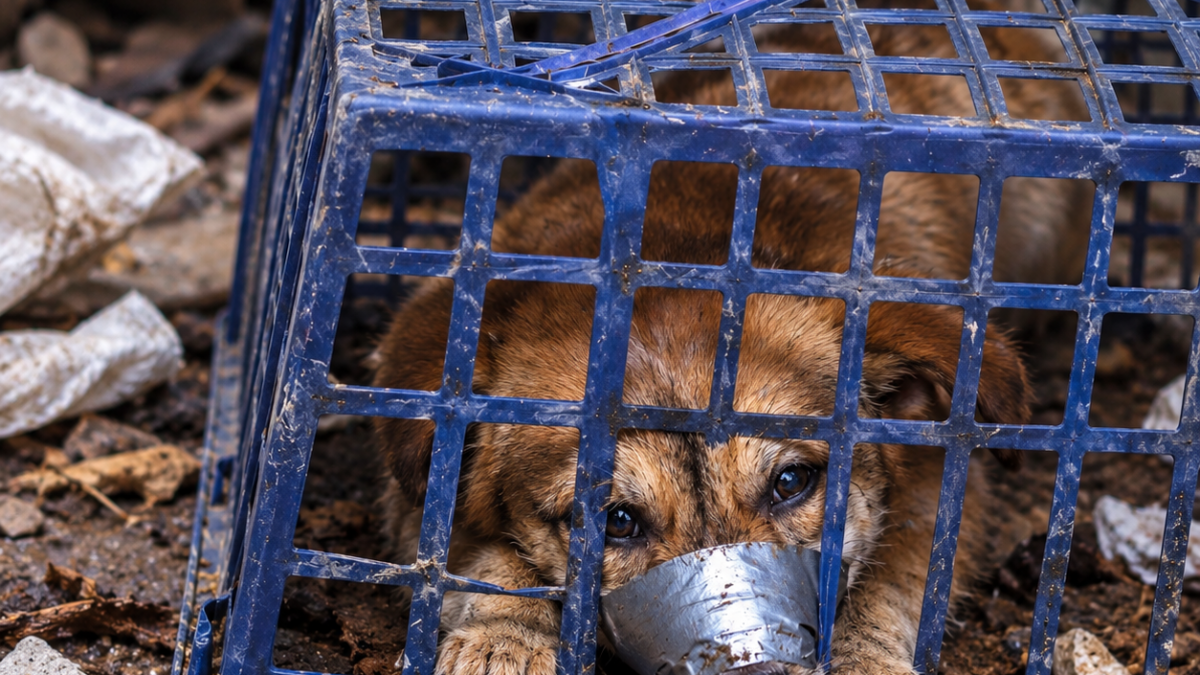
The puppy was so young he could fit inside two hands, but whoever abandoned him at the old market had wrapped heavy packing tape around his muzzle so tightly that he could neither cry for help nor open his mouth to drink. Then they turned a blue plastic produce crate upside down over him and left him between piles of garbage, where the only reason anyone found him was because the crate moved barely an inch beneath the morning sweeper’s broom. By the time I reached the veterinary clinic, we believed we were dealing with a simple act of cruelty—until something stuck to the adhesive around his face suggested that whoever had hidden him there might not have been a stranger at all.
Sergei found him shortly after five in the morning.
He had worked the old produce market for almost twelve years, cleaning whatever the nighttime vendors left behind—cardboard, spoiled vegetables, broken crates, torn bags.
That morning, one blue plastic basket caught his attention.
It was upside down between two stacks of garbage.
At first he thought a rat was trapped under it.
Then the basket moved.
Barely.
He stopped sweeping.
It moved again.
Sergei later told me there was something about the movement that frightened him. It wasn’t frantic. Whatever was underneath wasn’t fighting hard enough to escape.
It was moving like something that had almost stopped trying.
He lifted the crate.
A puppy stared back at him.
Tiny.
Brown-and-white.
Maybe five weeks old.
Its legs were folded beneath a body so thin Sergei could see the ribs immediately.
But that wasn’t what made him drop the broom.
The puppy’s muzzle had been wrapped with several layers of wide gray packing tape.
From beneath the nose to behind the jaw.
Tight.
Deliberate.
“Jesus Christ.”
The puppy looked up.
No bark.
No whine.
Nothing.
He couldn’t make one.
Sergei knelt and tried to touch the tape.
The puppy flinched so hard he rolled sideways.
“It’s okay. I’m not hurting you.”
Sergei called the market guard.
Then me.
I worked with a small rescue group that regularly handled abandoned animals from the district.
By the time I arrived, Sergei had placed the puppy on his jacket but had resisted tearing the tape off.
“Why didn’t you remove it?” I asked.
“I tried one corner.”
He pointed.
“It’s taking the fur and skin.”
He had done exactly the right thing.
We used warm saline and adhesive remover from the rescue kit, working millimeter by millimeter.
The puppy trembled beneath my hands.
“Easy, little guy.”
The first layer came free.
Then another.
Hair came with it.
Underneath, the skin around his mouth was raw.
The tape had compressed his lips enough to leave deep marks.
Sergei turned away.
“Who does this?”
I didn’t answer.
Nearly ten minutes later, I peeled away the final piece.
The puppy’s mouth opened.
He didn’t cry.
He drew in one long breath.
Then another.
I expected him to drink when I offered water.
He tried.
His tongue touched the surface once, then he pulled back.
The inside of his mouth was swollen.
“We need a vet.”
At the clinic, Dr. Elena examined him immediately.
“He’s extremely dehydrated.”
“How old?”
“Five weeks, maybe six.”
She lifted his lip gently.
“The gums are inflamed. Tongue too.”
“From the tape?”
“Partly. Maybe dehydration. Maybe he’s been unable to drink for longer than we want to think about.”
She weighed him.
Far too little for his estimated age.
Then she looked at the strips of tape I had sealed inside an evidence bag.
“You kept these?”
“Yes.”
“Good.”
“Why?”
She pointed toward one piece.
Stuck in the adhesive was a fragment of something red.
At first I thought it was plastic.
Dr. Elena used forceps to lift it.
It unfolded into a tiny strip of printed paper.
Part of a label.
Three letters were still visible.
And beneath them was a number.
Sergei leaned closer.
His face changed.
“I know that label.”
I looked at him.
“From where?”
He stared at the evidence bag.
“That’s from one of the meat stalls in the market.”
PART 2
For several seconds, nobody moved.
Dr. Elena was still holding the little red fragment with forceps.
Sergei leaned so close to the bag that his breath fogged the plastic.
“You’re sure?”
He nodded slowly.
“I see those labels every day.”
“What do they mean?”
“Vendor code.”
I looked at the three visible letters.
“You can identify which stall?”
“Maybe.”
That one word changed the morning.
Until then, the market had been only the place where the puppy had been dumped.
Now there was a possibility the person responsible had been inside it.
Dr. Elena interrupted before my anger could get ahead of the facts.
“First, the puppy.”
She pointed toward the treatment table.
“Everything else waits.”
She was right.
The little dog’s condition was worse than we had first understood.
His dehydration was severe enough that she didn’t want to let him gulp water.
“He’ll drink too fast if we let him.”
“So we don’t give him water?”
“We rehydrate him safely.”
She started fluids.
The puppy barely reacted when the needle went in.
That frightened me more than struggling would have.
Healthy puppies fight.
They complain.
They twist.
They bite.
This one simply lay there.
Dr. Elena checked his temperature.
Low.
Blood sugar.
Low.
Heart rate.
Fast.
She listened to his lungs.
“Any aspiration risk?” I asked.
“Not obvious right now.”
“What about infection?”
“Too early to know.”
The puppy’s eyes followed every movement in the room.
He had enormous dark eyes.
Too large for his narrow face.
Sergei stood near the door.
“I should go back to work.”
He didn’t move.
“You can,” I said.
Still nothing.
Finally he asked, “Will he live?”
Dr. Elena did not answer immediately.
“We found him in time to give him a chance.”
Sergei looked at the puppy.
“That’s not what I asked.”
“No.”
“It’s the best answer I can give.”
Sergei nodded.
Then he took his jacket off the chair.
The puppy was still lying on it.
Sergei looked at the dirty coat.
“Keep it.”
“I can wash it and—”
“No.”
He pointed toward the puppy.
“He knows the smell now.”
That told me everything I needed to know about Sergei.
He left wearing only his work sweater.
We spent the next several hours stabilizing the puppy.
Dr. Elena gave him glucose support.
Warm fluids.
Pain medication appropriate for his size.
She cleaned the inflamed skin around the muzzle.
When she finally offered a tiny amount of softened food from her finger, the puppy smelled it.
His tongue appeared.
One lick.
Then another.
He tried to chew.
Winced.
Stopped.
My chest tightened.
“Hurts?”
“Almost certainly.”
Dr. Elena mixed the food thinner.
This time he lapped a little.
Three mouthfuls.
Then he lowered his head.
“That’s enough.”
“Three mouthfuls is enough?”
“For now.”
Everything with severely compromised animals felt absurdly small.
A teaspoon of food became progress.
A normal temperature became victory.
Urination became news.
At noon, he lifted his head without help.
At one, he shifted closer to Sergei’s jacket.
At two, he fell asleep with his nose buried in the sleeve.
We needed a name for the chart.
“What are you calling him?” Elena asked.
“I’m not naming him.”
She wrote something.
“What did you write?”
“Button.”
“Why?”
“Because he’s the size of one.”
“That is terrible.”
“You weren’t naming him.”
I looked at the tiny puppy.
Button.
He opened one eye.
“Fine.”
The name stayed.
While Button slept, I called the city animal welfare officer.
Officer Pavel arrived that afternoon.
He photographed Button.
Photographed the tape.
Took my statement.
Then Sergei returned during his break and gave his.
Pavel studied the label fragment.
“You recognize this?”
Sergei nodded.
“Market meat section uses red thermal labels.”
“All of them?”
“No. Different vendors use different colors.”
“Which stalls use red?”
“Two, maybe three.”
Pavel looked at me.
“That narrows it.”
“But doesn’t prove anything.”
“No.”
I didn’t like his caution.
I understood it.
Those were different things.
We went back to the market that evening.
Sergei walked with us through the rows after closing.
By daylight, the old market looked nothing like the dark, trash-strewn place where Button had been found.
Vendors shouted prices.
Customers carried produce.
Knives hit cutting boards.
Refrigerators hummed.
People argued over change.
Life everywhere.
And less than twelve hours earlier, a puppy had been lying beneath a crate unable to make a sound.
Sergei pointed toward the meat aisle.
“Here.”
Three vendors used red labels.
The first sold poultry.
The second pork.
The third mixed meats and packaged scraps for pet owners.
Pavel checked the visible lettering on each.
One did not match.
Another came close.
The third matched the font and partial business code.
The stall belonged to a man named Mikhail.
He was packing up when we approached.
Pavel did the talking.
“Do you use these labels?”
Mikhail looked at the photograph.
“Yes.”
“Only you?”
“My workers too.”
“Could labels leave the stall?”
He laughed.
“Thousands leave every week. They’re stuck to meat packages.”
Pavel placed a photo of Button’s tape beside it.
Mikhail stopped laughing.
“What’s that?”
“A puppy was found this morning.”
Mikhail stared.
“That has nothing to do with me.”
“We haven’t said it does.”
He looked at Sergei.
Then at me.
His shoulders tightened.
“I don’t know anything about a dog.”
“Did anyone working here have a puppy recently?”
“No.”
The answer came too quickly.
Pavel noticed.
“So you’re sure?”
“I said no.”
A younger worker behind the counter had gone still.
Maybe nineteen.
Maybe twenty.
Pavel saw him too.
“What’s your name?”
“Anton.”
“Anton, any puppies around here recently?”
He glanced at Mikhail.
“No.”
Mikhail turned.
“Finish cleaning.”
Anton looked down.
That could have meant nothing.
Or everything.
We left without accusing anyone.
Outside, I said what I was thinking.
“The kid knows something.”
Pavel held up a hand.
“Maybe.”
“He looked terrified.”
“Of police. Of his boss. Of the situation. We don’t know.”
“Can you check cameras?”
“Yes.”
That was the next problem.
The market had cameras.
But not all of them worked.
One covered the central aisle.
Another the parking entrance.
A third pointed directly at the garbage area where Button had been found.
That should have solved everything.
It didn’t.
The garbage camera had been broken for eleven days.
Of course it had.
The entrance camera worked.
But the angle captured vehicles, not faces clearly.
Pavel collected footage from the night before.
We watched it in the security office.
Cars.
Vans.
Delivery trucks.
Workers.
At 11:48 p.m., a small white delivery van entered.
Nothing unusual.
At 12:16 a.m., it left.
At 1:03, a dark sedan entered.
Left ten minutes later.
At 2:41, a person on foot came through the side gate.
Too far away to identify.
Carrying something.
I leaned toward the screen.
“Stop.”
Pavel paused.
The figure held a rectangular object against the body.
Blue?
Maybe.
“Can you zoom?”
The security manager tried.
Pixels.
The object might have been a crate.
Might have been a bag.
Might have been nothing useful.
The figure disappeared toward the meat aisle.
Then camera coverage ended.
At 2:54 a.m., the person reappeared.
Empty-handed.
Exited through the side gate.
Thirteen minutes.
I looked at Pavel.
“That’s them.”
“It could be.”
“It’s a crate.”
“It might be.”
“Come on.”
He turned toward me.
“If you want this to hold up, stop turning possibilities into facts.”
I hated him for approximately five seconds.
Then I knew he was right.
Button deserved a real answer.
Not one we invented because we were angry.
The next morning, Button barked.
One small sound.
I was standing beside his kennel when it happened.
He had woken up and couldn’t see me because I was behind the curtain speaking to Elena.
A tiny:
“Yip.”
I froze.
Elena looked at me.
“Was that him?”
Another.
“Yip.”
I stepped around.
Button’s ears lifted.
He tried to stand.
His legs spread.
He collapsed backward.
But his tail moved.
I laughed.
“There’s your voice.”
For a puppy whose mouth had been taped shut, that little bark felt enormous.
We began learning more about him.
He hated hands approaching his face.
Understandably.
He loved being wrapped in Sergei’s jacket.
He preferred chicken-flavored food.
He cried if left completely alone.
He had no fleas.
No intestinal parasites beyond a mild common infection.
That was strange.
A puppy abandoned by a careless breeder or living outdoors usually carried something.
Button, despite his dehydration and low weight, was relatively clean beneath the market dirt.
His nails were short.
His ears clean.
That suggested he had spent most of his short life indoors.
Someone had cared for him recently.
Then something changed.
On the second evening, Anton—the young worker from the meat stall—came to the clinic.
Alone.
I recognized him immediately.
He looked behind himself twice before entering.
“Is the puppy here?”
I stood.
“Why?”
He swallowed.
“I want to see if he’s alive.”
My heart rate changed.
“What do you know?”
“Can I see him?”
“No.”
His face fell.
“Please.”
“Tell me what you know.”
He shoved both hands into his jacket pockets.
“Mikhail’s sister had puppies.”
There it was.
“How many?”
“Four.”
“What kind?”
“I don’t know. Small mixed dogs.”
“How old?”
“Maybe a month.”
“Where?”
“At her apartment.”
“Why would one be at the market?”
Anton looked toward the door.
Then spoke so quietly I almost missed it.
“Because this one wouldn’t stop crying.”
I went cold.
“What?”
He looked miserable.
“Mikhail brought him in two days ago.”
“Brought Button to the meat stall?”
“He kept him in the storage room.”
“Why?”
“His sister didn’t want him.”
“Why not?”
“He was the smallest. Cried at night. She said something was wrong with him.”
My hands tightened.
“There was nothing wrong with him.”
“I know.”
“Then what happened?”
Anton shook his head.
“I didn’t see.”
“That’s not good enough.”
“I left at eleven.”
“Who stayed?”
“Mikhail.”
“Anyone else?”
Anton hesitated.
“Mikhail’s nephew Denis.”
“How old?”
“Seventeen.”
My anger paused.
A teenager.
That complicated everything.
“What did they say about the puppy?”
Anton stared at the floor.
“Mikhail said if nobody took him by closing, he was ‘getting rid of the noise.’”
The room felt suddenly very small.
“Exact words?”
“I think.”
“You think?”
“He said something like that.”
“Did you report it?”
“No.”
“Why?”
Anton’s eyes lifted.
“Because I need my job.”
I wanted to shout at him.
Instead I asked, “Why are you here now?”
He rubbed his palms against his jeans.
“Because I saw the photo online.”
The rescue had posted a short notice asking for information.
No graphic image.
Just Button wrapped in a blanket and a request for anyone with information from the market to contact authorities.
Anton had recognized him.
“I thought Mikhail gave him away.”
“To whom?”
“I don’t know.”
“Why would you think that?”
“He told me a man took him.”
“When?”
“Yesterday morning.”
“After Sergei found him?”
Anton nodded.
So Mikhail had lied to his own worker too.
I called Pavel.
He arrived twenty minutes later and took Anton’s formal statement.
The next day, he returned to Mikhail’s stall.
This time, Mikhail had a lawyer on the phone within ten minutes.
He denied everything.
Yes, his sister had puppies.
Yes, one had briefly been at the market.
Yes, an unknown customer had agreed to take it.
No, he had not taped its mouth.
No, he had not placed it under a crate.
He suggested Anton was lying because they had argued about pay.
That part, unfortunately, was true.
Anton and Mikhail had argued two weeks earlier over missing overtime.
A defense attorney could use that.
Then Denis, the nephew, gave a different story.
He said he had never seen the puppy.
Pavel showed him a photo.
Denis looked for less than a second.
“No.”
Pavel asked, “You sure?”
“Yes.”
Then he made a mistake.
He added, “The tape wasn’t mine.”
No one had mentioned tape.
Pavel told me later.
“That’s not proof by itself.”
“But he knew.”
“He knew something.”
“Arrest him.”
“Not yet.”
I hated those words.
Button didn’t care about our investigation.
He cared about breakfast.
By day four, he was eating small meals eagerly.
By day five, his gums looked less inflamed.
The skin around his muzzle began healing.
Dr. Elena let me take him into the clinic courtyard for ten minutes.
He had never experienced grass before—or at least acted like he hadn’t.
The first step confused him.
He lifted one paw.
Sniffed.
Put it down.
Then tried to bite the grass.
“Everything goes in your mouth?”
Apparently yes.
That became his personality.
Shoelaces.
Towels.
Stethoscope tubing.
Fingers.
Elena laughed when he chewed the corner of a treatment pad.
“Good.”
“He’s destroying equipment.”
“He’s acting like a puppy.”
That was true.
A normal puppy was exactly what we wanted.
Sergei visited after work.
Button smelled him before seeing him.
The tail began immediately.
Sergei sat on the floor.
Button ran three unsteady steps and climbed into his lap.
The older man looked embarrassed.
“He remembers the jacket.”
“No.”
I smiled.
“He remembers you.”
Sergei shook his head.
“Dogs don’t remember that fast.”
Button curled against his stomach.
“Apparently this one does.”
Sergei looked down for a long time.
“My wife says I can’t bring another dog home.”
“How many do you have?”
“Three.”
“I understand her position.”
“So do I.”
Button yawned.
Sergei sighed.
“Maybe four is not so different.”
“Do not quote yourself to your wife.”
He laughed.
For the first time, I began imagining Button with a future.
Not only survival.
A home.
Training.
Chewed furniture.
Vaccinations.
Someone complaining that he woke them at six in the morning.
Ordinary problems.
But the investigation still hung over us.
Pavel obtained another piece of footage.
Not from the market.
From a pharmacy across the street.
Its security camera faced the side gate.
The image was better.
At 2:40 a.m., a figure crossed the road carrying a blue plastic crate.
Young male.
Dark jacket.
Baseball cap.
At 2:55, the same person came back without it.
Still no clear face.
But the jacket had a distinctive white stripe down one sleeve.
Pavel asked Anton whether he recognized it.
Anton looked at the still image.
“That’s Denis’s jacket.”
Again, not enough alone.
Lots of jackets have stripes.
Then the market manager provided employee locker footage from earlier that night.
Denis walked past at 10:32 p.m.
Dark jacket.
White stripe.
Same cap.
Pavel called him in for another interview with his mother present because he was seventeen.
This time the story changed.
Denis admitted carrying the crate.
“But there was no dog.”
“What was in it?”
“Trash.”
“Why take trash out through the side gate instead of the dumpster?”
“I don’t know.”
“Where is the crate now?”
“I left it.”
“Where?”
“Outside.”
“Under what?”
He realized the trap too late.
The interview stopped shortly afterward.
His mother requested an attorney.
Meanwhile Mikhail became aggressive.
He called the rescue.
I answered.
“You’re spreading lies about my business.”
“We have never named your business publicly.”
“People are talking.”
“That isn’t coming from us.”
“You need to delete that puppy post.”
“No.”
“He wasn’t even found at my stall.”
“He was found on market property.”
“You’re trying to ruin me.”
I heard customers in the background.
“You’re speaking to the wrong person. Call Officer Pavel.”
“I know what you people are doing.”
“What are we doing?”
“Making me into a monster because of some dog.”
Some dog.
I looked through the clinic window.
Button was trying to drag a towel twice his size across the floor.
“He’s five weeks old.”
Silence.
“You knew that, right?”
Mikhail hung up.
That call got documented too.
A week later, the final piece came from someone we had never met.
A woman named Galina contacted the police.
She had bought meat from Mikhail regularly and had been at the market late that night helping her sister pack a vegetable stand.
She remembered hearing a puppy crying from the meat storage room.
“Why didn’t you say anything before?” Pavel asked.
“I thought it belonged to someone.”
“What happened later?”
Galina hesitated.
“Near closing, I saw the boy.”
“Denis?”
“I know him by sight.”
“What was he doing?”
“Carrying the blue basket.”
“With the puppy?”
“I couldn’t see inside.”
“Did you hear anything?”
She nodded.
“Something whining.”
That mattered.
Then she added:
“Mikhail was walking behind him.”
The case finally had shape.
The investigation concluded that Button had been brought to the market by Mikhail after his sister decided she no longer wanted the smallest puppy from an accidental litter.
Instead of surrendering him properly, Mikhail tried to give him away informally.
No one took him.
Button cried in the storage area.
Late that night, according to witness statements and the evidence eventually gathered, Mikhail ordered Denis to remove him.
Denis later admitted wrapping tape around the puppy’s muzzle because he was afraid the sound would attract security while carrying him out.
Mikhail claimed he had never told Denis to use tape.
Denis insisted his uncle told him to “make sure nobody heard it.”
The exact wording could never be independently proven.
Both were responsible in different ways.
Because Denis was a minor and cooperated, his case was handled differently.
He faced juvenile consequences, mandatory counseling, community service, and restrictions involving animal care.
Mikhail faced the more serious animal cruelty and abandonment allegations, as well as business-related scrutiny after investigators found separate sanitation violations during the process.
No dramatic prison sentence followed.
Real life rarely delivers punishment in neat cinematic proportions.
But he lost his market lease several months later after multiple violations accumulated.
He was fined.
His sister surrendered the remaining puppies to a licensed rescue after animal welfare officers inspected the home.
Most importantly, Button and his littermates were removed from the situation entirely.
Anton quit the stall.
He later found work at a grocery warehouse.
The last time I spoke to him, he said something I remembered.
“I should’ve said something before.”
“Yes.”
I did not comfort him by pretending otherwise.
He nodded.
“I know.”
“But you said something eventually.”
“I keep thinking if I had done it that night…”
“So use that feeling the next time.”
He looked at me.
“You think there’ll be a next time?”
“There’s always a next time when somebody has to decide whether to look away.”
Button stayed at the clinic for nine days.
When Elena finally cleared him for foster care, Sergei came in holding a carrier.
I stared at it.
“I thought your wife said no.”
“She did.”
“And?”
“She came with me.”
A woman appeared behind him.
Short.
Silver-haired.
Expression unimpressed.
“I said we are fostering.”
Sergei smiled.
“She said fostering.”
His wife pointed at him.
“If you tell anyone we own four dogs, I’m leaving you here.”
I tried not to laugh.
Her name was Nina.
She walked to Button’s kennel.
The puppy bounced toward the gate.
Nina crouched.
“So this is the criminal.”
Button licked her fingers.
“He’s not the criminal.”
“I know.”
He bit her shoelace.
She sighed.
“He’s going to be.”
Foster care lasted exactly seventeen days before Sergei called me.
“Nina has a question.”
I already knew.
“What?”
“What paperwork do we need?”
“For?”
Silence.
Then Nina’s voice in the background:
“Give me the phone.”
Sergei protested.
She took it.
“We’re adopting him.”
I smiled.
“I thought four dogs was impossible.”
“I was wrong.”
“Can I tell Sergei that?”
“No.”
“Understood.”
Button grew quickly.
At three months, he no longer fit inside two hands.
At six months, he was an awkward collection of oversized paws, long legs, and ears that could not decide whether to stand.
The scars around his muzzle disappeared beneath new fur.
Emotionally, some things took longer.
He panicked the first time Nina used packing tape while wrapping a parcel.
She tore off a strip.
The sound ripped through the room.
Button dropped flat.
Urinated.
Crawled beneath the table.
Nina called me crying.
“I forgot.”
“You didn’t know.”
“I should’ve thought.”
“No one can predict every trigger.”
For weeks, they worked slowly.
Tape existed across the room.
Then closer.
Tape sound at low volume from a video.
Treat.
Pause.
Later, Nina handled tape while Sergei fed Button chicken.
They never forced it near his face.
The goal wasn’t to make him like tape.
Only to teach him the sound no longer meant he was about to lose control of his body.
Months later, Nina sent me a video.
She was wrapping a package.
Button lay three feet away chewing a toy.
He lifted his head when the tape ripped.
Then went back to chewing.
I watched the video twice.
Sometimes recovery looks boring.
That is usually a compliment.
Button loved Sergei’s older dogs.
The biggest, an elderly black shepherd named Boris, became his favorite.
Button slept against him.
Chewed his ears.
Climbed over him.
Stole his bed.
Boris tolerated everything with the patience of an animal too tired to argue.
One photograph became my favorite.
Boris asleep on a rug.
Button lying entirely across his back.
Nina captioned it:
**Apparently furniture is optional when you have brothers.**
On Button’s first birthday, we gathered at the clinic.
Not because dogs care about birthdays.
Because people who almost lose something sometimes need dates to celebrate.
Sergei brought a cake for humans.
Nina brought dog treats.
Elena examined Button unofficially while pretending not to.
“Stop checking his gums.”
“I’m not.”
“You are absolutely checking his gums.”
“Professional reflex.”
Button jumped against her leg.
“Healthy?”
She scratched behind his ears.
“Annoyingly.”
“Best diagnosis he’s had.”
The market had changed too.
After the case, security cameras were replaced.
The garbage area received proper lighting.
Vendors were given clearer procedures for reporting abandoned animals.
Sergei kept his morning route.
For months after Button’s rescue, he told me he automatically lifted every upside-down crate.
“Anything?”
I asked.
“Mostly trash.”
“Good.”
“One angry pigeon.”
“Less good.”
He never stopped checking.
Neither did I.
Years later, the blue crate itself was still stored with evidence until the case was fully closed.
I saw it once when Pavel showed me photographs from the file.
It looked ordinary.
Cheap plastic.
Scratched.
The kind of object anyone would walk past.
That bothered me.
Cruelty does not always announce itself loudly.
Sometimes it is an upside-down basket in a place full of baskets.
Sometimes the victim can’t make a sound.
Button was almost four when Sergei retired.
Nina sent me a photograph from his final market shift.
Sergei stood in the same garbage area where he had found Button.
Button sat beside him on a leash.
Fully grown.
Healthy.
Chest wide.
Tail curled.
No resemblance to the silent little thing beneath the crate except for those dark eyes.
Sergei had taken him there intentionally.
I called.
“Why bring him back?”
“To show the guys.”
“Show them what?”
“That he made it.”
Button did not appear afraid of the market.
He sniffed produce boxes.
Tried to steal a piece of sausage.
Barked at a broom.
Sergei laughed.
“He hates my broom.”
“That seems fair.”
Before leaving, they walked past the exact spot.
Sergei stopped.
Button didn’t.
He pulled forward toward Nina.
That picture mattered to me too.
Sergei looking backward.
Button moving ahead.
Five years after his rescue, Button developed into a dog with one especially strange habit.
He hated anything placed over his head.
Blankets.
Boxes.
Even people playfully hiding him with a towel.
Nina made a household rule.
Nothing covers Button.
Visitors were told.
Children were told.
Everyone respected it.
He had enough choices now.
One evening, Sergei called me.
His voice sounded tired.
“Boris died.”
The old shepherd had been fifteen.
I knew it was coming.
It still hurt.
“How’s Button?”
“Looking for him.”
That brought back another kind of rescue story.
Animals grieving.
Button walked room to room.
Checked Boris’s bed.
Waited at the back door.
For three nights he slept in the empty bed.
Nina left it there.
“He keeps carrying Boris’s old blanket around.”
“Let him.”
“I’m not taking it.”
A week later, Button stopped searching.
Not because he forgot.
Because animals, like people, somehow learn where absence lives.
Months later, Sergei and Nina adopted another senior dog.
Button hated him for two days.
Then slept beside him.
Life went on.
The final update I received from Sergei years later arrived on an ordinary Tuesday.
A photograph.
Button, now gray around his muzzle, lying in sunlight.
Behind him was Sergei’s old work jacket.
The same one from the market.
I had forgotten they kept it.
The sleeve was worn.
One cuff torn.
Button’s head rested across it.
Sergei wrote:
**He still steals my jacket.**
I looked at the picture for a long time.
The first morning returned.
A tiny puppy unable to bark.
Tape around his mouth.
A plastic crate hiding him from view.
And an exhausted market sweeper taking off his own coat because the animal beneath it was shaking.
That jacket had been the first soft thing Button touched after the concrete.
The first thing that smelled like somebody who meant help instead of harm.
Maybe Button remembered.
Maybe he simply liked an old jacket.
I didn’t need to know.
Some stories do not require a perfect explanation.
Button lived long enough for the worst thing that happened to him to become only the beginning.
He barked.
Loudly.
Frequently.
According to Nina, far too often.
He cried when Sergei came home late.
Growled at vacuum cleaners.
Howled when ambulances passed.
Demanded food.
Complained when doors were closed.
Made every sound a dog could possibly make.
No one ever silenced him again.
And whenever I thought back to the blue crate, that was the part I loved most.
The puppy someone had tried so hard to make unheard grew into a dog whose family spent the rest of his life listening to every sound he chose to make.
[END OF STORY]








