PART 2: They Surrendered Cooper as “Too Dangerous to Keep”—Hours Before Euthanasia, I Saw What Everyone Else Missed
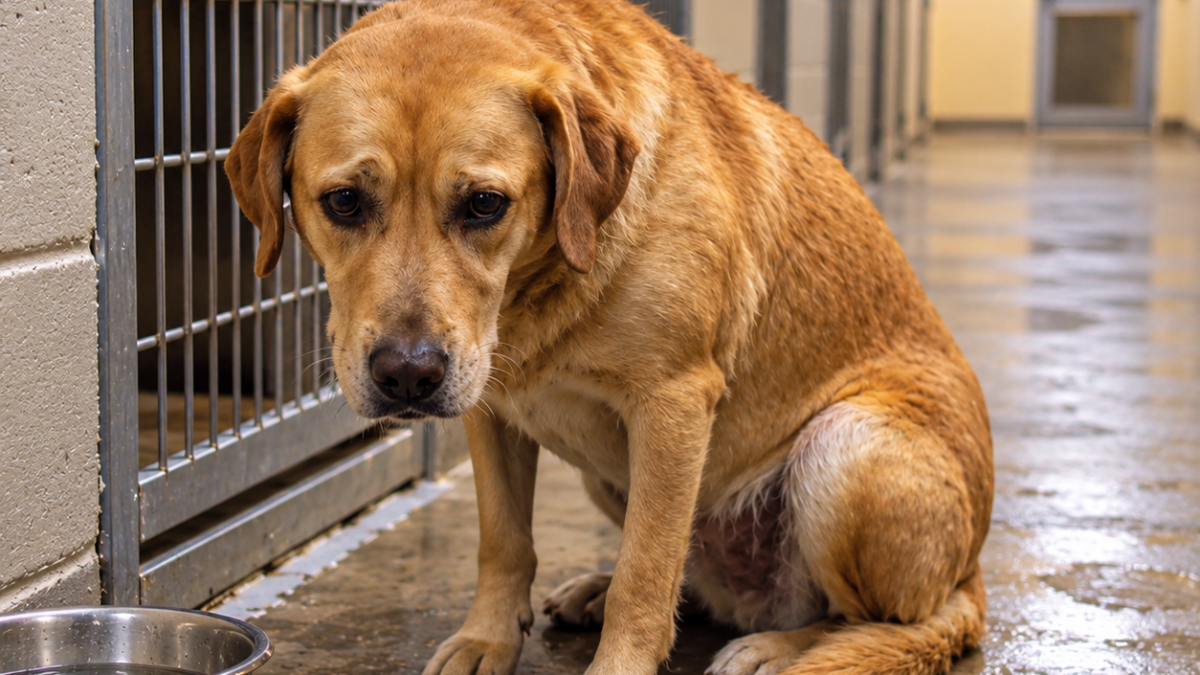
PART 2
Cooper did not bare his teeth.
He did not growl.
He did not lunge.
He took one shaky step toward me, then another, and before I fully understood what he was doing, all sixty pounds of him folded against my legs.
His head settled against my stomach.
For several seconds, I couldn’t move.
Neither could anyone else.
The same dog who had threatened anyone approaching his head less than an hour earlier was now pressing that head directly against my body.
I slowly lowered one hand.
“Cooper?”
His eyes closed.
I touched the top of his skull.
Nothing.
No flinch.
No warning.
I moved my fingers carefully toward the base of his good ear.
His body relaxed further.
Someone behind me whispered, “You’ve got to be kidding.”
I looked across the room at the surrender form.
I wanted to tear it in half.
Instead, I kept my hand on Cooper.
Because anger could wait.
This dog had already spent enough time paying for human misunderstanding.
“His pain isn’t completely gone yet,” our veterinarian reminded me. “The infection is significant.”
“I know.”
“He may still be defensive while it heals.”
“I know.”
But the transformation had already started.
Not because Cooper had suddenly become a different dog.
Because for the first time in who knew how long, the sharpest source of pain was no longer buried inside his ear.
He let out a long sigh.
Then he sank almost completely into my lap.
One of our animal-care attendants laughed softly.
“I don’t think he got the memo that he’s dangerous.”
I looked at the paperwork again.
“No.”
I rubbed Cooper’s chest.
“I think everybody else got the wrong memo.”
That first afternoon, we moved Cooper into a quiet medical kennel rather than returning him to the louder adoption wing.
He needed antibiotics.
Anti-inflammatory medication.
Daily ear treatment.
And, almost as importantly, time.
Pain doesn’t disappear emotionally the moment the physical cause is removed.
If someone has been hurting every time you touch one part of their body, they learn to anticipate the pain.
That anticipation becomes behavior.
Cooper had spent long enough believing hands near his head meant agony.
We weren’t going to force him to forget that overnight.
I placed a blanket in his kennel.
“Here you go.”
Cooper sniffed it.
Then he looked at me.
No growl.
“That’s already better.”
He stepped inside.
I closed the door gently.
One of the staff members, Jenna, came over.
“So what happens to the bite warning?”
“It stays documented.”
Her face fell.
“For how long?”
“We don’t erase history.”
“But it wasn’t aggression.”
“It was still a snap.”
She frowned.
I understood.
“But context matters,” I continued. “We document the medical finding too. Completely.”
“So he can still get adopted?”
“If his behavior continues improving and he passes evaluation.”
She looked at Cooper.
He was lying on the blanket, watching us.
“He almost died because nobody looked in his ear.”
I shook my head.
“We weren’t that close yet.”
“You know what I mean.”
I did.
A shelter dog doesn’t need to be scheduled that exact hour for the danger to be real.
Labels gain momentum.
Aggressive.
Bite risk.
Unsafe.
Rescue only.
Difficult.
Unadoptable.
Each word narrows the path forward.
And Cooper had arrived carrying all of them.
The grass seed widened the path again.
But it didn’t automatically erase what came before.
That night, I thought about his former owners more than I wanted to.
Part of me was furious.
How long had Cooper been hurting?
Had they noticed the head shaking?
Had he scratched his ear?
Did he cry?
Did he move away when touched?
How many warnings had happened before the snap?
Then another part of me tried to be fair.
People don’t always understand animal pain.
They see behavior and react to behavior.
If a dog growls, most people hear threat.
They don’t hear information.
That’s one of the hardest things I try to teach new staff.
A growl is not a moral failure.
A growl is communication.
It can mean:
I’m afraid.
I’m overwhelmed.
You’re too close.
I don’t trust this.
That hurts.
Please stop.
Punish the growl without understanding it, and sometimes all you teach a dog is to stop warning before the bite.
Cooper had warned.
The humans around him had heard only danger.
The next morning, I arrived before seven.
Cooper was awake.
The moment he saw me, his body rose.
Not stiffly.
Excitedly.
His tail hit the kennel wall.
Thump.
Thump.
Thump.
I stopped.
“Well, good morning.”
More thumping.
Jenna walked past carrying food bowls.
She glanced over.
“Is that our terrifying dog?”
“Extremely terrifying.”
Cooper stood on his hind legs for half a second, front paws against the gate.
“Control yourself, sir.”
He wagged harder.
When I entered, I did not reach directly for his right ear.
Instead, I sat sideways.
Let him approach.
Cooper sniffed my hands.
Then climbed halfway into my lap again.
“You understand you’re not small?”
He disagreed.
Apparently Cooper believed sixty pounds qualified as a lap dog.
I checked his temperature.
Normal.
Appetite?
Excellent.
He inhaled breakfast as if the bowl had personally insulted him.
Then came the first real test.
His ear medication.
I showed him the bottle.
Cooper’s body immediately changed.
His tail stopped.
Head lowered.
He stepped backward.
There it was.
Memory.
“Okay.”
I put the medication down.
“We’re not fighting.”
He watched me.
I tossed him a treat.
He ate it.
Another.
Then I touched his shoulder.
Treat.
Neck.
Treat.
Cheek.
His body tensed.
I stopped.
Treat.
It took almost ten minutes before I could safely work near the ear.
Not because Cooper tried to attack.
Because I refused to turn treatment into another battle.
Eventually, with gentle restraint and another staff member helping, we administered the medication.
Cooper pulled away once.
He did not growl.
When it was over, I released him immediately.
He stared at me.
I handed him chicken.
His expression changed.
“Oh, so we’re negotiating now.”
Chicken disappeared.
“Good talk.”
That became our routine.
Medical care followed by something good.
Touch followed by choice.
We taught Cooper that hands could approach his head without trapping him.
Within three days, he started leaning toward me when I scratched under his chin.
By the fifth day, I could touch the outer edge of the infected ear without his body stiffening.
By the end of the first week, he voluntarily rested that side of his head against my leg.
That nearly broke me.
Not because it was miraculous.
Because trust is expensive once somebody has taught an animal to expect pain.
Cooper was giving it back faster than we deserved.
Then the former owners called.
I happened to be at the front desk when our receptionist answered.
“Yes, Cooper is still here.”
My attention sharpened.
She listened.
“No, I can’t discuss medical details without checking your surrender agreement and speaking with the clinical team.”
Another pause.
“No, he has not been euthanized.”
The voice on the other end became louder.
Not enough for words.
Enough for tone.
The receptionist looked at me.
I held out my hand.
“I’ll take it.”
She transferred the call.
“This is the lead veterinary nurse.”
A man answered.
“We surrendered Cooper three days ago.”
“I’m aware.”
“My partner saw something online saying he’s receiving medical treatment.”
“We have not publicly shared identifying medical information.”
“I want to know what’s going on.”
I considered my words carefully.
Once an animal is legally surrendered, ownership rights often change according to the surrender agreement and shelter policy.
I wasn’t interested in creating unnecessary legal drama.
But I also wasn’t going to lie.
“During Cooper’s medical examination, we found a significant painful condition.”
Silence.
“What condition?”
“A foreign object was deeply lodged inside his ear, with substantial infection and inflammation.”
Another silence.
Longer.
Then:
“So?”
I blinked.
“So it explains a great deal of the behavior documented on his surrender form.”
“What are you saying?”
“I’m saying Cooper was in significant pain.”
The man’s voice hardened.
“He snapped at my partner.”
“Yes.”
“Without warning.”
I looked through the glass doors toward the medical wing.
“Did Cooper ever pull away when his head was touched?”
Silence.
“Shake his head?”
Nothing.
“Scratch the ear?”
“He scratched sometimes. Dogs scratch.”
“Did he ever cry or yelp?”
The man exhaled sharply.
“I don’t know.”
“Did he resist having that ear touched?”
“My partner said he became weird about his head.”
There it was.
Weird.
“Approximately how long?”
“I don’t know.”
“A few days?”
“Longer.”
“A week?”
“Maybe.”
“Several weeks?”
His silence answered before he did.
“Maybe.”
I felt anger rising.
I kept my voice professional.
“Cooper’s infection did not develop in a few hours.”
“I’m not a vet.”
“I understand.”
“We thought it was behavior.”
“I understand that too.”
“Then don’t act like we abused him.”
“I didn’t say that.”
But my voice must have changed because he became defensive.
“You people always do this.”
“Do what?”
“Make owners look horrible.”
I closed my eyes for one second.
“This isn’t about making you look like anything.”
“Then why are you asking all these questions?”
“Because medical history matters.”
He paused.
“Can we take him back?”
That surprised me.
“What?”
“If the ear was the problem, maybe we made a mistake.”
My anger disappeared.
Not because I was pleased.
Because the situation had suddenly become more complicated.
“Cooper was legally surrendered.”
“I know, but—”
“And right now he is under the shelter’s care.”
“We didn’t know he was sick.”
I looked toward Cooper again.
He was standing behind the medical kennel door, tail moving while Jenna spoke to him.
The man continued.
“We thought he was becoming dangerous.”
Maybe that was true.
Perhaps they genuinely had.
But there are mistakes you make once and there are mistakes that reveal what you were willing to notice.
“How long had you owned Cooper?”
“Almost four years.”
“So since he was young?”
“Yes.”
“Had he ever bitten before?”
“No.”
“Growled regularly?”
“No.”
“Shown aggression around food?”
“No.”
“Children?”
“No.”
“Other dogs?”
“He was fine.”
I let that sit there.
Four years of being fine.
Then sudden head sensitivity.
Growling when touched.
Snapping near the painful side.
And the conclusion had been:
Dangerous dog.
Not:
Something changed.
Why?
The man spoke more quietly.
“So what happens now?”
“Cooper completes treatment and behavioral evaluation.”
“And then?”
“If cleared, he’ll become eligible for placement through the appropriate process.”
“Not with us?”
“That decision isn’t mine alone, but surrender is generally final.”
He became angry again.
“That’s ridiculous.”
I looked down at the form still stored in Cooper’s file.
The words were unmistakable.
Not safe to keep.
“You signed paperwork stating you believed he was unsafe in your home.”
“Because we didn’t know!”
“And now we know.”
Silence.
I softened my voice.
“What matters is that Cooper receives the care he needs.”
The call ended without resolution.
I stood there holding the phone for several seconds.
Jenna came around the corner.
“Former owner?”
“Yes.”
“What did he want?”
“To know what happened.”
“And?”
“He may want Cooper back.”
Her eyes widened.
“Absolutely not.”
“It’s not that simple.”
“It is to me.”
“Good thing you’re not running the shelter.”
She crossed her arms.
“Would you send him back?”
I didn’t answer immediately.
Because my emotional answer was no.
My professional answer required more thought.
Did misunderstanding a medical problem automatically make someone an unfit owner?
Not necessarily.
People surrender dogs every day because of behavior they cannot safely manage.
Sometimes surrendering is the responsible choice.
But there were questions.
Why had nobody sought veterinary care when a previously gentle dog suddenly became head-shy and defensive?
How long had the symptoms gone on?
How much pain had Cooper endured before surrender?
And perhaps most importantly:
What would happen the next time Cooper couldn’t explain himself?
We documented everything.
Not out of revenge.
Out of responsibility.
The veterinarian wrote a detailed report.
Foreign body.
Severe otitis.
Marked inflammation.
Pain response.
Clinical behavior consistent with defensive reaction to painful stimulus.
That final sentence mattered.
Cooper was not given a clean slate through wishful thinking.
He was given context through evidence.
Our behavior specialist met him on day eight.
She knew the surrender history but wanted to observe Cooper herself.
I stood behind the viewing window while she worked.
Cooper approached her willingly.
Took food.
Responded to basic cues.
Sit.
Down.
Wait.
His obedience wasn’t perfect, but somebody had clearly trained him.
She touched his shoulders.
No reaction.
Chest.
No reaction.
Paws.
Mild objection to one rear foot, then acceptance.
She moved toward the head.
Cooper hesitated.
She stopped.
Offered food.
Tried again more slowly.
This time he permitted contact.
When she touched the right ear, Cooper moved his head away.
No growl.
She stopped immediately.
“Good boy.”
Treat.
I smiled behind the glass.
The specialist worked for another twenty minutes.
Then joined me.
“Well?”
“He’s not showing generalized aggression.”
I felt myself exhale.
“Fear?”
“Some handling sensitivity around the ear. Understandable.”
“Resource guarding?”
“None observed.”
“Strangers?”
“Cautious for about ten seconds, then social.”
“Dog-dog?”
“We’ll test separately.”
She studied the file.
“This dog got very unlucky.”
“Yes.”
“And then very lucky.”
I looked through the window.
Cooper was sitting hopefully beside the treat pouch she had left on a chair.
“Maybe.”
She followed my gaze.
“He’s going to be adoptable.”
The words hit harder than I expected.
“Are you sure?”
“No ethical evaluator should say sure after one session.”
Fair.
“But based on what I saw today? I see no reason to classify him as an inherently dangerous dog.”
That was enough.
His file status changed two days later.
The old red warning remained archived in his history.
But the active kennel card no longer read:
RESCUE ONLY — EUTHANASIA RISK.
Now it said:
MEDICAL HOLD — BEHAVIOR REASSESSMENT IN PROGRESS.
I stared at those words for a long time.
To most people, it was administrative paperwork.
To Cooper, it was the difference between being treated like a problem and being treated like a patient.
When his medical hold ended, we moved him into a quieter adoption kennel.
I hated it.
Not because the kennels were poor.
Because Cooper had become accustomed to the medical wing.
He knew us.
He knew the routines.
The adoption floor was noisier.
Dogs barking.
Doors opening.
Families walking past.
Cooper stood stiffly at first.
I sat outside.
“You’re okay.”
He looked at me.
“This is promotion.”
No response.
“You’re moving up.”
He pressed his nose through the bars.
I touched it.
“You know what happens here?”
Tail movement.
“Somebody meets you.”
More movement.
“And if everything goes right, you get out.”
He leaned against the kennel door.
“Not with me.”
His tail stopped.
I laughed.
“Don’t start.”
The truth was I had already considered it.
More than once.
Maybe too many times.
Cooper followed me whenever possible.
He recognized my footsteps.
If I entered the adoption wing, he sat up.
If I spoke to another dog, Cooper stared at me like I was betraying him.
Jenna saw it.
“You should take him.”
“No.”
“You want him.”
“I want approximately thirty dogs every month.”
“He wants you.”
“That is emotionally manipulative.”
Jenna shrugged.
“Still true.”
But I already had two dogs at home.
Both older.
One reactive around unfamiliar males.
Bringing Cooper into that situation because I loved him would have been selfish.
Saving an animal does not automatically mean you are the best permanent home.
That lesson is difficult for rescuers.
Sometimes love means letting the story continue with somebody else.
So we started looking.
Carefully.
Very carefully.
Cooper needed people who understood body language.
People who wouldn’t punish a growl.
People who would seek medical help if his personality suddenly changed.
People who understood that “he let me yesterday” does not mean “he must let me today.”
We rejected the first application.
Not because the family seemed cruel.
Because when I explained Cooper’s history, the father laughed.
“He just needs somebody to show him who’s boss.”
No.
Absolutely not.
I thanked them for coming.
After they left, Jenna looked at me.
“That was fast.”
“Very.”
“Too fast?”
“No.”
Cooper had almost died from humans misunderstanding his warnings once.
I wasn’t gambling with a second time.
The second family had three small children who loved dogs but moved fast and loudly.
Cooper handled the meeting surprisingly well, but I could see tension building.
He kept retreating behind the mother’s legs.
The children kept following.
She tried correcting them.
They were excited.
Good kids.
Wrong match.
The mother understood.
“I think he needs quieter people.”
I loved her for saying it before I had to.
“Yes.”
She scratched Cooper’s chest.
“He deserves that.”
They adopted another dog a week later.
A ridiculous beagle who thought children were the greatest invention in history.
Perfect.
Then came Daniel and Maya.
They were in their early forties.
No children living at home.
One older female dog named Rose who had recently died.
They told me they had waited six months before considering another adoption.
“We’re not trying to replace her,” Maya said.
I liked that immediately.
“You can’t.”
“I know.”
Daniel looked through the kennels.
“We just miss having a dog.”
Cooper was sitting quietly at the back of his enclosure.
He wasn’t barking for attention.
Maya stopped.
“What about him?”
My stomach tightened.
“That’s Cooper.”
“Can we meet him?”
“Yes.”
I gave them the full history before opening his kennel.
Not the simplified adoption version.
Everything.
Surrendered for snapping.
Painful ear foreign body.
Infection.
Sedated exam.
Behavioral re-evaluation.
Residual handling sensitivity.
Need for respectful head contact.
Maya listened without interrupting.
Daniel asked:
“What does he do when he’s uncomfortable now?”
That was the right question.
Not:
Will he bite?
Not:
Is he safe?
What does he do?
“He turns away first. He may lower his head. Sometimes his body stiffens. If pressure continues, he could growl.”
Daniel nodded.
“So we stop earlier than the growl.”
I looked at him.
“Exactly.”
Maya smiled.
“Rose had arthritis near the end. She’d look at us differently if we touched her hips on bad days.”
That mattered too.
They already knew that behavior changes with pain.
We brought Cooper into the meeting room.
He ignored Daniel initially.
Went directly to Maya.
Sniffed her shoes.
Then stepped away.
She didn’t reach.
Excellent.
Daniel sat on the floor.
Cooper looked at him.
Daniel looked away slightly rather than staring.
Even better.
After about thirty seconds, Cooper approached.
Sniffed his knee.
Daniel kept his hands in his lap.
Maya whispered, “You’re killing him.”
Daniel smiled without looking directly at Cooper.
“I know.”
Finally Cooper pushed his nose under Daniel’s wrist.
“Permission?”
I nodded.
Daniel scratched Cooper’s chest.
Within minutes, Cooper was leaning against him.
Maya looked at me.
“He’s not what I expected from the paperwork.”
“No.”
“What did you expect?”
She glanced at Cooper.
“A damaged dog.”
I waited.
Then she corrected herself.
“No.”
She shook her head.
“A dog somebody misunderstood.”
That was the moment I knew.
Not that the adoption was guaranteed.
We still needed the dog introduction.
Home check.
References.
Final evaluation.
But I knew.
These people were listening.
Cooper had spent his worst days surrounded by humans who heard only the noise of his behavior.
He needed humans who listened for the reason beneath it.
The introduction with their dog happened two days later.
Their second dog, technically.
They had recently begun fostering a senior spaniel named Lucy and were considering keeping her permanently.
Lucy entered the yard like she owned the shelter.
Cooper looked interested.
Lucy looked bored.
He approached.
She sniffed him once.
Then walked away.
Cooper followed.
She gave him a look that clearly meant:
Don’t embarrass yourself.
Jenna burst out laughing.
“This is perfect.”
Cooper tried a play bow.
Lucy ignored him.
He looked genuinely offended.
Five minutes later, they were walking side by side.
No tension.
No posturing.
Nothing dramatic.
The best dog introductions are often boring.
Boring is wonderful.
The home check passed.
References passed.
Final medical exam showed the infection nearly resolved.
Cooper’s ear was healing beautifully.
The adoption date was set.
And suddenly I didn’t want it to come.
That is the dirty secret of shelter work.
You spend weeks hoping somebody takes the dog.
Then somebody does.
And you think:
Not those people.
Not today.
Maybe one more week.
Maybe forever.
The morning Cooper was scheduled to leave, I arrived early.
He was asleep.
I sat outside his kennel.
“Hey.”
One eye opened.
“Today’s the day.”
He stood.
Tail wag.
“You’re leaving me.”
More wagging.
“No loyalty.”
He pushed his nose through the gate.
I opened it.
Cooper climbed directly against my chest.
I wrapped both arms around him.
For several seconds, I forgot professionalism.
Forgot intake numbers.
Forgot charts.
Forgot medications.
I just held him.
The first time Cooper had rested his head against me, he was waking from sedation after we removed the grass seed.
This time, he was healthy.
His ear no longer smelled infected.
No swelling.
No constant pain.
His eyes were soft.
“You know something?”
Cooper licked my chin.
“That’s disgusting.”
He did it again.
“You were one bad decision away from never getting here.”
His tail moved.
I rubbed his chest.
“And you have no idea.”
Maybe that was a blessing.
Dogs don’t sit around imagining the future they nearly lost.
Humans do enough of that for them.
Maya and Daniel arrived at ten.
They brought a new harness.
A blue leash.
A bed that looked large enough for a pony.
And a bag full of toys.
I stared.
Daniel shrugged.
“We panicked.”
“This is what panic looks like?”
Maya lifted a stuffed duck.
“He needed choices.”
“Clearly.”
Cooper saw them.
His entire body changed.
He ran toward Maya.
Not cautiously.
Ran.
She dropped to her knees.
“Hi, handsome!”
Cooper buried his head against her.
Daniel looked at me.
“I think we’re approved.”
“Barely.”
We completed the paperwork.
Then I reached the section that mattered.
Behavioral history.
I did not hide anything.
I wrote clearly.
Previous snap associated with severe untreated ear pain. No generalized aggression observed during shelter stay after medical treatment. Adopters counseled regarding canine body language, consent-based handling, medical follow-up, and pain-related behavior changes.
Daniel read every word.
Then signed.
Maya signed.
No hesitation.
That mattered more than any emotional promise.
The final step was removing Cooper’s shelter collar and replacing it with theirs.
Maya held the new collar.
“Can I?”
She was asking me.
But I looked at Cooper.
He was relaxed.
“Slowly.”
She let him sniff it.
Touched his neck.
Paused.
Cooper stayed soft.
She fastened it.
Blue collar.
Silver tag.
COOPER.
Below it, their phone numbers.
I swallowed hard.
“You’re official.”
Daniel opened the door.
Cooper walked halfway through.
Then stopped.
Turned.
Looked at me.
Of course he did.
I crouched.
“No.”
My voice cracked.
“Don’t you dare make this difficult.”
Cooper walked back.
Placed his head against my chest.
Maya covered her mouth.
I rubbed both sides of his face.
Including the right.
He didn’t flinch.
“Go home.”
He stared at me.
“That’s an order.”
Daniel laughed softly.
Cooper licked me once.
Then turned and followed them outside.
I stood in the doorway while they loaded him into the car.
He climbed into the back seat.
Immediately found the bag of toys.
Maya shouted, “Cooper!”
He pulled out the duck.
I laughed through tears.
The car drove away.
Jenna stood beside me.
“You okay?”
“No.”
“Good adoption?”
“The best.”
She bumped my shoulder.
“Then be miserable proudly.”
I wiped my face.
“I hate this job.”
“No, you don’t.”
“No.”
I watched the car disappear.
“I really don’t.”
I thought that would be the ending.
It wasn’t.
Three days later, the shelter received an email.
Not from Cooper’s adopters.
From his former owners.
They had apparently learned that Cooper had been adopted.
The message was angry.
They accused us of misrepresenting them.
They said shelter staff were “spreading the story that we abandoned a sick dog instead of helping him.”
They demanded copies of medical records.
They demanded the shelter stop describing Cooper’s surrender as related to untreated pain.
And finally, they claimed:
If the dog is safe now, we should have been given the opportunity to reclaim him.
Our shelter director called me into her office.
She had printed the email.
I read it.
Then read it again.
“What do you think?” she asked.
I sat back.
“What do I think professionally or personally?”
“Professionally.”
“The documentation is accurate.”
“Personally?”
I looked at the surrender form.
“I think Cooper has already answered them.”
She nodded.
“We respond with facts.”
No public shaming.
No dramatic social-media fight.
Facts.
Signed surrender.
Medical findings.
Timeline.
Behavioral assessment.
Veterinary opinion regarding pain-associated defensive behavior.
Confirmation that the surrender was final under the agreement they signed.
Nothing exaggerated.
Nothing emotional.
Nothing we couldn’t prove.
The director sent the response.
That should have ended it.
Instead, the former owner’s partner came to the shelter.
She arrived alone.
I recognized her name from the paperwork.
The person Cooper had snapped at.
She looked nervous.
Not angry.
“I need to talk to somebody about Cooper.”
I met her in a small consultation room.
“You’re Elena?”
She nodded.
“I was there when he snapped.”
“I know.”
She looked at the floor.
“I read the medical report.”
I waited.
“I didn’t know.”
Her voice cracked.
I stayed quiet.
Because sometimes silence is kinder than rushing someone away from guilt.
“He started shaking his head weeks before.”
There it was.
“We thought he had dirty ears.”
She wiped her eyes.
“I cleaned them.”
“How?”
“Cotton pads. Ear cleaner.”
“Did he resist?”
“At first, no.”
“And later?”
“Yes.”
She covered her mouth.
“He growled at me.”
I felt my chest tighten.
“What happened?”
“I told him no.”
Not cruelly.
She sounded ashamed.
“I thought he was testing me.”
Dogs testing humans.
Dominance.
Defiance.
So many theories become dangerous when they replace observation.
Elena continued.
“Then one night I reached over while he was sleeping and scratched his head.”
Her breathing became shaky.
“He snapped.”
“Did he make contact?”
“Barely. His tooth scraped my hand.”
That matched the surrender description.
“I screamed.”
She started crying.
“He ran into the kitchen.”
I handed her tissues.
“My partner said we couldn’t trust him anymore.”
“And you agreed?”
“I was scared.”
That answer mattered.
Not malicious.
Scared.
“I loved that dog.”
She looked directly at me.
“I really did.”
I believed her.
And that almost made it harder.
Because love alone is not always enough.
Love without understanding can still fail an animal.
“What do you want from us now?”
“I don’t know.”
She cried quietly.
“I think I wanted you to tell me I couldn’t have known.”
I didn’t answer.
She looked at me.
“Can you?”
I chose honesty.
“You couldn’t have known there was specifically a grass seed buried deep in his ear.”
Relief flashed across her face.
Then I continued.
“But you did know something had changed.”
The relief vanished.
“He was shaking his head.”
She nodded.
“Becoming sensitive.”
“Yes.”
“Growling when touched.”
“Yes.”
“A dog who had been gentle for years suddenly couldn’t tolerate contact with one area.”
She looked down.
“I should have taken him to the vet.”
“Yes.”
The word was quiet.
Not cruel.
But clear.
Her shoulders shook.
“Yes.”
I let her cry.
After a while she asked:
“Does he hate us?”
I almost smiled sadly.
“I don’t know what Cooper remembers the way you and I would.”
“Did he seem scared when we were mentioned?”
“No.”
“Angry?”
“No.”
“He’s happy?”
“Yes.”
That broke her again.
“Can I see him?”
“He’s already adopted.”
“I know.”
“No.”
She closed her eyes.
I expected an argument.
Instead she nodded.
“I understand.”
Before leaving, she took the copy of the medical report she had brought and folded it carefully.
At the door, she stopped.
“Please tell his family something.”
“I can’t disclose information or act as an intermediary unless appropriate.”
She nodded.
“Then just…”
She struggled.
“Tell whoever cares for him that he likes bananas.”
I stared at her.
“What?”
A tiny smile appeared through tears.
“Bananas.”
Despite everything, I laughed.
“Okay.”
“He used to hear the peel and run into the kitchen.”
That image hurt.
Because it reminded me Cooper had not spent four years without love.
Reality is rarely that clean.
His former family had probably fed him.
Walked him.
Played with him.
Laughed when he stole bananas.
Then, at the moment he most needed them to recognize pain, fear overwhelmed understanding.
Sometimes animals are failed by monsters.
Sometimes they are failed by ordinary people making one devastating chain of wrong decisions.
The second kind may be harder to accept.
But we have to accept it if we want to prevent it.
I did eventually tell Maya about the bananas.
Not the private details of Elena’s visit.
Just:
“Apparently Cooper likes bananas.”
Her reply arrived thirty seconds later.
Apparently? He stole half of mine yesterday.
Then a photograph.
Cooper lying on their kitchen floor.
Banana peel on the counter above him.
Expression shameless.
I laughed so loudly Jenna looked over.
“What?”
“Nothing.”
I showed her.
She smiled.
“Dangerous dog.”
“Obviously.”
Two weeks after his adoption, Cooper returned to the shelter.
My heart nearly stopped when I saw Maya’s car.
Adoption returns happen.
Even good ones.
People get overwhelmed.
Behavior changes in a home.
Dogs regress.
Reality differs from the meeting room.
I walked toward the entrance too quickly.
Maya opened the back door.
Cooper jumped out.
He saw me.
And lost his mind.
His tail became a weapon.
He pulled toward me so hard Maya laughed.
“Apparently he remembers you.”
I crouched.
Cooper crashed into my chest.
“Why are you here?”
Maya lifted a small bag.
“Follow-up medication.”
I exhaled.
“Oh.”
Her eyebrows rose.
“You thought we were returning him.”
“No.”
“Yes, you did.”
“No.”
“You look like someone just pardoned you from prison.”
I scratched Cooper’s neck.
“I have professional composure.”
“You were almost running.”
I ignored her.
“How’s the ear?”
“Great.”
“Any growling?”
“Once.”
I froze.
“When?”
“Daniel tried moving him while he was sleeping.”
“And?”
“Cooper stiffened and gave a low growl.”
My stomach tightened.
“What did Daniel do?”
Maya smiled.
“He said, ‘Okay, buddy,’ and walked away.”
I stared at her.
“Then what?”
“Five minutes later Cooper got up and came looking for him.”
That was it.
That was everything.
No punishment.
No dominance battle.
No shouting.
No surrender paperwork.
A growl happened.
A human listened.
Conflict ended.
I realized my eyes were wet.
Maya noticed.
“Oh no.”
“I’m fine.”
“You’re crying.”
“Something in my eye.”
“Both eyes?”
“Extremely aggressive dust.”
She laughed.
Cooper sat between us.
I looked down.
“That’s what I wanted for you.”
Maya became serious.
“What?”
“People who listen before you have to shout.”
She touched my arm.
“He’s safe.”
I nodded.
“I know.”
And for the first time, I fully believed it.
Months passed.
Cooper became a shelter legend.
Not because we wanted to sensationalize his story.
Because his case changed how some of our staff handled behavior.
Whenever a previously social dog suddenly became reactive, somebody would say:
“Check the Cooper stuff.”
It became shorthand.
Pain.
Medical change.
Neurological issues.
Dental disease.
Ear infection.
Arthritis.
Injury.
Something underneath the behavior.
We updated part of our intake protocol.
Dogs surrendered for sudden aggression were flagged for enhanced medical screening whenever safely possible.
Not because every aggressive behavior has a medical cause.
It doesn’t.
Some dogs have severe behavioral problems requiring specialized management.
Some are genuinely unsafe in particular environments.
But Cooper taught us not to skip the question:
What changed?
That question saved another dog six months later.
Her name was Ruby.
Seven-year-old shepherd.
Surrendered because she had started growling when children hugged her.
The family was terrified.
During examination, imaging revealed serious spinal pain.
Treatment changed her behavior dramatically.
She eventually went to an adult-only home.
Then came Baxter.
Suddenly snapping when picked up.
Dental abscess.
Then Milo.
Reactive when touched near the back end.
Hip injury.
Not every case had a simple fix.
But each dog received the dignity of being investigated before being judged.
That became Cooper’s real revenge against the label that nearly killed him.
The label lost power.
Because now, every time somebody read:
Aggressive
we asked:
Why?
Almost a year after Cooper left, Maya invited me to a small gathering at their house.
I resisted.
Shelter staff have to maintain boundaries.
Then she sent a photograph of Cooper wearing a birthday hat.
I surrendered immediately.
When I arrived, Daniel opened the door.
“Prepare yourself.”
“For what?”
Cooper appeared behind him.
For half a second, he stared.
Then recognition hit.
He ran.
I barely had time to crouch before he slammed into me.
“Cooper!”
Tail.
Tongue.
Paws.
No dignity.
I laughed so hard I couldn’t speak.
Maya stood in the hallway.
“He does not greet us like that.”
“Correct priorities.”
“Traitor.”
Cooper pushed his head against my chest.
I touched both ears.
No hesitation.
No tension.
Nothing.
His right ear—the ear that once made human contact unbearable—was now pressed directly into my palm.
I rubbed it gently.
Cooper closed his eyes.
That was the moment I almost lost control.
Maya noticed.
“You okay?”
I nodded.
“He lets you touch it.”
“He lets everybody touch it now.”
Daniel added, “Within reason.”
Good answer.
I sat on the floor.
Cooper climbed partly across my legs.
On the wall behind him were photographs.
Cooper at the beach.
Cooper sleeping beside Daniel.
Cooper and Lucy sharing a bed.
Cooper wearing antlers at Christmas and looking furious about it.
Cooper hiking.
Cooper asleep upside down.
A whole life.
None of the pictures contained shelter bars.
None contained warning labels.
None showed bared teeth.
I stared at them.
Maya followed my gaze.
“He’s a good dog.”
I smiled.
“He always was.”
She nodded.
“I know.”
That mattered.
We ate outside.
Cooper successfully stole bread.
Lucy successfully stole more.
Daniel blamed both dogs.
Maya blamed Daniel for leaving food where dogs could reach.
It was wonderfully normal.
Later, as the sun went down, Cooper lay beside my chair.
I looked at him and thought about the form.
Unpredictable aggression.
The phrase seemed almost absurd now.
Not because the snap hadn’t happened.
It had.
Not because the former owners had invented their fear.
They hadn’t.
But because the label described a moment without describing its cause.
And without cause, a story becomes a verdict.
Cooper had almost become his worst moment.
Humans do that to animals constantly.
Sometimes to each other too.
We freeze them at the instant they frightened us.
The growl.
The snap.
The bite.
The mistake.
Then we build an identity around it.
Dangerous.
Bad.
Broken.
Untrustworthy.
Cooper taught me to be suspicious of stories that become too simple too quickly.
A few months later, Elena wrote to the shelter again.
This time not asking for Cooper.
Not demanding anything.
She sent a donation.
The note said:
For medical exams for dogs surrendered because of sudden behavior changes. We should have asked why.
No name.
But I recognized the circumstances.
The shelter director showed me.
“What do you want to do?”
“Deposit it.”
“That’s it?”
“What else?”
She smiled.
“I thought you might have feelings.”
“I do.”
I looked at the note.
“But those are mine.”
The donation helped pay for diagnostic work on an older dog with thyroid disease.
Later, another.
Then another.
I never told Maya the donor’s identity.
It wasn’t relevant.
Accountability does not always need an audience.
Sometimes the best apology is a changed behavior nobody applauds.
Cooper turned six.
Then seven.
His muzzle started showing the faintest gray.
Maya sent regular photographs.
I rarely saw him in person.
That was good.
Shelter workers should become irrelevant to adopted animals.
The goal is not to remain the center of their lives.
The goal is to help them leave ours.
But every year on the anniversary of Cooper’s adoption, I received the same message.
A photo.
Cooper somewhere comfortable.
And beneath it:
Still dangerous.
One year he was asleep beneath a blanket.
Still dangerous.
Another year he was wearing pajamas.
Still dangerous.
Another, he was sitting beside a toddler visiting with family, carefully supervised, looking deeply concerned about a cracker.
Still dangerous.
I saved every photograph.
Not because I wanted proof that I had been right.
Because they reminded me that diagnosis matters.
Context matters.
Listening matters.
Years after Cooper’s intake, I trained a group of new shelter employees.
We were discussing defensive behavior.
One trainee asked:
“How do you know when a dog is actually aggressive?”
I paused.
There is no clean answer.
Aggression is behavior.
Not a personality.
It has triggers.
Functions.
Thresholds.
History.
Genetics.
Learning.
Environment.
Pain.
Fear.
Frustration.
Resources.
Territory.
Sometimes predatory behavior.
Sometimes neurological disease.
Sometimes poor socialization.
Sometimes trauma.
Sometimes reasons we never fully identify.
So I told them:
“First, stop asking whether the dog is good or bad.”
They wrote that down.
“Ask what the behavior accomplishes.”
Blank looks.
“If the dog growls and you move away, the growl created distance.”
They nodded.
“Then ask why distance matters to the dog.”
Fear?
Pain?
Resource?
Handling discomfort?
Overstimulation?
“Behavior gives you information,” I said. “Don’t waste it by turning it immediately into a moral judgment.”
Then I told them about Cooper.
Not dramatically.
No heroic version.
I told them the mistakes too.
How easily we could have trusted the paperwork.
How sedation was necessary for safe assessment.
How the medical discovery changed interpretation.
How treatment alone didn’t erase learned fear.
How responsible adoption still required disclosure.
How his previous snap remained part of his history.
Because Cooper’s story was not:
Every dog accused of aggression is secretly harmless.
That would be dangerous nonsense.
His story was:
Investigate before you conclude.
One trainee raised her hand.
“What happened to him?”
I smiled.
“He got adopted.”
“Good family?”
“Very.”
“Does he bite?”
“Last I heard, his greatest crimes involve bread theft.”
They laughed.
Then I showed them the photograph of Cooper asleep in pajamas.
Not the intake photo.
Not yet.
I asked:
“What do you see?”
“Relaxed.”
“Loose body.”
“Soft face.”
“Exposed belly.”
“Comfortable.”
Then I showed the intake photograph.
Stiff body.
Whale eye.
Ears back.
Weight shifted away.
Tight mouth.
“What do you see?”
“Fear.”
Exactly.
Same dog.
Different context.
I wrote two words on the board.
BEHAVIOR IS INFORMATION.
That became the lesson.
Cooper eventually became a senior dog.
The photographs changed.
Less hiking.
More sleeping.
Gray around the muzzle.
A ramp beside the car.
Medication bottles occasionally visible near his food.
One winter, Maya called.
Not texted.
Called.
My stomach tightened instantly.
“What’s wrong?”
“Nothing terrible.”
Nobody begins with those words unless something is at least slightly terrible.
“What happened?”
“Cooper has arthritis.”
I exhaled.
“Okay.”
“He growled at Daniel yesterday.”
My whole body became alert.
“Tell me exactly what happened.”
“He was sleeping. Daniel tried helping him stand by putting an arm beneath his hips.”
“Growl?”
“One.”
“Snap?”
“No.”
“What did Daniel do?”
“Stopped.”
Of course.
“And then?”
“We took Cooper to the vet.”
I smiled before she finished.
“X-rays?”
“Yes.”
“Arthritis.”
“Yes.”
She laughed softly.
“We learned.”
That sentence reached across all the years between intake and old age.
We learned.
The first family had experienced sudden behavior change and concluded character change.
The second family experienced sudden behavior change and asked medical question.
That was Cooper’s entire legacy in one phone call.
“He’s on pain medication now,” Maya said.
“Helping?”
“Massively.”
“Good.”
She went quiet.
“I keep thinking about that ear.”
“So do I.”
“If we hadn’t known his story…”
“But you did.”
“I know.”
“That’s why disclosure matters.”
She sighed.
“He’s asleep beside Daniel right now.”
“Tell Daniel not to move him.”
“He has learned that.”
I smiled.
Good.
Cooper had grown old without becoming misunderstood again.
That might have been the happiest ending I could imagine.
Years earlier, I had felt angry when his former owners called asking whether they could reclaim him.
I wanted consequences.
Some dramatic reversal.
I wanted them to see Cooper adored by another family and understand what they had lost.
Eventually, they did understand something.
But that wasn’t the justice that mattered.
Justice was Daniel backing away from a growl.
Justice was Maya calling the veterinarian instead of the shelter surrender line.
Justice was our intake staff checking ears, teeth, joints, skin, abdomen, and medical history before writing behavior off as character.
Justice was Ruby receiving spinal treatment.
Baxter getting his infected tooth removed.
Milo receiving treatment for his hip.
Justice was Elena’s quiet donation paying for another dog’s diagnostic exam.
Justice was Cooper growing gray in the same home that had promised to listen.
That was revenge enough.
The misunderstanding that almost killed him became the lesson that protected others.
The last photograph Maya sent me of Cooper arrived on a Monday morning.
He was lying outside in a patch of sunlight.
Gray face.
Eyes partly closed.
Daniel’s hand rested gently against his chest.
The caption read:
Best boy. Slower now, still stealing bananas.
I smiled.
I saved it.
Then returned to work.
A new surrender had arrived.
Three-year-old cattle dog.
Paperwork said:
Sudden aggression when handled.
I felt something inside me shift.
“Medical exam first,” I told the intake team.
One employee nodded.
“Cooper rule?”
I smiled.
“Cooper rule.”
The dog turned out to have a torn nail and severe inflammation between two toes.
Not every story becomes Cooper’s.
Not every problem is that simple.
But that day, it was.
We treated the foot.
The behavior changed.
The dog eventually went home with a new family.
Another life given context before judgment.
That afternoon, I walked through the medical ward.
Dogs barked.
Phones rang.
Metal bowls clattered.
Somewhere a puppy was screaming because somebody had stopped petting him for approximately four seconds.
Ordinary shelter chaos.
I passed an old storage cabinet.
Inside were archived surrender records.
Cooper’s original paperwork was among them.
I pulled the file once.
Just once.
The handwriting still looked heavy.
Unpredictable aggression.
Snapped at my partner.
Not safe to keep.
Below it was our medical report.
Foreign body deeply embedded in right ear canal. Severe infection and inflammation. Significant pain response.
Then the behavioral reassessment.
Then adoption approval.
Three versions of the same dog inside one folder.
Threat.
Patient.
Family member.
I closed the file.
Because the final version wasn’t actually on paper.
It was Cooper asleep in sunlight.
Cooper stealing bananas.
Cooper growling once when arthritis hurt and having a human answer:
Okay, buddy.
That was the ending.
Not that Cooper never growled again.
He did.
Not that he became a perfect dog.
There are no perfect dogs.
Not that every frightening behavior turned out to have a simple medical explanation.
It doesn’t.
The ending was that Cooper finally lived with people who treated communication as communication.
If he moved away, they noticed.
If he stiffened, they paused.
If he growled, they listened.
If his behavior changed, they asked why.
And because they listened early, he never had to scream the only way a dog can.
Years ago, when Cooper woke from sedation and climbed into my lap, I thought the most important thing we had removed that day was the grass seed.
I was wrong.
We removed a label.
Not by pretending his snap hadn’t happened.
Not by hiding risk.
By understanding the truth around it.
The grass seed had been tiny.
Smaller than my fingernail.
But pain doesn’t care about size.
That tiny seed had nearly cost Cooper his home.
Then nearly his future.
One overlooked thing had rewritten the way everyone saw him.
Removing it gave us a chance to see the dog underneath the warning.
A frightened dog.
A hurting dog.
A social dog.
A ridiculous lap dog.
A banana thief.
A dog who wanted nothing more complicated than to stop hurting.
That is the Cooper I remember.
Whenever someone tells me, “He growled for no reason,” I think of him.
Whenever I hear, “She suddenly became mean,” I ask what changed.
Whenever a dog is called stubborn, difficult, aggressive, dramatic, or bad, I look at the whole body before I accept the adjective.
Because animals can’t tell us:
My ear burns.
My tooth hurts.
My spine aches.
I’m frightened.
I don’t understand.
Please stop.
They tell us with movement.
Avoidance.
Tension.
Growls.
Sometimes teeth.
Our responsibility is not to romanticize every warning.
It is to interpret it responsibly.
Cooper almost lost everything because people heard his warning but misunderstood the message.
Then somebody finally listened.
And once the pain was gone, Cooper didn’t need to keep shouting.
The dog who had once been considered too dangerous to touch eventually grew old in a house where a single growl was enough.
No punishment.
No abandonment.
No new red warning label.
Just a man removing his hand and saying:
“Okay, buddy.”
That may sound like a small ending.
To me, it is enormous.
Because sometimes the happiest ending isn’t that a dog never has to say no again.
It is that he finally belongs to people who respect him the first time he does.








