PART 2: They Starved Her Until She Weighed Only 8 Pounds—Then the People Who Threw Her Away Learned She Survived
—
PART 2
—
The blood transfusion started shortly after midnight.
I sat in a plastic chair beside the treatment area and watched a dark red line travel slowly toward Kaefsi’s tiny body.
There are moments in rescue when time behaves strangely.
Minutes become enormous.
You begin noticing details that would normally mean nothing.
The hum of the fluorescent lights.
The sound of a metal kennel door closing three rooms away.
The veterinarian checking the transfusion rate again.
Kaefsi’s chest rising.
Falling.
Rising.
I watched every breath.
Her body had so little left.
The veterinarian explained that with anemia this severe, her organs were being deprived of the oxygen they needed.
Her heart had been trying to compensate.
Her entire body had been fighting to survive with almost no reserves.
“How was she still walking?” I asked.
The veterinarian looked toward her.
“Sometimes they keep going long after you think they should be able to.”
That sentence stayed with me.
Kaefsi had kept going.
Not because life had been kind.
Because something inside her had refused to stop.
### The First Night
Around two in the morning, her gums looked slightly less ghostly.
Not pink.
Not healthy.
But different.
I noticed immediately.
“Is that good?”
The veterinarian nodded.
“It’s something.”
I had learned never to dismiss something.
Rescue teaches you to celebrate tiny victories.
A dog drinking water.
A cat lifting its head.
A tail moving once.
In Kaefsi’s case, even a little color returning to her gums felt enormous.
We couldn’t feed her normally yet.
Her stomach and metabolic system had adapted to starvation, and refeeding had to be managed with extreme care.
Small amounts.
Specific intervals.
Constant monitoring.
I hated watching her look toward food and then taking the bowl away after only a few bites.
Her eyes followed it.
“I know,” I whispered. “I know.”
She didn’t understand why people who had finally offered food were now limiting it.
All she understood was hunger.
The veterinarian knelt beside me.
“You’re doing the right thing.”
“It doesn’t feel like it.”
“It rarely does when the safe option looks cruel in the moment.”
Kaefsi licked the empty edge of the bowl.
I turned away because I couldn’t let her see me cry, as ridiculous as that sounds.
### What Her Body Told Us
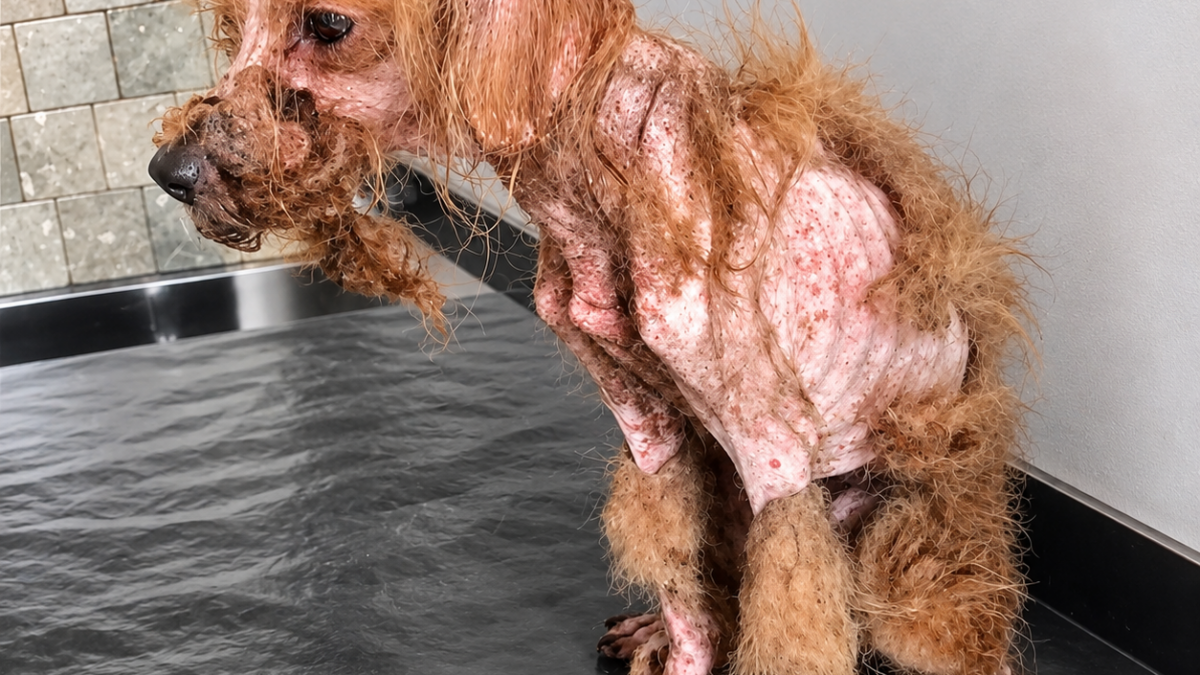
Over the next twenty-four hours, we documented everything.
The wounds on her hips were consistent with pressure against a hard surface.
There were scars along her sides.
The remaining nails had grown long enough to suggest she had not been moving normally.
Her hind-leg muscles were severely wasted.
The veterinarian stopped near one mark along her chest.
“Photograph this.”
I did.
“What do you think it is?”
“I think we need to document before we speculate.”
That was the rule.
Feelings could come later.
Evidence came first.
We photographed her from every angle.
Not because I wanted those images.
I hated them.
But if someone had done this deliberately—or allowed it to happen while she was under their control—I wanted no one to later say we exaggerated.
Pictures do not forget.
Medical records do not become emotional.
Numbers do not care whether a story makes someone uncomfortable.
Eight pounds.
Hematocrit five percent.
Severe dehydration.
Severe malnutrition.
Pressure injuries.
Anemia.
Those facts belonged to Kaefsi.
And someday, they might matter.
### Day Two
Kaefsi survived the first night.
That alone felt miraculous.
When I arrived the next morning, she lifted her head before I reached the kennel.
“You know me?”
Her eyes followed me.
I opened the door.
She sniffed my fingers.
Then rested her chin on my palm.
A technician smiled from behind me.
“She was waiting for you.”
“No, she wasn’t.”
“She kept looking toward the door.”
I tried not to let the sentence affect me.
It did.
No animal should become attached to the first person who shows basic kindness simply because kindness has been absent for so long.
But that seemed to be what Kaefsi was doing.
She watched everyone.
Listened to every voice.
Allowed every treatment.
She never snapped.
Never growled.
Never tried to bite when painful areas were cleaned.
The gentleness bothered me almost as much as her injuries.
Sometimes animals fight because they still believe fighting can change what happens next.
Kaefsi simply endured.
I wondered how many times she had learned resistance was useless.
### The Question Nobody Could Answer
We began asking around the residential complex.
I returned later that afternoon with photographs.
Not graphic images.
Just Kaefsi’s face.
“Have you ever seen this dog?”
Door after door.
No.
No.
Sorry.
Never.
One elderly man studied the picture longer.
“She showed up yesterday?”
“That’s what we were told.”
He shook his head.
“She didn’t walk far looking like that.”
Exactly.
Another resident said something similar.
“There are cameras near the parking lot.”
I stopped.
“What cameras?”
“Building security.”
Within an hour, we were speaking with the property manager.
The cameras did not cover every angle.
But one pointed toward a side entrance.
We reviewed the footage.
At 4:17 in the morning, a vehicle stopped briefly near the edge of the complex.
The image was poor.
Too dark to read the plate clearly.
A figure stepped out.
Opened a rear door.
Bent down.
Then returned to the vehicle.
Less than a minute later, the vehicle drove away.
The dog appeared from behind a parked car several minutes after that.
Slowly.
Dragging herself toward the building.
My hands went cold.
The manager paused the video.
“That could be her.”
“It is.”
I knew the way she moved.
I had watched those weak hind legs.
Someone had driven her there before dawn.
Someone had placed her outside.
Someone had left.
### Dumped
I returned to the clinic furious.
Kaefsi was asleep.
I stood outside her kennel until the anger settled enough that I could approach without bringing that energy near her.
Someone had not simply failed to find her.
They had delivered her to a place where strangers would discover the consequences.
It was deliberate.
Maybe they thought someone else would help.
Maybe they wanted plausible deniability.
Maybe they simply wanted the problem gone.
Whatever their reasoning, they had driven away from a dog whose body was so depleted she needed an emergency blood transfusion.
I crouched.
“You deserved better.”
Kaefsi’s eyes opened.
She stretched one paw toward the kennel door.
I gave her my fingers.
Her paw rested across them.
I had imagined many forms of cruelty in rescue.
That one felt particularly cold.
Drive.
Stop.
Open door.
Leave dog.
Drive away.
No goodbye she could understand.
No explanation.
No help.
### The Second Transfusion
Kaefsi’s blood values improved after the first transfusion, but not enough.
She remained dangerously anemic.
The veterinarian recommended another.
I nodded before she finished explaining.
“Do it.”
The costs were climbing.
Someone from the rescue asked whether we needed to start fundraising internally among our supporters and partner organizations.
“Yes.”
I hated that saving an animal sometimes required mathematics.
What can we afford?
How many days of hospitalization?
How many units of blood?
What happens if complications develop?
Kaefsi did not understand any of that.
She had never chosen to become expensive.
She had simply been denied care until everything became an emergency.
I sat beside her during the second transfusion.
“You know what your problem is?”
Her eyes moved toward me.
“You’re very dramatic.”
Her tail moved a fraction.
I laughed.
There.
Another victory.
### Food
By the fourth day, feeding became the center of our world.
Tiny meals.
Carefully measured.
Slow.
Kaefsi had become interested in food enough that she sometimes tried to push toward the bowl.
That was both wonderful and dangerous.
“No.”
She stared at me.
“You already ate.”
She stared harder.
“I don’t make the rules.”
A technician passed behind me.
“You absolutely enforce them.”
“Traitor.”
Kaefsi licked my thumb.
“You too?”
Eventually, she began eating without being hand-fed.
I placed a small dish down.
She lowered her head.
Ate carefully.
Then looked around for more.
I sat there smiling like she had just won an award.
“What?” the veterinarian asked.
“She’s eating by herself.”
“I can see that.”
“You’re not excited enough.”
The veterinarian grinned.
“I’m excited internally.”
“Unacceptable.”
We had started joking.
That was how I knew hope was becoming safer.
### The First Clue
The security footage was shared with the relevant local investigators.
The vehicle remained difficult to identify.
But one person noticed a detail.
A damaged rear light.
Not enough to identify a car alone.
Then a resident from another nearby street contacted us.
She had seen Kaefsi’s rescue photographs through a community group.
“I think I’ve seen that dog.”
My heart started pounding.
“Where?”
“There’s a house about fifteen minutes from that complex. They used to have several small dogs.”
“Used to?”
“Yes.”
“What happened to them?”
“I don’t know. They were always behind the house.”
“Outside?”
“Sometimes. Mostly in cages.”
I stopped writing.
“Cages?”
She lowered her voice.
“I complained once because of the smell.”
“When?”
“Months ago.”
“Did you see Kaefsi?”
“I can’t be sure. There was one little female that looked similar before she lost all the hair.”
Before she lost all the hair.
I felt sick.
“Do you have photos?”
“No.”
“Anything? Messages? Complaints?”
She thought.
“I reported it to the property owner. I might still have the texts.”
“Please don’t delete them.”
### A Place With Too Many Cages
I did not go to the house.
That mattered.
Anger makes people reckless.
Evidence needs procedure.
We forwarded everything to the people handling the welfare investigation.
The neighbor provided screenshots.
Months earlier, she had complained about multiple dogs confined behind the property.
Noise.
Odor.
Cages.
She had even written one sentence that made my stomach turn.
**One of the little dogs looks extremely thin.**
The response she had received?
**They say she’s old and sick.**
Kaefsi was not old.
We knew that now.
The veterinarian estimated she was still relatively young.
Someone had described her as old because disease and starvation had aged her body.
### Standing
On the sixth day, Kaefsi stood without help.
Not for long.
Her legs shook violently.
But she stood.
I was holding her towel when suddenly her paws pressed into the floor.
“Wait.”
I moved my hands away slightly.
Kaefsi balanced.
One second.
Two.
Three.
Then she sat back down.
I started crying.
The technician laughed.
“You cry a lot.”
“You work here. You’re supposed to be professional.”
“I’m crying too.”
She was.
Kaefsi looked between us as if humans were deeply confusing creatures.
“You did that,” I told her.
She licked her nose.
“You stood.”
Her tail moved.
I took a photograph.
Not of the wounds.
Not of the ribs.
Of Kaefsi standing.
That photograph became the first one I loved.
### The House
A few days later, the investigators visited the address identified by the neighbor.
What happened there was told to me afterward.
There were still dogs on the property.
Not as many as before.
But enough.
Several were being kept in cramped enclosures.
Some had veterinary needs.
Conditions were poor enough that immediate welfare concerns were documented.
The person at the property initially denied ever owning a dog matching Kaefsi.
Then investigators showed a photograph.
The story changed.
Maybe they had seen her.
Maybe she belonged to a relative.
Maybe she had been given away months earlier.
Every answer seemed to create another contradiction.
Then someone asked about the vehicle.
The damaged rear light matched.
Not proof by itself.
But another piece.
### “She Was Sick Anyway”
The breakthrough came from a message.
One of the people associated with the house had texted an acquaintance weeks earlier.
The acquaintance, after learning about the investigation, provided the conversation.
The message was short.
Cruel in its casualness.
**That little female is sick again. We can’t keep wasting money on her.**
Another message followed days later.
**I’m getting rid of her.**
I read those words in the clinic hallway.
My hands shook.
Getting rid of her.
Kaefsi was sleeping twenty feet away.
Alive because strangers had spent money, time, blood, food, medication, and sleepless nights on the dog someone else had decided was no longer worth the expense.
The investigator warned me not to contact anyone involved.
I didn’t.
I wanted to.
But Kaefsi needed justice more than I needed an argument.
### Two Weeks
Fourteen days after admission, the veterinarian smiled before she even entered the room.
“What?”
“She can leave.”
I stared at her.
“Leave the hospital?”
“Yes.”
“Today?”
“If you can stop interrogating me.”
I hugged her.
She froze.
“Professional boundaries.”
“Too late.”
Kaefsi had gained weight.
Her hematocrit had improved dramatically.
Her hydration was normalizing.
She could eat appropriate meals without assistance.
She could stand.
Walk.
Even trot a few steps when excited.
Her skin still needed care.
Her fur remained thin.
She still looked like a dog recovering from something terrible.
But she no longer looked like death had one paw on her.
I knelt beside her.
“You’re leaving.”
Kaefsi wagged.
She had learned that word.
Outside.
Leaving.
Food.
Her world was filling with good vocabulary.
### The Shelter
We moved her to the rescue shelter, though “shelter” hardly described the small rehabilitation space we used for vulnerable dogs.
Kaefsi had her own bed.
A thick one.
I became almost obsessive about it.
No hard surfaces.
No thin blankets.
No pressure against healing sores.
The first time she climbed onto the bed, she stood strangely.
Her paws sank into the cushion.
She looked down.
Then at me.
“It’s supposed to do that.”
She stepped again.
Turned once.
Twice.
Then collapsed into the center.
Within minutes she was asleep.
I sat on the floor watching her.
Someone had kept this dog confined long enough for pressure wounds to form.
Now she was sleeping on a bed so soft her little body disappeared into it.
That felt like justice before any official consequence arrived.
### Learning to Run
The first week outside the hospital, Kaefsi mostly walked.
Then one morning, another foster dog ran past her.
Kaefsi watched.
The dog turned.
Bowed.
Ran again.
Kaefsi took two faster steps.
Stopped.
The other dog returned.
Play bow.
Kaefsi’s tail moved.
Then something happened.
She ran.
Only six or seven feet.
But she ran.
I shouted without meaning to.
“Kaefsi!”
She stopped and looked at me.
The other dog circled.
Kaefsi chased.
Her legs were still weak.
Her movements awkward.
But she was playing.
Not surviving.
Playing.
I had seen countless dogs run.
That morning, it looked like the most beautiful thing in the world.
### The Investigation Tightens
Meanwhile, the evidence against the people linked to her former home kept growing.
Veterinary records were absent.
No one could produce meaningful proof that Kaefsi had received treatment while her condition worsened.
Several neighbors described repeated confinement.
The old complaint about the thin dog became important.
The messages became more important.
The vehicle footage tied the timeline together.
One person eventually admitted they had driven “a sick dog” away from the property.
They insisted the intention had been to leave her somewhere people would find her.
As if that made it kindness.
As if dropping an eight-pound, severely anemic dog beside an apartment complex before dawn counted as arranging care.
The investigator told me they expected enforcement action.
I looked at Kaefsi sleeping in the sun.
“What does that mean?”
“Potential penalties. Restrictions. The other dogs are being evaluated.”
“Can they keep animals?”
“That’s one of the issues being addressed.”
That mattered more than anything.
I could not change Kaefsi’s past.
But if her case prevented another dog from becoming the next one abandoned at 4:17 in the morning, then documenting every wound had been worth it.
### Her First Bath Without Fear
The hospital bath had been medical.
This one was different.
Her skin had healed enough for gentle grooming.
I filled a shallow basin with warm water.
Kaefsi watched suspiciously.
“You’ve done this before.”
She stepped backward.
“Apparently you remember.”
I lifted her carefully.
The moment her paws touched the water, she became rigid.
I stopped.
“It’s okay.”
No forcing.
No rushing.
I let her stand.
A little water over her feet.
Then legs.
Her body slowly relaxed.
I used a soft cloth around the remaining sensitive areas.
When we finished, I wrapped her in a towel.
She buried her face against me.
“You smell like a dog now instead of a hospital.”
Her tail moved beneath the towel.
### The Coat Comes Back
Fur returned slowly.
First, a faint fuzz along her shoulders.
Then soft patches along her sides.
Every week, there was more.
People who hadn’t seen her for several days would stop.
“Is that really Kaefsi?”
“Yes.”
“She looks completely different.”
I knew.
But I also didn’t.
Because when you care for an animal every day, change becomes invisible.
One ounce.
One patch of fur.
One stronger step.
You don’t notice the transformation until you compare photographs.
So one afternoon, I opened the original intake image beside a new photograph.
I couldn’t speak for several seconds.
The first dog looked hollow.
The second had light in her eyes.
That was the greatest transformation.
Not weight.
Not fur.
Light.
### The Woman Who Recognized Her
A woman contacted us privately.
She had lived near Kaefsi’s former property.
“I think I knew her.”
I agreed to meet.
When she saw Kaefsi, she started crying.
Kaefsi hesitated, then approached.
The woman crouched.
“They used to call her something else.”
I didn’t ask the name immediately.
For some reason, I didn’t want it.
Kaefsi had a name now.
A name connected to people who had saved her.
Eventually I asked, “Did you ever see how she was kept?”
The woman nodded.
“Small cage.”
“How small?”
She held her hands apart.
My jaw tightened.
“She was used for breeding.”
I closed my eyes.
That word explained another part of the story.
Exploited.
Kept.
Used.
When no longer useful—or when medical care became inconvenient—discarded.
“Are you sure?”
“I saw puppies more than once.”
The investigation later handled what could be substantiated.
I stopped myself from converting every rumor into fact.
But one thing was increasingly clear.
Kaefsi’s suffering had not happened overnight.
People had watched her decline.
And the person responsible had decided removing her from sight was easier than restoring her health.
### The Visit From the Investigator
One afternoon, an investigator came to the shelter.
Kaefsi was playing with a rope toy.
He stood watching for a few seconds.
“That’s the same dog?”
“Apparently.”
Kaefsi shook the rope violently.
“She has opinions now.”
“That’s usually a good sign.”
He sat with me and explained that the other animals removed or examined at the former property were being dealt with through the appropriate process.
There were documented welfare violations.
The abandonment evidence had become substantial.
The people responsible faced consequences under the local animal protection process, including penalties and restrictions related to keeping animals.
I wanted one thing clarified.
“Can they get her back?”
He looked surprised.
“No.”
“Absolutely?”
“Based on the surrender and abandonment circumstances, medical documentation, and current custody process, they have no legitimate path to simply reclaim her.”
I exhaled.
I had not realized how much fear I had been carrying until that moment.
Kaefsi was safe.
Not emotionally safe.
Not hopefully safe.
Legally and physically separated from the people who had reduced her to eight pounds.
### The Angry Phone Call
The case became known enough in the local community that eventually someone from Kaefsi’s past obtained the rescue’s number.
I answered.
“Is this the place with the little brown dog?”
“Which dog?”
“You know which one.”
I did.
My body became tense.
“What do you need?”
“You people are making us look like monsters.”
I stayed quiet.
That was not the opening I expected.
“You posted pictures.”
“We documented her condition.”
“You don’t know what happened.”
“Then tell me.”
“She was sick.”
“I know.”
“She wouldn’t eat.”
“I know.”
“We tried.”
“What veterinarian?”
Silence.
“What clinic?”
Nothing.
“What medication?”
The voice became defensive.
“We’re not rich.”
I looked through the office window.
Kaefsi was outside chasing another dog.
“You didn’t need to be rich to ask for help.”
“You think rescues take every dog?”
“You didn’t contact us.”
“You don’t know that.”
“We checked.”
Silence again.
Then came the sentence that told me everything.
“She wasn’t worth thousands of dollars.”
I stopped breathing for a second.
“Excuse me?”
“You spent all that money on her. That’s stupid.”
I looked at Kaefsi.
Alive.
Running.
Happy.
“Eight pounds,” I said.
“What?”
“She weighed eight pounds.”
No answer.
“Her hematocrit was five percent. She needed blood immediately. She could barely use her legs.”
“That wasn’t all because of us.”
“You left her outside before dawn.”
Silence.
I continued.
“She had pressure sores. Severe anemia. Severe dehydration. She had been starved long enough that we couldn’t even feed her normally without risking her life.”
The voice hardened.
“You act like you saved the world.”
“No.”
I watched Kaefsi roll onto her back while another dog pawed at her.
“We saved one dog.”
Then I hung up.
### Revenge
I was furious for hours afterward.
The words kept replaying.
She wasn’t worth thousands of dollars.
That was how they saw her.
A calculation.
Expense versus usefulness.
Cost versus value.
I wanted consequences.
For one ugly moment, I wanted humiliation.
I wanted everyone who had ever seen Kaefsi in that cage to know exactly what had happened.
Then I walked outside.
Kaefsi ran toward me.
Not gracefully.
She still had a slightly ridiculous bounce when excited.
She hit my legs and looked up.
Her tail moved so hard her entire body shook.
I crouched.
“You know what?”
She licked my chin.
“You’re right.”
She licked me again.
“The best revenge is probably making you extremely spoiled.”
That became the plan.
### Adoption Applications
Once Kaefsi’s medical condition stabilized, adoption conversations began.
I hated them.
Every application felt wrong.
Too busy.
Too far.
No other dog.
Too many dogs.
Small apartment.
Large yard.
Children.
No children.
There was always something.
The rescue coordinator finally confronted me.
“You are rejecting people because you don’t want her to leave.”
“I have valid concerns.”
“You rejected someone because their couch looked too high.”
“She could fall.”
“She can run.”
“Running is horizontal.”
The coordinator stared at me.
I crossed my arms.
“She almost died.”
“I know.”
“What if they don’t notice something?”
“That’s why we screen.”
“What if they get tired of her?”
“That’s why we screen.”
“What if—”
“Kaefsi needs a family, not a fortress.”
That hurt because it was true.
Protecting her could become another kind of cage if I wasn’t careful.
### The Family
Their application looked ordinary at first.
A couple.
One resident dog.
Stable home.
Veterinary references.
Experience with rescue animals.
Nothing dramatic.
Then we met them.
The woman sat on the ground immediately.
She did not reach for Kaefsi.
That mattered.
Kaefsi approached.
Sniffed.
Walked away.
The woman smiled.
“She doesn’t have to like me today.”
I looked at her.
Good answer.
Their dog was brought in next.
A gentle female.
Calm.
Confident.
She sniffed Kaefsi once, then walked away as though introducing yourself politely was enough.
Kaefsi followed her.
The woman laughed.
“Well, apparently my dog is more interesting than I am.”
Within twenty minutes, the two dogs were walking around together.
Not playing yet.
But comfortable.
The husband asked about Kaefsi’s medical history.
Not only the dramatic parts.
“What does her skin need long term?”
“Any diet restrictions?”
“Does she guard food because of the starvation?”
That question impressed me.
“Yes,” I said. “Sometimes.”
“How do you handle it?”
We talked for nearly an hour.
No one said, “She’s so cute, we want her.”
They asked how to care for her.
That was the difference.
### The Trial Visit
Kaefsi visited their home before the adoption became final.
She entered cautiously.
Her potential canine sister led the way.
Living room.
Kitchen.
Back door.
Yard.
Kaefsi followed.
Then she discovered a large dog bed near the window.
She climbed onto it.
Turned three times.
Lay down.
Her new family looked at me.
I tried to pretend I wasn’t emotional.
“She likes the bed.”
The woman smiled.
“We bought another one in case they don’t want to share.”
I looked toward the hallway.
There it was.
Another soft bed.
Kaefsi had once developed sores from lying too long against hard surfaces in confinement.
Now strangers had bought her two beds before she even belonged to them.
I turned my face away for a moment.
### The Setback
A few days before the scheduled adoption, Kaefsi stopped eating breakfast.
Every fear returned instantly.
I called the veterinarian.
We brought her in.
Bloodwork.
Exam.
Monitoring.
The waiting felt unbearable.
Had something returned?
Had we missed internal damage from starvation?
Was the anemia coming back?
I sat on the clinic floor exactly where I had sat weeks earlier.
Kaefsi rested beside me.
“Don’t do this.”
She looked at me.
“You have a family waiting.”
Her tail moved.
The veterinarian returned.
“Her blood values look good.”
I blinked.
“Then why isn’t she eating?”
“She has a mild gastrointestinal upset.”
I stared.
“That’s it?”
“That’s not nothing.”
“But she’s not dying?”
“No.”
I leaned back against the wall.
The veterinarian smiled.
“You know healthy dogs get stomachaches too.”
That was a strange milestone.
Kaefsi had become healthy enough to have an ordinary problem.
Two days later, she was eating normally.
### Adoption Day
I packed her things.
Blanket.
Favorite toy.
Medical documents.
Food.
Harness.
Then I added another blanket.
The coordinator removed it.
“She owns blankets at the new house.”
“This one smells familiar.”
“Fine.”
I added three toys.
“You’re moving her into a mansion, apparently.”
“Stop judging me.”
Kaefsi sat by the door.
Excited.
Unaware.
That helped and hurt.
At her new home, the other dog greeted her with a wagging tail.
Kaefsi followed her into the house as though she had already learned the route.
Her new mom knelt.
“We’re ready.”
I nodded.
I wasn’t.
I crouched beside Kaefsi.
“You know the rules?”
She licked my fingers.
“No starving.”
Tail wag.
“No cages.”
Another wag.
“You sleep on every bed you want.”
Her new mom laughed.
“That can be arranged.”
“And you make them earn your trust.”
Kaefsi leaned into my chest.
That nearly destroyed me.
I hugged her carefully.
“You never have to earn your right to stay here.”
Her new family became quiet.
I stood.
If I stayed another minute, I would take her back with me.
So I walked out.
At the gate, I turned.
Kaefsi was standing beside her new canine sister.
Her new mom had one hand resting gently on her back.
Kaefsi looked at me.
I raised my hand.
“Go home.”
She turned toward the house.
And did.
### The First Night
At 9:14 p.m., my phone buzzed.
A picture.
Kaefsi asleep on the couch.
Her new sister curled beside her.
A blanket covered both dogs.
The caption was simple.
**She ate dinner, explored the entire house, stole one sock, and is now asleep.**
I laughed until I cried.
One sock.
She had been there less than a day.
The criminal career had begun.
### What Happened to the People Who Abandoned Her
The welfare case continued after Kaefsi was adopted.
I received updates only when appropriate.
I did not need every detail.
What mattered was that the documented conditions had consequences.
The abandonment was substantiated through the available evidence.
The condition of other dogs on the property became part of the investigation.
Penalties followed.
Restrictions were imposed.
Animals were removed or placed under appropriate oversight where necessary.
The people responsible could not simply continue as though Kaefsi had never existed.
That was enough for me.
But apparently, it was not enough for them.
### “We Want Her Back”
Several months after adoption, the rescue received another message.
The person claimed Kaefsi had technically belonged to a different family member and had been “taken without permission.”
I almost admired the creativity.
Almost.
The documentation was forwarded.
Abandonment timeline.
Medical intake.
Security footage.
Witness statements.
Previous messages.
The matter ended quickly.
Still, I called Kaefsi’s new family.
“Just so you know, someone from her old situation is making noise again.”
Her new mom became quiet.
“Can they take her?”
“No.”
“Are you sure?”
“Yes.”
Another pause.
Then:
“Good. Because they’d have to go through me.”
I laughed.
“I suspected that.”
In the background, Kaefsi barked.
“What is she doing?”
“Stealing her sister’s bed.”
“She has her own bed.”
“She has three.”
Of course she did.
### The Park Encounter
The final confrontation happened by accident.
Kaefsi’s family took her to a community park several months later.
I happened to be there for another rescue event.
Kaefsi spotted me immediately.
She ran toward me.
I crouched.
“There’s my criminal.”
Her tail nearly knocked her sideways.
Then her body changed.
Not dramatically.
Just enough that I noticed.
She stopped.
Looked past me.
Her ears lowered.
I turned.
A woman stood near the parking area.
I recognized her from the investigation.
Someone from Kaefsi’s former household.
The woman stared.
Kaefsi moved behind my legs.
That was all I needed to see.
Her new mom reached us.
“What happened?”
I nodded toward the woman.
Her expression changed.
The woman approached slowly.
“I just want to see her.”
Kaefsi backed farther away.
Her new mom stepped between them.
“No.”
The woman stopped.
“She used to be ours.”
I looked down at Kaefsi.
“No.”
The woman frowned.
“What?”
“She used to be dependent on you.”
“That’s what I mean.”
“It isn’t the same thing.”
The woman’s face hardened.
“You people make everything sound worse than it was.”
Kaefsi’s new mom spoke before I could.
“She came in at eight pounds.”
The woman said nothing.
“Hematocrit five percent.”
Silence.
“She needed transfusions.”
“I know what happened.”
“No,” her new mom said. “You know what happened after someone else fixed what you left behind.”
The woman looked toward Kaefsi.
“She looks good now.”
Those words.
Again.
Looks good now.
As though health erased history.
Kaefsi moved closer to her new mom.
The woman called the old name.
Kaefsi froze.
Then looked up.
For one second, I wondered if she remembered.
She probably did.
Smell.
Voice.
Tone.
Dogs store the world differently than we do.
The woman crouched.
“Come here.”
Kaefsi did not move.
“Come on.”
Kaefsi turned.
Walked around her new mom.
Then sat beside her new canine sister.
The other dog leaned against Kaefsi.
Kaefsi relaxed.
The woman stood slowly.
“She doesn’t remember me.”
I looked at her.
“I think she does.”
That hurt more.
I could see it.
Then the woman asked the strangest question.
“Do you think she hates us?”
I looked at Kaefsi.
“No.”
The woman seemed relieved.
Then I added:
“I don’t think you matter to her anymore.”
Her expression changed.
That was the last time I saw her.
### The Revenge Everyone Expected
People love dramatic endings.
They wanted to hear that the people who hurt Kaefsi lost everything.
They wanted courtroom speeches.
Handcuffs.
Public humiliation.
A perfect punishment matching every day she suffered.
Life is rarely that symmetrical.
Consequences happened.
The investigation mattered.
Restrictions mattered.
The evidence mattered.
But none of that became my favorite ending.
My favorite ending was that afternoon in the park.
Kaefsi did not attack.
She did not cower forever.
She did not beg for affection from the person who had failed her.
She simply chose someone else.
The people who had once controlled everything about her life no longer controlled even where she sat.
That was revenge.
Freedom.
### Her New Sister
The bond between Kaefsi and her canine sister became stronger with time.
At first, the older dog simply tolerated her.
Then they began sleeping together.
Then playing.
Then stealing each other’s toys.
One day I received a video.
Kaefsi was chasing her sister through the yard.
Both dogs disappeared behind a tree.
Seconds later, Kaefsi emerged carrying an enormous branch.
Far too large.
She tried to run through a narrow gate.
The branch hit both sides.
She stopped.
Backed up.
Tried again.
Same result.
Her sister stood behind her barking.
I laughed until my stomach hurt.
This was the same dog who once could not move her hind legs properly.
Now her greatest challenge was spatial reasoning.
Progress.
### Food
Starvation leaves memories.
Even when the body heals, behavior can linger.
Kaefsi ate quickly.
Too quickly.
Her family used slow feeders.
They gave meals on schedule.
No one teased her with food.
No one removed a meal unpredictably.
Over time, she stopped panicking if another dog walked through the kitchen.
She learned that breakfast returned every morning.
Dinner returned every night.
The bowl would not suddenly disappear forever.
One day, her new mom sent me a message.
**She left three pieces of kibble in the bowl.**
I knew exactly why that mattered.
A dog who had once believed every calorie could be the last had stopped eating when she felt full.
Safety had reached her stomach.
### The Cage
Kaefsi hated crates.
We discovered that early.
Even a large open crate with bedding made her hesitate.
Her family never forced her inside.
Instead, they used baby gates, open rooms, and gradual desensitization for necessary travel situations.
Months later, they placed a large crate in the living room with the door permanently secured open.
Blanket inside.
Treats nearby.
No pressure.
For weeks, Kaefsi ignored it.
Then one afternoon, her new mom found her front paws inside.
The next week, her whole body.
Months later, Kaefsi occasionally slept there.
Door open.
Always open.
That detail mattered.
She had taken a space that once symbolized captivity and transformed it into something she entered voluntarily.
I don’t know if dogs think in metaphors.
Humans do.
And to me, it meant everything.
### One Year
On the anniversary of her rescue, we returned to the veterinary hospital.
The staff gathered around.
One technician stared.
“You’re lying.”
I laughed.
Kaefsi’s coat was thick.
Soft.
Healthy.
Her body had filled out.
Her muscles were strong.
Her eyes were bright.
The technician pulled up the original intake photo.
Everyone became quiet.
I had seen it countless times.
Still, it shocked me.
Eight pounds.
No fur.
Bones.
Wounds.
Exhaustion.
Kaefsi sniffed the screen.
Then licked it.
The veterinarian laughed.
“She approves.”
I crouched beside her.
“You have terrible taste in photos.”
Her tail wagged.
They weighed her.
Healthy.
Bloodwork.
Healthy.
Skin.
Healthy.
Heart.
Strong.
The veterinarian finished the exam.
“She looks excellent.”
I smiled.
“Worth thousands of dollars?”
The veterinarian looked confused.
I shook my head.
“Old argument.”
### Her Rescue Anniversary
Her family celebrated the date she was found instead of trying to guess a birthday.
They made her a dog-safe cake approved for her diet.
She wore a ridiculous little bandana.
Her sister wore another.
Kaefsi ate her portion too quickly.
Some things remained.
We took photographs.
In one, Kaefsi was standing between the people who adopted her.
Everyone smiling.
I thought about the security footage.
4:17 a.m.
Dark parking lot.
Car door.
Figure bending down.
Vehicle leaving.
Then this photograph.
Same dog.
Different world.
### A Child
A few years later, Kaefsi’s family had a baby.
I worried about how she would adjust.
She surprised us.
At first, she kept her distance.
She watched.
Listened.
Sniffed blankets.
Then gradually, she began sleeping near the nursery door.
When the baby cried, Kaefsi sometimes reached the parents before they did.
As the child grew, Kaefsi became incredibly gentle.
The little girl would sit beside her with a book, pretending to read.
Kaefsi listened seriously.
Her new mom sent me a photograph.
The child’s hand rested on Kaefsi’s back.
Kaefsi’s eyes were closed.
I stared at the scars still faintly visible beneath the fur near one hip.
The little dog who had once known hands as something unpredictable now slept beneath the hand of a child.
Trust had become complete.
### The Question About Forgiveness
Someone once asked me whether I forgave the people who hurt her.
I didn’t have a simple answer.
Forgiveness is personal.
Accountability is not the same thing.
What they did was wrong.
Starving an animal is wrong.
Allowing medical needs to worsen is wrong.
Keeping a dog confined until pressure injuries develop is wrong.
Leaving a critically ill animal outside before dawn is wrong.
Kaefsi’s happiness does not erase that.
But I also stopped wanting anger to occupy space Kaefsi had already filled with better things.
Her story did not belong to them forever.
That became important.
For a while, every conversation about Kaefsi began with cruelty.
Eventually, I changed how I told it.
I started with who she is now.
Funny.
Stubborn.
Affectionate.
Terrible at sharing beds.
Suspicious of vacuum cleaners.
Obsessed with warm laundry.
Gentle with children.
Loyal to her sister.
That was Kaefsi too.
Actually, that was more of Kaefsi than the wounds ever were.
### The Laundry
Her favorite thing became clean clothes straight from the dryer.
No one understands why.
Her new mom once placed a basket of warm towels on the couch.
Kaefsi climbed directly inside.
When asked to move, she became suddenly deaf.
Photographs followed.
Kaefsi inside towels.
Kaefsi under towels.
Kaefsi asleep with one towel wrapped over her head.
I saved every picture.
The dog who once had no soft place to lie had become a professional thief of luxury linens.
Again.
Revenge.
### The Final Update From the Case
Years after the original rescue, I received one final administrative update connected to the old case.
The restrictions imposed after the investigation had remained significant enough to prevent a return to the same kind of uncontrolled animal keeping that had contributed to the welfare concerns.
I read the message once.
Then closed it.
No celebration.
No anger.
Mostly relief.
Kaefsi’s case had mattered beyond Kaefsi.
Other animals had been noticed.
Conditions had been documented.
People had been forced to answer questions they once avoided.
That was meaningful.
Then I went outside.
Kaefsi happened to be visiting that day.
She was rolling in the grass.
I watched her and thought:
You have absolutely no idea what your medical records accomplished.
She sneezed.
Rolled again.
Probably better that way.
### Growing Older
Time did what time always does.
The tiny dog became an adult.
Then an older adult.
Gray hairs appeared around her muzzle.
Her running slowed.
Her sister slowed too.
They still slept together.
Still argued about beds.
Still followed the family into the kitchen.
Kaefsi developed mild arthritis.
Her family adjusted.
Soft ramps.
Joint support under veterinary guidance.
Shorter walks.
More comfortable bedding.
When she needed something, they provided it.
There was never a conversation about whether she was “worth” the expense.
That became one of the most healing parts of watching her age.
Old age had once been used as an excuse for how terrible she looked.
Now real aging arrived.
And no one left.
### The Vet Visit That Scared Everyone
One winter, Kaefsi became unusually tired.
Her appetite dropped.
Her mom called me.
“I’m scared.”
“Take her in.”
They did.
Immediately.
Bloodwork.
Imaging.
Examination.
I drove there too.
The old fear returned as soon as I smelled the clinic.
Kaefsi lay on a blanket.
Older now.
But not the same helpless dog.
Her family surrounded her.
The veterinarian eventually diagnosed a treatable infection.
Medication.
Monitoring.
Rest.
No catastrophe.
Her new mom cried in relief.
I looked at Kaefsi.
“You enjoy dramatic entrances.”
Her tail moved weakly.
Her mom laughed through tears.
The contrast stayed with me.
Years earlier, when Kaefsi became dangerously sick, someone had discarded her.
Now a mild change in behavior sent an entire family rushing to the veterinarian.
That is what love looks like when the inconvenience arrives.
### The Old Security Video
I watched the original security footage one final time.
I don’t know why.
Maybe I needed to measure the distance.
4:17 a.m.
Vehicle stops.
Door opens.
Figure bends.
Vehicle leaves.
I paused before Kaefsi appeared.
Then fast-forwarded.
There she was.
Tiny.
Weak.
Moving toward strangers because there was nowhere else to go.
I closed the video.
I did not need it anymore.
Evidence had done its job.
Kaefsi had done hers.
She survived.
### The Person She Became
People sometimes describe abused dogs as permanently broken.
I hate that phrase.
Kaefsi was changed by what happened.
Of course she was.
She carried behavioral memories.
Certain fears.
Food insecurity.
Crate anxiety.
But broken?
No.
A broken thing cannot grow.
Kaefsi grew.
She adapted.
Trusted.
Played.
Loved.
Chose.
A scar is not proof that something remained broken.
Sometimes it is proof that healing happened.
### The Final Encounter
Years later, I ran into one of the women who had lived near Kaefsi’s old property.
She recognized me.
“How is that little dog?”
I smiled.
“Old.”
Her face changed.
“Really?”
“Yes. She made it.”
The woman smiled.
“I always wondered.”
I showed her a recent photograph.
Kaefsi was lying on a couch beneath a blanket, gray around the muzzle, looking deeply satisfied with herself.
The woman stared.
“She looks nothing like I remember.”
I nodded.
“That’s the point.”
She handed the phone back.
“I wish I had done more back then.”
I understood.
People carry guilt for what they notice too late.
“You spoke when you had evidence.”
“I should have spoken sooner.”
“Maybe.”
I wasn’t going to lie to make either of us feel better.
“But you spoke eventually.”
That mattered.
### Kaefsi’s Favorite Place
Her favorite place in old age was a patch of sunlight near the sliding glass door.
Every morning, sunlight moved across the floor.
Kaefsi followed it.
She would lie on a soft bed positioned exactly where the light landed.
Her family called it “Kaefsi’s office.”
No one was allowed to move the bed.
When the child placed toys on it, Kaefsi gently pushed them off with her nose.
She had boundaries.
Good for her.
I visited one morning and found her there.
“Busy?”
She opened one eye.
Her tail tapped once.
I sat beside the bed.
My hand moved across her thick coat.
You could barely see the old scars anymore.
But my fingers knew where they had been.
### The Promise Revisited
Do you remember what I told you?
That was what I asked her.
Of course she didn’t understand the sentence.
I did.
The night of the first transfusion, I had asked her to stay.
Whatever happened before tonight, you stay.
She had.
Through transfusions.
Careful meals.
Skin treatments.
Recovery.
Investigation.
Adoption.
Years.
She stayed.
Long enough to become old.
There is something incredibly beautiful about an abused animal getting the privilege of aging.
Gray fur is not sad when you once thought the animal might not survive the week.
Slower steps are not tragedy when every extra year was once uncertain.
Kaefsi earned gray hair.
### What Revenge Eventually Meant
I used to think revenge meant watching bad people lose.
Kaefsi changed that.
Revenge was eight pounds becoming healthy weight.
Revenge was pale gums becoming pink.
Revenge was a second blood transfusion working.
Revenge was eating without a hand supporting her head.
Revenge was running.
Revenge was fur returning.
Revenge was choosing a family.
Revenge was stealing socks.
Revenge was three dog beds.
Revenge was leaving food in the bowl because she knew another meal would come.
Revenge was entering an open crate voluntarily and sleeping there because nobody could lock the door.
Revenge was a child reading books beside her.
Revenge was arthritis because she had lived long enough to develop it.
Revenge was old age.
The people who discarded her had tried to make her disappear.
Instead, Kaefsi lived loudly.
### The Ending I Wanted
There was a time when I wanted to tell this story and end with punishment.
I imagined writing about fines.
Restrictions.
Investigations.
The humiliation of people being exposed.
And yes, accountability mattered.
Without it, cruelty repeats.
But Kaefsi deserved to be the final image.
Not them.
So this is how I remember her story.
Not the cage.
Not the vehicle.
Not the parking lot.
Not even the hospital.
I remember one ordinary afternoon years later.
Kaefsi was in the backyard with her family.
Her canine sister was older too.
The child was running through the grass.
Kaefsi tried to follow.
Her legs were slower than they once had been, so she stopped halfway.
The child noticed.
Turned around.
Ran back.
Then sat beside her.
Kaefsi leaned against the child’s leg.
The other dog joined them.
From the porch, Kaefsi’s mom called that dinner was ready.
Kaefsi’s ears lifted.
Old or not, food remained important.
She stood.
Slowly.
The child walked beside her.
No leash.
No cage.
No one dragging her.
No one leaving her.
She crossed the yard toward the house.
Toward dinner.
Toward her bed.
Toward people who knew every scar and loved her anyway.
That is the ending.
### Home
Kaefsi once appeared outside a residential complex like something someone wanted the world to forget.
Eight pounds.
Severely anemic.
Dehydrated.
Covered in wounds.
Too weak to eat without help.
No name.
No known home.
No explanation.
Then strangers began giving things back.
Blood.
Food.
Warmth.
Medicine.
Time.
A name.
Trust.
Eventually, a family.
The first person who abandoned her had decided she was no longer worth the cost of care.
The last family she ever knew made an entirely different calculation.
They never measured her value against the work required to love her.
When she needed veterinary care, they went.
When she needed soft bedding, they bought it.
When fear appeared, they gave her space.
When old age slowed her down, they slowed down too.
Nobody ever again asked whether keeping Kaefsi was worth it.
Because once you truly love someone, that is usually the wrong question.
Kaefsi was never worthless.
She had simply been placed in the hands of people who failed to recognize value unless it served them.
The world corrected that mistake.
Not perfectly.
Not quickly.
But completely enough.
### One Last Morning
The last morning I visited her for a long while, Kaefsi was lying in her sunny spot.
Her muzzle was white now.
Her eyes were softer.
Her breathing calm.
I sat beside her.
She placed one paw over my wrist.
Exactly as she had once rested her paw over my fingers through the hospital kennel.
I remembered everything.
The transfusion line.
The five-percent hematocrit.
The tiny meals.
The security footage.
The investigation.
The first run.
The adoption.
The park.
The woman calling the old name.
Kaefsi choosing her new family.
I rubbed her paw.
“You really did it.”
Her eyes closed.
Outside, I heard her family moving through the house.
The child laughing.
A food bowl being placed on the kitchen floor.
Her sister’s tags jingling.
Home sounds.
Ordinary sounds.
The sounds she should have known from the beginning.
Kaefsi opened her eyes when she heard the bowl.
Of course.
I laughed.
“Still hungry?”
She stood slowly.
Then walked toward the kitchen.
I followed.
### And That Was Her Victory
Someone once confined her until her body developed sores.
Someone allowed hunger to consume nearly half of her.
Someone watched her become sick and decided the solution was to remove her rather than help her.
Someone put her in a vehicle before sunrise.
Opened a door.
Set her down.
Drove away.
They expected the story to disappear with them.
It didn’t.
A security camera remembered.
Neighbors remembered.
Messages remained.
Veterinary records documented what cruelty had done.
Investigators followed the evidence.
Consequences came.
Other animals were noticed.
And the dog they discarded received a name.
Kaefsi.
She received blood from another dog when her own body could no longer carry enough oxygen.
She received meals measured with the kind of care starvation had denied her.
She received medicine.
Soft beds.
Friends.
A family.
Years.
That is the part I want remembered.
Cruelty may explain the beginning of a rescue story.
It does not deserve to own the ending.
Kaefsi’s ending belonged to Kaefsi.
She was not the eight-pound dog forever.
She was not the dog in the cage forever.
She was not the nameless animal left beside a residential complex forever.
She became the dog who chased her sister across a yard.
The dog who stole socks.
The dog who slept inside warm laundry.
The dog who guarded her favorite bed.
The dog who learned food would always return.
The dog who trusted an open crate because she knew nobody would close the door.
The dog who became a child’s quiet companion.
The dog who grew gray.
The dog who got old.
The dog who finally had enough years for people to stop counting how close she once came to death.
And if there was any revenge in that story, it was simple.
The people who treated her as though her life had no value lost all power over that life.
They did not get to decide how her story ended.
Kaefsi did.
She chose warmth.
She chose people.
She chose her canine sister.
She chose the soft bed.
She chose the house where dinner appeared every evening.
She chose the child who sat beside her in the grass.
She chose home.
And after everything that had been taken from her, having the freedom to choose may have been the greatest gift of all.
The dog someone abandoned before sunrise eventually spent her mornings lying peacefully in sunlight.
No cage around her.
No hunger twisting through her stomach.
No engine driving away.
Just warmth on her fur, family voices nearby, and the certainty that when she opened her eyes, the people she loved would still be there.
That was Kaefsi’s revenge.
That was her victory.
And that was the life she should have had from the very beginning.








