PART 2: They Put the Old Dog in the Car and Said She Was Going Home—But the Place They Stopped Broke Everyone’s Heart
PART 2
The shelter.
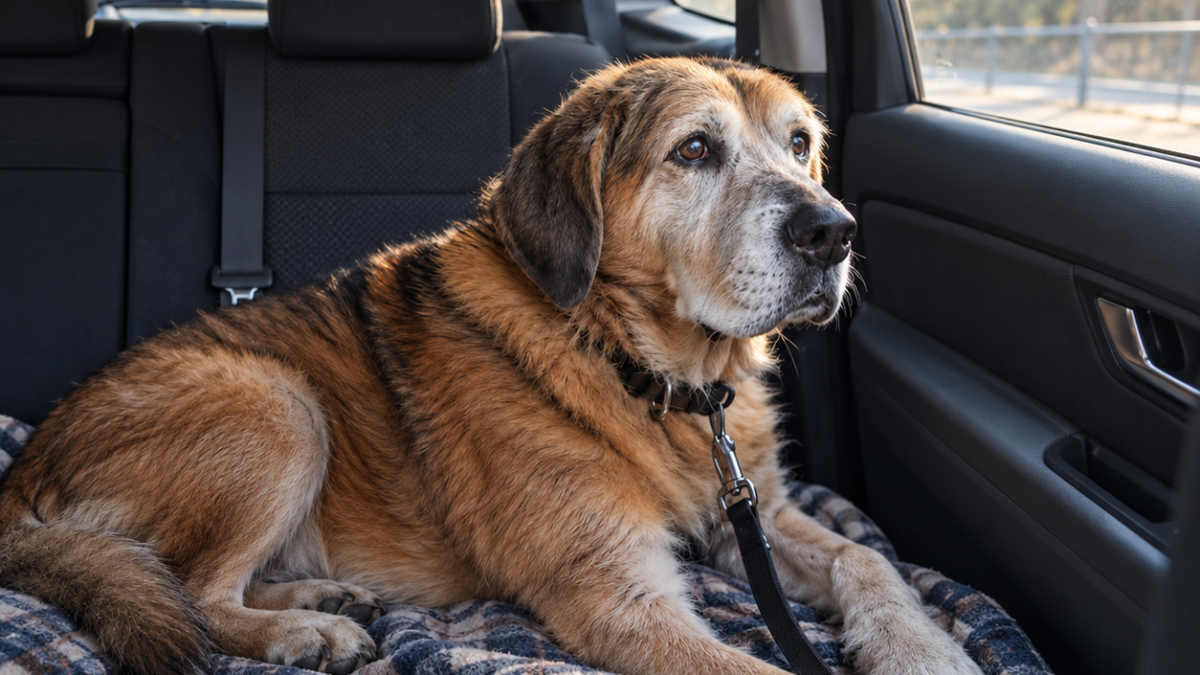
Marta stood there on the concrete, her leash loose in my hand, watching the old gray sedan as if she couldn’t understand why the people weren’t opening the back door for her again.
The man walked toward the driver’s side without turning around.
The woman moved even faster.
Marta took one step after them.
Then another.
Her limp was worse when she hurried.
I tightened my grip gently, not enough to pull her back, only enough to keep her from stepping into the parking lane.
“Marta,” I whispered. “Honey, wait.”
But she wasn’t listening to me.
Her whole body was pointed toward the people who had brought her there.
The man opened his door. Marta’s tail began wagging again.
The woman glanced back once. Her face was stiff, but there was something in her eyes I couldn’t read at first.
Shame, maybe.
Or irritation.
Maybe both.
The man got in.
The engine started.
Marta’s ears lifted.
And when the car began backing out, that old dog let out the smallest sound I had ever heard from an animal.
Not a bark.
Not a cry.
Just one soft, confused whine.
It sounded like a question.
I had worked with abandoned dogs long enough to know the difference between fear and heartbreak. Fear shakes. Fear pulls away. Fear tries to hide.
Heartbreak waits.
Marta waited until the car turned out of the lot and disappeared behind the line of maple trees along the road.
Only then did her tail stop moving.
She looked at me.
Her eyes were not accusing. That almost made it worse.
She didn’t look betrayed.
She looked patient.
As if she believed the people had simply forgotten something and would be back any minute.
I swallowed hard and crouched beside her.
“Come on, sweet girl,” I said. “Let’s get you inside.”
She followed me without resisting.
That was the first thing everyone noticed about Marta.
She followed.
Through the front doors. Across the lobby. Past the barking kennels. Past the metal exam table. Past the wall where we kept intake forms and emergency notes and photos of dogs who had gone home smiling in the arms of new families.
Marta walked beside me as if she had been trained for years to stay close and never cause trouble.
The shelter was loud that morning. Two hounds were barking from the quarantine room. A terrier had knocked over his water bowl. A young shepherd mix was crying because her puppies had just been transferred to foster care. Phones kept ringing. Volunteers moved quickly from one kennel to another with towels, food bowls, leashes, medicine.
Marta didn’t bark once.
She only paused at the first row of kennels and lowered her head.
I felt her body tremble through the leash.
“Easy,” I said. “I know.”
Our shelter manager, Denise, came out of the office with a stack of paperwork tucked under one arm.
“New intake?” she asked.
I nodded.
“Senior?”
“Eleven. Maybe older.”
Denise looked down at Marta, and her expression changed.
There was a special kind of grief that passed across Denise’s face whenever an old dog came through those doors. She had been running the shelter for sixteen years. She had seen dogs dumped before vacations, after divorces, after babies, after moves, after medical diagnoses, after the animal stopped being cute or convenient.
But senior dogs were different.
Senior dogs didn’t just lose a house.
They lost the map of their entire world.
Denise crouched slowly. “Hello, beautiful.”
Marta looked at her, then took two small steps forward and rested her chin on Denise’s knee.
That was it.
No begging.
No jumping.
Just that quiet, trusting gesture.
Denise closed her eyes for half a second.
“Oh, this one is going to hurt,” she murmured.
I brought Marta into the intake room. She let us scan her for a microchip. She let us check her ears, teeth, paws, belly, and joints. She stood still even when the metal table made her nervous. When the thermometer went in, she only looked back at me with mild disappointment, like she was too polite to complain.
The vet tech, Carlos, ran his hand along her spine.
“She’s thin,” he said. “Not starving, but underweight. Arthritis in the hips. Possible old injury in the back leg.”
“Teeth?”
“Bad, but not the worst I’ve seen.”
He checked her paws. “Nails are overgrown. She hasn’t been walked much.”
Marta licked his wrist.
Carlos sighed. “Of course she’s sweet.”
The scanner beeped over her shoulder.
Denise leaned closer. “She has a chip.”
The room went quiet.
A microchip on a surrendered dog could mean several things. Sometimes it confirmed the person surrendering was the owner. Sometimes it exposed that the person was not. Sometimes it led us to an address where no one wanted to answer the phone.
Carlos read the number aloud.
Denise typed it into the database.
A few seconds later, her eyebrows drew together.
“That’s strange.”
“What?”
She clicked again. “The chip is registered to a man named Arthur Whitaker.”
I looked at Marta.
She perked up slightly at the name.
Arthur.
Her ears moved.
Denise noticed too.
“Arthur Whitaker,” she repeated softly.
Marta’s tail gave one little thump.
My stomach tightened.
“That was her first owner,” I said.
Denise looked at the surrendered paperwork. “The man who dropped her off listed himself as Brian Kesler. Relationship to dog: family caretaker. Reason for surrender: unable to manage senior care.”
Carlos leaned against the counter. “Is Arthur still alive?”
Denise searched.
It didn’t take long.
Arthur Whitaker had passed away three years earlier.
There was an obituary from a local funeral home. A small photo showed an elderly man in a brown cardigan sitting on a porch, one hand resting on the head of a younger version of Marta. Her muzzle was darker then. Her eyes were brighter. But it was her.
No question.
The obituary said Arthur was a retired school custodian, widower, gardener, church volunteer, and beloved friend to many.
It also said he was survived by nieces, nephews, and “his faithful dog, Marta, whom he adored.”
Denise clicked away from the page and sat back.
For a moment, none of us spoke.
Marta sat between us, unaware that the little computer screen had just brought back the only person who had ever truly belonged to her.
I printed the intake sheet and wrote senior, arthritic, very gentle, emotionally distressed, bonded to humans.
Those words felt too small.
How do you write, “This dog has been waiting for someone to keep a promise”?
We settled her into a kennel at the end of the quiet row, away from the loudest dogs. I gave her a thick blanket, a raised bed, and a bowl of soft food mixed with warm water. Marta sniffed the food but didn’t eat.
She walked in a slow circle.
Then another.
Then she lowered herself near the kennel door and stared toward the lobby.
Waiting.
I sat on the floor outside her kennel during my lunch break.
She pressed her face against the bars.
I slipped two fingers through, and she leaned into them.
“You thought you were going home,” I whispered.
Her eyes moved over my face.
“I know.”
I did know.
Not because I had been passed from house to house like Marta, but because I had watched it happen to my grandmother’s old beagle when I was fifteen. My grandmother died suddenly, and the adults in my family all promised someone would take Daisy.
Someone always said, “We’ll figure it out.”
Then one Saturday morning, my uncle drove Daisy away.
He told me she was going to “a nice farm.”
I believed him for six months.
Then I found the truth by accident.
Daisy had been taken to a rural shelter and euthanized after five days because she was old, blind in one eye, and terrified.
I never forgave that lie.
I think that was the first day I understood that cruelty doesn’t always look violent.
Sometimes cruelty wears clean clothes, drives a decent car, signs a form, and says, “We just can’t anymore.”
So when Marta looked at me through those kennel bars, I felt something old and sharp open in my chest.
I made her a promise right there.
“You are not disappearing,” I told her. “Not while I’m here.”
That evening, Denise called the number on Marta’s microchip profile.
Disconnected.
She called the secondary contact.
No answer.
Then she checked the chip registration history. That was when the story became stranger.
Arthur Whitaker had listed one emergency contact when he registered Marta as a puppy: his attorney, Elaine Mercer.
Most people listed a spouse, child, sibling, or neighbor.
Arthur had listed a lawyer.
Denise stared at the screen. “That’s unusual.”
“Maybe he didn’t trust his family,” I said.
I meant it as a quiet comment.
I didn’t know yet how right I was.
Denise called the number listed for Elaine Mercer’s office. It rang three times before a receptionist answered.
“This is county animal services,” Denise said. “We’re trying to confirm information on a senior dog named Marta. She was registered to Arthur Whitaker.”
There was a pause.
Then the receptionist’s voice changed.
“One moment, please.”
Denise put the call on speaker.
Marta had fallen asleep on the blanket behind us, but the moment Arthur’s name came through the phone again, her ears twitched.
A woman’s voice came on the line.
“This is Elaine Mercer.”
Denise introduced herself and explained.
“We received a surrendered senior dog today. Her microchip still lists Mr. Whitaker as the owner. The dog’s name is Marta.”
Silence.
Then, very softly, Elaine said, “Marta is at the shelter?”
“Yes, ma’am.”
Another pause.
“Who brought her in?”
Denise looked at the paperwork. “A man named Brian Kesler.”
Elaine exhaled sharply.
“That name is familiar,” she said.
Her tone made my skin prickle.
Denise sat straighter. “Can you explain?”
“I represented Arthur Whitaker for many years,” Elaine said. “Before he died, he made very specific arrangements for Marta.”
My eyes went to the sleeping dog.
“What kind of arrangements?” Denise asked.
Elaine’s voice hardened. “The kind that were not supposed to end with her in a county shelter.”
By nine the next morning, Elaine Mercer walked through the shelter doors carrying a leather file folder, her silver hair pulled into a neat knot at the back of her head.
She looked like a woman who had spent decades making careless people regret underestimating her.
Marta was still in the quiet row.
She had eaten a little overnight, but not much. She had slept with her nose pointed toward the kennel door. Every time someone walked past, she lifted her head hopefully.
When Elaine stepped into the kennel area, Marta’s reaction changed.
She didn’t wag right away.
She stared.
Elaine stopped five feet from the kennel.
“Oh, sweetheart,” she whispered.
Marta stood slowly.
Her joints protested. Her back leg dragged for half a second. Then she came to the front of the kennel, sniffing the air.
Elaine crouched.
“Marta,” she said. “Do you remember me?”
Marta pressed her nose through the bars.
Then her tail began to move.
Not the polite little thump she had given us.
This was recognition.
Elaine covered her mouth with one hand.
I opened the kennel door.
Marta walked out and went straight into Elaine’s arms.
The old dog leaned into her with her whole body, sighing like some small piece of her past had finally come back.
Elaine held her tightly, and for several seconds no one said anything.
Then she looked at me and Denise.
“Arthur would have been furious.”
Denise led us into the small meeting room beside the lobby. Marta came too. She lay at Elaine’s feet, one paw touching the lawyer’s shoe.
Elaine opened the leather folder.
Inside were copies of legal documents, vet records, letters, and photographs.
The top photograph showed Arthur sitting in a garden chair with Marta’s front paws on his lap. He was smiling. She was wearing a red bandana.
“He adopted her when she was six months old,” Elaine said. “She had been found tied behind a closed grocery store in February. He told me she was the first living creature that made his house feel warm after his wife died.”
I looked down at Marta.
Her eyes were half closed, but she was awake.
Listening.
“Arthur knew his health was failing,” Elaine continued. “No children. Several distant relatives. Some helpful, some… less so. He was afraid Marta would be treated like leftover furniture.”
Denise’s mouth tightened.
“So he created a care provision.”
Elaine pulled out a document.
“Arthur left instructions that Marta was to remain with a designated family caretaker. That caretaker would receive a monthly stipend from his estate trust for Marta’s food, veterinary care, medication, grooming, and general needs.”
Carlos, who had joined us at the door, muttered, “There it is.”
I looked at him.
He shook his head. “Money.”
Elaine nodded grimly. “The original designated caretaker was Arthur’s niece, Patricia. She took Marta after he died. According to reports sent to the trust, Marta was still living comfortably with Patricia.”
“But she wasn’t,” I said.
“No.” Elaine tapped the file. “If what you were told is true, Marta has been passed from home to home while someone continued accepting money for her care.”
Denise leaned forward. “How much?”
Elaine looked at Marta, then back at us.
“Eight hundred dollars a month.”
The room went silent.
Eight hundred dollars a month.
For three years.
That was nearly thirty thousand dollars.
While Marta’s nails grew long.
While her joints ached.
While she was passed from one reluctant household to another.
While she climbed into car after car believing this time, maybe this time, someone meant it when they said she was going home.
My hands curled around the edge of my chair.
Denise’s voice became very calm. I knew that voice. It meant she was angry enough to be precise.
“Can you do anything legally?”
Elaine smiled once.
It was not a warm smile.
“Oh, yes,” she said. “I can do several things.”
That was when the revenge began.
Not the loud kind.
Not the kind that breaks windows or screams in parking lots.
The kind Arthur Whitaker would have appreciated.
Paperwork.
Records.
Receipts.
Dates.
Names.
Signatures.
Elaine asked for copies of the surrender form, intake photos, medical assessment, and microchip scan confirmation. Denise provided everything. Carlos documented Marta’s physical condition: underweight, untreated arthritis, overgrown nails, dental disease, stress indicators, and a healing sore on one elbow from lying too long on hard surfaces.
I took photographs of Marta’s paws, her thin hips, her cloudy eyes, her gray muzzle.
I hated taking them.
But evidence matters most when someone hopes nobody is paying attention.
Then Elaine began calling people.
By noon, we had a clearer timeline.
Arthur died three years earlier in April.
Patricia, his niece, took Marta into her home and signed an agreement acknowledging that Marta could not be sold, abandoned, euthanized for convenience, or surrendered without written notice to the trust attorney.
Six months later, Patricia moved into a condo that did not allow large dogs.
Instead of notifying Elaine, she gave Marta to her son.
Her son kept Marta for four months, then gave her to a coworker.
The coworker kept her through winter, then passed her to Brian Kesler, Patricia’s nephew by marriage.
Brian and his wife had kept Marta for just under five weeks before bringing her to us.
All the while, Patricia had continued submitting basic email confirmations to the trust.
Marta is doing well.
Marta had her food delivered.
Marta is comfortable.
Marta is still with family.
Elaine printed every email.
Her expression darkened with each page.
By late afternoon, Patricia called the shelter.
Denise put her on speaker in the office.
“This is Patricia Whitaker,” the woman said, breathless and irritated. “I received a message from Elaine Mercer saying there’s confusion about Arthur’s dog.”
Denise looked at me.
I stood beside her desk with my arms folded.
“No confusion,” Denise said. “Marta was surrendered to county animal services yesterday.”
“That’s impossible.”
“She is here.”
“Well, who surrendered her?”
“Brian Kesler.”
Patricia went quiet.
Then she said, “Brian shouldn’t have done that.”
Denise didn’t blink. “But he had the dog?”
A pause.
“Temporarily.”
“How long is temporarily?”
“That’s a family matter.”
Denise’s voice stayed even. “A senior dog connected to a legal care agreement was surrendered to a public shelter. It is now also an animal welfare matter.”
Patricia’s irritation sharpened. “Look, Marta is old. Arthur was sentimental, but dogs don’t live forever. Everyone has done their best.”
I looked through the office window toward the quiet row.
Marta was standing again, watching the lobby.
Waiting.
Denise said, “Doing your best would have included contacting the attorney listed in the agreement.”
“I was busy.”
“For three years?”
Patricia hung up.
Denise slowly set the phone down.
Carlos, standing in the doorway, said, “That went well.”
I didn’t laugh.
I was watching Marta.
That night, I couldn’t stop thinking about her.
I went home after my shift, but the image followed me into my kitchen, into my shower, into my bed. Marta looking through the car window. Marta wagging her tail when the man said her name. Marta pressing her face through the kennel bars because every footstep might be someone coming back for her.
At 11:40 p.m., I got out of bed, put on sweatpants, and drove back to the shelter.
The night attendant, Grace, buzzed me in.
“Couldn’t sleep?” she asked.
“No.”
“She’s quiet,” Grace said. “Too quiet.”
I went to Marta’s kennel.
She was lying on her blanket, but she lifted her head when she saw me.
Her tail thumped once.
“Hi, old girl.”
I opened the kennel and sat beside her on the blanket. Shelter policy normally didn’t allow staff to sit inside kennels after hours unless there was a medical reason.
I decided heartbreak counted.
Marta crawled slowly toward me and rested her head in my lap.
I stroked her ears.
“You know,” I whispered, “my grandma had a dog named Daisy.”
Marta sighed.
“She trusted people too.”
I sat with her for almost an hour.
At some point, Grace appeared at the end of the row with two mugs of coffee.
“She got you too, huh?” she said.
I looked down at Marta.
“Yeah.”
Grace leaned against the wall.
“You going to foster her?”
I didn’t answer right away.
I lived in a small rental duplex. I already had one dog, a twelve-year-old mutt named Juniper who believed all furniture belonged to her. My landlord allowed one pet officially, two unofficially only if nobody complained. My shifts were long. My savings account was embarrassing. I was not the perfect home for a senior dog with medical needs.
But perfect homes are rare.
Safe homes are made.
“I don’t know,” I said.
Grace smiled gently. “That means yes.”
The next morning, Marta became “evidence custody pending legal review,” which sounds cold, but it protected her. It meant no one from the family could reclaim her without documentation. It meant no hasty decision could be made. It meant she was not just another senior dog in an overcrowded shelter.
It meant Arthur’s promise still had teeth.
Elaine filed a formal notice with the estate trust by noon.
By three o’clock, Patricia Whitaker arrived at the shelter wearing a cream-colored coat and the expression of a woman deeply offended by consequences.
She did not ask to see Marta.
That was the first thing I noticed.
She walked to the front desk and said, “I need to speak with whoever is in charge.”
Denise came out.
Elaine was already there, sitting in the meeting room with a yellow legal pad. She had predicted Patricia would come.
Patricia stiffened when she saw her.
“Elaine.”
“Patricia.”
“This has been blown completely out of proportion.”
Elaine gestured toward the meeting room. “Then you’ll have no trouble clarifying it.”
I stayed near the front desk, pretending to sort forms.
The meeting room door remained partly open.
Patricia sat but did not remove her coat.
Elaine opened the file.
“Let’s start simply. Where has Marta been living for the past thirty-six months?”
“With family.”
“That is not an address.”
“She moved around a little.”
“How many times?”
Patricia looked toward Denise. “Is this necessary?”
“Yes,” Denise said.
Elaine continued, “Arthur’s agreement required you to maintain Marta in a stable home, provide veterinary care, and notify me immediately if you could no longer keep her. Did you do that?”
“I provided for her.”
“Did you keep her?”
“I arranged care.”
“Did you notify me?”
Patricia’s lips pressed together.
Elaine slid a document across the table.
“This is your signed agreement.”
Patricia glanced at it. “I know what I signed.”
“Good. Then you know the stipend was conditional.”
“I used that money for Marta.”
Elaine lifted another paper. “Please provide receipts.”
“I don’t keep every receipt from dog food.”
“Veterinary invoices?”
“She didn’t need much.”
“Medication?”
“She’s old. Old dogs limp.”
I felt heat rise in my face.
Denise’s jaw tightened.
Elaine’s voice sharpened for the first time. “Old age is not permission for neglect.”
Patricia leaned back.
“I loved Arthur,” she said. “I helped him when nobody else did. That dog was part of his life, yes, but he made things difficult by attaching money and lawyers and ridiculous conditions. My family had to deal with the burden.”
From the quiet row, Marta barked once.
Everyone froze.
It was the first bark I had heard from her.
Not loud. Not aggressive.
Just one rough, old sound.
Patricia looked toward the hallway.
For half a second, something like recognition crossed her face.
Then she looked away.
Elaine saw it.
“She knows your voice,” Elaine said.
Patricia’s eyes flashed. “Of course she does.”
“Then why haven’t you asked to see her?”
The room went dead quiet.
Patricia stood. “I came to resolve a legal misunderstanding, not be emotionally manipulated by shelter staff.”
Elaine closed the folder.
“You surrendered Arthur’s dog through another person after violating the care terms of his trust. You accepted money intended for Marta while failing to keep her in your home, failing to provide consistent medical care, and failing to notify my office. This is no longer a misunderstanding.”
Patricia’s face paled.
“What are you saying?”
“I’m saying the trust is suspending all further payments immediately. I’m also filing a petition for recovery of misused funds, plus costs for Marta’s medical rehabilitation.”
Patricia gripped her purse.
“You wouldn’t dare.”
Elaine stood too.
“I knew Arthur Whitaker for twenty-two years. He mopped school hallways for thirty-four of them, saved every spare dollar, and spent his last year worrying that the dog sleeping beside his chair would be thrown away when he died. So yes, Patricia. I would dare.”
Patricia walked out without looking down the hall.
Marta watched her leave from behind the kennel door.
Her tail moved once.
Then stopped.
That single tail wag destroyed me more than any cry could have.
Because some part of her still recognized Patricia as someone connected to home.
Some part of her still hoped.
Dogs can forgive things people should have to answer for.
That afternoon, I signed the foster paperwork.
Denise watched me fill it out.
“You sure?”
“No,” I said. “But I’m doing it anyway.”
She smiled. “That’s usually how the good ones start.”
Carlos packed Marta’s medication, joint supplements, special food, and a soft harness. Grace found a donated orthopedic bed from the storage room. Someone else added a fleece blanket with yellow ducks on it. By the time we were finished, Marta had more belongings than she had arrived with.
When I brought her out through the lobby, she hesitated at the front doors.
I understood.
The last time she had walked through them, she had been waiting for a car that never came back.
I crouched beside her.
“This time, you’re coming with me,” I said.
She looked at my face.
“Not forever yet,” I added softly. “But for tonight. And tomorrow. And as many tomorrows as we can make work.”
She took one step.
Then another.
When we reached my car, she froze.
Her body stiffened.
Her ears went back.
The car had become a question she was afraid to ask.
I opened the back door and placed the yellow duck blanket on the seat.
Marta sniffed it.
I didn’t rush her.
Cars had lied to her too many times.
Finally, she climbed in slowly, with my hand supporting her hips. Once she was settled, she looked at me through the open door.
I clipped her safety belt to the harness.
Then I said the words carefully.
“We are going home.”
Her tail tapped the blanket.
Once.
I drove slowly.
All the way to my duplex, I kept looking in the rearview mirror. Marta sat upright for the first ten minutes, watching the road like she was afraid to miss the moment I changed my mind.
Then her head lowered.
Her eyes grew heavy.
By the time we pulled into my driveway, she was asleep.
Juniper, my old mutt, was not impressed at first.
She stood in the living room like a retired queen whose throne had been insulted.
Marta entered cautiously, sniffing the rug, the sofa, the water bowl, the basket of toys Juniper had not touched in years but suddenly considered precious.
Juniper gave one low grumble.
Marta stopped immediately and looked away.
No challenge.
No pride.
Just peacekeeping.
Juniper sniffed her face.
Marta stood still.
Then Juniper sniffed her ear, her shoulder, and her tail.
After a tense moment, Juniper walked over to her bed, turned around three times, and lay down with a dramatic sigh.
That was acceptance.
Marta seemed to understand. She crossed the room slowly and lay on the yellow duck blanket I had spread near the couch.
For the first time since I had met her, she did not point her body toward a door.
She slept.
Deeply.
Heavily.
Like a dog who had been standing guard over her own hope for too long.
The next few weeks changed everything.
Marta was not difficult.
That was the lie people told about her.
She did not ask for much. She needed help getting in and out of the car. She needed medication hidden in soft cheese. She needed shorter walks. She needed rugs on the slippery floor so her back legs wouldn’t slide. She needed someone to wake up when she paced at night because old joints hurt more in the dark.
But she was not a burden.
She was a witness.
She watched everything I did.
When I made coffee, she watched from the kitchen doorway.
When I folded laundry, she rested her chin on the basket.
When I worked on shelter reports at the table, she lay under my chair with one paw touching my foot.
The first time I accidentally dropped a spoon, she flinched so hard her shoulder hit the cabinet.
I knelt immediately.
“Hey. You’re okay.”
She blinked at me, embarrassed by her own fear.
That told me enough.
Maybe no one had hit her. Maybe they had. I couldn’t prove it either way.
But I knew what a dog looked like when she had learned that mistakes annoyed people.
So I began teaching her the opposite.
If she spilled water, I cleaned it up and said, “No problem.”
If she woke me at 2 a.m., I took her outside and said, “I’ve got you.”
If she moved too slowly, I slowed down too.
Marta began to change in tiny ways.
Her tail rose a little higher.
She started eating full meals.
She discovered that Juniper’s favorite sunny spot by the window was big enough for two old dogs if both pretended not to notice.
She learned the sound of my car pulling into the driveway and met me at the door with a stuffed rabbit in her mouth. I had not bought her the rabbit. It had belonged to Juniper, who had ignored it for seven years until Marta loved it. After that, Juniper wanted it back out of principle.
They compromised by sleeping with one paw each on it.
Meanwhile, Elaine Mercer was building her case.
She called me every few days with updates.
“Patricia hired counsel,” she said once.
“Good counsel?”
“Expensive counsel.”
“Does that worry you?”
Elaine made a sound that might have been a laugh.
“Expensive does not mean correct.”
She subpoenaed bank records from the trust. Requested veterinary documentation Patricia claimed existed. Contacted each person who had housed Marta. Most were embarrassed. Some were defensive. One cried.
The coworker who had kept Marta through winter told Elaine, “I thought she was just helping family. Patricia said the dog was too sad at her house and needed someone home more often. She gave me fifty dollars once for food.”
Fifty dollars.
Out of eight hundred a month.
Brian Kesler, the man who surrendered Marta, was less cooperative until Elaine reminded him that the surrender form he signed became an official record.
Then his story changed quickly.
He admitted Patricia had asked him to “handle it quietly.”
He said she told him Marta was “basically at the end anyway.”
He said she warned him not to mention the trust.
When Elaine told me that, I had to sit down.
Marta was asleep on the floor beside me, her gray muzzle resting on the stuffed rabbit.
Basically at the end.
That was how people justified erasing her.
Not dead.
Not dying.
Just inconvenient enough to stop counting.
The first hearing took place six weeks after Marta came home with me.
Elaine asked me to attend.
“It may help the court understand the dog as a living beneficiary of Arthur’s instructions,” she said.
I looked at Marta, who was licking peanut butter off a spoon with intense concentration.
“Can she come?”
Elaine paused.
Then she said, “I was hoping you would ask.”
The courthouse allowed it because Marta was central to the matter and Elaine filed the request properly. Patricia’s attorney objected, calling it “emotionally prejudicial.”
The judge replied, “The dog’s condition is part of the evidence.”
So on a gray Tuesday morning, I put Marta’s red bandana around her neck.
It wasn’t Arthur’s original. That one had disappeared somewhere in the years after his death.
But Elaine had found the old photograph of Marta wearing a red bandana in Arthur’s garden, and I bought one as close as I could.
Marta stood patiently while I tied it.
Then she looked at herself in the hallway mirror.
Her tail wagged.
“You look beautiful,” I told her.
At the courthouse, people turned as we walked in.
Marta moved slowly but calmly beside me. Her nails had been trimmed. Her coat was cleaner. She had gained four pounds. The medication had helped her limp. She still looked old, of course.
But she no longer looked discarded.
Elaine met us outside the courtroom.
When she saw the red bandana, her eyes shone.
“Arthur would have loved that.”
Marta leaned into her hand.
Inside the courtroom, Patricia sat at one table with her attorney. She wore navy blue and pearls. She looked polished, controlled, and deeply annoyed.
When Marta entered, Patricia’s face changed.
Only for a second.
But I saw it.
Marta saw her too.
She stopped.
Her tail began moving.
My throat tightened.
“Marta,” I whispered.
She looked up at me, then back at Patricia.
Patricia stared straight ahead.
The tail wag slowed.
Then stopped.
Elaine touched my arm.
“Bring her here.”
I led Marta to the front bench behind Elaine’s table. She lowered herself onto the blanket we had brought and rested her head on her paws.
The judge entered.
Everyone stood except Marta, who tried, realized her hips disagreed, and looked apologetic.
The judge noticed.
“You’re fine, ma’am,” he said gently.
A ripple of quiet laughter moved through the room.
Even Elaine smiled.
Then the hearing began.
Patricia’s attorney spoke first. He argued that Arthur’s arrangement was informal in spirit, that Patricia had made good-faith efforts, that family care sometimes requires flexibility, and that Marta’s surrender had been an unfortunate misunderstanding by an extended relative.
Elaine listened without expression.
Then she stood.
“Your Honor, this case is not about whether caring for an elderly animal can become difficult. It can. Everyone in this room understands that. This case is about whether a person may accept restricted funds for a specific living animal while repeatedly transferring that animal, failing to provide documented care, concealing those transfers, and ultimately arranging for the animal to be surrendered to a public shelter without notice.”
She laid out the timeline.
Arthur’s death.
Patricia’s signed agreement.
The monthly stipend.
The emails.
The transfers.
The lack of veterinary records.
The surrender form.
The intake photographs.
The medical assessment.
Every fact landed quietly but heavily.
Patricia looked smaller by the minute.
Then Elaine called me.
I walked to the front and swore to tell the truth.
My hands trembled slightly, but when I looked at Marta, she lifted her head.
That helped.
Elaine asked me to describe the day Marta arrived.
I did.
I told the judge about the old gray sedan. About the grocery bag. About Marta wagging her tail when Brian said her name. About her trying to follow the car when it left. About the sound she made.
Patricia stared down at the table.
Elaine asked, “In your professional experience, how did Marta behave at intake?”
“She was gentle,” I said. “Confused. Emotionally distressed. She kept watching the door.”
“Did she show aggression?”
“No.”
“Did she appear to understand that she had been surrendered?”
My voice caught.
“No. She appeared to believe the people were coming back.”
Elaine gave me a moment.
Then she asked, “How is Marta now?”
I looked toward the old dog on the blanket.
“She’s safe,” I said. “She has arthritis. She needs medication and support. But she eats well now. She sleeps through most nights. She likes stuffed rabbits. She follows me from room to room. She is not a burden.”
The courtroom was silent.
“She is an old dog,” I continued. “But she is not disposable.”
Patricia’s attorney objected.
The judge sustained it gently and told me to stick to observations.
But the words had already been said.
Then came Patricia.
She took the stand with her shoulders stiff.
Her attorney guided her through a careful version of events. She had loved her uncle. She had tried to care for Marta. Circumstances changed. Housing issues. Work stress. Family emergencies. She believed Marta was always with responsible people. She had not intended harm.
Elaine’s cross-examination was surgical.
“You signed this agreement?”
“Yes.”
“You understood you were required to notify my office if you could no longer house Marta?”
“Yes, but—”
“You did not notify my office?”
“No.”
“You continued receiving eight hundred dollars per month?”
“Yes.”
“You submitted written updates stating Marta was still in family care?”
“She was.”
“With you?”
“Not always.”
“How many months did Marta actually live in your home after Arthur died?”
Patricia hesitated.
Elaine waited.
“About six.”
“Out of thirty-six?”
Patricia’s attorney shifted.
Elaine continued. “Can you provide veterinary invoices for the remaining thirty months?”
“No.”
“Medication receipts?”
“No.”
“Grooming receipts?”
“No.”
“Food receipts?”
“No.”
“Do you know what medication Marta currently takes for arthritis?”
Patricia’s face reddened. “No.”
“Do you know the name of her veterinarian?”
“I used different places.”
“Name one.”
Patricia looked at her attorney.
Elaine’s voice stayed calm.
“Name one veterinarian who treated Marta while you were accepting funds for her care.”
Patricia did not answer.
From the blanket, Marta sighed.
It was a small sound, but everyone heard it.
Elaine turned slightly toward the dog, then back to Patricia.
“Did you instruct Brian Kesler to surrender Marta quietly?”
“No.”
Elaine picked up a document.
“Your Honor, I’d like to introduce Mr. Kesler’s sworn statement.”
Patricia’s attorney objected.
The judge reviewed it and allowed limited use.
Elaine read one line.
“Patricia said not to mention the lawyer or the money because it would make things complicated.”
Patricia’s face drained of color.
Elaine lowered the page.
“No further questions.”
The judge did not issue a final ruling that day, but he issued temporary orders.
All stipend payments remained suspended.
Patricia had to provide full accounting records.
The trust would pay for Marta’s ongoing medical care directly through Elaine’s office.
Marta would remain in my foster care pending final placement.
And Patricia was prohibited from contacting or attempting to reclaim the dog.
When the judge said that, Marta was asleep.
She missed her own victory.
That felt right.
She had already been forced to carry too much of the story.
Let the humans handle the ugly parts.
Outside the courthouse, Patricia approached me near the steps.
Elaine was speaking with the court clerk a few feet away.
I had Marta’s leash in one hand and my purse in the other.
Patricia stopped in front of me.
For the first time, without the courtroom between us, I saw how angry she really was.
“You think you’re some kind of hero?” she asked.
I didn’t answer.
Marta sniffed the grass beside the walkway.
Patricia looked down at her. “She doesn’t even know what’s happening.”
That made me look up.
“No,” I said. “She doesn’t know about money or legal agreements or court orders.”
Patricia’s mouth twisted.
“She just knows who left,” I said.
Patricia flinched.
Then her face hardened.
“You don’t know what it was like,” she snapped. “Arthur made everyone feel guilty. He cared more about that dog than his own blood. Do you know what that feels like?”
I stared at her.
There it was.
Not exhaustion.
Not hardship.
Jealousy.
An old woman jealous of an old dog because a dying man had trusted the dog’s love more than hers.
“I know what it looks like when someone proves him right,” I said.
Patricia stepped closer.
Marta moved.
She didn’t growl. She didn’t bark. She simply stepped between us, old legs stiff, gray head lifted.
Patricia looked startled.
So did I.
Marta was not threatening her.
She was protecting me.
After everything, she still had enough heart left to protect someone.
Elaine appeared beside us.
“Walk away, Patricia.”
Patricia looked from Elaine to me to Marta.
Then she turned and left.
Two months later, the final order came.
Patricia was required to repay a substantial portion of the funds she had received from the trust. Additional penalties were assessed for misrepresentation. The court approved direct payment for Marta’s medical care for the rest of her life. Arthur’s remaining care provision would be transferred into a restricted account overseen by Elaine.
But the part that mattered most to me came on page seven.
Permanent placement of Marta shall prioritize emotional stability, continuity of care, and demonstrated attachment.
Elaine called me the moment the order was filed.
“I have a question,” she said.
I was sitting on the living room floor because Marta had decided my lap was still available despite being a seventy-pound senior dog.
“I think I know the question.”
“Would you consider adopting her?”
Marta was snoring.
Juniper was also snoring.
The stuffed rabbit was trapped under both of them.
“I’m not perfect,” I said.
“No one asked for perfect.”
“My landlord might complain.”
“I can write a letter.”
“She’s expensive.”
“The trust will cover approved medical needs.”
“She wakes up at night sometimes.”
“So do I,” Elaine said.
I laughed, then unexpectedly started crying.
Marta woke and lifted her head.
I pressed my hand to her face.
“Yes,” I said. “Yes, of course I’ll adopt her.”
The adoption ceremony was unofficial, but Denise insisted on making it a moment.
She printed a certificate with Marta’s paw print. Carlos bought a small cake for the humans and special treats for the dogs. Grace tied balloons to the front desk. Elaine came wearing the same silver hair knot and carrying another folder, because apparently lawyers celebrate with documents.
Marta wore her red bandana.
When Denise handed me the adoption certificate, she said, “Do you promise not to return this dog for being old, inconvenient, slow, expensive, stubborn, emotionally attached, or guilty of stealing half your pillow?”
“I do,” I said.
“Do you promise to understand that senior dogs come with history?”
“I do.”
“Do you promise that when she gets confused, tired, scared, or sore, you will remember she once waited for people who didn’t come back?”
My throat tightened.
“I do.”
Denise smiled.
“Then she’s yours.”
Marta, who had been sniffing Carlos’s pocket for treats, looked up when everyone clapped.
Her tail wagged.
She had no idea she had just become legally, officially, permanently wanted.
Or maybe she did.
Because that night, when we got home, something changed.
Usually, Marta slept on her bed beside mine. She liked being close, but she still kept a little space, as if asking for too much might get her sent away.
That night, she stood beside my bed and looked at me.
“What?” I asked.
She placed one paw on the mattress.
Then waited.
“Oh,” I said. “You want up?”
Her tail moved.
I helped her carefully, lifting her back legs so her hips wouldn’t hurt. She settled against my side with a long, deep sigh.
Juniper grumbled from the foot of the bed but didn’t move.
Marta rested her head on my shoulder.
For the first time, she did not sleep like a dog ready to be moved.
She slept like a dog who had arrived.
Weeks became months.
Marta became known around the neighborhood.
At first, people noticed her because she moved so slowly. Children on bikes would stop and wait for her to cross the sidewalk like she was a tiny parade. Mrs. Bell from two houses down began keeping soft treats in her apron pocket. The mail carrier learned her name and greeted her before greeting me.
“Morning, Miss Marta.”
Marta loved that.
She would lift her head with quiet dignity, as if being called Miss Marta was the exact respect she had always deserved.
Her health improved as much as old age allowed. She gained weight. Her coat grew softer. The sore on her elbow healed. Her eyes stayed cloudy, but brighter. Her limp never disappeared, yet she carried herself differently.
Pain can bend a body.
Love can lift it anyway.
Arthur’s story spread too.
Not because I posted it online. I didn’t.
But court records have a way of becoming local talk, especially in a county where everyone knows someone who knows someone. People began coming into the shelter asking about senior dogs. Some asked specifically, “Do you have any old ones like Marta?”
Denise called it the Marta effect.
A twelve-year-old spaniel went home with a retired couple.
A deaf shepherd mix found a family with a fenced yard and patient teenage sons.
A blind little terrier named Peanut was adopted by a woman who said, “I’m old too. We’ll figure it out together.”
Every time an old dog left the shelter in someone’s arms, Denise would look at me and say, “Arthur’s still working.”
Elaine thought so too.
She visited Marta once a month, always bringing a small bouquet of flowers. At first, I thought they were for me.
Then one Sunday afternoon, she asked if I would drive with her.
We took Marta to the cemetery where Arthur was buried.
I had never been there.
His grave was under a maple tree on a gentle hill. The stone was simple.
Arthur James Whitaker
Beloved Husband
Faithful Friend
Keeper of Small Promises
I stared at the last line.
Elaine stood beside me.
“He chose that himself,” she said. “He said big promises make people look noble, but small promises prove who they are.”
Marta sniffed the grass near the stone.
Then she lowered herself carefully and lay down.
Not dramatically.
Not in some movie-perfect way.
Just like an old dog resting beside someone she loved.
Elaine placed the flowers by the headstone.
“I’m sorry it took us so long,” she whispered.
The wind moved through the maple leaves.
Marta closed her eyes.
I sat beside her in the grass, my hand on her back, feeling each slow breath.
For a while, nobody spoke.
Then Elaine reached into her bag and pulled out an envelope.
“I found something in Arthur’s files,” she said. “It was sealed with your shelter’s name on it, but never delivered because he died before updating the final packet.”
She handed it to me.
My name wasn’t on it, of course. Arthur had never known me.
The envelope was addressed:
To whoever helps Marta when I no longer can.
My hands shook as I opened it.
Inside was a single handwritten letter.
Elaine nodded for me to read it aloud.
So I did.
To whoever has my girl,
Her name is Marta. She likes toast corners, porch shade, and being told what a good dog she is even when she already knows. She gets nervous during thunderstorms, but if you put your hand on her back, she will believe you can stop the sky from falling.
If this letter has reached you, it means my plan was not enough by itself. I hope that does not mean she suffered. If she did, I ask you to forgive an old man for trusting paper when he should have trusted only kindness.
Marta saved me after my wife died. People said I rescued her, but that was only half true. She made me get up in the morning. She made me walk when I wanted to sit. She made my house less empty. She listened to me talk to a woman who was no longer there.
Please do not let her last years be lonely.
She has already given more love than most people know how to receive.
Arthur
By the time I finished, I could barely see the page.
Elaine was crying openly.
Marta lifted her head at the sound of my voice breaking. She nudged my hand with her nose.
Still comforting people.
Always comforting people.
I folded the letter carefully and pressed it to my chest.
“I’ve got her,” I whispered toward the stone. “I promise.”
That promise became the center of our life.
Not dramatic.
Not perfect.
Just steady.
Marta had good days and hard days. On good days, she walked all the way to the end of the block, sniffed every mailbox, and tried to convince Mrs. Bell she had not already received two treats. On hard days, she made it only to the porch, where she lay in the sun while I drank coffee beside her.
She loved autumn leaves.
She hated rain.
She tolerated baths with the facial expression of a wrongfully accused duchess.
She became obsessed with toast corners, just as Arthur’s letter promised.
On Christmas, Elaine brought a framed copy of the photograph of Arthur and young Marta in the garden. I placed it on the bookshelf near Marta’s bed.
Marta sniffed it for a long time.
Then she wagged her tail.
I don’t know what dogs remember the way we do.
I don’t know if she saw Arthur’s face and thought, There you are.
But I know she slept beneath that photograph every night afterward.
Patricia’s life changed too.
Not in some wild, cinematic explosion.
In a better way.
A quieter, sharper way.
She had to sell her condo to repay part of what she owed. Her name appeared in the local paper because the civil judgment involved misuse of estate funds. The church committee she chaired asked her to step down. People stopped trusting her with responsibilities that required compassion.
Once, months later, I saw her at the grocery store.
She was standing in the cereal aisle, reading a label she clearly did not care about.
I had Marta with me because the weather was cool and we had just come from the vet.
Patricia saw us.
For a moment, neither of us moved.
Marta recognized her.
I felt it through the leash.
Her body shifted forward slightly.
My heart clenched.
Then Marta did something I will never forget.
She looked at Patricia.
She looked at me.
And then she turned away from Patricia and leaned against my leg.
Not out of anger.
Dogs don’t perform revenge the way people imagine it.
This was worse.
This was choice.
Patricia’s face crumpled.
She opened her mouth, but no words came out.
I didn’t say anything either.
There was nothing left to say.
Marta had already said it.
We walked out together, slowly, with her shoulder brushing my knee.
The final year of Marta’s life was the gentlest year I knew how to give her.
I won’t pretend old age became easy. It didn’t.
Her hips weakened. Her hearing faded. Some mornings she needed help standing. Sometimes she stared into corners like she was looking for a room from long ago. Sometimes she woke confused, and I would sit beside her bed, hand on her back, telling her the truth until she believed it again.
“You’re home.”
“You’re safe.”
“I’m here.”
“Arthur loved you.”
“I love you too.”
Every time, she would settle.
Every time, she trusted the voice.
In spring, the shelter held a small event for senior pet adoption. Denise asked if Marta could be the “guest of honor.”
I almost said no because Marta tired easily by then.
But when I pulled out her red bandana, she stood.
Slowly.
Determinedly.
As if she understood public duty.
At the shelter, they set up a soft bed under a canopy, away from the noise. A sign on the table told her story without naming Patricia. People came to meet her. Some cried. Some knelt and thanked her, which made Marta look mildly confused but pleased.
A little girl with pigtails asked me, “Why did nobody want her when she was old?”
I looked at Marta.
Then at the girl.
“Some people forget that love doesn’t stop being love just because it needs more help.”
The girl thought about that.
Then she hugged Marta very gently and said, “I would’ve helped.”
Her mother adopted a ten-year-old beagle that afternoon.
Denise found me later behind the supply tent, wiping my eyes.
“You okay?”
“No.”
She nodded. “Me neither.”
Marta slept the whole ride home.
That evening, we sat on the porch. The sunset turned the street gold. Juniper lay beside us, older too now, her chin on Marta’s paw.
I gave Marta a toast corner.
She took it carefully.
“Arthur said you liked those,” I told her.
Her tail moved.
By summer, I knew.
You always hope you’re wrong, but love teaches you the signs.
Marta’s appetite faded. Her breathing changed. She still had moments of joy, but they came like small lights through fog. The vet was kind. He didn’t rush me. He didn’t soften the truth too much either.
“She’s tired,” he said.
I nodded, crying before I meant to.
He placed a hand on Marta’s back.
“She has been deeply loved.”
That mattered.
It did not make the decision easier.
I called Elaine.
She came over that same evening.
Denise came too. Carlos stopped by after work. Grace brought flowers. Mrs. Bell brought a tiny piece of toast wrapped in a napkin and cried so hard she couldn’t speak.
Marta lay on her yellow duck blanket in the living room.
The stuffed rabbit was under her chin.
The photo of Arthur was on the bookshelf.
Everyone sat around her quietly, telling stories.
Denise talked about the day Marta fell asleep during her own court victory.
Carlos talked about how she once stole an entire cheese stick from his pocket with surgical precision.
Grace talked about the night I came back to the shelter because I couldn’t leave Marta alone.
Elaine read Arthur’s letter again.
When she finished, Marta opened her eyes.
I swear she looked toward the photograph.
The next morning was warm and clear.
The vet came to the house because I could not bear the thought of Marta’s last car ride being toward another place she didn’t understand.
She lay in my lap as much as her size allowed.
Juniper stayed pressed against her side.
Elaine sat near her head, one hand on the red bandana.
I held Marta’s face and told her everything I needed her to know.
“You were wanted.”
Her eyes blinked slowly.
“You were never the burden.”
Her breathing softened.
“You kept trusting us even when we didn’t deserve it.”
My voice broke.
“And I am so sorry it took so long for you to get home.”
Marta’s tail moved once against the blanket.
One small thump.
Then she was gone.
Peacefully.
Held.
Named.
Loved.
Not in a kennel.
Not in the back seat of a stranger’s car.
Not waiting for footsteps that would never return.
Home.
For a long time after, nobody moved.
Then Elaine whispered, “Arthur has her now.”
I wanted to believe that.
So I did.
We buried Marta’s ashes beneath the maple tree at Arthur’s grave, with permission arranged by Elaine because of course she had already handled the paperwork before I could even think clearly.
Her small marker sat beside his.
Marta
Faithful Girl
She Found Her Way Home
At the shelter, Denise hung Marta’s red bandana in a shadow box near the front desk. Under it, she placed Arthur’s line:
Small promises prove who we are.
People asked about it all the time.
And every time they did, someone told Marta’s story.
Not as a tragedy.
As a warning.
As a promise.
As proof that old dogs are not leftovers from someone else’s life.
They are living hearts that remember every voice that ever called them home.
Patricia appealed once.
She lost.
Brian Kesler wrote a letter of apology to the court, to Elaine, and strangely, to me. I read it once, then put it away. I don’t know whether guilt changed him. Maybe it did. Maybe it only scared him.
Patricia never apologized.
But years later, Elaine told me Patricia had started volunteering once a month with a church group that delivered pet food to elderly owners who couldn’t afford it.
I didn’t know what to do with that information.
Part of me wanted to reject it.
Another part of me thought about Marta stepping between Patricia and me outside the courthouse, not with hatred, but with courage.
Maybe justice had done what revenge alone never could.
It had forced someone to look at the harm.
Whether Patricia truly changed, I can’t say.
But I know she never again received a check for kindness she did not give.
And I know Marta’s last year helped other senior dogs find homes.
That was the ending Arthur wanted.
That was the revenge Marta deserved.
Not cruelty returned for cruelty.
But every lie exposed.
Every hidden dollar accounted for.
Every careless person made to answer.
And one old dog, who had been passed from house to house like a problem, finally sleeping under a roof where nobody ever again started the car by saying, “Come on, girl,” unless they truly meant:
We’re going home.
[END]








