PART 2: They Poured Motor Oil Over Two Mange-Covered Puppies—But Their Healing Took Two Very Different Paths
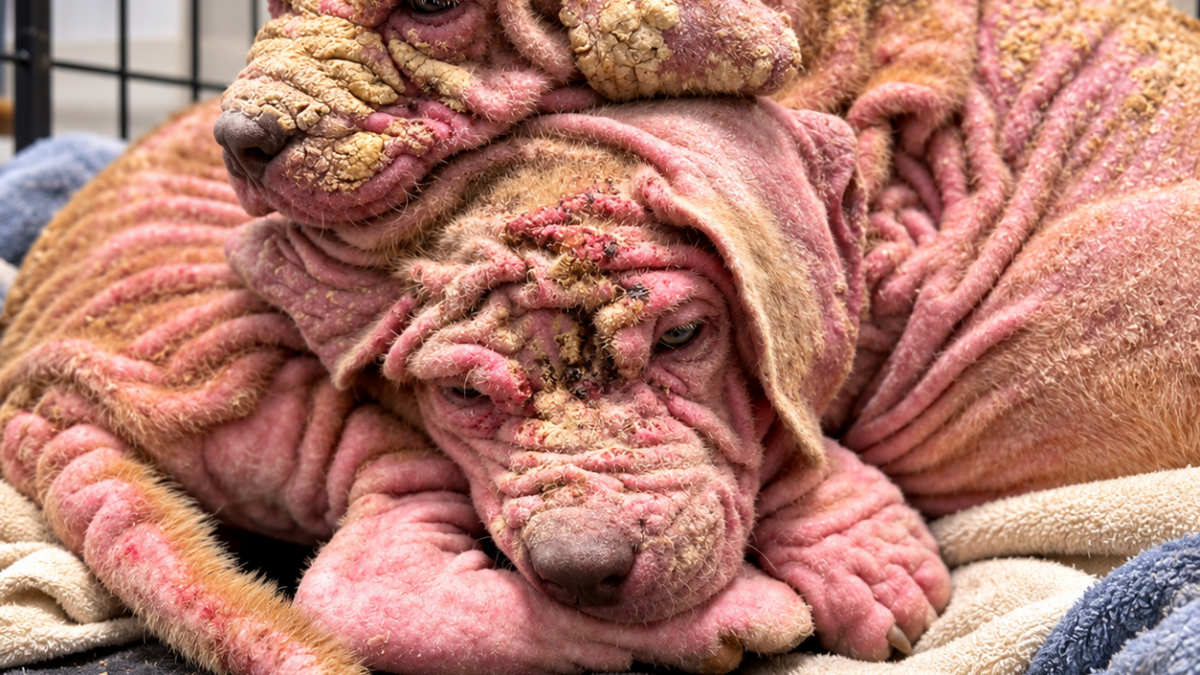
PART 2
Rhaegal fell asleep against my stomach within five minutes.
Drogon did not sleep.
He watched.
That became the first real difference between them.
Rhaegal seemed to treat every person as if we might be the answer to something he had been waiting for.
Drogon treated every person as a question.
Were we safe?
Would we grab him?
Would touching hurt?
Would the food disappear?
Would the bath burn?
Would the hand reaching toward him become another thing he needed to escape?
I didn’t know what had happened to them before Ana found them.
Neither did she.
All she knew was where they had been discovered.
Behind a row of repair shops near the edge of town, beside an abandoned storage shed where people sometimes dumped broken furniture and tires.
A mechanic had noticed two nearly hairless puppies scratching themselves against a concrete wall.
Instead of calling a veterinarian or rescue, someone had decided to try what Ana later called “an old neighborhood cure.”
Motor oil.
Used motor oil.
The kind drained from an engine.
By the time she arrived, the puppies had already been coated.
She asked who had done it.
No one admitted responsibility.
One man shrugged.
“People have used oil for skin problems forever.”
Ana had stared at him.
“That doesn’t make it medicine.”
He walked away.
There was no dramatic confrontation.
No useful confession.
No one standing there was going to fix what had already happened.
So Ana picked up the puppies.
That mattered more.
Leah confirmed severe demodectic mange complicated by secondary bacterial infection.
The good news was that demodex itself was treatable.
The bad news was almost everything around it.
Their immune systems were compromised.
Their nutrition was terrible.
Their skin was infected.
Their bodies were underdeveloped.
Rhaegal weighed several pounds less than we expected for his estimated age.
Drogon weighed even less.
Their legs showed signs consistent with nutritional rickets.
Leah stood beside the treatment board and wrote slowly.
Antiparasitic medication.
Antibiotics.
Medicated skin treatment.
Careful bathing.
Nutritional rehabilitation.
Vitamin and mineral correction.
Pain management.
Frequent bloodwork.
Weight checks.
Then she looked at me.
“And patience.”
“With the mange?”
“With everything.”
That was the part no photograph would show.
People like transformation pictures because they compress suffering.
Day one.
Then suddenly week eight.
Before.
After.
Hairless.
Fluffy.
What disappears between those images are the mornings when nothing seems better.
The diarrhea after changing food.
The puppy who refuses medicine.
The skin that looks angrier before it calms.
The weight gained one week and lost the next.
The night someone stays beside a kennel because breathing sounds different.
The day a frightened animal accepts your hand, then hides from the same hand twenty-four hours later.
Rhaegal and Drogon gave us all of it.
Their first proper bath took almost an hour.
We couldn’t scrub.
Their skin was too fragile.
We couldn’t use anything harsh.
The oil clung stubbornly to the surviving hair and folds of irritated skin.
Leah had us work slowly with lukewarm water and veterinary products chosen for their condition.
Rhaegal stood in the basin trembling.
I supported his chest.
He leaned his entire weight into my palm.
“Really?”
His tail moved.
“You trust us already?”
He tried licking my wrist.
Leah looked over.
“Don’t mistake need for trust.”
That checked me.
“What’s the difference?”
“A puppy desperate for warmth or contact may cling to the first safe thing available.”
“So he doesn’t trust me?”
“I didn’t say that.”
She rinsed one foreleg.
“I’m saying don’t build a romantic story faster than the dog can live it.”
Leah could be irritating in exactly the ways I needed.
Drogon’s bath went differently.
The moment I picked him up, his muscles locked.
His paws spread.
He twisted once.
Not trying to bite.
Trying to escape.
I almost tightened my hold.
Leah stopped me.
“Put him down.”
“He’ll jump out.”
“Then block, don’t squeeze.”
We placed Drogon in two inches of water.
He stood frozen.
I waited.
Thirty seconds.
Then a minute.
I dipped my fingers into the water and let a few drops run over one paw.
He flinched.
Pause.
Again.
Another flinch.
Less.
“Good.”
The word slipped out.
I wanted him to understand.
I wanted him to know we weren’t like whoever had poured oil on his skin.
But trust doesn’t arrive because a human urgently wants it.
So I stopped trying to persuade him.
I became predictable.
Touch shoulder.
Pause.
Water.
Pause.
Rinse.
Pause.
Every movement visible.
Every hand announced by position and speed.
When his trembling worsened, we stopped.
When his body softened, we continued.
By the end, Drogon looked exhausted.
I wrapped him in a warm towel and placed him beside Rhaegal.
Rhaegal immediately shifted closer.
Drogon tucked his face beneath his brother’s neck.
His entire body relaxed.
That told me something else.
Whatever people meant to them, the brothers still meant safety to each other.
The first week revolved around food.
Rhaegal ate as if every bowl might be the final bowl on earth.
He planted both front paws beside it and swallowed so quickly we had to slow him down.
Drogon was different.
He waited.
At first I thought he had less appetite.
Then I noticed what he was watching.
Not the food.
Us.
If I stayed beside the bowl, he remained against the kennel wall.
If I walked away, he approached.
I tested it twice.
Same result.
“He doesn’t trust people around food,” I told Leah.
“Maybe food was taken from him.”
“Or maybe humans were just near every bad thing.”
“Also possible.”
“So what do we do?”
“Give him information.”
That became another phrase I learned from her.
Not force.
Information.
I sat six feet away during Drogon’s meals.
No staring.
No reaching.
Next day, five feet.
Then four.
If he stopped eating, I moved farther away.
Within a week I could sit beside the kennel while he finished a meal.
No touch.
Just presence.
Rhaegal, meanwhile, had no concept of personal space.
He tried to crawl into laps while eating.
If someone opened the kennel, he shoved his head beneath the nearest hand.
He didn’t simply enjoy attention.
He demanded it.
At first everyone found that charming.
Then Leah warned us.
“Don’t create another problem.”
“What problem?”
“Teach him he can settle without constant human contact.”
“He’s a sick puppy.”
“He’s going to be a healthy adult dog.”
That distinction influenced everything.
Comfort them.
Yes.
But don’t accidentally teach helplessness.
Support Drogon without confirming the world was dangerous.
Love Rhaegal without teaching him humans existed solely to entertain him.
Rescue was full of those balances.
By day four, Rhaegal discovered a rubber ball.
He stared at it.
Pawed it.
The ball rolled.
He jumped backward.
Then lunged.
For the next five minutes, he attacked that ball with all the seriousness of a hunter.
Drogon watched from his bed.
The following day, Rhaegal found a towel.
He lowered his front half.
Rear in the air.
Tail going.
A play bow.
I stopped what I was doing.
“Dana.”
Our volunteer looked up.
“What?”
“Look.”
Rhaegal grabbed the towel and shook it.
Dana smiled.
“That’s a puppy.”
Exactly.
For days they had been patients.
Cases.
Charts.
Weights.
Medication doses.
Now one of them was being a puppy.
Drogon watched.
That became his pattern.
He watched Rhaegal do things first.
Rhaegal accepted a hand.
Drogon watched.
Rhaegal climbed into a lap.
Drogon watched.
Rhaegal played with a toy.
Drogon watched.
Rhaegal took food from fingers.
Drogon watched.
His brother became a kind of evidence.
Every time Rhaegal interacted with a human and nothing painful happened, Drogon received another piece of information.
On day nine, he took chicken directly from my hand.
I almost ruined it.
He had been sitting near the kennel entrance.
I held one tiny piece low.
No movement.
I looked away.
Several seconds later, I felt his nose.
Then the chicken disappeared.
I kept my hand still.
Drogon retreated.
I placed another piece on the floor.
He came back.
Third piece from my fingers.
This time he didn’t retreat as far.
My chest felt ridiculously tight.
I wanted to praise him.
Didn’t.
I wanted to touch him.
Didn’t.
The best thing I could do was avoid turning his brave decision into pressure.
So after three pieces, I stood and left.
Dana was outside.
“You look weird.”
“Drogon took food from my hand.”
“That’s why?”
“Yes.”
She smiled.
“Congratulations.”
Rescue recalibrates success.
Sometimes victory is not running through a field with a full coat.
Sometimes it is a puppy moving six inches closer.
The skin recovery was painfully slow.
At first, the biggest change was itching.
They scratched constantly when they arrived.
Rhaegal’s hind foot moved so fast against his neck that we worried he would tear the skin open.
Drogon rubbed his face against bedding.
We trimmed nails carefully.
Changed soft blankets repeatedly.
Kept the environment clean.
Followed medication schedules exactly.
No improvised treatments.
No mystery ointments.
No oil.
No chemicals somebody’s grandfather swore by.
Medicine.
Food.
Clean bedding.
Time.
The boring things.
The boring things saved them.
By the second week, the angry red skin had softened to pink in several areas.
Scabs dried.
Open patches began closing.
The smell of infection faded.
They stopped scratching every waking minute.
That alone transformed their sleep.
Rhaegal began sleeping stretched out instead of curled tightly.
Drogon started sleeping on his side.
The first time I saw his belly exposed, I called Leah.
She walked in.
“What?”
“Look.”
Drogon was asleep.
“That’s it?”
“He’s not tucked into a ball.”
Leah watched.
Then nodded.
“Good.”
She understood.
A vulnerable sleeping position can say things behavior notes cannot.
The rickets worried us longer.
Their legs were weak.
Rhaegal’s wrists bowed slightly.
Drogon tired quickly.
Leah warned us not to overexercise them.
“They’re puppies.”
“Yes.”
“They want to run.”
“Yes.”
“And I’m supposed to stop them?”
“Correct.”
“That feels cruel.”
“Letting weak bones absorb repeated impact would be crueler.”
So we built boring play.
Soft surfaces.
Five minutes.
Rest.
Gentle toys.
No jumping off furniture.
No stairs.
Rhaegal hated restrictions.
The first time Dana ended play and returned him to the kennel, he barked.
Sharp.
Offended.
She stared.
“Did he just yell at me?”
Rhaegal barked again.
“Yes.”
“Good.”
“Why good?”
“Because sick puppies usually don’t waste energy arguing.”
Drogon learned to bark a few days later.
Rhaegal had stolen a plush toy.
Drogon stared.
Rhaegal chewed.
Drogon stood.
One uncertain bark.
Rhaegal stopped.
Drogon barked again.
Then marched forward and took the toy.
I sat down laughing.
There is something reassuring about watching a traumatized puppy discover sibling irritation.
Normal puppy conflict meant there was enough energy left for nonsense.
At three weeks, the first fur appeared.
I noticed three dark hairs over Rhaegal’s eye.
I counted them.
Then called Leah.
She leaned in.
“You interrupted me for three hairs?”
“Four.”
“You counted?”
“Obviously.”
“I’m worried about your mental health.”
Two days later, Drogon developed a tiny patch on his shoulder.
Then more along the spine.
Their coats returned like islands.
Uneven.
Soft.
At first the new hair seemed impossibly thin.
But every week there was more.
The first real setback came just as we started feeling confident.
Rhaegal refused breakfast.
For any other puppy, that might not have alarmed me immediately.
For Rhaegal, refusing food was practically a medical emergency by personality.
I offered chicken.
Nothing.
Peanut butter on a spoon.
Nothing.
He walked toward me.
Then lay down.
“Leah.”
She examined him.
Temperature elevated.
One ear looked more inflamed.
Lymph nodes enlarged.
Bloodwork showed the secondary infection had not fully cleared.
A culture allowed Leah to adjust antibiotics.
“He’ll be okay?”
“I expect so.”
“You sound too calm.”
“I’m a veterinarian.”
“Try being reassuring.”
“I expect him to be okay.”
“Better.”
Rhaegal became quiet for almost two days.
Drogon changed with him.
He stopped playing.
Every time Rhaegal slept, Drogon pressed close.
That second night, Rhaegal remained in treatment for monitoring.
We left Drogon in the kennel.
Within minutes he began pacing.
Then whining.
Then scratching the gate.
He refused dinner.
I brought him Rhaegal’s blanket.
He climbed onto it.
Still restless.
At midnight, Leah came through.
“How long has he been doing that?”
“Hours.”
“Bring him into treatment.”
“We’re isolating Rhaegal.”
“They can be several feet apart.”
We set up a second bed.
The moment Drogon saw his brother, the whining stopped.
Rhaegal lifted his head.
Tail moved once.
Drogon curled down.
Within minutes, both were asleep.
I sat between them.
That was when I first questioned our assumption that they should always stay together.
“Are they too dependent?”
Leah was entering notes.
“Maybe.”
“That sounds bad.”
“Dependence isn’t automatically bad.”
“What about Drogon?”
“He uses Rhaegal as a safety cue.”
“So we keep them together.”
“For now.”
I looked at her.
“For now?”
Leah closed the laptop.
“What happens when one goes to the veterinarian without the other?”
“We bring both.”
“Every time?”
I knew where she was going.
“What if one gets adopted first?” she continued.
“They won’t.”
“You already decided that?”
“Yes.”
“Why?”
“They’re brothers.”
“They are.”
“They survived together.”
“They did.”
“They sleep together.”
“They also eat separately without distress.”
“That’s not the point.”
“What is the point?”
I stopped.
Because I knew the real answer.
The point was that keeping them together felt emotionally correct to me.
Leah saw it.
“Don’t make their future satisfy our narrative.”
I hated that sentence.
It stayed anyway.
Once Rhaegal improved, we began short separations intentionally.
Five minutes.
Rhaegal barely noticed.
He loved whoever had snacks.
Drogon watched the door.
Rhaegal returned.
Ten minutes next time.
Drogon remained alert but didn’t panic.
Fifteen.
Then thirty.
We paired the separation with enrichment.
Food puzzles.
Quiet contact.
Different rooms.
The lesson wasn’t that they should stop loving each other.
The lesson was that absence could end.
Rhaegal always came back.
That also helped Drogon with people.
Without his brother present, Drogon sometimes chose us.
Not because he had no alternative.
Because we had become an alternative.
The first time he initiated contact happened on a rainy afternoon.
Rhaegal was asleep after treatment.
I entered carrying clean bedding.
Drogon watched.
I placed the blanket.
Sat.
No food.
No reaching.
He stood.
Walked halfway across the kennel.
Stopped.
I kept my hands on my knees.
He came closer.
Sniffed my shoe.
Then my leg.
Then he rested his chin against my knee.
I stopped breathing normally.
Drogon looked at my hand.
I moved one inch.
He stayed.
Another.
I touched one finger to the side of his neck.
No flinch.
One stroke.
Stop.
Another.
His eyes closed.
That was the first time Drogon stayed near me simply because he wanted to.
The next morning he backed away from my hand again.
For a few seconds, disappointment hit me.
Then I caught myself.
Trust earned yesterday does not become debt today.
If he wanted distance, he got distance.
Two days later, he leaned into my hand again.
That was his pace.
By week five, both puppies had gained significant weight.
Rhaegal looked sturdy enough that visitors stopped reacting with shock.
Drogon still appeared lean but no longer fragile.
Their legs strengthened.
Their skin improved.
Fur covered almost half their bodies.
Rhaegal’s personality expanded with his health.
Unfortunately for everyone.
He stole gloves.
Dragged towels into his water bowl.
Tried climbing inside the laundry cart.
Learned that barking made humans look at him.
Used that information irresponsibly.
Once, I found him sitting on an overturned food dish barking at absolutely nothing.
“What?”
Bark.
“What do you want?”
Bark.
“You don’t know either, do you?”
Tail wag.
Drogon became funny in quieter ways.
He discovered he could approach volunteers from behind, sniff their shoes, then retreat before they turned.
He stole toys from Rhaegal and hid behind beds.
He preferred chest scratches to being touched over the head.
And he hated brooms.
Not mildly.
If one appeared, he moved to the opposite side of the room.
We had no idea why.
Maybe a broom had frightened him earlier in life.
Maybe he simply disliked it.
We didn’t need a dramatic explanation.
The broom stayed farther away.
Treats appeared when it was present.
No one chased him with it.
Over weeks, the broom became boring.
That was my favorite kind of progress.
Not a cinematic moment.
A thing that once mattered becoming irrelevant.
Then Rhaegal discovered the door to the supply room.
It didn’t latch perfectly.
He pushed it with his nose.
The door opened.
Inside were bags of food.
Dana found him halfway into one.
“Rhaegal!”
He froze.
His entire head was inside a bag.
She pulled him out.
His face covered in crumbs.
“He looks innocent,” I said.
“He committed burglary.”
Rhaegal wagged.
We fixed the latch.
The puppies were medically rechecked at six weeks.
Leah studied their new bloodwork.
“Better.”
“How much better?”
“Anemia resolving. Protein improving. Inflammation down.”
“Bones?”
“Need time.”
“Skin?”
“Excellent response.”
I smiled.
Then she looked at Drogon’s weight.
“He still needs more.”
Drogon had gained, just slower than Rhaegal.
We adjusted his feeding plan.
Added another small meal.
Checked stool.
No parasites.
No gastrointestinal disease.
He simply seemed to be catching up at his own pace.
Again.
Different roads.
Same direction.
The first adoption applications arrived before they were ready.
Our social media post had spread.
The photographs did what photographs do.
Two hairless puppies covered in oil.
Then images of them healing.
People felt invested.
Applications came from three states.
Some were wonderful.
Some were not.
One person wrote:
I want the brave one.
No name.
Just the brave one.
Rhaegal.
Another wrote:
Can I adopt the shy one because he looks calmer?
That bothered me even more.
Drogon was not calm.
He was cautious.
Those are not the same thing.
A dog can stand perfectly still because he feels safe.
Or because he feels trapped.
Behavior without context can lie.
We rewrote their profiles carefully.
Rhaegal:
Social, energetic, affectionate, playful, recovering from severe early malnutrition and skin disease. Benefits from structure and continued confidence-building around separation.
Drogon:
Sensitive, observant, increasingly affectionate, prefers patient introductions and predictable routines. Has made substantial progress in confidence and enjoys play once comfortable.
No “damaged.”
No “broken.”
No “problem dog.”
Labels become expectations.
Expectations affect how people behave.
Rhaegal was brave until a metal tray crashed behind him one afternoon.
He sprinted behind my legs.
Drogon, surprisingly, stayed in place.
Dana looked at me.
“Which one is brave?”
“Both.”
That became our answer.
Their fur thickened steadily.
By eight weeks in rescue, a stranger might never have guessed how they arrived.
Rhaegal’s coat came in warm brown-black with lighter markings across the face and chest.
Drogon’s coat was darker along the spine, almost charcoal in some light.
The skin underneath looked healthy.
The relentless scratching stopped.
Their ribs disappeared beneath muscle.
Leah finally increased their exercise allowance.
The first unrestricted yard session was complete chaos.
Rhaegal exploded through the door.
Drogon followed.
Rhaegal ran one circle.
Then another.
Drogon cut across the center and collided with him.
Both rolled.
Jumped up.
Ran again.
Dana shouted, “Slow down!”
They did not care.
I laughed against the fence.
For two months, every step had been measured.
Now their bodies finally felt strong enough to belong to them.
Rhaegal found a mud patch.
Drogon found Rhaegal in the mud patch.
Within minutes, both were filthy.
I looked at Leah.
“They just got fur.”
She shrugged.
“Now you get to wash it.”
The bath showed us how much had changed.
Rhaegal jumped into the tub because Dana dropped a treat.
Drogon paused at the edge.
Looked at me.
Sniffed.
Then climbed in.
No trembling.
No flattened posture.
No panic.
I rinsed his back.
He turned.
Licked my hand.
I stopped.
Not because I needed to.
Because I remembered the first bath.
The frozen body.
The eyes scanning every hand.
“Look at you.”
Drogon leaned into my fingers.
That night, I opened the arrival photographs on my phone.
Then the new ones.
Physically, the transformation looked dramatic.
But the photos still missed everything important.
They couldn’t show Drogon sleeping belly-up.
Couldn’t show Rhaegal waiting ten seconds before his food bowl was set down.
Couldn’t show Drogon moving toward a hand instead of away.
Couldn’t show Rhaegal surrendering a toy because he had learned another toy would appear.
Couldn’t show the way both puppies now complained loudly when bath time interrupted play.
Recovery lived in ordinary behavior.
That was when the adoption question became unavoidable.
Together?
Or separate?
My answer remained together.
Then we performed more structured assessments.
Individual walks.
Individual play.
Short trips apart.
One puppy at the clinic while the other stayed at the rescue.
Rhaegal thrived independently.
Drogon did too.
He noticed Rhaegal’s absence.
But he did not fall apart anymore.
That should have made me happy.
Instead, I felt disappointed.
Leah caught it.
“You wanted them dependent?”
“No.”
“You look like you did.”
“I wanted them together.”
“That’s different.”
“Is it?”
“Yes.”
I looked through the kennel window.
Rhaegal was asleep.
Drogon was twenty feet away chewing a toy.
Not touching.
Not watching.
Leah said, “They helped each other survive.”
“I know.”
“That doesn’t automatically mean they need the same home forever.”
“It would be a better story.”
The moment the words came out, I regretted them.
Leah looked at me.
“Exactly.”
That silenced me.
A better story for whom?
The audience?
Us?
The dogs didn’t care about narrative symmetry.
They cared about safety.
Exercise.
Food.
Affection.
Consistency.
Homes suited to their individual temperaments.
We continued accepting applications for both together and separately.
Then the Harrison family applied for Rhaegal.
Mark and Jennifer.
Their fifteen-year-old daughter Emma.
An older mixed-breed dog named Scout.
Fenced yard.
Someone usually home.
They came for a visit.
Rhaegal decided within thirty seconds that they were his people.
He climbed into Emma’s lap.
She laughed.
“You weigh more than you think.”
Rhaegal licked her entire face.
Mark did not ask whether Rhaegal would become prettier.
He asked:
“Does early rickets create long-term orthopedic risk?”
Good question.
Jennifer asked about skin recurrence.
Food.
Follow-up bloodwork.
Separation training.
Scout came for a dog meeting.
Rhaegal tried to wrestle immediately.
Scout gave him one look.
Rhaegal backed off.
They walked together.
Shared space comfortably.
Good.
Then an application came for Drogon.
Claire Jensen.
Thirty-seven.
Worked from home as an editor.
Quiet household.
No children.
One confident older cat named Olive.
Her application contained one line I read three times.
I don’t need him to love me immediately. I’m comfortable letting a cautious dog decide how fast the relationship moves.
Claire’s first visit lasted almost an hour.
For fifteen minutes, she ignored Drogon.
Not coldly.
Respectfully.
She sat sideways.
Talked to me.
Kept her hands low.
Drogon approached from behind.
Sniffed her shoulder.
Claire smiled without turning.
“That him?”
“Yes.”
“Good.”
Ten minutes later, he came around to the front.
She offered her hand low.
He sniffed.
Walked away.
Claire said, “That went well.”
I laughed.
“You have low standards.”
“Realistic ones.”
Second visit, Drogon took a treat.
Third, he sat beside her.
Fourth, he leaned against her leg.
My excuses began running out.
I invented one more medical check.
Then another.
Helen, our shelter director, called me into her office.
“You’re stalling.”
“I’m being careful.”
“You’re stalling professionally.”
“They’ve never been permanently separated.”
“That is true.”
“What if Drogon regresses?”
“Then Claire calls us.”
“What if Rhaegal misses him?”
“He probably will.”
“That’s not reassuring.”
Helen folded her hands.
“Missing somebody is not the same as being harmed by separation.”
I stared at her.
She continued.
“If they showed severe distress apart, I would insist on joint placement.”
“They don’t.”
“No.”
“They still love each other.”
“Of course.”
“So why split them?”
“Because two excellent homes have appeared, each suited to one dog, and we have no behavioral evidence that the dogs require placement together.”
I looked down.
Helen softened.
“You don’t have to like it.”
“I don’t.”
“But you do have to decide for them, not for yourself.”
That was the job.
Rhaegal’s adoption happened first.
Saturday morning.
Emma arrived carrying a blue harness that was slightly too large.
Rhaegal didn’t care.
His tail hit everything.
Wall.
Cabinet.
Emma’s knees.
My leg.
The paperwork took forty minutes because Mark read every line.
I appreciated that.
Before they left, we brought both brothers into the yard.
I expected something emotional.
They wrestled.
Rhaegal tackled Drogon.
Drogon bit Rhaegal’s ear.
Rhaegal stole a toy.
Drogon stole it back.
Normal.
Finally Emma clipped the leash.
“Ready?”
Rhaegal looked at Drogon.
Then Emma.
Then started chewing the leash.
I laughed.
“Deeply sentimental.”
Emma led him toward the parking lot.
Drogon stood beside me.
He watched until Rhaegal disappeared.
Then looked at the gate.
I waited for panic.
Nothing.
He sniffed.
Turned.
Walked inside.
That evening he was quieter.
He checked the shared bed twice.
Slept alone.
But he ate.
Played briefly.
Accepted touch.
The next morning he greeted Dana.
By afternoon, he seemed settled.
Rhaegal’s first update arrived that same night.
Photo.
Upside down on the Harrison couch.
Scout asleep at the other end.
Emma wrote:
He stole my pillow, my blanket, and half my dinner. Adjustment appears successful.
I showed Drogon the phone.
“Your brother is thriving.”
He sniffed the screen.
Walked away.
Dogs refuse to perform the feelings humans assign them.
Drogon left nine days later.
Claire brought a soft bed for the car.
No celebration banner.
No crowd.
No dramatic goodbye.
Exactly right for him.
She sat inside his kennel.
Drogon approached.
Pressed against her leg.
Claire looked at me.
“You okay?”
“No.”
“Bad no?”
“Rescue no.”
“What does that mean?”
“I don’t know.”
I clipped Drogon’s leash.
We walked toward the exit.
At the threshold, a truck started outside.
Drogon backed one step.
Claire did not pull.
She waited.
He sniffed.
Looked at her.
She stepped forward.
Drogon followed.
That was how he left.
Not carried.
Not dragged.
Choosing.
Afterward, I returned to the kennel.
Two empty beds.
For weeks, the room had held medication bottles, food bowls, clean towels, scratched bedding, barking, wrestling, and fur growing back one patch at a time.
Now silence.
I sat down.
Dana found me.
“You regret it.”
“Maybe.”
“They’re in good homes.”
“I know.”
“They’re healthy.”
“I know.”
“They were ready.”
“I know.”
“Knowing isn’t helping?”
“Not yet.”
It did later.
Rhaegal adapted immediately.
The Harrisons sent updates almost daily at first.
He followed Scout through the yard.
Slept with Emma.
Learned sit quickly.
Learned stay slowly.
Learned leave it only when the object wasn’t interesting.
Developed an obsession with socks.
Emma texted:
He does not eat them. He relocates them. We think he has a system.
At his six-month recheck, Leah reviewed his legs.
Muscle development good.
Bone changes improving.
No obvious pain.
“Will he always have risk because of the rickets?”
“Possibly some.”
“Meaning?”
“Keep him lean. Appropriate exercise. Monitor joints as he ages.”
Rhaegal tried climbing onto the exam table without permission.
Leah caught him.
“He also needs better judgment.”
Impossible.
Drogon’s adjustment was slower.
Claire expected that.
The first night, he slept at the far end of her bedroom.
Second night, closer.
Third, beside the doorway.
He followed her only when she wasn’t looking directly at him.
Olive the cat watched from high furniture like an offended landlord.
Drogon avoided her.
Excellent survival instinct.
On day four, Claire sent:
He took a treat while I was standing instead of sitting.
Big news.
A week:
He fell asleep with his back against my foot.
Two weeks:
He brought me a toy. I think it was intentional.
A month:
He barked at the mail carrier and then scared himself with his own bark.
I saved that one.
Drogon slowly became comfortable enough to develop preferences.
He liked sleeping near windows.
Hated vacuum cleaners.
Loved chicken more than beef.
Preferred women initially but warmed to calm men.
Did not appreciate strangers reaching over his head.
Loved chest scratches.
Would lean his entire body into Claire once he decided she belonged to him.
He never became Rhaegal.
That was important.
People love transformation stories where a shy dog turns outgoing.
But confidence does not require extroversion.
Drogon remained thoughtful.
Observant.
Selective.
Healing meant he could say no without fear and yes without panic.
That was enough.
The brothers met again almost a year later at a rescue picnic.
Rhaegal arrived first.
Full coat.
Strong.
Broad chest.
Emma barely contained him.
Drogon entered twenty minutes later beside Claire.
I noticed them before they noticed each other.
Rhaegal was sniffing grass.
Drogon walking quietly.
Then Rhaegal’s head snapped up.
Drogon stopped.
They stared.
For one second, the entire yard seemed to disappear around them.
Then Rhaegal charged.
Emma almost lost the leash.
“Rhaegal!”
Drogon’s tail began moving.
Rhaegal reached him.
Sniffing.
Whining.
Circling.
Drogon tolerated three seconds.
Then tackled him.
They wrestled.
Rolled.
Chased.
People gathered.
I cried.
Dana saw.
“Allergies?”
“Don’t.”
After twenty minutes, something even more important happened.
Rhaegal returned to Emma.
Drogon returned to Claire.
When the families walked opposite directions, neither puppy panicked.
They remembered each other.
They clearly cared.
And they knew where they belonged.
That was when I finally stopped questioning our decision.
We had not broken a bond.
We had helped each dog build enough security that love no longer required constant proximity.
Years passed.
Their lives became wonderfully ordinary.
Rhaegal moved with the Harrisons when they bought a larger home.
Emma went to college.
The first week after she left, Rhaegal checked her bedroom every morning.
When she came home for break, Mark sent a message:
Rhaegal screamed. Not barked. Screamed. Our neighbors may think we own livestock.
Drogon moved apartments with Claire.
She worried the environmental change would undo years of confidence.
It didn’t.
He entered the new place.
Sniffed every room.
Found his bed.
Found Claire.
Settled.
Safety had become portable.
That felt enormous.
Once, his feeling of safety existed almost entirely in Rhaegal.
Then partly in us.
Eventually it lived inside patterns he could carry anywhere.
Food comes.
Claire stays reliable.
Doors open.
Pain gets treated.
Hands ask instead of force.
That is what secure attachment looks like when translated into dog behavior.
One winter, Claire called.
“Drogon tore a knee ligament.”
My chest tightened.
“What happened?”
“Running.”
“Of course.”
“He needs surgery.”
Surgery meant anesthesia.
Hospitalization.
Postoperative restraint.
Pain.
Everything likely to challenge a dog with his history.
Claire was worried about the medical outcome.
She was equally worried about trust.
“What if he thinks I abandoned him at the clinic?”
“We plan around it.”
Claire stayed through admission as long as allowed.
The veterinary staff documented his handling preferences.
No unnecessary overhead reaching.
Food rewards.
Quiet kennel area.
Claire’s blanket.
She returned as soon as discharge permitted.
The surgery went well.
The first night home, Drogon refused his food.
Claire sat on the floor.
Offered pieces from her palm.
He ate three.
Then five.
Then the whole portion.
Recovery required weeks of controlled activity.
No running.
No jumping.
Leash walks only.
Claire texted:
Apparently surviving childhood trauma did not prepare Drogon for eight weeks of orthopedic boredom.
He healed.
Months later he ran again.
Not because he had forgotten pain.
Because bodies can relearn confidence too.
Rhaegal created his own emergency.
He swallowed part of a rubber toy.
Emma called from the emergency clinic.
“I feel like an idiot.”
“You’re not.”
“He survived mange and starvation and now he tries to die eating rubber.”
“That is extremely consistent with his personality.”
Imaging confirmed obstruction.
Surgery removed the piece.
Rhaegal recovered.
The Harrison household removed that type of toy permanently.
Normal dogs do stupid things.
That was strangely comforting.
Not every illness had to trace back to neglect.
Not every fear had to symbolize trauma.
Their past deserved to become background sometimes.
Years after rescue, I still received photographs.
Birthdays.
Holidays.
Vet visits.
Nothing dramatic.
Rhaegal wearing a ridiculous sweater.
Drogon sleeping beneath Claire’s desk.
Rhaegal stealing wrapping paper.
Drogon sharing a couch with Olive.
“Sharing” was generous.
Olive controlled most of it.
Drogon accepted approximately two feet of cushion.
The mange never returned severely.
They had occasional skin irritation.
Seasonal itching.
Normal veterinary problems.
Nothing resembling the raw bodies we first saw.
The motor oil disappeared from their visible lives.
That mattered.
For a long time, I stayed angry at whoever poured it over them.
Eventually the anger became more complicated.
Ana believed the person had probably thought they were helping.
That did not excuse it.
Intent does not neutralize harm.
But it changed what we did next.
Instead of only telling people:
“Don’t put motor oil on dogs.”
We created community information about mange.
What it is.
Why different types require proper diagnosis.
Why used oil and harsh chemicals can injure skin.
Where low-cost veterinary help was available.
How to contact rescue before a situation became severe.
Ana returned to the neighborhood where she had found them.
The same mechanic who had defended the practice initially refused the flyer.
Then she showed him updated photos.
Rhaegal beside Emma.
Drogon with Claire.
Full coats.
Healthy.
The man stared.
“That’s those dogs?”
“Yes.”
“They look normal.”
“They’re healthy.”
“What did you use?”
“Proper veterinary treatment.”
He hesitated.
“The oil didn’t help?”
“No.”
“People always said it did.”
“I know.”
He took the flyer.
That moment did not punish anybody.
It did something more useful.
It reduced the chance of another puppy receiving the same treatment.
Sometimes rescue is not about revenge.
Sometimes the best consequence for ignorance is making it harder to remain ignorant.
We eventually worked with a local low-cost clinic to host monthly skin-disease days.
Owners could bring dogs with itching, hair loss, lesions, or suspected mange.
Some were poor.
Some embarrassed.
Some had already tried home remedies.
We learned not to begin by shaming them.
A veterinarian once told me:
“If you make people too afraid to admit what they did, they’ll lie, and the dog pays for the lie.”
So we asked.
“What did you apply?”
Oil?
Tell us.
Bleach?
Tell us.
Herbal paste?
Tell us.
Human cream?
Tell us.
We needed the truth more than we needed moral victory.
Rhaegal and Drogon changed our program that way.
Their rescue became more than two adoptions.
Not because we turned them into symbols.
Because what happened exposed a practical gap.
People with sick dogs sometimes reach for the nearest thing they’ve heard about.
If proper care is inaccessible, rumor becomes treatment.
We couldn’t fix poverty or veterinary access overnight.
But we could offer one better door.
Years later, Ana called after finding another mange-covered puppy in the same district.
My stomach tightened.
“Oil?”
“No.”
“You’re sure?”
“The owner remembered the brothers.”
I sat down.
“What?”
“She said somebody told her not to use it. She called the clinic instead.”
That may have been the most satisfying update connected to Rhaegal and Drogon.
Not a photo.
Not an adoption anniversary.
Another puppy who never had motor oil poured onto damaged skin.
Rhaegal and Drogon were middle-aged by then.
The first gray hairs appeared around their muzzles.
I hated that.
Emma laughed when I complained.
“They’re not puppies.”
“They are to me.”
“Rhaegal is seventy pounds.”
“Large puppy.”
Rhaegal tried climbing into my lap during a visit.
“Evidence.”
Drogon approached from the side.
Sniffed.
Then leaned his shoulder against my leg.
Some things never changed.
We arranged another reunion.
Not because they needed it.
Because the families enjoyed staying connected.
Rhaegal greeted Drogon with enthusiasm.
Drogon greeted him with dignity for approximately five seconds before the wrestling began.
They tired faster than when young.
After ten minutes, both lay beneath a tree.
Rhaegal panted.
Drogon rested his head on his paws.
Emma sat beside me.
“Do you think they remember?”
“What?”
“How bad it was.”
I looked at them.
“I don’t know.”
“Do dogs remember pain?”
“Associations, definitely. Experiences. Smells. Places. Handling.”
“The actual mange?”
“I can’t answer that.”
She picked at the grass.
“I hope they don’t.”
Claire, sitting nearby, looked toward Drogon.
“I used to hope that.”
Emma turned.
“What changed?”
Claire thought for a moment.
“I don’t care if he remembers.”
“That sounds terrible.”
“No.”
She touched Drogon’s back.
“I just want everything after it to be bigger.”
I looked at her.
“What?”
“The memory.”
Claire nodded toward the dogs.
“If that first part is still in there somewhere, fine. I just want this part to take up more room.”
I remembered the sentence.
Because that is what recovery often is.
Not erasure.
Expansion.
The beginning stays true.
It simply stops occupying the whole story.
Rhaegal’s beginning contained hunger.
His later life contained Emma returning from college and sleeping with him on the couch.
Drogon’s beginning contained fear of hands.
His later life contained Claire touching his chest while he fell asleep.
Their beginning contained oil.
Their later lives contained ordinary shampoos, rain, mud, blankets, sun-warmed fur.
Their beginning contained weak legs.
Later there were hikes.
Runs.
A torn ligament from moving too fast.
A swallowed toy because Rhaegal remained an idiot.
Those things mattered too.
I once believed successful rescue should produce a perfect after.
No fear.
No health problems.
No setbacks.
No consequences.
I stopped believing that because of dogs like them.
Rhaegal remained vulnerable to joint problems.
Drogon remained cautious with strangers.
Their skin needed monitoring.
Those facts didn’t make their recovery incomplete.
Health is not perfection.
Trust is not fearlessness.
A safe life is not a life where nothing painful ever happens.
It is a life where pain gets noticed.
Treated.
Where fear is respected.
Where needs matter.
Where people stay responsible after the dramatic rescue photos are old.
That last part matters most.
Rhaegal’s adoption photo received hundreds of reactions.
Years later, when Emma gave him arthritis supplements every morning, nobody applauded.
When Claire spent weeks doing controlled leash walks after Drogon’s knee surgery, nobody saw.
When Mark replaced a backyard step because Rhaegal slipped once, it wasn’t a rescue story.
When Claire warned a visiting friend not to reach over Drogon’s head, there was no photograph.
But that was where the rescue kept happening.
Again and again.
Quietly.
One morning, many years after their arrival, Emma called.
Her voice sounded strained.
“Rhaegal collapsed.”
I sat up.
“What happened?”
“They’re at the emergency hospital.”
“Do you know why?”
“Not yet.”
He was older now.
Not ancient.
But old enough that the possibilities scared me.
The veterinarian found a splenic mass.
I knew what that could mean.
Emma knew too.
Further imaging suggested bleeding.
Surgery became the only realistic chance.
Rhaegal underwent emergency splenectomy.
The waiting was brutal.
Emma texted:
I keep thinking about when he was a puppy and you said he was a fighter.
I answered:
He also has excellent doctors. Let both things be true.
The mass was removed.
Pathology took days.
Those days felt longer than weeks.
Then the call.
Benign.
Not cancer.
Emma cried.
I cried.
Rhaegal recovered.
Slowly.
He wore a surgical shirt.
Hated it.
Tried stealing food before he was cleared for normal meals.
Some personalities survive everything.
Drogon’s older years were quieter.
Claire moved from an apartment into a small house with a fenced backyard.
The first morning, she opened the back door.
Drogon stood at the threshold.
Looked outside.
Then at Claire.
He stepped onto the grass.
Walked the perimeter.
Returned.
That evening he slept in a patch of sun near the kitchen.
Claire sent me a photo.
He owns real estate now.
He did not technically own anything.
No one told him.
Olive the cat died at eighteen.
Drogon searched for her for two days.
Then began sleeping in her favorite sunny spot.
Claire called it inheritance.
Rhaegal and Drogon continued aging on separate paths.
Exactly as they had healed.
Rhaegal loud.
Social.
Demanding.
Drogon quiet.
Selective.
Steady.
At one reunion in their later years, there was no wrestling.
Rhaegal’s arthritis had progressed.
Drogon’s knee made rough play unwise.
They approached.
Sniffed.
Tails moved.
Then Rhaegal lay down.
Drogon settled beside him.
Their shoulders touched.
No drama.
No wild recognition.
Just familiarity.
I sat several feet away.
For the first time, the memory of those tiny hairless bodies felt truly distant.
Not gone.
Distant.
That was a gift.
Rhaegal died first.
Years after the rescue.
Years after anyone could reasonably say he was lucky simply to be alive.
His arthritis had worsened, but it was not what ended his life.
A sudden neurological event took away his ability to stand properly.
At the emergency clinic, imaging suggested a serious spinal problem.
Surgery was possible.
The odds were poor given his age and other conditions.
Emma called me.
“What would you do?”
I hate that question.
Because people want certainty.
They want someone else to make grief logical.
I asked:
“What does the veterinarian say?”
“That surgery may not give him meaningful function.”
“Pain?”
“Controlled right now.”
“Can he stand?”
“No.”
“Does he still want food?”
A tiny laugh through tears.
“Yes.”
Of course he did.
Rhaegal ate chicken that night.
The family took him home with palliative medication while they considered options.
By morning, he was distressed despite treatment.
The decision became clearer.
Emma asked the veterinarian to come to the house.
Scout had died years earlier.
Rhaegal’s bed sat beside the couch he had claimed on his first night.
Emma lay on the floor with him.
Mark and Jennifer nearby.
They called me on video before the veterinarian arrived.
Rhaegal’s muzzle was almost white.
His coat was still full.
That struck me hardest.
The first time I saw him, he barely had fur.
Now he was leaving the world wearing all of it.
“Hey, trouble.”
His ears moved.
Emma put the phone closer.
“He hears you.”
“Rhaegal.”
His tail shifted.
One slow movement.
I cried.
Emma laughed through her own tears.
“He still likes you.”
“He likes everyone.”
“That’s true.”
The veterinarian sedated him at home.
Emma kept one hand on his chest.
Rhaegal fell asleep surrounded by the people he had spent years demanding attention from.
No isolation.
No raw skin.
No hunger.
No fear of being touched.
He died the same way he had lived after rescue.
Close to people.
Completely certain he belonged.
When Claire heard, she brought Drogon to visit Emma several weeks later.
I didn’t know whether that was necessary for Drogon.
Maybe it was more for the humans.
There was no Rhaegal scent to find in any meaningful fresh sense by then.
Still, Drogon entered the Harrison yard.
Sniffed.
Walked toward the porch.
Emma sat down.
Drogon approached her.
She buried her face in his neck.
He stood still.
Then leaned.
That was his gift.
He had always leaned.
Emma whispered:
“You’re the quiet one.”
Drogon rested his weight against her.
I watched from several feet away.
The two brothers had not needed the same home.
But their lives kept touching.
Drogon lived several more years.
His aging was gradual.
Kidney changes.
Hearing loss.
Arthritis.
Claire adapted the house.
Rugs over slippery flooring.
Night-lights because his vision declined slightly.
Ramp to the yard.
Medication.
A thicker bed.
He accepted aging with the same cautious patience he had shown as a puppy.
Observe first.
Adjust.
Then continue.
The final time I saw Drogon, he was sleeping beneath Claire’s desk.
I entered.
He did not hear me at first.
Claire touched his shoulder.
“Someone’s here.”
Drogon lifted his head.
Saw me.
Stood slowly.
Walked over.
Sniffed.
For a second, I wondered whether he recognized me.
Then he leaned his shoulder against my leg.
I closed my eyes.
“There you are.”
Claire smiled.
“He doesn’t do that to everyone.”
“I know.”
We sat together.
I asked how he was.
“Old.”
“Medical answer?”
“Stage-two kidney disease. Arthritis. Hearing about half gone. Still eating.”
“Chicken?”
“Always.”
Drogon slept while we talked.
At one point Claire said:
“Do you remember how he used to watch every hand?”
“Yes.”
“He lets the vet draw blood now without sedation.”
“That’s huge.”
“I know.”
Then she said something softer.
“I think he finally assumes people are trying to help.”
I looked down at him.
That may have been the most complete description of Drogon’s recovery anyone ever gave me.
Not that he loved everyone.
Not that he stopped being cautious.
He had simply shifted his default expectation.
A hand might help.
That is an enormous change for an animal who once flattened himself against a treatment table before anyone touched him.
Drogon died the following spring.
Kidney disease progressed.
His appetite decreased.
Then disappeared.
Claire tried fluids.
Medication.
Diet changes.
Everything appropriate.
Eventually comfort became the only treatment left.
The veterinarian came to the house.
Drogon lay in his sunny spot near the kitchen.
Claire called me afterward.
Not during.
“I couldn’t talk.”
“You didn’t need to.”
“He leaned against me.”
Of course he did.
“At the end?”
“Yes.”
Her voice broke.
“Right until he fell asleep.”
I sat at my kitchen table with the phone pressed against my ear.
For several moments neither of us spoke.
Then Claire said:
“He came into this world with Rhaegal.”
“Yes.”
“And left without him.”
“Yes.”
“Do you think that’s sad?”
I thought carefully.
“No.”
“Why?”
“Because he knew how to do it.”
Claire cried harder.
So did I.
The puppy who once needed his brother to tell him the world was safe had lived long enough to face his last moment leaning against the person he had chosen.
That didn’t erase Rhaegal.
It proved what the brothers had given each other.
Enough support to become separate.
After Drogon died, Claire sent me one final photograph.
Not from his last day.
From years earlier.
Drogon lying in sunlight.
Full dark coat.
Eyes half closed.
One paw touching Claire’s ankle.
Nothing dramatic.
I placed it beside Rhaegal’s photograph.
The earliest picture of the two brothers still existed too.
I rarely looked at it.
Not because I wanted to forget.
Because their first condition no longer deserved the most attention.
When new volunteers asked about the names Rhaegal and Drogon written on an old donor plaque, I told the story differently than I once had.
I did not begin with motor oil.
I began with personality.
“Rhaegal thought every person existed to love him.”
They would laugh.
“And Drogon?”
“Drogon needed proof.”
Then I explained.
Two brothers.
Same illness.
Same rescue.
Different response.
Different healing.
Different homes.
Long lives.
If they asked about the oil, I told them.
If they asked about the mange, I explained.
But those were facts.
Not identities.
The part I wanted people to remember was what happened afterward.
Rhaegal learned that food kept coming.
Drogon learned that hands could be gentle.
Rhaegal learned to settle without constant attention.
Drogon learned that separation didn’t mean abandonment.
They both learned that baths could end without pain.
That kennels could open.
That veterinary clinics could treat instead of hurt.
That families could mean consistency.
That leaving together was not necessary for both to arrive somewhere safe.
Years after both dogs were gone, Ana and I returned to the old repair-shop neighborhood for another outreach event.
The storage shed had been demolished.
Several businesses had changed.
The mechanic who once said motor oil was a traditional cure was still there.
Older.
Gray hair.
He recognized Ana.
Then me.
“You’re the dog people.”
“That depends who’s asking.”
He smiled.
“Those two puppies.”
“Rhaegal and Drogon.”
He nodded.
“They still alive?”
There are questions that briefly collapse time.
“No.”
His face fell.
“Oh.”
“They lived a long time.”
“Good lives?”
“Yes.”
He nodded slowly.
“That’s good.”
Then he pointed toward a small brown dog sleeping near his shop.
“Mine.”
I looked.
Healthy coat.
Collar.
Water bowl.
“Any mange?”
“Had a patch last year.”
“What did you do?”
He almost smiled.
“Took him to the clinic.”
Ana looked at me.
I looked away because suddenly my eyes hurt.
Not every change arrives as punishment.
Sometimes it arrives years later as a bowl of clean water beside a healthy dog.
Before leaving, the mechanic said:
“I still have that paper.”
“What paper?”
“The mange instructions.”
Ana laughed.
“That paper is almost ten years old.”
“So?”
“Nothing.”
He went back to work.
We walked toward the car.
Ana said, “Worth it?”
I looked back at the brown dog.
“Yes.”
Not because Rhaegal and Drogon needed their suffering to have meaning.
Animals should not have to suffer to teach humans lessons.
I reject that idea.
But once suffering has happened, the responsible thing is to learn enough that it is less likely to repeat.
Their story changed us.
Changed the rescue.
Changed at least one mechanic.
Probably changed several adopters who learned that shy does not mean broken.
Changed me most of all.
Before them, I believed recovery should look like one straight upward line.
Sick.
Treatment.
Better.
Adopted.
Happy.
Rhaegal and Drogon taught me recovery branches.
Rhaegal moved toward people first.
Drogon moved away.
Both survived.
Rhaegal healed loudly.
Drogon quietly.
Both healed.
Rhaegal needed human contact.
Drogon needed human patience.
Both needs were legitimate.
They were born together.
Recovered together.
Then lived apart.
Both were loved.
There is no single correct shape for a rescued life.
That is what I remember now.
Not the smell of oil.
Not the red skin.
Not the first photographs.
I remember two older dogs beneath a tree.
Rhaegal stretched on one side.
Drogon on the other.
Their shoulders touching.
Their families nearby.
No one watching for a miracle.
No one waiting for a transformation.
Nothing left to prove.
Just two dogs who had already done the hardest thing years earlier.
They had stayed alive long enough for kindness to find them.
Everything after that became theirs.
Rhaegal filled his years with noise, stolen socks, family couches, food theft, vet visits, bad decisions, good sleep, and people he loved without hesitation.
Drogon filled his with quiet rooms, careful introductions, sunny floors, a bossy cat, measured trust, a woman who never rushed him, and finally the certainty that a hand reaching toward him was probably there to help.
They started with the same pain.
They did not need the same ending.
Rhaegal’s home was loud.
Drogon’s was quiet.
Rhaegal ran toward affection.
Drogon leaned into it when ready.
Different families.
Different lives.
Different roads.
And both roads led farther from that oil-covered crate than I could ever have imagined the morning Ana carried them through our door.
[END OF STORY]








