PART 2: They Padlocked a Cat to a Radiator With Only 14 Inches of Chain—By the Time We Found Him, He Had Stopped Asking for Help
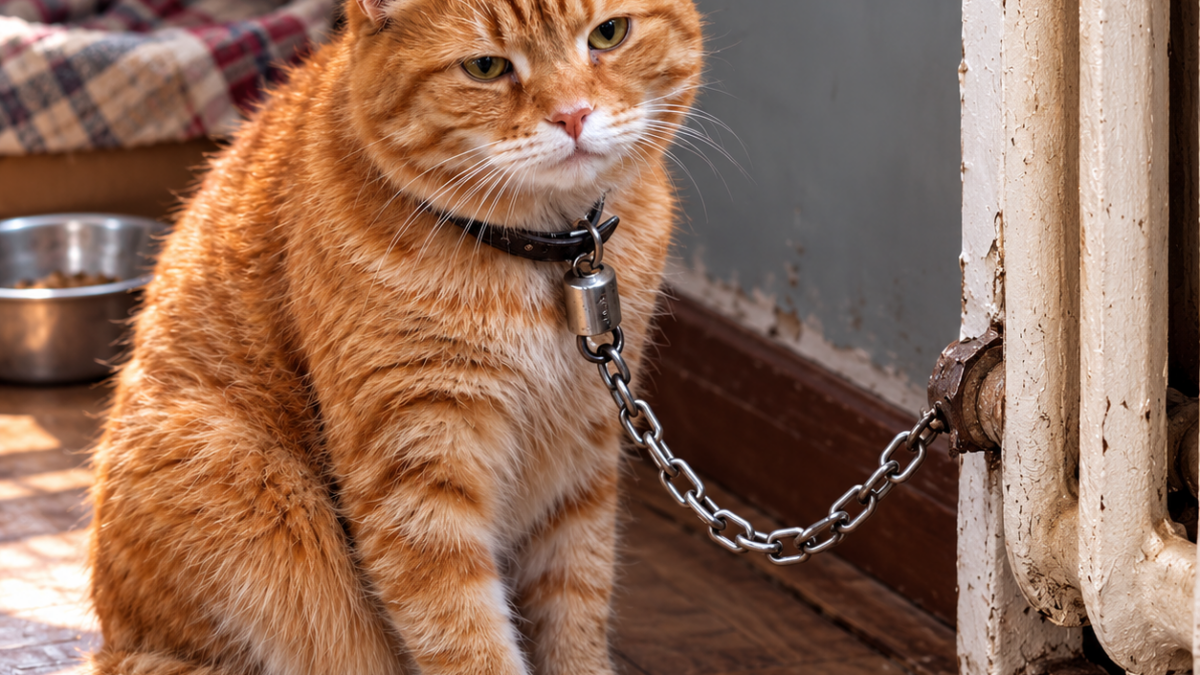
The big orange tabby was locked to a radiator with a fourteen-inch chain, and the part that disturbed me most wasn’t the empty bowl or the raw skin beneath his collar—it was the way he watched us enter without making a sound, as though he had already learned that calling for help changed nothing.
When I knelt beside him and reached for the padlock around his neck, he didn’t hiss, fight, or even try to run; he simply lowered his head into my hand, and that was when I realized we weren’t rescuing a cat who had just been trapped—we were trying to reach one who had stopped believing anyone would come.
His name was Bars.
I didn’t know that when I first saw him.
All I knew was that there was a large orange tabby sitting beside a rusted radiator in the corner of a nearly empty bedroom, and a steel chain ran from the thick leather collar around his neck to the heating pipe behind him.
Fourteen inches.
I measured it later because I couldn’t stop thinking about how short it looked.
Thirty-five centimeters.
That was his world.
He could take three or four careful steps to the left before the chain snapped tight.
Three or four to the right.
He couldn’t reach the window.
He couldn’t crawl under the bed.
He couldn’t get to the doorway.
He couldn’t fully stretch out on the floor unless he twisted his body at an angle.
He couldn’t even move far enough away from his water bowl to keep from stepping in it when somebody bothered to fill it.
When we entered that apartment, though, Bars didn’t pull against the chain.
He didn’t lunge toward us.
He didn’t cry.
He just looked.
I had worked animal rescue cases for nearly seven years by then. I had been bitten, scratched, urinated on, screamed at, threatened, lied to, and once chased halfway across a backyard by a seventy-pound dog whose owner had assured me he was “basically friendly.”
I understood fear.
I understood aggression.
I understood panic.
What I did not understand at first was that flat, exhausted silence.
The call had come from a woman named Elena Morris who lived in the apartment next door.
She was sixty-eight, retired, and the kind of neighbor who knew who collected their mail every afternoon, whose children visited on Sundays, and which dog belonged to which person in the building.
She had called our animal welfare office that morning.
“I keep hearing metal,” she told dispatch.
“Metal?”
“A chain. I think it’s a chain.”
The dispatcher asked whether she could hear an animal.
“Not anymore.”
That was what pushed the call to us.
Not anymore.
According to Elena, there had been noises from the neighboring apartment for weeks.
At first she heard a cat meowing occasionally.
Nothing strange.
Then the noises changed.
A dragging sound.
Metal scraping against the radiator pipe.
A sudden clank at night.
Sometimes a low, hoarse cry.
Then, over the previous few days, almost nothing.
She knocked several times.
No answer.
She contacted the property manager, who told her the tenant had been “in and out.”
That wasn’t good enough for Elena.
“I know what a cat sounds like,” she told us. “And I know what a chain sounds like.”
By the time my partner Marcus and I arrived, the property manager had finally agreed to meet us.
His name was Phil.
He looked irritated from the moment he stepped out of his truck.
“I’ve got another building across town,” he said. “So whatever this is, can we make it quick?”
Elena stood behind us in a blue cardigan with her arms folded.
“If you’d listened three days ago, maybe it would have been quick.”
Phil ignored her.
I asked him, “When was the tenant last seen?”
“Couple days.”
“How many?”
He shrugged.
“Three, maybe four.”
“Does he have a cat?”
“I guess.”
“You guess?”
“It’s an apartment building. People have pets.”
Elena snapped, “His name is Bars.”
Phil looked at her.
PART 2
She pointed at the wall.
“The cat. His name is Bars. I’ve heard that man calling him for years.”
That was the first time I heard the name.
Bars.
Phil inserted the master key.
Before he turned it, Marcus stopped him.
“If we enter and find an animal in immediate distress, we’re documenting everything.”
Phil sighed.
“Fine.”
“I need you to understand that.”
“I said fine.”
The door opened.
The smell hit first.
Not decomposition.
Not yet.
But stale litter, urine, dust, and an apartment that had been shut too long.
The living room was mostly empty.
One chair.
An old television.
Two cardboard boxes.
A scratched cat tree near the wall.
No cat.
“Bars?” Elena called from the hallway.
We asked her to remain outside.
I moved farther in.
Kitchen first.
A bag of dry food sat on the counter, rolled closed.
The bowl on the floor contained maybe a dozen pieces of kibble.
There was water in a plastic dish, but it looked cloudy.
I called out softly.
“Kitty?”
Nothing.
Then Marcus stopped.
“You hear that?”
I listened.
A faint sound came from the bedroom.
Not a meow.
Metal.
A soft scrape.
Then silence.
We moved toward it.
The bedroom door was open.
And there he was.
Big orange cat.
White around the chin.
Broad head.
Thick paws.
Except his body was too thin for his frame.
At first glance, he looked like a cat who had once been twenty pounds and had lost far too much of it.
He sat beside the radiator.
The chain hung slack between him and the pipe.
He watched us.
That was all.
Marcus whispered, “Jesus.”
I crouched several feet away.
“Hey, buddy.”
Bars blinked once.
I moved closer.
No reaction.
When my hand came within reach, I expected him to pull back.
Instead, he pushed his forehead forward until it touched my fingers.
That one movement nearly broke me.
“Okay,” I whispered. “Okay. We got you.”
I reached for the collar.
It was wide brown leather.
A small brass padlock had been threaded through two metal loops so the buckle couldn’t be opened.
I stared at it.
Marcus crouched beside me.
“Locked?”
“Yeah.”
“Seriously?”
“Yeah.”
The chain was clipped through a steel ring attached to the collar and looped around the radiator pipe.
Marcus tried the clasp.
It wasn’t a quick-release hook.
It had been secured with another small lock.
This wasn’t a leash accidentally tangled around furniture.
Someone had designed this arrangement.
Someone had taken time.
Collar.
Chain.
Padlock.
Pipe.
Fourteen inches.
Bars lowered himself onto his chest.
The chain clicked softly.
The sound Elena had heard through the wall.
Marcus looked at the radiator.
“How do we get him off without cutting near his neck?”
“I’ve got bolt cutters in the truck.”
“Chain first.”
“Definitely chain first.”
I didn’t want to put heavy cutters near the collar until Bars was restrained safely.
Marcus went back downstairs.
I stayed beside the cat.
Elena appeared in the bedroom doorway.
I should have told her to wait outside again.
I didn’t.
She put one hand over her mouth.
“Oh, sweetheart.”
Bars lifted his head.
His ears moved.
Elena whispered, “Bars?”
His tail gave one small movement against the floor.
Her eyes filled instantly.
“He knows me.”
“You’ve met him before?”
“Years ago.”
She took one step closer.
“When his owner first moved in, Bars used to sit in the hallway whenever the door opened. He’d come right to me.”
She crouched.
“Hi, handsome.”
Bars looked at her.
No meow.
Elena began crying.
“What did he do to you?”
I looked at the room more carefully.
A cheap plastic litter tray sat just beyond the circle Bars could reach.
He could touch one edge with his paw.
That was all.
I stared at it.
“Phil.”
The property manager was still in the hall.
“What?”
“Come here.”
He appeared reluctantly.
I pointed.
“Can you explain why the litter box is outside the range of his chain?”
Phil looked.
His face changed.
“I don’t know.”
“You’ve been inside this unit recently?”
“No.”
“When was your last inspection?”
“Months ago.”
“You said the tenant’s been in and out.”
“That’s what he told me.”
“When?”
“Yesterday.”
“You spoke to him yesterday?”
“By phone.”
“What did he say?”
Phil hesitated.
“Said he was staying with his girlfriend.”
“And the cat?”
“I didn’t ask about the cat.”
Elena turned on him.
“You didn’t ask?”
Phil lifted both hands.
“Lady, I’m a property manager, not an animal control officer.”
“No,” she said. “You’re the man with the master key.”
Marcus returned before the argument could go further.
We wrapped Bars in a thick towel, mostly to protect him from the cutters and keep him still.
He didn’t resist.
That frightened me.
Healthy cats resist almost everything on principle.
Bars simply lay there.
Marcus positioned the cutters around the chain several inches from the collar.
“Ready?”
I held Bars against my chest.
“Do it.”
The handles came together.
For one second, nothing happened.
Then the steel link snapped.
The sound was loud.
Bars jerked.
His claws finally came out.
He grabbed my sleeve.
“There you are,” I murmured.
Marcus put the cutters down.
The broken chain dropped away from the radiator.
For the first time in however long, Bars was no longer attached to the pipe.
But he didn’t move.
I loosened the towel.
He stood.
Looked at the doorway.
Looked toward the window.
Then sat back down in the exact same spot.
Marcus and I exchanged a glance.
“Come on, buddy,” I said.
I moved two feet away.
Bars stayed beside the radiator.
I moved farther.
Nothing.
Elena called him softly.
Still nothing.
His chain was gone.
But Bars didn’t seem to know he could leave.
So I picked him up.
He was lighter than he should have been.
Far lighter.
I felt his spine immediately.
His head tucked beneath my chin.
And as I carried him across the bedroom, his body became rigid.
One step beyond the old reach of the chain.
Two.
Three.
His claws caught my shirt.
He twisted his head toward the radiator.
Not because he wanted to return.
Because I think some part of him believed something terrible happened if he crossed that invisible boundary.
“It’s okay,” I whispered.
“We’re leaving.”
I carried him through the living room.
When we passed the front door, Bars finally made a sound.
A rough, broken little meow.
Elena covered her face.
The veterinary hospital was twelve minutes away.
I rode in the back with Bars inside a carrier.
At first he pressed himself against the rear wall.
Then I opened the small top flap and lowered two fingers inside.
Within seconds his forehead found them.
He stayed that way for the entire drive.
Dr. Singh examined him as soon as we arrived.
Weight first.
Eleven pounds, eight ounces.
“For his frame,” she said, “I’d expect significantly more.”
She checked his gums.
Eyes.
Heart.
Abdomen.
Paws.
Then the collar.
“We need this off.”
“It’s padlocked.”
“I noticed.”
The skin beneath it was angry and inflamed.
Not cut deeply, thankfully, but rubbed enough that some fur had disappeared.
A thin raw band circled part of his neck.
The clinic maintenance technician brought a compact rotary cutter.
We placed a metal guard between the lock and the collar.
Bars was lightly sedated.
The tool whined.
Sparks jumped once.
I turned my face away.
Then the lock split.
Dr. Singh removed the collar.
The smell underneath was sour.
Infection.
Sweat.
Skin that hadn’t had air.
Bars’s head dropped slowly onto the blanket.
For the first time, there was nothing around his neck.
No collar.
No padlock.
No chain.
I expected relief.
Instead, I felt fury.
Dr. Singh must have seen it.
“Stay useful,” she said.
I looked at her.
“What?”
“Anger later. Useful now.”
She was right.
I nodded.
“What do you need?”
“Photos of the collar before we clean the wound. Exact weight. Temperature. Body condition score. Hydration. Nail length. Photos of the chain if you have them.”
“We have everything.”
“Good.”
She listened to his chest again.
Then frowned.
“What?”
“His heart rate is elevated.”
“Stress?”
“Could be.”
She palpated his hind legs.
Bars flinched.
“Muscle wasting.”
“From being chained?”
“Partly. We need bloodwork.”
“Do it.”
Blood tests showed dehydration, mild anemia, elevated kidney values that Dr. Singh believed might improve with fluids, and nutritional deficits.
No immediate organ failure.
No broken bones.
No catastrophic infection.
That should have felt like good news.
It did.
But then she said, “I want X-rays.”
“Why?”
“Look at how he’s standing.”
Bars’s hind legs were tucked strangely beneath him.
We took the films.
Nothing fractured.
But his joints were stiff, and his muscles had weakened from restricted movement.
“How long would it take for that to happen?” I asked.
Dr. Singh stared at the image.
“Not overnight.”
“A week?”
“I can’t date it precisely.”
“Longer than a few days?”
She looked at me.
“Yes.”
That mattered.
Because Phil had said the tenant was only “in and out.”
A few hours later, Officer Dana Cole from the city’s animal cruelty unit arrived.
By then Bars was receiving fluids and had eaten a small amount of wet food.
Dana was one of those officers who never wasted words.
She walked into the treatment room holding a folder.
“Owner’s name is Victor Hale.”
“Have you spoken to him?”
“Trying.”
“Property manager has his number.”
“I have it.”
She looked through the photographs on my phone.
Radiator.
Chain.
Padlock.
Collar.
Litter box.
Food bowl.
“Fourteen inches?”
“Fourteen.”
She looked again.
“Measure documented?”
“Marcus photographed the tape.”
“Good.”
She slipped the phone back toward me.
“Any idea why the cat was chained?”
“No.”
“Neighbor hear anything?”
“Metal for weeks. Meowing before that.”
Dana nodded.
“Owner told the property manager he’s staying elsewhere?”
“With a girlfriend.”
“Cat was just left?”
“Looks like it.”
Bars moved inside the kennel.
Dana turned.
He watched her.
“He’s friendly?”
“Very.”
She reached one finger through the bars.
Bars pushed his nose against it.
Dana’s jaw tightened.
“Of course he is.”
That evening Victor Hale finally answered his phone.
I wasn’t there for the first conversation.
Dana told me about it later.
He claimed Bars was “aggressive.”
He claimed the chain was temporary.
He claimed he had restrained him because the cat had scratched furniture and urinated outside the litter box.
Dana asked how Bars was supposed to use the litter box when it was placed beyond the end of the chain.
Victor said someone must have moved it.
She asked who.
He didn’t know.
She asked how long Bars had been chained.
“Couple days.”
She asked when he last visited.
“Yesterday.”
Then she told him veterinary examination showed signs inconsistent with only a couple days of severe restriction.
Victor became defensive.
“You’re taking a veterinarian’s opinion over mine?”
Dana apparently answered, “Yes.”
The next morning Victor came to the animal control office demanding his cat back.
I happened to be there dropping off the physical chain as evidence.
I heard him before I saw him.
“That’s my animal!”
A receptionist said, “Sir, lower your voice.”
“You stole him out of my apartment.”
“No one stole anything.”
I stepped around the corner.
Victor was about forty.
Tall.
Unshaven.
Construction boots.
Heavy jacket.
He looked less like a monster than I wanted him to.
That is something people don’t understand about neglect cases.
The person responsible rarely walks into the room looking like evil.
Usually they look ordinary.
Tired.
Defensive.
Angry at being inconvenienced.
Victor saw the evidence bag in my hand.
His eyes dropped to the chain.
“You.”
I stopped.
“You went into my place?”
“I responded with the property manager and animal welfare authorization.”
“You cut my property.”
“I cut the chain attached to Bars.”
“Same thing.”
“No.”
He stepped toward me.
The receptionist stood.
“Sir.”
I kept my voice calm.
“Why was he locked to a radiator?”
Victor’s face hardened.
“You don’t know that cat.”
“I know he could move fourteen inches.”
“He destroys everything.”
“Then rehome him.”
“You think it’s that easy?”
“Call a rescue.”
“They’re full.”
“Call a shelter.”
“They charge fees.”
“Call a friend.”
“Nobody wants a ten-year-old cat that pisses everywhere.”
There it was.
Not aggression.
Not danger.
Inconvenience.
I asked, “How long did you keep him chained?”
He pointed at me.
“Don’t interrogate me.”
“I asked a question.”
“You people act like I tortured him.”
I looked at the bag.
“Fourteen inches.”
He rolled his eyes.
“He had food.”
“Sometimes.”
“He had water.”
“When we found him.”
“He was inside.”
“Chained to a heating pipe.”
“It wasn’t hot.”
I stared at him.
That was his defense.
Not hot.
Dana appeared from the back hallway.
“Mr. Hale.”
Victor turned.
“I want my cat.”
“Bars is currently under protective custody pending investigation.”
“You can’t do that.”
“We can.”
“I’ve had him nine years.”
“Then you should be able to explain why he was found padlocked to a radiator.”
Victor glanced around the office.
People were watching.
His voice dropped.
“My girlfriend won’t have him at her place.”
Dana said nothing.
Victor continued.
“I’m between apartments.”
“You’re still leasing the unit where Bars was found.”
“For now.”
“Why not surrender him?”
“I was going to figure something out.”
“When?”
“I don’t know.”
“How long had he been chained?”
Victor looked at me.
Then Dana.
“Maybe a week.”
Dana’s eyes changed.
Yesterday he’d said a couple days.
“A week?”
“On and off.”
“What does on and off mean?”
“I let him loose when I was there.”
“How often were you there?”
“Every day.”
“We have building entry logs.”
Victor stopped.
Phil hadn’t mentioned those to me.
Apparently the apartment building had key-fob access to the main entrance.
Dana continued.
“We can verify that.”
Victor folded his arms.
“Fine.”
“If you visited every day, the logs will show it.”
“They should.”
They didn’t.
The records showed Victor entering the building four times in nineteen days.
Four.
Once for seventeen minutes.
Once for twenty-three.
Once for nine.
And the final visit lasted eleven minutes.
That was it.
The first time Dana showed me the timeline, I stared at the page.
“Nineteen days?”
“That’s the period we’ve confirmed so far.”
“Was Bars chained the entire time?”
“We don’t know yet.”
Elena helped answer that.
Once investigators explained what they needed, she went through her calendar.
She kept handwritten notes of deliveries, medical appointments, and building maintenance visits.
“I know exactly when that noise started,” she said.
“How?”
“Because it was the night my granddaughter came over.”
She flipped a page.
“September twelfth.”
Dana checked the date.
That was sixteen days before we entered the apartment.
Elena remembered hearing repeated scraping after midnight.
Then a loud metallic snap.
“I almost called the police,” she said.
“Why didn’t you?”
“I thought Victor was moving furniture.”
She looked down.
“I wish I had.”
I told her what I tell witnesses constantly.
“You acted when you understood what you were hearing.”
“But maybe Bars spent two extra weeks there because I didn’t understand.”
“Or maybe he got out because you eventually refused to ignore it.”
She didn’t look convinced.
Neither was I.
Guilt doesn’t always respond to logic.
The investigation deepened.
Victor’s girlfriend, Allison, was interviewed.
At first she defended him.
She said Bars had become “impossible.”
She said the cat had started spraying.
She said Victor was under stress after losing a job.
She said the apartment owner was threatening eviction because of damage.
Then Dana asked one question.
“Did you know Bars was chained?”
Allison looked away.
That hesitation mattered.
“Ms. Price?”
“I knew Victor tied him sometimes.”
“With a padlocked chain?”
“I didn’t know about a lock.”
“Did you see the chain?”
“Once.”
“When?”
“Maybe three weeks ago.”
Three weeks.
Not two days.
Not one week.
Three.
“What did you say?”
“I told him it was messed up.”
“What did he say?”
“He said Bars kept trying to hide when he came over.”
That sentence haunted me.
Bars kept trying to hide.
So Victor shortened the distance until there was nowhere to hide.
Allison told investigators Victor originally used a longer leash attached to the radiator because he was afraid Bars would scratch the bedroom door.
Then Bars reached the bed and crawled underneath.
Victor shortened it.
Bars reached a pile of clothes.
Victor shortened it again.
Eventually he replaced the leash with a chain because Bars chewed through nylon.
“What was Victor trying to accomplish?” Dana asked.
Allison rubbed her forehead.
“He wanted him to stay in one place.”
“Why?”
“He was mad.”
“At the cat?”
“At everything.”
“That’s not an answer.”
Allison’s voice became quieter.
“Bars had belonged to Victor’s mother.”
That was the first part of the story none of us knew.
Bars had not originally been Victor’s cat.
He belonged to a woman named Lorraine Hale.
Victor’s mother.
She had adopted Bars as a young cat from a shelter almost ten years earlier.
When Lorraine suffered a stroke, she moved into assisted living.
Bars went to Victor.
At first, according to family members, everything seemed fine.
Lorraine called constantly to ask about him.
Victor sent pictures.
Bars gained weight.
He slept on Victor’s couch.
He followed him around.
Then Victor’s life started falling apart.
He lost his job.
His relationship became unstable.
He spent more time at Allison’s apartment.
Bars developed behavioral problems.
Whether those problems came first or the neglect came first, nobody could say for certain.
He urinated outside the litter box.
Scratched a door.
Yowled when left alone.
Victor reacted with frustration.
Then anger.
Then confinement.
By the time we found him, what might have started as “keeping the cat in one room” had turned into a fourteen-inch prison.
The saddest part came when Dana located Lorraine.
She was seventy-four.
Physically frail.
Speech slowed by the stroke.
But completely aware.
When Dana told her Bars had been removed from Victor’s apartment, Lorraine cried.
“Is he alive?”
“Yes.”
“Did Victor hurt him?”
Dana chose her words carefully.
“Bars was found in conditions we’re investigating.”
Lorraine understood.
“Did he hurt him?”
“Bars was chained to a radiator.”
Lorraine shut her eyes.
For a long time she said nothing.
Then she asked, “Does Bars still have his red blanket?”
Dana didn’t know.
We searched the apartment again.
Under a cardboard box in the living room, Marcus found an old red fleece blanket covered with orange hair.
We brought it to the veterinary hospital.
Bars was still there.
His kidney values had improved.
He was eating.
His neck was healing.
But psychologically, he remained strange.
He would move around his kennel.
But when staff placed him in a larger recovery room, he stayed within a tiny circle near the wall.
If they moved his food bowl six feet away, he wouldn’t go to it.
If they called him, he’d look.
Sometimes he’d take one step.
Then stop.
The veterinary behaviorist said he had learned confinement.
Not in some mystical sense.
Simply through repetition.
Every attempt to move had ended with the chain stopping him.
Eventually he stopped testing the limit.
When we placed Lorraine’s red blanket across the recovery-room floor, something changed.
Bars sniffed it.
Once.
Then again.
His eyes widened.
He stepped forward.
One foot.
Then another.
Then he walked onto the blanket and kneaded it with his front paws.
I watched from the doorway.
He lowered his face into the fleece.
And for the first time since the rescue, Bars began to purr.
Not loudly.
It was rough at first.
Almost like an engine struggling to start.
Then stronger.
I put my hand over my mouth.
Marcus whispered, “That’s his blanket?”
“Yeah.”
Bars circled twice.
Lay down.
And stretched.
Really stretched.
Front legs forward.
Back legs behind him.
His entire long body extended across the red fabric.
No chain stopped him.
No radiator.
No locked collar.
Just space.
That was the first time I understood what fourteen inches had taken from him.
Not only movement.
Expectation.
A cat should assume he can cross a room.
Jump onto furniture.
Walk toward a voice.
Turn away when he’s scared.
Choose sunlight.
Choose darkness.
Choose closeness.
Choose distance.
Bars had lost the habit of choice.
We had to give it back one decision at a time.
His rehabilitation started with something embarrassingly simple.
Food.
We placed his bowl two feet away.
He walked to it.
The next day, three feet.
Then five.
Then across the room.
The first time he crossed the entire recovery space by himself, three clinic employees applauded.
Bars froze.
Everyone immediately stopped.
Then he continued walking.
“Maybe less celebration,” Dr. Singh whispered.
I laughed.
The next challenge was hiding.
We gave him a cardboard box.
He stared at it.
A technician placed treats inside.
Bars approached slowly.
Sniffed.
Put his head in.
Backed out.
Tried again.
Eventually his entire body disappeared into the box.
I sat on the floor nearby for twenty minutes.
He did not come out.
I was thrilled.
That sounds ridiculous until you understand that hiding was something Bars had been punished for.
Now he had a place nobody would drag him from.
No chain could reach him.
We left the box.
It became his favorite sleeping place.
Victor, meanwhile, hired an attorney.
That changed the tone of everything.
The lawyer argued Bars had been lawfully owned, provided with food, sheltered indoors, and restrained temporarily to prevent property damage.
Temporarily.
That word became their shield.
Victor claimed the chain was removed whenever he stayed at the apartment.
The key-fob records contradicted that.
He claimed Bars had unrestricted access to food.
The veterinary report showed weight loss and dehydration.
He claimed the litter box had been moved after he left.
Crime-scene photographs showed dust around it indicating it had remained in the same position.
He claimed Bars was aggressive.
Every veterinarian, technician, rescuer, and officer who handled him documented the opposite.
Then Victor made a mistake.
He tried to blame Allison.
According to his lawyer, she had been responsible for checking Bars while Victor was away.
Dana asked for their text messages.
Allison initially refused.
Then Victor’s attorney formally suggested she had neglected the cat.
That changed her mind.
She turned over everything.
Hundreds of messages.
Most were irrelevant.
Arguments.
Money.
Groceries.
Relationship problems.
Then investigators found the conversation.
Victor: Cat shredded the bedroom curtain again.
Allison: Then take him somewhere.
Victor: No one wants him.
Allison: Call your mom’s old shelter.
Victor: Not paying surrender fees.
Allison: So what are you doing?
Victor: Fixed it.
She asked how.
Victor sent a photograph.
Bars.
Beside the radiator.
Chain visible.
The message underneath read:
Now he isn’t going anywhere.
The date was eighteen days before we found him.
Eighteen.
Not a couple days.
Not a week.
Eighteen days.
Allison replied:
Victor that’s cruel. Take that off him.
Victor:
He’s fine.
Then:
Food water heat. Better than outside.
The prosecutor later called that text the center of the case.
Because it proved he understood exactly what he had done.
This wasn’t an emergency tether used for minutes.
It wasn’t an accident.
It wasn’t a temporary restraint while moving furniture.
It was a system.
A system designed to make Bars unable to go anywhere.
When Dana showed me the screenshot, my hand tightened around the paper.
“He photographed it.”
“Yes.”
“He was proud of it.”
“I wouldn’t go that far.”
“He wrote ‘fixed it.'”
Dana nodded.
“That I can say.”
Victor’s attorney changed strategy.
Instead of denying the chain, he argued Victor had become overwhelmed and made an irresponsible decision under severe financial and emotional stress.
That was probably true.
People can be overwhelmed and cruel at the same time.
One does not erase the other.
The custody hearing came first.
Victor wanted Bars returned pending the criminal case.
Lorraine wanted him back too.
That surprised me.
Not because she didn’t love him.
She clearly did.
But assisted living did not allow personal pets except under specific service-animal rules.
Her attorney requested Bars be placed with a family friend she trusted.
Our rescue requested continued protective placement until his medical and behavioral condition stabilized.
Victor sat across the room from his mother.
They didn’t speak.
Lorraine looked much smaller than I expected.
She used a cane.
One side of her face still carried signs of the stroke.
When she saw photographs of Bars in the hearing packet, her hand trembled.
The judge asked whether she wished to say anything.
Lorraine nodded.
Her attorney helped her stand.
She looked at Victor.
Not the judge.
Not us.
Her son.
“I gave him to you because I trusted you.”
Victor looked down.
Lorraine continued slowly.
“You told me he slept on your bed.”
“He did.”
“You sent me old pictures.”
Victor’s head lifted.
The room changed.
His attorney turned.
Lorraine reached into her bag with shaking fingers.
She removed three printed photographs.
“My son sent these to me in September.”
The prosecutor took them.
Bars on a couch.
Bars near a window.
Bars asleep on a bed.
At first they looked ordinary.
Then Lorraine pointed.
“Same pictures from last year.”
Victor’s lawyer closed his eyes.
Lorraine had recognized the photographs because she kept every picture of Bars.
Victor had been sending old images to convince her that Bars was fine.
The judge asked him directly.
“Mr. Hale, did you send your mother photographs representing the cat’s current condition when they were actually older images?”
His attorney stood.
“My client will exercise his right—”
“I asked whether he’s answering.”
“No, Your Honor.”
Lorraine sat down.
She didn’t cry.
That was worse.
She simply stopped looking at her son.
Bars remained in protective custody.
Victor left the hearing without speaking to her.
Afterward, I found Lorraine sitting in the courthouse hallway.
Her driver was bringing the car around.
She held the red blanket on her lap.
We had loaned it back to her for the hearing.
“How is he?” she asked.
“Better.”
“Does he remember me?”
“I think he remembers your blanket.”
A tiny smile appeared.
“I made that.”
“I guessed.”
“He used to sleep on it every night.”
She touched the fleece.
“Can I see him?”
We arranged it through the rescue.
Three days later, Lorraine came to the clinic.
Bars was in the recovery room.
We placed a chair near the wall.
Lorraine sat.
I carried in the red blanket.
Bars emerged from his box.
He saw the blanket first.
Then her.
He stopped.
Lorraine whispered, “Barsy.”
The cat’s head lifted.
She said it again.
“Barsy.”
He walked toward her.
No hesitation this time.
Across the whole room.
Ten feet.
Maybe twelve.
Farther than fourteen inches.
He reached her shoes.
Sniffed.
Lorraine bent forward.
Bars put his front paws on her knee.
She started crying.
“Oh, my boy.”
He climbed into her lap.
All sixteen pounds of the cat he used to be weren’t back yet, but he was heavy enough that she laughed through her tears.
“You’re still too big.”
Bars pushed his face against hers.
Then he purred.
I stepped out of the room.
Not because I needed to.
Because that moment belonged to them.
Lorraine could not take him back to assisted living.
That reality devastated her.
For several days she asked administrators whether exceptions could be made.
They couldn’t.
Eventually she told me something I will never forget.
“Don’t give him back to me just because I love him.”
I looked at her.
“I can’t give him what he needs now.”
“That doesn’t mean—”
“It means love isn’t enough if the home is wrong.”
She glanced toward Bars.
“I learned that from my son.”
There was no bitterness in the sentence.
Only grief.
We started looking for a foster home.
Bars needed something specific.
Quiet.
No small children.
No dogs at first.
Someone patient enough to let him choose distance.
Someone home frequently.
Someone willing to deal with possible litter-box regression.
Someone who understood that recovery might take months.
We had dozens of applicants once his story circulated locally.
That worried me.
People love dramatic rescue animals.
Sometimes they love the story more than the animal.
Bars did not need somebody who wanted to feel heroic.
He needed boring.
Predictable.
Safe.
The best application came from a woman named Ruth Calder.
Sixty-two.
Widowed.
Retired librarian.
One-story house.
Screened porch.
No other animals.
She had owned cats for thirty years.
Her last cat had died at eighteen.
During the interview, she didn’t ask whether Bars would sleep in her bed.
She asked, “Where does he hide when he’s frightened?”
Good question.
She didn’t ask whether he was affectionate.
She asked, “What happens when a door closes?”
Better question.
She didn’t ask for a dramatic description of his rescue.
She asked, “What type of litter is he using successfully now?”
I looked at Marcus after the call.
“Her.”
He nodded.
“Her.”
The first meeting was almost boring.
Perfect.
Ruth entered the room.
Sat on the floor.
Put her hands in her lap.
Ignored Bars.
For twenty minutes.
Bars watched from his box.
Ruth talked to me about books.
Eventually Bars came out.
He sniffed her shoe.
She did not move.
He sniffed her knee.
Still nothing.
Then he rubbed his cheek against her hand.
Ruth smiled.
“Hello, Bars.”
That was it.
No tears.
No grabbing.
No baby voice.
No attempt to force intimacy.
Bars chose her.
We approved the foster.
The first week was difficult.
Bars spent two days under Ruth’s guest bed.
She texted me:
He ate overnight. Used litter box. I haven’t seen him since 6 a.m. I assume this is acceptable?
I replied:
Perfectly acceptable. Let him hide.
Her response:
Good. I have books.
On day three Bars sat in the hallway.
Day four, living room doorway.
Day five, beneath the coffee table.
Day seven, beside Ruth on the couch.
She sent one photograph.
Bars asleep.
Not touching her.
But close.
The caption:
Progress.
Two weeks later she sent another.
Bars stretched across the entire couch.
Front paws extended one direction.
Back paws the other.
Taking up as much space as physically possible.
Her caption:
Apparently fourteen inches is no longer his preferred arrangement.
I laughed so hard Marcus came into my office to ask what happened.
That picture became my favorite.
Victor’s criminal case moved slowly.
Months.
Motions.
Negotiations.
His attorney pushed for dismissal.
The prosecutor refused.
Then the defense offered a plea.
Victor would plead guilty to animal neglect rather than face a trial on the more serious cruelty count.
The agreement included probation, restitution for veterinary care, mandatory counseling, community service, and a prohibition on owning or residing with animals during the probation period.
The prosecutor asked Lorraine for her opinion.
She said only one thing.
“I want Bars safe.”
The plea was accepted.
Victor stood before the judge.
He apologized.
Some people in rescue were angry that his statement sounded rehearsed.
Maybe it was.
He said he had been overwhelmed.
He said he had failed to ask for help.
He said he convinced himself that because Bars had food, water, and shelter, the situation was not abuse.
Then the judge asked, “Why the padlock?”
Victor didn’t answer immediately.
Finally he said, “Because he kept getting out of the collar.”
The courtroom went silent.
The judge leaned forward.
“And why did he keep trying to get out?”
Victor looked down.
That question did more than any speech could have.
Because the answer was obvious.
Bars was trying to escape.
The judge imposed the agreed sentence, then added a remark that stayed with me.
“Providing enough for an animal to remain alive is not the same as providing humane care.”
Victor nodded.
The hearing ended.
He walked past me in the hallway.
For a second, I thought he would keep going.
Instead he stopped.
“How is he?”
“Bars?”
He looked irritated at the question, as if there were another animal we could possibly mean.
“Yeah.”
“He’s doing well.”
“Where is he?”
“I can’t tell you that.”
“I’m not asking for the address.”
“You asked where he is.”
“You know what I mean.”
I waited.
Victor shoved his hands into his pockets.
“My mother hates me.”
I didn’t respond.
“She thinks I wanted to hurt him.”
“What do you think?”
His jaw tightened.
“I screwed up.”
“That’s not what I asked.”
He stared at me.
For a moment the defensive version of Victor returned.
Then something seemed to collapse.
“I didn’t think about what it was like for him.”
I said nothing.
He looked toward the courthouse doors.
“I just wanted him to stop wrecking stuff.”
“So you made his world fourteen inches wide.”
He flinched.
I hadn’t planned the sentence.
It came out because it was true.
Victor nodded once.
“I know.”
Then he walked away.
I don’t know whether Victor changed.
I don’t know whether the punishment transformed him.
Real life does not always provide that kind of clean ending.
I know he completed probation.
I know he paid restitution slowly.
I know he was cited once for missing community service and then completed the remaining hours.
I know Lorraine did not speak to him for several months.
Later, according to her, they began having short phone conversations again.
She never gave him responsibility for another animal.
Bars’s story continued somewhere else.
That mattered more.
Three months into foster care, Ruth called me.
“He’s broken.”
My stomach dropped.
“What happened?”
“My curtain.”
I paused.
“What?”
“He climbed it.”
I heard laughter in her voice.
I sat back.
“You scared me.”
“I thought you’d appreciate the irony.”
“Is he hurt?”
“Not at all. My dignity and curtain rod are another matter.”
Bars had discovered windows.
Not merely discovered them.
Become obsessed.
Ruth moved a cat tree beside the largest window in her living room.
He climbed to the top platform every morning.
Sunlight.
Birds.
Squirrels.
Delivery trucks.
People walking dogs.
The whole world on the other side of glass.
The thing he could not reach from the radiator.
The first time I visited Ruth’s house, Bars was sitting there.
He looked healthier.
His coat had regained that thick orange shine Elena remembered.
He weighed fifteen pounds.
His neck fur had grown back almost completely.
You could still feel a slightly rough patch where the collar had rubbed him.
But you had to know where to look.
“Bars.”
His head turned.
He jumped down.
Walked across the room.
Straight toward me.
I crouched.
He bumped his forehead into my chin.
Then walked away.
That was all the greeting I got.
Ruth laughed.
“You’ve been demoted.”
“Apparently.”
Bars returned to the window.
I watched him stretch his front paws against the sill.
Full length.
No hesitation.
“Has he ever gone back to that small-circle behavior?”
“Once.”
“When?”
“I had a plumber here.”
That made sense.
Stranger.
Metal sounds.
Tools near pipes.
Bars hid under the bed for nearly six hours.
Ruth let him.
By evening he came out.
“Did he eat?”
“Everything.”
“Good.”
“Then he stole chicken off my plate.”
“Even better.”
Ruth looked toward him.
“I’d like to adopt him.”
I smiled.
“I figured.”
“I wanted to wait until I was sure.”
“Are you sure?”
Bars jumped from the window to the couch, turned twice, and sprawled across two cushions.
Ruth pointed.
“He has taken legal possession of the furniture.”
“Strong evidence.”
The adoption was finalized the following week.
Lorraine attended.
Ruth brought Bars in a carrier covered with the red blanket.
When Lorraine saw him, she cried.
Again.
Bars walked into her lap.
Again.
But this time, when it was time to leave, something happened that worried me.
Ruth placed the carrier on the floor.
Bars climbed inside voluntarily.
Lorraine touched his head.
“Go home, Barsy.”
Bars looked at her.
Then settled into the carrier.
Lorraine smiled through tears.
“He knows.”
“What?”
“Where home is.”
Ruth knelt beside her.
“You can visit whenever you want.”
And she did.
Once every few weeks, when transportation allowed, Lorraine visited Ruth.
Sometimes Bars climbed into her lap.
Sometimes he didn’t.
Lorraine never forced him.
She brought treats.
Brushed him.
Talked to him about people I didn’t know.
She told him stories about the house where he’d grown up.
The time he knocked over a Christmas tree.
The time he stole a roast chicken.
The time he disappeared for four hours and was found asleep inside a linen closet.
Bars listened the way cats listen.
Eyes half closed.
Pretending none of it mattered.
Elena visited too.
The first time, Bars recognized her voice before she entered the room.
“Bars?”
He appeared from the hallway.
Elena gasped.
“Look at you.”
He walked to her.
She sat on the floor because she didn’t trust her knees.
Bars rubbed along her arm.
Elena cried into his fur.
“I’m sorry I didn’t call sooner.”
Bars purred.
She looked at me.
“Does he forgive me?”
It was impossible to answer honestly in the way she meant.
So I said, “He came to you.”
That was enough.
A year passed.
Bars became almost boring.
That was the highest compliment I could give his recovery.
Vet checks.
Nap schedules.
Window watching.
Occasional stolen chicken.
He developed a habit of sleeping on Ruth’s feet while she read.
He regained confidence.
He disliked closed doors.
If Ruth shut the bathroom door, he sat outside and complained.
Loudly.
The cat who had stopped meowing now had opinions about everything.
Breakfast three minutes late?
Meow.
Wrong chair occupied?
Meow.
Bird visible?
Rapid clicking noises.
Carrier brought out for a vet appointment?
Long, dramatic howl apparently intended for the entire neighborhood.
Ruth called me once during a car ride.
“Listen.”
Bars screamed from inside the carrier.
I laughed.
“That’s the same cat?”
“Apparently he found his voice.”
I thought about the bedroom.
The silence.
The way he’d watched us without asking for anything.
“Let him complain.”
“Oh, I do.”
Another year passed.
Then Lorraine’s health declined.
Ruth called me one morning.
“She asked to see Bars.”
“How bad?”
“Bad enough that I think we should go today.”
The assisted-living facility made an exception for the visit.
Bars traveled in his carrier.
When we reached Lorraine’s room, she was in bed.
Much thinner.
Her voice barely audible.
Ruth placed the red blanket beside her.
Then opened the carrier.
Bars stepped out.
He sniffed the room.
Paused.
Lorraine whispered, “Barsy.”
His head turned.
He climbed onto the bed.
Slowly.
Carefully.
He walked across the red blanket.
Then curled against her side.
Lorraine placed one weak hand on his back.
For nearly an hour, nobody talked much.
Bars purred.
Lorraine slept.
When she woke, she looked at Ruth.
“Thank you.”
Ruth shook her head.
“You don’t have to thank me.”
“Yes.”
Lorraine stroked Bars.
“I do.”
Then she looked at me.
“You found him?”
“We all did.”
She smiled faintly.
“Elena found him.”
“Elena heard him.”
“And you opened the door.”
“Phil opened the door.”
Lorraine closed her eyes.
“Then everybody.”
That was closer to the truth.
Rescue stories often get simplified.
One hero.
One victim.
One villain.
Real life is rarely that clean.
Elena heard metal through a wall.
A dispatcher took her seriously.
Phil finally used the master key.
Marcus cut the chain.
Dr. Singh treated Bars.
Dana investigated.
Allison provided messages.
Lorraine fought for him even when she couldn’t take him home.
Ruth gave him space.
Bars did the rest.
Lorraine died nine days after that visit.
Ruth brought Bars to the memorial gathering.
He stayed in his carrier most of the time.
Too many people.
Too much noise.
Before leaving, Ruth placed the red blanket across the back seat.
Bars climbed onto it.
He slept all the way home.
Years passed.
The radiator apartment was renovated.
Phil eventually left the management company.
Elena moved to live closer to her daughter.
Marcus transferred to another county.
Dana was promoted.
Dr. Singh opened her own clinic.
Ruth kept sending me photographs.
Bars in sunlight.
Bars on books.
Bars inside grocery bags.
Bars occupying pillows.
Bars staring with deep offense at a Christmas sweater Ruth attempted to put on him once and never tried again.
One photograph made me stop.
Ruth had installed a long window shelf.
Bars was lying on it in full sunlight.
Stretched from the tips of his front paws to the end of his tail.
I saved the picture.
Later I opened the original evidence photograph from the rescue.
Bars beside the radiator.
Chain taut.
Same cat.
Same long orange body.
In the first photo, fourteen inches.
In the second, an entire window.
I placed the images side by side.
Then closed them.
Bars lived with Ruth for almost eight more years.
He became an old man.
His face narrowed.
His orange coat faded.
He developed arthritis.
Then kidney disease.
Nothing directly related to the chain anymore.
Just age.
When he was nineteen, Ruth called me.
Her voice told me before the words did.
“It’s time.”
I drove to her house.
Bars was on the red blanket near the window.
He was thin again.
But this thinness was different.
Not neglect.
Age.
His body had simply reached the end of what it could carry.
I sat beside him.
“Hey, Bars.”
One eye opened.
His tail moved.
Ruth sat in the armchair.
“I keep thinking about the first day.”
“The foster meeting?”
“Yes.”
“You ignored him for twenty minutes.”
“I was terrified.”
I laughed.
“You looked completely calm.”
“I’d read every piece of advice you sent me. I was thinking, ‘Don’t touch the cat. Don’t look at the cat. Be furniture.'”
“You were excellent furniture.”
She smiled.
Bars lifted his head.
He tried to stand.
Ruth immediately moved toward him.
“It’s okay.”
Bars walked three slow steps.
Then four.
Across the blanket.
Across the rug.
He stopped at the window.
Ruth opened it slightly so he could smell the air through the screen.
Bars raised his nose.
Outside, birds moved through the maple tree.
He watched.
I thought of the apartment again.
He couldn’t reach that window.
That had been one of the first things I noticed.
A window only a few feet away might as well have been another country.
Now, at the end of his life, Bars had spent eight years beside windows.
Watching storms.
Snow.
Birds.
Neighbors.
Sunsets.
Ordinary things.
People think freedom has to look dramatic.
Sometimes freedom is a cat choosing which patch of sunlight belongs to him.
Dr. Singh came to the house that afternoon.
Ruth wanted Bars to remain somewhere familiar.
He lay on the red blanket.
No carrier.
No metal table.
No strange room.
Ruth sat beside him.
I sat on the floor.
Dr. Singh examined him gently.
Then looked at Ruth.
“Are you ready?”
Ruth’s eyes filled.
“No.”
Dr. Singh nodded.
“That’s okay.”
Ruth bent over Bars.
“But he is.”
She kissed his forehead.
“I promised Lorraine I’d give you a good home.”
Bars purred weakly.
Ruth laughed through tears.
“I think I did okay.”
“You did more than okay,” I said.
She scratched under his chin.
“I’ll miss you, big guy.”
The medication made him sleepy.
His head rested against Ruth’s wrist.
Dr. Singh gave the final injection.
Bars exhaled.
Then went still.
No chain.
No collar.
No padlock.
No radiator.
Just an old red blanket beside an open window.
Afterward, Ruth sat there for a long time.
Eventually she touched the rough patch where his collar scar had once been.
The fur had hidden almost all of it.
“Did that ever go away completely?” she asked.
“The scar?”
“Yes.”
I looked closely.
“No.”
Ruth nodded.
“I guess some things don’t.”
Maybe.
But scars are not the whole story either.
A scar tells you where something happened.
It doesn’t tell you everything that came afterward.
After Bars died, Ruth donated his window shelf, carrier, unopened food, and medical supplies to our rescue.
She kept the red blanket.
I didn’t ask why.
I knew.
Several months later she invited me over.
The house felt wrong without Bars.
Too quiet.
On the windowsill sat a framed photograph.
Not the dramatic rescue picture.
Not the chain.
Not the courtroom.
Not the collar.
Bars asleep upside down on the couch.
One paw hanging off.
Completely ridiculous.
Completely safe.
Ruth poured coffee.
“Do people still ask about him?”
“Sometimes.”
“What do you tell them?”
I thought about it.
“Depends who’s asking.”
“What would you tell someone who never heard the story?”
I looked toward the window.
For years, I had thought Bars’s story was about fourteen inches of chain.
That was the image people remembered.
That was the outrage.
The padlock.
The radiator.
The cat who stopped crying.
But sitting in Ruth’s house, I realized that was only the beginning.
So I told her.
“I’d say Bars was a big orange cat who spent the last eight years of his life taking up more space than anyone thought a cat possibly could.”
Ruth laughed.
“That’s accurate.”
“And he yelled when breakfast was late.”
“Very accurate.”
“Stole chicken.”
“Constantly.”
“Ruined one curtain.”
“Two.”
“Two?”
“You never knew about the second.”
I stared at her.
She smiled.
“I protected his reputation.”
We laughed.
And for the first time, remembering Bars didn’t bring me straight back to the radiator.
It brought me to the window.
That’s how I think about him now.
Not the cat sitting silently at the end of a chain.
Not the cat who had learned that crying accomplished nothing.
I remember the cat who eventually complained about closed doors.
Who stretched across whole couches.
Who hid under beds because he could.
Who walked away from people when he felt like it.
Who walked toward them when he chose.
Who sat in Lorraine’s lap one final time.
Who filled Ruth’s quiet house with demands, orange fur, stolen food, and noise.
The chain was fourteen inches long.
We measured it.
We photographed it.
We entered it into evidence.
For a while, it defined almost every conversation about him.
But it did not define his life.
Eight years after someone decided fourteen inches was all the room Bars needed, he died beside a window with an entire house behind him, a woman he trusted touching his head, and absolutely nothing attached to his neck.
And whenever I remember the first moment I knelt beside that radiator and Bars lowered his head into my hand without making a sound, I wish I could have told him one thing he had no reason to believe yet:
You won’t always have to ask for permission to move.
One day, every step will be yours.








