PART 2: They Moved Away and Left Skiper Chained to Di3—But the One Thing They Left Behind Became Evidence
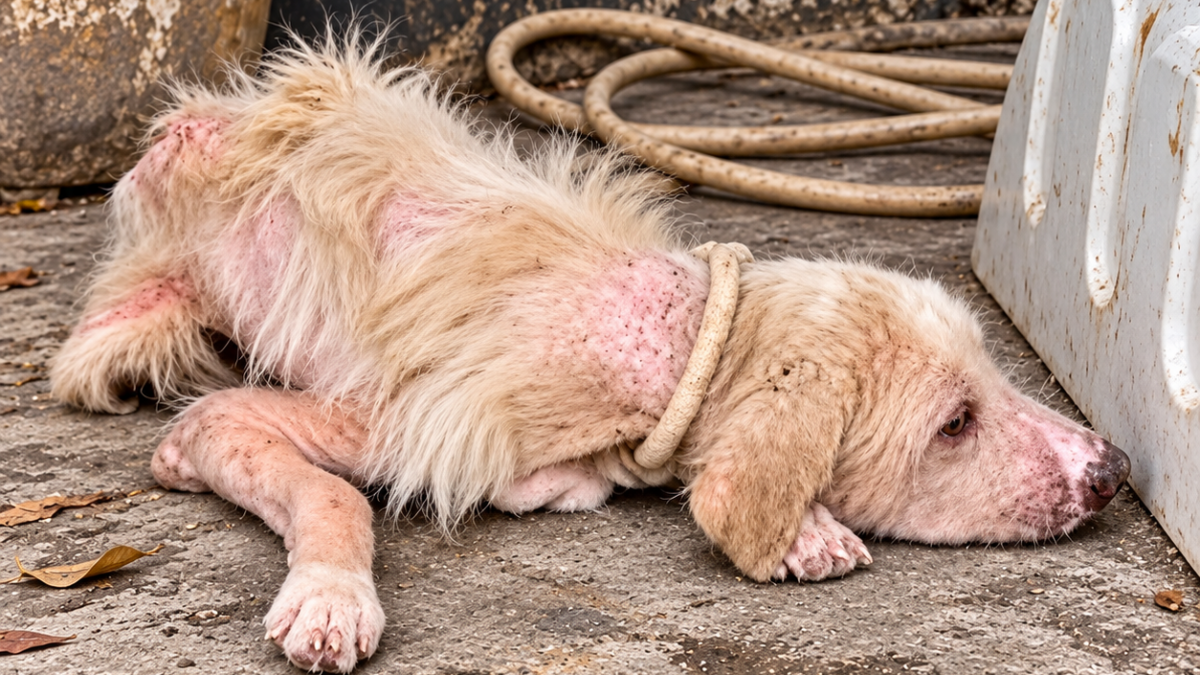
PART 2
We had to carry Skiper out.
He refused to walk past the gate.
Every time we guided him toward the opening, he planted his paws into the dirt and pulled backward.
At first, I thought he was afraid of us.
Then I realized something worse.
He was afraid of leaving.
That backyard was miserable, but it was the only world he understood.
The chain had defined the limits of his life for so long that even after it was removed, he still behaved as though an invisible one remained.
I wrapped a blanket around him.
He flinched the instant the fabric touched his back.
“Easy, buddy.”
His eyes followed every movement of my hands.
I slid one arm beneath his chest and another under his hindquarters.
He weighed much less than a dog his size should have.
When I lifted him, his entire body stiffened.
He did not bite.
He did not growl.
He simply endured.
That frightened me more than aggression would have.
A dog who growls is still telling you what he wants.
A dog who has learned that nothing he says matters sometimes becomes completely silent.
I carried him through the gate.
Donna began crying.
She reached toward him, then stopped herself.
“Will he make it?”
“I don’t know yet.”
It was the only answer I could give honestly.
At the veterinary clinic, we discovered just how badly his body had deteriorated.
He was severely underweight and dehydrated. His skin was inflamed from a combination of parasites, infection and prolonged exposure. Several areas were raw where he had scratched himself until they bled.
His nails were overgrown.
There were pressure marks around his neck from the collar.
The veterinarian, Dr. Kelly Morgan, ran her fingers carefully along his ribs.
“How old?”
“We don’t know exactly. Neighbor says the family got him as a puppy several years ago.”
Dr. Morgan looked at me.
“He’s been living outside?”
“Looks that way.”
“For a long time.”
It was not a question.
She showed me the calluses on his elbows and hips.
“Dogs develop these from repeatedly sleeping on hard surfaces. He probably hasn’t had proper bedding in years.”
I looked through the glass toward Skiper.
He stood in the examination room with his head lowered.
Years.
Not days.
Not one bad week.
Years.
Abandonment had nearly killed him, but the abandonment was only the final act.
The neglect had started long before the moving truck ever arrived.
We began treatment immediately.
Fluids.
Medication.
Skin treatment.
Small, carefully controlled meals.
The veterinary team needed to reintroduce nutrition gradually because feeding a severely depleted animal too aggressively can create additional medical complications.
Skiper tolerated every procedure.
That sounds like a good thing.
It wasn’t.
He tolerated us because he expected resistance to be useless.
Whenever someone reached toward him, his eyes closed.
Whenever a hand passed above his head, he ducked.
When we placed him on a soft blanket, he stepped off and lay on the floor.
The first night, I sat beside his kennel for almost an hour.
I didn’t touch him.
I didn’t talk much.
I just sat.
Eventually I placed a piece of chicken several feet from me.
He stared at it.
Then at me.
Then back at the chicken.
I turned my face away.
After nearly five minutes, I heard him move.
He grabbed the piece and retreated to the back of the kennel.
The next piece I placed a little closer.
He waited even longer.
By the time I went home, he had eaten four pieces.
It wasn’t much.
But rescue work teaches you to respect tiny victories.
Sometimes survival returns one bite at a time.
The next morning I brought him a dog bed.
It was thick, oversized and ridiculously soft.
I put it inside his recovery room.
Skiper sniffed it.
Then he walked around it and lay on the tile.
“You really don’t know what that is, do you?”
His ears moved slightly.
I sat beside the bed and pressed my hand into it.
“Look. Fancy.”
Nothing.
I laughed quietly.
It was the first time I had laughed since meeting him.
For three days, Skiper ignored that bed.
On the fourth morning, I opened the door and stopped.
He was asleep on it.
Not curled tightly into himself.
Not pressed against the wall.
Stretched out.
His head rested on the raised edge, one paw dangling over the side.
I took a picture.
Then I stood there longer than necessary because I didn’t want to wake him.
That was the first moment I allowed myself to imagine he might truly recover.
But his physical improvement came faster than his trust.
Bathing him was especially difficult.
The medicated shampoo needed to remain on his skin for several minutes, but the sound of running water made him panic.
The first time I turned on the hose attachment in the bathing room, Skiper tried to climb the wall.
I shut it off immediately.
“Okay. Not today.”
My coworker Rachel looked at me.
“You’re going to have to wash him eventually.”
“I know.”
“How?”
I looked at Skiper, trembling in the corner.
“His way.”
So we changed everything.
We filled containers before bringing him into the room so there was no running-water sound.
We used warm cloths.
We moved slowly.
If he panicked, we stopped.
If he looked overwhelmed, we gave him space.
A bath that should have taken twenty minutes took almost two hours.
But afterward, when I wrapped a warm towel around him, something happened.
I sat beside him on the floor.
He was tired.
His body leaned slightly against my knee.
I didn’t move.
For ten seconds, maybe fifteen, he allowed his weight to rest against me.
Then he realized what he was doing and pulled away.
But I had felt it.
Trust.
Tiny.
Fragile.
Almost accidental.
Still, it was there.
Over the next two weeks, Skiper gained several pounds.
His eyes became brighter.
His skin began healing.
Fine new hair appeared across previously bare patches.
And his personality began showing itself in flashes.
The first surprise came from a tennis ball.
Rachel dropped one while cleaning.
It bounced twice.
Skiper’s head snapped toward it.
The ball rolled across the floor.
He watched.
Rachel nudged it back.
Skiper stepped toward it.
Then another step.
He put one paw on the ball.
It shot out from underneath him.
For a second, he looked offended.
Rachel laughed.
“So you do know how to play.”
Skiper chased the ball.
Not far.
Maybe six feet.
But the sight of him running—even awkwardly—felt impossible after the dog I had carried from that backyard.
I threw it gently.
He ran after it again.
He didn’t bring it back.
Instead, he picked it up, carried it onto his bed and lay down with it between his paws.
“That’s fine,” I told him. “You can keep it.”
By the end of the week, Skiper owned seven tennis balls.
Technically, they belonged to the rescue.
Skiper disagreed.
That was when I started realizing something important.
We had spent so much time talking about what had been done to him that we almost forgot to discover who he actually was.
Skiper was funny.
He was stubborn.
He hated carrots.
He loved chicken.
He was terrified of brooms but fascinated by squeaky toys.
When excited, he made a strange snorting noise.
If Rachel walked past his room without saying hello, he would stare through the glass as if personally betrayed.
And when he finally decided he trusted someone, he followed that person everywhere.
For Skiper, that person became me.
It happened gradually.
One morning he followed me from his room to the laundry area.
Then from the laundry area to the supply closet.
When I walked toward the office, he came too.
“You know you don’t work here, right?”
His tail moved.
Just once.
I stopped walking.
“Did you just wag your tail?”
Nothing.
“Do it again.”
Skiper stared at me.
Rachel looked around the corner.
“What happened?”
“I think he wagged.”
“You think?”
“I saw movement.”
She rolled her eyes.
“This is what rescue has done to us. We celebrate possible tail movement.”
Then Skiper wagged again.
Twice.
Rachel gasped.
“Oh my God.”
I crouched down.
Skiper approached.
He sniffed my hand.
Then, for the first time, he pushed his nose beneath my fingers.
He was asking to be touched.
I scratched carefully under his chin.
His eyes softened.
Two weeks earlier, he had recoiled from my hand.
Now he stepped closer.
I stroked the side of his neck, avoiding the healing marks where the collar had rubbed him raw.
He stayed.
There are moments in rescue that never make headlines.
A dog eating from your hand.
A frightened animal falling asleep in the same room as you.
A tail wag.
A head resting against a knee.
To someone else, they look insignificant.
To us, they can mean everything.
Skiper had begun choosing contact.
That meant he was no longer merely surviving our kindness.
He was starting to believe in it.
I wished the story could have ended there.
Dog rescued.
Dog heals.
Dog finds family.
Perfect ending.
But the broken chain from that backyard was sitting in an evidence bag.
And the people who had left Skiper there were about to discover that leaving town did not erase what they had done.
Three days after the rescue, animal control investigator Mark Ellis called me.
“We identified the former owners.”
I moved into the hallway so Skiper couldn’t hear my voice change.
“Where are they?”
“Still in the county.”
I frowned.
“They didn’t move far?”
“No. About twenty-five minutes away.”
That made me angrier than I expected.
I had pictured them crossing state lines, disappearing hundreds of miles away.
Instead, Skiper had nearly died while they were less than half an hour from him.
“Have you spoken to them?”
“Not yet. I’m documenting everything first.”
“What do you need?”
“Medical records. Photographs from intake. Weight. Condition of the collar marks. Anything showing chronic neglect.”
“You’ll have it.”
He paused.
“There’s something else.”
“What?”
“The neighbor had security cameras.”
Donna.
I remembered the small camera mounted over her garage.
“What did they capture?”
“Not the backyard. But part of the driveway and front of the property.”
“And?”
“The family loading the moving truck.”
My hand tightened around the phone.
“Can you see Skiper?”
“No. But you can see the owners leaving. The timestamp establishes when the house was vacated.”
“How long before we found him?”
“Five days.”
Five.
Five days chained without accessible food or water.
Five days waiting for people who knew they weren’t coming back.
Mark continued.
“And Donna has messages.”
“What messages?”
“She texted one of the former owners after noticing the house was empty. Asked whether someone was caring for the dog.”
I already knew I wasn’t going to like the answer.
“What did they say?”
Mark read it to me.
“‘He’ll be fine. Somebody will probably take him.’”
I stopped breathing for a second.
“Somebody?”
“That’s what it says.”
They had not forgotten Skiper.
That would have been horrifying enough.
They remembered him.
They simply decided he was no longer their responsibility.
“Can that be used?”
“Yes.”
“Good.”
Mark’s voice softened.
“How’s he doing?”
I looked through the doorway.
Skiper was lying on his ridiculous oversized bed with three tennis balls lined between his paws.
“Better.”
“Then keep doing your part. I’ll do mine.”
I tried.
But knowing those messages existed changed something in me.
For days, I had imagined that maybe the family had panicked while moving. Maybe something had gone wrong. Maybe one person assumed another person was returning for the dog.
None of those excuses would have made the abandonment acceptable.
But the message destroyed even that possibility.
Somebody will probably take him.
As though Skiper were an old chair left beside the road.
That night, I stayed late.
Most of the building was dark.
I sat on the floor beside Skiper’s bed.
He had started sleeping close enough that I could rest my hand near him without causing fear.
“You know what the strange part is?” I whispered.
He opened one eye.
“You still trusted them.”
His tail tapped softly against the bed.
“You probably waited every time you heard a car.”
Another tap.
“And they didn’t deserve that.”
I had spent years working with neglected animals, and I knew anger could become dangerous if you allowed it to guide you.
Rescue cannot be about revenge.
It has to be about protection.
Evidence.
Accountability.
Prevention.
But I would be lying if I said I didn’t want the people who had abandoned him to feel something.
Not pain.
Not fear.
I wanted them to experience consequence.
I wanted someone to place the facts in front of them and make it impossible to shrug them away.
I wanted that chain to follow them the way it had followed Skiper.
And eventually, it did.
The first real confrontation happened six weeks after the rescue.
By then, Skiper looked like a different dog.
He had gained weight.
His coat was returning.
The dullness had left his eyes.
He still startled at sudden movements, but he no longer collapsed into himself.
He greeted me every morning with an excited little hop.
He had even learned that car rides could end somewhere pleasant.
That was important because we were preparing him for foster placement.
The rescue was not designed to be a permanent home.
Eventually, Skiper needed a family.
That frightened me.
Not because I thought nobody would want him.
By then, anyone who met him fell in love within minutes.
I worried because I had watched him build trust one fragile layer at a time.
The idea of handing him to strangers felt like asking him to start over.
Then I met the Harris family.
Michael and Emily Harris had submitted an application for a dog several months earlier.
They lived outside town on a fenced two-acre property and already had two rescued dogs, both older males.
Normally, placing three males together would require careful introductions, but the rescue coordinator thought their dogs might be a good match for Skiper because they were calm, social and confident.
Michael was a firefighter.
Emily worked from home as a medical billing specialist.
Their children were grown and lived nearby.
When they came to meet Skiper, I watched every movement.
Emily sat on the floor instead of approaching him.
Smart.
Michael stood several feet away with his hands relaxed.
Smarter.
Skiper looked between them.
Emily placed a treat beside her knee.
He approached, grabbed it and backed away.
She didn’t reach for him.
Five minutes later, he returned without a treat being offered.
He sniffed her shoulder.
Then her hair.
Michael smiled.
“He’s checking you out.”
Emily stayed perfectly still.
Skiper touched his nose to her cheek.
Her eyes filled with tears.
“I think I’m being interviewed.”
“You are,” I said. “His standards are high.”
“They should be.”
That sentence mattered to me.
Too many adopters see rescue animals as grateful recipients of charity.
Emily saw something different.
Skiper was choosing them too.
The first dog introduction happened outside.
Their larger dog, Hank, was a black Lab mix with a gray muzzle.
Hank sniffed Skiper.
Skiper froze.
Hank walked away.
That was exactly what we wanted.
No pressure.
Their second dog, Cooper, was younger and more playful.
He performed an exaggerated play bow.
Skiper stared.
Cooper bounced sideways.
Skiper took a cautious step.
Cooper ran in a circle.
And then something happened that none of us expected.
Skiper chased him.
One lap around the fenced enclosure.
Then another.
Cooper turned sharply.
Skiper followed.
For nearly a minute, the dog who had once been unable to walk beyond the radius of a chain ran simply because he could.
Emily covered her mouth.
Michael turned away for a second, pretending to wipe sweat from his face.
I didn’t bother pretending.
I cried openly.
Skiper ran until he became tired, then collapsed in the grass beside Hank.
Hank barely reacted.
Cooper dropped next to them.
Three dogs lying together beneath an open sky.
I knew before anyone said it.
This could be his home.
We scheduled a trial stay.
The first night, I barely slept.
At 6:11 the next morning, Emily sent a photograph.
Skiper was lying on a couch between Hank and Cooper.
His head was resting on Hank’s back.
The message read:
“He slept in the bedroom for part of the night. Then he discovered the couch. I think we’ve lost ownership of the furniture.”
I stared at that photograph for a long time.
A dog who had slept on dirt now had a couch.
A dog who had guarded scraps now had scheduled meals.
A dog who had spent his life alone on a chain now had two brothers pressed against him.
The adoption became official three weeks later.
We held a small signing at the rescue.
When Emily signed the final form, I looked down at Skiper.
“Well, buddy. You have a family.”
He wagged.
Michael clipped on Skiper’s new blue leash.
For a moment, the sight of something attached to his collar made me uncomfortable.
Then I noticed the difference.
The old chain had controlled where he was allowed to go.
The new leash led him somewhere.
He walked out between Michael and Emily with Cooper waiting in the car.
He never looked back.
I thought that was the happiest ending we were going to get.
Then Mark called.
“The case is moving forward.”
I sat upright.
“What happened?”
“The former owners were interviewed yesterday.”
“And?”
“They say the dog wasn’t theirs.”
I laughed once because the lie was almost insulting.
“What?”
“They claim he belonged to a relative.”
“They raised him from a puppy.”
“I know.”
“We have the neighbor.”
“I know.”
“We have photos.”
“I know.”
“And messages.”
“I know.”
“Then why would they say that?”
“Because people say strange things when they realize there may be consequences.”
He asked whether I would be willing to provide a statement about Skiper’s condition when he arrived.
“Absolutely.”
Then he added something I didn’t expect.
“They also said someone was supposed to pick him up.”
“Who?”
“They won’t give a name.”
“Convenient.”
“Very.”
Over the following weeks, pieces of the story came together.
The family had planned their move for nearly a month.
They had arranged utility shutoffs.
They had forwarded mail.
They had rented a truck.
They had changed the children’s school registration.
They had made detailed preparations for furniture, electronics, clothing and household belongings.
There was no plan for Skiper.
No boarding appointment.
No surrender request.
No rescue contact.
No veterinarian appointment.
No message asking a friend to care for him.
Nothing.
When questioned about food and water, one of the owners claimed they had left “plenty.”
The photographs proved otherwise.
Then Donna found something else.
She called me one evening.
“I don’t know if this matters.”
“What is it?”
“I went through my old messages.”
“With them?”
“Yes. About Skiper.”
My stomach tightened.
“How old?”
“Almost a year.”
“What do they say?”
Donna hesitated.
“I complained because he was crying outside during a cold night. I asked if they could bring him inside.”
“And?”
“She told me he was an outdoor dog.”
I closed my eyes.
“That helps establish the history.”
“There’s more.”
Donna forwarded screenshots.
One exchange stopped me cold.
Donna had written:
It’s supposed to be below freezing tonight. Please bring Skiper in.
The response:
He has fur. He’ll survive.
Another message from several months later:
Your dog’s chain is tangled again. He can’t reach the shade.
Response:
He does that to himself.
I stared at those words.
He does that to himself.
As if Skiper had chosen the chain.
As if the suffering caused by restraint was somehow his own mistake.
Mark added the messages to the evidence file.
The veterinary records documented chronic skin disease, malnutrition, dehydration and pressure injuries consistent with long-term inadequate care.
Donna provided statements.
Another neighbor came forward.
Then another.
People had noticed Skiper.
They had heard him bark.
They had seen the thin dog behind the fence.
Some had assumed somebody else would intervene.
That became the most painful part of the story for me.
Not everybody had known how bad things were.
But several people had seen something.
They simply had not realized their small piece of information mattered.
After Skiper’s rescue, those pieces formed a picture nobody could ignore.
The former owners were cited under local animal cruelty and abandonment provisions, with the exact charges determined by the authorities handling the case.
I attended one of the proceedings.
Not because I enjoyed it.
Because Skiper could not speak there.
Someone needed to describe the dog who had arrived at the clinic.
The courtroom was smaller than I expected.
No dramatic television lighting.
No shouting attorneys.
No packed gallery.
Just wooden benches, paperwork and people waiting for their names to be called.
Then I saw them.
The couple who had owned Skiper.
I recognized them from photographs provided during the investigation.
They looked ordinary.
That bothered me.
Part of me had wanted monsters.
People whose appearance somehow explained what had happened.
Instead, they looked like anyone you might stand behind at a grocery store.
The woman glanced at me.
Then looked away.
The man spoke quietly with their representative.
When the case was called, the evidence was reviewed.
Photographs of the yard.
The chain.
The empty bowls.
Skiper’s body condition.
Veterinary reports.
Donna’s messages.
Security footage establishing the move date.
Then I was asked about the dog’s behavior.
“What happened when you approached him?”
“He tried to get away.”
“Did he show aggression?”
“No.”
“What did he do?”
“He pulled backward until the chain became tight.”
“After the chain was cut, did he leave the yard willingly?”
“No.”
“Why not?”
I looked toward the judge.
“I can’t tell you exactly what a dog thinks. But based on my experience, he appeared so accustomed to confinement that leaving the area frightened him.”
The room went quiet.
I continued.
“He had to be carried through the gate.”
The former owner shifted in his chair.
I remembered Skiper staring at the broken chain.
I remembered how light he felt in my arms.
I remembered the first time he slept on a bed.
The first tail wag.
The first tennis ball.
“Was his condition caused only by being left there for several days?”
“No.”
“Explain.”
“Dehydration can develop quickly, but his overall body condition, skin disease, pressure calluses, coat loss and behavioral response indicated prolonged neglect. His problems did not start when the family moved.”
The defense pushed back.
Dogs can lose weight for many reasons.
Skin conditions can happen even in cared-for animals.
Outdoor dogs can develop calluses.
All technically true.
That is how these cases work.
A single fact can be explained away.
But the strength of the case was never one fact.
It was all of them together.
The medical evidence.
The physical environment.
The messages.
The timeline.
The chain.
And then came the statement I had been waiting to hear discussed.
He’ll be fine. Somebody will probably take him.
Their representative argued it did not prove intentional harm.
Mark later explained to me that legal standards can differ from moral judgment.
But the sentence still mattered.
Because it showed awareness.
They knew Skiper was there.
They knew they were leaving.
They simply expected responsibility to transfer magically to an unknown “somebody.”
The judge looked directly at the former owners.
“Animals are not property you leave at the curb in the hope someone retrieves them.”
Nobody moved.
“You had several options available to you. You could have contacted a shelter. You could have contacted animal control. You could have asked neighbors for assistance. You could have sought placement through a rescue. Instead, according to the evidence before this court, you left the animal restrained at a vacated property.”
The woman began crying.
I felt no satisfaction from that.
I had imagined I might.
Instead, I felt tired.
Because none of this gave Skiper back the years he had spent outside.
Nothing could.
The consequences included fines, restitution related to part of his care, and restrictions on future animal ownership consistent with the court’s disposition.
The exact numbers mattered less to me than one particular condition.
They were not simply allowed to walk out and acquire another dog the next morning as though Skiper had never existed.
There would be a record.
There would be scrutiny.
There would be consequences.
Outside the courtroom, the man approached me.
I didn’t expect it.
“You’re the rescue lady?”
I turned.
“Yes.”
He looked irritated rather than ashamed.
“You made us sound like monsters.”
“No.”
His expression hardened.
“I heard what you said.”
“I described how Skiper arrived.”
“You don’t know what was going on in our lives.”
“You’re right.”
“We were moving. We had money problems. Everything happened at once.”
I nodded.
“I believe you.”
That seemed to surprise him.
Then I continued.
“But Skiper was still chained in that yard.”
“We meant to figure something out.”
“You had years to figure something out.”
His jaw tightened.
“You think you’re better than us?”
“No.”
“Sure sounded like it.”
“I think Skiper deserved food, water, shelter and care.”
“He was a dog.”
That sentence erased the last trace of sympathy I had been trying to hold onto.
“Yes,” I said. “He was.”
He waited.
I continued.
“And that means he depended on you for every one of those things.”
The woman had come up behind him.
She looked exhausted.
“Is he alive?” she asked quietly.
For the first time, neither of them sounded defensive.
“Yes.”
Her face changed.
“Can I see him?”
I thought about it.
Skiper running beside Cooper.
Skiper sleeping between his new brothers.
Skiper pressing his head against Emily’s leg.
“No.”
She looked shocked.
“He was ours.”
“Not anymore.”
“I just want to know what he looks like.”
I could have shown her a photograph.
My phone contained dozens.
Skiper asleep upside down on the couch.
Skiper playing in snow for the first time.
Skiper wearing a ridiculous red bandana Emily had bought him.
Skiper sitting beside Hank and Cooper.
But those pictures were not trophies.
They belonged to his new life.
“You don’t need to see him,” I said.
Her eyes filled.
“Why?”
“Because he doesn’t need anything from you anymore.”
Then I walked away.
For weeks afterward, I wondered whether that had been cruel.
Eventually, I decided it wasn’t.
People often imagine closure as a final conversation.
An apology.
Forgiveness.
A dramatic confrontation where everyone understands what they did.
Life rarely gives us that.
Sometimes closure is simply a door that remains closed.
For Skiper, the important door was the one that had opened.
The door to the Harris home.
His transformation over the next several months was extraordinary.
Emily sent updates constantly.
At first, Skiper followed her from room to room.
If she entered the kitchen, he entered the kitchen.
If she went upstairs, he waited at the bottom until she returned because he had not yet learned to trust the stairs.
One evening, Cooper raced up them.
Skiper watched.
Hank followed slowly.
Skiper remained at the bottom.
Emily sat halfway up.
“Come on, Skiper.”
He placed one paw on the first step.
Then backed away.
“No pressure,” she told him.
The next day he tried again.
Three steps.
The day after that, six.
Within a week, Emily sent me a video of Skiper racing Cooper to the top.
He lost badly.
He barked the entire way.
I watched it four times.
His first winter indoors became another milestone.
A cold front moved through in December.
Temperatures dropped below freezing.
Emily sent a photograph at 10:30 that night.
Skiper was asleep under a blanket beside the fireplace.
Her message said:
“Thought you’d appreciate this. He refused to go outside after dinner until Michael put his coat on him.”
I remembered Donna’s old message.
It’s supposed to be below freezing tonight. Please bring Skiper in.
He has fur. He’ll survive.
Now he was wearing a blue winter coat.
He had a blanket.
A fire.
A warm house.
And apparently a firm opinion about cold weather.
That photograph made me cry harder than the courtroom ever had.
Because justice is not only punishment.
Sometimes justice is giving someone the life they should have had all along.
Skiper became inseparable from Cooper.
They wrestled in the living room.
They stole toys from each other.
They dug one enormous hole near the back fence and then stood beside it looking innocent while covered in mud.
Hank, older and more dignified, usually observed their nonsense from a safe distance.
But at bedtime, the three dogs slept together.
Skiper especially loved pressing himself against Hank.
Emily believed the older dog made him feel safe.
I believed it too.
Then came a moment none of us expected.
About six months after his adoption, Skiper disappeared.
Emily called me at 7:12 one morning.
Her voice made my stomach drop.
“I can’t find him.”
“What happened?”
“The back gate was open.”
“Was it broken?”
“I don’t know. Michael went out early. He thought he latched it.”
“How long has Skiper been missing?”
“Maybe twenty minutes. Thirty at most.”
I was already putting on shoes.
“Stay there. I’m coming.”
Old fear returned instantly.
Dogs with histories like Skiper’s can revert when frightened.
Some run blindly.
Some hide.
Some avoid strangers.
And Skiper had spent years surviving outside.
That frightened me even more.
By the time I reached their property, Michael was driving the nearby roads.
Emily was walking the tree line calling Skiper’s name.
Cooper stood at the gate whining.
“Any sighting?”
“No.”
I looked at the open gate.
The latch hadn’t broken.
It simply had not caught fully.
Wind had likely pushed the gate open.
We contacted neighbors.
Michael drove farther out.
I walked the roadside.
Every terrible possibility entered my mind.
Traffic.
Wildlife.
Someone picking him up.
Skiper panicking and running miles away.
Forty-five minutes passed.
Then Emily called.
“Come back.”
“What?”
“Just come back.”
I ran.
When I reached the yard, she was standing near the porch.
Crying.
And there was Skiper.
Sitting outside the gate.
Waiting to be let in.
He had mud on his paws and burrs in his fur.
Cooper was barking wildly from the other side.
Emily opened the gate.
Skiper walked inside.
That was it.
No dramatic reunion.
No collapse.
He simply came home.
Michael returned ten minutes later and wrapped both arms around him.
“You scared ten years off my life.”
Skiper licked his face.
Later, we checked a neighbor’s camera.
Skiper had left the yard and walked approximately two hundred yards down the road.
He sniffed along a ditch.
Investigated a mailbox.
Then turned around.
He came back by himself.
When I watched the footage, I understood why it mattered so much.
The first time Skiper had been freed from a gate, we had to carry him through it.
He did not understand that freedom could lead somewhere safe.
Months later, he walked through an open gate on his own.
Explored.
And returned.
Not because a chain forced him.
Because home was on the other side.
That distinction was everything.
His old life had taught him that staying was mandatory.
His new life taught him that returning could be a choice.
After that day, Michael upgraded every gate latch on the property anyway.
Twice.
He also installed self-closing hinges.
“I’m not trusting fate again,” he told me.
Skiper continued improving.
His coat eventually grew in so fully that strangers could not imagine how he had looked when we found him.
The marks around his neck faded beneath thick fur.
His weight stabilized.
His skin cleared.
The veterinarian eventually reduced most of his treatments to routine care.
But there were emotional scars that appeared unexpectedly.
One afternoon, Michael was repairing a section of fence.
He dropped a short length of metal chain onto the driveway.
The sound stopped Skiper instantly.
Michael said his entire posture changed.
Tail down.
Head lowered.
Body frozen.
Michael moved slowly.
He picked up the chain and put it into the garage.
Then he sat on the ground.
Skiper stood twenty feet away.
Michael waited.
Five minutes.
Ten.
Eventually Skiper approached.
Michael didn’t reach for him.
Skiper sniffed his knee.
Then leaned into his chest.
Michael later told me, “That was when I realized he remembers more than we know.”
Of course he did.
Healing is not forgetting.
I think humans get that wrong sometimes.
We want recovery to erase the past.
But scars are not evidence that healing failed.
Sometimes they are evidence that healing happened around something that could not be erased.
Skiper did not need to forget the chain.
He needed to learn that it no longer controlled his life.
A year after his rescue, the Harrises brought him back to our annual adoption reunion.
I knew he was arriving, but I still wasn’t prepared.
A truck pulled into the parking lot.
Cooper jumped out first.
Then Hank.
Then Skiper.
For one second, I saw the dog from the backyard.
Same face.
Same eyes.
But everything else was different.
His coat was thick and glossy.
His body was strong.
He wore a red bandana.
His tail was high.
And when he saw me, he ran.
Not cautiously.
Not in small steps.
Full speed.
He hit my knees hard enough that I nearly fell.
I dropped down and wrapped my arms around him.
“Hey, buddy.”
He covered my face with kisses.
Emily laughed.
“I guess he remembers you.”
I pressed my forehead against his.
“I remember him too.”
Around us, people were talking, dogs barking, volunteers setting up tables.
But for a few seconds, I could see only Skiper.
I remembered the overturned water bowl.
The dirt.
The broken fur.
The trembling legs.
The chain stretched tight as he tried to escape my approach.
Then I looked at the dog in front of me.
Healthy.
Playful.
Loved.
Free.
Michael walked over carrying something.
“You might want this.”
He handed me a framed photograph.
It showed Skiper, Hank and Cooper sitting together on their front porch.
Below the photograph was a small metal nameplate.
It read:
SKIPER — HOME IS WHERE YOU CHOOSE TO RETURN
I couldn’t speak for several seconds.
Emily touched my arm.
“He changed us too.”
People say that often about rescue animals.
But I understood what she meant.
Skiper had changed them because he made ordinary things feel extraordinary.
A dog sleeping safely through the night.
A bowl filled with clean water.
A gate he could walk through.
A person reaching down without causing fear.
Everyday things became reminders of what safety actually means.
Later that afternoon, I watched Skiper racing Cooper across the field.
At one point he stopped near a fence and looked toward the road.
No chain.
No post.
No one shouting for him to stay.
He could have gone anywhere within that enormous fenced field.
Instead, he turned when Emily called.
“Skiper!”
His ears lifted.
He ran toward her.
She crouched.
He crashed into her arms.
That could have been the end of his story.
But a few months later, Mark contacted me again.
“I thought you’d want to know something.”
“What?”
“One of Skiper’s former owners tried to acquire another dog.”
I sat still.
“From where?”
“Private rehoming situation.”
My stomach tightened.
“What happened?”
“Someone involved recognized the name and checked.”
“Checked what?”
“The case record.”
Relief hit me.
“They didn’t get the dog?”
“No.”
I looked through the rescue office window.
Skiper’s old intake photograph was still pinned on our case board.
He looked almost skeletal.
“Good.”
Mark paused.
“That’s why documentation matters.”
He was right.
For months, I had thought justice meant making the people responsible answer for what happened to Skiper.
But that wasn’t the most important consequence.
The record protected the next dog.
There would be no second backyard.
No second chain.
No second animal waiting for an owner who had already left.
At least not that day.
And that was enough.
I called Emily later.
I didn’t give her details she didn’t need.
I simply said the case had prevented another dog from potentially entering the same situation.
She went quiet.
“So Skiper helped another dog without even knowing it.”
“Yes.”
She laughed softly.
“Sounds like him.”
I thought about that for a long time.
Skiper never understood court proceedings.
He never knew photographs of his injuries became evidence.
He never knew strangers discussed his condition in a courtroom.
He never knew the chain from his backyard had been photographed, labeled and documented.
And maybe that was a mercy.
His job was not to carry the case.
His job was to live.
To eat breakfast.
To steal Cooper’s toys.
To sleep on couches.
To bark at delivery trucks.
To dig holes Michael absolutely did not approve of.
To discover that snow was fun for approximately three minutes and then insist on going back inside.
To become spoiled enough that plain dog treats were sometimes rejected unless Emily broke them into smaller pieces.
That was Skiper’s responsibility now.
To be a dog.
Nothing more.
Two years after the rescue, I visited the Harris home.
By then Hank had slowed considerably.
His muzzle was almost completely white.
Cooper remained an overgrown puppy.
And Skiper had become the unofficial guardian of the house.
Not an aggressive guardian.
He simply liked knowing where everyone was.
If Michael worked in the garage, Skiper checked on him.
If Emily went outside, Skiper followed.
If Hank struggled getting up, Skiper waited nearby.
“He hates being left out of anything,” Emily said.
“He spent enough time alone.”
“I think so too.”
We sat on their back porch while the dogs wandered around the yard.
There was a large water container near the door.
Another near the fence.
A third inside the house.
I smiled.
Emily noticed.
“What?”
“Three water bowls?”
“Four, actually. There’s one upstairs.”
I laughed.
“You’re overcompensating.”
“Absolutely.”
Skiper walked over and rested his head on my knee.
His fur was warm from the sun.
I scratched behind his ears.
For years, I had wondered what I would say if I ever got one more chance to address the people who abandoned him.
I used to imagine long speeches.
Anger.
Accusations.
Every detail of what he suffered.
But sitting there, I realized I no longer wanted anything from them.
Not an apology.
Not regret.
Not an explanation.
The most satisfying revenge had already happened.
They had treated Skiper as though he were worthless.
Life proved them wrong.
They had assumed nobody would care.
People cared.
They had left him because they believed he was disposable.
Another family considered him irreplaceable.
They had confined his entire world to the radius of a chain.
Now he had rooms to sleep in, acres to explore, brothers to play with and people who planned their days around him.
They had walked away expecting him to disappear.
Instead, Skiper became unforgettable.
And perhaps the most powerful part was that he did not need to become vicious, fearful or broken forever for justice to feel complete.
He remained gentle.
He learned to play.
He trusted again.
Cruelty did not get to decide what kind of dog he would become.
One summer evening, Emily called me.
Her voice was shaky.
For one terrible moment, I thought something had happened.
Then she said, “I need to tell you what Skiper did.”
“What?”
“Hank fell.”
My chest tightened.
“Is he okay?”
“He is now.”
She explained that Hank had gone into the yard late that evening.
His aging back legs gave out near the far fence.
He couldn’t get up.
Michael and Emily were inside and did not hear anything.
Skiper did.
He ran to the door and began barking.
Emily assumed he needed to go outside.
When she opened the door, he didn’t leave.
He ran a few feet into the yard, turned around and barked.
“Come on,” she said.
Skiper ran again.
Stopped.
Looked back.
That was unusual enough that she followed.
He led her straight to Hank.
Michael came out and helped lift the old dog.
They took him to the veterinarian.
No fracture.
Just weakness and arthritis.
He recovered.
“He wouldn’t stop until I followed him,” Emily said.
I smiled through tears.
“The dog who once cried in a backyard until a neighbor heard him?”
“Yes.”
“He made sure somebody heard Hank.”
Neither of us spoke for a moment.
There are circles life closes so quietly that you almost miss them.
Skiper had once depended on another person noticing his distress.
Years later, another dog depended on Skiper.
And he knew exactly what to do.
Hank lived another eleven months.
When he died, Skiper changed.
He searched the house for him.
He checked Hank’s favorite bed.
He waited near the back door.
For several days, he ate less.
Cooper stayed unusually close.
Grief belongs to animals too.
Emily moved Hank’s bed into the living room because Skiper kept lying beside it.
Eventually he began sleeping on it himself.
Not every ending can be happy.
A good home does not protect you from loss.
It gives you people to grieve with.
Months later, Emily adopted another senior dog.
Her name was Molly.
She had been surrendered after her owner entered assisted living.
Molly was nervous.
She paced.
She avoided eye contact.
And during her first night, she refused to sleep.
Emily told me that Skiper walked into the room and lay several feet from her.
He didn’t approach.
He didn’t crowd her.
He just stayed.
Molly eventually lay down.
By the end of the week, she was sleeping beside him.
When Emily told me, I remembered sitting beside Skiper’s kennel on his first night.
No touching.
No forcing.
Just staying.
Somewhere along the way, the frightened dog had learned how to offer another animal the same gift.
Presence.
That may be the part of Skiper’s story I love most.
Not the court case.
Not the transformation photographs.
Not even the moment his old owners were held responsible.
It is the fact that kindness changed him deeply enough that he learned how to give it away.
People sometimes tell me Skiper was lucky.
They are not wrong.
He was lucky Donna heard him.
Lucky animal control responded.
Lucky the veterinary team fought for him.
Lucky donors covered treatment.
Lucky the Harris family found him.
But saying he was lucky can make his story sound like magic.
It wasn’t.
It was people deciding not to look away.
Donna could have assumed the crying would stop.
She didn’t.
The officer could have treated it as a low-priority complaint.
He didn’t.
The veterinary staff could have focused only on Skiper’s physical injuries.
They didn’t.
The Harris family could have chosen a dog without fear, medical history or emotional scars.
They didn’t.
Every important turn in his life happened because someone made a choice opposite to the one his former owners had made.
They walked away.
Other people stayed.
Years after I first stepped into that backyard, I still have one photograph saved where I can find it quickly.
It is not the worst photograph of Skiper.
I rarely look at those anymore.
It is a picture Emily took one spring morning.
Skiper is lying in fresh grass.
Cooper is beside him.
Molly is stretched out behind them.
The sun is coming through the trees.
Skiper’s eyes are almost closed.
He looks completely relaxed.
Nothing dramatic is happening.
That is precisely why I love it.
For a dog like Skiper, peace was once impossible.
Now peace is ordinary.
There is another photograph I keep too.
The old chain.
Rusty links.
Worn collar.
Dirt beneath it.
For a long time, I hated that picture.
Eventually I started seeing it differently.
The chain is empty.
That is what matters.
Empty.
No dog at the end of it.
No frightened body pulling backward.
No empty water bowl nearby.
Just a useless piece of metal lying in the dirt.
The chain did become evidence.
It helped tell the truth about what happened.
But it also became something more.
Proof that the thing controlling Skiper’s life could be broken.
People often ask whether animals forgive.
I don’t know.
I’m not sure forgiveness is even the right word.
Skiper never had to absolve anyone.
He never had to understand why people who brought him home as a puppy eventually treated him like a burden.
He only had to discover that those people were not the whole world.
There were other hands.
Gentler hands.
Other voices.
Kinder voices.
Other homes.
Warm homes.
And eventually there was a family that never asked Skiper to be grateful for basic care.
They simply loved him.
One afternoon, during another visit, I watched Michael open the back gate to move a lawn mower through.
Skiper stood several yards away.
The gate remained open for perhaps thirty seconds.
He looked toward it.
Then looked at Michael.
Michael wheeled the mower through and closed the gate.
Skiper never moved.
I smiled.
Not because he was afraid to leave.
I knew better now.
He simply had nowhere else he wanted to be.
That evening, as I prepared to go, Skiper followed me to my car.
I crouched and scratched his neck.
“You know,” I told him, “the first time I met you, you wouldn’t even let me touch you.”
He leaned harder into my hand.
“Now I can’t get rid of you.”
His tail wagged.
Emily stood on the porch laughing.
“Skiper! Dinner!”
His head snapped around.
That word outranked our emotional farewell.
He sprinted toward the house.
Halfway there, he stopped.
Turned.
Looked back at me.
For one second we stared at each other.
Then he ran inside.
I got into my car.
Before starting the engine, I looked at the Harris house.
Warm light glowed through the windows.
Three dogs moved behind the glass.
I thought about another house years earlier.
Dark windows.
Empty rooms.
An abandoned backyard.
A dog chained to a post waiting for someone who had already decided not to return.
Those two houses belonged to the same dog’s story.
But only one became his home.
The people who abandoned Skiper once believed they could move away and leave their responsibility behind.
They learned that some things follow you.
Evidence follows you.
Choices follow you.
Consequences follow you.
But Skiper taught me something better.
Love can follow you too.
A neighbor heard him.
A rescuer came.
A veterinarian treated him.
A family chose him.
Two dogs became his brothers.
Another frightened dog eventually learned safety beside him.
One act of abandonment had caused enormous suffering.
But every act of kindness that followed pushed the story in another direction.
That was the revenge I finally understood.
Not suffering returned for suffering.
Not cruelty answered with cruelty.
Something far more complete.
Skiper survived long enough to become everything his former owners had denied him the chance to be.
Healthy.
Playful.
Trusted.
Needed.
Loved.
And free.
The people who left him behind became a chapter in his life.
The Harris family became the rest of the book.
Years after his rescue, Skiper still sometimes sleeps with one paw stretched over the edge of his bed.
Emily says he dreams deeply now.
Sometimes his legs move as if he is running.
Maybe he is.
Maybe somewhere inside those dreams there is no fence, no post and no chain.
Only an open field.
Cooper running ahead.
Molly behind him.
Hank waiting somewhere just beyond the trees.
And Skiper running as far as he wants, knowing that when he turns around, there will always be a home waiting for him.
A full bowl.
Clean water.
A soft bed.
A hand he no longer has to fear.
And people who will still be there when morning comes.
That is how Skiper’s story ends.
Not beside the chain where someone abandoned him.
But in the place he chose to return to.
Home.








