PART 2: They Left Magnolia on the Street Dragging a 14.9-Pound Tumor—Then the X-Rays Gave Us One Chance to Save Her
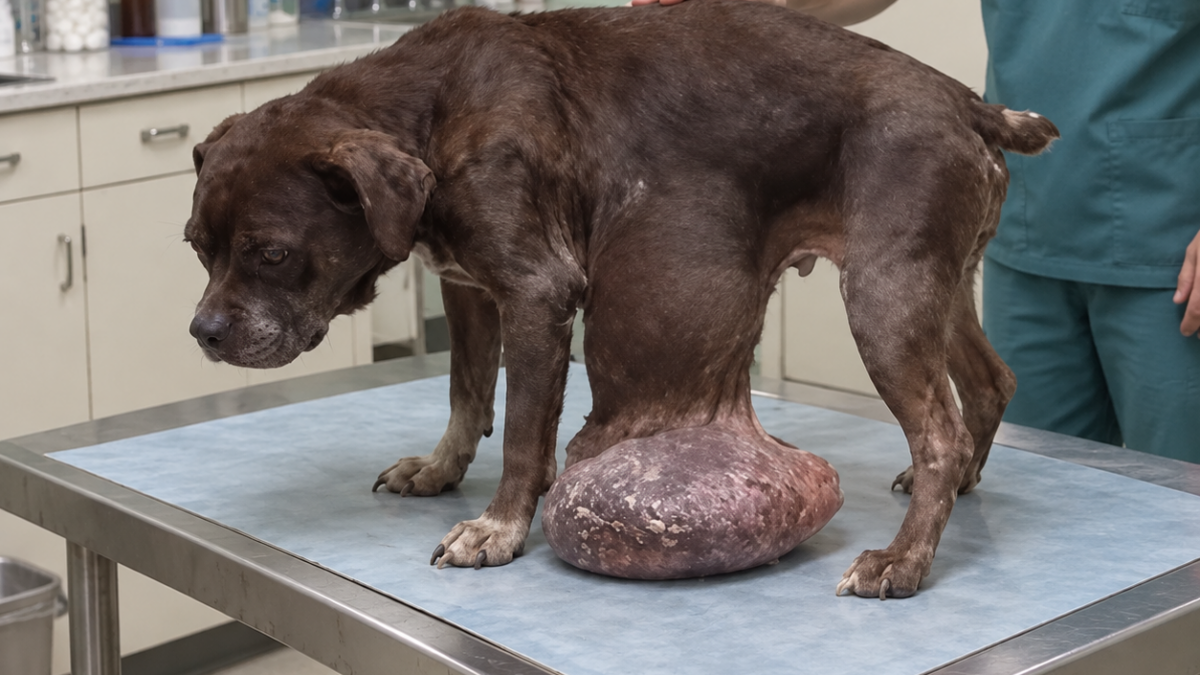
PART 2
He clipped the first image onto the illuminated panel.
I stood so quickly that my knee cracked against the chair.
“What do you see?”
“Give me a second.”
He leaned closer.
A technician entered behind him carrying another film.
Magnolia remained on the blanket, too tired to care that every person in the room was staring at images of the inside of her body.
The veterinarian examined them one by one.
I tried to read his expression.
Nothing.
Doctors and veterinarians become very good at not letting their faces answer questions before their mouths do.
Finally, he stepped back.
“I don’t see obvious evidence that it has spread to her lungs.”
For a second I thought I had misunderstood him.
“You don’t?”
“Not on these images.”
“What about the rest?”
“We’ll continue evaluating her, and imaging can never promise us there’s nothing microscopic happening. But right now, I’m not seeing the kind of obvious metastatic disease that would make me tell you surgery has no reasonable purpose.”
My hands went to my face.
It wasn’t a cure.
It wasn’t a guarantee.
But after staring at Magnolia and preparing myself to hear that we were already too late, those words felt like someone had opened a door.
“So we can remove it?”
His expression became serious again.
“We can try.”
Try.
One word.
Not yes.
Not absolutely.
Try.
I looked down at Magnolia.
She lifted her eyes toward me.
“What are the chances?”
“That’s harder to answer.”
He pointed toward the mass.
“This has a major blood supply. Something this large can bleed significantly during removal. Her blood pressure is already lower than I’d like. She’s weak. We don’t know exactly how long the surgery will take until we get in there and see what structures are involved.”
“What happens if we wait?”
“She continues carrying it.”
There was no hesitation in his answer.
“It could ulcerate more. She could become weaker. If it keeps growing, mobility becomes even harder. And if this is aggressive disease, time isn’t necessarily our friend.”
I stared at the X-rays again.
“So doing nothing is also dangerous.”
“Yes.”
That was the decision.
Not safe versus dangerous.
Dangerous versus dangerous.
One danger gave Magnolia a chance.
The other simply allowed the weight to keep taking pieces of her life.
I knelt beside her.
The tumor rested against the blanket.
It looked even larger when she was lying down, an enormous burden attached to an already tired animal.
“She deserves the chance,” I said.
The veterinarian nodded.
“That’s where I am too.”
The clinic began preparing Magnolia.
More blood work.
Fluids.
Medication.
Monitoring.
Discussions about blood loss and what might be needed if her numbers changed.
Everything moved quickly around her while I sat in one corner trying not to imagine the worst outcome.
A technician crouched beside me.
“You okay?”
“No.”
She gave me a small, sympathetic smile.
“Fair answer.”
“What if we got her here just to lose her on the table?”
“That’s possible.”
I looked up.
She didn’t soften the truth.
I appreciated that.
“But,” she continued, “she also got here because somebody finally stopped. That matters.”
I looked at Magnolia.
She had spent however long carrying the consequences of someone else doing nothing.
Doing nothing now felt impossible.
That evening, she was kept under close observation.
I stayed as long as they allowed me.
Every time I stood to leave, I found another reason not to.
Adjust her blanket.
Refill water.
Ask a question I had already asked.
Watch the monitor.
Finally the veterinarian said gently, “Go home for a few hours.”
“I’m fine.”
“You’re exhausted.”
“So is she.”
“And she’ll have staff here all night.”
I knew he was right.
Still, walking away from her felt wrong.
I went back and placed my hand beside her muzzle.
Magnolia sniffed it.
“Tomorrow’s a big day.”
Her eyes stayed on me.
“You have to do your part, okay?”
Her nose touched my fingers.
I swallowed.
“I know you’ve already done enough.”
That was the truth.
She had already done more than any animal should have had to do.
I drove home but didn’t really sleep.
Every time I closed my eyes, I saw her walking.
The tumor scraping beside her.
Her body leaning to compensate.
I kept wondering what the first day had looked like when the growth began interfering with her movement.
Had somebody noticed?
Surely they had.
Had it started small enough that treatment would have been simple?
Maybe.
Had someone told themselves it would go away?
Had they decided veterinary care was too expensive?
Had they watched it become larger and larger until acknowledging it would also mean acknowledging how long they had ignored it?
I had no answers.
Abandonment rarely comes with an explanation.
The animal carries the evidence, while the person disappears.
At five in the morning I stopped pretending to sleep.
By the time I reached the clinic, Magnolia was being prepared.
Her blood pressure remained a concern but had improved enough that the team was willing to proceed.
The surgeon met me before they took her back.
“We’re going to move carefully.”
I nodded.
“If there’s a point where continuing becomes more dangerous than stopping?”
“We make the safest decision we can for her.”
“Call me.”
“We will.”
I crouched beside Magnolia one last time.
Her head felt heavy in my palm.
“I’m right here.”
That wasn’t technically true.
I couldn’t follow her into surgery.
But I needed her to hear it.
“I’ll be here when you wake up.”
A technician started rolling her toward the surgical area.
Magnolia turned her head once.
Then the doors closed.
I hated those doors immediately.
There is a particular kind of helplessness in rescue that begins after you have done everything you can.
People assume action is the difficult part.
Driving out.
Picking up the dog.
Finding the veterinarian.
Signing consent forms.
Making decisions.
Sometimes the hardest part comes afterward, when all action belongs to somebody else.
I sat down.
Then stood again.
Bought coffee.
Forgot to drink it.
Checked my phone repeatedly even though the clinic staff knew where I was.
An hour passed.
Then another.
A rescuer friend joined me.
“You’ve heard anything?”
“Not yet.”
“That might be good.”
“Or it might mean they’re busy.”
“That too.”
I glared at her.
“Very comforting.”
“I’m trying.”
She sat beside me.
For several minutes, neither of us spoke.
Then she asked, “How big do you think it actually is?”
“Too big.”
“That wasn’t the question.”
“I don’t want to know.”
But I did.
The weight had become almost symbolic.
How much suffering had Magnolia physically carried?
Ten pounds?
Twelve?
Fifteen?
At that stage, numbers barely mattered.
One pound would have been unfair.
Anything large enough to force her body sideways was too much.
The surgical team worked slowly.
We received only brief updates.
She was stable.
Then her blood pressure dipped.
They were correcting it.
There was bleeding, but it was being managed.
The mass was difficult.
They were continuing.
Each update gave me enough information to worry harder.
At one point, I went outside because the waiting room felt too small.
Cars moved past the clinic as though the day were normal.
A man walked a small white dog toward the entrance.
The dog stopped at a patch of grass and refused to move.
The man laughed.
“Come on, spoiled brat.”
The dog stared at him.
He waited.
No pulling.
No anger.
Eventually the little dog finished sniffing and followed.
I watched them disappear inside.
Such a simple interaction.
A person waiting ten extra seconds because his dog wanted to smell grass.
And somewhere in Magnolia’s life, someone had not even given her the basic dignity of medical help while a tumor grew until it nearly prevented her from walking.
The contrast hurt.
My phone rang.
Clinic.
I answered immediately.
“Yes?”
“We’re still working.”
“Is she okay?”
“She’s stable right now.”
Right now.
Two words I didn’t like.
“How much longer?”
“We can’t give you an exact time.”
“Can I do anything?”
“No. Just stay reachable.”
I almost laughed.
Stay reachable.
As if I could have thrown my phone into a lake at that moment.
I went back inside.
More time passed.
The sun changed position through the windows.
Waiting room traffic came and went.
Animals arrived.
Animals left.
Magnolia remained behind the doors.
Finally the surgeon appeared.
His cap was still on.
His shoulders looked tired.
I stood before he reached me.
“Is she alive?”
“Yes.”
Every muscle in my body released at once.
“She’s alive?”
“She’s in recovery.”
I grabbed the back of the chair.
“Did you get it?”
“We removed the mass.”
My friend covered her mouth.
“All of it?”
“We removed what we intended to remove. We’ll still need pathology and follow-up. But the tumor is off her body.”
“How much did it weigh?”
He looked at me for a moment.
“Fourteen point nine pounds.”
I stared at him.
“Fourteen point nine?”
“Yes.”
Almost fifteen pounds.
I knew the number should not have shocked me after seeing the thing.
It did.
I tried to imagine carrying a fifteen-pound object everywhere.
Not in a backpack.
Not held against my chest.
Attached to my body.
Pulling against skin and tissue with every step.
Sleeping with it.
Standing with it.
Searching for food with it.
Crossing streets with it.
Unable to set it down even once.
Fourteen point nine pounds.
“How did she walk?”
The surgeon exhaled.
“Determination.”
He told us the operation had been demanding.
Magnolia had lost blood.
Her blood pressure required careful management.
The team had moved deliberately because speed could create mistakes, but prolonged anesthesia carried its own risk.
Now she was receiving fluids and being watched closely.
“Can I see her?”
“In a little while.”
“I promised her I’d be there.”
He gave me a tired smile.
“Then give us a few minutes to make sure she’s settled.”
We saw the tumor after it had been removed.
I wish I could say the sight gave me satisfaction.
It didn’t.
It made me angry again.
Detached from Magnolia, it looked obscene.
Something that size had no business being carried by a living animal.
My friend stared at it.
“She dragged that?”
“Yes.”
“Everywhere?”
“Yes.”
She looked away.
I did too.
The weight had finally been separated from Magnolia.
But seeing it by itself made the scale of her suffering more understandable, not less.
When they finally let me into recovery, she looked small.
That surprised me.
For the first time, there was no enormous mass altering the outline of her body.
Just Magnolia.
Bandaged.
Weak.
Connected to fluids.
Sleeping under a blanket.
I approached quietly.
“Hey.”
Nothing.
I sat beside her.
“You did it.”
Her breathing remained slow and steady.
“I know you can’t hear me yet.”
Maybe she could.
Maybe she couldn’t.
“I told you I’d be here.”
I stayed until the staff insisted she needed quiet and I needed rest.
That night, I was afraid to celebrate.
Surgery ending is not the same as recovery beginning safely.
Magnolia had just gone through a major procedure after arriving weak and depleted.
Her body had to adjust to blood loss, anesthesia, pain, fluid shifts, and the sudden absence of a mass that had changed the way she balanced herself for who knew how long.
I kept my phone beside my pillow.
Every vibration woke me.
At 2:17 a.m., a promotional message nearly stopped my heart.
At 4:06, I gave up sleeping again.
I arrived early the next morning.
A technician met me with a smile.
“She’s awake.”
I stopped.
“Really awake?”
“Really awake.”
“Has she eaten?”
“A little.”
Those words were almost as good as hearing the surgery had ended.
I hurried back.
Magnolia was lying on her side.
Her eyes opened when I entered.
“Hey, beautiful.”
Her tail did not move.
She looked exhausted.
But she looked at me.
A shallow dish sat nearby with evidence that she had eaten a few bites.
“You had breakfast.”
Magnolia blinked.
“That means you’re planning to stay, right?”
I touched her cheek.
For the first time since we found her, I could sit beside her without looking at the enormous growth.
The empty space where it had been felt almost startling.
Her body looked uneven because fur had been clipped and the surgical area was swollen and heavily protected.
But the weight was gone.
Completely gone.
“You don’t have to carry it anymore.”
Magnolia looked down as though she had no idea what I meant.
Of course she didn’t.
I wondered if her body understood yet.
When an animal compensates for pain or weight long enough, movement patterns become habit.
Her muscles had learned to lean.
Her spine had learned to adjust.
Her legs had learned to brace.
The tumor was gone in a single day.
The habits it created would take longer.
Later that morning, the team prepared to help her stand.
I held my breath.
“Don’t expect too much,” the veterinarian warned me.
“I’m not.”
That was a lie.
I desperately wanted to see her rise and suddenly realize she was free.
Life rarely gives you cinematic moments exactly when you want them.
Magnolia placed her front paws beneath herself.
A technician supported her chest.
Another supported her rear.
She pushed.
Her legs trembled violently.
For one second, she was upright.
Then she tried to shift her body toward the side where the tumor used to hang.
There was nothing there.
Her balance disappeared.
“Easy.”
They supported her before she fell.
Magnolia looked confused.
My heart sank.
“She doesn’t know how to stand without it.”
“She will,” the technician said.
“How long?”
“We don’t know.”
They helped her lower herself.
Magnolia panted.
She had been standing for only seconds.
It looked as though she had run a mile.
I stroked her forehead.
“I’m sorry.”
The veterinarian looked at me.
“For what?”
“I thought once it was gone…”
“You thought she’d feel instantly better.”
I nodded.
“She probably does in some ways. But her body has been compensating for a long time. Think about carrying a heavy suitcase on one side every day, then suddenly having it removed. Now multiply that by a lot.”
“So we teach her again?”
“We help her remember.”
That became the next mission.
At first, recovery was measured in seconds.
Five seconds standing.
Then eight.
A few supported steps.
Rest.
Try again.
Magnolia hated being rushed, so nobody rushed her.
If she became anxious, we stopped.
If she was tired, we stopped.
If her incision looked irritated, we adjusted the plan.
Food became important.
She needed calories and protein to rebuild, but her meals had to be manageable for a body recovering from major surgery.
The first time she finished a full portion, I nearly applauded.
A technician laughed.
“You’re easier to impress than most people.”
“You didn’t see her on the street.”
“I did see the photographs.”
“That’s different.”
It was.
Photographs freeze suffering.
Being beside it makes you understand the effort involved.
Magnolia began recognizing my footsteps.
I realized it on the fourth day.
I came around the corner speaking with a staff member.
Before Magnolia could see me, her head lifted.
When I entered, her tail moved once against the blanket.
I stopped.
“Was that for me?”
Another thump.
The technician smiled.
“I think you’ve been accepted.”
That tiny movement hit harder than I expected.
Magnolia had allowed us to touch her from the beginning because she was too tired to resist.
Trust was different.
Trust is voluntary.
I crouched.
“There’s my girl.”
Her tail thumped again.
The wound still frightened me.
It was large because the tumor had been large.
Whenever dressings were changed, I had to remind myself that healing often looks worse before it looks better.
Magnolia did not understand why people kept examining the painful area.
Sometimes she turned her head toward us with a worried expression.
“Almost done,” I would say.
She watched my face.
The team monitored her closely for infection, fluid accumulation, bleeding, and problems with the incision.
For several days, each small change created anxiety.
One morning, there was more swelling than the previous night.
My stomach tightened.
“Is that normal?”
The veterinarian examined it.
“Some swelling after a procedure this extensive can happen. We’re watching it.”
“Watching it” became another phrase I learned to dislike.
It meant nothing was definitively wrong.
It also meant nothing was definitively fine.
Magnolia’s temperature was checked.
Her gums.
Her hydration.
Her blood work.
Her appetite.
She remained stable.
The swelling did not become the disaster I had imagined.
By then, I realized something about myself.
I had become afraid of good news.
Every time Magnolia improved, part of me waited for punishment.
Maybe that happens when you rescue an animal who arrives so close to the edge.
You stop trusting progress.
Magnolia did not have that problem.
She cared about the present.
Breakfast arrived?
Eat it.
Blanket comfortable?
Sleep.
Person offers gentle scratches?
Accept them.
A step hurts?
Stop.
Try later.
She did not spend her recovery imagining tomorrow’s catastrophe.
I was doing enough of that for both of us.
A week after surgery, Magnolia took her first steps without someone carrying most of her weight.
There were only four.
Four awkward, slow, uncertain steps.
But they belonged to her.
I stood several feet away with food in my hand.
“Come on.”
Magnolia rose carefully.
Her front legs steadied first.
Then the rear.
Her body automatically tilted toward the old side.
She corrected.
One step.
I held my breath.
Another.
Her nails scraped the floor.
Third.
She stopped.
“You can do it.”
Fourth.
Then she sat.
I dropped to the floor beside her.
“That counts.”
The technician laughed.
“That absolutely counts.”
I gave Magnolia the treat.
She took it gently.
“Four steps today.”
Her tail moved.
“Five tomorrow?”
The next day she managed six.
Then we had a bad day.
Magnolia did not want to stand.
She ate less.
Her energy dropped.
The incision bothered her.
Immediately my mind went to the worst place.
“Something’s wrong.”
The veterinarian examined her again.
“She’s recovering from an enormous surgery. Not every day will be better than the day before.”
“But yesterday she walked.”
“And today her body is telling her to rest.”
“What if she’s going backward?”
“One difficult day is not a trend.”
I hated how reasonable he was.
Magnolia slept most of that afternoon.
I sat nearby feeling useless.
At one point, I said, “I’m sorry I keep asking so much from you.”
Her eyes opened.
“I just want to see you walk.”
She lifted her head.
“You don’t have to today.”
That was when I realized how easy it is for rescue to become another form of pressure.
We wanted Magnolia healthy because we loved her.
But love could not become a demand that she recover on our schedule.
Her body had carried a fifteen-pound tumor.
It had survived a dangerous surgery.
If she wanted one day to sleep, she had earned it.
I pulled the blanket higher around her shoulders.
“Rest.”
She did.
The following morning, Magnolia ate nearly all her breakfast.
That afternoon, she stood.
Seven steps.
The day after that, nine.
Progress returned.
Not dramatically.
Steadily.
The first time we took her outside after surgery, the sun was low and warm.
We used a support sling because her muscles were still weak.
The clinic door opened.
Magnolia stopped at the threshold.
I wondered if she was afraid.
The last time she had been outside before rescue, the world had not been kind to her.
“Want to go?”
She smelled the air.
Then stepped forward.
Her gait was strange.
She still widened her stance as if making room for the mass.
Every few steps, she glanced toward the side where it had been.
Maybe I was projecting human thought onto her.
But it looked like confusion.
I walked beside her.
“It’s gone.”
Magnolia took another step.
“You can leave that side empty now.”
She moved toward a patch of grass.
Then stopped.
For several seconds, she simply stood there.
No tumor touching the ground.
No huge weight pulling her skin.
Nothing beside her except air.
She lowered her head and smelled the grass.
I looked away because my eyes had filled.
The technician beside me noticed.
“You okay?”
“Yep.”
“You’re crying.”
“No.”
“You definitely are.”
“Mind your business.”
She laughed.
Magnolia continued smelling the grass.
We stayed outside less than ten minutes.
It was enough.
Back inside, she slept deeply.
The next challenge was muscle strength.
For a long time, Magnolia’s body had compensated around the tumor.
Some muscles were overworked.
Others were weak.
Her movement had been distorted.
Removing the mass gave her freedom, but freedom still had to be learned physically.
We worked on controlled walking.
Short distances.
Good footing.
No slippery floors.
Gentle exercises recommended by the veterinary team.
Nothing dramatic.
Rehabilitation looks boring if you measure it by spectacle.
Shift weight.
Stand.
Walk six feet.
Rest.
Turn carefully.
Repeat.
But those boring repetitions rebuilt Magnolia’s life.
One afternoon, she managed to walk the entire length of the hallway.
I walked backward in front of her.
“Come on.”
Magnolia followed.
Her tail was slightly raised.
A staff member leaned from a doorway.
“Look at her!”
That almost ruined everything because Magnolia stopped to investigate the voice.
We laughed.
“Keep going, girl.”
She finished the hall.
Then turned toward me and leaned her head against my thigh.
I scratched behind her ears.
“You know what you just did?”
She didn’t care.
She wanted the scratching to continue.
I was happy to oblige.
As Magnolia grew stronger, another part of her began emerging.
Personality.
The exhausted dog from the street had been so physically burdened that there had been little space for anything except survival.
Now she had opinions.
She liked soft blankets.
She strongly preferred the thicker ones.
She disliked cold floors.
She loved chicken.
She considered some medications a personal betrayal.
One technician became highly skilled at hiding pills in food.
Magnolia became highly skilled at eating the food and leaving the pill.
“She did it again,” the technician said.
I looked at the perfectly clean tablet sitting in the bowl.
“How?”
“No idea.”
Magnolia stared at us.
“I think she’s proud.”
She probably was.
Food motivated her, but affection began competing.
She would press her forehead against my leg and wait.
If I stopped petting her too soon, she nudged my hand.
“Excuse me?”
Nudge.
“You ignored humans for years and now I’m not allowed to stop?”
Nudge.
I resumed.
Her tail wagged.
“That’s what I thought.”
The transformation was not only physical.
Her eyes changed.
That sounds sentimental, but anyone who works with traumatized animals understands it.
On the street, Magnolia watched people as if every movement required evaluation.
At the clinic, that tension gradually softened.
Her forehead relaxed.
Her mouth rested open sometimes.
She slept while people walked nearby.
One afternoon, she snored.
Loudly.
I stared at her.
The staff member beside me whispered, “Elegant.”
Magnolia snored again.
“Very.”
I had never been so happy to hear an obnoxious sound.
Deep sleep meant she felt safe enough to let the world continue without monitoring it.
Still, there were reminders of the past.
Whenever someone approached quickly from the side, Magnolia flinched.
If a door slammed, she froze.
If she saw a large object being moved near her, she sometimes lowered her body.
We never knew which experiences had created those reactions.
And I stopped trying to invent a history we could not prove.
It was enough to know what she needed now.
Slow movements.
Predictability.
Choice.
Gentleness.
We could give her those.
The pathology conversation eventually arrived.
I had almost pushed it out of my mind because Magnolia’s recovery demanded so much attention.
The veterinarian called me into a room.
My stomach immediately tightened.
“Is it bad?”
“Sit down.”
“I hate when people say that.”
He smiled faintly.
“We knew from the beginning that removing the tumor was step one, not the end of every medical concern.”
I nodded.
He explained the report carefully.
The important point was not a dramatic declaration that Magnolia would never face another health issue.
Medicine rarely offers that kind of certainty.
The team had removed the massive growth, imaging had not shown obvious spread before surgery, and now Magnolia needed continued monitoring and follow-up.
“So she isn’t just finished with veterinary care.”
“No.”
“Could something still happen later?”
“Yes.”
I looked toward the door.
“But right now?”
“Right now she is recovering better than I expected when she first arrived.”
That was enough.
I had learned not to demand promises from Magnolia’s future.
She had today.
Today she ate.
Today she walked.
Today she wagged her tail.
Today the fourteen-point-nine-pound mass was no longer attached to her.
We would deal with tomorrow when it came.
Several weeks after surgery, the staff brought out a scale.
Magnolia stepped onto it with minimal help.
I stared at the number.
Without the tumor, she looked like a different dog.
“You realize you lost almost fifteen pounds in one day?”
The technician laughed.
“Worst diet plan ever.”
Magnolia looked at us.
“Don’t listen to her,” I said. “We’re putting healthy weight back on you.”
That became another goal.
Muscle instead of tumor.
Strength instead of burden.
Her appetite made the work easier.
A little too easy sometimes.
Once she understood meals arrived consistently, Magnolia began waiting for them.
Not quietly.
She developed a low, dramatic groan whenever food preparation took longer than she considered reasonable.
The first time she did it, I looked around.
“Was that her?”
The technician nodded.
Magnolia groaned again.
“You were abandoned on the street and now room service is too slow?”
Her tail wagged.
The technician handed me her bowl.
“Apparently.”
I placed it down.
Magnolia ate.
I watched her and felt something warm replace the anger I had carried since rescue day.
Entitlement was progress.
A dog who expects nothing does not complain.
Magnolia was beginning to expect care.
Good.
Let her.
She had spent enough time living as though basic comfort were too much to ask.
Her incision healed gradually.
The frightening surgical site became a scar.
Fur began growing.
Walking became smoother.
The wide, compensating stance started narrowing.
Then came the day she moved faster than a walk.
I wasn’t prepared.
We were outside.
Magnolia had been cleared for slightly longer controlled activity.
A bird landed near the fence.
Magnolia saw it.
Her ears went up.
The bird hopped.
Magnolia suddenly trotted three steps.
“Whoa!”
I tightened my grip on the leash without jerking it.
The bird flew.
Magnolia stopped.
I stood there with my mouth open.
A staff member laughed from behind me.
“She just trotted.”
“I saw.”
Magnolia looked at me.
“You’re not supposed to be doing surprise athletics.”
Her tail wagged.
“You dragged a fifteen-pound tumor and now you think you’re a racehorse.”
She stepped forward eagerly.
“No.”
I turned us back toward the clinic.
“You can be a racehorse after the vet says so.”
Magnolia looked deeply disappointed.
I was delighted.
The desire to run was something I had not allowed myself to imagine during the first week.
That night I found the original photograph on my phone.
Magnolia on the street.
Tumor beside her.
Head low.
Body exhausted.
Then I looked at a photograph from that afternoon.
Same dog.
Scar healing.
Head up.
Eyes focused on a bird.
Leash slightly taut because she wanted to move.
The difference was almost uncomfortable.
It made me think about how easily Magnolia could have died without anyone ever knowing what she might become.
That possibility haunted rescue work.
People see an animal at its worst and assume they are seeing the whole animal.
They aren’t.
Pain hides personality.
Fear hides affection.
Hunger hides playfulness.
Exhaustion hides curiosity.
Sometimes rescue is simply removing enough suffering for the individual underneath to finally appear.
Magnolia was appearing.
The next step was foster care.
The clinic had done everything it could medically, but Magnolia did not need to live in a hospital forever.
She needed a home environment.
A couch.
Normal household noises.
A yard.
A routine that did not include technicians checking her every few hours.
We discussed potential foster homes carefully.
She needed someone comfortable with recovery.
Someone who would not push exercise.
Someone willing to attend follow-up appointments.
Someone patient with a dog whose history we didn’t fully understand.
A woman named Claire volunteered.
She had fostered older and recovering dogs before.
The first meeting went quietly.
Claire sat in a chair rather than approaching Magnolia directly.
Magnolia smelled the air.
Claire ignored her.
That was intentional.
After several minutes, Magnolia walked closer.
Claire kept her hands in her lap.
Magnolia sniffed one knee.
Then her shoe.
Then the bag beside the chair.
Claire smiled but didn’t reach.
“She likes you,” I said.
“How can you tell?”
“She hasn’t stolen anything from your bag.”
Claire laughed.
Magnolia looked up at the sound.
Then walked away.
At the end of the visit, Claire asked the right questions.
“What scares her?”
“Sudden movement sometimes.”
“Stairs?”
“We’re avoiding them as much as possible for now.”
“Other dogs?”
“She’s been calm around the ones she’s seen, but introductions still need to be controlled.”
“Food guarding?”
“Not that we’ve seen.”
“Does she sleep through the night?”
I smiled.
“She snores through it.”
Claire looked at Magnolia.
“I can live with that.”
The transition happened several days later.
I packed her things.
Medication.
Food.
Blankets.
Medical instructions.
A folder thick enough to make Magnolia look like she was applying for a mortgage.
When Claire arrived, Magnolia wagged her tail.
Not dramatically.
But enough.
I loaded the supplies into the vehicle.
Then stopped.
I realized I was nervous.
“What if she thinks we’re abandoning her again?”
Claire’s expression softened.
“She won’t.”
“You don’t know that.”
“No. But I’ll make sure she knows where she wakes up tomorrow.”
I looked at her.
That answer helped.
I crouched beside Magnolia.
“You’re going somewhere good.”
Magnolia leaned her head into my chest.
I closed my eyes.
“I’ll see you soon.”
Claire drove away with Magnolia in the back.
I watched until the vehicle disappeared.
The empty space beside me felt wrong.
That evening, I checked my phone every few minutes.
At last Claire sent a photograph.
Magnolia standing in a living room on a large rug.
Message:
“She inspected every room.”
Another photograph arrived.
Magnolia lying beside the couch.
“She chose this spot.”
Then twenty minutes later:
“Correction.”
The third photo showed Magnolia on the couch.
I laughed.
The dog who once dragged a fifteen-pound tumor through the street had required less than one hour to discover upholstered furniture.
“Good girl,” I whispered.
Foster life revealed even more.
Magnolia liked television sounds as long as they weren’t too loud.
She loved sunbeams.
She followed Claire into the kitchen.
She was suspicious of the vacuum cleaner.
She had no understanding of personal space once she trusted someone.
And she snored badly enough that Claire sent me an audio recording as evidence.
“She sounds like construction equipment.”
I played it twice.
“Beautiful.”
“She woke herself up.”
“Even better.”
The biggest challenge came at night.
For the first few evenings, Magnolia paced.
Not constantly.
But enough that Claire noticed.
She would lie down, rise, walk toward the door, then return.
“Do you think she wants out?” Claire asked me over the phone.
“Maybe.”
“I take her out. She uses the yard, comes back, then does it again.”
“Could be the routine change.”
“Or?”
“Maybe she’s still learning that she doesn’t have to go anywhere.”
That sentence stayed with me.
Magnolia had lived on the street.
We didn’t know whether she had been abandoned in one location and stayed nearby or moved constantly.
But rest may not have felt secure.
Claire responded perfectly.
She didn’t lock Magnolia away.
Didn’t scold.
Didn’t force her into a bed.
She made the house predictable.
Last bathroom trip.
Lights dim.
Water available.
Same blanket.
Same room.
Same person.
Night after night.
By the fifth night, Magnolia paced once.
By the seventh, she did not get up.
By the tenth, she climbed onto the couch before Claire had finished turning off the lights.
“She stole my blanket,” Claire texted.
I smiled.
“Progress.”
Then we hit another medical scare.
Claire called early one morning.
Her voice was controlled but tense.
“Her incision looks different.”
My stomach tightened.
“How?”
“There’s a spot that looks swollen.”
“Is she bleeding?”
“No.”
“Discharge?”
“I don’t think so.”
“Temperature?”
“I don’t have a good reading.”
“We’re going in.”
I met them at the clinic.
Magnolia walked inside under her own power.
The sight should have reassured me.
It didn’t.
Every fear from surgery day returned.
Had the wound opened?
Infection?
Fluid?
Something deeper?
The veterinarian examined her.
Magnolia stood patiently until he touched one tender area.
She turned her head.
“I know,” he said.
I watched his face.
Again, that infuriating professional expression.
Finally he stood.
“I don’t think this is the catastrophe you’re imagining.”
“How do you know what I’m imagining?”
“Your face.”
Claire laughed softly.
I did not.
He explained that post-operative tissues could change as healing progressed and that the area required care and observation, but he was not seeing evidence at that moment of the dramatic failure I had feared.
Magnolia received the treatment and follow-up plan she needed.
By the time we left, she was trying to smell another dog’s treat bag.
Claire looked at me.
“You were more scared than she was.”
“I’m aware.”
“Do you do this with every rescue?”
“Unfortunately.”
Magnolia turned toward us.
“Don’t judge me,” I told her.
Tail wag.
The scare passed.
Weeks accumulated.
Magnolia grew stronger.
One day Claire sent a video.
Magnolia was in the yard.
No support sling.
No hesitant wide stance.
She walked from one end of the grass to the other with a smoothness I had never seen in person.
Then Claire called her.
“Magnolia!”
Magnolia turned.
And ran.
Not fast.
Not far.
But unmistakably ran.
I watched the video again.
Then again.
Then once more.
I remembered the question we had asked after surgery.
Would she ever walk freely again?
There was the answer.
Running across a yard because someone she trusted had called her name.
I sent Claire a message.
“I’m crying.”
Her answer came immediately.
“So am I.”
That evening, I showed the video to the clinic staff.
The technician who had been there on Magnolia’s first day covered her mouth.
“No way.”
I replayed it.
“She looks so different.”
“She is different.”
The veterinarian walked past.
We stopped him.
“Watch.”
He watched quietly.
When the video ended, he smiled.
“That’s why we did it.”
Four words.
That’s why we did it.
Every hour of surgery.
Every blood-pressure scare.
Every dressing change.
Every supported step.
Every worried phone call.
Every uncertain morning.
That.
Magnolia running six yards through grass.
No tumor dragging behind her.
No weight controlling her balance.
Only a dog moving because she wanted to.
By then, people began asking the next question.
Was Claire going to adopt her?
I refused to pressure her.
Foster homes are essential precisely because fostering does not automatically require permanent adoption.
Claire had opened her home to help Magnolia heal.
That alone was enough.
But I noticed things.
Magnolia followed Claire everywhere.
Claire had rearranged furniture to give Magnolia better traction.
A dog bed appeared in the living room.
Then another in the bedroom.
Then a basket of toys.
“You’re accumulating equipment,” I said during one visit.
“Foster equipment.”
“Three beds?”
“She likes options.”
“Four blankets?”
“She gets cold.”
“Personalized food mat?”
Claire looked at the floor.
“That was on sale.”
I smiled.
“Of course.”
She pointed at me.
“Don’t start.”
“I didn’t say anything.”
Magnolia walked in carrying a stuffed toy.
She dropped it at Claire’s feet.
Claire bent automatically and picked it up.
I raised an eyebrow.
“Not a word.”
I laughed.
Still, adoption was a serious decision.
Magnolia needed ongoing veterinary monitoring.
She was no longer the fragile dog from rescue day, but her medical history would always matter.
Claire understood that.
One evening she called me.
“I have a question.”
“Okay.”
“What would happen if somebody applied for her tomorrow?”
I paused.
“We’d review the application.”
“And if they were good?”
“We’d arrange a meeting.”
Silence.
“Why?”
Another silence.
Then:
“I don’t think I want to do that.”
I smiled before she finished.
“You don’t want someone to apply?”
“No.”
“Why not?”
“You know why.”
“I want to hear you say it.”
She sighed.
“You’re annoying.”
“I’ve been told.”
Magnolia barked faintly in the background.
Claire said, “I think she’s home.”
The words hit me unexpectedly.
Not “I want to keep her.”
Not “I’m adopting her.”
I think she’s home.
I sat down.
“Are you sure?”
“Yes.”
“You know the medical follow-up.”
“Yes.”
“You know we can’t promise she’ll never have another tumor.”
“Yes.”
“You know older rescue dogs can develop issues we didn’t predict.”
“Yes.”
“You understand this isn’t just because her story is sad.”
Claire’s voice sharpened.
“I’m not adopting her because I feel sorry for her.”
“Good.”
“I’m adopting her because she steals my blanket, follows me to the bathroom, snores beside the couch, and stands in front of the refrigerator whenever I open it. I’m adopting her because when I leave for twenty minutes, she acts like I’ve returned from war. And because this house feels wrong now when she isn’t in the room.”
I wiped my eyes.
“That’s a better answer.”
“I know.”
“When do you want to do the paperwork?”
“Yesterday.”
Magnolia’s adoption became official soon after.
There was no dramatic ceremony.
Just signatures.
A photograph.
A new tag.
A woman trying not to cry.
A dog trying to reach a bag of treats on the desk.
I held Magnolia’s face gently.
“You did it.”
She licked my wrist.
“You have your person.”
Claire stood beside us.
“She had people before.”
I looked at her.
“Not like this.”
Magnolia leaned against Claire’s legs.
No.
Not like this.
The updates continued after adoption.
They became less medical over time.
That was one of the best signs.
At first, every message had been about appetite, medication, swelling, steps, stitches, follow-up appointments.
Now the messages sounded like any dog owner complaining lovingly about a spoiled pet.
“Magnolia stole half my pillow.”
“Magnolia refuses to go outside because it’s raining.”
“Magnolia discovered peanut butter.”
“Magnolia barked at her reflection.”
“Magnolia carried one shoe into the living room but didn’t chew it. I think this was a threat.”
I saved too many photographs.
In one, Magnolia slept on her back with her legs partly in the air.
The scar was visible where the tumor had once hung.
I stared at the picture for a long time.
That exposed sleeping position meant more to me than almost anything else.
A vulnerable animal does not sleep deeply unless it feels secure.
On the street, Magnolia had been forced to rest while dragging a mass almost fifteen pounds heavy.
Now she slept upside down on a soft bed in a quiet house.
No one could convince me that wasn’t justice.
People occasionally asked whether we ever found the person who abandoned her.
We never got the clean confrontation people imagine.
There was no dramatic confession.
No courtroom scene where someone finally admitted they had watched the tumor grow and decided to leave.
Part of me had wanted that.
I wanted somebody to answer the question that had followed me since rescue day.
How?
How do you look at a dog carrying something that enormous and walk away?
How do you watch her struggle to stand?
How do you see her drag it across the ground?
How do you sleep after leaving her outside?
But Magnolia did not need an answer to recover.
That realization took me longer than it took her.
I had been carrying anger the way she had carried that tumor.
Not fifteen pounds.
But heavy enough.
I wanted somewhere to put it.
Someone to blame directly.
Someone to make understand what they had done.
Magnolia wanted breakfast.
She wanted a blanket.
She wanted Claire.
She wanted the sunny part of the yard.
Eventually I understood whose priorities mattered more.
That didn’t excuse what had happened.
Abandoning a sick animal was still wrong.
Ignoring suffering until it became this severe was still unforgivable to me.
But Magnolia’s future did not have to remain emotionally chained to whoever failed her.
One afternoon, months after the adoption, Claire invited me over.
Magnolia met me at the door.
For half a second she stared.
Then her tail started.
“Hi, beautiful.”
She walked toward me quickly.
Not the crooked, burdened walk from rescue day.
A normal, eager walk.
Then she pressed her head into my stomach hard enough to move me backward.
I laughed.
“You remember.”
Claire smiled.
“She remembers everybody who ever gave her food.”
“I’m choosing to believe this is emotional.”
Magnolia pushed against me again.
“See?”
Claire handed me a treat.
“Test the theory.”
I gave it to Magnolia.
She accepted it and stayed pressed against me.
I looked at Claire triumphantly.
“Emotional.”
“Fine.”
We went into the yard.
Magnolia moved around freely.
The scar was mostly hidden beneath regrown fur now.
If someone met her without knowing her history, they might notice nothing unusual.
That thought made me strangely happy.
Her trauma was no longer the first thing visible.
Magnolia was simply Magnolia.
She walked toward the fence.
Smelled something.
Turned.
Trotted back.
I watched her hips and shoulders.
Balanced.
Free.
Claire stood beside me.
“Sometimes I still see the old pictures and don’t understand how she carried that thing.”
“Me either.”
“How long do you think she had it?”
“I don’t know.”
“You ever stop wondering?”
“No.”
Magnolia found a patch of sunlight and lowered herself onto the grass.
Claire smiled.
“She does that every afternoon.”
We sat nearby.
For several minutes, nobody talked.
There was no crisis to solve.
That was new.
Rescue relationships often begin in emergency.
Your brain learns to associate the animal with urgency.
Monitor.
Call.
Drive.
Treat.
Wait.
Worry.
Seeing Magnolia with nothing wrong felt almost unfamiliar.
Claire broke the silence.
“You know what she did yesterday?”
“What?”
“Ran after a squirrel.”
I laughed.
“Did she catch it?”
“Not remotely.”
“Good.”
“She thought she was very impressive.”
Magnolia opened one eye at the sound of her name being discussed.
“You are impressive,” I told her.
Her tail tapped the grass.
I meant it.
Not because surviving automatically made her heroic.
Animals don’t choose suffering so they can inspire us.
Magnolia should never have had to prove strength that way.
What impressed me was her willingness to trust life again after life had given her good reason not to.
She accepted the next meal.
The next hand.
The next home.
The next chance.
That takes something humans often underestimate.
Months later, the clinic asked if Claire could bring Magnolia by for a follow-up and visit.
The staff had followed her recovery closely and wanted to see her.
Claire agreed.
When Magnolia walked through the front door, one technician recognized her immediately.
“No.”
She hurried around the desk.
“Is that Magnolia?”
Magnolia wagged.
The technician crouched.
“Look at you.”
More staff came out.
Someone who had assisted during the surgical period stared at her walking.
“She’s not even leaning anymore.”
“Nope,” Claire said.
Magnolia went from person to person collecting attention.
The veterinarian eventually appeared.
He stopped several feet away.
For a moment, he simply looked at her.
Then he smiled.
“Fourteen point nine pounds lighter.”
I laughed.
“And considerably more spoiled.”
Claire nodded.
“Very.”
He crouched.
Magnolia approached.
He ran a hand down her side, carefully examining the healed area.
“How’s she doing?”
“Running.”
His eyebrows lifted.
“Running?”
“After squirrels.”
He looked at Magnolia.
“I remember when four steps exhausted you.”
Magnolia licked his chin.
He stood.
“I’ll take that as a professional success.”
We all laughed.
Then one of the technicians brought out something unexpected.
A photograph from Magnolia’s first day.
She had printed it.
The room quieted.
There was Magnolia on the street.
The massive growth beside her.
Head low.
Body bent.
Then the real Magnolia stood directly below the photograph, tail wagging because someone had a treat.
Claire covered her mouth.
“I hate that picture.”
“I know,” I said.
“But I’m glad it exists.”
She looked at me.
“Why?”
“Because look at her now.”
Claire lowered her hand.
Magnolia sat.
Poorly.
More of a lazy collapse than a sit.
Everyone laughed.
I looked from the photograph to the dog.
The image no longer felt like a prophecy.
It was evidence of a chapter that had ended.
That distinction mattered.
There was another follow-up months later.
Then another.
We remained cautious about Magnolia’s health.
The original imaging had given us a chance, not immortality.
No responsible veterinarian would promise that any dog with her history would never face another problem.
Claire understood.
Regular checks became part of life.
But the medical appointments stopped dominating the story.
The years—or however much time Magnolia would ultimately receive—belonged to ordinary living now.
And Magnolia became very good at ordinary living.
She learned the sound of Claire’s car.
She waited near the door.
She knew which cabinet held treats.
She developed a habit of occupying the center of the couch.
If visitors sat too close, she sighed dramatically until they moved.
One evening Claire sent me a video.
Her television was playing in the background.
Magnolia was sprawled across three cushions.
Claire said from behind the camera, “Magnolia, move over.”
Magnolia opened her eyes.
Did not move.
“Please?”
Nothing.
“Your rent is due.”
Magnolia yawned.
The video ended with Claire laughing.
I watched it twice.
That was the kind of revenge I could live with.
Someone had discarded Magnolia as if her suffering were inconvenient.
Now she inconvenienced people by stealing couch space.
Perfect.
Someone had left her to search for somewhere safe to sleep.
Now she had strong opinions about which blanket belonged to her.
Perfect.
She once had to drag fifteen pounds every time she moved.
Now she sometimes refused to move because the couch was comfortable.
Perfect.
No punishment I could have imagined for the person who abandoned her would have given me as much satisfaction as Magnolia becoming completely, unapologetically comfortable.
There was one moment, though, that brought all the anger back.
Claire called me after meeting someone during a walk.
A stranger had recognized Magnolia from old rescue posts.
“She asked me why I kept her,” Claire said.
“What?”
“She said, ‘With everything she’s been through medically, weren’t you afraid she’d be expensive?’”
I felt my jaw tighten.
“What did you say?”
“I told her yes.”
I waited.
“And?”
“And I told her expensive isn’t the same thing as disposable.”
I sat silently.
“Then what?”
“Nothing. She apologized.”
I smiled.
“That was nicer than what I would’ve said.”
“I know.”
Magnolia barked somewhere near the phone.
Claire laughed.
“She agrees.”
That sentence stayed with me.
Expensive is not disposable.
Difficult is not disposable.
Sick is not disposable.
Old is not disposable.
Inconvenient is not disposable.
Magnolia’s tumor had made caring for her harder.
It had not made her worth less.
Somebody had confused those things once.
Claire never did.
On the anniversary of Magnolia’s surgery, I went back through photographs.
There were hundreds by then.
The first street images.
Clinic photos.
Bandages.
Her first assisted stand.
Her first walk outside.
Foster home.
Couch.
Yard.
Adoption day.
Running.
Sleeping.
Looking irritated in a raincoat.
I found one picture I had forgotten.
It was taken shortly after surgery.
Magnolia lay on her side, eyes barely open.
My hand rested near her head.
Most of the surgical area was outside the frame.
The photograph captured something I hadn’t noticed at the time.
My fingers were curled tightly into the blanket.
I looked terrified.
I remembered exactly why.
That was the morning after surgery.
We still didn’t know what recovery would look like.
Magnolia had eaten a few bites.
Everyone called that good news.
I was afraid to believe them.
I zoomed in on her face.
She looked exhausted.
Then I opened the newest photograph Claire had sent.
Magnolia in the yard with a toy in her mouth.
Head high.
Eyes bright.
Weight healthy.
The toy was bright and ridiculous.
I placed the phone down.
There are rescues where you remember the emergency more vividly than the recovery.
Magnolia taught me to do the opposite.
The surgery mattered.
The tumor mattered.
The abandonment mattered.
But if those are the only parts we remember, then the worst people and worst moments get too much control over the story.
Magnolia’s life was larger than what happened to her.
She deserved to be remembered running.
She deserved to be remembered snoring.
She deserved to be remembered stealing blankets and refusing pills and demanding slow people hurry with dinner.
She deserved to be remembered as a dog rather than a medical case.
Claire understood that better than anyone.
She rarely introduced Magnolia by telling the entire rescue story.
People would meet her and ask, “What happened to her side?”
Claire would answer simply.
“She had a huge tumor removed before I adopted her.”
If they wanted details, she gave them.
But Magnolia did not enter every room as “the dog with the fifteen-pound tumor.”
She entered as Magnolia.
That was important.
The past explained her scar.
It did not define her identity.
One evening I visited again.
It was raining.
Magnolia refused to go outside.
Claire stood by the open back door.
“Come on.”
Magnolia remained on the rug.
“You have to pee.”
No response.
“Magnolia.”
She turned her head away.
I laughed.
Claire pointed at me.
“Do not encourage her.”
“I’m not doing anything.”
Magnolia lay down.
“Oh, that’s bold.”
Claire picked up an umbrella.
“Fine. I’m going with you.”
Magnolia looked at the umbrella.
Then at Claire.
Slowly, reluctantly, she stood.
I laughed harder.
Claire shook her head.
“This dog survived the street but refuses rain.”
Magnolia walked outside beneath the umbrella.
I watched them from the doorway.
The absurdity hit me.
Months earlier, we had wondered whether Magnolia would survive surgery.
Now two adults were negotiating weather conditions with her so she would use the backyard.
I wouldn’t have changed a thing.
As time passed, her scar faded beneath fur.
The memory didn’t.
Whenever a rescue arrived with a neglected medical problem, I thought of Magnolia.
Not because every case had the same outcome.
They didn’t.
But because delay has weight.
Sometimes literally.
A small problem can become large.
Treatable can become dangerous.
Comfortable can become painful.
And animals often continue adapting long after humans would stop.
That ability to adapt can fool people.
A dog still eating must be fine.
A dog still walking must not hurt too badly.
A dog still wagging its tail must not be suffering.
Magnolia had been walking.
That did not mean walking was easy.
She had survived.
That did not mean survival was acceptable care.
She had learned to carry something no animal should have been required to carry.
Her endurance was never evidence that she didn’t need help.
It was evidence that help should have come sooner.
I carried that lesson into every case after her.
Then came a day when Claire sent me one photograph with no text.
Magnolia stood at the edge of a trail.
Trees behind her.
Leash clipped to her harness.
Head turned toward the camera.
I called immediately.
“You took her hiking?”
Claire laughed.
“A very short one.”
“How short?”
“Don’t panic.”
“That’s not a distance.”
“The vet cleared it.”
“Oh.”
“You thought I kidnapped her for a marathon?”
“I considered it.”
“She did great.”
Another picture arrived while we were talking.
Magnolia standing farther down the path.
No dragging.
No leaning.
No support.
Just walking.
I became quiet.
Claire noticed.
“You okay?”
“Yeah.”
“You’re crying again.”
“I hate that everyone knows when I’m crying.”
“You make it obvious.”
I stared at the photograph.
“The first time I met her, she could barely cross a street.”
“I know.”
“Now she’s on a trail.”
“I know.”
I heard Claire call softly.
“Magnolia, wait.”
Then she said to me, “I have to go. She’s found something interesting.”
The call ended.
I looked at the screen.
Magnolia walking away from the camera.
That image stayed with me.
Not because she was leaving.
Because she could.
Every step was optional now.
She wasn’t walking because hunger forced her forward.
She wasn’t walking because she needed to find shelter.
She wasn’t dragging anything.
She moved because there was a trail and she wanted to know where it went.
Freedom can look very ordinary.
A dog walking down a path.
One foot.
Then another.
Years of pain reduced to a scar hidden under fur.
I sometimes wondered whether Magnolia remembered the tumor.
Animals remember pain, but not necessarily as a story the way humans do.
Did she understand there had been a time when every turn required dragging that weight?
Did her body remember?
Did certain movements feel strange because they had once been impossible?
I would never know.
Maybe forgetting would be its own gift.
The person who abandoned her had given her one terrible lesson:
When you become difficult to care for, you may be left.
Claire spent every day teaching the opposite.
When you are sick, I take you to the doctor.
When you are scared, I slow down.
When you are hungry, I feed you.
When you are tired, I wait.
When you need help standing, I help.
When you can run, I watch you run.
When you grow old, I stay.
That was the home Magnolia deserved.
A promise made through routine rather than words.
One winter morning Claire sent me a picture of Magnolia curled under two blankets.
I called her.
“Two?”
“She was cold.”
“She has fur.”
“She disagrees.”
“Does she know she once lived outside?”
“Apparently she has repressed that information.”
I smiled.
“Good.”
And I meant it.
Let that life become distant.
Let warmth become normal enough that cold feels offensive.
Let food become predictable enough that a late dinner earns a complaint.
Let love become ordinary enough that Magnolia expects it rather than being surprised by it.
That is what recovery should do.
Not turn suffering into a personality.
Make suffering unnecessary.
There was never a single moment when we announced Magnolia completely healed.
Bodies don’t work that way.
Neither do histories.
There were checkups.
There were days she was slower.
There were concerns that required professional attention.
There were moments when Claire sent me a message beginning with, “Don’t freak out, but…”
I always freaked out.
Quietly.
Mostly.
But the direction of Magnolia’s life had changed.
That was undeniable.
On rescue day, every hour seemed to narrow her choices.
By the time she was home, life kept opening them.
Sleep here or there.
Walk now or later.
Chicken or regular food.
Couch or bed.
Sun or shade.
Follow Claire or stay asleep.
Tiny choices.
Normal choices.
Choices an abandoned animal never gets.
I visited on another anniversary.
Claire had kept the old photograph.
It was tucked in a drawer rather than displayed.
She pulled it out while Magnolia slept nearby.
We sat at the kitchen table.
“I still can’t look at this for long,” she said.
“Me neither.”
The picture showed the tumor touching the ground.
Claire traced the edge of the photograph with one finger.
“Do you ever wish you knew who did it?”
“Sometimes.”
“What would you say?”
I thought about that.
Months earlier, I would have had a speech ready.
Anger.
Accusations.
Questions.
Now I looked toward Magnolia.
She was asleep with her chin on a pillow.
“What would it change?”
Claire followed my eyes.
“Nothing.”
“Exactly.”
She folded the photograph back into the drawer.
Magnolia woke at the sound.
Her head lifted.
Claire stood.
“Sorry, baby.”
Magnolia’s tail wagged.
Claire walked over and kissed the top of her head.
There was my answer.
Whoever abandoned Magnolia had already lost every claim to her future.
They would not be present for this.
They would not receive that tail wag.
They would not know how she slept.
They would not learn which treats she preferred.
They would not watch her run.
They would not be the person Magnolia searched for when a door opened.
That privilege belonged to the people who stayed.
Maybe that was enough consequence for a story without a courtroom.
The person who had walked away from Magnolia disappeared into her past.
Magnolia moved forward without them.
Eventually, I stopped thinking of the tumor first when her name came up.
That surprised me.
Someone would say, “How’s Magnolia?”
And my first thought would be the couch.
Or the rain argument.
Or the squirrel.
Or the snoring.
The tumor became background.
That was when I knew she had truly taken back the story.
The worst thing that happened to her was no longer the most interesting thing about her.
Her life had finally become bigger than her suffering.
One afternoon, I was at Claire’s house when Magnolia brought me a toy.
She placed it near my shoe.
“What do you want?”
She stared.
I nudged it.
She picked it up.
I threw it gently a few feet.
Magnolia followed.
Not quickly.
She grabbed the toy and returned.
I threw it again.
This time she trotted.
Claire watched from the kitchen.
“She never brings it back to me.”
“That’s because I’m special.”
“She thinks you have food.”
“I reject that theory.”
Magnolia dropped the toy.
We repeated the game.
On the fourth throw, she did something simple.
She spun around quickly.
A tight turn.
No hesitation.
No awkward shift.
No compensating lean.
Just a dog turning to chase a toy.
My chest tightened.
I stopped.
Magnolia looked at me.
Claire noticed.
“What?”
“Did you see that?”
“See what?”
“The turn.”
“What about it?”
I smiled.
“Nothing.”
That was exactly the point.
Nothing.
There had been a time when turning required Magnolia to drag a fifteen-pound mass through an arc beside her.
Now turning was so ordinary Claire hadn’t noticed.
I picked up the toy.
“You ready?”
Magnolia crouched slightly.
I tossed it.
She ran after it.
Not six yards this time.
Across the entire yard.
I watched her go.
Her body looked balanced and strong.
The toy bounced.
She reached it.
Grabbed it.
Then stood there proudly as if she had accomplished something extraordinary.
She had.
She just didn’t know it.
“Bring it back!”
Magnolia looked at me.
Then walked the opposite direction.
Claire laughed.
“I told you.”
“Traitor.”
Magnolia carried the toy to the shade and lay down.
Game over.
I sat beside Claire.
For several minutes, we watched her chew.
The scar was barely visible beneath her coat.
“Do you remember the morning after surgery?” I asked.
“Yes.”
“I thought she might never walk normally.”
Claire nodded.
“Now she refuses to fetch properly.”
“Perfect ending.”
Claire smiled.
“Not ending.”
She was right.
That mattered too.
Rescue stories are often told as though adoption is a final page.
It isn’t.
It is the moment the animal’s real ordinary life begins.
Magnolia still had mornings to wake up.
Meals to demand.
Checkups to attend.
Toys to ignore.
Visitors to greet.
Rain to object to.
Maybe health problems in the future.
Maybe long stretches of nothing interesting happening at all.
I hoped for lots of nothing.
Nothing is underrated after crisis.
No emergency phone call.
No surgery.
No frightening blood-pressure reading.
No mass.
No abandonment.
Just Tuesday.
Then Wednesday.
Then Thursday.
Magnolia deserved thousands of boring days.
That became what I wanted most for her.
The final image I keep in my mind is not the photograph from the street.
It is not the operating room.
Not the fourteen-point-nine-pound tumor sitting apart from her body.
Not even the first morning she opened her eyes.
It is Magnolia in Claire’s yard.
Late afternoon.
Warm sunlight.
She has been asleep in the grass.
Claire opens the back door and calls her.
“Magnolia, dinner.”
Her head comes up immediately.
Of course it does.
Food has always been persuasive.
She stands.
There is no struggle.
No bracing.
No pause while a massive growth drags against her skin.
She simply stands.
Then she walks.
Halfway to the door, she decides walking is too slow.
She trots.
Claire laughs.
“Hungry?”
Magnolia reaches the steps.
I am standing off to the side.
She sees me.
For one second, she changes direction and comes over.
I scratch beneath her chin.
“You know something?”
Her tail moves.
“You’re heavy.”
Claire laughs from the doorway.
Magnolia looks offended.
I rub her shoulders.
“But it’s all you now.”
That is the weight I wanted her to carry.
Her own healthy body.
Nothing more.
No tumor.
No burden someone should have helped her with long before we met.
No proof of neglect dragging beside her.
Just Magnolia.
She turns toward Claire.
“Dinner,” Claire calls again.
Magnolia trots inside.
I watch her disappear through the doorway.
The first time I watched Magnolia walk away from me, every step looked painful.
This time, there is nothing to watch.
Nothing remarkable.
Nothing frightening.
Four paws crossing a floor toward a full bowl in a house where she is loved.
The door stays open behind her.
And for the dog who was once left alone carrying fourteen point nine pounds she could never put down, that ordinary walk home is everything.
[END OF STORY]








