PART 2: They Left Him Tied to a Rotting Doghouse to Di3—But They Never Expected Anyone to Find Him Alive
PART 2
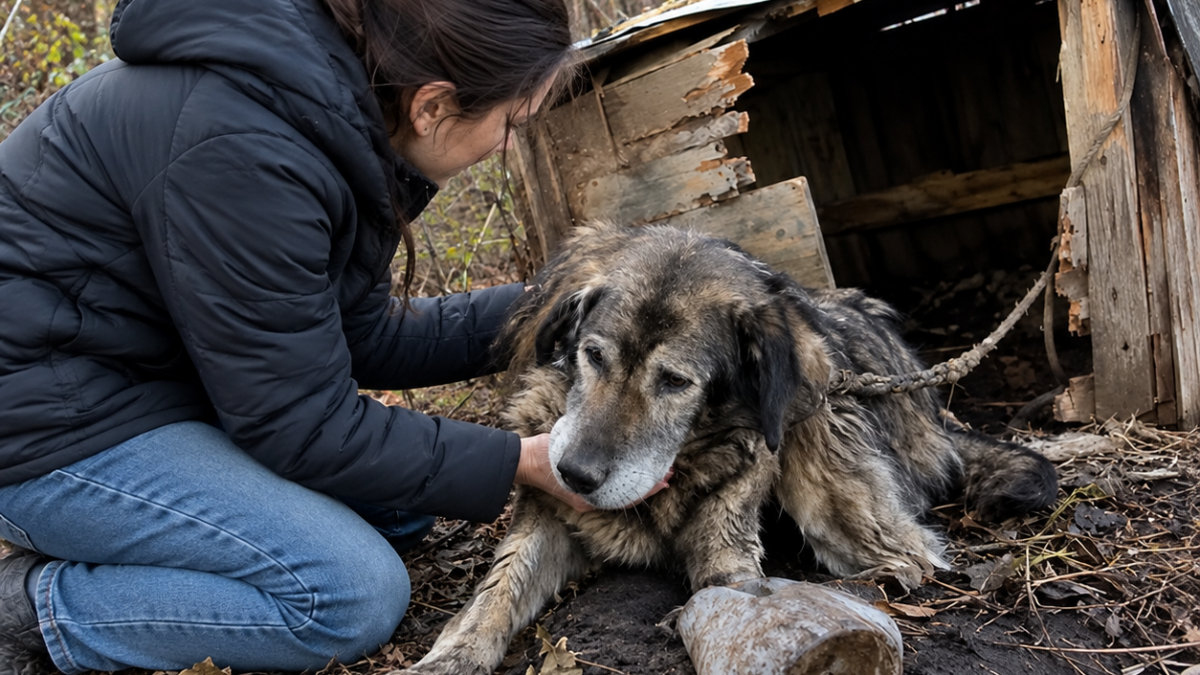
I stayed beside him for several more minutes before trying anything else. I wanted the next thing he experienced from a human hand to be patience, not force. Margaret stood behind me holding the flashlight, occasionally wiping her face with her sleeve. She kept looking at the rope as if she wanted to tear it apart herself.
I poured a small amount of water into a clean collapsible bowl.
When I placed it near him, his nose lifted.
He smelled it.
Then he drank.
At first, slowly.
Then desperately.
I pulled the bowl back before he could gulp too much.
“Easy.”
He stared at the water.
“I know.”
I let him drink again.
His tongue moved weakly against the surface.
As he drank, I inspected the rope more closely.
It had been tied through an old collar around his neck. The collar had twisted, and the rope rubbed directly against raw skin beneath his jaw. The wound smelled infected.
I reached for trauma shears.
The dog saw them.
His entire body stiffened.
I immediately put them down.
“All right.”
I waited.
Eventually he lowered his head again.
I touched the rope first.
No reaction.
Then the collar.
He flinched but stayed still.
“Good boy.”
It took nearly fifteen minutes to cut him free.
When the rope finally dropped into the mud, he stared at it.
I don’t know whether dogs understand freedom in the same abstract way we do.
But Mason—though I did not yet know his name—understood that something had changed.
He tried to stand.
His front legs pushed upward.
His hind legs shook.
Then his body collapsed.
I caught him against my chest.
He was frighteningly light.
A dog his size should have had weight behind him. Muscle. Strength.
Instead, I felt bones beneath fur.
Margaret gasped.
“How long has he been like this?”
“I don’t know.”
I wrapped him in two blankets.
When I lifted him, he did not resist.
His head rested against my shoulder.
I could feel his slow breathing through the blanket.
We carried him to my SUV.
Before shutting the door, I looked back at the doghouse.
The empty bowl remained in the mud.
The severed rope lay beside it.
Something about that image made me angry in a way I had not felt in years.
Someone had done this deliberately.
This was not a dog who had wandered away and become trapped.
Someone had tied him there.
Someone had walked away.
I climbed into the driver’s seat and called the emergency veterinary hospital.
“I’m bringing in a large adult dog,” I said. “Severe emaciation, dehydration, possible hypothermia, infected neck wound.”
“How far out?”
“About twenty minutes.”
“We’ll be ready.”
The drive felt endless.
At every red light, I looked into the rearview mirror.
“Stay with me.”
Sometimes his eyes opened.
Sometimes they didn’t.
At one intersection, I reached backward between the seats.
His nose touched my fingertips.
“Good.”
When we pulled into the clinic, two technicians came outside with a stretcher.
The dog tried to stand when they opened the SUV.
He couldn’t.
One technician lifted the blanket.
Her expression changed.
“Oh.”
That single sound told me everything.
Inside, the team worked quickly.
His temperature was dangerously low.
He was severely dehydrated.
His gums were pale.
His pulse was weak.
The wound around his neck was infected.
There were sores on his hips and legs, suggesting he had spent a long time lying on hard ground.
His nails were severely overgrown.
His coat was packed with dirt.
And once they examined his teeth and overall condition, Dr. Emily Warren estimated that he was at least eight years old, possibly older.
“How bad?” I asked.
She removed her gloves.
“Very.”
“Is he going to make it?”
She looked at him through the glass treatment-room door.
“I don’t know yet.”
I hated that answer.
But I trusted her because she refused to tell me what I wanted to hear.
They started warmed intravenous fluids, antibiotics, pain medication, and controlled nutritional support. Because severely starved animals can become dangerously ill if fed too much too quickly, every calorie had to be introduced carefully.
Then a technician scanned him.
The device beeped.
“He’s chipped.”
I looked up.
“You found one?”
“Yes.”
A few minutes later, we had a name.
Mason.
The registered owner was a man named Walter Reeves.
The phone number no longer worked.
The address was the abandoned property.
I stood beside Mason’s treatment cage.
“Mason?”
His eyelids moved.
“Mason.”
His ears lifted slightly.
Dr. Warren noticed.
“That’s his name.”
For the first time that night, the dog from the muddy yard was not just “the dog.”
He was Mason.
And names make things real.
I stayed until nearly two in the morning.
Before leaving, I placed my fingers through the kennel bars.
Mason smelled them.
Then rested his nose against my hand.
“I’ll come back.”
I meant it.
The next morning, I started asking questions.
The veterinary clinic listed on Mason’s chip still existed, although the veterinarian who originally implanted it had retired. Because the records involved a possible cruelty case, the clinic would not release private information directly to me.
But they confirmed several things.
Mason had been Walter Reeves’s dog.
He had once received regular veterinary care.
Walter had died three years earlier.
That stopped me.
“Three years?”
“Yes.”
“What happened to Mason afterward?”
The clinic manager couldn’t tell me.
So I called animal control.
By noon, Officer Daniel Ruiz met me at the abandoned property.
Ruiz had spent more than a decade working cruelty and neglect cases. He was quiet, observant, and rarely reacted visibly to what he saw.
When he looked at the doghouse, his jaw tightened.
“You cut him from here?”
“Yes.”
“Where’s the rope?”
I pointed.
He photographed it before placing it into an evidence bag.
A sheriff’s deputy joined us.
Together, they documented the doghouse, empty bowl, muddy ground, old food packaging, tire impressions near the alley, and several cigarette butts.
“Could somebody have been living here?” I asked.
Ruiz shook his head.
“Doesn’t look like it.”
The house had been officially vacant for months.
But someone had been using the backyard.
Margaret remembered her security camera.
It covered part of the alley.
We reviewed four days of footage.
Most of it showed nothing.
Cars passing.
A garbage truck.
A kid on a bicycle.
Then, late in the afternoon four days before Mason was found, a dark pickup truck appeared.
It stopped behind the property.
A man stepped out.
Then another.
They opened the back.
Mason climbed down.
Even on grainy video, he looked weak.
The first man held his collar.
The second carried the plastic bowl.
They walked through the broken rear gate.
Twelve minutes later, the two men came back.
Mason did not.
Nobody in Margaret’s kitchen moved.
Ruiz rewound the video.
“Again.”
We watched it a second time.
Then a third.
The rear license plate became visible for perhaps a second.
The deputy enlarged the image.
There was enough.
The truck was registered to Evan Reeves.
Walter’s nephew.
According to property records, Evan had inherited Walter’s house after his death.
Suddenly, we had a direction.
Over the next two days, I learned more about Walter.
Neighbors remembered him well.
He had been a retired mechanic.
Quiet.
Widowed.
The kind of man who fixed lawnmowers for people and refused payment.
And everybody remembered Mason.
“They were together all the time,” an older man named Bill told me.
“Walter would drive to the hardware store, Mason was in the truck. Walter went fishing, Mason went fishing. Walter sat on the porch, Mason sat beside him.”
A woman across the road found an old photograph.
Walter sat on the front steps with a younger Mason beside him.
The dog was broad-chested and healthy.
On the back, Walter had written:
My best buddy.
I stared at that photograph for a long time.
Mason had known love.
That somehow made what happened later even crueler.
He had not spent his entire life neglected.
He remembered warm houses.
Full bowls.
A hand he trusted.
Then Walter disappeared.
And somehow, the dog who had once been somebody’s best friend ended up tied beside a collapsing doghouse.
I took the photograph to the clinic.
Mason was stronger that afternoon.
Not much.
But enough to raise his head when I entered.
“Hey.”
His tail moved once.
Just once.
I nearly cried.
I sat beside him and held up Walter’s picture.
“This was your guy, huh?”
Mason stared at the photograph.
I knew dogs do not understand pictures exactly as humans do.
Still, I said the name.
“Walter.”
Mason’s ears lifted.
I froze.
“Walter?”
His head came up.
Dr. Warren, standing behind me, saw it.
“He remembers the name.”
My throat tightened.
Of course he did.
Dogs remember voices.
Smells.
Routines.
Names.
Mason had probably spent weeks after Walter died waiting for him to return.
Maybe every engine in the driveway made him raise his head.
Maybe every opening door made him expect those familiar footsteps.
But Walter never came back.
Instead, responsibility passed to Evan.
And somewhere along the way, responsibility turned into resentment.
Animal control interviewed Evan.
At first, he denied knowing where Mason was.
Then officers showed him the video.
His story changed.
He claimed he had only taken Mason to the property temporarily.
He said a friend was supposed to pick the dog up.
“Who?”
Evan supposedly couldn’t provide a name.
He said he had left water.
There was none.
He said he had left food.
There was no usable food.
He said Mason had been thin because he was old.
He said the dog had stopped eating.
Then Officer Ruiz asked the obvious question.
“If he was sick, why didn’t you take him to a veterinarian?”
Evan reportedly shrugged.
“It’s just a dog.”
When Ruiz repeated that sentence to me, something inside me hardened.
It’s just a dog.
Four words.
Four words that explained more than all of Evan’s excuses.
To him, Mason had become property.
An expense.
An inconvenience.
Something old and difficult that could be left somewhere until the problem disappeared.
But Mason had trusted people.
That was his only mistake.
The second man from the video was identified as Todd Mercer, a friend of Evan’s.
Todd did not stay loyal for long.
Once investigators explained that he could also face charges, he began talking.
Mason had lived with Evan after Walter died.
At first, things had been relatively normal.
Then Evan moved in with a girlfriend who did not want the dog indoors.
Mason was older.
He had arthritis.
He sometimes had accidents.
He barked when left alone.
Veterinary care cost money.
According to Todd, Evan became increasingly angry about having to care for him.
Several months before we found Mason, Evan moved him back to Walter’s empty property.
He claimed he would check on him.
Sometimes he did.
Sometimes days passed.
Then weeks.
Todd admitted helping Evan transport Mason to the property one final time.
“Did Evan say someone was coming for him?” investigators asked.
Todd hesitated.
“He said something like that.”
“Did you believe him?”
Todd looked down.
“No.”
Investigators recovered text messages.
One exchange became central to the case.
Todd had written:
What if somebody sees him?
Evan replied:
Nobody goes back there.
Todd:
How long are you leaving him?
Evan:
Doesn’t matter.
When I saw those words, I had to set the phone down.
Doesn’t matter.
I looked through the clinic window.
Mason was asleep beneath a warm blanket.
It mattered to him.
Hunger mattered.
Cold mattered.
Pain mattered.
Waiting mattered.
Every hour he spent listening for footsteps mattered.
Every time the rope tightened around his neck mattered.
Investigators also discovered that Evan had been preparing Walter’s property for sale.
The realtor had repeatedly told him that the yard needed to be cleared.
One message from Evan read:
I’ll deal with the dog before you come back.
Now the story was becoming painfully clear.
Mason was not abandoned because there were no options.
He was abandoned because helping him required effort.
A shelter was fifteen minutes away.
Two rescue organizations operated in the county.
Veterinary clinics could have discussed treatment.
If Mason’s medical condition had truly been hopeless, humane euthanasia existed.
Evan had choices.
He chose the doghouse.
Charges followed.
But while the case strengthened, Mason weakened.
The third night after his rescue, Dr. Warren called me at 11:17 p.m.
“His electrolytes are unstable.”
I was already reaching for my keys.
“What happened?”
“He’s vomiting. His body is struggling with nutrition. We’re adjusting everything.”
“Is he dying?”
A pause.
“I don’t know.”
I drove to the hospital.
Mason looked smaller than ever.
An IV ran into his leg.
His breathing was shallow.
I sat beside the cage.
“You’re supposed to be getting better.”
One eye opened.
I slid my hand inside.
“You survived that yard.”
His nose moved toward my palm.
“You survived the cold.”
He breathed.
“You survived Evan.”
I swallowed hard.
“So you don’t get to quit now.”
I stayed through the night.
Sometime before dawn, exhaustion pulled me asleep in a plastic chair.
I woke because something wet touched my fingers.
Mason was licking my hand.
I looked at him.
“You’re still here.”
His tail moved weakly.
Later that morning, Dr. Warren brought a tiny portion of soft food.
Mason smelled it.
One bite.
Then another.
Three bites total.
That was all.
I cried.
Three bites did not look like much.
But three bites meant he was still fighting.
The next day he ate five.
Then half a bowl.
By the sixth day, he could stand for several seconds.
A technician and I used a support sling to take him outside.
His legs shook.
He walked ten feet.
Then stopped.
There was a patch of grass beside the clinic.
Mason lowered his nose into it.
He smelled the earth.
The leaves.
The morning air.
Then he lifted his face toward the sunlight.
No rope pulled him back.
I watched him stand there and realized that for the first time in weeks, perhaps months, Mason could choose where to put his feet.
Freedom, for him, was ten feet of grass.
His recovery took weeks.
He needed controlled meals because his digestive system had to relearn normal eating.
His neck wound had to be cleaned every day.
His coat had to be slowly brushed and clipped because some areas were so badly matted that pulling them would hurt.
The pressure sores healed.
His blood values improved.
But his fear remained.
One afternoon, a metal tray fell in the treatment room.
Mason dropped instantly to the floor and covered his head.
Everybody froze.
Dr. Warren looked at me.
“That wasn’t learned in four days.”
No.
Something had happened before the doghouse.
We would never know everything.
Perhaps that was merciful.
Three weeks after his rescue, Mason was discharged.
Officially, he needed a foster home.
I volunteered.
I told everyone it would be temporary.
Dr. Warren laughed.
“What?”
“Nothing.”
“You think I’m keeping him.”
“I didn’t say anything.”
“You made a face.”
“I’ve seen that face before.”
“What face?”
“The foster failure face.”
“I am not adopting this dog.”
Mason was lying at my feet.
He looked up.
Dr. Warren smiled.
“Sure.”
The first time Mason entered my house, he froze at the doorway.
I had prepared everything.
A large orthopedic bed near the fireplace.
Food and water bowls.
Non-slip rugs.
A gated quiet area.
Blankets.
He looked past me into the living room but would not cross the threshold.
“Come on.”
Nothing.
I stepped inside and sat on the floor.
“No rush.”
After nearly a minute, Mason placed one paw inside.
Then another.
He smelled the rug.
The baseboard.
The leg of a chair.
Finally he saw the bed.
He walked toward it.
One paw touched the cushion.
He pulled it back.
I smiled.
“That’s yours.”
He tried again.
Eventually, he climbed onto the bed, turned slowly in a circle, and lowered himself.
His body remained tense for several minutes.
Then it softened.
His head dropped onto the cushion.
Within ten minutes, he was asleep.
Mason slept almost twelve hours that first night.
But healing was not linear.
Some days he seemed happy.
Other days he retreated.
He feared doors closing behind him.
He hated ropes, including ordinary leashes at first.
If I moved too quickly toward his neck, he flinched.
At night, he sometimes cried in his sleep.
Once, he woke suddenly and ran directly into a chair.
I sat beside him.
“Mason.”
He panted.
“You’re home.”
The word slipped out without planning.
Home.
He stared at me.
I placed my hand on the floor beside him rather than touching him.
“You’re home.”
Eventually, his breathing slowed.
A month passed.
Mason gained eight pounds.
Then twelve.
His coat began to shine.
He discovered that my refrigerator contained cheese.
That changed our relationship significantly.
He also discovered the kitchen trash.
That caused our first serious disagreement.
I walked into the room one afternoon and found him standing beside an overturned bin with a piece of paper stuck to his nose.
“Mason.”
He froze.
I pointed at the mess.
“Really?”
His tail moved.
“No.”
Another wag.
“You are not charming your way out of this.”
His tail accelerated.
I started laughing.
That was the first time Mason saw me laugh because of something he had done.
He tilted his head.
Then walked toward me.
The frightened dog from the yard was beginning to develop a personality.
He disliked rain.
He loved car rides.
He hated carrots.
He could hear a bag of chicken treats open from three rooms away.
He liked women immediately but remained cautious around unfamiliar men.
He slept near the fireplace even when it was too warm.
And every evening around nine, he came to find me.
He did not need anything.
He simply checked where I was.
Then he returned to bed.
I suspected he needed to know I had not disappeared.
Two months after bringing him home, I received an email from the rescue coordinator.
Foster status review: Mason.
I stared at it.
Technically, Mason was now healthy enough to begin adoption placement.
I looked across the room.
He was asleep on my couch.
My couch.
Not the expensive orthopedic bed I had bought specifically for him.
The couch.
He opened one eye.
“What?”
Tail thump.
“Don’t look at me like that.”
Another thump.
The next morning, I signed the adoption papers.
Mason became mine officially.
But I knew the truth.
He had chosen long before I signed anything.
While Mason was rebuilding his life, Evan was preparing for court.
His attorney attacked the case aggressively.
They suggested Mason had wandered away.
The video destroyed that claim.
They suggested he had been tied only briefly.
Veterinary evidence contradicted it.
They suggested Mason’s thinness resulted from age.
Dr. Warren documented prolonged malnutrition.
Then investigators found something else.
A hardware store receipt.
Evan had purchased rope matching the one found on Mason, along with the plastic bowl, nearly two weeks before the rescue.
Store security footage showed him making the purchase.
The defense shifted again.
Maybe the rope was used for something else.
Maybe the bowl was coincidence.
But the evidence kept accumulating.
Todd gave prosecutors additional text messages.
In one, Evan complained:
Old dog keeps costing me money.
In another:
Realtor wants that whole yard cleared by Friday.
Todd replied:
What are you doing with Mason?
Evan:
Taking care of it.
No shelter records showed Evan surrendering Mason.
No veterinary records showed recent treatment.
No rescue group had been contacted.
“Tackling the problem,” apparently, meant tying an old dog in an abandoned yard and waiting.
The case took seven months to reach trial.
During that time Mason became almost unrecognizable.
He gained more than twenty pounds.
His neck healed, leaving a thin scar.
His muscle tone improved.
He could walk around the block.
On cool mornings, he sometimes pulled me toward the park.
He never became fast.
But he became determined.
People in town began recognizing him because local coverage of the cruelty case had spread.
“Is that Mason?”
Sometimes strangers asked to pet him.
At first he hid beside me.
Later he allowed it.
Eventually he began approaching people himself.
One little boy crouched and held out his hand.
Mason walked directly to him.
The boy rubbed his ears.
“You’re a good dog.”
Mason leaned against him.
I turned away because my eyes had filled with tears.
The court date arrived in May.
I left Mason with Margaret that morning.
Before I left, I knelt beside him.
“Today’s about you.”
Mason licked my chin.
“You have no idea, do you?”
His tail moved.
“Probably better that way.”
The courthouse smelled like old wood, dust, and coffee.
Evan sat with his attorney at the defense table.
I had not seen him in person before.
He looked ordinary.
That disturbed me.
Part of you wants someone capable of cruelty to look visibly cruel.
You want to recognize danger.
But most cruelty does not announce itself.
Sometimes it wears a clean shirt.
Sometimes it pays taxes.
Sometimes it smiles at neighbors.
Sometimes it says, “It’s just a dog.”
I testified on the second day.
The prosecutor asked me to describe what I found.
I spoke about the doghouse.
The rope.
The empty bowl.
Mason’s body.
His inability to stand.
His reaction when I reached toward him.
Then she displayed photographs.
The courtroom became quiet.
The first photograph showed Mason beside the doghouse.
The next showed the wound around his neck.
The next showed the outline of his ribs.
I had seen those images many times.
They still hurt.
“Did Mason show aggression toward you?” the prosecutor asked.
“No.”
“Fear?”
“Yes.”
“How would you describe his physical condition?”
“Like a dog who was running out of time.”
The defense attorney stood for cross-examination.
He was polished.
Calm.
“Are you a veterinarian?”
“No.”
“An animal nutrition specialist?”
“No.”
“A forensic pathologist?”
“No.”
“So your opinion that Mason had been starving for an extended period was not a medical diagnosis.”
“No.”
He nodded as if satisfied.
Then I added, “That’s why the veterinarian is testifying.”
He paused.
A few people shifted.
He continued.
“You never saw Mr. Reeves strike Mason.”
“No.”
“You never saw him refuse food to Mason.”
“No.”
“You never saw him tie Mason to that structure.”
“No.”
“So your testimony cannot tell this jury what Mr. Reeves intended.”
I looked toward Evan.
Then back at the attorney.
“My testimony tells them what I found after he left.”
The prosecutor looked down, hiding a reaction.
Dr. Warren testified next.
She was devastating because she was precise.
No emotion.
No exaggeration.
Just medicine.
Body condition.
Dehydration.
Anemia.
Muscle wasting.
Pressure injuries.
Skin condition.
Infection.
Arthritis.
Refeeding risks.
The defense asked whether old age could contribute to weight loss.
“Yes.”
“Could illness cause appetite problems?”
“Yes.”
“Could arthritis reduce muscle mass?”
“Yes.”
“Then you cannot say every condition was caused by neglect.”
Dr. Warren looked directly at him.
“No. And I never said that.”
The lawyer waited.
She continued.
“What I can say is that Mason was an elderly dog with medical needs that made proper care more important. Those conditions do not explain why he was restrained outdoors without adequate shelter, nutrition, water, or medical treatment.”
The attorney’s expression tightened.
Then came the security video.
The prosecutor played it once.
Evan’s truck entered the alley.
Mason was removed.
The men disappeared behind the fence.
Twelve minutes later, the men returned.
The truck left.
Without Mason.
Then the text messages appeared.
What if somebody sees him?
Nobody goes back there.
How long are you leaving him?
Doesn’t matter.
No one in the jury box looked away.
Todd testified.
He admitted helping transport Mason.
He admitted knowing no rescue had been arranged.
He admitted Evan complained about the expense.
“Why did you help him?” the prosecutor asked.
Todd swallowed.
“I didn’t think.”
“No,” she said. “I’m asking why.”
He looked toward Evan.
“I was stupid.”
“Did you believe somebody was going to pick Mason up?”
“No.”
“Did Evan say when he planned to return?”
“No.”
“Did you see enough food for several days?”
“No.”
“Water?”
“There was some in the bowl.”
“How much?”
Todd looked uncomfortable.
“Not much.”
“Did you think an old dog should be left there?”
“No.”
“Yet you drove away.”
“Yes.”
The prosecution rested.
Evan testified in his own defense.
That surprised me.
His attorney had clearly prepared him.
He talked about Walter.
He said he had tried to help Mason.
He said the dog became difficult.
He said he was overwhelmed.
He said he had financial problems.
He insisted he never intended for Mason to die.
“I thought someone was coming to get him.”
The prosecutor stood.
“Who?”
Evan hesitated.
“A guy Todd knew.”
“Name?”
“I don’t remember.”
“Phone number?”
“I don’t have it.”
“Did you call him?”
“I don’t remember.”
“Did you text him?”
“I changed phones.”
“Did Mr. Mercer provide investigators with any message about this mystery person?”
“I don’t know.”
The prosecutor walked toward the evidence screen.
“You purchased the rope thirteen days before Mason was found.”
“Yes.”
“Why?”
“For work around the property.”
“And the dog bowl?”
“For Mason.”
“So thirteen days before Mason was found, you purchased supplies specifically for him?”
“I bought a bowl.”
“Then later you told investigators you hadn’t seen Mason in months.”
Evan shifted.
“I was confused.”
“You were confused about whether you had seen the dog whose bowl you purchased?”
His attorney objected.
The judge allowed the prosecutor to rephrase.
She did.
Evan’s answers became shorter.
Then she displayed the realtor message.
I’ll deal with the dog before you come back.
“What did you mean?”
“I meant find him a home.”
“Which home?”
“I don’t know.”
“Which rescue?”
“I don’t remember.”
“Which shelter?”
Silence.
Then came the final exchange.
How long are you leaving him?
Doesn’t matter.
“What did ‘doesn’t matter’ mean?”
Evan stared at the screen.
“It was just something I said.”
The prosecutor waited.
Then quietly:
“Did it matter to Mason?”
His attorney objected immediately.
Sustained.
But the jury had heard it.
Three hours after deliberations began, we were called back.
Margaret sat beside me.
Her hands shook.
“What if they don’t convict him?”
“We wait.”
“I don’t know if I can.”
Neither did I.
The jury entered.
Evan stood.
The clerk read the verdict.
Guilty.
Margaret grabbed my hand.
Another count.
Guilty.
Another.
Guilty.
I expected satisfaction.
Instead, I felt something heavier.
Relief.
Not celebration.
Nothing could return the days Mason spent tied outside.
Nothing could undo hunger.
Nothing could restore Walter.
Justice was not time travel.
But Evan would not get to erase what happened.
At sentencing, the judge reviewed the photographs again.
Then he looked at Evan.
“You inherited responsibility for an animal who had already lost the person he depended upon.”
Evan stared ahead.
“You had options. You could surrender him. Seek rescue assistance. Seek veterinary treatment. If his condition truly made continued life inhumane, you could obtain proper end-of-life care.”
The courtroom was silent.
“Instead, you chose isolation and abandonment.”
The sentence included penalties available under the convictions: financial restitution toward veterinary expenses, fines, court supervision, community service, restrictions prohibiting animal ownership for years, compliance conditions, and additional sanctions associated with the charges.
Todd received a lesser penalty in exchange for cooperation but did not escape consequences.
The property sale also turned into a disaster for Evan.
The criminal investigation delayed everything.
Repairs accumulated.
Legal bills grew.
Liens and restitution obligations consumed money.
By the time Walter’s house finally sold, the easy profit Evan apparently expected had largely vanished.
People asked whether that made me happy.
Not really.
My satisfaction came from somewhere else.
Mason was alive.
That was enough.
Months after the trial, the new owners of Walter’s old property contacted me.
They planned to renovate everything.
The collapsing shed would come down.
So would the doghouse.
“We thought you should know before we remove it.”
I debated whether to return.
More importantly, I debated whether Mason should.
Would the place frighten him?
Would the smell bring everything back?
I almost went alone.
Then one morning, while Mason sat beside the SUV waiting for a ride, I changed my mind.
“Want to go somewhere?”
His tail wagged.
We drove to the property.
The yard looked different.
The weeds had been cut.
Broken fencing was gone.
Sunlight reached the ground.
But the doghouse remained.
When Mason climbed out of the SUV, he stopped.
His ears moved forward.
His body tightened.
I crouched.
“You don’t have to.”
He looked at me.
Then toward the yard.
I loosened the leash.
Mason took one step.
Then another.
We walked together.
When we reached the backyard, he stopped again.
There it was.
The ruined doghouse.
The post where the rope had been tied.
Mason stared.
For several seconds, I wondered what he remembered.
Did he remember cold?
Hunger?
Waiting?
Did he remember the rope cutting into his neck?
Or did dogs protect themselves from the past better than humans do?
He moved closer.
Smelled the ground.
Smelled the post.
His tail stayed low but relaxed.
I stood silently.
The new homeowner waited near the shed.
Then Mason walked to the doghouse.
He sniffed one corner.
Turned sideways.
Lifted his leg.
And peed directly on it.
There was one second of stunned silence.
Then the homeowner burst out laughing.
I laughed so hard tears came to my eyes.
“Mason!”
He looked at me innocently.
The homeowner shook his head.
“I think he just gave us permission to tear it down.”
I rubbed Mason’s head.
“Apparently.”
That simple ridiculous moment broke something open inside me.
For months, the doghouse had represented everything that had happened to him.
Now it was just an old piece of wood Mason considered worthy of urinating on.
He turned away.
Walked toward the SUV.
Did not look back.
That was the only revenge Mason ever needed.
He got to leave.
Again.
But this time, it was his choice.
Years passed.
Mason grew older.
His muzzle turned almost completely white.
His arthritis worsened.
We added non-slip rugs across the hardwood floors.
Then a ramp at the back steps.
Then a second ramp near the porch.
He took joint medication every morning inside a piece of cheese because Mason could detect a pill inside almost any food except cheese.
He loved cheese more than medicine offended him.
Saturday mornings became special.
I made scrambled eggs.
Mason received a small amount mixed into his breakfast.
He knew Saturday.
I have no idea how.
But every Saturday morning, he appeared in the kitchen before the pan came out.
“You have a calendar?”
Tail wag.
“Did somebody give you a phone?”
Wag.
“You’re ridiculous.”
He did not care.
Mason also became a minor celebrity around the neighborhood.
Children knew him.
Mail carriers knew him.
The woman at the drive-through pharmacy knew him because I once took him there and she gave him a dog biscuit.
After that, every visit required a biscuit.
If one did not appear quickly enough, Mason stared through the window with intense disappointment.
One afternoon, a little girl asked about the scar on his neck.
“What happened?”
Her mother looked embarrassed.
“You don’t have to answer that.”
“It’s okay.”
I knelt beside Mason.
“Someone didn’t take very good care of him once.”
The girl frowned.
“Why?”
I had no good answer.
“I don’t know.”
She put both arms around Mason’s neck carefully.
He closed his eyes.
Then she said, “Well, they don’t get him anymore.”
I smiled.
“No.”
“They lost him.”
“Yes.”
She kissed his head.
“Good.”
Children sometimes understand justice better than adults.
Mason belonged to no one who considered him disposable.
He belonged where he was loved.
At night, he slept beside the fireplace.
Sometimes he dreamed.
His paws moved.
But the nightmares became rare.
He no longer woke panicked.
He no longer feared doors closing.
Eventually, he stopped checking whether I was still home every evening.
That change hurt me in a beautiful way.
He had finally learned I would come back.
One winter, I received a package from a woman named Claire Reeves.
Walter’s sister.
She had learned about Mason through a news article after the trial.
Inside the package was a photograph.
Walter stood beside a lake holding a fishing rod.
A younger Mason sat next to him.
Behind them was an old green pickup truck.
There was also a handwritten letter.
Claire explained that Walter had found Mason near a highway years earlier.
Mason had been thin, dirty, and frightened.
Walter told everyone he was keeping the stray “for one night.”
One night became years.
She wrote:
My brother loved Mason more than most people understood. After Walter became sick, his greatest worry was what would happen to that dog. I did not know how bad things became after he died. I wish I had. Thank you for finding Mason when Walter could no longer protect him.
I stopped reading.
For several minutes, I sat at the kitchen table with the letter in my hands.
Then I looked at Mason.
He was asleep.
I whispered:
“You’ve been rescued twice.”
First Walter.
Then me.
Maybe that was Mason’s life.
People failed him badly.
But not everyone.
Walter’s photograph went above Mason’s bed.
The first evening it hung there, Mason stared upward for several seconds.
I said:
“Walter.”
His ears moved.
Even years later.
I sat beside him.
“He would be happy to see you.”
Mason placed one paw on my leg.
I hoped Walter somehow knew.
I hoped that wherever he was, he knew his best buddy had not died alone in that yard.
Mason reached approximately fourteen years old before his health began changing more rapidly.
He slept longer.
Walked slower.
Some mornings his hind legs needed several minutes before they cooperated.
Dr. Warren adjusted his arthritis medication.
We shortened our walks.
Instead of going around the block, we went to the mailbox.
Then halfway down the street.
Mason did not seem bothered.
He cared less about distance than smelling every blade of grass.
I learned to stop measuring his life by how far he could walk.
Quality was not mileage.
Quality was waking up excited for breakfast.
Sleeping comfortably.
Enjoying the sun.
Wanting affection.
Still caring deeply about cheese.
For a long time, Mason had all of those things.
Then one morning, breakfast stayed untouched.
That scared me.
Food had become one of Mason’s great joys.
I placed the bowl closer.
He smelled it.
Turned away.
“Come on.”
Nothing.
I offered chicken.
Nothing.
Cheese.
He took it into his mouth, then dropped it.
My stomach went cold.
We went to the clinic.
Dr. Warren examined him.
Blood tests.
X-rays.
Ultrasound.
I waited in the same room where years earlier I had waited to learn whether Mason would survive starvation.
When Dr. Warren returned, I knew from her face.
“There’s a mass.”
I stared at her.
“Where?”
She explained.
Cancer.
Advanced.
Likely aggressive.
We could pursue treatment.
There were procedures.
Medications.
Potential extensions.
But the realistic question was not whether medicine could give Mason more days.
It was what those days would feel like.
I asked every question.
“What if we operate?”
“What if we do chemotherapy?”
“What if we try steroids?”
“What if—”
Finally, Dr. Warren sat beside me.
“You rescued him once.”
I covered my face.
“I’m trying to do it again.”
“I know.”
“What am I supposed to do?”
“The same thing you did then.”
I lowered my hands.
She looked toward Mason.
“Put what he needs ahead of what hurts you.”
That sentence stayed with me.
Mason had been hurt because somebody once chose convenience over his needs.
I would not make the opposite mistake and force him through suffering because I was afraid of grief.
I took him home.
We had three good days.
On the first day, Mason ate steak.
Not much.
But enough.
On the second, we drove to the park.
I opened the SUV windows.
Cold air moved through the vehicle.
Mason lifted his nose.
For twenty minutes, we sat beneath a tree.
He watched people walk by.
A child recognized him.
“Is that Mason?”
“Yes.”
The boy came over.
Mason accepted a gentle rub behind the ears.
The child had no idea it was goodbye.
Maybe that was better.
On the final evening, Margaret visited.
She had not seen Mason for several months.
When she entered, Mason raised his head.
His tail moved.
Margaret immediately started crying.
“Oh, buddy.”
She sat beside him.
“You remember me?”
Mason leaned toward her.
She kissed his forehead.
“I heard you.”
I looked at her.
She rubbed his face.
“I almost didn’t.”
Her voice broke.
“That first time, I thought it was the wind.”
Mason closed his eyes.
“But I heard you.”
That night, after Margaret left, I slept beside Mason on the floor.
At some point around two in the morning, I woke.
He was watching me.
“You okay?”
His breathing was slow.
I put my hand beside his face.
He rested his chin on it.
Exactly like the first night.
I remembered the mud.
The rope.
The empty bowl.
And suddenly I understood how far we had traveled together.
Not in miles.
In trust.
The next morning, sunlight came through the windows.
Dr. Warren arrived at ten.
I had moved Mason’s bed near the fireplace.
Walter’s photograph rested nearby.
Mason was tired but calm.
I sat beside him.
He placed his head in my palm.
I could not stop crying.
“You remember when we met?”
His eyes moved toward me.
“You scared me.”
I laughed through tears.
“You looked terrible.”
Tail movement.
Tiny.
“But you came to me.”
I stroked his cheek.
“You didn’t know me, and you still came.”
Dr. Warren prepared the medication.
I kissed Mason between the ears.
“I told you that night you weren’t dying there.”
My voice broke.
“And you didn’t.”
He breathed slowly.
“You came home.”
Another breath.
“You had a bed.”
I smiled.
“And then you stole my couch.”
His tail moved once.
“You got your eggs.”
I rubbed his ear.
“You got your car rides.”
Tears ran down my face.
“You got old.”
That mattered most.
For a dog somebody had left to die, growing old was victory.
I leaned close.
“And I promised nobody would leave you alone again.”
Dr. Warren gave the first medication.
Mason’s body relaxed.
His eyes grew heavy.
I kept my hand beneath his head.
“I meant it.”
His breathing became soft.
“You were a good boy.”
I swallowed.
“You were Walter’s good boy.”
One breath.
“And mine.”
His eyes closed.
“You mattered, Mason.”
Dr. Warren administered the final medication.
“You always mattered.”
Mason exhaled.
Then he was still.
His head remained in my hand.
Just as it had been on the first night.
But this time there was no cold.
No rope.
No fear.
His stomach was not empty.
He was not alone.
For a long time, I stayed beside him.
Grief does not care whether you know the ending is right.
It does not care that the life was good.
It does not care that suffering ended peacefully.
Grief simply notices that someone was there yesterday and is not there now.
The house became painfully quiet.
For weeks, I still woke expecting Mason beside the bed.
I still looked toward the fireplace.
I still opened the refrigerator and thought about cheese.
His leash remained on the hook near the door.
I could not move it.
Not yet.
Mason was cremated.
I kept most of his ashes at home.
But I knew where part of them belonged.
Not at the doghouse.
Never there.
Behind the old Reeves property stood a large maple tree.
Walter had planted it decades earlier.
The new owners gave me permission.
On an autumn afternoon, almost exactly four years after I first found Mason, I returned carrying a small container.
The doghouse was long gone.
The yard was beautiful now.
Grass.
Flowers.
A repaired fence.
Children’s toys near the porch.
Life had replaced abandonment.
I walked to the maple tree.
The leaves were turning orange.
I scattered a small portion of Mason’s ashes beneath it.
Then I placed a stone.
I had considered putting his entire story on it.
Something about survival.
Cruelty.
Justice.
Evan.
But standing there, I realized I did not want the worst thing that happened to Mason to become the sentence that defined him forever.
Evan did not deserve space on Mason’s memorial.
The doghouse did not deserve space.
The rope did not deserve space.
So the stone said only:
MASON
Beloved friend.
He was found.
He was saved.
He was loved.
I stood beneath the maple tree for a long time.
Wind moved through the leaves.
Somewhere nearby, a dog barked.
I thought about Walter.
About Margaret hearing that faint cry.
About Dr. Warren staying up through the night.
About Officer Ruiz collecting the rope.
About the jury.
About Mason peeing on the doghouse.
I laughed quietly.
Then cried again.
People still sometimes ask whether Evan’s punishment was enough.
I no longer know how to answer that question.
No legal sentence can make a person feel the exact pain they caused.
A fine cannot recreate hunger.
Probation cannot recreate cold nights.
Restrictions cannot return lost time.
There is no mathematical equation where suffering goes on one side and punishment balances it perfectly on the other.
But I know what Evan wanted.
He wanted Mason to disappear.
He believed nobody went back there.
That was literally what he wrote.
Nobody goes back there.
He believed there would be no witness.
No complaint.
No consequences.
An old dog would simply stop moving one day.
And that would be the end.
Instead, Margaret heard him.
I found him.
Dr. Warren saved him.
Investigators followed the evidence.
Todd talked.
The texts survived.
The video existed.
A jury listened.
And Mason lived.
That was the part Evan never planned for.
Mason lived long enough to become evidence against the man who discarded him.
Then he lived longer.
Long enough to learn that bowls could stay full.
Long enough to discover beds.
Long enough to sleep beside a fireplace.
Long enough to become annoyed when breakfast was late.
Long enough to steal my couch.
Long enough to trust children.
Long enough to remember Walter’s name.
Long enough to ride with his nose near an open window.
Long enough to go back to the yard where he had once been powerless.
Long enough to stand beside that rotten doghouse without a rope around his neck.
Long enough to turn his back on it.
Long enough to walk toward me.
Long enough to go home.
When I remember Mason now, I rarely see the dog from that first night.
I know he existed.
I will never forget him.
But that is not the image that stayed strongest.
I remember the older Mason.
Gray muzzle.
Bright eyes.
Standing beside my SUV after our final visit to Walter’s property.
The doghouse was behind him.
The door of my vehicle was open.
Mason looked at me.
I patted the seat.
“Come on, old man.”
He walked toward me.
Slowly.
One step.
Another.
No rope stopped him.
He climbed inside.
I closed the door.
Then I looked once toward the doghouse.
Mason did not.
He was already facing forward.
Already waiting to go home.
That is how I choose to remember him.
Not abandoned.
Not starving.
Not frightened.
Free.
Loved.
And looking forward.








