PART 2: They Left a Blind Mother Corgi and Her Five Starving Puppies to Di3 Beside Highway 82—But She Never Stopped Waiting for Someone to Come Back
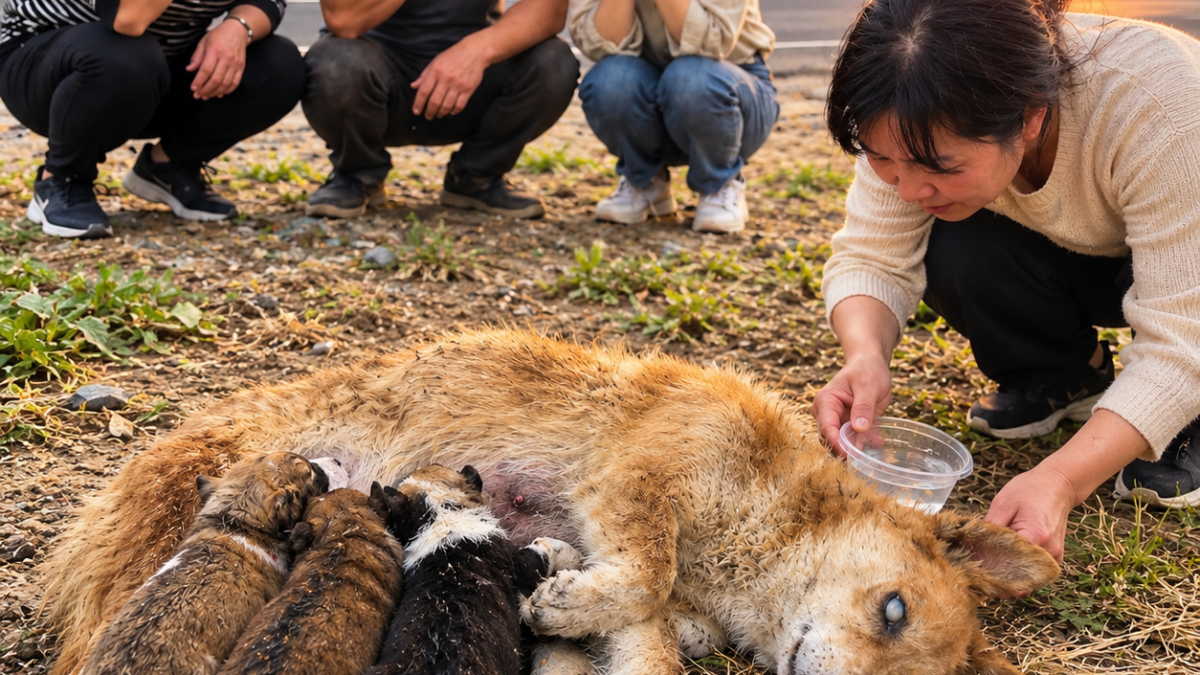
PART 2
I was still holding the weakest puppy when Officer Rachel Morgan crouched beside the mother dog.
Rachel worked for the county animal services department.
We had met during several previous rescues, and I trusted her judgment.
She was one of those people who could walk into a terrible situation without allowing her emotions to take control.
But that afternoon, even Rachel looked shaken.
“What is it?” I asked.
She carefully separated the matted hair beneath the dog’s neck.
A narrow strip of faded red nylon appeared.
It had been buried beneath the tangled fur.
Part of an old collar.
The buckle was missing.
A piece of frayed material remained caught against her skin.
And attached to it was a small metal identification tag.
Rachel gently turned it over.
The engraving was almost impossible to read.
Dirt filled the letters.
She wiped the surface with a clean cloth.
Then she read the name aloud.
“Maggie.”
I looked at the blind mother dog.
“Maggie?”
Her ears lifted.
Rachel looked toward me.
“Say it again.”
I swallowed.
“Maggie?”
The corgi turned her head.
Her tail moved.
Once.
Then twice.
The sound of her name seemed to reach somewhere deep inside her exhausted body.
I felt my eyes fill.
“Oh, sweetheart.”
I crouched closer.
“Maggie.”
She stretched her neck toward my voice.
And pressed her nose against my hand.
It was the first time she had deliberately reached for me.
Rachel turned the tag over again.
There was a telephone number on the back.
Several digits were worn away.
But enough remained to suggest that Maggie had once belonged to someone who cared enough to give her a name and an identification tag.
That made everything harder.
Because she hadn’t simply appeared beside Highway 82.
At some point, someone had put a collar around her neck.
Someone had called her Maggie.
Someone had fed her.
Maybe loved her.
And somehow, that same blind dog had ended up starving beside a highway with five puppies depending on her.
Rachel looked toward the rescue vehicle.
“We need to move.”
I nodded.
The smallest puppy in my arms was barely responsive.
His little chest rose and fell so faintly that I kept checking whether he was breathing.
“He’s still alive,” I whispered.
Rachel stood.
“Then let’s give him a chance.”
***
The rescue team moved quickly.
They brought a padded stretcher for Maggie and a ventilated carrier lined with clean towels for the puppies.
But Maggie became distressed the moment we moved the first baby away.
She raised her head.
Whined.
Then struggled to stand.
Her front legs gave way.
“Maggie, they’re right here.”
She couldn’t see them.
That was the problem.
She could hear the movement.
Smell unfamiliar people.
Feel the air shifting around her.
But she couldn’t see where her puppies were going.
Rachel understood.
“Keep them close enough for her to smell.”
I carried the smallest puppy toward Maggie’s face.
She sniffed him immediately.
Then licked his ear.
The puppy barely moved.
Maggie whined again.
I felt something tighten in my chest.
“He’s going with you,” I whispered.
“I promise.”
We carefully gathered the remaining four puppies.
One was black and tan like Maggie.
Two were mostly brown.
Another had a white stripe running down his forehead.
The smallest was cream-colored with one dark ear.
All five were frighteningly thin.
Their little bodies were hot from lying on the gravel.
Their mouths were dry.
Some were too weak to cry properly.
Rachel placed them in a padded carrier where Maggie could hear and smell them.
Then she and another officer carefully lifted the mother onto the stretcher.
Maggie didn’t resist.
She only kept turning her head toward the puppies.
Every time one cried, she answered.
A soft whine.
A tiny movement of her tail.
A desperate attempt to reassure them.
I stood beside the stretcher.
My hands were shaking.
Rachel touched my shoulder.
“Come on, Hannah.”
I nodded.
We loaded the entire family into the air-conditioned rescue vehicle.
I followed in my car.
The veterinary clinic was less than twenty minutes away.
But that drive felt endless.
Every red light made me nervous.
Every minute felt stolen from a family that had already lost too much.
I kept thinking about Maggie’s tag.
Her name.
The way she had lifted her head when I said it.
She had remembered.
Despite the heat.
Despite the hunger.
Despite everything.
Somewhere inside that fragile body was a dog who still believed her name meant someone was coming.
***
The emergency veterinary clinic was ready when we arrived.
Dr. Rebecca Ellis met us at the entrance.
She had worked with our rescue group for years.
Usually, she greeted me with a smile.
Not that afternoon.
One look at Maggie and the puppies changed her expression.
“Let’s get them inside.”
The technicians carried the puppies into the treatment area.
Maggie followed on the stretcher.
I hurried behind them.
“She’s blind,” I explained.
“One eye is missing. The other looks cloudy.”
Dr. Ellis nodded.
“Has she been examined before?”
“Not that we know of.”
“Any history?”
“Just an old identification tag.”
The veterinarian glanced toward Rachel.
“Microchip?”
“We’ll scan her once she’s stable.”
Dr. Ellis turned back toward Maggie.
“First things first.”
She began checking the dog’s breathing, pulse, temperature, and hydration.
Maggie’s gums were dry.
Her coat was tangled.
There were irritated areas beneath the mats.
Her body condition was extremely poor.
And around her neck was the unmistakable evidence of something that had rubbed against her skin for a long time.
Dr. Ellis examined the area.
“Could be an old collar injury.”
Rachel nodded.
“We found damaged collar material.”
“Document it.”
The veterinarian looked toward the puppies.
“They need immediate assessment too.”
I watched the smallest puppy being placed on a warm padded surface.
A technician carefully checked his breathing.
Another prepared the equipment needed to stabilize him.
I felt helpless.
The puppy was barely bigger than my hand.
He had survived the heat.
The highway.
The hunger.
And now he was lying on an examination table, fighting to remain alive.
Dr. Ellis approached me.
“Are you the person who found them?”
“Yes.”
“Do you know how long they were outside?”
I shook my head.
“No.”
“Any idea when they last ate?”
“No.”
She nodded.
“We’re going to run tests and begin supportive treatment.”
I looked toward the smallest puppy.
“Please save him.”
Her expression softened.
“We’ll do everything we can.”
Then the treatment-room doors closed.
And suddenly, all I could do was wait.
***
I sat in the clinic waiting room with Rachel.
My clothes smelled like hot asphalt.
Dust covered my shoes.
There was a small scratch across my wrist where I’d brushed against broken gravel.
I hadn’t even noticed it until then.
Rachel brought me a bottle of water.
“Drink.”
“I’m okay.”
“Hannah.”
I looked at her.
She held out the bottle.
“You’ve been standing in that heat for nearly an hour.”
I took it.
“Thanks.”
She sat beside me.
For several minutes, neither of us spoke.
Then I asked the question I’d been avoiding.
“Do you think someone abandoned her?”
Rachel looked down.
“I don’t know yet.”
“The collar.”
“Yes.”
“The tag.”
“Yes.”
“She’s blind, Rachel.”
“I know.”
“How does a blind mother dog end up beside a highway with five puppies?”
Rachel sighed.
“That’s what we need to find out.”
I looked toward the treatment-room doors.
“She kept wagging her tail.”
Rachel was quiet.
“Every time a car passed, she lifted her head.”
My voice broke.
“She thought somebody was coming back.”
Rachel reached for my hand.
I tried not to cry.
I failed.
***
The first update came almost an hour later.
Dr. Ellis entered the waiting room.
I stood immediately.
“How are they?”
She looked tired.
“Maggie is stable for now.”
I released a breath.
“And the puppies?”
“Four are responding to treatment.”
My stomach tightened.
“The fifth?”
“The smallest puppy is in critical condition.”
I closed my eyes.
The cream-colored puppy.
The one I’d carried against my chest.
The one who had barely moved.
“What’s wrong?”
“Severe dehydration, low blood sugar, and significant weakness. We’re addressing those problems, but he’s very fragile.”
I looked toward the door.
“Can I see him?”
“Not yet.”
I nodded.
I understood.
But it hurt anyway.
Dr. Ellis continued.
“The other four puppies are also underweight. We’ll need to monitor their feeding carefully.”
“And Maggie?”
“She is severely malnourished and dehydrated. She’ll need nutritional rehabilitation, treatment for skin irritation, and a thorough eye examination.”
I swallowed.
“Can her eyesight come back?”
The veterinarian hesitated.
“That depends on the cause of the cloudiness in her remaining eye.”
I looked at her.
“And the missing eye?”
“That appears to be an old injury or previous removal. We’ll examine the surrounding tissue carefully.”
I nodded.
Dr. Ellis rested a hand on my shoulder.
“She’s been through a lot.”
I looked toward the closed doors.
“She still tried to protect them.”
The veterinarian’s expression softened.
“Then let’s help her finish that job.”
***
I went home that night because Rachel practically ordered me to.
But I couldn’t sleep.
Every time I closed my eyes, I saw Maggie lying on the gravel.
Her ribs.
Her cloudy eye.
The puppies pressing against her.
The way her tail moved when a vehicle approached.
I kept hearing the sound of tires passing on Highway 82.
That terrible, steady rhythm.
A car approaching.
A dog lifting her head.
A car disappearing.
A dog lowering her head again.
Over and over.
How many times had that happened before I stopped?
Ten?
Twenty?
A hundred?
I would never know.
At 11:43 p.m., my phone rang.
It was the clinic.
My heart jumped.
“Hello?”
“Hannah, it’s Dr. Ellis.”
I sat upright.
“Is everything okay?”
“The smallest puppy is responding.”
I covered my mouth.
“What?”
“His blood sugar has improved. He’s more alert, and we’re seeing encouraging signs.”
I started crying.
“Thank God.”
“He’s still critical. But we’re cautiously optimistic.”
I wiped my face.
“And Maggie?”
“Resting comfortably.”
I closed my eyes.
For the first time that day, I allowed myself to breathe.
“Thank you.”
“Try to get some sleep.”
I laughed shakily.
“I’ll try.”
After the call, I sat in the darkness for a long time.
Then I opened the photograph I’d taken beside the highway.
Maggie lying on the gravel.
Five puppies pressed against her.
One exhausted mother.
I whispered her name.
“Maggie.”
And I made a promise.
Whatever happened next, she would never have to wait beside a highway again.
***
The next morning, I returned to the clinic.
Maggie was resting on a thick blanket.
Her fur had been gently cleaned around the worst tangles.
Her breathing was steadier.
There was fresh water nearby.
And her puppies were resting in a protected, temperature-controlled area.
When I entered, Maggie lifted her head.
Her ears turned toward my footsteps.
I stopped.
“Hey, sweetheart.”
Her tail moved.
I froze.
“Maggie?”
Another slow wag.
Then she carefully pushed herself upright.
Dr. Ellis smiled.
“She remembers your voice.”
I crouched beside her.
Maggie stretched her neck toward me.
Her nose moved.
Then she pressed her forehead against my hand.
I started crying.
Again.
I was beginning to think that dog had discovered exactly how to undo me.
I scratched gently behind her ear.
“Good morning, Mama.”
She leaned closer.
For several seconds, I simply held my hand against her head.
Then one of the puppies cried.
Maggie immediately turned toward the sound.
Of course she did.
Even after everything, her babies came first.
***
Dr. Ellis examined Maggie’s eyes later that morning.
The missing eye had healed long before the rescue.
There was no sign of an active wound in the old socket.
But her remaining eye was severely clouded.
Further examination suggested advanced cataract changes and chronic vision loss.
The veterinary team also checked for painful eye conditions that would require additional treatment.
When Dr. Ellis finished, she sat beside me.
“Hannah, I don’t expect Maggie to regain useful vision.”
I looked toward the corgi.
She was lying quietly with her head turned toward the sounds of her puppies.
“So she’s permanently blind?”
“Most likely.”
I swallowed.
“Will she be okay?”
The veterinarian smiled gently.
“Blind dogs can live wonderful lives.”
I looked up.
“They can?”
“Absolutely. They learn routines. They recognize voices. They navigate familiar spaces. They rely on smell, hearing, and memory.”
I looked toward Maggie again.
“She seemed to know exactly where her puppies were.”
“She probably did.”
Dr. Ellis continued.
“The important thing is to give her a stable environment and help her learn it safely.”
I nodded.
Then asked quietly, “Was she born blind?”
“We don’t know.”
“Could someone have hurt her?”
“We can’t determine that from what we’re seeing.”
I looked down.
Part of me wanted an explanation.
Something simple.
Someone to blame.
A reason Maggie had lost her sight.
But the veterinarian was right.
We didn’t know.
And Maggie didn’t need us inventing a past.
She needed us protecting her future.
***
The puppies began improving over the following days.
We gave them names.
The smallest cream-colored puppy became Bean.
It suited him perfectly.
He was tiny.
Stubborn.
And surprisingly loud once he regained his strength.
The black-and-tan puppy became Scout.
He was always the first to investigate anything new.
A reddish-brown female became Rosie.
She had a white patch beneath her chin and the gentlest little expression.
The puppy with the white stripe down his forehead became Teddy.
He loved sleeping.
Anywhere.
Anytime.
Usually on top of one of his siblings.
And the fifth puppy, a little brown female with oversized ears, became Clover.
She was curious, energetic, and always trying to climb over everyone.
Five puppies.
Five names.
Five tiny lives that had nearly disappeared beside a highway.
And their mother was finally receiving the care she should have had all along.
***
The first time Maggie was reunited with all five puppies at the clinic, I thought my heart might break.
Dr. Ellis had cleared them for supervised time together.
We prepared a quiet area with clean bedding.
Maggie was gently helped onto a thick blanket.
She stood uncertainly.
Her ears moved.
She sniffed the air.
Then she heard the puppies.
Scout cried first.
Maggie’s head turned immediately.
The technician brought him closer.
Maggie sniffed his face.
Then began licking him.
Rosie came next.
Then Teddy.
Then Clover.
Maggie moved slowly between them.
Checking.
Licking.
Nudging them closer.
And then Dr. Ellis brought Bean.
My little Bean.
The puppy who had barely survived.
He was stronger now.
Still small.
Still fragile.
But alert.
When the veterinarian placed him on the blanket, he crawled toward Maggie.
She heard his movement.
Lowered her head.
Sniffed him.
Then made a sound I’ll never forget.
A soft, trembling whine.
Not fear.
Not pain.
Something closer to relief.
She curled around him.
Bean pressed his face into her fur.
The other puppies crowded closer.
And for the first time since the rescue, the entire family rested together somewhere soft.
No gravel.
No scorching asphalt.
No passing traffic.
Just warmth.
I stood in the doorway.
My hands covered my mouth.
Rachel stood beside me.
Neither of us spoke.
We didn’t need to.
Five puppies were alive.
Their mother was alive.
And for that moment, it was enough.
***
The investigation into Maggie’s past began with the identification tag.
Rachel contacted the number engraved on it.
The first call went unanswered.
The second reached a disconnected recording.
Then animal services scanned Maggie for a microchip.
She had one.
That changed everything.
The chip was registered to a woman named Eleanor Whitcomb.
An address appeared in the database.
A small house nearly twenty miles from where we found Maggie.
Rachel called the listed number.
Disconnected.
She tried the secondary contact.
No answer.
Then she checked the public property records.
The house had been sold three months earlier.
Something about that timing bothered her.
Maggie had recently given birth.
Her coat showed signs of prolonged neglect.
Her old collar had been damaged.
And she had been found beside a highway far from the address on the registration.
Rachel asked a fellow officer to help locate Eleanor Whitcomb.
Two days later, she called me.
“Hannah, we found the registered owner.”
My heart jumped.
“Did she abandon Maggie?”
Rachel was quiet.
Then she said, “Eleanor Whitcomb died last winter.”
I stopped moving.
“What?”
“She was eighty-one.”
I looked toward Maggie.
The blind corgi was sleeping beside her puppies.
“Then who had her?”
“That’s what we’re trying to establish.”
I sat down.
For a long moment, I couldn’t speak.
Maggie hadn’t simply been left by someone who no longer wanted her.
She had lost the person whose name remained attached to her identification.
Someone who had once registered her.
Someone who had given her a home.
Someone who had called her Maggie.
And now that person was gone.
I looked at the photograph on my phone.
The mother corgi lifting her head toward the highway.
Her tail moving whenever a vehicle approached.
My throat tightened.
“Rachel?”
“Yeah?”
“What if she wasn’t waiting for the person who abandoned her?”
Rachel was quiet.
I looked toward Maggie.
“What if she was still waiting for Eleanor?”
***
The next week brought a visitor I hadn’t expected.
A woman named Ruth Whitcomb called the rescue center.
She was Eleanor’s younger sister.
Seventy-six years old.
She lived in Oklahoma and had only recently learned that Maggie had been found.
When Rachel explained the situation, Ruth began crying.
“That’s my sister’s dog.”
Her voice trembled.
“That’s Maggie.”
I arranged to meet her at the clinic.
Ruth arrived carrying a small photo album.
She wore a blue cardigan and held her purse close to her chest.
When she saw me, she reached for my hand.
“You’re the woman who found her?”
I nodded.
“Yes.”
Ruth squeezed my fingers.
“Thank you.”
Her eyes filled.
“Thank you for stopping.”
I didn’t know what to say.
She opened the album.
The first photograph showed a younger Maggie sitting beside an elderly woman in a flowered dress.
Eleanor.
Maggie’s coat was clean.
Her ears were upright.
She wore the same faded red collar.
But in the photograph, both of her eyes were already affected.
One was missing.
The other cloudy.
I leaned closer.
“She was blind back then?”
Ruth nodded.
“She lost her sight years ago.”
“Do you know what happened?”
“The first eye was removed after a serious medical problem. The other gradually clouded over.”
I looked at the photograph.
Maggie was resting her head against Eleanor’s knee.
Ruth smiled sadly.
“My sister adored that dog.”
She turned the page.
Another photograph.
Maggie sleeping beneath a kitchen table.
Then Maggie wearing a little red sweater.
Then Maggie sitting in a garden beside Eleanor.
“She used to say Maggie was her shadow.”
My throat tightened.
Ruth laughed through tears.
“Even after she went blind, Maggie followed her everywhere.”
I looked at her.
“Was Eleanor able to care for her?”
“For years, yes.”
“What happened after she died?”
Ruth’s expression changed.
“My nephew took over the house.”
“Your nephew?”
“Eleanor’s son, Curtis.”
I felt something shift inside me.
Ruth looked down at the album.
“He told me Maggie had been placed with a family.”
I stared at her.
“What family?”
“He never said.”
The room became quiet.
Ruth closed the album.
“I asked about her twice.”
“And?”
“He said she was fine.”
I looked toward the clinic door.
Somewhere behind it, Maggie was sleeping beside her puppies.
Ruth’s voice broke.
“I believed him.”
***
I didn’t tell Ruth what I suspected.
Not then.
Suspicion was not evidence.
And Rachel had already warned me that the investigation needed to proceed carefully.
But something about the situation made my stomach turn.
Eleanor had died.
Curtis had taken responsibility for the property.
Maggie had disappeared.
And months later, a blind corgi was found starving beside Highway 82.
With five puppies.
Rachel began gathering records.
She interviewed Ruth.
Reviewed the property timeline.
Contacted the veterinarian who had treated Maggie while Eleanor was alive.
The old veterinary clinic confirmed that Maggie had been a regular patient.
Eleanor had kept her vaccinations current.
She had purchased prescription medication when needed.
She had taken Maggie for eye examinations.
The records showed care.
Real care.
Maggie hadn’t spent her entire life neglected.
For years, she had been someone’s beloved companion.
That made the highway even harder to understand.
Then Rachel received another piece of information.
A former neighbor remembered seeing Maggie at Eleanor’s house after Eleanor died.
She said Curtis had been staying there while preparing the property for sale.
At first, Maggie remained inside.
Then she began appearing in the backyard.
Later, the neighbor noticed her outside more often.
The woman had offered to help.
Curtis reportedly told her he had the situation under control.
Then the property was sold.
And Maggie disappeared.
Rachel documented the statement.
But we still didn’t know who had taken Maggie to the highway.
***
Meanwhile, Maggie was beginning to heal.
Her coat had been carefully trimmed.
The matted sections were gone.
Her irritated skin was improving.
She was gaining weight.
And her puppies were growing stronger.
The rescue center arranged a foster home with a woman named Margaret Lawson.
Margaret was sixty-three and had fostered senior and special-needs dogs for nearly twenty years.
Her house had a fenced backyard, wide hallways, and soft rugs over the hardwood floors.
She understood that Maggie would need a predictable environment.
Furniture that stayed in the same place.
Clear pathways.
Gentle voices.
And patience.
When I first brought Maggie to the house, Margaret crouched beside the doorway.
“Hello, beautiful.”
Maggie’s ears turned toward her voice.
Margaret held out her hand.
Maggie sniffed.
Then slowly stepped forward.
Her nose touched Margaret’s fingers.
Margaret smiled.
“That’s it.”
I watched Maggie explore the entrance.
One careful step.
Then another.
She moved her head slightly from side to side, using her nose and whiskers to understand the space.
Whenever she became uncertain, she stopped.
Margaret waited.
No pulling.
No rushing.
No forcing.
Eventually, Maggie found the large padded bed in the quiet room.
She stepped onto it.
Turned in a circle.
Then lay down.
I laughed softly.
“Well, that was easy.”
Margaret smiled.
“She knows comfort when she finds it.”
The puppies were placed nearby.
Maggie heard them immediately.
Her tail began moving.
She walked toward their enclosure.
Sniffed.
Then settled beside them.
And for the first time since finding her on the highway, I watched Maggie fall asleep without checking every passing sound.
***
Life at Margaret’s house changed Maggie.
At first, she remained cautious.
If a chair moved, she stopped walking.
If someone closed a door too loudly, she lowered her head.
If a vehicle passed outside, her ears lifted.
Sometimes she walked toward the front door.
Stood there.
And waited.
That was the hardest part.
Even after everything, the sound of a car approaching still seemed to mean something to her.
One afternoon, I visited while Margaret was folding laundry.
A pickup truck passed the house.
Maggie lifted her head.
She stood.
Walked toward the front door.
Then sat.
Her tail moved slowly.
I stopped speaking.
Margaret noticed.
“She does that sometimes.”
I crouched beside Maggie.
“Maggie.”
Her ears moved.
“It’s me, sweetheart.”
She turned toward my voice.
Then approached.
I stroked her head.
She leaned into my hand.
But a few minutes later, another truck passed.
And Maggie turned toward the door again.
I swallowed.
“She’s still waiting.”
Margaret looked at me.
“Maybe.”
I looked down.
“How do we help her stop?”
Margaret sat beside us.
“By giving her something better to expect.”
I looked up.
“What do you mean?”
“A routine. Familiar voices. People who leave and return. A home where the sound of a car means somebody she knows is coming back.”
I looked at Maggie.
She was resting her head against my knee.
Margaret smiled.
“She’s already learning.”
***
The puppies became a source of constant chaos.
Scout discovered that everything in Margaret’s house was apparently worth chewing.
Rosie learned to climb into laps.
Teddy fell asleep in the middle of every activity.
Clover became an escape artist.
And Bean—
Bean became the loudest puppy in the room.
The smallest puppy.
The one who had nearly died.
He now complained about everything.
Late meals.
Missing toys.
Closed doors.
His siblings sitting on him.
Margaret called him “the tiny boss.”
One afternoon, I arrived to find Bean standing on top of a stuffed dog bed, barking at Scout.
Scout had stolen his toy.
I stared.
“Is that really Bean?”
Margaret laughed.
“Unfortunately.”
Bean turned toward my voice.
Then charged across the room.
He climbed onto my shoe.
Barked.
And tried to chew my shoelace.
I laughed so hard I nearly fell over.
“Well, look at you.”
I picked him up.
He immediately began licking my chin.
His body was warm.
Healthy.
Strong.
I remembered holding him beside Highway 82.
His tiny chest barely moving.
His mouth opening without sound.
Now he was barking because someone had stolen a stuffed rabbit.
I held him close.
“You have no idea how happy I am to hear you complain.”
Bean licked my nose.
I laughed through tears.
***
Maggie slowly began showing us her personality.
For weeks, she’d been nothing but a frightened mother trying to keep five puppies alive.
Now, with food arriving regularly and her body growing stronger, something changed.
She became curious.
She learned the layout of Margaret’s house.
She memorized the path between her bed and the water bowl.
She found the back door.
She learned the sound of Margaret preparing breakfast.
And she discovered toys.
The first one was a soft stuffed lamb.
Margaret had placed it near Maggie’s bed.
One morning, Maggie sniffed it.
Then picked it up.
She carried it across the room.
Carefully.
Slowly.
As though it were something precious.
Margaret called me immediately.
“Hannah, you need to hear this.”
My stomach tightened.
“Is everything okay?”
“Better than okay.”
“What happened?”
“Maggie has a toy.”
I laughed.
“A toy?”
“A stuffed lamb.”
“She’s playing?”
“She’s carrying it everywhere.”
I covered my mouth.
Margaret continued.
“She even brought it to the front door when I came home.”
I stopped laughing.
“What?”
“She heard my car. Walked to the door. And she had the lamb in her mouth.”
My eyes filled.
For weeks, Maggie had lifted her head at every passing vehicle.
Waiting.
Hoping.
Searching for someone who might never return.
Now she was beginning to recognize Margaret’s car.
And instead of collapsing in disappointment when the sound passed, she was greeting someone who actually came through the door.
That was the first time I understood what Margaret meant.
We weren’t teaching Maggie to stop hoping.
We were teaching her that hope could finally be answered.
***
The investigation took another turn when Rachel found a witness.
A man named Victor Alvarez operated a small roadside tire shop about five miles from where I found Maggie.
His security camera faced the highway.
When Rachel asked about vehicles stopping near the shoulder on the afternoon of the rescue, Victor remembered something.
A dark blue pickup truck had stopped farther down the road earlier that day.
The driver had been outside the vehicle for several minutes.
Victor hadn’t thought much of it.
People sometimes pulled over to check tires or secure cargo.
But when he reviewed the camera footage, he noticed something unusual.
The driver opened the rear door.
Then moved toward the grassy shoulder.
He returned to the truck without the objects he’d carried away.
The images were distant.
They did not show Maggie clearly.
But they showed a vehicle stopping in the area shortly before she was discovered.
And the truck had a distinctive dent near the left rear wheel.
Rachel requested additional footage from nearby businesses.
A gas station several miles away had captured the same truck that afternoon.
The license plate was visible.
The registered owner was Curtis Whitcomb.
Eleanor’s son.
My stomach turned when Rachel told me.
“Are you sure?”
“The registration is confirmed.”
“Was he driving?”
“We’re still verifying.”
I looked toward Maggie.
She was asleep with her stuffed lamb beneath her chin.
I felt anger rise.
“Rachel.”
“I know.”
“He told Ruth she’d been given to a family.”
“I know.”
“And now his truck was near the place where she was found?”
“That’s what the evidence shows.”
I clenched my jaw.
“Please tell me you’re going to make him explain.”
Rachel’s voice was steady.
“We’re going to follow the evidence.”
I knew she was right.
But that didn’t make waiting easier.
***
Curtis was interviewed the following week.
At first, he denied knowing anything about Maggie’s disappearance.
He claimed he had given her to someone months earlier.
When investigators asked for the person’s name, he couldn’t provide one.
When they asked for an address, he said he didn’t remember.
Then they showed him the truck footage.
His explanation changed.
He admitted he had transported Maggie in the pickup.
He claimed he intended to take her to an animal rescue organization.
But he said the dog had become difficult to manage.
She was blind.
She had puppies.
She required care.
He insisted he had stopped beside the highway because he needed to rearrange the animals in the truck.
Then he claimed Maggie had escaped.
Rachel asked why he hadn’t reported a missing blind dog and five puppies.
Curtis had no convincing answer.
Investigators continued reviewing the evidence.
They interviewed people who had seen the truck.
Collected veterinary records.
Documented Maggie’s condition.
And obtained additional footage showing the pickup leaving the roadside area without the dog family.
Eventually, Curtis admitted he had left Maggie and her puppies there.
He said he’d assumed someone would find them.
The words made my blood run cold.
Someone would find them.
As though a blind mother dog could safely navigate a highway.
As though five underfed puppies could survive on hot gravel.
As though the danger ended the moment he drove away.
When Rachel told me what he’d said, I sat in silence.
Then I asked, “Did he know she couldn’t see?”
Rachel answered quietly.
“Yes.”
I closed my eyes.
“He knew?”
“He acknowledged that Maggie had been blind for years.”
I looked toward the window.
The afternoon sun was shining.
Maggie was somewhere in Margaret’s house, sleeping beside her puppies.
“He left her there knowing she couldn’t see the road.”
Rachel didn’t answer immediately.
Then she said, “That’s part of what we’re documenting.”
I covered my face.
For a long time, I couldn’t speak.
***
Ruth Whitcomb learned about the investigation through the authorities.
She called me that evening.
Her voice trembled.
“Hannah?”
“Yes?”
“I need to ask you something.”
“Of course.”
“Is Maggie safe?”
I looked toward the photograph Margaret had sent earlier.
Maggie carrying the stuffed lamb.
Her tail wagging.
“She’s safe.”
Ruth began crying.
“Thank God.”
I waited.
Then she said, “I keep thinking about Eleanor.”
My throat tightened.
“She loved Maggie.”
“More than anything.”
Ruth swallowed.
“My sister was lonely after her husband died. Maggie became her whole world.”
I listened.
“Eleanor used to talk to her all day.”
A sad smile crossed my face.
“That sounds like something Maggie would love.”
Ruth laughed through tears.
“She did.”
Then her voice broke again.
“I wish Eleanor knew what happened.”
I looked down.
“I don’t.”
Ruth was quiet.
I continued.
“I wish she could know Maggie is safe now. That her puppies survived. That she’s being loved.”
Ruth began crying harder.
“That’s what I meant.”
We sat in silence for a moment.
Then Ruth said something I will never forget.
“My sister spent years making sure that dog never had to be afraid of the dark.”
I closed my eyes.
“And after Eleanor died, Maggie ended up alone beside a highway.”
I swallowed.
“But she isn’t alone anymore.”
Ruth whispered, “Thank you.”
I looked at Maggie’s photograph again.
“No. Thank Maggie.”
Ruth sounded confused.
“What?”
I smiled through tears.
“She never gave up on her babies.”
***
The case against Curtis moved toward prosecution.
Animal services documented the abandonment.
The veterinary records showed severe neglect.
The security footage established his vehicle’s presence.
Witnesses helped confirm the timeline.
And Curtis’s own statements became part of the case.
There were delays.
Legal arguments.
Requests for records.
Months of waiting.
But while the process continued, Maggie’s life moved forward.
Her puppies grew.
They played.
They barked.
They chased toys across Margaret’s living room.
And Maggie learned that the house was safe.
One afternoon, she did something that made Margaret cry.
She heard Margaret’s car pull into the driveway.
Immediately, she stood.
Picked up her stuffed lamb.
Walked toward the door.
And waited.
When Margaret entered, Maggie’s tail wagged.
Margaret crouched.
“Hello, sweetheart.”
Maggie walked straight into her arms.
I saw the video later.
I watched it five times.
Because that was the moment Maggie’s waiting had changed.
She wasn’t listening for someone who had disappeared.
She was listening for someone who came home.
***
The puppies reached adoption age.
And suddenly, the hardest part of rescue began.
Goodbyes.
Scout was adopted by a young couple with a fenced yard and another playful dog.
During their first meeting, Scout immediately stole the older dog’s toy.
The couple laughed.
“I think he’ll fit right in.”
Rosie went to a retired teacher named Helen.
Helen had recently lost her senior dog.
When Rosie climbed into her lap and fell asleep, Helen began crying.
“She’s perfect.”
Teddy was adopted by a family with two older children.
He spent the entire adoption meeting trying to fall asleep beneath the youngest boy’s chair.
The family loved him immediately.
Clover went to a woman named Andrea who worked from home and had experience raising small dogs.
Clover began exploring her purse within five minutes.
Andrea laughed.
“Well, I guess she’s ready to go.”
And then there was Bean.
My little Bean.
The puppy who had nearly died.
He had become a strong, energetic little dog with a personality twice his size.
A couple named Michael and Lauren applied to adopt him.
They had recently lost an elderly corgi.
They understood the breed’s needs.
They had a quiet home.
A fenced yard.
And the patience to care for a puppy who had survived a difficult beginning.
During their meeting, Bean climbed into Lauren’s lap.
Licked her chin.
Then fell asleep.
Lauren looked at me.
“He’s so small.”
I smiled.
“Not as small as he used to be.”
She looked down at him.
“He’s beautiful.”
I swallowed.
“He really is.”
On adoption day, I held Bean one last time.
His warm body rested against my chest.
His breathing was steady.
His little paws pressed against my arm.
I remembered holding him beside Highway 82.
Terrified he wouldn’t survive the drive to the clinic.
Now he was going home with people who wanted him.
I kissed the top of his head.
“You made it, little guy.”
Bean licked my cheek.
Then Michael gently took him.
I watched them leave.
And I cried.
Because sometimes the happiest endings still hurt.
***
After the puppies were adopted, Maggie became quieter.
Not sick.
Not withdrawn.
Just different.
For weeks, she walked toward the puppy enclosure whenever she heard movement.
Then she would stop.
Sniff.
Listen.
And realize the room was quiet.
Margaret watched her carefully.
Maggie continued eating.
Drinking.
Playing with her stuffed lamb.
But sometimes she stood near the doorway.
As though expecting the puppies to return.
One afternoon, I sat beside her.
She approached my voice.
Rested her head against my knee.
I scratched behind her ear.
“They’re okay, Mama.”
Her tail moved.
“Every one of them.”
I smiled.
“Scout has a family.”
Maggie leaned closer.
“Rosie has a woman who loves her.”
I swallowed.
“Teddy has two kids.”
Her ears moved.
“Clover is probably causing trouble.”
I laughed softly.
“And Bean…”
My throat tightened.
“Bean has a home.”
Maggie rested her chin on my leg.
I sat with her for a long time.
Then Margaret entered the room.
“Hannah.”
I looked up.
“Yes?”
“Have you thought about Maggie’s future?”
My heart tightened.
I knew what she meant.
Maggie was ready for adoption.
Her body had recovered.
Her behavior had improved.
She had learned to navigate the house.
She was affectionate.
Gentle.
Loving.
And she deserved a permanent home.
But the thought of someone else taking her away made something inside me ache.
Margaret sat beside us.
“She’s a wonderful dog.”
“I know.”
“She’s healthy enough for a normal life with the right care.”
“I know.”
“She needs someone patient.”
“I know.”
Margaret smiled.
“Hannah, I think Maggie’s already made her decision.”
I looked up.
“What?”
She nodded toward the corgi.
“Every time you come here, she recognizes your car.”
I swallowed.
“She does?”
“Before you even reach the door.”
My eyes filled.
“And when you speak, she walks straight toward you.”
I looked down at Maggie.
Her head was resting against my leg.
Margaret continued.
“She’s been waiting for you.”
Those words nearly broke me.
Because I remembered the highway.
The passing cars.
The little tail brushing the gravel.
Maggie lifting her head again and again.
Waiting for someone who never returned.
Now she was waiting for me.
And I suddenly understood something.
I didn’t want her to spend another day wondering whether I would come back.
I wanted her to know.
***
I went home that evening and told my husband, Daniel.
“I want to adopt Maggie.”
He looked up from the kitchen table.
Then smiled.
“I know.”
I blinked.
“What?”
“I know.”
“How?”
He laughed.
“Hannah, you’ve talked about that dog every day since you found her.”
I smiled.
“That doesn’t mean—”
“You bought her a bed.”
I looked toward the hallway.
The bed was already sitting against the wall.
“And toys.”
I glanced toward the closet.
“And a special water bowl.”
I started laughing.
“Okay.”
Daniel reached across the table.
“Bring her home.”
My throat tightened.
“Really?”
He smiled.
“Really.”
“But she’s blind.”
“I know.”
“She’ll need a predictable routine.”
“I know.”
“She might get scared.”
“Then we’ll help her.”
I looked at him.
“You’re sure?”
He nodded.
“She needs a family.”
I smiled through tears.
“And I think we need her.”
Daniel squeezed my hand.
“Then let’s stop pretending.”
***
Three days later, we signed the adoption papers.
Maggie stood beside me wearing a soft harness.
Her stuffed lamb lay at her feet.
Margaret handed me the folder.
“Congratulations.”
I stared at the paperwork.
Maggie.
Female.
Corgi.
Blind.
Rescued.
Adopted.
Those words meant more than I could explain.
I signed my name.
Then Daniel signed.
Margaret hugged us both.
Maggie listened quietly.
Then picked up her stuffed lamb.
I laughed.
“Well, I guess she’s ready.”
Margaret smiled.
“She certainly is.”
We loaded Maggie into the car.
She settled on a blanket in her secured travel area.
Her stuffed lamb rested beside her.
As we drove away, I looked toward her.
Maggie lifted her head whenever she heard a passing car.
For a moment, my chest tightened.
Then I spoke.
“You’re coming home, sweetheart.”
Her ears turned toward me.
“With us.”
Her tail moved.
And for the first time, I knew she wasn’t being left behind.
***
The first evening was quiet.
Maggie explored the house slowly.
She sniffed the doorway.
The living room.
The kitchen.
The hallway.
Our bedroom.
She bumped gently against a chair leg.
Stopped.
Then moved around it.
Daniel had already placed nonslip rugs along the main walking paths.
We kept the furniture in predictable positions.
We used our voices to guide her.
“Kitchen, Maggie.”
She followed the sound.
“Good girl.”
Her tail moved.
When she reached the bedroom, she found the large dog bed beside ours.
She sniffed it.
Stepped onto it.
Turned in a circle.
Then lay down.
I laughed.
“Well, that was easy.”
Daniel smiled.
“She knows a good bed when she finds one.”
Maggie rested her chin on the stuffed lamb.
Her breathing slowed.
I sat beside her.
For several minutes, I simply watched her sleep.
Warm.
Safe.
No gravel.
No traffic.
No five puppies crying from hunger.
Just a blind little dog resting in her own home.
I thought about Eleanor.
The woman who had loved Maggie for years.
I wished she could see her now.
I wished she knew her dog was safe.
Then I looked at Maggie.
Her tail moved in her sleep.
And I whispered, “She’s home again.”
***
The legal case against Curtis continued.
He challenged the allegations.
His attorney argued that he had not intended to harm the animals.
He claimed he’d believed someone would find them quickly.
But the evidence told a different story.
Maggie was blind.
Her puppies were underfed.
The temperature had been dangerously high.
And Curtis had left them beside a busy highway without shelter, food, or protection.
The veterinary records documented the consequences.
The security footage established the truck’s presence.
Witnesses supported the timeline.
And his own statements confirmed that he had abandoned the family.
I was asked to testify.
I agreed.
On the morning of the hearing, I wore a dark blazer and carried a folder containing my photographs.
Daniel drove me to the courthouse.
He held my hand before we went inside.
“You okay?”
I nodded.
“Just nervous.”
“You’ll be fine.”
I looked toward the building.
“I want him to understand what he did.”
Daniel squeezed my hand.
“Then tell the truth.”
***
The courtroom was quiet.
Curtis sat beside his attorney.
He looked ordinary.
A clean shirt.
Neatly combed hair.
Nothing about him suggested he was the person who had left a blind dog and five puppies beside a highway.
That disturbed me.
Cruelty doesn’t always look like a monster.
Sometimes it looks like an ordinary person deciding someone else’s suffering is no longer their problem.
When my name was called, I stood.
Walked to the witness stand.
Swore to tell the truth.
Then began describing what I found.
The heat.
The gravel.
The mother corgi.
The five puppies.
The missing eye.
The cloudy eye.
The rope mark.
The way Maggie lifted her head whenever a vehicle approached.
My voice shook.
I paused.
The prosecutor asked gently, “Do you need a moment?”
I swallowed.
“No.”
I continued.
“She couldn’t see me.”
The courtroom was silent.
“She could only hear my footsteps.”
I looked toward the judge.
“And when I spoke, she wagged her tail.”
My throat tightened.
“She was starving. Her puppies were starving. But she still believed someone was coming to help.”
I looked down.
“The smallest puppy was barely alive.”
The prosecutor asked, “What happened when you tried to pick him up?”
I closed my eyes briefly.
“Maggie tried to stand between us.”
“Why?”
“Because she thought I might take her baby.”
I swallowed.
“She was too weak to walk. But she still tried to protect him.”
The prosecutor nodded.
“No further questions.”
Curtis’s attorney stood.
He asked whether I had personally seen Curtis leave the animals.
“No.”
Whether I knew exactly how long they had been beside the highway.
“No.”
Whether I could personally prove Curtis intended for them to die.
I looked toward him.
“I can tell you what I saw.”
He nodded.
“And what was that?”
“A blind mother dog and five starving puppies lying on burning gravel while cars passed them.”
The courtroom became very still.
I continued.
“And I can tell you that if nobody had stopped, I don’t believe all six would’ve survived.”
The attorney paused.
Then said, “No further questions.”
I stepped down.
Daniel took my hand when I returned to the bench.
“You did good.”
I nodded.
But my heart was still racing.
***
Dr. Ellis testified after me.
She explained Maggie’s medical condition.
The dehydration.
The malnutrition.
The skin irritation.
The permanent blindness.
The condition of the puppies.
Bean’s critical state.
The treatment required to stabilize them.
Her testimony was calm.
Precise.
Professional.
When the prosecutor asked whether Bean had been at risk of dying, she answered simply.
“Yes.”
I felt Daniel tighten his grip on my hand.
The prosecutor continued.
“And Maggie?”
“She was also at significant risk from continued exposure and inadequate care.”
I looked toward Curtis.
He was staring at the table.
For the first time, I wondered whether he understood.
Not whether he regretted being caught.
Whether he understood that Eleanor’s dog had nearly died because of his decision.
I couldn’t know.
And eventually, I realized I didn’t need to.
The truth did not depend on his willingness to accept it.
***
The case continued through additional proceedings.
There were delays.
Arguments.
Requests for documentation.
Then Curtis entered a guilty plea to animal cruelty and abandonment-related charges as part of a negotiated resolution.
The court imposed penalties, restitution toward veterinary and rescue expenses, and restrictions on animal ownership during the applicable period.
It wasn’t dramatic.
There was no shouting confession.
No sudden courtroom confrontation.
No applause.
But there was accountability.
A legal record.
Consequences.
And formal recognition that what happened to Maggie and her puppies was not acceptable.
When I walked out of the courthouse, I expected to feel victorious.
Instead, I felt exhausted.
Daniel put his arm around me.
“It’s over.”
I looked toward the parking lot.
“For him, maybe.”
Daniel waited.
I continued.
“Maggie still lifts her head when she hears certain trucks.”
He nodded.
“I know.”
“She still gets nervous in unfamiliar places.”
“I know.”
I swallowed.
“But she’s getting better.”
Daniel smiled.
“She is.”
I looked at him.
“Let’s go home.”
He nodded.
“To Maggie.”
***
When we opened the front door, Maggie was waiting.
She heard Daniel’s keys.
Her ears lifted.
Then she heard my voice.
“Hey, sweetheart.”
Her tail began wagging.
She walked toward me.
Slowly.
Carefully.
But without hesitation.
I crouched.
Maggie pressed her head into my chest.
Her stuffed lamb was lying nearby.
I wrapped my arms around her.
For a long moment, I held her.
Daniel stood beside us.
Then Maggie pulled back.
Sniffed my hand.
And walked toward the kitchen.
I laughed through tears.
“Well, I guess that’s that.”
Daniel smiled.
“She wants dinner.”
I followed her.
And for the first time since finding her beside Highway 82, the case felt far away.
Because Maggie didn’t know about the court hearing.
She didn’t know about restitution.
Or probation.
Or legal records.
She knew that we had come home.
She knew dinner was waiting.
And she knew the people who walked through that door would return again.
That was the part that mattered most.
***
Spring came.
The weather warmed.
Grass returned to the yard.
Maggie discovered that the backyard was apparently the greatest place in the world.
She loved lying beneath the maple tree.
She loved sniffing the flowers along the fence.
She loved listening to birds.
And she loved carrying her stuffed lamb from room to room.
We continued working with her on orientation and confidence.
We used consistent verbal cues.
Kept furniture in familiar places.
Made sure the yard remained safe.
And allowed her to explore at her own pace.
Some days were easier than others.
Sometimes Maggie bumped into a chair.
Sometimes she hesitated at the doorway.
Sometimes a sudden noise startled her.
But she recovered faster.
She learned that she could stop.
Listen.
Sniff.
Then keep going.
And slowly, the frightened mother beside the highway became a confident little dog who knew exactly where she belonged.
***
The puppies continued growing.
Their families sent updates.
Scout became an energetic hiking companion.
Rosie loved sleeping beside Helen’s chair.
Teddy developed an obsession with stuffed toys.
Clover learned how to open a partially closed cabinet and became famous in her household for stealing dish towels.
And Bean—
Bean became a healthy, mischievous little dog who adored Michael and Lauren.
They sent photographs constantly.
Bean sleeping on the couch.
Bean running across the yard.
Bean wearing a ridiculous sweater.
Bean stealing socks.
Every picture made me smile.
But one photograph meant more than all the others.
It showed Bean stretched across Lauren’s lap.
Sleeping deeply.
His cream-colored fur was clean.
His little chest rose and fell steadily.
He looked completely peaceful.
I stared at it for a long time.
Because I remembered the smallest puppy on the gravel.
The one who barely moved.
The one whose breathing frightened me.
Now he was asleep in a warm home.
Loved.
Wanted.
Alive.
I sent Lauren a message.
“Thank you for loving him.”
She replied immediately.
“He’s the best thing that ever happened to us.”
I cried all over again.
***
The first anniversary of Maggie’s rescue arrived during another heat wave.
I woke early.
The sky was clear.
The forecast called for temperatures above 100 degrees.
I looked toward Maggie’s bed.
She was awake.
Her ears turned toward my footsteps.
I crouched.
“Good morning, sweetheart.”
Her tail moved.
She stood.
Stretched.
Then walked toward the kitchen.
I laughed.
“Breakfast?”
She wagged harder.
I fed her.
Refilled her water bowl.
Then opened the back door for a short morning walk before the heat became dangerous.
Maggie stepped onto the grass.
Sniffed the air.
Then walked toward the maple tree.
She stopped beneath its shade.
Lifted her head.
And listened.
A car passed somewhere beyond the fence.
Her ears moved.
For a moment, I watched her carefully.
Then she turned toward my voice.
“Maggie.”
Her tail wagged.
She walked straight back to me.
I knelt.
She pressed her head into my hand.
And I realized something.
Exactly one year earlier, the sound of a car had meant hope.
Then disappointment.
Then another desperate wait.
Now it meant nothing more than a car passing.
Because Maggie already knew where her family was.
Right here.
***
That summer, Margaret organized a reunion for Maggie and her five grown puppies.
We gathered in her backyard on a warm Saturday morning.
All five adoption families came.
Scout arrived first.
He had grown into a handsome, energetic dog.
He ran toward Maggie.
Stopped.
Sniffed her.
Then wagged his tail.
Maggie sniffed him back.
Her ears lifted.
Rosie arrived next.
She approached gently.
Pressed her nose against Maggie’s cheek.
Then sat beside her.
Teddy came bounding through the gate carrying a stuffed toy.
Of course he did.
Clover followed, immediately investigating every corner of the yard.
And finally, Bean arrived.
My little Bean.
Only he wasn’t little anymore.
He was strong.
Healthy.
Full of energy.
His cream-colored coat was glossy.
I crouched.
“Bean!”
He ran straight toward me.
Jumped into my arms.
And began licking my face.
I laughed so hard I nearly fell backward.
“Oh, look at you!”
Then Bean turned toward Maggie.
For a moment, the two dogs stood nose to nose.
Maggie sniffed him.
Bean pressed against her shoulder.
Her tail began wagging.
I couldn’t move.
Margaret stood beside me.
“Look at them.”
I nodded.
My eyes were filling.
“All six.”
She smiled.
“Every one.”
Then Scout ran across the yard.
Clover chased him.
Teddy followed.
Rosie joined in.
Bean bounded after them.
And Maggie—
Maggie started running too.
Not quickly.
Not perfectly.
She was blind, and she moved carefully through the familiar, open space with us guiding her.
But her little legs carried her forward.
Her ears lifted.
Her tail waved behind her.
She followed the sounds of her puppies playing.
I stood frozen.
Daniel grabbed my hand.
“Hannah.”
I nodded.
“I see her.”
Maggie trotted toward Bean’s barking.
He turned back toward her.
She sniffed him.
Then wagged her tail.
I laughed through tears.
“Go on, girl.”
And for one beautiful morning, the blind mother who had once lain helpless beside a highway was moving freely among all five of her grown puppies.
No gravel.
No scorching sun.
No hunger.
No fear.
Just life.
***
Years later, I still remember that first afternoon.
The heat.
The broken glass.
The dry weeds.
The traffic rushing past.
The blind corgi lying on the gravel.
The five puppies pressed against her.
And the tiny tail moving every time a vehicle approached.
I remember the mark around Maggie’s neck.
The old red collar.
The identification tag.
Eleanor’s photographs.
Ruth’s tears.
The veterinary team working to save Bean.
The foster home that gave them warmth.
The courtroom where the abandonment was finally acknowledged.
And the day Maggie learned that our car meant someone was coming home.
Those memories became larger than the cruelty.
Not because the cruelty stopped mattering.
But because Maggie’s life became so much more than what happened to her.
***
One December afternoon, Ruth Whitcomb visited us.
She had asked if she could see Maggie one more time.
I agreed immediately.
Ruth arrived carrying a small box.
Inside was a photograph of Eleanor holding Maggie years earlier.
There was also an old knitted blanket.
Blue and white.
Soft with age.
“Eleanor made this,” Ruth said.
I touched the fabric.
“It’s beautiful.”
Ruth smiled sadly.
“She used to put it on Maggie’s bed.”
I looked toward the living room.
Maggie was resting beside Daniel.
“Can I give it to her?”
Ruth nodded.
“That’s why I brought it.”
I carried the blanket to Maggie’s bed.
Laid it gently beside her.
Maggie lifted her head.
Her nose moved.
She sniffed the fabric.
Once.
Twice.
Then she stood.
Turned in a circle.
And lay down on the blanket.
Ruth covered her mouth.
“Oh, Maggie.”
Her voice broke.
Maggie’s ears lifted.
She turned toward the sound.
Ruth crouched.
“Maggie, sweetheart.”
The little corgi stood again.
She walked carefully toward Ruth.
Sniffed her hand.
Then pressed her head against the elderly woman’s knee.
Ruth began crying.
“She remembers.”
I couldn’t know exactly what Maggie recognized.
The voice.
The scent.
The blanket.
Perhaps all of it.
But I knew that something familiar had reached her.
Ruth held her gently.
For a long time, neither of us spoke.
Then Ruth whispered, “Eleanor would be so happy.”
I looked at Maggie.
Her tail was wagging.
“Yeah,” I said.
“I think she would.”
***
That evening, after Ruth left, Maggie carried her stuffed lamb onto Eleanor’s blanket.
She settled beside our bed.
I sat on the floor next to her.
Her muzzle had begun turning gray.
She moved a little more slowly on cold mornings.
But she was healthy.
Loved.
Content.
I scratched behind her ear.
“You know something?”
Her tail moved.
“I thought I was saving you.”
Maggie lifted her head.
I smiled.
“Turns out you had a little saving to do yourself.”
She leaned closer.
I remembered the empty house.
The long working hours.
The evenings when Daniel and I barely spoke because we were both exhausted.
The way life had become a routine of bills, work, dinner, and sleep.
Then Maggie arrived.
A blind mother corgi who had nearly lost everything.
She brought us laughter.
Purpose.
Patience.
And a reason to slow down.
I rested my forehead gently against hers.
“Thank you.”
She licked my cheek.
Then curled onto her blanket.
Within minutes, she was asleep.
I sat beside her in the quiet.
And I finally understood why the rescue had changed me so much.
I had spent years believing the most important things in life were the things I could control.
Work.
Schedules.
Money.
Plans.
Then one scorching afternoon, a tiny movement beside Highway 82 forced me to stop.
And there, on the gravel, I found six lives depending on one decision.
Keep driving.
Or stop.
I stopped.
And everything changed.
***
The last photograph I keep beside my bed was taken on Maggie’s third adoption anniversary.
It shows her lying on Eleanor’s blue-and-white blanket.
Her stuffed lamb rests beneath her chin.
The afternoon sunlight falls across her black-and-tan fur.
Her eyes are closed.
Her little tail is resting peacefully beside her.
If someone saw that photograph without knowing her history, they’d see an ordinary family dog.
A loved dog.
A happy dog.
They wouldn’t know about Highway 82.
The scorching gravel.
The five starving puppies.
The old collar.
The cloudy eye.
The missing eye.
The passing cars.
They wouldn’t know how many times Maggie lifted her head, hoping someone would return.
They wouldn’t know about the veterinarian who fought to save Bean.
Or the foster home that gave the family warmth.
Or the five adoption days.
Or the courtroom.
Or the reunion.
They would simply see Maggie.
And maybe that’s the most beautiful part.
Because she no longer has to spend the rest of her life being introduced by the worst thing someone did to her.
She’s not simply the blind dog who was abandoned.
She’s Maggie.
She loves stuffed lambs.
She knows exactly when dinner should arrive.
She follows Daniel into the kitchen.
She sleeps on Eleanor’s blanket.
She greets Ruth with a gentle wag whenever she visits.
She recognizes my footsteps.
She knows the sound of our car.
And every evening, she waits for us to come home.
Not because she’s afraid we’ve abandoned her.
But because she’s excited to welcome us back.
The person who left Maggie beside Highway 82 drove away believing she and her puppies were no longer his responsibility.
But that decision never became their ending.
The court addressed the abandonment.
The rescue saved their lives.
And the families who loved them afterward gave those lives meaning far beyond survival.
That was the true victory.
Not watching someone suffer.
Not answering cruelty with cruelty.
But watching every life that had nearly been lost become something beautiful.
Five puppies grew up.
Five families opened their doors.
One blind mother learned that the world was not entirely cruel.
And one woman who nearly drove past a shape on the side of the road found a reason to believe that stopping matters.
***
Sometimes, when Maggie sleeps beside me, I think about those passing cars.
The engines.
The tires.
The sound growing louder.
Then fading.
And the little mother dog lifting her head each time.
Waiting.
Hoping.
Believing.
I think about how many times she must have been disappointed.
How many times she must have listened to a vehicle disappear into the distance.
How many times she lowered her head back onto the gravel because nobody stopped.
Then I look at her now.
Her soft bed.
Her clean water.
Her favorite toy.
The blanket that once belonged to Eleanor.
And the warm house where she sleeps every night.
There is no highway beside her.
No scorching gravel beneath her paws.
No hungry puppies crying against her empty body.
And whenever she hears our car pull into the driveway, she knows exactly what comes next.
Footsteps.
Keys.
A familiar voice.
Then the door opens.
Every time.
I used to believe that Maggie’s tail wagging beside the highway was the saddest thing I’d ever seen.
Now I understand it differently.
Even when she was blind.
Even when she was starving.
Even when her puppies were too weak to cry.
Some part of her still believed kindness existed.
Some part of her still believed someone might come.
And eventually, someone did.
Not the person who left her.
Someone better.
Someone who stayed.
Someone who came back.
Again.
And again.
And again.
Until waiting stopped hurting.
Until the sound of a car no longer meant disappointment.
Until a little blind corgi finally understood that she had a family who would never leave her behind.
***
One evening, I came home later than usual.
The sun had already disappeared behind the trees.
Daniel was in the kitchen.
Maggie was lying on her blanket.
When my car pulled into the driveway, her head lifted.
Her ears turned.
Then she stood.
Slowly.
Carefully.
She picked up her stuffed lamb.
And walked toward the front door.
I could hear her nails tapping against the floor before I even turned the key.
I opened the door.
“Maggie?”
Her tail began wagging.
She moved toward my voice.
The stuffed lamb dropped at my feet.
I crouched.
“Hey, sweetheart.”
She pressed her head against my chest.
I wrapped my arms around her.
And suddenly I remembered the first time she lifted her head toward the sound of my car.
She had been lying on burning gravel.
Too weak to stand.
Too hungry to feed her babies.
Blind.
Frightened.
And still hoping someone would come back.
Now she was standing inside her own home.
Waiting beside a door she knew would open.
I held her close.
For a long moment, I couldn’t speak.
Then I whispered the words she’d spent so long waiting to hear.
“I’m home, Maggie.”
Her tail wagged harder.
I kissed the top of her head.
“And I’m not going anywhere.”
She sighed.
Then turned toward the kitchen, where dinner was waiting.
I laughed through tears.
Because the little dog who once had nothing left to give her babies now had an entire life waiting for her.
Warmth.
Food.
Safety.
Love.
And tomorrow.
Most of all, tomorrow.
**She had spent the hottest afternoon of her life listening for someone who never came back.**
**Now, every evening, she hears the sound of our car and knows that the waiting is finally over.**
**THE END**








