PART 2: They Left a Blind Crushed Dog to Die by an Abandoned Wall—But Feniks Came Back for Justice
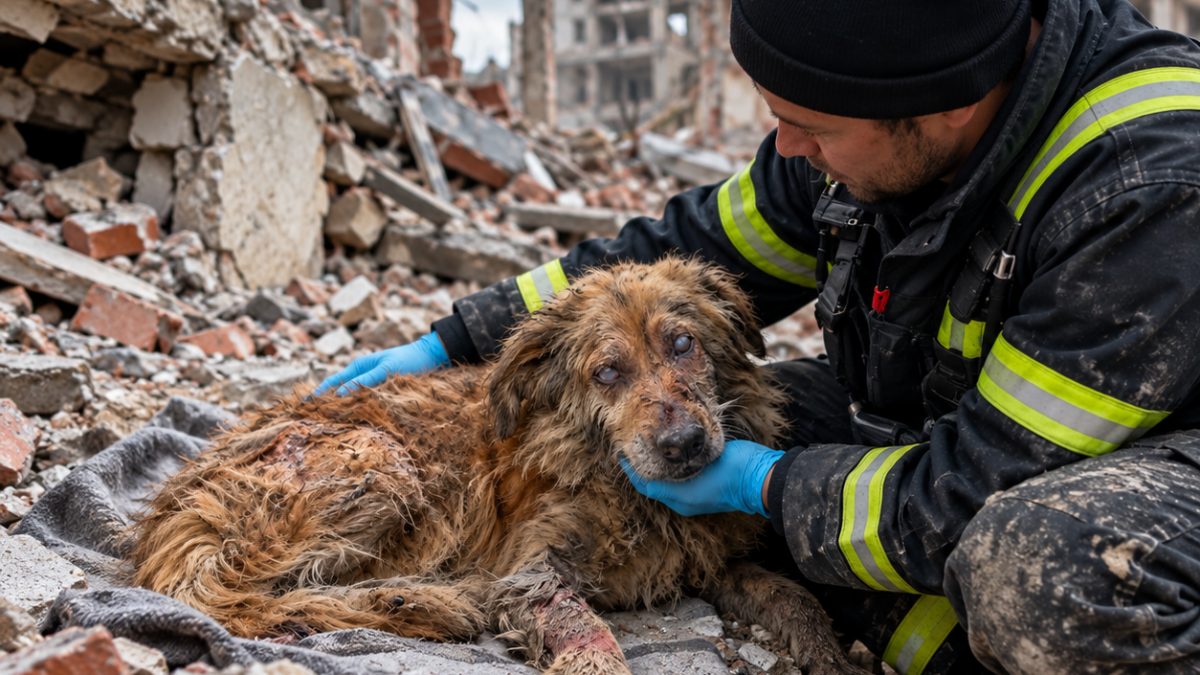
PART 2
“Feniks, no,” I whispered, rushing to his side.
His front legs trembled beneath him. The IV line tugged against the tape on his shaved foreleg. His injured back leg dragged uselessly behind him, and his whole body shook with the effort of doing something his body was not ready to do.
But he kept trying.
The nurse, a young woman named Hallie, reached for his shoulder.
“He’ll tear the line out,” she said.
I placed both hands gently against Feniks’s chest.
“Easy,” I said. “You don’t have to run anymore.”
The moment I said the word run, his body froze.
It was subtle, but I felt it.
His muscles locked under my palms. His ears pulled back. His head turned slightly toward the hallway, as if a sound no one else could hear had reached him.
Hallie noticed too.
“What was that?”
“I don’t know.”
Feniks’s nostrils moved. Once. Twice.
Then a low sound rose in his throat.
Not a growl exactly.
A warning.
The clinic was quiet except for the hum of machines and the soft buzz of fluorescent lights. No one was in the hallway. No one was near the back entrance. Still, Feniks faced that direction with every ounce of focus he had.
Blind, broken, barely alive—and afraid of something.
Or someone.
Hallie looked toward the hallway.
“Maybe he smells another animal.”
But I had worked rescue long enough to recognize the difference between fear and recognition.
Feniks was not confused.
He knew something.
I eased him back down, speaking softly until his body gave out and his head sank against the blanket. The warning sound faded into a tired breath.
Dr. Mason arrived twenty minutes later in jeans, boots, and a coat thrown over her pajama shirt. Hallie had called her after Feniks tried to stand.
“He shouldn’t be able to do that,” Dr. Mason said after examining him again. “Not with this level of trauma.”
“He heard something,” I told her.
“He’s blind, not deaf.”
“No, it was more than that.”
She looked at me over the rim of her glasses.
“Claire.”
“I know how it sounds.”
“I’m not saying you’re wrong. I’m saying he’s fragile. Right now, we focus on keeping him alive.”
I nodded, but my mind was still back on the way Feniks had turned toward the hall.
By sunrise, we had posted his photo on our rescue page, not the worst ones, just enough to ask if anyone recognized him. I wrote that he had been found near the old Miller Brickworks property, badly injured, blind, and in critical condition.
Within an hour, the post was being shared.
Within two hours, the comments had filled with anger.
Who could do this?
Poor baby.
Please update us.
I’ll donate.
Then one comment appeared that made my fingers go cold.
That looks like the dog that used to be behind Redline Auto.
I clicked the profile.
The woman’s name was Bethany Pike. She lived two towns over. Her account showed photos of kids, church potlucks, a garden full of sunflowers, and one blurry picture of a black-and-tan dog behind a chain-link fence.
I enlarged it.
My breath stopped.
The dog was thinner in the photo. Younger maybe. His coat was dusty, and the angle was bad, but the white patch on his chest was the same shape.
Feniks.
I messaged her immediately.
Bethany replied within minutes.
I used to pass that shop on my way to work. There was a dog tied behind it for months. Maybe longer. I called animal control once, but when they checked, the owner said the dog belonged to his cousin and was “temporarily housed.” After that, the dog disappeared.
What was the shop owner’s name? I typed.
Her answer came back.
Dale Rusk.
I knew the name.
Everybody in town did.
Dale Rusk owned Redline Auto & Towing, a place with faded flags, loud commercials, and a reputation for buying wrecked cars cheap. He sponsored Little League one year. Donated a grill to the fire department raffle. Shook hands at every county fair booth.
Men like Dale were good at looking generous where people could see them.
They were also good at hiding the places people didn’t look.
I showed the message to Wade when he came in later that morning.
His face hardened.
“Rusk?”
“You know him?”
“Had my truck towed by him once. Charged me three hundred dollars for a twenty-minute hold. Guy smiles like a preacher and talks like a debt collector.”
I looked through the glass at Feniks.
His body lay still now, the rise and fall of his chest steadier than it had been all night. His eyes remained clouded and unfocused.
“We need proof,” I said.
Wade nodded. “Then let’s get some.”
The problem was that rescue work did not give us police authority. We could not walk onto Dale Rusk’s property and demand records. We could not accuse him publicly without risking a lawsuit. And we could not make animal control reopen a case based only on a Facebook comment.
But we could gather.
I asked Bethany if she had more photos. She sent three.
One from March.
One from May.
One from August.
In each image, the same dog appeared behind Redline Auto, either tied to a post or standing inside a small fenced area cluttered with tires, oil pans, and scrap metal.
Feniks had been there for months.
Maybe longer.
In the May photo, his left ear was already torn.
In the August photo, his ribs showed.
I sent the images to Officer Grant, the animal control officer who had once helped us shut down an illegal backyard breeding operation.
He called me back instead of texting.
“Where is the dog now?”
“At Mason Veterinary Clinic. Critical.”
“Is he alive?”
“Yes.”
A pause.
“Do you have reason to believe Rusk hurt him?”
“I have reason to believe Rusk had him before he was found crushed and blind near Miller Brickworks.”
Grant exhaled.
“That old place is three miles from Redline.”
“I know.”
“Claire, listen to me carefully. Don’t post his name. Don’t stir people up online. Let me look into it.”
“I haven’t posted his name.”
“Good. Keep it that way.”
But someone else didn’t.
By mid-afternoon, Bethany’s comment had been screenshotted and shared in a local community group. Dale Rusk’s name spread faster than we could contain it.
And Dale saw it.
At 4:17 p.m., the clinic phone rang.
I was standing beside the reception desk when Mara, the receptionist, answered.
“Mason Veterinary Clinic, this is Mara.”
Her expression changed.
“Yes, sir, I understand you’re upset, but—”
She glanced at me.
“No, we cannot release information about an animal in medical care without—”
The voice on the other end grew loud enough for me to hear.
“That dog is stolen property.”
Mara’s fingers tightened around the phone.
“Sir, animals are not handled like impounded vehicles.”
The man barked something back.
Then Mara said, carefully, “What is your name?”
I already knew before she mouthed it.
Dale Rusk.
I reached for the phone, but Dr. Mason appeared from the hallway and held out her hand.
Mara passed it over.
“This is Dr. Mason.”
The room went quiet.
Dr. Mason listened without blinking.
Then she said, “Mr. Rusk, the dog is not medically stable for release.”
A pause.
“No.”
Another pause.
“No, raising your voice will not change the answer.”
Her jaw tightened.
“If you believe this dog belongs to you, you may provide proof of ownership to animal control. Until then, he remains under emergency veterinary hold.”
The voice exploded again.
Dr. Mason’s reply was cold.
“If you come onto my property threatening my staff, I will call the police.”
She hung up.
Mara looked shaken.
Wade, who had been restocking supplies behind me, muttered, “Well, that answers one question.”
I looked toward the back room.
“Feniks reacted last night when someone came near the hallway.”
“No one came in last night,” Mara said.
“Were the back doors locked?”
“Yes.”
But Hallie, who had just come in for her evening shift, went pale.
“What?” I asked.
She swallowed.
“At three forty-five, I took trash out through the rear door. I saw headlights near the alley. I thought it was just someone turning around.”
“What kind of vehicle?”
“A tow truck.”
The air left the room.
Dale had come to the clinic.
Before he ever called.
Before the public post named him.
Before he should have known Feniks was there—unless he had been watching.
Dr. Mason called Officer Grant immediately.
This time, Grant did not tell us to wait.
“Lock the doors,” he said. “I’m on my way.”
By evening, Feniks’s story had become the only thing anyone in town wanted to talk about.
Some people were furious.
Others defended Dale.
That’s not like him.
He helps people all the time.
You people are ruining a man’s business without facts.
Then a man named Randy Holt sent me a private message.
I used to work for Dale. I know that dog. Don’t use my name unless you have to.
I stared at the message for a full minute before replying.
Tell me what you know.
Randy answered slowly, in broken pieces, as if even typing it made him nervous.
The dog showed up at Redline about two years ago.
Dale said he found him near the highway.
At first, he kept him because the dog scared off thieves.
Then he started calling him “Junkyard.”
He tied him behind the shop.
Fed him scraps.
Sometimes didn’t feed him at all.
I asked why he didn’t take him to a shelter.
He said, “Shelters ask questions.”
My hands shook as I read.
Then came the message that changed everything.
A week ago, Dale said the dog was “costing him money.” Next day, dog was gone. Dale told us he ran off. But I saw blood in the tow yard and drag marks near the flatbed.
I stood so fast my chair rolled backward and hit the wall.
Wade looked up.
“What?”
I turned the phone toward him.
He read it once, then again.
“Send that to Grant.”
“I am.”
Officer Grant arrived twenty minutes later, followed by a county deputy named Alvarez. They took statements from Dr. Mason, Hallie, Mara, Wade, and me. They photographed Feniks’s injuries. They took copies of Bethany’s photos and Randy’s messages.
Then Grant stood at the treatment room window and looked in at Feniks.
His face softened.
“I’ve seen bad things,” he said quietly. “But this…”
Feniks lifted his head a fraction at the sound of Grant’s voice.
Grant stepped closer to the glass.
“You’re safe now, boy.”
Feniks’s ear twitched.
I wanted to believe that was enough.
But safety is not justice.
And sometimes justice only begins when the person who caused the suffering realizes the victim survived.
The next morning, Dale Rusk walked into Mason Veterinary Clinic wearing a clean work jacket with his company logo stitched over his heart. He had a paper folder in one hand and a smugness on his face that made my stomach twist.
Mara stood behind the desk.
“Can I help you?”
“I’m here for my dog.”
Dr. Mason stepped out of the hallway.
“Mr. Rusk, animal control is handling this matter.”
Dale smiled as though she had made a small, charming mistake.
“No, ma’am. This is a civil matter. I have proof of ownership.”
He slapped the folder on the counter.
Inside was a printed vaccination invoice from eighteen months earlier.
Patient name: Junkyard.
Owner: Dale Rusk.
Species: Canine.
Breed: Shepherd mix.
Mara looked at me.
Dr. Mason did not touch the paper.
“Ownership does not override an active cruelty investigation,” she said.
Dale’s smile thinned.
“Cruelty? That dog got hit by something. Maybe a truck. Maybe he wandered off and got himself hurt. That ain’t on me.”
“You told animal control he ran away a week ago,” I said.
His eyes shifted to me.
“And you are?”
“Claire Bennett. I run Second Chance Rescue.”
“Oh.” He gave a small laugh. “You’re the woman making money off sob stories online.”
Wade stepped forward, but I lifted a hand to stop him.
Dale leaned on the counter.
“Let me explain something, Claire Bennett. That dog is mine. I don’t know what fantasy you people cooked up for donations, but if you don’t hand him over, my attorney is going to enjoy this.”
Dr. Mason said, “Then have your attorney call mine.”
For one second, the mask slipped.
Dale’s face hardened into something ugly.
“You think people in this town are gonna side with a half-dead mutt over me?”
From the hallway came a sound.
A low, shaking growl.
Everyone turned.
Feniks stood in the doorway of the treatment room.
Hallie was behind him, horrified, holding the loose end of his leash. He should not have been on his feet. He should not have been able to reach the hallway. But there he was, trembling, wrapped in bandages, one leg supported by a sling, blind eyes fixed on nothing and somehow pointed directly at Dale.
Dale stepped back.
Just one step.
But everyone saw it.
Feniks growled again.
Not at Mara.
Not at Dr. Mason.
Not at Wade.
At Dale.
The room went silent.
Dale recovered quickly.
“See?” he snapped. “Dangerous dog. Always was.”
I knelt beside Feniks.
His body shook violently, but he did not retreat. His nose worked the air. His lips pulled back just enough to show his teeth.
He remembered.
Dr. Mason whispered to Hallie, “Get him back.”
As Hallie and I guided Feniks away, I looked over my shoulder at Dale.
He was smiling again, but sweat had appeared along his hairline.
Officer Grant arrived before Dale left.
The two men knew each other, which did not surprise me. In a town our size, everyone knew everyone, and that was exactly why cruelty sometimes survived longer than it should.
“Dale,” Grant said.
“Officer.”
Grant looked at the folder on the counter.
“What’s that?”
“Proof that dog belongs to me.”
Grant nodded slowly.
“Good. That helps.”
Dale blinked.
“Helps?”
“Establishes chain of custody.”
For the first time since entering the clinic, Dale had nothing to say.
Grant continued, “We’re going to need you to come down and answer questions.”
“I’m not going anywhere without my lawyer.”
“That’s your right.”
Dale picked up his folder, but Grant stopped him.
“We’ll need a copy of that.”
Dale’s eyes narrowed.
“I said I brought proof, not evidence for you.”
Grant’s voice stayed calm.
“You brought ownership documentation for a dog currently involved in a criminal investigation. You can provide a copy voluntarily, or we can obtain it another way.”
Dale looked around the lobby as if searching for someone on his side.
No one moved.
Finally, he tossed the paper onto the counter.
“Keep it,” he said.
Then he leaned close to me.
“You’re gonna regret making me the villain.”
I held his stare.
“No, Mr. Rusk. I think you did that yourself.”
That afternoon, Officer Grant obtained a warrant to inspect Redline Auto’s back lot.
By then, Randy Holt had agreed to speak officially.
Not publicly.
Not yet.
But officially.
Grant and Deputy Alvarez entered Redline with two more deputies, a crime scene technician, and a county prosecutor’s investigator.
Dale’s employees watched from the service bays.
Dale stood near the office door with his attorney beside him, arms crossed, face red.
The back lot told its own story.
There was the post where Feniks had been tied.
The old chain still wrapped around it.
A dented metal bowl.
A patch of ground worn bare in a circle where a dog had paced for months.
Behind a stack of cracked bumpers, investigators found stained gravel.
They collected samples.
Near the flatbed tow truck, they found more.
Blood.
Fur.
And on the edge of the truck’s hydraulic lift, a small piece of torn black-and-tan hair caught in a seam of metal.
Dale kept saying the same thing.
“Dog ran off.”
“Wasn’t my fault.”
“You can’t prove anything.”
But cruelty leaves patterns.
Neglect leaves records.
And men like Dale always think fear keeps people quiet forever.
They forget fear changes shape when people realize they are not alone.
After the warrant search, two more former employees contacted Officer Grant.
One said Dale had threatened to “dump that useless dog somewhere no one would find him.”
Another said he saw Dale strike Feniks with a metal pry bar months earlier when the dog knocked over a bucket of parts.
Then a teenager named Luis came forward.
Luis washed cars at Redline on weekends. He was sixteen, quiet, and terrified. His mother brought him to the sheriff’s office because he had been crying at night after seeing Feniks’s rescue post.
Luis told investigators that on the day Feniks disappeared, he had heard a terrible yelp from behind the shop.
When he looked out, Feniks was on the ground near the flatbed.
Dale was standing over him.
Luis said Dale shouted, “Get up, you stupid animal.”
But Feniks did not get up.
Then Dale dragged him by the chain.
Luis hid because he was afraid Dale would fire him or worse. Later, he saw the flatbed leave the yard with something covered by a tarp.
The prosecutor called me the next day.
Her name was Evelyn Ross, and her voice had the hard, controlled tone of someone who had heard every excuse people used to make suffering sound accidental.
“We are pursuing charges,” she said.
“What charges?”
“Felony aggravated animal cruelty, abandonment, evidence tampering, and obstruction if the witness statements hold.”
I closed my eyes.
“Will he be arrested?”
“We’re preparing the warrant.”
I looked through the window at Feniks.
He was awake, lying on his side while Dr. Mason changed the bandage on his leg.
His eyes still did not follow movement.
“Claire,” the prosecutor said, “I need you to understand something. Cases like this can be difficult. The defense will argue he was injured after running away. They’ll attack witness credibility. They’ll say the dog was already old, already sick, already beyond help.”
“He wasn’t beyond help.”
“I know.”
“No,” I said, my voice shaking. “You don’t understand. He tried to stand when he heard a tow truck. He growled when Dale walked in. He knows.”
“I believe you,” she said gently. “But court needs evidence.”
So we built evidence.
Not revenge.
Evidence.
There is a difference.
Revenge wants pain.
Justice wants truth dragged into daylight where nobody can pretend not to see it.
For the next several weeks, Feniks fought harder than any dog I had ever known.
His first surgery repaired the worst of the damage to his hind leg. A metal plate was placed along the fracture. The vet team cleaned infected wounds and removed debris embedded in his skin.
His head trauma improved slowly.
His appetite returned one spoonful at a time.
At first, he would only eat if I sat beside him and kept one hand near the bowl.
Not in it.
Near it.
Like he needed to know I was not going to take his food away.
When he slept, his paws twitched. Sometimes he whimpered so sharply that I would wake from the chair beside his kennel and whisper his name until he calmed.
“Feniks. You’re here. You’re safe.”
In the beginning, safe was just a word.
Then it became a room.
Then a voice.
Then a hand he trusted.
His blindness remained.
Dr. Mason explained that the trauma had damaged his vision severely. One eye had no sight at all. The other responded only faintly to changes in light.
“He may never see normally again,” she told me.
I looked at Feniks resting his chin on my shoe.
“That’s okay,” I said. “We’ll learn the world another way.”
And we did.
I wore a small bell on my wrist so he could locate me. I tapped twice on doorframes before leading him through. I used the same words for every step.
Step up.
Step down.
Left.
Easy.
Wait.
Good boy.
The first time he wagged his tail, the entire clinic cried.
It was barely a wag. More like a weak sweep against the blanket.
But it happened when Hallie brought him a soft toy shaped like a duck. She placed it near his paw, and he sniffed it suspiciously. Then he rested his chin on it and moved his tail once.
Hallie covered her mouth.
Dr. Mason turned away and pretended to check a chart.
Wade said, “I’m not crying. The air is stupid in here.”
Feniks became the town’s dog.
Children sent drawings. Strangers donated blankets. An elderly man brought a hand-carved wooden nameplate that said FENIKS in careful letters. A local bakery sent treats shaped like bones.
But not everyone was moved.
Dale’s supporters grew louder.
They called us liars.
They called Feniks dangerous.
They said people cared more about a dog than a hardworking man’s reputation.
One anonymous message said:
Maybe next time don’t rescue what should’ve been put down.
I read it while sitting beside Feniks during his physical therapy.
He was struggling to place weight on his repaired leg. The therapist, Monica, held a harness under his belly while I crouched in front of him with a treat.
“Come on,” I whispered. “One more step.”
Feniks lifted his paw.
Placed it.
Trembled.
Then took another.
I looked down at the message again.
Should’ve been put down.
I deleted it.
Feniks took a third step.
There was the answer.
The arrest happened on a Friday morning.
Dale Rusk was taken from Redline Auto in handcuffs while two tow trucks sat idling in the yard and customers stared from the waiting area.
Someone filmed it from across the street.
By noon, everyone had seen the video.
Dale did not look scared.
He looked furious.
As deputies guided him toward the patrol car, he shouted, “This is because of that rescue woman! This is a setup!”
The video shook as the person filming gasped.
Then Dale turned directly toward the camera and yelled, “That dog was worthless!”
That clip did more damage to Dale’s reputation than anything we could have said.
Because for weeks, his defenders had insisted he loved Feniks.
People can explain away a lot.
They could not explain away those words.
Still, the case did not end there.
Dale made bail the same afternoon.
His attorney filed motions.
His family gave interviews.
His sister cried on local news and said Dale was being “crucified over an animal.”
Then came the retaliation.
First, someone threw a brick through the front window of Second Chance Rescue.
No animals were hurt, thank God. The brick landed in the office, scattering glass across the desk where I usually filled out adoption forms.
A note was wrapped around it.
DROP IT.
Wade found it before I did.
He tried to hide the paper, but I saw his face.
“What is it?”
“Nothing.”
“Wade.”
He handed it over.
Two words.
That was all.
But my hands went cold.
I looked toward the kennels, where twelve rescued dogs barked anxiously from the noise.
“They’re trying to scare us,” Wade said.
“It’s working.”
He looked at me.
I folded the note.
“But not enough.”
Officer Grant took the brick into evidence.
Security cameras showed a dark pickup with no plates driving away at 2:13 a.m. The footage was grainy, but the truck looked familiar to half the town.
Dale’s cousin drove one just like it.
Then our rescue van’s tires were slashed.
Then Dr. Mason received a voicemail telling her to “remember who pays bills in this county.”
Then Bethany Pike, the woman who first identified Feniks, found a dead rat in her mailbox.
That was when the story changed again.
Because people who had stayed quiet out of fear began to get angry.
A retired judge named Harold Mercer called the county prosecutor and offered to testify about years of complaints against Redline being quietly dismissed.
A former dispatcher admitted that animal control calls about Dale’s property had been rerouted or delayed.
A mechanic named Troy brought in old photos showing another dog chained behind the shop years earlier—a dog that had disappeared.
And Randy Holt gave investigators the one thing nobody expected.
A flash drive.
He had saved surveillance clips from Redline after Dale ordered him to wipe the system.
“I knew one day somebody would need them,” Randy told me later, sitting in the rescue office with both hands wrapped around a paper cup of coffee.
His face looked ten years older than it probably was.
“Why didn’t you come forward sooner?” I asked.
He stared at the floor.
“Because I needed the job. Because I got kids. Because Dale knows people. Because I told myself it wasn’t my fight.”
His voice cracked.
“Then I saw that dog’s picture. And I realized he didn’t have the choice to walk away. I did.”
The flash drive contained fourteen clips.
Most were short.
Some showed Feniks chained in extreme heat.
Some showed him limping months before the final injury.
One showed Dale kicking the metal bowl away from him.
But the final clip was the one that made the prosecutor go silent.
It was from the morning Feniks disappeared.
The video was angled from above the back lot. There was no sound.
Feniks stood near the flatbed, thin and weak, chain dragging behind him. Dale walked into frame carrying a metal bar. Feniks backed away.
Dale swung.
Once.
Feniks collapsed.
A second employee stepped into frame and immediately stepped back, hands raised.
Dale looked around, then grabbed the chain.
The clip ended.
There was no footage of Dale dumping Feniks at Miller Brickworks, but it no longer mattered.
The lie had cracked open.
The man who said the dog ran away had been recorded striking him to the ground.
When Prosecutor Ross told me about the video, I had to sit down.
“Can I see it?” I asked.
“I don’t recommend that.”
“I need to.”
“Claire—”
“I need to know what he survived.”
There was a long silence.
Then she said, “Come to my office tomorrow.”
I went.
I watched the clip once.
Only once.
I did not cry while it played.
I did not make a sound.
But when it ended, I walked to the restroom, locked myself in a stall, and shook so hard I had to grip the metal partition.
Not because I hated Dale.
I did hate him in that moment, if I am honest.
But what broke me was Feniks.
The way he backed away.
The way he still seemed to hope the man would stop.
There is something especially cruel about hurting a creature that keeps believing you might become kind.
That night, I sat on the floor of Feniks’s recovery room.
He had graduated from the clinic kennel to a padded space at the rescue, where he could heal under constant supervision. His leg was stronger. His coat was cleaner. The swelling in his face had gone down, revealing a noble, scarred, beautiful dog beneath all the damage.
He rested his head in my lap.
“I saw it,” I told him.
His ear moved.
“I’m sorry.”
He sighed.
“I’m so sorry nobody came sooner.”
His tail touched the blanket once.
I pressed my face into the fur between his ears.
“We’re going to court,” I whispered. “And this time, everyone is going to see.”
The preliminary hearing drew more people than the courthouse expected.
Reporters lined the front steps. Animal advocates held signs across the street. Dale’s supporters gathered near the entrance, muttering about witch hunts and mob justice.
I did not bring Feniks.
Dr. Mason said the stress would be too much, and I agreed. He stayed at the rescue with Hallie, who sent me a photo of him sleeping beside his duck toy twenty minutes before the hearing began.
Still, it felt wrong walking into that courthouse without him.
He was the reason we were there.
The courtroom smelled like polished wood and old paper. Dale sat at the defense table in a navy suit, freshly shaved, hands folded as if he were a respectable businessman inconvenienced by nonsense.
His attorney argued that the video lacked context.
Maybe the dog had attacked.
Maybe Dale had been defending himself.
Maybe the injury came later.
Maybe the rescue had exaggerated the condition to raise money.
Then Prosecutor Ross stood.
She did not raise her voice.
She did not dramatize.
She simply presented the timeline.
Photos from Bethany.
Veterinary records.
Randy’s statement.
Luis’s statement.
Blood evidence from the tow yard.
Hair from the flatbed.
The ownership invoice Dale himself had brought to the clinic.
And finally, the video.
The judge watched without expression.
Dale stared at the table.
His attorney stopped taking notes.
Behind me, someone began to cry.
When the clip ended, the courtroom remained silent.
Prosecutor Ross said, “Your Honor, the state submits that the defendant is not being prosecuted for an accident. He is being prosecuted because the evidence shows a prolonged pattern of neglect, abuse, concealment, and retaliation after discovery.”
The judge denied the defense request to dismiss.
Trial was set.
And Dale turned around as deputies led him out.
His eyes found mine.
He smiled.
It was small, almost invisible.
But I saw it.
That smile said this was not over.
He was right.
Two nights later, the rescue caught fire.
The alarm went off at 1:08 a.m.
I lived in the small apartment above the rescue office, so the sound tore me out of sleep before my mind understood what it meant.
Then I smelled smoke.
For one terrible second, I froze.
The dogs.
I ran barefoot down the stairs into a hallway already filling with gray haze. The emergency lights flashed red. Dogs barked, howled, slammed against kennel doors.
“Wade!” I screamed, though he was not there.
I grabbed the ring of keys from the office hook, coughing as smoke burned my throat.
The fire was at the back of the building near the storage room.
That was where we kept donated blankets, cleaning supplies, paper towels—and the old electrical panel.
But fire investigators would later say it did not start inside the wall.
It started outside the back door.
With accelerant.
At that moment, all I knew was that I had living animals trapped inside.
I opened the first kennel.
Then the second.
The dogs knew the drill from our safety practices, but panic changes everything. Some ran toward the front. Some cowered. One terrified terrier bit my hand and I barely felt it.
Smoke thickened.
I reached Feniks’s room last because it was closest to the office, farthest from the fire.
He was standing.
Blind eyes wide.
Body trembling.
But not barking.
“Feniks!” I coughed. “Come.”
He didn’t move.
A crash sounded from the back as something collapsed.
I grabbed his harness.
“Come on, boy. We have to go.”
He took one step, then stopped.
Turned his head.
Toward the back hallway.
No.
“No, Feniks.”
He pulled against the harness.
For a dog still healing from major trauma, he suddenly had terrifying strength.
“Feniks, please!”
He barked.
Once.
Sharp.
Commanding.
Then I heard it.
A sound beneath the roar of alarm and fire.
A puppy crying.
My blood turned cold.
The storage room.
We had taken in a litter of five bottle-fed puppies that afternoon. Hallie had placed them in a portable crate near the laundry sink because their incubator pad needed a grounded outlet.
In the chaos, I had forgotten.
Feniks had not.
He could not see.
But he heard them.
I wrapped my arm through his harness and stumbled after him as he pulled toward the smoke.
“Step,” I rasped automatically. “Easy. Left. Wait.”
He ignored every command except the one his heart had chosen.
Save them.
The heat grew worse near the storage room. My eyes streamed. The smoke was so thick that the world narrowed to sound and instinct.
Feniks lowered his body and crawled.
I followed, one hand on his harness, the other sweeping in front of me.
The puppies cried again.
“There,” I gasped.
Feniks reached the crate first.
He pressed his nose against the bars.
I found the latch by touch, opened it, and pulled the crate toward me. It was heavier than I expected, awkward and hot along one side.
Feniks stood between me and the fire.
Like a shield.
Like he had not been the one we rescued.
Like the broken dog from the abandoned wall had risen into something no cruelty could destroy.
“Go!” I coughed.
He moved when I moved.
We dragged the puppies through the smoke together.
By the time firefighters broke through the front entrance, I was on my knees outside in the gravel, vomiting smoke, with Feniks collapsed beside me and the puppy crate clutched against my chest.
Wade arrived barefoot and wild-eyed five minutes later.
He dropped beside Feniks.
“No, no, no.”
“He’s breathing,” I choked.
Paramedics tried to put oxygen on me.
I pushed them away.
“Dog first.”
One of the firefighters, a broad-shouldered man with soot on his face, looked at Feniks, then at the crate of crying puppies.
“This dog went back in?”
I nodded because I could not speak.
He removed his own oxygen mask attachment and shouted for the pet oxygen kit.
Feniks lay on the gravel with smoke in his fur and ash on his bandages.
But he was alive.
Again.
The fire destroyed the back third of the rescue.
We lost supplies, records, equipment, and three kennels.
We did not lose a single animal.
Because of Feniks.
News spread before dawn.
By breakfast, the town was no longer simply angry.
It was changed.
People who had watched from a distance showed up with leashes, crates, towels, food, generators, plywood, bottled water. Carpenters came. Electricians came. A retired nurse cleaned smoke residue from frightened dogs. Teenagers washed bowls. A man who had once defended Dale online handed Wade five hundred dollars in cash and said, “I was wrong.”
The fire marshal confirmed arson.
Security cameras from the building across the alley captured a dark pickup stopping behind the rescue at 12:56 a.m.
This time, the plate was visible.
It belonged to Dale’s cousin, Marty Rusk.
Marty was arrested that afternoon.
He claimed he had acted alone.
No one believed him.
Phone records later showed six calls between Marty and Dale in the twenty-four hours before the fire.
Dale had violated the terms of his bail by contacting potential witnesses and associates involved in intimidation. His bail was revoked.
When deputies brought him back to court, he no longer looked polished.
He looked cornered.
That was when men like him became most dangerous.
But it was also when they made mistakes.
Marty, facing attempted arson charges and the possibility of serious prison time, took a deal.
He admitted Dale asked him to “send a message” to make me drop the case.
He said Dale never told him to hurt animals.
The prosecutor asked, “But he knew animals were inside?”
Marty cried then.
“He knew.”
The trial began three months later.
By then, Feniks could walk slowly on his repaired leg. His blindness remained, but he had mapped the rescue grounds with astonishing confidence. He knew the sound of my car, Wade’s boots, Hallie’s laugh, Dr. Mason’s keys, and the treat jar opening from three rooms away.
He had become gentle with puppies, patient with nervous dogs, and suspicious of men with heavy steps.
He slept beside my desk most afternoons, duck toy under his chin.
On the morning of the trial, I clipped a blue bandana around his neck.
“You don’t have to come,” I told him.
His tail moved.
Dr. Mason had approved one brief appearance, only if he stayed calm.
The prosecutor believed seeing Feniks might matter—not as a spectacle, but as truth.
Dale’s attorney fought it.
“He is not evidence,” the attorney argued.
Prosecutor Ross replied, “His body is the result of the defendant’s alleged conduct.”
The judge allowed Feniks to be present during victim-impact testimony, not during the full evidentiary presentation.
So Feniks waited in a quiet room until it was time.
The trial lasted four days.
Bethany testified first.
She described seeing Feniks behind Redline month after month, tied in heat and rain.
Randy testified next.
His hands shook, but his voice did not break when he identified Dale in the surveillance video.
Luis testified behind a privacy screen because he was a minor. He cried when he described the yelp he heard that morning.
Dr. Mason explained every injury.
The fractures.
The head trauma.
The eye damage.
The older scars.
The dehydration that proved Feniks had suffered long before the final attack.
Dale’s attorney tried to suggest Feniks had been aggressive.
Dr. Mason looked at the jury.
“In my professional opinion, Feniks’s behavior was consistent with extreme fear and trauma, not inherent aggression.”
“Could he have attacked Mr. Rusk?”
“Any terrified animal can react defensively.”
“So yes?”
Dr. Mason’s eyes narrowed.
“What I can say is that the injuries I treated were not consistent with a man defending himself from a dog. They were consistent with a dog being beaten, neglected, and left without care.”
The courtroom was silent.
Then came the video.
Several jurors looked away.
One covered her mouth.
Dale sat rigid, jaw tight.
He never looked at the screen.
On the fourth day, I testified.
I told them about finding Feniks beside the wall. About his blind eyes. About the ride to the clinic. About him trying to stand at four in the morning. About him growling when Dale entered the lobby.
Dale’s attorney objected to that last part.
“Sustained,” the judge said.
The jury would not consider it as proof.
But they had heard it.
Then Prosecutor Ross asked, “Ms. Bennett, did there come a time when the rescue caught fire?”
“Yes.”
“And was Feniks present?”
“Yes.”
“What happened?”
I looked down at my hands.
“He heard puppies trapped near the storage room. I had forgotten them in the smoke. Feniks pulled me toward them.”
“Feniks is blind, correct?”
“Yes.”
“And injured?”
“He was still recovering.”
“What happened because of his actions?”
I swallowed hard.
“Five puppies survived.”
Prosecutor Ross paused.
Then she said, “Where is Feniks now?”
The bailiff opened the side door.
Hallie entered first, holding Feniks’s leash.
He walked slowly, carefully, blue bandana at his neck, scars visible along his muzzle, one cloudy eye turned toward the sound of the room.
Every person in that courtroom saw him.
Not a photograph.
Not a rumor.
Not “property.”
A living being who had suffered, survived, and still trusted enough to walk among humans.
The jury stared.
One woman began crying silently.
Feniks paused near the witness stand.
His nose lifted.
He smelled the room.
Then he turned his head toward Dale.
The movement was small.
But Dale flinched.
It was instinctive.
Immediate.
The jury saw that too.
For the first time in the entire trial, Dale looked afraid.
Not because Feniks could hurt him.
But because Feniks had lived long enough to stand there.
I knelt and placed one hand on Feniks’s shoulder.
“He’s not here for pity,” I said when the prosecutor asked what I wanted the court to understand. “He’s here because someone decided his life didn’t matter. And every breath he takes proves they were wrong.”
The defense called Dale to testify.
That was their biggest mistake.
Dale walked to the stand like a man determined to charm his way through a locked door.
He said he had rescued Feniks from the highway.
He said he fed him.
He said the dog was unstable.
He said former employees were lying because they were disgruntled.
He said I had turned the town against him for attention and donations.
His attorney asked, “Did you intentionally injure this dog?”
“No.”
“Did you abandon him?”
“No.”
“Did you ask anyone to burn Second Chance Rescue?”
“Absolutely not.”
Then Prosecutor Ross stood for cross-examination.
She approached slowly, carrying a folder.
“Mr. Rusk, you testified that Feniks ran away.”
“Yes.”
“And yet you also testified he was unstable and dangerous.”
“He could be.”
“You kept a dangerous dog chained behind your business for nearly two years?”
“He was protection.”
“Protection you did not vaccinate regularly?”
“I did what was needed.”
“Protection you did not shelter properly?”
“He had shelter.”
Ross clicked a remote.
A photo appeared on the courtroom screen: Feniks tied behind Redline in the rain, standing beside an overturned plastic barrel.
“That shelter?”
Dale’s jaw moved.
Ross continued.
“You said you never struck him.”
“That’s right.”
She played the video.
The courtroom watched Dale swing the metal bar.
Ross paused the frame at the exact moment before impact.
“Is that you?”
Dale’s face flushed.
“Yes, but—”
“So you did strike him.”
“He lunged.”
The video resumed.
Feniks was backing away.
Ross paused it again.
“He is moving backward here, correct?”
Dale did not answer.
“Correct?”
“Yes.”
“You also testified you did not ask Marty Rusk to set the fire.”
“I didn’t.”
Ross opened the folder.
“Do you recognize this phone record?”
His attorney objected.
The judge allowed it.
Ross read the call times.
Then she played a recorded jail call between Dale and his sister, placed after Marty’s arrest.
Dale’s voice filled the courtroom.
Marty better keep his mouth shut. I didn’t tell him to burn the place down. I told him to scare her.
Ross stopped the audio.
The silence afterward was devastating.
Dale’s attorney closed his eyes.
Ross turned back to Dale.
“You told this jury absolutely not. But in your own words, you told Marty to scare me, meaning Ms. Bennett. Correct?”
Dale said nothing.
“Correct?”
He leaned toward the microphone.
“I was angry.”
Ross nodded.
“At the rescue woman?”
“Yes.”
“At the witnesses?”
“Yes.”
“At the dog?”
Dale’s mouth tightened.
Ross stepped closer.
“Mr. Rusk, what did you call Feniks when deputies arrested you?”
“I don’t remember.”
Ross lifted another transcript.
“Did you say, ‘That dog was worthless’?”
Dale stared at her.
The courtroom held its breath.
Then he said, “It was a dog.”
There it was.
Not remorse.
Not sorrow.
Not even shame.
Just the truth of him, bare and ugly.
Prosecutor Ross lowered the paper.
“Yes,” she said. “He was a dog. A blind, injured, living dog you had power over. And that is exactly why this matters.”
The jury deliberated for six hours.
Those six hours felt longer than the months before them.
I sat outside the courtroom with Feniks lying at my feet, his head resting on his duck toy. People came and went around us. Reporters whispered. Wade paced. Hallie prayed under her breath.
When the bailiff finally opened the door and said the jury had reached a verdict, my knees nearly failed.
We stood.
Dale stood.
The foreperson, a middle-aged man with silver hair, held the verdict sheet.
Count one: aggravated animal cruelty.
Guilty.
Count two: abandonment of an animal resulting in serious bodily injury.
Guilty.
Count three: evidence tampering.
Guilty.
Count four: witness intimidation.
Guilty.
Count five, related to conspiracy in the rescue fire.
Guilty.
Dale’s mother cried out.
His attorney put a hand on his shoulder.
Dale stared straight ahead.
I looked down at Feniks.
He was asleep.
Through the whole thing, he slept.
As if justice had finally become quiet enough for him to rest.
Sentencing took place four weeks later.
By then, letters had poured into the court from across the state. Rescue workers. Veterinarians. Neighbors. Children. Former employees. Even people who had once defended Dale wrote to say they had been fooled by a public image.
Dale’s attorney asked for leniency.
He spoke of Dale’s business, his community ties, his lack of prior felony convictions.
Then Prosecutor Ross stood.
She spoke of repeated cruelty, abuse of power, retaliation, and the fire that could have killed dozens of animals and me.
Finally, the judge asked if I wanted to speak.
I walked to the podium.
Feniks was not with me that day. I wanted him safe at home, sleeping in sunlight.
I had written a statement, but when I looked at Dale, I folded the paper.
“My name is Claire Bennett,” I said. “I rescue animals for a living, but I am not here because I think animals matter more than people. I am here because how we treat the powerless reveals what kind of people we are.”
Dale stared at the table.
“You called Feniks worthless. But he saved five puppies from a fire set because of this case. He taught a town to pay attention. He made frightened people brave enough to tell the truth. He survived what you did, and he did not become cruel.”
My voice shook.
“That is the part I hope follows you. Not that you were caught. Not that people hate you. But that the dog you tried to throw away became better than you.”
The courtroom was silent.
The judge sentenced Dale to prison.
Not forever.
No sentence ever feels like enough when you have seen suffering up close.
But it was real time. Real consequences. He was banned from owning or working with animals again. Redline Auto lost county contracts. Civil suits followed. His business collapsed under the weight of what had been hidden behind it.
Marty Rusk received his own sentence for the fire.
And Feniks?
Feniks came home.
Not to the clinic.
Not to the rescue.
Home.
Mine.
I had told myself for months that I was only fostering him through recovery. Rescue workers tell ourselves that lie all the time. We say we are temporary. We say our job is to heal them and let them go.
But Feniks had chosen me long before I admitted I had chosen him.
The adoption papers were signed on a Saturday morning at the rebuilt rescue.
Wade brought cupcakes.
Hallie tied blue ribbons to the fence.
Dr. Mason cried before anyone said anything emotional and blamed allergies even though it was November.
Feniks wore his bandana and stood patiently while children petted him one at a time.
Bethany Pike came with sunflowers.
Randy Holt came too. He stood at the edge of the crowd until I waved him over.
Feniks sniffed his hand.
Randy froze.
“He remembers me,” he whispered.
“Maybe,” I said.
His eyes filled.
“I should’ve helped him sooner.”
Feniks leaned forward and pressed his scarred muzzle into Randy’s palm.
Randy broke.
He sank to a crouch and sobbed into his sleeve while Feniks stood there, steady and forgiving in a way none of us deserved.
That was Feniks.
He did not erase what happened.
He did not magically become untouched by it.
He still woke from nightmares sometimes. He still flinched at the clang of metal. He still disliked tow trucks so much that I changed our walking route to avoid the impound yard.
Healing was not a straight road.
It was a hundred tiny moments.
The first time he climbed the porch steps without fear.
The first time he barked in his sleep and then relaxed when I touched his paw.
The first time he rolled onto his back in the grass, blind eyes turned toward the sun he could feel but not see.
The first time he played.
Really played.
It happened in spring.
The rescue yard had been rebuilt with new fencing, smooth pathways, and a sensory garden for blind dogs. Wind chimes hung from the posts. Lavender grew along the walkway. Different textures marked turns and gates.
Feniks knew every inch.
A young dog named Penny, rescued from a hoarding case, bounced around him with a rope toy.
For weeks, Feniks had ignored her invitations.
That day, Penny dropped the rope against his paw.
Feniks sniffed it.
Penny crouched.
I watched from the porch, hardly breathing.
Then Feniks grabbed the rope and gave one strong tug.
Penny leaped backward in delight.
Feniks wagged his tail.
Not once.
Not weakly.
Fully.
Wildly.
The yard erupted.
Wade shouted.
Hallie screamed.
Penny spun in circles.
And Feniks, the dog found broken beside an abandoned wall, played beneath an open blue sky as if joy had been waiting inside him all along.
A year after his rescue, we returned to Miller Brickworks.
I had avoided the place.
Part of me wanted it demolished. Part of me wanted never to see that wall again.
But the town had voted to turn the old property into a memorial park and walking trail. The county purchased the land after investigators confirmed it had been used for illegal dumping for years.
A small bronze plaque was placed near the spot where Feniks had been found.
It did not show the worst of him.
It showed his face as it was now—scarred, strong, calm.
The plaque read:
FENIKS
FOUND HERE.
ROSE ANYWAY.
MAY WE NEVER LOOK AWAY AGAIN.
I brought him there just before sunset.
The grass had been cut. The broken glass removed. The old wall still stood, but vines softened its edges. Children rode bikes on the new path. A woman walked a beagle near the far fence.
Feniks stepped carefully beside me.
“Step up,” I said.
He followed.
“Easy.”
He paused.
His nose lifted.
Maybe he smelled the old brick. The earth. The memory of pain. Maybe dogs remember places in ways we cannot understand.
For a moment, his body grew still.
I knelt beside him.
“We can leave,” I whispered.
Instead, Feniks took one step forward.
Then another.
He reached the wall, lowered his head, and sniffed the ground where he had once lain dying.
Then he turned away from it.
Just like that.
No drama.
No fear.
No final look back.
He turned toward my voice, toward the path, toward home.
I stood there with tears on my face, holding the leash of a dog the world had nearly erased.
People sometimes ask me if Feniks got revenge.
I understand why.
They want the cruel man punished.
He was.
They want the truth exposed.
It was.
They want the victim to rise in a way that makes the suffering mean something.
Feniks did.
But the deepest revenge was not Dale Rusk going to prison.
It was not Redline Auto closing.
It was not the courtroom silence when the verdict was read.
The deepest revenge was Feniks living long enough to become loved.
It was him sleeping through thunderstorms because he knew my hand would find him.
It was him leading frightened foster puppies through the sensory garden.
It was him standing in sunlight, blind and scarred and whole in every way that mattered.
It was a town learning that cruelty survives when people look away—and dies when one person finally stops the car, makes the call, saves the photo, tells the truth, opens the door.
Feniks never saw my face.
Not once.
But he knew me.
He knew my footsteps. My voice. The bell on my wrist. The way I tapped twice before opening a door. The way I whispered his name when nightmares came.
And I knew him.
I knew the tilt of his head when he was listening.
The soft huff he made when he found his bed.
The proud lift of his chest when puppies followed him.
The quiet dignity of a creature who had every reason to hate the world and chose, somehow, not to.
On his adoption anniversary, I sat with him on the porch as evening settled over the rescue.
The new sign out front glowed under the porch light:
SECOND CHANCE RESCUE
HOME OF FENIKS
He rested his head on my knee.
“You did it, boy,” I said.
His tail brushed the boards.
“You rose.”
The night air smelled of grass, clean blankets, and dog biscuits cooling in the kitchen. Inside, puppies whimpered in their sleep. Somewhere beyond the road, a truck passed, but Feniks did not flinch.
He only leaned closer.
And for the first time since the day I found him, I understood something clearly.
I had thought I was saving Feniks from the darkness.
But Feniks had dragged all of us out with him.
[END]








