PART 2: They Labeled Him “HOSPICE” and Said He Wouldn’t Get Up—Three Weeks Later, Walter Walked Down the Hall With His Favorite Toy
PART 2
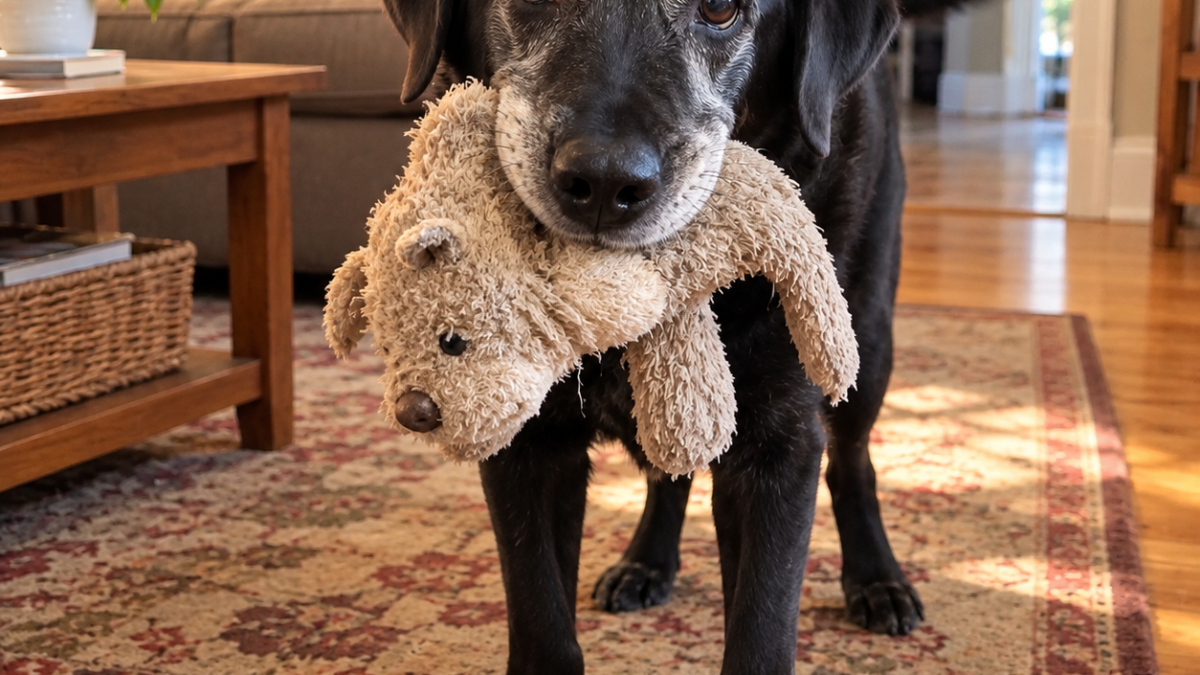
Walter carried that stuffed duck all the way down the hallway.
It took him almost a minute.
A younger Labrador could have covered the distance in seconds, probably while knocking over a lamp and stealing a shoe along the way.
Walter moved differently.
Every step required negotiation.
His front paws landed carefully.
His back legs followed with that stiff, shuffling rhythm we had already learned to recognize.
But there was determination in him now.
He wasn’t wandering.
He had a destination.
Me.
I sat on the floor beside the couch and watched him approach.
When he reached me, he lowered his head.
The stuffed duck dropped into my lap.
I looked down.
Then at Walter.
He looked back.
“What?”
His tail tapped the floor.
Thump.
Thump.
“You want this?”
No response.
I picked up the toy.
Walter’s eyes followed it.
I squeezed it.
Nothing happened.
The squeaker had died years ago.
“Great choice,” I told him. “You picked the only toy in this house older than you.”
David laughed from the kitchen.
Walter’s tail moved faster.
I held the duck toward him.
He took it gently.
And that was the first time I saw the old dog behind the hospice label disappear.
For three seconds, Walter was simply a Labrador.
Toy in mouth.
Eyes bright.
Waiting for the world to do something fun.
Then his back legs trembled and he lowered himself carefully to the rug.
The moment passed.
But I had seen it.
David had too.
He came over and crouched beside us.
“Did you see his face?”
“I did.”
“He looked different.”
“I know.”
Walter placed the duck between his front paws and rested his chin across it.
That night, I moved the toy beside his bed.
At six the next morning, something warm pushed against my hand.
I woke abruptly.
Walter stood beside the bed.
The duck was in his mouth.
I blinked at the clock.
“Six?”
Walter stared.
“Walter, hospice dogs do not wake people at six in the morning.”
His tail wagged.
David pulled the blanket over his head.
“He disagrees.”
Walter dropped the duck beside my hand.
Then nudged me again.
I started laughing.
“Okay.”
I got up.
Walter turned and walked toward the bedroom door.
Not quickly.
Never quickly.
But with purpose.
That morning became the first of hundreds.
Walter woke me at six.
Every day.
No barking.
No whining.
Just the gentle pressure of his head against my hand.
Sometimes the duck arrived too.
Sometimes another toy.
Eventually we realized Walter had a schedule.
Six o’clock: wake the humans.
Six-ten: outside.
Six-twenty: breakfast.
Six-thirty: inspect kitchen for mistakes.
Seven: collapse dramatically as though he had completed a twelve-mile hike.
By the fourth week, I called the shelter.
The coordinator answered.
“How’s Walter?”
“That depends.”
Her voice changed.
“What happened?”
“He’s waking me up every morning.”
Silence.
“Waking you?”
“At six.”
“Is he uncomfortable?”
“No. He wants breakfast.”
Another silence.
“And he’s carrying toys.”
“What?”
“He has a duck.”
“A real duck?”
I laughed.
“Stuffed.”
“Oh.”
“He walks around the house with it.”
“That’s…”
She stopped.
“What?”
“Unexpected.”
“Yeah.”
I looked across the room.
Walter was asleep on his bed, the duck tucked beneath one paw.
“I think we need to talk about the word hospice.”
The shelter arranged another veterinary appointment.
I went into it trying not to hope too much.
That was something I had learned from fostering senior dogs.
There can be good days before very bad days.
A burst of energy doesn’t erase kidney disease.
A wagging tail doesn’t cure cancer.
Love cannot negotiate with every failing organ.
I knew that.
So did David.
We had both agreed before bringing Walter home that we would never keep him alive for ourselves if his body was suffering.
Still, I couldn’t ignore what we were seeing.
Walter was eating.
Drinking.
Seeking affection.
Choosing toys.
Following us from room to room.
He was moving more every day.
At the clinic, Dr. Patel examined him carefully.
Walter tolerated the indignity with typical senior-dog patience.
Heart.
Lungs.
Joints.
Abdomen.
Neurological responses.
Bloodwork.
Urinalysis.
Dr. Patel watched Walter walk down the hall.
Then back.
“He’s arthritic,” she said.
“No surprise.”
“He has muscle loss in the hind end.”
“I figured.”
“He’ll need pain management, controlled exercise, traction, probably supplements. We’ll keep watching his kidney and liver values.”
I waited.
“But?”
She looked at me.
“But I wouldn’t classify what I’m seeing today as actively dying.”
I felt something release in my chest.
“What about him refusing to stand at the shelter?”
Dr. Patel folded her arms.
“That’s the question.”
“Could pain explain all of it?”
“Some.”
“Age?”
“Some.”
“What explains the rest?”
She looked toward Walter.
He was leaning against David’s leg while the technician entered notes into the computer.
“Environment can matter enormously for senior animals.”
I knew what she meant.
Stress.
Noise.
Confusion.
Loss.
Shelters are difficult places even for young animals.
For an old dog who had spent years in a home, losing everything at once could be devastating.
“What exactly happened before he was surrendered?” I asked.
Dr. Patel shook her head.
“That’s for the shelter to tell you.”
The shelter file had only four words that described the end of Walter’s old life.
OWNER SURRENDER.
No story.
No explanation.
Just a checkbox.
When we returned to the shelter, the coordinator pulled up his intake notes.
“I didn’t realize there was much more,” she said.
“Anything helps.”
She scrolled.
“Owner reported increasing mobility problems. Accidents in the house. Low activity.”
“Medical records?”
“Limited.”
“Why was he surrendered?”
She hesitated.
“The intake form says lifestyle change.”
I stared at her.
“Lifestyle change?”
“That’s what they wrote.”
For a fifteen-year-old dog.
A dog who had probably spent more than a decade with the same family.
Lifestyle change.
I hated the phrase immediately.
“What does that mean?”
“We don’t know.”
“Did they say he was terminal?”
“No.”
“Then why hospice?”
The coordinator looked uncomfortable.
“His age. His condition on intake. He wouldn’t get up. He barely ate for the first two days. We had to prioritize quality of life.”
I understood that.
I truly did.
Shelters make difficult judgments every day with incomplete information and limited resources.
No one had harmed Walter there.
They had actually done the opposite.
They had called us.
They had looked at an old dog who appeared to be shutting down and decided he deserved a home instead of a kennel.
Still, something bothered me.
“What was he like when his owner left?”
The coordinator pulled up another note.
Then stopped.
“What?”
She read quietly.
“Patient remained oriented toward lobby exit after surrendering party departed.”
My throat tightened.
“Meaning?”
“He watched the door.”
“For how long?”
She scrolled.
“Several hours.”
I looked away.
That explained more than any blood test.
Walter hadn’t arrived at the shelter because his body had failed.
His world had.
Imagine being fifteen.
You have spent most of your life learning one house.
One set of voices.
One schedule.
One smell on the pillow.
One hand that fills your bowl.
Maybe one place beside a sofa where you have slept thousands of nights.
Then one day, you are taken somewhere loud.
The familiar person leaves.
The door closes.
And doesn’t reopen.
You don’t know the phrase owner surrender.
You don’t know lifestyle change.
You only know your person walked away.
That night, after we returned home, Walter followed me into the bedroom.
The stuffed duck was in his mouth.
I sat beside him on the floor.
“Did you wait for them?”
His tail moved once.
I knew he couldn’t answer.
Maybe that was why I could ask.
“Did you think they were coming back?”
Walter lowered himself beside me.
He placed his head in my lap.
I stroked his gray muzzle.
For the first time since bringing him home, I cried for the life he had before us.
Not because I knew it had been cruel.
I didn’t.
There were no records showing abuse.
His weight had been reasonable.
His nails were not wildly overgrown.
He knew household routines.
He knew toys.
He knew how to ask to go outside.
He had clearly lived with people.
Maybe they had loved him once.
That possibility somehow hurt more.
Because sometimes abandonment does not happen after years of cruelty.
Sometimes it happens after years of love.
And the animal cannot understand why love suddenly stopped being enough.
Walter pushed his nose beneath my hand.
I scratched his ear.
“You don’t have to wait anymore.”
His eyes closed.
I wish I could say that from then on everything became simple.
It didn’t.
Walter was still fifteen.
Love gave him motivation.
It did not make him young.
His arthritis flared on cold mornings.
Some days he stood easily.
Some days I slid an arm beneath his chest and helped him.
We used a support harness for longer trips outside.
We added runners through the hallway.
Dr. Patel adjusted his medication.
David built a low ramp for the single step between the kitchen and back patio.
Walter hated the ramp.
He stared at it as though David had personally insulted him.
“Use it,” David said.
Walter looked toward the step.
“No.”
Walter looked at him.
“Ramp.”
Walter took the step instead.
David threw his hands up.
“Fifteen years old and already ignoring me.”
“That means he’s officially ours.”
But Walter was not ours.
Not legally.
Not yet.
We were still hospice fosters.
And that technical detail suddenly mattered.
The shelter had been thrilled by his improvement.
They changed his status from hospice to long-term medical foster.
Then came the call I never expected.
It was a Thursday afternoon.
The coordinator sounded tense.
“Walter’s previous owner contacted us.”
My hand tightened around the phone.
“Why?”
“They saw a post.”
The shelter had shared an update about Walter’s recovery.
Nothing sensational.
Just two pictures.
One from intake.
One of him carrying his duck.
The caption said the old dog once thought to be near the end was enjoying foster life.
Apparently someone recognized him.
“What do they want?”
The coordinator paused.
“They asked about taking him back.”
I laughed.
Not because anything was funny.
It was the sound anger made before I had words.
“You’re serious?”
“I am.”
“They surrendered him.”
“Yes.”
“They said lifestyle change.”
“Yes.”
“They left him at fifteen.”
“I know.”
“And now that he’s walking around carrying toys, they want him back?”
“That appears to be the request.”
I looked through the kitchen window.
Walter was lying outside in a patch of sunlight.
The duck rested between his paws.
“No.”
“I understand how you feel.”
“No, I mean no. He isn’t going back.”
“The surrender transferred ownership to the shelter. They don’t automatically have rights to him.”
That lowered my pulse by perhaps one beat.
“But?”
“No but. Legally, the shelter decides.”
“Then what’s the problem?”
“The family is asking for a meeting.”
“I’m not meeting them.”
“I didn’t say you had to.”
“Good.”
I hung up.
Then immediately felt guilty.
The coordinator didn’t deserve my anger.
Neither did Walter.
But rage had already arrived.
David came home an hour later and found me pacing.
“What happened?”
“They want him back.”
He didn’t need to ask who.
His expression changed.
“No.”
“Exactly.”
“Can they?”
“The shelter says no automatic rights.”
“Good.”
“But they’re pushing.”
David looked toward Walter.
The old dog had come inside and was standing in the doorway.
Toy in mouth.
Tail wagging.
David crouched.
Walter walked to him.
He dropped the duck.
David picked it up.
“You’re not going anywhere, buddy.”
Walter nudged his hand.
That night neither of us slept well.
At 5:57 a.m., Walter’s head touched my hand.
I opened my eyes.
He stood beside the bed.
Duck in mouth.
Three minutes early.
I sat up.
“You planning to keep us?”
His tail wagged.
I hugged him carefully around the neck.
“Yes,” I whispered.
“That’s what I thought.”
The former family continued calling the shelter.
Eventually, I agreed to hear their explanation, but only through the coordinator.
I did not want direct contact.
The story came in pieces.
Walter had belonged to a couple named Mark and Susan.
They had adopted him as a young dog.
He had spent nearly fourteen years with them.
Then Mark received a promotion.
They sold their house.
Bought a condo.
More travel.
Less space.
Walter had begun having occasional accidents.
He struggled with stairs.
They said they feared his quality of life was declining.
So they surrendered him.
I read the summary twice.
Then a third time.
The part that made me angriest was not the condo.
Not the travel.
Not even the accidents.
It was that they had apparently never pursued a serious senior-dog medical plan before surrendering him.
No arthritis-management trial.
No rehabilitation plan.
No mobility harness.
No floor traction changes.
No meaningful investigation into whether his reluctance to move might be pain plus depression.
They had decided the old dog was finished.
Then someone else gave him a rug, a bed, medication, routine, and three weeks of patience.
And he stood up.
David read the notes.
“So now?”
“They say they made the decision when they believed he was dying.”
“And now that he isn’t?”
“They regret it.”
David sat quietly.
I expected him to explode.
Instead he said, “Do you think they loved him?”
I looked at him.
“Why does that matter?”
“Because you keep acting like they hated him.”
“They left him.”
“I know.”
“At fifteen.”
“I know.”
“After fourteen years.”
“I know.”
His calmness infuriated me.
“So what are you saying?”
“I’m saying people can love something and still fail it.”
That stopped me.
David looked toward Walter.
“If we reduce this to ‘bad people never cared,’ maybe we miss what actually happened.”
“What happened?”
“They convinced themselves letting him go was reasonable because keeping him had become hard.”
I sat down.
That was worse.
Because it was believable.
Cruelty is easy to hate.
Convenience disguised as compassion is harder.
A week later, the shelter received a formal letter from the former owners’ attorney.
That changed everything.
They were requesting return of Walter, arguing they had surrendered him based on representations and assumptions regarding end-of-life care and that his “unexpected recovery” created circumstances they had not anticipated.
The shelter’s attorney responded.
Ownership had transferred.
Permanently.
The surrender agreement was clear.
No fraud.
No coercion.
No right of reclamation.
Still, the letter frightened me.
Not because I thought they would win.
Because Walter’s peace was being turned into a dispute.
I began imagining people appearing at our door.
I stopped posting him online.
I checked the gate twice.
Then three times.
I hated myself for doing that.
Walter did not know there was a conflict.
He knew breakfast.
His duck.
The backyard.
Our bedroom.
The sound of David opening cheese.
That last one could apparently wake him from a coma.
One Saturday, David opened the refrigerator.
Walter had been asleep in the living room.
The cheese wrapper crinkled.
Walter’s eyes opened.
His head rose.
“Don’t you dare,” David whispered.
Walter stood.
“Absolutely not.”
Walter walked toward him.
I watched from the table.
David tore off the tiniest piece.
“You are a criminal.”
Walter accepted it gently.
Then sat.
David looked at me.
“He manipulated me.”
“You lasted six seconds.”
“He has experience.”
That moment reminded me what we were fighting for.
Not ownership.
Not victory.
Normal life.
Walter deserved to spend his remaining time without becoming evidence in someone else’s regret.
The shelter eventually offered the former family one option.
They could submit a written statement for Walter’s file.
No meeting.
No visit.
No transfer.
No disruption.
Susan sent one.
Mark did not.
I did not want to read it.
Then I did.
She wrote that Walter had slept beside their son’s crib when the boy was a baby.
That he had learned to retrieve tennis balls from a lake.
That every Christmas he opened his own gift.
That he hated thunderstorms when he was young.
That he once stole an entire roast from a kitchen counter and spent the next day pretending to be sick until the veterinarian found nothing wrong.
I hated how much I loved those details.
They proved Walter had had a life.
A real one.
She wrote:
“We believed we were making a humane decision. He had stopped following us through the house. He struggled to stand. He slept almost all day. We thought he was telling us he was ready. We had also made major changes in our lives and I can see now that we may have interpreted his decline through the lens of what was easiest for us.”
I stopped reading.
That sentence mattered.
Not enough to undo anything.
But it mattered.
She continued:
“When we saw the photograph of him carrying the toy, I cried for two days. I wanted him back because I missed him and because I wanted a chance to repair what I did. I understand now that asking him to leave the place where he became himself again may have been another selfish decision.”
I felt my anger shift.
Not disappear.
Shift.
At the bottom she wrote:
“Please tell whoever has him that his favorite toy when he was younger was a yellow duck.”
I looked across the room.
Walter was sleeping.
His faded stuffed duck was beneath his chin.
I stood very slowly.
Walked over.
Picked it up.
Turned it over.
On one torn seam, almost completely hidden by wear, were faded stitched letters.
WALTER.
My breath caught.
I called David.
“Come here.”
He crouched beside me.
I showed him.
“That’s his?”
I nodded.
The toy had been donated to our home years earlier in a box of old dog supplies from the shelter.
We had no idea where it came from.
Apparently, Walter’s own possessions had been processed through shelter laundry and supply intake.
Somehow his yellow duck had ended up in the general foster box.
Months or maybe weeks later, it ended up in our living room.
And Walter had found it.
Of course he had known exactly what he was looking for.
The moment I understood that, I cried harder than I had since the day we brought him home.
Walter had not randomly chosen an old stuffed toy.
He had found a piece of his old life.
Maybe the only piece.
He had carried it through our hallway because it smelled familiar.
Because he remembered.
Because for the first time after losing his home, something belonged to him again.
David sat beside me.
“That explains everything.”
I shook my head.
“Not everything.”
But it explained enough.
We sent one photograph back through the shelter.
Walter asleep with his duck.
Nothing more.
Susan replied with only two words.
“Thank you.”
After that, the legal letters stopped.
The former family formally confirmed they would not challenge the surrender.
The dispute was over.
The shelter called us the next morning.
“There’s one more thing.”
I braced myself.
“What?”
“We’re changing Walter’s status.”
“To what?”
“Adoptable.”
My heart started beating faster.
“Adoptable?”
“Yes.”
I looked toward David.
He was already listening.
The coordinator laughed.
“Do you want to guess who has first option?”
I pretended to think.
“Is it someone younger?”
“Very funny.”
“Someone without rugs covering every floor?”
“Stop.”
David held out his hand.
I put the phone on speaker.
The coordinator said, “Would you like to adopt Walter?”
David answered before I could.
“Yes.”
I looked at him.
“You didn’t even let me answer.”
“You were going to say yes.”
“Correct.”
Walter became ours on a Tuesday.
There was no ceremony.
No balloons.
No dramatic announcement.
We signed papers at the same desk where weeks earlier I had signed HOSPICE FOSTER.
The coordinator slid the adoption agreement toward me.
I stared at Walter’s name.
Species: Dog.
Breed: Labrador Retriever.
Age: 15 years.
Status: Adopted.
I signed.
Then David signed.
The coordinator came around the desk and hugged us.
Walter was lying on the floor.
Asleep.
Completely unimpressed by the legal significance of the moment.
“Walter,” I said.
One eye opened.
“You’re officially stuck with us.”
His tail thumped once.
The coordinator laughed.
“That’s consent.”
I took his old hospice paperwork home.
I should have thrown it away.
Instead, I folded it and put it in a drawer.
Not because I wanted to remember that people thought he was dying.
Because I wanted to remember how wrong a label can be.
Hospice.
Low energy.
Reluctant to stand.
All true when written.
None complete.
That distinction stayed with me.
Walter taught us quickly that old age is not one condition.
There were mornings when he bounced—by Walter standards.
There were mornings when standing required help.
Some days he carried his duck through every room.
Some days he left it on his bed and slept until lunch.
We stopped asking whether each slow day meant the end.
Instead, we learned his language.
Eating?
Yes.
Drinking?
Yes.
Interested in us?
Usually.
Comfortable with medication?
Yes.
Still enjoying something?
Always.
Sometimes that something was enormous.
A slow walk to the mailbox.
Sunlight.
A ride in the car.
More often it was ridiculous.
Toast crust.
A sock he stole from David.
Watching a squirrel insult him through the patio door.
Walter’s happiness became very specific.
He loved mornings.
He loved the cool part of the evening.
He loved being brushed behind his shoulders.
He loved having his ears rubbed.
He hated rain.
He hated having his nails trimmed.
He tolerated baths with the expression of a betrayed statesman.
And he loved his duck.
If we moved it, he found it.
If it fell off the bed, he stared at us until one of us picked it up.
When the torn wing finally began separating completely, David brought out a sewing kit.
I stared.
“You?”
“What?”
“You’re sewing?”
“It’s his duck.”
“I have known you fourteen years. You once stapled a shirt.”
“That was an emergency.”
“You were going to a wedding.”
“Exactly.”
Walter lay beside him watching.
David threaded the needle.
Eventually.
After several attempts.
He repaired the duck badly but securely.
“There.”
Walter sniffed it.
Picked it up.
Walked away.
David looked offended.
“No gratitude.”
“He’s a Lab.”
“I saved his duck.”
“He expects competence.”
Winter was harder.
Cold weather stiffened Walter’s joints.
His morning walks grew shorter.
Dr. Patel adjusted medication again.
We started using the support harness every day.
The first morning I slipped it beneath him, Walter looked humiliated.
“I know.”
He turned his head.
“It isn’t a diaper.”
More judgment.
“It helps you walk.”
Walter refused to move.
David walked past carrying cheese.
Walter followed immediately.
I pointed.
“You manipulative old man.”
His tail wagged.
We laughed.
But beneath the laughter was fear.
Time had not stopped.
Walter’s recovery had not made him immortal.
He had gained months.
Then more months.
We never knew how many.
On his sixteenth birthday—an estimate based on shelter records—we gave him a hamburger patty approved by Dr. Patel, a new orthopedic bed, and three toys.
Walter ignored the new toys.
He carried the duck.
Of course.
Susan sent a birthday card through the shelter.
I debated whether to open it.
Inside was a photograph of Walter as a young dog.
Black coat shining.
Muscular body.
Tennis ball in his mouth.
Lake water behind him.
He could not have been more than two.
On the back, she had written:
“He always carried something when he was happiest.”
I sat at the kitchen table for a long time.
Walter slept beside me.
Old.
Gray.
Stiff.
The same dog.
I placed the photograph beside his bed.
When he woke, I held it where he could see.
“That’s you.”
Walter sniffed the picture.
Then looked at me.
“You were handsome.”
His tail moved.
“Still are.”
That evening, David found me crying.
“You okay?”
“Yes.”
“Then why—”
“I keep thinking about all the versions of him we never knew.”
David sat beside me.
“Puppy Walter.”
“Lake Walter.”
“Roast thief Walter.”
He smiled.
“Crib guardian Walter.”
I wiped my face.
“We got the end.”
David looked toward the bed.
Walter was asleep with the duck beneath his chin.
“No.”
“What?”
“We got another part.”
He was right.
I had been thinking of our life with Walter as the epilogue to someone else’s book.
It wasn’t.
It was its own chapter.
And Walter kept writing it.
Spring came.
He made it through winter.
Then summer.
His walks got slightly longer when the weather warmed.
One evening he followed us all the way to the end of the driveway.
David looked impressed.
“Marathon.”
Walter stopped.
Turned.
And very deliberately lay down.
“Ambitious marathon.”
We sat beside him on the grass.
The sun was setting.
Walter rested between us.
A family walked past with a young Labrador pulling at the leash.
The puppy saw Walter and went wild.
Walter lifted his head.
The puppy lunged playfully.
Walter stared with the exhausted expression of an old man watching teenagers set off fireworks.
The owner laughed.
“He’s sixteen months.”
I rubbed Walter’s shoulder.
“This one’s sixteen years.”
The woman stopped.
“Really?”
“Almost.”
She looked at Walter.
“He looks happy.”
That sentence stayed with me.
Not young.
Not healthy.
Not miraculous.
Happy.
That was enough.
Eventually, though, the day we had prepared for at the very beginning began approaching again.
This time, we knew Walter.
That made it harder.
He started leaving breakfast unfinished.
At first only a little.
Then half.
He slept later.
The six o’clock wakeups became six-thirty.
Then seven.
One morning, I woke on my own.
The room was quiet.
Walter was still in his bed.
The duck beneath his chin.
I lay there staring at him.
My stomach tightened.
“Walter?”
His eye opened.
His tail moved.
Relief hit me so hard I almost laughed.
He stood with help.
Ate most of breakfast.
The next day was better.
The next worse.
Dr. Patel examined him.
Bloodwork showed age catching up in ways love could not reverse.
Kidney function declining.
Muscle loss increasing.
Arthritis progressing.
Nothing immediately catastrophic.
But the direction was clear.
“How long?” I asked.
Dr. Patel gave the only answer an honest veterinarian could.
“I don’t know.”
I hated that answer.
“Days?”
“Maybe not.”
“Weeks?”
“Possible.”
“Months?”
“Also possible.”
I laughed bitterly.
“So nothing.”
“It means Walter decides more than the calendar does.”
I looked toward him.
He was lying on the floor beside David.
“What should we watch?”
She gave us the list.
Pain.
Appetite.
Mobility.
Breathing.
Engagement.
Joy.
That last word mattered most.
“What if he still has joy but his body is failing?”
“Then we balance.”
“And how do we know?”
Dr. Patel looked at me.
“You know him now.”
That was both comforting and terrifying.
For nearly a year, I had wanted to prove everyone wrong about Walter.
I wanted to prove he had not been finished.
That he was not simply an old body waiting to die.
Now I faced the opposite danger.
Loving his comeback so much that I might refuse to recognize the real ending when it arrived.
I promised him I wouldn’t.
That night, I sat beside his bed.
Walter’s eyes followed me.
“You don’t owe us anything.”
His tail tapped.
“You hear me?”
I touched his paw.
“You already stayed longer than anybody expected.”
Walter sighed.
“When you’re tired for real, you tell me.”
His eyes closed.
We had good weeks after that.
Very good ones.
Walter became obsessed with sitting outside under the maple tree.
We carried his bed onto the porch.
He watched birds.
Ignored squirrels unless they came within insult distance.
Accepted pieces of apple.
Sometimes he slept so deeply outside that I checked his breathing.
He always opened one eye as if annoyed by my lack of faith.
One afternoon, a package arrived from Susan.
No letter.
Only a new yellow stuffed duck.
It looked almost identical to Walter’s old one.
I laughed when I opened the box.
“Walter.”
He lifted his head.
I placed the new duck beside the old one.
He sniffed both.
Then picked up the old duck.
David crossed his arms.
“Loyal.”
“He has standards.”
We kept the new one anyway.
Walter never cared for it.
Then came the morning the old duck finally tore beyond repair.
Walter had fallen asleep with it beneath his head.
When he stood, stuffing remained on the bed.
I picked up the toy.
The seam across its body had split.
David tried sewing again.
The fabric was too thin.
Every stitch created another tear.
Walter watched from the rug.
“I’m trying,” David told him.
The duck came apart in his hands.
Walter stood.
Walked over.
Sniffed it.
Then looked at us.
My chest hurt.
“I’m sorry, buddy.”
I expected him to search for it.
Instead, he lowered himself beside David.
David placed the remains gently between Walter’s paws.
Walter rested his chin on them.
That night, I cried over a destroyed dog toy.
Not because of fabric.
Because the duck had survived one home.
A shelter.
A box.
Our living room.
Walter’s return to himself.
It had become the symbol of the entire second chance.
David found me in the kitchen.
“We can keep it.”
“I know.”
“Maybe put it in a shadow box.”
I laughed through tears.
“Now who’s sentimental?”
“I repaired that duck twice.”
“Badly.”
“Still counts.”
The next morning, Walter woke me at six.
For the first time in months.
His warm head pressed into my hand.
I opened my eyes.
No duck.
Just Walter.
His tail wagged.
I sat up.
“What happened to sleeping in?”
He turned toward the door.
I followed.
He ate his entire breakfast.
Then walked to the living room.
The new yellow duck was still lying beside the toy basket.
Walter stopped.
Sniffed it.
Picked it up.
I covered my mouth.
David stood frozen near the kitchen.
Walter carried the new duck toward us.
Slowly.
Carefully.
He dropped it at my feet.
I knelt.
“Well.”
His tail wagged.
David whispered, “He moved on.”
I shook my head.
“No.”
“What?”
“He kept going.”
There’s a difference.
Moving on can sound like forgetting.
Walter never forgot.
He simply accepted what came next.
That lesson arrived at exactly the time we needed it.
Because two weeks later, Walter stopped carrying the duck.
Then he stopped waking us.
He still ate.
Still leaned into my hand.
Still liked sitting beneath the maple tree.
But something had softened in him.
Not depression this time.
Not surrender.
Fatigue.
Real fatigue.
I recognized the difference now.
The first time Walter refused to stand, he had watched us with tired eyes that still wanted something.
Now he sometimes looked peaceful staying exactly where he was.
Dr. Patel came to the house.
That mattered to us.
No clinic.
No slippery floor.
No strange room.
She examined him on his own bed.
Afterward, we stepped into the kitchen.
“Is it time?”
She didn’t answer immediately.
“That depends on what you’re asking.”
“I’m asking whether keeping him longer is for him or for us.”
David looked down.
Dr. Patel’s voice was gentle.
“He still has some quality. But the margin is getting smaller.”
I closed my eyes.
“He ate this morning.”
“I know.”
“He watched squirrels.”
“I know.”
“He wagged when you came in.”
“I know.”
I hated that every piece of evidence could support both hope and goodbye.
Then Dr. Patel asked one question.
“What are Walter’s three favorite things now?”
I answered without thinking.
“Breakfast.”
“Okay.”
“Going outside.”
“Okay.”
“And being near us.”
She nodded.
“Is he still able to enjoy them?”
“Mostly.”
“Then today may not have to be the day.”
I exhaled.
“But,” she continued, “start counting joy, not days.”
That became our rule.
Joy.
Walter ate breakfast.
One.
Walter chose to go outside.
Two.
Walter leaned into David’s hand.
Three.
Walter picked up the new duck once.
Four.
We stopped asking how long.
We watched what remained.
For another ten days, the answer was enough.
Then on a Sunday morning, Walter did not want breakfast.
He drank a little water.
Went outside with help.
Lay beneath the maple tree.
The sun warmed his black coat.
I sat beside him.
David joined us.
Walter placed his head across my foot.
The new yellow duck lay beside his paw.
He did not pick it up.
Around noon, he looked toward the back door.
I thought he wanted inside.
We helped him stand.
He walked past the living room.
Past the kitchen.
Down the hallway.
Step.
Pause.
Step.
The same rhythm I had heard that second week.
My throat closed.
Walter entered our bedroom.
He walked to his bed.
Lowered himself.
And looked at me.
I knew.
Not because something dramatic happened.
Because nothing did.
There was no panic.
No collapse.
No cry.
Just an old dog who had reached the place he wanted to rest.
I sat beside him.
David called Dr. Patel.
She came late that afternoon.
Before she arrived, I offered Walter his favorite foods.
Chicken.
Cheese.
A piece of hamburger.
He ate one bite of cheese.
That was all.
His breathing remained calm.
His eyes remained clear.
But when I asked whether he wanted to go outside again, he stayed where he was.
When I showed him the duck, he sniffed it.
Then turned his face toward my hand.
I rested my palm on his cheek.
“You told me.”
His eyes stayed on mine.
“You told me when it was real.”
David sat behind him, one hand on his shoulder.
We both cried.
Not loudly.
Walter had never liked chaos.
Dr. Patel arrived near sunset.
She examined him one last time.
Then looked at us.
“You don’t have to rush.”
I shook my head.
“No.”
“Are you sure?”
I looked at Walter.
His head rested in my lap.
For the first time since bringing him home, I wasn’t afraid of the word hospice.
Because now it meant what it was supposed to mean.
Not giving up.
Not deciding an old life had no value.
It meant comfort when the body truly had no more road left.
“Yes,” I said.
“We’re sure.”
We moved his bed near the window.
Walter could see the maple tree.
David placed the duck beside him.
I held his head.
Dr. Patel gave the first medication.
Walter relaxed.
His breathing slowed.
I bent close.
“You were never finished.”
His ear moved beneath my fingers.
“You were just tired.”
David whispered, “Good boy.”
Walter’s tail moved once.
Just once.
Then his eyes closed.
The final medication went in quietly.
No fear.
No kennel.
No stranger leaving.
No door he had to watch.
He died with my hand beneath his head and David’s hand on his back.
The yellow duck rested against his chest.
Afterward, the house became impossibly silent.
I had once thought it was quiet before Walter came.
I had been wrong.
There is ordinary quiet.
Then there is absence.
For weeks, I woke at six.
Every morning.
No nudge.
No warm head.
No duck.
I would lie there waiting before memory returned.
David stopped buying cheese for a while.
He said it tasted wrong without Walter appearing beside him.
The rugs stayed on the floor.
Neither of us could move them.
His bowl stayed near the kitchen wall for twelve days.
On the thirteenth, I picked it up.
Then put it back.
On the twentieth, I washed it.
On the twenty-first, I put it in a cabinet.
Grief had no schedule.
The shelter sent us a card signed by every staff member.
Inside was a copy of Walter’s original intake photograph.
He was lying in the kennel.
Head down.
Eyes tired.
Behind it they placed his adoption photo.
Walter standing between David and me.
Gray muzzle lifted.
New yellow duck in his mouth.
I cried until I couldn’t see.
The coordinator had written:
“Thank you for seeing the difference between dying and giving up.”
I kept both photographs.
A month later, Susan wrote to us.
This time directly.
The shelter had asked permission before sharing our address.
I agreed.
Her letter was six pages.
She did not defend herself.
That surprised me.
She wrote about Walter as a puppy.
How he slept beneath their kitchen table.
How he learned to swim by falling off a dock.
How he carried a sock around their house whenever guests arrived.
How he stayed beside her when her mother died.
How he slept outside their son’s bedroom every night until the boy left for college.
Then she wrote:
“The worst thing I did was convince myself that because Walter was old, whatever time remained mattered less.”
I stopped.
Read it again.
She continued:
“I told myself we were making a compassionate decision. Part of that was true. I was afraid of watching him decline. But another part was that our new life was easier without an elderly dog. I can admit that now. I will regret it for the rest of my life.”
There was no request for forgiveness.
That mattered.
At the end she wrote:
“I am grateful he did not spend his last year wondering whether anyone wanted him. I’m grateful the last home he knew was yours.”
I folded the letter.
Placed it in Walter’s box.
Beside the old duck.
Or what remained of it.
Beside his collar.
Beside the hospice paperwork.
Beside the photograph of young Walter at the lake.
That box became the whole shape of his life.
Before us.
With us.
After.
Months passed.
Then the shelter called.
I almost didn’t answer.
David looked at the screen.
“You should.”
I picked up.
The coordinator said, “I have a question.”
“No.”
She laughed.
“You don’t even know what it is.”
“If it involves a fifteen-year-old Labrador, no.”
“It doesn’t.”
“Fourteen?”
“Sixteen.”
I closed my eyes.
“Absolutely not.”
David was already putting on his shoes.
“Traitor.”
The dog’s name was Rosie.
Sixteen.
Chocolate Lab mix.
Surrendered after her owner died.
She was eating.
Moving.
Medically stable.
But she had stopped interacting in the shelter.
The coordinator said, “We don’t think she’s hospice.”
I swallowed.
“Why are you calling us?”
“Because Walter changed how we look at dogs who shut down.”
That hit me harder than I expected.
“What do you mean?”
“We used to see age, low movement, low engagement and sometimes assume decline first. Now we ask more questions.”
I sat down.
“More questions?”
“Pain. Environment. Loss. Depression. Familiar objects. Whether they behave differently in quieter rooms. Whether a foster home changes anything.”
I covered my mouth.
Walter was gone.
But somewhere in that shelter, an old dog was being given more time because of him.
That was the revenge I had wanted without knowing it.
Not revenge against Mark or Susan.
Not humiliation.
Not punishment.
Something better.
Walter had been labeled finished.
Now his story was preventing other old animals from being labeled too quickly.
We brought Rosie home that afternoon.
Not hospice.
Foster.
The paperwork simply said:
SENIOR MEDICAL FOSTER — REASSESS AFTER DECOMPRESSION.
I stared at that line.
The language had changed.
That mattered.
Rosie spent her first three days sleeping.
On the fourth, she followed David into the kitchen.
On the fifth, she stole cheese.
David looked toward me.
“No.”
I started laughing.
“What?”
“I’ve seen this before.”
Rosie remained with us for seven months before being adopted by a retired couple who had lost their senior dog the year before.
We fostered another old dog after her.
Then another.
Some recovered dramatically.
Some didn’t.
One truly was hospice and stayed only six days.
But those six days mattered.
Another remained with us for eleven months.
One found a home at age seventeen.
And over time, the shelter developed a formal senior decompression program.
Old dogs who arrived withdrawn but medically stable were no longer automatically treated as though withdrawal meant dying.
Whenever possible, they got quiet foster placements first.
Soft floors.
Pain assessments.
Time.
Routine.
A chance to tell us who they were somewhere other than a kennel.
The program needed a name.
The staff voted.
They called it Walter’s Second Chance.
I cried when I saw the sign.
Under the name was a photograph.
Walter.
Gray muzzle.
Duck in mouth.
Eyes bright.
The dog who “wouldn’t get up.”
The opening line of the program guide said:
“Slow does not mean finished.”
I stood in the shelter lobby reading those words.
David came beside me.
“He did that.”
“We did.”
He shook his head.
“No.”
He pointed at Walter’s photograph.
“He did.”
The former family eventually donated to the program too.
Susan sent money every year on Walter’s birthday.
Mark never contacted us.
I never needed him to.
Some endings do not require every person to become better.
They require the right thing to survive them.
Walter did.
Not forever.
Nothing does.
But long enough.
Long enough to wake me at six hundreds of times.
Long enough to carry a duck down the hallway.
Long enough to make David learn terrible sewing.
Long enough to sit beneath a maple tree through four seasons.
Long enough to become ours.
Long enough to teach a shelter that an old dog lying still might be asking for something other than permission to die.
Sometimes he might be asking for quiet.
For pain relief.
For traction beneath his paws.
For one familiar toy.
For someone who stays.
Years later, I still wake early.
Not every day.
But sometimes.
When the house is quiet, I can almost feel the pressure of Walter’s head against my hand.
For half a second, I expect to open my eyes and see him standing there.
Gray muzzle.
Tail wagging.
Duck in mouth.
Then memory catches up.
And strangely, I smile.
Because grief changed.
At first it was the absence of Walter.
Now it is evidence that Walter was here.
There is a difference.
We once brought him home believing our job was to give him a peaceful death.
We were prepared to make the end softer.
We thought that was the gift.
We were wrong.
Walter did die peacefully in our home.
But that was not the miracle.
The miracle was everything before it.
Breakfast.
Hallways.
Toys.
Cheese.
Sunlight.
Rugs.
Cold mornings.
Warm evenings.
A torn yellow duck.
A second yellow duck.
The day his status changed from hospice to adoptable.
The moment we signed our names.
The first time he chose to stand simply because he wanted to be near us.
Walter’s greatest victory was not that he avoided death.
No dog can.
His victory was that before death came, he returned to life.
And the people who once believed his best days were finished had to see photographs of him standing proudly with a toy in his mouth.
Not as punishment.
As truth.
They had been wrong.
So had the shelter.
So had we.
Old did not mean finished.
Slow did not mean gone.
And refusing to stand did not always mean a body had reached the end.
Sometimes a heart had simply run out of reasons.
Walter found his again.
First in a quiet house.
Then in two people who stopped waiting for him to die.
Then in a battered duck he remembered from another life.
Then in mornings.
Meals.
Walks.
Touch.
Belonging.
We thought we rescued a hospice dog.
Walter changed the shelter.
He changed the way we fostered.
He changed how other old dogs would be evaluated after him.
And he changed us.
Years later, when someone asks which dog affected me most, I don’t tell them about the sickest animal we ever took home.
I tell them about the oldest Labrador.
The one with the gray muzzle.
The dog who arrived with paperwork that said HOSPICE FOSTER.
The dog who slept for a week.
The dog who finally stood.
The dog who found his duck.
The dog who woke me every morning as if each new day were something worth insisting on.
And I tell them about his last afternoon too.
Because the ending matters.
Walter was not immortal.
Love did not cure age.
We didn’t defeat death.
We defeated the idea that because death was somewhere ahead, the days before it had stopped counting.
That is different.
And better.
On the wall of the shelter now, beneath Walter’s photograph, there is a small brass plate.
I helped choose the words.
It reads:
FOR THE DOG WHO TAUGHT US TO ASK ONE MORE QUESTION BEFORE WE SAY GOODBYE.
Whenever I visit, I touch that plate.
Then I usually hear barking from the senior wing.
Sometimes I see an old dog sleeping.
Sometimes one stands slowly.
Sometimes one won’t.
And I never assume I know what that means anymore.
I wait.
I watch.
I listen.
Because of Walter.
Because a fifteen-year-old black Lab once came into our home with everyone already speaking about him in the past tense.
Because three weeks later he walked down a hallway carrying a worn-out duck.
Because sometimes the most satisfying revenge against abandonment is not anger.
It is proving that the life someone thought no longer mattered still contained joy.
And Walter proved it every morning.
One slow step at a time.
[END OF FULL STORY]








