PART 2: They Foreclosed on the House Three Doors Down—Then I Heard What the Family Had Left Behind
PART 2
I ran to him.
The Golden followed so closely that I nearly stepped on her paws.
“Easy,” I said, dropping to my knees. “Easy, buddy.”
The Beagle lifted his head.
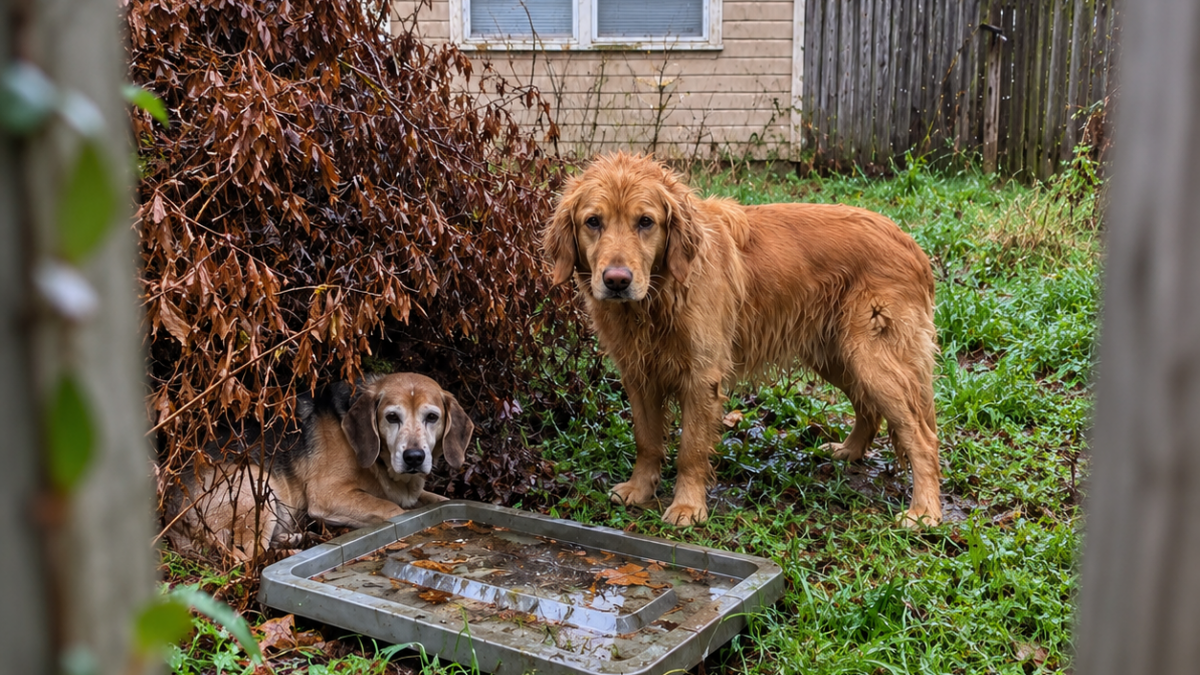
Up close, the condition of his body was worse than anything I had been able to see through the fence.
His coat hung loosely over him. Every rib was visible. The bones along his spine formed a hard ridge beneath thin skin, and his hips looked almost angular.
His eyes were dull with exhaustion.
But they followed me.
I put one hand near his nose.
He smelled my fingers.
Then his tail moved.
One weak scrape through the dirt.
That tiny movement hit me harder than if he had cried.
He had almost no strength left, and he was still trying to greet me.
“Oh, buddy.”
The Golden shoved her nose between us.
She sniffed my wrist, then turned and licked the older dog’s ear.
He closed his eyes.
Angela’s voice came through the fence.
“What do you need?”
“Water.”
“I’ve got bottled water.”
“Blankets.”
“I have those.”
“Food, but don’t bring too much.”
“What else?”
I looked at the old dog.
“Something we can carry him on.”
There was a pause.
Then I heard the ladder move.
“What are you doing?”
“Coming in.”
“You don’t have to.”
“Move.”
Angela climbed over in jeans and a sweatshirt.
Then I looked down.
“You’re wearing slippers.”
She glanced at her feet as if she had only just noticed.
“I left my house when I saw you climbing into a foreclosure property. I wasn’t exactly dressing for the occasion.”
Despite everything, I almost laughed.
She landed awkwardly.
“Never ask me to do that again.”
“I didn’t ask you the first time.”
“Good point.”
Then she saw the Beagle properly.
Her expression collapsed.
“Oh, sweetheart.”
The Golden rushed to her.
Angela crouched and let the dog smell her hands.
“She’s so thin.”
“He’s worse.”
Angela’s eyes moved toward the rainwater.
“That’s what they’ve been drinking?”
“Looks like it.”
She stared around the empty yard.
“No food?”
“Nothing I can find.”
She swore under her breath.
I opened a bottle of water.
We did not let either dog drink freely.
I knew enough to understand that animals who were badly dehydrated and starving sometimes needed careful reintroduction to food and water, though I had no idea what the correct amounts were.
The Golden would have emptied the bottle in seconds.
“Slow,” I told her.
She drank from the plastic container Angela held out, lifted her head, swallowed, then pushed forward again.
The Beagle was different.
He needed help even getting his muzzle close enough.
Angela supported his head.
I poured a little water into a shallow lid.
He drank.
Three laps.
Four.
Then stopped.
“Come on,” Angela whispered.
He did not.
His head sank against her hand.
She looked at me.
“He needs a vet.”
“I know.”
“My veterinarian has an emergency line.”
“Call.”
Angela reached for her phone.
The Golden immediately put herself beside the Beagle again.
Not in front of him.
Beside him.
She lay down with her body touching his.
Angela turned away while she talked to the clinic.
“Yes, two dogs.”
She listened.
“No, they’re not ours.”
Another pause.
“Well, technically we’re standing in somebody else’s backyard right now.”
I looked at her.
She waved me off.
“Yes, abandoned. Severe weight loss. One barely standing.”
She listened for almost a minute.
Then nodded.
“Yes. We can transport.”
She hung up.
“She’ll meet us.”
“How soon?”
“Twenty minutes.”
Relief hit me.
Then I looked at the padlocked gate.
“We still need to get him out.”
We could not safely lift him over the fence.
Angela walked to the gate and examined it.
“Can we take it off the hinges?”
We tried.
The hinges were old but positioned on the outside.
“No.”
She looked at the chain.
“Cut it.”
“That’s bank property.”
Angela slowly turned toward me.
“You climbed over the fence.”
“That’s different.”
“How?”
“I haven’t destroyed anything yet.”
She stared at me.
Then she pointed at the old dog.
“Do you think Citibank is coming over to hydrate him?”
“I don’t even know which bank owns the place.”
“Then I doubt they’ll arrive before we cut the lock.”
She was right.
Still, I hesitated.
Not because I cared about the padlock.
Because crossing a fence had felt reversible.
Cutting a chain felt like a decision.
Angela seemed to understand.
“Take pictures first.”
“What?”
“Everything.”
She pointed around the yard.
“The dogs. The empty bowls—or lack of bowls. The water. The gate. The chain.”
I pulled out my phone.
I photographed the yard.
The overgrown grass.
The rainwater.
The porch.
The dogs.
The foreclosure notice visible through a side window.
The gate.
The chain.
Then I climbed back over the fence.
I ran home.
My garage had a pair of bolt cutters I had purchased years earlier and barely used.
I carried them down the street.
Angela stood inside the fence with both dogs.
“Ready?”
“No.”
“Good enough.”
The chain snapped with one hard squeeze.
The sound startled the Golden.
She jumped, then immediately moved toward the Beagle.
“I’m sorry.”
Angela opened the gate.
I had brought an old comforter.
Together, we spread it beside the Beagle and carefully rolled him onto it.
He did not resist.
That frightened me.
Dogs usually object when strangers manipulate their bodies, especially when they are scared.
He simply let us do it.
“On three,” I said.
Angela grabbed two corners.
I took the others.
“One. Two. Three.”
We lifted.
He weighed far less than a dog his size should have.
The Golden followed so closely that Angela nearly tripped.
“Sweetheart, give me six inches.”
The dog ignored her.
Halfway across the yard, the Beagle made a soft whimper.
The Golden instantly put her nose against his face.
“She’s checking him,” Angela said.
“I know.”
“She’s been taking care of him.”
We carried him through the gate.
For the first time in more than ten days, he left that backyard.
I had already opened the rear door of my SUV.
We placed him across the back seat on the comforter.
Before we could decide what to do with the Golden, she jumped inside.
“She made the decision for us,” Angela said.
The Golden positioned herself against the Beagle.
Angela squeezed into the remaining space.
I looked at her slippers again.
“Don’t.”
“I didn’t say anything.”
“You were about to.”
I closed the door.
Then I drove.
The clinic was about fifteen minutes away.
Every traffic light felt intentionally cruel.
I kept checking the rearview mirror.
Angela had one hand resting lightly on the older dog.
The Golden stayed pressed against him.
At one point he whimpered.
She sat up immediately.
“Hey,” Angela whispered. “He’s still here.”
She stroked the Golden’s neck.
“So are you.”
I gripped the steering wheel harder.
The emergency lights of the clinic were already on when we arrived.
Dr. Howard met us at the side entrance wearing scrub pants, sneakers, and a sweatshirt over her uniform.
A veterinary technician stood beside her with a stretcher.
“What happened?”
“Foreclosed house,” Angela said. “Family moved out. Dogs were left in the backyard.”
“How long?”
“About ten days since the truck left,” I said. “I don’t know when they were last fed.”
Dr. Howard’s face tightened.
“The older one first.”
They transferred him onto the stretcher.
The Golden tried to follow.
A technician gently blocked her.
She panicked.
Not aggressively.
She scratched at the door.
Whined.
Looked at me.
Then back at the door.
“Hey,” I said.
She barely noticed.
Angela crouched beside her.
“He’s coming back.”
The dog paced.
She had no reason to believe us.
People had already left her once.
Now strangers had taken away the one companion who had remained.
Dr. Howard came back after several minutes.
“We’re starting fluids.”
“How bad?”
“I need bloodwork before I answer that.”
“Can we see him?”
“Not yet.”
She looked at the Golden.
“Let’s check her.”
The Golden was younger.
Maybe twelve to eighteen months.
Underweight.
Dehydrated.
Flea-infested.
Likely intestinal parasites.
But her heart was strong.
Her temperature was acceptable.
“She had more reserves,” Dr. Howard explained.
“Because she’s young?”
“That’s part of it.”
Angela looked toward the treatment room.
“What about him?”
Dr. Howard did not answer immediately.
That frightened me more than anything.
The technician took the Golden for bloodwork.
Angela and I sat in the empty waiting room.
For several minutes, neither of us said much.
Finally she looked at her feet.
“My slippers are ruined.”
“That’s what you’re thinking about?”
“No. I’m trying not to think about the other thing.”
“What other thing?”
“What if he dies?”
I looked down.
“I don’t know.”
“We should’ve gone in sooner.”
“We didn’t know.”
“We heard barking.”
“So did half the neighborhood.”
“That’s not making me feel better.”
“Me neither.”
The door opened.
Dr. Howard came in holding a clipboard.
I stood immediately.
“He’s severely dehydrated.”
“Okay.”
“Severely malnourished.”
I nodded.
“His kidney values are elevated.”
My stomach tightened.
“Kidney failure?”
“Not necessarily permanent. Dehydration can reduce blood flow to the kidneys. Sometimes values improve dramatically once circulation and hydration are restored.”
“Sometimes.”
“Yes.”
Angela crossed her arms tightly.
“How serious is he?”
Dr. Howard pulled out a chair.
That was when I knew the answer would not be simple.
“He’s in serious condition.”
“Can he survive?”
“Yes.”
I exhaled.
“But?”
“He is not stable enough for me to promise an outcome.”
She looked at both of us.
“If he had remained without meaningful water, food, and treatment for another forty-eight hours, I would be very concerned he wouldn’t have survived.”
Forty-eight hours.
I heard the number and immediately thought of the dispatcher.
Possibly a few days.
Paperwork.
Authorization.
Scheduling.
Nobody had been cruel on that call.
That almost made it worse.
The system had simply moved at the speed systems move.
Oliver’s body had not had that kind of time.
“What do you need from us?” I asked.
“Permission for treatment would normally come from an owner.”
“They don’t have one.”
“They legally may.”
I stared at her.
“They left.”
“I understand.”
“So treat him.”
“We are providing emergency stabilization. I’m also reporting suspected neglect to animal control. That gives us documentation while ownership is clarified.”
“Do whatever he needs.”
Dr. Howard nodded.
“We’ll start fluids carefully, monitor his kidney values, run a complete blood count, chemistry panel, urinalysis, parasite testing, and begin controlled nutrition when he can tolerate it.”
“Can we feed him?”
“Not a full meal. His body has been without adequate nutrition too long. We need to reintroduce calories carefully.”
Angela frowned.
“He can get sick from eating?”
“Potentially, yes.”
I rubbed my hands together.
“What about the Golden?”
“Underweight and dehydrated, but much more stable.”
“Can she go home?”
“With monitoring.”
The door behind Dr. Howard opened.
A technician walked the Golden past us.
She immediately pulled toward the treatment room.
The technician tried gently redirecting her.
The dog resisted.
“Bring her to him,” Dr. Howard said.
The technician hesitated.
“Are you sure?”
“For a minute.”
We followed.
The older Beagle lay inside a padded kennel.
An IV line ran to his front leg.
The Golden stopped at the doorway.
Her entire body changed.
She moved slowly now.
Quietly.
She approached the kennel, sniffed through the bars, then lowered herself beside the door.
The Beagle opened his eyes.
His tail moved once.
Dr. Howard watched them.
“How long have they lived together?”
“No idea.”
“They’re strongly bonded.”
Angela looked at me.
“That’s the polite version of what we already knew.”
Dr. Howard smiled faintly.
“We can kennel her beside him tonight.”
“Really?”
“If she’s calm there.”
The Golden walked into the neighboring kennel without resistance.
She turned three times.
Then lay down where she could see him.
The old dog closed his eyes.
Something in the room settled.
We stepped back into the lobby.
Suddenly the adrenaline left me.
I realized my shirt was filthy.
My hands smelled like dirty rainwater and dog.
Angela’s jeans were covered in grass stains.
Her slippers looked destroyed.
“What happens now?” she asked.
“I go home, apparently.”
“That’s not what I meant.”
“I know.”
She rubbed her forehead.
“Technically, those people may still own the dogs.”
“Maybe.”
“The bank owns the house.”
“Probably.”
“And we broke in.”
“Definitely.”
She nodded slowly.
“This has been a very productive evening.”
I laughed once.
Then the laughter stopped.
“Would you do it again?”
Angela looked toward the treatment-room door.
“Yes.”
“Me too.”
Animal control called the next morning.
The officer introduced himself as Ramirez.
His tone was formal.
Not hostile.
“Were you the person who entered the property last night?”
“Yes.”
“After speaking with dispatch?”
“Yes.”
“Dispatch advised you that an officer was pending.”
“They said possibly several days.”
“That is not the same as authorizing entry.”
“I know.”
“Did you cut a lock?”
“Yes.”
He paused.
“You are making my report very straightforward.”
“I photographed everything before I entered.”
That changed his tone slightly.
“What did you photograph?”
“The condition of the dogs. The yard. The water. The gate. The lock. No visible food containers.”
“Keep the original files.”
“I will.”
“Do not edit them.”
“I won’t.”
“Where are the animals now?”
“At Dr. Howard’s clinic.”
“We received her report.”
“How is the investigation going?”
“It began this morning.”
“Can the former owners take them back?”
“I cannot answer that yet.”
“They abandoned them.”
“I understand your position.”
“It’s not a position.”
“It is until I document the facts.”
His calm irritated me.
Then I caught myself.
He was not the person who had left them.
“I’m sorry.”
“No problem.”
There was a pause.
Then his voice softened.
“How is the older dog?”
“Vet says another forty-eight hours could have killed him.”
Officer Ramirez was quiet.
“All right.”
“What does that mean?”
“It means I will add it to the report.”
Not emotionally satisfying.
But real.
At noon, Angela and I returned to the clinic.
The Golden stood immediately.
The Beagle remained lying down.
But his eyes were open.
Dr. Howard handed me a small bowl containing a little soft food.
“Try.”
I crouched beside the kennel.
“Hey, buddy.”
He smelled the food.
Turned away.
My chest tightened.
“Come on.”
I moved the bowl slightly.
He smelled again.
Then licked.
Once.
Another lick.
Then a tiny mouthful.
Angela inhaled sharply.
He ate maybe two tablespoons.
Then stopped.
I looked at Dr. Howard.
“That’s all?”
“That’s enough.”
I had never been so happy about two tablespoons of dog food.
Angela wiped beneath one eye.
“Don’t.”
“Don’t what?”
“Pretend.”
“I have allergies.”
“You climbed a fence in slippers and now suddenly you have allergies?”
“Stress-induced allergies.”
The Golden stared intensely at the remaining food.
“No,” I told her.
She looked personally offended.
Angela crouched beside her.
“They need names.”
“They probably have names.”
“Maybe. But we don’t know them.”
I looked at the old Beagle.
Something about him felt like an Oliver.
“Oliver.”
Angela considered it.
“Oliver.”
His eyes moved toward us.
“See?” I said.
“You said a word. That is not proof.”
“He likes it.”
She turned toward the Golden.
“Daisy.”
The dog’s tail hit the kennel wall.
Angela smiled.
“There. Scientific.”
Oliver and Daisy.
Maybe not the names they started life with.
But they became the names of the life that came after.
Oliver stayed hospitalized for three more days.
His kidney values improved slowly.
That was our first major victory.
Dr. Howard showed me the numbers.
“See this?”
“I see numbers.”
“This value was much higher when he came in.”
“Lower is good?”
“In this case.”
“So his kidneys aren’t failing?”
“They were struggling. I’m cautiously optimistic that much of it was dehydration-related.”
“Cautiously optimistic.”
“You’ll hear that phrase a lot from veterinarians.”
“I hate it.”
“Good. It means you’re listening.”
He began eating small meals.
Then larger ones.
Daisy remained near him whenever possible.
The staff started calling her his nurse.
If Oliver stood, she stood.
If Oliver drank, she watched.
When he was taken to another room, Daisy sat facing the door.
One technician told me she had tried moving Daisy’s bed farther from Oliver’s kennel.
Daisy dragged the blanket back.
“She actually dragged it?”
“Across the floor.”
“Why?”
“She wanted to sleep closer.”
By day four, Oliver was strong enough to go home.
Dr. Howard called me that morning.
“You can pick them up.”
“Them?”
“Both.”
I felt a rush of relief.
Then panic.
“My house isn’t ready.”
“Do you have floors?”
“Yes.”
“Doors?”
“Yes.”
“Running water?”
“Yes.”
“Congratulations. You’re ahead of where they came from.”
“I’m serious.”
“So am I.”
She explained medication schedules.
Feeding amounts.
Parasite treatment.
Follow-up bloodwork.
Signs of dehydration.
Signs that meant I should return immediately.
I wrote everything down.
Then wrote it again.
Angela came over before we picked them up.
Together, we turned my spare room into a temporary dog space.
Temporary.
That was the word I kept using.
Temporary beds.
Temporary bowls.
Temporary baby gate.
Temporary arrangement.
“I’m fostering them,” I told Angela.
“Of course.”
“Until animal control clears ownership and we find a rescue.”
“Obviously.”
“Why do you keep saying it like that?”
“Like what?”
“Like you don’t believe me.”
“I believe you believe you.”
“That doesn’t make sense.”
“It will.”
Oliver walked into my house slowly.
Daisy entered like she had been fired from a cannon.
She investigated the living room.
Kitchen.
Hallway.
Back door.
Spare room.
Then back to Oliver.
She did not want him out of sight for more than a few seconds.
“She’s doing perimeter security,” Angela said.
“She’s insane.”
“She’s a Golden Retriever.”
“Same thing.”
Oliver reached the bed we had prepared.
He smelled it.
Turned carefully.
Then lowered himself.
Daisy immediately climbed onto the same bed.
There was barely enough room.
“Daisy.”
She ignored me.
Oliver rested his head against her side.
I stopped objecting.
The first night, I slept on the couch.
I told myself it was because Oliver might need help.
The truth was that I kept checking whether he was breathing.
Around two in the morning, something touched my hand.
I opened my eyes.
Oliver was standing beside the couch.
“Hey.”
His tail moved.
“Need outside?”
He did.
I took him into the backyard.
Daisy woke instantly and stood behind the glass door watching every step.
When we came back inside, she inspected Oliver from nose to tail.
Then both dogs returned to the bed.
I sat on the floor.
For the first time, I really thought about those ten days.
What happened the first night after the moving truck left?
Did they wait by the back door?
Did they bark when they heard cars?
Did Daisy expect someone to come back at sunset?
Did Oliver already understand before she did?
Who discovered the rainwater?
Who decided to sleep beneath the shrub?
Had Daisy given Oliver space at the water because he was older?
Or had Oliver allowed her to drink first because she was young?
There was no way to know.
Dogs do not provide witness statements.
Their bodies tell part of the story.
The rest stays with them.
Animal control’s investigation continued.
Officer Ramirez came to my house two days later.
He wore a body camera and carried a folder.
Daisy barked when he entered.
Then immediately brought him a sock.
He stared down at it.
“What am I supposed to do with this?”
“She thinks you need it.”
“I don’t.”
“Then don’t make eye contact.”
Daisy pushed the sock against his leg.
Officer Ramirez sighed.
“Evidence tampering.”
Angela laughed from the kitchen.
Oliver remained on his bed.
Ramirez photographed both dogs.
He compared their current condition to the pictures from the yard.
When he reached the image of the plastic lid full of dirty water, he stopped.
“This was the only accessible water source?”
“That I saw.”
“No bowls?”
“None.”
“Food containers?”
“No.”
“Any shelter?”
“Not unless you count the shrub.”
He made notes.
“Did you see anyone visiting the property during those ten days?”
“No.”
“Vehicles?”
“No.”
“Workers?”
“No.”
He looked at Oliver.
“The veterinary report says severe dehydration and malnutrition.”
“Yes.”
“And acute kidney stress.”
“Yes.”
He closed the folder.
“Bank representative says their inspection contractor did not report animals.”
I stared at him.
“They inspected the house?”
“Exterior inspection.”
“When?”
“Four days after vacancy.”
“And they didn’t see the dogs?”
“Apparently not.”
“How?”
“The dogs were in the backyard.”
“So nobody looked?”
“I’m telling you what is documented.”
Angela leaned against the counter.
“That sentence is going to become your catchphrase.”
Ramirez almost smiled.
“We’re trying to contact the former residents.”
“Trying?”
“The phone numbers we have are inconsistent.”
“Did they leave a forwarding address?”
“We’re working on it.”
I could feel my anger building.
“What happens if you find them?”
“That depends on the evidence and local statutes.”
“That is a very long way of saying you don’t know.”
“It’s the accurate way.”
I appreciated that even though I hated it.
Before leaving, Ramirez crouched near Oliver.
He did not touch him.
Just held out his hand.
Oliver smelled it.
Then slowly placed his chin in Ramirez’s palm.
The officer’s expression changed.
“Old guy.”
Oliver’s tail moved once.
Ramirez stood.
“I’ll call when ownership is cleared.”
“How long?”
He gave me a look.
“Don’t say several days.”
“I was going to say I don’t know.”
“Somehow worse.”
The first two weeks were difficult.
Oliver did not simply become healthy because he was safe.
His body had been starved.
His muscles were weak.
He tired after short walks into the yard.
Sometimes he stood and seemed to forget what he intended to do.
His appetite improved, but his stomach was sensitive.
Dr. Howard had us feed several small meals.
Daisy considered this policy discriminatory.
Every time Oliver received food, she believed she was legally entitled to an equal portion.
“You are not starving,” I told her.
She stared at me.
“You have eaten.”
Stare.
“You ate forty minutes ago.”
Stare.
Angela entered the kitchen.
“Give her something.”
“You’re the reason she behaves like this.”
“I’ve known her twelve days.”
“Exactly. Look what you accomplished.”
Daisy learned quickly.
She learned the refrigerator.
The treat cupboard.
The leash hook.
The sound of Angela’s car.
She learned that if she stood by the back door, I would let her outside.
Then she learned she could abuse that system.
Out.
In.
Out.
In.
At one point, I counted eleven trips in forty minutes.
“You don’t need to pee.”
She wagged.
“You’re running a scam.”
Oliver watched from his bed.
He looked tired just observing her.
But Daisy’s energy seemed to help him.
If she went outside, eventually he wanted to follow.
If she brought a toy, sometimes he lifted his head.
If she ran toward the front door when Angela arrived, Oliver stood too.
The first time he walked across the entire living room without wobbling, I texted Dr. Howard.
Oliver crossed the room by himself.
Her response arrived immediately.
Good. Do not let him overdo it.
That became the pattern of recovery.
Celebrate.
Then worry.
He gained half a pound.
We celebrated.
Then he had diarrhea.
We worried.
His kidney values improved.
Celebrate.
He seemed unusually tired one afternoon.
Worry.
Dr. Howard finally told me, “You have to stop measuring recovery by the hour.”
“How?”
“Measure by the week.”
“That seems irresponsible.”
“That seems survivable.”
Angela agreed.
“You’re becoming neurotic.”
“I rescued a half-dead dog.”
“You now watch him sleep like a security guard.”
“He’s old.”
“He snores.”
“That doesn’t mean anything.”
“It means he’s asleep.”
One evening, Oliver slept so deeply that I touched his side just to make sure he was breathing.
His eye opened.
He looked annoyed.
“Sorry.”
He sighed and went back to sleep.
Daisy lifted her head from the other side of the room as if to say I was embarrassing everyone.
Three weeks after the rescue, Officer Ramirez called.
“The bank has formally disclaimed any ownership interest in the animals and authorized surrender.”
“What does that mean?”
“It means the dogs can be legally placed through rescue or adoption pending completion of our report.”
“What about the former owners?”
“We made contact.”
My hand tightened around the phone.
“What did they say?”
“I can’t share every detail.”
“Did they admit leaving them?”
A pause.
“They confirmed the dogs had lived at the property.”
“That isn’t what I asked.”
“I know.”
I closed my eyes.
“Are they asking for them back?”
“No.”
That was enough.
“Good.”
Ramirez continued.
“The neglect investigation is documented. What happens next is a separate process.”
“Are they going to be charged?”
“I cannot promise that.”
My anger sharpened.
“Oliver almost died.”
“I know.”
“Then what exactly is required?”
“Evidence that meets the legal standard.”
“I have photographs.”
“You do.”
“Veterinary reports.”
“We have them.”
“They moved out.”
“We documented that.”
“So?”
“So cases are not decided by how obvious something feels to you or me.”
I hated the answer.
But I knew he was right.
“What can I do?”
“Keep caring for the dogs.”
“That’s it?”
“For them? Yes.”
I looked at Oliver and Daisy.
Daisy was asleep with one paw resting across Oliver’s back.
“Fine.”
The official process eventually became much less dramatic than my anger wanted it to be.
Reports were completed.
Ownership was relinquished.
The bank closed its involvement.
Animal control documented neglect.
There were communications with the former residents that I was never fully included in.
The matter eventually closed.
For a while, that bothered me.
I wanted a confrontation.
I wanted somebody to stand in my living room and explain how two dogs became less important than chairs and mattresses.
I wanted an apology addressed to Oliver.
I wanted Daisy to hear that none of it had been her fault, even though she would not understand the words.
Real life did not provide that scene.
Eventually, I understood that I could waste months imagining a justice that would never mean anything to the dogs.
Oliver did not care about legal punishment.
He cared about dinner.
Daisy did not need an apology.
She needed a tennis ball.
Their lives were moving forward whether my anger did or not.
I contacted local rescue groups.
The first coordinator came to meet them in person.
Her name was Melissa.
She sat on my living room floor.
Daisy immediately climbed halfway into her lap.
“Well,” Melissa said. “This one will be easy.”
Daisy licked her face.
“What about Oliver?” I asked.
Melissa looked toward him.
Oliver remained on his bed.
“Senior Beagle mix. Medical history. Bonded to a young large dog.”
“So?”
“So he’ll be harder.”
I knew that.
Hearing it made me angry anyway.
“He’s great.”
“I’m not saying he isn’t.”
“He’s house-trained.”
“Good.”
“Quiet.”
“Good.”
“Gentle.”
“Also good.”
Melissa smiled.
“I’m on your side.”
I sat back.
“Sorry.”
“You’re attached.”
“I’m fostering.”
Angela, who was standing behind me, made a choking sound.
I turned.
“Do you need water?”
“I’m fine.”
Melissa looked between us.
“Anyway.”
She opened a notebook.
“We can list them as a bonded pair.”
“That’s what I want.”
“That reduces applications.”
“I know.”
“Daisy could probably be adopted alone within days.”
“No.”
Melissa studied me.
“Do you think separation would be harmful?”
“Yes.”
“Based on?”
“Everything.”
That was not a professional answer.
So I explained.
Daisy panicked when Oliver disappeared from sight.
Oliver ate better when Daisy was near him.
They slept together.
They looked for each other constantly.
At the clinic, Daisy had dragged her bedding closer.
Melissa listened.
“Okay.”
“Okay?”
“We list them together first.”
Relief loosened something in my chest.
Photos were taken.
Descriptions written.
Daisy looked photogenic without trying.
Oliver looked like someone had interrupted his nap for tax paperwork.
Angela laughed at his adoption photo.
“That is terrible.”
“It shows his personality.”
“It shows resentment.”
“That is his personality.”
We retook it.
The second was better.
For the first few weeks, inquiries focused almost entirely on Daisy.
“She’s beautiful.”
“She’s young.”
“She looks so friendly.”
All true.
Then came the question.
“Can we adopt her without the Beagle?”
No.
Again.
No.
Again.
No.
I started dreading emails.
One family sounded wonderful.
Fenced yard.
Previous Golden Retriever experience.
Two teenagers.
Someone home much of the day.
Then the mother said, “We’re really only interested in Daisy.”
I looked at Daisy, who was curled against Oliver.
“They’re bonded.”
“We have an older dog already.”
“That would probably be too much.”
“Could Oliver go somewhere else?”
I knew she had not meant anything cruel.
Still, the sentence hit me.
Somewhere else.
Oliver had already been somebody’s somewhere else.
“No,” I said.
Afterward Angela found me staring at my laptop.
“What?”
“Nothing.”
“That face is not nothing.”
“I’m worried I’m making Daisy harder to adopt.”
“By keeping her with Oliver?”
“Yes.”
“What would she choose?”
“She’s a dog.”
“That wasn’t the question.”
I looked across the room.
Daisy had brought Oliver a rope toy.
He ignored it.
She dropped it on his face.
Oliver looked deeply offended.
Angela smiled.
“I think we have our answer.”
Oliver continued gaining weight.
At his six-week follow-up, Dr. Howard weighed him twice.
“You’re up almost nine pounds from admission.”
“Is that enough?”
“That’s excellent.”
His kidney values had normalized significantly.
Not perfect.
But no longer alarming.
I sat down.
“So he’s okay?”
“He’s an older dog who survived severe dehydration and malnutrition.”
“That’s not an answer.”
“He is doing much better.”
“Can I stop worrying?”
“No.”
I stared at her.
She smiled.
“People with older dogs don’t stop worrying. They just change the subject.”
Daisy’s exam was easier.
Healthy.
Strong.
Still gaining appropriate weight.
She had filled out beautifully.
Her coat became glossy.
The dull, desperate look in her eyes disappeared.
She had become obnoxiously happy.
That is the best phrase I can use.
Everything excited her.
Breakfast.
Visitors.
Walks.
Leaves.
Rain.
My shoes.
Angela’s purse.
A cardboard box.
Once, I bought her an expensive puzzle toy.
She ignored it and spent twenty minutes playing with the packaging.
Oliver watched from his bed.
“You understand value better,” I told him.
He looked at the treat bag.
“Exactly.”
The house developed routines around them.
Breakfast at seven.
Morning walk.
Oliver short route.
Daisy longer route afterward if she still had energy—which she always did.
Medication.
Nap.
Afternoon yard time.
Dinner.
Evening walk.
Couch.
Sleep.
At first, I structured everything because they needed stability.
Then one day I realized I needed the routine too.
Before them, my house had been quiet.
Not lonely exactly.
Just predictable.
I worked.
Came home.
Ate dinner.
Watched television.
Went to bed.
Suddenly there was motion everywhere.
Daisy’s toenails on the hallway floor.
Oliver snoring.
Bowls clinking.
Leashes hanging by the door.
Dog hair.
So much dog hair.
Angela came over one afternoon and found me vacuuming.
“You knew dogs shed.”
“I did not know Daisy was capable of producing a second Golden Retriever every three days.”
“That’s fair.”
She pointed toward Oliver.
“And him?”
“Mostly ears.”
Oliver looked up.
His ears were enormous.
Angela sat beside him.
“How are you, old man?”
His tail moved.
She gave him a biscuit.
I stared.
“What?”
“He looked hungry.”
“He ate twenty minutes ago.”
“So?”
“You’re undermining medical science.”
“I’m supporting recovery.”
“You are why he waits by the window for your car.”
“Good.”
I tried pretending I was annoyed.
I wasn’t.
Angela had become part of their world.
Maybe mine too.
Before the rescue, we had known each other only in the shallow way neighbors sometimes do.
Wave.
Smile.
Weather comment.
Trash-day complaint.
Now she had a key to my house.
She knew Oliver’s medication schedule.
Daisy recognized her car.
Sometimes rescue expands the definition of family in directions you do not expect.
Two months passed.
Then three.
The adoption applications slowed.
Bonded pairs were harder.
A senior dog with medical history made them harder still.
Melissa called.
“We may need to reconsider strategy.”
“What strategy?”
“Separate listings.”
“No.”
“Hear me out.”
“I have.”
“You haven’t.”
I sat down.
She continued.
“Daisy could be placed quickly. Oliver could then be marketed specifically to senior-dog adopters.”
“They would lose each other.”
“Yes.”
“No.”
“Look, I agree they’re bonded. But sometimes bonded dogs can adapt.”
“I don’t want them to adapt to losing each other.”
There was silence.
Then Melissa asked quietly, “Are you prepared to keep fostering indefinitely?”
The question irritated me because I did not have an answer.
“I’ll do what I have to.”
“That’s not what I asked.”
“I know.”
“You’ve had them three months.”
“I know.”
“Oliver could live another five years.”
“Good.”
“Daisy could live another twelve.”
“Also good.”
Melissa laughed softly.
“You hear yourself?”
“I’m fostering.”
“Right.”
When the call ended, I sat at my kitchen table.
Angela arrived twenty minutes later.
I had not called her.
She claimed she was returning a container.
She had also brought dog treats.
“Melissa called.”
“How do you know?”
“She called me too.”
“Why?”
“Because I’m listed as secondary foster contact.”
“You agreed to that?”
“You wrote my number down.”
“I forgot.”
“She thinks separating them might improve adoption chances.”
“I said no.”
Angela sat opposite me.
“I know.”
“You think I’m wrong?”
“No.”
“Then why do you look like that?”
“Because you’re avoiding the obvious answer.”
“What answer?”
She looked toward the living room.
Daisy lay beside Oliver.
“They’re already home.”
I hated how immediately the sentence landed.
“That’s not practical.”
“Why?”
“Because I never planned to have two dogs.”
“Plans are famously respected by Golden Retrievers.”
“I’m serious.”
“So am I.”
“Oliver has medical needs.”
“You already handle them.”
“Daisy is young. She needs exercise.”
“You already exercise her.”
“Two dogs are expensive.”
“You already pay for them.”
“Rescue has covered some veterinary expenses.”
“So talk to them.”
“This house is small.”
“They have claimed approximately sixty percent of it.”
“Angela.”
She held up both hands.
“Fine.”
I stared at the table.
Then I said quietly, “What if Oliver dies?”
Angela’s expression changed.
There it was.
The real problem.
Not money.
Not space.
Not responsibility.
Oliver was old.
I had taken him in while he was close to death.
Some part of me had kept “foster” as emotional insurance.
If he belonged to someone else eventually, maybe losing him would not feel entirely mine.
Angela understood before I said it.
“You’re going to lose him someday whether the paperwork says foster or adopted.”
“That’s helpful.”
“I didn’t say it was comforting.”
I looked into the living room.
Daisy had rolled onto her back.
Oliver’s head rested against her side.
“I don’t want to do that to Daisy.”
“Do what?”
“Lose him.”
“You can’t prevent that.”
“I know.”
“But you can make sure neither of them loses home first.”
That stayed with me.
A week later, we received the best adoption application we had ever seen.
An older couple.
Large fenced yard.
Retired.
Excellent veterinary references.
Experience with senior dogs.
Willing to adopt both.
I should have felt relieved.
Instead, when Melissa forwarded the application, I felt something close to panic.
I read it three times.
There was nothing wrong with them.
That was the problem.
I could not reject them for being unsuitable.
That evening, I opened my laptop.
Oliver and Daisy slept on the rug.
The application sat on the screen.
A sensible person would have been grateful.
This was what fostering was for.
You save them.
You stabilize them.
You help them recover.
Then someone else gives them a permanent home so you can help the next animal.
I understood all of that.
My cursor hovered over the reply button.
Daisy shifted.
Oliver made a soft sound in his sleep.
Her eyes opened instantly.
She looked at him.
Waited.
Then lowered her head again.
I closed the laptop.
Angela was sitting in the chair across from me.
She had been reading a book.
Or pretending to.
Finally she said, “There it is.”
“What?”
“The moment you stop lying.”
“I’m not lying.”
“You’ve rejected people for wanting one dog. You’ve rejected people whose homes weren’t right for Oliver. You’ve rejected people who lived too far from his vet.”
“For valid reasons.”
“Yes.”
She pointed at the laptop.
“And now you have a good application for both and you look like someone just served you an eviction notice.”
I said nothing.
Angela put down the book.
“You love them.”
“That’s not the issue.”
“It is exactly the issue.”
“I didn’t plan for this.”
“Nobody plans for the useful parts of life.”
“That sentence doesn’t even mean anything.”
“It sounded good in my head.”
I laughed.
Then stopped.
“What if I’m being selfish?”
Angela considered that.
“Maybe.”
I looked at her.
“That’s not the answer I wanted.”
“You asked.”
“What if they could have a better home?”
“Then figure out what ‘better’ means.”
“More space.”
“Daisy uses your entire yard to carry one tennis ball.”
“More time.”
“You work from home three days a week.”
“Retired owners would be there constantly.”
“Oliver sleeps eighteen hours a day. I doubt he wants a social calendar.”
I smiled.
Angela leaned forward.
“Don’t keep them because goodbye hurts.”
I looked at her.
“Keep them if this is the home that works.”
That was the test.
Not my fear.
Not guilt.
Not possession.
Were they happy?
Safe?
Cared for?
Could I afford them?
Could I meet their needs?
Did their bond work here?
The answers were all yes.
The only argument against keeping them was that I had once told myself I wouldn’t.
That suddenly seemed like a very stupid reason.
I went to the living room.
Sat on the floor.
Daisy immediately rolled onto her back.
Oliver lifted his head.
“Okay.”
Daisy’s tail thumped.
“This is ridiculous.”
More thumping.
“You’re staying.”
Daisy kicked one leg happily.
I looked at Oliver.
“You too, old man.”
He stared at me.
Then slowly stood.
He walked over.
Pressed his gray muzzle against my chest.
I wrapped my arms around him.
That was the moment.
No music.
No crowd.
No adoption banner.
Just an elderly Beagle leaning into me while Daisy shoved a paw against my side because I had stopped rubbing her belly.
Angela wiped beneath her eye.
I looked at her.
“Allergies?”
“Shut up.”
The official adoption took another week.
Melissa came over with paperwork.
She was not surprised.
“Everyone knew this would happen.”
“No, they didn’t.”
“Yes.”
“Who is everyone?”
“Me. Angela. Dr. Howard.”
“You discussed this?”
“Not formally.”
“This feels like a conspiracy.”
Melissa handed me a pen.
“Sign.”
I did.
Daisy became mine first on the paperwork.
Oliver second.
I stared at his name.
Owner.
Me.
Something about that word felt heavier than I expected.
Not ownership as possession.
Responsibility.
No temporary language anymore.
No exit.
No future family coming.
Just us.
I signed.
Melissa collected the papers.
“Congratulations.”
Daisy stole the pen.
That seemed appropriate.
The years afterward were quieter.
Not uneventful.
Never uneventful with Daisy.
But quieter.
Oliver recovered enough that strangers who met him later had trouble believing the first photographs.
He never became young again.
He was already a senior when we found him.
But he became comfortable.
Healthy enough.
Interested in life.
His gray muzzle became whiter.
His hearing declined.
Arthritis eventually appeared in his hips.
Dr. Howard prescribed medication.
We added rugs to slippery areas of the house.
I built a small ramp for the back step.
Daisy used the ramp even though she did not need it.
Apparently equality mattered.
Oliver still enforced breakfast.
At 6:58 a.m., he stood beside my bed.
Never 6:45.
Never 7:10.
6:58.
I have no explanation.
The first morning after daylight saving time changed, he appeared at the wrong hour according to the clock but exactly the right hour according to his stomach.
I tried explaining.
“You don’t understand time zones.”
He stared.
“The government changed the clock.”
Stare.
“This is not my fault.”
Daisy appeared behind him.
Two dogs now judging me.
“Fine.”
They won.
Daisy matured without becoming calm.
She learned basic obedience.
Mostly.
She learned “sit.”
“Stay” if nothing interesting happened.
“Drop it” only when the object had low value.
“Leave it” remained more of a philosophical suggestion.
She loved tennis balls with irrational intensity.
I once counted eleven under the couch.
Angela bought her more.
“You are the problem.”
“I’m an aunt.”
“You assigned yourself that title.”
“The dogs recognize it.”
Oliver’s interests remained simpler.
Food.
Sleep.
Sun.
Daisy.
Me.
Angela.
In roughly that order.
Sometimes I sat in the backyard watching them.
Daisy would run after a ball.
Oliver would lie in the grass.
Eventually Daisy always returned to him.
She might be young.
She might have enough energy to circle the yard six times.
But her center remained Oliver.
One afternoon, when they had been with me nearly a year, a moving truck stopped outside the old house.
I froze.
For a second, I was back at my kitchen window on that rainy Saturday.
Then I realized the truck belonged to new owners.
A young couple.
Two children.
They spent weeks renovating.
New paint.
New windows.
The broken section of fence was replaced.
The backyard was cleared.
The dead shrub disappeared.
I watched workers haul away the plastic debris.
One of them picked up what looked like the same old storage-bin lid.
He tossed it into a dumpster.
I stood at my window far longer than I meant to.
That piece of plastic had once been the difference between thirst and survival.
To the worker, it was trash.
Both things were true.
The new neighbors eventually introduced themselves.
They knew nothing about Oliver and Daisy.
Why would they?
The realtor had told them the property had been vacant.
That was the whole story they needed.
One afternoon, their little boy saw Daisy through my fence.
“Can I pet your dog?”
“Ask your parents.”
His mother nodded.
Daisy immediately made a new best friend.
Oliver watched from the porch.
The boy pointed.
“Is that her dad?”
I laughed.
“No.”
“Grandpa?”
“No.”
“What is he?”
I looked at Oliver.
Daisy ran back and stood beside him.
“Her best friend.”
The boy seemed satisfied.
Years passed.
Three, eventually.
The neighborhood forgot.
Foreclosures happen.
People move.
New people arrive.
Grass regrows.
Paint changes.
Stories disappear unless someone carries them.
I carried this one because every morning it walked into my bedroom.
Oliver became older.
His eyesight dimmed slightly.
He slept more.
Sometimes he became confused after waking.
Daisy adapted before I did.
She slowed down around him.
When they walked through narrow spaces, she stopped barreling past.
If he hesitated at the back step, she waited.
On walks, she learned that Oliver’s pace was the pace.
She still chased tennis balls in the yard.
But when he stood to go inside, she usually abandoned the game.
One afternoon, Dr. Howard watched them together in the exam room.
Daisy was lying beside Oliver while he waited for bloodwork.
“She’s still doing it.”
“Doing what?”
“Monitoring him.”
I looked down.
Daisy’s head rested across Oliver’s paws.
“She has for three years.”
Dr. Howard smiled.
“Some bonds change.”
“Theirs didn’t.”
“Maybe it did.”
I looked at her.
“How?”
“In the beginning she needed him because she was scared.”
Dr. Howard nodded toward Daisy.
“Now she stays because she loves him.”
That sentence stayed with me.
Survival had created their bond.
Safety had allowed it to become something else.
I often thought about the night I first heard the howling.
How close I came to dismissing it.
How easy it would have been to assume another neighbor would handle it.
That part bothered me.
Not because I believed I was uniquely responsible.
Because rescue stories often get simplified after the fact.
Someone was heroic.
Someone else was cruel.
Then everything became okay.
That was not how it felt from inside.
I hesitated.
I waited several nights.
I trusted the official process at first.
I worried about trespassing.
I worried about consequences.
Angela had to push me to cut the chain.
Dr. Howard had to explain that recovery would be slow.
Officer Ramirez had to remind me that anger and legal evidence were not the same thing.
Melissa had to challenge my assumptions about fostering.
Angela had to tell me the truth before I was ready to admit it.
Nobody did everything right.
But enough people did one necessary thing at the right moment.
That saved them.
One summer night, a thunderstorm rolled through.
Rain hammered the roof.
Daisy normally ignored storms.
That night, the sound of water seemed to bother her.
She paced.
Oliver slept.
Daisy walked to the back door.
Then away.
Back again.
I sat on the floor.
“Come here.”
She approached.
I rubbed her chest.
Thunder cracked.
She flinched.
Then went directly to Oliver.
She curled beside him.
He woke.
Lifted his head.
Daisy pressed against him.
Oliver put his chin over her front leg.
Within minutes, she settled.
I wondered whether rain sounded different to a dog who had once survived on rainwater.
Maybe that was me imposing meaning.
Maybe she simply disliked the thunder.
I would never know.
But I stayed with them until the storm passed.
Later that night, I stood at the kitchen window.
Three doors down, the new family’s porch light glowed warmly.
Their backyard was dark but cared for.
Nothing about it resembled the place where Oliver and Daisy had almost died.
That should have made the memory disappear.
It did not.
Sometimes healing means the world looks ordinary again while you still remember exactly what happened there.
Angela came over the next morning.
Daisy greeted her with a toy.
Oliver stayed on his bed.
Angela sat beside him.
“How are you, handsome?”
His tail moved.
She gave him a biscuit.
I pointed.
“I saw that.”
“You see nothing.”
“He has a diet.”
“He is eighty in dog years.”
“That is not how dog years work.”
“I refuse to debate mathematics before coffee.”
Oliver ate the biscuit.
Daisy looked at Angela.
“No.”
Daisy stared.
“No.”
Stare.
Angela gave her half a biscuit.
“Unbelievable.”
She shrugged.
“Equal protection.”
Eventually, Oliver’s age became something we could not ignore.
Not illness.
Just time.
He moved slower.
Some mornings he needed an extra minute before standing.
His arthritis medication increased.
We added another rug.
Then another.
My house slowly became a network of traction surfaces designed around one old Beagle.
Daisy adapted to those too.
She preferred sleeping beside him rather than in the expensive bed I bought specifically for her.
One evening, I found Oliver struggling to get comfortable.
He circled.
Stopped.
Circled again.
Daisy stood.
Oliver finally lay down.
She positioned herself beside him.
He rested his head across her shoulder.
Same position.
Same two dogs.
Different life.
I sat across from them.
Three years earlier, they had slept pressed together because the night was cold and nobody was coming.
Now the heat was on.
Bowls were full.
The doors were locked.
Their tags carried my phone number.
The difference was so ordinary it almost hurt.
Safety is mostly boring.
Food arriving at the same time.
Water always there.
A door opening when you need outside.
Medicine hidden in cheese.
Someone noticing when you limp.
Someone coming home.
Maybe that is why neglected animals can look transformed even when nothing dramatic happens.
They are no longer spending every minute solving survival.
One morning, I overslept.
7:12.
I woke to Oliver standing beside my bed.
Daisy behind him.
The betrayal on their faces was almost theatrical.
“Oh no.”
Oliver stared.
“I’m sorry.”
Daisy made a soft noise.
“Twelve minutes.”
Oliver stared harder.
“Call the authorities.”
I got up.
They followed me into the kitchen.
Food hit the bowls.
Daisy started eating immediately.
Oliver looked at me first.
Just for a second.
Then ate.
I stood there smiling.
That was when I realized what had changed most.
Once, their hunger had meant danger.
Now hunger meant breakfast was late.
Once, an empty bowl meant no one was coming.
Now it meant I had not filled it yet.
Those are completely different kinds of hunger.
A few months later, Angela and I walked past the old house.
The new owners were planting flowers near the fence.
Their children were playing in the yard.
Daisy trotted beside us.
Oliver moved slowly between us.
We passed the exact section where I had placed the ladder.
There was no mark.
The fence had been rebuilt.
Angela looked at me.
“Right there.”
“I know.”
“You had the ladder about here.”
“I know.”
“And I was wearing slippers.”
“You mention that more than necessary.”
“I could have died.”
“You climbed six feet.”
“In slippers.”
Oliver stopped.
He smelled the fence post.
Daisy stopped with him.
I wondered whether they recognized the place.
They gave no obvious sign.
No fear.
No pulling.
No hesitation.
Oliver finished sniffing.
Then continued walking.
Daisy followed.
Angela looked at me.
“I guess that answers that.”
“What?”
“They don’t live there anymore.”
I understood what she meant.
Not physically.
Something deeper.
The yard no longer owned part of them.
I wished memory worked that cleanly for people.
Sometimes it does not.
I still remembered the old Beagle beneath the dead shrub.
The Golden drinking muddy water.
The empty yard.
The chain snapping.
The lightness of Oliver’s body when we carried him.
Forty-eight hours.
That number never completely left.
Forty-eight hours could have separated this life from no life at all.
But I stopped treating that fact as a reason to remain angry every day.
It became a reason to notice.
Notice unusual barking.
Notice silence where noise used to be.
Notice the dog who stopped standing.
Notice the neighbor climbing a fence in slippers.
Notice the veterinarian who returned after hours.
Notice the animal-control officer whose careful language initially frustrated me but who still asked, first, how the dogs were doing.
Rescue was not one dramatic choice.
It was a chain.
If enough links held, animals survived.
Years after the foreclosure, Oliver developed a habit of waking from naps and looking around until he found Daisy.
He did not always get up.
Sometimes he simply lifted his head.
His cloudy eyes searched.
Daisy would notice.
She would thump her tail.
Oliver would see her.
Then settle again.
The first time I consciously noticed it, I felt something tighten in my chest.
That was what safety looked like for him.
Not knowing she would never leave.
Just checking.
Finding her.
Resting.
One evening, I sat on the floor beside both of them.
Daisy had gone gray around the muzzle too, though nowhere near as much as Oliver.
“You’re getting old.”
She licked my hand.
Oliver slept.
Angela sat on the couch.
“Remember when she was all ribs?”
“Yes.”
“She looked enormous compared to him.”
“She was enormous compared to him.”
“And now?”
“Now she thinks the couch belongs to her.”
“It does.”
“I bought the couch.”
“Legal ownership appears irrelevant in this story.”
I laughed.
Fair enough.
The abandoned house had taught me that papers and locks can define ownership without defining responsibility.
The bank owned the property.
The former residents may have legally owned the dogs until paperwork said otherwise.
Animal control had authority.
Dr. Howard had medical responsibility.
I had no legal connection when I crossed the fence.
Yet Oliver’s kidneys did not care who had standing.
Daisy’s thirst did not care who held title.
Eventually law and responsibility caught up with each other.
But the dogs had needed someone before that happened.
I do not tell myself that means rules do not matter.
They do.
I was lucky.
The dogs were nonaggressive.
The property was visibly vacant.
I documented what I saw.
A veterinarian and animal control became involved immediately.
Another situation could have been different.
What stays with me is not that everyone should cut locks.
It is how easy suffering can hide behind one.
The old house had looked empty from the street.
That was the part I could never forget.
Empty.
Quiet.
Finished.
Except it wasn’t.
Two animals were still waiting behind it.
Near the end of our third year together, I woke one night to find Daisy standing beside Oliver’s bed.
She was not barking.
Just standing.
I sat up immediately.
“What’s wrong?”
Oliver was breathing.
Slow.
Regular.
I knelt beside him.
He opened his eyes.
Daisy lowered herself next to him.
I touched his shoulder.
“You okay, old man?”
His tail moved.
Once.
I almost laughed from relief.
That tiny tail movement still had power over me.
The next morning, I scheduled a veterinary check.
Dr. Howard examined him.
“Arthritis flare.”
“That’s it?”
“That’s enough at his age.”
“But heart?”
“Sounds good.”
“Kidneys?”
“Bloodwork will tell us, but he’s been stable.”
“Lungs?”
“Also fine.”
She looked at me.
“You are doing it again.”
“Doing what?”
“Measuring his life by catastrophe.”
I did not understand.
She sat down.
“You met Oliver when he was almost dead. So every bad night still feels like the beginning of the end.”
I looked at him.
He was leaning against Daisy.
“What am I supposed to do?”
“Treat the problem in front of you.”
“That simple?”
“No.”
She smiled.
“But that’s the job.”
The bloodwork was good for his age.
His pain medication changed.
Within days, he moved more comfortably.
Nothing dramatic.
Just another small problem managed.
Another ordinary week.
That became the final lesson Oliver taught me.
Life after rescue is not one happy ending.
It is maintenance.
Appointments.
Medication.
Patience.
Messes.
Routine.
Fear.
Laughter.
More fear.
More routine.
And eventually years have passed.
People sometimes saw Daisy and Oliver on walks and said things like, “They’re so lucky you found them.”
I never knew how to answer.
Maybe they were.
But luck had very little to do with the ten days before I found them.
And I knew what they had given me too.
My house had become louder.
Messier.
More expensive.
Far less lonely.
I knew more about kidney values than I ever wanted.
I owned four different dog beds even though they used one.
My vacuum cleaner worked harder.
My schedule became less flexible.
My heart became vulnerable in ways I had tried avoiding by calling them fosters.
I would choose all of it again.
One night, not long after that vet visit, I walked into the living room before bed.
Daisy was already asleep.
Oliver stood nearby, turning slowly, trying to find the exact position he wanted.
Eventually he lowered himself beside her.
Daisy opened her eyes.
She shifted slightly.
Made space.
Oliver curled against her.
His head rested across her front legs.
The same position I had seen during those first terrible days.
But everything around them was different.
There was fresh water ten feet away.
Two bowls sat ready for breakfast.
Oliver’s medication was on the counter.
Daisy’s tennis balls were under half the furniture.
Their leashes hung beside the door.
Tags on their collars carried my address.
The heat hummed softly.
Rain tapped against the windows.
Neither dog reacted.
I sat on the floor.
Daisy opened one eye.
Her tail tapped once.
Oliver stayed asleep.
I thought about that rainy Saturday when the former family loaded the truck.
Mattresses.
Boxes.
Kitchen chairs.
Television.
Bicycle.
Furniture.
Objects.
They had taken everything they considered worth moving.
Then they drove away.
For a long time, I wanted to understand how anyone could leave two dogs behind.
I wanted an explanation with enough logic to make the memory less ugly.
I never found one.
Eventually, I stopped needing it.
The question that mattered was no longer why they left.
It was what happened after.
After the truck disappeared, Oliver and Daisy stayed together.
When food disappeared, they stayed together.
When water became dirty and scarce, they stayed together.
When Oliver became too weak to stand, Daisy stayed.
When strangers climbed over the fence, Daisy stayed beside him.
When he went into a veterinary treatment room, she waited at the door.
When he came home, she slept against him.
When his body grew old, she slowed down.
When he woke confused, he looked for her.
And she was there.
That loyalty had survived everything the people before me had failed to provide.
I reached down and touched Oliver’s gray muzzle.
His eye opened.
He looked at me.
His tail moved against Daisy’s leg.
Then he went back to sleep.
Daisy lowered her head over him.
Three years earlier, they had curled together because neither knew whether anyone was coming back.
Now they curled together because they wanted to.
That difference contained everything.
Tomorrow morning, around 6:58, Oliver would stand beside my bed demanding breakfast.
Daisy would appear behind him.
I would complain.
They would ignore me.
Angela would probably visit later carrying treats she insisted were accidental purchases.
Daisy would bring her a toy.
Oliver would search her pockets.
Nothing about it would look extraordinary.
That was what I loved most.
They had already survived the extraordinary part.
They no longer needed heroes.
No emergency calls.
No ladders.
No broken chains.
No blankets used as stretchers.
No desperate drives to the veterinarian.
No waiting for authorization.
They needed breakfast.
Medication.
Walks.
A warm floor.
Someone to come home.
At bedtime, I turned off the living-room lamp.
Daisy barely moved.
Oliver lifted his head.
“Come on, old man.”
He stood slowly.
Daisy stood with him.
They followed me down the hallway.
Halfway to the bedroom, Oliver paused.
Daisy paused too.
He looked at her.
Then kept walking.
She followed.
I opened the bedroom door.
They went inside.
No hesitation.
No looking back toward the front door.
No waiting for footsteps that would never return.
Just two dogs heading toward their beds in the house they already knew belonged to them.
I switched off the hallway light.
And for one more night, nobody left.
[END OF STORY]








