PART 2: They Dumped This Broken Puppy Beside the Trash to Freeze—Then Doctors Discovered What Had Been Done to Him
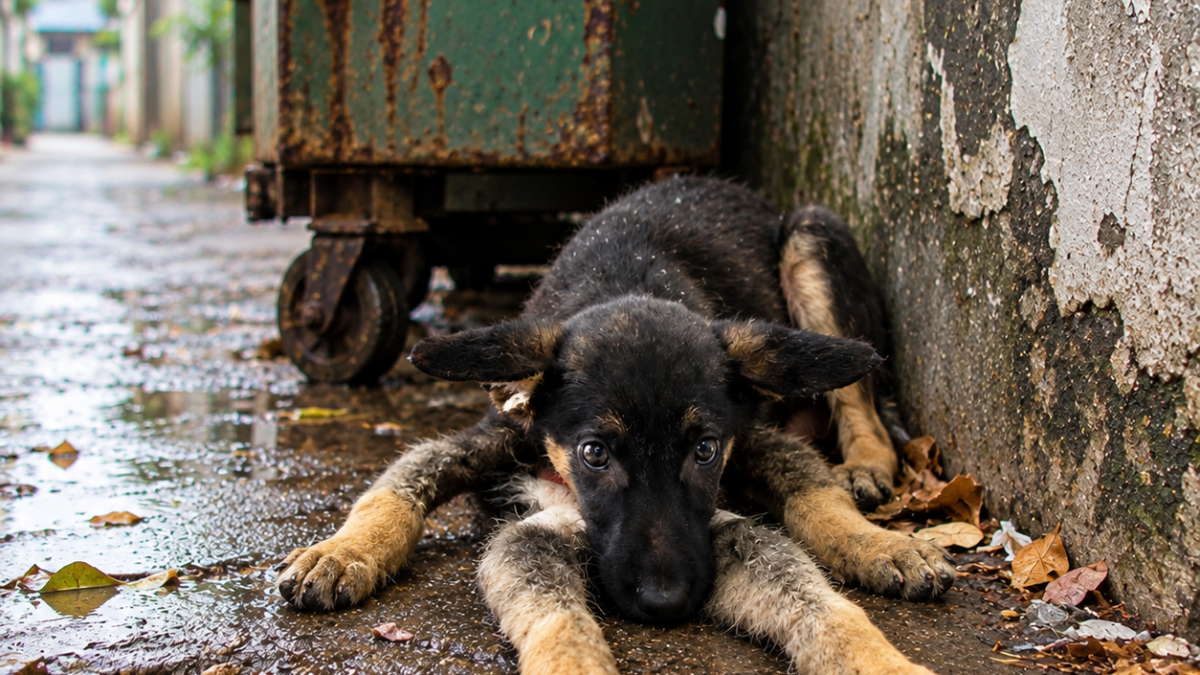
PART 2
The next morning, Sean was still alive.
That sounds like such a small sentence.
It wasn’t.
For the first several days, “still alive” was our greatest victory.
He remained weak enough that every change worried us.
If he ate less, we noticed.
If his temperature shifted, we noticed.
If he slept longer than usual, someone checked him.
The veterinary staff recorded everything.
Weight.
Fluids.
Medication.
How much food he accepted.
How his wounds looked.
Whether he reacted when his paws were touched.
Whether he could move his legs at all.
Sean didn’t understand any of it.
To him, the clinic was simply another unfamiliar place filled with human hands.
And hands still terrified him.
The first time a veterinary technician named Rachel tried to clean the wounds on his back, Sean flattened himself against the blanket.
His eyes became huge.
Rachel stopped instantly.
“Okay,” she whispered. “I’m not going anywhere.”
Sean shook.
She held the gauze where he could see it.
“No surprises.”
I watched from beside the table.
“You want me to hold him?”
“No.”
Rachel shook her head.
“He already feels trapped.”
So we waited.
Eventually, she touched one small area.
Sean flinched.
She stopped.
Then tried again.
The entire cleaning took almost three times longer than it normally would have.
Nobody complained.
That became our rhythm.
Sean set the speed.
We followed.
It was difficult because medically, there were things that had to happen whether he understood them or not.
His body needed treatment.
His wounds needed cleaning.
His nutrition had to improve.
The cruel irony was that the people trying to save him still had to do things that frightened him.
So we worked hard to make every necessary touch different from what he remembered.
Slow.
Visible.
Predictable.
Gentle.
Rachel started talking to him constantly.
“Okay, Sean. I’m touching your shoulder.”
Pause.
“Now I’m moving the blanket.”
Pause.
“Needle next.”
Pause.
“You can hate me for thirty seconds.”
Sean usually stared at her.
“You do hate me.”
His ears would twitch.
“I accept that.”
One morning, I walked into the room and found Rachel sitting on the floor beside his enclosure eating crackers.
“What are you doing?”
“Building trust.”
“With crackers?”
“They’re mine.”
“You’re eating in front of a starving puppy?”
“He has better food.”
Sean was watching her.
She held up one cracker.
“You can’t have this.”
His nose moved.
Rachel smiled.
“See? Judgment. That’s progress.”
It was.
The frightened, silent puppy was starting to pay attention to ordinary things.
Food smells.
Voices.
Doors opening.
Other animals passing.
The world around him was becoming something to observe instead of something to survive.
But physically, he had a long way to go.
His rickets was severe.
The veterinarian explained it to me carefully because I kept asking the same question in different ways.
“Can he walk?”
“I don’t know.”
“Ever?”
“I don’t know.”
“What if we fix the nutritional deficiency?”
“That will help his bones strengthen.”
“So he walks.”
“Not necessarily.”
“What if he gets surgery?”
“We first need to determine what can safely be corrected.”
“So maybe.”
“Yes.”
I hated maybe.
Maybe is an unbearable word when you’re looking at a puppy.
But medicine doesn’t care what answer makes you feel better.
So we lived inside maybe.
Maybe he would walk.
Maybe he wouldn’t.
Maybe surgery would help.
Maybe a wheelchair would eventually give him mobility.
Maybe his legs would always remain different.
What we knew was simpler.
Sean was here.
Sean was eating.
Sean was healing.
That had to be enough.
During the first week, he rarely ate willingly from our hands.
We offered carefully prepared meals designed to support his depleted body.
Sometimes he sniffed them and turned away.
Sometimes he ate only a little.
Rachel discovered that if she placed the food close and then turned her back, he ate more.
“He doesn’t like being watched,” she said.
“Can you blame him?”
“No.”
So for several days, we pretended not to care whether Sean ate.
We placed the food down.
Walked away.
Talked about something else.
Then listened.
Tiny licking sounds.
Rachel would look at me.
I would look at her.
Neither of us turned around.
One morning, she whispered, “He’s eating all of it.”
“Don’t look.”
“I’m not.”
“You’re smiling.”
“I can smile without looking.”
Sean finished the bowl.
By the end of that week, he had gained a small amount of weight.
Not much.
But enough for the veterinarian to circle the number on his chart.
“Right direction.”
I stared at it.
“That little?”
“That little matters.”
Everything little mattered with Sean.
An ounce.
A bite.
A minute spent relaxed.
A night without his temperature dropping.
A wound showing cleaner edges.
A moment when a hand moved and he didn’t flinch.
We collected tiny victories because giant ones weren’t available yet.
Then came a bad morning.
I knew something was wrong as soon as I saw Rachel’s face.
“What happened?”
“He didn’t finish breakfast.”
Sean lay unusually still.
His eyes were open, but the softness we had started seeing was gone.
The veterinarian examined him.
His inflammation had worsened around part of one wound.
His fragile body was fighting too many things at once.
Treatment was adjusted.
Fluids increased.
Monitoring became constant.
For the rest of the day, Sean barely moved.
I sat beside him that evening.
“Don’t do this.”
His eyes shifted toward me.
“You’ve already made everyone fall in love with you.”
Nothing.
“That was irresponsible.”
His breathing remained slow.
“You can’t come in here, ruin all of us, and then leave.”
I knew animals didn’t understand bargains.
I made one anyway.
“Stay through tonight.”
I put my hand near him.
“Just tonight.”
Sean closed his eyes.
I remained there.
At some point after midnight, I fell asleep sitting against the wall.
When I woke, sunlight had started coming through the window.
Something warm touched my finger.
I opened my eyes.
Sean’s nose.
He was sniffing my hand.
I didn’t move.
He sniffed again.
Then pulled away.
Rachel entered a few minutes later.
“He ate?”
“Not yet.”
She checked him.
His temperature had stabilized.
When fresh food arrived, Sean took several bites.
By afternoon, he finished almost half.
The crisis passed slowly.
Two days later, he was eating again.
I remember standing outside the clinic afterward feeling exhausted beyond reason.
I wasn’t the patient.
I wasn’t the veterinarian.
Yet my whole body felt like it had been fighting alongside him.
That is what rescue does sometimes.
It makes another creature’s survival feel physically attached to your own.
Around the second week, the wounds on Sean’s back finally began looking noticeably better.
Inflammation decreased.
The damaged skin started healing.
We could touch more of his body without causing discomfort.
But emotionally, something even more important was happening.
His face changed.
It was difficult to explain to anyone who hadn’t watched him from the beginning.
The shape was the same.
Same ears.
Same eyes.
Same little muzzle.
But the expression was different.
He stopped watching every door.
He slept more deeply.
Sometimes when Rachel entered, he lifted his head instead of shrinking.
Once, she caught him stretching.
“Did you see that?”
“Yes.”
“Normal puppy stretch.”
“Very impressive.”
“Don’t mock my excitement.”
“I’m not.”
Sean stretched again.
We stared as if he had performed surgery on himself.
The biggest breakthrough came with a yellow stuffed toy.
Someone donated a box of puppy supplies.
Inside was a small plush duck.
Rachel placed it near Sean.
He ignored it.
The next day, it had moved.
“Did you move this?” I asked.
“No.”
We placed it back.
Several hours later, it was beside Sean’s chest.
Rachel smiled.
“He moved it.”
“Maybe it rolled.”
“It did not roll uphill.”
The next morning, we caught him.
Sean opened his mouth.
Grabbed the duck by the wing.
Dragged it toward himself.
Then froze when he realized we were watching.
Rachel immediately looked away.
I stared at the ceiling.
“Terrible wallpaper.”
“The worst.”
From the corner of my eye, I saw Sean chew the duck.
Rachel whispered, “He’s playing.”
It was barely play.
But it counted.
The yellow duck stayed with him for months.
We started calling it his first possession.
Sean had arrived with nothing.
No collar.
No blanket.
No person searching for him.
No history anyone wanted to claim.
The duck was probably the first thing in his short life that belonged only to him.
He slept with it.
Chewed its ears.
Dragged it through food.
Once, he urinated on it.
Rachel washed it.
“True love,” I told her.
“Silence.”
As his body strengthened, the question of his mobility became harder to avoid.
We began gentle rehabilitation.
Because his bones were fragile, everything had to be carefully controlled.
Positioning.
Range-of-motion exercises.
Supporting his chest.
Helping his paws rest correctly.
Sean hated some of it.
One afternoon he snapped weakly toward Rachel’s sleeve.
She pulled back.
Then smiled.
“What?”
“He told me no.”
“He tried to bite you.”
“Exactly.”
I understood.
The puppy we met beside a trash can had not defended himself.
He had simply frozen.
Now he was willing to communicate.
No.
Stop.
I don’t like this.
That was not failure.
That was agency returning.
Rachel gave him a break.
Five minutes later, they tried again.
This time Sean tolerated the exercise.
We wanted him to learn something crucial:
Humans could listen.
If he communicated discomfort, the world did not always become worse.
Sometimes it stopped.
That lesson became almost as important as strengthening his body.
By the end of the third week, Sean started seeking us with his eyes.
If Rachel left the room, he watched the doorway.
If I sat farther away than usual, he stared until I moved closer.
He still didn’t crawl toward us easily.
His legs made movement difficult.
But emotionally, the distance was closing.
One evening, I was answering messages while sitting beside him.
Sean was asleep.
I felt something against my shoe.
His head.
He had shifted himself until his chin rested on my foot.
I stopped typing.
I didn’t breathe normally for at least thirty seconds.
Rachel walked in.
I pointed silently.
She covered her mouth.
Sean stayed asleep.
I whispered, “No photos.”
She whispered back, “Already took one.”
“You’re terrible.”
“That’s going on the wall.”
It did.
That photograph became my favorite from his early recovery.
Not because he looked healthy.
He didn’t.
Not because he was standing.
He wasn’t.
Because for the first time, Sean had chosen a human body as something comfortable enough to sleep against.
Trust had entered quietly.
Like most important things do.
But the question remained.
Would he ever stand?
We continued examinations.
The nutritional deficiency had caused severe problems during development.
Some deformities might be permanent.
The veterinarian warned us repeatedly not to build Sean’s worth around walking.
“If he never walks normally,” she said, “he can still have a good life.”
“I know.”
“Do you?”
“Yes.”
“You ask me every morning whether his legs look better.”
I sighed.
“Fine.”
She softened.
“Wanting improvement isn’t wrong. Just don’t make walking the finish line.”
That stayed with me.
Humans love miracle stories where the paralyzed dog suddenly runs.
But if Sean never ran, that didn’t make his survival incomplete.
If his future included wheels, he was still whole.
If someone had to carry him sometimes, he was still whole.
If he moved differently for the rest of his life, he was still Sean.
So we changed the language around him.
Not, “When he walks.”
Instead, “When he’s stronger.”
Not, “Once his legs are normal.”
Instead, “Once we understand what mobility works best for him.”
We stopped promising an ending his body might not provide.
And strangely, that gave all of us more hope.
Because now success had more than one shape.
Another month passed.
Sean gained weight steadily.
His body filled out.
The open wounds closed.
Hair began growing over damaged areas.
His coat became softer.
His eyes became brighter.
And then one morning, he barked.
It happened at 6:40 a.m.
I remember because Rachel called me immediately.
“He barked.”
I thought something was wrong.
“Why are you calling me before seven?”
“Sean barked.”
“Is he hurt?”
“No.”
“Then why—”
“He barked at me because breakfast was late.”
I sat up.
“What?”
“He has become rude.”
I drove over earlier than planned.
When I entered, Sean was staring at the food cart.
“Breakfast delayed?”
Rachel nodded.
“Four minutes.”
“Unacceptable.”
Sean made a tiny sound.
Not a full bark.
More like a squeaky protest.
I laughed.
“There he is.”
He stared at me.
“Your personality has arrived.”
That became another phase.
Sean became demanding.
Blanket wrinkled?
Complaint.
Bowl empty?
Complaint.
Rachel left the room without saying goodbye?
Complaint.
Yellow duck under the bed?
Emergency.
Every piece of attitude made us happy.
Fear was no longer using all the space inside him.
There was room for opinions.
By the second month, doctors considered him stable enough to leave constant veterinary hospitalization.
That day should have felt simple.
It didn’t.
The staff gathered around him.
Rachel carried Sean’s blanket.
I carried the yellow duck.
Another technician carried medication.
Dr. Patel—the veterinarian who had overseen most of his treatment—stood beside the table longer than necessary.
“You’re going to miss him,” I said.
“No.”
Sean looked at her.
She scratched his ear.
“Maybe a little.”
Rachel laughed.
“A little?”
Dr. Patel ignored her.
Sean was moving to a shelter environment where his rehabilitation and care could continue.
Not a perfect ending.
Not a permanent home.
But another step.
The shelter had experience with disabled dogs.
There were soft sleeping areas.
Secure outdoor spaces.
Other rescued dogs.
And importantly, other animals who moved differently.
The first day, Sean watched them from his bed.
A black dog named Pepper passed using mostly her front legs.
Another dog, Oscar, had limited use of his hind legs.
Sean stared.
Pepper stared back.
Then Pepper stole Sean’s yellow duck.
I gasped.
“Criminal.”
Pepper dragged it away.
Sean made a noise.
Pepper ignored him.
Rachel picked up the toy and returned it.
“Boundaries.”
Pepper immediately stole it again.
Sean barked.
Pepper froze.
Then dropped the duck.
Rachel smiled.
“He defended his property.”
Within days, Sean started enjoying the company.
Dogs didn’t approach him the way people did.
They didn’t lean over him.
They sniffed.
Moved.
Rested nearby.
Invited play.
Sometimes Sean tried to follow.
His body couldn’t do what his spirit wanted.
That was difficult to watch.
He would see Pepper moving across the yard and push forward.
His front legs worked harder.
His back end dragged or folded awkwardly.
Sometimes frustration appeared.
He barked.
Stopped.
Tried again.
One afternoon, I found myself crying.
Rachel sat beside me.
“What?”
“He wants to run.”
“I know.”
“He watches them.”
“I know.”
“It’s unfair.”
“Yes.”
I looked at her.
I expected reassurance.
She didn’t give it.
Sometimes the honest answer is that something is unfair.
Sean should not have been born into malnutrition.
He should not have been abandoned.
He should not have suffered injuries.
He should not have had to fight for a future other puppies receive automatically.
Pretending otherwise would not help him.
So we let ourselves be angry.
Then we went back to work.
The shelter began arranging mobility devices for Sean and several other dogs.
Measurements were taken.
Weight.
Chest size.
Leg length.
The process fascinated Sean because it involved treats.
He developed strong opinions about equipment.
One harness was unacceptable.
Another he tolerated.
A support sling earned Rachel a warning growl.
“Your patient feedback is aggressive,” I said.
“He’s management now.”
While we waited for the wheelchair, his rehabilitation continued.
We worked on upper-body strength.
Balance.
Safe movement.
Nutrition.
His bones became stronger as deficiencies were corrected.
Doctors monitored his development.
One day, Dr. Patel visited the shelter.
Sean recognized her voice.
That alone surprised us.
She entered.
“Where’s my difficult patient?”
Sean lifted his head.
His tail moved.
Dr. Patel froze.
“Oh.”
Rachel smiled.
“He remembers.”
Dr. Patel crouched.
Sean watched her.
Then pulled himself closer.
Not far.
Maybe eight inches.
But deliberately.
He placed his head against her knee.
Dr. Patel’s eyes filled.
“You’re terrible,” Rachel said.
“Quiet.”
“You said you wouldn’t miss him.”
“I said quiet.”
Sean licked her hand.
She laughed.
That was when I realized he had crossed another invisible line.
He didn’t simply tolerate us anymore.
He formed attachments.
The puppy who had once assumed humans brought pain was beginning to miss particular humans.
That is both beautiful and dangerous in rescue.
Because eventually, someone leaves.
Or the animal does.
And the stronger the bond becomes, the harder that day feels.
I started worrying about Sean’s long-term future.
Would anyone adopt a dog like him?
People love disabled dogs online.
Real life is different.
There are bladder needs.
Mobility assistance.
Medical appointments.
Equipment.
Possible complications.
Time.
Money.
Cleaning.
Patience.
Sean was adorable.
But adoption needed more than emotion.
It needed commitment.
I talked to the shelter director, Anna.
“What if nobody wants him?”
She looked at me.
“Somebody will.”
“You don’t know that.”
“No.”
“What if it takes years?”
“Then he lives here while we look.”
“That’s not the same as a home.”
“No.”
She didn’t lie either.
I appreciated that.
Then she added, “But Sean has survived every person who underestimated him so far.”
I looked toward the yard.
Sean was arguing with Pepper over a blanket.
“True.”
“Maybe stop underestimating him.”
I hated when people were right.
Weeks later, the wheelchair arrived.
Not just Sean’s.
Several mobility carts were delivered.
The shelter became chaotic.
Dogs sniffing wheels.
Staff adjusting straps.
Everyone taking photos.
Sean looked deeply suspicious.
Rachel positioned the cart behind him.
He turned his head.
“No.”
“He didn’t say anything.”
“That face says no.”
We introduced it slowly.
First, he sniffed it.
Treat.
Then the harness.
Treat.
Then we positioned him without moving.
More treats.
Sean tolerated bribery extremely well.
Finally, after careful adjustment, his body was supported.
His front paws touched the ground.
The wheels rested behind him.
Rachel moved away.
Sean stood there.
Confused.
I crouched several feet ahead.
“Come here.”
Nothing.
Rachel held chicken.
Sean stared.
“One step,” I said.
He moved one front paw.
The wheel rolled.
Sean froze.
His eyes widened.
“Good.”
Another paw.
Roll.
He stopped again.
We waited.
Pepper appeared.
She walked past him.
Sean watched.
Pepper stole the chicken from Rachel.
“Pepper!”
Sean barked.
Pepper ran.
And Sean followed.
Two movements.
Three.
The wheels rolled behind him.
His speed increased.
Rachel started laughing.
“Sean!”
He chased Pepper across the therapy room.
Not fast.
Not smoothly.
But moving.
Moving without dragging his body.
Moving farther than he ever had under his own power.
My vision blurred.
“Look at him.”
Rachel was crying openly now.
“I am.”
Sean reached the end of the room.
Pepper turned.
Sean tried to turn too quickly.
The wheelchair bumped lightly against a padded barrier.
He barked.
Everyone laughed.
He reversed accidentally.
Then discovered he could move again.
Sean’s expression changed.
I will never forget it.
Confusion became excitement.
He pushed harder.
Across the room.
Back again.
The wheels followed.
His front legs powered him.
For the first time, the environment could not leave him behind.
He chased Pepper.
He followed Rachel.
He reached his own water bowl without help.
He moved to the doorway.
Stopped.
Looked outside.
Then rolled forward.
Sunlight hit his face.
Sean entered the yard.
Other dogs gathered.
He didn’t care.
He kept moving.
The little puppy found beside garbage, unable to move normally, was crossing grass because he decided to.
That was his miracle.
Not suddenly walking on four perfect legs.
Something better.
A solution that belonged to the body he actually had.
Sean moved until he exhausted himself.
When we removed the wheelchair, he fell asleep almost immediately.
His yellow duck rested under his chin.
I sat beside him.
“You ran today.”
Technically, no.
But I didn’t care.
“You ran.”
His tail moved once in his sleep.
After that, mobility sessions became Sean’s favorite part of the day.
The moment he saw the cart, he barked.
“Hurry.”
Rachel translated.
“You don’t speak dog.”
“I speak Sean.”
Within two weeks, he maneuvered well.
Turns.
Doorways.
Uneven grass.
Stopping.
Starting.
He even learned how to use his wheel to block Pepper from stealing toys.
“Weaponized mobility,” I said.
Rachel nodded.
“Advanced rehabilitation.”
Sean’s world expanded.
He could join the other dogs outside.
He could move from one person to another.
He could investigate smells.
He could choose where to rest.
Choice again.
So much of Sean’s early life had been defined by a lack of choice.
His body limited him.
Malnutrition limited him.
Whoever abandoned him decided he was disposable.
A cold sidewalk decided where he spent the night.
Now wheels gave choices back.
Left.
Right.
Forward.
Stop.
Follow.
Explore.
The change in his personality was immediate.
Sean became bold.
Maybe too bold.
He barked at large dogs through fences.
Stole toys.
Rolled into staff ankles.
Once drove directly through a freshly filled water bowl.
Rachel stared at the mess.
Sean looked proud.
“You wanted independence,” I reminded her.
“I’ve made mistakes.”
He became one of the happiest dogs at the shelter.
That sentence would have been impossible to believe the morning we found him.
Then something unexpected happened.
A woman named Emily contacted us.
She had seen a short update about disabled rescue dogs.
She did not write, “I want the cute puppy.”
She wrote six paragraphs.
She had previously cared for an elderly dog with mobility problems.
Her home had no interior stairs on the main level.
Her partner worked from home.
They had a calm adult dog.
They understood wheelchairs.
They understood that Sean might need ongoing medical care.
They asked questions about his bladder function, long-term orthopedic monitoring, diet, skin care, and whether future procedures might still be recommended.
Anna walked into my office holding the application.
“You need to read this.”
“I’m busy.”
“You are staring at Sean through the window.”
“That’s work.”
“Read.”
I did.
Then I read it again.
“What’s wrong?” Anna asked.
“Nothing.”
“Exactly.”
“Too good.”
She laughed.
“You are impossible.”
“We need to verify everything.”
“We will.”
“And meet the dog.”
“We will.”
“And—”
“You’re panicking because somebody might adopt him.”
“I am not.”
She raised an eyebrow.
I was.
Sean had become part of our everyday lives.
His barking.
His wheels.
His yellow duck.
His ridiculous fights with Pepper.
Imagining the shelter without him felt wrong.
But rescue cannot become possession simply because goodbye hurts.
So we began the adoption process.
Emily and her partner, David, came to meet him.
I watched them carefully.
Sean was wearing his wheelchair.
Emily didn’t rush toward him.
Good.
She sat on the ground.
Sean stared.
She placed one treat beside her.
He rolled closer.
Ate it.
Then rolled away.
David laughed softly.
“Rejected.”
“Give him time.”
Sean circled.
Returned.
Sniffed David.
Then rolled directly over Emily’s shoe.
“Ow.”
I smiled.
“He likes you.”
“That’s how he shows it?”
“Unfortunately.”
Their dog, Rosie, was introduced later under supervision.
Rosie was six years old.
Calm.
Patient.
Sean barked at her immediately.
Rosie stared.
Sean barked again.
Rosie lay down.
David looked at me.
“Is that good?”
“Very.”
Sean rolled closer.
Rosie sniffed his face.
Sean tried to steal her toy.
Perfect.
Over several visits, their compatibility became clear.
Emily learned how to place Sean into the wheelchair.
How to check skin under the straps.
How to lift him safely.
How to help with exercises.
How to monitor signs of discomfort.
She asked a thousand questions.
I liked every one.
Then came the hardest.
“What scares him?”
I answered honestly.
“Being abandoned again.”
Emily looked at me.
“I mean triggers.”
“So do I.”
She became quiet.
I told her about the trash can.
The cold.
The fear.
How Sean initially flinched.
How trust developed.
“I know dogs don’t understand abandonment the way we narrate it,” I said. “But sudden changes are hard for him.”
“What helps?”
“Routine.”
She nodded.
“Choice.”
Another nod.
“And when he’s scared, don’t force affection.”
“Let him come.”
“Yes.”
Emily looked at Sean.
He was asleep beside Rosie.
“I can do that.”
The adoption was approved.
The night before Sean left, I sat beside his bed.
His yellow duck had almost no stuffing left.
We had replaced it twice, but he rejected the replacements.
So Rachel kept sewing the original.
It looked terrible.
Sean loved it.
I picked it up.
“You know this thing is disgusting.”
He grabbed it.
“Fine.”
Rachel entered carrying a small bag.
“Medicine.”
“Packed.”
“Records.”
“Packed.”
“Food.”
“Packed.”
“Backup harness?”
“Packed.”
“Duck?”
Sean had it.
Rachel sat beside me.
For a while, neither of us talked.
Then she said, “Remember when he wouldn’t eat if we looked at him?”
“Yes.”
“He stole my lunch yesterday.”
“Growth.”
She laughed.
Then wiped her eye.
“You’re crying.”
“No.”
“You are.”
“So are you.”
“I’m emotionally stable.”
“You yelled at a printer this morning.”
“It deserved it.”
Sean watched us.
Then crawled partly into Rachel’s lap.
She picked him up carefully.
“You better be happy.”
He licked her chin.
“That’s not a joke.”
Another lick.
“You have to be obnoxiously happy.”
I looked away.
Goodbyes in rescue are strange.
You spend months teaching an animal that you won’t leave.
Then one day you put him in a car with someone else.
We rely on something animals cannot understand in that moment:
We are not sending you away because you failed.
We are sending you forward because you succeeded.
The next morning, Emily arrived.
Sean rolled toward her in his wheelchair.
His tail wagged.
That helped.
Everything was reviewed again.
Medication.
Rehabilitation.
Appointments.
Emergency numbers.
Nutrition.
Cart maintenance.
Then we removed the wheelchair for travel and placed Sean into his padded carrier area.
He looked at me.
For one second, I saw the puppy beside the trash again.
Wide eyes.
Uncertainty.
My chest tightened.
I knelt.
“This is different.”
Sean watched.
“You’re not being thrown away.”
Emily crouched beside me.
“You’re coming home.”
Sean sniffed her hand.
Then placed his chin on it.
I had to stand.
Rachel was already crying.
Anna hugged me.
“I hate adoption,” I muttered.
“You say that every time.”
“I mean it every time.”
The car left.
Sean’s yellow duck went with him.
His wheelchair went with him.
His records.
His blankets.
Everything.
The space he had occupied at the shelter looked enormous afterward.
Pepper searched his bed.
That nearly destroyed Rachel.
“She misses him.”
“He’s twenty minutes away.”
“She doesn’t know that.”
Neither did Sean.
For the first few hours, I checked my phone constantly.
Then a picture arrived.
Sean lying beside Rosie.
Another.
Sean eating dinner.
Another.
Sean in his wheelchair moving through the backyard.
Caption:
He has already inspected every corner and yelled at a squirrel.
Rachel looked over my shoulder.
“He’s fine.”
“I know.”
“He’s better than fine.”
“I know.”
“Stop looking miserable.”
“I’m working on it.”
The days became weeks.
Sean settled.
He learned where the water bowl was.
Where Rosie slept.
Which cabinet held food.
Which door led outside.
He discovered Emily’s home office and decided her video calls required his participation.
Sometimes she sent us clips of barking in the background.
One message read:
My coworkers know Sean better than they know David.
Another:
He screamed because I moved his bed six inches.
I responded:
Normal.
Then came the photograph I had secretly hoped for.
Sean in his wheelchair.
Rosie beside him.
Both moving down a quiet park path.
His ears were up.
Mouth open.
Eyes bright.
No trash can.
No cold pavement.
No fear.
Just a dog going somewhere.
He had a destination because someone expected him to come home afterward.
That difference made me cry.
Months later, Sean returned to the clinic for a scheduled evaluation.
Dr. Patel had not seen him for a while.
Emily carried him in.
His body was fuller now.
Healthy weight.
Better coat.
Stronger chest and front legs.
Dr. Patel came around the corner.
Sean heard her voice.
He started barking.
She stopped.
“Is that my patient?”
Emily laughed.
Sean moved toward her.
Dr. Patel crouched.
He nearly climbed into her lap.
She looked at me.
“You did this.”
“No.”
She shook her head.
“All of you did.”
I looked at Sean.
“No. He did a lot too.”
The examination showed continued improvement in his overall health.
His bones were stronger than during his first weeks.
His mobility limitations remained significant.
There would be no magical announcement that his legs were suddenly normal.
But nobody needed one anymore.
Sean’s wheelchair worked.
His home worked.
His life worked.
Dr. Patel checked his back.
The burns had healed.
Scars remained.
Emily touched one gently.
“He doesn’t mind this now.”
Sean looked at her.
Then licked her wrist.
Dr. Patel smiled.
“That may be the biggest recovery.”
She was right.
Bones matter.
Walking matters.
Nutrition matters.
But Sean’s deepest injury had not appeared on an X-ray.
It was his belief that humans were dangerous.
And that wound had healed in the only way it could.
Through repetition.
One safe touch.
Then another.
One meal.
Another.
One person returning.
Again.
Again.
Again.
Until trust became stronger than memory.
People sometimes asked whether we ever discovered exactly who had abandoned Sean.
We never obtained the kind of certainty people wanted.
There were suspicions.
There were fragments.
But not enough for me to turn a guess into a fact.
That frustrated me for a long time.
I wanted someone to answer for the cold night.
For the injuries.
For the severe neglect.
I wanted a face to direct my anger toward.
A name.
An explanation.
An apology.
Something.
But rescue does not always provide a villain standing conveniently under bright courtroom lights.
Sometimes the person disappears.
Sometimes evidence disappears first.
Sometimes justice cannot reach backward far enough.
I hated that.
Then Sean taught me the same lesson many rescued animals eventually teach us.
Revenge can be overrated when survival is this beautiful.
Whoever discarded Sean had made a decision about his worth.
They had looked at a disabled, injured, malnourished puppy and apparently decided he was easier to leave beside garbage than to care for.
Sean answered that decision every day he lived afterward.
He answered when he gained weight.
When his wounds closed.
When he stole the yellow duck.
When he barked for breakfast.
When he chased Pepper in wheels.
When he rolled through Emily’s home as if he owned it.
When he barked during work calls.
When he slept beside Rosie.
When he returned from a walk knowing exactly which door was his.
That was revenge without cruelty.
The person who treated him like garbage became irrelevant.
Sean became loved.
A year after his adoption, Emily invited us to his birthday celebration.
“Birthday?” I asked.
“We don’t know the exact date.”
“So you invented one?”
“We chose the day he came home.”
Fair enough.
Rachel bought him a new yellow duck.
Sean ignored it.
He still had the original.
Barely.
“Disgusting animal,” she said affectionately.
Emily had created a small obstacle course in the backyard designed for his wheelchair.
Wide turns.
Soft surfaces.
Low ramps.
Sean flew through it.
He had become incredibly skilled with the cart.
At one point, he cut a corner too tightly and bumped Rachel’s shin.
She shouted.
“Sean!”
He looked delighted.
Everyone laughed.
Rosie followed him around.
There was cake for the humans and dog-safe treats for the dogs.
Sean ate too quickly and demanded more.
I sat near the fence watching him.
Emily joined me.
“Hard to believe?”
“Yes.”
She watched Sean roll toward David.
“You know, sometimes people say we saved him.”
“You did.”
“No.”
She shook her head.
“You saved him.”
“We stabilized him.”
“You know what I mean.”
I watched him.
“Maybe everyone got a turn.”
Emily smiled.
“That sounds right.”
Sean barked.
David offered a treat.
Sean rolled away with it.
Emily became quiet.
“He’s changed our life.”
“How?”
She thought.
“We used to think accessibility was something you added when needed.”
I listened.
“Now we notice everything. Curbs. Steps. Surfaces. Whether spaces assume every body moves the same way.”
She smiled.
“Sean made us see the world differently.”
I looked toward him.
A dog who had once been treated as if his body made him disposable was now teaching humans to build a kinder world around bodies like his.
That felt like justice too.
Later, a little boy from Emily’s extended family arrived.
He saw the wheelchair.
“What happened to him?”
Adults froze.
Children ask directly.
Emily answered simply.
“His back legs don’t work the same way yours do.”
The boy watched Sean.
“Does it hurt?”
“Not right now.”
“Can he run?”
Emily smiled.
“Watch.”
She called Sean.
He turned.
Then rolled across the yard at full speed.
The boy laughed.
“He’s fast!”
Sean circled him.
The boy held out a toy.
Sean grabbed it.
Within minutes, the wheelchair was no longer the most interesting thing about him.
Sean was.
That mattered.
Disability had become one fact about his body.
Not the definition of his life.
As the years went on, Sean became something of an unofficial ambassador for the shelter’s disabled dogs.
Not because we forced him into events.
We were careful.
But when circumstances were appropriate, Emily brought him to educational days.
People asked questions.
Children met him.
Families considering disabled animals could see the reality.
Yes, there was work.
Yes, wheels needed adjustment.
Yes, skin needed checking.
Yes, mobility could be messy.
But there was also this.
Sean stealing treats from pockets.
Sean barking at larger dogs.
Sean rolling toward strangers for attention.
Sean falling asleep in the middle of a room full of people because he knew Emily was beside him.
Several disabled dogs were adopted after families met Sean.
One couple told us, “We thought a wheelchair dog would be sad.”
Rachel almost exploded.
But Emily answered calmly.
“Sadness doesn’t come with wheels.”
The couple later adopted Oscar.
Months after that, we received a video of Oscar chasing a ball using his own cart.
I sent it to Emily.
Sean has started a movement.
She replied:
He demands royalties.
There were still medical challenges.
Sean developed skin irritation once from a strap that fit incorrectly after he gained weight.
We adjusted it.
Later, one wheel needed replacement.
There were days he seemed tired and preferred moving without the cart for short distances.
Some mornings his body was stiffer.
None of it erased the life around those problems.
That was another thing Sean taught us.
A happy ending is not a life without difficulty.
It is a life where difficulty is met with care.
The contrast with his beginning was almost unbearable.
Before, weakness had apparently made him disposable.
Now weakness made people lean closer.
Before, his body was a reason someone left.
Now his body was something an entire family learned to support.
Before, he had shivered beside garbage.
Now Emily heated a blanket during cold weather because Sean liked climbing into it after walks.
One winter morning, she sent me a photograph.
Sean was wrapped in that warm blanket, yellow duck beside his nose.
Caption:
He refuses to get up.
I replied:
He remembers winter and has chosen retirement.
She sent back:
He is three.
Sean continued aging.
Not dramatically.
Gradually.
The way lucky dogs do.
His muzzle lightened.
His routines became more fixed.
He still loved wheels but shorter outings suited him better.
Rosie aged too.
They slept closer.
One evening, Emily called.
“Nothing’s wrong.”
“You have learned.”
“I know how you answer the phone now.”
“What happened?”
“Come tomorrow if you can.”
My stomach tightened anyway.
“Why?”
“You’ll see.”
I arrived the next afternoon.
Sean was outside.
A new puppy was in the yard.
Tiny.
Nervous.
Rescued.
The puppy had a front leg injury and was temporarily staying with Emily as a foster.
She hid behind a chair.
Sean rolled toward her.
Emily whispered, “Watch.”
Sean stopped several feet away.
The puppy stared.
Sean lay down.
He didn’t bark.
Didn’t approach.
Just waited.
My throat tightened.
“How long has he been doing this?”
“Since yesterday.”
The puppy slowly emerged.
One step.
Then another.
She sniffed Sean’s wheel.
Sean remained still.
Then she sniffed his face.
His tail moved.
She jumped backward.
Sean waited.
A minute later, she returned.
Emily looked at me.
“He’s teaching her.”
I shook my head.
“No.”
“What?”
“He remembers.”
Maybe he did.
Maybe I was imagining it.
But something about the patience felt familiar.
Humans had once sat several feet from Sean and waited.
Now Sean was offering another frightened animal the same thing.
Space.
No pressure.
Presence.
The puppy eventually curled beside him.
Sean rested his head down.
I sat on the grass.
I couldn’t speak.
Years ago, Sean had been the one waiting beside garbage for whatever happened next.
Now another frightened puppy was choosing to sleep beside him.
Pain had not turned into more pain.
It had turned into gentleness.
That might have been his greatest revenge of all.
Someone had taught Sean fear.
Sean refused to pass it forward.
He passed safety instead.
The foster puppy recovered and was adopted several weeks later.
Sean returned to his usual job of supervising Emily.
Life continued.
That is where most stories should end.
Not with fireworks.
With continuity.
Breakfast.
Walks.
Medicine.
Naps.
Wheel maintenance.
Vet appointments.
Sun on the floor.
Rosie snoring.
Sean barking because somebody opened cheese.
Ordinary days stacked into years.
And every ordinary day was an answer to the night he was left beside that trash can.
Eventually, the original yellow duck became impossible to repair.
Rachel had sewn it countless times.
One afternoon, it finally tore apart completely.
Emily sent a photograph.
Yellow fabric everywhere.
Sean sitting in the middle.
Caption:
Crime scene.
Rachel insisted on performing “surgery.”
She recovered the largest pieces.
Rebuilt the duck around new stuffing.
Added fabric patches.
When she returned it, the toy looked less like a duck than ever.
Sean sniffed it.
Grabbed it.
Walked—dragged—toward his bed.
Rachel cried.
“I’m embarrassed for you,” I said.
“You cried too.”
“That’s irrelevant.”
The duck survived another year.
Maybe that toy became symbolic only because humans need symbols.
Sean didn’t.
To him, it smelled familiar.
That was enough.
One summer evening, we gathered at Emily’s house again.
No celebration.
Just dinner.
Sean rested beside me without wheels.
I scratched beneath his chin.
His back was covered with fur now.
The scars were still there if you knew where to feel.
I did.
My fingers stopped over one.
Sean looked up.
“Do you remember any of it?” I asked.
Emily heard me.
“Do you want him to?”
“No.”
Neither of us spoke.
I looked at Sean.
“I hope you forgot.”
Then I corrected myself.
“Actually, I hope you remember just enough to know this is different.”
Sean licked my hand.
Maybe that was all memory needed to become.
Not a replay of pain.
A contrast.
Then and now.
Cold and warm.
Garbage and home.
Fear and trust.
Abandoned and expected.
That last word mattered most.
Expected.
Every night, somebody expected Sean home.
Every appointment had a return trip.
Every walk ended at the same door.
Every morning someone knew where his food bowl belonged.
Every winter blanket was waiting.
Every wheelchair adjustment happened because someone assumed there would be another adventure tomorrow.
That is the opposite of abandonment.
Not simply being found.
Being expected.
Sean had become expected.
Years after that cold morning, I passed the place where he had originally been discovered.
The trash bins were different.
The building had been repainted.
People walked past carrying groceries.
Nobody knew what I was thinking.
I stopped.
For a moment, I could see him again.
Tiny.
Folded awkwardly.
Shivering.
Watching humans as if we were the most dangerous animals on Earth.
I remembered the woman saying:
“Why is he sitting like that?”
I remembered kneeling.
The wounds.
The veterinarian’s expression.
The uncertainty.
Maybe he would survive.
Maybe he wouldn’t.
Maybe he would walk.
Maybe not.
So many maybes.
Then my phone vibrated.
A message from Emily.
A video.
I opened it.
Sean was in his wheelchair at a park.
Older now.
Moving more slowly.
Rosie had passed away the previous year, and the loss had changed him.
But another rescued dog now walked beside him.
Sean stopped near a tree.
Looked toward Emily.
Then rolled toward her.
At the end of the clip, she said:
“Home?”
Sean barked.
The video stopped.
I stood beside the place where someone had once left him.
Home.
That word nearly broke me.
The person who abandoned Sean had tried to write the end of his story beside a garbage can.
They failed.
Completely.
They thought his damaged body meant his life was worth less.
They failed.
They thought leaving him in the cold would make him someone else’s problem.
Instead, he became someone’s family.
They may have looked at his legs and seen something useless.
Sean turned those same legs into a reason people learned about disabled animals.
His story helped others find homes.
His wheelchair did not become evidence of tragedy.
It became evidence of adaptation.
His scars did not become the ending.
They became background.
The fear in his eyes did not last forever.
It was replaced by impatience, curiosity, stubbornness, mischief, and affection.
If you want revenge, that was revenge.
Not violence.
Not suffering returned.
Something far more complete.
Sean outlived the judgment that had been made about him.
He became bigger than the cruelty.
Whoever left him beside garbage became a nameless shadow in the first pages of a much longer life.
Sean got everything they apparently thought he would never have.
Warmth.
Food.
Mobility.
Friends.
Medical care.
Toys.
A home.
A family.
Years.
And love he no longer had to earn by being easy.
He could be difficult.
Expensive.
Messy.
Disabled.
Loud.
Stubborn.
Afraid.
And still loved.
Especially loved.
I put my phone away.
Then I looked one last time at the spot beside the trash cans.
“You were wrong,” I whispered.
I didn’t know who I was talking to.
The person who left him.
The world.
Maybe even the version of myself who had once been afraid Sean would never have a real life.
“You were all wrong.”
Then I walked away.
Because Sean was no longer there.
He hadn’t been there for years.
He was home.
And that was the ending no one could take from him.
He was home.
And that was the ending no one could take from him.
For a long time, I thought that was where Sean’s story should stop.
A disabled puppy had been abandoned beside garbage on a freezing night. He had survived malnutrition, wounds, fear, and months of uncertainty. He had learned to move with wheels. He had found people who expected him home every night.
What more could an ending need?
Then, almost a year later, Emily called me.
Her voice sounded excited.
“I need you to come over Saturday.”
“Is Sean okay?”
“He’s fine.”
“Are you sure?”
She laughed.
“You always ask that first.”
“Because whenever someone calls instead of texting, something has happened.”
“Something has.”
My chest tightened.
“Emily.”
“It’s good.”
“What?”
“I’m not telling you.”
I hated surprises.
Especially surprises involving Sean.
But Saturday morning, I drove to Emily and David’s house.
The moment I pulled into the driveway, I heard barking.
Not one dog.
Several.
I got out of the car.
Emily opened the gate.
“You’re late.”
“By three minutes.”
“Sean has filed a complaint.”
As if summoned by his name, Sean appeared around the side of the house.
His wheelchair rolled smoothly over the paved path.
He spotted me.
His ears lifted.
Then he came racing forward.
“Slow down!”
He ignored me.
Sean crashed gently into my shin.
I grabbed the sides of his harness.
“There you are.”
He licked my wrist.
His muzzle had started showing the faintest gray hairs.
Not much.
Just enough to remind me how long he had already been loved.
Then another dog appeared.
A brown female in a blue wheelchair.
Behind her came a small white dog with one missing back leg.
Then Pepper.
I stared.
“What is happening?”
Emily smiled.
“Follow us.”
We went around the house.
David stood beside a newly built wooden structure.
It looked like a wide outdoor track.
Smooth pathways curved around low ramps, grass, shaded resting areas, and padded surfaces.
There were wide corners designed for wheelchairs.
Nothing steep.
Nothing narrow.
Nothing that would trap a dog with limited mobility.
A sign hung beside the entrance.
SEAN’S RUN.
I stopped.
Emily watched my face.
“No.”
She smiled.
“You did this?”
“David built most of it.”
David pointed at himself.
“I would like official recognition.”
I walked toward the sign.
“Sean’s Run?”
“We wanted a place where disabled shelter dogs could come exercise safely.”
I turned around.
Emily continued.
“A few families helped pay for materials. The shelter donated equipment. Dr. Patel reviewed the layout.”
I stared at Sean.
He had already entered the track.
The brown dog followed.
Within seconds they were racing.
Wheels rattled softly.
Tails wagged.
Pepper cheated by cutting through the grass.
David shouted, “Pepper!”
Pepper ignored him.
Sean tried to follow and bumped into a low barrier.
He barked angrily.
Everyone laughed.
I couldn’t.
Not yet.
My throat was too tight.
Emily stood beside me.
“You okay?”
I nodded.
Then shook my head.
“I remember the garbage can.”
“I know.”
“He couldn’t even change positions by himself.”
“I know.”
“And now people built him a racetrack.”
Emily looked toward Sean.
“No.”
“What?”
“We built it because of him.”
That difference mattered.
Sean did not simply receive something.
He inspired something.
For the next two hours, dogs from the shelter arrived.
Some had wheelchairs.
Some had neurological injuries.
One was missing both hind legs.
Another walked with a strange hopping motion that looked painful until you saw how happy she was doing it.
Every dog used the space differently.
Some raced.
Some explored.
Some simply lay in the grass.
Nobody demanded that they move the “right” way.
They moved their way.
Sean became impossible to control.
He wanted to greet everyone.
He stole treats.
He blocked a ramp because he decided to lie down halfway across it.
Then he barked when another wheelchair dog tried to pass.
“Move,” I told him.
Sean stared.
“You’re causing traffic.”
No reaction.
Emily nudged his wheel.
Sean barked.
David crossed his arms.
“The park is literally named after him. He thinks he owns it.”
“He may have a legal argument.”
Eventually, we moved him.
Later that afternoon, a mother arrived with her son.
The boy used a wheelchair.
He looked about nine.
The moment he saw the dogs, his face changed.
“Mom!”
A little black dog rolled toward him.
The boy leaned down.
“His wheels are like mine!”
His mother smiled.
“Kind of.”
Sean noticed them.
He rolled over.
The boy reached out but stopped before touching him.
“Can I?”
Emily nodded.
“Let Sean smell you first.”
The boy lowered his hand.
Sean sniffed.
Then pushed his head underneath it.
The boy scratched his ear.
“He likes me.”
“He does,” I said.
The boy studied Sean’s wheelchair.
“Can he walk without it?”
“Not very far.”
“Does he hate it?”
“The wheelchair?”
He nodded.
I thought about the question.
“No.”
“Why?”
“Because it lets him go where he wants.”
The boy looked down at his own chair.
Then back at Sean.
Sean barked.
The boy laughed.
“He’s loud.”
“Very.”
His mother smiled.
The boy leaned closer.
“You’re cool, Sean.”
Sean licked his hand.
I had to look away.
For the rest of the afternoon, the boy followed Sean around the track.
Or maybe Sean followed him.
It was difficult to tell.
Before leaving, his mother found me.
“Can I tell you something?”
“Of course.”
She glanced toward her son.
“He’s been having a hard time.”
I waited.
“Kids at school ask questions. Sometimes they stare.”
My chest tightened.
“He hates being different.”
She looked toward Sean.
“But today he saw those dogs and said, ‘Nobody feels sorry for them.’”
I swallowed.
“What did you say?”
“I said maybe they don’t need anyone to.”
Sean barked in the distance.
The woman smiled.
“I think he needed to see that.”
After she left, I sat beside the track.
Sean rolled over.
I put my hand on his back.
“You have no idea what you did today.”
He attempted to steal the sandwich from my hand.
“Of course you don’t.”
He succeeded.
“Sean!”
He rolled away with half my lunch.
Emily laughed so hard she had to sit down.
That became the beginning of something none of us planned.
Sean’s Run started opening once a month for dogs with mobility challenges.
Then twice.
Veterinary technicians volunteered.
Families donated used wheelchairs.
A local workshop began repairing damaged frames at cost.
People who could not afford custom equipment were connected with rescue organizations and veterinary charities.
We never turned Sean into a mascot who had to perform.
That mattered to me.
If he didn’t want to attend, he stayed home.
If he got tired, he left.
His story belonged to him before it belonged to anyone else.
But when Sean was there, people noticed him.
He had presence.
He would roll directly toward strangers and bark until they acknowledged him.
One afternoon, a man crouched beside him.
“You’re stubborn.”
Sean barked.
“He says thank you,” I replied.
The man laughed.
“My wife found a paralyzed puppy last month.”
I looked up.
“What happened?”
“We’re fostering him.”
“Good.”
“We weren’t sure about adopting.”
The man watched Sean moving across the track.
“What are you unsure about?”
“The work.”
“That part is real.”
He nodded.
“Everybody online talks about how inspiring these dogs are.”
“They’re also expensive sometimes.”
“I figured.”
“They need cleaning. Equipment breaks. Medical problems happen.”
“I appreciate you saying that.”
“Disabled dogs aren’t inspirational decorations.”
He smiled slightly.
“I can see that.”
Sean had stolen somebody else’s ball.
Two dogs chased him.
He accelerated.
The man laughed.
“What’s the good part?”
I pointed.
“That.”
He watched.
Sean rolled through the grass with the ball in his mouth.
His ears bounced.
His entire body looked alive.
Three weeks later, I received an adoption photograph.
The man and his wife had kept their foster puppy.
Sean had done it again.
Without trying.
That became the strange second life of his story.
He had been abandoned because his body did not work the way someone wanted.
Now that same body was convincing other humans that different did not mean broken.
I thought often about the veterinarian’s warning during Sean’s first months.
Don’t make walking the finish line.
She had been right.
If we had measured Sean’s life only by whether his legs eventually became “normal,” we would have missed everything else.
He learned to chase.
To choose.
To travel.
To make friends.
To comfort frightened dogs.
To change families.
To help other disabled animals get equipment.
None of it required four perfectly functioning legs.
It required opportunity.
Years passed.
Sean slowed.
His wheelchair sessions became shorter.
He preferred mornings because summer heat tired him.
Emily started carrying a folding bed in the car so he could rest wherever they went.
He hated it.
Not the bed.
Being told to rest.
One morning at Sean’s Run, I found him parked near the entrance.
Emily sat beside him.
“What happened?”
“He overdid it.”
Sean looked offended.
“I told him twenty minutes.”
“He did twenty?”
“Thirty-eight.”
“How?”
“He escaped David.”
I looked at David.
David raised his hands.
“He’s fast.”
Sean tried to move again.
Emily blocked the wheelchair.
“No.”
Sean barked.
She shook her head.
“No.”
Another bark.
“You can complain.”
Sean stared at her.
Then barked louder.
I sat beside him.
“I support management.”
He turned his head away.
“Very mature.”
Gray now covered much of his muzzle.
The scars along his back were almost invisible beneath thick fur.
I touched the place where one of the worst injuries had once been.
Sean didn’t flinch.
That still mattered to me.
It would always matter.
Eventually, Sean rested his head against my leg.
Emily smiled.
“He still does that with you.”
“What?”
“Acts like you belong to him.”
“He’s confused.”
“No.”
She watched us.
“I think some dogs remember who stayed.”
I looked down at him.
Sean’s eyes were closed.
“Maybe.”
I didn’t need certainty.
A few months later, Rosie died.
She had been older than Sean.
Cancer.
Fast.
Unfair.
Emily called me that evening.
“Sean keeps looking for her.”
I drove over.
He rolled from room to room.
Kitchen.
Hallway.
Her bed.
Back door.
Then returned to the living room.
He stared at us.
Animals grieve without needing human language for it.
Sean stopped eating normally for several days.
He became quieter.
His barking decreased.
That frightened me more than any medical symptom.
Emily sat on the floor one night with him.
“I don’t know how to explain she’s gone.”
“You can’t.”
“What do I do?”
“Stay.”
That was the answer we had given Sean from the beginning.
Stay.
So we did.
Nobody forced him to play.
Nobody immediately introduced another dog.
Nobody tried to make grief disappear.
We kept routines.
Walks.
Food.
Warm blankets.
Sean’s Run.
Slowly, he returned.
The first time he barked at a squirrel again, Emily called me crying.
“He’s being obnoxious.”
“Congratulations.”
Weeks later, a frightened foster dog named Lila arrived.
She had been rescued from an overcrowded property.
She avoided people.
Hid behind furniture.
Refused to eat if anyone watched.
Emily sent me a message.
You’re not going to believe this.
Video followed.
Sean was lying several feet from Lila.
No wheelchair.
Just resting.
Lila stared at him.
Sean did nothing.
Eventually she crawled closer.
Lay down.
Their paws nearly touched.
I watched the clip repeatedly.
That was how humans had once taught Sean safety.
Distance.
Stillness.
No demand.
Now he was giving the same thing away.
Lila eventually became his companion.
Not a replacement for Rosie.
Nothing replaces an individual life.
But a new relationship.
A different chapter.
Lila learned that Sean’s wheelchair was not frightening.
Sean learned that Lila stole blankets.
They slept together.
Sean became louder again.
Emily kept Lila.
Of course she did.
By Sean’s seventh birthday—or what we called his seventh birthday because his exact date would always be unknown—his face was almost completely gray.
His body had changed.
Age added challenges to a frame that had never developed normally.
Veterinary visits became more frequent.
Joint pain.
Muscle fatigue.
Skin checks.
Dr. Patel had moved to another clinic by then, but she still asked about him.
One afternoon, I brought Sean in for evaluation.
She came into the room and smiled.
“My difficult patient.”
Sean’s tail moved.
“Look at you.”
She crouched.
He immediately tried to lick her face.
“You’re old.”
I gasped.
“Doctor.”
“He is.”
“Unprofessional.”
Sean licked her again.
Dr. Patel examined him.
His heart sounded good.
Bloodwork acceptable.
Nothing catastrophic.
But she spoke carefully afterward.
“He’s aging faster in some ways because of the stress on his body.”
I knew.
“Pain?”
“Manageable.”
“For now?”
She looked at me.
“For now.”
I hated those words.
Years earlier, I hated maybe.
Now I hated for now.
But Sean had taught me what those uncertain phrases really meant.
They meant today still existed.
So we used today.
Short forest walks.
Soft beds.
Food he loved.
Time in the yard.
Visits to Sean’s Run when his energy allowed.
He stopped racing.
Instead, he parked near the entrance and watched younger dogs.
Sometimes they rolled past him in wheelchairs.
New models.
Better designs.
Several had been donated through a small fund started in Sean’s name.
I stood beside him one afternoon.
A young puppy in a red cart flew past.
Sean barked.
The puppy turned.
Sean barked again.
I laughed.
“You sound like an old man yelling at traffic.”
He looked at me.
“I’m sorry.”
No forgiveness.
Across the field, the boy I had met years earlier arrived.
Except he wasn’t a little boy anymore.
He was a teenager now.
Still using his wheelchair.
He rolled over.
“Sean.”
Sean’s tail moved faster.
The teenager leaned down.
“You’re ancient.”
“Everybody is insulting him today.”
He laughed.
“You remember me?”
Sean sniffed his hand.
Then licked it.
“I’ll take that as yes.”
We talked.
He told me he had started volunteering with an adaptive sports organization.
“I’m thinking about physical therapy someday.”
“That’s incredible.”
He shrugged.
“Sean helped.”
I looked at him.
“How?”
The teenager smiled.
“I used to think equipment meant you lost.”
He tapped his wheelchair lightly.
“Then I met him.”
Sean stared at him.
“He didn’t look like he lost.”
No.
He didn’t.
That might have been the most important thing Sean ever gave people.
A different picture.
Not pity.
Not tragedy.
Life.
Messy, loud, demanding life.
That night, I cried in my car.
Not because Sean was dying.
He wasn’t.
Not yet.
I cried because I could finally see the full distance between the trash can and everything that came after.
It was enormous.
A freezing sidewalk.
A veterinary table.
A yellow duck.
A wheelchair.
A shelter yard.
Emily’s home.
Rosie.
Sean’s Run.
Children.
Dogs.
Families.
Years.
That was the answer to the person who abandoned him.
Not punishment.
Scale.
They had reduced Sean to one conclusion:
Too damaged.
Too difficult.
Not worth it.
His life had spent years proving the opposite.
Then came the morning I had always known would come.
Emily called.
She didn’t say, “Nothing is wrong.”
I knew immediately.
“How bad?”
“He didn’t eat breakfast.”
My chest tightened.
“Anything else?”
“He doesn’t want his wheels.”
That was worse.
Sean loved movement.
“I’m coming.”
When I arrived, Sean was lying on his favorite bed near the window.
Lila beside him.
Emily sat on the floor.
David stood in the kitchen pretending to make coffee.
His hands were shaking.
I knelt.
“Hey.”
Sean opened his eyes.
Tail movement.
Small.
But there.
I touched his cheek.
“You look tired.”
He lowered his head again.
Dr. Patel examined him later that day.
Bloodwork.
Imaging.
A long conversation.
Sean’s body was failing in several ways at once.
Nothing dramatic.
Nothing easily fixable.
Age.
Damage.
Time.
Emily asked the question none of us wanted.
“Can we make him comfortable?”
“For a little while.”
“How little?”
Dr. Patel shook her head.
“Days. Maybe weeks.”
Emily cried.
David looked away.
I stared at Sean.
He was sleeping on a blanket.
It felt impossible.
The puppy we had fought so hard to keep alive was now an old dog.
That should have been a victory.
It still hurt like defeat.
We brought him home.
No hospital.
No unnecessary procedures.
Comfort.
Pain control.
Food whenever he wanted it.
Warmth.
People.
Lila.
For the next week, Sean had good hours and bad ones.
He ate chicken.
Refused regular food.
Barked once at the delivery driver.
Emily celebrated.
He went outside in his wheelchair one final time.
Only five minutes.
We rolled slowly toward the backyard.
Sean looked around.
Smelled the air.
Lila walked beside him.
No racing.
No sharp turns.
Just movement.
When we reached the grass, Emily unclipped part of the support system and let him rest.
Sean lay in the sun.
Eyes closed.
I sat beside him.
“You did pretty well.”
Tail movement.
“Better than pretty well.”
Another tiny movement.
“I remember when they told us you might never move.”
Sean breathed slowly.
“You made that sound ridiculous.”
He opened his eyes.
I placed my hand beside his paw.
Not touching at first.
Just there.
The same way I had done during his first night.
“You didn’t have to trust me then.”
Sean moved his paw.
Rested it against my fingers.
My throat closed.
“But you did eventually.”
That evening, Emily heated his favorite blanket.
Sean slept between her and Lila.
The next morning he refused chicken.
That was the sign.
Dr. Patel came to the house.
No clinic.
No metal table.
Sean stayed in his bed.
Yellow duck beside him.
The original duck.
Patched so many times almost none of the original fabric remained.
Rachel came.
Anna.
David.
Emily.
Me.
Nobody said much.
What could we say that Sean didn’t already know from years of repetition?
You are safe.
We are here.
We stayed.
Emily rested one hand near his chest.
“Thank you,” she whispered.
David kissed the top of his head.
Rachel cried openly.
“I’m still mad about all the lunches you stole.”
Sean’s tail barely moved.
She laughed through tears.
“Good.”
I waited until everyone else had spoken.
Then I leaned closer.
“You remember that trash can?”
Of course he didn’t understand.
Maybe he didn’t remember.
I hoped he didn’t.
“Somebody thought that was the end.”
My voice broke.
Sean breathed slowly.
“They were wrong.”
I touched his cheek.
“So wrong.”
His eyes were relaxed.
No fear.
Not even at the veterinarian’s touch.
Dr. Patel gave the sedative.
Sean became sleepy.
Emily whispered his name.
Lila rested beside him.
I held my fingers near his paw.
He died warm.
Surrounded.
Expected.
Loved.
For several minutes, nobody moved.
Then Rachel whispered something I will never forget.
“He got old.”
That broke me.
Because yes.
He had.
The abandoned puppy beside garbage got old.
He was allowed that privilege.
He had years enough for gray fur.
Years enough to lose friends.
Years enough to teach children.
Years enough to inspire a wheelchair track.
Years enough to become somebody’s annoying old dog.
That was victory.
We held a small gathering at Sean’s Run several weeks later.
No dramatic memorial.
Emily didn’t want one.
Instead, families brought their dogs.
Wheelchairs rolled across the track.
Children laughed.
The teenager who had met Sean years earlier came.
He brought a small plaque.
It said:
FOR EVERY DOG WHO DESERVES SOMEWHERE TO GO.
We placed it near the entrance.
Not Sean’s dates.
Not his injuries.
Not the words abandoned or abused.
Just the future.
That felt right.
A young puppy used the track for the first time that afternoon.
She had two deformed hind legs.
Her family had recently adopted her.
The puppy hesitated at the beginning.
Then moved.
One wheel.
Another.
Forward.
Her family cheered.
I almost told them not to make too much noise.
Then I stopped.
The puppy wasn’t frightened.
She loved it.
She moved faster.
Across the smooth path.
Around the turn.
Into the grass.
I looked at Sean’s name above the entrance.
Years earlier, someone had left him beside garbage because his body was difficult.
Now dogs he would never meet were running through a space built because he had existed.
There was the revenge.
Complete at last.
Not that the person who hurt Sean suffered.
Maybe they did.
Maybe they didn’t.
I stopped caring.
Their punishment had never been the most important part.
Their failure was.
They failed to decide Sean’s worth.
They failed to end his story.
They failed to make disability the same thing as misery.
They failed to make his fear permanent.
They failed to make abandonment the defining fact of his life.
By the end, the trash can had become almost irrelevant.
Sean was Emily’s dog.
David’s dog.
Rosie’s friend.
Lila’s teacher.
Rachel’s lunch thief.
Dr. Patel’s difficult patient.
The shelter’s loudest ambassador.
The reason a little boy once looked at his wheelchair and saw possibility instead of defeat.
The reason families adopted dogs they might once have overlooked.
The reason a wooden track existed behind a house filled with animals rolling, hopping, dragging, walking, and running in every way a body could move.
That was who Sean became.
Not garbage.
Not broken.
Not unwanted.
Sean.
Years later, I still visit the track.
The sign has weathered.
The wood has been replaced twice.
Wheelchairs have changed.
Better equipment.
Lighter materials.
More adjustable designs.
But the name remains.
Sean’s Run.
Sometimes I stand near the entrance and remember the first morning.
Cold pavement.
A tiny puppy folded beneath himself.
Wide eyes.
No sound.
I remember wondering whether he would live through the week.
I wish I could kneel beside that younger version of myself.
I wish I could say:
He will live.
He will be difficult.
He will cost money.
He will scare you.
He will steal food.
He will break your heart repeatedly.
He will never walk the way you imagine.
And none of that will matter.
He will move anyway.
He will love anyway.
He will be loved anyway.
One day, he will grow old.
And when he leaves, there will be dogs racing through a place named after him.
That is the ending I couldn’t have imagined beside that trash can.
The person who abandoned Sean thought his damaged body made him disposable.
But Sean’s life became proof of something far more powerful.
A body does not have to be perfect to carry a beautiful life.
A dog does not have to walk normally to move people forward.
And being unwanted by one person does not mean you are unworthy of everyone who comes afterward.
Sean’s first night almost ended beside garbage.
His last morning ended inside a home.
Warm blanket.
Familiar dog beside him.
Humans crying because losing him mattered.
His beginning said:
Nobody wants you.
His ending said:
Everyone here wishes we could keep you longer.
I cannot imagine a greater distance between two moments.
And whenever someone asks me whether Sean ever got justice, I no longer hesitate.
Yes.
He did.
Justice was the wheelchair beneath him.
Justice was the yellow duck.
Justice was every stolen sandwich.
Justice was Rosie sleeping beside him.
Justice was Emily heating his blanket.
Justice was a child learning not to pity a disabled body.
Justice was another frightened dog finding safety beside him.
Justice was gray fur around his face.
Justice was dying old enough to be missed.
And justice was every wheel that rolled across Sean’s Run after he was gone.
Someone once left him beside garbage because they believed his story wasn’t worth continuing.
They were wrong.
Sean’s story continued so far beyond them that eventually they disappeared from it completely.
The cruelty became the beginning.
It never became the ending.
Sean chose the ending with every day he survived.
Every person who stayed helped him write it.
And in the end, the puppy who had once been discarded because he couldn’t walk left behind a path where other dogs finally could.
That was Sean’s victory.
That was his revenge.
And that was the life nobody had the right to take from him.








