PART 2: They Chased This Dying Dog Out as “Bad Luck”—Two Months Later, the Entire Village Fell Silent When I Brought Him Back
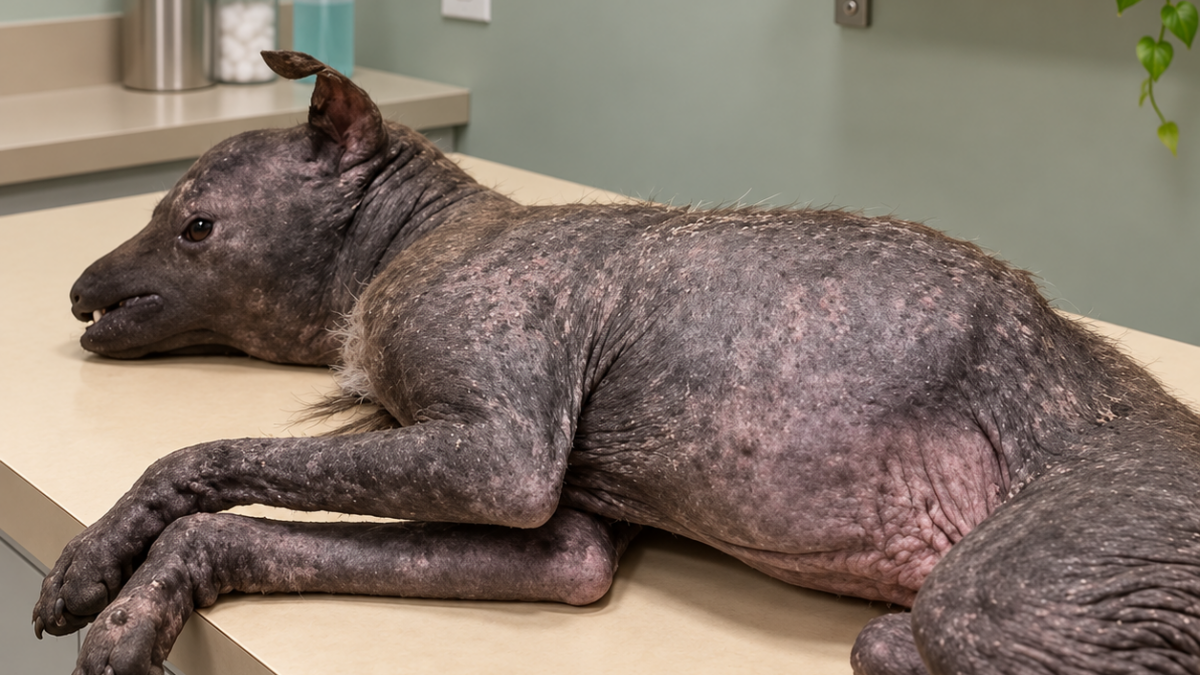
PART 2
The first night was worse than I expected.
I went home without Krouch.
That sounds like a small thing, but it felt wrong the moment I closed my front door.
Only a few hours earlier, I had never known he existed. Now I kept imagining him alone beneath the fluorescent lights of the hospital.
The veterinarian had warned me not to expect quick changes.
He hadn’t been exaggerating.
When I returned the next morning, Krouch was almost exactly where I had left him.
He lay curled against one side of his kennel with an IV line attached to his front leg.
“Did he eat?” I asked.
“Very little,” one of the technicians said.
“Fever?”
“Still high.”
I crouched outside his kennel.
“Krouch.”
One ear moved.
That was all.
I had given him the name during the drive to the hospital. I don’t know why that particular name came to me. Maybe I simply needed something to call him besides “that poor dog.”
A name made him somebody.
And after everything I had heard, I wanted him to be somebody.
I sat beside his kennel for almost an hour.
I didn’t touch him.
I didn’t force him to look at me.
I simply talked.
I told him ridiculous things.
I told him about the traffic on my way to the clinic.
I told him that I had burned my breakfast.
I told him there was a little patch of sunlight on my porch where dogs liked to sleep.
Mostly, I wanted him to hear a human voice that demanded nothing from him.
Before I left, he opened his eyes.
For perhaps two seconds, he looked directly at me.
Then he closed them again.
That tiny moment carried me through the rest of the day.
The second day, his fever rose.
The third day, one of his wounds looked worse.
By the fourth day, the veterinary team had adjusted his treatment and added more medication.
Every time my phone rang, my stomach dropped.
I began sleeping with it beside my pillow.
One night, just after midnight, it rang.
I sat upright immediately.
The hospital number glowed on the screen.
“Hello?”
“This is Dr. Arun.”
My heart started pounding.
“What happened?”
“Krouch had a difficult evening.”
I closed my eyes.
“How difficult?”
“He’s stable right now, but his temperature increased again. We’re watching him closely.”
“Should I come?”
There was a short pause.
“If you want to.”
I was dressed in less than three minutes.
When I reached the hospital, Krouch was awake.
Barely.
I sat beside him.
“Hey,” I whispered.
His eyes moved toward me.
“You scared me.”
The veterinarian had told me not to expect a reaction, but after several minutes Krouch slowly moved his head closer to the side of the kennel.
I slid my fingers through the bars.
His nose touched them.
That was the first time Krouch chose to come toward me.
I started crying.
Quietly.
I didn’t want anyone to notice.
The technician noticed anyway.
“He knows you,” she said.
I shook my head.
“I think he knows food comes with me.”
She smiled.
“No. This is different.”
I wanted to believe her.
But hope had become dangerous.
Every good sign seemed followed by another setback.
During the second week, Krouch finally began eating more consistently.
Then he developed another complication.
During the third week, his fever started falling.
Then one morning he refused food again.
His recovery was not a straight line.
It was a battle measured in tiny victories.
A few bites of chicken.
A lower temperature.
Five more minutes sitting upright.
A wound becoming cleaner.
A night without an emergency call.
I learned to celebrate things I once would never have noticed.
“He stood for twelve seconds today,” a technician told me.
“Twelve?”
“Twelve.”
I grinned like someone had told me he had won a championship.
When I walked into the ward later, Krouch saw me.
His tail moved.
Only once.
A weak little tap against the blanket.
I stopped.
“Did you see that?”
The technician laughed.
“We saw it yesterday too.”
“Yesterday?”
“You weren’t here yet.”
I crouched beside him.
“So you’ve been hiding tricks from me?”
Another tiny movement.
Tap.
That tail changed everything.
For the first time, I allowed myself to imagine him surviving.
Not merely surviving the night.
Surviving all of it.
Outside the hospital, however, another part of Krouch’s story was beginning to bother me.
I kept thinking about the village.
I knew superstition existed. I knew frightened people sometimes blamed animals for things they couldn’t explain.
But Krouch had injuries.
Real injuries.
He hadn’t simply wandered away.
Someone had chased him.
Perhaps several people had.
I wanted to know what had happened.
So one afternoon, after visiting him, I drove back.
The village looked ordinary.
Children played near a small shop. Motorcycles were parked beneath trees. Laundry moved in the afternoon wind.
Nothing about the place looked cruel.
That somehow made what had happened worse.
The older man who had warned me about Krouch recognized me.
“You took the dog.”
“I did.”
“Is he alive?”
The question irritated me.
“Yes.”
He looked genuinely surprised.
“Still?”
“Yes. Still.”
He glanced toward several nearby houses.
I asked, “What exactly did people think he had done?”
The man shifted uncomfortably.
“It started when he appeared around here.”
“That doesn’t answer me.”
“There were problems.”
“What problems?”
“A farmer lost two chickens. Someone’s motorbike crashed. A child became sick. Then there was a storm that damaged one roof.”
I stared at him.
“You blamed those things on a dog?”
“I didn’t say I did.”
“You told me he brought bad luck.”
“I told you what people said.”
“Did you stop them when they chased him?”
Silence.
That was an answer.
A woman from the shop had been listening.
She came closer.
“You don’t understand,” she said. “People became afraid.”
“Of him?”
She nodded.
I remembered Krouch trying to run on shaking legs.
“I met him when he was the one terrified of people.”
Her expression changed.
Only slightly.
I asked, “How did he get injured?”
Nobody answered.
That was the moment my anger sharpened.
“I’m asking a simple question.”
The woman looked away.
The older man muttered, “Dogs get hurt on roads.”
“Was he hit by a vehicle?”
“We don’t know.”
“Was he beaten?”
Nobody spoke.
“Was he chased?”
Finally the woman said, “Some boys threw things to make him leave.”
My stomach tightened.
“What things?”
“Stones. Maybe sticks.”
“Maybe?”
“I wasn’t there for everything.”
“Who was?”
Again, silence.
I could feel anger climbing through me, but shouting would have accomplished nothing.
So I said something quieter.
“He may die.”
The woman looked back at me.
“He had a fever so high the veterinarian was worried he wouldn’t make it through the week. His wounds were infected. He was starving.”
Nobody said anything.
“You were afraid he would bring bad luck?”
I pointed toward the road.
“He almost died alone because of what people did to him. Tell me whose luck was worse.”
The older man lowered his eyes.
I left before I said something I would regret.
When I returned to the hospital, I went directly to Krouch.
He was sleeping.
I sat beside him and watched his chest rise and fall.
“I found out a little more,” I whispered.
His ear twitched.
“They were afraid of you.”
I almost laughed.
“You.”
Krouch opened one eye.
“You’re scared of a broom leaning against the wall.”
His eye closed.
I reached through the kennel and touched his paw.
“I promise you something.”
My voice trembled.
“You’re never going to have to prove to those people that you deserved kindness.”
That promise became important later.
At the time, I thought I meant I would never take him back there.
I was wrong.
But first Krouch had to live.
By the fourth week, his fever was gone.
The wounds were finally healing well.
He still looked painfully thin, but his eyes had changed.
Fear remained there.
Fear doesn’t disappear simply because someone starts being kind.
But curiosity had joined it.
Whenever I arrived, his head came up.
Whenever I left, he watched me.
One afternoon, a technician opened his kennel.
“Want to try something?”
“What?”
“A short walk.”
I stared at her.
“Already?”
“Very short.”
She clipped a leash onto his collar.
Krouch immediately froze.
The leash frightened him.
We had no idea what had happened to him before he appeared in the village. Maybe someone had tied him somewhere. Maybe he had never been walked properly.
I knelt down.
“Krouch.”
His eyes found mine.
“You don’t have to go far.”
I took one step backward.
He remained still.
Another step.
His front paw moved.
Then another.
He walked three feet.
Stopped.
Looked at me.
Walked again.
By the time we reached the end of the hallway, everyone nearby was watching.
Nobody applauded.
I was grateful for that.
Krouch was still easily frightened.
But every face was smiling.
We turned around.
On the way back, he walked beside me.
Not behind.
Not dragging away.
Beside me.
That night I began preparing my house.
I bought a bed.
Then I decided the bed was too small and bought another.
I bought food bowls.
A collar.
A leash.
Blankets.
A ridiculous stuffed toy shaped like a duck.
My friend walked into my house and stared at the pile.
“You said you were fostering him.”
“I am.”
She picked up the duck.
“You bought a dog a stuffed duck.”
“He might need emotional support.”
“He has you.”
“The duck is less annoying.”
She smiled.
“You’re keeping him.”
“We don’t know yet.”
She put the toy down.
“You’re keeping him.”
I did not answer.
We both knew.
During the fifth week, I began taking Krouch outside the hospital.
At first, he hated open spaces.
Cars made him crouch.
Raised voices made him tremble.
If someone approached too quickly, he tried to hide behind me.
One afternoon, a man dropped a metal bowl nearby.
The clang sent Krouch flat to the ground.
His whole body shook.
I sat down immediately.
“You’re safe.”
He pressed himself against my leg.
The man apologized.
“It’s okay,” I said.
But it wasn’t okay.
Not yet.
Krouch carried invisible injuries too.
Those would take longer.
I started spending more time simply teaching him that ordinary life didn’t hurt.
A door closing.
A hand reaching toward him.
A stranger walking past.
A leash being clipped on.
Food being placed in a bowl without someone taking it away.
He learned slowly.
And then one day, something extraordinary happened.
Krouch played.
It lasted maybe ten seconds.
A technician rolled a soft ball across the floor.
Krouch watched it.
The ball stopped beside his paw.
He touched it with his nose.
It rolled.
He followed it.
The technician rolled it again.
Krouch made a strange little hop.
I covered my mouth.
“There,” she whispered. “Did you see?”
He hopped again.
For ten seconds, the dog who had been lying near death chased a ball.
I cried harder than I had the night of the emergency call.
Krouch stopped and stared at me as if my behavior was embarrassing.
“Don’t judge me,” I said.
His tail wagged.
By the end of the sixth week, the veterinarian finally used the word I had been afraid to ask for.
“Home.”
I stared at him.
“You think he can come home?”
“Soon.”
“How soon?”
“If everything continues like this, another week or two.”
My hands went to my face.
The veterinarian smiled.
“This is a very different dog from the one you brought us.”
I looked through the glass.
Krouch was standing.
His scars were visible.
His coat had begun growing back over several injured areas.
He was still thinner than he should have been.
But he was standing.
“When I first saw his tests,” the veterinarian continued, “I truly thought we might lose him.”
“So did I.”
“He surprised us.”
I shook my head.
“No.”
The doctor looked at me.
“He surprised everyone else. I think he knew exactly what he was doing.”
The doctor laughed.
Maybe that sounds sentimental.
Maybe it was.
But after six weeks of watching Krouch fight through pain, fear, infection, hunger, and exhaustion, I had earned the right to be sentimental.
Then something happened that changed what I intended to do about the village.
A young girl came to the hospital asking about him.
She was perhaps fourteen.
She stood near reception clutching a plastic bag.
“I heard the dog from our village is here.”
I happened to be walking toward Krouch’s ward.
“What dog?”
“The brown one. Krouch.”
I stopped.
“How do you know his name?”
She looked nervous.
“People said the woman who took him called him that.”
I realized news had traveled back.
“Why are you here?”
She lifted the bag.
Inside were several small packets of dog food.
“I wanted to give him these.”
Something about her expression softened me.
“What’s your name?”
“Lina.”
“Did you know Krouch?”
She nodded.
“He used to sleep behind my grandmother’s house.”
“Were you there when people chased him?”
Her eyes dropped.
“Yes.”
I waited.
“I didn’t throw anything.”
“I didn’t say you did.”
“But I didn’t stop them either.”
Her voice cracked.
“I was scared they would laugh at me.”
There it was.
Not superstition.
Not really.
Cowardice.
The most ordinary kind.
Lina wiped her face quickly.
“I gave him food sometimes before people started saying he was bad luck.”
“Why did they say that?”
She shrugged.
“One man said his chickens died after Krouch came. Then everyone started repeating it. When other bad things happened, they blamed him too.”
“Did anyone defend him?”
“My grandmother told them it was stupid.”
I almost smiled.
“I’d like your grandmother.”
Lina gave a weak smile.
“She yells a lot.”
“Now I definitely like her.”
The girl looked toward the ward.
“Can I see him?”
I hesitated.
Krouch was still frightened of unfamiliar people.
“From a distance.”
We walked toward his kennel.
Krouch saw me first.
His tail moved.
Then he noticed Lina.
He froze.
The girl stopped immediately.
“Oh.”
Her face crumpled.
“He remembers us.”
“I don’t know.”
“He does.”
She placed the food on the floor.
“I’m sorry, Krouch.”
He stared at her.
She didn’t approach.
She didn’t ask to touch him.
She simply stood there crying.
Then she left.
That night, I kept thinking about her.
Not because her apology erased anything.
It didn’t.
But because she had done something most adults in the village had refused to do.
She had admitted that doing nothing had been wrong.
Over the next week, two more people came.
Then four.
Some brought food.
One brought a blanket.
Another brought money toward Krouch’s veterinary bill.
I refused the money at first.
Then the veterinarian said something that changed my mind.
“Use it for other animals.”
So we started a small emergency fund in Krouch’s name.
The irony was almost perfect.
The dog accused of bringing bad luck was now helping save animals he would never meet.
But not everyone was remorseful.
The man whose chickens had died came to the clinic one afternoon.
His name was Dara.
He was one of the loudest voices behind Krouch’s expulsion.
I recognized him from my second visit to the village.
He did not bring food.
He did not bring an apology.
He came angry.
“You’re making us look cruel,” he said.
I stared at him.
“We’re standing in a veterinary hospital beside a dog your village chased away while he was sick.”
“You keep telling people things.”
“I haven’t told anyone anything that didn’t happen.”
“You don’t know what happened.”
“Then tell me.”
“He caused trouble.”
“Krouch?”
“Yes.”
“What did he do?”
“He came, and bad things followed.”
I almost couldn’t believe we were having the conversation.
“Your chickens died.”
“Yes.”
“Did a veterinarian examine the chickens?”
He frowned.
“What?”
“Did anyone determine why they died?”
“No.”
“Did Krouch attack them?”
“No.”
“Then how did he kill them?”
“That isn’t what I said.”
“No. You said something worse. You said his presence caused it.”
Dara crossed his arms.
“You weren’t there.”
“And you weren’t there when Krouch nearly died.”
The reception area had gone quiet.
I lowered my voice.
“Do you know what his temperature was when I brought him in?”
He didn’t answer.
“Do you know how infected his wounds were?”
Still nothing.
“Do you know your neighbors threw stones at an injured animal because adults like you told them he was cursed?”
His face hardened.
“I didn’t throw stones.”
“No. You only gave people permission to believe doing it was justified.”
That hit him.
I could see it.
But instead of admitting it, he became angrier.
“You think you are better than us?”
“No.”
I stepped closer.
“I think Krouch deserved better from all of us.”
That included me.
It included every person who had ever walked past an animal because helping was inconvenient.
I wasn’t interested in pretending I had always been perfect.
But perfection wasn’t the point.
Choice was.
When you see suffering, what do you do next?
Dara turned to leave.
I called after him.
“You know what the strangest thing is?”
He stopped.
“You said Krouch brought bad luck.”
I looked through the glass toward the ward.
“Since meeting him, I’ve watched strangers donate food. I’ve watched a frightened teenager find the courage to apologize. I’ve watched veterinary workers stay late because they refused to let him die.”
Dara said nothing.
“Maybe you misunderstood what he brought.”
He left without answering.
That confrontation reached the village before I did.
Within days, people were arguing openly about Krouch.
Some defended what had happened.
Others began condemning it.
Lina’s grandmother apparently stood in the center of the argument like a general commanding troops.
I finally met her when she came to visit.
Her name was Mara.
She was small, gray-haired, and approximately as subtle as thunder.
“You’re the woman who saved the dog,” she said.
“I helped.”
“You saved him.”
“The veterinary team did most of it.”
Mara waved one hand.
“Doctors need somebody to bring them patients.”
I liked her immediately.
She looked at Krouch from several feet away.
Her expression changed.
“That poor boy.”
Krouch watched her.
She sat on the floor.
To my surprise, he walked toward her.
Slowly.
Mara didn’t move.
He sniffed her hand.
Then he sat beside her.
Tears filled her eyes.
“I fed you rice behind my house,” she whispered. “Remember?”
Krouch leaned closer.
Maybe he remembered.
Maybe he simply sensed kindness.
It didn’t matter.
Mara looked at me.
“They were fools.”
I smiled.
“You said it.”
“I told them.”
“So I heard.”
“They said he caused sickness.”
She snorted.
“Then my neighbor blamed him when his roof leaked. The roof was twenty years old.”
I laughed.
Mara did not.
“They nearly killed him because people are sometimes more frightened of admitting they don’t understand something than they are ashamed of hurting something innocent.”
That sentence stayed with me.
Before leaving, Mara asked me a question.
“When he is strong enough, will you bring him back?”
My smile disappeared.
“No.”
“Why?”
“He was abused there.”
“I know.”
“I don’t want him frightened again.”
“Then don’t bring him for them.”
She pointed gently toward Krouch.
“Bring him for himself.”
I didn’t understand.
Mara continued.
“Let his last memory of our road not be running away.”
I looked at Krouch.
That idea frightened me.
But it also made sense.
Not immediately.
Not while he was fragile.
But someday.
Perhaps.
Two months after I found him, the day finally came.
Krouch was ready to leave the hospital.
I arrived carrying the collar I had bought weeks earlier.
It was simple.
Blue fabric.
A little metal tag.
KROUCH.
On the reverse side was my phone number.
My hands shook while fastening it.
The veterinarian crouched beside us.
“You know he may still need follow-up visits.”
“We’ll be here.”
“Continue his medication exactly as instructed.”
“I will.”
“Keep activity controlled for now.”
“I know.”
“And try not to spoil him.”
I stared at him.
“We both know that isn’t happening.”
The veterinarian laughed.
Then his expression softened.
“You did something good.”
I looked at Krouch.
“No.”
I clipped on his leash.
“He did the hard part.”
We walked toward the hospital doors.
Two months earlier, I had carried him through those doors wrapped in a blanket.
Now he walked out beside me.
His wounds had closed.
His coat was returning.
His body was stronger.
But the biggest difference was his face.
There was peace in it.
Not complete trust.
That would continue growing.
But peace.
Outside, Krouch lifted his nose toward the wind.
I opened the vehicle door.
“Ready?”
He looked at me.
Then jumped inside.
I laughed.
“Apparently.”
The first few days at home were almost comical.
Krouch didn’t understand stairs.
My stuffed duck terrified him.
The washing machine became his sworn enemy.
But he loved the patch of sunlight I had told him about during those first hospital visits.
The first morning, I found him stretched across it.
I stood in the doorway.
“I told you.”
He opened one eye.
“Best real estate in the house.”
He closed it again.
I sent the veterinarian a photograph.
His reply came immediately.
**Looks terrible. Return him.**
I laughed for a full minute.
Krouch learned routines quickly.
Breakfast.
Walk.
Nap.
Follow me into the kitchen although he had no business in the kitchen.
Second nap.
Stand outside bathroom door as if I might disappear through a secret tunnel.
Dinner.
Evening walk.
Bed.
The first time I left him home alone for twenty minutes, I came back to find him sitting behind the front door.
Not destructive.
Not barking.
Waiting.
When he saw me, his whole body wagged.
I sat on the floor.
“You thought I wasn’t coming back?”
He climbed halfway into my lap.
That became another promise.
“I’ll come back.”
Every time I left.
Every time I returned.
I would come back.
Weeks passed.
Krouch grew stronger.
His coat became thick and healthy.
The hollowness disappeared from his face.
He gained weight.
He learned that toys were not dangerous.
He learned that visitors could be friends.
He even learned that the washing machine, while suspicious, probably did not require constant surveillance.
Then Mara called.
“There is a village meeting next Saturday.”
I knew immediately why she was telling me.
“No.”
“You haven’t heard what I want.”
“You want me to bring Krouch.”
“Yes.”
“No.”
“Listen first.”
I exhaled.
“I’m listening.”
“People have collected money.”
“For what?”
“A feeding station. Vaccinations for stray dogs. Emergency treatment.”
I went quiet.
Mara continued.
“They want to change what happened.”
“Everyone?”
“No.”
I appreciated that answer.
“Some still think the old way. Some are embarrassed. Some are pretending they never agreed.”
“That sounds familiar.”
“But enough people want something different.”
I looked across my living room.
Krouch was asleep.
“Why does he have to be there?”
“He doesn’t.”
Mara’s voice softened.
“But I think people should see him.”
I knew what she meant.
Not as entertainment.
Not as a spectacle.
As evidence.
Evidence that the life they had almost thrown away had value.
I spoke to the veterinarian.
I spoke to an animal behavior specialist.
Most importantly, I watched Krouch.
By then, ordinary crowds no longer frightened him the way they once had.
He enjoyed meeting gentle strangers.
He was still cautious, but he had changed.
So on Saturday morning, I put his blue collar on.
“Want to take a drive?”
His tail wagged.
He had no idea where we were going.
I almost turned around three times.
When the village road appeared ahead of us, my hands tightened around the steering wheel.
Krouch stood in the back seat and looked through the window.
His tail stopped moving.
I noticed immediately.
“It’s okay.”
He stared outside.
“We don’t have to go.”
I pulled over.
For several minutes, I waited.
Krouch sniffed the air through the cracked window.
Then he sat.
He wasn’t shaking.
I took that as my answer.
We continued.
By the time we reached the center of the village, people were waiting.
More people than I expected.
Conversations stopped when I opened the door.
Krouch jumped down.
Silence.
Absolute silence.
I will never forget it.
Two months earlier, some of these same people had watched him stumble away sick, wounded, and starving.
Now Krouch stood beside me with a healthy coat, clear eyes, and the blue collar around his neck.
Lina was the first to move.
She approached slowly.
“Hi, Krouch.”
He watched her.
She stopped several feet away.
“Can I?”
She looked at me.
I nodded.
She crouched.
Krouch took one step.
Then another.
He sniffed her hand.
Lina started crying.
Krouch licked her fingers.
That broke the silence.
People began murmuring.
Mara marched toward us.
“I knew he’d remember.”
“You claim to know everything.”
“I usually do.”
Then I saw Dara.
He stood near the back.
Arms folded.
Face unreadable.
I had promised myself I wouldn’t turn the day into a confrontation.
Then he walked forward.
Krouch saw him.
The dog moved behind my leg.
Every muscle in my body went tight.
Dara stopped.
Everyone noticed.
He looked down at Krouch.
Then at me.
“I didn’t hit him.”
I said nothing.
“I want you to know that.”
“That doesn’t change what happened.”
“I know.”
The admission surprised me.
Dara looked around at his neighbors.
“My chickens died, and I became angry. I said the dog brought sickness.”
His voice was louder now.
“People listened.”
Nobody moved.
“I thought I was protecting my family.”
He looked at Krouch again.
“I was wrong.”
There are apologies that are performances.
And there are apologies that cost the speaker something.
Dara’s cost him pride.
That mattered.
But it did not erase Krouch’s scars.
“I’m not the one you owe an apology to,” I said.
Dara nodded.
He crouched.
Not close.
Just low enough that Krouch could see him.
“I’m sorry.”
Krouch stayed behind me.
Dara did not reach toward him.
That, more than anything, convinced me the apology might be real.
He finally understood that forgiveness was not something he was entitled to touch.
Then the village leader stepped forward.
He spoke about the new program they had created.
Vaccination days.
A small fund for injured animals.
Food and water stations.
A rule against harming or chasing stray animals except when qualified authorities needed to move an aggressive animal safely.
Most importantly, they had invited an animal welfare volunteer to speak with families and children about disease, safety, and responsible treatment.
It wasn’t dramatic justice.
Nobody went to prison.
Nobody lost a house.
There was no cinematic punishment.
But I realized something as I listened.
This was better.
Real revenge would have been making them afraid.
Krouch had already taught them something more difficult.
He had made them ashamed.
And shame, when people are brave enough to face it, can become change.
Then Mara handed me an envelope.
“What’s this?”
“Money.”
“I don’t need money.”
“It isn’t for you.”
I opened it.
Inside were donations for the emergency veterinary fund.
Krouch’s fund.
I looked at her.
“How much?”
“Enough to help several dogs.”
My throat tightened.
Mara smiled.
“Bad luck.”
I laughed despite myself.
“Terrible luck.”
Krouch stepped out from behind me.
Several children sat on the ground nearby.
Nobody rushed him.
They had been told not to.
Krouch approached them on his own.
One little boy held out an open hand.
Krouch sniffed it.
Then sat.
The child smiled.
That was when I noticed the older man from the roadside standing under a tree.
The man who had first warned me.
Don’t touch that dog.
That dog brings bad luck.
I walked toward him.
Krouch came with me.
The man looked embarrassed.
“He looks different.”
“He feels different too.”
He nodded.
“I was wrong.”
“Yes.”
My answer surprised him.
Perhaps he expected me to make it easier.
I didn’t.
He had been wrong.
There was nothing cruel about saying so.
After a moment, I added, “But you can be different too.”
He looked at Krouch.
“Will he let me touch him?”
“That’s his decision.”
The man crouched.
He waited.
Krouch looked at him.
Then walked past.
The man laughed quietly.
“I suppose I deserved that.”
I smiled.
“Maybe.”
We stayed for less than two hours.
That was enough.
Before leaving, I took Krouch down the same road where I had first found him.
Just the two of us.
The afternoon sun was warm.
The weeds were taller than I remembered.
I stopped at approximately the place where he had collapsed while trying to escape me.
Krouch sniffed along the roadside.
No trembling.
No panic.
No desperate attempt to run.
I sat down.
He came beside me.
“You remember this place?”
He looked toward the village.
Then back at me.
“I do.”
I rubbed his chest.
“You don’t live here anymore.”
His tail moved.
“You have a house.”
Another wag.
“A bed.”
Wag.
“Three beds, technically.”
Faster wag.
“You have the ridiculous duck you finally stopped being afraid of.”
Krouch leaned against me.
“And you have me.”
I stopped speaking.
For several seconds, we simply sat there.
Then I realized my eyes were wet.
I laughed at myself.
“You made me cry way too much, you know that?”
Krouch licked my chin.
“Disgusting.”
He did it again.
“Absolutely disgusting.”
For the first time since meeting him, I looked down that road without seeing the dying dog dragging himself away from me.
I saw the dog sitting beside me.
Healthy.
Loved.
Home.
But Krouch’s story did not end there.
In some ways, that was only the beginning.
The emergency fund grew.
People who heard about him began donating.
A few months later, the clinic called me about a young female dog found injured near another road.
The receptionist said, “We thought you might want to know.”
I looked at Krouch sleeping on the couch.
“You’re not suggesting I adopt another dog.”
“No.”
A pause.
“We’re suggesting Krouch’s fund might save her.”
I drove to the clinic.
The dog survived.
Then another animal needed help.
Then another.
We never saved them all.
That is one of the hardest truths of rescue work.
Sometimes help comes too late.
Sometimes illness wins.
Sometimes money runs out.
Sometimes humans have caused damage that love cannot completely repair.
But Krouch taught me that knowing you cannot save every animal is never an excuse to save none.
The village changed too.
Not magically.
Not overnight.
There were arguments.
Old beliefs did not disappear simply because one dog survived.
But Lina became one of the strongest voices for the animals there.
She started helping with vaccination days.
She carried bowls of water to the roadside during hot weather.
When younger children repeated superstitions about black dogs, sick dogs, or strange dogs bringing misfortune, Lina corrected them.
Sometimes change begins with the person who was once too afraid to speak.
Dara donated regularly to the veterinary fund.
For months, he never asked about Krouch directly.
Then one day I received a photograph from Mara.
Dara was repairing the roof of a small shelter they had built for stray dogs.
Under the photograph she had written:
**His roof finally caused something useful.**
I laughed until I had tears in my eyes.
Krouch became the unofficial symbol of the program.
Not because I wanted his face on posters.
I didn’t.
I had no interest in turning him into a mascot.
But people remembered his name.
Whenever somebody said an animal was unlucky, somebody else would answer:
“Remember Krouch.”
That was enough.
At home, Krouch became wonderfully ordinary.
That may be my favorite part of his story.
He stole socks.
He snored.
He hated rain but loved mud, which seemed logically inconsistent.
He discovered that if he stared at my dinner long enough, I eventually became psychologically weak.
He learned how to open one kitchen cabinet with his nose.
He developed a deeply unreasonable hatred of one particular delivery motorcycle.
And every morning, he found the patch of sunlight on my floor.
Sometimes I watched him sleeping there and thought about the veterinarian’s first warning.
He may not survive another week.
Years are made of weeks.
Krouch got another one.
And another.
And another.
One evening, long after his recovery, we returned to the village for a vaccination event.
Krouch walked beside me without hesitation.
Children recognized him.
Adults smiled.
Mara shouted from across the road.
“Krouch!”
His ears lifted.
He pulled me toward her.
She crouched and hugged him.
“You remember who gave you rice when this one wasn’t around?”
I pretended to be offended.
“He lives with me.”
“Because I prepared him for civilization.”
“You fed him leftovers behind your house.”
“Exactly.”
Krouch leaned against her.
Traitor.
Near the end of the day, I noticed something that stopped me.
A skinny young dog stood at the edge of the crowd.
Nervous.
Dirty.
Watching people from a distance.
For one terrible second, the scene felt familiar.
Then a little boy saw him.
The boy began walking toward the dog.
I almost called out for him to stop.
But the child didn’t chase.
He crouched.
Placed a little food on the ground.
Then backed away.
Exactly the way I had approached Krouch.
I looked toward Lina.
She was watching too.
She smiled.
“That’s Dara’s grandson.”
I stared at her.
“You’re kidding.”
“No.”
The boy waited patiently.
The frightened dog finally approached the food.
Dara came from behind one of the houses carrying a bowl of water.
He placed it nearby.
Then he saw me.
For a moment, neither of us spoke.
Finally he shrugged.
“Someone taught us.”
I looked down at Krouch.
Krouch looked at the young dog.
Then he walked over.
The two dogs sniffed each other.
The younger dog’s tail moved.
Something inside me broke open.
This was the revenge I had never known I wanted.
Not suffering returned for suffering.
Not cruelty answered with cruelty.
Something far more permanent.
Krouch had survived long enough to make the people who rejected him become the people who now bent down to help another frightened dog.
The belief that had nearly killed him was dying instead.
That was justice.
That was victory.
Later that evening, Krouch and I walked toward the car.
The sun was setting behind the village.
Mara called after us.
“Bring him back soon!”
I waved.
Krouch jumped into the passenger seat and immediately stole my place by leaning across the center console.
“Move.”
He ignored me.
“You understand I rescued you, right?”
Tail wag.
“This is my car.”
Another wag.
“You have become extremely arrogant for a dog who was afraid of a stuffed duck.”
He licked my cheek.
I pushed his face away, laughing.
“Fine. Stay there.”
As I started the engine, I looked once more at the village in the mirror.
I used to imagine what I would say if the people who hurt Krouch ever saw him healthy.
I thought I would want anger.
I thought I would want them humiliated.
Part of me probably did.
But seeing that little boy crouch instead of chase had satisfied something deeper.
Krouch had already won.
He had survived their fear.
He had survived their stones.
He had survived their neglect.
He had survived the fever that nearly ended his life.
And somehow, without understanding any of it, he had changed the place that had tried to erase him.
We drove home.
That night, Krouch ate dinner, carried his ridiculous duck into the living room, turned around three times on his bed, and fell asleep.
I sat beside him.
His breathing was slow and peaceful.
There were still scars beneath his fur.
There probably always would be.
I traced one gently with my fingers.
Krouch opened his eyes.
“You know something?”
His tail tapped once.
“They said you brought bad luck.”
Another tap.
I smiled.
“They had no idea.”
Krouch lowered his head onto my leg.
And in that quiet room, I finally understood what his story had taught me.
Cruelty often wears the disguise of fear.
People convince themselves they are protecting something when they are really punishing what they do not understand.
Sometimes they call it tradition.
Sometimes caution.
Sometimes superstition.
Sometimes they simply follow the crowd because standing alone requires courage.
Krouch had experienced all of those failures.
Yet his life became proof that one person choosing differently can interrupt the entire chain.
I did not perform a miracle.
I stopped my car.
I sat in the dirt.
I waited for a frightened dog to trust me.
Then, when someone told me his life might not be worth the cost of saving, I chose to try.
The veterinarians did the rest.
Krouch did the hardest part.
He stayed.
He fought.
He healed.
Months after that final village visit, I found Lina sitting on my porch with Krouch’s head resting across her knees.
She had come to help transport supplies for another vaccination event.
“You know,” she said, “I used to think about that day all the time.”
“What day?”
“When they chased him.”
Her fingers moved slowly through Krouch’s fur.
“I hated myself because I didn’t stop them.”
“You were a child.”
“I could still have said something.”
“Yes.”
She looked surprised that I agreed.
I sat beside her.
“But guilt is useful only if it changes what you do next.”
She looked down at Krouch.
“I think he forgave me.”
I watched his eyes close beneath her hand.
“Maybe.”
“You don’t think dogs forgive?”
“I think dogs live differently than we do.”
“How?”
“They don’t need us to explain our mistakes before they decide whether they feel safe.”
Lina considered that.
“So he trusts me.”
“He does.”
She smiled.
“That’s better.”
“Yes.”
It was.
Years from now, people might forget exactly why Krouch was chased away.
They might forget who first blamed him.
They might even soften the story because people often rewrite memories that make them uncomfortable.
But I will remember.
I will remember a trembling dog dragging an exhausted body through roadside dust because he believed a stranger approaching him meant danger.
I will remember a veterinarian holding test results and carefully explaining that kindness might still end in heartbreak.
I will remember opening my bag and knowing the money inside might disappear into an attempt that failed.
I will remember saying:
“Start the treatment.”
I will remember midnight drives to the clinic.
A nose touching my fingers through kennel bars.
A tail moving once.
Twelve seconds standing.
Three feet walking.
Ten seconds chasing a ball.
I will remember the hospital doors opening two months later and Krouch stepping outside on his own.
And I will remember the silence in the village when people saw what compassion had done to the animal their fear had nearly destroyed.
But most of all, I will remember ordinary mornings.
Krouch in the sunlight.
Krouch asleep while I worked.
Krouch carrying his duck.
Krouch waiting behind the door.
Those moments were the real ending.
Not the confrontation.
Not the apologies.
Not the shame on anyone’s face.
Home was the ending.
Safety was the ending.
The ability to sleep deeply because nobody was going to chase him awake was the ending.
A full bowl he didn’t have to defend was the ending.
Hands he no longer feared were the ending.
And being loved without having to earn it was the ending.
One morning, I opened the door and found Krouch already waiting for our walk.
His leash hung beside him.
“You ready?”
His whole body started wagging.
I clipped the leash onto that same blue collar.
We stepped outside together.
The road ahead was bright with morning sun.
Krouch didn’t walk behind me.
He didn’t pull away.
He walked beside me.
Exactly where he had learned he belonged.
I looked down at him and smiled.
“Come on, bad luck.”
His tail wagged harder.
And together, we walked home.








