PART 2: They Chained Eva to a Tree Until She Couldn’t Stand—Then She Found the One Place Her Body Remembered How to Move
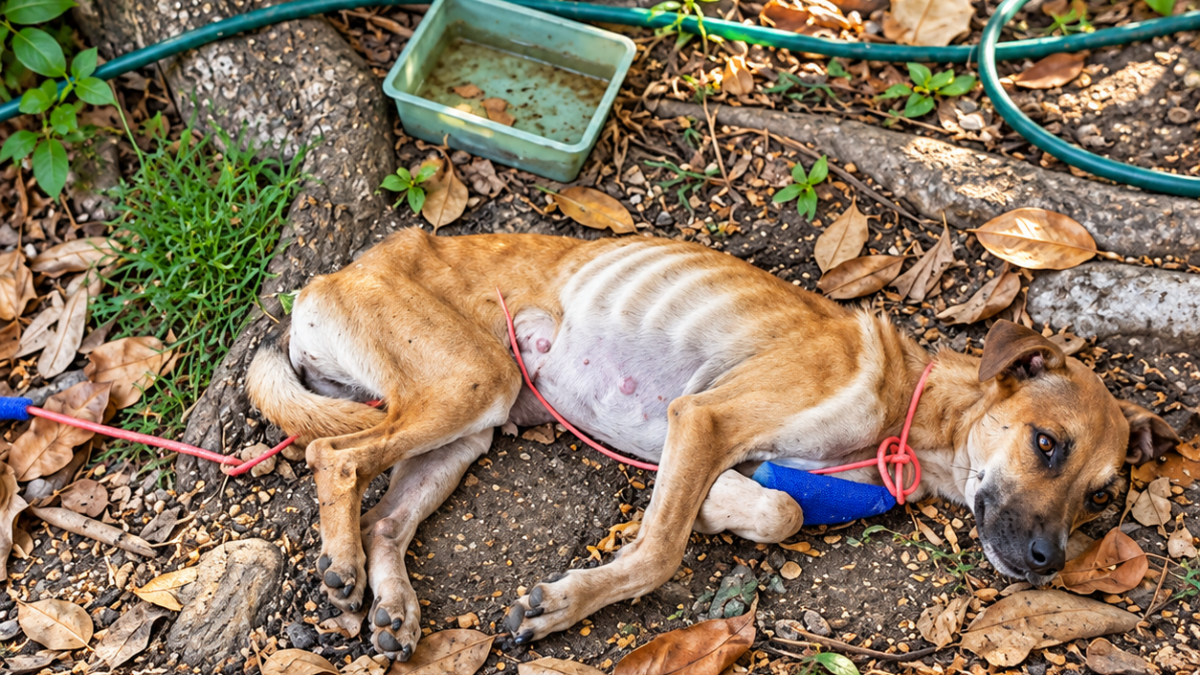
PART 2
For several seconds, I couldn’t answer him.
The hospital corridor suddenly felt too clean for what he had just said.
Too bright.
Too quiet.
“What do you mean since she was a puppy?”
Daniel exhaled.
“The woman says she used to see Eva behind a house about three blocks from where we found her. Same coloring. Same face. Same chain.”
“How long ago?”
“She thinks Eva was maybe five months old the first time.”
I looked through the window toward the recovery area.
Eva was awake.
A technician had tucked a blanket around her, and even from across the room I could see her watching the doorway.
She always watched.
Not curiously.
Carefully.
As if every approaching person required calculation.
“Who owned her?”
“We’re trying to confirm it.”
“Why was she moved to the storage yard?”
“No idea.”
“Did anybody ever report her?”
“The woman says she called animal control once.”
“And?”
“She doesn’t know what happened.”
I pressed my fingers against my forehead.
“How old do we think Eva is now?”
“Maybe three.”
Three years.
If the woman was right, the chain hadn’t been a temporary punishment.
It had been Eva’s childhood.
Her adolescence.
Almost her entire understanding of the world.
Dr. Brooks came out of the treatment area carrying a chart.
“You okay?”
“No.”
“Usually the honest answer.”
I told her what Daniel had learned.
She glanced toward Eva.
“Long-term tethering could explain some of the muscle wasting.”
“Could it cause the spinal injury?”
“Not exactly like this.”
“What could?”
“Trauma. Repeated strain. A severe fall. Being struck. A violent pull against the chain. There are several possibilities.”
“Can you tell which one?”
“Not from the MRI.”
I hated that.
I wanted the scan to tell us everything.
Who.
When.
How.
I wanted a neat line from cruelty to injury.
Medicine rarely offers that.
Dr. Brooks touched the folder.
“What I can tell you is that Eva has lost muscle because she hasn’t been moving normally for a long time.”
“How long?”
“Longer than a few days.”
I looked at her.
“So even before she became unable to stand…”
“She probably wasn’t moving much.”
A chain radius.
Bare ground.
A tree.
Maybe that had been Eva’s entire universe.
The next morning, rehabilitation began.
I expected something dramatic.
Machines.
Complicated exercises.
A team surrounding Eva.
Instead, Megan, the rehabilitation therapist, sat on the floor beside a blue mat with three small treats in her palm.
“That’s it?” I asked.
“That’s where we start.”
Eva lay on her side.
She watched Megan.
Megan didn’t reach for her.
“Eva.”
One ear moved.
“Good.”
Megan placed a treat six inches from Eva’s nose.
Eva smelled it.
Didn’t move.
Megan waited.
“She’s not hungry?”
“Maybe. Or she doesn’t know what we want.”
“What do we want?”
“Right now? For her to make a choice.”
I looked at Eva.
“What choice?”
“To move toward something because she wants it.”
That sounded almost ridiculous.
Then I remembered what Daniel had said.
Chained since puppyhood.
Choice might actually be new.
Eva eventually stretched her neck toward the treat.
Her front leg shifted slightly.
Her body didn’t follow.
Megan picked up the treat and brought it closer.
Eva ate.
“There,” Megan said.
“That counts?”
“Everything counts at the beginning.”
The first exercise was massage.
Megan worked slowly down Eva’s shoulders, back, hips, and limbs.
Eva stiffened whenever hands reached certain areas.
The muscles near her neck and front shoulders were painfully tight.
Her rear legs had wasted.
Her paws curled incorrectly when placed.
Megan moved each joint gently.
“Range of motion,” she explained. “If she isn’t moving the legs herself, we still need the joints to move.”
Eva tried to pull her paw away.
“Good,” Megan said.
I looked at her.
“She hates you.”
“She noticed me.”
Apparently, in rehabilitation, irritation could be progress.
The next step was supported standing.
A wide sling went beneath Eva’s abdomen and chest.
Megan lifted just enough to help Eva bear weight.
For a second, all four paws touched the mat.
Then the right front leg folded.
Eva fell into the sling.
She panicked.
Her paws scraped wildly.
“Easy.”
Megan lowered her.
Eva immediately tried to crawl away.
“Stop,” I said. “That’s enough.”
Megan nodded.
No argument.
No heroic push.
We stopped.
That mattered to me.
Eva had spent too much of her life with other people deciding that her discomfort didn’t count.
If she was going to trust rehabilitation, we couldn’t turn treatment into another thing she had no control over.
The next day, we tried for three seconds.
Then five.
Then three again because five had been too much.
Progress didn’t move in a straight line.
Neither did Eva.
Her back legs sometimes pushed harder than the front.
One afternoon, she managed to lift her hips while her front legs collapsed underneath her.
I caught her chest before her face hit the mat.
“Why are the back legs improving before the front?”
Megan looked toward Dr. Brooks.
The neurologist had joined us for the session.
“Spinal injuries don’t always recover in the order people expect,” she said. “Different pathways are affected differently. Swelling changes. Muscle strength changes.”
“So this is normal?”
“It’s not unusual.”
“Will the front legs catch up?”
She gave me the answer I was already starting to hate.
“We don’t know.”
Nobody knew.
I wanted certainty because uncertainty felt cruel.
But Eva didn’t seem interested in certainty.
She was interested in the next attempt.
On day five of rehabilitation, she stood for six seconds.
On day six, two.
On day seven, not at all.
That night I cried in the parking lot.
Not because Eva had gotten worse.
Because I had begun measuring my own hope in seconds.
Six seconds felt like a future.
Two felt like failure.
Zero felt like losing her.
Daniel found me sitting in my car.
He tapped on the window.
I unlocked the door.
“You leaving?”
“No.”
“Then why are you in here?”
“I needed quiet.”
He got into the passenger seat.
For a while we watched people come and go from the hospital.
Finally he asked:
“Bad session?”
“She couldn’t stand.”
“She couldn’t stand when we found her.”
“She stood yesterday.”
“So?”
“So I thought…”
I stopped.
Daniel waited.
“I thought once she improved, she would keep improving.”
“That would be convenient.”
I laughed despite myself.
“I hate you.”
“I know.”
He looked toward the clinic.
“Did she eat?”
“Yes.”
“Pain?”
“Controlled.”
“Did she try?”
“Yes.”
“Then maybe today wasn’t a failure.”
“Easy for you to say.”
“No.”
He turned toward me.
“I watched her fall too.”
That shut me up.
We went back inside.
Eva was asleep.
Her paws twitched.
I wondered what dogs dream about when their lives have been small.
The investigation into her history continued quietly.
We weren’t detectives.
Our job was Eva.
But people talked once her photograph circulated through local rescue networks.
A former neighbor named Mrs. Novak contacted us.
She remembered Eva as a puppy.
“She was always outside,” the woman told Daniel and me when we met her at a coffee shop.
“Always?”
“I never saw her inside.”
“Walks?”
Mrs. Novak shook her head.
“Maybe once. Not that I remember.”
“Did she have shelter?”
“A wooden box sometimes.”
“Water?”
“Usually.”
“Food?”
“I assume.”
That word irritated me.
Assume.
So much suffering survives inside assumptions.
“Did anyone hurt her?”
Mrs. Novak looked down at her coffee.
“I never saw anybody beat her.”
“But?”
“I heard yelling.”
“At the dog?”
“At everyone.”
“Did Eva bark?”
“When she was little.”
“And later?”
“Not much.”
That bothered me.
Dogs who stop barking are sometimes dogs who learned nobody comes.
Mrs. Novak continued.
“She used to run to the end of the chain when people passed.”
“Friendly?”
“I think so. Tail wagging. Jumping.”
I pictured puppy Eva.
Curious.
Excited.
Still expecting something from people.
“What changed?”
“She stopped.”
“When?”
“Maybe after the first year.”
Mrs. Novak stared through the café window.
“She would just lie there.”
I didn’t ask anything for several seconds.
Then:
“Did you report it?”
“Yes.”
“What happened?”
“An officer came once.”
“And?”
“The owner had water out that day.”
That was all she knew.
We later obtained two old welfare reports through legal channels.
Both documented a dog on a tether.
Both said minimal shelter and water had been present during inspection.
Neither had resulted in seizure.
I read them three times.
There was no dramatic proof of hidden abuse.
No confession.
No photograph of someone hurting Eva.
Only paperwork describing conditions that had apparently been acceptable enough not to trigger removal.
I wanted someone to blame.
Instead, I found a system of small moments when Eva’s life had been looked at and left unchanged.
That anger was harder to place.
So I put it where it could do something useful.
Into rehabilitation.
The electrical stimulation began during the second week.
Eva hated the machine before it even touched her.
She watched Megan unpack the pads and narrowed her eyes.
“You don’t know what those are,” I told her.
Eva looked at me.
“She knows she dislikes them,” Megan said.
“You’re making assumptions.”
Megan attached the first pad.
Eva huffed.
“I withdraw my objection.”
The treatment used gentle electrical stimulation to activate muscles and support rehabilitation.
It wasn’t painful when properly adjusted, but it felt strange.
Eva’s muscles twitched.
The first time it happened, she jerked her head around.
Megan laughed softly.
“That’s you.”
Eva stared at her thigh.
Another twitch.
Eva looked offended.
For the first time, I saw something beyond fear and exhaustion.
Personality.
Not gratitude.
Not sweetness.
Annoyance.
It was wonderful.
“There you are,” I whispered.
Over the next several days, Eva became more vocal.
A soft whine when she was tired.
A huff when food arrived late.
A low protest during certain stretches.
Once she barked at Daniel because he blocked her view of the hallway.
He stared at her.
“Did she just yell at me?”
“Yes.”
“I rescue her and this is what I get?”
Eva barked again.
I smiled.
“She has standards.”
The plasma injections started after further consultation.
Dr. Brooks explained every detail carefully.
“This is not magic.”
“I know.”
“We use the word treatment and people hear cure.”
“I don’t.”
“You might when you’re tired.”
She knew me too well by then.
The weekly injections were intended as part of a broader effort to reduce inflammation and support healing.
We continued everything else.
Massage.
Medication.
Electrical stimulation.
Assisted standing.
Passive range of motion.
Nutrition.
Rest.
Eva gained weight slowly.
At first, you could count every rib.
By the end of the third week, the lines softened.
Her eyes became brighter.
She lifted her head when familiar people entered.
Then one afternoon Megan said:
“I want to try the pool.”
I stared at her.
“She can’t stand.”
“Exactly.”
“That makes no sense.”
“It does in water.”
Hydrotherapy allowed Eva’s body to be supported by buoyancy.
Less weight.
Less fear of falling.
More opportunity to move limbs without carrying everything.
Still, the first time we brought her to the pool, I thought it was a terrible idea.
Eva stood in the sling at the edge, staring at the water.
Her ears flattened.
“Nope,” I said.
Megan looked at me.
“What?”
“She hates it.”
“She hasn’t touched it.”
“She has communicated clearly.”
Eva looked at me as if grateful somebody understood.
Megan smiled.
“We’ll go slowly.”
Her back paws touched the warm water first.
Eva stiffened.
Then her belly.
Then chest.
I knelt beside the ramp.
“Easy.”
Eva’s body floated slightly.
The sling supported her.
Megan loosened her grip.
For a second, Eva did nothing.
Then her right back leg moved.
A small paddle.
The left followed.
Then a front paw.
Then another.
I froze.
Megan whispered:
“Look.”
Eva paddled.
Clumsily.
Her head high.
Eyes wide.
But she was moving.
Not being moved.
Moving.
For weeks, every attempt on land had ended with gravity winning.
In the water, gravity was quieter.
Eva paddled toward Megan.
Turned.
Paddled toward me.
I held my hand near the surface.
“Come on.”
She reached me.
Her nose touched my wrist.
Then she turned away.
Not to escape.
To keep swimming.
Megan laughed.
“She likes it.”
“No.”
Eva paddled farther.
“She loves it.”
That first session lasted only a few minutes.
When Megan guided her toward the ramp, Eva tried to turn back.
“Seriously?”
Eva paddled away again.
I started laughing.
The dog who had been silent under a tree was arguing about leaving a swimming pool.
That night she slept deeper than I had ever seen her sleep.
The pool became our best day of the week.
On land, therapy meant concentration.
Balance.
Falling.
Trying again.
In water, Eva relaxed.
She discovered speed.
Not much.
But enough.
As soon as we entered the hydrotherapy room, her ears lifted.
Eventually she recognized the sound of the pump.
The smell of the room.
The blue flotation vest.
She would become impatient while Megan prepared everything.
Once another dog’s session ran ten minutes late.
Eva barked from the hallway.
Megan opened the door.
“Excuse me?”
Eva barked again.
“I think she has an appointment.”
“She has become unbearable,” Daniel said.
I couldn’t have been happier.
Swimming did not cure her.
That distinction stayed important.
Her spinal injury remained.
She still needed help standing.
Her front legs still folded unexpectedly.
But swimming gave her strength.
And maybe more importantly, it gave her joy.
There is a difference between rehabilitation a body needs and an activity an animal chooses.
The pool became hers.
That mattered.
By the fifth week, Eva began putting more weight through her back legs.
Her front paws remained the bigger problem.
The right one sometimes knuckled under.
The left would slide.
Megan taught us to reposition them correctly.
“Every time?”
“Every time.”
“What if she does it herself?”
“Then we celebrate quietly so we don’t scare her.”
I learned to stop celebrating too early.
Eva taught me that.
One afternoon she held herself upright for thirteen seconds.
I gasped.
Eva startled.
Her legs folded.
Megan stared at me.
“What did I say?”
“I forgot.”
“You knocked her down with enthusiasm.”
“I’m sorry.”
Eva glared from the mat.
“I apologized.”
We became more disciplined.
Stand.
Breathe.
Wait.
Let Eva work.
On bad days, she lasted three seconds.
On good days, twenty.
Then thirty.
One morning she reached forty-two.
Megan lowered the sling only slightly.
Most of the work belonged to Eva.
Her legs trembled.
Her head dipped.
I whispered:
“You can sit.”
She didn’t.
Forty-five seconds.
Forty-eight.
Then she lowered herself.
Not collapsed.
Lowered.
Controlled.
Megan looked at me.
I looked at her.
Neither of us spoke.
Afterward I went to the bathroom and cried.
Progress had turned me into a person who cried over controlled sitting.
I accepted it.
Then came the shoes.
Small protective boots with rubber soles.
The first time we put them on Eva, she looked personally betrayed.
She lifted one front paw and shook it violently.
The boot stayed on.
She looked at me.
“Not my idea.”
Megan said, “Coward.”
Eva tried to chew the boot.
“No.”
She looked at Megan instead.
“Also no.”
Daniel came in midway through the struggle.
He stopped.
“What is she wearing?”
“Shoes.”
“She looks like she’s going camping.”
Eva glared.
“Don’t mock the patient,” I said.
“I’m not. She looks fashionable.”
Eva tried to bite another shoe.
The boots gave her traction.
On smooth floors, her paws often slid before her muscles had a chance to stabilize.
With the rubber soles, she could push more effectively.
We fitted the sling.
Megan stood on one side.
I stood on the other.
“Ready?”
Eva wasn’t.
We tried anyway.
Back right.
Back left.
Front right.
Front left folded.
Reset.
Again.
One coordinated movement.
Eva advanced maybe four inches.
Then collapsed into the sling.
“Good.”
We rested.
Again.
This time, two movements.
Then three.
Her front paw started to knuckle.
I reached.
Megan whispered:
“Wait.”
Eva shifted her weight.
The paw dragged.
Then she lifted it.
Placed it flat.
By herself.
I stopped breathing.
Eva pushed forward.
One step.
Then another.
Then another.
Five.
Megan lowered the sling slightly.
Eva kept going.
The sixth step failed.
She sat hard.
No one spoke for several seconds.
Daniel finally whispered:
“Did she just walk?”
Megan smiled.
“Five real steps.”
My hands covered my mouth.
Eva looked up at us.
Exhausted.
Confused by our reaction.
Then she tried to stand again.
I laughed through tears.
“No.”
Eva pushed.
“No, ma’am.”
Push.
“Rest.”
She huffed.
“You get five steps and suddenly you run the place?”
Another huff.
The five steps became our new beginning.
Not an ending.
The next day she only managed two.
I panicked.
Megan didn’t.
“Muscles get tired.”
“She did five yesterday.”
“And ran a marathon emotionally.”
“She didn’t run.”
“You know what I mean.”
Three days later, she walked six.
Then four.
Then eight.
Then ten.
The first time she crossed the entire therapy mat, everyone pretended not to cry.
Even Daniel.
Especially Daniel.
“I have allergies,” he said.
“Inside?”
“Severe.”
“We’re in February.”
“Winter allergies.”
“Coward.”
Eva walked twelve steps.
Daniel cried harder.
Weeks turned into months.
The hospital stopped feeling like a crisis and became routine.
Eva knew the staff.
Staff knew Eva.
A receptionist kept chicken in a drawer because Eva refused most commercial treats.
The janitor learned not to move the blue mat while Eva watched because apparently its location mattered.
Megan developed a habit of singing badly during massage.
Eva tolerated it.
Barely.
The first time Eva managed a hallway without the sling carrying most of her weight, half the clinic appeared in doorways.
Megan pointed at them.
“Nobody make noise.”
Everyone froze.
Eva walked.
Shoes tapping softly.
One uneven step.
Pause.
Another.
Her back legs had become stronger than we expected.
The front right still occasionally dragged.
But she moved.
Past one door.
Then another.
Ten feet.
Fifteen.
At twenty feet, she stopped.
I crouched ahead.
“Come on.”
Eva looked toward me.
Then toward the open door to the lobby.
Choice.
She turned toward the lobby.
I laughed.
“Fine.”
She walked away from me.
It was the best rejection I had ever received.
Outside came next.
Grass frightened her.
That surprised me.
We carried her to a quiet garden behind the clinic.
Megan supported her with a harness.
Eva’s shoes touched grass.
She froze.
“She’s never seen grass?”
“She lived outside,” Daniel said.
“Bare dirt can replace grass around a chain.”
That silenced him.
Eva lowered her nose.
Sniffed.
A blade touched her whiskers.
She jerked her head back.
I smiled.
“It’s not dangerous.”
Eva sniffed again.
Then took one step.
The uneven ground challenged her.
Different from the mat.
Different from tile.
She had to adjust every foot placement.
A leaf rolled past in the wind.
Eva jumped.
Almost fell.
Then barked.
Daniel laughed.
“It’s a leaf.”
Eva barked again.
“Tell it.”
She sniffed the same patch of grass for almost a minute.
Then moved to another.
And another.
The walk lasted maybe eight minutes.
Distance?
Hardly anything.
Experience?
Everything.
A dog who had spent years inside one small circle was suddenly encountering a world too large to understand all at once.
We began controlled outdoor exploration.
Short.
Quiet.
Never enough to exhaust her.
The clinic garden.
A patch of sidewalk.
Packed dirt.
A wooden ramp.
A low curb.
Eva learned surfaces like a puppy, except she was doing it while also relearning how to walk.
Sometimes she became overwhelmed.
A delivery truck.
A child running.
A dog barking behind a fence.
We backed up.
Gave space.
Tried again another day.
One morning a butterfly passed in front of her.
Eva followed it with her head.
Then took three quick steps.
Too quick.
Her legs tangled.
She fell.
I rushed forward.
Eva got up before I reached her.
Megan stopped beside me.
“See?”
“She fell.”
“She got up.”
That became another lesson.
Eva fell constantly.
For months, I counted the falls because I feared them.
Eventually I began counting how often she rose.
It changed the whole story.
The deeper we got into Eva’s recovery, the more we learned about what she had missed.
She didn’t understand toys.
The first tennis ball we gave her rolled past.
Eva watched it.
Nothing.
Daniel retrieved it.
Threw it gently again.
Eva looked at him as if he were wasting resources.
“Fetch.”
No response.
“Dog?”
Nothing.
I laughed.
“She thinks you’re stupid.”
“We’ll see.”
The ball bounced.
Eva startled.
Then followed it.
Not chased.
Followed.
Sniffed.
Walked away.
Progress.
A stuffed toy confused her.
A squeaker terrified her.
We removed it.
A cardboard box became unexpectedly fascinating.
A blanket pile became heaven.
A couch?
Too difficult at first.
Then forbidden by nobody.
That confused her too.
The first time we let her rest on a padded bench after therapy, Eva remained at the edge.
She seemed to expect someone to remove her.
No one did.
After several minutes, she lowered her head.
Slept.
The former neighbor, Mrs. Novak, visited once.
I wasn’t sure it was a good idea.
She asked.
We discussed it.
Eventually I agreed.
When she entered the rehabilitation room, Eva watched her.
Mrs. Novak covered her mouth.
“That’s her.”
Eva showed no recognition.
Maybe she remembered a scent.
Maybe not.
Mrs. Novak stayed several feet away.
“She looks so different.”
“She’s stronger.”
“I used to see her from my kitchen.”
I didn’t answer.
Tears filled the woman’s eyes.
“I should’ve done more.”
There are sentences rescuers hear often.
Sometimes they’re true.
Sometimes they’re grief talking.
I didn’t know which this was.
“You called once,” I said.
“Once.”
She looked at Eva.
“I should’ve kept calling.”
I could have comforted her.
Instead I said:
“Maybe.”
She nodded.
That was harder.
But more honest.
Mrs. Novak placed a bag of chicken treats on the counter and left without touching Eva.
Afterward Daniel asked:
“Was that cruel?”
“What?”
“Saying maybe.”
“No.”
“You could’ve told her she did what she could.”
“I don’t know if she did.”
He thought about it.
“Fair.”
I wasn’t interested in punishing a woman years after the fact.
But I also didn’t want Eva’s history cleaned up so everybody could feel good.
Sometimes caring comes late.
The useful question is what you do when it finally arrives.
Mrs. Novak later began volunteering with a local tethered-dog outreach program.
She never told me she did it because of Eva.
She didn’t need to.
By early summer, Eva could walk short distances without a sling.
Not perfectly.
Never perfectly.
Her gait remained uneven.
The right front paw sometimes knuckled.
Her back legs crossed when she became tired.
We still used the harness for safety.
The shoes remained important.
And the pool remained her favorite place on earth.
She became stronger enough to swim longer sessions.
Megan began incorporating turns.
Controlled resistance.
Rest periods.
Eva learned the pool routine so well that she would stand at the ramp before we were ready.
“Wait.”
Eva leaned forward.
“Wait.”
She stepped into the water.
Megan grabbed the harness.
“I said wait.”
Eva started paddling.
“You have created a monster,” Megan told me.
“I saved a dog.”
“Same thing.”
In the middle of all the uncertainty, swimming gave us something uncomplicated.
Eva loved it.
Not because it was treatment.
Because it felt good.
That realization changed how I thought about rehabilitation.
We had spent months measuring function.
Steps.
Seconds standing.
Paw placement.
Muscle tone.
Range of motion.
But quality of life was not a neurological score.
It was also pleasure.
Interest.
Curiosity.
The willingness to keep participating.
The pool became where Eva reminded us she wasn’t a spinal-cord injury.
She was a dog.
A stubborn one.
A funny one.
A dog who splashed water into Megan’s face if she stood too close.
A dog who tried to turn away whenever the session ended.
A dog who barked at the closed pool door.
The weekly plasma treatments continued for the prescribed period.
Pain medication gradually changed as her discomfort decreased.
Massage remained part of the routine.
Electrical stimulation became less central as active movement improved.
Everything shifted slowly.
No miracle.
No single day when Eva became “fixed.”
She simply accumulated ability.
Five steps.
Ten.
Twenty.
A hallway.
A garden.
A short path.
Eventually, we took her beyond the clinic property.
A quiet park.
Early morning.
No crowds.
Daniel held the safety line while I walked beside her.
Eva stopped every few feet.
Smell.
Look.
Listen.
She investigated a tree for so long Daniel checked his watch.
“This could take hours.”
“She spent three years attached to one tree.”
He immediately put the watch away.
“Fair.”
Eva sniffed another.
Then another.
The symbolism was almost too obvious.
Trees had once meant confinement.
Now each tree was just somewhere she could choose to stop.
We let her take her time.
At a trail intersection, Eva froze.
Three directions.
Left.
Right.
Straight.
I waited.
Daniel asked:
“Which one?”
“Not ours to decide.”
Eva looked left.
Then right.
Then straight.
She chose right.
We followed.
I had to turn my face away.
“Are you crying?”
“No.”
“Winter allergies?”
“Shut up.”
It was June.
He didn’t mention that.
The adoption discussion began sooner than I expected.
I wasn’t ready.
Nobody asked whether I was.
The rescue posted Eva’s updated medical profile.
We were honest.
History of spinal-cord trauma.
Ongoing weakness.
Likely lifelong need for exercises.
Possible future arthritis.
Swimming highly beneficial.
No guarantee of further recovery.
She might never move like an unaffected dog.
She might always need shoes on certain surfaces.
Potential adopters needed to understand this before falling in love with a transformation video.
Many people sent messages.
Most disappeared after reading the medical requirements.
That was fine.
We didn’t need everyone.
We needed the right family.
Then Sarah Mitchell wrote from Canada.
Her email was different immediately.
No dramatic declarations.
No “I have to save her.”
No promises based on a photograph.
Instead:
How long can Eva currently walk before fatigue changes her gait?
Does she experience urinary or bowel dysfunction?
What does her pain management look like now?
Has the neurologist provided a long-term prognosis?
How often is hydrotherapy recommended?
Does cold weather worsen stiffness?
What signs tell you she needs rest before she chooses to stop?
I read the message twice.
Then sent it to Megan.
Her reply came within a minute.
Call her.
Sarah was a physical therapist.
Her husband Michael worked from home most of the week.
Their son Noah was fourteen.
They had previously cared for an older dog with progressive neurological disease.
That mattered.
They understood supportive care.
They understood that love doesn’t replace physical therapy.
During our first video call, Sarah took notes.
Actual notes.
Michael asked about flooring.
Noah asked whether Eva liked toys.
“Not really,” I said.
“Balls?”
“She thinks fetch is inefficient.”
Noah smiled.
“What does she like?”
“Swimming.”
His face lit up.
“We have a pool.”
I thought he meant one of those inflatable backyard pools.
Sarah turned the camera.
Behind the house was a fenced yard.
Beyond the patio sat a full-size swimming pool.
I looked at Megan.
She was sitting beside me.
“No,” I whispered.
“What?”
“Don’t react.”
She was already crying.
Sarah turned the camera back.
“We could install a ramp.”
Megan mouthed:
YES.
I ignored her.
We had more questions.
Many more.
Adoption across an international border complicated everything.
Medical clearance.
Transportation.
Documentation.
Home inspection through partner organizations.
Veterinary references.
A detailed rehabilitation handoff.
We didn’t rush.
Sarah didn’t push.
That reassured me.
Their veterinary reference was excellent.
Their previous dog’s records showed years of appropriate neurological care.
Their home was modified for an older animal before.
Non-slip rugs.
Few stairs on the main level.
Secure yard.
Pool.
Time.
Experience.
Still, I hesitated.
Susan noticed.
“You don’t like them?”
“I like them too much.”
“That makes no sense.”
“They’re far away.”
“Ah.”
I looked at Eva sleeping on a blanket.
“What if she gets worse?”
“They have veterinarians.”
“What if travel hurts her?”
“We plan it.”
“What if she thinks we’re dumping her?”
Susan folded her arms.
“There it is.”
“What?”
“The real problem.”
“I’m being responsible.”
“You’re attached.”
“Of course I’m attached.”
“Then say that.”
I did.
“I don’t want her to go.”
Eva opened one eye.
Susan sat beside me.
“Do you want to adopt her?”
The question hurt because I had already asked myself.
My life didn’t fit.
Long workdays.
Small apartment.
No yard.
No pool.
Rescue emergencies.
I could care for Eva.
I could not give her what the Mitchells could.
“No.”
“Then what do you want?”
“I want her close.”
“That’s about you.”
“I know.”
Susan waited.
“I hate when you’re right.”
“I know.”
The adoption process continued.
The Mitchell family joined several rehabilitation sessions by video.
Sarah watched Megan demonstrate exercises.
Michael asked about harness support.
Noah asked whether Eva would enjoy snow.
We laughed.
“She has never seen it.”
“She will.”
That sentence stuck with me.
She will.
Future tense.
Simple.
Confident.
Eva had a future large enough to contain snow.
The final medical evaluation happened three weeks before travel.
Dr. Brooks repeated the neurological examination.
Eva walked the length of the room in her shoes.
Uneven.
Slow.
Independent.
Dr. Brooks watched every step.
Then smiled.
“Remember when you asked me if she’d ever walk?”
“Yes.”
“You were very annoying.”
“I was under stress.”
“You asked six times.”
“Reasonable.”
“Not in one appointment.”
Eva reached the far wall.
Turned.
Walked back.
Dr. Brooks crouched.
“She exceeded what I expected.”
I looked at her.
“Will she keep improving?”
“Maybe.”
I laughed.
She smiled.
“You still hate that answer?”
“Yes.”
“Good.”
“Why good?”
“Because you’re finally learning to live with it.”
Eva nudged Dr. Brooks’s hand.
The neurologist scratched behind her ear.
“She may continue gaining strength. She may plateau. With age, some weaknesses could become more obvious.”
“Arthritis?”
“Likely eventually.”
“Pain?”
“Manageable, hopefully.”
“Swimming?”
“Excellent.”
I smiled.
“She’s moving to the right house.”
Dr. Brooks looked at me.
“Yes.”
That should have made leaving easier.
It didn’t.
The week before Eva’s flight, everyone behaved strangely.
Megan pretended the pool schedule was normal.
Daniel brought a new toy Eva ignored.
Susan updated paperwork that had already been checked twice.
I packed medication.
Then unpacked it.
Then packed it again.
Eva seemed unaware that her life was about to cross a continent.
She was focused on chicken.
Her final swim at our clinic was longer than usual.
Megan let her have extra time.
Eva paddled from one end to the other.
Turn.
Back.
Rest.
Again.
At the end, she refused the ramp.
“Eva.”
She turned away.
“Come on.”
Paddle.
“Don’t make this emotional.”
Megan looked at me.
“She’s a dog.”
“She knows.”
“She knows she wants to swim.”
Eva did another slow lap.
Finally we lifted her out.
I dried her.
She leaned against my chest.
Hard.
Her wet fur soaked my shirt.
I wrapped both arms around her.
“You’re making this difficult.”
Eva licked my chin.
Megan turned away.
“Are you crying?”
“No.”
“Everybody lies terribly here.”
At the airport, I nearly failed.
Not medically.
Emotionally.
Eva traveled with professional assistance following veterinary recommendations and approved procedures.
Her crate was large.
Padded.
Prepared.
Every document checked.
Medication schedule attached.
Emergency contact numbers.
Sarah’s information.
Michael’s.
Veterinary clinic in Canada.
Backup clinic.
Rehabilitation specialist.
I had made three copies.
Daniel looked at the folder.
“You know they have email?”
“Paper doesn’t lose battery.”
“Fair.”
When the transport coordinator arrived, my hands stayed on Eva’s crate.
“Laura.”
“I know.”
Eva looked through the door.
I crouched.
“You’re going to have a pool.”
Her ears moved.
“A bigger one.”
Daniel said:
“Lead with that.”
“Snow.”
No reaction.
“A kid named Noah.”
Eva blinked.
“Chicken.”
Her ears lifted.
Daniel nodded.
“There.”
I laughed.
Then it was time.
I pressed my fingers against the mesh.
Eva moved her nose toward them.
Not afraid.
Not pulling away.
I stood.
And let somebody else take responsibility for the dog I had spent months trying to protect.
It was one of the hardest parts of rescue I had ever experienced.
Not finding Eva.
Not the MRI.
Not watching her fall.
Letting her leave.
Because successful rescue sometimes looks exactly like loss.
Thirteen hours later, my phone vibrated.
Sarah.
A photograph.
Eva lying on a thick bed in a warm living room.
She looked exhausted.
Her shoes were off.
A bowl of water sat nearby.
Noah sat on the floor several feet away.
Not touching her.
Just present.
The message read:
She’s home. Ate chicken. Drank water. Sleeping now.
I cried so hard Daniel thought something was wrong.
“She’s fine,” I said.
“Then why are you crying?”
“Because she’s fine.”
“Rescue people are exhausting.”
The first morning update came before sunrise my time.
Eva had slept.
Stiff after travel.
Good appetite.
Normal bathroom routine.
Short massage.
No unexpected pain response.
Sarah sent a video of Eva standing on a non-slip rug.
She shook herself.
Nearly lost balance.
Corrected.
Took six steps toward the kitchen.
Then eight.
I watched the right front paw.
It dragged once.
“Look,” I told Megan later.
“She recovered.”
“No, there.”
“She looks good.”
“The paw.”
“Laura.”
“What?”
“She crossed a continent.”
“She dragged.”
“Once.”
“I saw it.”
Megan took my phone.
“You’re banned from clinical analysis for seventy-two hours.”
“That isn’t a thing.”
“It is now.”
Three days later came the pool video.
That one destroyed me.
Michael had installed a wide ramp and safety rail.
Sarah used Eva’s flotation harness.
Noah stood in the shallow end.
Eva approached the water.
Sniffed.
Recognized something.
Her whole posture changed.
She moved faster.
Sarah laughed.
“You know this, don’t you?”
Eva entered.
The moment water supported her body, her legs began moving.
Back.
Front.
Back.
Front.
She paddled toward Noah.
He held out his hands.
“Come on, Eva.”
She reached him.
Turned.
Paddled toward Sarah.
Then headed for the deep side like she owned it.
Sarah guided her gently back.
Ten minutes.
Rest.
Five more.
At the end, Eva refused to leave.
Of course.
Noah laughed.
“She really does this?”
I spoke to the phone even though the video had already ended.
“Yes.”
I watched it again.
And again.
The clinical pool had given Eva her first experience of movement without falling.
This new pool wasn’t treatment alone.
It was home.
Those two ideas had finally merged.
Recovery continued.
Not rapidly.
Not dramatically.
Eva’s neurological improvement began to plateau, just as Dr. Brooks had warned.
The right front paw still needed attention.
Long walks tired her.
Uneven surfaces remained harder.
Some days were better than others.
But the Mitchells didn’t interpret bad days as failure.
That impressed me.
Sarah would write:
Shorter walk today. She looked tired after ten minutes, so we stopped.
Not:
She regressed.
Not:
Something is wrong.
They listened to Eva.
That was what she had needed all along.
Winter came.
Eva’s first snow arrived in a video at 6:12 in the morning.
Sarah opened the back door.
Eva stood inside wearing a coat and tiny boots.
The yard was white.
Eva froze.
Noah whispered:
“She has no idea.”
Eva leaned forward.
Sniffed.
One paw touched the snow.
She jerked it back.
We laughed through the video.
Then she tried again.
Step.
Step.
The cold made her lift her paws more deliberately.
She moved across the patio.
Reached the grass beneath the snow.
Sniffed.
Then something happened.
Eva tried to run.
Her body couldn’t perform a normal run.
The front and back legs didn’t coordinate perfectly.
She produced a strange bouncing trot.
But she was fast enough to surprise Noah.
“Eva!”
She crossed half the yard.
Stopped.
Turned.
Tried again.
The dog who had spent years circling a tree now had more space than her body knew what to do with.
So she used all of it.
Weeks later, Sarah called me.
Not texted.
Called.
My stomach dropped immediately.
“What happened?”
“Nothing bad.”
“Then don’t call without warning.”
She laughed.
“I’m sorry.”
“What is it?”
“I want you to see something live.”
She turned the camera toward the yard.
Michael was maybe forty feet away.
Eva stood beside Sarah.
No flotation vest.
No sling.
No leash.
“What are you doing?”
“Watch.”
Sarah stepped away.
Eva stood.
Balanced.
Then walked.
One step.
Pause.
Another.
Slowly.
Across the grass.
Her gait crooked slightly to the right.
She corrected.
Kept going.
Ten feet.
Twenty.
Thirty.
Michael crouched.
“Come on, girl.”
Eva kept moving.
Forty feet.
When she reached him, she pressed her head against his chest.
Michael hugged her.
I couldn’t speak.
Sarah turned the camera back.
“You there?”
“Yes.”
“You’re crying.”
“No.”
“Laura.”
“Yes.”
I laughed.
“I remember five steps.”
“So do we.”
Five steps in ridiculous little shoes had once felt like the edge of possibility.
Now Eva crossed a yard because someone she loved was waiting.
Months became a year.
Eva’s daily life stopped feeling like a recovery story.
That was important.
She became a family dog.
She stole socks.
She barked at delivery drivers.
She learned the sound of the refrigerator.
She refused raw carrots but ate them cooked.
She developed an unreasonable hatred of the vacuum cleaner.
She liked Michael’s side of the couch better than Sarah’s.
Michael claimed it was because he was her favorite.
Sarah said it was because he dropped more food.
Noah taught her to wait before entering the pool.
Mostly.
She still cheated.
If the gate opened before the harness was clipped, Eva would move toward the ramp immediately.
“No.”
Eva continued.
“Eva.”
Continue.
“Wait.”
She would stop at the last possible second.
Then look back.
Sarah sent me a video with the message:
You gave us a criminal.
I replied:
She learned from Canada.
Sarah:
That doesn’t even make sense.
Normal conversations.
Normal dog.
That was the victory nobody could photograph as dramatically as the first steps.
Eva stopped being an emergency.
The old investigation into her previous conditions eventually ended without the clean justice people wanted.
Records were incomplete.
Ownership history complicated.
Witnesses disagreed about specific events.
Time had passed.
What could be documented clearly was neglectful long-term tethering and inadequate care during part of her history, but not every injury could be linked to one provable act.
I was angry.
For weeks.
Daniel less so.
“How are you not furious?”
“I am.”
“You don’t seem like it.”
“What do you want me to do?”
“I don’t know.”
“Exactly.”
He looked at the most recent video Sarah had sent.
Eva swimming in Canada.
“Would a conviction change that?”
“No.”
“Would a fine repair her spine?”
“No.”
“Then put the anger somewhere useful.”
I hated that advice because it sounded too simple.
It wasn’t.
I eventually helped our rescue expand community education around long-term tethering.
Not glamorous.
Not dramatic.
Information.
Welfare checks.
Connecting families with fencing assistance.
Spay and neuter resources.
Veterinary help.
Reporting repeat neglect.
Mrs. Novak joined another outreach group.
Several local volunteers started monitoring areas where chained dogs were common.
No courtroom climax.
No satisfying villain losing everything.
Just fewer animals being forgotten behind fences.
Sometimes that’s what justice looks like when the past refuses to become neat.
Two years after Eva’s adoption, Sarah invited me to Canada.
I declined.
She invited me again.
I declined again.
Daniel heard about it.
“Why aren’t you going?”
“Work.”
“You have vacation days.”
“Rescue.”
“We can survive.”
“Flights are expensive.”
“The Mitchells offered miles.”
“I don’t like flying.”
“You flew Eva.”
“I supervised paperwork.”
He stared at me.
“What are you afraid of?”
I knew.
I didn’t answer.
“What if she doesn’t remember me?”
Daniel laughed.
Not kindly.
“You are ridiculous.”
“Thank you.”
“Go.”
So I went.
At the Vancouver airport, Sarah met me.
I recognized her immediately even though we’d only ever spoken through screens.
She hugged me.
I didn’t know what to do with my arms.
“She’s at home,” Sarah said.
My stomach tightened.
“How has she been?”
“Good.”
“Any stiffness?”
“Some mornings.”
“Front paw?”
“Laura.”
“What?”
“You’re doing it.”
“Doing what?”
“Turning fear into medical questions.”
Daniel had apparently spread this phrase internationally.
At the house, Noah opened the door.
He was taller.
“Hi.”
“Hi.”
“She’s outside.”
Of course.
The pool.
I walked through the house.
Past family photographs.
Past a basket of Eva’s toys.
Past shoes by the patio.
The back door was open.
Eva stood near the pool.
Older than the dog who had left.
Healthier.
Shinier.
Stronger.
Tiny protective shoes on her paws.
She turned.
Saw me.
Stopped.
My heart dropped.
Nothing.
No bark.
No run.
No tail explosion.
Just staring.
“Eva.”
Her ears lifted.
I crouched.
“Hey.”
She took one step.
Then another.
Slow.
Careful.
Straight toward me.
I held my breath.
Eva reached me.
Sniffed my hands.
My jacket.
My face.
For one awful second, I thought the memory wasn’t there.
Then she pushed her whole body into my chest.
Hard enough to knock me backward onto the grass.
I laughed and cried at the same time.
“Okay.”
Eva climbed halfway across me.
Her tail beat against the lawn.
“You remember.”
She licked my chin.
Noah laughed.
Sarah covered her mouth.
“She doesn’t do that with new people.”
“She thinks I have chicken.”
“You probably do.”
I checked my pocket.
I actually did.
Everyone laughed.
Later, Eva swam.
Not for therapy.
For fun.
That difference overwhelmed me.
Sarah removed the shoes.
Noah clipped the flotation vest loosely.
Eva walked down the ramp.
Then launched herself badly into the pool.
Splash.
Michael groaned from the patio.
“Every time.”
Eva paddled.
Turned.
Paddled back.
Rested.
Then went again.
Her body moved freely under the water.
No falling.
No hesitation.
I stood at the edge remembering the first pool.
The terrified expression.
The first accidental paddle.
Megan whispering:
Look.
Now nobody needed to tell me.
I could see.
After dinner, we took Eva for a walk.
A real trail.
Not far.
Not difficult.
The forest outside Vancouver smelled different from home.
Wet earth.
Cedar.
Cool air.
Eva walked in front.
Long line loose.
Every few minutes she stopped.
Sniffed.
Decided.
Moved again.
At one intersection, three trails separated.
Eva stopped.
I stopped too.
Sarah looked at me.
“What?”
I couldn’t answer for a second.
Eva looked left.
Then right.
Then forward.
Finally she chose the left trail.
Sarah watched my face.
“The choice.”
I nodded.
Eva had once lived inside the radius of a chain.
Every direction except one had been impossible.
Now we stood behind her waiting for her decision.
She chose left.
We followed.
That image stayed with me longer than almost anything else.
Not Eva walking.
Choosing.
Freedom isn’t only distance.
It’s direction.
That night, Eva slept on a thick bed near the fireplace.
She twitched in her sleep.
Noah sat on the couch doing homework.
Michael was in the kitchen.
Sarah read.
Ordinary.
No one watched Eva constantly.
No one photographed every breath.
Nobody whispered about prognosis.
She was simply there.
Family.
I understood then that the best rescue stories eventually become boring.
Medication.
Dinner.
Laundry.
Walk.
Pool.
Sleep.
The emergency disappears.
That is success.
Eva aged.
Slowly at first.
Gray appeared around her muzzle.
Her spinal injury made some things harder earlier than they might have been for another dog.
Arthritis developed around the affected areas.
Cold mornings stiffened her legs.
Walks shortened.
The pool remained easier.
Sarah adjusted.
Veterinarians adjusted.
Eva adjusted.
There was never one final recovery.
Her life was a series of adaptations.
When she tired after ten minutes, they did eight.
When the front paw began knuckling more frequently, the protective boot returned.
When the patio became slippery, Michael added rubber runners.
When climbing into the car grew difficult, he built a ramp.
Nothing dramatic.
Just accommodation.
That word became beautiful to me.
Accommodation means the world changes a little so someone can stay inside it.
Eva had spent the first years of her life being forced to fit a tiny cruel world.
Her family did the opposite.
They changed their world around her.
Sarah called me once when Eva was around nine.
“She fell today.”
My stomach tightened instantly.
“Hard?”
“No.”
“Pain?”
“No.”
“Neurological?”
“Vet examined her.”
“And?”
“Fatigue.”
I exhaled.
Sarah laughed softly.
“You still do that.”
“Do what?”
“Become the person from the hospital.”
“I am the person from the hospital.”
“No.”
I went quiet.
She continued.
“You’re the person who found her.”
There was a difference.
At the hospital, every fall had felt like a verdict.
Years later, a fall could simply be a tired old dog needing help up.
Eva had earned that normality.
The last time I visited Canada, Eva was an old dog.
No dramatic illness.
Not yet.
Just age.
She slept more.
Swam less.
Walked slowly.
Noah had gone to college.
When he came home, Eva still followed him through the house.
Or tried.
He learned to wait.
One afternoon we went to the pool.
Sarah fitted the flotation vest.
I sat on the edge.
Eva entered.
Paddled.
Her strokes were slower.
Five minutes.
Rest.
Another three.
Then she came to the shallow platform and placed her chin on my wrist.
I rubbed the wet fur between her ears.
“Remember when five steps was everything?”
Sarah sat nearby.
“She doesn’t.”
“Good.”
Eva closed her eyes.
Water moved around her body.
Her legs still made small paddling motions beneath the surface.
Moving.
Years after a neurologist told me we didn’t know how much function would return.
Years after the tree.
The chain.
The hospital floor.
The blue mat.
The ridiculous shoes.
Five steps.
The first grass.
The first snow.
The first Canadian pool.
The first trail.
All of it lived inside one old dog resting her head against my hand.
After swimming, Sarah dried her.
Eva stood on the patio.
Tiny shoes back on.
Michael opened the kitchen door.
“Chicken?”
Eva’s head lifted.
I laughed.
“Still works.”
She walked toward him.
Tap.
Pause.
Tap.
Pause.
Her gait had never become perfect.
I was grateful for that in a strange way.
Perfect would have made people think the story was about fixing a damaged body.
It wasn’t.
Eva’s body carried history.
Scars.
Weakness.
Neurological limits.
Arthritis.
Yet it also carried her everywhere that mattered.
Into water.
Across grass.
Through snow.
Onto trails.
Into a family.
As she crossed the threshold, I remembered Dr. Brooks asking me to stop thinking only about whether Eva would become “normal.”
At the time, I thought that was surrender.
It wasn’t.
It was permission.
A life does not need to resemble an untouched life to be worth living.
Recovery did not erase Eva’s past.
It enlarged her future.
Years later, when people asked me what Eva’s greatest achievement was, they expected an answer like:
Walking.
Swimming.
Moving to Canada.
I usually said none of those.
The greatest thing Eva learned was that movement could belong to her.
At the tree, movement had ended at a chain.
At the hospital, movement had been something we asked her body to attempt.
In the pool, movement became pleasure.
On the trail, movement became choice.
At home, movement became ordinary.
That was the transformation.
Not from paralyzed to cured.
From confined to free.
Sarah sent me a video on one of Eva’s later rescue anniversaries.
No dramatic caption.
No music.
No before photograph.
Just Eva in the backyard.
Gray-faced.
Slow.
Standing near the pool.
The gate opened.
Eva walked down the ramp.
Entered the water.
Paddled.
At the far end, she turned.
Swam back toward Sarah.
Then climbed onto the shallow platform and rested.
I watched the video several times.
The first years of Eva’s life had been defined by a tree she could not leave.
Her later years were defined by people who waited for her to decide when she had gone far enough.
I deleted the old chained photograph from my phone that evening.
Not from the rescue records.
Those mattered.
But from my personal favorites folder.
I didn’t need it anymore.
When I thought of Eva, I no longer wanted the first image to be the tree.
I wanted the trail intersection.
Three directions.
Eva standing in the middle.
No chain.
No one pulling her.
No one deciding for her.
Left.
Right.
Straight.
She looked down each path.
Thought about it.
Then chose.
And walked forward.
[END OF STORY]








