PART 2: THEY CALLED AN EMERGENCY MEETING TO THROW ME OUT—SO I WALKED IN WITH THE AUDITOR WHO FOUND $287,450 MISSING
Karen smiled when she told me the proxies were already signed and that by Friday night, my own neighbors would vote me out of the home my wife and I had planned to grow old in.
She thought the emergency meeting would humiliate me in public, silence my questions, and warn anyone else who dared ask where the HOA money was going.
What she didn’t know was that the man sitting quietly beside me that night had spent thirty years following money people desperately wanted hidden.
My name is Mark Evans.
For twenty-five years, I served as an Army logistics officer.
When I retired, I wasn’t looking for another fight.
My wife, Sarah, and I bought a house in Willow Creek Estates because it looked like the kind of place where nothing dramatic ever happened.
Tree-lined streets.
Two hundred tidy homes.
A community pool.
A clubhouse.
Neighbors who waved while walking their dogs.
I built a workbench in the garage.
Sarah planted roses along the back fence.
After decades of deployments, moves, schedules, inspections, and orders, peace felt almost suspiciously good.
Then I attended my first annual HOA meeting.
The treasurer, Gary Smith, presented the budget.
Landscaping: $120,000.
Administrative expenses: $75,000.
Pool maintenance: $50,000.
Then Karen Thompson, the HOA president, announced a $40,000 emergency gate replacement and a $200 special assessment for every household.
I raised my hand.
“Can we see the competing bids?”
The room went strangely quiet.
Karen stared at me as if I’d asked to inspect her bank account.
“We use a preferred vendor,” she said.
“Did anyone else bid?”
“Our vendor has always been reliable.”
“I understand. I’d still like to see the numbers.”
Her smile tightened.
That was the moment I became a problem.
I requested the records politely.
Nothing.
I emailed again.
Nothing.
Then I cited the HOA bylaws guaranteeing homeowners access to financial records.
Suddenly, I received my first violation.
My grass was supposedly a quarter inch too tall.
Fifty dollars.
Two weeks later, I was fined because our trash cans stayed at the curb until 7:00 p.m.
That happened because Sarah had a doctor’s appointment.
I paid.
But I documented everything.
Dates.
Photographs.
Letters.
Emails.
When you’ve spent a career moving millions of dollars’ worth of equipment through complicated supply chains, you learn something important.
Patterns matter.
Karen wasn’t enforcing rules.
She was building a record against me.
Then the HOA lawyer sent me a letter refusing most of my financial requests.
Vendor names had been blacked out.
Expense details were hidden.
The gate paperwork still wasn’t there.
That was when I stopped wondering whether the board was merely disorganized.
Something was wrong.
A few days later, I found my neighbor Carol crying beside her rose garden.
She was a widow.
Karen had fined her $250 because the decorative fence surrounding the flowers was allegedly two inches too tall.
The fence had been there for five years.
“I’ll just pay it,” Carol whispered. “I don’t have the strength to fight them.”
That sentence stayed with me.
I told her she shouldn’t have to.
Apparently, someone told Karen about our conversation.
One week later, a certified envelope arrived.
SPECIAL MEETING OF THE MEMBERS.
One agenda item.
A vote to remove me from Willow Creek for conduct “injurious, disruptive, and prejudicial to the interests of the community.”
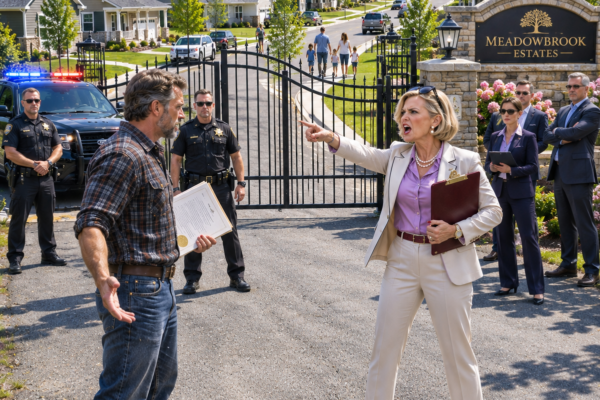
Karen found me at the mailboxes that afternoon.
She held a thick envelope of proxy votes.
“This is your final opportunity to leave with dignity, Mr. Evans.”
I looked at her.
“You’re voting me out of my own home?”
“We’re protecting the community.”
“From questions?”
“From you.”
She smiled.
“The proxies are already in.”
I went home and placed the meeting notice on my desk.
Then I made one phone call.
David Morrison answered on the second ring.
Dave and I had served together decades earlier.
After retiring, he became a certified fraud examiner.
I told him everything.
The gate.
The missing bids.
The special assessment.
The fines.
The hidden records.
The emergency meeting.
When I finished, he was silent for several seconds.
Then he said something that made me sit forward.
“Mark, people don’t usually work this hard to hide clean books.”
“What do you need?”
“Bank statements. Contracts. Cancelled checks. Vendor files. Three years minimum.”
“They won’t give them to me.”
“They don’t have to give them to you.”
I heard papers moving on his end.
“They have to let your designated representative inspect them.”
I looked at the expulsion notice.
“Dave…”
“Yeah?”
“Will you be my representative?”
He laughed softly.
“Book me a flight.”
Two weeks later, Karen called the emergency meeting to destroy me.
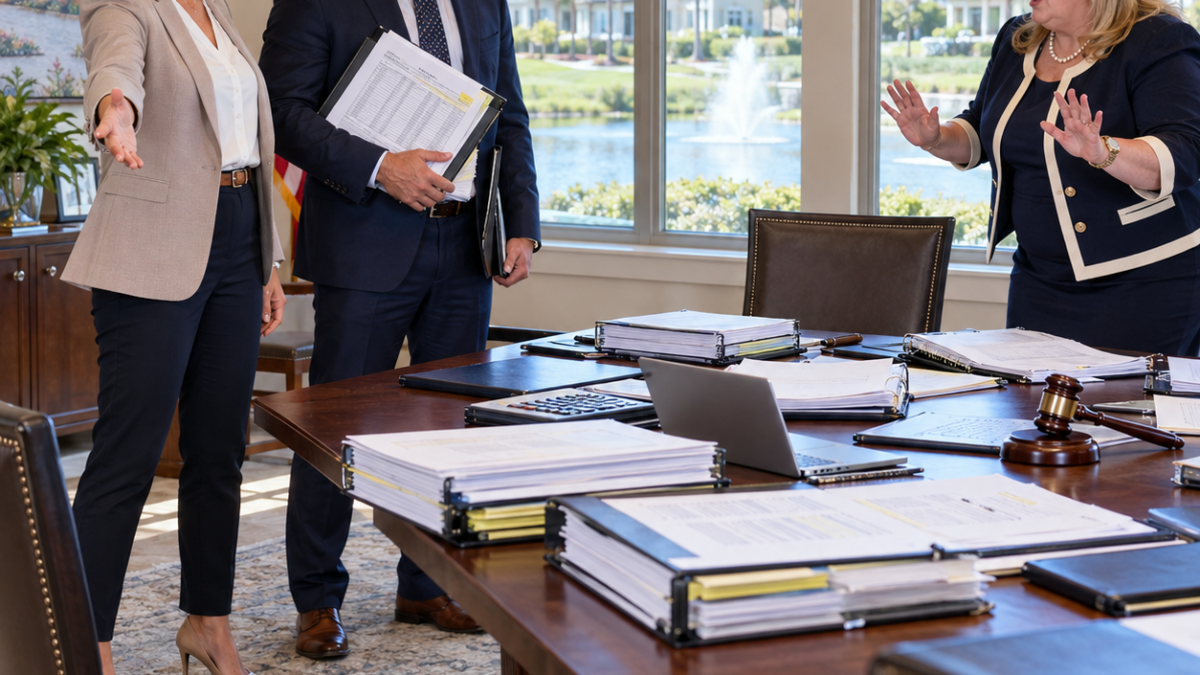
The clubhouse was packed.
She sat behind the board table with Gary and Brenda, smiling like a woman who had already won.
I walked in alone.
At least, that’s what she thought.
Because Dave wasn’t sitting with me.
Not yet.
And inside the laptop hidden in his briefcase was a number Karen had never expected anyone to find.
$287,450.
When Karen finally asked whether I had anything to say before my neighbors voted me out, I stood slowly.
“Yes,” I said.
“I’d like to present my defense.”
Then the clubhouse door opened.
And Karen’s smile disappeared.
PART 2
David Morrison walked into that clubhouse the same way I’d watched him walk into command briefings twenty-five years earlier.
No rush.
No drama.
No visible emotion.
Dark suit.
Black laptop bag.
Thin folder under one arm.
He wasn’t physically imposing.
He didn’t need to be.
Some men fill a room by being loud.
Dave filled one by making everyone wonder what he knew.
Karen shot to her feet.
“Who is this?”
I stayed standing.
“My designated representative.”
“This is a closed association meeting.”
“Bylaw 113 says the homeowner facing removal may present evidence in his defense.”
Her mouth tightened.
“You may present evidence.”
“I am.”
I pointed toward Dave.
“He’s the evidence expert.”
A few people laughed nervously.
Karen didn’t.
She looked toward Brenda, the board secretary.
Brenda immediately looked down at her papers.
That told me something.
Gary leaned toward Karen and whispered.
Dave calmly walked to the front wall and began setting up his projector.
Karen banged her gavel.
“Point of order!”
Dave continued plugging in cables.
“Mr. Evans, this meeting is not going to become some circus.”
“It was your meeting.”
“You are being deliberately disruptive.”
“I’m standing still.”
That earned a few more laughs.
Her cheeks flushed.
“Who exactly is this man?”
Dave finally turned.
“David Morrison. Certified Fraud Examiner.”
The room changed.
Not dramatically.
Just a subtle movement.
People shifted in their seats.
A few looked toward Gary.
Karen blinked.
“A what?”
“Certified Fraud Examiner.”
“And what exactly does a fraud examiner have to do with your alleged misconduct?”
“Quite a lot, actually.”
I turned toward the homeowners.
“For months, I’ve been accused of harassing this board because I asked to inspect our financial records.”
Karen immediately interrupted.
“You flooded volunteers with unreasonable demands.”
I looked at her.
“Then why did your lawyer eventually provide the records?”
“They were made available as a courtesy.”
Dave spoke without looking up.
“No, ma’am.”
Karen froze.
He connected the final cable.
“They were made available because state law required it.”
Someone in the second row whispered, “Oh, boy.”
Dave clicked a button.
The wall behind Karen lit up.
Plain white slide.
Black letters.
FORENSIC FINANCIAL REVIEW
WILLOW CREEK HOMEOWNERS ASSOCIATION
Prepared by David Morrison, CFE.
Karen stared at the words behind her.
“You have no authority to conduct an audit.”
Dave nodded.
“Correct.”
For a second, she looked relieved.
He continued.
“I’m not the association’s auditor.”
Her relief disappeared.
“I was retained by Mr. Evans as his designated representative to examine financial records made available under his statutory inspection rights.”
Gary leaned into his microphone.
“This is confidential financial information.”
Dave looked at him.
“HOA financial records presented to an association member exercising a legal inspection right are not magically transformed into privileged documents because the treasurer finds their contents embarrassing.”
A wave of laughter rolled through the room.
Gary’s face reddened.
Karen slammed the gavel.
“Enough.”
Dave looked at me.
I nodded.
He began.
“Before I show you anything, I want to make one thing clear.”
His voice was calm enough that people stopped whispering.
“I am not here tonight to tell you who to vote for.”
He glanced around the room.
“I am not here to tell you whom to remove.”
Then he looked directly at the board.
“I am here to show you what your own financial documents say.”
First slide.
The annual budget.
LANDSCAPING: $120,000.
Dave clicked again.
Vendor payments.
Evergreen Landscaping Solutions.
Almost every landscaping payment for three years had gone to that company.
“Anyone recognize the name?” Dave asked.
Nobody answered.
Karen folded her arms.
“They’re a reputable contractor.”
“Perhaps.”
Next slide.
Corporate registration.
Evergreen Landscaping Solutions LLC.
Registered address.
Registered agent.
Robert Zalinski.
Dave spoke carefully.
“Mr. Zalinski is related to a member of this board.”
A woman near the back said, “Who?”
Dave clicked.
A publicly available corporate record appeared beside a photograph.
It was Karen at a family barbecue.
Her arm was around a man.
The caption identified him as her brother-in-law, Bob.
The room erupted.
Karen stood so quickly her chair rolled backward.
“This is outrageous!”
Dave didn’t raise his voice.
“Is Robert Zalinski your brother-in-law?”
“That is irrelevant.”
“That’s a yes,” somebody shouted.
Karen banged the gavel.
“Order!”
Dave waited.
Eventually the noise dropped.
He clicked again.
Evergreen invoices.
Mulch.
Trees.
Seasonal flower installation.
Shrub replacement.
I had seen the documents during our four-hour inspection.
But seeing them enlarged on the wall made the numbers feel different.
Twenty-five thousand dollars.
Fourteen thousand.
Nine thousand.
Eighteen thousand.
Dave showed local supplier pricing.
Not because retail prices alone proved fraud.
He was careful about that.
But the differences were enormous.
One tree billed to Willow Creek at $1,000 had a nursery price under $350.
A landscaping enhancement invoiced at $15,000 had no matching project description, no detailed work order, no completion photographs, and no competitive quote.
Karen interrupted.
“Contractors mark up materials. That’s normal.”
Dave nodded.
“Correct.”
She blinked.
He continued.
“Which is why markup alone is not the issue.”
Next slide.
Payments.
Then transfers.
Then a distribution from Evergreen to an account connected to a company owned jointly by Karen’s brother-in-law and another family member.
Dave didn’t speculate about what Karen personally received.
He didn’t need to.
The relationship should have been disclosed.
It wasn’t.
A man in the third row stood.
“Did the board vote on that contract?”
Gary grabbed his microphone.
“Yes.”
“When?”
Gary looked toward Brenda.
Brenda shuffled papers.
“I—I would need to check the minutes.”
Dave clicked.
Board minutes.
No documented vote approving Evergreen for several of the years in question.
The room became louder.
Karen’s voice sharpened.
“This has nothing to do with removing Mark.”
I finally spoke.
“It has everything to do with it.”
She glared at me.
“You called this meeting because I asked to see these records.”
“You were creating hostility.”
“No.”
I pointed to the screen.
“I was creating visibility.”
Carol was sitting three rows back.
She looked at me.
Then at Karen.
Her hands were clasped tightly in her lap.
She looked frightened.
But she stayed.
Dave moved to the gate project.
This was the part I had been waiting for.
Karen herself had announced the $40,000 gate emergency.
Two hundred homes.
Two hundred dollars each.
Clean math.
She had told us the full forty thousand was needed for the replacement.
Dave placed the invoice on screen.
$40,000.
Then the bank check.
$22,500.
People began murmuring before he said a word.
Someone shouted:
“Where’s the rest?”
Dave raised one hand.
“That’s what I asked.”
Next slide.
Refund transaction.
$17,500.
Then, three days later, another HOA check.
$17,500.
Payable to:
COMMUNITY STRATEGIC SERVICES LLC
The room went dead quiet.
Dave clicked again.
State corporate registration.
Registered agent:
GARY SMITH.
Home address:
the same address listed in the Willow Creek resident directory.
Everyone turned toward Gary.
His face went gray.
A woman near the aisle whispered:
“Oh my God.”
Gary leaned into his microphone.
“That was a legitimate consulting contract.”
Dave turned toward him.
“Excellent.”
Gary seemed confused.
“Excuse me?”
“If there’s a contract, please produce it.”
Gary swallowed.
“I don’t have it here.”
“We didn’t find it in the files made available for inspection.”
“You weren’t shown everything.”
Dave nodded slowly.
“That may be important.”
Gary realized too late what he’d said.
People started shouting.
“What do you mean they weren’t shown everything?”
“You withheld records?”
“Is there another set of books?”
Karen hammered the gavel so hard I thought the handle might break.
“This meeting is about Mark Evans!”
Tom Miller stood.
Tom was thirty-two.
Young father.
Two children.
The HOA had denied his backyard playset because it supposedly disrupted “natural sight lines.”
He pointed toward the screen.
“No, Karen. This meeting is about our money now.”
Applause erupted.
She stared at him.
“Sit down.”
“No.”
It was a tiny word.
But in that room, it sounded enormous.
For years, people had sat down when Karen told them to.
Tom didn’t.
Dave waited until everyone quieted again.
Then he moved to Community Strategic Services.
Month after month.
$2,000.
Sometimes $3,500.
One payment for $12,000.
Descriptions:
Capital planning.
Strategic advisory services.
Reserve analysis.
Asset-management consulting.
No deliverables.
No reports.
No board-approved scope in the records we’d received.
Over three years, more than $180,000 had gone into Gary’s company.
Gary was sweating now.
He dabbed his forehead with a handkerchief.
“This is being deliberately misrepresented.”
Dave remained almost painfully polite.
“Then help me correct the record.”
“What?”
“What services did Community Strategic Services provide?”
Gary looked toward Karen.
She didn’t look back.
“Financial planning.”
“Can you identify one written report?”
“We gave verbal advice.”
“Worth one hundred eighty thousand dollars?”
“That isn’t what I said.”
Dave clicked again.
Reserve account.
Three years earlier:
$153,000.
Current balance:
under $30,000.
Several people gasped.
This mattered more than everything else.
Willow Creek had aging roads.
A pool.
Drainage infrastructure.
Clubhouse roofing.
Storm cleanup obligations.
The reserve account was supposed to protect the community from financial disaster.
Dave put the graph on screen.
A long downward slope.
“Your reserve fund has been reduced by more than one hundred thousand dollars during the period reviewed.”
He paused.
“Much of that reduction corresponds with payments to related-party vendors and Community Strategic Services.”
Nobody spoke.
Then Carol stood.
Her voice was quiet.
At first, Karen didn’t even notice her.
“I paid you two hundred and fifty dollars.”
Karen stared.
Carol swallowed.
“For my flower fence.”
“This is not the time—”
“Yes, it is.”
Her voice became stronger.
“My husband built that little fence before he died.”
The room went silent.
“You told me it was two inches too high.”
Karen’s face hardened.
“We apply the covenants equally.”
“No, you don’t.”
Carol’s hands were shaking now.
But she remained standing.
“You made me feel like a criminal over two inches.”
She pointed toward the reserve-fund slide.
“While this was happening?”
Karen opened her mouth.
Carol wasn’t finished.
“I paid because I was afraid.”
That sentence landed harder than anything Dave had shown.
“I thought if I fought you, you’d put a lien on my house.”
A woman beside Carol reached for her hand.
Carol looked around the room.
“How many of us paid because we were afraid?”
Hands went up.
One.
Five.
Ten.
Twenty.
Then more.
Even I wasn’t prepared for it.
Karen watched those hands rise.
Her kingdom wasn’t collapsing because Dave found numbers.
It was collapsing because people were realizing their fear had been shared.
They hadn’t been weak individually.
They had been isolated deliberately.
Dave clicked to his final slide.
No animation.
No dramatic music.
Just a table.
Questionable related-party payments.
Unsupported consulting charges.
Gate-project diversion.
Reserve-fund transfers.
Confirmed amount traced through the records reviewed:
$287,450
A woman in the back whispered:
“Two hundred eighty-seven thousand dollars?”
Dave turned toward the room.
“That is the amount I could trace from the documents made available to us.”
He let the sentence sit.
“It is not necessarily the final loss.”
Karen stood again.
“This is defamation.”
Dave looked at her.
“No, ma’am.”
“You’ve accused us of theft!”
“I have shown financial transactions.”
“You called it fraud!”
“I said the patterns warrant investigation.”
Gary suddenly pushed his chair back.
“I’m leaving.”
Karen snapped toward him.
“Sit down.”
He stared at her.
For the first time, I saw fear between them.
Real fear.
Not neighborhood politics.
Not HOA theatrics.
The kind of fear people feel when they realize the conversation has escaped their control.
Tom Miller raised his hand.
“I move to terminate this vote against Mark.”
Someone shouted, “Second!”
Karen slammed the gavel.
“You cannot interrupt the agenda!”
Tom turned toward the homeowners.
“Fine.”
He looked back at her.
“Then let’s finish the agenda.”
He faced me.
“Anybody still want to vote Mark out for asking where our money went?”
Nobody raised a hand.
Even Karen’s usual supporters looked down.
Tom continued.
“Then I move that the membership remove Karen Thompson, Gary Smith, and Brenda Lee from the board pending a full independent audit and legal review.”
Carol stood.
“I second it.”
Karen screamed.
“You can’t do that!”
Dave quietly began packing his laptop.
His work was finished.
The homeowners’ work was beginning.
Karen grabbed the manila envelope containing the proxy votes.
“I have forty percent of the membership right here!”
A man wearing a Marine Corps sweatshirt stood near the wall.
“Those proxies were collected to vote on Mark.”
“They establish support for the board.”
“No,” he said. “They establish that you convinced people Mark was the problem.”
Applause.
Gary leaned toward Brenda.
“Don’t say anything.”
I heard him.
So did Carol.
Brenda started crying.
Karen grabbed her arm.
“Pull yourself together.”
Brenda jerked away.
It was small.
But everybody saw it.
Tom asked for the vote.
Karen refused to recognize him.
Paul Hastings, another homeowner who had served on nonprofit boards, called out:
“Then someone other than the interested president needs to chair the motion.”
Karen looked around wildly.
“This is illegal.”
Charlie Renner, a retired attorney sitting near the back, stood.
“Karen, the membership has the authority under the bylaws to remove directors by the required vote.”
She pointed at him.
“You stay out of this.”
He smiled.
“That’s difficult while sitting in the meeting.”
Laughter exploded.
Karen’s face twisted.
“Fine!”
She threw the gavel onto the table.
“You want chaos? Have chaos!”
Then she pointed directly at me.
“This is what he wanted!”
I finally stepped forward.
“No.”
The room quieted.
“I wanted the gate bids.”
A few people laughed softly.
But I didn’t.
“This could have ended eighteen months ago.”
I looked at Gary.
“At the first request.”
Then Karen.
“At the first email.”
Then Brenda.
“At the first certified letter.”
“You had dozens of chances to answer one simple question.”
I paused.
“Where did the money go?”
Karen stared at me.
No answer.
Tom called the vote.
The result wasn’t close.
Karen was removed.
Gary was removed.
Brenda was removed.
The woman who had walked up to me days earlier and promised my neighbors would throw me out sat completely still while those same neighbors voted her out of office.
It should have felt like revenge.
It didn’t.
It felt like pressure leaving a room.
People exhaled.
Some cried.
Carol hugged the woman next to her.
Tom’s wife covered her mouth.
Sarah stood from her chair and came to me.
I hadn’t even noticed how tightly I’d been holding myself together until she touched my arm.
“You okay?”
“I think so.”
She smiled.
“Your hands are shaking.”
I looked down.
They were.
After twenty-five years in the Army, I had stood in situations where shaking would have been understandable.
But this was different.
These people lived twenty yards from my front door.
For eighteen months, Karen had been trying to turn them against me.
And now they were looking at me like I’d opened a locked door.
Then somebody shouted:
“Mark for interim president!”
I immediately shook my head.
“No.”
A wave of laughter.
Tom grinned.
“That’s the first qualification.”
“I’m serious.”
“So are we.”
“I don’t want the job.”
Carol spoke from behind him.
“Neither did George Washington.”
I stared at her.
“Carol, that’s absurd.”
“I’ve been waiting all night to say it.”
Even Sarah laughed.
Someone formally nominated me.
Carol was nominated as interim treasurer.
Tom as secretary.
I tried to object.
Charlie Renner leaned toward me.
“You started this.”
“I asked for invoices.”
“Leadership often begins with regrettable administrative questions.”
The vote passed overwhelmingly.
Twenty minutes earlier, I had been facing expulsion.
Now I was interim president.
Life has a strange sense of humor.
But before I could fully process it, two uniformed police officers entered the clubhouse.
The room went silent.
A sergeant looked at the projector.
The $287,450 figure was still glowing on the wall.
Then he looked at the removed board members.
“We received a report of suspected financial fraud.”
Dave stepped forward.
“My name is David Morrison.”
He showed his identification.
“I’m a Certified Fraud Examiner. I conducted a preliminary review of association records at the request of a member.”
The sergeant nodded toward the screen.
“That’s your number?”
“Preliminary traced amount.”
“Do you have supporting documentation?”
Dave lifted the encrypted drive.
“Yes.”
Karen jumped up.
“This is a civil matter.”
The sergeant looked at her.
“Maybe.”
“He’s lying.”
“Then the records will help establish that.”
“You cannot just take his word.”
“We’re not.”
His tone was almost gentle.
“We’re going to take everyone’s statements.”
Karen pointed toward me.
“Start with him.”
The sergeant glanced at me.
“Were you on the previous board?”
“No.”
“Authorized signer?”
“No.”
“Had control of association funds?”
“No.”
He looked at Karen.
“Then I think I’ll start with the people who did.”
A sound moved through the room.
Not quite laughter.
Not quite applause.
Relief.
The officers didn’t handcuff anyone that night.
Real investigations aren’t television.
They separated Karen, Gary, and Brenda.
Took initial statements.
Collected basic information.
Dave preserved his copies.
The interim board secured the management office records.
By midnight, I’d been awake nearly twenty hours.
When Sarah and I finally walked home, Willow Creek looked exactly the same.
Streetlights.
Trimmed lawns.
Porches.
The little fountain at the entrance.
It was strange.
A community can change completely while every house remains in the same place.
Sarah slipped her hand through mine.
“You went there tonight expecting them to vote you out.”
“Yes.”
“Were you scared?”
I thought about lying.
“No.”
She squeezed my hand.
“Try again.”
I sighed.
“Yes.”
“Of losing the house?”
“No.”
“Then what?”
I looked toward Carol’s roses.
“That everybody would believe them.”
Sarah stopped walking.
“Mark.”
“What?”
“You spent twenty-five years knowing who you were even when people above you were wrong.”
“That was different.”
“How?”
“I had a uniform.”
“So?”
“I had rank.”
She smiled sadly.
“You think rank made you honest?”
“No.”
“Then stop acting like you needed permission from Karen Thompson to be who you are.”
I kissed her forehead.
“Have you been saving that speech?”
“About six months.”
“You could’ve said it sooner.”
“You were busy documenting grass.”
That made me laugh.
The next morning, interim-president reality began at 6:42.
My phone rang.
Carol.
“Mark?”
“Yes?”
“The bank won’t talk to me.”
“Why?”
“They say I’m not an authorized signer.”
“You were elected twelve hours ago.”
“I know, but apparently democracy doesn’t update automatically.”
I sat up.
Sarah laughed into her pillow.
By 8:30, Tom and I were at the bank with meeting minutes, bylaws, identification, and Charlie Renner.
We froze discretionary association spending pending verification.
Then we changed access credentials to the financial systems.
The management company resisted at first.
Their regional supervisor called me.
“Mr. Evans, we need verification that the board transition was valid.”
“I agree.”
That surprised him.
“You do?”
“Yes. Verify everything.”
Silence.
“I’m sorry?”
“Don’t take my word for it.”
I looked at the stack of documents on my desk.
“That’s how we got here.”
By the end of the week, we retained independent association counsel.
Not Karen’s attorney.
A different firm.
We engaged Dave’s company for a formal forensic audit after obtaining proper member approval.
We also notified the association’s fidelity insurer.
Then the real numbers began appearing.
Dave’s preliminary figure had been conservative.
Some of the landscaping projects existed only on invoices.
No matching work orders.
No delivery receipts.
No photographs.
No evidence they had ever happened.
One “tree replacement program” had cost Willow Creek $28,000.
We inspected the locations.
Half the supposed trees didn’t exist.
Gary’s company was worse.
Automatic monthly payments.
Consulting fees.
Emergency planning fees.
Reserve analysis.
Vendor management.
The same generic invoice description appeared again and again.
Dave called me one afternoon.
“You sitting down?”
“I’ve learned to sit whenever you call.”
“Good.”
“What now?”
“The reserve study.”
“What about it?”
“Gary billed Willow Creek $9,800 for one.”
“And?”
“He didn’t perform it.”
“How do you know?”
“Because I called the engineering firm whose logo appears on the report.”
I closed my eyes.
“Forged?”
“Modified.”
“They produced a reserve study for another community four years ago. Gary appears to have changed the development name and several numbers.”
I leaned back.
“This is insane.”
“No.”
Dave’s voice became quiet.
“It’s ordinary.”
“What?”
“That’s the sad part.”
He continued.
“Big fraud sounds dramatic. Most fraud is boring. Somebody discovers nobody checks. Then they take a little.”
Pause.
“Then they take more.”
That evening, I told Sarah.
She listened while chopping vegetables.
When I finished, she put down the knife.
“Why?”
“Money.”
“No.”
“What do you mean?”
“Why did nobody check?”
I thought about it.
“People trusted them.”
“That’s not the same as not checking.”
“No.”
“Then why?”
“Apathy.”
She nodded.
“And fear.”
“Yes.”
Sarah wiped her hands.
“Then don’t replace Karen with yourself.”
I frowned.
“What?”
“If everybody trusts you so much they stop looking again, you haven’t fixed anything.”
That sentence shaped everything we did afterward.
At the first town hall under the interim board, every seat was filled.
This time, I stood at the same table where Karen had sat.
I hated it.
It felt too elevated.
So before the meeting began, Tom and I moved the board table down from the small platform onto the floor.
Carol looked at me.
“What are you doing?”
“Eliminating strategic high ground.”
She smiled.
“Army?”
“Marriage.”
The meeting opened differently.
No gavel.
No prepared speech.
I stood.
“First rule.”
Everyone looked at me.
“If you don’t understand a number, ask.”
A few people nodded.
“If the answer doesn’t make sense, ask again.”
More nods.
“If somebody tells you a question is disrespectful, ask why they’re afraid of the question.”
That got applause.
I held up the preliminary audit.
“We were not robbed because one woman was powerful.”
I looked around the room.
“We were robbed because too much power was left unexamined.”
The room became quiet.
“That includes me.”
I pointed toward Carol.
“If Carol asks me for a receipt, she gets the receipt.”
Carol said, “I absolutely will.”
Laughter.
“If Tom wants the bank statement, he gets the bank statement.”
Tom nodded.
“If any homeowner wants to inspect association records through the proper process, they get access.”
Then we announced the new system.
Every month:
Bank balances.
Invoices.
Approved contracts.
Payments.
Reserve changes.
Meeting votes.
All uploaded to a secure resident portal.
No secret vendor relationships.
Any board member with a financial or family connection to a vendor had to disclose it and recuse themselves.
Contracts over a threshold required competing bids unless a documented emergency made that impossible.
Carol raised her hand.
“Yes?”
“What about two-inch flower fences?”
The room laughed.
Tom looked at me.
“I knew this was coming.”
We formed a covenant review committee.
That work became almost as emotional as the audit.
Once residents realized they could speak without retaliation, stories poured out.
A single mother named Denise had asked permission to build a small accessibility ramp so her elderly mother could enter the house safely.
Denied.
“Architecturally inconsistent.”
One of Karen’s friends had received approval for a massive outdoor kitchen the same week.
The Millers brought their rejected playset application.
Another family had been fined for a basketball hoop.
Someone had received a violation because a campaign sign remained up forty-eight hours beyond the deadline.
Meanwhile, political signs favored by Karen had apparently remained for weeks.
We couldn’t erase every argument.
HOAs involve legitimate shared restrictions.
Some rules existed for sensible reasons.
But we could eliminate vagueness.
“Visual disharmony” disappeared.
“Subjectively unattractive exterior feature” disappeared.
Enforcement required specific evidence.
Residents received notice and a meaningful opportunity to respond before fines.
Anonymous complaints alone were no longer enough for penalties.
Most importantly, selective enforcement became expressly reviewable.
Two months after Karen’s removal, the district attorney’s office contacted us.
Investigators had subpoenaed bank records.
Brenda had started cooperating.
That didn’t surprise me.
What she told investigators did.
She had known more than I thought.
Not everything.
But enough.
Karen controlled the meetings.
Gary controlled the accounts.
Brenda prepared minutes based on notes Karen gave her after meetings.
Sometimes those minutes recorded votes that had never actually happened.
Sometimes they omitted objections.
Sometimes they described contracts as “unanimously approved” when Brenda couldn’t remember any discussion at all.
Why sign them?
Fear.
Karen had repeatedly threatened to blame Brenda personally if anything went wrong.
Brenda’s husband had been sick.
She didn’t want legal trouble.
She looked away.
Then signed.
I struggled with that.
Carol didn’t.
“She was scared.”
“So were other people.”
“True.”
“She helped them.”
“Also true.”
“You sound like you’re defending her.”
“No.”
Carol looked at me.
“Understanding isn’t defending.”
I leaned against the clubhouse counter.
“She could’ve stopped it.”
“So could we.”
That irritated me because it was true.
Carol continued.
“How many annual meetings did I skip?”
I didn’t answer.
“All but two in eight years.”
She looked toward the meeting room.
“How many financial reports did I read?”
“Probably none.”
“Exactly.”
She smiled sadly.
“Karen took advantage of my absence too.”
I didn’t like the idea that victims bore responsibility for theft committed against them.
They didn’t.
But communities do have responsibility for their own vigilance.
Those are different truths.
Both mattered.
Three months after the emergency meeting, criminal charges were filed.
Gary pleaded guilty first.
That shocked nobody.
He had the most obvious paper trail.
Community Strategic Services existed in his name.
Payments landed in accounts he controlled.
He agreed to restitution and cooperation.
Karen fought.
Of course she did.
Her attorney characterized everything as poor governance.
Related-party vendor choices.
Accounting mistakes.
Administrative oversights.
Aggressive but lawful enforcement.
Then investigators found emails.
One from Karen to Gary read:
Mark is becoming dangerous. If he sees the full vendor records, he’ll start connecting things.
Another:
We need enough violations to establish a conduct pattern before the special meeting.
And another:
Once he’s gone, this dies.
When Dave showed me copies through our attorney, I read the last sentence three times.
Once he’s gone, this dies.
I thought about the mailboxes.
Her smile.
The envelope of proxies.
Sell your house and leave quietly.
She hadn’t wanted to protect Willow Creek from me.
She wanted to protect herself from the next question.
Sarah found me sitting alone in the kitchen.
“You okay?”
I handed her the email.
She read it.
Then sat beside me.
“You knew.”
“Knowing isn’t the same as seeing it.”
“No.”
“She wanted us gone.”
Sarah touched my hand.
“I know.”
“This house was supposed to be it.”
“What?”
“The last move.”
I looked toward the back garden.
“No more PCS orders. No more packing. No more starting over. We picked this place because I told you I’d never make you move again.”
Sarah’s eyes softened.
“You didn’t.”
“She almost did.”
“No.”
“She came close.”
Sarah shook her head.
“You’re still thinking she had more power than she did.”
I looked at her.
“She had a title, Mark.”
Sarah squeezed my fingers.
“We had a home.”
Karen eventually took a plea rather than risk trial on every count prosecutors were prepared to bring.
Gary’s cooperation damaged her case badly.
Brenda’s testimony damaged it more.
The civil litigation was separate.
The HOA pursued recovery from Karen, Gary, related vendors, and available insurance coverage.
Evergreen Landscaping collapsed under scrutiny.
Karen’s brother-in-law insisted every charge represented legitimate work.
Some did.
Many didn’t.
The final recovery process took far longer than homeowners expected.
That’s another thing television stories get wrong.
Justice is slow.
Painfully slow.
Invoices.
Depositions.
Motions.
Insurance exclusions.
Settlement conferences.
Asset searches.
Tax questions.
Months became a year.
We didn’t recover every dollar.
But we recovered enough to stabilize the reserve account.
The fidelity bond paid a substantial claim.
Gary returned funds as part of settlement and restitution.
Additional money came through civil settlements.
For the first time in years, the reserve account started moving upward.
We had one large expense during that period.
A drainage culvert beneath the east road began failing.
Under Karen, it would have triggered another panicked emergency assessment.
Instead, the board did what boards are supposed to do.
We hired an engineer.
Published the report.
Requested three bids.
Held a homeowner information session.
Selected the lowest responsive qualified bid.
Posted the contract.
Carol looked almost disappointed.
“This is incredibly boring.”
“Good.”
“Karen would’ve turned this into a crisis.”
“That’s because crisis makes oversight harder.”
Tom laughed.
“Mark’s HOA motto: boring is beautiful.”
We printed it on coffee mugs as a joke.
I still have mine.
The permanent board election came that fall.
I didn’t want to run.
Truly.
The interim term had exhausted me.
One evening Sarah found me in the garage restoring an old bench vise.
“You’re hiding.”
“I’m working.”
“The election nominations close tomorrow.”
“I know.”
“People want you to run.”
“I know.”
“Do you?”
“No.”
She smiled.
“Liar.”
I looked at her.
“I didn’t retire from the Army to become president of a neighborhood association.”
“You retired to serve on three committees and spend six months investigating mulch?”
“That was different.”
“How?”
“National security.”
She laughed.
I couldn’t.
Then she became serious.
“Why don’t you want to run?”
“Because I don’t want to become Karen.”
Sarah stared at me.
“That’s really it?”
“Yes.”
She leaned against the workbench.
“You think power is contagious?”
“I think people get comfortable.”
“Then don’t.”
“That’s easy to say.”
“No, it isn’t.”
She picked up the wrench beside my vise.
“You build safeguards.”
I looked at her.
“Term limits.”
I said nothing.
“Published records.”
She continued.
“Independent audits.”
I smiled.
“You’ve thought about this.”
“Obviously.”
“Anything else?”
“Yes.”
“What?”
“If you ever start carrying a gavel, I’m leaving you.”
I laughed.
I ran.
Carol ran for treasurer.
Tom for secretary.
Our platform had three words:
Transparency. Fairness. Service.
We won with more than ninety percent of participating votes.
At my first official meeting as permanent president, I stood at the front.
Then stopped.
Karen’s old wooden gavel still lay in the drawer.
I took it out.
Everyone looked nervous.
I handed it to Carol.
“What am I supposed to do with this?”
“Take it home.”
“Why?”
“Firewood.”
The room erupted.
We never used one again.
The most satisfying changes weren’t financial.
They were small.
The Millers finally installed their playset.
One Saturday, several of us helped assemble it.
I spent four hours trying to understand instructions written by someone who apparently hated fathers.
Tom held up two identical bolts.
“Which one is B17?”
“That one.”
“They’re the same.”
“Then why did you ask?”
His daughter climbed the ladder before we finished tightening everything.
Sarah shouted:
“Get down until Mark signs off!”
I looked at her.
“Why me?”
“Army logistics.”
“This is a swing set.”
“Same chain of command.”
Across the street, Carol repainted her decorative fence.
Not because she had to.
Because she wanted to.
She chose blue.
Bright blue.
The old rules would have caused a crisis.
Under the revised standards, nobody cared.
When it was finished, she stood back.
“What do you think?”
“Two inches too high.”
She stared at me.
I ran.
At Denise’s house, the wheelchair ramp was finally approved.
Several neighbors volunteered to build it.
I helped set the posts.
When Denise’s mother arrived the following weekend and rolled up the ramp without needing two people to lift her chair, Denise cried.
So did Sarah.
I pretended I had sawdust in my eye.
There was no sawdust.
One year after the emergency meeting, we held an anniversary town hall.
Not intentionally.
The date just happened to fall close.
Dave flew in.
This time he wasn’t carrying a scanner.
He carried barbecue sauce.
We held the meeting outside near the clubhouse.
Families brought food.
Kids ran across the lawn.
Dave stood beside me watching Tom argue with a grill.
“You know what bothers me?” he asked.
“Everything?”
“You never thanked me properly.”
“I bought your flight.”
“Coach.”
“You’re lucky I didn’t book baggage.”
“You needed me.”
“I needed the scanner.”
He put a hand over his heart.
“After twenty-five years.”
I smiled.
“Thank you, Dave.”
He nodded.
“Better.”
Then his expression changed.
“Seriously, though.”
“What?”
“You understand the audit didn’t save the neighborhood.”
I looked at him.
“You found the money.”
“I found numbers.”
He pointed toward Carol.
She was laughing with Denise.
“The numbers wouldn’t have mattered if people stayed scared.”
Then toward Tom.
“And none of it would’ve happened if you hadn’t asked the first question.”
“I asked for bids.”
“Exactly.”
He took a drink.
“Most systems don’t collapse because somebody asks the perfect question.”
He looked at me.
“They collapse because somebody refuses to stop asking the obvious one.”
Later that evening, after everyone went home, Sarah and I sat on our porch.
The roses she had planted when we moved in were taller now.
Willow Creek was quiet.
Actually quiet.
Not the silence Karen had enforced.
Something different.
Comfortable.
Sarah rested her head against my shoulder.
“Remember why we moved here?”
“Peace.”
“Did we get it?”
I thought about the last two years.
Lawyers.
Auditors.
Police.
Emergency meetings.
Civil litigation.
Elections.
Playsets.
Wheelchair ramps.
Flower fences.
“Eventually.”
She smiled.
“What did you learn?”
“That retirement was a mistake.”
She elbowed me.
I laughed.
Then I became serious.
“I thought peace meant nobody bothered me.”
“And now?”
I looked down the street.
Carol’s little blue fence caught the last sunlight.
Children were still playing behind the Millers’ house.
A neighbor waved while walking his dog.
“Peace isn’t silence.”
Sarah waited.
“It’s knowing nobody has to stay silent to keep it.”
She squeezed my hand.
That became the lesson I carried from Willow Creek.
Karen had believed authority meant never being questioned.
I had spent my career learning the opposite.
Any system worth trusting must survive inspection.
Budgets.
Orders.
Contracts.
Leadership.
All of it.
Especially leadership.
A title doesn’t make someone honest.
A uniform doesn’t make someone right.
A board vote doesn’t transform abuse into governance.
And politeness does not require silence when something is wrong.
Years later, new residents sometimes hear pieces of the story.
They’ll corner me after meetings.
“Are you the guy they tried to kick out?”
I usually answer:
“They tried.”
Then someone inevitably asks whether I planned the whole thing.
Whether I knew from the beginning Karen was stealing.
No.
I didn’t.
I suspected the numbers looked wrong.
That’s all.
The first time I raised my hand, I wasn’t trying to overthrow anyone.
I didn’t have an auditor waiting outside.
I didn’t have a coalition.
I didn’t have evidence of $287,450.
I had one question.
Can we see the bids?
Everything Karen did afterward turned that question into an investigation.
She ignored me.
Then resisted me.
Then fined me.
Then attacked my reputation.
Then tried to remove me.
Each escalation told me the answer mattered more than she wanted anyone to know.
That’s the tragedy of people like Karen.
They often expose themselves trying to suppress scrutiny.
The emergency meeting was supposed to be the night she proved her power.
She had proxies.
A prepared speech.
The board.
A lawyer.
A room full of homeowners she believed were too frightened or apathetic to challenge her.
I had one guest.
An auditor.
But Dave didn’t destroy her.
The truth did.
Dave merely turned on the projector.
Karen had already created every slide herself.
Every invoice.
Every check.
Every undisclosed relationship.
Every transfer.
Every missing dollar.
Every retaliatory fine.
Every email about silencing me.
She built the evidence one decision at a time.
All Dave did was place those decisions beside each other.
The final time I saw Karen was months after she sold her home.
I was leaving the grocery store.
She was crossing the parking lot.
We noticed each other at the same moment.
For one second, I considered turning away.
Then I didn’t.
She stopped.
So did I.
She looked different.
Tired.
Smaller somehow.
Not physically.
Power changes how people occupy space.
Losing it does too.
“Mark.”
“Karen.”
A long silence.
I expected anger.
She surprised me.
“You ruined my life.”
I looked at her.
“No.”
“You embarrassed me in front of everyone.”
“I asked for records.”
“You brought that man to the meeting.”
“You called the meeting.”
Her jaw tightened.
“You knew what would happen.”
“No.”
“Don’t lie.”
“I knew what Dave found.”
I paused.
“I didn’t know what the neighbors would do.”
“You turned them against me.”
“No, Karen.”
I had said those words before.
This time, there was no audience.
No cameras.
No homeowners.
Just two people in a parking lot.
“You made them afraid of you.”
She looked away.
“You don’t understand what it took to run that place.”
“Maybe not.”
“They complained about everything.”
“I know.”
“They wanted perfect landscaping and low fees. Security and no assessments. Rules enforced against everyone except themselves.”
She shook her head.
“You try pleasing two hundred households.”
“I did.”
That stopped her.
For several months, I had been president by then.
She looked at me.
“And?”
“You can’t please them.”
A bitter smile appeared.
“Exactly.”
“But you can tell them the truth.”
Her smile disappeared.
For a moment, I thought she might say something important.
An apology.
An explanation.
Anything.
Instead she walked away.
I watched her reach her car.
Then I turned toward mine.
That was our last conversation.
I don’t know whether she ever accepted what happened.
I stopped needing her to.
That’s another lesson age teaches you.
Closure doesn’t always come from the person who hurt you.
Sometimes closure is simply reaching the point where their explanation no longer controls your peace.
Willow Creek eventually stopped talking about Karen.
That may have been the clearest proof we’d healed.
New problems replaced old ones.
Pool repairs.
Roof shingles.
A tree that fell across the walking path.
Arguments over whether holiday lights should come down by January 15 or January 31.
Normal community nonsense.
I loved every boring minute.
At one meeting, a new homeowner raised his hand.
He looked nervous.
“I have a question about the landscaping contract.”
Everyone turned toward him.
He almost lowered his hand.
I smiled.
“Good.”
He looked surprised.
“What?”
“Ask it.”
“Well… I noticed the new bid is almost twelve thousand dollars more than last year’s.”
Carol immediately opened her laptop.
“Page forty-seven.”
I laughed.
The homeowner continued.
“Can we see why?”
“Absolutely.”
We put all three bids on the screen.
Explained the scope differences.
Answered questions.
Changed part of the contract because one resident noticed a duplicated service line.
The discussion took forty minutes.
Nobody was fined afterward.
Nobody received a threatening letter.
Nobody was labeled disruptive.
When the meeting ended, Sarah met me at the door.
“How’d it go?”
“Terrible.”
“What happened?”
“People asked questions.”
She smiled.
“You poor thing.”
We walked home together.
I looked back once at the clubhouse.
Lights still on.
Neighbors still talking.
There was a time when Karen would have called that disorder.
I called it health.
That emergency meeting had been intended to erase my voice.
Instead, it taught two hundred homeowners how to use theirs.
And that is why, when people ask me whether bringing Dave Morrison to that meeting was the best revenge I ever got, I tell them they’re asking the wrong question.
Revenge would have been watching Karen lose everything and enjoying it.
That satisfaction faded quickly.
What lasted was Carol no longer being afraid of a letter.
The Millers hearing their children laugh on a playset they had once been told was unacceptable.
Denise’s mother rolling safely into her daughter’s house.
Residents opening financial reports without needing permission.
Board members knowing that every dollar could be questioned.
Neighbors understanding that leadership belongs to the people being served, not the person holding the gavel.
Karen thought the emergency meeting would prove she controlled Willow Creek.
Instead, she gave Willow Creek back to us.
And the strangest part is that none of it began with fraud investigators, police officers, lawyers, or a $287,450 discovery.
It began with one retired man sitting in the back row of a boring HOA meeting, looking at a $40,000 gate assessment and raising his hand.
“Excuse me,” I had said. “Can we see the bids?”
Karen could have answered.
She could have shown us the paperwork.
She could have welcomed the question.
Instead, she decided the questioner had to go.
Months later, when I sat at that same table as elected president, I kept a framed copy of the first financial-record request in the clubhouse office.
Not the audit.
Not the criminal documents.
Not the emergency meeting notice.
The first request.
One page.
Polite.
Boring.
I put it there so every future board member would remember how little it takes for accountability to begin.
Underneath it, Sarah added a small brass plaque without telling me.
I discovered it after one meeting.
It read:
QUESTIONS ARE NOT DISLOYALTY.
SILENCE IS NOT PEACE.
I stared at it for a long time.
Then Sarah appeared behind me.
“You like it?”
“You ordered this?”
“Yes.”
“Without board approval?”
She smiled.
“Impeach me.”
I pulled her close.
“Tempting.”
Outside, Willow Creek was quiet.
Not because people had been frightened into obedience.
Not because one president controlled everything.
Not because nobody questioned anyone.
It was quiet because the books were open, the rules were fair, the neighbors were talking, and nobody had to fear losing their home for asking where their own money went.
That was the peace Sarah and I had come looking for.
It just took a fight to understand what peace actually meant.
The peace Sarah and I had come looking for.
It just took a fight to understand what peace actually meant.
I thought that was where the story ended.
I was wrong.
Because six months after we rebuilt Willow Creek’s finances, after the criminal case had moved out of the headlines and the neighborhood had finally begun feeling normal again, we discovered exactly why the missing reserve money had mattered so much.
It happened during a storm in early September.
The weather service had predicted heavy rain, but nobody expected what arrived.
By midnight, water was coming down so hard I could barely see the streetlights from our bedroom window.
Sarah was asleep beside me when my phone started ringing.
I looked at the clock.
12:43 a.m.
Carol.
I answered immediately.
“Mark?”
Her voice was trembling.
“What’s wrong?”
“There’s water coming across my backyard.”
I was out of bed before she finished the sentence.
“Stay inside. Don’t go near it.”
I pulled on jeans and boots.
Sarah sat up.
“What happened?”
“Flooding.”
She was already reaching for her sweater.
“I’m coming.”
“No.”
“Mark.”
“Sarah, somebody needs to coordinate calls from here.”
She stared at me.
That old military instinct to control the situation had slipped into my voice.
She crossed her arms.
“You have exactly five seconds to ask nicely.”
I sighed.
“Would you please stay here, call the neighbors on the low side of the community, and make sure everyone knows not to drive through standing water?”
“Better.”
I kissed her forehead.
Then I ran outside.
Rain hit me like gravel.
By the time I reached Carol’s house, Tom Miller was already there in a rain jacket.
Water was pushing through the drainage swale behind the homes, rising faster than either of us liked.
“This is the east culvert,” Tom shouted over the rain.
I nodded.
The same culvert we’d inspected months earlier.
The same one we had repaired properly after taking three bids and publishing the entire contract.
For one horrible second, I thought our repair had failed.
Then the county emergency crew arrived.
Their engineer inspected the downstream side with a flashlight.
“Culvert’s open!”
“Then why is it backing up?” I shouted.
“Debris jam farther down!”
Tree limbs and trash had collected where the drainage channel narrowed beyond Willow Creek.
The water wasn’t being blocked by our repaired culvert.
The system downstream couldn’t handle the volume.
That distinction didn’t make the water any less real.
Within an hour, twenty neighbors were outside.
Not because I ordered them.
Nobody waited for orders anymore.
Tom organized sandbags near the low houses.
Dave—who had driven in for a board workshop and gotten stranded by the storm—helped move elderly residents to the clubhouse.
Carol made coffee for emergency workers even while water crept toward her patio.
Sarah turned our kitchen into a phone center.
Every ten minutes she called me.
“House nineteen is safe.”
“Mrs. Bennett has gone to her daughter’s.”
“The Millers have their kids at the clubhouse.”
“County says another band of rain is coming.”
At 3:17 a.m., the water reached the first row of sandbags behind Carol’s house.
She stood at the back door watching.
I went inside.
She looked smaller than I remembered from the night she stood up to Karen.
“Is it going to come in?”
“I don’t know.”
That was the only honest answer.
Carol nodded.
Then she looked around her living room.
Photographs.
Books.
Her late husband’s chair.
The same home she’d once feared losing because Karen threatened a lien over a flower-bed fence.
“I don’t want to leave,” she whispered.
“You may have to.”
She looked at me.
“I know.”
“You’ll come to our house.”
“What about yours?”
“We’re uphill.”
She tried to smile.
“Of course you are. Army planning.”
“That was Sarah.”
“Even better.”
Then Carol suddenly laughed.
“What?”
She pointed outside.
“If Karen were still president, she’d probably fine the water for violating landscaping standards.”
Despite everything, I laughed.
Then Tom appeared at the back door.
“Mark!”
His expression told me something had changed.
“County cleared the blockage.”
We stepped outside.
The water was still high.
But it had stopped rising.
Twenty minutes later, it began dropping.
By sunrise, Willow Creek looked battered but standing.
Lawns were covered in mud.
Branches were everywhere.
Two garages had taken minor water.
The walking path was destroyed in several places.
Part of the pool fence had collapsed.
But no house had suffered major structural damage.
No one was hurt.
The clubhouse smelled like wet coats and burned coffee.
Residents sat around folding tables wrapped in blankets.
Children slept across chairs pushed together.
I stood near the front with Tom and Carol looking at the preliminary damage estimates.
Tom rubbed his face.
“This is going to cost.”
“Yes.”
“How much is left in emergency reserve?”
Carol opened her laptop.
A year earlier, that question would have terrified us.
Because Karen and Gary had nearly emptied the fund.
But after insurance recovery, restitution payments, budget cuts, and disciplined monthly contributions, we had rebuilt enough of it.
Carol gave us the number.
I stared.
“We can cover the immediate repairs.”
Tom looked at me.
“No special assessment?”
“Not for the emergency work.”
“No borrowing?”
“Not if the estimates hold.”
Carol closed the laptop.
For a moment, none of us spoke.
Then she started crying.
I thought exhaustion had finally caught up with her.
I put a hand on her shoulder.
“You okay?”
She nodded.
“I was just thinking about that graph.”
“What graph?”
“The one Dave showed the night of the meeting.”
The reserve fund falling from over $150,000 to less than $30,000.
She wiped her eyes.
“If this storm had happened two years ago…”
She didn’t finish.
She didn’t have to.
If the storm had hit while Karen and Gary were draining the accounts, Willow Creek would have faced a crisis with almost nothing available.
Emergency borrowing.
Massive assessments.
Delayed repairs.
Maybe worse.
Dave had been right.
The missing money had never just been numbers.
It was protection against a night exactly like that one.
That afternoon, after sleeping for three hours, I returned to the clubhouse.
Nearly fifty residents were there cleaning.
Not attending a meeting.
Cleaning.
Tom’s kids were stacking bottled water.
Denise’s mother sat at a folding table folding towels.
Neighbors who barely knew each other before the emergency meeting were carrying damaged furniture, sweeping mud, and organizing meals.
Sarah found me standing at the doorway.
“You’re doing that thing again.”
“What thing?”
“Watching everybody like you’re personally responsible for them.”
“I’m president.”
“You’re not commander of Willow Creek.”
“Thankfully.”
She handed me coffee.
“Look around.”
I did.
“What do you see?”
“Wet carpet.”
She gave me the look.
“Fine.”
I looked again.
People were helping each other without waiting for permission.
“No one needs me.”
Sarah smiled.
“Exactly.”
That should have offended me.
Instead, it made me strangely proud.
Leadership is easy to misunderstand.
When you’re younger, you think leadership means everybody looks to you.
Later, if you’re lucky, you learn the goal is to build something that doesn’t collapse when you’re not standing in the middle of it.
The storm accelerated something I’d already been thinking about.
Term limits.
At the next board meeting, I proposed that no president should serve more than two consecutive terms.
Tom frowned.
“You planning to leave?”
“Eventually.”
Carol looked suspicious.
“Is Sarah making you do this?”
Sarah was sitting in the back.
She raised one hand.
“I’m not answering without counsel.”
Everyone laughed.
I continued.
“No office should become someone’s identity.”
That quieted the room.
We all understood who I meant.
“If a system only works when the right person is in charge, it isn’t a good system.”
Tom nodded slowly.
“So two terms?”
“Maximum.”
Carol added, “Independent financial review every year.”
“Agreed.”
“Competitive bids over a set amount.”
“Already policy.”
“Put it in the bylaws.”
“Agreed.”
A homeowner near the back raised her hand.
“What if we get another Karen?”
I looked at her.
“Then the rules shouldn’t require us to be lucky enough to find another auditor.”
We passed the reforms.
Not unanimously.
That mattered too.
One resident worried term limits could force out good board members.
Another thought annual reviews were too expensive.
Someone else wanted three-year terms instead of two.
We debated for almost two hours.
Nobody was punished.
Nobody was called disloyal.
Nobody got a grass violation the following week.
At the end, we compromised.
That became normal.
So normal that, eventually, the story of Karen started sounding almost unbelievable to newer residents.
One afternoon, about two years after that emergency meeting, I was checking the clubhouse maintenance log when a young couple came in.
Jason and Priya.
They had moved into Willow Creek three months earlier.
Jason pointed to the framed copy of my original records request.
“What’s that?”
“The most expensive request for gate bids in neighborhood history.”
He laughed.
“No, seriously.”
So I told them.
Not every detail.
Just enough.
The special assessment.
The missing records.
The retaliation.
The emergency meeting.
The audit.
Priya looked stunned.
“They tried to vote you out of the neighborhood?”
“Yes.”
“For requesting invoices?”
“More or less.”
“And then you became president?”
“Against my better judgment.”
Jason pointed to the brass plaque.
QUESTIONS ARE NOT DISLOYALTY. SILENCE IS NOT PEACE.
“Your wife wrote that?”
“She had it made.”
Priya smiled.
“That’s kind of beautiful.”
“Don’t tell Sarah. She already has enough confidence.”
From the back doorway, Sarah called:
“I heard that.”
Of course she did.
The criminal cases eventually ended too.
Gary received a sentence that included incarceration, restitution, and restrictions connected to financial management.
Karen’s outcome was more complicated.
Her attorneys fought hard.
Some counts were resolved through plea negotiations.
Some allegations became part of the civil recovery rather than criminal prosecution.
The final sentence wasn’t as dramatic as people expected.
No twenty-year movie ending.
No judge delivering a speech while thunder cracked outside.
Real courts are usually quieter.
But there were consequences.
Substantial ones.
Restitution.
Probationary conditions after custody.
Loss of assets.
Legal fees that consumed much of what she had.
More important to Willow Creek, the financial judgments allowed additional recovery over time.
Brenda received much more lenient treatment because of her cooperation and comparatively limited role.
Some homeowners were angry about that.
Tom especially.
“She signed the fake minutes.”
“Yes.”
“She knew.”
“Sometimes.”
“She helped them.”
“Yes.”
“So why should she get a break?”
I understood his anger.
But Dave explained it better than I could.
“Because investigations often depend on people inside the room deciding to stop protecting the lie.”
Tom didn’t like it.
Neither did I.
But justice isn’t the same as maximum punishment.
Sometimes accountability includes creating a path for somebody to tell the truth before even more damage is done.
A year later, Brenda wrote the HOA a letter.
Not asking forgiveness.
That surprised me.
She simply described what she had done and why.
She admitted being afraid of Karen.
She admitted signing minutes she knew were incomplete.
She admitted convincing herself it wasn’t her responsibility because she didn’t personally move the money.
The final paragraph stayed with me.
I thought being passive made me innocent. I understand now that sometimes silence is a decision.
We read the letter during a meeting.
Carol cried.
Tom looked down.
Nobody applauded.
Nobody needed to.
We archived it with the association records.
Not as punishment.
As history.
Willow Creek became financially boring.
I mean that as the highest compliment possible.
At quarterly meetings, Carol would present reserve balances.
People would ask why insurance increased.
Tom would explain maintenance schedules.
Somebody would complain about pool hours.
Another person would complain that the first person complained too much.
Normal democracy at microscopic scale.
One year, we spent forty minutes debating whether the clubhouse should buy a new refrigerator.
Forty minutes.
I drove home afterward grinning.
Sarah asked:
“What happened?”
“We argued about a refrigerator.”
“And you’re happy?”
“Extremely.”
“You need hobbies.”
“I have hobbies.”
“HOA governance is not a hobby.”
“Tell that to the refrigerator committee.”
Then came the election that ended my presidency.
I had served two full terms.
Enough.
Tom wanted me to seek a bylaw amendment allowing a third.
I refused.
Carol threatened to nominate me anyway.
I threatened to raise her flower fence two more inches.
Sarah simply said:
“We’re going somewhere.”
“Where?”
“Anywhere that doesn’t have meeting minutes.”
A younger homeowner named Priya—the same woman who had once asked about the framed records request—ran for president.
She was an accountant.
Sharp.
Patient.
Completely unimpressed by anyone’s title.
Her opponent was a retired contractor named Mike Holloway, who wanted to improve maintenance planning.
They ran clean campaigns.
No anonymous letters.
No selective fines.
No proxy intimidation.
At the candidate forum, someone asked Priya:
“What would you do differently from Mark?”
I expected diplomacy.
She said:
“Plenty.”
The room laughed.
I laughed hardest.
She continued.
“Mark helped fix a crisis. That doesn’t mean every decision he’s made should become permanent tradition.”
I looked at Sarah.
Sarah whispered:
“I love her.”
Priya won with fifty-eight percent.
Mike congratulated her.
No lawsuits.
No accusations.
No emergency meeting.
Just an election.
My last official duty was handing her the clubhouse office key.
We stood beneath the framed letter.
She looked nervous.
“You okay?”
“Why wouldn’t I be?”
“You’ve been doing this for years.”
“That is precisely why I’m okay.”
She smiled.
“Any advice?”
“Yes.”
She waited.
“Don’t trust me.”
Her smile disappeared.
“Excuse me?”
“Don’t trust anyone enough to stop checking.”
I pointed at the financial cabinet.
“Verify signatures.”
Then the online system.
“Review reconciliations.”
Then the framed request.
“And never punish somebody for asking you to explain a number.”
She nodded.
“Anything else?”
“Yes.”
“What?”
“Never own a gavel.”
She laughed.
I walked out.
That first Saturday without board responsibilities, I woke at 5:30 out of habit.
I checked my phone.
No emails.
No maintenance report.
No emergency water leak.
No resident complaint about a barking dog.
I stared at the ceiling.
Sarah rolled over.
“Don’t.”
“What?”
“Whatever you’re thinking.”
“I wasn’t thinking anything.”
“You were thinking about checking the HOA portal.”
“That is a serious accusation.”
“Go back to sleep.”
“I can’t.”
“Then make coffee.”
So I did.
We sat on the porch as the sun came up.
Exactly what we’d imagined when we first bought the house.
Remember that?
That was supposed to be the whole plan.
A lawn.
A garage.
Sarah’s garden.
A porch.
Quiet.
We’d somehow taken a very long route to get there.
Sarah looked toward the roses.
“They need trimming.”
“I’ll do it.”
“You always say that.”
“I mean it.”
She smiled.
“You know what I think?”
“That I’m bad at gardening?”
“Also true.”
She reached for my hand.
“I think you’re finally retired.”
I looked at her.
“No.”
“No?”
“Now I’m retired.”
There is a difference between leaving a career and learning how to stop needing one.
The Army had given me structure for twenty-five years.
Then the HOA fight gave me another mission almost immediately.
Maybe part of me had welcomed it.
Not Karen.
Not corruption.
But being needed.
Having a problem to solve.
A plan.
An objective.
A team.
When Willow Creek became healthy enough not to need me at the center, I had to figure out who Mark Evans was when nobody required him to lead.
Sarah already knew.
She always had.
We traveled.
Nothing dramatic.
Savannah.
Blue Ridge Parkway.
A week in Maine.
We visited our daughter in Colorado.
I learned to cook three meals that didn’t involve a grill.
Sarah claimed two were edible.
I rebuilt an old 1968 Mustang in the garage over eighteen months.
Dave visited twice and offered opinions nobody requested.
Carol remained treasurer for one additional term and then stepped down.
Tom became the unofficial neighborhood expert on playground hardware.
Denise’s mother celebrated her eighty-sixth birthday in the clubhouse.
And Willow Creek continued.
That’s important.
It continued without me.
Priya improved our financial dashboard.
Mike chaired maintenance.
A twenty-eight-year-old software engineer built a better homeowner portal.
A retired teacher rewrote confusing sections of the welcome packet.
New people arrived who had never known Karen.
Eventually, most of the neighborhood had no personal memory of the night Dave walked through the clubhouse door with a laptop.
I loved that.
A healthy community shouldn’t require everyone to relive its worst chapter forever.
But history still matters.
Five years after the emergency meeting, Willow Creek created a small orientation session for new board members.
Priya invited me to the first one.
“I thought I was retired.”
“You are.”
“Then why am I receiving calendar invitations?”
“You’re historical context.”
“That sounds dangerously close to being old.”
“You are old.”
Sarah liked Priya even more after that.
At the session, I told the new directors something I wished someone had told Karen before power became personal.
“You’re going to make mistakes.”
One young director looked surprised.
“Hopefully not big ones.”
“Some will be.”
I continued.
“The danger isn’t making a mistake.”
I pointed to the framed request still hanging on the wall.
“The danger is deciding that admitting a mistake threatens your authority.”
They listened.
“If a homeowner catches an error, thank them.”
A few smiled.
“I mean it.”
I looked around the room.
“The moment you start seeing questions as attacks, you are protecting yourself instead of serving the association.”
That was the last formal HOA speech I ever gave.
At least so far.
A few months later, Carol became ill.
Cancer.
Aggressive.
The news moved through Willow Creek like a cold wind.
This woman who had once whispered that she would simply pay an unfair fine because she didn’t have the strength to fight had become one of the strongest people in the neighborhood.
We rotated meals.
Drove her to appointments.
Maintained her roses.
Tom repaired her porch railing.
Priya handled some insurance paperwork.
Sarah sat with her on difficult afternoons.
Near the end, I visited alone.
Carol was sitting beside the window looking at the little blue garden fence.
Still two inches too high.
She smiled when I walked in.
“Former President Evans.”
“Former Treasurer.”
“Did you bring work?”
“No.”
“Good. You always brought work.”
I sat beside her.
For a while we watched a cardinal hop along the fence.
Then she said:
“Do you remember that first day?”
“What first day?”
“When you came here with Dave and all those papers.”
“I remember.”
“I was terrified of Karen.”
“I know.”
“I thought losing my house would be worse than being treated badly.”
She looked at me.
“Funny, isn’t it?”
“What?”
“How fear makes something small look enormous.”
I didn’t answer.
Carol continued.
“You know what I’m proudest of?”
“Being treasurer?”
“No.”
“The fence?”
She smiled.
“That too.”
Then she became serious.
“The night I stood up.”
I knew exactly which night.
The emergency meeting.
Her voice shaking.
Her hands trembling.
“I was scared the whole time,” she said.
“You didn’t look scared.”
“Then you weren’t paying attention.”
I laughed softly.
She touched my arm.
“Courage isn’t feeling brave, Mark.”
Her voice was weaker now.
“Sometimes it’s just being more tired of being afraid.”
Carol died six weeks later.
The entire neighborhood attended her memorial.
Her niece sold the house the following spring.
Before she left, she asked if the HOA wanted the little blue fence removed.
Priya answered:
“No.”
The new homeowner kept it.
Years passed.
Willow Creek changed.
Children grew.
Families moved.
Trees became taller.
The clubhouse roof was replaced from a fully funded reserve account.
No emergency assessment.
Every invoice posted publicly.
Every bid available.
The project came in under budget.
I received the update by email.
I forwarded it to Dave.
Subject line:
LOOK WHAT TRANSPARENCY CAN DO.
He replied:
Still obsessed with HOA documents. Seek help.
I wrote:
Says the fraud examiner.
He never answered.
One evening, Sarah and I walked past the clubhouse.
Through the window, I could see a meeting happening.
Priya had finished her terms years earlier.
Someone else was president now.
A man I barely knew.
Residents were discussing landscaping.
A woman raised her hand.
The president stopped.
Listened.
Answered.
Then another resident challenged the answer.
Nobody became angry.
Nobody threatened anyone.
No one received a violation letter for questioning leadership.
Sarah squeezed my hand.
“You’re staring again.”
“Just looking.”
“Miss it?”
I thought carefully.
“No.”
That surprised me.
For years I had assumed the emergency meeting was the most important night of the story.
Karen calling my name.
The motion to throw me out.
Dave walking through the door.
$287,450 glowing on the wall.
The neighbors standing up.
The vote.
The police arriving.
Those were the dramatic moments.
But standing outside the clubhouse years later, I realized the real victory looked nothing like that.
It looked boring.
A resident asking a question.
A board member answering it.
Another resident disagreeing.
Then everyone going home.
No fear.
No retaliation.
No hero required.
That was the thing I had helped build.
A community that no longer needed saving.
Sarah and I continued down the sidewalk.
At Carol’s old house, the little blue fence caught the porch light.
Still standing.
Still slightly too high.
I smiled.
“What?”
Sarah asked.
“Nothing.”
“You’re smiling at a fence.”
“It has history.”
We reached our porch.
I sat down.
Sarah beside me.
The same porch we’d dreamed about before Willow Creek became a battlefield.
The same neighborhood where a woman once threatened to remove me from my own home because I asked to see financial records.
I thought about Karen sometimes.
Not often.
I no longer felt anger.
Mostly I felt sadness.
She had been given something ordinary and valuable: the trust of her neighbors.
Instead of treating that trust like something borrowed, she treated it like ownership.
That mistake destroyed her.
Because trust is never ownership.
It is temporary custody.
The same is true of leadership.
Property.
Money.
Authority.
Reputation.
Even time.
You hold it for a while.
Then somebody else does.
The only question is what condition you leave it in.
When I became president, Willow Creek had less than $30,000 left in reserves and almost no trust.
When I left, the money was recovering.
But the number wasn’t what made me proud.
People were asking questions.
That was the real reserve fund.
An engaged community.
People willing to notice.
People willing to speak.
People willing to listen.
People willing to admit when they’re wrong.
Years earlier, Karen had stood beside the mailboxes holding an envelope full of proxy votes.
“You can leave quietly,” she’d told me, “or we can vote you out publicly.”
She believed those were my two choices.
Leave quietly.
Or lose publicly.
She never imagined a third possibility.
Stay.
Ask questions.
Open the books.
And let the truth decide who should go.
She called an emergency meeting to remove me.
I brought an auditor as my guest.
But the auditor wasn’t the most important person in the room.
Neither was I.
The most important people were the neighbors who finally stopped being afraid of each other.
Carol standing up.
Tom refusing to sit down.
Families raising their hands.
Homeowners realizing the association belonged to them—not to the person sitting behind the gavel.
That’s why I never kept Karen’s old gavel.
I never wanted a trophy from that night.
The only thing I kept was a copy of the first records request.
One page.
Still framed in the clubhouse.
The question that started everything.
Where did the money go?
Sometimes the most dangerous thing you can hand a dishonest person isn’t a lawsuit.
It isn’t a threat.
It isn’t an auditor.
It’s a reasonable question they cannot answer honestly.
And sometimes the strongest thing an ordinary person can do is keep asking it.
Sarah rested her head on my shoulder.
The neighborhood was quiet around us.
A good quiet.
A peaceful quiet.
The kind that doesn’t require anyone to remain silent.
And after everything we’d been through, I finally understood the difference.