PART 2: Their Mother Was Gone—Then I Found Five Sick Puppies Huddled Beside a Dumpster Waiting for Her to Come Back
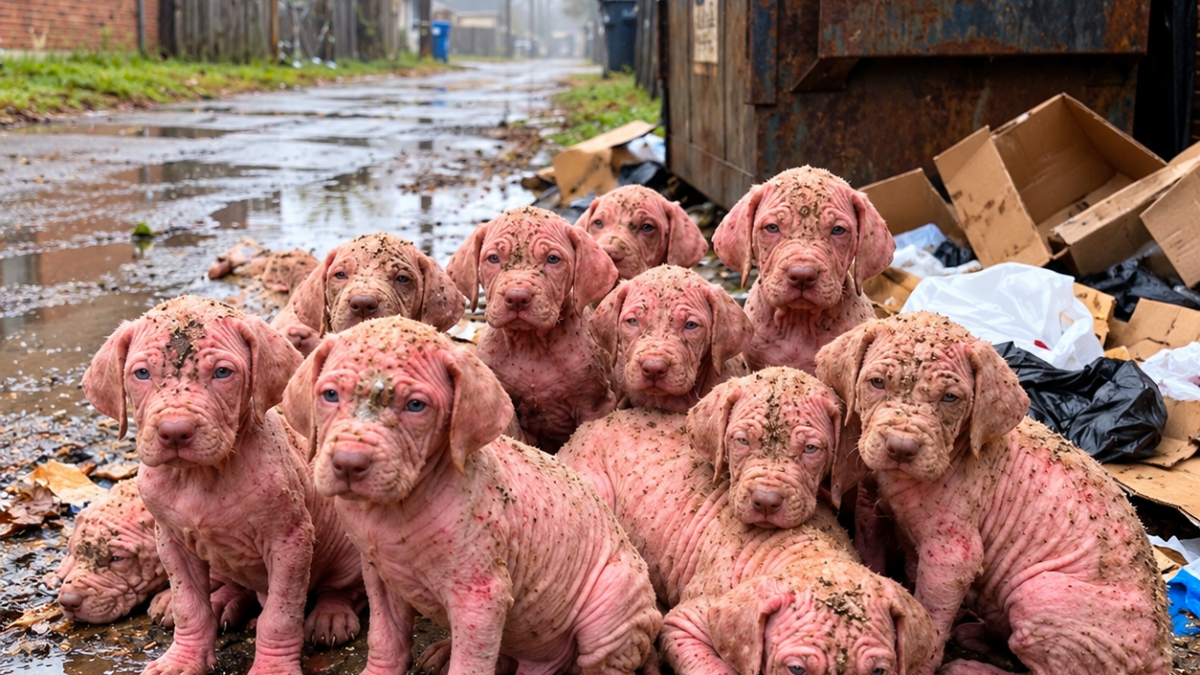
PART 2
For a moment, all I could hear was traffic at the far end of the block.
A car door slammed.
Somewhere above us, an air conditioner rattled in a window.
The puppies made soft, restless sounds behind me.
I looked at the elderly woman.
“You saw her come back?”
“Not when she was hit.”
“What did you see?”
“My name is Rosa Alvarez.”
She touched one hand to her chest, almost as if she had suddenly remembered we had never introduced ourselves.
“I live right there.”
She pointed toward a second-floor apartment overlooking the alley.
“I saw her the next morning.”
“Alive?”
Rosa nodded.
“Barely.”
The sanitation worker shifted his weight beside us.
“What happened after that?”
I asked.
Rosa looked ashamed.
“I called the city.”
“When?”
“Early that morning.”
“And?”
“They said someone would come.”
“Did someone?”
“Yes.”
“When?”
“Later.”
My eyes moved to the puppies.
“They took the mother.”
“Yes.”
“But not them.”
Rosa shook her head.
“They were hiding.”
I looked behind the dumpster again.
There were gaps beneath broken furniture, flattened cardboard boxes, and a piece of old plywood propped against the wall.
Five frightened puppies could easily disappear in that mess.
“The crew didn’t know they were there?”
“I don’t think so.”
“Did you tell them?”
“I tried.”
Her voice tightened.
“I told the man she had puppies. He said he didn’t see any.”
I closed my eyes for a second.
Nobody had necessarily intended to leave them.
That almost made it harder.
One person saw an injured stray.
Another called for help.
A city crew removed the mother’s body.
The puppies hid.
People assumed someone else had handled the rest.
And somehow five sick babies remained behind.
I turned toward the sanitation worker.
“You said you noticed them two days ago.”
“Yeah.”
“Why didn’t you call?”
“I did.”
“Who?”
“Dispatch.”
“And?”
“They said animal services was backed up.”
His jaw tightened.
“I started bringing water.”
I noticed a cut plastic container near the wall that I had assumed was trash.
“That yours?”
He nodded.
“I’m here every morning.”
“Food?”
“Some.”
“They eat?”
“Not much.”
I looked at the puppies.
At least they had not gone completely without water.
That mattered.
But they needed far more than one man could provide behind a dumpster.
I opened a large carrier and lined it with towels.
“We’re taking them now.”
The first puppy I picked up was the one who had tried standing.
He weighed almost nothing.
I expected him to fight.
Instead, he simply folded against my chest.
His skin smelled infected.
Warm in patches.
His ears were thick with debris.
When I touched beneath his neck, he flinched.
“Sorry.”
His eyes lifted toward me.
No trust.
No aggression.
Only fatigue.
I placed him into the carrier.
Immediately, the others started crying.
The sound changed completely.
Panic.
“They think you’re taking him away,” Rosa whispered.
“I’m not separating them.”
I carried them in pairs whenever I could.
The fourth puppy tried backing under the plywood.
I moved slowly.
No grabbing.
No cornering.
“Easy.”
She trembled harder.
I slid a towel beneath her and lifted gently.
She cried once.
The puppy already in my carrier answered.
I held her close enough to smell the others.
“You’re staying together.”
The final puppy was the smallest.
She barely moved when I picked her up.
That frightened me most.
A healthy puppy should object to being handled by a stranger.
This one simply rested against my forearm.
I could feel each rib.
I put all five into two carriers positioned side by side.
The moment they could smell and hear one another, the crying eased.
Rosa stood near my vehicle.
“Will you tell me what happens?”
“Yes.”
“Promise?”
“Yes.”
She looked toward the dumpster.
“Their mama was a good dog.”
“I believe you.”
“She was scared of people.”
“How long had she been here?”
“Months.”
“Did anybody know where she came from?”
“No.”
Rosa shook her head.
“She just appeared.”
“Did anyone try to catch her?”
“A rescue once.”
“What happened?”
“She ran.”
That did not surprise me.
Some stray dogs survive because they distrust people.
Then that same distrust makes helping them harder.
“She let you feed her?”
“I put food down and went upstairs.”
“Did she come?”
“Eventually.”
“What did you call her?”
Rosa smiled sadly.
“Mama.”
It was not much of a name.
But it was the only one she had.
I loaded the carriers.
Before closing the vehicle, I looked back at the place where she had spent her last hours.
The story was easy to romanticize.
A dying mother crawling back to her puppies.
But standing there, I did not feel inspired.
I felt angry.
She should not have needed to do that.
She should have had a home.
She should have had veterinary care.
She should never have been raising five puppies behind a dumpster.
Her devotion was real.
So was the failure surrounding it.
I drove to the clinic.
One puppy cried almost continuously.
Another answered whenever the first stopped.
I talked to them even though I knew my voice meant nothing yet.
“You’re okay.”
Whine.
“You’re together.”
Cry.
“I know.”
The smallest puppy remained quiet.
Every few minutes I checked the mirror.
Her body rose and fell.
That was enough to keep me driving.
Dr. Patel met us at the isolation entrance.
The moment she saw them, her entire posture changed.
“How many?”
“Five.”
“Age?”
“Maybe six to seven weeks.”
“Mother?”
“Dead.”
Dr. Patel looked at me.
“What happened?”
“Hit by a car. Apparently crawled back to them afterward.”
She exhaled slowly.
“Let’s get them stabilized first.”
We labeled the puppies with temporary colored bands because they looked similar beneath the dirt and missing fur.
Blue.
Red.
Yellow.
Green.
Purple.
Purple was the smallest.
We weighed them.
Every number was lower than I wanted.
Blue was underweight.
Red was underweight.
Yellow.
Green.
All of them.
Purple was dangerously small.
Dr. Patel checked gums.
“Anemic.”
“How bad?”
“Need bloodwork.”
She examined skin.
“Likely mange.”
“Contagious?”
“Depends on the type. We’ll scrape.”
She listened to Blue’s chest.
He coughed.
My stomach dropped.
“What?”
“Could be irritation. Could be infection.”
“Parvo?”
“Testing.”
“Distemper?”
“Testing.”
I hated the list.
Not because it was unreasonable.
Because every answer took time, and these puppies looked as though they had already used all of theirs.
The first rapid parvo test was negative.
I almost sat down from relief.
“Negative means safe?”
“No.”
Dr. Patel did not let me celebrate too early.
“It means this test is negative. We still isolate because of symptoms and unknown history.”
“Understood.”
Skin scrapings showed mites consistent with mange.
There were secondary bacterial infections.
Fleas.
Intestinal parasites.
Malnutrition.
Dehydration.
Two puppies were significantly anemic.
Purple’s blood sugar was low.
“How serious?” I asked.
Dr. Patel looked toward the smallest puppy.
“She’s the one I’m watching most closely.”
“Will she make it?”
“I don’t know yet.”
“Give me your best answer.”
“She has a chance.”
I hated that phrase.
A chance can mean almost anything.
But it was more than none.
The clinic began treatment.
Fluids for the two most dehydrated puppies.
Carefully measured nutrition.
Deworming.
Skin treatment appropriate to their ages and weights.
Antibiotics for the infected lesions.
Warm bedding.
Glucose support for Purple.
The puppies were cleaned gently.
Not because they needed to look better.
Because dirt, feces, and infected skin made recovery harder.
The first bath was heartbreaking.
Red cried the entire time.
Green tried climbing out of the basin.
Blue trembled.
Yellow became strangely still.
Purple barely reacted.
Dr. Patel noticed my face.
“Don’t confuse quiet with comfort.”
“I know.”
“She’s exhausted.”
“I know.”
“Then stop looking like this is the end.”
I looked at her.
“That easy?”
“No.”
She softened.
“But right now, they are warmer than this morning. They have fluids. They have food. They have medication.”
She pointed toward the puppy enclosure.
“Measure the next hour, not the next year.”
That night I went home.
I made it until 12:07 a.m.
Then the clinic called.
I answered before the second ring.
“Which puppy?”
The technician paused.
“You already know?”
“Purple.”
“Yes.”
I sat upright.
“What happened?”
“Her glucose dropped.”
“How low?”
She told me.
My hand tightened around the phone.
“We’ve corrected it.”
“Is she conscious?”
“Yes.”
“Eating?”
“Small amounts.”
“I’m coming.”
“You don’t have to.”
“I know.”
The clinic lobby was dark when I arrived.
A technician let me through the side entrance.
I put on protective gear and sat outside isolation.
Purple lay beneath a warming blanket.
Blue was beside her.
Even sick, the puppies pressed together.
Purple’s head looked too small for the blanket surrounding her.
I sat on the floor.
“Come on, baby.”
Blue crawled toward my hand.
He sniffed.
Then licked one finger.
That tiny lick nearly broke me.
“You’re supposed to be resting.”
His tail moved once.
Purple opened her eyes.
I did not touch her.
I only stayed where she could see me if she wanted.
The technician came back with a syringe of formula.
“She took some fifteen minutes ago.”
“Enough?”
“For now.”
Those words became another phrase I learned to accept.
For now.
Hope is often not a long-term promise.
Sometimes it is enough nutrition for the next hour.
Enough warmth.
Enough glucose.
Enough strength to remain present.
I stayed until after two.
Purple stabilized.
Before leaving, I looked at all five.
“Tomorrow you get names.”
The technician smiled.
“Not tonight?”
“If I name them tonight, I’ll never sleep.”
“You already weren’t sleeping.”
Fair.
The next morning, we stopped calling them by colors.
Blue became Milo.
Red became Ruby.
Yellow became Sunny.
Green became Finn.
Purple became Hope.
Obvious?
Absolutely.
Nobody cared.
Hope was still the smallest.
Still fragile.
But she ate a little more that morning.
Dr. Patel showed me the amount.
“That’s good?”
“That’s good.”
“Good enough?”
“There you go again.”
“What?”
“Trying to turn one meal into a prognosis.”
I sighed.
“Fine.”
She pointed at the puppies.
“Watch the direction.”
The direction was slowly improving.
Milo became the first to greet people.
He still looked terrible.
Patchy coat.
Red skin.
Skinny legs.
But when a technician entered, he lifted his head.
Then his tail.
By day three, Ruby had enough strength to protest medication.
Loudly.
“That’s a good sign,” I said.
The technician laughed.
“You can administer it tomorrow.”
Finn discovered that shoelaces existed.
Sunny discovered that food bowls could be entered with all four feet.
Hope discovered nothing.
Not yet.
She mostly slept.
That worried me.
Then, on the fourth morning, I entered isolation.
Hope raised her head before I spoke.
I froze.
“Hi.”
Her ears moved.
I crouched.
She stood.
Slowly.
Her legs shook.
But she stood.
Three seconds.
Maybe four.
Then sat.
I smiled so hard my face hurt.
“Dr. Patel!”
The veterinarian looked in.
“What?”
“Hope stood.”
Dr. Patel looked at me.
“Yes.”
“You saw?”
“Yes.”
“Why are you not more excited?”
“Because I’ve been watching her stand since six this morning.”
I stared.
“You knew?”
“I work here.”
“You could have texted.”
“I assumed you would eventually arrive like a normal person.”
I looked at Hope.
“Still counts.”
“It does.”
The puppies remained hospitalized for a week.
During those days, I returned to the apartment complex.
I told myself I needed background information for the rescue records.
That was partly true.
The other truth was Mama stayed in my mind.
Rosa invited me upstairs.
Her apartment overlooked the alley.
From the kitchen window, I could see the dumpster.
“Where did Mama first appear?”
Rosa pointed toward an overgrown area beyond the fence.
“There.”
“Pregnant?”
“Not then.”
“How long before the puppies?”
“Maybe four months.”
“Could anyone get near her?”
“No.”
“Ever?”
“Children sometimes.”
That surprised me.
“Children?”
“She wasn’t as afraid of them.”
Rosa brought out her phone.
She showed me a picture.
Mama stood twenty feet from a little girl sitting on the sidewalk.
Thin.
Alert.
Ears raised.
“She stayed there?”
“Ten minutes.”
“Food?”
“The girl threw pieces of chicken.”
Another photograph showed Mama near Rosa’s steps.
“I put bowls out.”
“You never touched her?”
“No.”
“Did she growl?”
“Never.”
“Run?”
“Always.”
Then came the pregnancy.
Nobody knew which dog had bred with her.
Nobody knew whether it had happened before she reached the neighborhood.
Rosa noticed her abdomen growing.
She contacted a rescue group.
Volunteers tried a humane trap.
Mama vanished for three days.
When she returned, she would no longer approach the feeding spot.
“She thought the trap was dangerous,” I said.
“Yes.”
“Did they try again?”
“They were supposed to.”
“What happened?”
“Another emergency. Then another.”
That was rescue work.
Too many animals.
Not enough fosters.
Not enough money.
Not enough hours.
People imagine there is always an organization waiting with an empty kennel.
There often is not.
Mama gave birth somewhere behind a boarded-up storage building.
Rosa did not see the puppies for weeks.
Then heavy rain came.
The drainage ditch behind the building flooded.
Rosa watched from her window as Mama appeared carrying something.
A puppy.
“She carried them?”
“One at a time.”
“To the dumpster?”
“Yes.”
“How many trips?”
“Five.”
Rosa counted.
Mama disappeared.
Returned with a puppy.
Disappeared.
Returned again.
Five times.
The dumpster area was ugly.
But slightly elevated.
Dry.
Protected on three sides.
It was the safest place Mama could find.
“She saved them from the rain,” Rosa said.
I stared at the location.
“She already rescued them once.”
Rosa nodded.
Then came the car.
A resident heard brakes and a dog cry.
By the time Rosa came downstairs, Mama had disappeared beneath a parked car.
Someone called for help.
The driver stopped but eventually left after giving information to another resident.
Mama was injured badly.
When people tried approaching, she dragged herself away.
Nobody could catch her.
Sometime during the night, she returned to the dumpster.
“How far from where she was hit?”
I asked.
“Maybe two blocks.”
Two blocks.
For a healthy dog, nothing.
For a dying one, enormous.
Rosa found her in the morning.
Five puppies pressed around her.
“She was breathing?”
“Yes.”
“Could she stand?”
“No.”
“Did she react when you came close?”
“She looked at me.”
Rosa’s voice broke.
“I brought water.”
“Did she drink?”
“No.”
“Food?”
“No.”
“The puppies?”
“They were trying to nurse.”
I looked down.
Rosa wiped her face.
“I thought the city would come faster.”
“You called.”
“I should have done more.”
“Like what?”
“I don’t know.”
That was the danger after something terrible happens.
Everyone rewrites themselves into someone who could have prevented it.
“If you hadn’t been feeding her for months, she might not have lived long enough to have those puppies.”
“That doesn’t help.”
“I know.”
“If I had caught her—”
“You couldn’t.”
“If I had tried harder.”
“The rescue tried.”
Rosa looked toward the window.
“Still feels like failure.”
I understood.
“Then help me make the part after her not fail.”
She looked at me.
“How?”
“Tell me everything you remember. Help us follow the puppies. When they’re ready, help me make sure they end somewhere better.”
Rosa nodded.
That was something we could do.
Back at the clinic, Hope had developed diarrhea.
The call came while I was driving.
“Please tell me this is routine.”
Dr. Patel did not.
“We’re repeating infectious testing.”
“Parvo?”
“Yes.”
My stomach dropped.
The test remained negative.
Additional evaluation suggested intestinal parasites, stress, malnutrition, and gastrointestinal sensitivity were the likely causes.
Still dangerous.
But treatable.
Hope returned to fluids.
Her weight dipped slightly.
For one day, she stopped improving.
That day felt longer than the previous week.
I sat with Karen, one of our experienced foster volunteers, in the clinic lobby.
She had come to meet the puppies before taking them home when medically cleared.
“You’re staring at the door.”
“I know.”
“You think that will make the doctor appear?”
“Yes.”
“Interesting.”
“I’m testing a theory.”
Karen handed me coffee.
“You need caffeine.”
“I need Hope to eat.”
“She will.”
“You don’t know that.”
“No.”
Karen took a sip.
“But I’ve fostered sick puppies before.”
“So?”
“So sometimes they scare you right before they turn a corner.”
“And sometimes?”
She looked at me.
“Sometimes they don’t.”
I appreciated that she did not lie.
“Why do you keep doing this?”
“Fostering?”
“Yes.”
Karen thought.
“Because when it works, somebody gets to become a dog instead of staying a case.”
That sentence came back to me often.
Right then, Hope was a case.
Blood sugar.
Weight.
Parasites.
Anemia.
Fluids.
Skin lesions.
Diarrhea.
Medication.
We wanted her to become a puppy.
Finn had already started.
He barked whenever a technician walked past.
Ruby discovered she had lungs.
Milo wagged at everyone.
Sunny had become obsessed with meals.
Hope was still catching up.
The next morning, she ate half her breakfast.
At lunch, more.
That afternoon, she walked across the enclosure.
Five steps.
Stopped.
Then stepped on Finn.
Finn screamed.
Hope stared.
I laughed.
Dr. Patel looked at me.
“There.”
“What?”
“Puppy problem.”
Not medical crisis.
Sibling conflict.
Exactly what we wanted.
At the end of the week, four puppies were cleared to leave.
Hope was not.
The foster plan had assumed all five would go together.
Karen frowned.
“What happens if I take four?”
“Hope stays hospitalized.”
“Will separation hurt her?”
“Maybe temporarily.”
I looked through the glass.
The puppies were piled together.
Hope had always slept in the center.
Dr. Patel joined us.
“Keeping four medically cleared puppies in hospital has costs and infection risks too.”
“I know.”
“Hope may need another forty-eight hours.”
Karen crossed her arms.
“I can come back.”
“We know.”
I hated the decision.
There was no perfect option.
Finally, we moved four puppies into Karen’s foster home.
Hope remained.
The moment the others were carried away, she cried.
A small, sharp sound.
I sat beside her enclosure.
“I know.”
She walked to the front.
Cried again.
I felt terrible.
The technician brought a blanket the siblings had slept on.
Hope smelled it.
Then curled on top.
That night Karen sent me a photograph of Milo, Ruby, Sunny, and Finn sleeping in a pile.
I did not show Hope.
Ridiculous, I know.
She was a dog.
But the guilt was irrational too.
The next morning, I arrived early.
Hope was eating.
Standing.
Alert.
Dr. Patel smiled.
“If she keeps this up, she goes tomorrow.”
“She heard the others got a house.”
“Excellent scientific explanation.”
The next afternoon, Hope was discharged.
I drove her to Karen’s place.
The moment we entered the puppy room, the other four went insane.
Milo barked.
Ruby squealed.
Finn tried climbing the pen.
Sunny ran in circles.
Hope froze.
Then her tail moved.
I placed her down.
They surrounded her.
Smelling.
Licking.
Stepping on her.
Hope disappeared beneath siblings.
Karen laughed.
“Welcome home.”
For the first time, all five puppies were safe somewhere that did not smell like disinfectant.
The room was warm.
Blankets clean.
Water full.
Food scheduled.
There were no cars rushing past.
No dumpster.
No mother.
That absence remained.
But for the first time, absence was not the only thing defining them.
Foster care was not easy.
Five recovering puppies with skin disease create an unbelievable amount of laundry.
We washed blankets constantly.
Disinfected surfaces.
Administered medication.
Tracked weights.
Cleaned ears.
Checked stool.
Watched skin.
Karen sent me updates morning and night.
**Milo +4 oz.**
**Ruby scratching less.**
**Finn committed three crimes before breakfast.**
**Sunny climbed into food bowl again.**
**Hope ate full meal.**
The first photograph where Hope’s belly looked slightly round made me cry.
Not bloated.
Fed.
There is a difference.
Their skin slowly improved.
Mange treatment worked.
Inflammation decreased.
Scabs disappeared.
Soft hair began emerging where bare skin had been.
It did not happen overnight.
That was important.
Recovery photographs often compress weeks into two images.
Before.
After.
What disappears between them are the baths.
Medication.
Vomiting.
Missed sleep.
Setbacks.
Vet bills.
Laundry.
The puppy who looks worse one morning and better that afternoon.
The foster who sits on the floor at 2:00 a.m. because one dog will not settle.
The question repeated every day.
Are we moving forward?
With these five, eventually the answer became yes.
Milo became confident first.
He adored people.
Anyone entering the room was obviously there for him.
Ruby was more cautious.
She watched first.
Then approached.
Sunny cared mainly about food.
If she disappeared, check the kitchen.
Finn believed rules were personal challenges.
Karen put up a baby gate.
Finn studied it.
Twenty minutes later, he was on the other side.
“How?”
Karen asked.
Finn wagged.
Hope stayed different.
Not unhealthy.
Cautious.
She followed Karen.
Not immediately at first.
But gradually.
One morning, Karen walked into the kitchen.
She turned.
Hope was behind her.
“You escaped.”
Hope sat.
Karen walked farther.
Hope followed.
Coffee maker.
Hope.
Laundry room.
Hope.
Living room.
Hope.
Karen texted me.
**We have a shadow.**
I replied:
**Congratulations.**
She responded:
**No.**
I knew exactly what that meant.
Foster denial.
Weeks passed.
Vaccinations began.
More deworming.
Rechecks.
Ruby’s anemia resolved.
Hope’s blood values improved.
All five gained steadily.
The skin that once looked painful became healthy pink beneath new fur.
They spent time outside.
Their first grass experience was chaos.
Milo stepped onto the lawn and froze.
Sunny tried eating grass immediately.
Ruby smelled everything.
Finn charged forward and ran into a flowerpot.
Hope stayed at the doorway.
Karen sat several feet away.
No leash pressure.
No calling.
No reaching.
“Whenever you’re ready.”
Hope watched her siblings.
Milo ran past.
Finn chased him.
Ruby joined.
Hope stepped out.
One paw.
Then another.
She stopped.
A bird moved in the hedge.
Hope jumped backward.
Karen stayed still.
After another minute, Hope tried again.
This time she reached the grass.
She smelled it.
Then Milo bumped her while running.
Hope startled.
Then chased him.
Five seconds.
Maybe ten.
I watched the video six times.
A month earlier, Hope had been too weak to stand.
Now she was running because another puppy had annoyed her.
That was recovery.
Not looking beautiful.
Having enough energy for nonsense.
The adoption applications began before the puppies were officially available.
We ignored them until the time was right.
Puppies with dramatic rescue histories attract people.
Some excellent.
Some not.
One message said:
**I want the saddest one.**
Deleted.
Another:
**Which puppy suffered most? My daughter wants to save one.**
No.
One applicant wanted whichever dog would remain smallest.
No guarantee.
Another wanted a puppy immediately as a birthday surprise.
Absolutely not.
I became protective.
Maybe too protective.
Karen called me out.
“You know we have to let people adopt them.”
“I know.”
“You are acting like nobody is good enough.”
“Most aren’t.”
“Claire.”
“What?”
“Read the whole application before deciding they’re terrible.”
I sighed.
“Fine.”
She was right.
Rescue can create its own kind of control.
After fighting so hard to save animals, letting strangers take them feels impossible.
But keeping every animal is not rescue.
Finding the right future is.
Milo’s application came from a family with two boys, ages ten and thirteen.
They had owned a dog before.
Fenced yard.
Veterinary reference.
Parent working from home several days each week.
They came for a meeting.
The boys sat on the floor.
They did not call Milo repeatedly.
Did not chase him.
Did not grab.
Milo approached on his own.
Smelled the older boy.
Climbed into his lap.
The boy looked at his mother.
“Can I pet him?”
That question decided most of it for me.
He asked.
He waited.
“Yes.”
Milo relaxed into his hands.
The younger boy whispered, “He’s warm.”
I smiled.
“He should be.”
Milo went home two weeks later after final veterinary clearance.
Karen cried after the car left.
“I hate this.”
“You’ve fostered sixty puppies.”
“I hated fifty-nine goodbyes too.”
“What about number one?”
“I didn’t know enough yet.”
We laughed.
Then returned inside.
Four puppies remained.
The room felt too quiet.
Ruby searched for Milo.
Finn did too.
Hope walked around smelling the blanket he had used.
Karen sat with them.
“They’ll adjust.”
I knew.
Still hurt.
The first update came that night.
Milo asleep between the boys.
One hand resting on his back.
Clean blanket.
Full stomach.
I sent it to Rosa.
Her reply came quickly.
**Mama would be happy.**
I stared at that sentence.
I could not know what Mama would understand.
But I knew what she had fought for.
A living puppy.
Milo was alive.
Ruby found her family next.
A quiet couple with an older mixed-breed dog.
During the introduction, Ruby stayed behind Karen at first.
The older dog did not push.
He smelled the air.
Lay down.
Ruby watched.
Then approached slowly.
Five minutes later, she was chewing his leash.
The adopter laughed.
“I think that’s approval.”
Ruby went home.
Sunny’s adoption was almost comically easy.
She met a retired teacher who had prepared more carefully for one puppy than some people prepare for children.
Food measured.
Veterinarian scheduled.
Training class booked.
Crate.
Bed.
Another bed.
And apparently a third bed upstairs.
“She has three beds?”
I asked.
The woman shrugged.
“One was on sale.”
Sunny immediately fell asleep on the floor.
I laughed.
“Money well spent.”
Three puppies gone.
Finn and Hope remained.
Finn received many applications.
Most were wrong.
Too little exercise.
Too much expectation that he would be calm.
One applicant wanted a companion for an elderly relative.
Finn was currently sprinting across the room with a towel.
No.
Then Rachel applied.
Thirty-two.
Runner.
Flexible work schedule.
Fenced yard.
Experience with high-energy dogs.
No young children.
Training plans already researched.
She met Finn.
He untied her shoe.
She stared down.
“You’re trouble.”
Finn wagged.
Not:
Poor baby.
Not:
Look what happened to you.
Trouble.
A future identity.
Exactly what he needed.
During the home visit, Finn explored every room.
Rachel did not follow anxiously.
She had puppy-proofed.
Covered cords.
Secured trash.
Put shoes away.
Mostly.
Finn found one anyway.
Rachel looked at me.
“He found the only one I missed.”
“Consider it an audit.”
Finn went home.
That left Hope.
The smallest.
The one we almost lost.
By then, nobody looking at her would have guessed.
Her fur had grown.
Eyes bright.
Weight healthy.
She played.
Stole toys.
Barked at the vacuum.
She was still cautious with new people.
But around Karen?
Different dog.
Hope followed her constantly.
Karen denied attachment.
Repeatedly.
“I am fostering.”
“Correct.”
“She needs permanent placement.”
“Correct.”
“I am not keeping her.”
“Absolutely.”
“You’re making fun of me.”
“Never.”
One evening, I arrived and found Hope asleep against Karen’s older dog on the couch.
Karen was sitting in a chair.
“Thought dogs weren’t allowed on the couch.”
“That rule existed before Hope.”
“Interesting.”
“It’s temporary.”
“Of course.”
Applications came.
One family was excellent.
Quiet home.
Older children.
Dog experience.
Work schedules compatible.
They met Hope properly.
No rushing.
Hope approached after fifteen minutes.
Took treats.
Allowed touch.
Nothing wrong.
Afterward, Karen was miserable.
“They’re perfect.”
“I know.”
“I hate them.”
“I know.”
“They didn’t do anything.”
“No.”
Karen sat down.
“I’m supposed to let her go.”
“You’re supposed to do what is right for Hope.”
“She could be happy there.”
“Yes.”
“She’s happy here.”
“Yes.”
“This is not helping.”
I smiled.
“You want me to make the decision.”
“Yes.”
“I won’t.”
“Why?”
“Because you know.”
Karen looked toward Hope.
Hope was following Karen’s older dog toward the bedroom.
“What if I’m keeping her because goodbye hurts?”
“Then don’t.”
“What if I’m keeping her because this is her home?”
“Then do.”
Karen sat silently for a long time.
Finally she said, “She knows this house.”
“Yes.”
“She trusts my dogs.”
“Yes.”
“She follows me.”
“Yes.”
“She sleeps on my couch.”
“Apparently.”
Karen laughed.
Then cried.
“I think she’s home.”
So Hope stayed.
The puppy named for uncertainty became the one puppy who never had to move again after foster care.
Months later, I organized a reunion.
All five puppies.
Not babies anymore.
Adolescents.
Long legs.
Healthy coats.
Bodies full.
The first one to arrive was Milo.
He jumped from the car and immediately dragged one of his boys across the parking lot.
Ruby came next.
Then Sunny.
Finn arrived at maximum speed.
Hope stayed close to Karen at first.
For a few minutes, it looked like five unrelated dogs meeting.
Sniff.
Circle.
Play bow.
Pause.
Then Finn ran.
Milo followed.
Ruby joined.
Sunny barked.
Hope watched.
Then ran after them.
All five crossed the yard.
Turned.
Came back.
Again.
Again.
Their adopters laughed.
Rosa sat in a folding chair near the fence.
She had asked to come.
Of course I said yes.
Tears ran down her face as the dogs played.
“You okay?”
She nodded.
“I keep seeing them behind that dumpster.”
“Me too.”
“They were so small.”
“I know.”
“And sick.”
“I know.”
She looked toward Hope.
“That one?”
“Yes.”
“The one you thought might die?”
“Yes.”
Hope was currently wrestling Finn.
Rosa laughed through tears.
“Look at her.”
I did.
Strong legs.
Full coat.
Tail high.
No trace of the puppy lying under a warming blanket.
Rosa grew quiet.
“I wish Mama could see this.”
There was no easy response.
I sat beside her.
“She got them far enough.”
Rosa nodded.
“Barely.”
“Sometimes barely is enough.”
That was the truth.
Mama had not lived to see vaccinations.
She never saw Milo carried into a house by two boys.
She never saw Ruby sleep beside an older dog.
Never saw Sunny choose the floor over three expensive beds.
Never saw Finn become someone’s running partner.
Never saw Hope claim Karen’s couch.
But everything Mama did before she died had moved them toward those futures.
She found food.
Kept them warm.
Moved them out of floodwater.
Returned after she was injured.
Stayed beside them.
Then other people had to take over.
That is rescue too.
Not one person doing everything.
One life handed forward.
At the reunion, the dogs eventually collapsed under a shade tree.
Not in a desperate pile.
They had space.
Milo on one side.
Ruby nearby.
Finn chewing a stick.
Sunny asleep.
Hope stretched near Karen’s feet.
I took a photograph.
Five healthy dogs.
When I compared it later with the original dumpster photo, the contrast was almost impossible to process.
Same animals.
Different world.
The first image showed survival.
The second showed life.
That distinction mattered.
Survival is not the final goal.
Living is.
After the reunion, each family left separately.
The scene affected me more than I expected.
At the dumpster, the puppies had lost their mother all at once.
Now they separated again.
But differently.
Milo walked toward a car because two boys called his name.
Ruby climbed into a back seat with her family.
Sunny went home with her retired teacher.
Finn nearly pulled Rachel off balance trying to reach his vehicle.
Hope jumped into Karen’s car.
Every departure had a destination.
Every dog belonged somewhere.
No one was being abandoned.
I watched Karen drive away last.
Hope stood with her front paws against the rear window.
Tail moving.
I raised my hand.
“Go home.”
The car turned out of the lot.
The space became quiet.
Rosa stood beside me.
“They’re gone.”
“Yes.”
She smiled.
“That’s good now.”
“Yes.”
Gone could mean something different.
That was another thing rescue taught me.
A year after I found them, I returned to the apartment complex.
Not for the puppies.
Another call nearby.
When I finished, I walked behind the building.
The dumpster was still there.
Same metal.
Different trash.
The pavement had been pressure-washed at some point.
Nothing marked the spot.
I stood exactly where Hope had lain.
A young man came outside carrying a garbage bag.
“You okay?”
“Yes.”
“You lose something?”
I almost said yes.
Then stopped.
“No.”
He threw the bag away.
Went inside.
I remained another minute.
No memorial.
No sign.
No plaque saying five puppies almost died here.
That was fine.
Their lives were elsewhere.
The evidence of rescue did not need to remain in the alley.
It slept on couches.
Destroyed shoes.
Waited for breakfast.
Ran trails.
Barked at delivery drivers.
That was better.
I visited Rosa before leaving.
She had printed the reunion photograph.
It sat in a small frame near her kitchen.
“All five?”
I asked.
“All five.”
“You printed it.”
“Of course.”
She touched Mama’s old photograph on her phone.
“I still have hers too.”
We sat quietly.
Then Rosa said, “I used to think I failed her.”
“Mama?”
“Yes.”
“You helped keep her alive.”
“I didn’t save her.”
“No.”
There was no point lying.
“She died.”
Rosa’s eyes lowered.
“But the puppies?”
“Alive.”
“All of them?”
“Yes.”
“Happy?”
“Yes.”
“Then maybe…”
She stopped.
“Maybe what?”
“Maybe helping her mattered even though it wasn’t enough to save her.”
I nodded.
“That’s how this works sometimes.”
Nobody wants partial victories in rescue.
We want everyone saved.
Every mother.
Every puppy.
Every injured dog.
Every stray.
Reality refuses.
Sometimes you lose one and save five.
That is not justice.
It is still worth doing.
The updates continued.
Milo graduated from beginner training.
His adopter sent a photograph of him sitting beside a certificate.
He had apparently stolen the instructor’s treat pouch ten minutes earlier.
Ruby developed a habit of sleeping beneath her family’s dining table.
Sunny gained a reputation for waking her adopter at exactly 5:45 every morning.
Finn became an excellent running companion after months of training.
Hope became Karen’s shadow.
One Christmas, Karen sent me a photograph.
Hope wore a red bandana.
Her coat was full and shiny.
Behind her stood a decorated tree.
She looked mildly annoyed by the camera.
Caption:
**The sickest puppy is now mad because dinner is seven minutes late.**
I stared at the photograph.
Seven minutes late.
Once, Hope had been hungry long enough for her blood sugar to become dangerous.
Now seven minutes mattered.
That difference contained an entire rescue.
I saved every update.
Not because the dogs needed their old story preserved.
Because I did.
There is a temptation in animal rescue to keep animals emotionally trapped in the worst photograph anyone ever took of them.
The starving dog.
The burned dog.
The puppy with mange.
The dog behind bars.
Those images get attention.
But attention is not identity.
Hope was not “the dying puppy.”
Finn was not “the dumpster puppy.”
Milo was not “the orphan.”
Those things happened to them.
They were not what they became.
I tried to remember that when talking about Mama too.
She was not simply “the dead mother.”
She had lived months before that accident.
She had navigated streets.
Avoided people.
Accepted food from Rosa.
Found shelter.
Gave birth.
Moved her puppies away from floodwater.
Returned after injury.
She had a whole existence we saw only in fragments.
The puppies were part of it.
Not the entire thing.
One afternoon, Rachel called me about Finn.
My first thought was something was wrong.
“Is he okay?”
“He’s fine.”
“Then why are you calling?”
“He did something.”
“What?”
“We were running.”
I waited.
“He stopped by a dumpster.”
My stomach tightened.
“Okay.”
“I thought he smelled food.”
“Probably.”
“He stood there for maybe thirty seconds.”
“Then?”
“Then kept running.”
I said nothing.
Rachel seemed to realize what I was thinking.
“I’m not saying he remembered.”
“Good.”
“I know dogs don’t work like that.”
“We don’t know what he remembered.”
“Exactly.”
Finn had been very young at rescue.
Could scent trigger some buried familiarity?
Maybe.
Could it simply have smelled like food?
More likely.
Not every ordinary action needs to become symbolic.
“What happened after?”
Rachel laughed.
“He chased a squirrel.”
“Much more believable.”
Still, after the call, I thought about five puppies behind a dumpster.
Their entire universe had been maybe twenty feet wide.
Concrete.
Trash.
Their mother.
One another.
Then that world broke.
Everything afterward was expansion.
Clinic.
Foster room.
Grass.
Cars.
Homes.
Families.
Trails.
Bedrooms.
Kitchens.
The world got bigger.
That was the best part.
Two years after rescue, Karen hosted another gathering.
Not all five families could come.
Milo and Ruby did.
Finn did.
Hope obviously lived there.
Sunny’s adopter sent a video instead.
The dogs were adults now.
Not puppies.
I almost did not recognize Milo at first.
Broad chest.
Healthy coat.
Ruby had become elegant.
Finn still looked slightly guilty even when innocent.
Hope stood beside Karen with complete confidence.
No frightened puppy remained on the surface.
Karen handed me an old towel.
“What’s this?”
“You gave it to me the day Hope came here.”
I looked closer.
One corner was faded.
“That blanket?”
“Yep.”
“You kept it?”
“I keep weird things.”
“Why?”
Karen shrugged.
“Same reason you keep their medical files.”
“I legally have to.”
“No you don’t.”
“Fair.”
Hope smelled the towel.
No reaction.
Then Finn tried stealing it.
Karen pulled it away.
“Some things never change.”
We laughed.
Later, I stood in the yard watching Hope.
She approached a stranger.
Slowly.
Smelled his hand.
Then allowed him to pet her chest.
That was enormous for the dog she had once been.
Not because every dog must love strangers.
They do not.
Because Hope was choosing.
The puppy behind the dumpster had no choices.
Cold.
Hunger.
Disease.
Mother gone.
Now she could choose whether to approach.
Whether to move away.
Where to sleep.
Which toy.
Which person.
Choice is one of the quietest parts of recovery.
And one of the most important.
The families sometimes asked whether the puppies should know their history.
I always laughed.
“They’re dogs.”
“I mean, should we keep something from the rescue?”
Photos?
Blankets?
Names?
My answer was simple.
“If it matters to you.”
The dogs did not need a shrine.
They needed veterinary care when sick.
Good food.
Training.
Safety.
Patience.
The rest belonged to humans.
Rosa kept Mama’s memory.
Karen kept the towel.
I kept the photographs.
The families kept the dogs.
That seemed like the right division.
Years later, the dumpster story became less painful to tell.
Not painless.
Less painful.
Because the ending had grown longer than the beginning.
The puppies spent only part of their lives behind that dumpster.
The rest?
Years.
Homes.
Birthdays.
Vet visits.
Training.
Walks.
Vacations.
Furniture destruction.
Ordinary mornings.
The crisis that once seemed like their entire story became one chapter.
That is what I wish for every rescued animal.
Not simply survival.
Enough ordinary years that the terrible part becomes small in comparison.
The last time I visited Rosa, she was older and walking more slowly.
She asked about each dog by name.
“Milo?”
“Good.”
“Ruby?”
“Healthy.”
“Sunny?”
“Still obsessed with food.”
She laughed.
“Finn?”
“Running with Rachel.”
“Hope?”
I showed her a photograph.
Hope lying upside down across Karen’s couch.
Rosa laughed harder.
“Look at that one.”
“The sickest.”
“I remember.”
She touched the phone screen.
“She looked dead.”
“Almost.”
“And now?”
“Completely spoiled.”
“Good.”
She leaned back.
For a while, neither of us spoke.
Then she said, “You think Mama knew somebody would help them?”
“No.”
The answer came easily.
“I don’t think she knew anything except that they were hers.”
Rosa nodded.
“She came back anyway.”
“Yes.”
“She could have hidden somewhere.”
“Probably.”
“But she came back.”
“Yes.”
Rosa looked toward the alley.
“That’s what I remember.”
Me too.
Not as proof dogs understand sacrifice exactly the way humans do.
Not as a sentimental legend.
As behavior.
An injured mother returned to her puppies.
Stayed near them.
They were alive when we arrived.
That was enough.
Before leaving, I walked past the dumpster once more.
Nothing special happened.
No puppies.
No dramatic music.
A delivery truck moved through the alley.
Someone had left a broken chair nearby.
I looked at the concrete.
Then kept walking.
The story no longer lived there.
It lived everywhere those dogs had gone.
Milo’s house.
Ruby’s.
Sunny’s.
Finn’s running trail.
Karen’s couch.
And maybe, in a quieter way, inside the people who had helped.
The sanitation worker who stopped me.
Rosa.
Dr. Patel.
The overnight technician who stabilized Hope’s glucose.
Karen.
Every adopter.
Nobody had done everything.
Each person did something.
That is how five lives crossed from one world into another.
The mother could not follow them.
That remains the hardest truth.
There is no version of the story where I get to change that.
No late reveal where Mama survived.
No reunion.
No miracle.
She died before we came.
I used to resent that ending inside the larger happy one.
Eventually I stopped trying to solve it.
Her life ended.
The puppies’ lives did not.
Those facts exist together.
And perhaps the most respectful thing we could do was not turn Mama’s death into a slogan.
Just remember what she actually did.
She found them shelter.
She fed them while she could.
She moved them away from floodwater.
She returned when injured.
Then other hands continued the work.
Years after the rescue, Karen sent me a final photograph one quiet Sunday morning.
Hope was sleeping in sunlight.
No bandana.
No dramatic pose.
No rescue context.
Just a dog.
Her body stretched across a clean rug.
One ear folded backward.
Her paws twitching slightly in sleep.
Beside her sat a full water bowl.
I stared at the photograph for a long time.
That was the image I wanted associated with the story now.
Not the dumpster.
Not the crusted skin.
Not the desperate eyes.
Not the day we were unsure whether she would survive.
Sunlight.
Sleep.
A full bowl.
Nothing missing.
Nothing urgently wrong.
Hope did not need to know how close she came to dying.
She did not need to understand that her mother was gone.
She did not need to carry gratitude.
She only needed to live.
And she did.
So did Milo.
Ruby.
Sunny.
Finn.
Five puppies who once pressed themselves together because they had nobody else.
Five dogs who eventually learned they could sleep apart because safety no longer depended on another small body keeping them warm.
Five lives their mother kept going long enough for the rest of us to reach.
I still think of Mama sometimes.
Not behind the dumpster.
Not injured.
I imagine her earlier.
Standing at the edge of Rosa’s yard.
Suspicious.
Thin.
Watching.
Waiting until everyone stepped away before approaching the food bowl.
Alive.
Then I imagine the five puppies running across Karen’s yard months later.
Strong.
Healthy.
Far enough from one another that nobody had to huddle.
That is where I leave the story.
Not with death.
Not with rescue.
With distance.
The distance between five frightened puppies pressed against dirty cardboard and five dogs walking through different front doors where somebody was waiting for them.
Mama could not cross that distance with them.
But she got them to the beginning.
We carried them the rest of the way.
[END OF STORY]








