PART 2: The Vet Said My Blind, Broken Cat Might Not Survive the Night—Then He Moved One Ear When I Whispered His Name
PART 2
I stared at him.
“If he makes it through tonight.”
The sentence seemed to change the temperature of the room.
I had been expecting a percentage, maybe some medical language I could cling to, but those seven words were brutally simple.
Tonight.
That was the distance between Jasper and whatever came next.
“What are you doing for him?” I asked.
“Pain control, IV fluids, oxygen support, monitoring for internal bleeding. We’re stabilizing the pelvic fracture and watching his lungs closely. There’s also swelling around the head and eyes.”
“Does he need surgery?”
“Possibly. But right now anesthesia would be dangerous. First we need him stable enough to survive it.”
I nodded even though half of what he was saying barely reached me.
“Can I see him?”
Dr. Patel hesitated.
“For a few minutes.”
The critical-care area was warm and unnaturally bright.
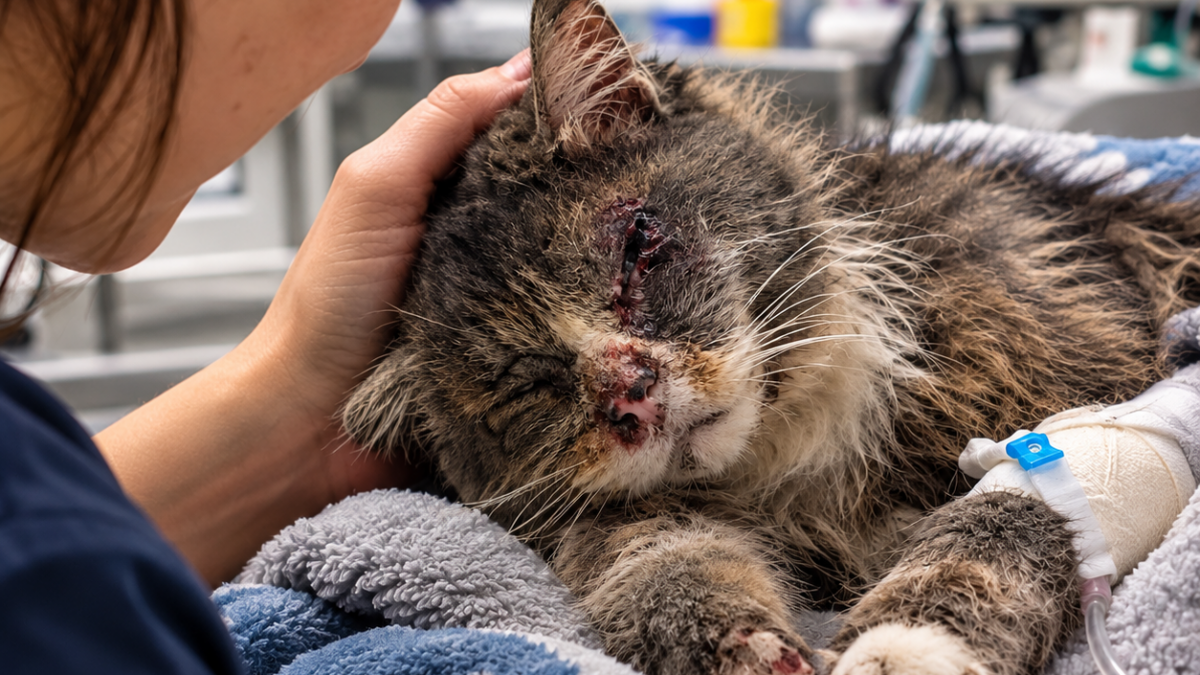
Jasper lay inside an oxygen enclosure on a folded blue blanket.
One foreleg was shaved for an IV.
There was dried blood around his mouth despite someone having cleaned him.
His breathing looked less violent than it had beside the road, but machines surrounded him now.
I hated the machines.
I loved the machines.
They meant he was still here.
A veterinary technician opened a small access panel.
“You can put your hand inside, but don’t move him.”
I slid my fingers through.
“Jasper.”
Nothing.
I touched one finger gently against his cheek.
His ear moved.
Again.
I laughed and cried at the same time.
“You stubborn little jerk.”
The technician smiled faintly.
“He definitely knows your voice.”
I stayed until they told me I had to leave.
Then I sat in the waiting room.
Midnight passed.
Then one.
Then two.
I answered three calls from my older sister, Rachel, and lied every time she asked whether I was okay.
At 2:18, she stopped asking and simply said, “I’m coming.”
“You don’t need to.”
“I know.”
Forty minutes later, she walked through the clinic doors carrying two coffees and my phone charger.
Rachel was five years older than me and had spent most of our lives acting as if my emergencies were items she could organize into manageable categories.
Coffee.
Charger.
Sweater.
Questions.
She sat beside me and handed over the cup.
“What do we know?”
I told her.
When I reached the blindness, my voice cracked.
Rachel took my hand.
“He doesn’t need to see you tonight.”
I looked at her.
“He just needs to stay.”
That was exactly what I needed someone to say.
At 3:07, Dr. Patel came out.
I stood so fast my coffee spilled.
“What happened?”
“His blood pressure dropped.”
My knees weakened.
“But it responded to treatment.”
I exhaled.
“We’re also seeing bruising in the lungs. That can worsen during the first twenty-four hours after trauma.”
“Is he dying?”
“Right now, he’s holding.”
Holding.
Another word I learned to love.
At 4:40, I went outside for air.
The sky was black.
Cars passed on the road beyond the clinic.
Every pair of headlights made something twist inside me.
I kept seeing Jasper beside Hawthorne Avenue.
A cat who never went outside.
That question had been waiting behind the fear all night.
How did he get there?
At 5:12, my phone buzzed.
A notification from my apartment building’s resident app.
**Reminder: exterior hallway door on second floor reported malfunctioning. Maintenance scheduled this morning.**
I read it once.
Then again.
My building had an enclosed second-floor hallway with a stairwell door at the far end.
Jasper sometimes slipped into the hallway when I opened my apartment door, but he never went farther than the mat.
The stairwell door was supposed to close automatically.
If it had been malfunctioning…
I called my neighbor, Mrs. Turner.
She was seventy-two and awake at hours no human being should voluntarily be awake.
She answered after four rings.
“Emily?”
“Mrs. Turner, I’m sorry. I need to ask you something.”
“What happened?”
“Jasper was hit by a car.”
There was a sharp intake of breath.
“Oh, honey.”
“Did you see him today?”
Silence.
Then:
“Yes.”
My heart stopped.
“When?”
“Around noon.”
“Where?”
“In the hallway.”
I closed my eyes.
“What happened?”
“I was carrying groceries. Your door was open.”
“My door?”
“No, sweetheart. The stairwell door.”
“Was Jasper near it?”
“Yes.”
“Did you see him go through?”
“No. I called his name, but he ran away from me toward the stairs.”
“Why didn’t you call me?”
“I thought he went back to your apartment.”
My mouth went dry.
“Did anyone else see him?”
Mrs. Turner hesitated.
“There was a maintenance contractor there.”
“What contractor?”
“The young man working on the smoke detectors.”
That was the first new piece.
His name, I later learned, was Travis Cole.
He worked for a subcontractor called North Ridge Property Services.
According to the building log, he had entered my apartment at 11:42 that morning for a required smoke-detector inspection.
No one had called me.
The leasing office claimed notice had been emailed.
I searched my inbox.
Nothing.
Spam.
Nothing.
Resident portal.
Nothing.
At 6:00, the clinic staff changed shifts.
At 6:20, Dr. Patel came out again.
This time he smiled.
Only a little.
But I saw it.
“He made it through the night.”
I covered my mouth.
Rachel stood beside me.
“What does that mean?” I asked.
“It means we have work to do.”
I started crying.
Not quietly.
Not gracefully.
I sat down and cried into both hands while my sister rubbed my back.
Jasper was alive.
That was the only fact I needed for the next five minutes.
Then reality returned.
The eye specialist arrived later that morning.
Dr. Melissa Grant.
She examined Jasper while I waited.
When she returned, she closed the door before sitting.
I had begun to hate doctors who closed doors.
“Tell me.”
“The trauma to his eyes is severe.”
“Both?”
“Yes.”
“Can you fix them?”
“One eye has a retinal detachment and significant internal bleeding. The other has damage to the optic nerve.”
I felt the floor tilt beneath me.
“He’s blind.”
“At this point, yes.”
“At this point?”
“There’s a small possibility of partial improvement in the right eye as swelling decreases, but I don’t want to give you false hope.”
I nodded slowly.
“Is he in pain?”
“His eye pressure is controlled. We’re treating inflammation aggressively.”
“If his eyesight never comes back…”
She waited.
“Can cats live blind?”
Dr. Grant’s expression softened.
“Yes.”
I stared at her.
“Really?”
“Yes. Very well, in many cases.”
“But he jumps onto everything.”
“He’ll learn.”
“He runs through the apartment.”
“He’ll build a map.”
“He’ll be scared.”
“At first.”
The tears came again.
Dr. Grant leaned forward.
“Emily, blindness will change Jasper’s life. It does not automatically end his quality of life.”
I needed those words.
I wrote them down on my phone.
Not because I thought I would forget.
Because I needed evidence.
By that afternoon, I started asking questions about how Jasper had escaped.
The property manager, Alan Pierce, initially sounded concerned.
“Emily, I am so sorry.”
“Who entered my apartment yesterday?”
“A contractor.”
“Did he leave the door open?”
“I don’t know.”
“He was seen in the hallway when Jasper was out.”
“We’ll investigate.”
“Was I notified that someone would enter?”
“We sent notices.”
“I didn’t receive one.”
“We have records.”
“Send them.”
A pause.
“I’ll have the office look.”
“Also preserve hallway security footage.”
Another pause.
“Emily—”
“Preserve it.”
“Of course.”
The camera at the second-floor elevator covered most of the hallway.
It also pointed toward my apartment door.
I wanted that footage.
Badly.
Alan promised he would save it.
That evening, Jasper moved his head when I entered the ICU.
Both eyes were swollen.
He looked toward the sound of my voice rather than directly at me.
That broke me in a completely new way.
“Hey, buddy.”
His head turned slightly.
I put my fingers near his nose.
He sniffed them.
Then his tongue touched my knuckle.
One tiny lick.
The technician beside me smiled.
“That’s the most interactive he’s been.”
I bent down until my forehead nearly touched the enclosure.
“You hear that? Gold star.”
Jasper tried to move.
His body tensed.
Pain stopped him.
I whispered, “Don’t. You don’t have to prove anything.”
The next three days were a series of good news followed by bad news.
His lungs improved.
Then his blood count dropped.
The blood count stabilized.
Then he developed a fever.
The fever came down.
Then the orthopedic surgeon found the pelvic fracture was more complicated than first believed.
Surgery became unavoidable.
“Will he survive anesthesia?” I asked.
The surgeon, Dr. Vaughn, didn’t pretend certainty.
“He is much stronger than he was seventy-two hours ago.”
“That isn’t an answer.”
“It’s the answer I can honestly give.”
I signed the surgical consent form.
The estimate at the bottom was more than my emergency savings.
I signed anyway.
Rachel saw the number.
“Em.”
“I know.”
“I can help.”
“No.”
“Stop.”
“I said no.”
“And I said stop pretending accepting help makes you weak.”
I looked at her.
She reached for the form.
“I’m paying half.”
“You have kids.”
“I also have a job.”
“Rachel.”
“He’s family.”
That ended the argument.
The surgery lasted three hours.
I paced the waiting room so long that the receptionist eventually told me I was making her nervous.
At 4:16, Dr. Vaughn appeared.
“Emily?”
I stood.
“He did well.”
I nearly collapsed.
The pelvis had been repaired with plates and screws.
There would be weeks of restricted movement.
Possibly months before he moved normally.
Blindness complicated everything.
But Jasper was alive.
The same afternoon, I received an email from Alan Pierce.
**Unfortunately, the hallway camera system experienced a recording interruption during the period you requested.**
I read that sentence four times.
Then I called him.
“What interruption?”
“We had a server issue.”
“When?”
“I don’t have the exact technical details.”
“Was the camera working yesterday?”
“Possibly live, but the recorded archive appears incomplete.”
“How convenient.”
“Emily, I understand you’re upset.”
“Do not say that to me.”
“I’m trying to help.”
“Then send me the maintenance entry logs.”
“I can’t release contractor personnel records.”
“Then send me the notice you claim you sent.”
Silence.
“Alan?”
“We’re still checking.”
Something felt wrong.
Not merely careless.
Wrong.
I called Mrs. Turner again.
“Did you see Travis near my apartment?”
“I think so.”
“Did he open my door?”
“I don’t know.”
Then she hesitated.
“What?”
“There was another woman in the hallway.”
“Who?”
“Maria from 2B.”
I knew Maria Lopez.
Thirty-two.
Nurse.
Owned a beagle named Theo.
I called her.
Maria answered from work.
When I explained what happened, she said, “Wait.”
“What?”
“I saw your cat.”
My heart jumped.
“When?”
“A little before noon.”
“Where?”
“Near the stairwell.”
“With Travis?”
“Yes.”
“What was he doing?”
Silence.
“Maria.”
“He was trying to catch Jasper.”
I gripped the phone.
“And?”
“Jasper was scared. Travis reached for him, and Jasper bolted down the stairs.”
“Did Travis follow?”
“For a second.”
“For a second?”
“He swore and said, ‘Not my problem.’”
Something inside me hardened.
“Did he close the stairwell door?”
“No.”
“Did you?”
“I was carrying Theo and groceries. By the time I put everything inside, I went back and the door was shut.”
“Did you see Jasper again?”
“No.”
I sat in the clinic parking lot.
“So Travis entered my apartment, let Jasper out, failed to catch him, and then walked away.”
“I don’t know if he let him out.”
“But he knew my cat was loose.”
“Yes.”
“And didn’t call anyone.”
“No.”
That was enough to make me furious.
It wasn’t enough to explain Hawthorne Avenue.
My building was almost half a mile from where Jasper was found.
How had an indoor cat, terrified and unfamiliar with traffic, traveled that far?
Two days later, the answer began with a knock on my apartment door.
Jasper was still hospitalized.
I had gone home to shower.
When I opened the door, a teenage boy stood there.
Maybe sixteen.
Baseball cap.
Nervous expression.
“Are you Jasper’s owner?”
My heart jumped.
“Yes.”
“I’m Noah. My mom lives in Building D.”
“What happened?”
He held up his phone.
“I think I saw your cat.”
I stepped aside.
“Come in.”
Noah had been riding his bicycle home around 12:20 the day of the accident.
Near the rear parking lot, he saw a gray cat crouched underneath a landscaping truck.
“A guy was yelling at it,” Noah said.
“What guy?”
“I don’t know. Maintenance clothes.”
“Travis?”
I showed him the subcontractor photo I had found on North Ridge’s website.
Noah’s eyes widened.
“Yeah. Him.”
“What happened?”
“He tried to pull the cat out with a broom.”
My stomach turned.
“A broom?”
“Not hitting him. Just pushing under the truck to make him move.”
“What happened?”
“The cat ran.”
“Toward Hawthorne?”
“Yeah.”
“Then?”
Noah looked uncomfortable.
“There was a white SUV.”
My chest tightened.
“What SUV?”
“It came around the corner fast. The cat ran across.”
I stopped breathing.
“Did you see it hit him?”
“No. I heard brakes after I turned into the bike path.”
“Did you see the plate?”
“No.”
“Driver?”
“Not really.”
I sat down.
Noah swallowed.
“There might be a camera.”
“What?”
“The gas station.”
Hawthorne Avenue had a small gas station at the intersection.
Its parking-lot cameras faced part of the road.
I was in my car within ten minutes.
The manager would not show me footage without police or an official request.
That was reasonable.
I hated reasonable.
I called the non-emergency police line.
An officer came.
I explained.
Cat hit by car.
Possible vehicle.
Possible property negligence.
I expected him to dismiss me.
He didn’t.
Officer Daniel Brooks owned two cats.
Sometimes luck arrives wearing a badge and cat hair on its uniform.
He asked the manager to preserve footage.
Then he said, “Whether the driver committed an offense depends on what happened. But if there’s evidence, we’ll document it.”
“When can I see it?”
“If it’s relevant, we’ll contact you.”
Again.
Waiting.
Everything after the accident seemed designed to teach me patience by force.
Jasper finally came home eleven days after he was hit.
He was blind.
He could barely walk.
The lower half of his body had been shaved for surgery.
His eyes had healed enough that the swelling was gone, but they looked different.
Clouded.
Unfocused.
I had spent two days preparing my apartment.
Furniture stayed exactly where it had always been.
I blocked stairs.
Moved sharp objects.
Put rugs along routes between his bed, litter box, food, and water.
Dr. Grant told me blind cats memorize textures and distances.
“You become his voice before you become his hands,” she said.
“What does that mean?”
“Talk before touching him.”
So I did.
When I opened the carrier at home, Jasper stayed inside.
I sat on the floor.
No reaching.
No pulling.
“It’s me.”
His ears moved.
“You’re home.”
He smelled the air.
One paw appeared.
Then disappeared.
“Take your time.”
Five minutes passed.
Then ten.
Finally, he stepped out.
His body was low.
His movements slow because of the repaired pelvis.
He took three steps.
Stopped.
His whiskers touched the carrier door.
He backed up.
I wanted desperately to pick him up.
I didn’t.
He needed to learn the world again.
Eventually he reached the rug.
His front paw touched the familiar texture.
Something changed.
He sniffed.
Moved forward.
Six steps later he found the side of the couch.
He pressed his face against it.
I covered my mouth.
He knew.
Maybe not exactly where he was.
But he knew something.
Home has a smell.
A texture.
A sound.
I sat on the floor and cried quietly.
Jasper slowly followed the couch until his shoulder touched my knee.
Then he leaned against me.
That night I slept beside him on the floor.
At 2:00 a.m., I woke because he was moving.
His legs shook.
He bumped into the side of the litter box.
I whispered, “Easy.”
His head turned toward me.
He took another step.
Then another.
The world was black for him now.
But my voice existed inside it.
I became his landmark.
Three days after Jasper returned home, Officer Brooks called.
“We got the gas station footage.”
I sat down.
“And?”
“There’s a vehicle.”
“What vehicle?”
“White Lexus SUV.”
My pulse jumped.
“Did it hit him?”
“The camera catches part of the roadway. We see the cat enter the street, the SUV brake, then continue.”
“Continue?”
“Yes.”
“Did they stop?”
“Briefly.”
“Who was driving?”
“We have a plate.”
My fingers tightened around the phone.
“Who?”
There was a pause.
“Emily, I need to handle this through the report.”
“Daniel.”
He exhaled.
“The vehicle is registered to someone connected to your apartment property.”
My stomach went cold.
“Alan?”
“No.”
“Who?”
“North Ridge Property Services.”
I stopped breathing.
The subcontractor.
Travis.
The same company whose employee had been inside my apartment.
The same man Noah had seen chasing Jasper.
The same man Maria heard say, “Not my problem.”
“You think Travis hit him?”
“We’re determining who was driving.”
The next day, North Ridge denied Travis had been operating that SUV.
Their supervisor claimed it was assigned to another technician.
Then Officer Brooks obtained GPS logs.
The vehicle had been signed out to Travis Cole.
That changed everything.
But not in the way I expected.
Travis contacted me first.
I was feeding Jasper medication when my phone rang.
Unknown number.
“Emily Carter?”
“Yes.”
“This is Travis.”
My whole body went still.
“Travis Cole?”
“Yes.”
“What do you want?”
“I heard you’re telling police I ran over your cat.”
“I’m telling them what witnesses saw.”
“I didn’t hit him.”
“There’s video.”
“Video doesn’t show contact.”
“So what happened?”
“The cat ran into the road.”
“And you?”
“I stopped.”
“Then drove away.”
“I didn’t see anything.”
“You didn’t see the gray cat you had been chasing fifteen minutes earlier?”
Silence.
I looked at Jasper.
He was lying in his recovery pen.
His ears pointed toward my voice.
“Why was my apartment door open?”
“It wasn’t.”
“Mrs. Turner saw Jasper in the hallway while you were doing inspections.”
“Cats slip out.”
“You entered my apartment without me knowing.”
“Management authorized it.”
“Did Jasper get out while you were inside?”
“I don’t know.”
“You knew he was loose.”
“I tried catching him.”
“With a broom.”
“I was guiding him.”
“You scared him.”
“You weren’t there.”
“No. I was working because I had no idea a stranger was entering my home.”
“That’s management’s issue.”
“Did you hit him?”
“No.”
“Did you get out of the SUV?”
Silence.
“Travis?”
“I stopped.”
“That isn’t what I asked.”
“I looked.”
“You got out?”
“No.”
“Did you call anyone?”
“No.”
“Did you know it was Jasper?”
“How would I know?”
“You had just chased him across the property.”
His voice hardened.
“You need to stop blaming me for your cat running away.”
I almost shouted.
Then something stopped me.
My phone automatically recorded calls through an app I used for work interviews.
I saw the red icon.
Recording.
I lowered my voice.
“What happened when you entered my apartment?”
Another pause.
“He ran past me.”
There.
My hand froze.
“Say that again.”
“What?”
“You just said Jasper ran past you.”
“So?”
“You told me you didn’t know how he got out.”
“I meant—”
“You opened my door.”
“He bolted.”
“And instead of calling me, management, animal control, anyone, you chased him with a broom.”
“I tried to fix it.”
“Then he ran into the street.”
“That’s not my fault.”
“Then the SUV you were driving nearly or actually struck him.”
“I said I didn’t hit him.”
“And you never called.”
“Because it wasn’t my cat.”
There was the sentence.
Cold.
Simple.
Final.
I looked through the bars of Jasper’s recovery pen.
He lifted his head.
“No,” I said quietly. “He was mine.”
Travis hung up.
I saved the recording immediately.
Then I sent it to Officer Brooks.
The legal process that followed was not the movie scene my anger wanted.
There was no detective kicking down doors.
No handcuffs in the parking lot.
No instant courtroom.
It was paperwork.
Insurance claims.
Statements.
Requests.
Video analysis.
Property records.
Veterinary invoices.
Building policies.
Contractor logs.
And one increasingly nervous property manager.
Because the deeper we looked, the worse the management side became.
Remember the missing security footage?
It had never been missing.
Alan Pierce had received it.
A former leasing assistant named Beth called me six weeks after the accident.
She had quit.
“I need to tell you something.”
We met at a coffee shop.
Beth brought printed emails.
Alan had downloaded the hallway footage the morning after Jasper’s accident.
The video showed Travis opening my apartment door at 11:43.
He was carrying a clipboard and tool bag.
At 11:47, Jasper walked into the hallway.
At 11:48, Travis came out.
He looked both directions.
Then instead of retrieving Jasper, he continued to the next apartment.
For almost nine minutes, Jasper remained visible in the hallway.
Then the stairwell door opened.
Jasper disappeared through it.
Who opened the stairwell door?
Travis.
At 11:58.
He carried equipment through and allowed the door to remain propped with his toolbox.
The footage continued.
At 12:04, Travis noticed Jasper on the stairwell landing.
He lunged toward him.
Jasper fled downstairs.
Travis followed.
Then both left the camera view.
My hands trembled around the printed screenshots.
“Alan had this?”
“Yes.”
“Why did he tell me the system failed?”
Beth looked uncomfortable.
“North Ridge is owned by his brother-in-law.”
I sat back.
There it was.
Not a conspiracy worthy of television.
Something more ordinary.
And therefore more believable.
A manager protecting a contractor relationship.
“Did Alan delete the footage?”
“He told me to mark the request as unavailable.”
“Did he destroy it?”
“No.”
“Why not?”
“I copied it first.”
I stared at her.
“Why?”
Beth looked at me.
“Because I have a cat too.”
That footage changed the entire case.
Not criminally in some dramatic sense.
Financially and professionally.
The property company’s regional office had not known Alan lied.
Neither had North Ridge’s insurer.
My attorney—yes, by then I had one—sent formal preservation letters and copies of the evidence.
Suddenly people who had ignored my calls wanted meetings.
North Ridge terminated Travis before the civil claim reached mediation.
The apartment company suspended Alan pending investigation.
He resigned two weeks later.
The company waived my lease for a year, reimbursed Jasper’s uncovered veterinary bills, and paid additional damages through a settlement whose details I agreed not to publicize.
Money never felt like revenge.
It paid the credit cards.
It paid Rachel back.
It bought Jasper rehabilitation equipment.
It covered future ophthalmology appointments.
Useful things.
But none of it made my anger disappear.
The part I wanted answered was simpler.
Did Travis actually hit Jasper?
The vehicle footage could not prove impact because a tree blocked the exact second.
Then another witness appeared.
An elderly man named Frank Wilson had been sitting outside the gas station with a coffee.
He remembered the SUV.
“I heard something,” he told Officer Brooks.
“What?”
“A thump.”
I closed my eyes when Daniel told me.
Frank saw the SUV stop.
The driver opened his door slightly.
Looked backward.
Then closed it and drove away.
“You think he knew?” I asked.
Daniel chose his words carefully.
“I think the evidence supports that he knew something happened.”
“Can he be charged?”
“Traffic law involving domestic animals is complicated, and proving criminal intent is another matter. But leaving after a collision can carry consequences depending on the facts.”
“What consequences?”
“Let the prosecutor handle that.”
I hated that answer.
Months later, Travis accepted responsibility in a negotiated resolution related to the incident, driving conduct, and false statements he made during the investigation. His employer’s internal records also showed prior complaints about entering apartments carelessly and leaving doors unsecured.
That mattered almost more.
Jasper had not been the first warning.
He was simply the first consequence too large to hide.
The strongest confrontation happened at the civil mediation.
Travis attended because North Ridge’s insurer required him to.
I hadn’t seen him in person before.
He was thirty-one.
Tall.
Dark hair.
Ordinary face.
That bothered me.
Some part of me had wanted him to look obviously cruel.
He didn’t.
He looked tired.
Nervous.
Human.
Jasper was not there, of course.
But his photographs were.
Before the accident.
After the accident.
The ICU.
The surgery.
The clouded eyes.
The recovery pen.
The mediator asked whether either party wanted to make a statement.
My lawyer looked at me.
I had prepared one.
Two pages.
Angry.
Polished.
I folded it instead.
Then I looked at Travis.
“I want to ask you one question.”
His attorney shifted.
The mediator nodded cautiously.
I said, “When you opened your SUV door after Jasper was hit, what did you see?”
Travis stared at the table.
His lawyer touched his arm.
“You don’t have to answer.”
“I know.”
Silence.
Then Travis said:
“I saw him move.”
The room became still.
My hands went cold.
“You saw him alive.”
“Yes.”
“And you left.”
His lawyer interrupted.
“Emily—”
The mediator raised a hand.
Travis continued.
“I panicked.”
I stared at him.
“You panicked.”
“Yes.”
“You had a phone.”
“I know.”
“You knew which apartment he came from.”
“I wasn’t sure.”
“You had just been inside it.”
He looked down.
“I thought he would run away.”
“He couldn’t.”
“I didn’t know that.”
“You saw him on the road.”
“I know.”
The anger I had carried for months finally found a shape.
Not screaming.
Not revenge fantasy.
A question.
“Why didn’t you help him?”
Travis rubbed his palms together.
“I was already in trouble.”
“For what?”
“Letting him out.”
“So you thought if you stopped, someone would know.”
“Yes.”
The answer was barely audible.
My lawyer stopped taking notes.
Travis continued.
“I thought if I left, maybe nobody would connect it to me.”
There it was.
Not cruelty for entertainment.
Cowardice.
Fear of consequences.
A choice to protect himself while Jasper lay injured.
I looked at him for a long time.
Then I said, “He went blind because you were more afraid of getting written up than you were afraid of leaving him in the road.”
His eyes filled.
“I’m sorry.”
I had imagined hearing those words.
For months.
I thought they would satisfy something.
They didn’t.
“I believe you,” I said.
He looked surprised.
“And I still don’t forgive what you did.”
His face tightened.
“I understand.”
“No. I don’t think you do.”
I placed a photograph on the table.
Jasper after surgery.
Eyes swollen.
Body shaved.
IV line visible.
“This is what your bad afternoon looked like in my life.”
Nobody spoke.
Then I placed another photo beside it.
Jasper standing in my apartment three months later.
Blind.
Head tilted.
One front paw touching the edge of a textured rug.
“This is what he did afterward.”
Travis stared at it.
“He had to relearn my home.”
His mouth opened.
Nothing came out.
“He learned where the walls are. Where the couch is. Where his litter box is. Where I stand when I call him.”
My voice cracked.
“He did all that because leaving wasn’t an option for him.”
Travis wiped his face.
I sat back.
That was the only revenge I ever needed from him.
Not watching his life collapse.
Making him look at the life Jasper had to rebuild because he chose to drive away.
The settlement was finalized that day.
North Ridge’s insurer paid the remaining medical and rehabilitative expenses.
The property company implemented new entry rules requiring direct resident confirmation for non-emergency access whenever possible, body-worn entry logging for contractors, and automatic alerts when a unit was accessed.
The second-floor stairwell door was replaced.
Cameras were upgraded.
Not because they loved cats.
Because liability finally became expensive enough to create responsibility.
I accepted that.
Jasper had more important things to do.
Learning to be blind became his full-time job.
At first he hated it.
People love inspirational stories about disabled animals because they usually skip the ugly middle.
The confusion.
The frustration.
The setbacks.
Jasper walked into walls.
He misjudged distances.
He hissed at furniture that had always been there.
One afternoon he tried jumping onto my bed, missed, and fell backward onto a padded rug.
He wasn’t hurt.
But he sat there afterward and made a low, furious sound.
I sat beside him.
“I know.”
He turned his face toward my voice.
“I know.”
He tried again twenty minutes later.
Missed.
Tried again.
Made it.
I cheered so loudly he jumped.
“Sorry.”
He slapped my arm.
That felt more like Jasper than anything since the accident.
We built routines.
I placed textured runners between important locations.
Bedroom to hallway.
Hallway to kitchen.
Kitchen to water.
A different texture near the litter box.
I used small bells on certain toys.
I never moved furniture without showing him.
Visitors learned to speak before touching him.
Rachel taught her children not to leave backpacks on the floor.
Jasper memorized everything.
Seven steps from the couch to the rug.
Turn left.
Follow the wall.
Three steps.
Water.
The first time I watched him move from his bed to his food bowl without hitting anything, I stood in the kitchen holding my breath.
He ate.
Then looked vaguely in my direction.
“What?”
I laughed.
“You know exactly where you are.”
Within six months, a stranger entering my apartment would not immediately know he was blind.
He ran.
Carefully.
But he ran.
He jumped onto the couch.
He climbed into bed.
He once stole chicken from my plate again.
I almost cried.
Then I remembered it was my dinner and pushed him away.
“You survive one near-death experience and suddenly there are no rules?”
Jasper licked his paw.
No remorse.
His right eye eventually regained a tiny amount of light perception.
Not vision in the way we think of it.
Dr. Grant described it as an ability to detect brightness and perhaps movement at close range.
His left eye remained completely blind.
Did it matter to Jasper?
Probably less than it mattered to me.
Cats adapt to what exists.
Humans mourn what should have existed.
That difference taught me something I still haven’t fully mastered.
A year after the accident, the clinic invited Jasper and me to an open house for families with disabled pets.
I almost declined.
I didn’t want him turned into a symbol.
He was a cat.
An annoying one.
Not a motivational speaker.
Then Dr. Grant said, “Bring him for the owners who think blindness means euthanasia is the only humane option.”
That changed my mind.
So Jasper went.
He wore a soft harness.
No costume.
No ridiculous inspirational sign.
He sat on a blanket and ignored everyone.
Perfect.
A woman named Denise approached carrying a carrier.
Inside was an eleven-year-old orange cat recently blinded by high blood pressure.
She was crying.
“My vet says he can adapt.”
“He can.”
“How?”
“Slowly.”
“He won’t leave the closet.”
“Jasper didn’t leave his carrier for ten minutes when I brought him home.”
“That’s different.”
“It doesn’t feel different when you’re in it.”
She looked at him.
Jasper was washing one paw.
“Does he bump into things?”
“Sometimes.”
“Does he seem unhappy?”
I thought about it.
“He seems furious when dinner is late.”
She laughed through tears.
Good.
That was better than reassurance.
The following spring, I moved.
That terrified me more than Jasper.
My building had become emotionally contaminated.
Every time I saw the stairwell, I saw the accident.
Every time a maintenance worker entered the hallway, I tensed.
The settlement gave me enough flexibility to find a small ground-floor townhouse.
Quiet street.
No stairs.
Fenced patio.
I worried Jasper would lose the map he’d spent a year learning.
Dr. Grant helped me plan.
One room at a time.
Same furniture.
Same rugs.
Same food bowls.
Same bedding.
We introduced the new home slowly.
On moving day, Jasper stayed with Rachel.
I arranged everything before bringing him over.
Then I placed his carrier in the living room.
Opened it.
Sat down.
“It’s me.”
His ears turned.
“New place.”
He stayed inside for five minutes.
Then emerged.
His whiskers went forward.
One step.
Two.
He found the textured runner.
I watched him build a world.
That first night, he got lost between the bedroom and kitchen.
He cried.
Not loudly.
One confused meow.
I went to him but didn’t pick him up.
“Jasper.”
He turned.
“This way.”
I tapped the floor.
He followed the sound.
The next night he found the bedroom alone.
Within two weeks he owned the place.
Within a month, I was apparently the tenant.
The fenced patio became his favorite thing.
I had it enclosed with cat-proof mesh so he could sit outside safely.
The first time I opened the door, he froze at the threshold.
Wind moved through his whiskers.
Birds called from somewhere beyond the fence.
Cars passed far away.
I worried the sound would frighten him.
Instead, Jasper stepped into the sunlight.
His face lifted.
His eyes saw almost nothing.
But he smelled everything.
He listened.
He sat there for nearly an hour.
I sat beside him.
That became our routine.
Coffee for me.
Morning air for him.
Years passed.
The legal case became paperwork in a file.
North Ridge no longer serviced my old apartment complex.
Alan Pierce found another property-management job in a different county, according to someone who contacted me later.
That bothered me for about five minutes.
Then I realized I had no desire to spend my life monitoring his consequences.
Travis sent one letter through my attorney six months after mediation.
I almost threw it away unopened.
Instead, I read it.
He wrote that losing his job had forced him to confront how often he handled problems by hiding them.
He said he had assumed Jasper was “just a cat,” and that phrase now embarrassed him.
He said he had started volunteering occasionally with a municipal shelter after a counselor suggested service work.
I didn’t know whether that lasted.
I didn’t check.
The letter ended:
**I know helping other animals does not undo what I did to yours. I only wanted you to know I finally understand that.**
I put the letter in the same file as the accident reports.
I never answered.
Not because I wanted him to suffer.
Because his growth did not require my participation.
Jasper was my responsibility.
Travis was his own.
Two years after the accident, Jasper developed arthritis around the repaired pelvis.
The veterinarian had warned me it might happen.
We adjusted medication.
Added ramps.
Made the bed easier to reach.
He hated the first ramp.
Naturally.
For three days he walked around it.
Then one morning I woke with seventeen pounds of gray cat sitting directly on my chest.
I opened my eyes.
“Did you use the ramp?”
He screamed for breakfast.
I considered that confirmation.
He became older.
His face whitened around the mouth.
He slept more.
Played less.
But he still recognized the refrigerator.
Some instincts survive everything.
Sometimes people meeting him for the first time said:
“Poor thing.”
I hated that.
Jasper did not consider himself poor anything.
He knew where his food was.
Where the sunlight landed at eleven.
Where my bed was.
Where Rachel kept treats when she visited.
He knew the sound of my car.
He knew my footsteps.
Most of all, he knew his name.
Years after the accident, I tested it once without meaning to.
I was sitting on the patio while Jasper slept inside.
A neighbor asked:
“How old is Jasper now?”
Inside the house, two gray ears appeared above the couch.
I laughed.
“He heard that.”
A moment later he walked toward the screen door.
Blind.
Slight limp.
Completely certain someone had mentioned him.
That was Jasper.
The final piece of the accident came unexpectedly almost four years later.
I ran into Officer Brooks at a grocery store.
He recognized me before I recognized him.
“How’s the famous cat?”
“Still running my life.”
“Good.”
We talked briefly.
Then Daniel said, “You know, there was something I never told you.”
My stomach tightened automatically.
“What?”
“Frank Wilson.”
“The gas-station witness?”
“Yes.”
“He passed away last year.”
“I’m sorry.”
“Before he did, his daughter found a note in his desk. He’d written down what he saw that day because he was worried he’d forget details before we interviewed him.”
I stared at Daniel.
“What did it say?”
“He saw Travis stop the SUV.”
“I knew that.”
“He also saw Jasper lift his head after the impact.”
My throat tightened.
Daniel continued.
“He wrote that the driver looked back directly at him.”
I closed my eyes.
Jasper had been conscious.
Alive.
Travis had seen him.
Then driven away.
I expected the old rage.
It didn’t come.
Not the way it once would have.
Instead I pictured one ear moving when I whispered Jasper’s name beside the road.
The same tiny signal.
I’m here.
Still here.
That was what Travis had seen too.
And left.
I looked at Daniel.
“You know what’s strange?”
“What?”
“I spent almost a year wanting proof he knew.”
Daniel nodded.
“And now?”
“Now it doesn’t change anything.”
Because Jasper was waiting at home.
That evening, I sat on the patio with him.
Rain clouds gathered.
The first drops began tapping against the roof.
Jasper hated heavy rain after the accident.
Maybe because of the hospital.
Maybe because storms amplified the traffic sounds.
Maybe because I connected too many things in my own mind.
That night, instead of going inside, he remained beside me.
I put my hand near his face.
He sniffed my fingers.
“You okay?”
His ears moved.
Rain fell harder.
He stayed.
I thought about the veterinarian on that first night.
**If Jasper makes it through tonight, tomorrow we’ll find out what kind of fight he has left.**
I had spent years remembering the first half.
If he makes it.
Only then did I understand the second.
What kind of fight he has left.
Jasper’s fight had never looked heroic.
It was not one dramatic recovery.
It was hundreds of ordinary attempts.
One more breath.
One more night.
One more step.
Finding the water bowl.
Missing the bed.
Trying again.
Crossing a new room.
Trusting a sound.
Learning darkness.
Growing old anyway.
The last chapter of Jasper’s life began quietly.
He was fifteen when his kidneys started failing.
By then we had been together nearly fourteen years.
Dr. Grant had retired, but Dr. Patel still occasionally worked at the emergency clinic.
Our regular veterinarian managed Jasper’s treatment.
Fluids.
Diet.
Medication.
More good days than bad.
Until there weren’t.
One Sunday morning, Jasper did not come to the kitchen when I opened the refrigerator.
That frightened me more than any laboratory number.
I carried his food to the living room.
“Chicken.”
His ear moved.
But he didn’t stand.
I sat beside him.
“Come on, buddy.”
He lifted his head.
His clouded eyes turned toward my voice.
For years, I had been his landmark.
That morning, he became mine.
I knew.
People talk about knowing when it’s time.
I used to think that was something people said afterward to make impossible choices sound cleaner.
Maybe sometimes it is.
But I knew.
Not because Jasper was dying that second.
Because he was tired in a way I had never seen.
Not accident tired.
Not surgery tired.
Not frustrated tired.
Finished.
I called Rachel.
She came without asking questions.
We took Jasper to the clinic wrapped in the blue blanket he’d used since his accident.
The veterinarian examined him.
Then looked at me.
“We can hospitalize him.”
I looked at Jasper.
“And?”
“Maybe stabilize him for a little while.”
“How long?”
“No one can promise.”
I stroked his head.
“What would you do?”
The veterinarian hesitated.
Then said, “I would ask whether we’re giving him more life or asking him for more fight.”
That sentence ended the argument inside me.
Jasper had fought enough.
More than enough.
I chose to let him go while my voice was the last thing guiding him.
Rachel stood behind me.
I held Jasper against my chest.
His body was lighter than it used to be.
“Hey, buddy.”
His ear moved.
Even then.
I laughed through tears.
“You still hear me.”
I kissed the top of his head.
“You did good.”
His breathing was slow.
“You did so good.”
The veterinarian administered the medication.
I kept talking.
“I’m right here.”
One breath.
“You’re home.”
Another.
“I’ve got you.”
Then none.
For several minutes, I didn’t move.
Rachel cried behind me.
I pressed my face into Jasper’s fur.
Fourteen years.
One accident.
Two blind eyes.
One impossible night.
Thousands of ordinary mornings afterward.
He had survived long enough to become old.
That was the victory.
Not immortality.
Age.
Time.
A life that reached its natural exhaustion instead of ending on Hawthorne Avenue because someone drove away.
I had Jasper cremated.
I kept his ashes in a small wooden box beside the window he used to sit near.
For months, I still stepped carefully around the rug paths I had made for him.
I couldn’t move the couch.
Couldn’t move his empty bed.
Couldn’t throw away the little bell toys.
Then one Saturday, Rachel came over.
She didn’t say anything about the bed.
She simply sat beside me.
I finally said, “I keep thinking if I move things, he won’t know where they are.”
Rachel’s face crumpled.
“Oh, Em.”
That was when I broke.
Not at the clinic.
Not at the cremation office.
Then.
Because some part of me was still organizing the world for a blind cat who wasn’t coming home.
Rachel held me while I cried.
Eventually, I moved the bed.
Not far.
Just into the closet.
Months later, I donated Jasper’s ramps and unopened food to a rescue organization specializing in senior and disabled cats.
I almost kept the textured runners.
Then I thought of another frightened animal learning a new map.
I donated those too.
One thing stayed.
The blue blanket.
I couldn’t give that away.
A year after Jasper died, Dr. Patel emailed me.
The emergency clinic had started a support fund for owners facing catastrophic veterinary bills.
Someone on staff remembered Jasper’s case.
They wanted permission to name one small portion of the fund after him.
I stared at the message.
**The Jasper Emergency Assistance Fund.**
I laughed.
Then cried.
Then agreed.
I sent them a photograph from two years after the accident.
Not the ICU photo.
Not the blind eyes.
Jasper sitting on the patio with sunlight on his face, head lifted toward birds he could hear but never see.
That’s the picture hanging in the clinic now.
Under it is no dramatic quote.
Just his name.
**Jasper Carter**
**2011–2026**
The last time I visited, a young couple sat beneath that photograph holding a carrier.
Inside was a badly injured cat.
The woman was crying.
The man was staring at the floor.
I recognized those faces.
I had worn both expressions at once years earlier.
The receptionist explained that the fund could cover part of their emergency deposit.
The woman looked at Jasper’s photograph.
“Who was he?”
The receptionist smiled.
“A patient who had a rough night once.”
I stood in the hallway and covered my mouth.
A rough night.
That was one way to describe it.
On the drive home, rain started.
Cold autumn rain.
For years, rain had taken me back to Hawthorne Avenue.
The blood.
The towel.
The shallow breathing.
The terrible silence before Dr. Patel answered my question.
That evening, the memory changed.
I remembered Jasper older.
Gray around the muzzle.
Blind eyes facing sunlight.
One paw touching the edge of a rug.
His ear turning whenever I said his name.
I went home and opened the patio door.
The house was quiet.
No paws.
No demanding meow.
No cat appearing because the refrigerator had opened.
I sat in Jasper’s old spot.
Rain tapped against the roof.
I held the blue blanket across my lap.
For a long time, I listened.
Years earlier, beside a road, I had whispered his name and watched one ear move just enough to tell me he was still there.
I had thought that tiny movement was a plea for me to save him.
Maybe it was.
But fourteen years with Jasper taught me something else.
Sometimes survival isn’t one person saving another.
Sometimes you simply keep answering each other.
His ear moved.
I stayed.
He learned darkness.
I became his voice.
He grew old.
I finally learned how to let him rest.
Outside, cars moved along the wet street.
Headlights passed.
Then disappeared.
I placed one hand on the blue blanket.
“Good night, Jasper.”
There was no ear twitch this time.
No answer from another room.
Only rain.
And for the first time, that silence didn’t feel empty.
It felt earned.
[END OF STORY]








