PART 2: The Vet Gave Us Two Choices for the Paralyzed Kitten—Then He Wrapped One Paw Around My Finger
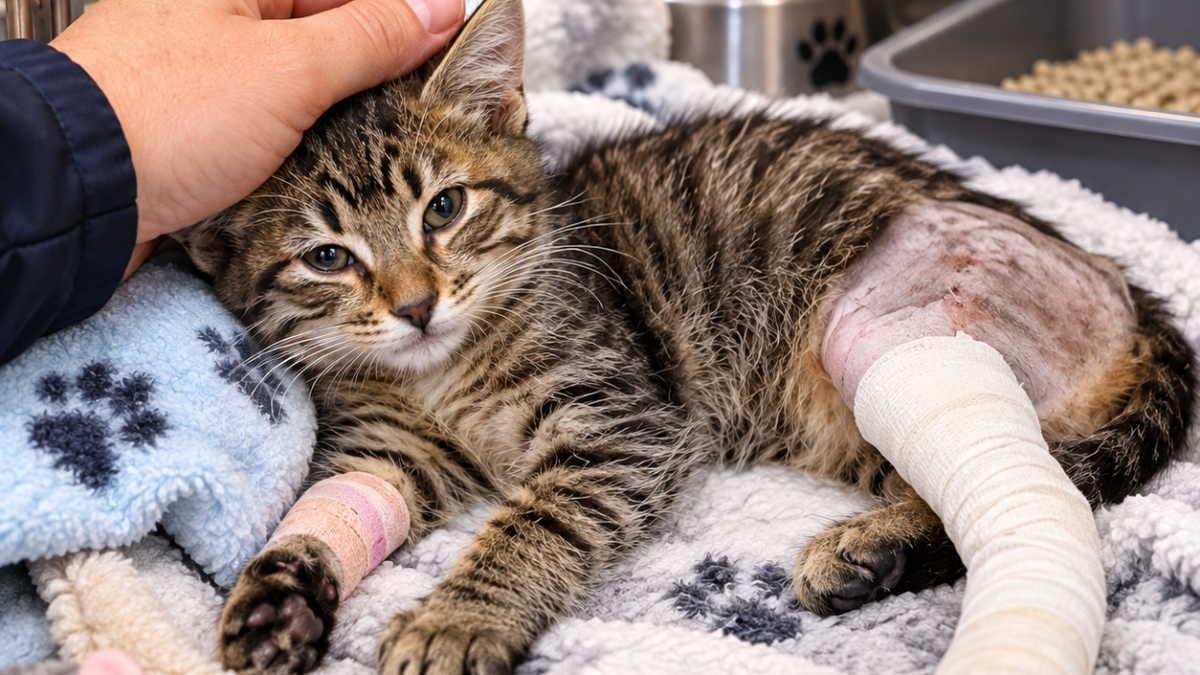
PART 2
The writing was faded, but I could still make it out.
HFP-17.
For a second, I just stared at it.
Susan was the first to speak.
“No.”
Megan looked between us.
“What?”
I took the strip from Dr. Patel.
“HFP.”
“What does that mean?”
“Harlan Family Pets.”
Megan’s face changed.
Everybody in our rescue community knew Harlan Family Pets.
It was a pet-supply store twenty minutes away that also advertised “family-raised kittens,” small animals, grooming supplies, and occasional adoption events.
Its owner, Wade Harlan, had donated food to our rescue twice.
He had posed for photographs beside our volunteers.
He had once handed me a check for five hundred dollars and said, “Nobody should have to choose between money and saving an animal.”
Now I was holding a torn collar marked with the initials of his business while a half-paralyzed kitten lay at my feet.
Susan took it from me.
“Could be anything.”
“I know.”
“He could have sold the collar.”
“I know.”
“Someone could have reused it.”
“I know.”
She held my gaze.
“You are already convicting him in your head.”
I looked toward the carrier.
“Maybe.”
“Don’t.”
I hated that she was right.
Dr. Patel placed the collar fragment in a plastic bag.
“We need to concentrate on the kitten first.”
The kitten.
Not evidence.
Not a case.
Not a symbol.
A living animal who might not survive long enough for any of our suspicions to matter.
Susan sat beside the carrier.
“What do we do?”
Dr. Patel looked at all three of us.
“I can stabilize him for another twenty-four hours. Then I want a neurologist to evaluate him. I’m not telling you treatment is definitely the right choice. I’m telling you we do not yet have enough information to say euthanasia is the right choice.”
“How much for twenty-four hours?” Susan asked.
He told us.
I watched the number hit her.
Our rescue had spent nearly six thousand dollars the previous month on a shepherd with a fractured pelvis and a senior beagle with dental disease.
We were not wealthy.
We were not even comfortable.
Every emergency meant another ordinary case might have to wait.
That was the part people rarely saw.
Love did not erase arithmetic.
Susan rubbed both hands over her face.
“We can approve stabilization and the neurological consult.”
Megan exhaled.
I looked at her.
“That’s it?”
“That’s what I can authorize without the board.”
“And if the neurologist says months of rehab?”
“Then we decide with real information.”
I hated the word decide.
It felt like we had already decided once and the kitten had answered for himself.
His paw was still around my finger.
Dr. Patel looked down.
“You need to stop calling him ‘the kitten.’”
Susan glanced at me.
“Your turn.”
“Why mine?”
“He grabbed you.”
“That is not a naming contract.”
Megan said, “Oliver.”
I looked at her.
“Why Oliver?”
She shrugged.
“He looks like an Oliver.”
The kitten’s purr strengthened for three seconds.
Susan pointed.
“He voted.”
So Oliver became Ollie before he had even proven he intended to stay alive.
That afternoon, animal control picked up the collar fragment and the intake photographs from the abandoned garage.
Officer Luis Mendoza interviewed Megan about exactly where she had found Ollie.
The old garage stood on Benton Street, behind a vacant automotive shop that had closed after its owner retired.
There was no food bowl.
No box.
No mother cat.
No other kittens.
Only Ollie.
A wet towel.
The torn collar.
And faint drag marks in the grime where he had apparently pulled himself beneath an overhang to escape the rain.
Mendoza called me later.
“You said you recognized the initials.”
“Yes.”
“Harlan Family Pets?”
“Yes.”
“Why?”
“They use HFP on everything. Donation bags. Store labels. Their volunteer shirts.”
“Have you ever seen numbered collars?”
“No.”
“Then don’t post anything.”
“I wasn’t going to.”
“That answer came too fast.”
“I’m not posting.”
“Good.”
“I want to talk to Wade.”
“No.”
“Luis—”
“No.”
“He knows me.”
“That makes it worse.”
“He might answer me.”
“He might also change his story before I ask him.”
I leaned against the clinic hallway wall.
“You think he has a story to change?”
“I think you found a piece of nylon with three letters on it. That’s all.”
“And a number.”
“Yes.”
“HFP-17.”
“Yes.”
“So what does seventeen mean?”
“That is exactly the kind of question I would prefer to ask before someone tells him we’re asking it.”
I closed my eyes.
“Fine.”
“Rachel.”
“What?”
“Help the cat.”
The call ended.
I looked through the glass.
Ollie was asleep.
For once, helping the cat was harder than investigating the person.
Because the next morning, the neurologist gave us news nobody wanted.
Dr. Caroline Lee was calm and precise.
She reviewed the images, tested Ollie’s reflexes, pinched gently between his toes, checked his tail response, and watched him try to move.
“He has an incomplete spinal cord injury,” she said.
I grabbed onto the first good word.
“Incomplete.”
“Yes.”
“So he can recover?”
“Possibly.”
Susan asked, “Can he walk?”
“Maybe.”
I nearly laughed from frustration.
“Every answer is maybe.”
Dr. Lee nodded.
“With spinal injuries, anyone promising certainty would be lying to you.”
She pulled up the scan.
“One vertebra has an old compression injury. The fracture itself has begun to heal. I don’t believe surgery is automatically the best option now because we may cause more trauma trying to correct something already stabilizing.”
“Then what?”
“Time. Physical therapy. Pain control. Bladder management. Monitoring for infections and pressure sores. Assisted movement. Possibly hydrotherapy later.”
“And if his legs never work?”
Dr. Lee looked at me.
“Then we evaluate his quality of life as a cat, not his ability to impress humans by walking normally.”
I went quiet.
She continued.
“Cats adapt remarkably well. Some partially paralyzed cats use carts. Some scoot. Some regain enough function to move independently. The questions are whether he can be comfortable, whether we can manage elimination, whether he eats, plays, interacts, rests normally, and shows interest in life.”
I looked at Ollie.
He was trying to attack the edge of his towel.
A weak attack.
But an attack.
Dr. Lee noticed.
“That,” she said, “is interest in life.”
Susan laughed despite herself.
“What are his odds?”
“Better today than yesterday.”
It was not certainty.
But it was enough.
We chose treatment.
Not because Ollie had dramatically begged us to save him.
Not because every injured animal should undergo every possible intervention.
We chose it because his pain was controlled, his injury was incomplete, his organs were functioning, and a specialist believed he had a reasonable chance at a comfortable life.
The paw around my finger had made us stop.
The medicine gave us a reason to continue.
The next three weeks nearly broke me.
Ollie could not empty his bladder normally.
Dr. Lee taught me how to help.
The first time, I was terrified I would hurt him.
“You won’t if you follow what I showed you.”
“What if I do it wrong?”
“You probably will do it badly at first.”
“That is not reassuring.”
“It’s honest.”
Ollie glared at both of us from a towel.
I looked at him.
“You could cooperate.”
He bit my sleeve.
Dr. Lee smiled.
“Excellent.”
“He bit me.”
“I know.”
“You’re happy.”
“Yes.”
“Why?”
“Because yesterday he barely reacted when you touched him.”
I looked down.
Ollie bit the sleeve again.
“Fair point.”
By the end of the week, he was eating like a construction worker.
His eyes improved.
The fever disappeared.
His coat, once cleaned, was mostly black along his back with a white chest, white paws, and a crooked white stripe running up his nose.
He had enormous ears for his head.
Megan said he looked assembled from spare parts.
I told her she was banned from naming future animals.
The infection cleared.
The weight began returning.
But his back legs remained nearly useless.
He dragged them.
That was difficult to watch.
The first time I saw him attempt to chase a toy, his front half shot forward while his back end lagged behind.
He stopped.
Looked at his legs.
Then looked at me.
I had to turn away.
Susan caught me in the hallway.
“Don’t.”
“What?”
“Don’t feel sorry for him while he’s playing.”
“I’m not.”
“You’re crying.”
“I have allergies.”
“You don’t.”
I wiped my face.
“He should be able to run.”
Susan leaned against the wall.
“He doesn’t know what you think he should be.”
I looked at her.
“He knows what he can do today.”
That sentence became important.
Because I kept mourning the cat Ollie might have been.
Ollie was busy becoming the cat he actually was.
He learned to climb using his front legs.
He learned which rugs gave him traction.
He learned that if he screamed loudly enough before breakfast, three different volunteers would accuse each other of starving him.
He learned that Dr. Patel kept treats in the second drawer.
He learned that Megan was weak.
She claimed she was not.
Ollie gained almost a pound in her presence.
Meanwhile, Officer Mendoza was working on HFP-17.
He called Susan first.
Then me.
“I need you both at the shelter tomorrow.”
“Why?”
“I found the number.”
My stomach tightened.
“What does seventeen mean?”
“Tomorrow.”
“Luis.”
“Rachel.”
“You’re enjoying this.”
“Not remotely.”
The next morning, he placed a photograph on the table.
It had been taken inside Harlan Family Pets.
Rows of carriers sat on metal shelves in a back room.
Each carrier had a blue collar clipped to the front.
White marker.
HFP-09.
HFP-10.
HFP-11.
I felt cold.
Mendoza placed another photograph down.
A kitten.
Black and white.
Much smaller.
Standing.
Around his neck was a blue collar.
HFP-17.
I stopped breathing.
“That’s him.”
Susan leaned closer.
The kitten’s crooked white nose stripe was unmistakable.
“Where did you get this?”
“A former employee.”
“Who?”
“Her name is Leah Mercer.”
“Does Wade know she spoke to you?”
“No.”
“What did she say?”
Mendoza watched me.
“You’re not going to like it.”
“Tell me.”
Leah had worked at Harlan Family Pets for fourteen months.
According to her, Wade did much more than sell pet supplies.
He bought litters of kittens cheaply from farms, informal breeders, and people who did not want them.
Some went through legitimate veterinary checks.
Others did not.
He advertised them online as “family-raised companion kittens.”
The blue collars were inventory identifiers.
HFP-17 was Ollie.
He had arrived at the store approximately seven weeks before we found him.
Healthy.
Walking.
Megan whispered, “Then the spine injury happened there.”
“Maybe,” Mendoza said.
“Did Leah see it?”
He put another photograph down.
Ollie lying in a crate.
Back legs extended.
I covered my mouth.
The timestamp was five weeks before he was found.
“What happened?”
Mendoza opened his notebook.
“A shelving unit tipped in the stockroom.”
My head snapped up.
“On him?”
“Leah says several carriers were stacked improperly. A metal shelf shifted. One carrier fell.”
“Did Wade take him to a veterinarian?”
“No.”
I stared at him.
“No?”
“Leah says she asked repeatedly.”
“What did he do?”
“Pain medication from an old prescription. Kept the kitten in a crate.”
Susan’s chair scraped backward.
“You’re telling me that cat had a spinal injury for five weeks and nobody treated him?”
“Leah tried.”
“What does that mean?”
Mendoza slid printed messages across the table.
LEAH: 17 still can’t use his back legs. He needs imaging.
WADE: No.
LEAH: He’s in pain.
WADE: We already lost money on him.
LEAH: Then surrender him.
WADE: To who?
LEAH: Any rescue.
WADE: And explain why a kitten got crushed in my stockroom?
LEAH: I don’t care.
WADE: I do.
I read that exchange three times.
My hands started shaking.
Then another.
LEAH: Please let me take him.
WADE: Absolutely not.
LEAH: Why?
WADE: Because then he becomes evidence.
Susan whispered, “Oh my God.”
Mendoza held up one hand.
“There’s more.”
I did not want more.
There was always more.
A message from Wade to another employee named Travis Cole.
WADE: Move 17 out of the store tonight.
TRAVIS: Where?
WADE: Benton.
TRAVIS: The old shop?
WADE: Yes.
TRAVIS: What do I do with him?
WADE: Leave the carrier by the back overhang.
TRAVIS: It’s cold.
WADE: Then somebody better find him.
My chair moved backward before I realized I had stood.
“Rachel.”
I walked toward the door.
Susan grabbed my wrist.
“Where are you going?”
“Harlan’s.”
“No.”
“He left him there.”
“Sit down.”
“He knew.”
“Yes.”
“He knew Ollie couldn’t walk.”
“Yes.”
“He knew it was freezing.”
“Yes.”
“And he told somebody to leave him there.”
Susan tightened her grip.
“Which is why you are not going to hand his attorney a story about an angry rescue volunteer confronting him.”
My whole body was shaking.
Mendoza stood.
“She’s right.”
I looked at him.
“What happens now?”
“We verify the messages. Interview Travis. Obtain records. If the evidence supports it, we take the next legal steps.”
“What legal steps?”
“I’m not discussing that yet.”
I laughed bitterly.
“You have photographs.”
“I have copies supplied by one witness. I need originals, metadata, corroboration, and statements.”
“You have Wade saying the kitten was evidence.”
“Yes.”
“And you need more?”
“I need a case that still exists after a defense attorney attacks it.”
That shut me up.
I sat.
Susan pushed a cup of water toward me.
I did not drink it.
Mendoza looked down at the photograph of healthy Ollie.
“You asked me what seventeen meant.”
I nodded.
“It meant inventory.”
That hurt more than I expected.
Inventory.
Not Oliver.
Not a kitten.
Seventeen.
A number attached to something Wade Harlan expected to sell.
And when Ollie could no longer be sold, his value disappeared.
I went straight from that meeting to the clinic.
Ollie was in physical therapy.
His therapist, Dana, had placed him on a padded surface with a rolled towel beneath his abdomen. She gently moved his back legs through a stepping motion while he attacked a feather toy.
“Good timing,” she said.
“I’m not in a good mood.”
“Ollie is.”
The feather passed his face.
He slapped it.
Missed.
Slapped again.
Caught it.
Dana looked at me.
“He moved his left leg.”
“What?”
“Watch.”
She supported his hips.
Ollie lunged for the feather.
His left hind foot pulled forward.
Barely.
Maybe an inch.
I crouched.
“Do that again.”
He did not.
“Oliver.”
Nothing.
Dana laughed.
“He’s a cat.”
“I’m aware.”
“He doesn’t perform miracles on command.”
Five minutes later, he moved it again.
I sat on the floor and cried.
Dana pretended not to notice.
That evening I brought Ollie to my house as a medical foster.
Susan handed me a box of supplies.
Medication.
Pee pads.
Disposable gloves.
Food.
Cleaning wipes.
Extra towels.
A printed schedule.
“You’re sure?”
“No.”
“Excellent.”
“What?”
“People who say they’re completely sure about taking on a medically complex animal usually have no idea what they’re doing.”
“That is comforting.”
“Ollie will be fine.”
“And me?”
Susan smiled.
“Unclear.”
The first night, Ollie screamed from his crate.
I moved it beside my bed.
He screamed louder.
I opened the door.
He dragged himself out, climbed onto my slipper, and fell asleep with his face pressed against my ankle.
That was the last night he slept in the crate voluntarily.
My house changed around him.
Rugs appeared everywhere because hardwood was difficult.
A low-sided litter box replaced the normal one.
I put a small ramp beside the couch.
He ignored the ramp and climbed the fabric using his claws.
I bought him a padded bed.
He slept in a cardboard box.
I spent sixty dollars on an orthopedic cushion.
He preferred a grocery bag.
He was alive enough to be annoying.
I treasured every irritating second.
Three days later, Wade Harlan called me.
I almost did not answer.
Then I saw his name.
My thumb hovered.
I remembered Susan.
I remembered Mendoza.
I answered.
“Hello?”
“Rachel.”
His voice sounded exactly as it always had.
Friendly.
Confident.
“I hear you have one of my cats.”
I said nothing for two seconds.
Then, “Your cat?”
“Number seventeen.”
Hearing him say it made my stomach turn.
“His name is Oliver.”
“Whatever you’re calling him.”
I gripped the phone.
“What do you want?”
“I want him returned.”
I actually laughed.
“You cannot be serious.”
“I own the animal.”
“You abandoned him.”
“That isn’t what happened.”
I stood in my kitchen.
Ollie was dragging a toy mouse beneath the table.
“Then what happened?”
“One of my employees acted without authorization.”
“Which employee?”
“My lawyer told me not to discuss details.”
“Good lawyer.”
“Rachel, I am trying to resolve this reasonably.”
“You left an injured kitten in freezing weather.”
“I did not.”
“We have the messages.”
Silence.
I immediately regretted saying it.
Too much.
Wade’s voice became quieter.
“What messages?”
I closed my eyes.
“I’m not discussing the investigation.”
“That’s interesting.”
“What is?”
“You just told me there is one.”
“I’m hanging up.”
“Don’t.”
I almost did anyway.
Then he said, “That cat belongs to my business.”
“No.”
“I have purchase records.”
“Then give them to animal control.”
“I will.”
“Great.”
“And when I do, I expect him back.”
I looked at Ollie.
He had reached the kitchen mat and was trying to climb onto a low stool.
“You’re not getting near him.”
“That is not your decision.”
“No.”
I smiled without humor.
“For once, it isn’t yours either.”
I hung up.
Then I called Mendoza and told him exactly what I had said.
He was silent for several seconds.
Finally he sighed.
“You told him about the messages.”
“Yes.”
“Why?”
“Because I am apparently an idiot.”
“Good. Self-awareness saves me time.”
“I’m sorry.”
“Did he threaten you?”
“No.”
“Demand the cat?”
“Yes.”
“Anything else?”
“No.”
“Do not speak to him again.”
“Understood.”
“Rachel.”
“What?”
“If he calls, don’t answer.”
“Yes.”
“If he comes to your house, call us.”
That gave me pause.
“Do you think he might?”
“I think a man who describes an injured kitten as evidence is currently trying to understand what evidence we have.”
I looked through the window.
The street suddenly felt different.
Wade did not come to my house.
He did something smarter.
His attorney sent the rescue a formal demand for Ollie’s return.
The letter claimed Harlan Family Pets remained the lawful owner and that an employee had removed the kitten without authorization.
It accused the rescue of wrongfully withholding property.
Susan read it twice.
Then dropped it on her desk.
“I hate people.”
I sat across from her.
“What happens?”
“We don’t hand Ollie over.”
“Good.”
“But we also don’t adopt him yet.”
My chest tightened.
“What?”
“Legal hold.”
“For how long?”
“As long as it takes.”
“He can stay with me?”
“Yes.”
“Then fine.”
Susan looked at me.
“Rachel.”
“I said fine.”
“You said it like someone threatening a hostage negotiator.”
I exhaled.
“He is not going back.”
“I agree.”
“Then we fight.”
“We let the people whose job is to fight do it.”
That became one of the hardest lessons of the entire case.
Waiting.
While lawyers wrote letters, Ollie learned to move.
While investigators verified text-message records, Ollie learned to climb.
While Wade insisted publicly that a “disgruntled former employee” had mishandled one kitten, Ollie gained weight.
Leah Mercer gave a formal statement.
So did Travis Cole.
Travis’s testimony was complicated.
He had been the one who drove Ollie to Benton Street.
He admitted it.
He cried through most of the interview.
According to Travis, Wade had ordered him to remove Ollie after closing.
Travis asked where the kitten was going.
Wade told him a rescue volunteer would collect him from the garage.
“That’s why I left him,” Travis said.
Mendoza asked, “Did you contact the rescue?”
“No.”
“Did you see anyone waiting?”
“No.”
“Did you leave food?”
“No.”
“Water?”
“No.”
“Why not?”
Travis covered his face.
“Wade told me it would only be an hour.”
“How long did you believe that?”
No answer.
“When did you learn nobody picked him up?”
“The next morning.”
“What did you do?”
“I called Wade.”
“And?”
“He told me to stay out of it.”
“Did you go back?”
“No.”
“Why?”
Travis cried harder.
“Because I was scared I’d lose my job.”
I was furious when I heard that.
Then I remembered Danny Maddox from Millie’s case years later would not exist in this story—wrong continuity. I caught myself comparing people who chose silence because their lives might become inconvenient.
Travis had not caused Ollie’s spinal injury.
But he had placed him on cold concrete and driven away.
Fear explained his decision.
It did not erase it.
Still, his cooperation mattered.
He gave investigators access to his phone.
The messages were authentic.
More important, he had one message Wade apparently forgot.
TRAVIS: Nobody was there. Are you sure someone’s coming?
WADE: Not our problem anymore.
TRAVIS: He can’t walk.
WADE: Exactly.
That last word became the center of the case.
Exactly.
Not despite Ollie’s disability.
Because of it.
Authorities obtained a search warrant for parts of Harlan Family Pets and a storage property connected to the business.
I was not there.
I learned the details later through court records and people involved in the seizure.
They found cats.
More than anyone expected.
Eleven adults.
Seven kittens.
Some healthy.
Some thin.
Three with untreated respiratory infections.
One pregnant female housed in a cramped enclosure in a storage room that had no public access.
There were cages stacked along a wall.
Veterinary records were incomplete.
Sales records did not match the animals present.
Blue collars hung from hooks.
HFP-21.
HFP-22.
HFP-25.
Inventory.
A handwritten ledger listed intake cost, food cost, estimated sale price, and status.
Beside HFP-17:
BLACK/WHITE M.
GOOD MARKINGS.
$650 ASK.
INJURED.
NO SALE.
Under that:
LOSS.
When Susan showed me a copy months later, I had to put it down.
Loss.
That was what Ollie had become on paper.
A financial loss.
It was strange, because by then he was sitting in my lap trying to steal the corner of the document.
“You’re eating evidence.”
He bit it.
“Apparently you disagree with the accounting.”
He bit again.
I moved the page.
He climbed my shirt.
By that stage, Ollie had begun showing more movement in both hind legs.
Not normal movement.
Not graceful.
His left side was stronger.
The right foot sometimes knuckled under.
He tired quickly.
But he could push himself upright for a few seconds.
Dana began hydrotherapy using a shallow rehabilitation pool.
Ollie hated water.
The first session was an insult of historic proportions.
He clung to Dana’s arm.
His eyes became enormous.
He screamed.
I stood nearby holding a tube of lickable chicken treat.
“Ollie.”
He ignored me.
“Chicken.”
One ear moved.
“Chicken.”
His head turned.
Dana whispered, “Use the power.”
I held the treat ahead of him.
Ollie began paddling.
Mostly with his front legs.
Then his left rear leg kicked.
His right twitched.
Dana smiled.
“There.”
I almost shouted.
She glared.
“Do not scare him.”
I whispered, “There.”
Ollie paddled toward the chicken with the determination of an animal who believed physical rehabilitation was a conspiracy but poultry made it tolerable.
Over the next two months, he improved.
Not in a straight line.
There were bad days.
A urinary infection set him back.
One morning, his right leg seemed weaker and I panicked, convinced we had lost everything.
Dr. Lee examined him.
“Inflammation. Give him time.”
I cried in the parking lot anyway.
Another week, he developed a small sore near his ankle from dragging it.
We changed the way his leg was protected.
The sore healed.
Then he learned to pull himself onto the couch.
The first time he succeeded, I was in the kitchen.
I heard something fall.
I ran in.
Ollie sat on the couch beside a lamp lying on the floor.
I stared.
He stared.
“How?”
He began washing his paw.
“You climbed up there.”
No acknowledgment.
“You could have waited until I saw it.”
Still nothing.
I called Megan.
“He got on the couch.”
“By himself?”
“Yes.”
“How?”
“I don’t know. He refuses to reenact it.”
“That sounds like him.”
That night I sat beside him.
He crawled into my lap.
His purr was no longer broken.
It was loud.
Ridiculously loud.
I put my hand over his chest.
I remembered that first faint vibration inside the clinic.
The sound that had seemed almost accidental.
Now the entire cat seemed powered by it.
Then Wade’s attorney filed a motion challenging the seizure of the other animals.
The case escalated.
Wade claimed Leah had fabricated messages because she had been fired.
Leah had not been fired.
She had quit.
Wade claimed Travis misunderstood instructions.
Travis’s phone contradicted him.
Wade claimed the cats at the storage location belonged to customers.
Most did not.
He claimed Ollie’s spinal injury had happened before the kitten entered his care.
The inventory photograph showed Ollie standing normally.
He claimed the collapsed shelving unit was an unforeseeable accident.
That might have been true.
The prosecutor was not arguing the shelf fell intentionally.
The cruelty came afterward.
No veterinary examination.
No imaging.
No proper pain management.
Weeks in a crate.
Then abandonment.
The defense tried another strategy.
They suggested euthanasia would have been financially reasonable for an injured kitten and that Wade’s failure was simply administrative.
That argument made me furious for a different reason.
Because there was a version of the story where euthanasia might have been humane.
If Ollie had been in uncontrollable pain.
If his condition had no reasonable treatment.
If a veterinarian had evaluated him and recommended it.
There is no shame in preventing suffering when medicine cannot restore comfort.
But Wade had not taken him to a veterinarian.
He had not chosen humane euthanasia.
He had chosen to avoid the cost and the record.
There was a difference.
A massive one.
Dr. Lee explained it later when she testified.
The defense attorney asked, “Doctor, would euthanasia have been a medically acceptable option when this injury occurred?”
Dr. Lee answered carefully.
“Possibly, depending on the kitten’s neurological status, pain level, prognosis, and the owner’s ability to provide required care.”
“So Mr. Harlan’s conclusion that the animal might not be worth extensive treatment was not inherently unreasonable.”
Dr. Lee looked at him.
“You are combining two very different decisions.”
“How?”
“Humane euthanasia performed by a veterinarian after evaluation is not the same as leaving an injured animal untreated for weeks and then abandoning him outside.”
The courtroom went quiet.
The attorney shifted.
“But you cannot say the kitten would definitely have recovered if treated immediately.”
“No.”
“So treatment offered no guarantee.”
“Medicine rarely offers guarantees.”
“Exactly.”
Dr. Lee leaned slightly toward the microphone.
“But pain does not require a guarantee before it deserves treatment.”
Nobody moved.
The attorney stopped.
I wrote that sentence down.
I still have it.
The case took almost eight months to reach its decisive hearing.
In those eight months, Ollie changed completely.
His coat grew glossy.
He reached a healthy weight.
His eyes cleared.
His front legs became muscular from compensating.
He began standing for longer periods.
Then one afternoon, Dana called me from the rehabilitation room.
“Rachel.”
I was answering emails.
“What?”
“Put the phone down.”
“Why?”
“Put it down.”
I did.
Ollie was standing on a rubber mat.
No sling.
No towel under his belly.
Just Ollie.
His back legs trembled.
Dana crouched several feet away.
She held a treat.
“Ollie.”
He stared at her.
Then at me.
“Come on,” I whispered.
His left foot moved.
Then his right.
Unsteady.
Awkward.
A half-step.
Then another.
His body swayed.
I stopped breathing.
Three steps.
Four.
On the fifth, his rear legs folded.
He fell sideways.
I lunged.
Dana blocked me.
“Wait.”
Ollie lay there for one second.
Then pushed himself upright.
He took two more steps.
I started crying.
Dana was crying too.
Neither of us pretended it was allergies.
“He’s walking.”
“A little.”
“He’s walking.”
“A little, Rachel.”
“Let me have this.”
She laughed.
“He’s walking.”
I sat on the floor.
Ollie staggered toward me, collapsed against my leg, and immediately demanded the treat.
I gave him three.
That night, I called Susan.
“He walked seven steps.”
“I know.”
“How?”
“Dana called everybody.”
“She betrayed me.”
“She called before you left the building.”
“Seven.”
“I know.”
“He may never walk normally.”
“I know.”
“I don’t care.”
Susan became quiet.
“That’s the point.”
“What?”
“You finally don’t care.”
I understood.
For months, I had measured Ollie against an imaginary healthy kitten.
Four legs working normally.
Jumping.
Running.
No bladder assistance.
No therapy.
I had treated that imaginary cat as the standard for whether Ollie’s life was complete.
Ollie had never asked to be measured that way.
He wanted food.
Warmth.
Toys.
Windows.
People.
The right to knock objects off tables.
If his walk was crooked, that was my problem, not his.
The county animal-cruelty case and the state business investigation eventually converged.
Wade Harlan faced multiple allegations involving neglect, abandonment, inadequate veterinary care, falsified records, and violations connected to the way animals were being sold and housed.
Not every accusation survived.
Some were reduced.
Some were administrative rather than criminal.
That frustrated people.
It frustrated me.
But Mendoza reminded me of something.
“Justice isn’t a menu where you order the punishment that feels emotionally correct.”
“I know.”
“You say that like you don’t know.”
“I want him to understand what he did.”
“He may never.”
“Then what’s the point?”
“The point is stopping him from doing it again.”
That changed how I looked at the outcome.
The case was not supposed to heal my anger.
It was supposed to protect the next animal.
The strongest evidence remained Wade’s own records and messages.
The ledger marked Ollie as LOSS.
The messages refusing veterinary care.
The order to move him to Benton Street.
The response when Travis reminded him Ollie could not walk.
Exactly.
That single word followed Wade into court.
The prosecution displayed it on a screen.
TRAVIS: He can’t walk.
WADE: Exactly.
Wade stared at the table.
Leah testified next.
She was twenty-seven.
Thin.
Nervous.
She looked at Wade only once.
The prosecutor asked, “Why did you photograph HFP-17?”
“Because I thought I might need proof.”
“Proof of what?”
“That he was injured.”
“Why?”
“Wade kept saying he’d been that way when he arrived.”
“Had he?”
“No.”
“How do you know?”
“I handled him on intake. He climbed out of the carrier and ran under a desk.”
I closed my eyes.
Ran.
Ollie had run.
The word hurt.
The prosecutor showed the first photograph.
Little Ollie standing on four working legs.
“What happened later?”
“The shelf fell.”
“Who was present?”
“Me, Travis, and Wade.”
“Did the kitten cry?”
“Yes.”
Her voice broke.
“He screamed.”
I looked down.
I did not need to hear that.
But Leah continued.
“He couldn’t stand afterward.”
“What did you recommend?”
“A vet.”
“What did Mr. Harlan say?”
“He said we would wait.”
“For how long?”
“Until the next day.”
“What happened the next day?”
“Nothing.”
“The day after?”
“Nothing.”
“Did you ask again?”
“Yes.”
“How often?”
“Every day.”
“Why didn’t you take the kitten yourself?”
Wade’s attorney objected before she answered.
The judge allowed a limited response.
Leah swallowed.
“Because I was afraid he would fire me and accuse me of stealing the cat.”
The prosecutor showed another message.
LEAH: LET ME TAKE HIM TO MY VET. I’LL PAY.
WADE: NO.
“Did you offer to pay?”
“Yes.”
“Did he accept?”
“No.”
“Why not?”
“He said if a vet documented the injury, the business could be blamed.”
There it was.
Not money alone.
Evidence.
The defense attorney stood.
“You disliked Mr. Harlan by the time you left the company.”
“Yes.”
“You believed he was a bad employer.”
“Yes.”
“You had threatened to report him.”
“Yes.”
“So you had motive to damage his reputation.”
Leah looked at him.
“I had motive to stop him.”
The attorney paused.
“That was not my question.”
“It’s my answer.”
He tried another route.
“You remained employed for several weeks after this kitten was injured.”
“Yes.”
“You continued accepting a paycheck from the man you now describe as cruel.”
Leah’s face reddened.
“Yes.”
“You didn’t call police.”
“No.”
“Animal control?”
“No.”
“A rescue?”
“No.”
“So despite your testimony today, you did nothing.”
Leah went still.
I hated the question because part of it was true.
Then she said quietly, “I took the pictures.”
The attorney waited.
“I saved the texts. I asked to take the kitten. I contacted Officer Mendoza after I learned he survived.”
“That was weeks later.”
“Yes.”
“After you left the company.”
“Yes.”
“So you acted only when there was no risk to your job.”
Leah’s eyes filled.
“Yes.”
The attorney turned as if satisfied.
Then Leah added, “And I will regret that for the rest of my life.”
The room became silent.
The attorney had no good place to go after that.
Travis testified too.
His testimony hurt more because he physically carried Ollie to Benton Street.
He admitted it.
No excuses.
The prosecutor asked, “Why did you leave the kitten?”
“I believed Wade when he said someone was coming.”
“Did you verify that?”
“No.”
“When you saw nobody there?”
“I texted him.”
“What did he say?”
“Not our problem anymore.”
“And you left?”
“Yes.”
“Knowing the kitten could not walk.”
“Yes.”
“Why?”
Travis stared at his hands.
“I was a coward.”
His lawyer shifted.
But Travis continued.
“I was behind on rent. I had a kid. Wade had fired people for arguing with him. I told myself somebody was coming because that made it easier to drive away.”
The prosecutor let the silence remain.
“What did you do the next morning?”
“I asked Wade if the kitten was picked up.”
“And?”
“He told me never to mention it again.”
“Did you go back?”
“No.”
“Why?”
“I was still being a coward.”
I looked at him.
My anger did not disappear.
But it changed.
Wade had made the decision.
Travis had carried it out.
Both mattered.
One did not erase the other.
Wade testified last.
I did not expect him to.
His attorney probably had reasons I did not understand.
Wade wore a dark suit.
He looked older than he had eight months earlier.
The pet store had already closed while licensing disputes and the seizure case continued.
He described debts.
A failed expansion.
Rent increases.
Vendor bills.
He said he had been trying to keep twelve employees working.
Some of that was true.
Harlan Family Pets had been losing money.
The prosecutor asked, “Was HFP-17 a financial asset?”
Wade frowned.
“He was an animal.”
“Your ledger says ‘$650 ask.’”
“We sold kittens.”
“Your ledger later says ‘LOSS.’”
“That’s accounting language.”
“So when he could no longer be sold, he became a loss.”
“That doesn’t mean I wanted him hurt.”
“No one has alleged that you intentionally caused the shelving accident.”
Wade’s shoulders lowered slightly.
Then the prosecutor said, “What we are asking about is what you did after.”
She displayed Leah’s message.
17 STILL CAN’T USE HIS BACK LEGS. HE NEEDS IMAGING.
WADE: NO.
“Did you write that?”
“Yes.”
“Why refuse?”
“We were monitoring him.”
“Are you a veterinarian?”
“No.”
“Was Ms. Mercer?”
“No.”
“So who medically evaluated the kitten after a metal shelf fell on him and he lost use of his hind legs?”
Wade said nothing.
“Mr. Harlan?”
“No one.”
“Why?”
“Cost.”
There it was.
One honest word.
“Did Ms. Mercer offer to pay?”
Wade shifted.
“She was emotional.”
“That was not my question.”
“Yes.”
“And you still refused.”
“Yes.”
“Why?”
“My insurance situation was complicated.”
“Because you feared documentation?”
“My lawyer objected to how I was characterizing—”
“Did you write this?”
Another message.
WADE: IF A VET WRITES DOWN THAT THE SHELF DID IT, WE’RE SCREWED.
“Yes.”
The prosecutor nodded.
“Thank you.”
She moved on.
“Why was the kitten taken to Benton Street?”
“I wanted him surrendered.”
“To whom?”
“A rescue.”
“Which rescue?”
“I don’t remember.”
“Who did you contact?”
“I thought Travis handled it.”
Travis was sitting behind his attorney.
His face did not move.
The prosecutor displayed the message.
TRAVIS: WHERE?
WADE: BENTON.
TRAVIS: THE OLD SHOP?
WADE: YES.
TRAVIS: WHAT DO I DO WITH HIM?
WADE: LEAVE THE CARRIER BY THE BACK OVERHANG.
“Where in this exchange do you tell Mr. Cole a rescue is coming?”
Wade said nothing.
“Where do you provide a contact name?”
Nothing.
“Phone number?”
Nothing.
“Pickup time?”
Nothing.
The prosecutor displayed the last exchange.
TRAVIS: NOBODY WAS THERE. ARE YOU SURE SOMEONE’S COMING?
WADE: NOT OUR PROBLEM ANYMORE.
TRAVIS: HE CAN’T WALK.
WADE: EXACTLY.
Wade stared at the words.
The prosecutor asked quietly, “What did ‘exactly’ mean?”
He looked at his attorney.
The judge instructed him to answer.
“I was frustrated.”
“That is not an explanation.”
“I meant that was why we couldn’t keep him.”
“Because he couldn’t walk.”
“Yes.”
“And because he could not be sold.”
“I didn’t say that.”
The prosecutor walked back to the ledger.
INJURED. NO SALE. LOSS.
“You wrote it.”
Wade’s face changed.
He looked suddenly tired.
Not defeated.
Just tired.
“I had forty thousand dollars in business debt.”
Nobody spoke.
He continued.
“I had employees asking for hours. Rent was due. The store was failing. Every animal that needed hundreds or thousands in care was another bill I couldn’t pay.”
The prosecutor did not interrupt.
For the first time, Wade was not denying the pressure.
He was explaining it.
“I made bad decisions.”
“Yes,” the prosecutor said.
“I was trying to save the business.”
“And what was HFP-17 trying to save?”
Wade looked up.
She pointed toward the photograph of Ollie lying in a crate after the injury.
The question hung there.
Wade did not answer.
There was no answer that helped him.
The outcome came weeks later.
Some charges were resolved through plea agreements.
Others resulted in findings against him after hearings.
Wade was prohibited from operating an animal-sale or boarding business for an extended period, ordered to pay substantial restitution toward veterinary and seizure costs, fined for multiple violations, and placed under conditions that restricted his possession and commercial handling of animals.
The store never reopened.
His business lease ended.
The remaining animals were legally released to rescue groups after the ownership proceedings concluded.
Travis accepted responsibility for his part in Ollie’s abandonment under a separate agreement that included penalties, community service, and restrictions on unsupervised animal-care work.
Leah was not charged.
She later told me she did not feel brave.
“I waited too long.”
“You came forward.”
“After.”
“Yes.”
She looked at Ollie.
“After is sometimes all you have left.”
That did not erase her regret.
But regret became useful.
Leah eventually began working at a veterinary office.
The first time I saw her there, she was cleaning carriers.
She looked embarrassed.
“I started at the bottom.”
“That’s usually where animals are.”
She laughed.
Then she asked, “How is seventeen?”
I looked at her.
She caught herself.
“Ollie.”
“He hates physical therapy.”
“Still?”
“He hates anything that doesn’t involve food.”
“That sounds healthy.”
“It is.”
The seized cats were placed over the next several months.
Some needed treatment.
One required extensive dental surgery.
Two kittens had chronic eye infections.
The pregnant female gave birth safely in foster care.
Every one of them eventually left the legal hold.
That became the part of the case I cared about most.
Wade had tried to protect his business by hiding one injured kitten.
Instead, that kitten led investigators to every animal behind the locked doors.
That was the payback no one could have planned better.
His own collar.
His own inventory number.
His own ledger.
His own messages.
His own effort to make Ollie disappear had created the trail that ended the operation.
I never confronted Wade.
Not after the phone call.
Not in the courthouse.
Not outside.
For months I imagined what I would say if he approached me.
Then one day, after a hearing, he did.
I was walking toward the parking lot.
Susan was beside me.
Wade stood near the courthouse steps.
“Rachel.”
Susan immediately slowed.
I stopped.
“What?”
He looked thinner.
His suit jacket hung loosely.
For a moment, he said nothing.
Then, “How is the cat?”
“Ollie.”
“Yes.”
“He’s good.”
“Walking?”
I studied him.
“A little.”
Wade nodded.
“That’s surprising.”
Something about the word angered me.
“Why?”
“The vet I talked to later said chronic spinal injuries can be difficult.”
“The veterinarian you talked to later.”
His eyes lowered.
I regretted the sharpness only because I did not want to become the person screaming outside a courthouse.
Wade nodded.
“Yes.”
We stood there.
Finally he said, “I didn’t think he’d live.”
I felt Susan tense beside me.
I asked, “When?”
“What?”
“When didn’t you think he’d live? When the shelf fell? When you kept him in a crate? Or when you sent him to Benton Street?”
His face tightened.
“I’m not trying to fight.”
“Then why are you talking to me?”
“I don’t know.”
That answer sounded real.
He looked across the parking lot.
“I saw pictures.”
“What pictures?”
“From the rehabilitation center.”
I had agreed to let them use a photograph of Ollie for an internal fundraiser.
“He looks happy.”
“He is.”
Wade swallowed.
“I was wrong.”
I had dreamed about that sentence.
I thought hearing it would feel like a door slamming shut.
It did not.
It felt small.
Too small for months of pain.
Too small for cold concrete.
Too small for a kitten trying to drag useless legs under a rusted overhang.
I said, “Yes.”
That was all.
Wade looked at me.
Maybe he expected forgiveness.
Maybe anger.
Maybe a speech.
I gave him none.
He nodded once.
Then walked away.
Susan waited until we reached my car.
“That was it?”
“What did you want me to do?”
“I don’t know. I expected fire.”
“I’m tired of giving him that much energy.”
She smiled.
“There you are.”
That night, Ollie knocked an entire glass of water off my nightstand.
Justice had been restored.
His legal hold was finally released two weeks later.
Susan called me.
“You can adopt him.”
I nearly dropped the phone.
“What?”
“The ownership challenge is finished. He’s officially available.”
I looked across the room.
Ollie was upside down on the couch.
“Okay.”
Susan laughed.
“Okay?”
“What do you want?”
“I expected emotion.”
“I’m emotional.”
“You sound like you’re ordering lunch.”
“What am I supposed to say?”
“I don’t know. Maybe, ‘Yes, I’ve been waiting eight months for this.’”
I looked at Ollie.
He opened one eye.
“Yes,” I said. “I’ve been waiting eight months for this.”
“Much better.”
I signed the papers the next afternoon.
His adoption fee was one hundred dollars.
I told Susan that after everything, charging me seemed rude.
She said the fee included emotional damages.
I paid.
Ollie became mine.
Officially.
The paperwork changed nothing about our daily life.
He still screamed for breakfast.
Still hated the carrier.
Still tried to bite his exercise bands.
Still slept against my ankle.
But something in me relaxed.
Nobody could demand him back.
Nobody could refer to him as inventory.
Nobody could decide his life had become an accounting loss.
His adoption certificate said:
OLIVER TURNER.
Male.
Domestic shorthair.
Black and white.
Special needs.
I crossed out “special needs” on my copy.
Then I wrote underneath:
Special demands.
More accurate.
A year after we found him, Ollie could walk across an entire room.
Not gracefully.
His back legs moved with a strange rhythm, one stronger than the other.
When he became excited, they tangled.
For longer distances, he used a small custom cart.
The first time we put him in it, he stood completely still.
Dana rolled a toy across the room.
Nothing.
Megan opened a tube of chicken paste.
Ollie launched himself forward.
The cart rattled behind him.
He chased Megan down the hallway.
She screamed.
“Why is he so fast?”
I laughed so hard I had to lean against the wall.
“You wanted mobility.”
“Not this much!”
Ollie cornered her near the supply cabinet.
She surrendered the chicken.
He became terrifying in the cart.
At home, he used it mostly outside or when he wanted speed.
Inside, he preferred his crooked walk.
Sometimes he fell.
Then stood.
Sometimes he dragged himself.
Sometimes he surprised me by moving almost normally for several steps.
Dr. Lee never promised complete recovery.
She had been right.
But she also had been right about something else.
Quality of life was not measured by whether his body looked normal.
Ollie played.
He ate.
He climbed.
He demanded affection when he wanted it and rejected affection when he did not.
He sat in windows.
He hunted dust.
He terrorized paper bags.
He developed an irrational hatred of one particular orange pillow.
Nothing about him suggested he was waiting for someone to decide whether his life had been worth saving.
He had already decided.
Two years later, the rehabilitation clinic asked if Ollie could attend an open house.
I agreed.
He wore a little harness.
No costume.
No inspirational sign.
I refused.
“He is not a motivational poster.”
Dana laughed.
“He’s a cat.”
“Exactly.”
A family arrived with a girl named Sophie.
She was nine and used a wheelchair.
The moment she saw Ollie’s cart, she pointed.
“Mom. Look.”
Ollie rolled past.
Sophie laughed.
“He has wheels.”
Her mother smiled.
“So do you.”
Sophie looked offended.
“His are cooler.”
I crouched beside her.
“Do you want to meet him?”
“Yes.”
I took Ollie out of the cart and placed him on a blanket.
He stared at Sophie.
She held out one hand.
Ollie sniffed.
Then climbed halfway into her lap.
Sophie began scratching beneath his chin.
“He doesn’t care about my chair.”
“No.”
“He likes me.”
“He likes anyone who scratches there.”
She smiled.
For twenty minutes, she told Ollie everything.
Her school.
A boy she disliked.
A teacher she loved.
A surgery she had coming up.
Ollie listened with the solemn concentration of a cat who was actually waiting for a snack.
When Sophie left, she said, “Bye, Wheels.”
I looked at Ollie.
“You have a nickname.”
He sneezed.
Months later, the clinic received a photograph.
Sophie after surgery.
Smiling.
On the table beside her was a printed picture of Ollie.
I framed it.
Not because I believed Ollie had magically healed anyone.
He had not.
But there was something powerful about seeing a body that worked differently and discovering it could still belong to a full life.
That was what Ollie had taught me.
Not that every animal must be saved at any cost.
Not that euthanasia is always wrong.
Not that love defeats biology.
Those would have been dishonest lessons.
The truth was more demanding.
You have to evaluate the life in front of you.
Not the inconvenience.
Not the price tag alone.
Not whether the body looks the way you expected.
The life.
Three years after the case, I received a letter from Travis.
He had completed his community service.
Part of it had been assigned through a municipal program, not directly with our rescue.
He wrote only one page.
Rachel,
I don’t expect you to forgive me.
I still think about leaving him there. I kept telling myself somebody was coming. When I drove away, I looked in the mirror and saw the carrier under the overhang.
I could have turned around.
That is the part I can’t make excuses for.
I’m sorry.
I hope Oliver has a good life.
Travis.
I put the letter in a drawer.
I did not answer immediately.
Six months later, I did.
I wrote:
He does.
That was all.
I never heard from Travis again.
Wade disappeared from animal-related businesses in our area.
Years later, someone told me he was working in commercial flooring.
I felt nothing.
That surprised me.
For so long, I had wanted consequences to feel satisfying enough to balance Ollie’s suffering.
They never did.
The court orders mattered.
The store closing mattered.
The animals being removed mattered.
The ban mattered.
Restitution mattered.
But punishment could not travel backward through time and put Ollie in a clinic the night the shelf fell.
The only thing that changed the weight of the past was what came afterward.
And Ollie became very good at afterward.
He became famous at our rescue despite my objections.
Volunteers called him “Inspector Ollie” because he crawled into every box.
New fosters met him through a gate.
He was excellent with frightened kittens.
Terrible with adult cats.
Indifferent to dogs.
Obsessed with shoelaces.
One winter evening, Susan called.
“We have a problem.”
“What kind?”
“Kitten.”
“That is not automatically a problem.”
“This one won’t eat.”
I drove over.
A tiny brown kitten sat inside a kennel, pressed into the corner.
Maybe eight weeks old.
Found beneath a porch.
Terrified.
I sat outside.
“Has the vet seen her?”
“Yes. Stable. Just scared.”
I opened the kennel door.
She hissed.
Good.
I smiled.
Susan looked at me.
“Why are you smiling?”
“She has opinions.”
“That is your favorite diagnosis.”
I sat on the floor.
No reaching.
No grabbing.
Just waiting.
Then I heard a strange scraping sound behind me.
Ollie.
He had followed Susan down the hallway.
“Why is he here?”
“He escaped your carrier.”
“He can’t even run properly.”
“He doesn’t need to. You failed to latch it.”
Ollie dragged himself toward the kennel.
The kitten hissed harder.
He stopped.
Looked at her.
Then sat.
For nearly ten minutes, neither moved.
Finally the kitten approached the bars.
Ollie leaned forward.
Nose to nose.
The kitten’s body loosened.
A minute later, she ate.
Susan looked at me.
“Did he just do your job?”
“I believe he did.”
“You should give him your volunteer badge.”
“He’d demand health insurance.”
Ollie began purring.
That sound still stopped me.
Even after years.
Because I could hear the first version underneath it.
Weak.
Broken.
Almost disappearing inside his chest.
The sound he had made while his paw wrapped around my finger and four adults stood in a clinic wondering whether his future could justify the cost.
He was six when his bladder problems worsened.
We had always known complications were possible.
Dr. Lee warned me from the beginning that nerve damage could affect urinary function long-term.
Ollie developed repeated infections.
We adjusted medication.
Diet.
Hydration.
Monitoring.
He tolerated all of it badly.
He bit Dr. Patel twice.
Dr. Patel still adored him.
“You saved his life and this is the gratitude.”
Ollie tried to bite him again.
“Apparently.”
At seven, arthritis developed around the old spinal injury.
That frightened me more than it frightened him.
His walks became wobblier.
He used the cart more often.
We added pain medication.
The question from his first morning returned.
Quality of life.
Every veterinary appointment, I asked.
“Are we still on the right side?”
Dr. Patel never lied to me.
“Yes.”
Then months later:
“Yes, but watch him.”
Then:
“He’s slowing down.”
I learned to ask better questions.
Does he eat?
Yes.
Does he seek affection?
Aggressively.
Does he play?
When bribed.
Does he groom?
Mostly.
Does he sleep comfortably?
Yes.
Does he show persistent pain despite medication?
No.
Then we continued.
Eight years after he arrived, Ollie was no longer a kitten.
His face had softened.
White hairs appeared around his nose.
He had become expert at getting exactly what he wanted with minimal effort.
One February morning, I found him sitting beside the refrigerator screaming.
His food bowl still contained breakfast.
“What?”
Scream.
“You have food.”
Scream.
I opened the refrigerator.
He stared at the chicken.
“No.”
Scream.
“You are being unreasonable.”
Scream.
I gave him chicken.
Old age had not improved his character.
That spring, Megan visited with her daughter.
Her daughter, Lily, was four.
Ollie had never met her.
Lily sat on the floor.
Ollie rolled toward her in his cart.
She stared.
“Why does the kitty have a car?”
Megan laughed.
“His legs don’t work like other cats.”
Lily considered that.
Then asked, “Does he know?”
I looked at her.
“What?”
“Does he know his legs are different?”
I smiled.
“I think he knows they’re his.”
That satisfied her.
She spent the next hour pushing toy cars beside him.
Ollie tolerated it because children drop snacks.
Later, after they left, I kept thinking about the question.
Does he know?
Of course he knew.
He lived in his body.
But he had never treated his disability as the central fact of his identity.
Humans did that for him.
We called him brave.
Inspirational.
Miraculous.
Ollie called himself hungry.
Maybe he had the better perspective.
The anniversary of his rescue came every October.
For years, I went back to Benton Street.
At first I did not know why.
The garage remained empty after the investigation.
Eventually the property was sold.
The old building was demolished.
A plumbing company constructed a warehouse there.
The first year after demolition, I drove past and almost missed it.
No rusted barrels.
No cracked overhang.
No concrete corner.
Gone.
I pulled over anyway.
Ollie was in his carrier beside me after a rehabilitation appointment.
I opened the passenger door.
“You know this place?”
He looked at me.
Then at the traffic.
Then screamed for food.
I laughed.
“Exactly.”
The place where I thought his story might end meant nothing to him.
That was strangely comforting.
When Ollie was nine, Dr. Patel retired.
His last week at the clinic, I brought Ollie in.
Dr. Patel sat on the floor.
Ollie climbed onto his leg.
“You know,” he said, “I really thought we might euthanize you that morning.”
“Great farewell speech.”
“I’m serious.”
“I know.”
Dr. Patel scratched Ollie’s chin.
“I worried we were prolonging suffering because none of us wanted to make the hard decision.”
I looked at him.
“Did we?”
“No.”
“How do you know?”
He smiled.
Ollie had rolled onto his back and was trying to steal the pen from Dr. Patel’s pocket.
“That.”
I laughed.
Dr. Patel’s expression became quieter.
“Rachel, euthanasia can be an act of love.”
“I know.”
“And treatment can be an act of ego.”
“I know.”
“What matters is which one you’re choosing for the animal instead of for yourself.”
I nodded.
“That morning, I wasn’t sure.”
“Neither was I.”
“That’s why I gave you another day.”
He looked at Ollie.
“He used it well.”
Before we left, Dr. Patel took the original intake photograph from a folder.
Ollie beneath the heat lamp.
Wet.
Thin.
Eyes half closed.
Then he placed beside it a photograph taken that morning.
Ollie in his cart.
Overweight by half a pound.
Annoyed.
Alive.
“Keep both,” he said.
I almost refused the first one.
Then I understood why.
One did not erase the other.
The second mattered because the first had existed.
At ten, Ollie’s kidneys began failing.
Slowly at first.
Extra water.
Special diet.
Medication.
More bloodwork.
He disliked all of it.
One evening, Susan came over.
Ollie was asleep between us on the couch.
“You know he’s old.”
“I know.”
“For him.”
“I know.”
“You’re going to have to make another decision one day.”
I stared at the television.
“I know.”
“The same one.”
“No.”
She looked at me.
“No?”
“The first time we were deciding whether to give him a life.”
I put my hand on his side.
“This time I’ll be deciding when to stop asking him to stay in it.”
Susan became quiet.
“You’ve thought about that.”
“Every day since Dr. Lee said chronic spinal injuries could mean complications.”
Ollie opened one eye.
“Stop eavesdropping.”
He closed it.
Susan smiled.
“He’s not ready.”
“No.”
He wasn’t.
For another year, Ollie ruled the house.
Then came a cold October morning.
Of course it was October.
I found him beside the sliding door.
He loved sitting there in sunlight.
That morning, he did not shout for breakfast.
That was wrong.
“Ollie?”
His head lifted.
Slowly.
I brought chicken.
He sniffed.
Turned away.
My stomach dropped.
At the clinic, the bloodwork was worse.
Kidneys.
Anemia.
Dehydration.
Dr. Morgan, who had taken over after Patel retired, sat beside me.
“We can hospitalize him.”
“What does that buy?”
“Maybe days. Maybe weeks if he responds.”
“Will he feel better?”
“Possibly.”
There was that word again.
Maybe.
Possibly.
No guarantees.
The language of the first morning returned all at once.
“What would you do?”
Dr. Morgan shook her head.
“I can tell you what I see. You have to tell me who he is at home.”
I looked at Ollie.
He lay wrapped in a towel.
“Yesterday he stole turkey off my plate.”
“Good.”
“Two days ago he chased a toy.”
“Good.”
“Today he won’t eat.”
“Yes.”
“Is he hurting?”
“Probably nauseated. Tired. Some discomfort.”
“Can you control it?”
“We can try.”
I closed my eyes.
Eleven years earlier, we had chosen treatment because Ollie’s body still had room for recovery.
Was I about to choose treatment now because I could not imagine my house without him?
That distinction terrified me.
We hospitalized him overnight.
He improved slightly.
He ate two bites.
Came home.
For a week, he rallied.
He demanded chicken.
Sat at the window.
Bit me during medication.
I celebrated the bite.
Then one morning, he could not lift himself.
His front legs tried.
Failed.
He looked at me.
No panic.
Just exhaustion.
I sat beside him.
“All right.”
His eyes remained on mine.
“I hear you.”
I called Susan.
Then the clinic.
Dr. Morgan offered to come to my house.
I said yes.
I moved Ollie to his favorite blanket beside the sliding door.
Sunlight came through the glass.
He had spent thousands of hours there.
Birds.
Snow.
Rain.
Neighbors.
Delivery trucks he hated.
The whole world from one piece of carpet.
Susan came first.
She sat beside him.
“Hi, trouble.”
Ollie’s tail moved once.
She started crying.
“He still hates me.”
“No. That’s affection.”
“Liar.”
Megan came.
Dana came.
Dr. Lee sent a message because she could not get away from the hospital.
Tell him he was my most stubborn patient.
I read it aloud.
Ollie blinked.
“Accurate.”
Dr. Morgan arrived last.
She examined him gently.
Then looked at me.
“I think you’re making the right decision.”
The sentence almost destroyed me.
Not because I doubted her.
Because I remembered Dr. Patel standing in an office eleven years earlier discussing the same word.
Euthanasia.
Then, it had sounded like giving up.
Now I understood better.
Sometimes the cruelest thing is making an animal stay because you cannot bear being left.
I lay beside Ollie.
His head rested in my palm.
Exactly as it had rested in Megan’s hand beside the garage.
Except this time he was warm.
Clean.
Safe.
Old.
Loved.
“You remember the clinic?”
No reaction.
“Blue towel?”
His eyes half closed.
“You grabbed my finger.”
I slipped one finger beneath his paw.
For a second, nothing happened.
Then his toes curled.
Weakly.
Around my finger.
I stopped breathing.
Susan made the same sound she had made eleven years earlier.
Megan covered her mouth.
Dr. Morgan looked away.
I laughed through tears.
“You dramatic little monster.”
Ollie’s chest moved.
And there it was.
A purr.
Faint.
Broken by age.
But unmistakable.
The same sound.
The whole room disappeared.
I was back beside a carrier with a half-paralyzed kitten while four adults tried to decide whether tomorrow was worth the risk.
We had been given eleven years.
Eleven.
I pressed my forehead against his.
“You did enough.”
His paw stayed around my finger.
“No more physical therapy.”
The purr continued.
“No more bladder medicine.”
Another breath.
“No more stupid carts.”
Susan whispered, “He liked the cart.”
“He weaponized the cart.”
She laughed while crying.
I kissed the top of Ollie’s head.
“You can go.”
Dr. Morgan gave the sedative.
His body relaxed.
For the first time in days, the tension left his face.
I kept my finger beneath his paw.
When the final medication went in, his purr slowed.
Then stopped.
His paw remained loosely closed around mine.
Dr. Morgan listened to his chest.
Then whispered, “He’s gone.”
Nobody moved.
I stayed beside him until the sunlight shifted away from the blanket.
For weeks afterward, my house felt wrong.
Too easy.
No rugs required for traction.
No medication alarms.
No low litter box.
No wheel cart parked beside the door.
No scream from the kitchen at 5:47 every morning.
I hated the silence.
I left his cart where it was for a month.
Then Dana asked if I wanted to donate it.
I almost said no.
Then I remembered how many medical fosters could never afford custom mobility equipment.
So I gave it to the rehabilitation center.
Three months later, Dana sent me a photograph.
A young orange cat was wearing Ollie’s old cart.
One back leg amputated.
The other weak after pelvic trauma.
He was chasing a ball down the hallway.
Under the photograph, Dana wrote:
THE CART STILL HAS TOO MUCH SPEED.
I laughed for the first time in weeks.
A year after Ollie died, our rescue opened a small medical foster room.
Nothing fancy.
Two quiet kennels.
Washable flooring.
A sink.
Storage for supplies.
Space for animals recovering from surgery or neurological injuries.
Susan asked what we should name it.
“Not Ollie.”
She looked surprised.
“Why?”
“Because he would hate having a room named after him.”
“He was a cat.”
“He had opinions.”
“What then?”
I thought about it.
Above the door, we eventually placed a small sign.
ROOM 17.
No sad photograph.
No long explanation.
Just the number that once meant inventory.
The number that once appeared beside the word LOSS.
Inside Room 17, animals nobody could immediately place went to recover.
A dog after spinal surgery.
A kitten with a broken pelvis.
A senior cat learning to eat after jaw surgery.
A rabbit surrendered after an injury.
Some recovered completely.
Some did not.
A few eventually faced humane euthanasia.
We did not pretend every story had Ollie’s ending.
That would have dishonored the difficult decisions rescue work actually requires.
What changed was that nobody’s future was decided because they could no longer be sold.
Nobody became a number that meant worthless.
Five years after the Harlan case, Leah visited Room 17.
She stood beneath the sign.
“You kept the number.”
“We took it back.”
She smiled.
Inside, a black kitten was recovering from a fractured leg.
Leah crouched.
“Can I?”
“Sit first.”
She sat.
The kitten approached.
Leah stroked its cheek.
After a while she whispered, “I still think about the day the shelf fell.”
“I know.”
“I should have picked Ollie up and walked out.”
“Maybe.”
“I should have called someone.”
“Yes.”
She looked at me.
I did not soften that answer.
She nodded.
“I tell new technicians about him.”
“At your clinic?”
“Yes.”
“What do you say?”
“That if somebody tells you not to document an injury because documentation could cause trouble, that is exactly when you document everything.”
I smiled.
“That’s a good lesson.”
“I learned it badly.”
“Still learned it.”
She wiped her eyes.
“I wish he knew.”
“He didn’t care.”
She laughed.
“That sounds like him.”
One October evening, almost seventeen years after the night Megan found Ollie, I was closing the rescue when I heard scratching from Room 17.
A new kitten had arrived that morning.
Tiny.
Brown tabby.
Pelvic injury from an accident.
Terrified of people.
The veterinarian believed recovery was possible.
Long.
Expensive.
Uncertain.
Very familiar words.
I entered the room.
The kitten flattened himself against the rear wall.
I did not reach.
I sat on the floor.
For twenty minutes, nothing happened.
Then he crawled one inch closer.
Stopped.
Another inch.
I placed my hand palm-up on the floor.
He stared.
I waited.
Eventually, one little front paw landed on my finger.
I stopped breathing.
For a second, I saw Ollie.
Not as the old cat beside my window.
Not in the cart.
Not walking seven crooked steps across a rehabilitation mat.
Not even the kitten on cold concrete.
I saw the exact moment inside the clinic when his paw had reached through metal bars and closed around my finger.
The moment none of us knew whether we were making the right decision.
The moment before eleven years of life.
The tabby pulled his paw back.
I smiled.
“No pressure.”
He watched me.
Then he moved forward again.
Somewhere behind me, another volunteer entered.
“What do you think?”
“About what?”
“Treatment.”
I looked at the kitten.
Then at the medical notes.
I did not answer emotionally.
I did not say we save everyone.
I did not say love always wins.
I asked the questions Ollie’s doctors had taught me to ask.
“Can his pain be controlled?”
“Yes.”
“Does the specialist think treatment gives him a reasonable chance at a comfortable life?”
“Yes.”
“Does he have neurological function?”
“Some.”
“Can we manage the care?”
The volunteer hesitated.
“With help.”
I looked at the kitten.
He reached for my finger again.
This time, he held it.
I smiled.
“Then we give him the chance.”
Outside Room 17, the hallway was quiet.
Above the door was a number that once meant one injured kitten could no longer make somebody money.
Inside, it meant something completely different.
It meant we would look again before deciding a broken body had reached the end of its story.
And whenever I passed beneath that little sign, I still heard the faintest purr in my memory—from a black-and-white kitten who had once been listed in a ledger as a loss, then spent the next eleven years proving that was the one thing about him his owner had gotten completely wrong.
[END OF STORY]








