PART 2: The Three-Legged Dog at the Dump Stared at My Prosthetic Leg—Then I Found Out Who Had Left Him There
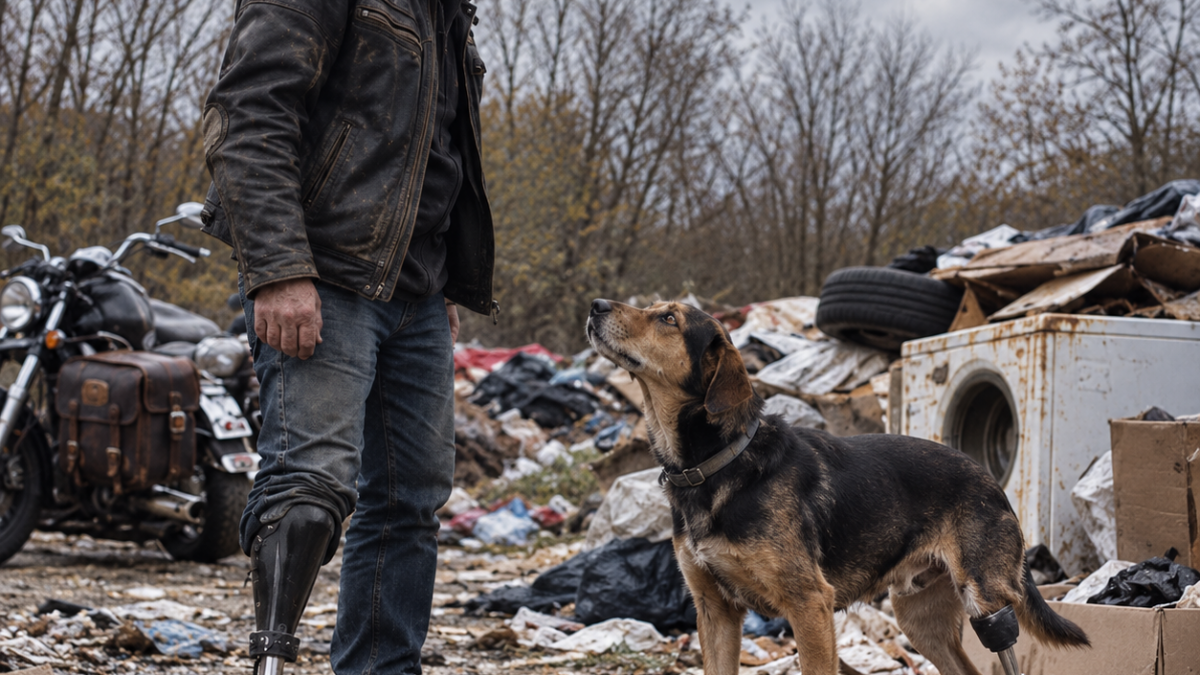
PART 2:
The name on the strip was **ORION**.
I read it twice.
“Orion.”
The dog’s ears lifted.
Not much, but enough.
I felt something hard settle inside my chest.
“So that’s you.”
His tail moved again.
This time it was definitely a wag.
One weak sweep through the dust.
I turned the plastic strip over. The back had once carried more writing, but mud and friction had worn most of it away.
The phone number was still legible.
Ten digits.
French mobile.
I took out my phone.
For several seconds, I simply looked at the number.
Part of me wanted to call immediately.
The other part wanted to put the phone away, get Orion somewhere safe, and let an animal welfare organization deal with whoever answered.
I had spent enough of my life learning what happens when anger gets to choose the order of operations.
So I didn’t call.
Not yet.
First, I needed the dog.
That turned out to be harder than finding him.
He would take food from my fingers now, but the moment I reached toward his collar, he backed away.
I didn’t blame him.
People imagine rescue as a moment.
A scared animal sees kindness, understands it, and climbs gratefully into your vehicle.
Real fear isn’t that cooperative.
Fear has memory.
Fear says every hand may become the hand that hurt you.
I sat on that filthy pallet for nearly forty minutes.
My motorcycle idled until I finally shut it off.
The afternoon grew quiet.
Every now and then, a car passed on the road.
Each time, Orion ducked behind the washing machine.
That told me something too.
Cars frightened him.
I called my friend Luc.
He answered with, “If you’re calling because that old Triumph finally died, I’m leaving you there.”
“The Triumph is fine.”
“Then what’s broken?”
“A dog.”
There was silence.
“What?”
“I found a three-legged dog at a dump.”
“You found a what?”
“Bring your van.”
“Marc—”
“Luc.”
He heard something in my voice.
“I’m coming.”
Luc Martin had known me since before the accident.
He’d been there during the months when I couldn’t stand the sight of my prosthesis.
He’d watched me throw one temporary leg across a rehabilitation room because I couldn’t get the socket comfortable.
He’d picked it up without saying anything and handed it back.
That was friendship with Luc.
Very little poetry.
A lot of showing up.
While I waited, I found an old plastic basin among the trash, rinsed it with bottled water from my saddlebag, and poured fresh water into it.
Orion drank for nearly a minute.
I had to stop myself from giving him too much food too quickly.
He was painfully thin, and a starving animal could become sick if overfed.
When Luc’s white van finally turned onto the access road, Orion disappeared so fast behind the washing machine that I barely saw him move.
Luc climbed out.
He was sixty-one, broad-shouldered, bald, and wearing mechanic’s coveralls.
He took one look at the dump.
Then one look at me.
“You always find the nicest vacation spots.”
“Keep your voice down.”
His expression changed when he saw Orion.
“Oh.”
“Yeah.”
Luc crouched.
The dog stared at him.
Luc looked at the missing leg.
Then at mine.
Then back at the dog.
“You’re kidding.”
“I wish I were.”
“What’s his name?”
“Orion.”
“You named him already?”
“No.”
I held up the strip.
“Somebody else did.”
Luc read it.
His jaw tightened.
“You call?”
“Not yet.”
“Good.”
I looked at him.
He shrugged.
“If you called now, you’d probably say something involving prison.”
“I was thinking more along the lines of a shovel.”
“That too.”
We spent another half hour getting Orion close enough to the van.
Luc had an old wool blanket in the back.
We laid it near the open side door.
I sat beside it.
Eventually Orion approached.
He sniffed the blanket.
Then the van.
Then me.
When a truck passed on the road, he panicked.
He tried to turn too quickly, lost his balance, and fell hard onto his right hip.
The sound he made wasn’t a yelp.
It was worse.
A short, breathless grunt, the kind pain makes when an animal is too exhausted to cry properly.
I moved toward him.
He bared his teeth.
I stopped immediately.
“All right.”
Luc whispered, “He’s hurting.”
“I know.”
Orion tried to stand.
His remaining rear leg shook.
Something about the movement hit me directly in a place I hadn’t visited in years.
Rehabilitation.
Parallel bars.
Sweat soaking the back of my shirt.
A physiotherapist saying, “Again.”
Me saying, “Go to hell.”
Falling.
Getting up.
Falling again.
The humiliation of needing instructions for something I’d done without thought since childhood.
I looked at Orion.
“You don’t have to prove anything.”
Of course, he didn’t understand the sentence.
But he understood the tone.
His teeth disappeared.
I moved slowly.
This time, when my hand touched his shoulder, he didn’t pull away.
Luc brought the blanket around him from the other side.
Together, we lifted him.
He weighed almost nothing.
That frightened me.
I expected resistance.
There was none.
Orion simply went limp in our arms.
We placed him in the van.
I climbed into the back beside him.
Luc looked at my motorcycle.
“What about the Triumph?”
“I’ll come back.”
“You’re leaving your bike here?”
“I’m not leaving him alone.”
Luc didn’t argue.
We drove straight to a veterinary clinic in Limoges.
The receptionist took one look at Orion and called someone immediately.
A veterinarian named Dr. Claire Vautrin examined him.
She was probably in her early forties, calm voice, quick hands.
Orion trembled on the table.
I kept one hand near his nose.
“He’s severely underweight,” she said.
“How bad?”
“Bad enough that I don’t want to guess how long he’s been eating irregularly.”
She checked his gums.
“Dehydrated. Fleas. Some abrasions. The right hind paw is overloaded.”
“From compensating?”
She glanced at my leg.
“Yes. You know the problem.”
“I do.”
She moved to the stump.
Her fingers barely touched the scar.
Orion flinched hard.
Dr. Vautrin stopped.
“This amputation wasn’t recent.”
“I figured.”
“Possibly a year, maybe more. We’d need records if we want to know exactly.”
“Could it have been done badly?”
She examined it again.
“The surgical line itself isn’t terrible. But there’s pressure damage on the skin and no evidence anyone has been managing it recently.”
“What does that mean?”
“It means an amputee dog needs weight control, proper footing, nail care, monitoring of the remaining limb, sometimes rehabilitation. If he’s been living outside or abandoned, none of that happens.”
I looked at Orion.
“You hear that? High maintenance.”
His eyes remained fixed on me.
Claire scanned him for a microchip.
The machine beeped.
She looked at the display.
“He’s chipped.”
My stomach tightened.
“To who?”
“I’ll have to check the registry.”
The clinic had procedures.
Privacy.
Ownership questions.
Animal abandonment laws.
I understood.
I also hated waiting.
Claire made a phone call from another room.
When she returned, her expression had changed.
“There is a registered owner.”
“Same phone number?”
“I can’t give you personal data yet.”
“Doctor.”
“Marc, listen to me.”
I hadn’t told her to call me Marc.
She’d seen it on the intake form.
I shut my mouth.
She continued.
“If this dog was abandoned, there needs to be documentation. Photographs. His condition. Where he was found. The collar. Everything.”
“I took pictures at the dump.”
“Good.”
“Can you contact the owner?”
“I can contact the registry-listed owner and notify the relevant authorities if the circumstances are suspicious.”
“Suspicious?”
She looked at the dog’s ribs.
Then his missing leg.
Then at me.
“Yes. Suspicious.”
That word saved me from doing something stupid.
I gave her the laminated strip.
She put it in a clear evidence bag.
“What happens to him tonight?”
“We keep him.”
“No.”
Claire raised an eyebrow.
“No?”
“He doesn’t stay alone.”
“This is a veterinary clinic.”
“He was dumped.”
“And he’s medically unstable.”
“I’ll stay.”
“You can’t stay overnight in our treatment room.”
“I can sleep in the parking lot.”
Luc, who had been leaning against the wall, muttered, “He will.”
Claire looked between us.
Then she sighed.
“You bikers are exhausting.”
Luc pointed at me.
“Mostly him.”
She admitted Orion for fluids, bloodwork, parasite treatment, and X-rays of the remaining hind leg.
I sat in the waiting room.
Luc went to retrieve my motorcycle.
At seven that evening, he returned with the Triumph in the van and two sandwiches.
I had no appetite.
He gave me one anyway.
“You calling the number now?”
“No.”
“Good.”
“You already said that.”
“Still good.”
I looked at him.
“What if the owner says he ran away?”
Luc chewed slowly.
“Then maybe he ran away.”
“With a collar and no tag?”
“Could happen.”
“At an illegal dump?”
“Could happen.”
“Underweight?”
“Could happen.”
“Terrified of cars?”
Luc stopped chewing.
“That one’s interesting.”
We were quiet.
Finally he said, “Don’t decide the whole story before you know it.”
I hated when Luc sounded reasonable.
Around eight-thirty, Claire came into the waiting room.
“Bloodwork could be worse.”
“That sounds comforting.”
“It should. No major organ failure. Mild anemia. Dehydration. Malnutrition. His right hip is arthritic and overloaded, but there’s no acute fracture.”
“What about the stump?”
“Inflamed, irritated, but not infected deeply.”
“Can he recover?”
“If he gets care, yes.”
The relief was so strong I had to look away.
Claire sat across from me.
“There is something else.”
I waited.
“The chip was registered to a man named Philippe Renaud.”
I repeated the name.
Didn’t know it.
“He lives outside Limoges. The chip records show Orion was registered three years ago.”
“And the amputation?”
“I made a few calls.”
She paused.
“Orion had surgery seventeen months ago at another clinic after a hunting accident.”
“Hunting?”
“Yes.”
“What kind?”
“Gunshot injury.”
I stared at her.
“Somebody shot him?”
“The record says accidental firearm trauma during a boar hunt.”
My jaw clenched.
“Owner?”
“I don’t know who fired the shot.”
“Was the leg salvageable?”
“Apparently not.”
I looked toward the treatment-room door.
Something in me had gone very quiet.
Claire continued.
“The previous clinic documented good follow-up for several months.”
“So somebody cared for him.”
“At least initially.”
“What changed?”
“That,” she said, “is the question.”
The next morning, I got an answer.
Not the whole answer.
Just enough to make things worse.
Claire called me at seven-forty.
“Marc, are you awake?”
“I slept in a van outside your clinic.”
“Of course you did.”
“Is Orion okay?”
“Yes.”
I sat upright.
“What happened?”
“The listed owner called back.”
“And?”
“He says Orion disappeared six weeks ago.”
I stared through the windshield.
“Six weeks.”
“Yes.”
“Did he report him missing?”
Pause.
“No.”
“Did he put up notices?”
“I don’t know.”
“Call shelters?”
“I don’t know.”
“Police?”
“Marc.”
“What?”
“He claims the dog escaped from his property.”
I looked at the clinic doors.
“And landed at a dump twenty kilometers away.”
“That’s what needs to be investigated.”
I got out of the van.
My prosthesis clicked against the asphalt.
“Did he ask how Orion was?”
Another pause.
“Yes.”
Something about that answer bothered me.
Maybe because I had wanted Philippe Renaud to be simple.
A monster.
A man who heard the dog had been found and immediately said he didn’t want him.
Instead, he had asked how Orion was.
People are inconvenient that way.
“They’re coming to speak with him today,” Claire said.
“Who?”
“An animal protection investigator and a gendarme.”
“I want to be there.”
“You found him, so they’ll likely speak to you.”
“Good.”
“Marc.”
“Yes?”
“Do not contact Renaud yourself.”
I said nothing.
“Marc.”
“I heard you.”
“That is not the same as agreeing.”
“I won’t contact him.”
“Thank you.”
I meant it.
For almost three hours.
Then Philippe Renaud contacted me.
He must have obtained my name from somewhere in the process.
My phone rang at 10:17.
Unknown number.
I answered.
“Delmas?”
“Yes.”
“This is Philippe Renaud.”
Every muscle in my body tightened.
I stepped away from the clinic entrance.
“You own Orion.”
“I did.”
Did.
Not do.
Did.
“What do you want?”
“I was told you found him.”
“Yes.”
“Where?”
“You know where.”
“I was told near Saint-Priest-Taurion.”
“At a dump.”
He went silent.
I let the silence stay.
Finally he said, “Is he alive?”
“Yes.”
Another breath.
“Good.”
“You sound relieved.”
“I am.”
“You didn’t report him missing.”
His voice hardened.
“I don’t need to explain myself to you.”
“No. You’ll explain it to someone else.”
“Listen, biker—”
“No. You listen.”
My voice had dropped.
Luc, twenty feet away, turned toward me.
I continued.
“I found your dog eating rotten food beside broken glass. He could barely stand. His collar had your old number hidden underneath it. If you want to tell me he wandered there by accident, save it.”
“I never said that.”
That stopped me.
“What?”
“I said he disappeared.”
“What’s the difference?”
Philippe exhaled.
“The difference is I didn’t dump him.”
“Then who did?”
Silence.
I heard movement on his end.
A door closing.
When he spoke again, his voice was lower.
“My brother.”
I didn’t say anything.
“His name is Laurent,” Philippe continued. “We live on the same property. He handles the hunting dogs.”
“Orion was a hunting dog?”
“Yes.”
“And your brother dumped him?”
“I think so.”
“You think?”
“I was away.”
“Where?”
“Toulouse. Work.”
“For six weeks?”
“Ten days.”
“And when you came back?”
“Orion was gone.”
“What did Laurent say?”
“That he’d slipped the gate.”
“You believed him?”
“At first.”
“At first.”
Another pause.
“Then I found Orion’s old bed gone too.”
My grip tightened around the phone.
“Why didn’t you report him?”
“You don’t understand my family.”
“Try me.”
“My father owns the land. Laurent runs the hunting business. I work there too. Everything is tied together.”
“So you let your brother throw away your dog because confronting him was inconvenient?”
“Don’t talk to me like you know me.”
“I know enough.”
“No, you don’t.”
His voice broke on the last word.
That surprised me.
Then came something I hadn’t expected.
“I paid for Orion’s surgery.”
I stayed silent.
“I slept on the floor beside him for two weeks,” Philippe said. “I built ramps. I did therapy exercises. I stopped hunting with him.”
“Then why was he starving at a dump?”
“Because my brother said a three-legged hound was useless.”
There it was.
Useful.
Useless.
A familiar vocabulary.
I looked down at my prosthesis.
“Your brother shot him?”
Philippe didn’t answer.
“Was it Laurent?”
“Yes.”
The word was barely audible.
I closed my eyes.
“Accident?”
“That’s what everyone said.”
“What do you say?”
“I wasn’t there.”
“What do you believe?”
Long pause.
“I believe Laurent gets angry when dogs don’t perform.”
I opened my eyes.
The clinic doors reflected my face.
Gray beard.
Hard eyes.
A man I barely recognized from the expression.
“Why are you telling me this?”
“Because they’re coming to question me.”
“Good.”
“And if I tell them everything, my family is finished.”
“Your dog almost was.”
He didn’t respond.
I could hear him breathing.
Finally he said, “Can I see him?”
“No.”
“You don’t get to decide that.”
“You’re right. The veterinarian does.”
“Tell her I asked.”
“I will.”
“And Delmas?”
“Yes?”
“Don’t underestimate Laurent.”
The call ended.
Luc was standing beside me.
“That looked healthy.”
I told him what Philippe had said.
Luc listened without interrupting.
When I finished, he rubbed his jaw.
“So the owner may not be the dumper.”
“Still failed the dog.”
“Yes.”
“Didn’t report him.”
“Yes.”
“Stayed quiet because the family business mattered more.”
“Yes.”
I looked at him.
“Why do you keep saying yes?”
“Because you’re looking for an argument.”
“I don’t need one.”
“No. You need a target.”
That made me angry because it was true.
By noon, an investigator from an animal protection association arrived with a gendarme named Captain Moreau.
Moreau had the kind of face that gave nothing away.
He asked me to walk him through exactly what happened.
I did.
Where I parked.
What I heard.
Where Orion emerged.
Where the food was.
Where the collar strip was found.
He photographed the photographs on my phone, then had me email the originals.
“Did you move anything at the site?”
“The tarp. Some food. A basin.”
“Anything else?”
“No.”
“Did you see tire tracks?”
“Many.”
“Recent?”
“I didn’t check.”
“Any cameras nearby?”
“Not that I saw.”
He nodded.
“We’ll inspect.”
The animal protection investigator, a woman named Sophie Barre, asked about Orion’s behavior.
“Afraid of cars,” I said.
“How afraid?”
“Dropped low and tried to hide when vehicles passed. Panicked when we tried to get him into the van.”
“Afraid of men?”
“He was afraid of everybody.”
“Did he react differently to you?”
I almost said yes.
Then stopped.
“Maybe.”
“How?”
“He kept looking at my leg.”
Sophie glanced down.
I moved my prosthetic foot.
Click.
Orion, visible through the glass door of the treatment area, lifted his head.
Everybody saw it.
Sophie looked at me.
“That is unusual.”
“Maybe he associates the sound with something.”
“Maybe.”
Claire joined us.
She had printed the previous veterinary records.
Orion’s history told a story no one had expected.
He had been a working hound.
Male.
Five years old.
Healthy until the hunting injury.
Severe trauma to the left rear leg.
Emergency amputation.
Then rehabilitation.
Weight stable.
Regular follow-ups.
One note from the old veterinarian stood out.
**Owner reports conflict with family member regarding dog’s continued care. Owner wishes to retain animal as companion despite inability to return to hunting.**
Captain Moreau read it twice.
“Who was the owner at this appointment?”
Claire pointed.
“Philippe.”
Moreau looked at me.
Then Sophie.
“No one contacts Laurent Renaud yet.”
I folded my arms.
“I wasn’t planning to.”
Moreau gave me a look that suggested he didn’t believe me.
He was right not to.
But I kept my promise.
The authorities visited the Renaud property that afternoon.
I didn’t go.
I wanted to.
God, I wanted to.
Instead I sat beside Orion while he ate his first measured meal without shaking.
Claire had moved him into a quieter kennel.
I sat on the floor outside it.
“You’ve caused quite a mess,” I told him.
He licked food from the bowl.
“You could at least look guilty.”
Nothing.
“Typical.”
His tail tapped once.
Later, Sophie called.
“We found something.”
My pulse jumped.
“What?”
“A trailer.”
“What kind?”
“Utility trailer used to transport feed and equipment.”
“And?”
“There are traces of blue nylon caught on a sharp edge near the rear gate.”
I pictured the collar.
“Same color?”
“Appears so.”
“That proves he was transported.”
“It suggests it. Forensic certainty is different.”
“What else?”
She hesitated.
“We found dried blood.”
My stomach tightened.
“Orion’s?”
“Unknown.”
“Could be from game.”
“Yes.”
“This is a hunting property.”
“Yes.”
I hated careful people.
They refused to hand anger the certainty it wanted.
Sophie continued.
“Laurent says Orion escaped.”
“Of course.”
“He also says Philippe asked him to get rid of the dog.”
That changed everything.
“What?”
“He claims Philippe told him Orion had become a burden.”
I stood.
“Philippe told me the opposite.”
“I know.”
“So one of them is lying.”
“Yes.”
“Which one?”
“We don’t know yet.”
For the first time, I understood that this could become more complicated than finding a cruel man and exposing him.
Family lies rarely come alone.
They travel in packs.
The next morning, Philippe came to the clinic.
Claire called me before letting him near Orion.
“You don’t have to be here,” she said.
“I know.”
“Then why are you here?”
“Because he called me.”
“That is not a reason.”
“It is to me.”
She studied my face.
“Stay calm.”
“I am calm.”
“No, you’re quiet. Those are different.”
She was beginning to know me too well.
Philippe Renaud looked nothing like I expected.
Late forties.
Thin.
Clean-shaven.
Work jacket.
Hands rough from labor.
He didn’t look like someone who ran dogs through the woods for sport.
He looked like an accountant who occasionally fixed fences.
When he saw Orion through the glass, he stopped walking.
His face collapsed.
Not dramatically.
His shoulders simply dropped.
“Oh, God.”
Orion heard the voice.
His head lifted.
Philippe crouched outside the kennel.
“Orion.”
The dog stared at him.
For one second, nothing happened.
Then Orion stood.
Three legs trembling.
He moved forward.
Philippe covered his mouth.
“Come here, boy.”
Orion approached the bars.
He sniffed Philippe’s fingers.
Then licked them.
I looked away.
I had wanted Orion to reject him.
That would have made everything simple.
But dogs don’t organize morality for our convenience.
Philippe began crying.
Quietly.
“I’m sorry.”
Orion pressed his nose between the bars.
I felt anger rise again.
Not because Philippe was faking.
Because he wasn’t.
After several minutes, Claire led us into a consultation room.
Philippe sat across from me.
“You found him.”
“Yes.”
“Thank you.”
I said nothing.
“I mean it.”
“I know.”
He looked at my leg.
Then back at me.
“Orion always notices prosthetics.”
I frowned.
“What?”
“My father lost part of his foot in a farm accident. He wears an orthopedic brace that clicks when he walks.”
I looked toward the kennel.
That explained the sound.
Maybe not all of Orion’s reaction.
But some.
Philippe continued.
“When Orion came home after the amputation, my father was the first person he trusted besides me. Same uneven step. Same noise.”
The strange connection I’d felt at the dump suddenly had a logical shape.
I wasn’t some mystical mirror.
I sounded familiar.
And maybe that had been enough.
I asked, “Did you tell Laurent to get rid of him?”
Philippe’s face changed.
“No.”
“He says you did.”
“He’s lying.”
“Why?”
“Because if he admits what he did, my father cuts him out.”
“Out of what?”
“The property. The hunting operation. Everything.”
“Would your father?”
“Yes.”
“Then why hasn’t he already?”
Philippe looked down.
“Because my father doesn’t know everything.”
“Know what?”
Philippe hesitated.
I leaned forward.
“What?”
“The shooting.”
I felt cold.
“You said it was an accident.”
“That’s the official story.”
“What’s the unofficial one?”
Philippe rubbed both hands together.
“Laurent was training Orion on boar scent. Orion broke off and followed a deer trail. Laurent had been drinking.”
My jaw tightened.
“Keep going.”
“He fired into the ground near him.”
“To scare him?”
“Yes.”
“And hit him.”
Philippe closed his eyes.
“The shot destroyed the leg.”
For several seconds, I couldn’t speak.
“So Laurent didn’t accidentally shoot a dog during a hunt.”
“No.”
“He shot at a dog because it disobeyed.”
“He says he wasn’t aiming at Orion.”
“That’s supposed to help?”
“No.”
“Who knew?”
“Me. Laurent. Two other men.”
“And you lied.”
“Yes.”
“To the vet?”
“We said hunting accident.”
“To authorities?”
“There was no investigation.”
“You protected him.”
Philippe’s eyes filled again.
“Yes.”
“And seventeen months later he dumped the same dog.”
Philippe looked toward the door.
“I think so.”
“You think so?”
“I wasn’t there.”
“Stop hiding behind that.”
His head snapped up.
“You think I don’t hate myself?”
“I don’t care how you feel.”
“That’s easy for you.”
I stood.
My chair scraped back.
“Easy?”
Claire appeared in the doorway immediately.
“Marc.”
I ignored her.
“You want to talk to me about easy?”
Philippe stood too.
“I meant you weren’t there.”
“No. I wasn’t there when your brother shot him. I wasn’t there when you lied. I wasn’t there when you let him keep controlling the property after he nearly killed the dog.”
“I was protecting my family.”
“And who protected Orion?”
The room went silent.
Philippe’s face went pale.
I realized I was shaking.
Not from fear.
From something older.
Something I knew too well.
The phrase protecting my family.
People used protection to justify almost anything.
Protect the family.
Protect the business.
Protect the reputation.
Protect the peace.
Sometimes all it meant was protecting the person causing the harm because confronting them would be expensive.
Claire stepped between us.
“Enough.”
I sat.
Philippe did too.
After a moment, he whispered, “You’re right.”
I looked at him.
“I know.”
The investigation widened.
Captain Moreau spoke with the two men who had witnessed the shooting.
At first, both repeated the old story.
Accident during a hunt.
Then one of them changed his account.
His name was Étienne Borel.
He was seventy.
He had hunted with the Renauds for decades.
Moreau didn’t tell me what made Étienne change his mind.
Étienne told me himself.
He found me at a café three days later.
“You’re Delmas?”
I looked up.
“Yes.”
He removed his cap.
“May I sit?”
“Depends.”
“On?”
“Who you are.”
“Étienne Borel.”
I knew the name.
I gestured to the chair.
He sat.
His hands shook slightly.
Not fear.
Age.
“I heard you found Orion.”
“I did.”
“How is he?”
“Alive.”
Étienne nodded.
“Good.”
I waited.
He stared at his coffee.
“I lied.”
“Yes.”
His head lifted.
“You know?”
“I know somebody did.”
“I told the gendarmes the truth yesterday.”
“Why now?”
He looked toward the window.
“Because I saw a photograph of Orion at the clinic.”
I said nothing.
“He looked worse than when we found him after Laurent shot him.”
“You were there.”
“Yes.”
“Tell me.”
Étienne swallowed.
“We were training three dogs. Orion was the youngest. Smart animal. Too smart, maybe. Laurent liked obedience more than intelligence.”
I hated the sentence immediately.
“He’d been drinking?”
“Yes.”
“How much?”
“Enough.”
“Orion went off scent?”
“He followed deer tracks. Laurent screamed. Dog kept going.”
Étienne’s fingers tightened around the cup.
“Laurent fired into the dirt beside him. Orion jumped. Second shot caught the leg.”
“Second shot?”
Étienne looked at me.
I felt something inside me turn to stone.
“Philippe said one.”
“Two.”
“Was the second aimed at him?”
“I don’t know.”
“That’s not an answer.”
“He pointed the gun in Orion’s direction.”
My hands flattened against the table.
“What did you do?”
“We got the dog.”
“What did you do about Laurent?”
“Nothing.”
“Why?”
Étienne’s face folded inward.
“Cowardice.”
At least he had a word for it.
“He begged us not to tell Philippe’s father. Said he’d lose the hunting lease, the dogs, everything.”
“So you invented the accident.”
“Yes.”
“And now?”
“Now I saw where that silence ended.”
He looked at me.
“In a dump.”
I leaned back.
For once, I had nothing to say.
Étienne continued.
“There’s more.”
Of course there was.
“What?”
“Laurent has gotten rid of dogs before.”
My chair stopped moving.
“How many?”
“I don’t know.”
“Alive?”
“Some were rehomed.”
“Some?”
He stared at his hands.
“One disappeared four years ago after becoming gun-shy.”
“What does that mean?”
“I don’t know.”
“Did you ask?”
“No.”
I stood.
Étienne looked up.
“Where are you going?”
“To find Moreau.”
“He knows.”
I stopped.
“You told him?”
“Everything.”
That evening, I sat outside the clinic with Luc.
The sun was going down over the parking lot.
Orion had improved enough that Claire expected he could leave within a few days, provided custody was legally sorted out.
That had become another problem.
Philippe remained the registered owner.
He had not been charged with abandonment.
Laurent denied everything.
There was evidence but not enough yet.
And Philippe, despite everything, still legally had a claim to the dog.
“What if they give Orion back?” I asked.
Luc opened a soda.
“To Philippe?”
“Yes.”
“You think he’d hurt him?”
“No.”
“You think he’d dump him?”
“No.”
“Then what’s the problem?”
I looked at him.
“You know the problem.”
Luc nodded slowly.
“He failed him.”
“Yes.”
“People can fail once and do better.”
“This wasn’t once.”
“No.”
“He protected Laurent after the shooting.”
“Yes.”
“He didn’t report Orion missing.”
“Yes.”
“He chose his family over the dog twice.”
“Yes.”
I rubbed my face.
“So why are you defending him?”
“I’m not.”
“Sounds like it.”
Luc stared across the parking lot.
“I’m defending the possibility that people aren’t frozen at their worst moment.”
That shut me up.
He took another drink.
“Remember after your accident?”
“Don’t.”
“You were unbearable.”
“I said don’t.”
“You punched a bathroom door because you couldn’t get into the shower.”
“The door had it coming.”
“You stopped answering your daughter.”
I looked at him.
That one still hurt.
Luc continued.
“You treated everybody who loved you like they were insulting you by staying.”
“I was in pain.”
“Yes.”
“You’re comparing that to abandoning a dog?”
“No.”
He finally turned toward me.
“I’m reminding you that shame makes people stupid. Fear makes them quiet. Pride makes them cruel in ways they don’t understand until later.”
I said nothing.
“You don’t have to forgive Philippe,” Luc said. “But Orion gets a vote too.”
I looked through the clinic window.
Orion was asleep.
“Dogs don’t vote.”
“No. They just keep loving people who don’t deserve it.”
A week after I found him, Orion came home with me.
Temporarily.
That was the word everybody used.
Temporary foster.
Pending investigation.
Pending ownership determination.
Pending veterinary clearance.
I hated the word temporary.
Orion didn’t care.
He hated my apartment stairs.
The first night, he stood at the bottom and stared upward.
Three flights.
No elevator.
I looked at him.
He looked at me.
“Well.”
He sat down.
I sighed.
“You’re enjoying this.”
I lifted him.
Twenty-four kilos after rehydration.
Still light for his frame.
By the second flight, my residual limb was screaming inside the socket.
Orion rested his chin on my shoulder.
“Don’t get comfortable.”
He did.
At the apartment, he refused to cross the threshold.
I remembered the van.
The clinic.
The dump.
Too many unfamiliar doors.
So I sat inside with the door open.
Five minutes.
Ten.
Eventually he stepped forward.
Click.
Tap.
Click.
Tap.
My prosthetic foot.
His three paws.
We crossed the living room together.
That first night, Orion slept beside the sofa.
At two in the morning, I woke to nails scraping on the floor.
I sat up.
He was standing near the front door.
Panting.
“What is it?”
His tail tucked.
Then I heard a truck outside.
Air brakes.
Orion flattened himself to the floor.
I got down beside him.
“Okay.”
He shook.
The truck moved on.
He stayed pressed against the floor.
I put one hand against his shoulder.
“I know.”
I did not know exactly.
But I understood what a sound could do.
For years after my crash, headlights appearing around a bend at night made my body react before my mind did.
Sweat.
Tight chest.
Hands locked around handlebars.
Memory lives in the nervous system long after language gets tired of explaining it.
I slept on the floor beside Orion that night.
The investigation kept moving.
Slowly.
Painfully.
Captain Moreau found traffic-camera footage from a road two kilometers from the dump.
The camera wasn’t aimed at the illegal dumping area.
It monitored an intersection.
But at 6:12 on the morning Philippe left for Toulouse, a dark green pickup towing the Renaud utility trailer passed toward the dump road.
At 6:49, it returned.
The driver wasn’t clearly visible.
The plate was.
Registered to Laurent Renaud.
Laurent claimed he had been hauling scrap.
Moreau asked what scrap.
Laurent couldn’t remember.
Investigators inspected the dump again.
Behind the washing machine where Orion had hidden, they found a torn piece of old wool blanket.
Philippe identified the pattern from photographs.
It had belonged to Orion.
The blanket that disappeared with his bed.
Not proof by itself.
But evidence was beginning to stack.
Then came the mistake that finally shifted everything.
Laurent called me.
I don’t know how he got my number.
Probably through Philippe.
Maybe somebody at the hunting circle.
It didn’t matter.
I answered at 9:36 on a Thursday night.
“Delmas?”
“Yes.”
“You need to stay out of my family’s business.”
His voice was rough.
Angry.
I stood in my kitchen.
Orion lifted his head from his bed.
“Laurent.”
“So you know who I am.”
“I know enough.”
“No, you don’t.”
Everyone in that family loved that sentence.
“What do you want?”
“I want you to stop talking.”
I almost laughed.
“That usually works better before you call the person.”
“You think you’re clever?”
“No.”
“You think because you’ve got one leg and that dog has three, this is some kind of story?”
My grip tightened around the phone.
Orion stood.
“Careful.”
“Or what?”
I didn’t answer.
He continued.
“That dog was useless.”
There it was.
Not alleged.
Not misunderstood.
Not escaped.
Useless.
I opened the voice recording app on my second phone.
Luc had once told me never to rely on memory when angry people start talking.
“What did you say?” I asked.
“You heard me.”
“No. Say it again.”
“Orion couldn’t hunt. Couldn’t breed properly. Couldn’t keep up. Philippe spent money on rehabilitation like the thing was a child.”
“The thing.”
“Yes. A dog.”
I leaned against the counter.
“And you dumped him?”
Silence.
Then Laurent laughed.
“You people are unbelievable.”
“Did you?”
“I took a problem off my brother’s hands.”
My heart kicked.
“You took him to the dump.”
“I never said that.”
“You just said you took care of the problem.”
“Interpret it however you want.”
“Did Philippe ask you to?”
Another pause.
“No.”
That was the moment.
Not because I needed more.
Because Laurent didn’t realize what he had just admitted.
I kept my voice calm.
“So Philippe didn’t ask.”
“He was too weak to ask.”
“And you decided for him.”
“Someone had to.”
I thought of every person who had ever decided what another living thing was worth based on usefulness.
“You shot Orion too.”
The line went silent.
When Laurent spoke again, his voice had changed.
“Who told you that?”
“Doesn’t matter.”
“Was it Borel?”
I didn’t answer.
“That old coward.”
“So it’s true.”
“It was an accident.”
“Two shots?”
Another silence.
I could hear my own breathing.
Then Laurent said, “Dogs need correction.”
My whole body went cold.
“Correction?”
“He broke scent.”
“You shot at him.”
“I fired near him.”
“Twice.”
“He moved.”
I closed my eyes.
“Then you watched your brother pay to amputate the leg.”
“Philippe always got sentimental.”
“And when Orion couldn’t hunt anymore?”
“I found somewhere else for him.”
“An illegal dump.”
“I said I didn’t say that.”
“You don’t have to.”
Laurent’s voice hardened.
“Listen carefully. You don’t know who you’re dealing with.”
There it was.
The threat people make when facts stop working.
I said, “Actually, I’m beginning to.”
“If you keep dragging my name around, you’ll regret it.”
“Is that a threat?”
“Call it advice.”
“No.”
“What?”
“I’ll call it a threat.”
He swore.
Then hung up.
I stood in the kitchen for several seconds.
Orion came toward me.
Three paws against tile.
My prosthetic foot clicked when I crouched.
He pressed his head under my hand.
I looked at the recording screen.
Thirty-seven minutes.
The next morning, Captain Moreau listened to the entire call.
He didn’t smile.
Moreau was not a man who wasted expressions.
But when Laurent said, **“Philippe didn’t ask,”** Moreau paused the audio.
“Again.”
We listened.
Then Laurent said, **“I found somewhere else for him.”**
Moreau paused again.
“That helps.”
“Helps?”
“It contradicts his statement that Orion escaped.”
I leaned back.
“So now?”
“Now I speak to him again.”
“Can I come?”
“No.”
“Why not?”
“Because this is an investigation, not theater.”
I almost argued.
Then didn’t.
He was right.
My part was finding Orion.
Keeping him safe.
Giving evidence.
Not creating a confrontation just because I wanted to see Laurent lose control.
Justice is slower than anger.
That’s why anger hates it.
Laurent was questioned again.
This time, the story changed.
Orion had not escaped.
According to Laurent’s new version, he had taken the dog to a man who agreed to rehome him.
Name?
Couldn’t remember.
Address?
Didn’t know.
Phone?
Lost.
Description?
Vague.
Moreau showed him the traffic footage.
Laurent said he had gone to the dump road to dispose of scrap.
Moreau showed him the blanket fragment.
Laurent said old blankets were common.
Moreau played the phone recording.
That was when Laurent asked for a lawyer.
I learned all of that later.
What happened next came from Philippe.
He arrived at my apartment unannounced on Saturday morning.
I nearly shut the door in his face.
Then Orion heard him.
The dog pushed past my leg.
Philippe crouched in the hallway.
“Hey, boy.”
Orion approached.
Tail wagging.
That sight still hurt me.
Not because Orion loved Philippe.
Because love can survive neglect.
That is one of the cruelest things about it.
Philippe stroked his ears.
“You look better.”
“He is.”
“I brought something.”
He held up a cardboard box.
Inside was a harness.
Old.
Blue.
Modified with a padded support strap.
“I used this after surgery.”
Orion sniffed it.
His whole body changed.
Tail faster.
Nose working.
He remembered.
I looked at Philippe.
“Why are you giving it to me?”
“Because he needs it.”
“That isn’t what I mean.”
Philippe stood.
His eyes were red.
“I signed the surrender papers.”
I stared at him.
“What?”
“I transferred ownership to the rescue association.”
“When?”
“Yesterday.”
“Why?”
He looked down at Orion.
“Because if I ask for him back, I’m asking him to trust the same house that failed him.”
“You could leave that property.”
“I could.”
“Will you?”
“Yes.”
That surprised me.
“My father is selling my share to me,” Philippe continued. “Laurent won’t be working there anymore.”
“Because of the investigation?”
“Because my father finally knows what happened.”
I folded my arms.
“And?”
Philippe gave a hollow laugh.
“And he nearly put Laurent through a wall.”
“Your father?”
“He’s seventy-six.”
“I like him already.”
Philippe almost smiled.
Then his face hardened.
“He knows we lied after the shooting.”
“He know you lied too?”
“Yes.”
“How did that go?”
“He told me that protecting your brother from consequences isn’t protecting your family.”
I looked at Philippe.
Good sentence.
Painful sentence.
Useful sentence.
“What happens to Laurent?”
“Whatever the court decides.”
“That doesn’t answer me.”
“No.”
Philippe looked toward the stairs.
“He’ll lose the hunting dogs regardless. My father has already transferred their care. The hunting association suspended him pending investigation.”
There it was.
The first consequence.
Not revenge from me.
His own behavior finally reaching his own life.
Philippe continued.
“The other dogs were examined. Two had untreated ear infections. One had an old rib fracture.”
My jaw tightened.
“Abuse?”
“Unclear.”
“Everything is unclear with your family.”
He accepted that without protest.
Then he held out the box.
“Will you take the harness?”
I took it.
“Yes.”
He nodded.
He crouched once more beside Orion.
“I don’t know if I’ll see you again, boy.”
Orion licked his wrist.
Philippe’s face broke.
I looked away.
A minute later, he stood.
At the door, he said, “Marc.”
“Yes.”
“Are you keeping him?”
“I don’t know.”
That was a lie.
We both knew it.
Philippe smiled sadly.
“You do.”
I looked at Orion.
He was standing beside my left leg.
“Probably.”
“Good.”
Then Philippe left.
Three days later, the rescue association called.
“Marc,” Sophie said, “we have a question.”
“If it’s whether I’m returning the dog, no.”
She laughed.
“That answers it.”
“What?”
“Philippe formally surrendered Orion. We can place him for adoption once the veterinary hold clears.”
“Okay.”
“Would you like to apply?”
I looked across the room.
Orion was asleep on my sofa.
Not beside it.
On it.
He had discovered furniture.
The bastard.
“No,” I said.
Sophie went silent.
Then I added, “Just send me whatever form makes him legally mine.”
She laughed again.
“You had me for a second.”
“I’m fifty-eight. Let me have hobbies.”
The adoption became official two weeks later.
Luc came with me to sign the papers.
He wore his leather vest because, according to him, it was a formal occasion.
Claire brought Orion out wearing the blue support harness Philippe had given me.
His coat was shinier.
He had gained three kilos.
He still moved awkwardly, but the weakness was changing into strength.
Claire handed me a folder.
“Diet plan. Exercise schedule. Joint supplements. Skin care for the stump. Follow-up in four weeks.”
Luc looked at the thickness of the folder.
“Marc didn’t get this much paperwork when they gave him his leg.”
Claire ignored him.
“Swimming would be excellent.”
“I hate swimming.”
“Orion doesn’t care.”
“He might.”
“He’s a hound.”
“That doesn’t make him aquatic.”
She looked at me over her glasses.
“You’re going to be a difficult owner.”
“I’m experienced.”
“At being difficult?”
Luc raised his hand.
“Expert level.”
I signed.
Orion Delmas.
The name looked ridiculous.
It also looked right.
Life settled for a while.
Morning walks became slower.
My usual motorcycle trips became shorter because Orion couldn’t ride safely.
I bought a used sidecar.
Luc said it was the ugliest mechanical object ever built.
I told him his face remained competitive.
We modified the sidecar with a low entry, padded floor, secure harness points, and a small windscreen.
The first time Orion saw it, he refused to enter.
The second time, he put one paw inside.
The third time, we sat there for twenty minutes without moving.
A week later, we drove around the block.
By the end of the month, Orion climbed in before I did.
People stared.
Old biker.
Metal leg.
Three-legged dog.
Sidecar.
I stopped caring.
Sometimes children waved.
Orion loved that.
He would sit tall, ears blowing back, looking as if losing a leg had been part of an elaborate plan to become famous.
Then the court summons arrived.
Not for me as a defendant.
As a witness.
Laurent Renaud was being prosecuted for animal abandonment and related offenses tied to the false account and treatment of Orion. The shooting itself, because of time and evidentiary complications, was being handled separately and did not carry the dramatic certainty I wanted.
Real cases rarely do.
Not every wrong becomes a charge.
Not every lie becomes a conviction.
That frustrated me.
But Moreau told me something useful.
“Do not confuse incomplete justice with no justice.”
So I showed up.
The courthouse was smaller than the one in my imagination.
No television cameras.
No crowd.
No cinematic music.
Just benches, files, lawyers, tired clerks, and people waiting for official language to catch up with private damage.
Laurent sat with his attorney.
He was bigger than Philippe.
Broad face.
Heavy shoulders.
Early fifties.
When he saw me, his eyes dropped to my prosthetic leg.
Then moved away.
I smiled.
Not kindly.
Philippe was there too.
So was Étienne Borel.
Captain Moreau.
Sophie.
Claire.
Laurent’s father sat in the back row.
I recognized him from Philippe’s description.
Older man.
Cane.
Orthopedic brace visible beneath one trouser leg.
When he walked, it made a faint sound.
Click.
I looked toward him.
He looked toward me.
For a second, neither of us spoke.
Then he nodded.
I nodded back.
The hearing took hours.
Evidence was introduced.
Photographs of Orion at the dump.
Veterinary assessments.
Traffic footage.
The blanket fragment.
The altered statements.
The recorded phone call.
Laurent’s attorney argued that abandoning a dog could not be proven beyond the circumstances.
He said the dump was accessible by multiple roads.
He said Orion might have wandered after Laurent left him with an unknown third party.
He said emotional interpretations were contaminating objective facts.
Then the recording played.
Laurent’s own voice filled the room.
**“That dog was useless.”**
I watched Laurent.
He stared straight ahead.
**“I took a problem off my brother’s hands.”**
His jaw tightened.
Then:
**“Philippe didn’t ask.”**
The room became extremely still.
His lawyer looked down.
That was the moment the balance shifted.
Not because of anything I said.
Not because I had outsmarted him.
Laurent had done it himself.
His contempt had made him careless.
His certainty that Orion was merely property had made him talk.
When I testified, I described the dump.
No speeches.
No philosophy.
Just what I saw.
The bag.
The glass.
The ribs.
The collar.
The missing leg.
The fear of vehicles.
Then the prosecutor asked, “Why did the animal approach you?”
“I don’t know.”
“Did you feel there was some connection because of your own amputation?”
I looked at Orion’s photograph on the evidence screen.
“At first, yes.”
“Do you still believe that?”
“Partly.”
“What do you mean?”
I explained Philippe’s father’s brace.
The familiar clicking sound.
Then I added, “I don’t think Orion looked at me and understood that we had matching injuries. Dogs aren’t writing poetry in their heads.”
A few people smiled.
Even the judge.
“But he knew the sound?”
“Yes.”
“And perhaps recognized it as something associated with safety?”
“That’s what I believe.”
The prosecutor nodded.
Then Laurent’s lawyer stood.
“Mr. Delmas, you dislike my client.”
“Yes.”
A murmur moved through the room.
The lawyer paused.
“You admit that freely?”
“You asked.”
“Would you say you hated him?”
“At one point.”
“At one point?”
“When I heard the recording.”
“So your interpretation may be emotionally biased.”
“Of course it is.”
He seemed surprised.
I continued.
“I found the dog. I carried him into a van. I watched him shake when trucks passed. I watched him eat like he thought somebody would steal the food. If you’re asking whether I have feelings about the man who called him useless, yes.”
The lawyer tried another direction.
“You were not present when Orion left the Renaud property.”
“No.”
“You did not see my client transport him.”
“No.”
“You did not see my client abandon him.”
“No.”
“So you cannot testify that he did.”
“No.”
The lawyer nodded, satisfied.
Then I said, “That’s why you have the traffic footage and his recording.”
The judge looked at me.
“Mr. Delmas, answer only the questions.”
“Yes, Your Honor.”
Luc later told me that was the closest I came to being thrown out.
He exaggerated.
Probably.
Étienne testified next.
His testimony about the shooting damaged Laurent’s credibility even though the immediate case centered on abandonment.
Then Philippe took the stand.
That was harder to watch.
He admitted lying about the shooting.
Admitted protecting Laurent.
Admitted failing to report Orion missing.
Admitted fearing the financial consequences of confronting his brother.
Laurent stared at him with open hatred.
At one point, Laurent muttered something.
The judge warned him.
Philippe continued.
“When Marc asked me who protected Orion, I didn’t have an answer.”
The prosecutor paused.
Philippe looked toward me.
Then toward his father.
“The truth is no one did when it mattered.”
Laurent’s father lowered his head.
The final ruling did not give me the spectacular revenge story anger had imagined months earlier.
Reality gave me something better.
Laurent was found responsible for abandoning Orion and received a substantial fine, restrictions related to animal ownership and handling, and additional legal consequences connected to false statements and the wider investigation. His hunting association permanently revoked his membership before the criminal process was fully finished.
The family hunting operation dissolved.
Not because I destroyed it.
Because once the truth became public, landowners who had allowed Laurent access withdrew permission.
Two regular clients removed their dogs from his training program.
The veterinarian who had treated Orion’s amputation provided records to investigators.
Other people started talking.
One former client said his dog had returned from training with unexplained injuries.
Another said Laurent had threatened to “teach the animal respect.”
Not every allegation became a charge.
But reputation works differently from court.
A court asks what can be proven.
People deciding whether to hand you their animals ask whether they trust you.
Laurent lost that trust.
Piece by piece.
The most satisfying moment happened outside the courthouse.
Not inside.
Laurent came through the doors after the ruling.
His lawyer had already walked ahead.
I was standing beside Luc.
Philippe was speaking with Sophie.
Laurent saw me.
He changed direction.
Luc stepped forward.
I touched his arm.
“No.”
Laurent stopped three feet away.
“You happy?”
His face was red.
I looked at him.
“No.”
That surprised him.
“You got what you wanted.”
“What do you think I wanted?”
“This. My business gone. My name dragged through mud.”
“You did that.”
He took another step.
“You think you’re better than me?”
“No.”
“You’ve been enjoying this since day one.”
That wasn’t entirely false.
There had been moments when imagining his humiliation gave me satisfaction.
I wasn’t proud of that.
I said, “I wanted you to look at what you did.”
“I did what had to be done.”
Even then.
After everything.
Still that sentence.
“What had to be done?”
“The dog was finished.”
Behind me, I heard a cane tap.
Laurent’s father.
He had come out of the courthouse.
“You shut your mouth,” the old man said.
Laurent turned.
His father approached slowly.
Click.
Tap.
Click.
The brace.
The sound Orion had recognized.
Laurent’s expression changed.
“Dad.”
His father stopped.
“You said the dog ran away.”
Laurent said nothing.
“You told me Philippe was lying.”
Nothing.
The old man’s hand tightened around the cane.
“I taught you to hunt.”
Laurent looked away.
“I taught you that a dog works with you.”
“Dad, not here.”
“No. Here.”
People had stopped moving around us.
Philippe stood near the steps.
Laurent’s father pointed the cane toward his son.
“You called him useless because he lost a leg.”
Laurent’s eyes moved toward mine.
The old man saw it.
Then he did something I will never forget.
He lifted his trouser leg slightly, exposing the orthopedic brace beneath.
“Am I useless?”
Laurent’s face went white.
“That’s different.”
“Is it?”
“You’re my father.”
“And Orion trusted you.”
Silence.
The old man lowered his trouser leg.
“I am ashamed of you.”
Laurent looked around.
Not angry anymore.
Smaller.
He walked away.
No one stopped him.
There was no applause.
No dramatic victory.
Just a man leaving while every person he had expected to protect him remained where they were.
Philippe came beside his father.
The old man looked at me.
“Where’s Orion?”
“At home.”
“Good.”
He nodded.
“Keep him there.”
“I intend to.”
Then he reached into his coat and handed me something.
A photograph.
Orion before the amputation.
Four legs.
Shiny coat.
Standing beside an older man with a brace on his leg.
Laurent’s father.
Both were looking at the camera.
Orion’s tail was blurred from wagging.
I swallowed.
“Philippe found this.”
The old man said, “He used to follow me everywhere.”
I looked at the photograph.
“He still reacts to your walk.”
His eyes filled.
“I know.”
“You can see him.”
He looked surprised.
I hadn’t planned to say it.
But suddenly it felt right.
“Not today,” I added. “But someday.”
He nodded.
“Thank you.”
Months passed.
Orion grew stronger.
He never became graceful.
Neither did I.
We developed routines.
Morning walk.
Breakfast.
Short rest.
Afternoon outing.
On good days, sidecar.
On wet days, couch.
He gained enough muscle that he could climb the small ramp Luc built for my apartment stairs, though I still carried him when he was tired.
I began taking him to a rehabilitation pool outside Limoges.
The first session confirmed my suspicion.
Orion was not aquatic.
He looked at the water like it had personally insulted him.
Claire stood at the edge.
“He’ll learn.”
Orion tried to climb up my chest.
“He has learned. He hates it.”
“Put him back.”
“You put him back.”
“You adopted him.”
“This feels discriminatory.”
Eventually he swam.
Badly.
Then better.
His remaining hind leg strengthened.
His stump irritation faded.
The trembling became rare.
And something else changed.
He stopped panicking at every vehicle.
Not immediately.
Trauma did not vanish because he had a warm bed.
At first, trucks still sent him to the floor.
Then he began looking at me before hiding.
Then one day, a delivery van stopped outside while we were walking.
Orion froze.
I waited.
He looked up at me.
I shifted my prosthetic foot.
Click.
His ears lifted.
“Come on.”
He moved forward.
That was all.
One step.
But I knew what one step could mean.
About nine months after the dump, Philippe called.
We had spoken occasionally.
He had moved into a small place closer to Limoges and taken a job unrelated to his family.
He asked about Orion.
I sent photographs.
Nothing more.
That day, he said, “My father isn’t doing well.”
I sat down.
“What happened?”
“Heart problems.”
“I’m sorry.”
“He asked about Orion.”
I looked across the room.
Orion was asleep with his head hanging off the sofa.
“What does he want?”
“To see him.”
I remembered the courthouse.
The photograph.
The brace.
The click.
“All right.”
We arranged to meet at a quiet park.
Luc insisted on coming, though he pretended he simply happened to need coffee nearby.
Philippe arrived first.
Then his father.
The old man moved slowly with a cane.
Orion was sniffing grass twenty yards away.
I unclipped the leash but kept my hand near the harness.
Philippe’s father took one step.
Click.
Orion stopped.
Another.
Click.
The dog’s head lifted.
The old man froze.
“Orion.”
I felt the hair rise on my arms.
Orion stared.
Then he moved.
One hop.
Balance.
Another.
Faster.
His tail began swinging.
By the time he reached the old man, his whole body was shaking with excitement.
The man dropped his cane.
He went down on one knee.
I nearly moved to help.
Philippe stopped me.
“Wait.”
Orion pushed his head against the old man’s chest.
The old man wrapped both arms around him.
“Mon garçon.”
My boy.
He cried into Orion’s neck.
Philippe turned away.
So did I.
Luc, from behind me, muttered, “Dust.”
“There is no dust.”
“Pollen.”
“It’s November.”
“Shut up.”
We stayed almost two hours.
The old man told me Orion had never been the best hunting dog.
Too curious.
Too independent.
He had always preferred people.
“He would abandon scent to come find me,” the old man said.
“That seems like good judgment.”
He smiled.
Before leaving, he touched my prosthetic leg lightly with his cane.
“Philippe says you and Orion understood each other.”
“I think we recognized the same problem.”
“What problem?”
“Everybody assumes losing a leg is the end of something.”
The old man nodded.
“It is.”
I looked at him.
He continued.
“And then something else begins.”
I liked that better than inspirational nonsense.
He didn’t say loss was a gift.
Didn’t say everything happens for a reason.
Didn’t say we were stronger because suffering chose us.
He said one thing ended.
Something else began.
That was true.
A year after finding Orion, I returned to the dump.
Not because I wanted to.
Because the municipality and a volunteer group had finally organized a cleanup of the illegal site.
Sophie invited me.
Luc came.
Claire came.
Even Philippe showed up.
The washing machine was still there.
Rustier.
Half buried in weeds.
I stood beside it for a long time.
This was where Orion had hidden.
Where he’d eaten rotten scraps.
Where I’d first heard his claws scraping among broken glass.
The site looked smaller than I remembered.
Bad places often do once you’re no longer trapped inside the first moment.
Orion came with us.
On leash.
Healthy weight.
Blue harness.
Three strong legs.
He sniffed near the washing machine.
Then immediately lost interest and tried to steal a volunteer’s sandwich.
I laughed.
“You sentimental animal.”
Nothing.
No trembling.
No recognition.
Maybe dogs are wiser than people.
They don’t always need a place to mean something forever.
During the cleanup, we found old tires, appliances, bags of construction waste, broken furniture.
By late afternoon, a municipal truck hauled away the washing machine.
I watched it disappear.
Sophie stood beside me.
“Feeling dramatic?”
“A little.”
“Don’t.”
“Thank you for your support.”
She smiled.
“Look.”
Orion was twenty feet away.
A teenage boy helping with the cleanup was crouched beside him.
The boy wore a carbon-fiber prosthetic running blade below his right knee.
Orion was staring at it.
The boy moved.
Tap.
Orion’s ears lifted.
Then he walked toward him.
The teenager laughed.
“He likes my leg.”
I put my hands in my pockets.
“Yeah.”
“Why?”
“Maybe it sounds familiar.”
The boy scratched Orion’s neck.
“What happened to him?”
“Long story.”
“He seems okay.”
I looked at the dog.
Sunlight on his coat.
Tail moving.
Three legs planted firmly on clean ground where trash had been piled a year earlier.
“Yeah,” I said. “He is.”
That evening, Orion climbed into the sidecar.
Luc had repainted it.
I still thought it was ugly.
Orion loved it.
We rode home through the outskirts of Limoges.
At a traffic light, a little girl in the back seat of the car beside us pressed her face to the window.
She pointed.
Her father looked.
Then smiled.
The girl waved wildly.
Orion’s ears lifted.
I waved back.
The light changed.
The motorcycle rolled forward.
My left prosthetic foot shifted against the peg.
Click.
In the sidecar, Orion turned his head toward the sound.
He didn’t freeze anymore.
He didn’t crouch.
He didn’t look for somewhere to hide.
He simply looked at me.
I looked back.
“Ready?”
His tail struck the sidecar.
Once.
Twice.
I opened the throttle.
And the two of us—one man with one metal leg and one dog with three real ones—headed home on the road ahead of us, carrying exactly what we had left and needing nothing more to prove that it was enough.
[END OF STORY]








