PART 2: The Shelter Warned Me He Might Never Trust a Woman Again—Three Nights Later, He Made a Choice I’ll Never Forget
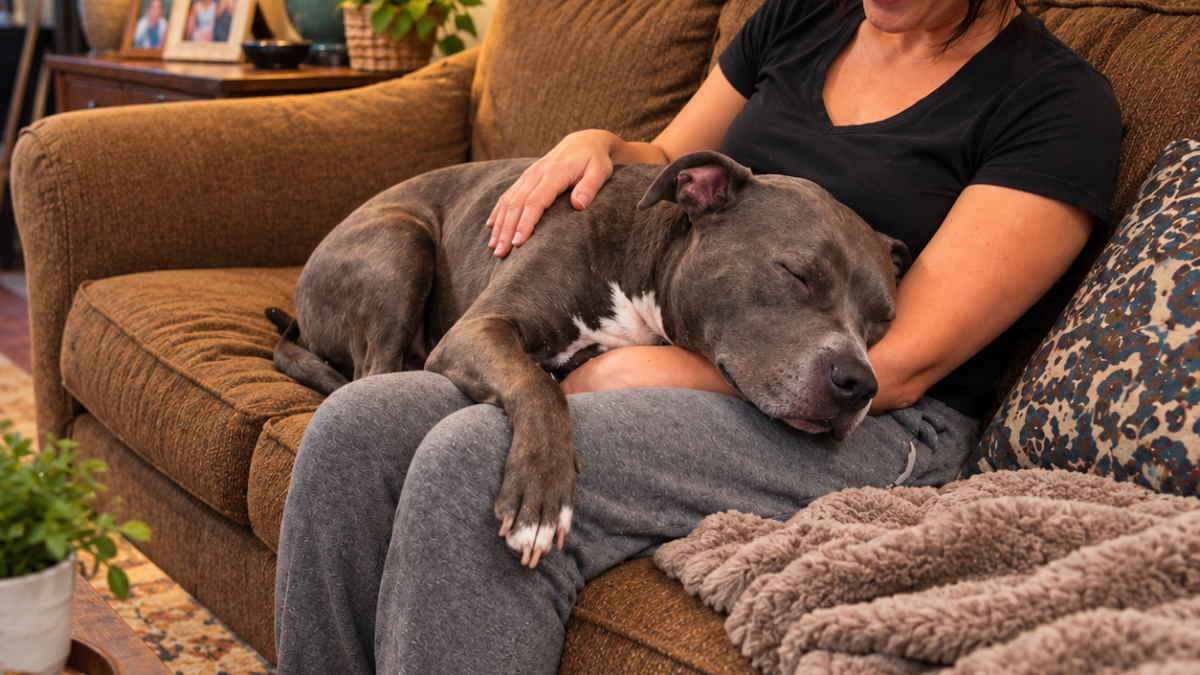
The volunteer stopped us at the shelter door and said something that made me wonder whether bringing him home was about to become much harder than we understood. He had already been returned once, and there was one kind of person he seemed especially afraid of—someone exactly like me. The strangest part was that three nights later, he would make a decision none of us could force, teach, or ask from him.
We had known our rescue dog for less than a week.
Even saying “our dog” still felt new.
My husband and I had walked into the shelter hoping to meet a dog who needed a home. We weren’t searching for a perfect personality or some movie-style connection where a dog runs straight into your arms.
Then we met him.
He stayed a little farther back than the other dogs.
Quiet.
Watchful.
There was something in his eyes that kept pulling my attention toward him.
When the paperwork was finished and we were preparing to leave, one of the volunteers approached us.
She lowered her voice.
“There’s something you should know.”
I stopped.
My husband turned toward her.
“He’s been returned before.”
I looked at our new dog.
He was standing several feet away with the leash loose between us.
The volunteer hesitated.
“He’s very uneasy around women.”
My stomach tightened.
“How uneasy?”
“He freezes. Sometimes trembles. He may give a low growl if he feels trapped, but he hasn’t shown us real aggression.”
Then she said the sentence I remembered all the way home.
“It might take time. He may never fully trust again.”
I nodded, but I didn’t understand yet what that warning looked like in real life.
I learned quickly.
At home, he was noticeably more comfortable around my husband.
Not completely relaxed.
But different.
When my husband walked through the room, he watched him.
When I did, his entire body changed.
His shoulders tightened.
His legs stiffened.
His eyes widened.
If I moved too close, he froze.
Not angry.
Terrified.
The first time it happened, I instinctively reached toward him.
“It’s okay, buddy.”
His body pulled backward.
I stopped immediately.
Then I heard it.
A low growl.
So quiet I almost missed it.
My husband looked at me.
I raised one hand.
“It’s okay.”
And strangely, I meant it.
Because I could see what that growl was.
It wasn’t, “I want to hurt you.”
It was, “Please don’t make me defend myself.”
I backed away.
That evening, I changed the plan.
I stopped trying to win him over.
No treats pushed toward his face.
No reaching.
No baby talk from six inches away.
No forcing affection because I desperately wanted him to understand that I was safe.
Instead, I sat across the room.
That was all.
He stayed near the wall.
Watching me.
I read quietly and pretended not to notice.
Every few minutes, I could feel his eyes on me.
The first night, he never came closer.
Before bed, I stood slowly.
His body tightened.
So I moved around him instead of toward him.
“Good night,” I said.
The next evening, I sat in the same place.
This time, after almost twenty minutes, he moved.
One step.
Then stopped.
I kept reading.
Later, another step.
He was still nowhere near me.
But he was closer than the night before.
My husband whispered from the kitchen, “Don’t look.”
“I know.”
I could barely concentrate on the page.
The dog stood there studying me.
Fear pulling him backward.
Curiosity pulling him forward.
On the third night, I sat down again.
No treats.
No invitation.
No expectation.
Almost half an hour passed.
Then I heard his paws against the floor.
One step.
Pause.
Another.
I kept my hands still.
He came close enough that I could see him trembling.
Then he stopped beside me.
I didn’t breathe normally.
He looked at my face.
Looked at my hands.
And slowly lowered himself to the floor.
His shoulder touched my leg.
Then, with a caution that nearly broke my heart, he rested his head against me.
I did not move.
Because I understood exactly what he had just given me.
And I knew that if I rushed that moment, I might lose something he had spent far too long learning how to offer.
PART 2
His head felt almost weightless against my leg.
Not because he was small.
He wasn’t.
He was a solid dog with a broad chest and paws that looked slightly too large when he stretched them across the floor.
But the pressure was so gentle that at first I wondered whether he had touched me accidentally.
I looked down without moving my head too quickly.
He was there.
Eyes open.
Body still tense.
His head resting against my thigh.
My husband stood in the doorway to the kitchen.
He saw us and stopped.
Neither of us spoke.
The dog’s eyes shifted toward him.
Then back toward me.
My husband slowly stepped backward and disappeared around the corner.
He understood.
This was not a moment for applause.
It was not a trick.
It was not even affection yet, at least not in the easy way people usually mean that word.
This was an experiment.
Our dog was asking a question with his entire body.
If I come close to you, what happens?
So I gave him the safest answer I could.
Nothing.
I did not grab him.
Did not hug him.
Did not lean over him.
I kept my hands resting loosely in my lap.
For several minutes, we stayed like that.
Eventually, I felt his breathing change.
The breaths became longer.
Slower.
His body was not relaxed exactly.
But the rigid line through his shoulders softened.
I wanted so badly to touch him.
The urge was almost painful.
I wanted to stroke his head and tell him he was good.
Tell him he was safe.
Tell him nobody in this house was going to hurt him.
But I was beginning to understand that those were human needs.
Mine.
Not his.
He did not need a speech.
He needed evidence.
And evidence took time.
So I sat there.
After perhaps ten minutes, he lifted his head.
Immediately, I worried I had done something wrong.
He stood.
Looked at me.
Then walked away.
That was it.
No wagging tail.
No kiss.
No dramatic cuddle.
He crossed the room and lay near my husband.
I finally exhaled.
My husband came over once the dog had settled.
His voice was barely above a whisper.
“That was huge.”
I nodded.
My eyes had filled with tears.
“I know.”
“You okay?”
“Yeah.”
I wiped my face and laughed quietly.
“I just really wanted to pet him.”
My husband smiled.
“You didn’t.”
“No.”
“That’s probably why he stayed.”
That sentence stuck with me.
Sometimes trust grows because of what you choose not to do.
That night, I lay awake thinking about the shelter volunteer.
He may never fully trust again.
I understood why she had warned us.
Shelters have to be honest.
A dog who has been returned already carries a greater risk of another failed placement.
A dog fearful around half the human population presents challenges.
People imagine rescue as love solving everything.
But love is not always enough.
Love can be impatient.
Love can become overwhelming.
Love can say, “I’m safe, so you should know I’m safe.”
Trauma does not work that way.
I had no idea what had happened to our dog before he entered our lives.
That is important.
I did not know whether a woman had deliberately hurt him.
I did not know whether one frightened him repeatedly.
I did not know whether there had been neglect, chaos, punishment, rough handling, or some other experience that built the association.
I only knew what he showed me.
Women scared him.
Especially women moving directly toward him.
Especially reaching hands.
So I stopped trying to write a past I could not verify.
I focused on the dog in front of me.
The next morning, I entered the kitchen and found him drinking water.
He saw me.
His body stiffened.
My heart sank.
For one foolish second, I thought the previous night should have changed everything.
Then I corrected myself.
Three nights of patience did not erase whatever came before.
I turned sideways.
Gave him space.
“Morning.”
He finished drinking.
Then moved away.
No growl.
That counted.
Later, I walked through the living room.
He watched but did not stand.
That counted too.
I began collecting victories invisible to everyone else.
He stayed lying down when I crossed the room.
Victory.
I placed his food bowl six feet away and he ate before I left.
Victory.
My hand moved and he did not flinch.
Victory.
He slept while I sat nearby.
Victory.
My husband found the whole process fascinating.
“Do you realize you celebrate him ignoring you?”
“Yes.”
“You’re happy because the dog doesn’t care where you are.”
“Exactly.”
“That’s a very strange relationship.”
“It’s perfect.”
And I meant it.
Indifference was progress.
A dog cannot live peacefully if he believes every movement matters.
I wanted to become boring.
Safe.
Predictable.
Completely uninteresting.
For the first week, we developed routines.
Morning feeding.
Quiet walks.
Rest.
Evening time in the living room.
Same general schedule.
Same voices.
No sudden pressure.
I started narrating some of my movements softly.
“I’m going to the kitchen.”
“I’m getting your bowl.”
“I’m walking behind you.”
I do not know how much he understood.
Probably not the sentences.
But tone and pattern mattered.
Soon he began recognizing sounds.
The cabinet where his food was kept.
The drawer with the leash.
My husband’s car.
My footsteps on the stairs.
Mine were different from my husband’s.
I noticed because our dog noticed.
When my husband came down, the dog sometimes approached.
When I came down, he watched.
But by the second week, the watching changed.
Less fear.
More assessment.
One evening, I sat in my usual chair.
He was across the room.
My husband had gone upstairs.
For several minutes, the dog remained near the couch.
Then he stood.
My pulse immediately sped up.
I forced myself to look down at my book.
He walked toward me.
Stopped halfway.
I turned a page I had not read.
Another step.
Then another.
He came beside my chair.
This time, he did not immediately lie down.
He sniffed my knee.
Then my hand.
I kept my fingers relaxed.
He sniffed again.
His nose touched my knuckles.
I wanted to laugh.
I wanted to cry.
Instead, I did nothing.
Then he pushed his nose beneath my hand.
That was different.
I looked down.
“Are you asking?”
He looked away.
I moved one finger.
Slowly.
Touched the side of his neck.
He froze.
I stopped immediately.
My hand remained exactly where it was.
He could walk away.
For several seconds, nothing happened.
Then he shifted closer.
I stroked once.
Stopped.
He stayed.
Another slow stroke.
His shoulders loosened.
“Okay.”
My voice shook slightly.
“Okay, buddy.”
His head lowered.
That was the first time I truly petted him.
Not because I decided it was time.
Because he did.
After perhaps thirty seconds, he stepped away.
I let him.
No following.
No “come back.”
He lay down several feet away.
I looked toward the stairs.
My husband was standing halfway down, watching.
“How long have you been there?”
“Long enough.”
“You’re spying.”
“I live here.”
“He let me touch him.”
“I saw.”
I smiled.
Then my husband said something I still remember.
“He trusts you more because you let him say no.”
That became the rule of our home.
No had to mean something.
If he moved away, we respected it.
If he turned his head, we slowed down.
If his body stiffened, we stopped.
People sometimes worry that respecting a fearful dog’s boundaries will somehow “reward fear.”
That was not what we saw.
Giving him control made him braver.
Because approaching us no longer meant losing control.
He could come close.
Then leave.
Nothing bad happened.
He could investigate.
Then retreat.
Nobody chased.
Every successful interaction gave him evidence.
The evidence accumulated.
By the end of the second week, he started following me occasionally.
Not room to room.
That came later.
At first, he just appeared in doorways.
I would be folding laundry and look up.
There he was.
Standing ten feet away.
Watching.
“What?”
He looked away.
“You came in here.”
Nothing.
“I’m not chasing you.”
He stayed.
Sometimes he would leave after a minute.
Sometimes he would lie down.
Those moments mattered because they were voluntary.
He was choosing proximity.
One afternoon, I was cooking when I felt something touch the back of my leg.
I froze.
Looked down.
His nose.
He had approached from behind and sniffed me.
Then stepped away.
I laughed softly.
“So you’re allowed to sneak up on me?”
His ears shifted.
“Interesting rules.”
My husband laughed from the table.
“He makes the rules now.”
Apparently he did.
There were setbacks.
Of course there were.
One happened when I dropped a metal pan.
The crash was enormous.
Our dog had been lying near the kitchen.
He bolted.
Not just into the next room.
Upstairs.
Under the desk in the spare bedroom.
I found him crouched there, shaking.
My heart broke.
I lowered myself several feet away.
“I’m sorry.”
He would not look at me.
The old instinct came back.
I wanted to crawl under the desk.
Pull him close.
Convince him.
Instead, I sat on the floor.
The same thing I had done in the beginning.
Ten minutes.
Nothing.
Fifteen.
His breathing slowed.
I slid one treat across the floor.
It stopped near him.
He ignored it.
I stayed.
Eventually he sniffed.
Ate it.
I did not throw another.
A few minutes later, he came out halfway.
Then stopped.
I stayed still.
He came the rest of the way.
Walked past me.
Downstairs.
I followed several minutes later.
That evening, he did not sit beside me.
I felt crushed.
My husband noticed.
“You didn’t ruin it.”
“It feels like I did.”
“You dropped a pan.”
“He was terrified.”
“And then?”
“He recovered.”
“Exactly.”
The next night, our dog approached me again.
Not as closely.
But he approached.
The setback had not erased everything.
That was another lesson.
Healing is not a staircase.
It does not rise one clean step at a time.
Sometimes fear returns with full force.
That does not mean trust disappeared.
It means the nervous system remembered something faster than the heart could reason through it.
We kept going.
The third week brought another first.
I was sitting on the couch rather than my usual chair.
Our dog entered.
Looked at me.
Then looked at the open space on the far end of the couch.
I did not invite him.
He walked closer.
Sniffed.
Then put his front paws up.
Paused.
I pretended to be deeply interested in television.
He climbed onto the far cushion.
My husband texted me from upstairs.
Where is he?
I replied:
On the couch.
Immediate response:
WITH YOU?
Other end.
DO NOT MOVE.
I smiled.
As though I needed the warning.
For fifteen minutes, our dog stayed on the opposite side.
Then his eyes closed.
I looked at him.
Sleeping.
With me in the same place.
That felt enormous.
Half an hour later, I shifted my foot accidentally.
His eyes opened.
Body tense.
I froze.
Then, instead of jumping down, he watched me.
His eyelids slowly lowered again.
I felt tears.
Not because a dog was asleep on a couch.
Because he had decided one unexpected movement did not automatically mean danger.
That was trust becoming flexible.
Weeks passed.
His personality emerged.
Fear had hidden so much of it.
He was funny.
Stubborn.
Obsessed with certain treats.
Suspicious of the vacuum cleaner.
He hated rain but loved wet grass afterward.
He carried one specific toy from room to room but rarely played with the others.
He had a dramatic sigh when dinner was late.
We discovered that if my husband stopped scratching his chest too soon, he would place one paw on his arm.
“Keep going.”
The first time he did it to me, I nearly lost my mind.
He was lying near my feet.
I had been scratching gently behind his ear.
I stopped because I did not want to overdo it.
A paw landed on my knee.
I looked at him.
“Excuse me?”
The paw remained.
“You want more?”
His eyes met mine.
I scratched again.
The paw lowered.
I laughed.
“So now I’m staff?”
My husband said, “You worked hard for the promotion.”
He was right.
By one month, our dog sometimes greeted me when I entered the room.
Not always.
But enough.
His tail would move.
His body stayed loose.
One morning, I came downstairs before my husband.
Our dog was in the hallway.
He saw me.
Tail wag.
Then he walked toward me.
I stopped.
He came all the way.
Pressed his shoulder against my leg.
No hesitation.
I rested a hand on his back.
“Good morning.”
He leaned harder.
I thought about the shelter.
The warning.
Very uneasy around women.
And here he was.
Not cured.
I hated using that word for fear anyway.
Fear is not a disease you erase.
But he was changing his expectations.
One safe experience at a time.
The most difficult test came several weeks later.
A female friend visited.
Until then, most of the people in our home had been us.
We knew he could be fearful around women.
So we prepared.
I told my friend before she arrived.
“Please ignore him.”
She laughed.
“I can do that.”
“I’m serious.”
“I know.”
“No reaching. No eye contact if he seems nervous. Let him decide.”
She agreed.
When she entered, our dog immediately moved behind my husband.
His body stiffened.
That old posture.
My chest tightened.
My friend did exactly what I asked.
She sat down.
Turned partly away.
Talked to us.
Ignored him.
Twenty minutes passed.
He remained across the room.
Then he started sniffing.
Air first.
Then the floor.
He moved closer.
My friend kept talking to me.
He reached five feet.
Stopped.
Three feet.
Stopped.
Then sniffed her shoe.
She did not move.
I wanted to hug her for being so patient.
He moved away again.
Ten minutes later, he returned.
This time, he sniffed her hand where it rested loosely beside her.
Still she did not reach.
Finally, he touched his nose to her fingers.
My friend looked at me but did not turn her head toward him.
Her eyes filled.
I smiled.
He stepped away.
That was enough.
After she left, I sat on the floor.
Our dog came toward me.
He leaned into my side.
I whispered, “You did really well.”
He rested his head against my leg.
Exactly as he had on the third night.
Only now his body was relaxed.
No trembling.
His eyes closed.
I finally understood what had changed.
The first time he put his head there, he had been asking whether I was safe.
Now he already knew.
Months passed.
The dog who had kept maximum distance from me began following me from room to room.
At first, I barely noticed the change because it happened gradually.
Kitchen.
He appeared.
Laundry room.
He appeared.
Home office.
There he was.
Bathroom door.
A nose waited outside.
I opened it one day.
“Seriously?”
Tail wag.
“You have a whole house.”
He followed me to the bedroom.
“Apparently not.”
My husband began teasing me.
“You realize he likes you more now.”
“Absolutely not.”
“He follows you everywhere.”
“He has abandonment issues.”
“He ignores me when you’re home.”
“That means nothing.”
Then one evening, both of us called him from opposite sides of the living room.
My husband patted the couch.
“Come here.”
I said nothing.
Our dog looked at him.
Then walked directly to me.
I laughed so hard I had to cover my mouth.
My husband looked offended.
“Traitor.”
The dog rested his head on my knee.
I scratched behind his ears.
“Apparently patience has benefits.”
My husband shook his head.
“I fed you for weeks.”
No response.
“Unbelievable.”
We laughed.
The humor mattered.
Because for months we had treated every reaction carefully.
Now our house could contain ordinary teasing.
Our dog was becoming an ordinary dog.
That phrase meant everything to me.
I did not want him to spend his whole life as “the traumatized rescue.”
He deserved to be annoying.
Demanding.
Funny.
Lazy.
Playful.
He deserved problems that had nothing to do with fear.
One such problem involved the couch.
We originally decided he would not sleep on it overnight.
That policy lasted approximately six weeks.
One night, I woke around two in the morning to get water.
I walked into the living room.
There he was.
Flat on his back.
All four paws in the air.
Head hanging slightly off the cushion.
Completely unconscious.
I turned on a tiny lamp.
He opened one eye.
“You’re not supposed to be up there.”
Eye closed.
“Excuse me.”
Nothing.
I stood beside the couch.
“You know the rules.”
His tail thumped once.
That was it.
I started laughing.
“Fine.”
I went back to bed.
The next morning, my husband asked why I was smiling.
“Your dog violated couch policy.”
“My dog?”
“Yes.”
“I thought he liked you more.”
“Not when crimes are involved.”
Our dog came into the room.
I looked at him.
He looked innocent.
Healing sometimes looks like having enough security to break household rules.
I welcomed it.
There were still reminders of his past.
A woman moving too quickly could make him step back.
Someone reaching over his head from above made him uncomfortable.
Loud voices were difficult.
Once, during an argument in a television show, he left the room.
I turned the volume down.
My husband looked at me.
“You know it’s fake, right?”
“He doesn’t.”
That became another accommodation.
We did not restructure every second of life around fear.
But when something was easy to change, we changed it.
Why not?
Safety is built from hundreds of small decisions.
The shelter had given us advice.
The rest, our dog taught us.
One afternoon, I saw something that made me think about the person who had returned him.
I still did not know the entire story.
I did not know why the adoption failed.
Perhaps they were unprepared.
Perhaps he froze around someone in the house.
Perhaps they misread a growl.
Perhaps his fear frightened them.
Perhaps life circumstances changed.
It was tempting to be angry.
To imagine someone giving up too quickly.
But I reminded myself I did not know.
The real victory was not blaming people from his past.
The real victory was that his past had stopped controlling every new relationship.
That afternoon, a delivery woman came to the door.
Normally, we would keep our dog at a comfortable distance.
But he happened to be several feet behind me when I opened it.
The woman smiled.
“Beautiful dog.”
I glanced back.
His body stiffened slightly.
I expected him to retreat.
Instead, he sniffed the air.
The woman did not reach.
She handed me the package.
“Have a good day.”
“You too.”
She walked away.
I closed the door.
Our dog stood there.
No trembling.
No growl.
He looked at me.
Then walked back into the living room.
I nearly laughed.
An interaction lasting ten seconds would have been impossible months earlier.
Now it was unremarkable to him.
That was the goal.
Not forcing affection with every woman.
Neutrality.
Choice.
Confidence.
The ability to exist without fear dominating the moment.
One night, maybe three months after we adopted him, I woke and realized something warm was against my feet.
I looked down.
He was sleeping on the bed.
I had not felt him climb up.
My husband was asleep.
The dog was curled at the bottom.
I smiled.
Then lay back.
Around dawn, I woke again.
He had moved.
His head now rested against my leg.
That old position.
Only now there were no wide eyes.
No stiff shoulders.
No trembling.
Deep sleep.
I lay there looking at him.
I thought about our third night.
The living room.
The silence.
One uncertain step at a time.
His first careful contact.
Back then, I had been afraid even to breathe.
Now he was snoring.
I touched his head.
His tail moved once without him waking.
I closed my eyes.
There is no dramatic moment when trauma officially loses.
No judge declares victory.
No bell rings.
Sometimes you simply wake up one morning and realize fear is no longer the loudest thing in the room.
That happened with us.
Slowly enough that we nearly missed it.
The volunteer had said he might never fully trust again.
I never resented her for saying it.
She was preparing us.
And she was right about something important.
There was no guarantee.
Adoption is not a contract that says love will produce a certain outcome.
We could provide safety.
Routine.
Patience.
We could respect him.
But trust had to remain his choice.
That is why the day he began seeking me out meant so much.
I did not train him to cuddle me.
I did not corner him into affection.
I simply stopped making my desire for closeness more important than his need for distance.
Eventually, he crossed the distance himself.
That was the entire miracle.
About four months after the adoption, we returned to the shelter for a small community event.
We debated whether bringing him was a good idea.
The shelter staff told us it could be done carefully and we could leave immediately if he became uncomfortable.
So we went.
The parking lot alone made me nervous.
Would he remember?
Dogs experience places differently from us.
Smell can pull old associations forward instantly.
When we entered, his nose worked rapidly.
He slowed.
I watched his body.
Slight tension.
But not panic.
We kept the leash loose.
Then the volunteer who had stopped us on adoption day appeared.
She recognized him immediately.
“Oh my God.”
She stopped herself from rushing forward.
I smiled.
“Still give him a minute.”
Her eyes filled.
“Of course.”
She crouched sideways several feet away.
Our dog watched her.
Then moved forward.
Sniffed.
The volunteer covered her mouth.
“He remembers.”
Maybe.
Maybe not.
But he did something that mattered more.
He approached a woman without freezing.
She held out her hand.
He sniffed.
Then allowed her to touch his chest.
The volunteer looked at me.
“How is he?”
I laughed.
“Terrible.”
Her face fell.
I smiled.
“He steals my side of the bed.”
She laughed through tears.
“He sleeps with you?”
“Every night if we let him.”
Her eyes widened.
“And with you?”
“Yes.”
She looked down at him.
The dog leaned against my leg.
Her hand covered her mouth again.
“I honestly didn’t know if he’d ever do this.”
Neither had I.
I scratched his shoulder.
“He decided differently.”
The volunteer stood slowly.
“He was returned because people thought the fear meant he couldn’t bond.”
I looked at her.
She did not offer details.
I didn’t ask.
I no longer needed them.
Because there he was.
Bonded.
Not because we were magical.
Not because previous people were necessarily cruel.
Because this combination of time, environment, routine, and choice had finally worked.
Sometimes an animal does not need a “better” person in some moral sense.
They need the right circumstances.
A home capable of moving at their speed.
We had been lucky enough to provide that.
The shelter event became more emotional than I expected.
Several people remembered him.
They were stunned by his body language.
“He used to hide at the back.”
“He never walked toward women.”
“Look at his tail.”
I started feeling strangely protective.
I did not want him turned into an exhibit.
So after a short visit, we left.
In the parking lot, I opened the car door.
He jumped in immediately.
Then looked out at us.
Ready.
My husband said, “Home?”
Tail wag.
We climbed in.
As we drove away, I looked back.
Our dog settled into the rear seat.
No looking toward the shelter entrance.
No crying.
He was leaving because home was somewhere else now.
That was one of the most satisfying moments of my life.
The place that once represented uncertainty had become somewhere he could visit and leave.
He knew where he belonged.
Months five and six were when affection became unapologetic.
He started greeting me at the door.
At first, a wag.
Then approaching.
Then full-body excitement.
One day, I returned after being gone several hours.
I opened the door.
He came running.
I barely had time to put down my bag.
“Hi!”
He pressed himself into me.
Tail whipping.
I crouched.
He pushed his face against my neck.
I hugged him.
And the strangest part was that I no longer had to think about whether I should.
His body answered.
Loose.
Happy.
Seeking more.
The first few months, every touch involved calculation.
Now affection had become conversation.
He asked.
I responded.
Sometimes I asked.
He accepted.
Sometimes he moved away.
Fine.
There was freedom in both directions.
That is what healthy trust looked like for us.
Not endless cuddling.
Choice without fear.
One rainy afternoon, I sat reading on the couch.
He approached.
Climbed up.
Turned in a circle.
Then dropped half his body directly onto me.
I laughed.
“You realize you’re not a lapdog?”
No response.
“You weigh too much.”
He sighed.
“Personal space?”
Nothing.
I looked down at the dog who had once refused to stand within several feet of me.
The irony was absurd.
“You used to be terrified of me.”
One eye opened.
“Remember?”
Eye closed.
“Now I can’t get rid of you.”
Tail thump.
My husband walked in.
“There’s my dog.”
I pointed.
“Remove him.”
“He chose you.”
“I have no circulation in my leg.”
“Trust has consequences.”
I threw a pillow at him.
The dog did not move.
That became our life.
Ordinary.
Funny.
Safe.
But occasionally, the past returned.
About seven months after adoption, we had workers in the house.
One of them was a woman carrying equipment.
She moved quickly through the hallway.
Our dog saw her.
He backed away sharply.
His tail lowered.
I saw the old fear flash across his face.
For a second, my heart broke all over again.
Then something happened.
He looked at me.
Not the worker.
Me.
I crouched a few feet away.
“You’re okay.”
I did not call him toward me.
He came anyway.
He stood beside my leg.
Not hiding behind me exactly.
Anchoring.
The worker noticed and slowed down.
“Is he nervous?”
“A little.”
She nodded.
“I’ll give him space.”
“Thank you.”
She moved away.
Our dog watched.
No trembling.
His breathing stayed steady.
Then he walked with me into another room.
That moment taught me that healing did not mean never feeling afraid.
It meant having somewhere to take the fear.
He had come to me.
The woman he once might have viewed as part of the threat category.
Now I was safety.
That reversal made me emotional in a way almost nothing else had.
When we were alone, I knelt.
“You know what you just did?”
He sniffed my face.
“You came to me.”
Tail wag.
I laughed.
“Yeah. You don’t care.”
He pushed his head beneath my hand.
Maybe he did.
Maybe he simply understood more than I gave him credit for.
Either way, I scratched his ears.
Months later, he met my mother.
That introduction terrified me more than it should have.
My mother loves dogs.
Which was exactly the problem.
People who love dogs often want to show it immediately.
I gave her strict instructions.
“You have to ignore him.”
She frowned.
“I’m good with dogs.”
“I know.”
“They like me.”
“Mom.”
“What?”
“Please.”
She sighed.
“Fine.”
When she arrived, she followed the rules.
Mostly.
I caught her looking at him lovingly.
“Stop staring.”
“I’m not staring.”
“You are absolutely staring.”
Our dog stayed across the room.
My mother whispered, “He’s beautiful.”
“Pretend he’s furniture.”
“That’s rude.”
“He’ll survive.”
Half an hour later, he approached.
Mom froze.
He sniffed her knee.
Then her hand.
She looked at me like a child waiting for permission.
I shook my head.
“Wait.”
Our dog stayed.
Then pushed his nose slightly upward beneath her fingers.
I nodded.
Mom touched his chest gently.
His tail moved.
Tears filled her eyes immediately.
“Oh no,” I whispered.
“I’m fine.”
“You’re crying.”
“I am not.”
A tear rolled down.
Our dog looked at her.
Mom laughed quietly.
“Sorry.”
Then he did something we had never seen him do with a new woman.
He leaned against her.
Mom looked at me.
I covered my mouth.
Nobody moved.
Later, after she left, my husband said, “He has a type.”
“What?”
“Women who sit still and cry.”
“Very funny.”
But the humor could not hide what we both felt.
His world had expanded.
I was no longer the exception.
Women themselves were slowly becoming less frightening.
Some remained difficult.
Strangers still required caution.
But the category was breaking apart.
Not “women equal danger.”
This woman is safe.
That woman is neutral.
Another woman needs distance.
Individual experiences replacing a blanket fear.
That was progress deeper than simple affection.
About nine months after adoption, we received an email from the shelter.
They were collecting updates from adopters for an anniversary post.
They asked for a picture and a few sentences.
I opened the message.
Then looked at our dog.
He was sleeping on my feet.
I laughed.
“What am I supposed to write?”
My husband said, “He’s defective.”
I kicked him lightly.
“He follows my wife everywhere and now I have no dog.”
“That’s better.”
I started typing.
Then stopped.
How do you summarize months of trust?
How do you explain that the biggest changes were invisible?
Not barking less.
Not obeying commands.
Not becoming more photogenic.
The change was that his nervous system no longer treated my presence like an emergency.
I finally wrote something simple.
When we brought him home, he could barely tolerate me standing near him. Now he follows me into every room, sleeps against my legs, and comes to me when he is frightened. We did not teach him to trust. We tried to give him enough control and consistency that he could choose trust for himself.
I read it to my husband.
He nodded.
“That’s him.”
We attached a photograph.
Our dog asleep with his head on my lap.
When the shelter shared it, several volunteers responded.
One message made me cry.
“I remember him freezing whenever a woman entered. Thank you for waiting.”
Thank you for waiting.
That was all.
Not rescuing.
Not saving.
Waiting.
I realized then that patience had been the real work.
Waiting when I wanted affection.
Waiting when progress slowed.
Waiting after setbacks.
Waiting for him to approach.
Waiting through fear without interpreting it as rejection.
People often take animal fear personally.
He doesn’t like me.
Maybe.
But fear is not always about you.
Our dog did not know me well enough to dislike me in the beginning.
His body was responding to patterns learned before I existed.
Once I understood that, I stopped demanding that he make me feel like a good person.
That was freeing for both of us.
He did not owe me quick trust as proof that I was kind.
I did not need to force closeness to prove I loved him.
We could simply exist.
And from that quiet space, something grew.
Our first adoption anniversary arrived faster than expected.
My husband remembered the date.
I almost didn’t.
He came home carrying a new toy.
I laughed.
“What is that?”
“Anniversary gift.”
“For the dog?”
“He’s family.”
Our dog immediately investigated the bag.
“Apparently he agrees.”
We gave him the toy.
He carried it around proudly.
That evening, we sat together in the living room.
Same room where our entire relationship had begun.
I looked toward the spot where I used to sit across from him.
I could picture that first night.
Dog pressed near the far wall.
Me pretending to read.
Every movement carefully controlled.
Then the second night.
One step closer.
Then the third.
The long hesitation.
The walk across the floor.
His head against my leg.
Now he was stretched beside me on the couch with his paws partly across my lap.
I touched his shoulder.
No flinch.
He rolled slightly onto his side.
I scratched his chest.
His eyes closed.
My husband noticed me staring.
“What?”
“Nothing.”
“You’re doing the emotional thing.”
“I’m not.”
“You are.”
I smiled.
“I was just thinking about that first week.”
He looked at the dog.
“Yeah.”
“He wouldn’t even let me stand near him.”
“And now?”
Our dog stretched one paw across my stomach.
My husband pointed.
“Now he owns you.”
I laughed.
“That was his revenge.”
The word surprised me.
Revenge.
Not against me.
Not against some unidentified person from the past.
Against the story fear had written for him.
Fear said a woman’s hand meant danger.
Now he pushed his head beneath mine.
Fear said closeness meant vulnerability.
Now he slept against me.
Fear said keep your distance.
Now I could not go to the bathroom without an escort.
If there was justice in his life, that was it.
The things that once frightened him had become sources of comfort.
He had taken the very category of person his body distrusted most and chosen one as home.
That victory belonged entirely to him.
I was simply lucky enough to be on the other side of it.
Later that night, we gave him his normal bedtime routine.
Outside.
Water.
Final check around the house.
Then upstairs.
Our dog followed me.
My husband entered the bedroom first.
I climbed into bed.
The dog stood at the edge.
“Up?”
He jumped.
Turned in a circle.
Then lay beside me.
His head landed against my hip.
Within minutes, he was asleep.
I rested one hand gently on his shoulder.
The shelter volunteer had been right.
Trust took time.
She had also been wrong about one thing, though there was no way she could have known it.
He was capable of far more trust than anyone dared promise.
Not because time erased everything.
There were still moments.
A sudden hand.
A strange woman.
A loud voice.
But trust does not require forgetting.
That became another thing I learned.
You do not have to erase your fear to love someone.
You only have to know fear is not always in charge.
Our dog knew that now.
He could feel uncertain and still approach.
Startled and still recover.
Afraid and still come looking for me.
That was resilience.
I thought about the people who say dogs like him are “too difficult.”
I understand where the phrase comes from.
Fear can complicate life.
It requires awareness.
Management.
Patience.
Education.
But difficult was never the word I would use.
He was not giving us a hard time.
He was having a hard time.
There is a huge difference.
Once I understood that, almost everything changed.
His growl stopped feeling like disrespect.
It became communication.
His retreat stopped feeling like rejection.
It became a request.
His freezing was not stubbornness.
It was his body trying to protect him.
When we listened to those messages instead of punishing them, he stopped needing to send them as often.
One year became two.
Our routines became almost absurdly normal.
Breakfast.
Walk.
Work.
Evening.
Couch.
Bed.
The dog who once trembled around me developed a habit of nudging my hand off the keyboard when I worked too long.
The first time, I pushed his head gently away.
“I’m working.”
He nudged again.
“Seriously?”
Again.
I scratched his ears.
He immediately settled.
I stared.
“You manipulated me.”
Tail wag.
He had become an expert.
Another time, I tried to leave for an appointment while he blocked the doorway.
“Move.”
Nothing.
“Please.”
He looked at me.
“I have to go.”
Still nothing.
My husband shouted from another room, “Tell him you’re coming back.”
I laughed.
“I’m coming back.”
Our dog moved.
I stopped.
“No way.”
My husband appeared.
“He understands everything.”
“He understands tone.”
“Let me believe.”
I crouched and kissed the top of our dog’s head.
Yes.
Kissed him.
The same dog whose body once froze when my hand moved toward him.
“I’ll be back.”
I left.
When I returned, he greeted me.
Maybe he did not understand the words.
But he understood the pattern.
People leave.
People come back.
Doors close.
Doors open.
A woman walks away.
The same woman returns.
That repetition had rewritten something.
One evening, I realized I had stopped thinking of him as a rescue dog altogether.
He was just our dog.
Not a project.
Not a trauma case.
Not an inspiring story.
Ours.
I think that is one of the best outcomes rescue can offer.
The past becomes context rather than identity.
We still respected it.
We did not intentionally place him in situations that overwhelmed him.
But we stopped talking about him as though everything he did was caused by trauma.
Sometimes he barked because he was a dog.
Sometimes he ignored me because he felt like it.
Sometimes he stole food because it smelled good.
Sometimes he disliked someone for reasons entirely his own.
He deserved that complexity.
One afternoon, a woman walking in our neighborhood asked if she could pet him.
Years earlier, the answer would have been an immediate no.
I looked at his body language.
Loose.
Curious.
He looked toward her.
I said, “Let him come to you.”
She crouched sideways.
Our dog approached.
Sniffed.
Then pushed his shoulder beneath her hand.
She stroked him gently.
His tail moved.
“Sweet boy,” she said.
I felt tears rising.
Not because he had accepted affection from a stranger.
Because I remembered the volunteer lowering her voice.
He’s very uneasy around women.
Here he was.
A woman’s hand resting on his shoulder.
His body soft beneath it.
No trembling.
No frozen stare.
After a few seconds, he returned to me.
I scratched him.
“You know what you just did?”
He sniffed the ground.
“Nothing?”
He kept walking.
I laughed.
Of course.
What had once been extraordinary was becoming ordinary.
That was perfect.
Several months later, we happened to meet the same shelter volunteer again.
She was working at an adoption event.
Our dog recognized the setting before he recognized her.
He became alert.
Then she saw him.
“Oh my goodness.”
She approached carefully.
He sniffed.
Then wagged.
She looked at me.
“I cannot believe this is him.”
“It is.”
“He looks so relaxed.”
“He is.”
She touched his chest.
He leaned closer.
Then she looked directly at me.
“And with women?”
I smiled.
“You’re touching him.”
She laughed.
Then her eyes filled.
“I worried about him.”
“I know.”
“When he came back after the previous adoption, he was more shut down than before.”
That was the first time she had said anything specific.
My smile faded.
“What happened?”
She shook her head.
“Nothing dramatic that we knew of. It just wasn’t the right fit. They felt they couldn’t manage the fear and returned him.”
I nodded slowly.
There was no villain.
No shocking revelation.
Just a failed placement.
Sometimes that is all trauma needs to deepen.
Another door.
Another transition.
Another set of people disappearing.
The volunteer scratched his neck.
“We were afraid another return would destroy whatever confidence he had left.”
I looked down.
Our dog leaned against my leg.
My hand rested naturally on his back.
I thought about how badly I once wanted to blame someone.
Maybe blaming would have made the story simpler.
But real life is often not simple.
People can have good intentions and still be the wrong home.
Dogs can need more than someone is capable of providing.
Failure does not always require cruelty.
The important thing was what happened afterward.
He found the right environment.
We moved slowly.
He responded.
That was enough.
The volunteer smiled.
“What did you do?”
I thought about it.
Then answered honestly.
“Almost nothing.”
She laughed.
“No, really.”
“I stopped trying to convince him.”
Her expression changed.
“I just sat there.”
I looked at our dog.
“He did the rest when he was ready.”
That was the truth.
People love techniques.
Five steps to gain a rescue dog’s trust.
Ten rules.
Three secrets.
Those can be useful.
But with him, the most powerful thing was simpler.
We stopped seeing trust as something we deserved.
It belonged to him.
He could give it.
Withhold it.
Test it.
Take it back.
Try again.
Our responsibility was to create conditions where giving it felt increasingly safe.
Years after adoption, the third-night moment remained vivid.
I could still remember the pressure of his head against my leg.
The terror of moving.
The tears I held back.
Now, when he put his head there, I barely noticed.
Sometimes I would be watching television and realize he had been leaning against me for twenty minutes.
That realization always made me smile.
What once required extraordinary courage from him had become habit.
That is what healing did.
It made courage less necessary.
A safe life should not require bravery every minute.
In the beginning, he had to be brave just to approach me.
Eventually, he could be lazy.
Lazy was better.
Lazy meant his nervous system could rest.
One winter night, thunder shook the house.
Our dog had always been somewhat nervous around storms.
He paced.
I sat on the floor.
Old habit.
“Come here if you want.”
He walked toward me immediately.
Then stopped.
I expected him to lie beside me.
Instead, he climbed halfway into my lap.
I laughed.
“You’re huge.”
Another thunderclap.
He pressed closer.
“All right.”
I wrapped my arms loosely around him.
He stayed.
Years earlier, holding him would have been impossible.
Now my arms were where he went when the world became frightening.
That realization almost brought me to tears again.
I stroked his neck.
“You know, this is backwards.”
His breathing slowed.
“You were supposed to be afraid of me.”
Thunder sounded.
He pushed his face beneath my chin.
I smiled.
“Never mind.”
The storm passed.
He fell asleep.
I stayed on the floor longer than necessary.
There was something beautiful about the symmetry.
On the third night, I stayed motionless because he was afraid of my touch.
Years later, I stayed motionless because he had fallen asleep inside my arms.
Same woman.
Same dog.
A completely different meaning.
People occasionally asked whether I wished I knew exactly what happened before we adopted him.
Early on, yes.
I obsessed over it.
I wanted the missing chapter.
I wanted a person to blame.
I wanted to understand every flinch.
Every freeze.
Every growl.
Eventually, I stopped.
Knowing might have satisfied me.
It would not have changed what he needed.
Dogs do not require us to solve their history before treating them gently.
Sometimes the evidence in front of you is enough.
He was afraid.
So we slowed down.
He needed control.
So we gave choices.
He needed predictability.
So we created routines.
He needed space.
So space became an act of love.
Eventually he needed closeness.
We gave that too.
That was the whole treatment plan.
Patience adjusted moment by moment.
The older he became, the more affectionate he got.
Maybe age softened him.
Maybe security accumulated.
Maybe both.
He began sleeping with his head on my chest sometimes.
That would have sounded impossible during week one.
I remember one morning waking with his face inches from mine.
His eyes were open.
Watching.
I smiled.
“Creepy.”
Tail thump.
“How long have you been staring at me?”
Another thump.
I scratched him.
He moved closer.
I thought about the distant look in his eyes during the first week.
It was gone.
Not literally.
The same eyes.
But no distance.
He was present.
With me.
That might have been the greatest change.
Fear had once pulled part of him away from every interaction.
Always monitoring.
Always preparing.
Now he could simply be there.
One evening, my husband found an old photograph from adoption day.
Our dog stood beside us outside the shelter.
My husband looked happy.
I looked nervous.
The dog looked away from the camera.
Body stiff.
Tail low.
We compared it with a recent photo.
Our dog sprawled between us on the couch.
One paw across my lap.
Head against my shoulder.
His expression completely relaxed.
My husband shook his head.
“Doesn’t even look like him.”
“It does.”
“Not the face.”
I understood.
Safety changes posture.
Eyes.
Muscles.
The way an animal occupies space.
In the adoption photo, our dog seemed to be asking permission to exist.
In the newer one, he took up half the couch.
Good.
I hoped he took up space for the rest of his life.
He had spent enough time making himself small.
That night, before bed, I sat on the floor in the living room one more time.
Not because he needed it.
Because I wanted to remember.
Same place.
Same house.
Years later.
Our dog entered.
Looked at me sitting there.
Then walked straight over.
No hesitation.
He lowered himself beside me.
Head on my leg.
I smiled.
“There it is.”
He sighed.
I rested my hand on his shoulder.
“You have no idea, do you?”
His eyes closed.
Maybe that was best.
He did not need to carry the symbolism.
I could carry it for both of us.
He only needed the present.
A warm room.
A familiar hand.
A body that no longer tightened at my approach.
I thought about the warning one final time.
It might take time… if he ever fully trusts again.
Time.
Yes.
It took time.
But not in the way I expected.
At first, I thought patience meant waiting for him to become the dog I wanted.
I learned that patience meant accepting the dog he was today without demanding tomorrow’s version.
That changed everything.
On day one, he needed distance.
We gave distance.
On day three, he needed stillness.
We gave stillness.
Later, he needed a hand.
I offered one.
Eventually, he needed somewhere to place his head.
My lap was there.
Years later, he no longer asked whether he was safe with me.
He knew.
And I no longer wondered whether he loved me.
I knew too.
One night, I climbed into bed later than usual.
My husband was already asleep.
Our dog was curled near my pillow.
I whispered, “Move.”
He opened one eye.
Did not move.
“Seriously?”
Nothing.
I tried to slide into the tiny space he had left.
He sighed dramatically as though I were inconveniencing him.
I laughed quietly.
“You know what?”
His ear moved.
“You win.”
I lay down.
Almost immediately, he shifted.
His head came to rest against my shoulder.
I put an arm around him.
No trembling.
No stiffness.
Just warmth.
I thought about revenge again.
Not revenge against whoever had failed him.
We did not need that.
His life did not become better because someone else suffered.
His victory was cleaner than that.
Fear had told him to freeze when a woman came close.
He chose to sleep beside one.
Fear had told him hands were uncertain.
He learned to push his head beneath mine.
Fear had told him distance was safety.
He learned that sometimes safety could be contact.
Fear had told him people disappear.
He watched us leave hundreds of times—and watched us come home hundreds more.
That was his revenge.
A life so full of evidence that the old rules stopped making sense.
He had not erased the past.
He had outlived its authority.
I kissed his forehead.
He did not wake.
Outside, the house was quiet.
Inside, the dog we had once been warned might never trust me again was sleeping with his face pressed against mine.
I could not imagine a more satisfying ending.
Not because I had won him over.
Because he had won himself back.
The shelter had given him another chance.
We had given him time.
But the final step had always belonged to him.
He crossed the room.
He chose my leg.
He chose my hand.
He chose the couch beside me.
He chose to follow.
He chose to return after fear.
Again.
And again.
Until one day choosing me no longer required courage.
It was simply home.
And now, whenever I move from one room to another, I often hear paws behind me.
I turn.
There he is.
Never far away.
Sometimes I laugh.
“You know you don’t have to follow me.”
He looks at me as though the suggestion is ridiculous.
Maybe it is.
Years ago, he stayed as far from me as possible because something inside him said distance meant survival.
Now he follows because closeness is safe.
That distance between those two truths is our entire story.
And we crossed it one quiet evening at a time.
No forcing.
No deadlines.
No demand that he forget.
Just patience.
Until the dog who once froze whenever I came near finally learned something stronger than fear:
I was not coming to hurt him.
I was not coming to take anything away.
And when I left the room, I would come back.
He had spent long enough carrying things we could not see.
He did not have to carry them alone anymore.
That night, as he slept beside me, I rested my hand over his shoulder.
His breathing remained slow and deep.
I whispered the words I wished I could have given him on adoption day.
“You never have to earn your place here.”
He slept through them.
That was okay.
By then, he already knew.








