PART 2: The Puppy Everyone Chased Away Could Only Crawl—Then I Saw Her Trying to Reach Me
PART 2
“She needs nutrition first,” the veterinarian said. “Careful nutrition. Supplements. Support for the limbs. Treatment for the mange. And rest.”
I nodded while trying to remember everything.
“Will she need surgery?”
“Not necessarily. That’s why the X-rays matter. There are no fractures, which is encouraging. Her bones are still developing. At her age, improvement may be possible if we correct the underlying deficiencies and give her proper support.”
May be possible.
Those three words stayed with me.
Not *will*.
Not *definitely*.
Possible.
I stepped back into the examination room.
Ayla had been placed on a folded towel while the technician prepared her medications. She looked even smaller beneath the fluorescent lights.
I touched her head.
“You hear that?” I whispered. “Possible is good.”
Her eyes closed.
The veterinarian discussed the stone next.
Because Ayla wasn’t vomiting continuously and the object didn’t appear to be causing an immediate obstruction, they hoped she might pass it naturally. But she would need close monitoring.
“If she starts vomiting, becomes severely lethargic, refuses food, or shows abdominal pain, we reassess immediately.”
I looked at the X-ray again.
“Why would she eat a stone?”
The veterinarian lowered the image.
“Hunger can make animals consume things that aren’t food. Nutritional deficiencies can contribute to abnormal eating behavior too.”
I knew that.
Still, hearing it while looking at Ayla made the explanation feel different.
She hadn’t swallowed a stone because she was mischievous.
She may have swallowed it because her body was desperately searching for something it wasn’t getting.
Food.
Minerals.
Anything.
For the first time since I’d found her, anger began pushing through the fear.
Not anger at one specific person.
I didn’t know enough about where Ayla had come from to blame anyone.
I was angry at the whole chain of circumstances that allowed a puppy to become this depleted before somebody stopped.
At every doorway she had crawled toward.
At every person who had seen only the mange.
At the fact that she had learned to expect rejection before she’d even had time to learn how to walk properly.
But anger wasn’t going to straighten her legs.
So I focused on what would.
The clinic kept her.
That first night, they started treating her skin, gave her carefully measured meals, supplements, fluids as needed, and wrapped her front legs to provide support without placing too much pressure on growing bones.
I came back a few hours later.
I wasn’t prepared for what I saw.
Ayla was asleep.
That sounds ordinary.
It wasn’t.
She was curled into a soft bed with a blanket gathered around her body, her nose tucked toward her chest.
Nobody was pushing her away.
Nobody was yelling.
Nobody was making her crawl somewhere else.
For the first time since I had met her, she wasn’t moving because she didn’t need to.
I stood beside the kennel without opening it.
“She’s been out for almost forty minutes,” one of the technicians said.
“Did she eat?”
“A little.”
“Any vomiting?”
“No.”
“And the stone?”
“Still waiting.”
I nodded.
The technician looked at Ayla through the kennel door.
“Poor baby was exhausted.”
That word hit me.
Exhausted.
Of course she was.
Imagine moving everywhere on damaged skin.
Imagine being hungry enough to eat something off the ground that wasn’t even food.
Imagine itching constantly from mange.
Imagine sleeping in places where you were never certain you’d be allowed to remain until morning.
Her body hadn’t just been sick.
It had been working constantly to survive.
I sat on the floor outside her kennel.
For almost an hour, I watched her sleep.
Every few minutes, one paw twitched.
Once she made a tiny noise and lifted her head.
“It’s okay,” I said.
She looked at me.
Then, slowly, she lowered her head again.
That small decision—to go back to sleep while I was still there—felt like the first bit of trust she had offered me.
The following morning brought our first scare.
Ayla wasn’t interested in breakfast.
The clinic called me early.
“She’s alert,” the technician explained, “but we’re watching her stomach carefully.”
I drove over.
The veterinarian examined her again.
The stone was still a concern.
I hated how helpless waiting felt.
If her legs needed treatment, we could treat them.
If her skin needed medication, we had medication.
But the stone had turned into a silent threat sitting inside a puppy whose body was already fragile.
“Could you remove it?”
“We could intervene if necessary,” the veterinarian said, “but we’d rather avoid putting her through more than she needs right now. She’s malnourished. Anesthesia always deserves careful consideration in a patient like this.”
“So we wait?”
“We monitor.”
Ayla was awake when I entered.
Her tail moved.
Once.
Barely an inch.
I laughed before I could stop myself.
“Was that for me?”
The tail moved again.
The veterinarian smiled.
“That’s something.”
It became our first little milestone.
Not standing.
Not walking.
A tail wag.
By afternoon, Ayla ate a small portion of food.
The next day, she ate more.
Every meal was measured because a severely undernourished animal can’t always be fed aggressively all at once. Her body needed to readjust safely.
I learned to celebrate things I would have ignored before.
A finished bowl.
A normal bowel movement.
A longer period of sleep.
Less scratching.
A bandage that stayed in place.
A paw positioned slightly better than it had been the day before.
Then came the call about the stone.
“It’s out.”
I sat up so fast I nearly dropped my phone.
“What?”
“She passed it naturally.”
“You’re sure?”
The technician laughed.
“We are very sure.”
I covered my mouth with one hand.
It was such a ridiculous thing to feel emotional about.
A rock.
But that rock had become a symbol of how desperate Ayla’s life had been before we found her.
Now it was no longer inside her.
One danger gone.
Several still remained.
The mange treatment began working gradually.
At first, the difference was almost impossible to see.
Her skin still looked irritated.
She still scratched.
Bare patches covered much of her body.
Then one afternoon, while rubbing her shoulder, I noticed something.
Tiny hairs.
“Wait.”
I leaned closer.
A technician passing behind me stopped.
“What?”
“Is this new?”
She looked.
A smile spread across her face.
“Looks like it.”
I stared at those few wisps of fur as though Ayla had just performed a miracle.
“You’re growing a coat.”
Ayla tried to chew the edge of her blanket.
“Apparently she finds that less exciting than you do,” the technician said.
That was another change.
Mischief.
At the beginning, Ayla had used almost every bit of energy just to survive.
Now she had enough left over to be annoying.
She chewed her bedding.
She tried to grab the corner of bandages during changes.
She became fascinated with shoelaces.
Once, while a technician was adjusting the wrap on one front leg, Ayla twisted around and attempted to steal a piece of gauze.
“Excuse me,” the technician told her.
Ayla held on.
“That isn’t yours.”
Ayla pulled harder.
I started laughing.
The technician looked at me.
“You’re encouraging her.”
“I absolutely am.”
For a puppy who had once lowered her head and accepted whatever happened, stubbornness felt healthy.
Still, her legs were the question none of us could ignore.
As Ayla gained weight, the team began gently encouraging her to use them correctly.
Nothing was forced.
Her joints and bones needed time.
The veterinarian explained that puppies grow quickly, which can work both for and against them. Problems can worsen rapidly during growth, but young bodies can also respond dramatically when nutrition and support improve.
“We’re trying to guide development,” he said. “Think of it as giving her body better conditions to do what it’s already trying to do.”
Ayla didn’t care about developmental explanations.
She wanted food.
And increasingly, she wanted attention.
She began recognizing footsteps.
I discovered this accidentally.
One afternoon, I entered through the clinic’s back area while talking to a staff member.
Ayla couldn’t see me yet.
But the second I spoke, something started thumping inside her kennel.
Thump.
Thump.
Thump.
I stopped.
“Is that—”
“Her tail.”
I walked around the corner.
Ayla saw me.
The slow thumping became frantic.
Her entire back end wiggled.
“Hey!”
She pushed herself forward.
For an instant, my heart jumped because I thought she was going to drop onto her chest the way she always had.
But she caught herself.
One front paw planted.
Then the other.
Her elbows trembled.
She stood.
It lasted maybe two seconds.
Then she sank back down.
Nobody spoke.
I looked at the technician.
“Did she just—”
“Yes.”
Ayla barked.
It was the first time I’d heard her bark.
A tiny, indignant puppy bark, as if annoyed that nobody was responding quickly enough to what she had just accomplished.
I opened the kennel.
“Do it again.”
Of course she didn’t.
Instead, she rolled partly onto her side and demanded belly scratches.
Still, I couldn’t stop smiling for the rest of the day.
That evening I asked the veterinarian whether the two-second stand meant what I hoped it meant.
“It means she’s trying.”
“Is that good?”
“Very.”
“Could she really walk normally?”
He gave me the same careful expression I’d seen on the first day.
“I don’t want to promise an outcome yet.”
There was that caution again.
I understood it.
Hope is important in rescue work.
False certainty isn’t.
So I stopped asking for promises.
We took days one at a time.
Ayla gained weight.
Her ribs became less prominent.
Her skin calmed.
Soft fur slowly began filling the bare areas along her back and face.
And her personality expanded at almost exactly the same rate.
She loved towels.
Nobody knew why.
Give Ayla a perfectly good toy and a towel, and she would investigate the towel first.
She dragged them toward herself, burrowed underneath them, chewed corners, and occasionally fell asleep with one draped over her head.
She also developed strong opinions about medication.
At first, she swallowed whatever the clinic gave her without protest.
Once she felt better, she became suspicious.
A technician hid medicine in food.
Ayla ate everything around it.
The pill remained in the center of the bowl.
“Seriously?”
Ayla wagged.
They tried again.
She spit it out.
I happened to be there.
“She’s getting smarter.”
The technician pointed at me.
“This is partly your fault.”
“How?”
“You praise everything she does.”
“She deserves it.”
“She just outsmarted me.”
“That’s neurological development.”
The technician stared at me.
“You’ve been talking to the vet too much.”
We laughed.
That kind of laughter would have seemed impossible the first day.
Then Ayla took her first real steps.
It happened during a therapy session.
Her bandages had been adjusted, and the team was encouraging controlled weight-bearing. A staff member placed food a short distance ahead of her.
Ayla stretched her neck.
“No cheating,” I said.
She looked at me.
Then at the food.
She pushed herself upright.
Both front legs shook.
One paw moved.
Set down.
Then another.
Her rear legs pushed too quickly, and she almost pitched forward.
The technician supported her lightly.
“Easy.”
Ayla steadied.
Then took another step.
And another.
They were awkward.
Uneven.
Tiny.
Perfect.
My vision blurred.
“She’s walking.”
“Don’t distract her,” the technician whispered.
I pressed my lips together.
Ayla made it five steps before her legs gave out.
She landed gently on the padded surface.
Then immediately looked toward the food as though the only disappointing part of the experience was that she hadn’t reached it.
The technician moved the dish closer.
“You earned it.”
Ayla ate like she’d completed a marathon.
Maybe for her, she had.
When I got home that night, I sat in my car for several minutes without going inside.
I kept replaying those five steps.
Not because they were beautiful in the way people usually imagine recovery.
They weren’t.
Her legs were still visibly deformed.
Her balance was poor.
She needed support.
But several weeks earlier, crawling had been the only way Ayla knew how to move.
Now her body was discovering another possibility.
Five steps changed the scale of hope.
The veterinarian remained cautious.
“Don’t turn this into a race.”
“I won’t.”
“She’ll have good days and bad days.”
“I know.”
“Sometimes people see an improvement and want to push too fast.”
“I understand.”
He looked at me.
“Do you?”
I sighed.
“Probably not.”
He smiled slightly.
“That’s why I’m reminding you.”
He was right.
The next morning, Ayla barely wanted to stand.
I panicked.
“Did we overdo it?”
The technician checked her legs.
“No swelling. No obvious acute pain. She’s tired.”
“So this is normal?”
“Progress isn’t a straight line.”
I had heard that phrase countless times.
Living it with Ayla gave it teeth.
One day she would take six steps.
The next she would take two.
Then four.
Then none.
Her body was rebuilding itself while still growing.
The bandages needed frequent adjustment because her limbs were changing.
Her diet was monitored.
Her calcium and nutritional support had to be appropriate rather than excessive.
And the mange treatment continued even when her skin began appearing dramatically better.
Through all of that, Ayla became a puppy.
Not a patient.
A puppy.
The distinction mattered.
She discovered balls.
The first one was soft and small enough for her mouth.
I rolled it toward her.
She stared.
It touched her paw.
She jumped backward.
I laughed.
“What was that?”
Ayla barked at the ball.
I rolled it again.
She slapped at it.
It moved.
She froze.
Then slapped it harder.
The ball rolled away.
Ayla stared at me as though I had just revealed the greatest secret in the universe.
Then she went after it.
Her gait was still awkward, but excitement overruled hesitation.
She shuffled forward, caught the ball between her paws, and bit it.
Her tail went wild.
“That’s yours,” I told her.
That sentence meant more to me than it should have.
Yours.
A bed that was hers.
Food that was hers.
A toy that was hers.
People who were happy when she came toward them instead of people telling her to leave.
Over the following weeks, the ball became an obsession.
She carried it whenever she could.
If it rolled beneath something, she complained until somebody retrieved it.
If another dog showed interest, Ayla suddenly remembered exactly how quickly she could move.
“Look at you,” I said one afternoon as she hurried across the floor with the ball clamped between her teeth. “Now you can run away from people for stealing your toys.”
She stopped and looked at me.
Then trotted back.
That was when I realized something else had changed.
Ayla no longer moved away automatically.
She moved toward us.
Toward voices.
Toward hands.
Toward open doors.
Trust had returned almost invisibly.
There was no dramatic day when she decided people were safe.
It happened through repetition.
A bowl arriving when she was hungry.
Hands touching her without hurting her.
Bandages being replaced gently.
Medicine followed by praise.
A warm bed still being there when she woke up.
Nobody chasing her away.
Day after day.
Eventually, safety became predictable.
And once safety became predictable, Ayla stopped bracing for its disappearance.
Her follow-up X-rays showed improvement.
The veterinarian put the films beside the originals.
“Look here.”
I leaned closer.
He pointed to the alignment and development of the front limbs.
“Not perfect.”
My chest tightened.
Then he continued.
“But considerably better.”
“How much better?”
“Enough that I’m pleased.”
From this man, that sounded like a celebration.
“She’ll walk?”
“She’s already walking.”
“You know what I mean.”
He nodded.
“I think her functional outlook is very good if she continues responding this way.”
I looked through the glass window into the treatment area.
Ayla was attempting to steal a glove.
“Functional,” I repeated.
“Don’t expect her legs to look exactly like another dog’s. Cosmetics aren’t the goal. Comfort and function are.”
“I don’t care what they look like.”
“I know.”
I watched her hop sideways as a technician recovered the glove.
“I just want her to be able to live.”
“She’s making that fairly clear.”
Ayla barked.
The veterinarian smiled.
“Very clear.”
Soon she no longer needed constant clinic care.
That transition frightened me more than I expected.
The clinic had become controlled.
Schedules.
Medication charts.
People who understood every small change.
Taking Ayla into a more ordinary environment meant learning to trust her progress.
The first night outside the clinic, I prepared a soft enclosed area with blankets, water, food, and enough room for her to move without slipping.
I checked everything twice.
Then a third time.
Ayla watched me.
“Don’t judge me.”
She yawned.
“You have caused considerable anxiety.”
She chewed her toy.
I put the bed in one corner.
She dragged the blanket out.
I returned it.
She dragged it out again.
“Fine.”
Five minutes later, she fell asleep on the blanket exactly where she’d pulled it.
I sat nearby.
Her breathing became slow.
No shivering.
No frantic scratching.
No crawling over dirt.
Just sleep.
I thought about the first night I’d watched her in the clinic.
Back then, rest itself had seemed like treatment.
Now it looked ordinary.
That was the miracle I hadn’t understood at the beginning.
Recovery isn’t only dramatic milestones.
Sometimes recovery is when suffering stops being the most important thing happening.
Eventually Ayla’s days stopped revolving around medication and started revolving around toys.
She met other dogs carefully.
At first she was hesitant.
One friendly dog approached and sniffed her face.
Ayla retreated behind my leg.
“It’s okay.”
The other dog lowered itself into a play bow.
Ayla peered around me.
Tail wag.
One step.
Another.
The dog bounced backward.
Ayla followed.
Within minutes, she was trying to play.
Her movements weren’t graceful.
She tumbled.
Recovered.
Charged again.
The other dog adjusted instinctively, slowing down when Ayla needed it and racing ahead when she tried to chase.
I stood watching with my hands over my mouth.
Someone beside me asked, “You okay?”
“Yeah.”
I laughed.
“I’m just remembering when she couldn’t do that.”
Ayla fell over.
The other dog stopped.
Ayla immediately jumped up and lunged playfully.
“Apparently she doesn’t remember.”
Maybe that was good.
I remembered enough for both of us.
Her skin healed so thoroughly that people who met her later had difficulty believing the photos from the beginning.
Her fur came in soft.
Her face filled out.
Her body developed the round, healthy shape of a growing puppy.
But the biggest difference was in her eyes.
The first day, Ayla watched every movement cautiously.
Months later, she looked at people with expectation.
What do you have?
Where are we going?
Can I play with that?
Do you have food?
Will you throw my ball?
Fear had stopped being her first question.
One afternoon, I gave her a new toy.
She grabbed it, ran several feet, then turned and came back.
Another dog was nearby.
Ayla proudly carried the toy straight over and dropped it in front of her friend.
Her tail wagged.
The other dog picked it up.
Ayla bounced.
Not crawled.
Not dragged herself.
Bounced.
I started laughing.
“There it is.”
Someone asked what I meant.
I pointed at her.
“That’s the puppy.”
They looked confused.
“The real one,” I said.
Because the animal I’d found dragging herself across the ground had been Ayla, of course.
But suffering had hidden so much of her.
Pain had hidden the playful puppy.
Hunger had hidden the mischievous puppy.
Fear had hidden the affectionate puppy.
Weakness had hidden the puppy who wanted to race after a ball.
Once those burdens began falling away, Ayla wasn’t becoming someone new.
She was finally getting the chance to be who she had always been.
There was still one question left.
Where would she live permanently?
People sometimes assume rescuing an animal ends when the emergency ends.
In reality, that’s often when another important decision begins.
Ayla needed a home prepared to accept everything about her.
Not just the adorable recovered puppy.
Her medical history.
The possibility that her legs might always need monitoring.
The uncertainty that comes with developmental problems.
The responsibility of maintaining good nutrition, healthy weight, and appropriate activity.
I didn’t want someone to see the transformation and imagine the difficult part had disappeared forever.
So when interest in Ayla grew, I became protective.
Maybe too protective.
People saw her photos and loved her.
Of course they did.
By then she was irresistible.
But I kept thinking about the frightened puppy lowering her head before I’d touched her.
I wanted the person who took her home to love that puppy too.
The broken-looking one.
The itchy one.
The expensive one.
The inconvenient one.
The one who might have needed years of follow-up rather than becoming a perfect success story.
One potential adopter asked me, “Is she completely normal now?”
The question wasn’t cruel.
I understood what they meant.
But I paused.
“What do you mean by normal?”
“Her legs. Is everything fixed?”
“She’s doing wonderfully. She walks, plays, runs, and keeps improving. But she had significant deformities associated with severe nutritional deficiency, and I can’t promise nobody will ever need to think about those legs again.”
The person nodded slowly.
“Would there be vet expenses?”
“Possibly.”
That interest faded.
I was disappointed.
Then relieved.
Ayla deserved someone who wasn’t buying a guaranteed outcome.
Another person loved her appearance but wanted a puppy who could immediately handle long hikes.
Not the right match.
Another family had slippery floors throughout the home and wasn’t interested in modifying anything.
Not the right match.
I started wondering if I had become unreasonable.
A veterinarian reminded me otherwise.
“You’re not looking for perfection.”
“No.”
“You’re looking for commitment.”
“Exactly.”
“So keep looking.”
Ayla, unaware that adults were debating her future, spent the next afternoon carrying three toys into her bed one by one.
The last toy was almost as large as she was.
She struggled with it for several minutes.
I could have helped.
I didn’t.
She eventually figured out how to drag it backward.
When it reached the bed, she climbed over it, turned twice, and sat triumphantly.
“You’re ridiculous.”
Tail wag.
Then the right people appeared.
They didn’t begin by asking whether Ayla was normal.
They asked what she needed.
That difference mattered immediately.
They wanted to know about her diet.
Her follow-up care.
Her legs.
Her skin.
Her exercise.
They asked what frightened her, what she loved, where she preferred to sleep, what kind of toys she played with, and whether she got along with other dogs.
“Does she have any habits we should know about?” one of them asked.
“How much time do you have?”
They laughed.
“That’s a good sign.”
“She steals towels.”
“Towels?”
“Constantly.”
“Okay.”
“She may also believe every ball in the world belongs to her.”
“Reasonable.”
“And medication requires negotiation.”
They looked down at Ayla.
She was sitting between us chewing a toy.
“We can negotiate.”
Ayla stood and walked over to them.
No hesitation.
She sniffed one hand.
Then the other.
One of them crouched.
“Hi, little girl.”
Ayla’s tail started.
The person didn’t grab her.
Didn’t lift her.
Didn’t overwhelm her.
They just waited.
Ayla moved closer.
Then placed one paw on their shoe.
Something inside me loosened.
Over the following visits, I watched.
I watched how they handled her.
How they listened.
How they reacted when she stumbled.
They didn’t gasp.
They didn’t make her struggle into a tragedy.
They gave her space to recover and keep moving.
When she dropped a ball, they rolled it gently instead of throwing it across the room.
When she tired, they let her rest.
When she showed off, they laughed.
At one point Ayla carried a toy over to them, dropped it, then hurried back to collect another.
“What’s she doing?”
“Showing you her inventory.”
A second toy arrived.
Then a third.
“She does this?”
“Apparently you’re important enough for the full tour.”
They sat on the floor while Ayla surrounded them with possessions.
I leaned against the wall.
For weeks I had wondered whether I would recognize the right home when it appeared.
That was the moment I knew.
Not because Ayla performed some cinematic gesture.
Not because everyone cried.
Not because someone declared instant love.
I knew because nothing felt forced.
Ayla behaved as though these people belonged in her world.
And they treated her as though she already belonged in theirs.
The day she left, I packed more things than she needed.
Food.
Medication information.
Vet records.
Bandages just in case.
Her favorite blanket.
Two balls.
Three other toys.
Then another ball because I convinced myself the first two weren’t enough.
One of her adopters looked into the bag.
“Is she moving out or opening a store?”
“Don’t make fun of me.”
“I’m afraid to ask what’s in the second bag.”
“Emergency supplies.”
“For what emergency?”
I stared at them.
They raised both hands.
“Never mind. Bring it.”
I knelt beside Ayla.
She was distracted by a squeaky toy.
That helped.
I’d imagined the goodbye so many times that I’d accidentally turned it into something dramatic.
I expected her to sense my sadness.
Maybe lick my face.
Maybe hesitate at the door.
Instead, she grabbed the squeaky toy and trotted toward the car.
I laughed through the tears gathering in my eyes.
“Seriously?”
She turned.
Tail wagging.
Then she came back.
For one second, she stood in front of me.
I put both hands gently around her face.
“You know something?” I whispered. “The first time I saw you, you were trying to crawl away from everybody.”
Ayla licked my chin.
I closed my eyes.
“Now look at you.”
She twisted free because something outside had caught her attention.
Of course it had.
The world was interesting now.
She had things to investigate.
People waiting for her.
A home.
She left walking on her own legs.
I watched the car disappear.
Then I went inside and found one of her towels under a chair.
I sat on the floor holding it.
That was when I finally cried.
Not because I regretted letting her go.
Because I remembered how little it had taken for the world to almost lose her.
A few more days without food.
An infection getting worse.
A stone causing an obstruction.
One vehicle not seeing a crawling puppy.
One more person chasing her away.
Any of those things might have ended the story before it began.
Instead, somebody stopped.
And once somebody stopped, other people helped.
A veterinarian looked beyond the deformity and searched for its cause.
Technicians changed bandages.
People measured meals.
Someone cleaned damaged skin.
Someone monitored a stone.
Someone encouraged a first step.
Then another.
Then five.
Ayla’s new family kept sending updates.
The first photo showed her asleep in a bed.
Not remarkable to anyone who didn’t know her.
To me, it was everything.
Her body was sprawled carelessly across the cushion.
One front paw stuck out.
The puppy who had once slept curled tightly as though trying to disappear now took up as much space as possible.
The message beneath it said:
**She has decided this is her bed. We were not consulted.**
I laughed.
Another update arrived two days later.
Ayla had discovered a basket of toys.
Every toy had been removed.
Not played with.
Removed.
She had carried each one into another room.
**Inventory transfer complete,** the message said.
Then came a short video.
I opened it while standing in my kitchen.
A ball rolled across the floor.
Ayla chased it.
My heart stopped.
She ran.
Not perfectly.
Not like a dog whose legs had never been compromised.
But fast.
Confident.
Happy.
She caught the ball, spun around and ran back.
The video was only a few seconds long.
I replayed it.
Again.
Again.
Again.
The dog beside her entered the frame.
Ayla grabbed another toy and carried it over.
She dropped it proudly near her friend, tail swinging behind her.
I thought about the first day.
Her belly nearly touching the dirt.
Her front legs folding beneath her.
Her body shivering.
The raw skin.
The mange.
The bones showing beneath what little fur remained.
And the way she’d flinched when I’d approached.
Those images hadn’t disappeared.
They probably never would.
But now they had competition.
Ayla standing for two seconds.
Ayla stealing gauze.
Ayla barking at her first ball.
Ayla taking five steps.
Ayla dragging a towel.
Ayla playing with another dog.
Ayla presenting her toys like treasures.
Ayla running through a house that welcomed her.
Weeks passed.
Then months.
Her family kept every veterinary follow-up.
They watched her weight carefully because carrying excess weight would place unnecessary stress on her front limbs.
They adjusted exercise as advised.
They paid attention when she seemed tired.
They didn’t pretend her early damage had never happened.
They simply refused to let it define every day that came afterward.
At one follow-up, I happened to be there.
Ayla recognized me before I reached the room.
I heard scratching from the other side of the door.
Then a bark.
The door opened.
Ayla came toward me so quickly that one of her people laughed.
“Apparently you’ve been remembered.”
I crouched.
“Hey, trouble.”
She nearly climbed into my lap.
Her fur was thick now.
Healthy.
Warm.
I ran my hands gently down her front legs.
The memory of those first X-rays flashed through my mind.
“How’s she doing?”
“Ask the vet, but at home?”
They shook their head dramatically.
“Unstoppable.”
The veterinarian entered holding the new films.
“Want to see?”
“Always.”
We placed them beside the earliest images.
I didn’t need medical training to see the difference.
Development.
Correction.
Strength.
Not perfection.
That word no longer mattered to me.
“She’s done extremely well,” he said.
“Any concerns?”
“The usual ones. Maintain appropriate weight. Don’t overdo high-impact activity. Watch her as she grows. But functionally?”
He looked through the window.
Ayla was pawing at a toy.
“She’s doing what a puppy should do.”
That sentence brought me back to the beginning.
Ayla should have been playing.
She should have been sleeping without fear.
She should have been eating enough.
She should have been discovering toys instead of swallowing stones.
She should have been learning that hands could mean affection instead of rejection.
Now she was.
Not because the past had been erased.
Because she had survived long enough to outgrow it.
After the appointment, we stepped outside.
Ayla’s family had brought her favorite ball.
They tossed it only a short distance.
She ran after it.
Picked it up.
Then, instead of bringing it directly back, she detoured toward another dog waiting nearby.
She stopped in front of him.
Dropped the ball.
The other dog took it.
Ayla bounced sideways, inviting him to chase her.
Her family laughed.
“So much for possessive.”
“She’s selective.”
The other dog ran.
Ayla followed.
I watched her cross the grass.
There was still something slightly unusual in the movement of her front legs if you knew what you were looking for.
I knew.
I saw it.
But I also saw speed.
Strength.
Choice.
Ayla could decide where she wanted to go.
That freedom was something most animals receive without anyone ever noticing.
For her, it had been earned inch by inch.
She ran toward the other dog.
Turned.
Ran back.
Then stopped halfway between us.
For a second she simply stood there in the sunlight with her mouth open, panting, her tail raised.
I remembered that first moment in the dirt.
The puppy dragging herself forward.
The puppy people wouldn’t let near them because her body looked frightening.
The puppy whose stomach held a stone.
The puppy whose legs couldn’t support her.
If someone had shown me this scene then, I’m not sure I would have believed it.
Ayla suddenly sprinted toward me.
I braced.
She reached me, bumped against my knees, then dropped the ball at my feet.
I picked it up.
“You want this?”
She stared.
Tail wagging.
I rolled it across the grass.
Ayla turned and ran.
No crawling.
No dragging.
No one shouting for her to leave.
Just a young dog racing after her ball while the people who loved her watched.
And this time, wherever she was going, she knew she was allowed to be there.
The first time I saw Ayla, she was dragging herself across the dirt on the bent joints of her front legs.
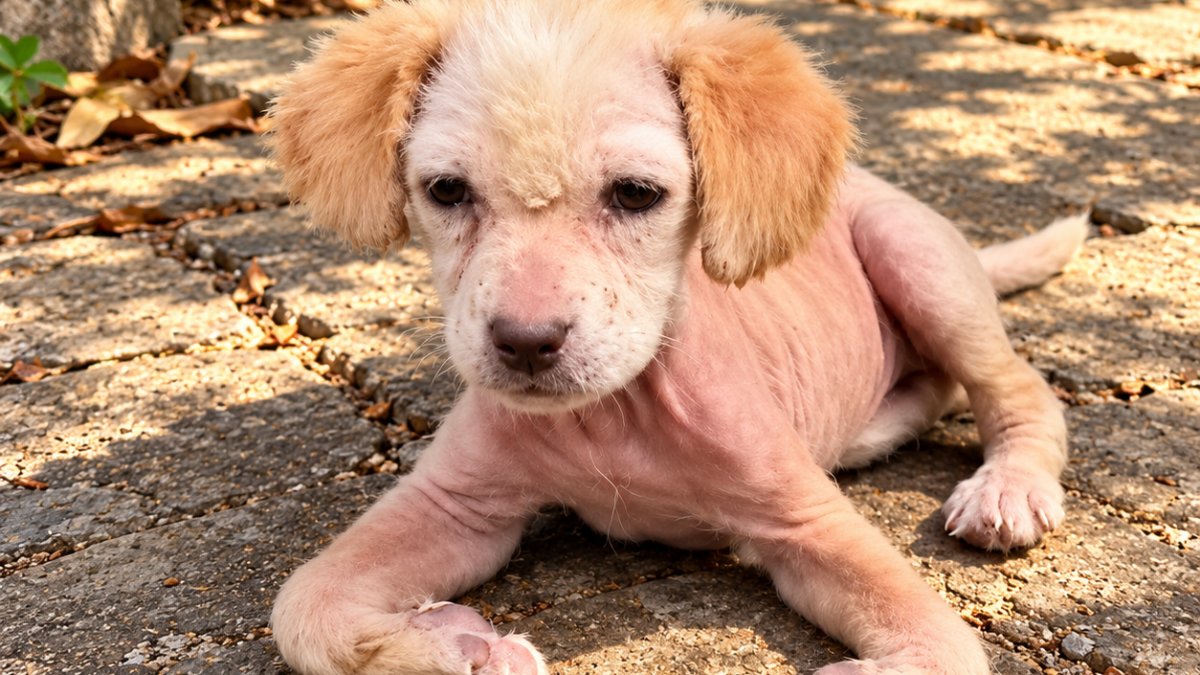
She couldn’t have been more than two and a half months old. Her body was frighteningly thin, her coat had been eaten away by mange, and what little skin remained exposed was scratched, irritated, and raw. Every time she tried to move, her chest scraped against the ground.
At first, I thought she had been hit by a car.
Then I realized something even worse.
This was how she had been getting around.
Her front legs curved beneath her in an unnatural position, so instead of standing on her paws, she pushed with her back legs and pulled herself forward with whatever strength she had left.
A few inches.
Stop.
A few more.
Stop again.
She was shivering even though the day wasn’t especially cold.
“Hey, sweetheart,” I said softly.
Ayla looked up at me.
That look stayed with me.
There was fear in it, but there was something else too.
Exhaustion.
Not puppy exhaustion after playing too hard.
The kind that comes from spending every hour trying to survive.
I crouched several feet away.
She immediately tried to crawl backward.
“No, no. It’s okay.”
She didn’t know that.
Someone nearby told me the puppy had been appearing around the neighborhood looking for food. People had chased her away because of her skin.
Some were afraid of the mange.
Others simply didn’t want a sick stray near their houses.
Everywhere Ayla tried to go, somebody pushed her away.
I looked down at her.
She had probably been hungry.
Probably thirsty.
Definitely hurting.
And she was still trying to find someone.
I slowly held out my hand.
She lowered her head.
That broke something inside me.
She didn’t growl.
Didn’t snap.
Didn’t try to defend herself.
She simply became still, almost as if she had learned there was no point resisting whatever a person decided to do.
I moved closer.
“You’re coming with me.”
When I lifted her, she barely struggled.
She weighed almost nothing.
I could feel every rib beneath my fingers.
Her little heart was racing against my palm, but after a few seconds she leaned into my chest.
I wrapped her in a towel and carried her to the car.
During the drive to the veterinary clinic, I kept looking over at her.
Ayla lay curled on the passenger seat, trembling beneath the towel.
At one traffic light, she lifted her head.
“We’re almost there,” I whispered.
Her eyes remained fixed on me.
“I know you don’t trust me yet. That’s okay.”
I don’t know why I talked to her so much.
Maybe I needed to hear the words myself.
At the clinic, the veterinarian took one look at Ayla and called for a technician.
“How old?”
“About two and a half months.”
He frowned as he examined her legs.
“Has she ever walked normally?”
“I don’t know. I just found her.”
He touched one front limb carefully.
Ayla whimpered.
My hands tightened.
“Is it broken?”
“We need X-rays.”
They weighed her.
The number was far lower than it should have been for a puppy her size.
She was severely malnourished.
The mange had spread across much of her body, and repeated crawling had created new wounds along her chest and legs.
The veterinarian listened to her heart, checked her gums, examined her eyes and ears, and then moved his hands carefully over her abdomen.
Suddenly he stopped.
“What?”
He pressed gently again.
“There’s something here.”
My stomach tightened.
“What kind of something?”
“I’m not sure yet. We’ll include her abdomen when we do the X-rays.”
Ayla was taken into another room.
I sat outside waiting.
That may have been the longest twenty minutes of my life.
I kept thinking about the way she’d been crawling.
Was it permanent?
Would she ever be able to stand?
Would she need surgery?
And then there was whatever the veterinarian had felt in her stomach.
When he finally returned, he was carrying several images.
“The good news is there are no fractures.”
I released a breath I hadn’t realized I was holding.
“So her legs aren’t broken?”
“No.”
“Then why do they look like that?”
He placed the films where I could see them.
“The deformity appears consistent with a nutritional problem. Calcium deficiency is likely part of it.”
“Can it be corrected?”
“She’s very young. That’s in her favor.”
I waited.
“But?”
“But I can’t promise anything yet. Her bones are still developing, which means there’s an opportunity for improvement, but she needs proper nutrition, supplements, limb support and careful monitoring.”
Then he showed me another image.
A round object was clearly visible inside Ayla’s stomach.
“What is that?”
“It appears to be a stone.”
I stared at him.
“A stone?”
He nodded.
“She swallowed a rock?”
“Most likely.”
For several seconds, I couldn’t speak.
I looked through the doorway at Ayla lying on a folded towel.
She had been hungry enough to swallow something that wasn’t food.
That was when the full reality of her condition hit me.
This wasn’t a puppy who had missed a few meals.
Ayla had been surviving however she could.
“Does she need surgery?”
“Not immediately. If it passes naturally, that’s preferable given her current condition. But we’ll monitor her very closely.”
“And if it doesn’t?”
“We intervene.”
The clinic admitted her.
That first night, everything was about stabilization.
Nutritious food in controlled amounts.
Supplements.
Treatment for the mange.
Fluids when necessary.
Bandaging and support for her front legs.
Pain management.
Rest.
When I returned later that evening, I expected to find Ayla awake.
Instead, she was asleep.
She had curled herself into the corner of a soft bed.
A blanket covered part of her back.
Her nose was tucked toward her chest.
One of the technicians walked up behind me.
“She’s been sleeping for a while.”
“Did she eat?”
“A little.”
“Any vomiting?”
“No.”
“The stone?”
“Nothing yet.”
I nodded.
Then I looked at Ayla again.
Something about seeing her sleep made my throat tighten.
When I found her, she hadn’t had the luxury of resting.
Every place she stopped carried danger.
Someone might chase her.
Another animal might approach.
She might have to move again on those painful legs.
Now she had a bed.
Walls.
Food.
People who wanted her there.
For once, she didn’t need to keep crawling.
I sat on the floor beside her enclosure.
After several minutes, Ayla opened her eyes.
She noticed me.
Her head lifted slightly.
“It’s okay,” I whispered.
She watched me for another moment.
Then her head settled back onto the blanket.
That tiny act felt important.
She was willing to sleep while I was nearby.
Maybe trust begins like that.
Not with some dramatic moment.
Just an exhausted animal realizing nobody is going to hurt her while she closes her eyes.
The next morning, the clinic called early.
Ayla wasn’t interested in breakfast.
My heart dropped.
“What about the stone?”
“That’s one of the things we’re watching.”
I drove straight there.
The veterinarian examined her abdomen again.
She wasn’t showing the signs of a complete obstruction, but he didn’t want to take chances.
“We’ll continue monitoring.”
“Couldn’t you just remove it?”
“We could, but surgery and anesthesia aren’t small things for a severely malnourished puppy. If her body can pass it safely, that’s better.”
I hated waiting.
There was nothing I could do about a stone inside her stomach.
I couldn’t pull it out.
Couldn’t convince her body to move faster.
Couldn’t undo the hunger that had made her swallow it.
I opened the kennel door and touched her head.
Ayla looked at me.
Then her tail moved.
Once.
I froze.
“Did you just wag your tail?”
It moved again.
The technician laughed.
“Looks like she did.”
I couldn’t help smiling.
“Good girl.”
Ayla’s tail tapped the bedding a third time.
That became our first victory.
Not walking.
Not standing.
A tail wag.
By afternoon, she ate.
The next day, she ate a little more.
Every meal was carefully controlled. Her system needed time to adjust after prolonged malnutrition.
Then the phone call came.
“The stone passed.”
I nearly shouted.
“Really?”
“Really.”
“She’s okay?”
“She’s fine.”
I sat down.
I hadn’t realized how much tension I had been carrying until it disappeared.
A rock had become one of the most important objects in my life.
Its presence had frightened me.
Its absence felt like a celebration.
One danger was gone.
Now we could focus more fully on Ayla’s legs.
The veterinarian explained that the deformity hadn’t developed overnight, which meant correcting it wouldn’t happen overnight either.
Her body needed proper nutrition first.
Minerals.
Protein.
Time.
Her bandages helped support the developing limbs and encourage better positioning.
Nothing could be rushed.
“If she improves,” I asked, “when would we know?”
“We’ll see changes gradually.”
“And if she doesn’t?”
He looked at me.
“Then we adapt. The goal is a comfortable, functional life. Don’t think only in terms of perfect-looking legs.”
That stayed with me.
Comfortable.
Functional.
Happy.
Those were better goals than perfection.
For the next several days, Ayla’s world was small.
Her bed.
Her food bowl.
Treatment.
Bandage changes.
Short periods of gentle movement.
But as her body strengthened, her personality started emerging.
At first, she accepted everything.
Then she discovered she had opinions.
One afternoon, a technician was changing the bandage on her leg.
Ayla twisted around and grabbed a strip of gauze.
“Give me that.”
Ayla pulled.
The technician pulled back.
“Seriously?”
I started laughing.
“Don’t encourage her,” the technician said.
“I can’t help it.”
Ayla shook her head with the gauze still in her mouth.
“Two days ago she barely had enough energy to move,” I said.
“And today she’s stealing medical supplies.”
“That’s progress.”
The technician finally recovered the gauze.
Ayla barked.
It was tiny.
Sharp.
Indignant.
We both stared at her.
Then I laughed harder.
“There she is.”
The frightened little puppy I had found was still inside her.
But now there was another Ayla appearing.
Curious.
Stubborn.
Playful.
Hungry for attention.
And absolutely determined to interfere with every bandage change.
Her skin slowly improved too.
The mange treatment took time.
Some days I would look at her and feel as though nothing had changed.
Then one afternoon, I ran my fingers gently across her shoulder.
Something felt different.
Tiny hairs.
“Come look at this.”
A technician leaned closer.
“New growth.”
I smiled.
“It’s coming back.”
Ayla immediately tried to chew the towel beneath her.
Apparently hair growth didn’t impress her.
As the days passed, more fur appeared.
The angry redness of her skin began fading.
She scratched less.
Her ribs became less visible.
Her face started filling out.
And her tail seemed to develop a personality of its own.
Eventually, I could tell whether she recognized someone simply from the sound inside her enclosure.
Thump.
Thump.
Thump.
One afternoon, I entered the treatment area while talking.
Ayla couldn’t see me.
But she heard my voice.
The thumping started immediately.
“She knows you’re here,” someone said.
I stepped around the corner.
Ayla’s whole body started wiggling.
“Hi, baby.”
She pushed herself forward.
Normally, she would have dropped onto her chest and crawled toward me.
This time, something different happened.
She planted one front paw.
Then the other.
Her legs trembled.
Her shoulders shook.
But she remained upright.
I stopped breathing.
Ayla stood for maybe two seconds.
Then her legs folded and she lowered herself onto the bedding.
“Did you see that?”
The technician nodded.
“Yes.”
“She stood.”
“She did.”
I opened the enclosure and knelt beside her.
“Do it again.”
She rolled onto her side and offered me her stomach.
I laughed.
“Fine. Later.”
But those two seconds stayed in my mind all day.
At the next appointment, I asked the veterinarian what it meant.
“It means she’s gaining strength.”
“Could she walk normally someday?”
He hesitated.
I had started learning what that hesitation meant.
He didn’t want hope to become a promise.
“She’s responding,” he said. “That’s what matters right now.”
So we kept going.
Ayla began practicing controlled weight-bearing.
The exercises looked almost ridiculously simple.
Stand.
Balance.
Shift weight.
Rest.
Try again.
But for her, they were enormous.
Her muscles had developed around an abnormal way of moving.
Her body had to learn something completely new.
During one session, a technician placed a small amount of food several feet in front of her.
Ayla stared at it.
“That’s cheating,” I said.
The technician smiled.
“Motivation.”
Ayla pushed herself upright.
Her legs shook.
She stretched her neck toward the food.
“Come on,” I whispered.
One paw moved forward.
She planted it.
Then another.
Her body swayed.
The technician kept a hand near her chest without fully supporting her.
Ayla stepped again.
One.
Two.
Three.
Four.
Five.
Then her legs gave out and she lowered herself onto the padded floor.
Nobody said anything for a moment.
My eyes were burning.
“She walked.”
The technician smiled.
“Five steps.”
Ayla looked at the food.
Apparently she was less interested in history than dinner.
The dish was moved closer.
She ate immediately.
“Five steps and she’s already demanding payment.”
That evening, I couldn’t stop replaying the moment.
When I’d found her, she moved by dragging her body across dirt.
Now she’d taken five steps.
They weren’t graceful.
Her legs were still crooked.
Her balance was poor.
But she’d done it herself.
The next day, however, Ayla barely wanted to stand.
I panicked.
“Did we hurt her?”
The veterinarian checked her legs.
“No swelling. No acute injury.”
“Then why isn’t she standing?”
“Because she’s tired.”
I stared at him.
“That’s it?”
“Recovery isn’t linear, Krista.”
I knew that intellectually.
Emotionally, it was harder.
Every improvement made me afraid of losing it.
Ayla might take six steps one day and only two the next.
Sometimes she’d stand beautifully.
Sometimes she’d immediately sit back down.
But over time, the good days began outnumbering the difficult ones.
Then came the ball.
It was soft, small, and bright enough for her to see easily.
I rolled it toward her.
Ayla froze.
The ball stopped against her paw.
She jumped backward.
I laughed.
“It’s a toy.”
She barked at it.
I rolled it again.
This time she slapped it with one paw.
It rolled away.
Ayla stared.
Then she chased it.
Her gait was awkward, somewhere between walking and bouncing, but she didn’t care.
The ball moved.
That meant it had to be caught.
She reached it, trapped it between her paws and bit down.
Her tail started wagging so hard her entire body moved.
I sat there watching her.
“That’s yours.”
Something about saying those words nearly broke me.
Yours.
Her own ball.
Her own blanket.
Her own bed.
Food that would still be there tomorrow.
People who were happy when she approached.
Ayla became obsessed with toys after that.
Balls were her favorite.
She carried them around the clinic.
If one rolled under a table, she complained until somebody retrieved it.
She also developed an unusual love for towels.
Give her a brand-new toy and a plain towel, and there was a good chance she’d choose the towel.
She dragged them into her bed.
Burrowed beneath them.
Chewed the corners.
Once she pulled a towel across the floor for several minutes, then lay down directly beside it instead of on it.
“You worked really hard for that,” I told her.
She ignored me.
The stronger she became, the more obvious another change became.
She was no longer frightened when people approached.
At the beginning, she would lower her head.
Now she lifted it.
She expected good things.
A hand meant affection.
Footsteps meant someone might be bringing food.
A voice might mean playtime.
An opening door was something to investigate.
Trust had returned gradually enough that I almost missed it.
There was no single dramatic moment.
Safety simply became predictable.
And once safety became predictable, Ayla stopped preparing for pain.
Her follow-up X-rays confirmed what we were seeing.
The veterinarian placed the new images beside the old ones.
“Look here.”
I leaned closer.
“Is that better?”
“Considerably.”
“How considerably?”
He smiled.
“Enough that I’m pleased.”
I laughed.
“That’s the most excitement I’ve ever heard from you.”
“We still need to be careful.”
“Of course.”
“Her legs may never look exactly like another dog’s.”
“I don’t care.”
“Good. Because appearance isn’t the priority.”
I looked through the treatment-room window.
Ayla was attempting to steal someone’s glove.
“She’s walking,” I said.
“Yes.”
“Playing.”
“Yes.”
“Running a little.”
“Apparently.”
Ayla escaped with the glove.
A technician followed her.
The veterinarian watched.
“Functional enough for trouble.”
That might have been the best diagnosis she ever received.
Eventually, Ayla was ready to leave constant clinic care.
The first night outside the hospital environment made me more nervous than she was.
I prepared everything.
Soft bedding.
Non-slip surfaces.
Food.
Water.
Her supplements.
Medications.
Backup supplies.
Then I checked everything again.
Ayla watched me.
“You’re judging me.”
She yawned.
I placed her blanket in the bed.
She pulled it out.
I put it back.
She pulled it out again.
“Fine.”
She slept on the floor with the blanket beside her.
I sat nearby longer than necessary.
Watching her sleep had become strangely meaningful to me.
That first night at the clinic, sleep represented safety.
Now she sprawled across the floor like any spoiled puppy.
No shivering.
No curling into the smallest possible space.
She took up room.
I loved that.
Soon her days became less about treatment and more about living.
She met another dog.
At first, Ayla hid partly behind my leg.
The other dog approached gently, sniffed, then dropped into a play bow.
Ayla stared.
Her tail moved.
The dog bounced backward.
Ayla stepped forward.
Another play bow.
Then something changed.
Ayla lunged playfully.
The other dog ran.
Ayla chased.
For several minutes, I stood watching the puppy who once couldn’t walk attempting to chase another dog around a room.
She stumbled once.
The other dog stopped.
Ayla stood again.
Then immediately continued.
Someone beside me asked, “Are you crying?”
“No.”
“You are.”
“Mind your business.”
They laughed.
I wiped my face.
Ayla didn’t care that I was emotional.
She was busy.
That was exactly how I wanted it.
Her past mattered to me.
It didn’t need to matter to her every second.
Over the following weeks, her fur filled in.
Her skin became healthy.
Her body gained weight.
The frightened, nearly hairless puppy disappeared beneath a soft coat and a growing personality.
People seeing her for the first time struggled to believe how she had looked before.
But I remembered.
I remembered every raw patch of skin.
Every rib.
Every time she’d tried to crawl.
And eventually another question became impossible to avoid.
Where would Ayla live permanently?
Rescuing an animal doesn’t end when the medical emergency ends.
Sometimes finding the right home is its own challenge.
Ayla needed people who understood her history.
Not people who only saw an adorable recovered puppy.
Her legs might need monitoring as she grew.
Her weight needed to remain healthy.
Future veterinary care was possible.
I wanted someone prepared for that.
At first, several people were interested.
One asked me, “Is she completely fixed?”
I hesitated.
“What do you mean?”
“Her legs. Are they normal now?”
“She’s doing extremely well. She walks, plays and runs. But she had significant developmental deformities. There may always be things her family needs to monitor.”
“So there could be medical bills later?”
“Yes.”
The enthusiasm disappeared.
I was disappointed.
But also relieved.
Ayla had spent enough of her life being wanted only when she was convenient.
Another family wanted a puppy who could immediately go on long mountain hikes.
Wrong match.
Another liked her photos but wasn’t willing to make their slippery flooring safer for her.
Wrong match.
After several failed possibilities, I began wondering if I was being too strict.
The veterinarian answered that for me.
“You’re looking for someone willing to keep caring after the exciting rescue story is over.”
“Exactly.”
“Then you’re not being unreasonable.”
Eventually, the right people arrived.
They didn’t ask whether Ayla was perfect.
Their first question was, “What does she need?”
That caught my attention immediately.
They asked about her diet.
Her legs.
Her supplements.
Her follow-up appointments.
Her activity.
Her skin history.
They wanted to know what kind of floors were safest.
How much exercise she could handle.
Whether she liked other dogs.
What frightened her.
What made her happy.
Then one of them asked, “Any bad habits?”
I laughed.
“She steals towels.”
“Towels?”
“Constantly.”
“Okay.”
“She also believes every ball belongs to her.”
“Understandable.”
“And she may hide medication in her mouth and spit it out when you’re not looking.”
One of them crouched in front of Ayla.
“We can negotiate.”
Ayla walked toward them.
She sniffed one hand.
Then the other.
They didn’t reach for her immediately.
They waited.
Ayla stepped closer.
Her tail began wagging.
Then she placed one paw on the person’s shoe.
I felt something inside me settle.
During later visits, I watched how they behaved with her.
When she stumbled, they didn’t panic.
They waited.
When she became tired, they let her rest.
When she wanted to play, they played.
They listened when the veterinarian explained what her future might require.
Nobody treated her medical history like an inconvenience.
And Ayla loved them.
One afternoon, she carried a toy over and dropped it at their feet.
Then she went back for another.
And another.
“What is she doing?”
“Showing you everything she owns.”
By the fourth toy, everyone was laughing.
Ayla sat in the middle of her collection looking enormously pleased with herself.
That’s when I knew.
She wasn’t performing.
She wasn’t afraid.
She wasn’t uncertain.
She was simply being Ayla around them.
The day she left for her new home, I packed far too much.
Food.
Records.
Medical notes.
Her blanket.
Her favorite toys.
Bandaging supplies just in case.
Two balls.
Then I added another ball.
One of her adopters looked into the bag.
“How long is she moving away for?”
“Don’t criticize me.”
“Is there a second suitcase?”
“There might be.”
They laughed.
I knelt beside Ayla.
For weeks, I’d imagined this moment.
I thought maybe she would understand.
Maybe she’d hesitate.
Maybe we’d have some dramatic goodbye.
Instead, she grabbed a squeaky toy and headed for the door.
I stared at her.
“Seriously?”
Her tail wagged.
Then she turned back.
She walked toward me and stopped.
I held her little face.
“The first day I met you, you couldn’t even walk over to me.”
Ayla licked my chin.
I laughed through the tears.
“And now you’re leaving without me.”
She pulled away because something near the door had caught her attention.
That was Ayla.
The world had become interesting.
She had places she wanted to go.
I stood outside and watched her climb into the car.
She left on her own legs.
After the car disappeared, I went back inside.
One of her towels was underneath a chair.
I sat down on the floor holding it.
That was when I cried.
Not because she was leaving.
Because she had lived long enough to leave.
A few more days alone might have changed everything.
The stone could have caused an obstruction.
The infection from her skin could have worsened.
Malnutrition could have damaged her developing body even more severely.
A car could have struck her while she crawled along the ground.
Someone could have chased her into somewhere dangerous.
So many small things could have ended her story.
Instead, one small thing changed it.
Someone stopped.
Then another person helped.
Then another.
A veterinarian looked at her deformed legs and saw a condition worth treating rather than a hopeless puppy.
Technicians changed bandages.
Meals were measured.
Medicine was given.
Skin was cleaned.
Exercises were repeated.
One tail wag became one stand.
One stand became five steps.
Five steps became walking.
Walking became chasing a ball.
Ayla’s new family sent updates constantly.
The first picture showed her asleep in a large bed.
She was stretched diagonally across the entire thing.
One leg hung over the edge.
The message said:
“Apparently this bed belongs to her now.”
I laughed.
Another photo showed every toy removed from a basket and scattered across the living room.
“She completed an inventory inspection.”
Then they sent a video.
I opened it while standing in my kitchen.
A ball rolled across the floor.
Ayla chased it.
I stopped breathing.
She ran.
Not perfectly.
Her front legs still moved differently.
But she ran.
Fast enough that the person filming had to turn quickly to keep her in frame.
Ayla caught the ball.
Turned.
Ran back.
The video lasted only seconds.
I watched it again.
Then again.
Another dog entered the frame.
Ayla picked up a different toy and carried it over.
She dropped it in front of her friend.
Her tail was wagging so hard her entire body moved.
I thought of the first time I saw her.
Dragging herself through dirt.
People pushing her away.
Mange covering her body.
A stone sitting inside her stomach.
Her legs unable to hold her weight.
The fear in her eyes before I even touched her.
Now she was presenting toys to a friend.
Months passed.
Her family continued every veterinary check.
They kept her weight controlled so her legs wouldn’t carry unnecessary stress.
They adjusted her activity when needed.
They watched carefully for discomfort.
They never assumed that because Ayla looked healthy, her history could simply be forgotten.
But they didn’t turn her history into her identity either.
She wasn’t “the crippled puppy.”
She wasn’t “the mange dog.”
She wasn’t “the rescue case.”
She was Ayla.
The dog who stole towels.
The dog who loved balls.
The dog who rearranged toys.
The dog who demanded attention.
The dog who became wildly excited whenever someone she loved entered the room.
I saw her again at a follow-up appointment.
Before I entered the room, I heard scratching against the other side of the door.
Then a bark.
The door opened.
Ayla came toward me.
Fast.
I crouched.
“Hey, trouble.”
She nearly climbed into my lap.
Her coat was thick now.
I ran my hand down her back.
Warm.
Healthy.
Solid.
One of her family members laughed.
“She definitely remembers you.”
Ayla licked my face.
I touched her front legs carefully.
The veterinarian came in holding new X-rays.
“Want to see?”
“Always.”
He placed the newest images beside those from the beginning.
Even I could see the difference.
Improved alignment.
Better development.
Stronger structure.
Not perfect.
But perfection had stopped mattering a long time ago.
“She’s done very well,” he said.
“Any concerns?”
“Keep monitoring her as she grows. Maintain her weight. Avoid excessive high-impact activity. Otherwise?”
He looked through the window.
Ayla was trying to steal another dog’s toy.
“She’s living like a puppy.”
That sentence landed harder than any medical explanation.
Living like a puppy.
That was all I had wanted for her.
She should have spent those first months playing.
Sleeping safely.
Learning.
Exploring.
Eating.
Instead, she had spent them crawling from place to place searching for help.
Now she was getting those days back in the only way life ever gives anything back.
Not by erasing what happened.
By giving her something better afterward.
When the appointment ended, we went outside.
Ayla’s family brought her favorite ball.
They rolled it across the grass.
She ran after it.
Picked it up.
Then changed direction and carried it toward another dog.
The other dog took the ball.
Ayla bounced sideways.
The dog ran.
Ayla chased.
I stood watching.
If you knew what to look for, you could still see something slightly unusual in the movement of her front legs.
I noticed it.
I probably always would.
But that wasn’t what mattered anymore.
What mattered was that those legs carried her wherever she wanted to go.
Across the grass.
Toward her friends.
Toward people who loved her.
Toward toys.
Toward home.
Ayla suddenly stopped and looked at me.
For a moment, she stood perfectly still.
Then she ran straight toward me.
She reached my feet and dropped the ball.
I picked it up.
“You want me to throw it?”
Her entire body shook with excitement.
I rolled the ball across the grass.
Ayla turned.
And ran.
I watched her chase it, remembering the tiny puppy who once scraped her chest against the ground just to move a few inches.
Nobody was chasing her away now.
Nobody was afraid of how she looked.
Nobody was telling her she didn’t belong.
She ran until she reached the ball.
Then she picked it up, turned around and headed back toward the people waiting for her.
This time, wherever Ayla chose to go, she knew she was welcome there.
[END OF STORY]
:::








