PART 2: The Pregnant Dog Chained to a Pine Tree Went Into Labor in My Patrol Car—By Nightfall, Our Brigade Was Fighting for Seven Lives
PART 2
“Vannier.”
For a second, the only sound inside the patrol vehicle was the mother dog panting behind me.
Marc held the broken red strap between two fingers.
Stamped into the aluminum tag were four words.
VANNIER — LA COMBE HAUTE.
I knew La Combe Haute.
Everybody in our sector did.
It was a small farm outside Montsauche, owned by Gérard Vannier, a fifty-six-year-old livestock dealer who also kept dogs on the property. Nothing about the man had ever put him at the top of any criminal file. He had been fined for an unregistered trailer years earlier, had a few disputes with neighbors, and once called us because someone had cut fencing near his pasture.
Two days earlier, I had seen him at the bakery.
We had shaken hands.
He had asked after my wife.
Now I was staring at his name beside a dog who had nearly been left to give birth chained to a pine tree.
Marc saw my expression.
“You’re sure it’s him?”
“I’m sure that’s his farm.”
That was all I was willing to say.
A name on a strap was evidence.
It was not a conviction.
Fifteen years in uniform had taught me the difference.
Before I could answer again, the dog let out a low cry.
Claire’s voice came from the phone on the seat.
“Julien, forget the strap for now. What’s happening?”
I looked back.
The mother was straining again.
“Second puppy.”
Marc leaned through the open door.
“I can drive.”
“No. I’m not moving her until Claire says.”
“I’m saying move her,” Claire cut in. “If the first puppy is breathing and the mother isn’t hemorrhaging, get here. Slowly. No siren unless you have to. Marc, sit in back with her.”
Marc looked at his uniform.
Then at the blood and fluid covering my back seat.
“Of course I sit in back.”
Even then, I laughed.
It lasted maybe half a second.
We transferred the mother and puppy as carefully as we could. Marc settled beside them with three towels and the expression of a man who had responded to armed domestic disputes with less anxiety.
I got behind the wheel.
We made it less than four kilometers.
“Stop.”
Marc said it quietly at first.
Then he shouted.
“Julien, stop!”
I pulled onto the shoulder.
The second puppy came there.
This one cried before Marc even finished clearing its face.
He stared at the tiny animal in his hands.
“Oh, thank God.”
The mother immediately reached for it, licking with an urgency that seemed impossible in a body so exhausted.
I watched her for a moment.
Whatever people had done to her, she knew exactly what her puppies needed.
That fact stayed with me.
We reached Claire’s clinic shortly after seven.
She was waiting outside in boots and a heavy sweater with her hair tied back, two veterinary assistants behind her and a wheeled stretcher ready.
The mother tried to stand when we opened the door.
Her legs folded.
Claire’s face changed.
“Get her inside.”
Within minutes the little consultation room became something between a delivery ward and an emergency room.
Claire checked the dog’s gums, temperature, hydration, heart rate, and abdomen while one assistant weighed the two puppies.
“Female, severely malnourished,” Claire said. “Dehydrated. Anemic, most likely. And she has pressure sores around the neck.”
“From the collar?”
“Probably long-term restraint.”
I felt my jaw tighten.
“How long?”
“I can’t tell you that from looking at her.”
The dog lifted her head toward me.
I was standing by the door because there was nothing useful left for me to do, but every time I shifted, her eyes followed me.
Claire noticed.
“She trusts you.”
“She met me an hour ago.”
“That may say more about what happened before she met you than it does about you.”
Another contraction started.
The third puppy was born at 7:19.
The fourth came twenty-seven minutes later.
By then the first two had found their mother and were nursing.
Claire relaxed slightly.
Then the dog stopped contracting.
Ten minutes passed.
Then twenty.
Claire palpated her abdomen and frowned.
“What?”
“At least two more.”
I looked at the clock.
“Is that bad?”
“It can be.”
She gave medication, waited, checked again.
Nothing.
The mother panted harder.
Her eyes seemed unfocused.
Claire looked at me.
“We may need surgery.”
“Do it.”
She gave me a look.
“You don’t own her, Julien.”
“No.”
“The municipality hasn’t officially taken responsibility yet.”
“Then call whoever has to authorize it.”
“We already are.”
“Claire.”
She stopped.
“If this is about money, the brigade will figure it out.”
From behind me, Marc said, “He means he’ll pay it and argue with everyone afterward.”
I turned.
“You’re not helping.”
“I’m helping emotionally.”
Claire almost smiled, but it disappeared when she looked back at the dog.
The animal-control representative finally reached us by phone. Temporary emergency custody was authorized because of the suspected abandonment and immediate danger.
Claire prepared for surgery.
Before they carried the mother through the doors, she twisted her head toward me.
I put my hand against her cheek.
“You did your part,” I said. “Let them do theirs.”
Her eyes closed beneath my palm.
Then she was gone.
Marc and I stood in the hall with four newborn puppies in a heated box.
Neither of us spoke.
It was strange.
We had spent years learning not to carry every scene home with us.
You had to.
Otherwise the job ate through you one call at a time.
But there was something about those four tiny bodies pressed together beneath a towel that made professional distance feel ridiculous.
Marc eventually looked at the red strap sealed inside an evidence bag.
“You want to call Vannier?”
“Not yet.”
“Why?”
“Because if it belongs to his farm, I want to know what he says before he knows exactly what we found.”
Marc nodded.
We returned to the tree after another patrol came to sit at the clinic.
The weather had started to clear.
In daylight, the site looked worse.
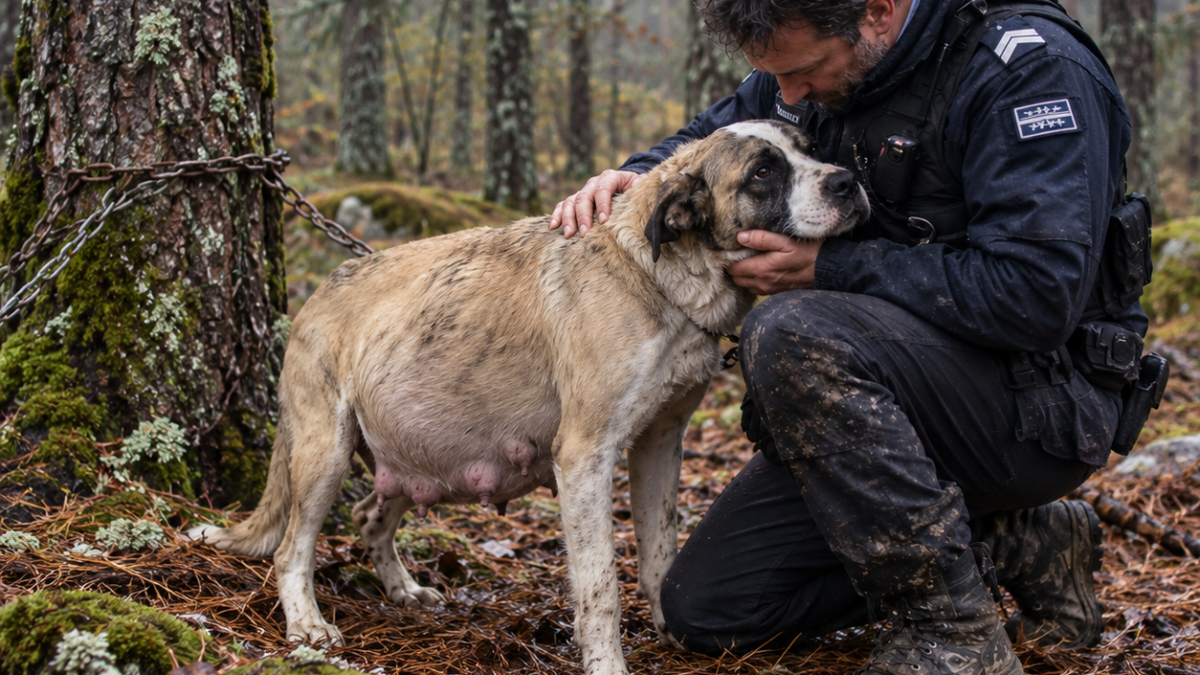
The chain had been wrapped around the pine and secured through itself with a heavy snap hook. The ground within its radius had been churned into mud.
There were claw marks near the trunk.
The dog had apparently tried to dig.
A flattened patch of needles suggested she had spent at least some time lying there.
Marc photographed everything while I walked the track.
About thirty meters away I found tire impressions.
A narrow commercial-van pattern.
Not unusual.
Still worth documenting.
Near the edge of the road was a cigarette filter mashed into the mud.
Marc looked at it.
“Could be anybody’s.”
“Exactly.”
We bagged it anyway.
Further down the track we found something more useful.
A forestry department camera.
It was mounted high enough on an oak that neither of us had noticed it during the rescue.
The cameras were used to monitor illegal dumping and vehicle access during wet months.
Marc looked at me.
“Well.”
I felt the case change shape.
Back at the brigade, our commander, Captain Sophie Renaud, was waiting.
Sophie was forty-eight and had the ability to make a room feel quieter without raising her voice. She listened while I described the scene, the delivery, the strap and the camera.
When I finished, she folded her arms.
“Where is the dog?”
“Still at Claire’s.”
“Condition?”
“Bad. Surgery likely.”
“And the puppies?”
“Four born alive when we left.”
Sophie nodded slowly.
“Before either of you decides that Gérard Vannier is guilty because his name is on a piece of nylon, we do this correctly.”
“I know.”
“I’m saying it because I know you know him.”
Marc looked at me.
Sophie noticed.
“What?”
“I saw him Sunday,” I said.
“Socially?”
“Bakery. Two minutes.”
“That all?”
“Yes.”
She held my gaze.
“Good. Then document it in the report.”
That was Sophie.
Nothing got hidden because it felt inconvenient.
At 9:46, Claire called.
I answered before the second ring.
“How is she?”
“Alive.”
I sat down.
Marc stopped typing across the room.
“And?”
“We took two puppies by cesarean. Both are alive. Six total.”
I closed my eyes.
Six.
Claire continued.
“The mother lost more blood than I like, but she’s stable. We’re treating dehydration, anemia, malnutrition and an infection around the collar wounds. I’m keeping her.”
“Can I see her later?”
There was a pause.
Then Claire said, “She may be happier if you do.”
I did not realize how hard I had been gripping the phone until I put it down.
Marc leaned back.
“Six?”
“Six.”
“And the mother.”
I nodded.
Seven lives.
At that moment, I thought the morning had reached its emotional peak.
I was wrong.
The forestry department sent us the camera recording just before noon.
The video was grainy and colorless in the predawn light.
At 4:38 a.m., a white Renault Trafic entered the closed track.
At 4:51, it left.
There was no readable plate in the first clip.
In the second, mud obscured part of it.
But not all.
Marc enlarged the frame.
Three characters were clear.
Two more were probable.
The vehicle also had a distinctive black dent along the lower rear door.
Sophie stood behind us.
“Do we know what Vannier drives?”
Marc was already searching previous reports.
He found the complaint from the fencing incident.
Vehicle listed: white Renault Trafic.
Registration matched the visible characters.
I felt a familiar pull in my chest—the instinct to move.
Sophie placed a hand on the back of my chair.
“No heroics.”
“I wasn’t planning any.”
“You were already halfway to his farm in your head.”
She was right.
We contacted the prosecutor’s office, documented the evidence we had, and received instructions to proceed with an interview while additional checks were made.
Marc and I drove to La Combe Haute that afternoon.
The farm sat at the end of a narrow road bordered by hedges and wet fields.
Vannier’s white van was parked beside a stone barn.
The dent on the rear door was exactly where it had been in the camera image.
He came outside before we reached the house.
For the first few seconds, he looked like the same man I had seen buying bread two days earlier.
Work jacket.
Mud on his boots.
Gray stubble.
Hands rough from years around animals and machinery.
Then he saw my face.
Something shifted.
“Julien.”
“Gérard.”
“What’s happened?”
“We need to speak with you about a dog.”
His eyes moved to Marc.
Then back to me.
“A dog?”
“Yes.”
“What dog?”
It was too quick.
Not proof.
But I heard it.
I had not described her yet.
I said, “A pale tan female. White chest. Dark marking around the left eye.”
For half a second, nothing moved.
Then Vannier shrugged.
“Lots of dogs look like that.”
“Do you own one?”
“No.”
Marc took out a photograph of the red strap.
“Recognize this?”
Vannier barely looked.
“No.”
“Your name is on it.”
“I can see that.”
“So?”
“So things get lost.”
“What was it used for?”
“Could have been from a lead. I’ve owned plenty of dogs.”
“Recently?”
He looked at me again.
I saw irritation now.
“Am I being accused of something?”
“We’re asking questions.”
“That means yes.”
Behind him, a dog barked from the barn.
Then another.
Vannier glanced back.
Marc heard them too.
“How many dogs do you have here?”
“Four.”
“What breeds?”
“Mixed.”
“Can we see them?”
His jaw hardened.
“No.”
The answer came so firmly that the conversation changed.
He must have felt it too, because he immediately added, “Not without paperwork.”
“That’s your right,” I said.
He crossed his arms.
“So get your paperwork.”
We left.
Marc waited until the farm disappeared behind the trees.
“He knows.”
“Maybe.”
“Oh, come on.”
“He knows something.”
“That better?”
“Yes.”
Marc hit the steering wheel lightly.
“You can be unbearable.”
“I’m aware.”
At the clinic that evening, the dog was awake.
Claire had placed her in a large recovery kennel with blankets beneath her. The six puppies were lined along her belly like small warm stones.
One was noticeably smaller than the others.
“The first one?” I asked.
Claire nodded.
“The one you delivered.”
“He okay?”
“He’s a fighter.”
I crouched beside the kennel.
The mother raised her head.
Her tail moved once against the blanket.
Claire leaned against the wall.
“She needs a name for the records.”
“She doesn’t have one?”
“No chip found.”
That surprised me.
French law required dogs to be identified, but compliance was not universal, especially with people operating outside legitimate breeding channels.
“What are you calling her?”
“Dog 2846.”
“No.”
Claire smiled.
“Then fix it.”
I looked at the dark patch around her eye.
“What about Naya?”
“Why Naya?”
“No reason.”
The dog rested her chin on the blanket.
Claire wrote it on the chart.
NAYA.
I visited again the next morning.
Then again that evening.
I told myself it was part of the case.
Nobody at the brigade believed me.
By Thursday, photographs of the rescue had reached local animal-welfare volunteers because temporary foster placement would eventually be needed. Sophie was careful about what information left the brigade. No suspect’s name. No investigative details.
But in a rural area, information travels on its own legs.
Someone recognized Naya.
The call came from a woman named Aline Marchal.
“I’ve seen that dog before,” she told me.
“Where?”
“At Vannier’s farm.”
My pen stopped.
“When?”
“Three months ago. Maybe four.”
“Why were you there?”
“My sister wanted a puppy. Vannier had advertised a litter online.”
“From Naya?”
“I don’t know. But that dog was tied beside the barn.”
“What condition was she in?”
Aline hesitated.
“Thin.”
“How thin?”
“Not like the photo you posted. But thin enough that I asked about it.”
“What did he say?”
“That she was a rescue and difficult to keep weight on.”
“Did you buy a puppy?”
“No.”
“Why not?”
Another pause.
“Because I didn’t like what I saw.”
She told me there had been several dogs housed in improvised runs behind the barn. Nothing she described alone amounted to proof of criminal mistreatment, but the conditions had bothered her enough that she had taken two photographs on her phone.
She still had them.
An hour later, they were in our file.
One showed three dogs behind wire fencing.
The second showed a pale tan female beside the barn.
White chest.
Dark patch around the left eye.
Red nylon lead attached to her collar.
The same color as the strip from the forest.
We went back to the prosecutor.
This time, we had enough for a formal search of the property.
When we returned to La Combe Haute with the appropriate authorization and animal-welfare personnel, Vannier was waiting in the yard.
Someone had clearly told him we were coming.
He looked at the paperwork.
Then at me.
“You think I left that dog there.”
“I think we need to search.”
“I told you she isn’t mine.”
“You told us you didn’t own a dog matching her description.”
“I don’t.”
“Did you?”
His eyes narrowed.
“That’s a different question.”
It was.
And he knew exactly why.
The search lasted nearly three hours.
We found four adult dogs.
All had water.
All had shelter.
Two were properly identified.
Two were not.
The conditions were rough but not catastrophic.
Then one of the animal-welfare officers called from a locked storage room attached to the barn.
Inside were veterinary supplies, old collars, leads and folders.
On a hook hung the other half of a red nylon leash.
Marc did not say anything.
He did not need to.
The torn edge matched the piece recovered beneath the pine.
In a plastic document box, we found handwritten breeding records.
Dates.
Colors.
Sexes.
Prices.
Initials beside some litters.
And a name.
Naya.
I stared at it.
Vannier was standing several meters away with Sophie.
I carried the book over.
“You said she wasn’t yours.”
He looked at the page.
“She wasn’t.”
“Her name is in your record.”
“She stayed here.”
“That isn’t what I asked.”
“A friend left her.”
“What friend?”
He named a man called Rémi Cottin.
We checked.
Rémi had died fourteen months earlier.
Vannier knew that.
I looked at him.
“You want to try again?”
His face flushed.
“My brother knew him.”
“Your brother says he never met him.”
“You talked to my brother?”
“Yes.”
That was a bluff only in timing. Marc had called him twenty minutes earlier.
Vannier glanced toward the house.
For the first time, he seemed less angry than worried.
Then a woman appeared in the doorway.
She was in her early twenties.
I recognized her as Vannier’s daughter, Émilie.
“Dad.”
He turned.
“Go inside.”
She did not.
“Dad.”
“Now.”
She looked at the breeding book in my hand.
Then she looked at me.
“She was ours.”
The yard went silent.
Vannier’s shoulders seemed to rise.
“Émilie.”
“She was ours,” she repeated.
He stepped toward her.
Sophie moved between them without drama.
“Stay where you are, Gérard.”
Émilie wrapped her arms around herself.
“She was mine first.”
I kept my voice calm.
“Tell me what happened.”
Her eyes filled.
Vannier said, “You say nothing.”
Émilie flinched.
That movement told me more about the family than I wanted to know.
I said, “Émilie, you’re an adult. You can speak if you choose.”
She stared at the ground.
“Naya was mine when I lived here. I got her when she was about eight months old. When I moved to Dijon, my landlord wouldn’t allow a dog that size. Dad said he’d keep her until I found somewhere else.”
“When was that?”
“Almost two years ago.”
“Did you come back to see her?”
“At first.”
“And later?”
Her mouth tightened.
“Dad always had excuses. She was at another property. She was at the vet. She was out with someone.”
Vannier laughed bitterly.
“This is ridiculous.”
Émilie turned on him.
“You told me she’d been rehomed.”
“I told you she was gone.”
“You said a family near Autun took her.”
“She was a burden!”
The words hit the yard like something thrown.
Vannier seemed to realize what he had said.
Nobody moved.
Émilie whispered, “What did you do?”
He looked away.
“Nothing.”
“What did you do to her?”
“Émilie—”
“She was pregnant when we found her,” I said quietly.
Émilie’s hand covered her mouth.
Vannier looked at me with open hatred.
“You had no right.”
“To tell her?”
“To come here and tear apart my family over a dog.”
Marc shifted beside me.
I felt my temper rise.
Sophie spoke before I could.
“This is not about your family, Mr. Vannier. It is about whether an animal was intentionally abandoned while restrained and in medical distress.”
“I didn’t abandon anything.”
“Then help us understand why her leash is in your barn and part of it was found where she was chained.”
He said nothing.
That silence did not solve the case.
But it was the first time he stopped denying that Naya had been his responsibility.
We finished the search.
Before Émilie left, she asked me one question.
“Is she alive?”
“Yes.”
“The puppies?”
“All six.”
Her face collapsed.
Not dramatically.
Her chin simply trembled.
“Can I see her?”
I could not promise that.
Naya was evidence in an active cruelty investigation and under temporary protective custody.
“I’ll ask.”
Émilie nodded.
Then she walked toward her car.
Vannier called after her.
She never turned around.
That night, I sat in my kitchen long after my wife, Camille, had gone upstairs.
I kept seeing Naya leaning against my shoulder after the chain broke.
Camille came back down eventually and found me staring at nothing.
“You’re thinking about the dog.”
“I’m thinking about how long she waited.”
“For you?”
“No.”
I shook my head.
“For anybody.”
Camille sat across from me.
“Did you find who did it?”
“We found who had her.”
“That isn’t the same thing.”
“No.”
She knew me well enough not to ask what I could not tell her.
Instead, she reached across the table.
“You brought her out.”
“Barely.”
“But you did.”
I looked at her.
“She started giving birth thirty seconds after I cut the chain.”
Camille’s expression changed.
I had not told her that part.
“If I’d driven past…”
“You didn’t.”
“If the wind had been stronger, I wouldn’t have heard her.”
“But you did.”
I hated that answer because it was true and insufficient at the same time.
The next morning brought the first serious complication.
The smallest puppy stopped nursing.
Claire called me from the clinic.
His temperature had dropped.
She had him in an incubator and was supplementing glucose and formula.
“Is he going to make it?”
“I don’t know.”
I stared through my office window.
In the yard outside, Marc was checking a patrol car.
“He was the first one.”
“I know.”
“The silent one.”
“I know that too.”
I rubbed my forehead.
Claire’s voice softened.
“You can’t investigate biology into cooperating, Julien.”
“I’m aware.”
“No, you’re not.”
I went to the clinic at lunch.
The puppy looked even smaller without his littermates around him.
Claire had begun calling him Petit One because the volunteers needed something to write on his feeding chart.
I put two fingers beside him.
His paw fit across one fingernail.
“You made a lot of noise after scaring ten years off my life,” I told him. “So you don’t get to stop now.”
Claire stood behind me.
“That was almost affectionate.”
“Don’t spread it around.”
“Your reputation is safe.”
Across the room, Naya watched us.
She had gained less than half a kilogram, but she was drinking regularly. The wounds around her neck had been cleaned and treated. Her coat still looked dull.
When Claire brought Petit One near her, Naya immediately began licking his back.
He moved.
Then he rooted weakly against her.
Claire let out a breath.
“Come on.”
He found a teat.
He latched.
Nobody spoke for almost a minute.
That was when Captain Renaud called.
The forestry video had been enhanced enough to establish the Renault’s registration with reasonable certainty.
More important, investigators had retrieved traffic-camera footage from a road several kilometers away.
At 4:22 that morning, Vannier’s van had traveled toward the forest.
At 5:03, it traveled back.
His phone, according to records obtained through proper procedure later in the investigation, had also connected with towers covering that area.
But none of that answered the most important question.
Who had actually tied the chain?
Vannier changed his story.
First Naya had never been his.
Then she had belonged to a dead acquaintance.
Then she had stayed temporarily on his farm.
Finally, through his attorney, he admitted she had lived at La Combe Haute but claimed she escaped while being transported and that he had searched unsuccessfully.
The chain made that explanation nearly impossible.
He responded by saying someone else must have found her and tied her there.
Then we received another call.
This one came from his neighbor.
The neighbor’s name was Pascal Giroux, a retired forestry worker who lived about eight hundred meters from La Combe Haute.
“I saw Gérard load a dog that morning,” he told me.
“What time?”
“Before five.”
“How can you be sure?”
“My wife had a hospital appointment in Nevers. We left early. His van was at the gate with the rear doors open.”
“Could you identify the dog?”
“Not clearly. It was dark.”
“Anything else?”
Pascal hesitated.
“Someone was arguing.”
“Who?”
“I heard Gérard.”
“And?”
“A younger man.”
“Do you know who?”
“I think it was his nephew, Thomas.”
That was new.
Thomas Vannier was twenty-six and occasionally worked at the farm.
We interviewed him the following afternoon.
He arrived with a lawyer.
He had prepared answers.
Yes, he had been at the farm.
Yes, Naya had been there.
No, he had not abandoned her.
Yes, he had argued with his uncle.
About what?
“Money.”
“What money?”
“Feed bills.”
“For the dogs?”
“For everything.”
“Was Naya in the van?”
His lawyer touched his arm.
Thomas looked at him.
Then at me.
“I don’t know.”
“You were standing beside the van.”
“I didn’t look.”
“What were you arguing about?”
“I told you.”
“Feed bills.”
“Yes.”
“Did your uncle tell you where he was taking Naya?”
Silence.
“Thomas?”
“No.”
“Did you ask?”
His jaw tightened.
His lawyer said, “My client has answered.”
I closed the file.
“Then I’ll ask one last question. When you saw the photographs of Naya chained to that tree, were you surprised?”
Thomas looked at me.
That was the first question he had not expected.
His face lost color.
His lawyer said his name.
Thomas stared at the table.
“No.”
The room became still.
I leaned forward.
“Why not?”
His lawyer raised a hand.
“This interview is over.”
Thomas stood.
So did I.
“Why weren’t you surprised?”
“Julien,” Sophie warned from the observation side of the room.
I stopped.
Thomas left without answering.
But two hours later, his lawyer called.
Thomas wanted to amend his statement.
The second interview was different.
He looked exhausted.
He kept rubbing his palms across his jeans.
“My uncle’s been losing money,” he said. “For a long time.”
“From the farm?”
“Livestock, fuel, everything. He started breeding dogs because somebody told him there was money in it.”
“Was there?”
“Sometimes.”
“What happened with Naya?”
Thomas stared at the table.
“She got pregnant.”
“Intentionally?”
“I don’t know. Maybe. He had a male there for a while. A big mastiff mix.”
“Did your uncle plan to sell the puppies?”
“Yes.”
“Then why abandon her?”
Thomas swallowed.
“She stopped eating properly. Then she started having discharge. I told him she needed a vet.”
“And?”
“He said he didn’t have five hundred euros to throw at a dog.”
My hand tightened around the pen.
“What happened that morning?”
Thomas closed his eyes.
“I got to the farm and he was putting her in the van.”
“Was she chained?”
“She had a lead.”
“Did he tell you where he was taking her?”
“Not exactly.”
“What did he say?”
Thomas looked up.
“He said he was solving the problem.”
Even Sophie, sitting beside me, became completely still.
“What did you think that meant?”
“I knew it wasn’t good.”
“Did you stop him?”
“I tried.”
“How?”
“I told him to leave her with a shelter. I said I’d call someone.”
“And?”
“He said shelters ask questions.”
“Why would that matter?”
“Because of the breeding.”
Thomas’s breathing grew faster.
“He’d sold litters for cash. Some dogs weren’t registered correctly. Some puppies weren’t identified before they left. He was scared somebody would look at everything.”
“So he drove away.”
“Yes.”
“And you let him.”
Thomas looked at me.
“I did.”
There was shame in his face.
I had seen people fake shame.
This looked different.
“I should’ve called you.”
“Yes,” I said.
His lawyer shifted.
Sophie glanced at me but did not interrupt.
Thomas nodded.
“I know.”
We now had motive, opportunity, physical evidence and a witness placing Naya in Vannier’s van shortly before the vehicle went into the forest.
The case no longer depended on one muddy strap.
But Vannier still denied tying her to the tree.
He claimed Thomas had invented the account because of a family dispute.
Then he attacked our handling of the case.
Through his attorney, he filed a complaint alleging we had prejudged him.
He specifically named me.
Sophie called me into her office.
“You expected this.”
“Yes.”
“You’re off direct interviews with him.”
I stared at her.
“Sophie—”
“That isn’t a punishment.”
“It feels like one.”
“I don’t care how it feels.”
I leaned back.
She waited.
That was another of her talents.
She could sit through anger without trying to defeat it.
Finally she said, “You found Naya. You delivered the first puppy. You visit the clinic. His lawyer will argue emotional involvement.”
“I can separate the two.”
“I believe you.”
“Then—”
“But believing you and protecting the investigation are the same decision here.”
I hated that she was right.
“Marc takes lead?”
“Marc and I will handle Vannier. You keep working evidence.”
I got up.
At the door, Sophie said, “Julien.”
I turned.
“Being angry with what happened doesn’t make you weak.”
“I didn’t say it did.”
“No. You’re just behaving as if admitting it would.”
I left before she could be more accurate.
For the next week, my part of the investigation became quieter.
Records.
Photographs.
Timelines.
Veterinary documentation.
Statements from people who had seen Naya at the farm.
Online advertisements for puppies.
Bank deposits that investigators later compared with claimed agricultural income.
Animal-welfare inspections.
Nothing cinematic.
But cases are often won in the boring hours.
Meanwhile, the brigade changed around us.
It started with towels.
Marc brought a bag from home because Claire said the clinic was running through them.
Then Élodie, our administrative officer, brought puppy formula.
One of the younger gendarmes built a wooden barrier for the temporary foster room at the shelter.
Sophie pretended not to notice that half the brigade had Naya’s latest photograph saved on their phones.
Every morning, somebody asked me the same thing.
“How are the seven?”
The seven.
That was what we called them.
Not officially.
But names have a way of creating responsibility.
Petit One survived the critical forty-eight hours.
Then he started gaining weight.
The other five grew faster.
Their eyes opened one by one.
Naya began to stand without shaking.
Claire sent us a photograph of her sleeping on her side while six puppies climbed over her.
Marc stared at it for a long time.
“That dog was tied to a tree ten days ago.”
“I know.”
“Doesn’t look real.”
“No.”
He zoomed in on Petit One.
“You named him yet?”
“I did not.”
“You talk to him.”
“That isn’t naming.”
“You called him Sergeant yesterday.”
“He was climbing over the others.”
“So?”
“He showed leadership.”
Marc laughed so loudly Sophie closed her office door.
The first time Émilie was allowed to see Naya, I stayed out of the room.
I watched through the observation window at Claire’s clinic with permission because her reaction still had evidentiary relevance, though by then I mostly wanted to know what Naya would do.
Émilie entered slowly.
Naya was lying on a blanket.
For a second, the dog simply stared.
Émilie knelt.
“Naya.”
The reaction was immediate.
Naya stood so fast that Claire reached for her.
Her tail began moving.
Then her entire body seemed to move with it.
She crossed the room and pressed into Émilie.
Émilie buried her face against the dog’s neck and started crying.
“I’m sorry.”
She said it over and over.
“I’m sorry. I’m sorry. I’m sorry.”
Naya licked her chin.
I looked away.
Later, Émilie came into the hallway.
Her eyes were red.
“Does she hate me?”
“No.”
“I left her.”
“You left her with your father because you thought he would care for her.”
“I should have checked.”
“Yes.”
She flinched.
I could have softened it.
I chose not to.
Then I added, “But what happened in that forest is not something you ordered, wanted or knew about.”
She looked at me.
“I kept believing him because believing him was easier.”
That sentence stayed with me.
A lot of damage begins that way.
A week later, Émilie made another statement.
She provided messages between herself and her father.
Months earlier, she had asked for photographs of Naya.
Vannier repeatedly avoided sending them.
Then, six weeks before the abandonment, he wrote:
SHE’S FINE. STOP ASKING.
Three weeks later:
I FOUND SOMEONE TO TAKE HER.
The day before I found Naya, Émilie had texted again.
Can I have their number? I want to check on her.
Vannier never replied.
The timing mattered.
So did another discovery.
The veterinarian Vannier sometimes used had seen Naya eight days before she was abandoned.
Not for a full examination.
Vannier had brought another dog in, and Naya was in the van.
The vet noticed her pregnancy and poor condition.
“I told him she needed to be examined,” the veterinarian said in a formal statement.
“What did he say?”
“He said she wasn’t his problem.”
That sentence made it into the file.
Vannier’s attorney tried to explain it away.
He claimed Gérard meant Naya belonged to Émilie.
Legally, ownership records were complicated.
Morally, the sentence sounded exactly like what it was.
The final piece came from the chain.
Forensics could not magically tell us who had touched every link, and I never expected that.
But the snap hook used to secure it was an unusual agricultural type.
During the search, officers had photographed a box of identical hooks in Vannier’s barn.
That was circumstantial.
Then Thomas told investigators where the chain itself had come from.
“It hung beside the side door,” he said. “Used to secure the feed gate.”
Photographs from a previous insurance inspection of the farm showed it there six months earlier.
Same chain pattern.
Same oversized hook.
The case did not depend on fingerprints or a dramatic confession.
It accumulated.
One fact beside another.
Until every alternate explanation required more coincidences than the obvious one.
Vannier was formally charged under the applicable animal-cruelty and abandonment provisions, with additional administrative and regulatory issues arising from the breeding operation.
The day he learned the prosecutor intended to pursue the case, he came to the brigade.
Not for an interview.
To confront me.
I was leaving through the rear entrance when I saw him by my car.
“Gérard.”
He turned.
His face looked older than it had two weeks earlier.
“You destroyed my life.”
I stopped several meters away.
“No.”
“My daughter won’t speak to me.”
I said nothing.
“My nephew sold me out.”
Still nothing.
“People in town look at me like I’m some kind of monster.”
“You should discuss the case with your lawyer.”
“I’m talking to you.”
“I’m not discussing evidence with you here.”
He stepped closer.
“You think you’re a hero because you found a dog.”
“No.”
“You love this.”
That made me look at him.
“What?”
“The attention. Everybody talking about you saving puppies.”
I almost laughed.
Not because it was funny.
Because it was so far from what the previous two weeks had felt like.
“You think I enjoyed wondering whether that first puppy would breathe?”
His mouth tightened.
“You have no idea what it’s like trying to keep a farm alive.”
“That may be true.”
“You have a salary every month.”
“Yes.”
“Pension. Benefits. A government car.”
“Gérard.”
“I was drowning.”
For the first time, something in his voice changed.
The anger cracked.
What remained underneath it sounded like exhaustion.
“Feed went up. Fuel went up. Two buyers didn’t pay me. The bank was calling. I had bills stacked in the kitchen.”
I watched him.
There it was.
Not innocence.
But the human reason beneath an inhuman decision.
“I understand being desperate.”
“No, you don’t.”
“Maybe not the way you were.”
His eyes were wet now, though whether from anger or shame I could not tell.
“She was sick,” he said.
“Yes.”
“She was going to cost me money I didn’t have.”
“So you chained her to a tree.”
He looked away.
It was the closest thing to an admission I had heard from him.
I waited.
He rubbed both hands over his face.
“I thought somebody would find her.”
My whole body went still.
“What?”
He realized what he had said.
“You heard me.”
“Say it again.”
“I’m not saying anything.”
“You thought somebody would find her.”
He stepped back.
“That’s not what I meant.”
“Then what did you mean?”
His anger returned because anger was easier.
“Go to hell.”
He walked away.
I did not follow.
I immediately went inside and documented the encounter.
There had been no recorder running.
No planned interview.
His remark alone would never carry the case.
But I wrote down every word while it was fresh.
Sophie read the report.
Then she looked at me.
“You kept your temper?”
“Barely.”
“But you did.”
“Yes.”
She nodded.
“That matters.”
By the time the puppies were five weeks old, Naya looked like a different dog.
Her ribs no longer stood out sharply.
The fur beneath her collar was beginning to grow back.
Her eyes were brighter.
She played.
That surprised me most.
The first time I saw her chase a soft ball across Claire’s yard, I stood there stupidly smiling.
Claire noticed.
“I have photographic evidence.”
“Delete it.”
“Never.”
Six puppies came tumbling behind Naya.
They had developed personalities.
The biggest male was calm and heavy-footed.
A tan female with white paws attacked every shoelace she saw.
One dark-muzzled male screamed whenever separated from the group.
Petit One remained the smallest.
He was also fearless.
He climbed everything.
Beds.
Boxes.
His mother.
My leg.
One afternoon, he latched onto the cuff of my uniform trousers and refused to release it.
Marc watched from a chair.
“There’s your sergeant.”
“He lacks discipline.”
“He has your personality.”
“I can have you transferred.”
“No, you can’t.”
The staff began discussing adoption plans.
That should have made me happy.
Instead, I felt something unexpectedly close to grief.
Claire saw it immediately.
“You know you can’t keep seven dogs.”
“I don’t want seven dogs.”
“You said that too fast.”
“I have a house, not a farm.”
“You have a yard.”
“Camille would leave me.”
Claire raised an eyebrow.
“Have you asked?”
“No.”
“Interesting.”
That evening I told Camille the puppies would soon be placed.
She was chopping onions.
“Good.”
“Good?”
“They need homes.”
“Yes.”
She kept chopping.
“You’re disappointed.”
“No.”
She stopped.
“Julien.”
“Maybe a little.”
“Which one?”
I stared at her.
“What?”
“Which puppy?”
“I never said—”
“Which one?”
I sat down.
“Petit One.”
She smiled.
“Of course.”
“What does that mean?”
“You spent ten minutes telling me how he gained eighty grams yesterday.”
“That was medically relevant.”
“To whom?”
I had no answer.
Camille wiped her hands.
“We are not deciding tonight.”
“Deciding what?”
She laughed.
That was the moment I understood my marriage was more dangerous than any interrogation room.
Petit One eventually became Paco.
Camille named him.
She claimed it was provisional.
It was not.
The court process took months.
Real justice usually does.
There were hearings, expert reports, challenges, witness statements and delays.
Vannier did not suddenly become a theatrical villain.
Sometimes I saw him in town.
He looked smaller each time.
His farm operation contracted.
Several of the dogs were permanently removed following separate administrative findings.
Others were placed under monitoring and later transferred.
His breeding activity ended.
Émilie stopped speaking to him for several months.
Thomas found work elsewhere.
People who had bought puppies from Vannier contacted investigators, adding records and statements.
Some had healthy dogs.
Others described illnesses that had appeared shortly after purchase.
Those matters were investigated separately.
When Vannier finally stood before the court, the room was smaller than people imagine.
No dramatic wooden gavel.
No cheering crowd.
No music.
Just files, lawyers, tired chairs and facts.
I testified about the discovery.
I described hearing the whine.
The chain.
The absence of water.
Naya’s condition.
The birth in the patrol vehicle.
Vannier stared at the table.
His attorney questioned me carefully.
“You had prior contact with my client?”
“Yes.”
“You knew him socially?”
“No.”
“You had spoken outside official duties?”
“Briefly. Like many people in our patrol area.”
“You became personally attached to the animal, correct?”
“I was concerned for her welfare.”
“You visited her repeatedly.”
“Yes.”
“And you adopted one of her puppies.”
That caused Vannier to look up.
It was true.
By then Paco had been living with Camille and me for nearly four months.
I answered.
“Yes.”
“Would you agree that this case became emotional for you?”
“Yes.”
The lawyer seemed momentarily surprised.
He had expected resistance.
I continued.
“Finding a severely malnourished pregnant dog chained to a tree and delivering a puppy who initially did not breathe affected me emotionally. That does not change where I found her, what the chain looked like, what the camera recorded, or what the witnesses later reported.”
The lawyer paused.
“No further question.”
Thomas testified after me.
He looked terrified.
Vannier never looked at him.
Then Émilie testified.
That was harder.
She described leaving Naya with her father.
The messages.
The repeated excuses.
The lie about rehoming her.
Her voice shook only once.
“When did you learn Naya had not been rehomed?” the prosecutor asked.
Émilie looked toward me, then toward the floor.
“When Officer Morel told me she had been found chained in the forest.”
“And pregnant?”
“Yes.”
“What did you think?”
The judge intervened gently.
“You may take a moment.”
Émilie swallowed.
“I thought she had been waiting for me to come back.”
Nobody moved.
Even Vannier’s lawyer looked down.
The veterinarian explained Naya’s condition.
She was underweight beyond what could reasonably be attributed to pregnancy alone.
She was dehydrated.
She had chronic pressure injuries around the neck.
The lack of shelter and water created obvious risk.
Labor had already begun.
Asked what might have happened if Naya had remained tied there, the vet was careful.
“I cannot state with certainty that she would have died.”
Then she added, “But both the mother and puppies were at substantial risk, and two puppies ultimately required surgical delivery.”
Claire’s report was even more detailed.
It included photographs of Naya on arrival.
I had seen them before.
I still hated looking at them.
Then came the forestry footage.
White van in.
White van out.
Traffic cameras.
Timeline.
Leash.
Chain.
Breeding records.
Messages.
Vannier’s shifting explanations.
The case was not one devastating piece of evidence.
It was twenty smaller pieces that all leaned in the same direction.
When Vannier testified, his attorney tried to present what had happened as panic rather than cruelty.
Vannier talked about debt.
The farm.
His divorce years earlier.
His fear of losing his property.
The pressure of keeping animals fed.
Some of it was probably true.
I believed that.
Desperate people do irrational things.
But desperation does not erase choice.
The prosecutor asked him a simple question.
“If you wanted someone to find the dog, why did you take her down a closed forestry track before sunrise?”
Vannier stared ahead.
“I wasn’t thinking clearly.”
“Why chain her?”
“So she wouldn’t wander onto the road.”
“Why not bring her to a shelter?”
“I panicked.”
“Why not call a veterinarian?”
“Money.”
“Why not call your daughter?”
Silence.
The prosecutor waited.
“Mr. Vannier?”
He looked toward Émilie.
She did not look back.
“I was ashamed.”
That was the first answer he gave that sounded completely true.
The judgment came later.
Vannier was found responsible for the abandonment and mistreatment of Naya, alongside violations tied to the unregulated breeding activity uncovered during the investigation.
The consequences included fines, restrictions on owning and breeding animals, compensation obligations associated with Naya’s care, and additional penalties imposed under the applicable proceedings.
He did not go to prison for years.
There was no cinematic ending where handcuffs snapped around his wrists while a crowd applauded.
Real consequences were quieter.
He lost the breeding operation.
He lost animals he had treated as inventory.
He lost money.
He lost standing in a community where reputation matters.
For a time, he lost his daughter.
And perhaps worst for him, the story he had told himself—that he had simply been a desperate man solving a problem—no longer survived contact with the facts.
Months after the case ended, I saw him outside the same bakery where we had shaken hands before the rescue.
He was loading groceries into his car.
We noticed each other.
Neither of us spoke.
Then he said, “How’s the dog?”
I knew which one he meant.
“Naya?”
He nodded.
“Good.”
“And the puppies?”
“All good.”
He looked down.
“I didn’t think she’d have them that morning.”
I said nothing.
“I thought there was more time.”
There were a hundred answers I could have given.
Instead I asked, “Would that have made it better?”
He closed the trunk.
“No.”
It was barely audible.
Then he got into the car and left.
I never knew whether that was remorse.
Maybe it was only defeat.
Sometimes those things look similar from a distance.
Naya did not return to Émilie immediately.
That decision involved animal-welfare professionals, legal custody and a careful assessment of what was best for the dog.
Émilie accepted that.
She visited.
She brought treats.
She sat on the floor and let Naya decide how close to come.
Eventually, after moving into housing where she could properly keep a large dog and after completing the required process, Émilie was approved to adopt her.
The day Naya went home with her, half our brigade somehow found an excuse to be near Claire’s clinic.
Marc claimed he happened to have patrol work nearby.
Sophie claimed she was checking documentation.
Élodie did not bother lying.
“I came to see the dog.”
Naya wore a new red collar.
That detail stopped me for a moment.
Claire noticed.
“You okay?”
“Yeah.”
“You sure?”
I looked at the collar.
“Different red.”
Claire understood.
“This one comes off whenever she wants.”
Émilie clipped on a loose walking lead.
Naya immediately turned toward me.
I crouched.
She walked over and put her head against my shoulder.
Exactly as she had in the forest.
For one second, I was back beside that pine tree with a broken chain at my knees.
Except she was heavier now.
Warm.
Strong.
Her coat shone.
And there was no fear in the way she leaned into me.
I scratched behind her ear.
“You have a house to go to.”
Her tail thumped against my leg.
Émilie smiled through tears.
“She still remembers you.”
“I think she remembers everybody with food.”
Claire laughed.
Marc looked away suspiciously.
I pointed at him.
“Are you crying?”
“Allergies.”
“In November?”
“Very aggressive November allergies.”
Émilie walked Naya toward the car.
Before getting in, she turned.
“Julien?”
“Yes?”
“Thank you for hearing her.”
I had no clever answer.
So I just nodded.
The six puppies went to homes over the next month.
We checked every placement.
Probably more than necessary.
Definitely more than normal.
The large calm male went to a retired couple near Beaune.
The white-pawed female went to a family with two teenagers and immediately took control of their sofa.
The noisy dark-muzzled male ended up with a veterinary assistant who claimed she liked “dogs with opinions.”
Two others were adopted through the partner shelter after careful screening.
And Paco came home with me.
The first night, he cried until 1:10 a.m.
I moved his bed beside ours.
He cried until 1:24.
Camille put her hand over her face.
“Your son wants you.”
“He is a dog.”
“He has your sleep schedule.”
I carried him downstairs and sat on the kitchen floor.
Paco climbed into my lap, turned twice and fell asleep.
I stayed there nearly an hour.
At work the next morning, Marc looked at me.
“You look terrible.”
“Puppy.”
He nodded solemnly.
“Thoughts and prayers.”
“Shut up.”
Paco became an unofficial member of the brigade long before anybody admitted it.
I occasionally brought him by after a veterinary appointment.
Then Élodie started keeping treats in her desk.
Then Marc taught him to sit.
Then Sophie caught him asleep beneath the conference table during lunch and said, “The dog leaves at two.”
At four, he was still there.
Eventually we began using him during certain community events, especially visits involving children.
Not as an official service dog.
Nothing so grand.
He simply had the strange ability to make anxious people forget for a few minutes that they were inside a police station.
Once, a nine-year-old boy who had been terrified to speak after witnessing a serious domestic incident spent twenty minutes rubbing Paco’s ears.
He eventually told us what he had seen while staring at the dog instead of at us.
Afterward, Marc found me in the hallway.
“Seven lives.”
“What?”
“That morning.”
I knew exactly what he meant.
We had thought we were saving seven lives.
Maybe the arithmetic had been more complicated.
The brigade changed practical things too.
Sophie arranged better animal-emergency equipment in two patrol vehicles.
Thermal blankets.
Slip leads.
Collapsible water bowls.
Muzzles.
Extra towels.
Basic neonatal supplies approved after consultation with Claire.
We created an updated contact list for veterinarians, shelters, animal-control personnel and foster groups.
Nobody called it the Naya protocol officially.
Everybody called it that unofficially.
New gendarmes who arrived months later had no idea why.
“Why does the checklist say NAYA at the top?”
Marc would answer, “Long story.”
Then usually tell it anyway.
The forest changed for me too.
For months, every time I patrolled that road, I slowed near the track.
One afternoon the following spring, I stopped.
Paco was with me because I was off duty.
He was nearly grown.
Still smaller than his siblings, according to Claire.
Still convinced size was a clerical error.
We walked down between the pines.
The needles were dry now.
Sunlight reached the ground in narrow stripes.
I found the tree easily.
The chain was gone, obviously.
But the bark still showed a faint scar where the metal had rubbed against it.
Paco sniffed the trunk.
Then he looked at me.
He had Naya’s eyes.
Not the color exactly.
The expression.
Alert but gentle.
I knelt beside him.
“This is where you started causing trouble.”
His tail moved.
He had no idea what I was talking about.
That seemed right.
Dogs do not need our stories the way we do.
A year after the rescue, the seven of them met again.
Émilie organized it with the adopters at a fenced field outside Autun.
I arrived expecting chaos.
I was correct.
Six full-grown young dogs tore across the grass while Naya stood in the middle trying to decide whether to supervise them or escape them.
Paco recognized her almost immediately.
He approached more slowly than the others.
Naya sniffed his face.
Then she licked the side of his muzzle.
I had to look away for a second.
Marc was there with his wife.
Claire came.
Élodie came.
Sophie insisted she was “only stopping by.”
She stayed two hours.
We stood along the fence while the dogs ran.
At one point Claire came beside me.
“Remember the first ten seconds?”
I knew what she meant.
The silent puppy.
My gloves.
Her voice on speaker telling me to rub harder.
“Every second.”
“You sounded terrified.”
“I was not terrified.”
“Julien, you yelled my name like the vehicle was exploding.”
“I was communicating urgency.”
She laughed.
Across the field, Paco chased his sister.
Naya lay down in the grass.
Émilie sat beside her.
There was something I had wanted to ask for months.
“Do you think Naya knew I was helping her when I cut that chain?”
Claire considered it.
“I think she knew the pressure around her neck disappeared.”
“That’s not what I asked.”
“I know.”
She watched Naya.
“Dogs don’t build the same stories we do. But they learn who brings pain and who brings safety.”
Naya rolled onto her side while Émilie scratched her chest.
Claire nodded toward her.
“So yes. In whatever way mattered to her, I think she knew.”
Later that afternoon, the other families left one by one.
Paco slept in the back of my car before we reached the main road.
I drove past the forest on the way home.
For the first time, I did not feel the need to stop.
The tree was only a tree again.
Years have passed since then.
I still work cases where the ending is not good.
Animals do not always survive.
People do not always confess.
Evidence does not always give us what we need.
Sometimes we arrive too late.
That is the part of the job nobody can fix.
But on difficult mornings, Paco still waits by the kitchen door when I put on my boots.
His muzzle has started to gray now.
He no longer attacks shoelaces.
Mostly.
Naya grew old with Émilie.
Claire sent me photographs over the years.
Naya sleeping beside a radiator.
Naya in the garden.
Naya wearing a ridiculous birthday scarf.
Naya stretched across Émilie’s bed as if she had paid the mortgage herself.
The last photograph I received showed her lying in sunlight on a wooden terrace, eyes half closed, no collar around her neck.
I stared at that one for a long time.
One rainy morning, almost exactly like the morning I found her, I arrived at the brigade before anyone else.
Paco had come with me because he had a veterinary appointment later.
He curled beneath my desk.
I made coffee.
Then one of our younger gendarmes, Antoine, walked in carrying a new emergency kit.
“Captain says this goes in vehicle three.”
I opened it.
Toweling.
Thermal blanket.
Water bowl.
Slip lead.
Gloves.
Small scissors.
Everything organized.
On the inside of the lid someone had written one word in black marker.
NAYA.
Antoine pointed at it.
“I keep meaning to ask. Who’s Naya?”
I looked under the desk.
Paco had opened one eye.
For a moment I saw a wet forest, a rusted chain, a starving dog leaning against my shoulder, and a tiny silent body in my hands.
Then Paco yawned.
I closed the kit.
“She was a dog we almost found too late.”
Antoine waited.
I picked up my coffee.
“But we didn’t.”
Under the desk, Paco’s tail tapped once against the floor.
And that was enough.
[END OF STORY]
:::








