PART 2: The Little Dog in the Back of the Shelter Had Stopped Asking for Help—Then I Learned Who Had Left Her There
PART 2
I stood up so quickly that the little dog flinched.
Immediately, I sat back down.
“Sorry,” I whispered.
Angela looked from me to the plastic bag.
“What is it?”
“Let me see that.”
She passed it through the open kennel door.
The strip was dirty and frayed. The black marker had bled into the fabric, but the first four letters were unmistakable.
MADD.
There could have been a dozen explanations.
A dog named Maddie.
A last name.
An old foster label.
A reused leash.
I knew that.
But my mind had already landed on one person.
Daniel Maddox.
Everybody called him Danny.
He owned Maddox Property Services, a small company that handled foreclosures, estate cleanouts, lawn maintenance, winterization, and abandoned-property inspections for banks around Maple County.
Including the old Mercer house.
I had known Danny for almost nine years.
Not well enough to call him a close friend, but well enough to wave when we passed each other in town. Well enough that he had donated lumber when the shelter repaired its outdoor runs. Well enough that two summers earlier, he had stood beside me at a fundraiser grilling hamburgers while telling people how much he loved dogs.
Angela read my face.
“You know something.”
“Maybe.”
“What?”
“The property where she was found. Maddox Property Services has worked that house.”
“You’re sure?”
“No.”
I handed back the strip.
“I’m sure they’ve worked foreclosures in that area. I’m not sure about that specific house.”
That distinction mattered.
One thing volunteering around animal cruelty cases had taught me was that anger loved certainty long before evidence earned it.
Angela sealed the bag again.
“Should I tell Tom?”
Tom Alvarez ran the shelter.
“Yes. And animal control.”
“You think somebody from Maddox left her?”
“I think we shouldn’t think anything yet.”
Angela gave me a look.
“You’re thinking it.”
“I’m trying not to.”
From the corner, the little dog shifted.
I turned.
Her eyes were still on me.
“What are we calling her?”
Angela shrugged.
“You’re the first person she’s watched for more than five seconds. You name her.”
“That feels like a trap.”
“It probably is.”
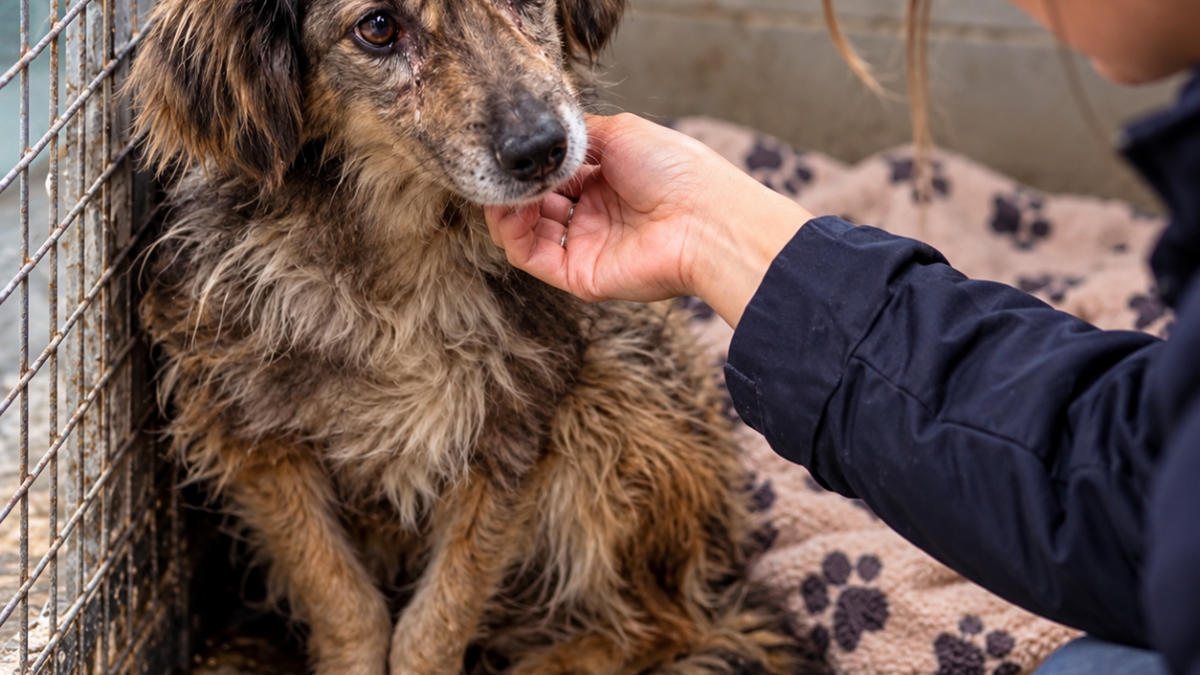
I studied the little dog’s gray, uneven coat.
“Hope?”
Angela shook her head.
“Too obvious.”
“Sadie?”
“Too many Sadies.”
The dog blinked.
“Millie?”
One ear moved.
Angela smiled.
“That one.”
“Millie, then.”
I lowered myself back onto the concrete.
“Hi, Millie.”
She did not wag.
She did not approach.
But she did not close her eyes either.
That was enough for the first day.
The shelter veterinarian, Dr. Elena Ruiz, examined Millie that afternoon.
Her problems were worse than I had guessed.
She was underweight by nearly a third.
She had infected skin beneath several mats.
Both ears were inflamed.
Her nails were severely overgrown.
Her teeth showed years of poor care.
The wet tracks I had seen beneath her eyes were caused partly by blocked tear ducts and infection.
And there was something else.
Dr. Ruiz ran her fingers carefully along Millie’s left side.
Millie stiffened.
“Easy.”
Dr. Ruiz glanced at me.
“She has at least one old rib fracture.”
“Old?”
“Healed.”
“How old?”
“Impossible to say exactly without imaging, but not recent.”
I stared at Millie.
“Could it have been an accident?”
“Of course.”
Another careful touch.
Millie pulled away.
“But?”
Dr. Ruiz sighed.
“But I don’t like the total picture.”
Neither did I.
She ordered X-rays.
One healed rib fracture.
Another partially healed.
A small irregularity in the right rear leg consistent with an older untreated injury.
Nothing alone proved deliberate abuse.
Together, they told us Millie’s life had not been gentle.
Dr. Ruiz clipped the worst mats.
When the tight fur came away from Millie’s neck, we found a narrow ring of irritated skin beneath where the collar had rested.
The collar itself was cheap red nylon, torn at the buckle.
On the inside, written in faded black marker, was more of the name.
MADD—.
Tom contacted animal control immediately.
Officer Kevin Brooks arrived an hour later.
Kevin had worked with our shelter for years. He was patient, methodical, and almost impossible to provoke.
He photographed the collar.
Then the broken leash.
Then Millie.
“Where exactly was she found?”
Tom handed him the intake report.
“Under the rear stairs of 214 Mercer Road.”
Kevin read.
“Property owner?”
“A bank, apparently.”
“Maintenance contractor?”
Tom looked toward me.
I spoke.
“I think Maddox Property Services may have handled it.”
Kevin raised his eyes.
“You know that or suspect it?”
“Suspect.”
“Good answer.”
He wrote something.
“Why?”
I explained Danny’s business.
Kevin nodded.
“I’ll check.”
That was it.
No dramatic rush.
No accusation.
No patrol cars racing toward someone’s house.
Real investigations often begin with paperwork.
I hated paperwork that afternoon.
All I wanted was to sit beside Millie.
So I did.
For two hours.
I read emails on my phone.
Answered rescue messages.
Pretended not to watch her.
At some point, she lowered her chin onto her paws.
An hour later, she fell asleep.
That was the first victory.
The second happened the next morning.
I brought boiled chicken.
Bribery is not beneath me.
I sat inside the kennel and placed one tiny piece halfway between us.
Millie stared at it.
Then at me.
Then at the chicken.
For five minutes, nothing happened.
I looked away.
A faint sound.
Lick.
The chicken disappeared.
I put down another piece, slightly closer.
Ten minutes.
Gone.
By the sixth piece, she had moved maybe eight inches.
I tried not to breathe too loudly.
Angela walked past.
I raised one finger to my lips.
She nodded and kept going.
Millie stretched her neck.
Took the chicken.
Her nose brushed my finger.
Her entire body jumped backward.
But she did not retreat to the wall.
“Okay,” I whispered.
“You’re allowed to change your mind.”
She watched me.
I placed another piece down.
This time, closer.
She ate it.
On the third day, Kevin returned.
He found me sitting beside Millie.
“Your hunch was right.”
My stomach tightened.
“Maddox?”
“They had the maintenance contract on Mercer.”
“When?”
“About eight months.”
“Who had access?”
“That’s where it gets messy.”
“How messy?”
“Company has six employees. Subcontractors sometimes. Bank representatives. Realtor. Locksmith. Anyone who had the lockbox code.”
I exhaled.
So the collar did not automatically point to Danny.
Kevin continued.
“But we found something else.”
“What?”
“The leash.”
He showed me a photograph on his phone.
One of Maddox Property Services’ social-media pages had a picture from a summer charity event.
Danny stood beside a folding table with two employees.
Behind them were several giveaway bags printed with the company logo.
Each contained a red nylon leash.
The same general style as Millie’s.
I stared at the screen.
“That still doesn’t prove—”
“No.”
Kevin put the phone away.
“But it narrows where it could have come from.”
“Have you spoken to Danny?”
“Not yet.”
“Why?”
“Because I like knowing more than the person I’m questioning.”
That almost made me smile.
Almost.
“What about the name?”
“MADD could simply be the company marking.”
“Exactly.”
Kevin looked into the kennel.
Millie had curled beside my leg.
Not touching.
Close.
He lowered his voice.
“You getting attached?”
“No.”
He raised an eyebrow.
“Professionally concerned.”
“Sure.”
“I have fostered twelve dogs.”
“How many did you keep?”
“Two.”
“Excellent record.”
“It is.”
“Rebecca.”
“What?”
“You’ve named this one.”
“That proves nothing.”
He smiled.
“I’ll let you know what we learn.”
That afternoon, something happened that changed how I looked at the case.
A delivery man entered the shelter carrying dog food.
He was tall.
Dark work jacket.
Heavy boots.
The moment his boots struck the concrete hallway, Millie’s head snapped up.
She saw him.
Then screamed.
Not barked.
Screamed.
Her body slammed backward into the corner.
She urinated beneath herself.
I dropped beside her.
“Millie!”
The delivery man froze.
“What did I do?”
“Nothing. Please step back.”
He immediately retreated.
Millie shook so hard her teeth clicked.
I reached toward her, then stopped.
Her eyes were enormous.
“It’s me.”
Nothing.
“Millie. Look at me.”
I sat on the floor.
Slowly, she focused.
I did not touch her.
After several minutes, she crawled toward me.
Then, for the first time, she pressed her body against my thigh.
I stayed still.
The delivery man looked horrified.
“I swear, I never—”
“I know.”
He had done nothing.
But something about him had reminded her of someone.
The boots?
Height?
Jacket?
Movement?
We could not know.
Kevin happened to arrive fifteen minutes later.
I told him.
He wrote it down but warned me.
“Behavior isn’t identification.”
“I know.”
“Trauma associations can be broad.”
“I know.”
“You keep saying that.”
“Because I know.”
He looked at Millie.
“But it tells us something happened.”
“Yes.”
That night, I could not stop thinking about the scream.
There are sounds animals make that do not leave you.
I heard it while brushing my teeth.
While making coffee the next morning.
While driving back to the shelter.
By Friday, Millie would eat from my hand.
She still did not allow me to touch the top of her head.
So I did not.
Instead I scratched gently beneath her chin.
The first time, she froze.
The second time, she tolerated it.
The third time, her eyes softened.
Then she leaned forward.
One inch.
I smiled.
“Got you.”
Her tail moved.
Barely.
But it moved.
Kevin called that afternoon.
“I talked to Danny Maddox.”
I stepped outside.
“And?”
“He says he has never seen Millie.”
“Did you show him a picture?”
“Yes.”
“Reaction?”
“Nothing useful.”
“What did he say about the leash?”
“Company giveaway. Hundreds made.”
“So anyone could have one.”
“Exactly.”
My heart sank.
Kevin continued.
“But I asked who serviced Mercer.”
“And?”
“Danny says one employee handled most visits.”
“Who?”
“Eric Harlan.”
The name meant nothing to me.
“Still works there?”
“Not anymore.”
“Why?”
Kevin paused.
“Danny says he fired him about six weeks ago.”
“For?”
“Stealing equipment.”
I leaned against the shelter wall.
“Did Eric own a dog?”
“We’re checking.”
There was more.
I heard it in Kevin’s silence.
“What aren’t you telling me?”
“Danny got defensive when I asked for work logs.”
“Why?”
“He claims old schedules were deleted.”
“Convenient.”
“Rebecca.”
“I know.”
“Say it.”
“Suspicion is not evidence.”
“Good.”
“You’re annoying.”
“Also good.”
The next breakthrough came from an old woman named Mrs. Evelyn Harper.
She lived three houses down from the abandoned Mercer property.
Kevin interviewed her after learning she had called the bank repeatedly about trespassers.
She remembered Millie.
Not from the days under the stairs.
From months earlier.
“I saw that little dog before,” she told us when we visited.
Kevin set his recorder on her kitchen table.
“When?”
“Summer.”
“Where?”
“At the Mercer place.”
“With anyone?”
“A man.”
“What did he look like?”
Mrs. Harper frowned.
“Tall. Maybe forty. Brown or black hair. Wore those tan work boots men all wear now.”
My mind flashed to Millie screaming at the delivery driver.
Kevin glanced at me.
I kept my face neutral.
“Vehicle?”
“White truck.”
“Company markings?”
“I think so.”
“Maddox Property Services?”
Her eyes sharpened.
“Yes. That sounds right.”
“Did you see the man with the dog more than once?”
“Three, maybe four times.”
“What was he doing?”
“She’d follow him around the yard.”
“Did she seem afraid?”
Mrs. Harper thought.
“No.”
That surprised me.
Kevin asked, “Did she appear to belong to him?”
“I assumed so.”
“Did you ever see anything concerning?”
She hesitated.
“One time.”
“What?”
“He yelled.”
“At the dog?”
“Yes.”
“What happened?”
“She wouldn’t get in the truck.”
“What did he do?”
Mrs. Harper’s hands tightened around her coffee cup.
“He grabbed her leash and pulled.”
“How hard?”
“Hard enough that I almost went outside.”
“Why didn’t you?”
She looked ashamed.
“Because I thought it wasn’t my business.”
That sentence again.
Not my business.
Someone else’s problem.
Kevin continued.
“Could you identify the man?”
“I might.”
A photo lineup was arranged later.
Mrs. Harper did not identify Danny.
She identified Eric Harlan.
The fired employee.
When Kevin called me, my first emotion was relief.
Not because Eric might be guilty.
Because Danny might not be.
That bothered me.
It forced me to admit how badly I had wanted someone I knew to be innocent.
Kevin heard it.
“You were worried it was Danny.”
“Yes.”
“Why?”
“Because I trusted him.”
“Be careful with that.”
“With what?”
“People we trust are not automatically innocent.”
“I know.”
“And people we dislike aren’t automatically guilty.”
“I know.”
“You keep passing the test.”
“I hate your tests.”
“We need to find Eric.”
They did.
Eric Harlan was living in a motel twenty miles away after separating from his girlfriend.
Animal control and a sheriff’s investigator interviewed him.
Eric admitted Millie had been his dog.
Her original name was Daisy.
When Kevin told me, I looked through the shelter window at her.
“Daisy.”
She was sleeping.
I said it louder.
“Daisy?”
Her head lifted instantly.
My stomach dropped.
She knew the name.
Kevin stood beside me.
“That answers that.”
I crouched.
“Daisy.”
Her tail did not move.
Her ears lowered.
I stopped saying it.
“Millie’s fine.”
She lay back down.
Eric’s explanation was simple.
Too simple.
He said Daisy disappeared two months earlier.
Ran away.
He claimed he searched.
Posted online.
Asked neighbors.
Investigators found no posts.
No flyers.
No calls to shelters.
No report to animal control.
When they confronted him, he said he had been busy.
Then he said his ex-girlfriend might have taken her.
The ex-girlfriend’s name was Jenna Walsh.
Jenna agreed to speak immediately.
She cried when they showed her Millie’s photograph.
“Oh my God. She’s alive?”
Kevin asked, “You know her?”
“That’s Daisy.”
“When did you last see her?”
“August.”
“Why?”
“I left Eric.”
“Did Daisy stay with him?”
Jenna closed her eyes.
“I tried to take her.”
“What happened?”
“He wouldn’t let me.”
“Why?”
“He knew I loved her.”
Her voice broke.
“He used her to punish me.”
That changed everything.
According to Jenna, Daisy had originally belonged to her.
She adopted the dog from a family friend five years earlier.
When she moved in with Eric, Daisy came with her.
The microchip?
There was none.
License?
Expired.
Vet records?
In Jenna’s name.
That mattered.
Jenna showed investigators photographs.
Dozens.
Daisy asleep on a couch.
Daisy in Christmas sweaters.
Daisy running at a lake.
Daisy sitting beside Jenna in a car.
The little dog had once been happy.
I stared at one photograph longer than the others.
Daisy—Millie—was standing on her hind legs against Jenna, mouth open, eyes bright.
I could barely connect that dog with the animal curled in kennel seventeen.
“What happened?” I asked.
Jenna answered quietly.
“Eric changed.”
“How?”
“It started with yelling.”
At first he yelled at her.
Then at Daisy.
Then he threw things.
Punched holes in doors.
Broke Jenna’s phone.
Controlled her money.
Tracked where she went.
Once, when Daisy barked during an argument, Eric kicked a chair so hard it struck the dog.
Jenna left shortly afterward.
She waited until Eric was at work.
A friend helped.
She packed quickly.
She tried to take Daisy.
But Daisy was gone.
Eric had left her with his brother.
When Jenna demanded the dog, Eric refused.
“You don’t get everything,” he texted.
She called police.
Because ownership documentation was incomplete and the dog was not at the residence, officers told her it could become a civil dispute.
Jenna had been planning to pursue it.
Then Eric told her Daisy escaped.
She believed him.
For two months, she searched.
Shelters.
Facebook groups.
Roads.
Nothing.
“I thought she was dead,” Jenna whispered.
Kevin asked the question carefully.
“Do you believe Eric abandoned her?”
Jenna’s face changed.
“Yes.”
“Why?”
“Because he told me he would.”
The room went still.
“What exactly did he say?”
She unlocked her phone.
Old messages.
She had kept them all.
One from September.
JENNA: Tell me where Daisy is.
ERIC: Not your problem anymore.
JENNA: If you hurt her I swear—
ERIC: Relax. Maybe she’ll find somebody who actually wants her.
JENNA: What does that mean?
ERIC: You’ll find out.
I felt sick.
There was more.
Jenna had received a photograph three weeks later.
Daisy sitting in the passenger seat of Eric’s work truck.
Caption:
STILL THINK SHE MISSES YOU?
Another message:
JENNA: Give her back.
ERIC: Come get her yourself.
JENNA: Where?
ERIC: Exactly.
Cruelty with a purpose.
Not toward the dog alone.
Toward Jenna.
Millie had become leverage.
A living thing turned into a weapon.
Kevin contacted the sheriff’s investigator.
The case expanded.
Domestic abuse history.
Animal cruelty.
Potential theft of property.
False statements.
But we still needed proof of who had left Millie at Mercer.
Then Danny Maddox came to the shelter.
He looked exhausted.
I met him in Tom’s office.
“I need to tell you something.”
Tom sat beside me.
Kevin was on speakerphone.
Danny rubbed his hands together.
“When Officer Brooks first came to me, I lied.”
My stomach tightened.
“About what?”
“The work logs.”
Kevin’s voice came through the phone.
“Why?”
“Because Eric was doing jobs off-book.”
“What kind?”
“Cleanouts. Scrap hauling. Sometimes I paid him cash.”
“That’s a labor violation problem,” Kevin said. “Why hide it from an animal investigation?”
Danny looked at the floor.
“Because the Mercer property was supposed to be secured. No personal use.”
“Was Eric staying there?”
“Sometimes.”
I sat forward.
“What?”
Danny looked at me.
“I found out after I fired him.”
“How long?”
“Maybe weeks. Maybe months.”
“Was Millie there?”
He hesitated.
“I saw a dog once.”
My hands tightened.
“When?”
“July.”
“Did she look like Millie?”
“I didn’t get close.”
“Danny.”
“Yes.”
The word was barely audible.
“You saw her.”
“Yes.”
“And you didn’t say that when Kevin asked?”
“No.”
“Why?”
“Because I was scared.”
“Of what?”
“Losing the bank contracts. They’d find out an employee was using foreclosed property. We could’ve been finished.”
I stared at him.
“So you protected your business.”
His face flushed.
“I didn’t know he was hurting her.”
“You knew she was there.”
“Yes.”
“Did she look okay?”
He hesitated again.
“No.”
Anger rose so fast I had to stand.
Tom said quietly, “Rebecca.”
I stepped away from the desk.
Danny continued.
“She was thin.”
“How thin?”
“I noticed.”
“And what did you do?”
“I told Eric he couldn’t keep a dog there.”
“That’s all?”
“I thought it was his dog.”
“Does that matter?”
“No.”
“You donated money to this shelter.”
“I know.”
“You stood beside me telling people animals deserved better.”
“I know.”
“And when one was standing in front of you?”
His face collapsed.
“I looked away.”
Silence.
Kevin finally spoke.
“Danny, did you ever see Eric strike the dog?”
“No.”
“Did you see him restrain her?”
“Yes.”
“How?”
“Leash tied to the back stairs sometimes.”
My stomach turned.
The same stairs where she was eventually found.
“Did the leash have company markings?”
Danny nodded.
“We gave those out.”
“Did Eric take them?”
“Everybody did.”
“Did you ever see Daisy—Millie—wear one?”
“Yes.”
That connected the collar.
Not perfectly.
But strongly.
Then Danny gave us the last thing we needed.
Security records.
Maddox trucks had GPS trackers for insurance.
Danny had initially claimed old location data was unavailable.
That was another lie.
The data existed in archived fleet reports.
Eric’s company truck had been deactivated when he was fired.
But for several days after termination, he still had possession of it because Danny had allowed him time to return tools.
One of those days was the Friday before Millie was found.
The GPS history showed the truck arriving at 214 Mercer Road at 7:42 p.m.
It remained there eighteen minutes.
Then left.
Mrs. Harper had first noticed Millie under the stairs the next morning.
The timeline fit.
Kevin requested further digital evidence.
Eric’s phone location, obtained later through legal process, also placed him near Mercer.
Still, Eric denied abandoning her.
He claimed he went to retrieve tools.
Where was Daisy?
Already missing.
Why had Jenna received messages implying otherwise?
Jokes.
Why did Daisy know the Mercer property?
Because she had been there before.
Why was her leash found attached to the rear stairs?
No answer.
The sheriff’s investigator asked him one final question.
“If Daisy ran away, why didn’t she leave Mercer?”
Eric stared.
“What?”
“She was found with a broken leash attached.”
Eric’s jaw tightened.
“Maybe somebody tied her.”
“Who?”
“I don’t know.”
“Someone found your missing dog, drove her to a property where you had been staying, tied her beneath stairs you regularly used, and did it the same evening your phone and truck were there?”
Eric said nothing.
His lawyer ended the interview.
Millie’s case became public after charges were filed.
That was when things became ugly.
People online wanted blood.
They posted Eric’s address.
Threatened him.
Threatened his family.
Someone threw a brick through his brother’s window.
I hated it.
Justice was one thing.
Mob cruelty was another.
I made a statement through the rescue.
Not asking anyone to like or share anything.
Just asking people not to interfere with the case.
If evidence mattered, then we had to behave as though evidence mattered.
Millie did not need strangers becoming violent in her name.
She needed the people who hurt her to face consequences that would actually hold.
Meanwhile, Jenna asked to see her.
That became one of the hardest decisions.
Legally, ownership questions remained unresolved.
Emotionally, Millie had clearly known and loved Jenna once.
But trauma changes associations.
We could not simply open a door and hope.
Dr. Ruiz suggested a controlled meeting.
Neutral room.
No sudden approach.
Millie allowed to choose.
Jenna arrived ten minutes early.
She carried no treats.
No toys.
Nothing that would pressure the dog.
She sat on the floor.
I brought Millie in on a loose leash.
The moment Millie saw her, she froze.
Jenna covered her mouth.
“Oh, Daisy.”
Millie’s ears lifted.
Not flattened.
Lifted.
Jenna started crying.
“I’m sorry.”
Millie stood perfectly still.
“I’m so sorry, baby.”
I loosened the leash.
Millie took one step.
Then another.
Stopped.
Jenna did not move.
“Come here if you want.”
Millie approached.
Sniffed her hand.
Then turned away.
Jenna’s face crumpled.
I almost intervened.
Then Millie circled back.
She sniffed Jenna’s knee.
Her coat.
Her sleeve.
Jenna whispered, “It’s me.”
Millie’s tail moved.
One cautious sweep.
Then another.
And suddenly the little dog climbed into Jenna’s lap.
Jenna broke.
She wrapped her arms around Millie without squeezing.
“I’m sorry. I’m sorry. I’m sorry.”
Millie licked her chin.
I turned away.
So did Dr. Ruiz.
Some moments do not belong to witnesses.
Afterward, Jenna asked me the question I had dreaded.
“Can I take her home?”
I looked at Millie.
She was lying against Jenna’s leg.
“I don’t know yet.”
Jenna nodded.
She did not argue.
That mattered.
“I want what’s best for her.”
“So do I.”
“You love her.”
It was not a question.
“Yes.”
Jenna looked down.
“She needs you too.”
That hurt in a different way.
Because she was right.
By then Millie followed me everywhere.
She trusted my hands.
She slept against my chair.
She would accept Jenna.
But when frightened, she came to me.
How do you decide who a traumatized dog belongs with when two people love her and neither wants to become another person who takes away her choice?
We did not decide quickly.
That became part of the healing.
Jenna visited every other day.
Never longer than an hour at first.
Millie improved.
She learned both of us could exist in the same room without demanding anything from her.
Her coat grew back.
Her weight increased.
She played with a plush rabbit.
The first time she grabbed it and shook it, Angela cheered.
Millie dropped it immediately.
We all groaned.
“Sorry.”
The next day, she shook it again.
No cheering.
But everyone smiled.
One afternoon, a man in work boots entered the lobby.
Millie stiffened.
I felt the change through the leash.
I knelt.
She looked at the boots.
Then at me.
“Your choice.”
The man walked past.
Millie trembled.
But she did not scream.
That night, I cried in my car.
Progress can be almost invisible until you remember what came before.
The criminal case moved toward court.
Eric was charged with animal cruelty and abandonment, along with charges connected to violating protective-order conditions and harassment involving Jenna.
There were also issues relating to his unauthorized use of the Mercer property and company vehicle.
Danny faced consequences too.
Not criminal animal cruelty charges, because investigators could not prove he participated in the abandonment or assault.
But his lies mattered.
The bank terminated one maintenance contract.
He paid penalties tied to employment and property-management violations.
More important, he had to live with what he had admitted.
He saw a thin dog.
He looked away.
I was angrier at him than the law could justify.
It took me months to separate those things.
Danny came to the shelter again before Eric’s trial.
“I want to help.”
I folded towels without looking at him.
“We don’t need money.”
“I know.”
“Then what?”
“I’m changing company policy.”
I stopped.
He handed me a folder.
Mandatory animal-welfare reporting for any animal found on managed property.
Photographs.
Immediate supervisor notification.
Contact with animal control.
No employees allowed to leave animals onsite without documentation.
Failure meant termination.
I read it.
“That should have existed already.”
“Yes.”
“You want forgiveness?”
“No.”
That surprised me.
“What do you want?”
“To make it harder for the next person to do what I did.”
“What did you do?”
He met my eyes.
“Nothing.”
The word sat between us.
Exactly.
Sometimes nothing is an action.
I put down the folder.
“Good policy.”
“Thank you.”
“That’s not forgiveness.”
“I know.”
He left.
I respected him more for not asking.
Eric’s trial came the following spring.
By then, Millie barely resembled the dog from kennel seventeen.
Her coat was soft silver-gray.
Her eyes were bright.
The tear staining had improved after treatment.
She had gained nearly eight pounds.
She still disliked tall men in heavy boots.
She still flattened briefly if someone reached over her head too fast.
But now she recovered.
That was the difference.
Fear came.
Then left.
In court, Jenna testified first.
She described adopting Daisy.
Living with Eric.
The deterioration of their relationship.
The way he used the dog to control her.
The text messages.
His attorney tried to frame the dispute as a bitter breakup.
“You were angry with Mr. Harlan?”
“Yes.”
“You wanted the dog.”
“Yes.”
“You had threatened legal action.”
“Yes.”
“So you had reasons to portray him negatively.”
Jenna’s hands trembled.
She took a breath.
“I didn’t need to portray him.”
The attorney paused.
She continued.
“He sent the messages himself.”
That ended that line quickly.
Mrs. Harper testified about seeing Eric with Millie at Mercer.
Danny testified about the company truck and his own failure to act.
That was painful to watch.
The prosecutor asked him, “Did you see the dog while she was in Mr. Harlan’s care?”
“Yes.”
“How did she appear?”
“Thin.”
“Did that concern you?”
“Yes.”
“What did you do?”
Danny stared at the floor.
“Nothing.”
“Why?”
“I didn’t want problems.”
“What kind of problems?”
“Business problems.”
“So you chose not to intervene?”
“Yes.”
The prosecutor let the silence sit.
That was all.
Kevin testified about the GPS data, interviews, and timeline.
Dr. Ruiz testified about Millie’s physical condition.
The defense suggested the injuries might have happened after she supposedly escaped.
Dr. Ruiz answered carefully.
“The healed rib fractures predated the abandonment by a significant period.”
“Can you say who caused them?”
“No.”
“Can you say they were intentionally inflicted?”
“No.”
“Then they do not prove abuse by my client.”
“By themselves, no.”
The attorney seemed satisfied.
Then Dr. Ruiz added, “But her severe underweight condition, untreated infections, overgrown nails, skin disease, and behavioral response to handling are consistent with prolonged neglect and chronic fear.”
The attorney objected to the behavioral interpretation.
The judge limited the testimony.
Still, the physical evidence remained.
Then the prosecutor introduced Eric’s messages.
Maybe she’ll find somebody who actually wants her.
You’ll find out.
The photograph of Daisy in the truck.
Still think she misses you?
Then GPS.
The truck at Mercer.
Phone location nearby.
Mrs. Harper’s sighting.
The leash.
The collar.
The work records.
No single piece was perfect.
Together, they formed a wall.
Eric testified.
That surprised everyone.
His lawyer had clearly advised caution.
But Eric wanted to tell his story.
He said Jenna had abandoned him.
Said she manipulated people.
Said Daisy was difficult.
Said the dog had separation anxiety.
Destroyed things.
Snapped.
Ran away repeatedly.
The prosecutor asked, “If Daisy was such a burden, why didn’t you let Ms. Walsh take her?”
Eric crossed his arms.
“Because she was mine too.”
“Was she?”
“I cared for her.”
“That wasn’t my question.”
He looked annoyed.
“Fine. Jenna had her first.”
“So when Jenna left, why keep Daisy?”
“Because I was attached.”
The prosecutor held up the messages.
“You expressed attachment by telling Ms. Walsh, ‘Maybe she’ll find somebody who actually wants her’?”
“That was sarcasm.”
“And ‘You’ll find out’?”
“Argument.”
“What did she find out?”
“Nothing.”
The prosecutor changed slides.
A photograph of Millie at intake.
Thin.
Dirty.
Terrified.
“Is this nothing?”
Eric’s face tightened.
“My dog ran away.”
“Then why were your truck and phone at the exact property where she was found the evening before a neighbor first saw her there?”
“I went for tools.”
“And Daisy happened to be there too?”
“I don’t know.”
“Was she with you?”
“No.”
“Are you certain?”
“Yes.”
“Then who tied her beneath the stairs?”
“I don’t know.”
“Who left her without food?”
“I don’t know.”
“Who left her without water?”
“I don’t know.”
“Who left the company leash attached to her collar?”
“I don’t know.”
The prosecutor approached the witness stand.
“Mr. Harlan, how many unknown people do you believe participated in this coincidence?”
His attorney objected.
Sustained.
The prosecutor stepped back.
“One last question. After Daisy disappeared, how many shelters did you call?”
Eric said nothing.
“Animal control agencies?”
Silence.
“Veterinary clinics?”
Nothing.
“Missing-dog posts?”
Nothing.
“Flyers?”
Nothing.
“You say the dog you were supposedly attached to disappeared, and you did not make a single documented effort to find her.”
Eric looked toward Jenna.
Then he said something that destroyed him more effectively than any forensic evidence could have.
“She wasn’t worth all that.”
The courtroom went still.
Jenna shut her eyes.
The prosecutor did not react.
“Nothing further.”
I remember looking down at my hands.
For months, I had imagined a dramatic moment where Eric’s lies collapsed.
I expected satisfaction.
Instead, I felt grief.
Because somewhere inside every explanation, there it was.
He had reduced Millie’s life to worth.
Not worth a vet visit.
Not worth returning to Jenna.
Not worth searching for.
Not worth water beneath abandoned stairs.
The jury found him guilty on the main animal-cruelty and abandonment counts and on several related charges arising from the broader harassment case.
The sentence was not a movie ending.
No one cheered.
No dramatic music.
He received jail time on the combined offenses, probation, mandatory counseling, fines, restitution for veterinary care, and a lengthy prohibition on owning or possessing animals.
The protective order involving Jenna was extended.
He also lost his remaining claims against the dog.
But the moment that mattered most came later.
During sentencing, the judge asked whether Jenna wished to make a victim-impact statement.
She stood.
Her hands shook.
She looked at Eric.
“For months, I thought the worst thing you did was use Daisy to hurt me.”
Eric stared ahead.
Jenna continued.
“But this case taught me something. You didn’t hurt her because you loved me too much or because our breakup made you crazy. You hurt her because when she stopped being useful to you, you decided she did not matter.”
The courtroom was silent.
“You wanted me to believe leaving you cost me the thing I loved most.”
She took a breath.
“It didn’t.”
Eric finally looked at her.
Jenna’s voice steadied.
“Leaving you saved both of us.”
That was the revenge.
Not violence.
Not humiliation.
Not destruction.
He had tried to use Millie to keep Jenna afraid.
Instead, the dog became evidence.
His own messages became evidence.
His truck became evidence.
His lies became evidence.
Every tool he had used for control helped expose him.
After sentencing, Jenna and I sat on a courthouse bench.
Neither of us spoke for a while.
Finally she asked, “Do you feel better?”
“No.”
“Me neither.”
I looked at her.
“Maybe that’s not what this is supposed to feel like.”
“What is it supposed to feel like?”
“I don’t know.”
She laughed softly.
“Helpful.”
I smiled.
Then she became serious.
“What happens with Millie?”
We had delayed the final placement decision until the legal ownership issue was resolved.
Now it was.
Technically, Jenna had the strongest prior ownership claim.
But months had passed.
Millie lived with me in foster care.
She loved Jenna.
She trusted me.
The rescue wanted a behavioral evaluation and transition plan.
Jenna surprised everyone.
“I don’t want to rip her away from Rebecca.”
I stared.
“She was yours.”
“She was.”
“She still loves you.”
“I know.”
“Then—”
Jenna shook her head.
“She sleeps at your house.”
I could not answer.
“When she’s scared, who does she go to?”
“Me.”
“And when she sees me, she’s happy.”
“Yes.”
“That’s enough.”
My throat tightened.
“What are you saying?”
“I’m saying maybe loving her means I stop deciding what I deserve and start asking what she needs.”
I looked down.
“I don’t want you to think I took her.”
“You didn’t.”
“She was yours first.”
Jenna smiled through tears.
“Then let me be part of what comes next.”
That became our solution.
Not perfect.
But right.
I adopted Millie.
Jenna stayed in her life.
At first she visited every week.
Then every two weeks.
When Jenna moved into a new apartment with a fenced courtyard, Millie sometimes spent weekends with her.
The first overnight terrified all three of us.
I packed medication.
Food.
Blanket.
Three toys.
Two emergency numbers.
A four-page instruction sheet.
Jenna stared.
“I raised her for years.”
“I know.”
“She survived before meeting you.”
“Barely.”
“That was not my point.”
“Call me.”
“I will.”
“At any time.”
“Rebecca.”
“What?”
“Go home.”
I did.
I slept terribly.
At 7:03 the next morning, my phone buzzed.
A photograph.
Millie stretched across Jenna’s bed, upside down, mouth open.
Caption:
SHE STOLE MY PILLOW. WE’RE FINE.
I laughed until I cried.
That arrangement lasted for years.
Millie had two people who loved her.
Not one replacing the other.
Not one winning.
Two.
Danny Maddox changed too.
His new company animal policy became real, not just paper.
Six months later, one of his employees found three cats inside a foreclosed house.
Instead of leaving them, they stopped work.
Called animal control.
Waited.
Danny paid the crew for the lost time himself.
He sent me no message.
Asked for no credit.
Kevin told me later.
That mattered more.
A year after Millie’s rescue, Danny came to the shelter fundraiser.
He stayed near the back.
I saw him.
He saw me.
Neither approached.
At the end, he placed an envelope in the donation box.
No name.
Tom later found a check.
Five thousand dollars.
I knew the handwriting.
I did not call.
Forgiveness did not require friendship.
Accountability did not require permanent hatred.
Life could hold both.
Mrs. Harper began volunteering.
The woman who once said a dog was not her business became the person who checked every kennel water bowl before going home.
The first week, she told me, “I’m trying to make up for it.”
“You don’t have to punish yourself forever.”
“I know.”
“Do you?”
“No.”
Neither did I.
The broken leash stayed in the evidence file until the case closed.
Afterward, Jenna asked if she could have it.
I was surprised.
“Why?”
“I thought I wanted to burn it.”
“And now?”
She looked at Millie sleeping beside us.
“I don’t want it.”
We left it.
Some objects do not deserve to become symbols.
They are only what they are.
A leash.
A tool.
Something another person used badly.
Millie’s new leash was blue.
Soft handle.
No writing.
No company logo.
The first time I clipped it to her collar, she backed away.
I waited.
She sniffed it.
I laid it on the floor.
The next day, we tried again.
Click.
She froze.
Then looked at me.
I opened the front door.
Outside was bright autumn sunlight.
“Your choice.”
She stepped forward.
Then another.
By the sidewalk, her tail was up.
The first walk lasted six minutes.
The next lasted twelve.
Within months, she loved them.
That may have been my favorite victory.
Something that once meant restraint became the sound that meant we were going somewhere together.
Two years passed.
Millie developed opinions.
Strong ones.
She hated rain.
Loved scrambled eggs.
Refused cheap treats.
Slept under blankets but became offended if anyone covered her intentionally.
She barked at delivery trucks.
Trusted exactly three men.
Kevin was one.
Tom was another.
Frank, our elderly neighbor, became the third because he carried bacon.
“Corruption,” I told him.
“Relationship building.”
“She only likes you because of pork.”
“I’ve built friendships on less.”
Millie sat beside him.
“Traitor.”
Tail wag.
Her coat became almost silver.
Her eyes remained dark.
Sometimes tear staining returned when allergies flared.
But those wet tracks no longer looked like surrender.
They were just eyes.
Medical.
Treatable.
Ordinary.
I loved ordinary.
After everything, ordinary felt luxurious.
Jenna rebuilt her life too.
She went back to school.
Finished a counseling degree.
Eventually began working with a domestic-violence nonprofit.
One day she asked if she could use Millie during a small support-group meeting.
“Officially?”
“No. Just there.”
We talked with the rescue behaviorist.
Tried it carefully.
Millie surprised us.
She walked into the room.
Six women sat in a circle.
Millie sniffed each one.
Then chose a woman named Tasha who had barely spoken.
She lay across Tasha’s feet.
For forty minutes.
Afterward, Tasha said, “She knew.”
Jenna smiled.
“No. She just knows what being scared feels like.”
Millie began attending occasionally.
Never forced.
Never treated as a certified therapy dog.
Just a quiet companion.
Something changed in those rooms when she was present.
People touched her ears while telling stories they could not initially tell while looking another person in the eye.
I started understanding the strange way pain can travel.
Eric had used Millie to make Jenna feel powerless.
Years later, that same dog sat beside women learning they were not.
That was a kind of revenge no court could order.
The old Mercer house was eventually demolished.
I drove past on the day crews began.
The rear stairs were already gone.
I thought I would feel something dramatic.
I did not.
Just relief.
The place where Millie had waited was disappearing.
Good.
Not every painful place needs preserving.
Three years after the trial, Eric was released.
His probation conditions remained.
So did the animal-ownership prohibition.
I did not follow his life.
I did not want to.
Then one afternoon, I received a letter.
No return name on the front.
Inside was one page.
Rebecca,
I don’t expect you to answer.
I saw a picture of Daisy online from the shelter fundraiser. She looks happy.
I know saying I was angry or drinking or messed up doesn’t undo anything. I used to think everybody exaggerated what I did because they hated me. I don’t think that anymore.
I was cruel to her.
I was cruel to Jenna.
I am sorry.
Eric.
I read it twice.
Then put it down.
Did I believe him?
I did not know.
Did it matter?
Not as much as I once thought it would.
I showed Jenna.
She read it.
Folded it.
Handed it back.
“You keeping it?”
“No.”
“Me neither.”
We shredded it.
Not in anger.
It simply had no job in our lives.
Apology does not always require reunion.
Remorse does not create entitlement to forgiveness.
And Millie certainly did not need to carry another piece of Eric’s story.
She had her own.
By the time Millie was ten or eleven—we never knew her exact age—gray had begun whitening around her muzzle.
She slowed on walks.
The old leg injury caused arthritis.
Dr. Ruiz prescribed medication.
Millie accepted pills only if hidden in cheese.
Peanut butter?
Suspicious.
Pill pockets?
Insulting.
Cheddar?
Acceptable.
We adapted.
One cold October morning, nearly six years after I first saw her, I woke to find Millie sitting beside the bed.
She no longer jumped up without help.
I lifted her.
She circled once.
Then settled against my chest.
Outside, rain tapped the window.
The same kind of cold October rain that had soaked her beneath those stairs.
I stroked her ear.
“Do you remember that place?”
She sighed.
Of course I had no idea what she remembered.
Dogs do not narrate their trauma for us.
They carry it in reactions.
Then, if they are lucky, sometimes they learn new reactions.
Years earlier, an approaching hand made Millie close her eyes and shrink.
Now when I held out my hand, she pushed her forehead beneath it.
That was enough.
A few months later, Jenna came over carrying an old box.
“What’s that?”
“Pictures.”
She had found a storage bin from before she left Eric.
Inside were photographs of young Daisy.
Millie at two.
Millie at three.
Millie sitting beside a Christmas tree.
Millie swimming badly.
Millie asleep upside down.
And one photograph that made both of us cry.
Jenna sat on the porch of her old apartment.
Millie was in her lap.
Her head pressed beneath Jenna’s chin.
On the back, Jenna had written:
MY LITTLE SHADOW.
Almost the same thing Margaret had once written about another rescued dog in another life, I thought, though Millie’s story was entirely her own.
Jenna smiled.
“She always did that.”
“What?”
“Lean into people.”
I looked across the room.
Millie was asleep in sunlight.
“She stopped.”
“For a while.”
“Yes.”
Jenna’s voice softened.
“Then she learned again.”
We framed that photograph.
Not the intake picture.
I kept the intake photo in a file, but I never displayed it.
I did not want the worst day of Millie’s life to become the image that defined her.
People do that too often with rescued animals.
We show the ribs.
The wounds.
The fear.
Because suffering gets attention.
But survival deserves an image too.
So on my wall, Millie was not the dog curled against concrete.
She was running through leaves.
Sleeping on a couch.
Wearing a ridiculous yellow raincoat she hated.
Looking at Jenna.
Looking at me.
Alive.
At twelve, her heart began failing.
Not suddenly.
Slowly.
Dr. Ruiz heard a murmur.
Then fluid appeared.
Medication helped.
For almost a year.
The first time Dr. Ruiz said “congestive heart failure,” I stopped breathing normally.
Millie sat on the examination table eating cheese.
“How long?”
Dr. Ruiz hated that question.
“I don’t know.”
“Months?”
“Maybe.”
“A year?”
“Possible.”
“More?”
“Rebecca.”
I looked at her.
“She’s comfortable now.”
That was the answer I needed.
So we focused on now.
Shorter walks.
More blankets.
Less salt.
More sleep.
Jenna visited more frequently.
Mrs. Harper sent homemade dog treats until Dr. Ruiz banned half the ingredients.
Danny never saw Millie again, but once a year the shelter received an anonymous donation around the anniversary of the rescue.
Nobody said his name.
Nobody needed to.
Kevin retired.
At his party, I brought Millie.
She walked straight to him.
He crouched.
“Well, number 5472.”
I frowned.
“You remember that?”
“Of course.”
Millie licked his hand.
Kevin looked at me.
“I told you that you were getting attached.”
“You were unbearable.”
“Correct.”
“You retired just in time.”
“Did I?”
He scratched Millie beneath the chin.
“She’s the best case I ever worked.”
“Because you won?”
“No.”
He looked at her.
“Because the evidence got to live afterward.”
I had to turn away.
Kevin pretended not to notice.
The final winter was quiet.
Millie could no longer climb stairs.
I carried her.
She hated it.
She would stiffen in my arms as if I had insulted her dignity.
“You weigh seventeen pounds.”
Glare.
“This is not a moral crisis.”
Another glare.
Jenna bought a ramp.
Millie refused to use it.
We placed cheese along it.
Suddenly she understood ramps.
“Traitor,” I said.
Jenna laughed.
Spring came.
Then summer.
Millie stopped attending support-group visits.
She tired too easily.
But people asked about her.
Tasha, the woman whose feet Millie had chosen years earlier, mailed a card.
On the front was a badly drawn gray dog.
Inside:
She sat with me when I couldn’t say anything. Tell her I’m okay now.
I read it aloud.
Millie slept through the whole thing.
“That’s rude.”
Tail tap.
In September, she began refusing breakfast.
First once.
Then twice.
Dr. Ruiz adjusted medication.
Blood tests.
Ultrasound.
Her kidneys were weakening too.
“Can we fix it?”
“Not fix.”
“Manage?”
“For a while.”
I knew what “for a while” meant.
October arrived.
Of course it was October.
The month I had found her.
Cold mornings.
Wet leaves.
Gray sky.
One Sunday, Jenna came over.
We took Millie outside in a wagon because she could no longer manage the full path.
At the park, we lifted her onto the grass.
She sniffed.
Walked four steps.
Stopped.
A breeze moved her ears.
Then she sat.
Jenna sat on one side.
I sat on the other.
Millie leaned first against Jenna.
Then shifted against me.
Jenna laughed through tears.
“She refuses to choose.”
“She never had to.”
“No.”
We sat there until the air became too cold.
That night, Millie ate half a piece of chicken.
The next morning, none.
The day after that, she could not stand.
Dr. Ruiz came to my house.
Jenna was already there.
So was Angela, the shelter technician who had stood beside kennel seventeen six years earlier.
Angela looked at Millie sleeping on the blanket.
“She looks so different.”
“Yes.”
“Do you remember the first day?”
“Every second.”
“She wouldn’t look at anybody.”
“I know.”
Millie opened her eyes.
Angela knelt.
“Hey, little girl.”
Tail movement.
Barely.
Angela cried.
Then left us.
Dr. Ruiz examined Millie.
Listened to her heart.
Her lungs.
Checked her gums.
Then sat back.
I knew.
“Is she hurting?”
“She’s struggling.”
“Can we give her more time?”
“Yes.”
“Should we?”
Dr. Ruiz looked at me.
That was the real question.
Millie’s breathing was shallow.
Her body looked tired in a way sleep would not repair.
I put my hand beside her face.
She pressed her forehead into my palm.
Years earlier, the sight of a hand had made her shrink against a shelter wall.
Now she used mine as a pillow.
I started crying.
“I think she’s done.”
Jenna covered her mouth.
Dr. Ruiz nodded.
“You’re giving her permission to stop.”
We moved Millie onto her favorite blanket near the window.
Rain had begun outside.
Soft.
Steady.
Jenna sat beside her.
I sat on the other side.
For a few minutes, nobody spoke.
Then Jenna whispered, “Do you remember your real name?”
Millie’s eyes moved.
“Daisy.”
One ear twitched.
Jenna laughed softly.
“You do.”
I stroked Millie’s cheek.
“She had two names.”
Jenna shook her head.
“One life before. One after.”
“No.”
She looked at me.
“Same life.”
She was right.
I had spent years dividing Millie’s story.
Before rescue.
After rescue.
Before fear.
After safety.
Daisy.
Millie.
But a life is not separate chapters to the one living it.
It is all one body carrying everything forward.
The bad.
The good.
The things survived.
The things relearned.
Dr. Ruiz gave the sedative first.
Millie relaxed.
Her breathing slowed.
Jenna stroked one ear.
I kept my hand beneath her chin.
“No more waiting,” I whispered.
That was the phrase that broke me.
Because waiting had defined the first thing I knew about her.
Waiting beneath stairs.
Waiting for someone to notice.
Waiting for Jenna.
Waiting in kennel seventeen.
But she had not spent the rest of her life waiting.
She had lived.
Dr. Ruiz looked at us.
We nodded.
The final medication entered slowly.
Millie breathed once.
Twice.
Then let out a small sigh.
Her face became completely peaceful.
No tension.
No bracing.
No fear.
Dr. Ruiz listened.
Then whispered, “She’s gone.”
Jenna put her forehead against Millie’s.
I closed my eyes.
Outside, rain touched the window.
I thought about that first day.
Kennel seventeen.
Dirty fur.
Wet eyes.
A broken leash.
A frightened little dog pressing herself into concrete because she believed my hand might hurt.
If someone had shown me the end then, I might have thought the story was about rescue.
It was not.
Rescue was only the door.
The story was about what came after.
Trust returning one inch at a time.
A leash becoming a promise of a walk instead of restraint.
A woman escaping a violent relationship and learning she had not lost everything.
A neighbor deciding the next suffering animal would become her business.
A businessman discovering that doing nothing could make him part of harm.
A shelter changing how it handled domestic-violence animal cases.
Women sitting in a room with a small gray dog at their feet and finding enough courage to speak.
Years of sunlight.
Cheese.
Squirrels.
Raincoats.
Two homes.
Two names.
More love than anyone had expected.
After Millie died, the shelter placed a small plaque outside kennel seventeen.
I argued against it at first.
I did not want her turned into a sad story.
Tom listened.
Then showed me what they had written.
No photograph from intake.
No description of abuse.
Just:
MILLIE’S CORNER
FOR THE DOGS WHO NEED A LITTLE MORE TIME
Below it was a soft chair.
Volunteers used the space to sit quietly with fearful dogs.
No reaching.
No pulling.
No forcing.
Just time.
I approved.
A year later, I walked into the shelter on another cold October afternoon.
A new dog was pressed against the back of kennel seventeen.
Small.
Brown.
Terrified.
A young volunteer stood outside.
“What do I do?”
I looked at the dog.
For one second, I saw wet gray fur and dark eyes.
Then I smiled.
“Nothing.”
The volunteer frowned.
“Nothing?”
“Sit down.”
“For how long?”
“As long as she needs.”
I opened the gate.
We sat on the concrete.
The dog watched us.
Ten minutes passed.
Then fifteen.
Finally, one trembling paw moved forward.
Only an inch.
I looked down at my hand.
I remembered Millie touching my finger years earlier.
The tiny gesture that had started everything.
I did not reach.
I waited.
The dog moved closer.
And somewhere above us, on the little plaque outside the kennel, Millie’s name remained exactly where it belonged—not attached to the worst thing anyone had done to her, but to the patience that came afterward.
[END OF STORY]








