PART 2: The Kitten Under the Plastic Crate Couldn’t Even Cry—Then We Found Out Who Had Left Him There
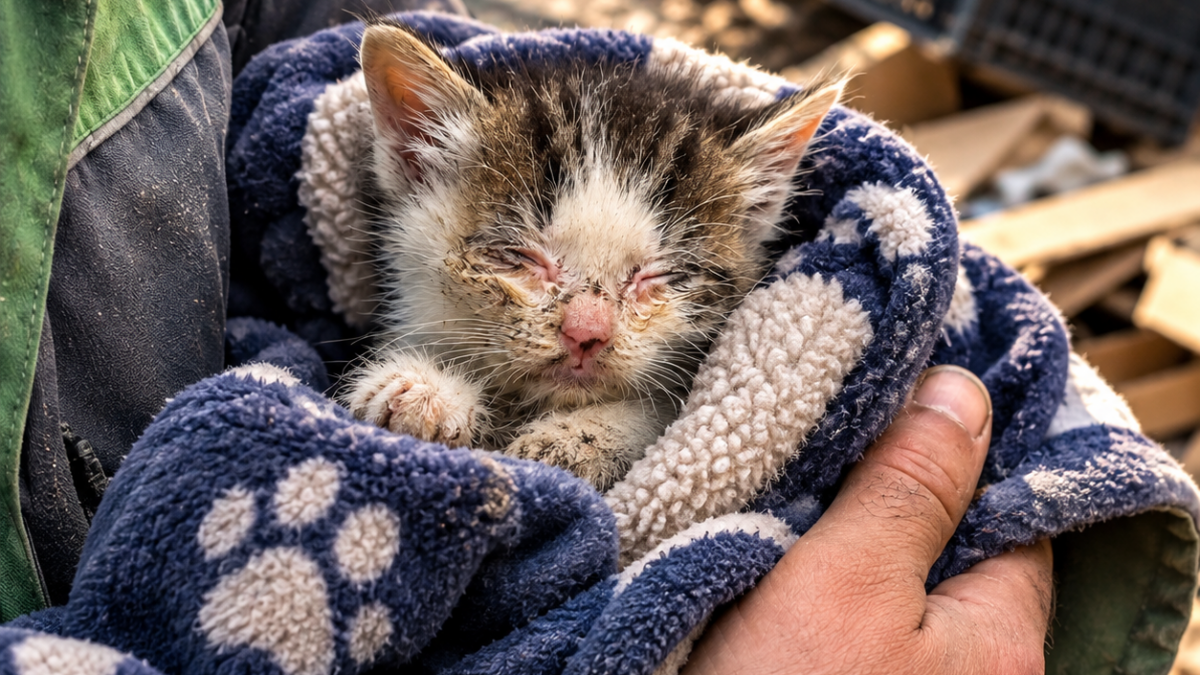
PART 2
His name was Kevin Mills.
He ran a fruit stand three aisles over, and I had known him casually for years.
Not well enough to call a friend.
Well enough that I knew he took his coffee black, hated country music, and complained every winter that the market management never turned the heat up high enough.
That morning, though, he looked like a man who had just seen something he desperately hoped would stay buried.
“Where did you get that?” he asked.
I looked at the collar.
“Under the crate.”
His eyes moved to the kitten inside my jacket.
“Is that…”
He stopped.
“Is that what?”
Kevin stepped closer.
“Oh, God.”
“You know him?”
“Maybe.”
“That’s not an answer.”
Milo shifted weakly against my chest.
Kevin stared at him.
“Milo?”
The kitten’s ears moved again.
That was enough for me.
“You know him.”
Kevin looked over his shoulder toward the empty stalls.
Then back at me.
“Daniel, you need to get him to a vet.”
“I know that.”
“Now.”
“I know.”
He turned as if he intended to walk away.
I caught his sleeve.
“Hold on.”
Kevin looked at my hand.
“Who owns him?”
His jaw tightened.
“I don’t know.”
“You just called him by name.”
“I’ve seen him.”
“Where?”
“Here.”
“At the market?”
“Yes.”
“When?”
He hesitated.
“Around.”
My patience disappeared.
“Kevin, this kitten is barely breathing. His collar was removed and left underneath him. Somebody wrapped him in a market apron and put a crate over him. If you know something, now would be a really good time to stop being vague.”
Kevin glanced toward Stall 18.
The look was brief.
But I saw it.
“Who runs Stall 18?” I asked.
“You know who.”
I did.
Martha Bell.
Bell Family Produce.
She had been selling vegetables in that market for nearly twenty years.
Martha was in her mid-fifties, tall, sharp-eyed, and built like someone who had spent most of her adult life lifting crates before dawn. She had a reputation for being organized, stubborn, and impossible to intimidate.
She also sat on the vendor board.
Half the people in the market liked her.
The other half were afraid of making her angry.
I had never seen her with a cat.
“Martha?” I asked.
Kevin shook his head too quickly.
“I didn’t say that.”
“You looked at her stall.”
“I looked down the lane.”
“No, you didn’t.”
He stepped back.
“Take the kitten to a vet.”
“Did Martha own him?”
“I don’t know.”
“Who does the phone number belong to?”
“I said I don’t know.”
That part I could answer myself.
I dialed.
The phone rang three times.
Then voicemail.
A young woman’s voice.
“Hi, you’ve reached Jenna. Leave a message.”
I looked at Kevin.
“Who’s Jenna?”
His expression changed again.
Not fear this time.
Defeat.
“Martha’s daughter.”
I stared at him.
“You knew.”
“I knew Jenna had a kitten.”
“Named Milo.”
“Yes.”
“And you saw him here.”
“A couple times.”
“How did he get here?”
Kevin lowered his voice.
“Jenna brought him sometimes when she helped her mother close.”
“Where is Jenna now?”
“I don’t know.”
“Call her.”
“I don’t have her number.”
I held up the collar.
“I do.”
I called again.
Still voicemail.
Milo tried to make another sound.
Nothing came out except that terrible little rasp.
That ended the conversation.
Whatever Kevin knew could wait.
I carried Milo to the maintenance office.
Mike Sanders, my supervisor, took one look at him and stopped making jokes.
“Damn.”
“I’m taking the truck.”
“The city truck?”
“Yes.”
“You can’t just take—”
“Then write me up.”
Mike stared at the kitten.
Milo’s head was tucked against my chest, and one little paw had hooked weakly into my sweatshirt.
Mike grabbed the vehicle keys from the wall.
“Take it.”
The nearest emergency animal hospital opened at six, but when I arrived at 5:41 and started pounding on the glass, someone inside took pity on me.
A veterinary technician unlocked the door.
“What happened?”
“I found him outside.”
She reached for Milo.
He barely reacted when she took him.
“Cold exposure?”
“Hours, maybe.”
“Do you know his age?”
“No.”
“Owner?”
“Maybe.”
She looked at me.
“That sounds complicated.”
“It is.”
She disappeared through the treatment doors.
I stood in the lobby holding the soaked red collar and suddenly feeling more useless than I had in years.
At 6:12, a veterinarian came out.
She was small, probably early forties, with dark hair tied behind her head and a calm expression that made me nervous.
“Are you the person who found the kitten?”
“Yes.”
“I’m Dr. Rachel Singh.”
“How is he?”
“He’s extremely weak.”
I nodded.
“What does that mean?”
“Severe dehydration. Hypothermia. Low blood glucose. Upper respiratory infection. Significant eye infection. And he is badly underweight.”
“Can he survive?”
Dr. Singh paused.
“That depends on how he responds over the next several hours.”
“Do whatever you need.”
“We will. Are you assuming financial responsibility?”
That question hit reality hard.
I wasn’t wealthy.
I had a union sanitation job, a mortgage on a small house, a fifteen-year-old pickup truck, and a savings account that existed mainly to repair things that broke.
Emergency veterinary medicine was not in the budget.
I looked through the treatment-room window.
Milo lay inside a heated incubator.
Tiny.
Still.
I pulled out my credit card.
“Yes.”
Dr. Singh studied me.
“You’re not the owner.”
“No.”
“You don’t have to take on—”
“Yes, I do.”
She didn’t argue.
The deposit hurt.
I signed anyway.
Then I sat in the waiting room and stared at the floor.
At 6:38, Jenna called.
“Hello?”
Her voice sounded young.
Early twenties, maybe.
“This is Daniel Harris. I think I found your kitten.”
Silence.
“What?”
“Milo.”
Another silence.
Then I heard something fall on her end.
“Where?”
“I found him behind the old market.”
“What do you mean behind the market?”
“Under an overturned produce basket near your mother’s stall.”
“No.”
The word came instantly.
“No?”
“That can’t be him.”
“He has a red collar with his name and your phone number.”
Her breathing changed.
“Is he alive?”
“Yes.”
“Oh my God.”
“He’s at Riverbend Animal Emergency Clinic.”
“I’m coming.”
She hung up.
Twenty-five minutes later, Jenna Bell ran through the clinic doors wearing sweatpants, sneakers, and a coat thrown over pajamas.
She looked nothing like Martha at first glance.
Smaller.
Softer face.
Dark hair tied badly.
Eyes already red.
“Where is he?”
I stood.
“They’re treating him.”
She saw the collar in my hand.
Her knees nearly buckled.
“That’s his.”
I gave it to her.
She pressed it against her chest.
“I’ve been looking for him.”
“How long?”
“Three days.”
I froze.
“Three days?”
“Yes.”
“Where did he go missing?”
“From my apartment.”
That made no sense.
“Do you live near the market?”
“No. About twenty minutes away.”
I looked toward the treatment room.
“So he didn’t wander here.”
Jenna shook her head.
“No.”
“Who had access to your apartment?”
She stared at me.
Then slowly lowered her eyes.
“My mother.”
There it was.
Not proof.
But a door opening.
“Why would your mother take your kitten?”
Jenna rubbed tears off her face.
“She hates him.”
The answer came too fast.
“You’re saying she stole him?”
“I’m saying she told me for weeks that I shouldn’t keep him.”
“Why?”
“I moved back in with her temporarily over the summer. I found Milo in a parking lot in August. He was maybe five weeks old. I took him to the vet. He had parasites and an eye infection.”
“Same problems?”
“Not this bad.”
“She didn’t want him in the house?”
“She said animals were dirty. She said I was spending money I didn’t have. We argued constantly.”
“When did you move out?”
“Six weeks ago.”
“And Milo went with you.”
“Yes.”
“So why would she still care?”
Jenna looked toward the floor.
“Because she thinks I ruin everything.”
The sentence came out flat.
Like she had said it before.
A lot.
I sat beside her.
For the next ten minutes, the story became less about Milo and more about a mother and daughter who had spent years trying to control each other.
Jenna had started college.
Dropped out.
Gone back.
Changed majors twice.
Left again after her father died.
She had worked at a salon, then a bakery, then the market with her mother.
She had gotten engaged at twenty-one.
Ended it eight months later.
Moved back home.
Run up credit-card debt.
Then found Milo behind a pharmacy and brought him home inside her hoodie.
To Jenna, he was the first thing she had chosen in years without asking Martha whether it was sensible.
To Martha, he became proof that her daughter was still incapable of making responsible decisions.
“She kept saying I couldn’t afford him,” Jenna said.
“Could you?”
Her eyes lifted sharply.
I held up a hand.
“I’m not judging you. I’m asking.”
She exhaled.
“Barely.”
“Vet care?”
“I put the first visit on a credit card.”
“Food?”
“Yes.”
“Rent?”
“I’m paying it.”
“So why did your mother care?”
“Because she always cares.”
Jenna’s voice sharpened.
“She thinks if something might go wrong, she has the right to stop me before it does.”
“Did she have a key to your apartment?”
Jenna closed her eyes.
“Yes.”
“Does she still?”
“I thought so.”
“You thought?”
“I asked for it back. She said she lost it.”
I leaned back.
“Jenna.”
She looked at me.
“You need to call the police.”
Her expression tightened.
“My mother wouldn’t…”
“Wouldn’t what?”
She looked toward the treatment room.
“Leave him like that.”
I didn’t answer.
Not because I agreed.
Because certainty wasn’t mine to give.
At 7:20, Dr. Singh returned.
Milo’s temperature had started rising.
His glucose was responding.
His lungs sounded congested but not yet dangerously compromised.
His eyes were badly infected, but Dr. Singh did not believe he was blind.
“That’s the good news,” she said.
Jenna gripped the edge of her chair.
“And the bad?”
“He’s severely malnourished. That did not happen overnight.”
“How long?” I asked.
“Several days without proper food would be consistent, especially in a kitten this young.”
Jenna covered her mouth.
“He disappeared Tuesday.”
It was Friday.
Dr. Singh looked between us.
“Then that timeline would fit.”
Jenna started crying.
Not quietly.
“I should have changed the lock.”
“Stop,” I said.
She looked at me.
“You don’t know who did this yet.”
“She took him.”
“You don’t know.”
“My mother took him.”
Her voice changed from grief to something sharper.
“She kept telling me I was wasting money on him.”
She stood.
“I’m going to the market.”
I stepped in front of her.
“No.”
“Move.”
“No.”
“That’s my mother.”
“Exactly.”
“You think I’m going to sit here?”
“Yes.”
“Why?”
“Because if you go there angry, you’ll give her an argument instead of giving the police evidence.”
That stopped her.
Barely.
“Who says the police will care?”
“Tell them somebody entered your apartment without permission and took property.”
Her expression twisted.
“He’s not property.”
“I know.”
“But legally?”
“Yes.”
I hated saying it.
She hated hearing it.
But boring legal words sometimes open doors emotional ones can’t.
She called.
Officer Marcus Hill arrived forty minutes later.
He listened.
Asked about the key.
Asked whether anything else had been taken.
Nothing.
Only Milo.
He asked whether Jenna had any messages from Martha.
She did.
Dozens.
Some mundane.
Some angry.
One from the week before Milo vanished stood out.
You cannot keep making emotional decisions and expect everyone else to rescue you from them.
Another:
That cat is another expense you don’t need.
Another:
You are choosing an animal over getting your life together.
Officer Hill read them without reacting.
Then he asked me where I had found Milo.
I described Stall 18.
The crate.
The apron.
The collar.
The wet leaves.
The silence.
Hill photographed the collar and called another officer to meet us at the market.
By then vendors were arriving.
Trucks backing into the loading lane.
Metal shutters lifting.
People yelling over hand trucks.
Martha stood behind Stall 18 arranging tomatoes.
She saw me first.
Then Hill.
Her hands stopped moving.
“Daniel?”
Hill introduced himself.
“I need to ask you a few questions.”
Martha wiped her hands on her apron.
Blue.
Same market logo.
“What about?”
“A kitten found behind your stall.”
Her face did something small.
Too small to call guilt.
But I saw it.
“A kitten?”
“Yes.”
“My daughter has one.”
“Named Milo?”
Martha’s mouth tightened.
“Yes.”
“When did you last see him?”
“Last week.”
Officer Hill watched her.
“Did you visit Jenna’s apartment Tuesday?”
Martha paused.
“Yes.”
“Why?”
“I brought groceries.”
“Did Jenna know you were coming?”
“No.”
“You have a key?”
“I did.”
“Did you enter the apartment?”
“Yes.”
“Was Milo there?”
Martha hesitated.
“I don’t remember.”
That was the first bad lie.
Not because people remember every detail.
Because Milo was the single subject she and Jenna had fought about for weeks.
Hill wrote something down.
“Did you take the kitten?”
“No.”
Her voice hardened.
“No, I did not.”
Then Kevin appeared at the edge of the stall.
He saw me.
Saw Hill.
Stopped.
Martha noticed him too.
Their eyes met.
That was the second bad moment.
Hill noticed.
“Sir?”
Kevin swallowed.
“Yeah?”
“Do you work here?”
“I have a fruit stall.”
“Do you know anything about the kitten?”
“No.”
The lie came too fast.
I stared at him.
Kevin wouldn’t look at me.
The market had cameras.
Old ones.
Cheap ones.
The kind management kept insisting were “good enough.”
But Stall 18 sat beneath two of them.
Officer Hill made a formal request.
The manager resisted for about five minutes until Hill made it clear that “voluntary cooperation” was still an option and probably the easiest one.
By noon, he had the footage.
Jenna and I were at the clinic when he called.
“I want you both to come down.”
“Did you find something?” Jenna asked.
“Come down.”
We drove separately.
At the station, Hill took us into a small interview room and turned a monitor toward us.
“This is Tuesday night.”
Timestamp:
10:37 p.m.
The market was mostly closed.
Martha’s dark minivan pulled into the rear service lane.
Jenna made a sound.
Hill pressed play.
Martha got out.
Walked around the van.
Opened the passenger door.
Then reached inside.
For several seconds, we couldn’t see what she held.
When she turned toward the camera, we could.
A pet carrier.
Jenna stood so fast the chair struck the wall.
“That’s mine.”
Hill paused.
“You recognize it?”
“Blue top. White bottom. Crack in the handle. That’s mine.”
The video continued.
Martha carried it behind Stall 18.
Ten minutes passed.
Then she returned.
Without the carrier.
My stomach tightened.
“What happened behind the stall?” Jenna whispered.
Hill clicked to another camera.
Different angle.
Worse quality.
Still enough.
Martha crouched behind the stall.
Opened the carrier.
Reached inside.
Pulled Milo out.
Even through grainy video, I recognized him.
Tiny.
Moving.
Alive.
She placed him on a piece of blue fabric.
The apron.
Then she removed the red collar.
Jenna started crying.
“No.”
Martha folded the apron partly around him.
Then overturned a green plastic produce basket over him.
She stood.
Looked down.
Picked up the empty carrier.
And walked away.
No panic.
No rush.
No hesitation.
A decision.
Hill stopped the video.
Jenna stared at the frozen image.
“Why?”
No one answered.
Officer Hill said, “We need to speak with your mother again.”
“I want to be there.”
“No.”
“She stole my cat.”
“I know.”
“She left him to die.”
“I understand.”
“No, you don’t.”
Jenna slammed both palms onto the table.
“He trusts people. He sleeps on my neck. He follows me into the bathroom. She knew that.”
Her voice broke.
“She knew exactly what he meant to me.”
Hill waited.
Then said quietly, “And that video isn’t going anywhere.”
That was the first time I saw Jenna understand the difference between pain and evidence.
Pain could be denied.
Evidence had weight.
Martha was questioned again.
This time she changed her story.
She admitted taking Milo.
But she insisted she believed someone at the market would find him quickly.
“He was under shelter,” she said.
That became her phrase.
Under shelter.
The crate.
The awning.
The apron.
Safe enough, in her version.
Then weather records became important.
Temperature dropped to thirty-eight degrees.
Rain.
Wind.
Standing water behind Stall 18.
Dr. Singh documented Milo’s condition.
Hypothermia.
Malnutrition.
Severe infection.
Dehydration.
Martha said Milo had already been sick.
That part was true.
She tried to use the truth to protect the lie.
“He was sick when I took him.”
Exactly.
A sick kitten needed care.
Not abandonment.
That evening, Kevin called me.
“Can you meet?”
“Why?”
“I need to tell you something.”
“Tell Hill.”
“I will.”
“Then why me?”
Silence.
“Because I should’ve helped him.”
We met at a diner across town.
Kevin looked ten years older than he had that morning.
Coffee sat untouched between his hands.
“I saw Martha Tuesday.”
I waited.
“She asked if I knew anyone who wanted a kitten.”
“What did you say?”
“I said no.”
“Then?”
“She said Jenna was being irresponsible.”
“Anything else?”
Kevin rubbed his forehead.
“She said she was going to leave it somewhere somebody would take it.”
“Did she say the market?”
“Not directly.”
“Kevin.”
“She said, ‘Somebody always picks up whatever gets left behind here.’”
The sentence turned my stomach.
Garbage.
Boxes.
Broken crates.
Discarded produce.
Somebody always picks up whatever gets left behind.
She had counted on the same system that might have killed Milo.
“Did you see her leave him?”
“No.”
“Then why were you scared when you saw the collar?”
Kevin stared at the table.
“Because Wednesday morning I saw the basket.”
I froze.
“What?”
“I was opening my stall.”
My voice went quiet.
“And?”
“I heard something.”
“You heard him.”
“I wasn’t sure.”
“You heard him.”
“Yes.”
“What did you do?”
Kevin’s eyes filled.
“I lifted one side of the crate.”
My chair moved backward.
“You saw Milo on Wednesday?”
Kevin nodded.
“What did he look like?”
“Wet.”
“Alive?”
“Yes.”
“Crying?”
“A little.”
My hands curled.
“And you left him.”
“I thought Martha was coming back.”
“You left him.”
“I asked her about it.”
“What did she say?”
“She said Jenna had dumped him there.”
I stared at him.
“And you believed her?”
“I wanted to.”
That answer was worse.
Not ignorance.
Convenience.
“What did you do with the crate?”
Kevin lowered his head.
“I put it back.”
My entire body went rigid.
“You covered him again.”
“Yes.”
“Why?”
“I thought if Martha had put him there—”
“No.”
I pointed at him.
“Do not tell me what Martha did. I’m asking what you did.”
Kevin’s mouth trembled.
“I put it back.”
“Then you went to your stall.”
“Yes.”
“And Wednesday passed.”
“Yes.”
“Thursday.”
“Yes.”
“You never checked him again?”
Kevin covered his face.
“No.”
“Why?”
“Because Martha sits on the vendor board.”
I stared at him.
“What?”
“My lease was almost canceled last year. She fought to keep me in. My stand barely survived the renovation. If I accused her of abandoning an animal and she denied it…”
“So you protected your business.”
He looked at me.
“Yes.”
I sat down slowly.
Not because I forgave him.
Because something inside me had shifted.
Martha had created the danger.
Kevin had discovered it.
Fear made Kevin leave Milo there.
A whole network of ordinary decisions had built the place where that kitten almost died.
“I want you to call Hill.”
“I will.”
“Now.”
Kevin took out his phone.
He called.
His statement destroyed the last version of events Martha tried to preserve.
Milo had not simply been abandoned and accidentally overlooked.
He had been found.
Seen.
Then hidden again.
When Jenna learned, she went very still.
“Someone found him.”
“Yes.”
“He was found Wednesday.”
“Yes.”
“And they put the crate back.”
I didn’t answer.
Her voice sharpened.
“I want them both charged.”
The legal system turned out to be slower and messier than grief wanted.
Martha faced charges connected to unauthorized entry, taking Milo from Jenna’s apartment, and animal cruelty.
Kevin’s situation was different.
He had not stolen Milo.
He had not transported him.
He had not created the original danger.
But he had knowingly left a visibly sick animal where he found him.
His legal exposure was less clear.
His moral failure wasn’t.
The vendor board suspended him while the case was investigated.
Martha was removed from board duties immediately.
Still, none of that mattered to Milo.
For six days, he fought infection.
His eyes had to be cleaned every few hours.
He received IV fluids.
Antibiotics.
Nutrition in tiny controlled amounts.
Warming support.
Nebulizer treatment for his breathing.
On the second day, his temperature dropped again.
Dr. Singh called Jenna at two in the morning.
We both went.
Milo lay inside the incubator, breathing faster than before.
“What happened?” Jenna asked.
“His respiratory infection is progressing.”
“Pneumonia?”
“Possible early pneumonia.”
“Can you treat it?”
“We are.”
“That’s not what I asked.”
Dr. Singh looked at her.
“Yes. We can treat it. But he is still extremely fragile.”
Jenna pressed both hands against the incubator.
“Milo.”
His ears moved.
She whispered, “Come on, baby.”
I stood near the wall.
For the first time since finding him, I wondered if all the evidence and arguments and anger were going to end with a tiny body in a heated box anyway.
At three-thirty, Jenna sat on the floor beside the incubator.
“I should’ve known.”
I looked at her.
“What?”
“My mother.”
“No.”
“I should’ve changed the lock.”
“You asked for the key back.”
“I should’ve changed the lock.”
“You trusted her.”
“That was stupid.”
“That was normal.”
Jenna looked up.
“You don’t know her.”
“No.”
“She’s been like this forever.”
“Like what?”
“Making decisions for me, then saying it’s because she loves me.”
I sat beside her.
Jenna stared at Milo.
“When I was sixteen, I wanted to go to art school. She told me artists don’t make money. She filled out community-college applications for me instead.”
“You went?”
“For one semester.”
“What happened?”
“I hated it.”
She gave a dry laugh.
“She said I was proving her right.”
“What about your father?”
“He stayed out of it.”
“Helpful.”
“He was sick by then.”
The anger in her voice softened.
“He died when I was nineteen.”
“I’m sorry.”
“She got worse after that.”
“More controlling?”
“More afraid.”
That word mattered.
Afraid.
“Of what?”
“Everything.”
Jenna counted on her fingers.
“Debt. Illness. Me moving away. Me dating the wrong person. Me quitting jobs. Me being alone. Me having children too young. Me never having children. Everything.”
“She sounds terrified.”
“She is.”
“Doesn’t excuse this.”
“I know.”
Jenna looked at Milo.
“But sometimes I think she thinks controlling something is the same as preventing disaster.”
We sat there in silence.
Then Milo’s mouth opened.
A little rasp came out.
Jenna froze.
“Did you hear that?”
Dr. Singh, standing nearby, smiled.
“I did.”
Milo tried again.
This time a thin squeak emerged.
Jenna started crying.
“Oh my God.”
Another squeak.
Louder.
She laughed through tears.
“You found your voice.”
Dr. Singh leaned closer.
“That’s a good sign.”
For the first time that night, I breathed.
The next morning, Milo’s oxygen level improved.
By the third day, his eyes opened fully for the first time.
They were blue-gray and still cloudy from infection.
He looked at Jenna.
Then me.
Then screamed.
A rough, ugly little meow.
Dr. Singh laughed.
“That’s more like it.”
Jenna kissed his head.
“He has opinions.”
“Most cats do.”
“He almost died.”
“Most cats still have opinions.”
By day six, Milo could leave the hospital.
The bill was brutal.
Jenna stared at the total.
“I can’t pay this.”
“I already put down the deposit.”
Her head snapped toward me.
“You what?”
“I found him.”
“That doesn’t mean you pay.”
“It means the first part is handled.”
“No.”
“Jenna.”
“No. You don’t know me.”
“I know.”
“You don’t owe me anything.”
“I know.”
“Then why?”
I looked toward Milo.
He was sitting inside the carrier, yelling because a technician had stopped petting him.
“Because I picked up the crate.”
Jenna’s face folded.
“You saved him.”
“No.”
“I mean it.”
“The clinic saved him.”
“You stopped.”
That sentence stayed with me.
I almost didn’t stop.
Thirty seconds later, I might have thrown that basket into the trash cart.
Maybe Milo with it.
I would think about that for years.
Jenna’s apartment had new locks by the time she brought Milo home.
Officer Hill had helped her document the unauthorized entry.
Martha was ordered not to enter Jenna’s residence during the pending case.
Jenna also installed a small indoor camera facing the front door.
“Overkill?” she asked me.
“No.”
She looked at Milo.
“Feels ugly.”
“What?”
“Having to protect my home from my mother.”
I understood that.
Milo adapted quickly.
Within a week, he was climbing onto the couch.
Within two, he was attacking shoelaces.
Within three, he had learned that standing on Jenna’s chest at five in the morning produced breakfast faster than waiting politely.
His voice became stronger.
Too strong.
Jenna sent me videos.
Milo screaming at closed doors.
Milo screaming at the refrigerator.
Milo screaming at a bird through the window.
Milo screaming because Jenna had picked him up.
Milo screaming because Jenna put him down.
The silent kitten beneath the crate became one of the loudest animals I had ever met.
Then the market turned ugly.
Martha had been there almost twenty years.
People took sides.
Some vendors believed the camera footage ended the argument.
Others believed family problems should never have become a public legal matter.
A few people said things they probably regretted later.
“She thought someone would find him.”
“She didn’t beat him.”
“She was trying to teach her daughter a lesson.”
That last one made me furious.
What kind of lesson uses a living thing as leverage?
Kevin became a target too.
Some people thought he was worse because he had physically found Milo and still walked away.
Others defended him.
“Martha could’ve ruined his business.”
“He was scared.”
“He made one bad choice.”
One bad choice.
That phrase got used a lot.
It was true.
The problem is that some single choices last longer than the moment it takes to make them.
One afternoon, I was cleaning near Kevin’s stand when a woman yelled at him.
“You left that kitten to die.”
Kevin kept stacking apples.
“I know what I did.”
“You should be ashamed.”
“I am.”
She seemed almost disappointed he didn’t argue.
He had changed.
Not dramatically.
Quietly.
He stopped attending vendor-board meetings.
Stopped defending himself.
Stopped telling people Martha had confused him.
Then Dr. Singh called me.
“Do you know Kevin Mills?”
“Yes.”
“He came by.”
“Why?”
“He paid part of Milo’s bill.”
I frowned.
“How much?”
“Two hundred dollars.”
“Why?”
“He said he’d keep paying.”
I called him.
“What are you doing?”
He sighed.
“I knew someone would tell you.”
“Why are you paying?”
“Because I left him.”
“That doesn’t undo it.”
“I know.”
“Then what are you trying to buy?”
He went quiet.
“That’s not what I’m doing.”
“What are you doing?”
“Something.”
“That’s vague.”
“Doing nothing is what got me here.”
I had no answer.
He kept paying.
Fifty dollars one month.
A hundred the next.
Twenty-five when business was slow.
He never sent Jenna a message.
Never asked for forgiveness.
Never told people publicly.
He just kept paying.
Martha did the opposite.
She fought everything.
The first hearing was procedural.
The second dealt with conditions while the case moved forward.
The third became the one everyone remembered.
By then Milo was healthy enough that Jenna brought photographs.
Before.
After.
Hospital.
Recovery.
The prosecutor introduced security footage.
Martha’s attorney argued that Martha had acted recklessly but not maliciously.
That distinction mattered legally.
Emotionally, Jenna didn’t care.
Martha sat across the room wearing a navy suit.
No market apron.
No crates.
No tomatoes.
She looked smaller without her stall around her.
The security video played.
Martha carrying the carrier.
Martha removing Milo.
Martha taking off the collar.
Martha placing the basket over him.
The room stayed silent.
Then Kevin testified.
He looked terrified.
Martha stared at him.
“When did you first see the kitten?” the prosecutor asked.
“Wednesday morning.”
“What did you do?”
“I lifted the basket.”
“What did you see?”
“A kitten.”
“Alive?”
“Yes.”
“Did you recognize him?”
“Not at first.”
“When did you recognize him?”
“When I saw the collar Friday.”
“Why did you put the basket back?”
Kevin looked at the floor.
“Because I was afraid.”
“Of what?”
“Losing my stand.”
“How could helping a kitten cost you your stand?”
Kevin swallowed.
“Martha had influence on the vendor board.”
Martha’s attorney objected.
The judge allowed limited explanation.
Kevin continued.
“My lease had been under review. Martha helped keep it active. I thought if I accused her of something and I was wrong, she could make things difficult.”
“Did Martha tell you Jenna had abandoned the kitten?”
“Yes.”
“Did you believe her?”
“No.”
That surprised everyone.
The prosecutor paused.
“You did not believe her?”
“No.”
“Then why did you leave the kitten?”
Kevin’s voice dropped.
“Because believing her would’ve made leaving easier.”
The room went still.
That was the ugliest truth in the entire case.
Not that he had been fooled.
That he had chosen the version that allowed him to do nothing.
Martha’s attorney stood.
“Mr. Mills, you dislike my client now, correct?”
Kevin looked at him.
“I’m afraid of her.”
“Those aren’t the same.”
“No.”
“Did she explicitly threaten your lease if you helped the kitten?”
“No.”
“Did she tell you not to call animal control?”
“No.”
“Did she instruct you to put the crate back?”
“No.”
“So that was your decision.”
Kevin closed his eyes.
“Yes.”
The attorney nodded.
“Your failure, not hers.”
Kevin looked toward Martha.
Then back.
“My failure happened because of fear. Hers happened because she decided the kitten could be used to control her daughter.”
Martha’s lawyer objected again.
The judge struck part of the answer.
But everyone had heard it.
Then Jenna testified.
She described finding Milo.
His first vet visit.
Her arguments with Martha.
The missing key.
The day she discovered him gone.
The three days of searching.
She printed flyers.
Called shelters.
Walked neighborhoods.
Posted online.
She even contacted Martha Tuesday night.
That text appeared on the screen.
Have you seen Milo?
Martha replied:
No. Maybe he got out because you weren’t paying attention.
Jenna’s voice shook as she read it.
The prosecutor asked, “Where was Milo when your mother sent that message?”
Jenna looked at the video still.
“Under her market stall.”
Martha closed her eyes.
That was one of the hardest moments.
Because it showed something worse than abandonment.
She knew Jenna was panicking.
And she let her panic.
Jenna’s attorney? No—this was the prosecutor, not civil. Let’s keep consistent.
The prosecutor continued.
“Did your mother know Milo was sick?”
“Yes.”
“How?”
“She went with me to his first vet visit.”
“Did she know he needed medication?”
“Yes.”
“Did she know he had trouble keeping weight on?”
“Yes.”
“So when she removed him from your apartment, she knew he was medically vulnerable.”
“Yes.”
Martha’s defense tried to frame the act as misguided intervention.
“She believed you could not afford Milo, correct?”
“She said that.”
“Were you struggling financially?”
“Yes.”
“Had you missed a credit-card payment?”
“Yes.”
“Had you borrowed money from your mother?”
“Yes.”
“Did you sometimes need help buying groceries?”
Jenna’s jaw tightened.
“Yes.”
“So your mother had legitimate concerns.”
“About me.”
“About your ability to care for an animal.”
“I paid for Milo’s food and first vet visit.”
“With credit?”
“Yes.”
“Money you didn’t have.”
Jenna stared at him.
Then said quietly:
“Being poor does not give someone else permission to steal what you love.”
The room became silent again.
The defense attorney shifted.
“That wasn’t my question.”
“No. But it’s the answer.”
The judge asked Jenna to respond directly.
She did.
“Yes, I was struggling.”
The attorney sat down.
Martha eventually accepted a negotiated plea rather than risk harsher consequences.
She admitted enough facts to remove the fantasy that she had merely relocated Milo.
She faced fines.
Probationary requirements.
Restitution toward veterinary bills.
Restrictions involving animal ownership.
Mandatory counseling.
The vendor board terminated her stall agreement.
That was the consequence she fought hardest.
Bell Family Produce had operated at that market nearly twenty years.
Her husband had started there with her.
After his death, Martha had run it alone.
The stall wasn’t just a business.
It was identity.
History.
Status.
She appealed the lease termination.
Lost.
The evidence wasn’t only criminal.
The market’s insurance provider had become involved.
Leaving a sick animal behind a stall created liability.
Using market property to conceal it made the board nervous.
The board members who once avoided confronting Martha suddenly became very interested in rules.
Money does that.
Martha blamed Jenna at first.
“You destroyed twenty years of my life.”
Jenna showed me the voicemail.
Her hand shook while it played.
“You could have handled this privately. You could have talked to me. You turned strangers against me.”
Jenna deleted it.
Then blocked her number.
That lasted four months.
Milo continued growing.
At six months, he looked almost unrecognizable.
His coat became glossy.
His eyes cleared, though one remained slightly cloudy.
He had chronic respiratory sensitivity from the infection, so cold weather sometimes made him sneeze.
But otherwise?
Healthy.
And loud.
Extremely loud.
I started visiting him every couple of weeks.
Jenna called me his “garbage uncle.”
I hated the name.
She used it more because I hated it.
One Sunday, I brought Milo a scratching post.
He ignored it and climbed into the cardboard box it came in.
“Perfect.”
Jenna laughed.
“You spent forty dollars on that.”
“I see.”
“He likes the box.”
“I see.”
“Should’ve brought him garbage.”
“Careful.”
She grinned.
Then her face became serious.
“Can I ask you something?”
“Sure.”
“Do you think I did this?”
I frowned.
“What?”
“All of it.”
“No.”
“My mother says if I had my life together, none of this would’ve happened.”
I sat down.
Milo chewed the edge of the cardboard box.
“That’s convenient.”
“What?”
“If the person who makes a bad decision can blame someone else’s imperfections, they never have to look at their own decision.”
Jenna stared at me.
“I was broke.”
“Yes.”
“I moved too often.”
“Yes.”
“I made bad choices.”
“Probably.”
“Thanks.”
“You asked.”
She almost smiled.
I continued.
“None of that put Milo behind Stall 18.”
Her eyes filled.
“No.”
“That part belongs to her.”
It took Jenna a long time to believe that.
Not because Martha had convinced her once.
Because Martha had spent years teaching her to doubt her own judgment.
The kitten case became the first time Jenna held a boundary Martha couldn’t simply talk through.
The market changed too.
After Milo’s case, management added an animal emergency policy.
Any animal found on property had to be reported.
Maintenance received carriers, gloves, blankets, rescue contacts.
A small heated crate was installed in the maintenance office.
Mike complained.
“Why do we need a cat hotel?”
Then the first winter, somebody found an elderly terrier wandering near the loading dock.
The dog spent two hours in the heated crate until animal control arrived.
Mike took photographs and bragged about “our rescue station” like he had invented the thing.
I reminded him he called it a cat hotel.
He denied everything.
Kevin’s stall reopened fully after the board review.
His leadership role did not.
He accepted that.
Some vendors refused to speak to him.
Others did.
His business survived.
The monthly payments to the clinic continued until Milo’s bill was cleared.
When Dr. Singh told Jenna, she sat silent.
“How much did he pay?”
“Almost half.”
Jenna looked at me.
“You paid the deposit.”
“Yes.”
“The rest?”
“I covered some.”
She frowned.
“How much?”
“Enough.”
“Daniel.”
“Don’t.”
“I’m paying you back.”
“No.”
“I’m serious.”
“So am I.”
“I can pay fifty a month.”
“Buy Milo food.”
“That’s not the same.”
“Exactly.”
She stared at me.
“You’re impossible.”
“Probably.”
A few weeks later, an envelope arrived at my house.
No return address.
Inside:
Fifty dollars.
A note:
Buy yourself food. Milo already eats better than you do.
I laughed.
Then put the fifty into a jar.
Every time Jenna sent money, I added it.
A year later, I used that jar to pay adoption fees for three cats at a local rescue during a senior-animal event.
I never told her.
Maybe one day.
The first anniversary of Milo’s rescue arrived on a rainy Friday.
Jenna brought him to the market.
He wore a harness.
He hated the harness.
Everyone heard about it.
The moment Jenna carried him inside, Milo announced his objections to approximately two hundred people.
Mike covered his ears.
“That’s the same cat?”
“Apparently.”
“He was quieter before.”
“He was dying before.”
Mike nodded.
“Good point.”
Milo walked cautiously along the aisle.
Not fearful.
Curious.
He sniffed boxes.
Tried to chew plastic wrap.
Attempted to climb a pumpkin display.
Then Jenna carried him toward Stall 18.
The stall belonged to someone else now.
A young couple selling flowers, jams, and seasonal produce.
Milo sniffed the floor.
No reaction.
No recognition.
Maybe he remembered.
Maybe he didn’t.
Animals don’t tell us how memory works.
Jenna held him against her chest.
“You okay?”
Milo bit the zipper on her jacket.
She laughed.
I stood a few feet away and looked at the spot where I had found him.
For months, that place had felt contaminated.
Wet leaves.
Cold concrete.
Tiny paw.
Silent mouth.
Now sunlight came through the skylights.
Children carried cider.
Someone played acoustic guitar near the entrance.
Life had covered the scene without erasing it.
Then Kevin appeared.
He stopped several feet away.
Jenna stiffened.
Kevin looked at Milo.
Then at her.
“I can leave.”
Jenna glanced at me.
I stayed out of it.
“No,” she said.
Kevin nodded.
“I wanted to say—”
“Don’t apologize again.”
His mouth closed.
“If you apologize again, I’m going to get angry.”
“I understand.”
“No. Just listen.”
He did.
“You should have picked him up.”
“I know.”
“You should have called somebody.”
“I know.”
“You should never have put that crate back.”
His face tightened.
“I know.”
Jenna stared at him.
Then said, “But you told the truth later.”
“Too late.”
“Yes.”
Kevin nodded.
“I know.”
Jenna adjusted Milo.
“I also know you paid the clinic.”
Kevin glanced at me.
I shrugged.
Jenna continued.
“You didn’t have to.”
“Yes, I did.”
“No.”
Kevin looked at her.
“Yes.”
She waited.
He added, “Not legally.”
That mattered.
Jenna nodded once.
“Thank you.”
Kevin’s eyes filled.
He nodded.
Then walked away.
Milo meowed loudly.
Jenna looked down.
“Yes, you’re brave.”
Another scream.
I laughed.
“He wasn’t always that loud.”
“I know.”
Martha’s relationship with Jenna became more complicated than anyone expected.
For months, they had almost no contact.
Then Martha wrote a letter.
Not a voicemail.
Not a text.
A handwritten letter.
Jenna didn’t open it for three days.
When she finally did, she called me.
“Can you come over?”
I found her sitting at the kitchen table.
Milo slept on the back of the couch.
The letter lay folded between her hands.
“What does it say?”
“She wants to apologize.”
“That bad?”
Jenna almost smiled.
“She says she started counseling.”
“Good.”
“She says she understands now that she used fear as an excuse to control me.”
“That sounds specific.”
“She says the therapist made her list every decision she made for me without asking.”
“How long was the list?”
Jenna looked at me.
“Seven pages.”
I whistled.
“She wants mediation.”
“Do you?”
“I don’t know.”
“Then don’t decide today.”
“She’s still my mother.”
“I know.”
“I miss her.”
“That doesn’t mean you trust her.”
Jenna looked at the letter.
“I hate that I miss her.”
“You’re allowed to.”
“She almost killed Milo.”
“Yes.”
“How do both things exist?”
I thought about it.
“People can love someone and still need protection from them.”
Jenna was quiet.
Milo woke.
Jumped down.
Walked across the table.
Sat directly on Martha’s letter.
Jenna laughed.
“Apparently he has an opinion.”
“He has an opinion about all paper.”
Three months later, Jenna agreed to mediation.
Not reconciliation.
Mediation.
The first session went badly.
Martha kept explaining.
“I was trying to help.”
“I thought you were spiraling.”
“I believed someone would find him.”
“I never wanted him to die.”
Jenna came home furious.
“She still thinks intention is the whole story.”
“It isn’t.”
“I told her if she says ‘I was trying to help’ one more time, I’m leaving.”
“Reasonable.”
The second session was worse.
The third changed something.
The therapist apparently asked Martha one question:
“If Jenna had done exactly what you did to something you loved, would your fear excuse it?”
Martha couldn’t answer.
The silence lasted almost a minute.
Then she said:
“No.”
Jenna told me that was the first real apology.
Not because Martha cried.
She had cried before.
Not because she said sorry.
She had said that too.
Because this time she stopped explaining.
“I took Milo because I believed my judgment mattered more than yours.”
Jenna asked:
“Yes or no?”
Martha said:
“Yes.”
“You knew I would say no if you asked.”
“Yes.”
“You knew I was looking for him.”
“Yes.”
“You lied when I asked whether you’d seen him.”
“Yes.”
“You left him outside knowing he was sick.”
Martha started crying.
“Yes.”
No “but.”
No “because.”
Just yes.
That didn’t fix everything.
But truth without self-defense gave them somewhere to stand.
They began talking occasionally.
Never alone at first.
Then short lunches.
Then phone calls.
Martha was never given another key to Jenna’s apartment.
She was never allowed to make veterinary decisions for Milo.
She never handled Jenna’s finances again.
Boundaries became physical because words had once failed.
One day, almost two years after the rescue, Martha asked to see Milo.
Jenna called me first.
“What do you think?”
“Why are you asking me?”
“You found him.”
“He’s your cat.”
“What would you do?”
I pictured Martha lifting Milo from the carrier.
Removing the red collar.
Putting the crate over him.
Then I pictured her losing her business.
Sitting in therapy.
Admitting what she did.
Consequences matter.
Change matters too.
“I’d let you decide.”
“That’s useless.”
“Welcome to adulthood.”
She swore at me.
Then invited Martha.
The visit happened in Jenna’s apartment.
I wasn’t there.
Later she told me what happened.
Martha stood inside the doorway and cried the moment she saw Milo.
Milo?
He smelled her shoes.
Then walked away.
That was it.
No dramatic recognition.
No hiss.
No revenge.
No forgiveness scene.
Just a cat who had moved on faster than the humans.
Martha sat on the sofa.
Milo eventually climbed beside her because she had treats.
“He doesn’t remember,” Martha whispered.
Jenna said, “Maybe that’s lucky.”
Martha looked at her.
“For him.”
That sentence stayed with Jenna.
Three years after the rescue, I was promoted to lead sanitation supervisor.
Less lifting.
More paperwork.
My knees approved.
I still walked the market early most mornings.
Old habits.
One rainy October morning, I saw an overturned green produce crate beside a wall.
My body stopped automatically.
Same shape.
Same angle.
For a second, I was back there.
Wet leaves.
Cold concrete.
Tiny paw.
I crossed the lane fast and lifted it.
Nothing underneath.
Just water.
I stood there longer than necessary.
Then someone behind me said:
“You still check every one?”
Jenna.
I turned.
She held Milo in a carrier.
He was three now.
Huge.
Fifteen pounds of black-and-white attitude.
“Apparently.”
“You know what happened because you checked.”
“I almost didn’t.”
“But you did.”
That distinction had always bothered me.
Almost.
Thirty seconds.
A different step.
A different angle.
A louder truck.
Milo might have gone into the trash cart.
Years later, I mentioned that fear to Dr. Singh during one of Milo’s checkups.
“You keep focusing on the thirty seconds you almost lost,” she said.
“What else should I focus on?”
“The second you stopped.”
I thought about that for a long time.
People like dramatic rescues because they make us imagine bravery.
Running into fire.
Diving into water.
Facing danger.
Milo’s rescue was less impressive.
I stopped.
Looked twice.
Lifted plastic.
Sometimes that’s the whole difference.
The market’s emergency-animal program grew.
Management partnered with a local rescue.
Twice a year, volunteers held adoption events in the central hall.
Spay and neuter vouchers were available.
Vendors started keeping small bowls of water during summer.
One old butcher complained that the place was becoming a zoo.
Then he adopted a senior tabby from the second event.
Nobody let him forget it.
Kevin volunteered quietly at those events.
At first, some rescue volunteers didn’t know his history.
Then someone told them.
I expected him to stop coming.
He didn’t.
He cleaned cages.
Carried bags of litter.
Directed families.
Never told anyone his story unless asked.
One Saturday, I saw him sitting beside a frightened orange cat who refused to come out of the back of a carrier.
Kevin sat on the floor for forty minutes.
No reaching.
No forcing.
Just waiting.
I stood nearby.
“You okay?”
He looked at the cat.
“Yeah.”
Then he said, “I keep thinking about Wednesday.”
I knew what he meant.
“You can’t change Wednesday.”
“No.”
The orange cat finally moved closer to the door.
Kevin smiled.
“But I can be different on Saturday.”
That was about as good as remorse gets.
Martha never returned as a vendor.
She eventually started bookkeeping for a landscaping company.
According to Jenna, she was good at it.
Numbers.
Schedules.
Order.
Things that stayed where she put them.
Their relationship remained cautious.
Realistic.
No magical repair.
Some weeks they spoke.
Some weeks they didn’t.
One Christmas, Martha came to Jenna’s apartment for dinner.
I was invited too, which felt strange.
Kevin was not.
That would have been too much.
Milo wore a red bow tie for approximately forty-seven seconds before ripping it off.
Martha brought him a toy.
Jenna watched carefully.
Martha placed it on the floor.
Did not try to pick him up.
Did not tell Jenna what food he should eat.
Did not comment on veterinary costs.
Small things.
Huge things.
At dinner, Martha asked me:
“Do you hate me?”
The question came without warning.
Jenna froze.
I put down my fork.
“No.”
Martha looked surprised.
“I did.”
“When?”
“The week I found him.”
“Fair.”
“I wanted your stall taken. Your reputation destroyed. Everything.”
She looked at me.
“And now?”
“Now I think you did something terrible.”
“That isn’t the same answer.”
“No.”
“Do you think I’m terrible?”
I looked toward Milo.
He was under the table attacking my shoelace.
“I think people would prefer if the worst thing they ever did explained them completely.”
Martha waited.
“But it doesn’t.”
Her eyes filled.
“That sounds forgiving.”
“It isn’t.”
I leaned back.
“What you did stays true. So does what you do after.”
She nodded slowly.
Jenna said nothing.
Later, while washing dishes, she asked:
“Did you mean that?”
“Yes.”
“You really don’t hate her?”
“No.”
“I do sometimes.”
“You’re allowed.”
“She’s better now.”
“You’re still allowed.”
That mattered to Jenna.
Improvement does not erase injury.
Forgiveness is not a deadline.
Milo turned five last fall.
Jenna held a birthday party.
Yes.
A birthday party for a cat.
I complained for two weeks.
Then arrived with an expensive toy and a bag of freeze-dried chicken.
Dr. Singh came.
Mike came.
Jenna’s boyfriend Ethan came.
Martha came.
Kevin sent a gift but stayed away.
That boundary had become permanent.
His card read:
For the loudest cat I ever failed to hear properly.
Jenna stared at it.
Said nothing.
Placed it beside the other cards.
Milo spent most of the party inside a cardboard box instead of playing with any gift.
At one point, I sat on the floor.
He climbed into my lap.
Five years earlier, his entire body had fit between my hands.
Now he covered both legs.
“You remember me?”
He bit my sleeve.
“That’s touching.”
Jenna laughed.
Then Milo opened his mouth.
“MRRRAAAAAOW.”
Everyone turned.
I stared at him.
“You really overcorrected.”
Another scream.
Louder.
People laughed.
I didn’t.
Not immediately.
Because beneath that ridiculous sound, I still remembered the silence.
That tiny mouth opening beneath wet plastic.
Nothing coming out.
No strength left to ask for help.
I put my hand on his back.
Warm.
Solid.
Alive.
“Yeah,” I whispered. “I hear you.”
That same year, Jenna got married.
Not to the fiancé she had left years earlier.
To Ethan.
A patient elementary-school teacher who adored Milo despite Milo repeatedly stealing his socks.
Martha attended.
So did I.
Milo did not.
Jenna said he would scream through the ceremony.
She was correct.
Before walking down the aisle, Jenna handed me a small object.
The red collar.
Milo’s original collar.
“I kept it.”
I turned it over.
The plastic tag was scratched.
MILO.
Phone number.
“You want me to hold this?”
“Just until after.”
“Why?”
She looked toward the doorway where Martha was waiting.
“Because this is where everything started.”
“No.”
She frowned.
“What?”
“It started before that.”
“With my mother?”
“No.”
“With Milo?”
“No.”
She stared at me.
I tapped the tag.
“It started when you gave him a name.”
Her eyes filled instantly.
“Oh, great.”
“What?”
“I paid a makeup artist.”
“Sorry.”
She laughed.
Then walked down the aisle.
After the wedding, she framed the collar.
Not as trauma.
As history.
It hung near a photograph of Milo sleeping on Ethan’s chest.
One object from when he almost died.
One image from the ordinary life afterward.
That pairing felt right.
Ordinary life became the real victory.
Milo developed one chronic problem.
Cold weather irritated his lungs.
Every winter, Jenna watched for coughing.
Dr. Singh prescribed medication when needed.
One December night, Milo had a bad episode.
Jenna called me at 2:00 a.m.
“He’s breathing weird.”
I was in my truck before she finished speaking.
At the emergency clinic, old fear returned.
Incubator.
Oxygen.
Waiting.
Not as severe as before.
Still enough to break open memory.
Jenna paced.
“I can’t do this again.”
“You are doing it.”
“No. I mean losing him.”
“He’s not dying.”
“You don’t know that.”
“No.”
She stopped.
“I hate that answer.”
“I know.”
Milo recovered after treatment.
Asthma-like inflammation.
Manageable.
When Jenna carried him out the next morning, he screamed at the carrier door.
I laughed.
“What?”
“Nothing.”
Five years earlier, I had begged for one sound.
Now that sound could still fill a hospital lobby.
By then, my own life had changed too.
For years I had lived alone.
Divorced.
No children at home.
My daughter lived in Denver.
We spoke, but not enough.
Finding Milo had made me realize how narrow my days had become.
Work.
Home.
Television.
Sleep.
Repeat.
I started volunteering at the rescue twice a month.
Not because I became some animal saint.
I still hated cleaning litter boxes.
I still preferred dogs that didn’t bark constantly.
But the work gave shape to Saturdays.
I became especially useful with frightened animals.
Maybe because I knew not to demand gratitude.
One cat hid from me for six weeks.
The first time she took food from my hand, I texted Jenna:
Your species is ridiculous.
She replied:
You’re obsessed now.
She was right.
I adopted a senior orange cat named Gus when he was eleven.
Mike laughed for a month.
“You, with a cat.”
“Shut up.”
“Does he scream?”
“No.”
“Disappointing.”
Gus slept on my couch.
Hated everyone except me.
Milo hated Gus.
The feeling was mutual.
We tried introductions twice.
The second ended with Milo screaming from behind a baby gate while Gus stared at him with the expression of a retired man annoyed by neighborhood children.
We stopped trying.
Not every relationship needs repair.
The legal and family drama around Milo eventually faded.
That surprised me.
For almost a year, it had dominated everything.
Then life kept moving.
Martha’s probation ended.
Kevin finished paying the clinic.
Jenna stopped checking her door camera every hour.
The market replaced its old security system.
People stopped whispering when Martha’s name came up.
New vendors joined who knew nothing about Stall 18.
That is what time does.
It turns crisis into history.
But history still shapes behavior.
One summer, a teenage employee found a litter of kittens behind a freezer unit.
He didn’t touch them immediately.
He called me.
“Daniel, there are babies.”
I went over.
Healthy.
Warm.
Mother nearby.
We contacted rescue.
Set up safe monitoring.
Waited.
No panic.
No dumping.
No guessing.
The kittens and mother were trapped safely, fostered, treated, adopted.
The teenage employee asked:
“How did you know what to do?”
I almost said experience.
Instead:
“I learned what not to do.”
He didn’t understand.
That was fine.
One autumn morning, five years and eleven months after Milo, I was making my usual first round when I heard a sound beneath a pallet.
Meow.
I stopped.
Different sound.
Strong.
Annoyed.
I crouched.
A tabby cat stared at me.
Adult.
Healthy.
Probably shelter escapee or neighborhood wanderer.
I laughed.
“Seriously?”
The cat meowed.
“Fine.”
I checked for a collar.
None.
Scanned later.
Microchip.
Owner located.
Gone six hours.
Returned same afternoon.
No drama.
No police.
No court.
No destroyed family.
Just a cat that got out.
That mattered too.
Not every story had to become Milo.
I had spent years seeing danger in overturned crates.
Sometimes a crate is just a crate.
Sometimes a missing animal is just lost.
Sometimes fear teaches vigilance.
Sometimes it teaches suspicion.
Knowing the difference takes practice.
Martha learned that too.
Jenna told me one afternoon they had an argument.
Not about Milo.
About money.
Jenna and Ethan wanted to buy a house.
Martha thought the mortgage was too high.
Old pattern.
Martha started:
“You need to—”
Then stopped.
Jenna waited.
Martha took a breath.
“What do you want from me?”
Jenna almost cried.
Not because of the mortgage.
Because that question had never existed in their relationship.
People imagine change as a dramatic apology.
Sometimes change is one sentence arriving years late.
Kevin changed in quieter ways.
One winter, his stall burned after an electrical fault.
Not destroyed completely.
Bad enough.
For three months he couldn’t operate normally.
The vendor board organized temporary space.
Guess who chaired the relief effort?
A new florist named Ava.
She asked me whether Kevin deserved special help given what had happened years earlier.
I said:
“Help the business because the fire happened now.”
She looked at me.
“That simple?”
“No.”
“But?”
“If consequences never end, they stop being consequences and become identity.”
Kevin received temporary space.
Rebuilt.
Never reclaimed his board position.
Didn’t ask.
One afternoon he told me:
“I thought losing the board seat was the punishment.”
“And?”
“It wasn’t.”
“What was?”
He looked toward the market aisle.
“Knowing I had a choice.”
That was the real punishment.
Not a fine.
Not public shame.
Memory of the moment before action.
The exact second when you could have done something different.
I knew that feeling too.
My version was kinder.
The second my boot touched the plastic crate.
I could have kept moving.
I didn’t.
One decision saved Milo.
One decision almost killed him.
One decision abandoned him.
One decision hid him again.
One decision told the truth.
One decision changed a lock.
One decision accepted responsibility.
Lives often turn on smaller hinges than we admit.
Six years after I found Milo, Jenna called.
“Can you come to the market?”
“What happened?”
“Nothing bad.”
“Then why do you sound weird?”
“Just come.”
It was October.
Cold morning.
Rain the night before.
Exactly the kind of weather that always brought memory back.
When I arrived, a small group stood near Stall 18.
Mike.
Jenna.
Ethan.
Dr. Singh.
Several rescue volunteers.
Even Martha.
Kevin stood at the back.
That surprised me.
“What is this?”
Jenna pointed.
A small brass plaque had been mounted on the wall beside the service lane.
I stepped closer.
It read:
MILO’S CORNER
For every animal that needs someone to stop, look twice, and care.
Below it was a list of emergency rescue numbers.
I stared at it.
“No.”
Jenna laughed.
“What?”
“This is too much.”
“You hate it.”
“Yes.”
“You’re crying.”
“I’m not.”
Mike handed me a tissue.
“Rain.”
“We’re indoors.”
“Roof leak.”
I used the tissue anyway.
Beside the plaque stood a large insulated animal emergency cabinet.
Blankets.
Gloves.
Carriers.
Heat packs.
Microchip scanner.
Food.
Rescue contacts.
Funded by vendors, management, and donations.
Including one large anonymous donation.
I looked at Jenna.
“Who?”
She glanced toward Martha.
Martha looked away.
I understood.
Kevin had donated too.
Not anonymously.
Of course not.
He had learned hiding wasn’t always noble.
Jenna opened Milo’s carrier.
Milo stepped out wearing a harness.
He immediately screamed.
Everyone laughed.
Martha covered her mouth.
Kevin looked down.
Dr. Singh smiled.
I crouched.
“Come here, trouble.”
Milo walked toward me.
Six years old.
Broad.
Healthy.
Slight cloudiness in one eye.
A little wheeze when winter got bad.
Otherwise magnificent.
He rubbed against my knee.
I scratched his head.
“Remember this place?”
He tried to eat a piece of cardboard.
“Excellent.”
Jenna crouched beside me.
“You know, the first time you found him, he couldn’t make a sound.”
“I remember.”
Milo opened his mouth.
A howl echoed through the service lane.
Mike laughed.
“So much for that.”
We stayed until the market opened.
Vendors passed.
People asked about the plaque.
Jenna told the short version.
Not the ugly version.
Found kitten.
Almost died.
Recovered.
Inspired new emergency procedures.
That was enough for strangers.
Not every truth needs every detail.
Before leaving, Kevin approached Jenna.
She looked at him.
He gestured toward Milo.
“Can I?”
For a second, she didn’t understand.
Then she held out the leash.
Kevin crouched.
Milo sniffed his hand.
Kevin did not touch him immediately.
Waited.
Milo stepped closer.
Then head-butted his palm.
Kevin’s face folded.
I looked away.
Not because it was forgiveness.
It wasn’t.
Milo had no courtroom.
No vendor board.
No moral ledger.
He had smell.
Warmth.
Tone.
Current behavior.
Kevin scratched under his chin.
“You’re loud.”
Milo screamed.
Kevin laughed and cried at the same time.
Jenna watched.
Then quietly said:
“He doesn’t know what you did.”
Kevin nodded.
“I do.”
That was enough.
Martha stood farther away.
She did not ask to hold Milo.
That was part of her change.
Knowing that love does not create entitlement.
On the drive home, rain began.
Light at first.
Then harder.
The same smell filled the streets.
Wet leaves.
Cold pavement.
Autumn.
For years, rain had taken me directly back to that morning.
The crate.
The little paw.
The mouth opening without sound.
That day, the memory felt different.
I remembered Milo screaming beneath the market roof.
Warm.
Heavy.
Alive.
I went home to Gus.
He was waiting beside the food bowl pretending starvation despite having eaten two hours earlier.
“You cats are all liars.”
Gus meowed.
I fed him anyway.
That night, Jenna sent me a photograph.
Milo asleep on a blanket.
No harness.
No market.
No drama.
Just a cat.
Caption:
He slept the entire ride home. Hero work is exhausting.
I saved it.
Then scrolled backward through years of Milo photos.
Hospital.
Tiny.
Eyes crusted.
Jenna holding him.
First day home.
First Christmas.
First birthday.
Harness.
Wedding photos.
Window naps.
Ethan asleep with Milo on his chest.
Milo beside a baby crib.
That one stopped me.
Jenna and Ethan had a daughter the year before.
Sophie.
Milo loved the baby.
Or tolerated her.
Hard to tell.
There was a photograph of Sophie lying on a blanket while Milo sat beside her, staring suspiciously at the camera.
I thought about Martha.
Years earlier, she had tried to remove Milo because she believed he represented Jenna’s inability to build a stable life.
Now Milo lived in a house with Jenna.
Ethan.
Sophie.
Bills.
Mortgage.
Jobs.
Mess.
Normal adult chaos.
Martha had been wrong about what stability looked like.
She thought stability meant preventing bad choices.
Jenna learned it meant surviving choices, correcting them, asking for help, and keeping responsibility where it belonged.
Milo had been part of that lesson.
Not because he fixed anyone.
Animals don’t exist to repair human families.
He simply survived long enough for everyone else to be forced into honesty.
A month after the plaque ceremony, Martha asked me to coffee.
That was new.
We met in a small diner.
She looked older than when the case began.
So did I.
“Why did you want to meet?” I asked.
“I wanted to tell you something.”
“That phrase usually causes problems.”
She smiled faintly.
“I know.”
She stirred coffee.
“For years I hated you.”
“Understandable.”
“You were the person who found him.”
“I know.”
“If you had not found him…”
She stopped.
I waited.
“I could have kept lying to myself.”
That sounded familiar.
Kelly from another story? No, must not reference. But it’s a common theme. We can continue.
“What lie?”
“That someone would find him quickly.”
I said nothing.
“You did find him.”
“Yes.”
“But not quickly enough to make what I did harmless.”
“No.”
She nodded.
“I used to think consequences were things other people did to you.”
I leaned back.
“And now?”
“Sometimes consequence is finding out what kind of person you were in one moment.”
I looked at her.
“That sounds painful.”
“It is.”
“Good.”
She laughed unexpectedly.
“Still not forgiving.”
“No.”
“I don’t need you to.”
“That’s healthier.”
She reached into her purse.
Pulled out a folded paper.
“I’m leaving Pittsburgh.”
“Where?”
“North Carolina. My sister lives there.”
“Jenna know?”
“Yes.”
“She okay?”
“I think so.”
Martha looked down.
“I’m not asking you to watch over her.”
“Good.”
“I would have, once.”
“I know.”
“I’m learning.”
Before leaving, she said:
“Thank you for stopping.”
I wanted to dismiss it.
Say anyone would have.
But Kevin had shown me that wasn’t true.
Martha had shown me that wasn’t true.
I simply said:
“You’re welcome.”
A year later, Milo turned seven.
No giant party this time.
Sophie was a toddler and had taken over the family birthday budget.
Jenna sent me a video.
Sophie sitting on the floor.
Milo beside her.
She pointed to him.
“Mi-wo.”
Milo meowed.
Sophie laughed.
Again.
“Mi-wo!”
Meow.
Back and forth.
I watched it five times.
Then sent Jenna:
He finally found someone as loud as he is.
She replied:
Pray for us.
The market plaque weathered.
People touched it.
Some ignored it.
New vendors came.
Old vendors left.
Stall 18 changed hands twice.
The emergency cabinet was used seventeen times in the first three years.
Lost dogs.
Injured pigeons.
Three cats.
One rabbit somebody inexplicably found near a bakery stall.
Every time someone opened it, I thought about the green crate.
Not with dread anymore.
With gratitude for the existence of a better option.
The best legacy of a bad event is not the story people tell.
It’s the system they build so the same failure becomes harder to repeat.
Eight years after I found Milo, I retired.
Sixty-seven.
Bad knees.
Good pension.
Mike had retired before me and came back to mock my farewell cake.
The market staff gave me a framed photograph.
Not of me.
Of Milo.
Naturally.
In the photo, he sat beneath the MILO’S CORNER plaque looking bored.
Underneath, someone had engraved:
LOOK TWICE.
I pretended to hate it.
I hung it in my living room.
Jenna came to the retirement party with Ethan and Sophie.
Milo stayed home.
“Too much noise,” Jenna said.
I stared at her.
“The cat is too sensitive to noise?”
“He’s older.”
That hit me.
Milo was nine.
Not old-old.
But no longer the kitten in my head.
His respiratory problems needed more monitoring.
He had gained too much weight.
Dr. Singh put him on a diet.
Milo treated this as a human-rights violation.
I visited him a week after retirement.
He walked slower.
Still loud.
Still climbed into cardboard boxes.
Still remembered me.
Or at least remembered I carried treats.
I sat on the floor.
He climbed into my lap.
Heavy.
Warm.
I ran one hand over his back.
“You’re getting old.”
Milo bit my finger.
“Fair.”
Jenna sat across from me.
“You ever think about what would have happened if you hadn’t heard him?”
“No.”
She looked surprised.
“You used to.”
“I stopped.”
“Why?”
“Because it didn’t happen.”
She smiled.
“That sounds simple.”
“It took eight years.”
Milo purred.
A deep, rough sound.
Different from his meow.
I remembered that first silent mouth.
The inability to ask for help.
Now he didn’t need to ask.
He had a home arranged around his needs.
Medication on the counter.
Food measured.
Vet appointments scheduled.
A little girl who knew to approach gently.
Adults who listened when he breathed differently.
Ordinary care.
Nothing viral about it.
That was the point.
When people tell rescue stories, they usually stop too early.
They stop at survival.
The dramatic photograph.
The first meal.
The first purr.
But rescue is mostly what happens afterward.
Years of buying food.
Cleaning vomit.
Paying bills.
Going to appointments.
Changing plans.
Waking at two in the morning because breathing sounds wrong.
Saying no to vacation because medication schedules don’t cooperate.
Love becomes routine.
Routine becomes safety.
Safety becomes life.
Milo got that life.
So did Jenna.
So, in quieter ways, did Kevin.
Even Martha found a path that did not erase what she did but stopped it from defining every day afterward.
And I?
I learned to look twice.
That sounds small.
It isn’t.
One winter afternoon after retirement, I visited the market as a customer for the first time in decades.
No uniform.
No keys.
No radio.
Nobody expecting me to haul anything.
It felt wrong.
I walked to Stall 18.
Bought apples.
Then stopped at Milo’s Corner.
The emergency cabinet was scratched.
Used.
Real.
A young employee was restocking blankets.
“You Daniel?”
I frowned.
“Yes.”
He pointed to the photograph on the plaque.
“People told me you found the cat.”
“Long time ago.”
“He still alive?”
“Yes.”
“Cool.”
That was all.
Cool.
I laughed.
History gets simple when it belongs to someone else.
I went outside.
Cold rain started.
Of course.
I stood beneath the awning.
My phone buzzed.
Video from Jenna.
Milo was sitting on the kitchen counter.
Sophie, now six, stood beside him holding an empty food bowl.
She said:
“Mom says dinner is in twenty minutes.”
Milo screamed.
Sophie looked into the camera.
“He disagrees.”
Another scream.
I laughed so loudly the employee inside glanced toward me.
Eight years earlier, Milo could not make enough sound to save himself.
Now his complaint echoed from my phone speaker into the same market service lane where I had once found him beneath plastic and wet cloth.
I played the video again.
Not because I needed to remember.
Because I liked the sound.
Loud.
Annoying.
Alive.
I looked at the brass plaque one last time.
LOOK TWICE.
Then I slipped my phone into my pocket and walked into the rain.
Behind me, the market stayed open.
People moved through aisles.
Boxes stacked.
Crates shifted.
Someone laughed.
Someone argued over prices.
Someone dropped a bag of onions.
Life.
Ordinary, messy, noisy life.
And somewhere across town, a black-and-white cat with one cloudy eye and the loudest voice I had ever heard was probably screaming because dinner was late.
That was enough.
More than enough.
[END OF STORY]








