PART 2: The HOA Tried to Steal My Private Airport—Then Federal Authorities Showed Them Who Really Owned the Runway
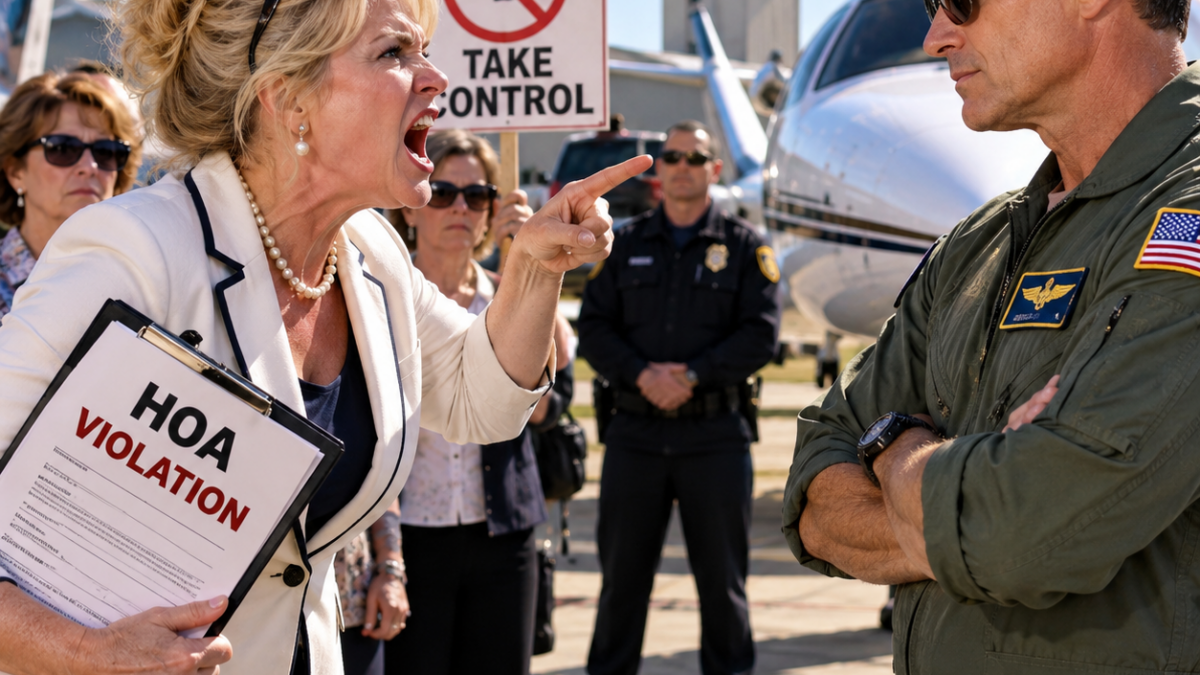
PART 2
Two weeks after Patricia made her offer, I drove onto the property just after seven in the morning and noticed something pink moving in the grass.
At first, I thought it was trash.
Then I saw another one.
And another.
Survey stakes.
Someone had driven them into the ground along the eastern approach to my runway.
I parked my truck beside the first stake and stepped out.
A thin pink ribbon snapped in the wind.
About sixty yards ahead of me, three men in reflective vests were carrying equipment toward the fence.
“Morning,” I called.
One of them raised a hand.
“Morning.”
“Who authorized this?”
The man looked down at his clipboard.
“Sunrise Meadows.”
I almost laughed.
“You’re standing on Calloway Field.”
He glanced at the other two workers.
“Yeah.”
“Sunrise Meadows doesn’t own Calloway Field.”
His expression changed immediately.
Nobody likes discovering halfway through a survey that the person paying them may not own the property.
He turned the clipboard toward me.
“We were given a site plan.”
I looked at it.
Patricia’s proposed walking trail ran in a curved line directly through my runway protection zone.
“You need to stop.”
“Sir, we were contracted—”
“I understand. I’m not blaming you. But you are on private property without my permission, and you’re marking land for a project I already rejected.”
The three men exchanged glances.
The supervisor finally sighed.
“We’ll call the client.”
“Good.”
I pulled the first stake out of the ground.
Then the second.
By the time the crew had packed up, I had a bundle of pink-ribboned stakes in the back of my pickup.
I drove them straight to the entrance of Sunrise Meadows, stacked them beside the decorative stone sign, and went back to work.
I thought the message was clear.
Patricia apparently thought it was an act of war.
The next morning, a sheet of paper was taped to my hangar door.
At the top, in bold capital letters, it read:
**EMERGENCY RESOLUTION — SUNRISE MEADOWS HOMEOWNERS ASSOCIATION**
Below that was a list of accusations.
Excessive noise.
Dangerous low-altitude operations.
Public nuisance.
Unapproved commercial activity.
Risk to residents.
Then came the sentence that made me laugh out loud.
**All aviation operations at Calloway Field are hereby suspended pending community safety review.**
At the bottom, another line threatened me with a five-thousand-dollar fine for every takeoff or landing conducted after the notice had been posted.
I stood there in the morning sun holding the paper.
A student pilot taxied past me in a Cessna.
The instructor inside gave me a puzzled wave.
I waved back.
Then I walked into my office and called Naomi Reyes.
Naomi practiced aviation and land-use law about forty minutes away. I had hired her years earlier when I renegotiated a fuel agreement, and she had the useful habit of reading every page of a regulation instead of only the paragraph somebody highlighted.
She answered on the third ring.
“Dennis.”
“I have something you’re going to enjoy.”
“That usually means something expensive happened.”
“An HOA just grounded my airport.”
Silence.
Then:
“Say that again.”
I read her the resolution.
When I finished, she laughed once.
Not because it was funny.
Because it was absurd.
“Send me a photograph.”
I did.
She called back ten minutes later.
“Dennis, this may be the most confidently written piece of nonsense I’ve seen in years.”
“So I can throw it away?”
“No.”
That caught my attention.
“Keep it.”
“Why?”
“Because people who put bad ideas in writing are doing half of a lawyer’s work for her.”
I leaned back in my chair.
“What exactly can they do?”
“To your airport?”
“Yes.”
“Almost nothing.”
She began explaining it slowly.
Airspace and aviation operations were not controlled by Patricia’s board.
A homeowners association could enforce valid covenants on property actually governed by those covenants.
My airport was not one of those properties.
They could not order aircraft grounded.
They could not create their own flight restrictions.
They could not close my runway.
And they certainly could not fine me five thousand dollars for using land they did not own or control.
Then Naomi said something that made the situation more serious.
“Your grant assurances are still active, right?”
“Yes.”
Years before I bought the field, the airport had received federal improvement funding. Additional grant obligations had continued when the runway was repaved and new lighting installed.
Those grants mattered.
They meant Calloway Field wasn’t simply an empty stretch of private pavement I could abandon whenever I felt like it.
The field had obligations attached to it.
Among them was the requirement that I protect airport operations and prevent incompatible interference around critical areas.
Naomi said, “Patricia thinks she’s fighting you.”
“She is.”
“No. She thinks she is. That’s different.”
I waited.
“You have federal obligations attached to that airport. If she knowingly interferes with those operations, she may be creating a problem much larger than a property dispute.”
“Then we file something.”
“Not yet.”
I frowned.
“She put a fake closure notice on my hangar.”
“I know.”
“So why wait?”
“Because I want to know what she’s actually doing.”
“That sounds dangerous.”
“It could be.”
“Naomi.”
“Document everything. Don’t provoke her. Don’t remove anything that could create a safety dispute unless you absolutely have to. Photograph every notice. Save every email. Record who comes onto the property. If she stops now, we resolve it quickly.”
“And if she doesn’t?”
Naomi paused.
“Then every step she takes becomes another page in our file.”
I looked through the office window toward my runway.
The windsock was stretched almost straight in a steady western breeze.
“You think she’ll keep going.”
“I think someone willing to claim authority she doesn’t have usually doesn’t stop because the facts are inconvenient.”
Naomi was right.
Patricia kept going.
Three days later, the flight school instructor walked into my office holding an envelope.
“Dennis, what the hell is this?”
Inside was a letter from Sunrise Meadows.
It warned the flight school that any student landing at Calloway Field after the HOA’s “suspension order” could be treated as a trespasser.
I read it twice.
The instructor’s name was Mark.
He had been flying out of my field for seven years.
“This isn’t enforceable,” I told him.
“You sure?”
“Yes.”
“Because parents are nervous.”
That hit harder than Patricia probably understood.
Flight schools do not survive on legal theories.
They survive on trust.
A parent handing a teenager the money for flying lessons does not want to hear that the airport is involved in a dispute.
Even a ridiculous accusation can damage a business if it is repeated loudly enough.
“How many canceled?”
“Three lessons today.”
I clenched my jaw.
“I’ll cover the scheduling loss.”
Mark shook his head.
“That’s not why I’m here.”
“I know.”
He sat across from me.
“I trust you, Dennis. But if this turns into police at the gate every weekend, I’ve got to think about my students.”
That night, I slept badly.
Not because I feared losing the airport.
Not yet.
I feared what Patricia was doing to everyone around it.
The medical transport company called the following morning.
Their helicopter operated from my east hangar.
The director, Evan Bishop, sounded exhausted.
“We received a covenant violation notice.”
“You’re not subject to their covenants.”
“I know that.”
“What did they say?”
“That our departures are creating an unsafe condition for the neighborhood. They’re threatening legal action.”
“They can’t shut you down.”
“Maybe not.”
He paused.
“But patients don’t care who wins a property argument six months from now.”
I stared at my desk.
“Evan, your base is staying open.”
“I need to know that.”
“It is.”
I said it firmly.
I hoped I was telling him the truth.
Over the next several days, Patricia expanded her campaign.
She contacted the county planning department and claimed Sunrise Meadows held an aviation easement over my entire field.
A clerk who apparently knew something was wrong forwarded the message to Naomi.
Patricia told residents I had expanded commercial operations without approval.
I had not.
She said aircraft were suddenly flying lower.
They were not.
She said I had ignored safety complaints.
There were no legitimate safety complaints.
Naomi kept building the file.
I kept operating.
And Patricia interpreted my restraint as weakness.
That was her biggest mistake.
The first physical obstruction appeared on a Thursday.
I arrived before sunrise because a crop duster was scheduled to take fuel shortly after six.
My headlights swept across the taxiway.
Something reflected.
I slowed.
A chain had been stretched across it.
A handmade sign hung from the center.
**CLOSED BY ORDER OF SUNRISE MEADOWS BOARD**
For several seconds, I did nothing.
I just sat behind the wheel.
There is something different about seeing somebody’s arrogance turned into steel.
Letters are paper.
Threats are words.
A chain across an active taxiway is physical.
It can damage an aircraft.
It can trap someone where they should not be trapped.
It can change an ordinary morning into an emergency.
Two private security guards stood near a pickup truck.
They wore dark uniforms and silver badges shaped enough like police shields to bother me.
I stepped out.
One of them approached.
“Airport’s closed.”
“No, it isn’t.”
“Board order.”
“You’re standing on my property.”
“We were told the association controls access.”
“Who told you?”
“Ms. Vale.”
I took out my phone.
The guard looked uncomfortable.
“What are you doing?”
“Documenting.”
I filmed the chain.
The sign.
The guards.
Their vehicle plates.
The location.
The time.
I did not touch the obstruction.
Then I called Naomi.
She answered sounding half asleep.
“Tell me you’re calling about coffee.”
“They chained my taxiway.”
She was awake instantly.
“Do not touch it.”
“I wasn’t planning to.”
“Photograph everything.”
“Already doing it.”
“Call the aviation office.”
That call changed the temperature of the entire fight.
I explained to the official that an active airport taxiway had been physically obstructed by people claiming authority through a homeowners association.
There was a pause.
“A homeowners association?”
“Yes.”
“Placed a chain across an aircraft movement area?”
“Yes.”
“Is the airport open?”
“Yes.”
“Is the obstruction marked through any authorized airport closure procedure?”
“No.”
Another pause.
This one was longer.
“Do not operate through the obstruction. Keep aircraft clear. We’re opening a report.”
His voice had changed.
Patricia wanted attention.
She had finally gotten it.
Just not from the people she expected.
The crop duster diverted that morning.
I wrote down the extra fuel cost.
The flight school delayed two lessons.
I wrote those down too.
The medical crew had to plan around ground access.
Documented.
Naomi had told me not to fight Patricia emotionally.
So I fought her with timestamps.
Receipts.
Photographs.
Emails.
Names.
Every time she acted, the file got thicker.
And every page made me calmer.
That weekend Patricia held a community meeting.
I did not attend.
I did not need to.
Sunrise Meadows had more than three hundred residents, and apparently half of them recorded everything.
By Sunday morning, I had received five different phone videos.
Patricia stood at the front of the clubhouse beneath a projected image of a passenger jet.
The photograph had not even been taken at my airport.
She told the room Calloway Field threatened property values.
She said pilots were flying dangerously over children.
She claimed the association was “actively reclaiming community-controlled land.”
One resident asked the obvious question.
“Does the HOA own the airport?”
Patricia answered, “Ownership is not the only form of authority.”
Another resident asked whether a court had approved the runway restrictions.
Patricia stiffened.
“We do not need permission to protect this community.”
A man near the back said, “But do we legally have the authority?”
Patricia gave the sentence that eventually became famous around Sunrise Meadows.
“Authority is often a matter of confidence.”
I replayed that line three times.
Then I sent the video to Naomi.
She responded almost immediately.
**Save three copies.**
At that same meeting, the board voted to hire a private company to place cones and temporary barriers across my runway whenever I was away from the field.
That was when Naomi stopped laughing about the case.
“Dennis,” she said the next morning, “from now on, assume she is willing to create a dangerous condition.”
“I already do.”
“No. I mean really assume it. Every time an aircraft is inbound, verify the runway. Every time you leave, verify it when you come back.”
“I can’t live like that forever.”
“You won’t.”
Something in her voice told me she already had an idea.
But we still did not know how deep Patricia’s plan went.
That answer arrived Friday night.
I was finishing paperwork in my office when headlights appeared on the access road.
An older sedan pulled up.
Harold Finch stepped out.
I knew Harold only casually. He had served on the Sunrise Meadows board before resigning several months earlier.
He carried a thick manila folder under his arm.
I opened the office door.
“Harold?”
“Can we talk?”
His face looked pale.
“Sure.”
He entered and placed the folder on my desk.
For a few seconds, he did not sit.
Then he said, “Patricia isn’t trying to stop the airport because of noise.”
I looked at the folder.
“What is she trying to do?”
“Take it.”
The room suddenly felt smaller.
I opened the folder.
Board minutes.
Invoices.
Consulting agreements.
Transfers.
One company name appeared repeatedly.
**Ridge Aviation Partners.**
“What is this?”
“A consultant Patricia hired.”
“For what?”
Harold swallowed.
“To study acquisition options for Calloway Field.”
I stared at him.
“She offered to buy forty acres.”
“That was the beginning.”
He pulled out another page.
“She believes that if your airport closes, the protection area can eventually be opened for development.”
“How much land?”
“About thirty acres immediately attractive to developers. More if they can alter the surrounding plan later.”
I kept reading.
The board had authorized forty-one thousand dollars from its road maintenance fund for consulting work.
“Forty-one thousand?”
Harold nodded.
“Keep reading.”
The registered address for Ridge Aviation Partners appeared on another page.
A commercial mailbox.
The account holder was a man whose last name I recognized from something Naomi had mentioned.
“Who is this?”
Harold looked directly at me.
“Patricia’s brother-in-law.”
For a moment, I heard nothing except the coffee maker behind me clicking as its heating plate cycled.
“Did the board know?”
“No.”
“They approved forty-one thousand dollars.”
“They thought Ridge was independent.”
“Who knew about the connection?”
“I found out after I resigned.”
“Why bring this to me now?”
Harold looked toward the hangar window.
“Because I watched that meeting.”
He rubbed both hands over his face.
“I watched her tell three hundred people that she was protecting children while she was using their road money to pursue property the association doesn’t own.”
He looked ashamed.
“I voted for the first payment.”
“You didn’t know.”
“I should have asked.”
“That’s different.”
“Maybe.”
He pushed the folder toward me.
“There may be more money.”
“How much more?”
“I don’t know.”
I closed the folder.
For weeks, Patricia had been trying to make me feel isolated.
She wanted pilots nervous.
Businesses nervous.
Residents angry.
County employees confused.
She had tried to manufacture the appearance of authority until people became too tired to question it.
But the folder on my desk changed everything.
This was no longer just arrogance.
There was money behind it.
And money leaves tracks.
I called Naomi.
It was almost ten at night.
She answered with, “This had better be serious.”
“It is.”
I told her about Harold.
The board minutes.
The consultant.
The mailbox.
The family connection.
For the first time since the dispute began, Naomi did not tell me to wait.
“Scan everything.”
“Tonight?”
“Now.”
“Then what?”
“I’m filing.”
“For the injunction?”
“For everything we can support.”
I looked at Harold.
He was sitting across from me, shoulders hunched, staring at the floor.
Naomi continued.
“Dennis, Patricia has moved beyond letters. She has physically obstructed airport operations, threatened tenants, represented ownership interests she apparently doesn’t have, and may have used association funds for an undisclosed related-party transaction.”
My pulse had started climbing.
“What happens next?”
“Tomorrow could be interesting.”
Saturday morning arrived clear and cold.
Naomi filed for emergency relief.
The petition included the airport records, federal grant assurances, property documents, photographs, videos, Patricia’s notices, evidence of the chain, statements from airport users, and Harold’s folder.
An aviation inspector opened an official inquiry.
Another office contacted the county sheriff regarding interference with an active runway.
I knew those things were happening.
Patricia did not.
Silence is strange.
When you are winning, silence can feel like confirmation.
When you are losing and do not know it yet, silence can feel exactly the same.
Patricia chose the second interpretation.
At nine o’clock that morning, she arrived at Calloway Field.
Not alone.
Two moving trucks followed her SUV.
A pickup carrying security guards came behind them.
And behind that came a sheriff’s vehicle with a deputy Patricia had apparently persuaded to accompany her while she “secured disputed property.”
I was standing outside my office when she stepped from her SUV.
She wore a navy blazer and carried a clipboard.
“Dennis,” she called.
I said nothing.
Men opened the backs of the trucks.
Orange cones came out.
Then portable barriers.
My stomach tightened.
One of the security guards walked toward a hangar carrying a length of chain.
“Do not damage that door,” I said.
Patricia raised her hand.
“This property is now under association control pending resolution.”
“No, it isn’t.”
“We passed an emergency measure this morning.”
“You cannot vote yourself ownership of somebody else’s land.”
“We have an easement interest.”
“No, you don’t.”
“That issue has been resolved.”
“By whom?”
“The board.”
I almost smiled.
“The board isn’t a court, Patricia.”
She turned away from me.
“Proceed.”
The guards began dragging cones across my runway.
I looked at the deputy.
“Are you authorizing this?”
He frowned.
“I’m here to keep the peace.”
“Then I suggest you take a very careful look at the paperwork she gave you.”
Patricia snapped, “Deputy, he has been repeatedly warned.”
The deputy held up a hand.
“I’m reviewing it.”
Patricia’s men reached the first hangar.
I raised my voice.
“That aircraft belongs to a medical transport company. You interfere with it, document exactly who gives the order.”
The guard stopped.
Patricia shouted, “Lock it.”
He hesitated.
“Ma’am—”
“Lock it.”
The chain went around the handles.
My anger became so sharp that for a second I could feel it in my teeth.
I wanted to walk over, cut the chain, throw the cones into her trucks, and tell every person on that runway to get off my property.
Instead, I remembered Naomi’s voice.
**Let her show us how far she’s willing to go.**
So I took out my phone.
And recorded.
Patricia climbed onto the bed of one of the trucks with a battery-powered megaphone.
Her voice echoed across the field.
“Effective immediately, Calloway Field is under the control of the Sunrise Meadows Homeowners Association. All aviation operations are suspended. Any aircraft attempting to enter this property will be considered an unauthorized intruder.”
I almost could not believe what I was hearing.
Then my handheld radio crackled.
“Calloway Field, Ag Seven-Two-Four, I’m holding west. What’s happening down there?”
I turned away from Patricia.
“Seven-Two-Four, remain high and hold. Runway obstructed.”
“Copy. You need me to divert?”
“Stand by.”
Patricia heard the radio and smiled.
That smile is what I remember most.
She thought the airplane circling overhead proved that she had won.
She thought she had grounded me.
She thought enough cones, enough uniforms, enough paperwork, and enough confidence could transform fiction into authority.
Then a gray sedan turned onto my access road.
I noticed the plates first.
Federal.
Patricia noticed the car.
Her smile widened.
She straightened her blazer.
Another vehicle followed.
Then the sheriff’s cruiser.
Naomi called my phone at the exact same moment.
“Dennis?”
“I see them.”
“Do not say anything unnecessary.”
“I won’t.”
“Let the order speak.”
The gray sedan stopped near the office.
A woman stepped out wearing a navy field jacket.
She carried a document folder.
A second official exited the following car.
The sheriff stepped from his cruiser holding several pages clipped together.
Patricia climbed down from the truck.
She walked toward them as though she were greeting invited guests.
“Good morning,” she said. “I’m Patricia Vale, president of Sunrise Meadows. I’m glad you’re here. We have an ongoing safety issue involving this operator.”
The aviation inspector looked past her.
She saw the cones.
The barriers.
The chained hangar.
Then she looked back at Patricia.
“Who authorized the obstruction of this runway?”
Patricia lifted her clipboard.
“The association.”
The inspector waited.
Patricia apparently mistook the silence for confusion.
“We have exercised emergency community authority.”
“Does Sunrise Meadows hold federal authority to close this airport?”
“That isn’t required.”
“Do you have a court order?”
“The board issued—”
“I asked whether you have a court order.”
Patricia’s jaw tightened.
“No.”
“Do you hold any aviation certification authorizing you to obstruct an active runway?”
“No, but—”
The inspector opened her folder.
“Then you will remove every cone, barrier, chain, vehicle, and unauthorized object from the aircraft operating area immediately.”
Patricia gave a short laugh.
It was the same laugh she had probably used at a hundred board meetings when someone challenged her.
“You don’t understand how Sunrise Meadows operates.”
The inspector looked at her.
“I understand exactly how federal aviation oversight operates.”
The air seemed to leave the space between them.
The inspector handed Patricia a notice.
“You have ten minutes.”
Patricia did not take it at first.
“What happens in ten minutes?”
The sheriff stepped forward.
“This.”
He unfolded the papers in his hand.
“Mrs. Vale, I have an emergency injunction ordering Sunrise Meadows Homeowners Association, its board members, agents, contractors, security personnel, and anyone acting under its direction to immediately cease interference with Calloway Field.”
Patricia stared at him.
He continued.
“You are ordered to remove all obstructions and remain off Mr. Calloway’s property except as specifically authorized by law or further court order.”
Patricia grabbed the paper.
She scanned the first page.
“This is fake.”
The sheriff looked at her.
“It isn’t.”
“This wasn’t properly served.”
“It is being served now.”
“You don’t have jurisdiction over federal property.”
I almost laughed.
Even then, she still did not understand.
The sheriff said, “Mrs. Vale, this is privately owned property subject to federal aviation obligations. It is not HOA property. Right now, my concern is your compliance with this court order.”
She turned to me.
“You arranged this.”
I finally spoke.
“No, Patricia.”
My voice surprised me with how calm it sounded.
“You arranged this.”
She stared at me.
Behind her, two deputies began removing cones.
One by one.
The private security guards stepped backward.
The man who had chained the medical hangar immediately began unlocking it.
Patricia shouted, “Stop! Nobody removes association property without authorization.”
One of the deputies carried two cones toward the truck.
“Ma’am,” he said, “your authorization stopped mattering when the judge signed this.”
That was when the crop duster called again.
“Calloway, Seven-Two-Four. Runway status?”
I looked at the inspector.
She looked at the deputies clearing the last barrier.
Then at me.
“Verify it.”
I walked the pavement.
No cones.
No chains.
No trucks.
No debris.
Clear.
I returned to the radio.
“Seven-Two-Four, runway clear. Wind favors two-seven. Use caution for personnel well clear.”
“Copy that.”
The aircraft turned toward final.
Patricia was still arguing with the sheriff when the engine became audible.
Everyone looked west.
The yellow crop duster dropped over the tree line.
It seemed enormous because of how low and close we were standing.
Its engine roared across the field.
The airplane crossed the threshold, settled, and touched down less than two hundred feet from where Patricia stood safely outside the movement area.
The sound swallowed her voice.
For five glorious seconds, nobody could hear a word she said.
The aircraft rolled past.
The pilot lifted one hand from the cockpit window.
I raised mine.
Residents had begun gathering along the fence.
Some were filming.
One of Patricia’s own security guards lowered his head.
The inspector stood beside me.
I looked at Patricia.
“Would you like to see the deed now?”
She said nothing.
“The airport layout?”
Nothing.
“The grant agreements?”
Her face had turned red.
“I know what you’ve done.”
“I protected my airport.”
“You embarrassed me in front of my community.”
I shook my head.
“No, Patricia. I told you the land wasn’t yours five weeks ago. I told you again when you sent surveyors. I told you when you posted your resolution. You had every chance to stop.”
“You think this is over?”
The inspector opened another document.
“Mrs. Vale, I strongly recommend that you stop making statements until you understand the notices you have been given.”
Patricia turned on her.
“This man is being protected because he has connections.”
That made me angry.
Not because it insulted me.
Because it ignored every piece of paper that had been sitting in public records long before Patricia ever moved into Sunrise Meadows.
I said, “I don’t have special connections.”
She scoffed.
“I have obligations.”
I pointed toward the runway.
“That pavement existed before your house. The approach protections existed before your house. The filings existed before your house. You didn’t lose today because I know somebody. You lost because you never bothered to learn what you were trying to take.”
The inspector pulled out the relevant grant document.
She read the provision explaining that the airport owner was obligated to protect continued aviation use and prevent incompatible interference.
Patricia stared at the ground.
Four hours earlier, she had arrived intending to claim control of the airport.
Now a federal inspector was explaining that her interference had forced me to defend it.
There are moments when revenge feels satisfying in imagination.
You picture shouting.
Humiliation.
A dramatic speech.
But standing there, I discovered something strange.
I did not feel victorious.
I felt tired.
This airport was not a trophy.
It was not a weapon against Patricia.
It was the place where I had built the quieter life I wanted after twenty-six years in commercial aviation.
I did not want to destroy her.
I wanted her to leave it alone.
But she had made that impossible.
And the runway confrontation was only the first part of what came next.
By noon, Naomi was standing in my office with Harold’s folder spread across the conference table.
The federal officials had left after documenting the site.
The sheriff had warned Patricia and her contractors to remain away.
The field was operating again.
But Naomi was staring at a bank record.
“Dennis.”
I knew that tone.
“What?”
“The forty-one thousand dollars wasn’t the only payment.”
I moved beside her.
“How much?”
“She found transfers.”
“Who?”
“The board treasurer.”
Apparently, once the injunction hit and word spread that Patricia’s consultant had a family connection, the Sunrise Meadows treasurer began reviewing the accounts herself.
She had discovered additional payments.
Sixty-two thousand dollars.
Transferred over four months.
I leaned against the table.
“So more than a hundred thousand?”
“Potentially.”
“To her brother-in-law’s company?”
“That’s what needs to be investigated.”
I looked through the office window.
Patricia’s cones were gone.
The runway was clear.
But suddenly the real battlefield had moved somewhere else.
Bank statements.
Board approvals.
Invoices.
Conflict disclosures.
Harold sat quietly in the corner.
He looked sick.
“I signed one of those votes,” he said.
Naomi turned to him.
“You approved a consulting contract presented to you as independent?”
“Yes.”
“Were you told about the family relationship?”
“No.”
“Did you authorize the later transfers?”
“No.”
“Then stop trying to confess to something nobody has accused you of.”
Harold looked at me.
“I should have caught it.”
I understood that feeling.
For weeks, I had asked myself whether I should have taken Patricia more seriously when she threatened to “find another way.”
We always believe warnings should look obvious after we understand them.
They rarely do beforehand.
“Harold,” I said, “you brought me the folder.”
He looked down.
“Too late.”
“No.”
I thought about the cones.
The chains.
The aircraft circling overhead.
“It was close.”
That evening, Sunrise Meadows held an emergency board meeting.
I did not intend to attend.
Then Harold called.
“You should come.”
“Why?”
“Because residents deserve to know who Patricia was fighting.”
“I don’t want a spectacle.”
“It already is one.”
Naomi advised me not to speak about matters under investigation.
But she saw no reason I could not sit in the room.
So I went.
I entered through the back doors.
The clubhouse was packed.
People stood along the walls.
Some residents looked angry at me.
Others looked embarrassed.
Many simply looked confused.
For five weeks they had been told that I was reckless, stubborn, dangerous, and greedy.
Now they had learned that the supposed community safety campaign had ended with federal officials clearing HOA barriers from an airport.
Patricia sat at the board table.
She looked smaller than she had on my runway.
The treasurer, Elaine Porter, opened the meeting.
“We are here to address financial expenditures associated with Ridge Aviation Partners and actions taken regarding Calloway Field.”
Patricia interrupted immediately.
“Those expenditures were authorized.”
Elaine held up a packet.
“The first consulting expenditure was authorized under representations that Ridge Aviation Partners was an independent aviation advisory firm.”
“It is.”
“Is the registered mailbox for Ridge Aviation Partners held by your brother-in-law?”
Silence.
The room changed instantly.
You could hear chairs creak as people leaned forward.
Patricia said, “That is irrelevant.”
A man in the audience laughed once.
Not humorously.
Elaine continued.
“Did you disclose that relationship before the board approved payment?”
“The company’s corporate relationships are not material to the quality of its work.”
“That isn’t what I asked.”
Patricia’s voice rose.
“This board authorized me to protect property values.”
“You transferred another sixty-two thousand dollars after the initial authorization.”
“That work was necessary.”
“Where is the board approval?”
Patricia shuffled papers.
“It was within executive discretion.”
Elaine looked down the table.
“No.”
One board member shook his head.
Another said, “Absolutely not.”
Patricia turned to them.
“You all knew what we were trying to accomplish.”
“We knew you said you were studying noise mitigation.”
“We were studying strategic options.”
“You never said we were trying to acquire the airport.”
Voices rose around the room.
A woman near the front stood.
“My dues paid for this?”
Someone behind her shouted, “Road maintenance money!”
Another resident said, “Our street hasn’t been resurfaced in three years!”
Elaine struck the table with her palm.
“Please.”
The room quieted slowly.
Patricia looked directly at me.
“This is exactly what he wanted.”
I almost stayed silent.
Naomi was beside me.
She gave me the smallest shake of her head.
Do not argue the case.
So I kept it simple.
“I wanted you to stay off my property.”
That was all.
Patricia’s face twisted.
“You think you’re better than this community.”
“No.”
“You brought federal authorities into our neighborhood.”
“You put barriers on an active runway.”
“You could have negotiated.”
“You offered to buy land I couldn’t safely develop and then tried to shut down my airport when I refused.”
People turned toward her.
She said, “That is his interpretation.”
Harold stood.
“No.”
Patricia froze.
Harold walked toward the front carrying copies of the meeting minutes.
“It’s in the records.”
“Harold, sit down.”
“No.”
His voice shook, but he stayed standing.
“You told us the first consultant was studying community impact.”
“It was.”
“You never told us your brother-in-law controlled the mailbox.”
“That does not mean he controls the company.”
“You never told us the long-term objective was acquisition.”
Patricia stared at him.
Harold continued.
“And you never told us you planned to use the runway closure pressure to reduce its value.”
The room erupted.
Naomi looked at me sharply.
I had not seen that exact phrase in the documents I had read.
Patricia stood.
“That is false.”
Harold pulled out a page.
“You said it.”
He held it up.
“In executive session.”
“You violated board confidentiality.”
“I resigned.”
“That doesn’t release you.”
“It doesn’t make what you did right.”
Elaine called for order again.
Patricia was breathing hard.
She looked around the room, perhaps expecting the same people who had applauded her community-safety speeches to defend her.
Nobody did.
Elaine made the motion.
“Pending an independent financial review and legal investigation, I move that Patricia Vale be suspended from all presidential authority immediately.”
A second came before she finished the sentence.
The vote was seven to one.
Patricia cast the one.
Her title disappeared in less than sixty seconds.
Afterward, residents crowded around Naomi and me.
Some apologized.
Some asked questions.
One man, probably in his seventies, shook my hand.
“I believed her,” he said.
“You weren’t the only one.”
“She made it sound like you were flying jets over playgrounds.”
“I know.”
He glanced toward Patricia, who was gathering papers at the board table.
“I should’ve checked.”
I thought about Harold.
About the flight school parents.
About the medical helicopter.
About how easy it had been for one confident voice to make reasonable people doubt something that had existed peacefully for decades.
“Next time,” I said, “ask for the paperwork.”
He nodded.
Patricia left through a side door.
She did not look at me.
Over the following week, the dispute changed completely.
The county opened a financial investigation into the association’s payments.
The federal aviation review documented the runway obstruction, delayed operations, emergency effects, and inspection costs.
The association hired outside counsel.
The new board sent me a letter.
It was only three paragraphs long.
The middle paragraph mattered.
**Sunrise Meadows Homeowners Association acknowledges that it possesses no ownership interest, easement authority, operational jurisdiction, or other right to interfere with any portion of Calloway Field.**
I read the sentence twice.
Then I framed it.
I hung it beside the coffee maker.
Mark from the flight school came in the next morning.
He stared at it.
“Subtle.”
“I thought so.”
“You putting Patricia’s picture underneath?”
“No.”
“Shame.”
“I’m trying to improve the decor.”
He laughed.
For the first time in weeks, the sound felt normal.
But the consequences were far from finished.
The federal review calculated costs related to runway inspection, disrupted operations, delayed flights, and emergency helicopter rerouting.
The total climbed past one hundred eighty thousand dollars.
The figure stunned even me.
People sometimes think blocking a runway is like blocking a driveway.
It is not.
When you interfere with an airport, the costs spread outward.
Fuel.
Crew time.
Inspections.
Scheduling.
Safety responses.
Diversions.
Ground support.
Medical contingency planning.
Every unnecessary disruption touches another operation.
The association’s insurer disputed portions of the claim.
Attorneys argued.
Accountants calculated.
Invoices accumulated.
Then came the question Sunrise Meadows feared most.
Who had actually authorized what?
The board records showed that some expenditures had never received proper approval.
Patricia had signed or directed them anyway.
That distinction mattered.
A judge eventually held her personally responsible for the largest share associated with her unauthorized decisions.
I was sitting beside Naomi when she told me.
“She’s personally liable?”
“For a substantial portion.”
I leaned back.
I had imagined this fight ending with Patricia being told to stay away from my airport.
I had never imagined her house becoming part of the financial consequences.
Naomi watched my face.
“You don’t look happy.”
“Should I?”
“That depends.”
“On what?”
“Whether you wanted accountability or revenge.”
I looked through her office window.
“What’s the difference?”
“Accountability stops when the damage is answered for.”
“And revenge?”
“Usually wants extra.”
I thought about Patricia standing on my runway with a megaphone.
I remembered her smile when she saw the crop duster circling.
I remembered the chain on the medical hangar.
For a few seconds, I had the ugly human urge to enjoy every dollar she lost.
Then I remembered something else.
She had a home.
Neighbors.
A life.
Whatever had made her believe she could control everyone around her, losing everything would not give me back a single morning I had spent checking my runway for barriers.
“I don’t need extra,” I said.
Naomi nodded.
“That’s probably why you won.”
A lien was eventually placed against Patricia’s hilltop home.
The news spread quickly through Sunrise Meadows.
I heard rumors.
I ignored most of them.
Some people said Patricia blamed me personally.
Others said she blamed Harold.
Or Elaine.
Or the sheriff.
Or federal regulators.
Or the lawyers.
Apparently, the one person she rarely blamed was Patricia Vale.
Months passed.
The airport settled back into rhythm.
The crop dusters came and went.
Flight students practiced touch-and-go landings.
The medical helicopter stayed in its hangar.
That mattered most to me.
One night, near two in the morning, the phone rang.
A highway collision had left several people badly injured.
The helicopter crew arrived minutes later.
I opened the hangar.
The aircraft rolled out beneath bright ramp lights.
Its turbine started with a rising whine.
I stood outside as the rotor came up to speed.
The pilot lifted into the dark and turned toward the highway.
I watched the navigation lights disappear.
For the first time since the fight began, I allowed myself to imagine what would have happened if Patricia had succeeded.
What if the hangar had been chained that night?
What if everyone had spent ten minutes arguing about access?
What if the aircraft had been based somewhere else because Evan decided my field was too legally unstable?
People who have never worked around emergency aviation sometimes think ten minutes is nothing.
To someone bleeding in a crushed vehicle, ten minutes is not nothing.
That night changed the way I thought about the entire dispute.
Patricia had framed Calloway Field as my private obsession.
My land.
My airplanes.
My stubbornness.
But the airport had never been only about me.
The student pilot practicing his first solo used it.
The crop duster protecting a farmer’s season used it.
The medical crew waiting for a call used it.
The mechanic working late used it.
The county benefited from it.
Even residents who hated the noise might someday need the helicopter parked eighty yards from my office.
Ownership gives you rights.
Sometimes it also gives you responsibility.
That was what Patricia never understood.
She thought possessing authority meant making other people obey.
I believed authority meant being responsible for what happened when they did.
The flight school eventually added a second Cessna.
Mark brought me the paperwork with a grin.
“You’re getting crowded.”
“I’ll survive.”
“You know what Patricia would say.”
“I’m trying very hard not to know.”
He laughed.
Then he became serious.
“I almost left.”
“I know.”
“I had another airport willing to take us.”
I looked at him.
“What changed your mind?”
“The day those inspectors came.”
“The federal people?”
“No.”
He shook his head.
“The way you handled it.”
I frowned.
“I didn’t do much.”
“That’s the point.”
He leaned against the doorframe.
“You could’ve turned it into a circus. You didn’t. You kept telling us to document everything and keep operating safely.”
“I was terrified.”
“I know.”
“Didn’t feel calm.”
“You looked calm.”
“That’s aviation.”
He smiled.
“That’s why I stayed.”
After he left, I stood beside the framed HOA letter for a while.
Sometimes courage is badly described.
We imagine brave people feel certain.
I had not felt certain.
I had been worried about money.
Tenants.
Safety.
Legal costs.
Public perception.
I had lain awake at night wondering whether one woman with enough determination could make a legitimate operation so difficult that businesses would leave before a court had time to stop her.
Being right does not automatically protect you.
You still have to prove it.
And while you prove it, you still have bills.
Employees.
Fuel orders.
Insurance.
People depending on you.
That was the part Patricia nearly exploited successfully.
She could not legally take my airport.
But she could try to make keeping it painful enough that I surrendered.
I think that was always the real plan.
Close the field.
Make tenants leave.
Damage revenue.
Create public anger.
Drive down value.
Then appear with a buyer.
Harold’s documents had exposed the financial side before that process could finish.
The county investigators followed the money.
Ridge Aviation Partners became impossible for Patricia to explain as an ordinary independent consultant.
Payments were reviewed.
Emails were collected.
Meeting records were compared.
Board members were interviewed.
I was interviewed twice.
The investigators asked me whether Patricia had ever explicitly said she intended to depress the airport’s value.
“No.”
“Did she threaten you?”
“She said the board would find another way to make me reconsider selling.”
“Exact words?”
“As close as I can remember.”
“Did you write them down?”
“No.”
The investigator looked up.
“Why not?”
“Because at the time, she was just an annoying HOA president making an offer.”
He nodded.
“Most people don’t recognize evidence until after they need it.”
That sentence stayed with me.
Patricia’s downfall did not happen because one dramatic document existed.
It happened because dozens of smaller pieces lined up.
The offer.
The threat.
The survey stakes.
The fake suspension order.
Letters to tenants.
Claims to the county.
The taxiway chain.
The community presentation.
The decision to obstruct the runway.
The consultant payments.
The family connection.
The unauthorized transfers.
The megaphone.
The cones.
The court order.
One bad decision can be explained.
Ten become a pattern.
Twenty become a story nobody can talk their way out of.
A few months after Patricia was removed, Sunrise Meadows elected a new president.
His name was Robert Ellis.
He called me before visiting.
That alone made him unusual.
“Mr. Calloway?”
“Dennis is fine.”
“This is Robert Ellis from Sunrise Meadows.”
I waited.
“I’d like to come by and speak with you.”
“About?”
“Our relationship with the airport.”
My first instinct was suspicion.
He must have heard it in my silence.
“Not jurisdiction,” he added quickly.
I laughed.
“That helps.”
Robert arrived alone.
No security.
No clipboard.
No plans.
He sat in my office and accepted a cup of bad coffee.
Then he said something Patricia had never said.
“We handled this badly.”
I looked at him.
“You inherited most of it.”
“I was a resident. I watched.”
“So did a lot of people.”
“I believed some of what she said.”
“I know.”
He nodded.
“We owe you an apology.”
“The letter was enough.”
“No.”
He looked toward the window.
“We owe the flight school an apology too. The medical operator. Probably the sheriff.”
“That could be a long list.”
“I’m finding that out.”
I almost smiled.
Robert proposed something simple.
Not control.
Not restrictions.
Communication.
If the airport planned unusual maintenance, Sunrise Meadows would appreciate notice when practical.
If residents reported genuine safety concerns, they would contact me rather than invent enforcement procedures.
The association would educate new homeowners that Calloway Field predated the development and aircraft operations were an established part of living beside it.
I agreed.
That was all Patricia ever needed to do.
Ask.
Talk.
Understand.
Instead, she tried to conquer.
Robert stood to leave.
At the door, he stopped beside the framed letter.
“You really framed that?”
“Yes.”
“I suppose we earned it.”
“You did.”
He laughed.
“Fair.”
That spring, I began repainting the runway numbers.
They needed it anyway.
But the work felt symbolic.
The old numbers faded under fresh white paint.
The chain marks on the taxiway disappeared after repairs.
The temporary scratches left by barriers vanished.
I ordered a new sign for the entrance.
When it arrived, Mark helped me mount it.
It read:
**CALLOWAY FIELD**
**PRIVATE AIRPORT**
**FEDERAL OBLIGATIONS APPLY**
Mark stepped back.
“You sure that isn’t aimed at anybody?”
“It’s informational.”
“Right.”
“Very official.”
“Very.”
I tightened the final bolt.
He looked at me.
“You know people are going to take pictures of this.”
“They can.”
“What if Patricia sees it?”
I shrugged.
“She knows where the airport is.”
By summer, Patricia’s house was listed.
I discovered it accidentally.
I was picking up lunch in town when someone mentioned it.
For several weeks I avoided driving through Sunrise Meadows.
Not because I feared her.
Because I did not want to see the sale as a trophy.
Then one afternoon, I had to meet a contractor near the north entrance, and the easiest route took me past the ridge.
The sign stood in her yard.
**FOR SALE.**
I slowed.
Her house had once looked like a symbol of everything Patricia valued.
Large stone facade.
Perfect landscaping.
Wide windows overlooking the airport she had tried to control.
I expected satisfaction.
Instead, I felt something closer to sadness.
Not sympathy for what she had done.
Consequences were deserved.
But sadness at the scale of waste.
She had lived in a beautiful house overlooking open fields and sunset approaches.
She could have enjoyed it.
She could have watched training aircraft turn final and understood that every person inside was learning something difficult and extraordinary.
She could have heard the medical helicopter depart and recognized that somebody, somewhere, desperately needed it.
She could have become the president who built a good relationship between the neighborhood and the airport.
Instead, she saw something beyond her control and decided it had to become hers.
That decision eventually cost her the position she loved.
Her reputation.
Her financial security.
And finally, the view she had fought to dominate.
I drove on.
A year after the confrontation on my runway, Patricia left the county.
There was no dramatic final meeting.
No confrontation at my gate.
No apology.
No last threat.
Her house sold.
A moving truck arrived.
Then she was gone.
Some people found that disappointing.
Harold visited me a few weeks later.
He brought donuts.
“Thought you’d get more satisfaction out of it,” he said.
“Out of what?”
“Her leaving.”
I poured coffee.
“I wanted her to stop.”
“She stopped.”
“Then I got what I wanted.”
Harold sat down.
“You ever think about what would’ve happened if I hadn’t brought you that folder?”
“Yes.”
Often.
Patricia still would have lost the airport fight.
The legal authority was simply not hers.
But exposing the money had changed everything inside the association.
Without Harold, she might have survived politically long enough to keep making trouble.
“You did the right thing,” I told him.
“Eventually.”
“Eventually still counts.”
He looked at the framed HOA letter.
“I voted for that first consultant payment.”
“We’ve covered this.”
“I know.”
“Then stop punishing yourself for being lied to.”
He smiled weakly.
“Easy for you to say.”
“No.”
I leaned forward.
“I spent weeks asking myself why I didn’t react when she said she’d find another way to make me sell.”
“What could you have done?”
“Exactly.”
He nodded slowly.
“That’s your answer too.”
We drank coffee without talking for a minute.
Outside, a Cessna taxied toward the runway.
A student pilot sat in the left seat.
The instructor was beside him.
The airplane stopped at the hold line.
I watched the student perform the run-up.
There is something about watching someone learn to fly that never gets old.
You can see the concentration even through glass.
Every checklist item matters.
Every sound matters.
The airplane eventually rolled onto the centerline.
Its engine climbed in pitch.
It accelerated.
Then the wheels lifted.
For one brief second, it seemed to float just above the pavement.
Then it climbed.
Harold watched it disappear.
“You know,” he said, “Patricia used to complain those things ruined the view.”
I looked toward the sky.
“I think they are the view.”
Years earlier, when I left commercial aviation, friends asked why I wanted the burden of owning a small airport.
They saw maintenance.
Insurance.
Fuel systems.
Inspections.
Grass cutting.
Lighting repairs.
Paperwork.
And they were not wrong.
An airport is an expensive way to own a lot of pavement.
But they missed something.
Every runway is a promise.
It tells a pilot that there is a place ahead where the ground has been prepared.
Where obstacles have been kept away.
Where someone has maintained lights, markings, surfaces, and records so that when wheels come down, the pavement will be where the chart says it is.
That promise depends on trust.
Patricia treated my runway as unused land because she only saw the moments when nothing was happening.
She looked at acres of grass and asked why they could not hold a clubhouse.
She looked at an empty runway and assumed it was wasted space.
She never understood that empty space can be the most important part of an airport.
A runway protection zone is valuable precisely because nothing is built there.
A clear approach path matters because nothing blocks it.
Quiet moments between flights do not mean the airport is unnecessary.
They mean it is ready.
That lesson became painfully real one evening near the end of summer.
A storm line was moving across the county.
The medical helicopter had launched earlier for a patient transfer.
As the weather worsened, the pilot called asking about conditions at the field.
I checked the wind.
Rain had started.
Visibility remained workable.
The runway lights were on.
The approach was clear.
No chains.
No cones.
No unauthorized trucks.
No one claiming a committee vote could override aviation safety.
Just a runway.
Ready.
The helicopter appeared through the rain.
Its landing light shone against the wet pavement.
It descended toward the apron and settled safely.
The crew shut down.
Evan walked toward me afterward.
“Remember a year ago?”
“I try not to.”
He smiled.
“I almost moved this operation.”
“I remember.”
“Glad I didn’t.”
“So am I.”
He looked toward the hangar.
“You know what the funny thing is?”
“What?”
“Most days, nobody notices we’re here.”
“That’s how emergency infrastructure works.”
He nodded.
“Until you need it.”
That night, after everyone left, I sat alone in my office.
The framed HOA letter hung beside the coffee maker.
My old commercial pilot certificate was mounted on another wall.
A photograph of my first airplane sat on the shelf.
For months, people had described what happened as my victory over Patricia.
I never liked that description.
Because nothing about the fight felt like winning.
I spent money I did not want to spend.
Lost sleep I could not recover.
Watched tenants become frightened.
Saw neighbors turn against one another.
Watched an association burn through more than a hundred thousand dollars chasing control it never possessed.
Watched a woman destroy her own standing because she could not accept one word.
No.
If there was a victory, it was simpler.
The runway stayed open.
That was enough.
A few days later, a letter arrived from a woman in Sunrise Meadows.
I did not recognize the name.
She wrote that her husband had suffered a cardiac emergency months earlier.
The medical helicopter based at Calloway Field had been involved in his transfer.
He survived.
She had learned about the HOA dispute only afterward.
Near the bottom of the page she had written:
**I used to complain about the helicopter noise. Now every time I hear it, I remember that somewhere a family may be praying for that sound.**
I read that sentence several times.
Then I placed the letter in the same frame as the association acknowledgment.
Not because I wanted to embarrass anyone.
Because that sentence explained the airport better than every regulation in Naomi’s files.
One afternoon not long after, Robert Ellis stopped by.
He noticed the new letter.
“What’s that?”
I let him read it.
He handed it back quietly.
“Changes your perspective.”
“It did mine.”
He looked outside.
A flight student was practicing landings.
“You know, my wife still thinks they’re noisy.”
“They are noisy.”
He laughed.
“I appreciate you admitting it.”
“Airplanes are terrible at whispering.”
We watched the Cessna climb.
Robert said, “But maybe noise isn’t always the same as nuisance.”
“No.”
“Sometimes it means somebody’s doing something useful.”
I nodded.
“That’s the part Patricia never wanted to hear.”
By the second anniversary of the confrontation, almost nobody in Sunrise Meadows talked about the airport fight anymore.
Children rode bicycles along the neighborhood streets.
Residents walked dogs.
The board argued about ordinary things again.
Landscaping.
Pool hours.
Roof colors.
Exactly the kind of disagreements homeowners associations were meant to handle.
Nobody tried to regulate airplanes.
Nobody sent me a violation over the windsock.
Nobody chained a taxiway.
The strangest part was that relations between the neighborhood and airport actually became better than they had been before Patricia.
Pilots made an effort to be considerate whenever safety allowed.
The association educated new residents about the airport.
Complaints went through a normal contact process.
When a resident had a legitimate question, I answered it.
When somebody asked why aircraft sometimes seemed lower on windy days, Mark explained traffic patterns at a community meeting.
Information did what threats could not.
It reduced conflict.
One Saturday, Sunrise Meadows held a neighborhood picnic.
Robert invited me.
I almost declined.
Then Naomi told me I was being stubborn.
“You spent a year demanding they behave like neighbors,” she said. “Now they’re behaving like neighbors and you refuse to attend their picnic?”
“When you say it that way—”
“It sounds ridiculous?”
“Yes.”
“Good.”
So I went.
No speeches.
No legal documents.
No board confrontation.
Just hamburgers, children running across grass, and people introducing themselves.
An older woman approached me.
“You’re the airport man.”
“I suppose I am.”
“My grandson wants to be a pilot.”
“That’s a dangerous ambition.”
Her eyes widened.
I smiled.
“Dangerous to his bank account.”
She laughed.
“Can he visit?”
“Absolutely.”
The following weekend, she brought him to the airport.
He was eleven.
He asked approximately four hundred questions in forty minutes.
Why are runway numbers different?
How does a windsock work?
What does the red light mean?
Why do pilots check fuel if the gauge says full?
Why does an airplane turn left after takeoff?
Could a Cessna fly to California?
Could it fly to Europe?
Could he become a pilot if he wore glasses?
I answered every question I could.
Then Mark let him sit in the training aircraft.
The boy placed both hands on the yoke.
His entire face changed.
I remembered that feeling.
The first time you touch an airplane control, the machine stops being an object.
It becomes a possibility.
His grandmother stood beside me.
“He’s going to talk about this for a year.”
“Good.”
She looked toward Sunrise Meadows.
“Hard to believe people almost ruined all this.”
I followed her gaze.
“No.”
I thought about Patricia.
“It’s actually very easy to believe.”
She looked at me.
“Why?”
“Because people usually don’t destroy things by deciding they’re evil.”
I watched the boy pretend to line up the airplane.
“They convince themselves they’re entitled to improve them.”
The woman nodded slowly.
That was the lesson I carried from the entire ordeal.
Patricia did not walk onto my property announcing herself as a villain.
She believed she was the competent person in every room.
The one willing to act.
The one who understood what everybody else was too timid to do.
Every time someone questioned her, she treated the question as proof they lacked vision.
When a law contradicted her, she called it outdated.
When ownership contradicted her, she claimed broader community rights.
When aviation rules contradicted her, she said safety justified ignoring them.
When finances became inconvenient, she moved money.
When people resisted, she increased pressure.
Confidence can be useful.
But confidence without humility is dangerous.
Especially when people mistake it for authority.
My revenge, if anyone insists on calling it that, was not taking Patricia’s house.
I never touched it.
It was not humiliating her at the board meeting.
I barely spoke.
It was not watching federal officials remove her cones.
I would have preferred the cones never be placed there.
The closest thing I had to revenge was giving her exactly what she had spent five weeks avoiding.
The truth.
Not shouted.
Not decorated.
Not exaggerated.
Just documented.
She said she controlled my airport.
The deed said otherwise.
She said she could close my runway.
Federal obligations said otherwise.
She claimed an easement.
County records said otherwise.
She claimed her consultant was acting for the community.
Financial records raised a very different question.
She believed authority was a matter of confidence.
The law disagreed.
And unlike Patricia, the law did not need a megaphone.
Years have a way of making even dramatic moments feel smaller.
Today, when I walk the field, there are few physical signs of the conflict.
The taxiway was repaired.
The paint was renewed.
The grass grew over the holes left by survey stakes.
The chains are long gone.
The orange cones went back to whatever contractor Patricia hired.
Her house belongs to someone else.
A family lives there now.
Sometimes I see them on the back deck.
They wave.
I wave back.
They have never complained about my windsock.
The airport itself is busier than when Patricia tried to close it.
The flight school operates two aircraft.
The medical company renewed its agreement.
Seasonal agricultural traffic continues.
Young pilots still make imperfect radio calls.
Old pilots still complain about fuel prices.
My coffee is still terrible.
Everything important survived.
One evening, just before sunset, I walked to the edge of the runway.
The last training flight of the day was returning.
The sky had turned orange behind the ridge where Patricia once lived.
The Cessna entered the pattern.
Downwind.
Base.
Final.
Its landing light appeared as a bright white point against the darkening trees.
I stood beside the sign we had installed after the dispute.
**CALLOWAY FIELD**
**PRIVATE AIRPORT**
**FEDERAL OBLIGATIONS APPLY**
The airplane crossed the fence.
Its wheels touched pavement.
A little puff of tire smoke appeared.
The pilot held the nose wheel off for another second before lowering it.
Not bad.
The aircraft taxied toward the hangar.
Mark’s voice came over the radio correcting something the student had done.
Normal.
Beautifully normal.
I thought back to that Saturday morning when Patricia stood almost in the same spot and declared the field belonged to her association.
She had security guards.
Trucks.
A megaphone.
A crowd.
Official-looking documents.
For a few hours, she probably felt unstoppable.
I had almost none of those things.
I had a deed.
A file cabinet.
An attorney who read regulations.
A former board member who finally decided to speak.
And years of records nobody had bothered to look at until Patricia forced them to.
That turned out to be enough.
I used to think power announced itself loudly.
Commercial aviation had taught me otherwise.
Real authority is often quiet.
A clearance spoken through a headset.
A number printed on an approach chart.
A signature at the bottom of an order.
A line in a deed.
A regulation sitting unnoticed in a file until somebody tests it.
Patricia surrounded herself with noise because she needed everyone to believe she possessed power.
The people who finally stopped her never needed to raise their voices.
The inspector asked a question.
The sheriff read an order.
The treasurer opened the accounts.
The board counted votes.
The judge reviewed the records.
And just like that, the kingdom Patricia had built around herself disappeared.
The student shut down the Cessna near the hangar.
Silence returned.
Then I heard another sound in the distance.
The medical helicopter.
It was returning from a call.
I watched it approach.
Its landing lights brightened.
Rotor noise rolled across the field and up toward Sunrise Meadows.
Years ago, Patricia would have called it a nuisance.
Maybe somebody in those houses still did.
But I remembered the letter beside my coffee maker.
Somewhere a family may be praying for that sound.
The helicopter descended.
The skids touched the apron.
I stood there until the engine wound down.
Then I looked across the runway I had spent so much of my life protecting.
Patricia had wanted that empty land because she saw millions of dollars waiting to be developed.
I saw something else.
I saw a place where a frightened student could learn to become a pilot.
A place where a farmer’s aircraft could refuel before sunrise.
A place where a medical crew could lift into darkness when somebody’s life depended on minutes.
A place where the ground was kept clear because sometimes the most valuable thing you can build is nothing at all.
She had tried to take it from me because she thought I was only one man standing in her way.
She never understood that I was not standing alone.
Behind me were forty years of records.
Federal obligations.
Pilots.
Mechanics.
Medical crews.
Property law.
Public filings.
And eventually, ordinary neighbors who realized they had been lied to.
She wanted a fight over who could shout the loudest.
I gave her paperwork.
She wanted me angry enough to make a mistake.
I gave her patience.
She wanted me afraid enough to sell.
I kept the runway open.
In the end, Patricia lost her presidency, her credibility, a great deal of money, and eventually the house from which she had looked down on an airport she believed she could control.
I kept almost exactly what I had when the whole thing started.
Two hundred twelve acres.
Six hangars.
A small fuel farm.
A battered coffee maker.
And 3,800 feet of pavement stretching beneath an open sky.
That may not sound like revenge.
To me, it was better.
Because the most satisfying answer I could ever give Patricia Vale was never a threat.
It was the same answer I gave her the first time she tried to tell me what I could do with my own land.
**This property is not part of your association.**
Only now, everybody knew it.
And every time another airplane lifted from Calloway Field, the sky proved it all over again.








