PART 2: The HOA Secretly Stole 2.4 Million Gallons From My Peach Orchard—Then Their Luxury Lake Turned Bright Green
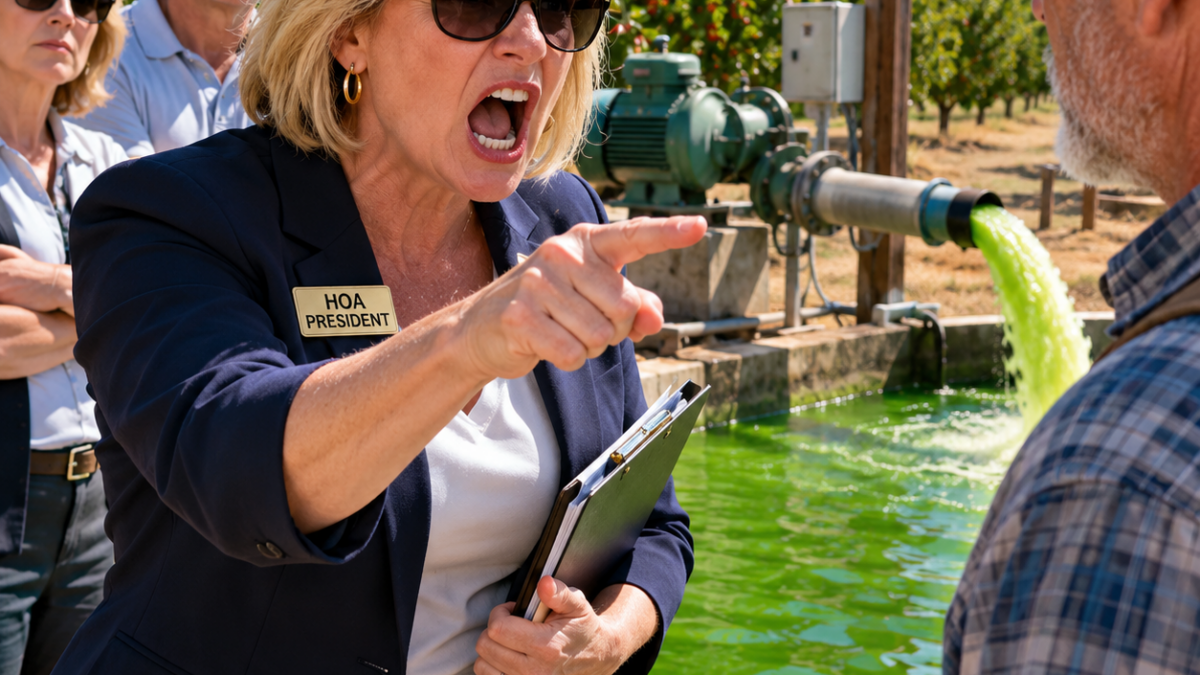
PART 2
The sentence was printed near the bottom of my father’s letter, partially obscured by the shadow of an old staple.
Temporary use shall remain subject to the limitations and conditions set forth on the following page.
I read it again.
“The following page,” I said.
Felicity’s expression hardened.
“Mr. Navaro, you’re trying to manufacture a technicality.”
“Where’s the page?”
“Our legal department has reviewed the documentation.”
“That wasn’t my question.”
Nina turned the photocopy over. Nothing.
“An agreement referring to an attachment isn’t complete without that attachment,” she said. “I need to see the original documentation and any water company authorization before I can determine whether this connection was permitted.”
Felicity pulled out her phone.
“I’ll have our attorney contact the irrigation company.”
“That’s fine,” Nina said. “In the meantime, I’m documenting the connection and preserving the meter readings.”
Felicity looked directly at me.
“Do not touch that pump, Jack. If you interfere with an emergency community water source, the association will hold you financially responsible.”
I glanced toward the lake.
Hundreds of thousands of dollars had clearly been spent making that artificial shoreline beautiful.
The stonework was new. The grass was greener than anything else in the valley. Sprinklers ran beneath decorative trees that hadn’t grown enough to cast meaningful shade.
And my orchard was drying out below it.
“You’re threatening me over water coming out of my own account.”
“I’m informing you of your responsibilities.”
I took the photocopy from Nina and photographed every page.
Felicity watched me.
Then, without another word, she walked toward the pump enclosure.
A few seconds later, her phone rang.
She answered quietly, turned her back to us, and stepped behind the maintenance truck.
I couldn’t hear the conversation.
But I noticed something.
She looked at the unfinished lake three times while she was speaking.
Not once did she look toward the houses she claimed the reservoir was supposed to protect.
That detail stayed with me.
By the time the sun rose above the eastern ridge, I knew we were in trouble.
The soil around the northern peach trees should have been dark and cool. Instead, when I pushed my fingers beneath the surface, I found dry, crumbly earth less than two inches down.
The leaves had begun folding along their center veins.
Peach trees do that when they’re trying to conserve moisture.
It’s an early warning, not a death sentence.
But during a Colorado heat wave, the distance between those two things can shrink frighteningly fast.
I walked row after row, checking irrigation emitters and digging into the soil.
One hundred eighty-six mature trees in the north block carried fruit approaching harvest.
Those peaches were already sold.
The buyer expected a minimum size, and our contract allowed him to reduce the order if the fruit fell below grade.
Without sufficient water, peaches don’t simply become less juicy.
They stop sizing.
They soften unevenly, drop early, and lose the quality that makes them worth harvesting.
By seven, I was calculating how much fruit we might lose.
At seven-fifteen, my daughter pulled into the driveway.
Rosa stepped out of her car carrying a cardboard file box.
She was thirty-two, worked as a physical therapist in Grand Junction, and helped manage our online peach orders every harvest season.
She had her mother’s dark hair, her mother’s stubbornness, and an ability to recognize a financial problem long before I wanted to discuss it.
“Dad?”
I was standing beside the north distribution box.
“Why are the sprinklers barely running?”
I pointed uphill.
“Someone connected a pump to our irrigation line.”
“Who?”
“Canyon Vista.”
She looked at me.
“You’re kidding.”
“I wish I were.”
She followed the line of my arm toward the subdivision.
“That’s insane. They can’t just take our water.”
“They say your grandfather authorized it.”
Rosa frowned.
“Grandpa died before that neighborhood existed.”
“That’s part of what we’re trying to figure out.”
She set the cardboard box on the tailgate of my pickup.
Then she looked at the trees.
“How bad?”
“Bad enough that we need to make choices.”
We spent the next hour examining every distribution box.
The pressure was insufficient to keep all four irrigation blocks running effectively.
I could concentrate what little water remained on the mature north block.
But doing that meant closing the supply to ninety-two younger trees near our packing shed.
Rosa stood beside the valve.
“Those are Mom’s trees.”
“I know.”
We had planted them during Elena’s illness.
She’d insisted on choosing the varieties herself, even when chemotherapy made standing in the sun exhausting.
Some days she’d sit in a folding chair while Rosa and I worked.
She would point at a crooked trunk or uneven row and tell us to fix it.
“Trees don’t care whether you’re having a hard year,” she used to say. “They still need somebody to show up.”
After she died, those young trees became something Rosa and I never discussed directly.
We just took care of them.
Now I was asking my daughter to turn off their water.
“If we sacrifice the young block,” I said, “we might save the marketable fruit in the north.”
“And if we don’t?”
“We could lose both.”
She stared at the valve for several seconds.
Then she turned it.
The pipe shuddered as the remaining flow redirected toward the older trees.
Neither of us said anything.
The cardboard box on the tailgate held another problem.
Rosa waited until we were back inside the kitchen before opening it.
“I was coming over to talk about this.”
She removed a folder containing a broker’s valuation.
At the top was the name of a produce warehouse company interested in buying our property.
I already knew Rosa had been speaking to someone about the possibility of selling.
I hadn’t realized the conversation had gone this far.
“There’s an offer?”
“A preliminary one.”
“For what?”
“The road frontage, the packing shed, most of the acreage. They’d preserve the house and lease part of the remaining land.”
I looked at the figures.
The amount wasn’t insulting.
That bothered me more than a low offer would have.
It was enough to pay our remaining debts and give Rosa a meaningful financial cushion.
It was also a price for dismantling something three generations had built.
“You were going to show me this on Sunday?”
“Yes.”
“Before or after telling me you want the orchard gone?”
She shut the folder.
“I don’t want it gone, Dad.”
“Then what do you want?”
“I want you to stop pretending that keeping it alive isn’t costing us anything.”
I started to answer.
She raised a hand.
“The frost fan needs repairs. Labor costs keep climbing. Last year’s harvest barely covered the loan. You worked through a shoulder injury because you wouldn’t hire another person.”
“I managed.”
“You always manage. Until one day you can’t.”
That landed harder than I wanted to admit.
Elena had handled the bookkeeping for most of our marriage.
I handled the land, equipment, labor, and water.
We had been good at dividing responsibilities.
After she died, I learned how many problems she’d solved without ever making them sound like problems.
Rosa had stepped into much of that work.
Now she was tired, too.
I looked at the valuation again.
“We’re not making a decision about selling because some HOA president decided to steal our water.”
“I’m not asking you to.”
“Then why bring it today?”
“Because the trees are in trouble, Dad. And I don’t know how many more emergencies we can survive.”
Before I could answer, the pressure gauge mounted outside the kitchen window dipped.
I heard it before I saw it.
A low vibration carried through the irrigation pipe.
The hidden pump had restarted.
Rosa turned toward the sound.
“You’ve got to be kidding me.”
We hurried outside.
The needle dropped further.
Up on the ridge, Canyon Vista’s sprinklers began rotating across the grass again.
Rosa took out her phone and started recording.
“Now I understand why you looked like you wanted to punch somebody when I arrived.”
“I don’t want to punch anybody.”
She glanced at me.
“That’s a new development.”
Despite everything, I almost smiled.
Then I looked toward the north block.
The pressure continued falling.
And the smile disappeared.
By noon, I had reviewed footage from the camera mounted on our pump house.
The camera didn’t cover the hidden trench.
But it captured vehicles traveling the maintenance road beside our north fence.
Three nights in a row, after midnight, the same Canyon Vista maintenance pickup had passed through.
Twice, it was followed by a truck belonging to High Desert Pump and Rental.
The vehicles arrived with work lights.
They left before sunrise.
I saved the recordings to two separate drives.
Then I called Aaron Walsh, the attorney who had handled Elena’s estate.
Aaron knew our property records better than almost anyone.
I explained the pump, the seal, and the incomplete agreement.
He listened without interrupting.
“Don’t disconnect anything yourself,” he said.
“That’s exactly what Felicity wants.”
“And I’m sure she’d appreciate footage of you cutting a line that her attorney is calling emergency infrastructure.”
“So we just let them take the water?”
“No. We document the problem, establish the actual flow, and find the complete agreement.”
“How long will that take?”
“Depends on who still has the records.”
“My trees don’t have weeks.”
“I understand.”
“No, Aaron. I don’t think you do.”
There was a pause.
Then he said something that made me regret my tone.
“Jack, I represented Elena for six years while she was arranging your estate documents. I know what that orchard meant to her.”
I closed my eyes.
“I’m sorry.”
“Don’t apologize. Just don’t let Felicity turn your anger into evidence against you.”
He asked me to send every photograph, video, and document.
Then he gave me a list of records to locate.
My father’s original letter.
The recorded easement.
Any correspondence with the original developer.
And the complete irrigation account history.
We were no longer arguing about a pipe.
We were trying to establish what that pipe was legally allowed to do.
The next afternoon, Canyon Vista held an emergency HOA meeting.
I had attended exactly one of their board meetings before, years earlier, when a construction crew blocked the road our harvest trucks used.
This gathering was different.
Almost every chair in the glass clubhouse was occupied.
Through the windows, the unfinished lake reflected the afternoon sun.
A large screen displayed an architectural rendering of the completed development.
There were kayaks on impossibly blue water.
Children running across green lawns.
Families enjoying picnic tables beneath mature cottonwood trees.
None of those trees existed yet.
Neither did the lake as pictured.
Felicity stood beside the screen wearing a cream-colored business jacket.
“Thank you for coming on such short notice,” she began. “We’ve encountered an unexpected challenge involving a neighboring agricultural property.”
I sat near the back with Rosa.
She squeezed my wrist.
“Unexpected challenge,” she whispered. “That’s you.”
Felicity continued.
“The association has been exercising historically granted water access to maintain our emergency reservoir and landscaping infrastructure during the current drought.”
A photograph of my orchard appeared on the screen.
My property boundary had been highlighted in red.
“Unfortunately, the neighboring owner is attempting to obstruct the association’s lawful use.”
Heads turned toward me.
I kept my hands folded.
Felicity knew how to speak to frightened homeowners.
She framed every sentence around safety, property values, and community stability.
Then a woman near the front stood.
She had two children sitting beside her.
“My name is Melanie Voss,” she said. “We bought our home because we were told the lake would provide additional emergency water during wildfire season.”
Felicity nodded.
“Exactly.”
“So if Mr. Navaro stops the water, does that make us less safe?”
“The association believes interrupting the supply would create an unnecessary risk.”
I stood.
Several people turned.
“My name is Jack Navaro. I own the orchard below your neighborhood.”
Felicity smiled tightly.
“Mr. Navaro, public comments will come at the appropriate time.”
“You just told these people I was endangering their homes.”
“We are discussing an essential community resource.”
“Then show them the fire district certification.”
The room quieted.
Felicity folded her hands.
“The certification process involves several agencies.”
“Is the lake currently approved as a firefighting reservoir?”
“Our professionals are handling all applicable requirements.”
“That wasn’t the question.”
Her expression cooled.
“You’re an orchard owner, Mr. Navaro. You’re not qualified to evaluate regional water infrastructure.”
I looked around the room.
“I worked for Mesa Crown Irrigation Company for twenty-two years. I was the senior ditch rider responsible for this exact reach of channel before Nina Patel took over.”
A few homeowners straightened in their chairs.
“I inspected those gates. I checked their seals. I approved temporary connections when the paperwork allowed them. There was never an authorized Canyon Vista intake on my private lateral.”
Felicity interrupted.
“Your father’s own documents contradict you.”
“They may. That’s why I want the missing page.”
She turned toward the audience.
“Even Mr. Navaro acknowledges the historical agreement.”
“I acknowledge my father’s signature.”
I held up the photocopy.
“What I don’t acknowledge is that his signature gave this association permanent access to my water thirty years later.”
A man seated near the front spoke.
“I’m Harold Kim, the association treasurer. Has Mesa Crown confirmed this drought connection?”
Felicity looked toward him.
“The easement predates current company procedures.”
“That wasn’t my question,” Harold said.
He glanced at me, then returned his attention to Felicity.
“Do we have a current water delivery ticket?”
Felicity hesitated.
“Our legal team is reviewing the administrative requirements.”
Harold wrote something on his tablet.
That was the first moment I saw another board member publicly challenge her.
It didn’t last.
Felicity advanced to the next slide.
A construction financing diagram appeared.
She explained that Canyon Vista’s developer had refinanced an $8.6 million construction note.
A lender inspection was scheduled for Tuesday.
The lake, landscaping, and eighteen premium lots were part of the completion package.
If the inspection failed, the lender could withhold a final $1.9 million draw.
I leaned forward.
Suddenly, something about the situation made sense.
The lake wasn’t merely decorative.
It was connected to a financial deadline.
Felicity wasn’t just defending a landscaping project.
She was defending Tuesday’s inspection.
And my water was the fastest way to make an unfinished amenity look complete.
After the meeting, Rosa and I stood beside my truck.
The clubhouse lights reflected across the partially filled lake.
“You heard the money part,” she said.
“I did.”
“$1.9 million.”
“That’s a strong reason to fill a lake in a hurry.”
“Do you think she knew the connection was illegal?”
“I don’t know what she knew yet.”
Rosa stared at the building.
“She made you sound like you were stealing water from children.”
“She made people afraid.”
“That woman with the kids looked terrified.”
“Because wildfire risk is real.”
“But the lake?”
“That’s what we need to check.”
Rosa crossed her arms.
“If we find the missing page and it says Grandpa gave them permission, what happens?”
I considered lying.
I wanted to tell her there was no possible way my father could have granted those rights.
But I’d seen his signature.
And I remembered how generous he could be when he thought someone needed help.
“If the agreement is valid,” I said, “we respect it and negotiate what we can.”
“Even if it costs us the orchard?”
“We’ll do everything lawful to keep the trees alive.”
She looked disappointed.
Maybe she wanted a stronger answer.
Maybe I did, too.
But after twenty-two years enforcing water schedules, I understood something that made this dispute harder.
A right doesn’t become invalid merely because it hurts you.
And a document doesn’t become true merely because somebody important waves it around.
We needed proof.
That night, at 11:46, Nina’s remote recorder sent an alert.
The pump was pulling harder than before.
Rosa was still at the house when my phone sounded.
I showed her the pressure reading.
“That’s worse than this morning.”
“I know.”
She grabbed her keys.
“I’m coming.”
We drove toward the north gate.
The pump enclosure was illuminated by portable floodlights.
A Canyon Vista security pickup blocked the maintenance path.
I rolled down my window.
“We need access to the irrigation equipment.”
The guard stayed beside his truck.
“Association orders. Nobody alters shared infrastructure.”
“That equipment is connected to Mesa Crown’s headgate.”
“I was told not to let you pass.”
“I’m not asking you to let me touch the pump. I’m asking you to move so the water company can inspect its equipment.”
He shook his head.
Rosa began filming.
“Can you state your name and who told you to block this road?”
The guard looked uncomfortable.
“I’m just doing my job.”
“Then we need to document what your job includes.”
I called Nina.
She contacted her manager.
Within forty minutes, two sheriff’s deputies arrived to prevent the dispute from becoming physical.
Felicity appeared shortly afterward.
This time she carried the same red folder and wore a dark coat over her clothes.
“Jack, this behavior is completely unnecessary.”
“Your security contractor is blocking access to an irrigation headgate.”
“The association is preserving the status quo.”
“You mean preserving the pump.”
She turned toward the deputies.
“These people are trying to sabotage an emergency reservoir.”
One deputy asked Nina’s manager what authority the irrigation company had over the equipment.
He explained that Mesa Crown controlled the company headgate and could suspend delivery while an unapproved connection was investigated.
Then he made the decision I had feared.
He ordered the upstream gate closed until the bypass could be safely isolated.
The pump stopped.
So did the water flowing toward my orchard.
I watched the downstream gauge fall.
Rosa turned toward me.
“Dad?”
I said nothing.
Felicity stood beside her vehicle.
“You wanted the connection shut down,” she said. “Now nobody gets water.”
I stared at her.
“My orchard has no water.”
“The association repeatedly offered cooperation.”
“Cooperation would’ve started before your contractor buried a pipe on my property.”
She opened her car door.
“Perhaps now you’ll appreciate why disputes should be handled through legal channels.”
Then she left.
The deputies departed after the equipment was secured.
Nina apologized, although she hadn’t done anything wrong.
“We’ll move as quickly as we can,” she promised.
I looked toward the dark rows of trees.
“Please.”
The following morning, the orchard was silent in a way I had never liked.
An irrigated orchard makes small sounds.
Water moving through pipes.
Emitters tapping.
Leaves shifting against wet branches.
That morning, the distribution lines were dry.
By ten, the temperature had reached 100 degrees.
Rosa began calling water suppliers within sixty miles.
I checked the youngest trees.
Several had already lost their remaining soil moisture reserve.
One sapling near the packing shed had dropped nearly every leaf on its western side.
I wrapped the weakest trunks and stretched temporary shade cloth across the young rows.
By noon, Rosa had located a tanker.
It couldn’t arrive until evening.
“How much?” I asked.
She told me.
I winced.
“Book it.”
She didn’t argue.
That frightened me more than the price.
By afternoon, we were removing immature peaches from the weakest north-block trees.
The crop load was increasing their water demand.
Reducing it might help the trees survive.
Each green peach we dropped into a bin represented fruit we’d spent months producing and would never sell.
Rosa worked beside me without speaking.
Eventually she stopped.
“Mom planted this row.”
“I remember.”
“She was wearing that ridiculous yellow sunhat.”
I smiled faintly.
“She bought it because you told her she’d get wrinkles.”
“I was fourteen.”
“She wore it for six summers.”
Rosa turned a small peach in her hand.
“I hated that hat.”
“No, you didn’t.”
She dropped the peach into the bin.
“No. I didn’t.”
We worked until the heat made it difficult to stand.
Then we carried water to the youngest trees by hand.
It wasn’t enough.
But doing nothing felt impossible.
At six-twelve, the tanker finally arrived.
Rosa stood in the driveway waving the driver toward the packing shed.
I watched the first water flow into our emergency holding tank.
For the first time that day, I felt something other than anger.
Relief.
Not victory.
Just relief that we had bought another night.
Mesa Crown’s preliminary water comparison arrived the next day.
I sat at the kitchen table with Rosa while Nina explained the numbers over speakerphone.
“Since Sunday evening, the company gate recorded approximately eleven acre-feet delivered through the headgate.”
I did the conversion in my head.
About 3.6 million gallons.
“Your downstream totalizer,” Nina continued, “shows roughly 1.2 million gallons reaching the orchard.”
Rosa picked up a pen.
“That leaves…”
“Approximately 2.4 million gallons unaccounted for between the readings,” Nina said.
My daughter stopped writing.
She looked at me.
“Two point four million?”
I nodded.
I’d spent decades working with acre-feet and delivery records.
I understood the scale.
But hearing it applied to my family’s orchard made it feel different.
Nina continued.
“We still have to evaluate leakage, instrument accuracy, and any other outlets. I won’t certify a diversion total based only on these comparisons.”
“Can the pump account for it?” I asked.
“Possibly. The controlled flow test will tell us much more.”
“When?”
“Tuesday morning.”
Rosa leaned toward the phone.
“That’s the day of Canyon Vista’s lender inspection.”
“Yes,” Nina said.
I looked out the window toward the ridge.
The HOA’s lake had been rising during the same period our orchard was losing water.
The quantity missing from my meter was consistent with much of the lake’s sudden gain.
That didn’t settle the legal issue.
But it narrowed the physical mystery.
Two point four million gallons weren’t disappearing into thin air.
Somewhere, that much water had gone.
And Tuesday morning, we intended to find out exactly where.
Friday was the worst day of the heat wave.
The temperature reached 107 degrees.
The air felt sharp against my face.
Even standing beneath the orchard’s canopy offered little relief.
The emergency tanker and our remaining moisture reserves saved most of the ninety-two young trees.
Sixty-eight stabilized.
Twenty-four still showed severe stress.
Their leaves were scorched, and some of the newest growth had softened.
I marked each questionable tree with colored tape.
Not because the tape would save it.
Because I needed to know which trees had suffered and whether they recovered.
Meanwhile, our peach buyer arrived to inspect the north block.
He had purchased from our family for eleven years.
He wasn’t a cruel man.
That made the conversation worse.
He measured fruit from three rows and shook his head.
“Jack, we’re below minimum pack size.”
“We’ve got a water interruption.”
“I know.”
“We’re trying to correct it.”
“I believe you. But I have orders to fill.”
“How much are you reducing?”
He looked toward the bins.
“Thirty percent of Monday’s order.”
I stared at him.
“Thirty?”
“I’m sorry.”
I wanted to argue.
But he hadn’t stolen our water.
He hadn’t buried the pipe.
And he couldn’t sell peaches that didn’t meet his customers’ specifications.
After he left, I found Rosa kneeling beside a tree.
She was holding a peach that had fallen before ripening.
“The buyer called me,” she said.
“I know.”
“Thirty percent.”
“Yes.”
She looked down at the fruit.
“Do you know how much that is?”
“I have a pretty good idea.”
“No, Dad. I mean after labor, packaging, transport, and the operating loan.”
I sat beside her on an overturned harvest crate.
For a moment, neither of us spoke.
Then she said quietly, “I wasn’t trying to get rid of Mom’s orchard.”
“I know.”
“I was trying to protect you.”
I looked at the damaged fruit in her hand.
“Maybe I’ve made it too hard for you to do that.”
Her eyes filled.
“You’re allowed to need help.”
Those words hurt because Elena had said almost the same thing during her last year.
I reached over and squeezed Rosa’s shoulder.
“We’re going to finish this.”
“Even if we have to sell afterward?”
I looked down the row.
“Even if that’s what we eventually decide.”
She nodded.
It wasn’t the answer either of us wanted.
But it was the first time we’d discussed the future without pretending one of us had to win.
The next important evidence came from High Desert Pump and Rental.
Aaron had sent preservation requests to Canyon Vista and its contractors.
High Desert’s foreman, Cole Danner, agreed to provide the job file through the attorneys.
He met us at Aaron’s office.
Cole looked like a man who would rather be repairing equipment than sitting between two lawyers.
He placed a folder on the conference table.
“The HOA hired us to install a temporary reservoir-fill system.”
“Who signed the order?” Aaron asked.
“Canyon Vista HOA. The contact was Felicity Crane.”
“What were you told about the source?”
“That it was an existing association water intake, approved through the ditch company.”
He unfolded a map.
A bright blue line crossed the property boundary and led directly to my irrigation lateral.
I recognized it immediately.
It was the same route attached to my father’s incomplete agreement.
“Did you verify this with Mesa Crown?” Aaron asked.
“No. We were told verification had already been handled.”
“Who told you that?”
“Ms. Crane.”
Cole shifted uncomfortably.
“Look, we weren’t out there trying to steal anything. We were told this was an authorized job.”
I believed he was telling us what his crew had been told.
That didn’t make the installation lawful.
But it mattered.
Aaron pointed toward the connection location.
“Your delivery coordinates show the north fence of Navaro Orchard.”
“That’s where we were instructed to install the equipment.”
“And you photographed the site?”
“We photograph every job before excavation.”
He opened a laptop.
The first image showed the ditch, the fence, and the original headgate.
I leaned closer.
The company seal was visible.
The last three digits were 816.
The correct number.
The photograph had been taken Sunday afternoon.
By Wednesday morning, the seal had ended in 618.
Someone had changed it during that interval.
I looked at Cole.
“Who replaced the seal?”
He shook his head.
“I don’t know.”
Aaron held up a hand before I could press further.
“Then we document what you do know.”
Cole supplied the original photographs, job order, invoice, and map.
When he left, Aaron closed the folder.
“Now we have an independent contractor record.”
“That shows they installed the pipe.”
“And that the map was supplied as an authorized connection. We still need to establish who created it and whether the underlying agreement permitted anything like this.”
Rosa pointed to the blue route.
“It wasn’t on our old maps.”
“That’s important,” Aaron said. “But let’s get the originals before we draw conclusions.”
The problem was finding originals from nearly thirty years earlier.
Mesa Crown searched its archives.
The county recorder had the historic easement exhibit, but not my father’s separate correspondence.
The original developer had dissolved roughly twenty years earlier.
Aaron called former surveyors, title offices, and engineering firms.
Most leads ended in disconnected numbers or boxes of records nobody had examined in decades.
I searched through my father’s files in the old office beside the packing shed.
There were purchase agreements, tax receipts, equipment manuals, and handwritten notes about irrigation turns.
I found the first page of his letter.
The staple holes at the top suggested something had once been attached.
But the second page was gone.
For a moment, I sat alone at his desk.
My father had been a practical man.
He believed a handshake mattered.
He also believed paperwork mattered because people forgot what they shook hands about.
I couldn’t imagine him granting permanent water access without conditions.
But imagination wasn’t evidence.
I ran my thumb over his signature.
“Dad, what did you agree to?”
There was no answer.
Only the hum of the old refrigerator in the adjoining room.
That evening, Rosa found something in Elena’s tax files.
It was a yellow paper tab attached to a folder dated 1996.
Elena had written a short note in her neat handwriting.
Water letter copy sent to Bell Survey — August 12.
Rosa placed the note on the table.
“Bell Survey.”
I looked at it.
My wife had kept the kind of records that made our accountant laugh.
She saved receipts for bolts.
She labeled envelopes.
She wrote explanations on bank statements so nobody would have to guess what a payment meant later.
Sometimes I’d teased her about it.
Now, three years after her death, one little yellow tab offered the first real chance of finding the missing page.
Aaron contacted the successor company.
Bell Survey had been absorbed into another engineering firm, but its archive survived.
An employee located an index referring to the 1996 water letter.
The original was stored on microfilm.
They could retrieve the image by Monday.
I wrote the day on a calendar.
Monday.
One day before the controlled water test.
And one day before Felicity’s lender inspection.
We still needed water.
Nina helped us arrange a lawful temporary transfer from a vineyard owner who had surplus water within the irrigation company’s approved delivery system.
The transfer cost $12,000.
Rosa authorized the payment from the orchard operating account.
I watched her confirm the transaction.
“That’s more than we planned to spend on water this month.”
“I know.”
“It puts pressure on payroll.”
“I know that, too.”
I leaned against the kitchen counter.
“The broker said buyers like clean numbers.”
Rosa closed her laptop.
“Dead trees aren’t clean numbers either.”
I looked at her.
She shrugged.
“I’m learning from your bad habits.”
“Which ones?”
“Being stubborn when something matters.”
The emergency delivery reached the orchard after midnight.
We walked the rows with flashlights, checking emitters and watching the soil-moisture readings.
The first measurable improvement appeared shortly before dawn.
A sensor in the north block climbed out of its critical range.
I showed Rosa.
She studied the screen.
“That’s good?”
“That’s very good.”
She smiled.
Not because the problem was solved.
Because the trees finally had a chance.
Saturday morning, Harold Kim called.
He sounded exhausted.
“I’ve been reviewing the lake expenditures,” he said.
“What did you find?”
“The board approved forty-two thousand dollars for temporary lake stabilization.”
“That’s a lot of stabilization.”
“That’s what I thought.”
He explained that $33,800 had been spent on pump rental, trenching, electrical work, landscaping, and security.
Another $8,200 was labeled water acquisition and coordination.
“Who sold the association that water?” I asked.
“That’s the problem. I can’t find the supplier agreement.”
“Did the board vote to connect to my lateral?”
“No.”
“Did the board authorize a pump on my property?”
“No.”
“What exactly did you authorize?”
“A lawful temporary water source.”
I let the silence sit.
Harold continued.
“Felicity presented it as an existing easement arrangement. She said the legal review was complete.”
“Was it?”
“I’m trying to determine that.”
I looked toward the ridge.
Harold wasn’t defending Felicity now.
He was trying to find out what the board had actually purchased.
“Harold, your residents deserve to see the records.”
“I agree.”
That afternoon, Canyon Vista’s attorney sent us a settlement proposal.
The amount at the top was $75,000.
I read it twice.
The HOA would pay immediately if I allowed the temporary connection to continue through Tuesday’s inspection.
It would cover emergency water expenses, agree to abandon future claims to my lateral, and negotiate final crop damages after harvest.
Rosa sat across from me.
“Seventy-five thousand would help.”
“Yes.”
“It covers the tanker, the transfer, most of the reduced order, and some of the other losses.”
“Probably.”
She looked at me carefully.
“Don’t reject it just because you’re angry.”
I wasn’t offended.
She had every reason to say it.
For days, I had imagined shutting that pump down myself.
I’d replayed Felicity’s threats in my head.
I’d pictured confronting her in front of the entire subdivision.
Anger was real.
So was payroll.
Aaron waited while Rosa and I discussed the numbers.
Then he turned to page four.
“There’s something you both need to see.”
He pointed to a sentence in the settlement.
For purposes of lender certification, the parties would acknowledge the temporary connection as an existing supply arrangement pending transition to a permanent source.
I read it slowly.
Then again.
“Existing supply arrangement?”
Aaron nodded.
“If you sign, that statement could be used to support the lender’s understanding of how the lake was supplied.”
“But we dispute that the arrangement ever existed.”
“Exactly.”
Rosa leaned across the table.
“They’re not just paying for Tuesday’s water.”
“No,” I said.
“They want us to say the connection was legitimate before we ever discovered it.”
Aaron didn’t answer immediately.
Then he said, “That’s the concern.”
I looked at the money again.
It was enough to change the farm’s immediate outlook.
But the wording would change the record.
It would allow a hidden pipe, installed without my permission, to be presented as an arrangement we’d acknowledged.
Rosa slid the agreement toward Aaron.
“No.”
I looked at her.
She was the one who’d brought the broker’s offer.
The one who worried about payroll.
The one who had been telling me for months that we couldn’t afford another emergency.
“Are you sure?” I asked.
She looked at the document.
“Mom spent thirty years keeping honest books. I’m not putting my name on something that makes this look like an agreement we made.”
Aaron prepared a counterproposal.
Canyon Vista could purchase properly documented water through Mesa Crown.
The source dispute would be disclosed to the lender.
The bypass would remain disconnected until the controlled test.
Felicity rejected it within nineteen minutes.
Her response said the proposed disclosure would create unnecessary alarm and compromise the inspection.
I read the email aloud.
Rosa looked up.
“She’s more afraid of the lender learning the truth than she is of our orchard dying.”
I couldn’t prove what Felicity feared.
But her priorities were becoming difficult to misunderstand.
Sunday brought another problem.
Canyon Vista distributed an emergency notice to residents.
It warned that a neighboring property owner was attempting to disable a critical firefighting reservoir during dangerous wildfire conditions.
By lunchtime, three homeowners had driven past our driveway.
One slowed down and shouted that I should be ashamed of myself.
Another took photographs of our irrigation equipment from the public road.
I didn’t approach either vehicle.
I had enough problems without a confrontation becoming another item in Felicity’s folder.
Melanie Voss came by that afternoon.
She stood beside my gate, looking uncomfortable.
“I wanted to ask you something directly.”
“Go ahead.”
“Is there any chance that shutting down the lake really does put our neighborhood at risk?”
I could have dismissed her concern.
I could have told her Felicity was lying and sent her home.
But drought and wildfire risk were real.
I knew what a fast-moving fire could do to dry grass and wooden fences.
“If the fire district has approved the lake as an emergency source, that’s relevant,” I said. “But even then, it doesn’t automatically authorize taking my irrigation water.”
Melanie looked toward the young trees.
“Are those the ones you had to shut off?”
“Yes.”
She walked closer.
Several had scorched leaves.
One was already losing its upper branches.
“My children helped plant trees at our community center,” she said. “They cried when one died.”
I looked at her.
She seemed embarrassed by the comparison.
“I’m sorry. I know it’s not the same.”
“It’s all right.”
She lowered her voice.
“Felicity keeps saying your orchard has plenty of water.”
I pointed to the pressure gauge.
“That’s the pressure we’re getting because of the disputed connection.”
Melanie studied it.
Then she looked uphill.
“She said the lake was part of the original neighborhood fire plan.”
“Ask her for that plan.”
“I did.”
“What did she say?”
“She told me to trust the professionals.”
I almost laughed.
Instead, I said, “Then let’s find out what the professionals actually approved.”
Aaron requested the subdivision’s fire protection plan from the district.
The written response arrived later that afternoon.
The approved plan relied on hydrants, tanker access, defensible space, and the county road network.
The ornamental lake had no approved firefighting drafting pad.
No tested engine turnaround.
No final district certification.
There was an application under review for possible future use.
But that was different from being an approved emergency reservoir.
Harold forwarded the district’s response to the homeowners.
Felicity responded by saying the certification process was ongoing.
For once, she had chosen words that were technically accurate.
The application was ongoing.
But her notices had presented the lake as an existing emergency system.
That distinction mattered to the residents.
It also mattered to Maria Chen.
Maria was the engineering consultant representing Canyon Vista’s construction lender.
She called Aaron on Monday morning.
The lender had received the source dispute documentation and wanted to observe Tuesday’s controlled test.
Maria also requested the approved completion drawing for the lake.
When Aaron obtained a copy, he called me.
“Jack, I need you and Rosa to look at something.”
We drove to his office.
The drawing was spread across the conference table.
A blue line ran from the existing irrigation ditch toward Canyon Vista’s lake.
Beside it was a label.
Permanent Community Water Line.
I stared at the words.
“That’s my lateral.”
Aaron nodded.
“According to this plan, it’s part of their permanent lake supply.”
“There’s no permanent community water line.”
“That’s why Maria asked for the source agreement.”
Rosa pointed to the revision block.
“When was this drawing approved?”
“Nine months ago.”
I looked at Aaron.
Nine months.
The drought emergency Felicity kept citing had happened only recently.
High Desert had installed the pump days earlier.
But the developer’s financial documents had identified my lateral as a permanent community water source months before anyone claimed an emergency.
“She planned to use that line long before this heat wave.”
“We know the drawing existed,” Aaron said carefully. “We still need to establish who directed the change.”
I placed my palm on the table.
“She told everyone this was a temporary emergency.”
“Yes.”
“And the lender was shown a permanent source.”
“Yes.”
Rosa exhaled.
“Two different stories.”
Aaron nodded.
“That’s exactly what the records show.”
At 2:12 Monday afternoon, the archive manager called.
Bell Survey’s successor company had located the microfilm.
The scans arrived in separate files.
The first showed the letter I already possessed.
The second was crooked and difficult to read.
The lower right corner was blurred.
Rosa enlarged it on her laptop.
I could make out a few words.
Separate meter.
Written approval.
Then a line that appeared to include a date.
The rest was illegible.
Rosa called the archive manager.
“Could you rescan just the bottom right corner?”
The woman agreed.
We waited with the document open between us.
I could hear the kitchen clock ticking.
At 2:41, a new email arrived.
Rosa opened the attachment.
The image was sharper.
We both leaned toward the screen.
The missing page listed three conditions.
Any construction connection had to be separately metered and paid for by the developer.
Any drought-related use required written approval from the irrigation company and was limited to a defined emergency period.
The temporary privilege expired when the original Mesa grading work ended or on October 31, 1997, whichever occurred first.
I read the expiration date aloud.
“October thirty-first, nineteen ninety-seven.”
Rosa looked at me.
“That’s almost thirty years ago.”
I sat back.
For days, Felicity had used my father’s signature like a weapon.
She’d pointed to it in front of homeowners.
She’d threatened liability.
She’d relied on the document to justify taking water from an orchard during a drought.
But the missing page showed that my father had never granted permanent irrigation rights to a future luxury subdivision.
He had allowed a temporary construction arrangement, subject to conditions.
Those conditions had long since expired.
Rosa covered her mouth.
“Mom kept the note.”
I nodded.
“If she hadn’t…”
I couldn’t finish.
My wife had been gone for three winters.
Yet the little tab she’d saved had led us to the document that finally explained what my father signed.
I took off my glasses.
For several seconds, I just sat there.
Then Rosa asked the next question.
“What about the blue line?”
I looked back at the screen.
The archived exhibit contained no route climbing toward Canyon Vista’s lake.
Neither did the county recorder’s version.
Only the HOA’s copy did.
Somebody had added it.
And now we had a way to prove that.
Aaron immediately sent the complete agreement to Canyon Vista’s attorney and Maria Chen.
He included both archival maps and the county copy.
The differences were visible even without specialized software.
The original easement showed the drainage swale and the main ditch.
The HOA version showed an additional blue route crossing toward my private lateral.
There was no evidence in the originals that my father had granted that route.
Felicity received the package Monday afternoon.
At five, she sent an email to residents.
It said the archived language was subject to legal interpretation and that the HOA continued to believe its position was justified.
I read the message on my phone.
Rosa stood beside me.
“Does she ever admit when she’s wrong?”
“Not so far.”
At six, the lights around the pump enclosure came on.
I watched from the orchard.
For a moment, I thought the motor was about to restart.
But it remained silent.
Mesa Crown had secured the bypass under a preservation agreement until the controlled test.
Above us, the lake continued losing water through evaporation and normal seepage.
Its level fell another inch overnight.
By morning, the artificial shoreline looked less impressive.
The lender’s inspection was only hours away.
And Felicity was running out of explanations.
Tuesday morning was clear and painfully bright.
I reached headgate 14 before seven.
Nina was already there.
She wore her reflective vest and carried the same tablet she’d used on the first morning.
“How are the trees?” she asked.
“Still standing.”
“That’s something.”
“How’s the equipment?”
“Calibrated and ready.”
A neutral irrigation engineer named Dr. Elaine Foster would direct the controlled test.
Mesa Crown had arranged for independent verification because the dispute involved both its delivery system and private property.
High Desert sent Cole Danner.
Harold represented the HOA board.
Aaron attended for me.
Maria Chen arrived with the lender’s survey crew.
Felicity appeared shortly before eight.
She wore a vivid red suit.
The color reminded me of the rain jacket she’d worn the morning I found the pipe.
She carried the same folder.
Her attorney walked beside her.
For a moment, she looked completely confident.
Then she saw the original maps laid out on the temporary worktable.
Her steps slowed.
Elaine gathered everyone near the measuring equipment.
“Before we begin,” she said, “I want to be clear about what today’s test can and cannot establish.”
She looked from Maria to Felicity, then to me.
“We can measure flow, determine the effects of operating the bypass, and observe where water travels.”
Felicity folded her arms.
“We already know where the pipe goes.”
Elaine continued without acknowledging the interruption.
“This test will not determine property ownership, interpret the legal agreement, or establish who altered any documentation.”
Aaron nodded.
“Understood.”
“We will begin with the bypass closed.”
Mesa Crown released a measured flow through the headgate.
The upstream meter stabilized.
The downstream orchard meter matched within normal operating tolerance.
I watched the pressure rise.
For the first time in days, the distribution box held steady.
Elaine recorded the readings.
“Baseline established.”
Felicity stepped closer.
“So the orchard receives water normally.”
“With the bypass closed,” Elaine said.
“Which suggests there isn’t a system leak.”
“The baseline gives us a comparison. That’s all.”
Cole opened the bypass valve with the pump still off.
The readings shifted slightly.
Nothing dramatic.
Then Elaine authorized the pump to be energized.
The motor started with a low mechanical hum.
The sound deepened.
The pipe vibrated.
I watched the upstream meter.
Its flow remained steady.
Then I looked at the orchard meter.
The reading began falling.
Ten percent.
Twenty.
Forty.
The downstream pressure dropped.
At the stabilized operating point, the orchard’s measured flow had fallen by approximately sixty-eight percent.
Rosa stood beside me.
“That’s what it was doing?”
“That’s what it’s doing right now.”
Elaine kept the pump running for eleven minutes.
The readings remained consistent.
She documented the pump rate, the drop in orchard delivery, and the water exiting toward the lake.
When she finished, she turned toward the group.
“At the measured rate, using the documented periods of operation, this system could account for approximately 2.4 million gallons diverted from the orchard delivery.”
Nobody spoke.
Even Felicity seemed to be calculating how she wanted to respond.
Then she stepped forward.
“That proves the connection works as designed.”
Elaine looked at her.
“It proves the connection diverts a substantial amount of water.”
“Which is precisely its intended purpose.”
“Whether the HOA had a legal right to divert that water is a separate question.”
Felicity tightened her grip on the folder.
“Then this test does not settle the dispute.”
“Not by itself.”
Elaine glanced toward the lake.
“But we’re not finished.”
The tracing dye had been approved for the controlled demonstration.
Elaine explained that a measured amount would enter the water downstream of the company gate.
It would allow everyone to observe the flow path visually.
The dye wasn’t intended to determine ownership or prove a crime.
It would simply show where the water went.
I watched the engineer prepare it.
A small quantity entered the measured flow.
Then we waited.
The pump continued running.
For several minutes, nothing visible happened.
Felicity moved toward Maria.
I couldn’t hear their conversation.
Her attorney stood close enough to intervene if necessary.
Up at the clubhouse, residents gathered along the terrace.
Melanie was among them.
Harold watched the lake through binoculars.
Then Cole pointed toward the decorative stone inlet.
“There’s the first trace.”
A thin green ribbon appeared beneath the pale shoreline rocks.
At first, it looked like sunlight reflecting off algae.
Then the color intensified.
A vivid fluorescent stream spread into the blue water.
The green plume widened.
It followed the current outward from the concealed inlet, making the water’s route unmistakable.
Rosa grabbed my arm.
“Dad.”
“I see it.”
For nine days, we’d relied on pressure readings, disputed documents, and a buried pipe.
Now everyone could see the connection’s destination.
The ornamental lake was receiving water from my irrigation lateral.
The same line that should have been supplying my peach trees.
A murmur moved across the clubhouse terrace.
Someone shouted, “What’s happening to the lake?”
Cole stepped away from the pump.
Harold lowered the binoculars.
Maria raised her camera.
The green plume spread farther across the surface.
It was bright enough to see from the opposite shore.
Felicity looked furious.
“Was this necessary?”
Elaine answered calmly.
“The tracer confirms the flow path.”
“You’ve made our lake look contaminated.”
“The dye was selected and measured for this authorized test. Its purpose is to make the route visible.”
“Residents are going to panic.”
“They’re watching a controlled demonstration.”
Felicity turned toward Maria.
“This is an unnecessary spectacle.”
Maria didn’t answer.
She was studying the lake inlet.
Then she looked at the approved completion plan.
“Where is the permanent source agreement for this line?”
Felicity opened her folder.
“Our easement documentation establishes the historical right.”
She handed over the blue-line exhibit.
Maria compared it with the archived copy Aaron had provided.
The difference was obvious.
One map had a line.
The other didn’t.
“Who added this route?” Maria asked.
Felicity glanced at her attorney.
“The route reflects existing infrastructure.”
“That doesn’t answer who added it.”
Her attorney intervened.
“We would need to review the document history before making any statement about its preparation.”
Maria turned toward the project engineer.
“Your firm produced the completion drawing.”
“Yes.”
“Who supplied the water source exhibit?”
He checked his project file.
“HOA management sent the route nine months ago.”
“Was it legally verified?”
“We were told property counsel had reviewed the easement.”
Canyon Vista’s attorney frowned.
“Our firm did not issue that verification.”
Silence spread around the worktable.
From the terrace, Melanie called down.
“Did the board vote to connect that pipe?”
Harold opened the meeting minutes.
“The board authorized purchasing a lawful temporary water supply.”
“Did that vote mention Mr. Navaro’s irrigation line?”
Harold looked at the record.
“No.”
“Then why were we told he was trying to disable our emergency reservoir?”
Felicity turned toward the terrace.
“The association acted in good faith under an established easement. This community has invested millions in its infrastructure.”
I stepped forward.
“Felicity, you showed those people my father’s signature.”
She looked at me.
“You’ve seen the agreement.”
“I’ve seen all of it now.”
I placed the missing second page on the worktable.
“It expired in 1997.”
“Our counsel disputes your interpretation.”
“Then show the Mesa Crown approval for a current drought connection.”
She said nothing.
Nina placed the company’s written response beside the agreement.
“No current drought delivery to Canyon Vista was authorized,” she said. “No water purchase ticket exists for this connection.”
Felicity looked toward Maria.
“Regardless of the paperwork dispute, the lake is already built. The association can compensate Mr. Navaro while the permanent supply arrangements are completed.”
Maria studied the completion drawing.
“A working pump is not proof of a lawful permanent water source.”
“The inspection can proceed with a disclosure.”
“Not on the existing certification.”
Felicity’s voice sharpened.
“Do you understand what withholding that draw would do to this development?”
Maria closed the document folder.
“I understand that the lender was provided a completion plan identifying a permanent supply agreement that hasn’t been substantiated.”
Felicity took a step closer.
“You’re risking millions of dollars over a line on an old map.”
Maria didn’t raise her voice.
“I’m suspending certification of the lake amenity until the source issue is resolved.”
I heard Rosa exhale beside me.
The pump was still running.
The green plume had reached the middle of the lake.
Maria continued.
“The final $1.9 million construction draw cannot be certified on the documentation presently available.”
Nobody cheered.
Nobody applauded.
The residents on the terrace looked stunned.
Some had worried that losing the lake would damage their property values.
Others had bought premium lots expecting permanent waterfront views.
Harold stared at the documents.
Felicity looked toward the lake.
For days, she’d insisted a completed lake would justify the water required to fill it.
Now the completed lake had become evidence of the question she couldn’t answer.
And the color spreading across its surface made the missing source agreement impossible to ignore.
The lender didn’t seize anyone’s home.
It didn’t foreclose on the subdivision.
It didn’t cancel residential mortgages.
It simply withheld certification of the final construction draw tied to the disputed completion package.
That was enough.
The developer could no longer represent the eighteen premium lots as completed lakefront properties without addressing the water source problem.
Canyon Vista would have to disclose the issue, correct the drawings, and establish a lawful long-term plan.
Felicity stood near the shoreline speaking rapidly with her attorney.
Harold approached Aaron.
“We need an emergency board session.”
Aaron nodded.
“That’s a good idea.”
“Today.”
Within an hour, four HOA directors gathered on the clubhouse terrace.
Residents remained nearby, watching the green water slowly disperse.
The board reviewed the records and voted to suspend Felicity’s authority over contractors, financing certifications, and document preservation pending an independent investigation.
She remained president for the moment, but her ability to direct the project was removed.
I watched from below.
She didn’t scream.
She didn’t throw the folder.
She argued.
She warned that delaying the construction draw would hurt homeowners.
She insisted her actions had been necessary to protect community investment.
Harold listened.
Then he said something I heard clearly even from several feet away.
“The board authorized a lawful supply. We did not authorize using Mr. Navaro’s irrigation lateral without verification.”
Felicity lifted the blue-line drawing.
“This route was included in our plans for months.”
“Then somebody should have verified it months ago.”
She pointed toward the lake.
“The system works.”
Harold looked at the fluorescent water.
“That’s not what we’re debating anymore.”
A few minutes later, Cole shut down the pump.
Under the supervision of the appropriate irrigation and engineering personnel, his crew disconnected the temporary bypass and capped my private lateral.
Mesa Crown confirmed the secured arrangement.
The orchard pressure returned to its expected operating level.
I stood beside the downstream meter.
The number stabilized.
Rosa checked the reading on her phone.
“It’s holding.”
I watched for another minute.
It stayed steady.
For the first time in nine days, water was moving through my irrigation system without somebody else deciding where most of it should go.
The investigation didn’t end with the test.
In some ways, it had only begun.
An independent review of the digital design records showed that a freelance planning technician had added the blue route nine months earlier.
The technician had received instructions from Felicity.
The original email contained a question.
Had the proposed water source been legally verified?
Felicity’s reply said the route followed existing shared infrastructure and that confirmation from property counsel would follow.
But the follow-up verification never appeared in the project records.
Two months later, the blue-line exhibit was included in the lender package.
The technician’s question wasn’t included.
When Aaron showed me the emails, I sat quietly for a long time.
Felicity hadn’t necessarily started out planning to steal water in the middle of the night.
The records suggested a more ordinary progression.
A route was placed on a planning map before its legal status was settled.
That unresolved route became part of a lender drawing.
The drawing created expectations about a permanent lake.
The lake became essential to the construction deadline.
Then the drought made securing lawful water more expensive and difficult.
Instead of correcting the assumption, the HOA’s leadership kept building on it.
One unsupported statement became the foundation for the next.
And by the time High Desert installed the pump, the paperwork had begun to look more authoritative than the original property records.
That realization made me angrier than the first confrontation.
Because my trees hadn’t suffered from a single careless mistake.
They’d suffered while a series of unanswered questions was treated as permission.
The seal investigation produced another chain of records.
High Desert’s work log showed that a crew member had removed the original wire seal during installation.
The work had been performed after Felicity represented that Mesa Crown had authorized the connection.
A replacement seal disc was delivered by Canyon Vista maintenance.
Its number ended in 618.
The maintenance manager said Felicity had represented the replacement as supplied by the irrigation company.
Nina confirmed Mesa Crown had issued no such seal.
The available records established how the incorrect seal had reached the equipment.
They also raised serious questions about who had knowingly authorized the substitution.
Aaron cautioned me against declaring criminal guilt.
“Let the appropriate authorities evaluate the evidence,” he said.
“I understand.”
“Do you?”
I looked at him.
He smiled slightly.
“Just checking.”
I didn’t need an arrest to feel that the truth was finally catching up.
I had spent days listening to Felicity describe my attempt to protect my orchard as a threat to public safety.
Now independent records were contradicting her claims one by one.
The board’s investigation eventually found that the association had approved a result—a lawful temporary water supply—without properly verifying the method used to achieve it.
Felicity had treated the desired outcome as justification for proceeding.
Her actions exposed the HOA to crop-loss claims, contractor disputes, financing complications, and expenses the residents had never knowingly approved.
When it became clear a recall campaign was organizing, she resigned.
There were no police lights outside the clubhouse.
No dramatic handcuffs.
No crowd shouting as she walked away.
She submitted a letter, and the board accepted it.
The woman who had insisted she controlled the situation no longer controlled the records.
That was enough for me.
The financial negotiations took considerably longer.
Aaron and the HOA’s insurer agreed that the most defensible approach was to document actual losses.
We listed the emergency water transfer.
The tanker expense.
Additional labor.
Fence and pipe repairs.
Professional inspection costs.
Reduced fruit sales.
And damage to individual trees that could be supported by agronomic observations and harvest records.
I wanted compensation for every peach that had fallen during the heat wave.
Aaron reminded me that not every damaged peach could automatically be attributed to the disputed diversion.
Some losses might have occurred because of extreme temperatures.
Some young trees might have struggled even with perfect irrigation.
Our job was to prove what we reasonably could.
At first, that frustrated me.
Then I remembered what Nina had said on the first morning.
Document before accusing.
So Rosa and I built the claim carefully.
We compared expected packout against actual results.
We separated already incurred expenses from estimated future losses.
We recorded the condition of each affected tree.
And when harvest arrived, we counted what we actually sold.
One evening, Rosa noticed that an additional labor expense appeared twice in the spreadsheet.
She corrected it.
I looked over her shoulder.
“That adjustment reduces our claim.”
“By a few hundred dollars.”
“The adjuster might not have noticed.”
She turned toward me.
“Mom would’ve noticed.”
I nodded.
“She would’ve.”
“And then she would’ve found three more mistakes and color-coded them.”
I laughed.
It caught me off guard.
For months, every reference to Elena had carried a little ache.
That evening, for a moment, remembering her made both of us smile.
Canyon Vista and its insurer ultimately funded the documented emergency expenses, the pipe removal and repairs, and the supported crop losses.
The orchard claim remained open until harvest so actual damage could be measured.
The final supported amount was lower than my worst fear.
It was also higher than the HOA’s initial estimate.
I didn’t receive a magical windfall.
Nobody handed me millions of dollars.
And no settlement could put lost peaches back onto the branches.
But the compensation covered the damage we could demonstrate.
More importantly, the disputed connection was permanently abandoned.
Canyon Vista recorded an acknowledgment that the old 1996 agreement created no present right to take irrigation water through my lateral.
The corrected property map showed the historic drainage route and the true boundary.
There was no blue line climbing toward the lake.
Mesa Crown installed a tamper-resistant enclosure at headgate 14.
The new system included remote monitoring and a two-person access log.
If somebody attempted to open or alter that equipment without authorization, the company would have a record.
I checked it myself after installation.
Old habits.
Nina caught me inspecting the latch.
“You’re retired, Jack.”
“Doesn’t mean I’ve forgotten how a gate works.”
She shook her head.
“Then stop trying to do my job.”
I smiled.
“Fair enough.”
Canyon Vista had its own problems to solve.
The lender required revised completion plans and a lawful water strategy before releasing the remaining construction funds.
The original full-sized blue-water lake was no longer financially practical without a secure, authorized supply.
The board eventually chose a smaller lined stormwater basin with drought-tolerant landscaping around it.
The eighteen waterfront lots were reappraised without guaranteed lake frontage.
Some residents were angry.
I didn’t blame them.
They had paid for homes based partly on promises about the completed development.
Many had trusted the board to verify those promises.
Now they faced redesign costs, legal expenses, and changes to the amenities they expected.
A few still blamed me.
One homeowner sent a letter saying that I should have allowed the pump to operate because a peach orchard wasn’t worth jeopardizing the subdivision’s investment.
I read it once.
Then I gave it to Aaron.
I didn’t answer.
There was nothing useful I could say to someone who believed his property value entitled him to water from my farm.
But other homeowners began asking better questions.
Melanie helped organize a resident committee to review future emergency claims involving neighboring properties.
Harold pushed through requirements that contractor packets include actual recorded documents, not cropped planning exhibits supplied by management.
The board also adopted clearer procedures for verifying utility access and major amenity expenditures.
Those changes weren’t exciting.
They wouldn’t make a dramatic headline.
But they meant the next property owner shouldn’t have to discover a hidden pump at four in the morning just to find out who had authorized it.
Harvest arrived three weeks after the water test.
The north block wasn’t destroyed.
From the county road, someone might have thought the orchard looked normal.
The branches still carried fruit.
The rows were green enough.
Our workers arrived before sunrise with picking bags and bins.
But I could see the losses.
Some peaches were undersized.
Others had dropped early.
The buyer’s reduced order had not returned.
Several young trees still showed damage.
Twenty-four had failed to recover fully, and eleven eventually required replacement.
We recorded each loss.
When the final numbers were ready, Rosa printed the report and set it beside Elena’s old ledger.
I studied the pages.
“So that’s what nine days cost us.”
“That’s what we can support,” Rosa said.
I nodded.
There was a difference.
And learning to accept that difference had probably kept us from making the same kind of mistake Felicity made.
I wanted an answer that matched my anger.
The records gave us an answer that could be defended.
One evening after harvest, Rosa found me in the north block.
I was checking a tree that had produced smaller fruit than expected.
She carried the same cardboard box she’d brought on the morning we found the pipe.
My stomach tightened.
I knew what was inside.
The broker’s valuation.
The potential sale.
The future we’d avoided discussing while trying to keep the orchard alive.
She placed the box on an empty harvest bin.
“I talked to the broker.”
I looked at her.
“What did you tell him?”
“That we’re not accepting the offer right now.”
I said nothing.
She removed the unsigned page and folded it.
“Dad, I’m not promising forever.”
“I wouldn’t ask you to.”
“Forever is a terrible business plan.”
“Your mother would’ve agreed.”
“She would’ve made a spreadsheet proving it.”
I smiled.
Rosa continued.
“I want to try one more season.”
I looked down the rows.
“Doing what?”
“I’ll manage water scheduling, online orders, and the books. We hire additional help where it makes sense. You stop pretending your body is thirty-five.”
“Forty, maybe.”
She rolled her eyes.
“I’m serious.”
“So am I.”
“No, you’re negotiating.”
I laughed.
She stepped closer.
“I want us to make the decision when we’re not being pushed into it by somebody else’s emergency.”
I looked at the young trees near the packing shed.
Several had begun producing healthy new growth.
Some would need replacing.
Others might recover over the next season.
The orchard wasn’t perfect.
It wasn’t financially easy.
It might never be.
But for the first time in months, the decision about its future felt like ours again.
“One season,” I said.
“One season.”
I held out my hand.
She ignored it.
Instead, she wrapped her arms around me.
For a moment, I closed my eyes.
I could smell dry leaves, peach wood, and the faint sweetness of fruit left on the ground.
It reminded me of the years when Rosa was little and Elena would call us both inside after sunset.
I hadn’t realized how much I’d missed that feeling.
Not simply owning the orchard.
Sharing the responsibility for it.
By October, the changes above our fence were visible.
Much of Canyon Vista’s bright green sod had been removed.
Native grasses replaced the thirsty landscaping.
The huge artificial lake was being redesigned into a smaller basin.
Children still rode bicycles around the clubhouse.
Families still walked along the paths.
The subdivision hadn’t disappeared.
It had simply lost an expensive illusion.
I occasionally saw Harold at the county road intersection.
He would wave.
I waved back.
Melanie brought her children to buy peaches during the last weeks of the season.
She apologized again for the way some homeowners had treated me.
I told her she didn’t owe me an apology for asking whether her family was safe.
She smiled.
Then her youngest son asked why some of my trees had colored tape tied around their trunks.
I explained that the tape helped us track which trees needed extra attention.
He considered that.
“Are they going to live?”
“Most of them.”
“What about the others?”
“We’ll plant new ones.”
He looked satisfied.
Children are sometimes better than adults at accepting that an answer can be sad and hopeful at the same time.
The following spring, Rosa and I opened headgate 14 for the first full irrigation turn of the season.
The morning was cool.
White peach blossoms covered the rows.
Snow remained on the distant mountains, and the sky above the valley was pale blue.
Nina stood beside the new tamper-resistant enclosure.
She checked the remote access log, then nodded.
“Everything’s ready.”
I looked toward Rosa.
“Want to do the honors?”
She stepped forward.
Nina supervised the opening.
Water entered the measuring structure and flowed toward the orchard.
The upstream meter registered the delivery.
I watched the numbers settle.
Then Rosa walked uphill to the first distribution box.
She called me from beside the young trees.
“Pressure’s steady.”
“What’s the reading?”
She gave me the number.
I checked mine.
It matched.
For a few seconds, I stood there holding the phone, listening to water move through the system exactly as it should.
Across the fence, there was no hidden pump.
No temporary enclosure beneath plywood.
No pipe climbing the dry slope toward an artificial lake.
The smaller stormwater basin reflected a narrow strip of morning sky.
I looked down the rows my grandfather had begun planting decades earlier.
Some of the trunks were older than the subdivision.
Some trees were young enough that Rosa and I still remembered carrying them out of the nursery truck.
Eleven replacements would grow where damaged trees had failed.
They wouldn’t produce a meaningful harvest immediately.
We would have to water them, prune them, protect them from frost, and wait.
There was no shortcut for that.
Rosa came walking back toward me.
“Everything looks good up there.”
I nodded.
“Your mother would be checking the numbers twice.”
“She’d already have a spreadsheet.”
“And she’d find something wrong with my handwriting.”
Rosa laughed.
I looked toward the headgate one last time.
I’d spent twenty-two years working in irrigation. That experience helped me recognize an incorrect seal and understand what low pressure meant for an orchard during a drought.
But experience alone hadn’t resolved our dispute.
The contractor’s photographs, the company gate logs, my father’s complete letter, the original survey, the altered map, the lender’s drawing, and the calibrated measurements had done that.
Each independent record had answered a different question.
Together, they established what happened.
Felicity had believed that if Canyon Vista’s lake was full by Tuesday, everyone would eventually accept the water source as a permanent fact.
But the water had to come from somewhere.
And the path it traveled could be measured.
I turned away from the ridge.
Rosa was already moving toward the north block, checking the first row of emitters.
I followed her beneath the blossoms.
Behind us, the gate remained secure.
Ahead of us, water moved through the roots of the trees my family had spent generations keeping alive.
For the first time in nearly a year, I wasn’t thinking about a hidden pipe, an HOA meeting, a lawyer’s letter, or what the orchard might be worth to a buyer.
I was thinking about the coming harvest.
And how good it felt to hear water flowing exactly where it belonged.
[END OF STORY]








