PART 2: The HOA Paved Over My Emergency Runway for a $2.8 Million Car Show—Then a Medevac Pilot Called Mayday
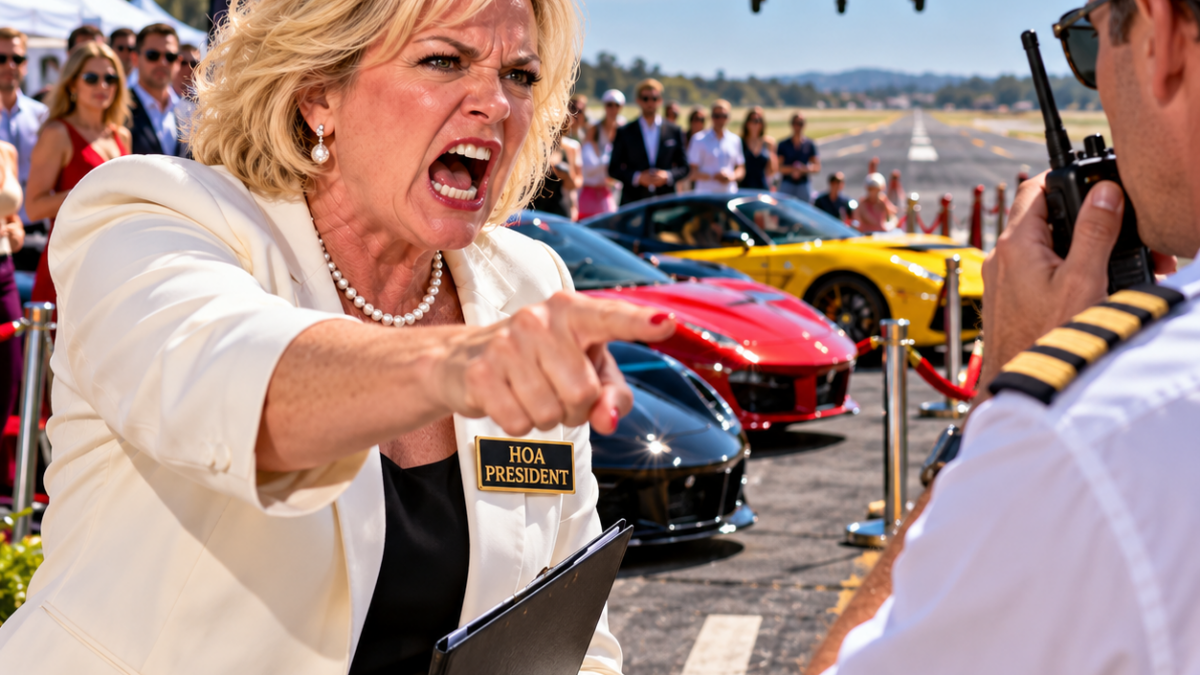
PART 2
I drove straight to the county records office.
I had known June Alvarez, one of the senior clerks there, for years. She had the kind of memory that made computers seem optional. When I gave her the parcel number and asked for every filing connected to Reed Field and Silver Mesa, she disappeared into the archive room without asking why.
Twenty minutes later, she came back carrying two property plats, a permit packet, and a printed scan of the declaration Celeste had shown me.
I sat at a small table beneath fluorescent lights and read it slowly.
DISCONTINUANCE OF AVIATION USE.
The language claimed Walter Reed had surrendered the western approach and agreed the strip would no longer be maintained for aircraft operations.
Dad’s signature sat at the bottom.
Same heavy W.
Same shortened tail on the R.
Same slight downward slant caused by the arthritis in his hand.
June watched me.
“You recognize it.”
“Yes.”
She pulled out a chair.
“So what’s wrong?”
I didn’t answer immediately.
I remembered the last year of Dad’s life.
His hands shook badly by then. I handled his bills. He still insisted on signing certain documents himself because he hated the idea of becoming dependent.
Maybe he had signed this one.
Maybe I had misunderstood the land I thought he left me.
That possibility hurt worse than anything Celeste had said.
Then I noticed two small holes near the top left corner.
I leaned closer.
“June.”
“What?”
“What fasteners did county operations packets use eleven years ago?”
She looked at the page.
“Three-hole metal fasteners, usually.”
“This has staple holes.”
She frowned.
I pointed to a code near the bottom.
TEMP OPS 30.
June enlarged the original scan on her monitor.
My memory clicked into place.
“That summer,” I said.
“What?”
“We had a windstorm. Tore sheet metal off an old equipment shelter and scattered roofing nails all over the runway.”
I remembered Dad standing beside the tractor while I picked nails from the gravel.
We had closed the strip temporarily while replacing the top layer.
Thirty days.
TEMP OPS 30.
“This wasn’t a permanent closure,” I said.
June’s fingers moved quickly over the keyboard.
She searched an older archive index.
Then she stopped.
“There’s an entry.”
“What entry?”
“Temporary operation suspension. Same date.”
“Open it.”
“I can’t.”
“Why?”
“The original attachment is missing.”
I looked at the discontinuance declaration.
“You’re telling me someone replaced it.”
“I’m telling you the index says one thing and the attached document says another.”
“Can you certify that?”
“I can certify what the database contains today. Proving when the attachment changed requires an audit log.”
“How long?”
“Usually a week.”
“I have fifty-six hours.”
June printed the old index entry and initialed the retrieval time.
It was something.
Not enough, but something.
Then she found my own mistake.
She looked at another screen.
“Mason, your annual emergency surface report is still marked Draft.”
My stomach dropped.
“No.”
“Yes.”
“I completed it two weeks ago.”
“You completed it. You didn’t submit it.”
I remembered the evening.
A thunderstorm had knocked out power while I was reviewing the final inspection sheet. I had shut the laptop and gone outside to check the hangar doors.
I never reopened the form.
“When does it expire?”
“Noon tomorrow.”
I rubbed both hands over my face.
That report mattered because Reed Field wasn’t a commercial airport. Its emergency-use status depended on annual surface certification and obstruction reporting.
If mine expired, Celeste’s false declaration would still be false.
But I would lose the clean operational status I needed to fight her event.
“Can I submit it now?”
“You require independent condition verification.”
“I know.”
“You wrote that rule, didn’t you?”
Years earlier, when I worked for the state aeronautics division, I had helped draft rural emergency-strip procedures after several neglected private runways remained listed long after becoming unsafe.
At the time, I had insisted owners should not be allowed to self-certify after a lapse.
Now my own rule had its hand around my throat.
“Yeah,” I said. “I wrote it.”
June almost smiled.
I didn’t.
By the time I got back to Reed Field, asphalt covered nearly two hundred feet of the western approach.
Temporary fencing blocked my normal service lane.
Workers were unloading black crowd barriers and stage components.
The foreman saw me walking in and came over.
His name was Nate Doran.
“I don’t want trouble,” he said.
“Then stop paving my runway.”
“My contract says the HOA controls this zone.”
“Did the contract say it was a runway?”
He hesitated.
“It says abandoned farm road.”
I pointed to the remains of the threshold markings.
“Farm roads usually have those?”
Nate looked over his shoulder.
Then he lowered his voice.
“Celeste told us to scrape the markings.”
“When?”
He didn’t answer.
“When, Nate?”
“Three weeks ago.”
That changed everything.
Silver Mesa had applied for its county event permit only twelve days earlier.
If Celeste had ordered runway markings removed three weeks ago, she had done it before the permit application supposedly concluded the strip was inactive.
“Put that in writing.”
Nate shook his head immediately.
“I have four hundred grand tied up in this event.”
“And if a plane comes in?”
“Celeste says none will.”
I looked at him.
“Do you believe her?”
He stared at the asphalt.
“No.”
That night, I opened the metal cabinet where Dad and I kept flight logs.
Every emergency-use landing had been recorded.
Date.
Aircraft registration.
Reason for landing.
Pilot signature.
The most recent entry was fourteen months earlier.
A medical transport had taken a ranch hand with a crushed pelvis out during a highway closure.
Fourteen months was long enough for Celeste to tell people the runway was dead.
But legal closure and infrequent use were not the same thing.
I pulled the inventory sheet.
Six portable runway lights.
I looked toward the charging cabinet.
Empty.
I walked outside with a flashlight.
Fresh rectangular scars marked the runway shoulders.
The electrical leads had been cut cleanly.
Somebody had removed every light.
I called Tom Bell.
Tom’s hayfield overlooked my western approach.
“Your camera still cover the service road?”
A pause.
“Most of it.”
“I need footage from about three weeks ago.”
“Mason…”
“What?”
“Celeste says this is county-approved.”
“I’m not asking what Celeste says. I’m asking what your camera saw.”
Another pause.
“I’ll look.”
The next morning, Tom arrived with a thumb drive.
We opened it on the computer in my barn.
At 2:26 a.m. on August 17, a flatbed truck came through Silver Mesa’s maintenance gate.
Two men got out.
They removed my runway lights.
Then they loaded several white marker panels.
I froze the frame on the truck door.
DORAN SITEWORKS.
Nate’s company.
The timestamp mattered even more than the theft itself.
The lights had been removed eighteen days before Silver Mesa’s permit application claimed officials inspected an already-unmarked inactive corridor.
I made three copies.
One went to June.
One to my attorney.
One stayed locked beneath my workbench.
I wanted to drive straight to Celeste’s house.
Instead, I waited.
Evidence has strange timing.
Show it too early and the person lying gets time to build a better lie.
Show it too late and their lie becomes asphalt.
I had forty-four hours before the event opening and fifteen hours before my own report deadline.
That Friday morning, Lydia Park arrived from Redmond.
Lydia was a licensed surveyor with no connection to either side.
She set up a base station near my barn and spent hours walking the western approach.
At noon, orange flags cut straight through Silver Mesa’s temporary stage, VIP tent, and display platforms.
She handed me her tablet.
“They’re over your boundary.”
“How far?”
“Seventy-eight feet at the widest point.”
I stared at the overlay.
Celeste’s permit map showed six hundred feet of runway under HOA control.
Lydia enlarged the county plat.
“Look at this drainage notch.”
“I see it.”
“Recorded plat faces northwest.”
Then she opened Silver Mesa’s event plan.
“Their version faces southeast.”
I stared at it.
“They rotated the drawing.”
“One hundred eighty degrees.”
“A mistake?”
“Not with the monument numbers copied correctly.”
She looked at me.
“Whoever did this understood the source map.”
That was worse than I expected.
Lydia signed the boundary report and performed the independent condition verification I needed.
At 11:52 a.m., I submitted my emergency surface report.
Eight minutes before the deadline.
The confirmation message appeared.
I should have felt relieved.
Instead, I felt embarrassed.
The runway was my responsibility.
I had almost let paperwork make Celeste’s lie easier.
Lydia’s inspection also forced me to report every new obstruction.
Stage.
Steel barriers.
Fresh asphalt.
Display platforms.
Reed Field remained registered, but Cascade Medical’s Saturday arrival depended on clearing those hazards.
Under normal circumstances, what we had discovered would have supported an immediate stop-work order.
Silver Mesa’s lawyers made sure circumstances stayed anything but normal.
At county planning, their attorney claimed the HOA possessed an old access license allowing limited control over the disputed strip regardless of the parcel line.
I had never seen the license.
They produced a copy carrying another Walter Reed signature.
The planner scheduled an emergency field review for four o’clock Saturday.
As I left, Celeste was waiting in the hallway.
“You’re making this very expensive for your neighbors.”
“They’re not my neighbors when you send me their bills.”
“They’ll become your problem when assessments double.”
She opened a folder.
Inside was the event cancellation clause.
If Silver Mesa failed to deliver the venue after final setup, it owed the promoter up to $2.8 million in fees, guarantees, and sponsor losses.
“Sell us the western six acres,” she said.
“For how much?”
“Four hundred eighty thousand. We withdraw your fine. Lifetime access to your barn.”
I stared at her.
“You’re offering me access to my own barn.”
“I’m offering you a graceful exit.”
I handed the contract back.
“Cancel your event.”
“No.”
“Move it.”
“There is nowhere to move three hundred guests and eighty-seven vehicles.”
“That sounds like something you should have considered before paving someone else’s runway.”
Her expression hardened.
“By tomorrow evening, those guests will see exactly what I see. An empty road, a rusted windsock, and a man desperately pretending airplanes still need either one.”
She walked away.
But one question stayed with me.
Why would anyone risk $2.8 million on land they didn’t clearly own?
That night, I found my answer in a glass display case.
Silver Mesa’s sales office contained a scale model of its planned expansion.
The existing homes sat on the eastern half.
Along my western boundary were eighteen new villas surrounding a decorative pond.
Where Reed Field existed in real life, the model showed landscaping.
No runway.
But beside those villas stood a miniature hangar.
And on the grass sat a tiny decorative airplane.
A gold plaque read:
AVIATOR RESERVE.
They planned to erase the runway legally while selling the image of aviation access.
The next morning, I drove to High Desert Community Bank.
I did not ask for private loan files.
I asked for the public financing notice tied to Silver Mesa’s expansion.
One sentence changed the entire dispute.
The development facility was secured partly by premium amenities including “direct adjacency to an operational private airstrip.”
Operational.
I read it twice.
If Reed Field was abandoned, Silver Mesa had misrepresented an amenity to its lender.
If Reed Field was active, its permit filings were false.
Celeste needed the runway to be dead for the county and alive for the bank.
Both stories could not survive in the same room.
I gave the bank manager Lydia’s survey, photographs of the construction, the public filing, and the camera stills showing my runway lights being removed.
She stamped a receipt.
“We’ll review the collateral description.”
“Before tonight?”
“I can’t promise that.”
“Someone told your bank the runway was active while telling the county it didn’t exist.”
She looked at the financing notice again.
“I understand.”
At 11:30, Tom called me.
His voice sounded wrong.
“Mason, I need you to delete the camera footage.”
“No.”
“It doesn’t show what I thought.”
“It shows a truck taking my runway lights.”
“They could’ve been HOA fixtures.”
“They were connected to my charging cabinet.”
Silence.
I walked to the barn door and looked across the flats.
A Silver Mesa SUV sat beside Tom’s hay shed.
“What did Celeste offer you?”
“Nothing.”
“What did she threaten?”
His voice dropped.
“I’m not going to testify.”
Tom owed the HOA more than four thousand dollars after his wife’s cancer treatment had pushed their finances behind.
Celeste had offered to erase the debt if he signed an affidavit saying the runway had not been used in ten years and the lights belonged to Silver Mesa.
“I can’t lose this house,” he said.
“Don’t sign anything today.”
“I already did.”
The affidavit reached the county minutes later.
Tom claimed his camera timestamp was unreliable.
He claimed the lights were HOA event equipment.
He claimed no aircraft had used Reed Field in a decade.
At 11:38, my request for an administrative stop was denied pending the field inspection.
Tom called again.
“Can you pay what I owe?”
I closed my eyes.
“No.”
“Then you don’t get to tell me what today costs.”
He hung up.
Machines started outside.
Silver Mesa’s crew paved over the second threshold marker.
That was when I finally understood Celeste’s real strength.
She didn’t need everyone to believe her.
She only needed to know which bill frightened each person most.
At one o’clock, June called.
The county audit log had arrived.
The original temporary suspension scan had been replaced through an outside account.
Kesler Planning Group.
Silver Mesa’s consultant.
The server still contained the original upload, the substituted page, the account that made the change, and the approval trail.
“Lock it,” I said.
“Already did.”
For the first time in two days, I smiled.
By three o’clock Saturday, Silver Mesa looked like someone had built a television commercial on top of my runway.
Exotic cars sat beneath white covers.
Banners concealed the remaining markings.
A catering tent blocked the eastern turnaround.
Music played from speakers beside Lydia’s survey flags.
Celeste waited near the stage with two attorneys and a county planner.
The state sent aviation safety inspector Daniel Cho.
He stepped out of his vehicle carrying a tablet and measuring wheel.
Celeste approached him first.
“This is Mason Reed,” she said. “He insists this dirt road qualifies as aviation infrastructure.”
Daniel looked at me.
His eyebrows lifted.
“Mason?”
“Daniel.”
Celeste looked between us.
“You know each other?”
Daniel set down the wheel.
“Mr. Reed wrote part of the rural-strip procedure we use.”
The area went quiet.
“He also trained my first inspection team.”
I had spent eighteen years with the state aeronautics division.
I inspected rural strips.
Reviewed approach corridors.
Investigated surface failures.
Helped write emergency-use standards.
Then my wife died.
Dad’s health declined.
I left state service and came home.
I never hid that history.
Celeste simply never bothered asking who the man in the leaking barn had been before she decided what he was worth.
“This inspection is compromised,” she snapped.
“No,” I said. “Daniel follows the published checklist. I stay out of his way.”
Daniel looked at me.
“And because we know each other, I’m documenting every defect on your side too.”
“Good.”
The inspection lasted nearly an hour.
The original compacted runway base remained intact.
The emergency-use registration had never been cancelled.
My Friday filing preserved its status.
Daniel did find one problem I had missed.
The eastern windsock light had failed.
Its backup battery was dead.
He wrote it down.
I signed the acknowledgment.
My previous job did not make Reed Field perfect.
And I wasn’t going to ask Daniel to pretend otherwise.
Then he examined the removed lights.
“Maintenance violations caused by removal,” he said. “Not evidence of abandonment.”
Celeste crossed her arms.
“We dispute who owned them.”
Daniel pointed toward the stage.
“That won’t matter for this.”
The emergency easement required a clear approach corridor.
Silver Mesa’s platforms and barriers violated it regardless of the parcel dispute.
The county planner stared at the event plan.
“Our permit assumed non-aviation property.”
Celeste pointed at me.
“He manufactured this status.”
Daniel looked at the state database.
“No. Registration remained valid.”
“He hasn’t had an aircraft land here in fourteen months.”
“Frequency does not determine validity. Closure does.”
“Then close it.”
Daniel looked toward me.
“That application would have to come from the owner.”
Everyone turned.
I said nothing.
Celeste’s attorneys pulled her aside.
Twenty minutes later, she returned with a proposal.
Silver Mesa would remove some platforms and leave a forty-foot lane down the runway.
In exchange, I would sign a statement acknowledging Reed Field was inactive for ordinary use.
Daniel rejected it before I could.
“Forty feet is unsafe.”
Celeste looked at him.
“You haven’t even measured the aircraft.”
“I don’t need to. The listed medical aircraft has a wingspan over fifty feet, and your lane is bordered by rigid obstacles.”
She turned toward the county planner.
“We have a valid event permit.”
“Not anymore.”
He handed her a written suspension.
Celeste did not take it.
Her phone rang.
She walked away.
When she returned, she had lost the calm expression she had worn since Thursday.
“Open the gates at five fifteen.”
Her event manager blinked.
“We were scheduled for six.”
“Five fifteen.”
I understood instantly.
The event contract activated once the first paid guest entered the venue.
She wasn’t saving the party.
She was trying to hit the contractual milestone before the suspension reached every vendor and security checkpoint.
At 4:52, covers came off the cars.
At 5:03, security opened the entrance.
At 5:07, Celeste’s phone buzzed.
She read the screen.
Her face went pale.
High Desert Community Bank had frozen Silver Mesa’s next construction draw.
I thought that would stop her.
It didn’t.
Instead, she ordered security to block my runway access.
Guests flowed through the gates.
They walked across my centerline holding champagne glasses.
A host welcomed them to the first annual Silver Mesa Legends Weekend.
He described my runway as a “transformed agricultural corridor.”
My attorney was seeking an emergency injunction.
The nearest available judge was reviewing it remotely.
The law was moving at the speed of documents.
Celeste was moving at the speed of a microphone.
Then Nate slipped through the service gate.
He handed me his phone.
“She threatened to charge every delay to my company,” he said. “So I searched the original job folder.”
An email filled the screen.
From Celeste Ward.
Sent eighteen days before the permit application.
Remove aviation lights and bury white markers before inspection. Once guests enter opening day, old use will be impossible to restore without major loss.
I read it twice.
“You sent this to county counsel?”
“Full headers. Attachments. Everything.”
For the first time, the intent was in writing.
Not a drafting error.
Not a misunderstanding.
Not a neighbor dispute.
She had ordered evidence of an active runway removed before claiming the runway was inactive.
At 5:19, Tom appeared.
He looked exhausted.
He handed me a notarized statement.
“I signed a lie this morning.”
I opened it.
The statement confirmed his camera timestamp.
It confirmed the footage was unedited.
And attached to it was Celeste’s written offer to forgive his HOA debt in exchange for his earlier affidavit.
“What about your house?” I asked.
“They reinstated everything. Filed a lien notice.”
“Tom…”
“My wife read the agreement.”
He swallowed.
“She said if we saved the house by helping Celeste steal yours, we’d spend every morning knowing who really owned us.”
Tom looked toward the event.
“Celeste made one mistake.”
“What?”
“She sent the offer by email.”
By then, we had the whole ladder.
The altered county record.
The rotated site plan.
The stolen lights.
The public financing contradiction.
Celeste’s instruction.
Tom’s inducement.
The survey.
The state registration.
It was enough to destroy her case eventually.
Eventually.
But my runway was still full of cars.
At 5:26, the radio inside my truck came alive.
“Reed Field, Reed Field, this is Cascade Medical Two-Seven. Anybody monitoring?”
I grabbed the microphone.
“Cascade Two-Seven, Reed Field ground. Go ahead.”
The pilot’s voice was steady.
The engine noise behind it was not.
“We have fluctuating oil pressure and rising temperature. Two souls plus one medical patient. Bend is beyond safe endurance. Request immediate landing conditions Reed Field.”
I looked down the runway.
Eighty-seven vehicles.
Two stages.
Steel barriers.
A catering truck.
Nearly three hundred people.
“Cascade Two-Seven, runway obstructed. State altitude and time available.”
“Seven thousand two hundred, descending. Estimate twelve minutes before seizure risk. Highway option appears congested.”
For two days, Reed Field had been paperwork.
Property.
Financing.
Pride.
At that moment, it became twelve minutes of ground beneath a failing airplane.
I turned to Celeste.
She had heard the call through a security handset.
“Clear the runway.”
She stared at me.
“We don’t know if that call is real.”
Daniel raised his tablet.
“The aircraft is on the state feed.”
Celeste looked at him.
“Send them to the regional airport.”
“They may not make it.”
The promoter came over.
“How much runway?”
“At least twenty-five hundred feet clear,” I said. “More if the engine quits before touchdown.”
Celeste pointed at the narrow lane between the cars.
“He says it’s a runway. Let them use the center.”
“The aircraft is fifty-two feet wide.”
“Then move the cars nearest the lane.”
“No. Every car moves.”
The promoter stared at her.
“You represented this property as free of aviation restrictions.”
“It is.”
Daniel held up the state listing.
“No, ma’am. It isn’t.”
Celeste pointed at me.
“This is his stunt.”
I stepped closer.
“You can accuse me after that aircraft is on the ground.”
I checked my watch.
“Right now, you have eleven minutes.”
She ordered security to keep the gates shut.
That was the last meaningful order anyone obeyed from her.
I walked to the event sound console.
The host tried to stop me.
“What are you doing?”
I unplugged his microphone and connected the emergency transmitter from my truck.
Years earlier, I had required a temporary emergency-address system for gatherings near rural aviation corridors.
Celeste had mocked the requirement during planning.
Fortunately, her staff had left the connection port installed.
My voice came through every speaker.
“Attention. An aircraft carrying a medical patient has declared an emergency and is approaching Reed Field from the southwest. This is not a demonstration. Move every vehicle to the eastern service road immediately. Leave keys in the ignition if necessary. All guests move behind the stone wall and remain there.”
Nobody moved.
Not for the first second.
Then someone pointed toward the ridge.
A small aircraft was visible in the distance.
The crowd changed instantly.
Engines started.
Guests abandoned drinks.
Owners ran toward their cars.
Workers dragged barriers aside.
Nate climbed into a loader and rammed the western stage backward.
Electrical cables tore from the ground.
Celeste ran toward him.
“If you damage that platform, your company pays!”
Nate kept moving.
“If I leave it there, my company gets hit by an airplane!”
The first row cleared in ninety seconds.
The second jammed at the service gate because Silver Mesa’s access system required every vehicle tag to scan individually.
I grabbed bolt cutters from my truck.
Celeste saw me.
“That gate is HOA property!”
“The posts are on my survey line.”
I cut the chain.
The gate swung open.
Cars poured through.
Daniel and Lydia moved guests behind the barn.
Tom drove his tractor toward the catering trailer.
The county planner called fire dispatch.
I raised the radio.
“Cascade Two-Seven, wind two-five-five at nine. Runway two-four. First two thousand feet clearing now. Fresh asphalt western threshold. Possible loose debris midfield.”
“Copy Reed Field. Oil temperature redline. We may lose power on final.”
“Stay high over the ridge. Rising terrain north and east. Best approach southwest over Bell’s field.”
“Understood.”
Eight minutes.
One silver coupe refused to start.
Its owner repeatedly pressed the ignition.
Nothing.
Four people tried to push it.
Electronic transmission lock.
Nate approached with the loader.
The owner stepped in front.
“No. Absolutely not. That car is worth nine hundred thousand dollars.”
I looked toward the approaching aircraft.
Then back at him.
“You can own a scratched car or explain why your perfect car was sitting where three people needed to land.”
He moved.
Nate slipped padded straps beneath the front frame.
The loader dragged the coupe into the grass.
Its bumper cracked against a display stand.
Nobody cared.
At midfield, we found a worse problem.
The stage crew had drilled steel anchors straight through the runway base.
Moving the platform left eight rods sticking up.
I dropped to one knee with a cutter.
Nate ran back carrying a battery grinder.
Sparks sprayed across the asphalt.
Five minutes.
One rod.
Two.
Three.
The aircraft crossed the ridge lower than I wanted.
A thin blue haze trailed from the left engine.
Four.
Five.
Six.
Daniel shouted from behind the wall.
“Three-mile final!”
Seven.
The grinder battery began to fade.
“Come on,” Nate muttered.
The eighth rod finally dropped.
I ran the centerline.
Kicked a cable aside.
Dragged one section of barrier farther into the grass.
The radio sounded.
“Reed Field, Cascade Two-Seven. Three-mile final.”
“Runway clear. Landing at pilot’s discretion. Emergency units four minutes out.”
Static.
Then the pilot’s voice.
“We’ve lost the engine.”
The propeller slowed.
The airplane came over Tom’s field in near silence.
No engine roar.
Only wind.
Its nose drifted left in the crosswind.
Corrected.
Landing gear down.
I watched it cross the western fence by less than fifty feet.
The tires hit fresh asphalt.
The aircraft bounced once.
Settled.
Brakes.
Hard.
It rolled across the scraped white marker and past where the stage anchors had been.
Then stopped.
One hundred eighty feet short of the catering tent.
Nobody cheered.
Not immediately.
We were too stunned.
The cabin door opened.
A flight nurse climbed out.
Behind her was a twelve-year-old girl being transferred for emergency cardiac treatment after firefighting operations temporarily affected the regional airport.
She was conscious.
Stable.
Alive.
I never asked her name that afternoon.
I didn’t need to.
Reed Field had just answered the question Celeste had spent two days trying to erase.
The runway was still needed.
Fire crews arrived.
Mechanics inspected the aircraft.
The left engine had lost most of its oil through a failed line.
Investigators later confirmed the pilot could not safely have reached Bend.
I knew the emergency didn’t prove ownership.
An airplane landing on land doesn’t create a deed.
Emotion doesn’t replace a survey.
I had spent too many years in aviation enforcement to pretend otherwise.
But the landing proved the danger of what Celeste had done.
While paramedics transferred the girl to an ambulance, the event promoter confronted Celeste in front of dozens of guests.
“You told us there were no aviation restrictions.”
She pointed toward me.
“He staged this.”
The pilot heard her.
He walked over carrying part of the failed oil line.
“Ma’am.”
Celeste turned.
“I did not destroy an engine to interfere with your car show.”
Silence.
Even Celeste seemed to realize how absurd her accusation sounded when the pilot said it aloud.
At 6:18, my attorney called.
The emergency injunction had been granted.
At 6:24, High Desert Community Bank placed Silver Mesa’s construction facility on a compliance hold.
The $2.8 million event ended with half its cars scattered in a hayfield and a medical aircraft cooling on my centerline.
Three weeks later, the county held a public hearing inside the Silver Mesa clubhouse.
Every chair was filled.
Celeste sat beside her attorney.
She looked smaller without construction crews, security guards, and contracts moving around her.
Her lawyer opened with the emergency landing.
“A dramatic event cannot determine ownership.”
My attorney stood.
“We agree.”
That seemed to surprise them.
He didn’t begin with the twelve-year-old patient.
He began with Lydia’s survey.
The actual monuments.
The seventy-eight-foot encroachment.
The rotated permit map.
Then June presented the original archive index showing Walter Reed had signed a temporary thirty-day suspension, not a permanent discontinuance.
The county IT administrator authenticated the audit log.
The original document had been replaced.
The replacement came through Kesler Planning Group’s account.
Next came Tom’s camera footage.
The truck.
The lights.
The date.
Nate testified that Celeste ordered his crew to remove aviation markers before the permit inspection.
Then county counsel displayed her email.
Remove aviation lights and bury white markers before inspection.
Nobody spoke while it remained projected on the wall.
Celeste’s attorney tried.
“My client relied on consultants.”
Nate shook his head.
“That email came from her.”
Then the bank’s public financing notice appeared.
DIRECT ADJACENCY TO AN OPERATIONAL PRIVATE AIRSTRIP.
The hearing officer looked at Celeste.
“You represented the airstrip to the lender as operational.”
Her lawyer objected.
The officer continued.
“You represented it to the county as abandoned.”
No answer.
Tom testified last among the property witnesses.
He stood with both hands gripping the podium.
“I signed a false affidavit.”
Celeste stared straight ahead.
“I was afraid of losing my house,” Tom continued. “Mrs. Ward didn’t invent that fear. She used it.”
He produced her written debt-forgiveness offer.
“My signature was still mine. What I signed was still a lie.”
Only after the ownership record was established did the medevac pilot testify.
He described the falling oil pressure.
The rising temperature.
The twelve-minute estimate.
The engine failure on final.
He did not dramatize it.
He didn’t need to.
The hearing officer voided Silver Mesa’s event permit.
My boundary was upheld.
The altered county filing was referred for investigation.
The planned eighteen-villa Aviator Reserve expansion was rejected pending full title and compliance review.
The bank demanded an independent audit before releasing additional construction funds.
Celeste resigned as HOA president that evening.
The residents held their recall vote anyway.
They removed her by a wide margin.
The temporary board cancelled the fine Silver Mesa had issued against me.
Auditors also reviewed Tom’s account and found improper legal charges mixed into his HOA debt.
Not every financial consequence vanished.
The association had signed legitimate contracts through its elected board.
Some restoration expenses became a smaller special assessment.
I knew several residents resented me for that.
I understood.
Nobody enjoys paying for damage they didn’t personally cause.
But pretending the damage didn’t exist would only have created another lie.
A month later, the black event asphalt was removed from the western threshold.
The compacted gravel underneath was repaired.
New white markers went down.
Six replacement lights returned to the shoulders.
The windsock received a new light and battery.
I kept one of the cut stage anchors.
It sits on my workbench today.
Not as a trophy.
As a reminder of how permanent something can look right before it gets removed.
The damaged medical aircraft remained in my barn for nine days while mechanics replaced the engine.
Every morning I walked past it and remembered the sound of that propeller slowing over Tom’s field.
Or more accurately, the lack of sound.
After everything Silver Mesa had done, I could have closed Reed Field.
The easement allowed me to restrict future use if maintenance became unreasonable.
I could have installed a gate.
Filed permanent closure paperwork.
Let every future aircraft use the regional airport.
No one would have blamed me.
Instead, I called Daniel.
“I want a new agreement.”
“With who?”
“The county.”
“For what?”
“Emergency use.”
He was quiet.
“You sure?”
“No.”
He laughed once.
“That’s probably the most honest answer you’ve given me.”
The final agreement was one page.
The county would maintain the emergency lighting, windsock, and annual surface inspection.
Medical and public-safety aircraft could use Reed Field without charge.
Recreational flights still required my permission.
Silver Mesa received no ownership interest.
No event rights.
No authority to close, obstruct, pave, lease, advertise, or schedule anything on the runway.
Ownership stayed with me.
Responsibility was shared only where public benefit actually existed.
Tom eventually came by while I was replacing a cabinet hinge.
He stood in the barn doorway for almost a minute before speaking.
“I’m sorry.”
I kept working.
“I know.”
“That’s it?”
“What do you want me to say?”
He looked toward the runway.
“I signed against you.”
“You were scared.”
“That doesn’t make it right.”
“No.”
He nodded.
“I keep thinking about that.”
“So do I.”
He looked at me.
I set down the screwdriver.
“You came back.”
“That doesn’t erase it.”
“No. But it matters.”
We never became close friends after that.
Some things don’t return to what they were.
But when I needed help reseeding the disturbed western field that autumn, Tom arrived with his tractor before I asked.
That was enough.
The twelve-year-old girl reached the hospital by ambulance after the emergency landing.
Months later, an envelope arrived at Reed Field.
Inside was a photograph.
She was standing beside a small model airplane.
On the back she had written:
Thank you for keeping a place to land.
I carried the photograph into the barn.
Dad’s old runway log was still inside the metal cabinet.
I opened it near the back.
His final entry was written in the same heavy hand Celeste had tried to turn against me.
I placed the photograph beside it.
Outside, the restored runway looked exactly as unimpressive as it had before.
Pale gravel.
White markings.
A windsock turning in the high-desert wind.
No champagne tents.
No exotic cars.
No decorative entrance.
Nothing worth $2.8 million to anyone looking for spectacle.
And that was fine with me.
Some land becomes valuable because people build something expensive on it.
Reed Field had value for the opposite reason.
It stayed open.
Maintained.
Unremarkable.
Waiting.
The place where Silver Mesa wanted eighteen villas grew native bunchgrass again.
The runway remained where Dad had put it.
And whenever I see the new edge lights glowing at dusk, I remember that afternoon when nearly three hundred people were moving million-dollar cars as fast as they could because one small aircraft had nowhere else to go.
Celeste had looked at those six acres and seen collateral.
My father had looked at the same ground and seen a place a stranger might someday need.
For a while, paperwork almost made her version of the land more powerful than his.
But the last word never came from a lawyer, an HOA board, or even a judge.
It came from a pilot descending over the ridge with a dying engine, asking a simple question over the radio.
“Reed Field, are you available?”
And because my father had kept that strip open—and because I had refused to let someone quietly erase it—the answer was still yes.
At five o’clock on a Thursday morning, I woke to diesel engines grinding across the emergency runway my father had spent forty-three years keeping open, and by the time I reached the field, an HOA construction crew was already covering the first landing marker with black asphalt.
The woman directing them calmly told me the runway had been legally abandoned, handed me paperwork carrying my dead father’s signature, and warned that if I interfered with her $2.8 million luxury car event, I would be the one paying for every minute of delay.
Then a medical aircraft called my radio to confirm its Saturday arrival, and the look on her face told me this fight had never really been about an abandoned strip of gravel.
My name is Mason Reed, and Reed Field sits behind my maintenance barn in the Oregon high desert.
Nobody driving past it would mistake it for a commercial airport.
It was 3,200 feet of compacted gravel, two faded white threshold crosses, six portable edge lights, a windsock, and enough clear approach space for crop dusters, utility planes, and small medical transports.
My father, Walter, built it decades earlier after a ranch hand was nearly killed waiting for help.
The man had been crushed beneath a piece of farm equipment. A helicopter tried to come through the ridge but turned back because of wind and poor visibility. The nearest ambulance took hours over bad roads.
Dad never forgot the helplessness of standing there with an injured man and nowhere for an aircraft to land.
So he built somewhere.
By the time I drove my pickup onto the western end of the strip that Thursday morning, two asphalt trucks were already backing toward the centerline.
A road grader had scraped away half of one white cross.
Workers in reflective vests were driving steel stakes into the shoulders.
A temporary sign had been planted beside my fence.
SILVER MESA LEGENDS WEEKEND
PRIVATE AUTO EXPERIENCE
I stopped my truck directly in front of the grader.
The foreman killed the engine and climbed down.
Before he reached me, a white SUV came over the rise.
Celeste Ward stepped out wearing a red suit that looked absurdly clean for a construction site.
She was president of Silver Mesa, the gated development that had appeared along my eastern boundary five years earlier.
From the beginning, she had treated Reed Field like a stain somebody had forgotten to remove.
First my barn was “visual blight.”
Then my windsock became “unauthorized signage.”
Then I received notices complaining about aircraft noise from planes that landed less than once every few months.
I had ignored most of it.
This was different.
“Move your truck, Mr. Reed.”
I pointed behind her.
“You’re paving an active emergency strip.”
She opened a leather folder and pulled out a stamped county permit.
“County records say this runway was abandoned ten years ago.”
“It was not.”
“That isn’t what the filing says.”
“It also isn’t Silver Mesa property.”
She held the permit toward me.
“Then you have until Saturday at five to prove it.”
I took the paper.
The site map shaded the western portion of my runway as an “inactive utility corridor” inside the HOA event boundary.
“That boundary is wrong.”
“The county approved it.”
“My deed doesn’t.”
Her expression barely changed.
“Your deed isn’t the document controlling this improvement.”
“Improvement?”
She glanced toward the asphalt truck.
“By Saturday afternoon, this becomes part of the Silver Mesa Legends venue.”
“You’re holding a car show on my emergency runway.”
“It stopped being a runway a decade ago.”
I was about to answer when the radio inside my pickup crackled.
“Reed Field, Cascade Medical Two-Seven conducting Saturday route check. Confirm availability for seventeen-thirty arrival.”
I turned toward the cab.
Celeste moved faster.
She reached through the open passenger window, grabbed the microphone, and switched the radio off.
I stared at her.
It was such a small action.
That was what made it revealing.
She wasn’t surprised by the call.
She wasn’t confused about what Reed Field was.
She wanted the call silenced.
“You knew.”
She calmly put the microphone back.
“I know this property is no longer certified for aviation use.”
I picked it up and turned the radio back on.
“Cascade Two-Seven, Reed Field ground. Runway temporarily obstructed. I’ll confirm Saturday status by noon tomorrow.”
“Copy, Reed Field.”
Celeste waited for the transmission to end.
Then she looked at my barn.
“You repair crop dusters under a leaking roof. You don’t decide what qualifies as aviation infrastructure.”
Normally that sentence would have made me angry.
Instead, something on the permit caught my attention.
A document number.
Beneath it was a declaration supposedly filed eleven years earlier discontinuing aviation use of Reed Field.
At the bottom was my father’s signature.
Walter Reed.
The signature looked real.
That was worse than a bad forgery.
Dad had died nine years earlier. During his last year, medication and exhaustion had made paperwork difficult. I handled most of his bills and county notices, but not every piece of paper passed through my hands.
For one uncomfortable second, I wondered whether he had signed away the runway without telling me.
Celeste noticed my hesitation.
“Saturday. Five o’clock.”
She turned toward the grader.
The engine restarted.
I stepped toward her.
“Stop the work until I verify that declaration.”
“The permit is active.”
“You’re destroying a registered emergency strip.”
“I’m improving community property.”
“It isn’t community property.”
“Then prove it.”
The asphalt truck released its first load.
Black pavement rolled across the pale gravel where my father’s landing marker had been visible since I was a teenager.
I watched it disappear.
Then I drove straight to the county records office.
June Alvarez was working behind the counter when I walked in.
She knew me from my years dealing with aviation filings.
“What happened to you?”
I looked down.
Dust covered my boots and the knees of my jeans.
“Silver Mesa is paving Reed Field.”
She stopped typing.
“They’re what?”
“I need every record tied to the property. Especially anything filed eleven years ago.”
Twenty minutes later, June returned with plats, permits, archived scans, and the declaration Celeste had shown me.
I sat beneath fluorescent lights and studied it.
DISCONTINUANCE OF AVIATION USE.
The text claimed my father had surrendered the western approach corridor and discontinued operation permanently.
His signature appeared at the bottom.
Same heavy W.
Same short tail on the R.
Same slight downward drift caused by arthritis.
June pulled out a chair.
“You recognize it.”
“Yes.”
“So what’s wrong?”
I didn’t know yet.
That was the problem.
Dad had been stubborn enough to sign things without telling me.
Maybe he had decided the runway was too expensive.
Maybe there was something I had missed while caring for him.
I turned the page over.
Two tiny holes were visible near the upper corner.
“June, what kind of fasteners were county operation packets using that year?”
“Usually three-hole metal fasteners.”
“This has staple holes.”
She leaned closer.
Then I noticed a code near the bottom.
TEMP OPS 30.
My memory snapped into place.
“That summer.”
“What about it?”
“A windstorm tore sheet metal off one of the old shelters. Roofing nails went everywhere.”
I could see Dad again, moving slowly behind the tractor while I picked nails from the gravel.
“We closed the runway for a month while we resurfaced.”
June typed into the archive index.
Then she stopped.
“There’s an entry.”
“What does it say?”
“Temporary operation suspension.”
“How long?”
“Thirty days.”
“Open the attachment.”
She clicked.
Nothing happened.
She tried another archive.
“The original scan is missing.”
I looked back at the declaration.
“So somebody replaced it.”
“I can tell you the index and attachment don’t match. Proving who changed it requires the server audit.”
“How long?”
“Normally a week.”
“I have until Saturday.”
June printed the original index entry and initialed the retrieval time.
It wasn’t enough to stop construction.
But it was the first crack.
Then she found something that made the situation worse.
“Mason.”
Her tone changed.
“What?”
“Your annual emergency surface report is still marked Draft.”
My stomach tightened.
“No. I completed that two weeks ago.”
“You completed it. You didn’t submit it.”
I remembered exactly what had happened.
A power outage hit while I was doing the final review. I closed the laptop and went outside to secure the barn.
I never reopened the form.
“When does it expire?”
“Noon tomorrow.”
That hurt because I had helped write the rule.
Years earlier, during my eighteen years with the state aeronautics division, I had argued that rural emergency-strip owners should not be allowed to keep operational status without current inspections.
I had insisted on independent verification after a lapse.
Now that same rule was sitting between me and the runway my father built.
“Can I submit now?”
“Not without independent condition verification.”
“I know.”
June looked at me for a moment.
“You wrote that requirement, didn’t you?”
“Part of it.”
“That’s cruel.”
“No. It’s correct.”
And that was what made it worse.
When I returned to Reed Field, asphalt covered almost two hundred feet of the western threshold.
Temporary fencing blocked my service road.
Black steel barriers were stacked near the runway shoulder.
Workers were assembling part of a stage.
The foreman came toward me.
His name was Nate Doran.
“I don’t want trouble.”
“Then stop paving.”
“My contract says the HOA controls this zone.”
“Does your contract mention a runway?”
He hesitated.
“It calls it an abandoned farm road.”
I pointed toward the remains of the white threshold marker.
“Farm roads have aviation markings now?”
Nate looked over his shoulder.
Then he lowered his voice.
“Celeste told us to scrape those off.”
“When?”
He hesitated again.
“When?”
“About three weeks ago.”
I felt something shift.
Silver Mesa had applied for the event permit only twelve days earlier.
“You removed the markers before the permit application?”
“I didn’t personally.”
“But your crew did.”
“Yes.”
“Put that in writing.”
Nate immediately shook his head.
“I have four hundred thousand dollars tied to this job.”
“And if a plane tries to land?”
“Celeste says none will.”
“Do you believe her?”
He stared at the asphalt.
“No.”
That night I went through Dad’s old runway logs.
Every emergency landing had been recorded.
Date.
Aircraft number.
Reason.
Pilot signature.
The most recent entry was fourteen months earlier, when a medevac plane carried a ranch hand with a crushed pelvis out during a highway closure.
Fourteen months was a long enough silence for Celeste to call the runway dead.
Then I checked the equipment inventory.
Six portable edge lights.
All missing.
I walked the shoulders with a flashlight.
Fresh rectangular scars marked where they had been mounted.
The copper leads had been cut cleanly.
Someone had removed them deliberately.
At nine that night, I called my neighbor, Tom Bell.
His hayfield overlooked the western approach.
“You still have that security camera on the service road?”
A pause.
“Most of it.”
“I need footage from three weeks ago.”
“Mason…”
“What?”
“Celeste says the project is legal.”
“I’m not asking what Celeste says. I’m asking what your camera saw.”
He finally agreed.
The next morning, Tom arrived carrying a thumb drive.
At 2:26 a.m. on August 17, the footage showed a flatbed truck entering from Silver Mesa.
Two men loaded all six runway lights and several white marker panels.
The truck door carried Nate’s company logo.
But the timing mattered even more.
The equipment was removed eighteen days before the permit application claimed officials had inspected an already-unmarked, inactive strip.
I copied the video three times.
One copy went to June.
One went to my attorney.
One stayed locked in my barn.
I wanted to confront Celeste immediately.
I didn’t.
Evidence has timing.
Show it too early and the other side changes its story.
Show it too late and their story becomes concrete.
Friday morning, Lydia Park arrived.
She was a licensed surveyor from Redmond with no connection to either side.
She set a base station near my barn and spent hours walking the disputed western end.
Orange survey flags slowly appeared through Silver Mesa’s temporary stage, VIP tent, and display platforms.
At noon, she showed me the overlay.
“They crossed your line.”
“How far?”
“Seventy-eight feet at the widest point.”
I studied Silver Mesa’s event map beside the official plat.
Lydia pointed at a drainage notch.
“Look here.”
“I see it.”
“The recorded plat faces northwest. Their permit version faces southeast.”
“They rotated the drawing.”
“One hundred eighty degrees.”
“Could that happen accidentally?”
“Not with the monument numbers copied correctly.”
She looked directly at me.
“Whoever prepared this understood the original map.”
Lydia signed both the boundary survey and my runway condition verification.
At 11:52 a.m., I submitted my emergency surface report.
Eight minutes before the deadline.
Reed Field remained registered.
But the report also forced me to list every new obstruction.
Stage.
Barriers.
Fresh asphalt.
Display platforms.
Cascade Medical was scheduled to arrive Saturday evening.
Unless those obstacles were removed, the runway might exist legally and still be useless physically.
County planning scheduled an emergency field review for four o’clock Saturday.
When I stepped into the hallway afterward, Celeste was waiting.
“You’re making this expensive for everyone.”
“They’re not my neighbors when you send me their bill.”
“They will be when their assessments double.”
She opened a folder and showed me a contract clause.
If the venue became unavailable after final setup, Silver Mesa could owe the promoter $2.8 million in cancellation fees, guarantees, sponsor losses, and logistics costs.
Then she made me an offer.
“Sell us the western six acres. Four hundred eighty thousand dollars. We withdraw your fine and guarantee lifetime access to your barn.”
I stared at her.
“You’re offering me access to my own barn.”
“I’m offering you an exit.”
“Cancel the event.”
“No.”
“Move it.”
“There is nowhere to move three hundred guests and eighty-seven vehicles.”
“That sounds like a planning problem.”
Her smile disappeared.
“By tomorrow night, those guests will see what I see. An old strip of gravel nobody uses and one man who refuses to accept that the world moved on.”
She walked away.
But something bothered me.
Why would Silver Mesa risk $2.8 million on land they didn’t clearly control?
That night, I went to their sales office.
Through the glass, I could see a scale model of the planned expansion.
Eighteen villas curved around a decorative pond on the western edge.
Exactly where my runway existed.
A gold plaque read:
AVIATOR RESERVE.
There was no runway on the model.
But there was a miniature hangar.
And a decorative airplane.
They planned to destroy actual aviation access while selling buyers the image of living beside an airstrip.
The next morning, I drove to High Desert Community Bank.
Public financing records tied to Silver Mesa’s expansion included a description of the development’s premium amenities.
One sentence stopped me cold.
DIRECT ADJACENCY TO AN OPERATIONAL PRIVATE AIRSTRIP.
Operational.
To the county, Celeste claimed Reed Field had been abandoned ten years earlier.
To the lender, Silver Mesa was using the same runway to support the value of future development.
Both statements could not be true.
I gave the bank manager copies of Lydia’s survey, the camera stills, and the public filing.
“We’ll review this,” she said.
“Before tonight?”
“I can’t promise.”
“Somebody told you the runway was active while telling the county it didn’t exist.”
She looked down at the financing notice.
“I understand.”
At 11:30, Tom called.
“Mason, I need you to delete that camera footage.”
“No.”
“It might not show what I thought.”
“It shows a truck taking my runway lights.”
“They could be HOA fixtures.”
“They were wired into my charging system.”
Silence.
I stepped outside.
Across the flats, a Silver Mesa SUV was parked beside Tom’s hay shed.
“What did Celeste offer you?”
“Nothing.”
“Then what did she threaten?”
Tom’s voice dropped.
“I’m not testifying.”
He owed the HOA more than four thousand dollars after his wife’s cancer treatment had put them behind on payments.
Celeste offered to erase the debt if he signed an affidavit saying the runway had been unused for ten years and the lights belonged to the association.
“I can’t lose my house,” he said.
“Don’t sign.”
“I already did.”
His affidavit reached the county minutes later.
My emergency stop request was denied.
Tom called again.
“Can you pay what I owe?”
I couldn’t.
“Then you don’t get to tell me what today costs.”
He hung up.
I was angry.
But beneath the anger, I understood what Celeste was doing.
She didn’t need everyone to admire her.
She only needed to know which bill each person feared.
At one o’clock, June called.
The server audit had arrived early.
The original temporary-closure document had been replaced through an external account belonging to Kesler Planning Group.
Silver Mesa’s consultant.
The audit preserved the original upload, the substituted document, and the approval trail.
“Lock it,” I said.
“Already done.”
By three Saturday afternoon, Reed Field looked like a luxury commercial.
Exotic cars sat beneath white covers.
Banners hid the remaining runway markings.
A catering tent blocked the eastern turnaround.
Music played beside Lydia’s boundary flags.
Celeste stood near the stage with lawyers and county officials.
Then the state inspector arrived.
Daniel Cho stepped out carrying a tablet and measuring wheel.
Celeste approached him.
“This is Mason Reed. He believes this dirt road is an airport.”
Daniel looked at me.
“Mason?”
“Daniel.”
Celeste turned between us.
“You know each other?”
Daniel put down the wheel.
“He wrote part of the rural-strip procedure we use.”
The area went silent.
“He also trained my first inspection team.”
I had never told Celeste about my eighteen years with state aeronautics because she had never asked.
She saw an old barn, work boots, and crop dusters.
She decided she understood the man standing beside them.
“This inspection is compromised,” she snapped.
“No,” I said. “Daniel follows the procedure. I stay out of his way.”
Daniel nodded.
“And because I know him, I’m documenting every problem on his side too.”
The inspection confirmed the original runway base remained intact.
My registration had never been cancelled.
My Friday filing preserved operational status.
Daniel also found something I had missed.
The eastern windsock light had failed.
Its backup battery was dead.
He wrote it down.
I accepted it.
My past job did not make my runway perfect.
Then Daniel examined the missing lights.
“Their removal created a maintenance defect. It does not prove abandonment.”
More importantly, Silver Mesa’s stage and barriers violated the protected emergency approach corridor.
The county planner looked at Celeste.
“Our permit assumed this was non-aviation property.”
“He manufactured the status,” she said.
Daniel opened the state listing.
“No. Registration remained continuous.”
“No plane has landed in fourteen months.”
“Frequency doesn’t determine legal closure.”
“Then close it.”
Daniel turned toward me.
“That request must come from the owner.”
I said nothing.
At 4:30, Celeste offered to leave a forty-foot lane between the vehicles if I signed a statement acknowledging the runway as inactive for normal use.
Daniel rejected it immediately.
“The medical aircraft listed for tonight has a wingspan over fifty feet.”
Celeste’s jaw tightened.
The county planner handed her a written suspension.
She refused to take it.
Then her phone rang.
She listened.
When she returned, her controlled expression was gone.
“Open the gates at five fifteen.”
Her event manager blinked.
“We open at six.”
“Five fifteen.”
I understood.
Once the first paying guest entered, a contractual acceptance clause activated.
She was trying to lock the promoter into the venue before everyone received the suspension.
At 5:03, the gates opened.
At 5:07, Celeste received another message.
High Desert Community Bank had frozen Silver Mesa’s next construction draw.
I watched the color disappear from her face.
I thought that would end it.
Instead, she ordered security to block me from the runway.
Guests came through carrying drinks.
They photographed cars positioned directly over the centerline.
A host welcomed them to the Silver Mesa Legends Weekend.
Then Nate found me.
He held out his phone.
“I searched the original job folder.”
An email from Celeste filled the screen.
Remove aviation lights and bury white markers before inspection. Once guests enter opening day, old use will be impossible to restore without major loss.
My hands went still.
“You sent this to county counsel?”
“Everything. Headers, attachments, all of it.”
At 5:19, Tom appeared beside the service gate.
He handed me a notarized statement.
“I lied.”
I opened it.
He confirmed his camera timestamp.
Confirmed the footage was unedited.
Attached Celeste’s written offer to forgive his debt in exchange for testimony.
“What about your house?”
“They reinstated the debt.”
“I’m sorry.”
“My wife read the agreement.”
His voice cracked slightly.
“She said if we saved our house by helping somebody steal yours, then the house wasn’t really ours anymore.”
We finally had everything.
The false record.
The rotated survey.
The removed lights.
The loan contradiction.
Celeste’s email.
Tom’s inducement.
Eventually, it would destroy her case.
Eventually was not fast enough.
At 5:26, my radio came alive.
“Reed Field, Reed Field, Cascade Medical Two-Seven. Anybody monitoring?”
I grabbed the microphone.
“Cascade Two-Seven, Reed Field ground. Go ahead.”
The pilot sounded controlled.
The engine behind him did not.
“We have fluctuating oil pressure and rising temperature. Two crew, one medical patient. Bend is beyond safe endurance. Request immediate landing conditions.”
I looked down the runway.
Eighty-seven vehicles.
Two stages.
Steel barriers.
A catering truck.
Almost three hundred people.
“Runway obstructed. State altitude and time available.”
“Seven thousand two hundred, descending. Estimate twelve minutes before engine seizure.”
Everything changed.
For two days, Reed Field had been a property dispute.
Now it was twelve minutes of ground beneath a failing aircraft.
I turned to Celeste.
“Clear the runway.”
She had heard the call.
“We don’t know if that’s real.”
Daniel lifted his tablet.
“The aircraft is on the state traffic feed.”
“Send them to the regional airport.”
“They may not reach it.”
The promoter walked over.
“How much room?”
“At least twenty-five hundred feet. More if the engine quits.”
Celeste pointed between the cars.
“Use the center lane.”
“The wingspan is fifty-two feet.”
“Then move the closest cars.”
“Every car moves.”
The promoter stared at her.
“You told us this airstrip was legally terminated.”
“It was.”
Daniel raised the state record.
“It was not.”
Celeste pointed at me.
“He arranged this.”
I stepped toward her.
“You can investigate me after the plane lands.”
I looked at my watch.
“You have eleven minutes.”
She ordered security to keep the gates closed.
That was the moment she lost control.
I connected my emergency transmitter to the event sound system.
My voice blasted through every speaker.
“Attention. An aircraft carrying a medical patient has declared an emergency and is approaching from the southwest. This is not a demonstration. Move every vehicle to the eastern service road immediately. If necessary, leave keys in the ignition. All guests move behind the stone wall.”
For one second, nobody moved.
Then a man near the first row pointed at the sky.
The aircraft was visible above the ridge.
The crowd erupted into motion.
Engines started.
People ran.
Staff dragged barriers aside.
Nate climbed into a loader and pulled the western stage backward.
Electrical cables snapped from the ground.
Celeste screamed at him.
“You damage that platform, your company pays!”
Nate kept moving.
“If I leave it here, my company gets hit by an airplane!”
The first row cleared quickly.
The second jammed at the electronic service gate.
I grabbed bolt cutters.
Celeste raised her phone and began filming.
“You’re destroying HOA property!”
“The posts are on my side of Lydia’s survey.”
I cut the chain.
Cars poured through.
Tom hooked his tractor to the catering trailer.
Daniel and Lydia moved guests behind the barn.
I raised the radio.
“Cascade Two-Seven, wind two-five-five at nine. Runway two-four. First two thousand feet clearing. Fresh asphalt western threshold. Loose debris possible midfield.”
“Copy. Oil temperature redline. We may lose power on final.”
Eight minutes.
One silver coupe would not start.
Its owner repeatedly pressed the ignition.
Nate approached with the loader.
The owner stood in front.
“That car is worth nine hundred thousand dollars.”
I looked toward the approaching plane.
“Then decide whether you want it scratched or sitting under a crashing aircraft.”
He moved.
The loader dragged the coupe into the grass.
The front bumper cracked against a display stand.
Nobody stopped.
Then we found steel rods sticking from the runway where stage anchors had been drilled into the base.
Nate grabbed a battery grinder.
Sparks flew.
Five minutes.
The aircraft crossed the ridge.
Blue haze trailed from the left engine.
The final anchor dropped.
I ran the centerline one last time.
“Cascade Two-Seven, runway clear. Landing at pilot’s discretion.”
Static.
Then:
“Reed Field, we’ve lost the engine.”
The propeller slowed.
The plane descended over Tom’s field almost silently.
Its nose drifted in the crosswind.
Corrected.
Landing gear down.
The aircraft cleared the western fence by less than fifty feet.
The tires hit the new asphalt.
Bounced.
Settled.
The pilot braked hard.
The airplane rolled across the scraped center marker and stopped less than two hundred feet from the catering tent.
For several seconds, nobody spoke.
Then the cabin door opened.
A flight nurse came down first.
The passenger was a twelve-year-old girl being transferred for emergency cardiac treatment.
She was alive.
Stable.
The runway Celeste had called useless had just become the only safe place that aircraft could reach.
Fire crews arrived minutes later.
Investigators found the left engine had lost most of its oil through a failed line.
The pilot could not safely have reached Bend.
While paramedics moved the girl to an ambulance, the promoter confronted Celeste.
“You represented this location as free of aviation restrictions.”
“He staged it,” she said.
The pilot heard her.
He walked over carrying part of the failed oil line.
“Ma’am, I didn’t destroy an engine to interfere with your car show.”
Nobody laughed.
There was nothing to add.
At 6:18, my attorney called.
Emergency injunction granted.
At 6:24, the bank placed Silver Mesa’s construction loan on compliance hold.
Three weeks later, the county hearing room was packed.
Celeste’s lawyer tried to focus on the emergency landing.
“A dramatic incident cannot determine land ownership.”
My attorney stood.
“We agree.”
Then he began with evidence.
Lydia’s survey.
The seventy-eight-foot encroachment.
The rotated permit map.
June presented the old archive index showing Dad had signed only a temporary thirty-day closure.
County IT authenticated the audit trail proving the attachment was later replaced through Silver Mesa’s planning consultant.
Then came Tom’s camera footage.
Nate testified about removing the markers before inspection.
Celeste’s email appeared on a screen at the front of the room.
Remove aviation lights and bury white markers before inspection.
The room became completely quiet.
Then the bank filing was displayed.
DIRECT ADJACENCY TO AN OPERATIONAL PRIVATE AIRSTRIP.
The hearing officer looked at Celeste.
“You represented this airstrip to your lender as operational.”
Her attorney started to speak.
The officer continued.
“You represented the same airstrip to the county as abandoned.”
Tom testified next.
“I signed a false statement because I was scared of losing my house.”
He looked toward Celeste.
“She didn’t create the fear. She used it.”
Only after the property evidence was complete did the medevac pilot describe the emergency.
That distinction mattered to me.
I didn’t own Reed Field because a sick child happened to need it.
I already owned it.
The emergency simply showed what Celeste’s false paperwork had put at risk.
The event permit was voided.
My boundary was upheld.
The altered filing was referred for investigation.
Silver Mesa’s eighteen-villa expansion was rejected.
The lender required an independent audit before releasing further money.
Celeste resigned that evening.
Residents held a recall vote anyway and removed her formally.
The temporary board cancelled every fine issued against me.
Auditors also reviewed Tom’s HOA account and found legal charges that should never have been added.
Not every cost disappeared.
Residents had signed contracts through their board, and some restoration costs became a smaller special assessment.
People were angry.
Some blamed Celeste.
Some blamed the former board.
A few blamed me.
I could live with that.
Truth does not always arrive without a bill.
After everything, I could have permanently closed Reed Field.
I considered it.
For several nights I sat inside the barn after dark looking toward the runway.
Closing it would have been easy.
No more inspections.
No more arguments.
No more people telling me what the land should become.
But every time I imagined filing the closure form, I heard Cascade Two-Seven again.
Twelve minutes before engine seizure.
So I negotiated a new agreement with the county.
The county would maintain the emergency lights, windsock, and annual inspection.
Medical and public-safety aircraft could use Reed Field without charge.
Recreational use still required my permission.
Silver Mesa received no ownership rights.
No event authority.
No power to obstruct the approach.
It was written plainly enough that nobody would need a courtroom to understand it.
The asphalt from the car show was removed.
The gravel threshold was restored.
Six new edge lights were installed.
The windsock received a new battery system.
I kept one piece of the stage anchor on my workbench.
A month later, Tom came by.
He stood at the barn entrance.
“I owe you an apology.”
“I know.”
He looked surprised.
“That’s all?”
“What do you want me to do, Tom?”
“I betrayed you.”
“You were scared.”
“That doesn’t make it right.”
“No.”
He nodded slowly.
“My wife says I need to stop asking people to make what I did feel smaller.”
“She’s probably right.”
He almost smiled.
We never became the same kind of neighbors we had been before.
But when I needed help reseeding the damaged field that fall, Tom showed up with his tractor before sunrise.
He didn’t mention the affidavit.
I didn’t mention the debt.
Sometimes forgiveness doesn’t sound like a speech.
Sometimes it sounds like an engine starting in the next field.
The damaged medical aircraft remained in my barn for nine days while mechanics replaced its engine.
After it left, the space seemed strangely empty.
Months later, an envelope arrived.
Inside was a photograph of the twelve-year-old passenger standing beside a small model airplane.
On the back she had written:
Thank you for keeping a place to land.
I carried the photograph to Dad’s old metal cabinet.
His runway log was still there.
I opened it near the last page containing his handwriting.
The same handwriting Celeste had tried to use against me.
I placed the photograph beside his final entry.
Then I stepped outside.
Reed Field looked ordinary again.
Pale gravel.
White markers.
Six small lights.
A windsock moving slowly in the evening air.
No luxury cars.
No stage.
No banners.
No $2.8 million spectacle.
That was exactly how I wanted it.
Celeste had looked across those six acres and seen land that could support loans, villas, contracts, and assessments.
My father had looked at the same ground and seen something much simpler.
A place somebody might need when every better option was gone.
For a few days, paperwork nearly made her version more powerful than his.
But whenever I walk past the radio in my truck, I remember the call that finally reduced the entire argument to one question.
“Reed Field, are you available?”
And because my father had kept that strip open for strangers he would never meet, and because I refused to let someone quietly erase it for a weekend car show, the answer was still the same.
“Yes.”
[END OF STORY]








