PART 2: THE HOA FORGED MY SIGNATURE—THEN I OPENED THE ORIGINAL NOTARY LEDGER IN FRONT OF FEDERAL AGENTS
PART 2
“What did she take?”
I was already reaching for the radio before Jack answered.
“I can’t see everything from here. They’ve got me against the fence.”
“Can you see the office?”
“Part of it.”
A burst of static came over the line.
Then I heard glass break.
Not crack.
Break.
The sound came through the microphone clipped beneath Jack’s work shirt like somebody had dropped a box of dishes beside him.
I leaned forward in the passenger seat.
“Jack?”
“I’m here.”
“What happened?”
“One of her guys smashed the window in the office door.”
My jaw tightened.
Beside me, Deputy Chief Aaron Cole glanced over.
He had worked fugitive operations with me for seven years. Aaron was the kind of man who could read an entire room from somebody’s breathing.
“You okay?” he asked.
“No.”
That was all I said.
I wasn’t afraid for the building.
Buildings can be repaired.
I wasn’t even thinking about the gate she had ordered the loader to crush.
Steel can be replaced.
I was thinking about five people zip-tied against my fence while armed civilians pretended an HOA document gave them police powers.
And I was thinking about the red folder on Jack’s desk.
Aaron knew about it.
So did the FBI case agent traveling in the vehicle behind us.
The red folder contained working copies of several pieces of evidence related to the forged easement.
Not originals.
The original notary journal was already secured elsewhere.
But the folder was important.
We had left it in the locked field office because the task force wanted to document whether Vanessa’s people would enter the building during their threatened “property enforcement action.”
Nobody expected her to personally steal it.
I pressed the radio button again.
“Jack, listen carefully. Do not provoke her. Do not tell her what she’s taking. Do not say anything about the folder.”
A pause.
Then Jack understood.
“Copy.”
“Everybody still okay?”
“Luis has a cut on his cheek. They shoved him into the fence. Miguel’s hands are turning red from the ties.”
My anger arrived slowly.
That was always the dangerous kind.
People assume law enforcement officers stop feeling things because we’re trained to control them.
We don’t.
Training doesn’t remove anger.
It teaches you where to put it.
Mine went into details.
Times.
Names.
Commands.
Actions.
Evidence.
“Two minutes,” Aaron said.
I looked through the windshield.
Dust hung above the road in the distance.
Fourteen months.
That’s how long Vanessa Whitmore had been trying to make me react emotionally.
She never understood why I wouldn’t.
The first time we met, she assumed I was a farmer who happened to own valuable land.
Technically, she wasn’t wrong.
The ranch had been in my family since my grandfather, Samuel Mercer, bought 212 acres in 1968.
He built the original equipment barn with his brothers.
My father expanded the irrigation system.
I grew up repairing fences, digging post holes, pulling calves in freezing rain, and learning that land was never just dirt.
Land was memory.
The hill behind the house was where my father taught me to shoot.
The cottonwoods along Miller Creek were where my mother used to walk every evening after dinner.
The southern pasture—the section Vanessa wanted most—was where my grandfather’s ashes had been scattered.
I never told her that.
I didn’t owe her an explanation for saying no.
But people like Vanessa treated “no” as an invitation to negotiate harder.
Her first offer came through a company called Green Valley Agricultural Holdings.
The name sounded innocent.
The offer did not.
They wanted twenty-seven acres in a narrow strip running from the county highway across my southern boundary to a ridge adjoining Vanessa’s HOA.
Their proposed price was less than half the land’s market value.
I called the representative.
“What’s the intended use?”
“Agricultural access.”
“For what agriculture?”
He hesitated.
That was mistake number one.
Three weeks later, I learned Green Valley Agricultural Holdings shared a registered business address with Ridgeline Residential Partners, a development company that had been quietly acquiring parcels around the western side of the HOA.
Ridgeline wanted to build another 186 luxury homes.
The problem was access.
Their current route required expensive bridge improvements and county approval.
A road across my property solved everything.
I declined in writing.
Two days later, Vanessa called me personally.
“Mr. Mercer, I think there’s been a misunderstanding.”
“There hasn’t.”
“You rejected a very fair offer.”
“Yes.”
“Perhaps you weren’t properly informed about the benefits.”
“I was informed.”
“Then may I ask why you refused?”
“No.”
Silence.
That word bothered her more than anything I could have said.
She tried again.
“You don’t want to discuss it?”
“No.”
“This expansion is going to happen.”
“That doesn’t require my participation.”
She laughed softly.
“You may discover that it does.”
I remember looking out my kitchen window at the southern pasture while she said it.
“What exactly does that mean?”
“It means communities evolve, Mr. Mercer.”
“My ranch isn’t part of your community.”
“Geographically, we’re all connected.”
“Legally, we’re not.”
Another silence.
Then her voice changed.
Not much.
Just enough.
“You should reconsider.”
“I already have.”
I hung up.
The first HOA violation notice arrived nine days later.
It was taped to my gate in a plastic sleeve.
LANDSCAPE NONCOMPLIANCE.
Jack brought it into my office laughing.
“They’re citing us for weeds.”
I read it.
They were.
Specifically, “unmanaged native vegetation exceeding community visual standards.”
I looked through the window at two hundred acres of working ranch.
“That’s hay.”
“I know.”
“They fined us three hundred dollars.”
“I know.”
“Should I send them a picture of the cows eating the evidence?”
I almost did.
Instead, I put the letter into a file.
The second violation was for fence color.
The third was for operating agricultural machinery before 8:00 a.m.
The fourth accused us of disturbing neighborhood tranquility because a tractor had crossed a field at 6:40 one morning.
We weren’t inside the HOA.
Their covenants didn’t touch our deed.
Their board had no jurisdiction over us.
But the notices kept coming.
Then the tone changed.
One morning Jack called me from the southern boundary.
“You need to see this.”
I drove down.
Three survey stakes had moved.
Not much.
Maybe twelve feet.
But on a land corridor worth millions to the right buyer, twelve feet matters.
Jack pointed at the disturbed soil.
“These weren’t moved by weather.”
“No.”
“You want me to put them back?”
“No.”
He looked at me.
“No?”
“Leave them exactly where they are.”
I called a state-licensed surveyor named Hannah Briggs.
Hannah had known my father.
She arrived the next afternoon carrying GPS equipment and the suspicious expression of somebody who had spent twenty-five years settling arguments created by fences.
She checked the county coordinates.
Then she walked to the displaced stakes.
“Somebody moved these.”
“How sure are you?”
“Enough to testify.”
That sentence mattered to me.
“Document everything.”
Hannah looked at me for a second.
“Daniel, what’s happening?”
“I don’t know yet.”
That wasn’t entirely true.
I knew somebody wanted my land badly enough to manufacture a boundary dispute.
I just didn’t know how far they were prepared to go.
Over the next four months, I found out.
Security vehicles began parking near the ranch entrance.
Sometimes they stayed twenty minutes.
Sometimes two hours.
Men photographed my employees.
One followed our hay truck into town.
Another appeared near the irrigation pump after midnight.
Jack wanted confrontation.
Not because he was reckless.
Because he had spent thirty years protecting that property.
His father had worked for my grandfather.
He felt every intrusion personally.
One evening he came into the barn office and tossed his cap onto my desk.
“We’re letting them walk over us.”
“No.”
“Feels like it.”
“We’re letting them document themselves.”
He leaned against the desk.
“You really think they’re going to cross into criminal territory?”
“They already may have.”
“Then why don’t we stop them?”
“Because I want to know who is behind them.”
Jack studied me.
There are people who hear silence and assume weakness.
Jack knew better.
“What do you need me to do?”
“Keep a log.”
“Of what?”
“Everything.”
And he did.
Every unfamiliar plate.
Every visit.
Every letter.
Every photograph.
Every phone call.
If somebody taped something to the gate, Jack photographed it in place before touching it.
If a vehicle sat across the road, he recorded the time.
If survey markers moved, Hannah documented them before we corrected anything.
We installed cameras, but we didn’t advertise them.
Then Vanessa made her first serious mistake.
She filed liens.
The paperwork claimed my ranch owed more than $86,000 in unpaid HOA fines, legal fees, inspection costs, and “community remediation expenses.”
I found out because my bank called.
“Daniel, there’s been a filing against the ranch title.”
I was silent.
The loan officer continued.
“We believe it’s questionable, but you should have counsel review it.”
“I will.”
That afternoon I obtained copies.
At the bottom of one page was a typed statement claiming the property had “historically subjected itself to association oversight through predecessor agreement.”
There was no predecessor agreement.
My grandfather had bought the property before the development existed.
That was when I contacted a federal prosecutor I trusted.
Not because an HOA dispute automatically becomes federal.
It doesn’t.
And not because my badge gave me special authority over a private property fight.
It didn’t.
I knew better than to blur those lines.
I showed him the documents because the filings appeared to be part of a broader fraud scheme involving interstate communications, shell companies, and property records.
His first question was the same one I had been asking.
“What’s their financial motive?”
“I think a developer needs my land.”
“Think?”
“Yes.”
“Prove it.”
So we kept going.
Quietly.
Then, six months into the campaign, Vanessa delivered the document she believed would end the fight.
Jack found the envelope in our post office box.
Certified mail.
Inside was a recorded easement.
It claimed that years earlier, my ranch had granted what would later become Vanessa’s association a permanent right-of-way across the southern acreage.
It had signatures.
Witness lines.
A legal description.
And a notary seal.
Jack was standing across from me when I reached the final page.
He stopped breathing for a moment.
“What?”
He took the document.
His face changed.
Not dramatically.
Jack wasn’t a dramatic man.
But the color disappeared from his cheeks.
“Daniel.”
“What?”
He pointed.
“That’s me.”
The seal bore his commission name.
JACKSON E. MERCER.
No relation despite the same surname.
The signature looked almost perfect.
Almost.
Jack went to a locked cabinet.
From the bottom drawer he removed a thick hardbound journal.
He placed it on the desk like it was something fragile.
“I’ve had my notary commission for six years.”
“I know.”
“I record every notarization.”
He opened the journal.
Page after page contained handwritten entries.
Dates.
Document descriptions.
Identification methods.
Signatures.
Thumbprints where required.
Jack found the alleged execution date.
Then the day before.
Then the day after.
Nothing.
He checked again.
Nothing.
“I never notarized this.”
I looked from the journal to the easement.
“Could somebody have gotten your stamp?”
“My physical stamp?”
“Yes.”
“No. It stays locked.”
“Have you ever notarized anything connected to the ranch?”
“Plenty.”
“Recorded documents?”
“Yes.”
That was the answer.
Public records.
Somewhere in the county archive was a legitimate document containing Jack’s notary seal and signature.
Someone could scan it.
Copy it.
Clean up the image.
Paste it onto another document.
Jack stared at me.
“They stole my signature.”
“No.”
“What?”
“They copied your signature.”
I tapped the easement.
“That’s worse.”
The next seventy-two hours changed everything.
A forensic document examiner compared the fraudulent filing to an older zoning document Jack had legitimately notarized.
The seal artifacts matched.
Same microscopic printing defects.
Same tiny break in the outer ring.
Same irregular pixelation around Jack’s signature.
It wasn’t merely similar.
It appeared copied from that specific archived image.
Then something happened I hadn’t expected.
Vanessa’s own attorney called me.
His name was Robert Gaines.
I had seen his name on several HOA letters but never spoken to him.
His voice was strained.
“Mr. Mercer, I need to meet with you.”
“About?”
“I can’t discuss it by phone.”
“Then talk to my attorney.”
“I can’t.”
That got my attention.
“Why?”
“Because I don’t know who I can trust.”
We met at a diner forty miles away.
Robert arrived carrying a laptop bag and looking like he hadn’t slept.
Before he sat down, he said, “I didn’t prepare that easement.”
“I didn’t think you did.”
He froze.
“You didn’t?”
“No competent attorney would produce something that bad.”
For the first time all morning, he almost smiled.
Then it vanished.
“You need to understand something. Vanessa is moving money.”
“What money?”
“Association money.”
He opened the bag.
“I started noticing legal expenses that never came through my office. Consulting fees. Environmental studies. Security retainers. Land-use research.”
“Who was being paid?”
“LLCs.”
“Connected to Ridgeline?”
His eyes lifted.
“How do you know about Ridgeline?”
That was enough.
Robert pulled out printed records.
One shell company shared an agent with Ridgeline Residential Partners.
Another had received more than $300,000 from HOA accounts.
A third had paid a consulting company connected to Vanessa’s brother-in-law.
Then Robert showed me an email.
It had been sent by Vanessa to two Ridgeline executives.
The line I remember was simple.
Once Mercer is forced to recognize the access agreement, the corridor is effectively ours.
I read it twice.
“How did you get this?”
“I was copied on an earlier chain. She deleted me from the later messages. IT restored them during a server migration.”
“Does she know you have them?”
“No.”
“You need counsel.”
“I am counsel.”
“You need your own counsel.”
He rubbed both hands over his face.
“I know.”
“Why come to me?”
“Because yesterday she asked me to defend the easement if Mercer challenged it.”
“I am Mercer.”
“I know.”
“She forged the document.”
“I believe she did.”
“Believe?”
Robert looked at the window.
Then he reached into the bag and placed another page on the table.
It was an internal invoice.
“Graphic document preparation.”
The vendor was one of the shell companies.
The invoice date was three days before the forged easement had been filed.
Description:
Seal reproduction and historical document reconstruction.
I didn’t touch it immediately.
“Robert.”
“Yes?”
“Do you understand what this means?”
His voice was barely audible.
“Yes.”
“Then this doesn’t stay with me.”
“I know.”
“You take it to the FBI.”
His head snapped up.
“I thought you were federal.”
“I am.”
“Then why—”
“Because I’m the victim.”
That distinction mattered.
“I don’t investigate my own case.”
Robert understood.
Maybe for the first time he understood why I had never stormed into Vanessa’s office flashing a badge.
My profession did not put me above procedure.
It made procedure more important.
Within days, Robert met with federal agents.
The investigation expanded.
Financial subpoenas followed.
Records began connecting Ridgeline, the shell companies, Vanessa, and HOA money.
None of that was visible to her.
From Vanessa’s perspective, I still looked passive.
That became her biggest miscalculation.
She interpreted restraint as fear.
Soon she started sending more aggressive letters.
One warned that the association might “exercise physical access rights.”
Another threatened to “secure the disputed corridor.”
Then a former police officer named Travis Heller appeared at my gate.
Travis ran a private security company called Sentinel Community Protection.
He was broad, tattooed, confident, and exactly the kind of man Vanessa liked to place between herself and consequences.
He handed Jack a notice.
Jack read it.
“This says you’re authorized to enter.”
“We are.”
“By whom?”
“The association.”
“This isn’t association property.”
Travis shrugged.
“Take it up with the board.”
Jack handed the paper back.
“No.”
Travis smiled.
“You guys make everything difficult.”
Jack pointed toward the county road.
“You’re standing on public pavement. Stay there.”
Travis left.
That evening Jack called me.
“He’s going to come back.”
“I know.”
“How do you know?”
“Because Vanessa isn’t getting what she wants.”
“You sound almost happy about that.”
“I’ll be happy when this ends.”
It was taking a toll neither of us admitted.
My wife, Claire, had died six years earlier.
Cancer.
Afterward the ranch became more than home.
It became the only place where the silence didn’t feel empty.
There were mornings I would drink coffee on the porch and remember Claire walking barefoot across the kitchen.
Evenings when the sunset hit the cottonwoods and I could almost hear her asking whether I planned to sit outside until the mosquitoes carried me away.
Vanessa didn’t know any of that.
To her, the ranch was acreage.
A route.
A number on a development map.
To me, it was where Claire and I had planned to grow old.
That was why I wouldn’t sell.
Not because I hated development.
Not because I believed nothing should change.
Because some things shouldn’t belong to the person willing to apply the most pressure.
One night my daughter Emily came over for dinner.
She was twenty-six and worked as an emergency room nurse.
Halfway through the meal, she put down her fork.
“Dad.”
“What?”
“You’re not eating.”
“I am.”
“You’ve moved the same piece of chicken around for five minutes.”
I sighed.
She knew about the HOA dispute but not the federal case.
I couldn’t tell her much.
“Work.”
“Which work?”
I smiled.
She didn’t.
“Ranch or marshal?”
“Both.”
“Is somebody threatening you?”
“No.”
“That’s not an answer.”
“It is technically an answer.”
She stared at me the way her mother used to.
I hated when she did that.
“You know what Mom would say?”
“Unfortunately.”
“She’d tell you that pretending you’re made of stone doesn’t make the people who love you less worried.”
I looked away.
“I’m being careful.”
“Promise?”
“Yes.”
That promise stayed with me on the morning Vanessa brought nine SUVs to my gate.
The arrest warrants had been signed the previous afternoon.
Search warrants covered the HOA office, several financial accounts, electronic devices, and records connected to the development scheme.
Vanessa herself was going to be arrested for offenses related to the fraudulent filings and financial conspiracy.
The plan was coordinated for 8:00 Tuesday morning.
We intended to arrest her at the HOA office.
But Vanessa changed the location for us.
At 6:18 a.m., Jack called.
“They’re staging vehicles at the north turnoff.”
“How many?”
“Five so far.”
“Any equipment?”
“Loader on a flatbed.”
“Workers on site?”
“Four irrigation guys.”
“Get them inside the fence.”
“They already are.”
“Lock the office.”
“Done.”
Then I called the task force.
By 7:05, surveillance confirmed more vehicles arriving.
At 7:31, Vanessa showed up.
At 7:47, Sentinel guards blocked the road.
At 7:52, they entered the ranch.
At 7:54, Vanessa ordered workers detained.
By 7:56, Jack’s wrists were zip-tied.
At 7:58, the loader struck my gate.
At 7:59, Vanessa entered the field office.
At 8:00, our convoy turned onto the final stretch of county highway.
I saw the ranch entrance ahead.
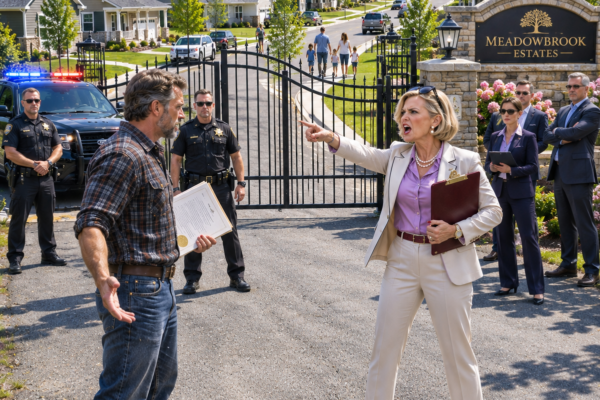
My gate was folded inward.
Black SUVs crowded the road.
Men in tactical clothing stood beside my fence.
And five people were restrained against it.
For one second, all the documentation disappeared from my mind.
All I saw was Luis Ortega.
Luis was fifty-eight.
He had worked for my family since I was in college.
His cheek was bleeding.
Then I saw Jack.
His hands were bound behind him.
His cap was gone.
And fifteen yards beyond him, Vanessa was walking out of my field office carrying her tote bag.
Aaron spoke into the radio.
“Teams, execute.”
Everything changed at once.
Our lead vehicles split.
Two went left.
Two right.
Deputies moved between the private security vehicles and the ranch workers.
Commands cut through the dust.
“Federal agents! Hands visible!”
“Do not reach for your belts!”
“Step away from the detainees!”
The Sentinel men froze.
Some had law-enforcement backgrounds.
They recognized instantly that the situation had left the imaginary universe of HOA authority.
Travis Heller turned slowly.
His face changed when he saw the lettering on the tactical vests.
U.S. MARSHALS.
He lifted both hands.
I stepped out of the lead vehicle.
For the first time since she had started this campaign, Vanessa saw me in person.
Not at a meeting.
Not across a lawyer’s letter.
Not through somebody else’s report.
She saw my badge.
Her face went blank.
“You,” she said.
I walked toward her.
“Mrs. Whitmore.”
She looked at the vehicles.
Then back at me.
“What is this?”
I didn’t answer.
I looked past her at Jack.
“Who restrained those men?”
Travis spoke.
“We did.”
“Under whose authority?”
He glanced at Vanessa.
“Community protection order.”
“Signed by what judge?”
No answer.
“State court?”
Nothing.
“Federal court?”
Nothing.
Vanessa stepped forward.
“The HOA has emergency authority to secure environmental and zoning violations.”
I turned toward her.
“This ranch isn’t in your HOA.”
“It is subject to an easement.”
“That doesn’t authorize detention.”
“They refused lawful instructions.”
“Your lawful instructions?”
“Yes.”
“Based on what law?”
She opened her mouth.
Stopped.
I looked at the deputies.
“Cut them loose.”
Trauma shears went through the plastic ties.
One by one my workers stepped away from the fence.
Luis rubbed his wrists.
Jack didn’t.
He simply walked toward me.
“Morning,” he said.
“Morning.”
“Gate’s broken.”
“I noticed.”
“Office window too.”
“I noticed that also.”
Vanessa watched us.
Her eyes moved between Jack and me.
Then recognition began to appear.
She knew Jack’s name.
She knew the name printed beside the notary stamp on the easement.
She had just never bothered to connect the man to the face.
Jack looked directly at her.
“Have we met?”
She said nothing.
“I asked because you’ve been using my signature for months.”
That landed.
For the first time, I saw genuine fear.
Not anger.
Not irritation.
Fear.
Vanessa reached for her tote bag.
Deputies immediately shifted.
“Hands visible,” Aaron ordered.
She stopped.
“I have documents proving our rights.”
“What documents?” I asked.
“The easement.”
“The one Jack notarized?”
“Yes.”
Jack almost laughed.
“You’re standing three feet from the notary.”
Her mouth opened.
No sound came out.
I continued.
“Ask him whether he signed it.”
Vanessa looked at Jack.
He held up the red marks around his wrists.
“I didn’t.”
“You’re lying.”
“No.”
“We have a certified copy.”
“So do I.”
“It bears your seal.”
“A copy of my seal.”
“That’s ridiculous.”
Jack’s voice stayed level.
“My original journal says otherwise.”
She shook her head.
“This is a setup.”
“No,” I said. “The setup happened when somebody took a legitimate image of Jack’s seal from an old county filing and reproduced it on an easement he never notarized.”
“You can’t prove that.”
That was when the FBI vehicles arrived.
Two dark sedans and another SUV turned into the ranch.
Special Agent Rebecca Sloan stepped out.
Rebecca had spent fifteen years working complex financial cases.
She had a talent for speaking softly while dismantling lies.
Vanessa saw the FBI markings on one tactical vest and took a step backward.
Rebecca approached.
“Vanessa Whitmore?”
Vanessa didn’t answer.
Rebecca repeated it.
“Yes.”
“I’m Special Agent Sloan with the Federal Bureau of Investigation.”
“This is insane.”
Rebecca held out a folded document.
“We have a warrant for your arrest.”
Vanessa’s entire body stiffened.
“No.”
Rebecca continued.
“And search warrants for the association office and specified records and devices.”
“No. No, this is a property dispute.”
Rebecca looked around.
Four injured ranch employees.
A destroyed gate.
An illegally entered office.
A front-end loader.
Armed security.
“Doesn’t look like one.”
Vanessa turned toward me.
“You did this.”
“No.”
“You used your federal position against me.”
“I didn’t investigate you.”
“You called them.”
“Your attorney did.”
That broke through her composure.
“What?”
“Robert Gaines brought evidence to the FBI.”
Her face became almost unrecognizable.
“Robert?”
Rebecca said nothing.
Neither did I.
Vanessa’s breathing quickened.
“You’re lying.”
Then I saw the red folder.
It was protruding from her tote bag.
Rebecca saw it too.
She looked at me.
I gave the smallest nod.
“Mrs. Whitmore,” Rebecca said, “what is in your bag?”
“Personal property.”
“The red folder.”
“Association documents.”
Jack slowly turned toward the shattered office.
I asked, “Where did you get it?”
Vanessa realized too late that everyone was listening.
“I brought it.”
“You brought that folder?”
“Yes.”
I looked at Jack.
“What color folder was on your desk this morning?”
“Red.”
Vanessa’s eyes widened.
Rebecca stepped closer.
“Mrs. Whitmore, do not reach into the bag.”
“This is harassment.”
“Place the bag on the ground.”
“I am the president of—”
“On the ground.”
Authority sounds different when it comes from someone who actually possesses it.
Vanessa lowered the bag.
A female agent stepped forward.
Rebecca read Vanessa her rights.
Then agents secured her wrists.
There was no theatrical slam to the ground.
No screaming mob.
No revenge fantasy.
Just two metal cuffs closing around the wrists of a woman who, minutes earlier, had watched my employees being bound with plastic ties.
Click.
Click.
Final.
An agent opened the tote under the warrant and photographed its contents.
Then she removed the folder.
Jack exhaled.
Rebecca opened it.
Inside were copies of the forged easement, the comparison images of Jack’s real notary seal, transaction summaries connected to the shell companies, and notes prepared for the investigation.
Vanessa stared at the documents.
“You planted that.”
Jack’s expression hardened.
“You broke my window.”
“I did not.”
“We have cameras.”
Her face went pale.
That was another thing she hadn’t known.
The field office had three cameras.
One exterior.
One inside above the doorway.
One pointed toward Jack’s desk.
They had recorded her entering.
Opening drawers.
Taking the folder.
Putting it in her bag.
The guard who smashed the glass was also recorded.
Rebecca closed the folder.
“Thank you.”
Vanessa looked confused.
“For what?”
“For carrying it outside.”
Vanessa lunged verbally, not physically.
“This whole thing is entrapment!”
Rebecca didn’t react.
“Nobody instructed you to enter a locked private office.”
“I had authority.”
“From whom?”
“The HOA.”
Rebecca looked at her.
“An HOA cannot authorize you to burglarize property it doesn’t own.”
Vanessa turned toward Travis.
“Tell them.”
Travis looked at the ground.
“Tell them we had authority.”
He stayed silent.
“Travis!”
Finally he looked at her.
“You told us your lawyers cleared it.”
“They did.”
“No,” he said. “You said there was a court order.”
Vanessa froze.
Everyone heard him.
Rebecca turned.
“She told you there was a court order?”
Travis swallowed.
“Yes.”
“Did you see it?”
“She said it was being delivered.”
Vanessa snapped, “Shut up.”
Rebecca’s eyes shifted back to her.
“Mrs. Whitmore, I strongly recommend you exercise your right to remain silent.”
For once, Vanessa followed advice.
Across town, federal agents were already inside the association office.
They found far more than we expected.
Server backups.
Financial ledgers.
Contracts.
Draft versions of the forged easement.
Image files containing Jack’s copied seal.
Emails discussing pressure tactics.
A spreadsheet estimating how much Vanessa would receive after the Ridgeline expansion secured access.
The amount beside her name was $2.4 million.
That number explained fourteen months of harassment.
But it didn’t explain everything.
Greed rarely acts alone.
Power had become part of it.
Vanessa had spent years running the association without meaningful opposition.
She controlled meetings.
She humiliated homeowners publicly.
She issued violation letters over tiny issues.
She used private security to intimidate residents.
People had learned that challenging her cost time and money.
Some paid fines they didn’t owe because fighting seemed worse.
Some moved.
Some stopped attending meetings.
When she encountered my ranch, she treated me like another homeowner.
The difference wasn’t my badge.
It was that I didn’t need her approval to exist.
That infuriated her.
The day after the arrests, twenty-three HOA residents contacted investigators.
Then forty-one.
Then more.
Stories emerged.
Improper towing.
Threatened liens.
Selective enforcement.
Board votes that residents believed had been manipulated.
Construction contracts awarded to companies connected to friends.
Not every allegation became a crime.
Some were simply bad governance.
Others weren’t.
One elderly resident named Margaret Lewis had nearly lost her house after Vanessa’s board recorded more than $18,000 in questionable fines and collection fees.
Margaret was seventy-four.
Her husband had died two years earlier.
She came to the temporary community meeting carrying every notice in a grocery bag.
I attended only because the new interim board had invited me to speak about the ranch dispute.
Afterward Margaret approached.
“Mr. Mercer?”
“Yes, ma’am.”
She held out one of the letters.
“Was she doing this to you too?”
I read it.
The language sounded familiar.
Aggressive.
Absolute.
Designed to make disagreement feel pointless.
“Yes.”
Margaret’s eyes filled.
“I thought I was stupid.”
“No.”
“I thought maybe I signed something I didn’t remember.”
“You weren’t stupid.”
“She kept telling me the records proved I owed it.”
I handed the letter back.
“Keep every page.”
“Why?”
“Because records work both ways.”
That sentence became more important than I expected.
Federal prosecutors focused on the serious financial and property crimes.
State investigators reviewed additional matters.
The association’s insurer became involved.
Residents hired independent counsel.
The Ridgeline development company tried immediately to distance itself from Vanessa.
Their first public statement claimed she had acted independently.
That defense lasted approximately forty-eight hours.
Agents recovered a contract from her desk.
It described a “success fee” payable upon securing the access corridor.
Ridgeline executives had signed it.
Emails showed company representatives discussing “administrative pressure” on my ranch.
One message asked Vanessa whether I was “close to cracking.”
Her answer:
He will. Everyone does.
When Rebecca showed me that email, I stared at it longer than I should have.
“What?” she asked.
“Nothing.”
“That’s not nothing.”
I pointed to the sentence.
“She thought the goal was to make me crack.”
Rebecca closed the file.
“Wasn’t it?”
“No.”
“What was the goal?”
“For her, maybe.”
“And for you?”
I looked through the conference-room glass.
Jack was sitting outside with a prosecutor, his notary journal on the table.
“For me, the goal was to make sure she couldn’t do it to the next person.”
The original journal became central.
It wasn’t dramatic to look at.
No secret code.
No hidden recording.
Just an old hardbound book with numbered pages.
But page sequence matters.
Jack’s entries showed exactly what he had notarized around the date on Vanessa’s forged easement.
A livestock financing document.
A vehicle title.
A water-right affidavit.
No easement.
No Ridgeline representative.
No HOA officer.
No Mercer ranch transfer.
More importantly, investigators obtained the original archived document from which Jack’s seal appeared to have been copied.
Digital examination showed matching defects.
Even the faint scratch across one letter in the seal appeared in exactly the same position.
Vanessa’s defense team attacked the evidence.
That was expected.
They argued she relied on staff.
They suggested somebody else prepared the paperwork.
They claimed she believed the easement was legitimate.
Then prosecutors produced the graphic-editing file from her computer.
Layers remained inside it.
One layer contained the source scan.
Another the cropped seal.
Another the reconstructed easement.
And metadata linked the work to a user account assigned to Vanessa.
That was devastating.
But the emotional moment for Jack came later.
During a pretrial evidence hearing, prosecutors asked him to authenticate his real journal.
He took the witness stand.
Vanessa sat at the defense table.
It was the first time he had seen her since the ranch raid.
The prosecutor approached.
“Mr. Mercer, what is this?”
“My notary journal.”
“Is it the original?”
“Yes.”
“How do you know?”
“I’ve had it in my possession since the first entry.”
“Do you record each notarization?”
“Yes.”
“Why?”
“Because that’s the point of keeping the record.”
A few people smiled.
The prosecutor placed the forged easement on the screen.
“Did you notarize this document?”
“No.”
“Is that your name?”
“Yes.”
“Your commission number?”
“Yes.”
“Your seal?”
“An image of it.”
“Your signature?”
“A copy of it.”
“Did you give Vanessa Whitmore permission to reproduce any of those items?”
“No.”
“Did you meet the supposed signatories on the date shown?”
“No.”
“Did you witness them sign?”
“No.”
“Did you administer an oath or acknowledgment?”
“No.”
The prosecutor opened the journal.
“Where is the entry?”
“There isn’t one.”
“Why not?”
“Because it never happened.”
That sentence settled over the courtroom.
Vanessa stared at the table.
Jack looked at her.
Not with triumph.
With disappointment.
Later, outside court, he sat beside me on a bench.
“That was harder than I expected.”
“Why?”
He rubbed his palms together.
“Because it was my name.”
I waited.
“People think signatures are nothing,” he continued. “Just ink. But my name was saying I witnessed something I never saw. My seal was telling the county a lie.”
I nodded.
“That’s why the journal mattered.”
He looked at me.
“No. That’s why the truth mattered.”
I didn’t answer.
Jack smiled slightly.
“You federal boys always make it about evidence.”
“Evidence helps.”
“So does being right.”
“Being right without evidence is a miserable courtroom strategy.”
He laughed.
It was the first time I had heard him laugh since the raid.
Vanessa initially insisted on trial.
Then the security chief began cooperating.
Travis Heller’s decision wasn’t noble.
He wanted to save himself.
But useful testimony doesn’t require pure motives.
He provided text messages from Vanessa.
One instructed him to “make the ranch understand that refusal is no longer an option.”
Another promised that “legal cover is handled.”
Another told him to seize phones if workers recorded the operation.
His company had also been told that a judge had approved the access action.
No such order existed.
Travis pleaded to reduced charges and surrendered his security licenses.
Several guards cooperated as well.
They admitted they had never seen judicial paperwork.
Some said they had raised concerns before the raid.
One testified that Vanessa told them, “By the time anyone sorts out the paperwork, the road will already be ours.”
The developer’s executives fought harder.
They blamed Vanessa.
Then Robert Gaines testified.
He described HOA funds being routed into entities connected to Ridgeline.
He produced internal email chains.
He explained how he had become alarmed by the easement.
He admitted he should have acted sooner.
That mattered to the residents.
At one community meeting, an angry homeowner shouted at him.
“You knew?”
Robert stood at the microphone.
“I knew something was wrong before I knew it was criminal.”
“And you stayed.”
“Yes.”
“Why?”
Robert looked around the room.
“Cowardice, at first.”
The room became quiet.
He didn’t make excuses.
“I was afraid of losing the client. Then I was afraid of being blamed for decisions I didn’t make. Then I was afraid that if I spoke, nobody would believe me.”
Margaret Lewis raised her hand from the third row.
“But you eventually did.”
“Yes, ma’am.”
“Why?”
Robert swallowed.
“Because one morning I realized I was using fear as permission to stay silent.”
Margaret nodded.
“Good.”
It wasn’t forgiveness.
But it was something.
The HOA board collapsed within weeks.
Three members resigned immediately.
Two claimed they had never been told the truth about Ridgeline.
Investigators found evidence that some board votes had been held without full disclosure.
Not every director was charged.
Most weren’t.
Being inattentive isn’t automatically criminal.
But homeowners were furious.
For years, meetings had been sparsely attended.
Now the clubhouse couldn’t hold everyone.
The first independent election attracted nearly ninety percent of eligible households.
I stood at the back.
I wasn’t a member.
I didn’t vote.
I was there because several residents had asked me to attend.
The most striking thing wasn’t anger.
It was embarrassment.
People kept saying versions of the same sentence.
“We should have paid attention.”
A young father named Chris stood up.
“I thought HOA politics were stupid.”
A woman behind him said, “They are.”
People laughed.
Chris continued.
“I ignored every meeting because I thought it was about mailbox colors. Meanwhile, they were moving hundreds of thousands of dollars.”
Another resident called out, “So what do we do?”
Margaret Lewis answered before anybody at the front could.
“We show up.”
That got applause.
The new board commissioned a complete forensic audit.
Questionable fines were reviewed.
Collection practices changed.
Homeowners received access to financial records that had previously been difficult to obtain.
The expansion agreement with Ridgeline was terminated.
The fraudulent easement was challenged and removed from the county record.
Every supposed HOA lien against my ranch was released.
The county corrected the title.
I received the official notice on a Friday morning.
Jack carried it into the equipment barn.
He didn’t say anything.
Just handed it to me.
I read the first page.
Then the second.
At the bottom was confirmation that the recorded easement had been declared invalid and removed from the chain of title.
I handed it back.
Jack frowned.
“That’s it?”
“What?”
“Fourteen months.”
“Yes.”
“Broken gate.”
“Yes.”
“Federal case.”
“Yes.”
“Fake easement.”
“Yes.”
“Vanessa nearly annexes half the planet.”
“Twenty-seven acres.”
“Felt larger.”
“What response are you expecting?”
He held up the letter.
“I don’t know. Fireworks?”
“I have cattle.”
“They’re afraid of fireworks.”
“Exactly.”
Jack shook his head.
“You are profoundly disappointing.”
But that afternoon I drove alone to the southern pasture.
I parked beside the old cottonwoods.
The same place Claire and I used to walk.
I carried the county letter with me.
For fourteen months, I had treated the case as evidence.
Documents.
Elements.
Timelines.
Statements.
I had avoided letting myself feel what the dispute really meant.
Someone had tried to turn my home into leverage.
Someone had looked at land carrying four generations of my family’s history and decided its value was determined solely by what could be built beyond it.
I sat beneath one of the cottonwoods.
Claire’s favorite tree was still there.
Its trunk had split years earlier but somehow both sides kept growing.
I unfolded the letter.
“Kept it,” I said.
Saying it aloud felt stupid.
There was nobody there.
Then again, grief makes you comfortable talking to empty places.
“I kept it.”
Wind moved through the leaves.
For the first time in more than a year, I felt the tension leave my shoulders.
Not victory.
Relief.
There is a difference.
Victory wants somebody else to lose.
Relief means the thing you loved survived.
A month later, Vanessa changed her plea.
The evidence had become overwhelming.
Her attorneys negotiated.
There were hearings.
Victim statements.
Financial restitution calculations.
Ridgeline executives faced their own cases and civil exposure.
I avoided public commentary while proceedings continued.
The final sentencing hearing was packed.
Residents filled the benches.
Jack sat beside me.
Margaret was there.
Robert sat farther back.
Vanessa entered in custody.
She looked smaller.
Not physically.
The certainty was gone.
For nearly two years, everything about her had been built around the assumption that she controlled the room.
Now she waited for permission to sit.
The prosecutor described the scheme.
The hidden financial arrangement.
The association funds.
The forged easement.
The harassment.
The armed ranch intrusion.
The office break-in.
Then victims were permitted to speak.
Margaret went before me.
She walked slowly to the podium.
Her hands shook.
But her voice didn’t.
“My husband died after forty-seven years of marriage,” she said. “Six months later I received the first violation letter.”
Vanessa stared forward.
Margaret continued.
“I was alone. I had never handled our finances. My husband did. When the association told me I owed thousands of dollars, I believed them.”
She took a breath.
“I sold his truck.”
The courtroom became completely silent.
“I sold the truck because I thought I had to save the house.”
Jack looked down.
Margaret’s voice broke for the first time.
“That truck wasn’t valuable to anyone else. But he taught our son to drive in it. He brought our grandchildren home from the hospital in it. After he died, sometimes I sat behind the wheel because it still smelled like him.”
Vanessa finally looked toward her.
Margaret saw.
“I will never get that back.”
No shouting.
No curse.
No demand for vengeance.
Just that.
I will never get that back.
It hit harder than anything else said that day.
When my name was called, I walked to the podium.
I had prepared three pages.
I didn’t use them.
I looked at Vanessa.
“For fourteen months, you believed this was about whether you could force me to sell land.”
She kept her eyes on me.
“It wasn’t.”
I paused.
“It was about whether documents still mean something when powerful people decide they don’t like the answer written on them.”
I glanced toward Jack.
“A deed meant something.”
Then toward Margaret.
“A homeowner’s account meant something.”
Back to Vanessa.
“A notary’s signature meant something.”
My voice tightened.
“And the word no meant something.”
She lowered her eyes.
“You had every right to make an offer. I had every right to refuse it. Everything after that happened because you believed my refusal was an obstacle instead of an answer.”
I stepped back.
Then I remembered Emily.
My daughter.
My promise to come through the situation safely.
I returned to the microphone.
“One more thing.”
The judge waited.
“I don’t want my ranch remembered as the place where a federal officer beat an HOA.”
A few heads lifted.
“Because my job isn’t the point.”
I looked at the residents.
“The evidence would have mattered if I were a mechanic, a teacher, a widow, a ranch hand, or anybody else.”
Margaret nodded.
“What protected us was that people kept records, somebody finally spoke up, and investigators followed the evidence.”
I sat down.
The judge later imposed a substantial federal sentence on Vanessa, along with restitution and financial penalties consistent with the charges resolved in the case.
I won’t pretend the sentence erased the damage.
Prison does not bring back Margaret’s truck.
It doesn’t erase Luis’s memory of being shoved into a fence.
It doesn’t return the months Jack spent wondering whether somebody had successfully attached his name to a fraudulent act.
It doesn’t give homeowners back every night they spent worrying over money taken from their association.
Consequences are not time machines.
They simply mark a boundary.
This far.
No farther.
Ridgeline’s expansion collapsed.
Financing disappeared.
The access corridor was unusable without my land.
The company sold several surrounding parcels.
The shell entities connected to the scheme were unwound through litigation and enforcement actions.
Restitution funds eventually returned money to the HOA.
The old security contract was terminated permanently.
Vanessa’s portrait, which had hung inside the clubhouse conference room, disappeared.
Nobody knew who removed it.
Jack claimed innocence.
I did not believe him.
Six months after the raid, we rebuilt the ranch entrance.
I had planned to reinstall a gate similar to the original.
Jack objected.
“If we’re doing it again, we’re doing it right.”
“What does that mean?”
“Steel.”
“The old one was steel.”
“More steel.”
“That isn’t an engineering standard.”
“It should be.”
He ordered a gate that looked capable of discouraging armored vehicles.
When it arrived, I stared at it.
“Jack.”
“What?”
“This belongs at a military installation.”
“Good.”
“We raise cattle.”
“Cattle respect boundaries.”
“Do they?”
“No. But Vanessa might.”
I laughed.
It surprised both of us.
The crew finished installation late in the afternoon.
Luis welded the final hinge.
Miguel adjusted the motor.
Hannah came by to verify the new posts sat exactly on the surveyed line.
She looked at Jack’s enormous gate.
“Compensating for something?”
Jack pointed at me.
“His trust issues.”
“My trust issues?”
“You’re the one who hired three surveyors.”
“One.”
“Felt like three.”
Hannah unfolded the map.
“The boundary is correct.”
Jack leaned over.
“You sure?”
She looked offended.
“I’ll move your survey stakes while you sleep.”
He backed away.
“Boundary looks perfect.”
For the first time, the southern entrance felt peaceful again.
Then a car stopped near the road.
Jack immediately straightened.
Old habits.
A woman got out.
Margaret Lewis.
She carried a paper grocery bag.
“Hope I’m not trespassing.”
Jack called back, “Depends. You with the HOA?”
She stared at him.
He smiled.
Margaret laughed.
She had brought pie.
Apple.
Homemade.
We ate it sitting on folding chairs near the new gate.
At one point Margaret looked across the pasture.
“This is what she wanted?”
“Part of it.”
“For a road?”
“Yes.”
She shook her head.
“People ruin themselves over strange things.”
Jack took another bite.
“That’s very good pie.”
“Thank you.”
“Daniel doesn’t cook.”
“I cook.”
Margaret looked at me.
“What?”
“Eggs.”
“Eggs count.”
“Do they?”
“They count if you survive.”
Jack nodded.
“Barely.”
For a few minutes we talked about nothing important.
Weather.
Cattle.
Her grandchildren.
The HOA’s new landscaping committee.
Apparently they had spent forty-five minutes debating mulch.
Margaret rolled her eyes.
“I almost miss federal crime.”
I nearly choked on the pie.
She smiled.
“Almost.”
That ordinary afternoon meant more to me than the sentencing.
Maybe because justice is loud when it arrives.
Sirens.
Courtrooms.
Orders.
Judges.
Handcuffs.
But healing is usually quiet.
A gate rebuilt.
A neighbor bringing pie.
Workers laughing where they had once been restrained.
A notary journal returned to its drawer.
Months later, Jack’s commission came up for renewal.
He considered letting it expire.
“Too much trouble,” he said.
“You’ve notarized hundreds of legitimate documents.”
“One fake one nearly got me kidnapped by suburban commandos.”
“You weren’t kidnapped.”
“I was zip-tied to my own fence.”
“Fair.”
He stared at the renewal form.
“You think I should keep it?”
“Yes.”
“Why?”
“Because somebody misused your signature.”
“Excellent argument for never signing again.”
“No.”
I slid the form back toward him.
“They don’t get to decide what your name means.”
He looked at me.
Then at the form.
The next week he renewed his commission.
When the new stamp arrived, he opened the box like it contained explosives.
“You want to test it?”
“No.”
“Scared?”
“Terrified.”
He stamped a blank scrap page.
Clean.
Sharp.
Official.
Then he locked it away.
A year after the raid, the new HOA board asked to meet with me.
I’ll admit my first instinct was to decline.
Jack’s was less diplomatic.
“Tell them the ranch has been annexed by Canada.”
“We’re not near Canada.”
“They won’t check.”
But I agreed.
Three board members came to the ranch.
No security.
No folders.
No threats.
The new president was Chris—the young father who once admitted he had ignored every HOA meeting because he thought they were stupid.
He stood beside the gate and looked embarrassed.
“I don’t know how to say this without sounding ridiculous.”
“Try.”
“We want to apologize.”
“You didn’t do it.”
“The organization did.”
“Organizations don’t act. People do.”
He nodded.
“Then we want to acknowledge what people acting in the organization’s name did.”
That wording I respected.
He handed me a letter.
Not a legal demand.
An apology approved unanimously by the new board.
It recognized that the ranch was outside HOA jurisdiction.
It renounced the old expansion claims.
It promised no association officer, contractor, or representative would enter my property without permission.
Jack read it.
“Needs one more clause.”
Chris looked concerned.
“What clause?”
“No beige suits.”
Chris laughed.
I didn’t.
Jack looked at me.
“I’m serious.”
The apology went into my files.
Not the evidence files.
A different drawer.
I kept it because accountability deserves documentation too.
That evening Emily came for dinner.
This time I cooked steak.
She watched me carry plates to the porch.
“So it’s really done?”
“Yes.”
“No more raids?”
“That’s generally the goal.”
“No more forged documents?”
“I can’t guarantee what humanity does tomorrow.”
“Dad.”
“Yes. It’s done.”
She looked toward the southern pasture.
“Mom would have been furious.”
“At Vanessa?”
“At you.”
I frowned.
“Why me?”
“For carrying all of it alone.”
I knew she was right.
“I didn’t want you involved.”
“I know.”
“I was protecting you.”
“I know.”
She touched my arm.
“But there’s a difference between protecting somebody and shutting them out.”
Claire had said almost the same thing once.
I looked away before Emily noticed what that did to me.
Too late.
She noticed.
She always did.
“I miss her too,” she said.
“I know.”
We stood there while sunset spread across the pasture.
The fight over the ranch had started because Vanessa saw land.
During the case, I had convinced myself I was defending property.
But standing beside my daughter, I understood that I had been defending continuity.
The place where my grandfather built.
Where my father worked.
Where Claire lived.
Where Emily grew up.
Where someday, if she wanted it, another generation might stand.
The following spring, Emily surprised me.
She arrived wearing old boots.
“Why are you dressed like that?”
“Like what?”
“Competent.”
She glared.
“I took the week off.”
“Why?”
“To help.”
“With?”
She pointed toward the irrigation field.
“I thought maybe you could teach me what Grandpa taught you.”
I looked at her.
“You hate fence work.”
“I hated being fourteen.”
“Fair.”
We spent the morning repairing line.
She complained constantly.
I corrected everything she did.
She accused me of enjoying that.
She was correct.
At lunch we sat on the tailgate.
Emily looked toward the ridge where Ridgeline’s subdivision would have stood.
“What happens to that land now?”
“Somebody else owns most of it.”
“Any houses?”
“Eventually, probably.”
“You okay with that?”
“Yes.”
She seemed surprised.
“I thought the whole battle was about stopping development.”
“No.”
“What was it about?”
I handed her a water bottle.
“Consent.”
She nodded slowly.
“That simple?”
“That complicated.”
A year and a half after Vanessa’s arrest, I received notice that the remaining restitution distributions had been processed.
Margaret got money back.
So did dozens of residents.
The association recovered part of what had been diverted.
Nothing restored everything.
But the community survived.
More importantly, it changed.
Meeting attendance stayed high.
Budgets were posted.
Contracts required competitive bids.
Board members rotated.
Residents asked irritating questions.
That last part made me happiest.
Democracy at any scale is often inconvenient.
That’s usually healthier than silence.
One Saturday, the HOA held a community picnic.
Margaret invited Jack and me.
Jack refused.
Then asked what food they were serving.
He attended.
We arrived without uniforms.
No badges.
No evidence bags.
Just two ranchers walking into the community that had once tried to claim our road.
Children ran across the grass.
Someone grilled burgers.
Residents who had testified during hearings sat under shade tents.
Robert Gaines attended briefly.
He no longer represented the HOA.
He had moved into a smaller practice.
Margaret hugged him.
That surprised me.
Afterward I asked her about it.
“You forgave him?”
She considered the question.
“Not all at once.”
“Then why hug him?”
“Because he eventually told the truth.”
“That fixes everything?”
“No.”
She looked at me.
“But if we only allow perfect people to do the right thing, we’re going to be waiting a very long time.”
Margaret had a way of ending conversations.
As sunset approached, Chris came over carrying two sodas.
He handed one to me.
“You know what everybody called you after the raid?”
“I probably don’t want to.”
“The Marshal.”
“I am a marshal.”
“No. Capital T. Capital M.”
“That sounds ridiculous.”
Jack joined us.
“I like it.”
“You would.”
Chris grinned.
“Some people thought you had planned the entire thing.”
“The raid?”
“The timing.”
“I did not plan Vanessa’s timing.”
“She picked the same morning as her arrest.”
“Yes.”
“And then stole the evidence folder herself.”
“Yes.”
Jack shook his head.
“Still the funniest part.”
“It wasn’t funny at the time.”
“It was a little funny.”
“She had five people restrained.”
“Not that part.”
Chris laughed.
I looked around the picnic.
There had been a time when every person in that community seemed like part of the threat.
That had been unfair.
Vanessa was not the HOA.
Neither were the developers.
Neither were the board members who looked away.
The HOA was also Margaret.
Chris.
The families rebuilding trust.
The residents who started reading budgets.
The neighbors who finally understood that governance belonged to people who showed up.
That distinction mattered.
Before we left, Margaret handed me a small framed photograph.
It showed the rebuilt ranch gate.
“What’s this?”
“Turn it over.”
On the back she had written:
A boundary doesn’t exist to keep good people apart. It exists so everyone knows where respect begins.
I stared at it.
“Did you write this?”
“Yes.”
“That’s annoyingly good.”
“I know.”
I hung it in the ranch office.
Right above the cabinet where Jack kept his notary journal.
Years from now, most people will probably forget the details.
The shell companies.
The filings.
The statutes.
The exact amount of money.
Maybe they’ll remember the absurd image of an HOA president arriving with private security only to find federal agents coming the other direction.
Maybe they’ll remember that she broke into a field office and walked outside carrying evidence connected to the case against her.
Jack certainly plans to repeat that story until he dies.
But that isn’t the part I remember most.
I remember opening the original notary journal.
I remember Jack’s finger running down the numbered entries.
I remember the empty space where Vanessa’s fabricated transaction should have been.
An empty line shouldn’t be powerful.
That one was.
Because lies often depend on people believing records are boring.
That nobody will check.
That nobody kept the original.
That nobody remembers what really happened.
Vanessa built her entire plan on that assumption.
She had copied a signature.
Copied a seal.
Created an easement.
Recorded it with the county.
Moved money through companies with impressive names.
Hired men in uniforms.
Brought heavy equipment.
She surrounded a lie with enough paperwork, money, and intimidation that she assumed it would become truth.
It never did.
Because Jack kept the original book.
Robert kept the emails.
Residents kept the notices.
Surveyor Hannah kept the coordinates.
The cameras kept the footage.
And eventually, every record told the same story.
The rebuilt gate still stands today.
The southern pasture is still open.
Cattle still cross it every morning.
The cottonwoods along Miller Creek still lean toward the water.
Sometimes I walk there near sunset.
I stop beneath Claire’s tree.
The development on the ridge has changed owners twice.
Some new homes were eventually approved through a different route.
I don’t mind.
They followed the process.
They stayed off my land.
They asked instead of taking.
That’s all I ever wanted.
Last fall, Jack and I were replacing a fence brace when a delivery driver stopped outside the gate.
He leaned out his window.
“This the Mercer ranch?”
“Yes.”
“Need a signature.”
Jack immediately pointed at me.
“His.”
The driver looked confused.
I signed.
After the truck left, I stared at Jack.
“You’re a notary.”
“Exactly.”
“And?”
“I’ve learned signatures are dangerous.”
“You renewed your commission.”
“Against my better judgment.”
I shook my head.
He went back to the fence.
Then he added, “At least yours is ugly enough nobody will forge it.”
I threw a work glove at him.
He ducked.
For a few seconds we were laughing so hard neither of us could continue working.
And maybe that’s the ending I value most.
Not Vanessa in handcuffs.
Not the courtroom.
Not the money.
Not even the county removing the false easement.
It’s two men standing beside a fence that stayed exactly where it belonged, laughing on land somebody once tried to steal with a copied signature.
The original notary journal is still locked in Jack’s cabinet.
The fraudulent easement is no longer attached to my title.
Vanessa’s development deal is gone.
The old board is gone.
The private security convoy never returned.
And the road across my southern pasture was never built.
Because in the end, Vanessa was right about one thing.
A signature can determine who controls a piece of land.
She just never imagined that the signature she forged would lead investigators straight back to the original record—and that the original record would be the one thing she could never rewrite.