PART 2: The HOA Dumped 63 Beehives on My Farm Before a 108° Heat Wave—Then One Queen Tag Exposed Their $18 Million Secret
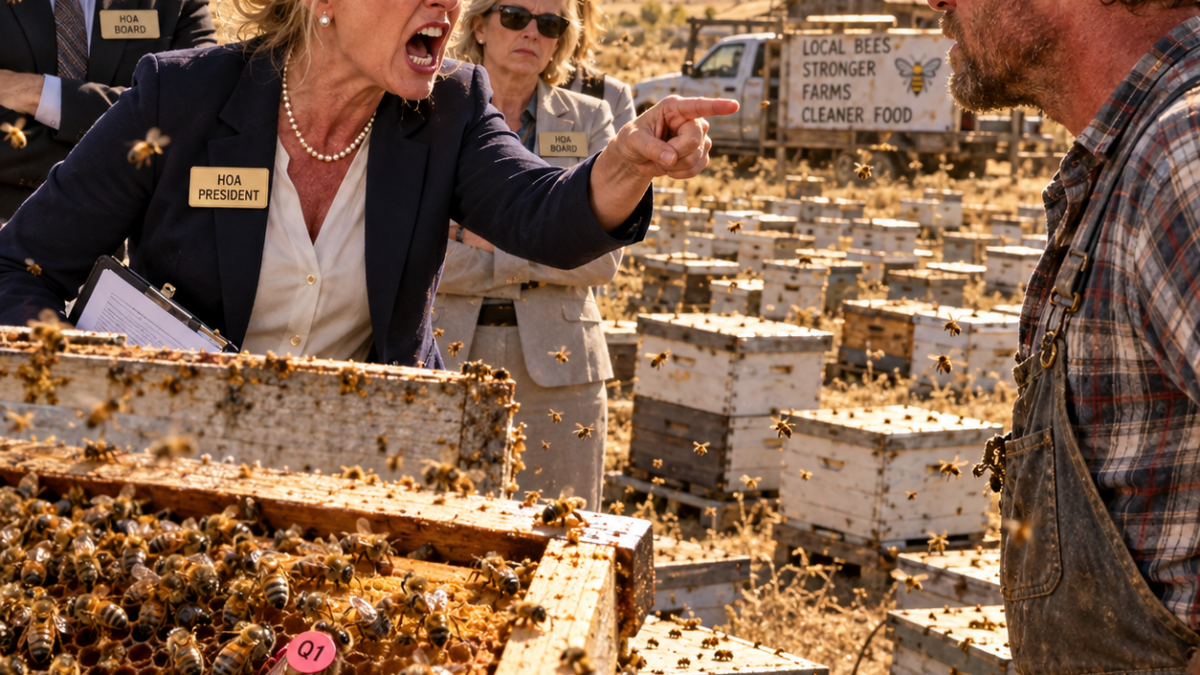
PART 2
The first thing I did after Lena hung up was walk back to the house and pull the memory cards from my trail cameras.
I kept three cameras along the eastern fence because deer regularly pushed through that corner of the property. One faced the service gate. Another covered the old irrigation road. The third looked south across the meadow.
I had installed them for wildlife.
That morning, they became witnesses.
I sat at my kitchen table with a mug of coffee cooling beside me and opened the first file.
The timestamp read 3:42 a.m.
A white flatbed truck stopped outside my locked service gate.
Two men climbed down.
One tried the padlock.
He pulled once, twice, then looked back toward the truck.
A second man walked up carrying bolt cutters.
There was no hesitation.
No discussion.
No phone call.
He put the jaws around my secondary chain and cut it.
I replayed that moment twice.
The metal snapped.
The gate swung inward.
The truck rolled onto my property.
The second camera showed the first load of hives entering.
Then the second.
Then the third.
The fourth trip came just after five.
The third camera captured Celeste’s black SUV parked on the county road twelve minutes before the first truck entered.
She had not arrived later because someone called her about an emergency.
She had been waiting.
On the last delivery, she stood in the meadow directing workers.
One man pointed toward the western side.
Celeste shook her head and pointed closer to my old teaching apiary.
The worker moved the pallet.
At 5:06, she walked to my weathered apiary sign.
It had hung crooked for years.
Ellie used to tell me to straighten it.
I would always say, “Saturday.”
Then Saturday would fill with fence repairs, irrigation problems, hay deliveries, or students coming for lessons.
After Ellie died, I stopped promising to fix it.
I stopped looking at it.
On the video, Celeste took a photograph of the crooked sign.
Five minutes later she called one of the workers back.
He straightened it.
Then she photographed it again.
I paused the image.
That was not an emergency relocation.
It was a staged photograph.
They wanted the old sign visible.
They wanted my property to look like an active apiary.
I printed still frames from each camera.
Truck arrival.
Chain cut.
First load.
Second load.
Celeste’s SUV.
Celeste directing the placement.
The worker straightening my old sign.
Then I called the sheriff’s non-emergency number.
The dispatcher asked whether anyone was still on the property.
“Only the bees.”
“Any immediate threat to you?”
“No.”
“Any weapons involved?”
“Not unless you count bolt cutters.”
She took the report.
A deputy would come when available.
Then I went back outside.
The morning was heating quickly.
The hives were louder now.
The cracked colony continued leaking bees through one damaged corner.
I resisted the instinct to repair it.
Lena had said not to touch anything except what was necessary to keep them alive.
That distinction mattered.
The last time I had handled a state investigation, I had been forty-five years old and still believed paperwork was the annoying part of the job.
By sixty-two, I’d learned otherwise.
Paperwork was what separated memory from proof.
I photographed every hive entrance.
Every pallet.
Every seal.
Every visible queen code.
Every piece of equipment Sunrest Ridge had left behind.
I photographed the tire tracks with a measuring tape.
The cut chain.
The broken lock.
The invoice.
The forged agreement.
By the time Lena’s state vehicle appeared on the county road, I had nearly two hundred photographs.
She arrived with an animal-health technician named Eric Douglas and two sealed sampling cases.
Lena had changed since the last time we’d worked together regularly.
More gray in her hair.
Reading glasses hanging from a cord around her neck.
Same habit of standing still before entering an apiary.
People who don’t understand bees tend to walk straight toward them.
Good inspectors watch first.
Lena stayed outside the first row for almost a minute.
“What are you seeing?” I asked.
“Three things I don’t like.”
She pointed.
“That colony’s entrance traffic is disorganized.”
Another hive.
“Those workers are trembling.”
Then toward the cracked box.
“And that one is showing neurological behavior.”
“That’s what I thought.”
She glanced at me.
“You’re retired.”
“Apparently my eyes didn’t get the notice.”
Eric smiled.
Lena didn’t.
“Let’s establish a clean approach.”
We moved along the north side.
Eric laid numbered evidence markers on the ground.
Lena collected dead workers with sterile forceps.
Wax scrapings.
Pollen.
Dust from one entrance board.
Residue from a pallet strap.
Every sample went into a separate container.
Every container received date, time, location, collector initials, and seal number.
When we reached the cracked HDH hive, I stopped.
“The queen was visible here.”
Lena crouched.
We waited.
The workers shifted in a slow wave.
Then the queen appeared.
Blue dot.
Tiny printed characters.
HDH-14.
Lena didn’t say anything for several seconds.
Then she exhaled.
“You’re right.”
“I’d rather be wrong.”
“High Desert line.”
“That’s what I remember.”
Eric looked between us.
“High Desert what?”
Lena stood.
“High Desert Honey started it. Later became High Desert Pollinator Cooperative. Controlled breeding program.”
Eric looked at the hive.
“I thought they shut down.”
“The commercial operation did,” I said.
Lena nodded.
“The genetic registry didn’t.”
That difference was important.
Commercial businesses can close.
Animals, seed lines, breeding records, patents, contracts, trusts, and biological material do not automatically vanish with them.
The HDH colonies had been selected over generations for traits commercial beekeepers cared about.
Heat tolerance.
Disease resistance.
Temperament.
Winter survival.
Recovery after transport.
The queens themselves could be valuable.
But the real value came from verified lineage.
A queen without trustworthy records was just a queen with a blue dot.
Lena inspected the remaining hives.
Fourteen carried HDH markings.
Nine others bore orange seals from a university research trial.
The remaining forty appeared to be ordinary commercial pollination colonies.
Several still showed the same neurological symptoms.
“What do you think exposed them?” I asked.
“Too early.”
“Pesticide?”
“Possible.”
“Heat?”
“Not at this level, not yet.”
“Transport?”
“Wouldn’t explain the residue.”
She straightened.
“Where were they before this?”
“Celeste didn’t say.”
Lena held out her hand.
“Show me the paperwork.”
I gave her the agreement.
She read the first page.
Then the signature page.
Then the apiary number.
“This isn’t a transfer certificate.”
“She says it is.”
“She’s wrong.”
“What is it?”
“A private receiving-site acknowledgment.”
“Does it authorize movement?”
“No.”
“Does my old registration number?”
“No.”
“Does my forged signature?”
She looked up.
“If you didn’t sign it, absolutely not.”
“Then why use it?”
She glanced toward Sunrest Ridge.
“Because somebody needed a legitimate destination.”
That sentence stayed with me.
Not a safe destination.
Not a willing destination.
A legitimate-looking destination.
By noon, the temperature reached ninety-six.
Bees were already bearding heavily on several boxes.
I had old shade frames stacked behind the teaching shed.
The shed had been locked for eight years.
I stood in front of it with the key in my hand.
For a second, I couldn’t turn it.
Then Lena said quietly, “Wade?”
“I’m fine.”
I wasn’t.
I unlocked the door.
Dust floated in the light.
The room smelled faintly of dry wood, old wax, and the smoke Ellie had used in her teaching demonstrations.
Her veil still hung on the peg where she’d left it.
I looked away.
“Shade cloth is on the back shelf.”
Eric helped carry it out.
We set temporary frames without touching the quarantined boxes.
I connected the solar pump to the old irrigation line.
We placed shallow water trays with stones so the bees had landing surfaces.
Lena wrote an emergency care authorization.
“You really think we need paperwork for water?” I asked.
“Celeste told you the bees are your responsibility.”
“Then said they’re HOA property.”
“Exactly.”
She signed the page.
“When someone changes ownership depending on which argument helps them, document everything.”
At two that afternoon, Celeste returned.
Trent Barlow came with her.
He was Sunrest Ridge’s property manager.
Early forties.
Clean polo shirt.
New work boots.
Camera hanging from his neck.
They stopped outside the shade structures.
Celeste’s expression changed immediately.
“You altered the site.”
“I kept the colonies alive.”
“You were instructed not to interfere with HOA property.”
I stared at her.
“This morning they were my responsibility.”
Trent’s camera lowered slightly.
Celeste recovered.
“The association retains management authority until the transfer is finalized.”
“There is no transfer,” Lena said.
Celeste turned.
She saw the state insignia.
Her face tightened.
“Who called you?”
“The receiving landowner.”
“This is a private civil matter.”
“Controlled colonies crossed inspection zones without the required documentation.”
“Our consultant approved the relocation.”
“Your consultant doesn’t administer our movement program.”
Trent looked down.
Celeste didn’t.
She held her folder tighter.
“Have you photographed the queen markings?”
Lena’s eyes narrowed.
“Why would that concern you?”
Celeste’s mouth opened.
Nothing came out.
Then she smiled.
“It doesn’t.”
She turned toward Trent.
“We’re leaving.”
She never asked if the bees were alive.
Never asked how many were sick.
Never asked whether the broken colony might survive.
She wanted to know whether the state had seen the blue queen tags.
That was the first moment I became certain she understood more than she was saying.
That evening, a courier brought a cease-and-desist letter.
Sunrest Ridge accused me of obstructing a lawful environmental relocation.
Interfering with association assets.
Creating a public nuisance by allowing bees near the county trail.
The letter demanded removal of my shade structures.
It also demanded access to my property between six in the morning and eight at night.
Attached was a site map.
My east meadow was colored green.
MERCER RECEIVING APIARY.
A dashed line ran from the Sunrest Ridge golf course, across the county road, through my service gate, directly to the hive rows.
In the lower corner was a revision date.
Eleven weeks earlier.
I stared at it.
The delivery hadn’t been improvised because the bees suddenly needed somewhere to go.
My land had been part of someone’s plan for nearly three months.
The next morning, attorney Mara Park sat at my kitchen table.
I’d known Mara’s father for years.
He’d handled farm contracts for half the county before retiring.
Mara had inherited his patience and none of his tolerance for nonsense.
She watched every trail-camera clip.
Read Celeste’s documents.
Read the cease-and-desist letter.
Then she asked one question I didn’t expect.
“Do you want the bees?”
“No.”
She waited.
I corrected myself.
“I want them alive.”
“Ownership?”
“No.”
“Do you claim the HDH stock?”
“No.”
“Do you want Sunrest Ridge off your property?”
“Yes.”
She nodded.
“Good.”
“Why is that good?”
“Because if this gets before a judge, regulator, or hearing officer, the first question is whether you’re trying to turn unauthorized delivery into ownership.”
“I’m not.”
“Then we say that clearly.”
She drew three boxes on a legal pad.
“Unauthorized entry.”
I pointed toward the camera stills.
“Cut chain and truck footage.”
“Good.”
Second box.
“No consent.”
“I was in Oregon when one of their documents says I approved this.”
“Why Oregon?”
“My sister’s funeral.”
Mara’s expression softened.
“Do you have records?”
“Hotel. Fuel. Credit card. Probably phone location.”
“Good.”
Third box.
“Lawful custody.”
“State and trust.”
“Exactly.”
She picked up the map.
Then frowned.
“What?”
“Revision eleven.”
“So?”
“This isn’t a simple relocation sketch.”
“Meaning?”
“Environmental consultants make repeated revisions when the underlying project keeps changing.”
She opened her laptop.
“Let’s see what Sunrest Ridge is building.”
The county planning portal had a major application pending.
SOLARA WELLNESS CENTER.
Private fitness club.
Spa.
Restaurant.
Glass event hall.
Expanded tennis courts.
Heated pool.
Parking.
Landscaping.
Estimated construction value:
$18.4 million.
I stared at the screen.
“What does that have to do with bees?”
Mara opened the public environmental summary.
“Nothing here.”
“Then we’re guessing.”
“For now.”
She requested the full environmental attachments.
Outside, the temperature passed one hundred degrees.
I went back to the meadow.
The old solar pump was losing pressure.
I followed the line and found a cracked underground coupling.
I was kneeling in mud when a pickup stopped outside the gate.
A young woman climbed out carrying bottled water, hose, and two bags of ice.
“Wade Mercer?”
“Yes.”
“I’m Maya Chen.”
I didn’t recognize her.
She smiled.
“Mrs. Mercer let me hold a frame when I was nine.”
Then I saw it.
Pink child-sized veil.
Nervous hands.
Ellie kneeling beside her.
“Maya.”
“You remember?”
“Ellie remembered.”
Her smile faded a little.
“I saw the hives from the county trail.”
She carried the water toward me.
“I also saw Celeste’s message.”
“What message?”
Maya opened her phone.
A Sunrest Ridge resident alert.
Celeste had written that a neighboring landowner had voluntarily accepted a large bee relocation and then failed to secure the colonies properly.
“What time did she post that?”
Maya scrolled.
“Tuesday. Five-twenty in the morning.”
My shovel stopped.
Five-twenty.
Nine minutes after Celeste ordered someone to straighten my apiary sign.
Before she spoke to me.
Before she handed me the forged document.
Before I supposedly refused responsibility.
“Send me that.”
“I already saved screenshots.”
“Why?”
“Because she edited it.”
She showed me the earlier version.
One sentence had disappeared.
This relocation completes the final environmental condition required before construction approval.
I read it twice.
“Construction approval.”
Maya nodded.
“I thought that sounded strange, so I saved it.”
I called Mara.
“Tell me you found something useful.”
“Celeste told residents the relocation completed a final environmental condition.”
Silence.
“When?”
“Before she spoke to me.”
“Send everything.”
Maya helped repair the irrigation line.
Her father arrived two hours later with livestock troughs.
Then another Sunrest Ridge resident came.
Then another.
By sunset, six residents were carrying water, placing reflective covers, and clearing tinder-dry weeds from around the hive pallets.
Celeste had described the bees as a neighborhood threat.
The neighborhood showed up to save them.
Thursday morning, Lena called.
“We’ve got pyrethroid residue.”
I stepped away from the hives.
“Concentration?”
“Inconsistent with casual household drift.”
“Can you identify source?”
“Not directly. Pollen gives us more.”
“What did you find?”
“Ornamental sage. Golf-course clover. Hybrid lavender.”
My stomach tightened.
Sunrest Ridge had landscaped heavily with that lavender near the clubhouse.
“You’re saying they were foraging inside the subdivision.”
“Strongly consistent with it.”
That afternoon Mara received the permit attachments.
I drove to her office.
She had page forty-three on the screen.
Same green map.
Same dashed route to my property.
Page forty-four was worse.
POLLINATOR MITIGATION CERTIFICATE.
It stated all affected colonies had been lawfully transferred to an active state-inspected apiary.
My old license number appeared at the top.
My electronic signature sat at the bottom.
Submission date:
May 9.
2:13 p.m.
Mara looked at me.
“Where were you?”
I opened my wallet.
“Let’s find out.”
My credit-card app showed fuel near Bend, Oregon.
Hotel charge.
Restaurant.
Everything from the week of my sister’s funeral.
My phone location records put me more than four hundred miles away.
Mara compared the dates.
Then she leaned closer to the certificate.
“There’s another problem.”
“What?”
“This says transfer complete.”
“So?”
She pointed to the date.
“Six weeks before the truck reached your farm.”
I sat back.
Sunrest Ridge had already told the county the bees were safely relocated.
They had used my property to satisfy a permit condition.
Then, weeks later, someone had realized the physical reality didn’t match the paperwork.
The sixty-three hives weren’t an emergency problem.
They were unfinished paperwork made alive.
Thursday evening, the National Weather Service increased the forecast.
108 degrees.
The worst heat would hit Friday afternoon and continue through Saturday.
Lena authorized external ventilation adjustments.
Twelve transport screens were partially covered by adhesive labels.
Four hives had almost no upper airflow.
“Whoever packed these rushed,” Eric said.
“Or didn’t care what happened after they moved.”
We lowered shade cloth.
Increased water.
Placed battery fans beside the weakest colonies.
At 8:12 p.m., HDH-14 changed sound.
Most people hear buzzing.
Beekeepers hear structure.
A normal colony has layers of sound.
Flight.
Fanning.
Guard activity.
Movement inside the boxes.
HDH-14 sounded flat and frantic.
Thousands of workers were fanning at once.
Very few were entering.
A thin line of honey appeared at the lower seam.
“Wax is softening,” I said.
Maya stood beside me with a flashlight.
“What do we do?”
“Call Lena.”
I described the conditions.
“Don’t break the quarantine seal yet,” she said.
“We could lose the colony.”
“I’m requesting emergency authority.”
“How long?”
“Move the fan closer. Lower the shade. Don’t move the hive.”
Maya held the flashlight while I repositioned the fan.
The honey leak slowed.
Then I checked the silent box.
The unnumbered hive.
The one with the nailed entrance.
Every other hive was warm.
That box was cool.
No bees clustered on the exterior.
No heat vented from the top.
No vibration reached my palm when I held it near the side.
Whatever was inside was not a living colony.
At 11:48 p.m., my motion alarm triggered.
Two vehicles had stopped outside the east fence with their headlights off.
I called the sheriff’s office.
Then I opened the camera feed.
Three figures wearing bee veils crossed through the section damaged during the original delivery.
They carried empty white hive boxes.
They ignored the first row.
Ignored the university-sealed colonies.
Went directly toward the HDH line.
I turned on the floodlights.
The meadow flashed white.
All three froze.
One turned and ran.
The other two grabbed HDH-14.
In 104-degree heat, with thousands of workers clustered outside, moving that hive in darkness was reckless.
“PUT IT DOWN.”
My voice came through the field loudspeaker.
One man shouted back.
“We’re authorized!”
“Authorized contractors use gates.”
“We have a work order.”
“Then wait for the sheriff.”
They tried to lift the colony.
The upper box slid three inches.
A cloud of bees erupted.
One man dropped his side.
“Easy!” I shouted. “Put it down!”
They lowered it crookedly.
Deputy Aaron Bell reached the road before the vehicles could leave.
The ownership questions were complicated enough that he didn’t arrest anyone on the spot.
But he documented names.
Vehicles.
Equipment.
And the work order.
I stood under the floodlights while he read it.
Then he handed it to me.
REMOVE 14 MARKED COLONIES AND SUBSTITUTE 14 STANDARD BOXES BEFORE FRIDAY STATE INSPECTION.
Fourteen.
Exactly fourteen HDH queens.
My hands went cold despite the heat.
Until that moment, Sunrest Ridge could still claim incompetence.
Bad consultant.
Bad paperwork.
Confused contractor.
Rushed relocation.
The midnight work order was different.
Someone knew which colonies mattered.
Someone wanted them gone before inspectors came.
Trent called at seven the next morning.
“I didn’t authorize that work order.”
“It came from your office.”
“Celeste used my account.”
“Why did she have access?”
Silence.
“Trent.”
“She said the permit could not miss Monday.”
Mara arranged a meeting at the county administration building.
Neutral location.
Security cameras.
Trent brought his attorney and a flash drive.
The first emails dated back five weeks.
The Sunrest Ridge golf-course superintendent reported unusual bee deaths near the proposed wellness-center site.
Internal photographs showed piles of dead workers outside several hives.
A landscaping contractor had treated flowering ornamental shrubs while they were in active bloom.
The environmental consultant warned that a significant colony-loss event could trigger additional testing.
Testing meant delay.
Delay threatened the permit.
Celeste replied with six words.
Move them before the county visit.
I stared at the email.
The consultant refused to certify my farm without consent.
Two days later, Celeste sent him a copy of the receiving acknowledgment carrying my signature.
I looked across the table at Trent.
“You knew I wasn’t at a relocation meeting.”
“I believed she contacted you separately.”
“Did you call me?”
“No.”
“Did you check whether my apiary license was active?”
“No.”
“Did you contact the state?”
“No.”
“Did you tell the contractor 108-degree heat was coming?”
He looked down.
“No.”
My chair scraped backward.
Mara touched my arm.
“Wade.”
“What?”
“The records are doing the work.”
I sat again.
She was right.
Trent’s excuses didn’t matter as much as what his own files contained.
Then his attorney opened another spreadsheet.
Construction financing.
The Solara Wellness Center needed final county approval by Monday to preserve a locked loan rate.
A delay longer than thirty days allowed repricing.
A delay beyond ninety days allowed the lender to withdraw.
I looked at the number at the top.
Eighteen-point-four million dollars.
That was the pressure behind the bees.
Not safety.
Not environmental protection.
A financing deadline.
Friday afternoon arrived like an oven opening.
Then higher.
The air itself felt abrasive.
Bees covered the fronts of the hives in heavy living curtains.
One weak colony began ejecting damaged brood.
Lena returned with two inspectors and emergency authority to open colonies at immediate risk.
We started with HDH-14.
Inside, the upper wax had begun to sag.
Honey ran down one frame.
Thousands of workers were dead.
But the queen moved.
Blue dot.
Alive.
“We need this one inside,” Lena said.
We transferred the quarantined unit into my old teaching shed.
The moment I crossed the threshold, the smell hit me.
Warm wax.
Smoke.
Honey.
Dry wood.
Eight years disappeared.
Ellie had taught in that room every spring.
She had a gift for making nervous people feel foolish for being afraid without ever embarrassing them.
“Bees don’t care that you’re scared,” she’d say. “That’s useful. It means you don’t have to perform for them.”
Her old hive tool lay on the workbench.
Red paint.
Handle worn bare where her thumb used to rest.
I picked it up without thinking.
Maya watched me.
“You okay?”
“No.”
She waited.
Then I said, “But keep going.”
We positioned ventilation.
Checked temperature.
Kept the quarantine barrier intact.
For years, I had told myself closing the apiary preserved what Ellie and I had built.
Standing there, I understood the opposite.
I had preserved the equipment.
I had abandoned the work.
By sunset, every critical colony was still alive.
Four remained unstable.
Eleven required additional ventilation.
Water consumption almost doubled.
Residents brought shade panels.
Frozen bottles.
Extension cords.
Food.
A local electrician loaned two generators.
The fire district inspected the entire setup because the meadow grass was dry enough to ignite from a spark.
A crime scene had become a field hospital.
Then Celeste posted another resident notice.
She accused me of operating an unauthorized commercial apiary beside family homes.
She accused the state of helping me exploit the emergency.
This time residents responded immediately.
Someone posted the trail-camera timestamp.
Someone else posted the forged certificate date.
Maya shared the original and edited versions of Celeste’s first message.
Another resident asked why HOA contractors had returned near midnight.
Celeste disabled comments.
Saturday morning, Samuel Price arrived from the High Desert Agricultural Trust.
Sam was seventy-one.
Big shoulders.
Slow speech.
He inspected every HDH queen code with Lena.
Then he reviewed the genetic registry.
“Fourteen maternal lines still active.”
Maya asked, “How much are they worth?”
Sam looked at her.
“Wrong first question.”
She flushed.
He smiled.
“It’s everyone’s first question.”
He explained it carefully.
A single queen could be expensive.
But genetic value depended on records.
Pedigree.
Survival history.
Disease performance.
Temperament.
Heat resistance.
Verified custody.
Without those things, a queen was not a program.
She was an insect with paint on her back.
“Can the trust remove them?” I asked.
“Not in this heat.”
“Then they stay.”
“For now.”
Sam walked through the old teaching area.
Inspected the water line.
Shed.
Meadow.
Setback from the county trail.
“You could bring this back.”
“I don’t want your bees.”
“I know.”
“Then why say it?”
“Because you don’t want them.”
I didn’t understand him then.
Before leaving, he checked the transport manifest.
His finger stopped.
“Count?”
“Sixty-three.”
“This says sixty-two.”
I looked toward the south row.
Silent box.
Lena opened it under quarantine protocol.
No bees.
No comb.
No live colony.
Between two empty frames was a weatherproof pouch.
Inside:
A handwritten checklist.
Pesticide application copies.
A memory card.
Initials.
C.M.
Caleb Morris.
Former assistant groundskeeper.
Mara called him without telling him what we’d found.
He identified the hive number.
The pallet.
The pouch.
Then he told us why.
Grounds crews had warned Celeste not to spray ornamental beds while lavender was blooming.
The landscaping contractor complained that delaying treatment would interfere with a private investor tour.
Celeste approved the application.
Within a day, workers found piles of dead bees.
Caleb photographed them.
He filed an internal report.
He was told to delete the images.
He refused.
Trent suspended him for insubordination.
When Caleb later heard that all hive-shaped equipment was being removed before the county inspection, he hid copies of the records inside an unused swarm box.
The sixty-third hive wasn’t valuable breeding stock.
It was a witness box.
Maya almost smiled when Mara explained it.
Mara stopped her.
“Don’t celebrate.”
“Why?”
“Because dramatic evidence is still evidence.”
She pointed to the memory card.
“Caleb authenticates this.”
Then the application logs.
“Server originals must match.”
Then Lena’s samples.
“Laboratory results must correlate with the products.”
Then the trail-camera footage.
“Every piece has to stand on its own.”
I nodded.
She looked at me.
“You know this.”
“I do.”
“Then act like it.”
Sunday morning, the heat began to ease.
We lost one weak colony.
The other sixty-two survived.
All fourteen HDH queens were alive.
The trust agreed to fund veterinary screening and temporary care.
At ten that morning, Sunrest Ridge’s attorney sent Mara a settlement proposal.
The HOA would:
Cancel the $7,200 invoice.
Repair my fence.
Remove all bees once the heat emergency ended.
Reimburse limited emergency expenses.
In exchange, I would:
Return all copied documents.
Delete recordings.
Sign the receiving certificate.
Acknowledge the relocation as voluntary.
Agree not to oppose the Solara Wellness Center.
Offer expires in four hours.
Mara slid the paper across my kitchen table.
“They’re offering to reverse the smallest part of what they did.”
“So I validate the largest.”
“Exactly.”
I looked at my forged signature.
For days, that fake name had been used to explain why people could enter my farm, move living colonies, and satisfy a permit condition.
Now they wanted the real version.
I wrote one sentence.
My signature is not for sale.
Monday’s county hearing moved to the largest meeting room in the administration building.
More than one hundred Sunrest Ridge residents attended.
Others watched online.
Celeste sat beside the HOA attorney.
Red pantsuit.
Perfect posture.
Behind her was a display board showing the Solara Wellness Center.
Glass walls.
Stone terraces.
Blue pool.
Healthy landscaping.
Smiling families.
No dying bees.
The HOA attorney called the relocation “an imperfect emergency response.”
He said there had been confusion over receiving-site documentation.
Then he suggested I had initially accepted the bees but changed my position after discovering the value of the HDH stock.
Mara didn’t argue.
She displayed Exhibit One.
My supposed acceptance certificate.
Beside it:
Fuel receipt.
Hotel invoice.
Phone-location record.
More than four hundred miles away.
Date and time matched exactly.
Exhibit Two.
Trail-camera footage.
3:42 a.m.
Truck arrives.
Gate locked.
Worker cuts chain.
Four deliveries.
Celeste’s SUV waiting on the county road.
5:11 a.m.
Worker straightens expired apiary sign.
Exhibit Three.
Midnight work order.
REMOVE 14 MARKED COLONIES AND SUBSTITUTE 14 STANDARD BOXES BEFORE FRIDAY STATE INSPECTION.
Celeste leaned toward her microphone.
“Mr. Mercer changed his position when he discovered those bees had commercial value.”
Then she made the mistake that shifted the room.
“He is a retired hay farmer, not an environmental professional.”
Lena stood.
She carried an old field manual.
Placed it beside the microphone.
“Mr. Mercer spent seventeen years inspecting commercial apiaries and investigating pesticide and disease events for the State of Idaho.”
People turned toward me.
Celeste stared.
Lena continued.
“He participated in drafting the emergency relocation guidance Sunrest Ridge claims its consultant relied upon.”
Silence.
I had never mentioned that career to Celeste.
There had been no reason.
A former job didn’t make me right.
When the chair invited me to speak, I said that.
“Don’t trust me because I used to carry a state badge.”
I pointed toward the exhibits.
“Trust the timestamps.”
Then Lena presented the residue results.
Pollen profile.
Transport violations.
HDH registry.
Agricultural trust statement.
Caleb authenticated the memory card.
The landscaping chemical logs matched the products identified in testing.
Original internal files matched his copies.
Celeste denied authorizing the midnight colony swap.
The county technology officer displayed system-access logs.
Trent’s management account had been opened at 10:36 Thursday night.
The device used:
Celeste’s board-issued tablet.
Eleven minutes later, the work order was transmitted from the clubhouse network.
Her attorney requested a recess.
The planning chair shook his head.
“This isn’t a criminal trial.”
He looked toward Celeste.
“We are determining whether this county can rely on the applicant’s environmental representations.”
He looked down at the documents.
“At present, it cannot.”
The Solara Wellness Center permit review was suspended.
The HOA was ordered to submit:
A corrected environmental package.
A lawful pollinator mitigation plan.
An independent chemical-application review.
A complete chain of custody for relocated colonies.
The forged signature and attempted evidence substitution were referred to appropriate investigators.
Nobody announced Celeste guilty of a crime.
That wasn’t the hearing’s job.
Then a man sitting two rows behind her stood.
He gathered his briefcase.
Walked toward the door.
Celeste watched him.
Mara whispered, “Lender.”
He left.
No speech.
No threat.
No dramatic announcement.
Just a man carrying the financial future of an $18.4 million project out of the room.
Monday was the loan-lock deadline.
The project did not collapse instantly.
But the assumption underneath its financing had.
Sunrest Ridge called an emergency meeting that night.
I didn’t attend.
Maya did.
Nathan Chen—her father—called me afterward.
“Residents want everything.”
“Everything what?”
“Contracts. Consultant emails. Legal bills. Board minutes.”
“What did Celeste say?”
“That she was protecting homeowners from a dangerous delay.”
“What did the board say?”
“Three directors claim they were told the bees were going to a licensed commercial apiary.”
“Did they see my consent?”
“No.”
He paused.
“Then Maya asked her something.”
“What?”
He laughed once.
“She asked whether Celeste was afraid of a delay to the project or a delay to the truth.”
By midnight, the board voted to remove Celeste as president pending an independent audit.
Trent’s management company placed him on leave.
The landscaping contractor’s insurer opened a claim.
The $7,200 invoice vanished from Sunrest Ridge’s accounting system.
I didn’t let my copy vanish.
I framed it.
Maya saw it hanging inside the teaching shed.
“You seriously framed it?”
“Absolutely.”
“Why?”
I pointed to the official-looking logo.
“Because this is what authority looks like when nobody checks whether it exists.”
The next six weeks were quieter.
The quarantine investigation continued.
Veterinary screening.
Residue testing.
Colony evaluations.
Two HDH queens were removed from immediate breeding plans pending more health data.
Thirty-eight ordinary colonies recovered well enough to return to commercial service.
Nine weak colonies were combined.
One colony had died in the heat.
Another had arrived already queenless.
The agricultural trust retained ownership of the registered stock.
Nobody disputed that.
Then Sam Price returned with a contract.
Three-year operating agreement.
The trust would provide:
Breeding records.
Veterinary oversight.
Startup equipment.
Genetic testing.
Replacement queens when justified.
I would provide:
Site management.
Colony care.
Apprentice training.
Facilities.
Documented transfers.
I would receive a negotiated share of queen and nucleus-colony revenue.
I left the papers on my kitchen table for three days.
Money wasn’t the problem.
The teaching shed was.
Every time I opened it, Ellie was there without being there.
Her gloves.
Her veil.
Notes in the margins of old lesson plans.
The little dent in the workbench where she once dropped a smoker.
One evening I sat outside the shed holding her hive tool.
Maya found me.
“You haven’t signed.”
“No.”
“Are you going to?”
“I don’t know.”
“Mrs. Mercer would.”
I looked at her.
“You were nine.”
“I remember her.”
“You remember one afternoon.”
“I remember being terrified.”
I waited.
“She put a frame in my hands.”
“That sounds irresponsible.”
Maya smiled.
“She told me to stop thinking about all the bees and look at what one bee was doing.”
I could hear Ellie saying it.
Maya looked toward the meadow.
“Then she showed me another. Then another. Five minutes later I wasn’t scared anymore.”
I looked down at the red handle.
“That was her.”
“Exactly.”
The next morning, I signed.
We called the restored site:
Ellie’s Meadow Apiary.
The name was Maya’s idea.
I pretended to dislike it for about three minutes.
The first year was expensive.
We replaced irrigation lines.
Installed monitored ventilation.
Rebuilt fencing.
Added secure hive stands.
Poured washable work surfaces.
Set up a quarantine area separate from teaching space.
Planted additional forage farther from the road.
Every queen transfer had paperwork.
Every treatment had a log.
Every colony loss had a cause category.
Every pesticide application on our own land had a time, product, weather record, and forage restriction.
Maya became our first paid apprentice.
Caleb joined months later after completing additional pesticide-safety training.
He was quiet during his first week.
On Friday I asked why.
He shrugged.
“Still getting used to asking questions.”
“What does that mean?”
“At Sunrest Ridge, questions sounded like accusations.”
“Here, bad questions are cheaper than bad decisions.”
He looked at me.
“Can I write that down?”
“No.”
He wrote it down anyway.
Our first income came from normal pollination contracts.
Then small nucleus colonies.
Then controlled queen sales.
Nobody became rich.
By the end of the first full season, gross revenue reached around $94,000.
It sounded impressive until you subtracted:
Equipment.
Labor.
Testing.
Feed.
Veterinary costs.
Vehicles.
Habitat restoration.
Insurance.
State compliance.
What remained was respectable.
Not magical.
Three years later, an independent agricultural appraisal valued the breeding program, verified stock, equipment, and contracts at a little over $400,000.
Reporters liked that number.
Sunrest Ridge residents repeated it.
People who didn’t understand the story sometimes said Celeste had accidentally made me rich.
That annoyed me.
Because it wasn’t true.
The valuable part wasn’t the appraisal.
It was Saturday mornings.
Students came back.
New beekeepers stood behind the observation glass.
Children in oversized veils walked through Ellie’s meadow.
Sunrest Ridge families crossed the county trail to buy honey and learn why pollinator habitat involved more than planting decorative flowers on a brochure.
The farm sounded alive again.
Sunrest Ridge eventually built a smaller wellness center.
Less land.
Smaller footprint.
Independent environmental monitoring.
A broad pollinator corridor between the golf course and surrounding open space.
The project opened almost two years later than Celeste promised.
It cost homeowners money.
I never celebrated that.
Four hundred twelve households hadn’t forged my signature.
They hadn’t cut my chain.
They hadn’t ordered colony substitution at midnight.
Accountability becomes another kind of injustice when you stop caring who actually made the decision.
The independent HOA audit found that Celeste exceeded her authority.
Failed to provide parts of the board with complete information regarding the bee deaths.
Relied on unverified consent.
Used management access in connection with the midnight work order.
Regulators handled the environmental findings.
Civil claims handled property and colony losses.
Other investigators handled the signature and access issues.
There was no single cinematic ending.
No day when every consequence landed at once.
Real accountability arrived in separate envelopes.
Insurance notices.
Board minutes.
Investigation letters.
Legal invoices.
Lost authority.
Corrected permits.
Records she could no longer control.
The landscaping contractor and insurers covered supported losses and emergency-care expenses.
My fence was repaired.
State records were corrected.
The trust recovered lawful control of its breeding program.
Celeste lost the HOA presidency and influence over Solara.
The bees survived.
My land remained mine.
For me, that was the center of it.
Celeste came to my farm once after the revised wellness center finally opened.
I was moving feed equipment toward the teaching shed when I noticed a gray sedan near the east gate.
She stood outside.
She didn’t enter.
I walked over.
She wore a gray coat.
No red blazer.
For several seconds, neither of us spoke.
Then she looked past me.
Rows of white hives sat beneath the cottonwoods.
Students were inside the shed.
A smoker sent a thin ribbon of white through the open window.
“You got your business,” she said.
I followed her gaze.
“No.”
Her expression changed slightly.
“I got my meadow back.”
She noticed the framed $7,200 invoice hanging inside the shed.
“You kept that?”
“Yes.”
“You could take it down.”
“I could.”
“It makes it look like…”
She stopped.
“Like what?”
She looked away.
Then said, “You could’ve asked permission before turning this into a public spectacle.”
For a moment I thought I’d misheard her.
I looked at the repaired gate.
The new chain.
The steel post replacing the one damaged during the delivery.
Then back at Celeste.
“You could’ve asked permission before putting sixty-three hives on my farm.”
She stared at me.
Neither of us said anything else.
She returned to her car.
I walked back toward the meadow.
That evening, after Maya and Caleb left, I sat inside the teaching shed.
Ellie’s hive tool hung above the bench.
The framed invoice remained on the wall.
Outside, bees moved through the wildflowers in the last light.
Sixty-two colonies had survived that original heat emergency.
Some left later.
Some were combined.
Some became part of the restored breeding program.
But the meadow never went silent again.
For eight years after Ellie died, I had believed silence was preservation.
Don’t move her tools.
Don’t reopen the classroom.
Don’t bring bees back.
Don’t change anything.
Because changing it meant admitting she wasn’t coming back.
Then Celeste dumped sixty-three colonies onto my land because she believed an expired registration, an old sign, and a forged signature could turn my grief into a permit condition.
She was wrong.
But in trying to use the dead version of my apiary, she forced me to see why I had kept it dead.
I wasn’t protecting Ellie’s memory.
I was hiding inside it.
The next Saturday, twelve students arrived.
One was a boy around ten who refused to step through the teaching-shed door.
His mother whispered to Maya.
“He’s scared of bees.”
Maya looked toward me.
I almost laughed.
“Bring him to the observation glass.”
The boy stood six feet away.
Arms folded.
“I don’t want to get stung.”
“You won’t be opening anything today.”
He shook his head.
“There are too many.”
I looked at the observation colony.
Then at him.
“Don’t look at all of them.”
He frowned.
“What?”
“Pick one bee.”
He stared through the glass.
“Which one?”
“You choose.”
After a few seconds, he pointed.
“That one.”
“What is she doing?”
“Walking.”
“Where?”
He leaned closer.
“Into a hole.”
“Cell.”
He watched.
“Why?”
“Could be cleaning. Could be checking it.”
Another bee moved past.
“What about that one?”
He pointed again.
Five minutes later his arms were no longer folded.
Ten minutes later he asked whether he could wear a veil.
I stood behind him holding Ellie’s old hive tool.
For a second, the room felt full in a way I hadn’t experienced for years.
Not because Ellie was there.
Because the work she’d cared about was.
After class, Maya found me putting equipment away.
“You used her line.”
“What line?”
“‘Pick one bee.'”
“I’ve said that for years.”
“No, you haven’t.”
I looked at her.
She smiled.
“Mrs. Mercer did.”
I hung the hive tool back on its hook.
Outside, sunlight moved across the meadow.
A low, steady hum floated through the open door.
Not the violent roar that woke me at four in the morning when those sixty-three hives first arrived.
This was different.
Balanced.
Familiar.
Alive.
I walked to the eastern gate.
The new lock was secure.
Across the road, the edge of Sunrest Ridge’s redesigned pollinator corridor had begun flowering.
No trucks waited in the dark.
No forged documents sat on my porch.
No one had photographed my old sign.
I looked back toward the teaching shed.
Its doors were open.
That became the image I remembered most clearly from the entire fight.
Not Celeste at the county hearing.
Not the lender walking out.
Not the midnight contractors under the floodlights.
Not even the blue HDH queen tag that first told me the bees were more than they appeared.
A locked gate.
An open teaching shed.
One protected what was mine.
The other finally let life back in.
And for the first time since Ellie died, I understood that I could have both.
For the first few days after the county hearing, nothing felt like a victory.
People kept calling it one.
Maya called from Sunrest Ridge the morning after Celeste was suspended.
“You should see the resident portal.”
“I’d rather not.”
“Half the neighborhood is demanding the entire project file.”
“Good.”
“The other half is asking whether their HOA dues are going to pay for this.”
“Also reasonable.”
“And somebody posted a picture of Celeste leaving the clubhouse.”
“Maya.”
“What?”
“Stop reading comments.”
She laughed.
“That’s what my dad said.”
“Your dad is smarter than both of us.”
I hung up and walked toward the meadow.
The heat had finally broken, but the damage hadn’t disappeared with it.
One colony was dead.
Several others were badly weakened.
HDH-14, the hive the midnight crew had nearly tipped over, remained under observation in the teaching shed.
It had lost thousands of workers.
The queen was alive, but survival was only the first measurement.
A breeding colony could survive and still lose what made it valuable.
Stress could change brood patterns.
Chemical exposure could affect queen performance.
A weakened worker population could leave brood vulnerable to temperature swings or disease.
The agricultural trust wasn’t celebrating either.
Sam Price returned with two technicians and enough paperwork to make the state inspectors look casual.
He stood beside HDH-14 while one technician photographed the brood pattern.
“She’s laying,” I said.
“She is.”
“That’s good.”
“It’s better than not laying.”
I looked at him.
“You’re exhausting.”
He nodded.
“I’ve been told.”
The technician marked several frames.
Sam continued.
“We don’t know whether the exposure created longer-term reproductive effects.”
“So we wait.”
“We measure.”
“Same thing.”
“No.”
He glanced at me.
“Waiting is passive. Measuring tells you what changed.”
That sounded like something Ellie would’ve liked.
She hated the phrase wait and see.
“See what?” she’d always ask. “If you’re waiting, you should know what you’re watching for.”
I looked toward her hive tool hanging above the workbench.
For years, memory had reached me through objects.
Now it was coming back through sentences.
That was harder.
And better.
Outside, Lena’s team was finishing an inventory.
Every hive received a final quarantine identifier.
Every photograph was linked to location.
Every queen code was entered separately.
The ordinary commercial colonies had owners too, though it took days to sort them out.
Some belonged to a pollination broker that had leased them to Sunrest Ridge for seasonal landscape support.
Others had been purchased by a management subsidiary.
Several ownership records contradicted the relocation manifest.
Nothing about the delivery had been organized cleanly.
That became part of the problem for the HOA.
Celeste had acted as though putting sixty-three boxes on my land transferred responsibility.
Legally and biologically, those boxes represented several different interests.
Registered genetic stock.
Research colonies.
Commercial colonies.
Dead equipment.
And one empty witness box carrying evidence.
The more investigators separated those categories, the less believable the original story became.
Three days after the hearing, a man named Dennis Holbrook came to the farm.
He lived near the southern end of Sunrest Ridge.
I recognized him from county meetings.
He had spoken twice in support of the wellness center.
That made me cautious.
He waited outside the gate.
“I don’t expect you to invite me in.”
“Good start.”
He gave a tired smile.
“I wanted to apologize.”
“For what?”
“I believed Celeste.”
“That’s not illegal.”
“I repeated what she said.”
“Still not illegal.”
He looked toward the meadow.
“I told people you’d accepted the bees and then tried to hold the HOA hostage when you discovered what they were worth.”
I said nothing.
He rubbed the back of his neck.
“My wife asked me whether I’d ever seen the agreement.”
“Had you?”
“No.”
“Then why repeat it?”
He looked embarrassed.
“Because it came from the board.”
That answer mattered.
Not because it excused him.
Because it explained how Celeste had operated.
Most people didn’t inspect every claim.
They had jobs.
Children.
Mortgages.
Appointments.
Problems of their own.
The board president said an agreement existed.
So they assumed someone had checked.
“I spent seventeen years doing inspections,” I said. “You know what most bad systems depend on?”
Dennis shook his head.
“Everybody assuming the last person checked.”
He looked toward the repaired gate.
“Are you going after the whole association?”
“No.”
His eyebrows lifted.
“I thought—”
“Four hundred twelve households didn’t cut my chain.”
He nodded slowly.
“So who pays?”
“Whoever the evidence says is responsible. Insurers. Contractors. Organizations. Individuals where appropriate.”
He looked relieved.
That irritated me.
“You don’t get to be relieved yet.”
His head came up.
“The HOA still has to fix how this happened.”
“We’re trying.”
“Good.”
He nodded.
Then he said, “My daughter wants to help with the bees.”
“How old?”
“Sixteen.”
“Has she worked livestock?”
“Chickens.”
“Those aren’t bees.”
“I know.”
“Saturday. Eight in the morning. Long pants. Closed shoes. No perfume.”
Dennis smiled.
“I’ll tell her.”
He started walking toward his truck.
Then turned.
“For what it’s worth, the entrance sign looks stupid now.”
I laughed before I could stop myself.
“That’s not evidence.”
“No.”
He grinned.
“But it’s true.”
The independent HOA audit began the following week.
Mara warned me not to confuse an internal audit with a law-enforcement investigation.
“They’ll overlap,” she said, “but they’re asking different questions.”
We were sitting at my kitchen table again.
That table had seen more paperwork in three weeks than in the previous five years.
“What does the audit care about?”
“Authority. Procedures. Financial controls. What the board knew and when.”
“And investigators?”
“Potential legal violations.”
“County?”
“Permit reliability.”
“State?”
“Bee movement and chemical handling.”
“Trust?”
“Breeding stock.”
I rubbed my forehead.
“Anything else?”
“Insurance.”
“Of course.”
Mara smiled.
“You wanted evidence.”
“I wanted bees off my land.”
“Too late.”
She wasn’t wrong.
The auditors requested documents from Sunrest Ridge management.
Board emails.
Vendor contracts.
Project approvals.
Login histories.
Environmental consultant invoices.
Legal correspondence.
The records showed something I hadn’t understood at first.
Celeste hadn’t necessarily begun with a plan to forge my consent.
The problem had grown.
The wellness center was her signature project.
She had campaigned for HOA president on modernization.
Higher property values.
New amenities.
A development that would make Sunrest Ridge “competitive with destination communities.”
The phrase appeared in at least six presentations.
At first, the environmental requirements were manageable.
Then the bee deaths happened.
The chemical treatment complicated the pollinator mitigation requirement.
The consultant wanted additional review.
The loan deadline was approaching.
Someone mentioned my old apiary.
Then my expired registration number appeared in project notes.
After that, every shortcut made the next one easier to justify.
The audit reconstructed the progression through emails.
Celeste asked whether my property could serve as a receiving site.
A consultant replied that owner consent would be necessary.
Three days later, Celeste wrote:
Owner relationship being handled separately. Continue design assumption.
There was no owner relationship.
The map was revised anyway.
Weeks later, when the consultant again requested confirmation, Celeste supplied the acknowledgment with my signature.
The permit package moved forward.
The bees remained at Sunrest Ridge.
Then the county inspection date approached.
Suddenly the paper transfer needed to become a physical one.
That was when the trucks came.
I read those emails in Mara’s office.
“They built the facts after the paperwork.”
“That’s one way to describe it.”
“And when Lena found the HDH queens?”
“They realized state inspection might uncover more than the county would’ve.”
“Then the midnight swap.”
“That’s what the timeline suggests.”
I leaned back.
Celeste had not woken up one morning and decided to create a massive conspiracy.
She had made one decision.
Then another.
Then defended the previous decision with the next.
That bothered me more than if she’d been some cartoon villain.
Because ordinary people do that.
They protect a promise.
Then a reputation.
Then a deadline.
Eventually, they can’t admit the original assumption was wrong because too many other things now depend on it.
That didn’t excuse her.
It explained why she kept going.
The pesticide investigation developed more slowly.
Laboratory analysis identified compounds consistent with the landscaping treatment records.
But Lena remained careful.
“Consistent doesn’t mean we can attribute every dead bee to one application.”
We stood beside the wildflower meadow while she reviewed a report.
“The timing fits.”
“Yes.”
“Products fit.”
“Yes.”
“Pollen fits.”
“Yes.”
“So?”
“So science doesn’t improve because you get impatient.”
I smiled.
“Still charming.”
“Retirement made you worse.”
The evidence eventually supported the conclusion that the treatment had contributed materially to the colony losses observed near the development.
But Lena refused to claim more than that.
Some colonies had other stressors.
Transport.
Heat.
Preexisting weakness.
Poor ventilation.
One had been queenless before relocation.
The truth was messy.
That made it stronger.
Every exaggerated claim Celeste made had created another weakness in her story.
I didn’t want to make the same mistake in the opposite direction.
If a colony had been weak before reaching my farm, we recorded it.
If a loss couldn’t be tied confidently to the chemical event, we didn’t pretend.
Caleb appreciated that more than anyone.
He came to the farm one afternoon while still cooperating with investigators.
He stood outside the teaching shed.
“I thought everybody would want the worst possible number.”
“What do you mean?”
“Dead colonies. Damage. Money.”
“Some people do.”
“You don’t?”
“I want the right number.”
He looked through the observation window.
“At Sunrest Ridge, when I reported the dead bees, Trent asked whether I understood what a delay could cost.”
“What did you say?”
“I said dead bees were already a cost.”
I nodded.
“What happened then?”
“He told me I was being emotional.”
“That’s convenient.”
Caleb laughed without humor.
“I started copying everything after that.”
“The memory card.”
“Yes.”
“Why the hive box?”
“I needed somewhere connected to the incident but not obvious.”
“You expected inspectors to find it?”
“Eventually.”
“That’s a big gamble.”
“I didn’t have a better idea.”
He stared at the floor.
“I thought I’d ruined my career.”
“Maybe.”
He looked up.
“Thanks.”
“I didn’t say you did.”
That made him laugh properly.
Then I said, “But reporting a problem isn’t the part you should regret.”
He nodded.
Several months later, when I offered him work, I remembered that conversation.
The first Saturday class at Ellie’s Meadow wasn’t planned as a reopening.
Maya invited three people.
They brought six.
Then Dennis Holbrook’s daughter arrived.
Then two families from outside Sunrest Ridge.
By eight-thirty, twelve people stood outside the teaching shed.
I looked at Maya.
“This isn’t an apprentice session.”
She looked innocent.
“I never said it was.”
“You invited children.”
“Mrs. Mercer invited children.”
“Ellie also ignored schedules.”
“Another tradition.”
I should’ve sent half of them home.
Instead, I unlocked the shed.
The room still held old educational frames.
Protective veils.
A demonstration smoker.
Some equipment needed replacing.
Some was fine.
I gave everyone the same first instruction Ellie used to give.
“Nobody touches a hive because they’re curious.”
A boy raised his hand.
“What if I’m really curious?”
“Then you get really good at waiting.”
The parents laughed.
The boy didn’t.
Good.
He would remember it.
Maya demonstrated how to check a veil.
Dennis’s daughter helped distribute gloves.
I explained why we kept the quarantined breeding colonies separate from teaching stock.
A woman asked whether these were the famous $18 million bees.
“No.”
She looked confused.
“The project was eighteen million dollars. Bees aren’t.”
“What are the special queens worth?”
“Less if people keep asking that before asking whether they’re healthy.”
Maya covered a smile.
I continued.
“Breeding stock has value because records follow it. Survival. Disease resistance. Temperament. Performance. You can’t photograph a queen and invent those things.”
That became one of the first formal lessons of the new apiary.
Value came from continuity.
It wasn’t a bad lesson for me either.
Sam’s three-year proposal sat unsigned while the classes grew.
He didn’t pressure me.
Every few days he’d call about health data.
Never the contract.
Finally I asked him why.
“You don’t chase reluctant beekeepers.”
“Why not?”
“They make terrible partners.”
“That’s your sales pitch?”
“I don’t sell.”
“What if I say no?”
“We relocate the stock when medically safe.”
“And the teaching apiary?”
“That’s yours.”
I looked across the meadow.
“What would Ellie say?”
Sam went quiet.
He had known her.
Not well.
Enough.
“She’d ask whether you’re reopening because you want to or because you feel guilty.”
That irritated me.
Which meant it was probably useful.
That night I sat alone in the teaching shed.
The summer heat had finally eased.
A small fan turned near the ceiling.
Ellie’s hive tool rested in my hand.
I thought about guilt.
Guilt that I’d closed the apiary.
Guilt that the meadow had gone unused.
Guilt that part of me had felt alive again during the worst week those bees experienced.
That last one was hardest to admit.
People were lying.
Colonies were dying.
My land had been invaded.
Yet for the first time in years, I had woken every morning knowing exactly where I needed to be.
That didn’t mean I was grateful for what Celeste did.
It meant crisis had uncovered something I’d buried.
I missed the work.
Not only Ellie.
The work itself.
Teaching.
Observing.
Solving small biological problems before they became big ones.
Watching a colony become stronger because you noticed what it needed.
I signed Sam’s agreement the following morning.
When Maya arrived, I handed her a copy.
She read the heading.
Then looked up.
“You’re doing it?”
“Three years.”
She grinned.
“That’s a yes.”
“That’s a three-year contractual obligation.”
“You’re impossible.”
“So was Ellie.”
Maya’s smile softened.
“I know.”
Restoring the apiary became a project bigger than I expected.
The old water system had three leaks.
The shed ventilation needed replacement.
The quarantine room required washable surfaces.
Fencing had to meet updated standards.
We installed monitoring sensors that would’ve made Ellie suspicious.
She trusted thermometers and notebooks.
Maya trusted dashboards.
We compromised.
Both.
Caleb joined several months later.
His first assignment was mapping forage.
He walked every section of the property.
Wildflower zones.
Dry grass.
Irrigated strips.
Trees.
Nearby crops.
Then he came back with a color-coded map.
I stared at it.
“You’ve been spending time with Maya.”
“Why?”
“Colors.”
He looked offended.
“Color communicates information.”
“That is exactly what she says.”
Our first production colonies arrived in spring.
Ordinary stock.
Not HDH.
I wanted apprentices learning on colonies that didn’t carry research-level genetic responsibility.
Maya complained.
“You’re treating us like beginners.”
“You are beginners.”
“I’ve been helping for months.”
“That makes you an experienced beginner.”
Caleb laughed.
She threw a glove at him.
The operation slowly became normal.
That was what surprised me.
For months, everything involving bees had felt connected to investigation.
Sample bags.
Seals.
Attorneys.
County meetings.
Then one morning, I realized I had spent three hours inspecting colonies without thinking about Celeste once.
That felt like recovery.
Not forgetting.
Recovery.
The HOA audit report arrived nearly five months after the dumping.
Mara called me before sending it.
“It’s long.”
“How long?”
“One hundred eighty-three pages.”
“I’ve decided I don’t care.”
“You care.”
“Give me the important part.”
The audit found that Celeste had exceeded her delegated authority in several project decisions.
That project documentation had been submitted without adequate verification of landowner consent.
That key information about the pesticide-related bee deaths was not fully disclosed to several board members.
That controls over management-system credentials were weak enough to allow improper use.
And that financial pressure from the Solara schedule had distorted decision-making.
Trent was criticized too.
The report found that he failed to verify critical representations.
Failed to escalate conflicts appropriately.
And allowed administrative access practices that should never have existed.
The report did not call every board member corrupt.
It didn’t claim all residents benefited knowingly.
It separated responsibility.
I respected that.
Dennis called after reading it.
“So what happens now?”
“To what?”
“Celeste.”
“Not my department.”
“You’re not curious?”
“Of course I am.”
“Then?”
“I spent months trying to stop other people from deciding what was mine. I’m not going to start deciding what punishment belongs to someone else.”
He was quiet.
“That’s annoyingly reasonable.”
“Mara’s influence.”
Civil claims continued.
Regulatory findings continued.
Separate investigations continued.
Some consequences were financial.
Some professional.
Some legal.
Some reputational.
But the biggest consequence had already happened.
Celeste no longer controlled the story.
She could deny motives.
Explain pressure.
Argue context.
But she could not make May 9 happen while I was in Idaho.
She couldn’t make a 3:42 a.m. truck arrive with permission.
She couldn’t make sixty-three become sixty-two.
She couldn’t erase a midnight work order that specified fourteen marked colonies.
Dates are rude that way.
They refuse to negotiate.
The revised Solara project returned to the county almost a year later.
Smaller building.
Reduced parking.
No construction in the most sensitive pollinator zone.
Expanded native planting.
Independent environmental monitoring.
Revised pesticide practices.
Sunrest Ridge residents argued about it for months.
Some wanted the project canceled entirely.
Others wanted the original version restored.
Most wanted the dispute to end.
I attended one hearing only because the new environmental plan bordered my property.
The new HOA president approached before the meeting.
“Mr. Mercer?”
“Wade.”
“I’m Daniel Reeves.”
“I know.”
He smiled.
“I wanted to show you something.”
He handed me a site plan.
A broad planted corridor ran along the development boundary.
Native flowering species.
Reduced chemical treatment zone.
Monitoring stations.
He pointed toward my farm.
“No access across your property.”
“Excellent design feature.”
He laughed nervously.
“We’ve learned.”
“Good.”
“If there’s ever interest in cooperation between the pollinator corridor and your apiary, we’d ask separately.”
“In writing.”
“In writing.”
“And ‘no’ remains an answer.”
“Absolutely.”
That was the first conversation I’d had with an HOA president that ended before either of us became angry.
Progress.
The smaller wellness center eventually received approval.
Construction began.
The world did not end.
Property values did not collapse.
Sunrest Ridge remained a subdivision.
People still played golf.
Children still rode bicycles.
The stone entrance still looked ridiculous.
The difference was that the new project had to exist in the real landscape instead of on top of whatever facts were inconvenient.
Two years after the first hives arrived, Ellie’s Meadow held its first formal apprentice graduation.
Maya hated the word.
“We didn’t graduate.”
“You completed the program.”
“That sounds worse.”
Caleb stood beside her.
“I vote graduation.”
“Nobody asked you.”
We had six students that year.
Two were from Sunrest Ridge.
One was Dennis’s daughter.
The others came from neighboring counties.
Sam attended.
Lena came late carrying a folder.
I pointed at it.
“No government paperwork today.”
“Relax.”
She handed it to me.
Inside was the latest HDH breeding summary.
HDH-14’s line had recovered sufficiently to remain in the program.
The queen herself was aging.
Her daughters carried forward the verified line.
I read the health notes.
Heat response strong.
Brood pattern stable.
No detectable long-term residue in daughter colonies under monitored management.
I closed the folder.
“Good.”
Lena looked at me.
“That’s all?”
“What do you want?”
“You nearly slept beside that hive for three nights.”
“I was younger then.”
“It was two years ago.”
“Ancient history.”
She smiled.
During the ceremony, Maya gave me a framed photograph.
It showed Ellie in the old teaching shed.
I hadn’t seen the picture before.
She stood beside a group of children.
One small girl in a pink veil held a frame.
Maya.
“Where did you find this?”
“My mom.”
I stared at it.
Ellie was laughing at something outside the frame.
For years, most photographs of her had hurt because they showed a finished life.
This one didn’t.
It showed continuity.
The pink-veiled girl in the photograph was now standing beside me in the same meadow, training new students.
I put the picture beside the framed $7,200 invoice.
Maya looked at both.
“That’s a weird wall.”
“History usually is.”
Celeste’s final visit happened after the revised wellness center opened.
By then, the meadow looked completely different from the morning she’d dumped the hives.
Restored fencing.
New water lines.
Teaching shed open.
Pollinator beds extending toward the cottonwoods.
She waited outside the gate.
I walked over.
Her gray coat surprised me.
I’d always associated her with red.
Maybe that was unfair.
Maybe memory chooses uniforms for people.
She looked toward the hives.
“You built something out of it.”
“I rebuilt something.”
“Same difference.”
“No.”
She looked at me.
I pointed toward the old teaching shed.
“This existed before you.”
She glanced at the window.
The invoice was visible.
So was Maya’s photograph of Ellie.
“You still have that bill framed.”
“Yes.”
“Why?”
“Because official letterhead doesn’t turn a lie into authority.”
Her jaw tightened.
“You know I wasn’t trying to destroy your farm.”
“I know.”
That surprised her.
I continued.
“You were trying to save your project.”
She looked away.
“People had invested years in it.”
“I know.”
“Homeowners would’ve blamed me if financing failed.”
“Probably.”
“You make it sound simple now.”
“It wasn’t simple.”
She faced me again.
“Then you understand.”
“I understand how you got there.”
For the first time, her expression softened.
Then I finished.
“That isn’t the same as agreeing you had the right.”
The softness vanished.
I expected anger.
Instead, she looked tired.
“You got your business.”
“No.”
I looked toward the meadow.
Students were packing equipment.
Bees moved across the late flowers.
“I got my meadow back.”
She followed my eyes.
“You could’ve taken the invoice down.”
“You could’ve asked permission.”
She looked at me.
Neither of us needed to explain which permission.
After several seconds, she walked away.
I didn’t feel triumphant.
That surprised me too.
For months, I’d imagined how satisfying it might be to confront her once everything was proven.
The actual moment felt smaller.
She had lost her position.
The project had changed.
Records had been corrected.
My property was secure.
There wasn’t anything left I needed from her.
Not even an apology.
That Saturday, a ten-year-old boy came to class with his mother.
He refused to enter the shed.
“Too many bees.”
“Then don’t look at all of them,” I said.
He frowned.
“How?”
“Pick one.”
He pointed through the observation glass.
“That one.”
“What is she doing?”
“Walking.”
“Watch.”
She disappeared into a cell.
Another bee passed.
The boy leaned closer.
“What is that one carrying?”
“Pollen.”
“Why is it orange?”
“Depends what flower she visited.”
Another bee arrived.
Within ten minutes, he had forgotten to be afraid.
Maya stood behind me.
After the class ended, she said, “You used Ellie’s lesson.”
“I’ve used that lesson for years.”
“No, you haven’t.”
I looked at her.
She smiled.
“She used it on me.”
I glanced toward the photograph on the wall.
Pink veil.
Ellie laughing.
Maybe some things return because you deliberately rebuild them.
Others wait quietly until someone says the right sentence.
That evening, after everyone left, I walked to the eastern gate.
The lock was secure.
Across the county road, native flowers had begun blooming in Sunrest Ridge’s new corridor.
I could hear traffic near the wellness center.
Closer to me was the lower sound of the apiary settling toward evening.
Behind me, the teaching shed doors remained open.
I stood between the two for a while.
A locked gate.
An open shed.
For years, I would have thought those things contradicted each other.
Closed meant protection.
Open meant vulnerability.
Now I understood the difference.
The gate protected consent.
The shed welcomed people I’d chosen to let in.
Celeste’s biggest mistake wasn’t assuming my old apiary was abandoned.
It was assuming abandoned meant available.
It didn’t.
My grief wasn’t public property.
My land wasn’t project space.
My signature wasn’t a permit tool.
And the bees weren’t boxes that could be moved until a spreadsheet turned green.
I looked back toward Ellie’s Meadow.
The final sunlight lay across the hive roofs.
Workers still crossed the air in short dark lines.
Somewhere inside one of those colonies, a daughter of the blue-tagged HDH queen moved through the frames carrying a genetic history older than the Solara project, older than Celeste’s presidency, and now tied to records nobody could quietly rewrite.
I closed the gate.
Then I walked back toward the open shed.
The meadow hummed behind me.
Not loudly.
Not urgently.
Just alive.
And this time, I had no intention of shutting it down.
[END OF STORY]








