PART 2: The HOA Disabled My Private Backup Generator—Then a Storm Knocked Out 84 Homes and They Came Demanding My Power
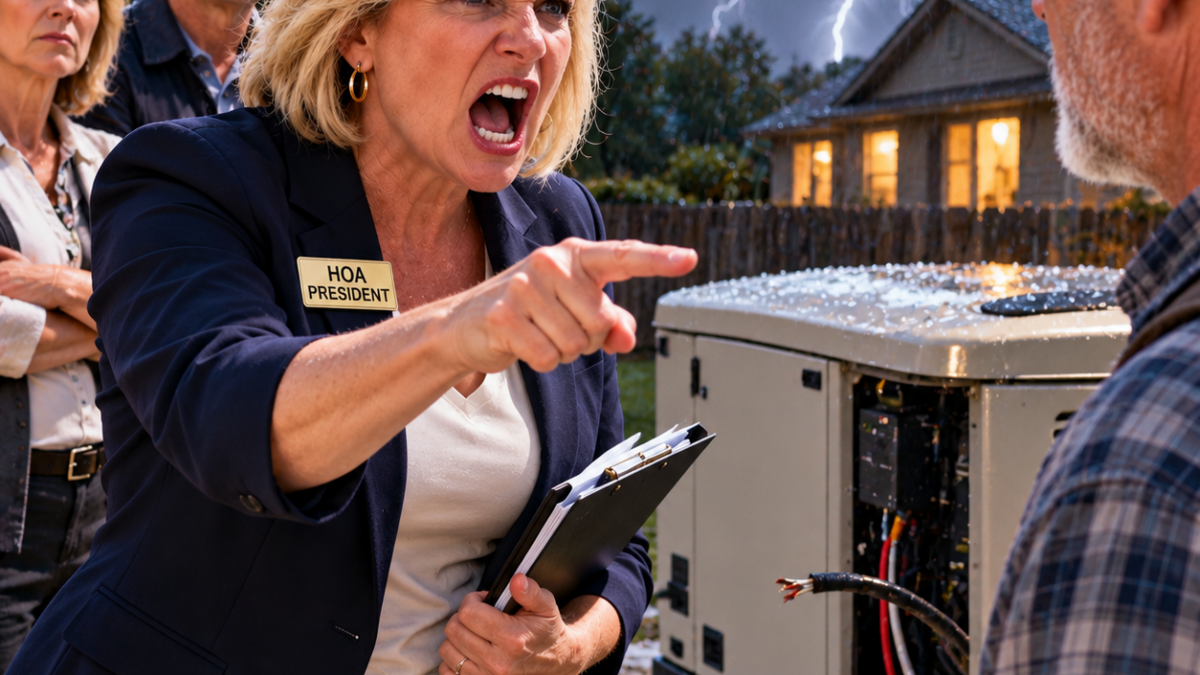
PART 2
“Don’t,” Diane said.
The word came fast enough that even Nathan looked at her.
Rainwater dripped from the edge of his jacket onto the medication bag pressed against his chest.
Behind Diane stood Paul Redding, a recently appointed board member, and another director named Calvin Brooks. Calvin had his phone raised, recording.
I picked up the folder.
Diane stepped closer.
“This is an emergency, Owen. We don’t have time to reopen a property dispute.”
“You brought witnesses.”
“We need documentation.”
“Of what?”
She didn’t answer immediately.
Paul did.
“She told us you had previously agreed to provide backup power to the clubhouse.”
I looked at Diane.
“No.”
Her jaw tightened.
“We had a verbal understanding.”
“No, we didn’t.”
“Owen—”
“I told you any arrangement would require engineering, a written agreement, and my permission. Then you sent me a contract giving your board access to my station forever. I rejected it.”
Paul turned toward her.
“You said he changed his mind after the equipment review.”
“He did.”
Nathan looked between us.
His face had changed.
For weeks, he’d been one of the residents who believed Diane’s emails.
I handed him the folder.
“Read it.”
Diane moved forward.
“That contains privileged correspondence.”
Mara would’ve laughed at that.
“It’s my correspondence.”
Nathan opened the folder.
The first document was my written refusal to sign the Community Cooperation Agreement.
The second was the regional management company’s email canceling Tuesday’s visit.
The third showed my explicit denial of entry.
Then Nathan reached the contractor’s work order.
I watched his eyes stop on one line.
He read it aloud.
“‘Hold operating controls until owner signs.'”
Rain hit the porch roof hard enough to make the silence afterward feel unnatural.
Paul stepped beside him.
“Let me see that.”
Nathan handed him the page.
Paul read the instruction twice.
Then he looked at Diane.
“Why were they supposed to hold his controls?”
Diane pointed toward the dark subdivision.
“We are wasting time.”
“Answer him,” I said.
“The contractor found safety concerns.”
“That isn’t what the work order says.”
“It was an evolving situation.”
“You told them to take the controls until I signed.”
“I authorized a compliance procedure.”
“On property your own management company told you not to enter.”
Nathan closed the folder.
“My mother needs refrigeration,” he said quietly. “I don’t care who wins this argument tonight. I need to know what actually works.”
That sentence cut through everything.
Not the fine.
Not the trespass.
Not Diane’s emails.
Not my anger.
What works?
I pointed toward the station.
“My main generator doesn’t.”
Nathan’s shoulders dropped.
I continued before Diane could jump in.
“The engine itself may be fine. The control and protection equipment isn’t. Priya Sha, my service engineer, inspected it Tuesday. We cannot operate it safely in its current condition.”
Diane shook her head.
“He has a generator sitting right there.”
Paul turned on her.
“Stop saying that like he can press a button.”
She stared at him.
I told Nathan about the smaller mobile unit my old colleague Luis Ortega had available for possible emergency deployment.
“It can’t power your whole neighborhood,” I said. “Maybe not even the whole clubhouse. But if the county approves the site and the electrical arrangement checks out, it may handle essential loads.”
“Medication refrigeration?”
“Potentially.”
“Lights?”
“Probably.”
“Phone charging?”
“Likely.”
“What about getting it here?”
“That’s what we’re trying to determine.”
Nathan nodded once.
“Then that’s what we work on.”
Diane folded her arms.
“This is exactly what I was trying to arrange six weeks ago.”
I looked at her.
“No. Six weeks ago you were trying to make my private station your permanent emergency system without paying to repair your own.”
Her expression changed.
That was the first time I’d said it in front of two board members.
Paul caught it.
“What does that mean?”
Diane answered before I could.
“It means Owen has been making accusations since we began updating our emergency preparedness plan.”
I took another document from the folder.
“Ask her about the clubhouse generator.”
Paul looked at Diane.
“What about it?”
“The last service assessment said it needed repair and testing before the HOA relied on it.”
His face tightened.
“I thought those repairs were completed.”
“They weren’t.”
Diane said, “The board prioritized several urgent capital projects.”
“Like the entrance sign?” I asked.
Paul turned sharply.
“What entrance sign?”
I almost felt sorry for him.
Almost.
“The illuminated monument sign at the main entrance.”
“We already approved that before I joined.”
“Exactly.”
Diane stepped between us.
“We’re not holding a budget hearing in a hurricane.”
“It isn’t a hurricane here,” Paul said. “And if we deferred emergency generator repairs because we thought Owen’s private equipment was available, I want to know.”
Diane’s voice dropped.
“People need leadership right now.”
Paul looked at Calvin’s phone.
“Keep recording.”
She stared at him.
He repeated himself.
“Keep. Recording.”
For the first time since Diane arrived at my gate, the witnesses she’d brought no longer seemed to belong to her.
Six weeks earlier, none of this had looked like it would end with a storm.
It had started with a photograph.
My generator performed an automatic fifteen-minute exercise once each month during daylight hours.
The routine wasn’t unusual.
Engines that sit unused for emergencies need scheduled testing.
Mine had been inspected, permitted, and maintained.
The first HOA letter called the sound a nuisance.
The second called the building an unauthorized utility structure.
The third added a fine.
At first I assumed their management system had confused my address with one of the Cedar Reach lots.
The employee I spoke with seemed to assume the same thing.
Then she checked the account notes.
“Your address was added manually.”
“By whom?”
There was a pause.
“The board president.”
“Diane Keller?”
“Yes.”
“Why?”
“I don’t have that information.”
I asked her to remove it.
She said the board would review my documentation.
I emailed the deed and recorded map that afternoon.
Three days later Diane came to my fence.
She didn’t spend more than thirty seconds discussing the noise.
Instead she asked whether my system could support the clubhouse.
That told me the noise complaint was leverage.
I gave her a cautious answer.
“Technically? Maybe part of it, depending on the load.”
“So yes.”
“No. That’s not what I said.”
“But it’s possible.”
“Lots of things are possible after engineering review. That doesn’t make them available.”
She smiled.
“I think we’re talking past each other.”
“No, I think you’re asking a different question than the one in your letter.”
Her smile disappeared.
Two days later, the agreement arrived.
Mara read it page by page.
“It starts as voluntary assistance,” she said. “Then it creates operational access. Then it gives them continuing authority unless they agree to terminate it.”
“Can they do that?”
“You can agree to almost anything if you sign it.”
“I’m not signing.”
“Good.”
She drafted the rejection.
We included the property survey.
We included the state and county inspection documentation.
We stated clearly that Cedar Reach had no authority over my station or parcel.
The management company acknowledged receipt.
Diane kept sending fines anyway.
Fifty dollars became a hundred.
A hundred became two hundred fifty.
Each letter added language suggesting continued noncompliance might result in “further enforcement.”
Mara responded to each one.
Eventually, even she stopped pretending the situation was a clerical mistake.
“Diane knows you’re outside the HOA,” she said.
“So why keep doing this?”
“Pressure.”
“To get the generator?”
“Most likely.”
I leaned back in her office chair.
“That’s insane.”
“No. Insane would be easier. This looks intentional.”
Nathan became involved because of an email.
He lived in Cedar Reach with his seventy-nine-year-old mother, Ruth.
We weren’t close friends then.
We knew each other from small things.
He’d helped me move a fallen limb after a windstorm.
I’d used my tractor to pull his pickup out of mud near the county shoulder.
Ruth occasionally brought me tomatoes from her garden even though I had no idea what to do with that many tomatoes.
One evening Nathan stopped beside my driveway.
“Owen, can I ask you something?”
“Sure.”
He held out his phone.
The subject line read:
CEDAR REACH EMERGENCY POWER PROGRAM UPDATE
The message said an “adjacent power provider” was delaying implementation of a community resilience partnership.
Below the text was a photograph of my generator station.
The photo had been taken from the HOA side of the fence.
“Are you asking them for more money?” Nathan asked.
“I haven’t offered them electricity.”
His forehead creased.
“Diane says terms are being finalized.”
“They aren’t.”
I brought him to my workshop office and showed him the rejected agreement.
He read the first page.
Then the second.
“This gives them a key?”
“More than that.”
He reached the termination language.
“Why would this be permanent?”
“Good question.”
Nathan looked embarrassed.
“I assumed you’d already agreed.”
“So did everyone else, apparently.”
He handed the papers back.
“I’ll ask Diane.”
I didn’t blame him.
Most people don’t perform legal audits on neighborhood emails.
If the board says the pool closes Friday, you assume the pool closes Friday.
If it says a neighbor has agreed to emergency assistance, you assume somebody checked.
I saved the email.
At that point I thought it might help Mara get the fines removed.
I didn’t yet understand how important it would become.
Then the orange tag appeared on my gate.
EQUIPMENT REVIEW SCHEDULED TUESDAY. OWNER COOPERATION REQUIRED.
It looked official enough that a neighbor might have mistaken it for a government notice.
I called the county inspection office.
The employee searched my address.
“No inspection scheduled.”
“Did your office issue an orange tag?”
“No.”
I sent her a photograph.
“That’s not ours.”
Mara contacted Cedar Reach’s regional management company.
After several calls, their manager sent a written message Monday afternoon.
Tuesday visit canceled. No contractor authorized to access Mercer parcel without owner consent.
That sentence should have ended it.
I photographed the locked gate.
Saved the email.
Completed the generator’s normal exercise.
Everything tested correctly.
Then I left Tuesday morning for an industrial consulting job inland.
At 11:42, my phone vibrated.
Gate camera.
Movement detected.
I opened the feed.
A white contractor truck blocked part of the image.
The gate stood open.
Diane was inside.
Three men followed her.
One carried a black tool case.
My stomach tightened.
I called Diane.
No answer.
I called management.
The employee repeated that the inspection had been canceled.
“Then why is another contractor inside my property?”
“What?”
“I’m watching them.”
She stopped talking.
On-screen, one worker approached the generator building.
Another carried a wrapped assembly.
I took screenshots.
Saved the clips.
Called the sheriff’s non-emergency line.
The indoor camera uploaded one short segment before its connection dropped.
A worker stood beside the control cabinet.
His body blocked most of the view.
Another man moved toward the door carrying something.
Then Diane crossed the frame.
Red sleeve.
Black folder.
Gone.
When I arrived more than two hours later, a deputy was waiting.
The contractor crew had already left.
So had Diane.
The cut padlock lay near the gatepost.
The deputy photographed it.
“Ms. Keller told dispatch the HOA had authority to inspect association equipment.”
“This isn’t association equipment.”
“I understand that’s your position.”
“It’s on my deeded parcel.”
“I’m documenting both statements.”
That answer irritated me at the time.
Later, I appreciated it.
He wasn’t there to become my lawyer.
He was preserving facts.
Inside the station, the facts were ugly.
A control assembly was missing.
A cabinet door had been bent.
Fresh tool marks crossed components that had been clean Monday.
And the air carried a faint burned-electrical smell.
I did not touch anything.
I called Priya.
She arrived with diagnostic equipment and a camera.
“Stay outside the working clearance until I make it safe.”
I stood in the doorway.
She inspected the cabinet.
Checked records.
Compared photographs from the last service visit.
Then she looked at me.
“The engine is still here.”
“I can see that.”
“That’s not what I mean. Someone could look at this and say, ‘The generator’s intact.’ But the equipment that allows it to operate safely isn’t.”
“Can you restore it before Thursday?”
She didn’t answer immediately.
That was enough.
She called her supplier.
Then a second one.
Then the manufacturer.
Finally she lowered the phone.
“Earliest replacement assembly is next week.”
My weather app sent an alert while she was speaking.
The tropical system offshore had strengthened.
Our area was now under a storm warning for Thursday night.
I stared at the dark control cabinet.
Diane had managed in two hours to disable a system I couldn’t restore in two days.
Then, before Priya finished documenting the damage, my email chimed.
Cedar Reach HOA.
Invoice attached.
Compliance inspection and equipment handling.
Payment due in ten days.
I showed Priya.
She stared at the amount.
Then at the damaged cabinet.
“Don’t say anything about this to them yet.”
“I wasn’t planning to.”
“Good.”
She raised her camera again.
“We’re going to photograph everything.”
The next morning, Diane’s explanation arrived through attorneys.
Her contractor, she claimed, had discovered a preexisting unsafe condition.
According to her version, the HOA’s intervention may have prevented dangerous operation.
Mara called me.
“Do you have documentation showing normal operation before Tuesday?”
“Monday’s exercise log.”
“Anything else?”
“Maintenance history. Remote diagnostics.”
“Good.”
I exported everything.
Monday’s fifteen-minute exercise showed normal startup, stable voltage, stable frequency, no protective alarms, and normal shutdown.
Tuesday’s communication loss began during the contractor’s visit.
That didn’t prove exactly which hand damaged which component.
But it established sequence.
Priya’s assessment added the physical condition.
She refused to speculate about anything she hadn’t personally observed.
That annoyed me for about five seconds.
Then I remembered how useful careful people become when everyone else starts exaggerating.
“The equipment is damaged,” she said. “The missing assembly is documented. The previous service records show its prior condition. I can tell you what the evidence supports. I can’t tell you which individual touched each part.”
“Fair.”
Her preliminary restoration estimate was $68,400.
I sat at my kitchen table staring at the number.
Elise’s old coffee mug sat beside the lamp.
It was blue with a small chip near the handle.
I had kept it even though I never used it.
Years earlier, before we built the station, a severe outage forced us to evacuate.
Road closures changed while we were driving.
We spent hours in rain trying to reach a place with power.
Elise sat beside me holding a paper map even though both our phones had GPS, because she trusted something that didn’t need a battery.
When we finally reached a motel with electricity, she said, “Next time, let’s have a plan that belongs to us.”
The generator station became that plan.
She died years later.
I finished the final upgrades without her.
Now someone had entered my property and taken away my ability to use the thing we’d built specifically so no board, shelter, hotel, or blocked road would decide whether we had power.
That was what made the damage personal.
Not the price.
The loss of control.
My phone rang.
Mara.
“I have something.”
I sat up.
“The contractor’s owner is cooperating with the investigator.”
“What did he say?”
“The crew supervisor questioned the locked gate before entry.”
“And?”
“Diane told them the owner was withholding mandatory access and that HOA counsel had approved the work.”
“Did their lawyer approve it?”
“No.”
I gripped the edge of the table.
“Anything else?”
“Yes.”
Paper rustled on her end.
“I’m going to read this exactly.”
She paused.
“‘Hold operating controls until owner signs.'”
I stood.
“Where are the controls?”
“Contractor depot.”
“They took them intentionally.”
“According to the work order, the controls were to be retained pending signature.”
“That was the whole point.”
“It appears so.”
The generator hadn’t been disabled because Diane wanted it destroyed.
She wanted leverage.
Take away my ability to use the station.
Make restoration dependent on cooperation.
Then offer the controls back once I signed away access.
What she hadn’t planned for was the storm.
Nathan came over that afternoon carrying the Cedar Reach emergency handbook.
He looked tired.
“My mom keeps this on top of the refrigerator.”
Ruth required medication that needed controlled storage.
The HOA handbook told residents that during prolonged outages, medication and essential perishables could be stored in the clubhouse refrigerator.
Nathan opened the backup power section.
There were two listed resources.
Clubhouse Generator.
And beneath it:
Mercer Station — Standby Support Confirmed.
I stared at the words.
“When was this distributed?”
He showed me the email date.
Six weeks earlier.
Before Diane sent my cooperation agreement.
Before she fined me.
Before she asked for a key.
Before I had consented to anything.
Nathan turned the page.
The photograph of my station had been cropped tightly enough to remove my PRIVATE PROPERTY sign.
“We planned around this,” he said.
I looked at him.
“What do you mean?”
“Mom’s medication. The handbook said the clubhouse would have backup refrigeration.”
“You were told my generator would support it?”
“Everybody was.”
I called Mara immediately.
The next set of records came through Cedar Reach residents who had inspection rights under the association’s governing procedures.
The board minutes showed the clubhouse generator had failed its latest service assessment.
A technician had recommended repair and load testing.
The board deferred the expense.
During the same budget period, it approved an illuminated entrance sign.
The financial notes contained a justification for deferring generator work.
Adjacent backup support expected to be available during extended outages.
My station.
They had budgeted around electricity I had never offered.
I read the sentence three times.
That was the deeper betrayal.
My generator hadn’t become Diane’s backup plan after the clubhouse generator failed.
My generator had become the excuse for not fixing theirs.
That evening, Diane called.
“I think we can resolve this.”
“I doubt it.”
“We’ll withdraw the fines.”
“They’re invalid anyway.”
“We’ll arrange immediate return of the control equipment.”
“It’s already being returned through the investigation.”
She paused.
“Then we can put this behind us.”
“What do you want?”
“A temporary emergency agreement.”
Mara had warned me she might try something like that.
“Send it to counsel.”
She did.
The agreement restored access to the controls.
It also released the property damage claim.
And acknowledged continuing board access to the station.
I declined.
Diane called again.
“People will remember who refused to help.”
I stared out my kitchen window toward Cedar Reach.
“Make sure they know what you’re asking me to sign.”
Then I hung up.
That was when I called Luis Ortega.
Luis owned a company specializing in temporary power systems.
We’d worked together after storms and industrial outages.
“I heard you got trouble coming,” he said.
“Weather or HOA?”
“Both, apparently.”
I explained the situation.
He couldn’t repair my station.
He also didn’t have a full-size spare generator sitting idle.
His large mobile units were already committed to hospitals, municipal sites, pumping facilities, and other critical loads.
But he had a smaller unit being held for a possible overflow gathering location.
“It isn’t assigned yet,” he said. “County coordinator decides.”
“Could it handle a clubhouse?”
“Depends on the clubhouse.”
“Lights, refrigeration, charging.”
“Maybe.”
“Kitchen?”
“Don’t even say kitchen until I see the load.”
I almost smiled.
“What do you need?”
“Site drawings. Electrical records. Access route. Transfer setup. Someone with authority to sign off on the location.”
I sent the information I had.
The county emergency coordinator remained cautious.
The staffed public shelter was still the preferred option for residents who could reach it safely.
The mobile generator could only be deployed if Cedar Reach became a suitable supplemental gathering point.
No promises.
That mattered.
After weeks of Diane promising things that weren’t hers to promise, I appreciated hearing “maybe.”
By Thursday afternoon, weather conditions deteriorated quickly.
One eastern road closed.
The western route remained open, but inspectors were watching a bridge after rising water damaged an approach.
Nathan arranged an alternate destination for Ruth and packed her medication.
I charged every portable battery I had.
Flashlights.
Radios.
Phone banks.
I filled water containers and left a travel bag near the door.
My generator station remained dark.
At 8:17 p.m., utility power failed.
Cedar Reach vanished behind the fence.
A few seconds later I heard the clubhouse generator crank.
Once.
Stop.
Crank again.
Then silence.
An HOA email arrived minutes later.
BACKUP ACTIVATION IN PROGRESS. RESIDENTS SHOULD REMAIN CALM.
Luis texted me something much less polished.
Crew ready. County still checking route/site. Don’t promise anybody anything.
That was the message I trusted.
Forty minutes later, headlights appeared at my gate.
Diane.
Paul.
Calvin.
Then Nathan arrived with Ruth’s medication bag.
And that brought us back to the folder on my porch.
Back to Diane asking me to turn on a generator she had helped disable.
Back to her bringing witnesses because she needed evidence that I—not she—had refused to solve the emergency.
Only now the witnesses had read the paperwork.
Her plan was coming apart.
But the storm didn’t care who was right.
After Paul told Calvin to keep recording, he called the county coordinator himself.
Nathan checked road updates.
“The bridge on Mom’s planned route just closed.”
“Is she safe where she is?” I asked.
“She’s with Mrs. Holloway. They have medication packed properly for now.”
“Then don’t move her until the county tells you where the safe route is.”
Diane threw up her hands.
“We have a clubhouse fifty yards away.”
“A dark clubhouse,” Nathan said.
“We’re getting it powered.”
“With what?”
“The mobile generator.”
I shook my head.
“That’s not approved yet.”
“You said it was available.”
“I said it might be.”
She looked at Paul.
“This is what I’ve dealt with for six weeks. Every answer changes.”
“No,” I said. “The conditions change. That’s how emergency work actually works.”
Paul held up his phone.
“County coordinator says the site can remain under review if we provide the renovation electrical drawings.”
Diane frowned.
“Why do they need renovation drawings?”
Luis answered that question when I called him.
“Because your emergency load list is wrong.”
Diane moved closer to my phone.
“The clubhouse is practically new.”
Luis heard her.
“Then somebody should have accurate drawings.”
I put him on speaker.
He explained that the HOA’s emergency list described refrigeration, selected lighting, and charging circuits.
But building records indicated additional equipment had been added after renovation.
Nobody had verified what now sat on the proposed circuits.
Diane said, “Just bring the generator. Your electrician can figure it out here.”
Luis’s voice stayed calm.
“No.”
“We have residents without power.”
“And I’d like to keep them from having an electrical fire too.”
Paul almost smiled.
Diane didn’t.
“Can you support essential loads?”
“If the final drawings match the site and my electrician approves a limited arrangement.”
“How long?”
“As long as it takes to do it safely.”
She looked at me.
“This is exactly why the board wanted operational authority.”
I stared at her.
“No. This is exactly why you weren’t getting it.”
The management portal barely loaded through the unstable cellular connection.
Calvin stood inside my porch doorway refreshing his phone.
Finally, the clubhouse renovation folder opened.
Floor plans.
Electrical drawings.
Final inspection record.
Paul forwarded them to me.
I sent them to Luis.
His electrician reviewed the material while we stayed on the phone.
After several minutes he said, “Okay. There may be a workable limited setup.”
“What does limited mean?” Paul asked.
“Main gathering room. Essential lighting. Primary refrigeration. Charging. Selected support circuits.”
“Kitchen?”
“No cooking loads.”
Diane immediately objected.
“People are going to expect hot food.”
Paul turned toward her.
“They need a safe place with lights.”
“The association spent a fortune renovating that kitchen.”
“And tonight that doesn’t matter.”
Calvin’s phone chimed.
He looked down.
“What?”
He hesitated.
“Diane, there’s a board message scheduled to go out.”
“What does it say?”
Calvin read it.
“‘Full clubhouse services restored through Mercer Partnership.'”
I laughed once.
Not because it was funny.
Because after everything we’d just discussed, the lie was already queued.
Paul stared at Diane.
“Cancel it.”
“It’s messaging.”
“It’s false.”
“The residents need confidence.”
“They need accurate information.”
“Paul—”
“Cancel it.”
Calvin deleted the scheduled notice.
For the first time in six weeks, Diane couldn’t make a claim faster than someone else could verify it.
The county coordinator eventually cleared Cedar Reach as a temporary gathering point subject to final site inspection.
The mobile unit was released.
Volunteers began calling residents.
The message was simple.
Limited emergency gathering space.
Essential refrigeration.
Charging.
Selected lights.
Not full service.
Not whole-house backup.
County shelter remained the primary option for anyone who could travel safely.
Truth was less impressive than Diane’s announcements.
It was also usable.
Luis’s crew took the approved route.
Nobody crossed the closed bridge.
Nobody drove through standing water to save twenty minutes.
Nathan went back for Ruth.
I headed to the clubhouse after Paul confirmed the short local approach remained open.
Out of habit, I picked up my blue maintenance binder before leaving.
Then I set it down again.
Tonight wasn’t about proving what had happened to my generator.
That evidence could wait safely in my house.
Tonight was about not repeating the same mistake.
When I reached Cedar Reach, residents were waiting in vehicles and beneath the covered entrance.
Flashlights moved behind dark windows.
A volunteer wrote names on paper because the front desk computer had no power.
Diane stood near the entrance.
Luis’s truck arrived towing the generator.
She immediately walked toward him.
“We need the entire building operational.”
Luis looked past her.
“Who’s site authority tonight?”
Paul stepped forward.
“For the temporary deployment, I’ll coordinate with the county.”
“Good.”
Diane stared at him.
Luis continued.
“Approved scope is limited essential loads.”
“We have eighty-four homes.”
“You have a generator sized for the approved clubhouse loads we discussed.”
“Can it do more?”
“Maybe.”
“Then let’s use it.”
Luis looked at me.
I didn’t need to answer.
He already knew the type.
“Capacity isn’t permission,” he said.
His electrician inspected the connection equipment.
Compared panel schedules.
Opened covers.
Verified isolation.
Asked questions.
Waited for answers.
There was something deeply reassuring about the process.
No threats.
No speeches.
No emergency being used as permission to skip the next step.
One person called out a circuit.
Another verified it.
Someone documented the load.
Luis approved the sequence.
Finally, the mobile generator started.
Its engine settled into a steady mechanical rhythm.
A few minutes later, one bank of lights inside the gathering room came on.
People began moving toward the building.
Not cheering.
Just moving.
Parents carrying bags.
Older residents holding flashlights.
A couple with a toddler asleep against the father’s shoulder.
Volunteers admitted people gradually and kept the work area clear.
The main refrigerator came online.
Phone charging stations were established.
Selected lights operated.
The rest of the building stayed restricted.
Then Diane told a volunteer to start the kitchen.
“Coffee first,” she said. “Then hot meals.”
The volunteer looked toward the electrician.
Not Diane.
That small choice told me her authority was already changing.
“Kitchen appliances aren’t included,” the electrician said.
Diane pointed toward the coffee equipment.
“Surely that one thing won’t matter.”
I handed her the load schedule.
“One thing always matters.”
“Owen, don’t start.”
“I’m not starting anything. If you want to add load, ask the crew what comes off.”
She looked at Luis.
He nodded.
“He’s right.”
Diane glanced into the gathering room.
Ruth had just arrived with Nathan.
A volunteer was helping them confirm medication storage.
Nearby, several residents were charging phones.
Emergency lights covered the main room.
The building felt calmer already.
“What do I have to remove?” Diane asked.
Luis pointed at the listed priorities.
“Something equivalent, if engineering approves the swap.”
Medication refrigeration.
Lighting.
Communications.
Charging.
Diane looked at the coffee machine.
Then at Ruth.
She didn’t answer.
The kitchen stayed off.
As the hours passed, people asked for more.
A microwave.
A television.
Additional refrigerators.
A space heater in an office.
An electric kettle.
Each request sounded small on its own.
That is how overloaded temporary systems get into trouble.
Nobody asks for fifty extra kilowatts at once.
They ask for “just one more thing.”
I had spent enough years around emergency equipment to know that capacity has a habit of disappearing one convenience at a time.
So we checked.
Measured.
Prioritized.
Denied requests when necessary.
Near midnight, the gathering room was lit and stable.
The essential refrigeration held temperature.
Residents had charging access.
County staff were coordinating safe transportation for people with medical or mobility needs.
The generator wasn’t powering eighty-four houses.
It wasn’t even powering the entire clubhouse.
It was doing exactly the job that had been evaluated and approved.
That made it useful.
Diane didn’t seem satisfied.
She stood near the entrance recording herself with her phone.
“The Cedar Reach board is pleased to activate our long-planned emergency partnership with Mercer Station—”
Paul stepped directly into the frame.
He held the county deployment paperwork.
“This unit was released by the county coordinator and supplied by Ortega Temporary Power. Owen Mercer’s station is currently disabled.”
Diane lowered the phone.
“I’m trying to reassure people.”
“Then tell them what happened.”
“Not tonight.”
“Tonight is when they’re relying on the information.”
Behind Paul stood Calvin.
His phone was still in his hand.
He had kept the full recording from my gate.
Diane saw it.
So did I.
She walked away.
I could have followed.
Could have demanded an apology in front of every resident.
Could have told everyone their HOA president had cut my lock, taken my controls, and then tried to blame me when their own generator failed.
Instead Luis called from the equipment table.
“Owen, take a look at this monitoring entry.”
I went back to work.
There would be time for records later.
At two in the morning, Nathan found me sitting beside the temporary control table.
Ruth had a chair inside.
Her medication was stable.
The county had given them a transportation plan for daylight if conditions improved.
Nathan sat down.
“You could have told all of us to go to hell.”
“I considered it.”
He laughed tiredly.
“I’m serious.”
“So am I.”
He looked through the glass doors toward his mother.
“After what Diane did to your station, why are you helping?”
I thought about Elise.
That night years earlier.
Rain on the windshield.
Her paper map spread across her knees.
The motel sign finally appearing after hours of rerouting.
“Your mother didn’t cut my lock,” I said.
Nathan looked at me.
“She just needed somewhere with lights.”
He nodded.
We sat without talking.
Outside, trees bent in the wind.
Inside, volunteers passed around sandwiches.
Someone wrote down another family’s transportation request.
A child slept across three chairs.
The relief wasn’t dramatic.
People simply stopped sounding frightened.
That was enough.
By dawn, the strongest weather had begun moving inland.
Utility crews assessed damage.
The county reopened some roads and kept others closed.
The mobile generator continued running within its approved limits.
When Cedar Reach no longer needed the temporary gathering point, Luis’s unit moved on through the county deployment system.
It had done the job promised.
No more.
No less.
My station remained broken.
Diane’s first post-storm email arrived before some residents even returned home.
She described the property dispute as “an unfortunate distraction from Cedar Reach’s successful emergency response.”
I read it at my kitchen table.
Then Nathan sent me a message.
Not this time.
He replied to the resident list.
With permission from the people involved, he distributed the recording from my gate.
My written refusal.
The canceled inspection notice.
The contractor’s instruction to hold the controls until I signed.
Paul distributed corrected information about the mobile generator deployment.
Calvin confirmed the recording was complete and unedited.
For the first time, Cedar Reach residents didn’t have to choose between Diane’s version and mine.
They could read the records themselves.
And records have one advantage over speeches.
They don’t get nervous when someone asks the same question twice.
The special HOA meeting took place six weeks later.
I attended by invitation.
Mara sat beside me.
Before the meeting began, she leaned closer.
“Remember, you are not a member.”
“I know.”
“You don’t vote.”
“I know.”
“You are here as an affected property owner and witness.”
“Mara.”
“What?”
“I know.”
She smiled.
“I enjoy hearing you say it.”
The clubhouse generator had finally been repaired by then.
The meeting room was full.
No storm.
No emergency lights.
No excuse to hurry.
The presentation was short.
That made it more damaging.
First slide:
The clubhouse generator service report.
Repair recommended before reliance.
Second slide:
Budget minutes showing the repair deferred.
Third slide:
Approval of the illuminated entrance sign.
Fourth slide:
Budget note citing expected adjacent backup support.
Fifth slide:
The emergency handbook distributed six weeks before I was asked for consent.
Mercer Station — Standby Support Confirmed.
Sixth:
My written refusal.
Seventh:
The canceled contractor visit.
Eighth:
The replacement contractor’s work order.
Hold operating controls until owner signs.
Diane sat at the board table.
When public statements began, she stood.
“The storm forced difficult decisions.”
Nathan rose from the audience.
“No.”
The room turned.
He held the emergency handbook.
“The storm didn’t make you promise us his generator six weeks before you asked him.”
Diane looked toward the board attorney.
“This meeting is becoming personal.”
Nathan continued.
“My mother and I made medical plans based on this document.”
He held it higher.
“You told us the clubhouse had backup support. You hadn’t repaired your generator, and Owen hadn’t agreed.”
“I believed an agreement could be finalized.”
“Then why did the handbook say confirmed?”
She didn’t answer.
Paul stood next.
“I need to address my own role.”
The room quieted.
“When I joined the board, I accepted representations about the emergency plan without independently verifying them. I should have asked for the supporting agreements.”
He looked toward me.
“I didn’t.”
Then he faced the residents.
“During the storm, I saw the documents at Mr. Mercer’s gate.”
Calvin connected his phone to the room’s system.
The recording played.
Rain hissed in the background.
Diane’s voice came through clearly.
We need a record that the board offered a solution and the owner declined.
Nobody moved.
Then my voice.
The equipment isn’t operational because your contractor removed the controls.
Diane again.
The generator is still there.
Then Paul asking whether I’d agreed.
Her answer.
Verbally, he’s changed his position.
The recording continued until Nathan read the contractor instruction aloud.
Hold operating controls until owner signs.
When the video stopped, silence filled the clubhouse.
Diane reached for her microphone.
“Those conversations occurred during an unprecedented emergency.”
Nathan answered from his seat.
“The work order was written before the emergency.”
That was the moment her storm explanation collapsed.
Not because anyone shouted.
Because the dates refused to move.
Eligible Cedar Reach homeowners voted under the association’s governing procedures.
Diane and the directors named in the recall proposal were removed.
Paul was not part of Diane’s inner group in the same way, but he publicly acknowledged his failure to verify the emergency plan and declined to remain in leadership when the replacement board was selected.
Harold Simmons, a retired municipal accountant who had spent most meetings saying very little, became interim treasurer.
A new president was elected later.
The new board commissioned an independent operational review.
My address was removed from every HOA enforcement system.
All fines and notices against my parcel were formally withdrawn.
The corrected emergency handbook contained no mention of my station.
The new language stated that assistance from neighboring private properties could be used only under specific written agreements voluntarily executed by the property owner.
Mara read that sentence twice.
“I like this board better.”
“They’ve been in office eleven days.”
“Give them time.”
I laughed.
For the first time since Diane’s first letter, the fence between Cedar Reach and my property felt like a boundary again instead of an argument.
The property damage claim took several more months.
Investigators collected original security footage.
The contractor supplied job records, internal messages, photographs, and the returned control equipment.
Priya completed her technical assessment.
Mara handled the civil claim.
I learned more than I ever wanted to know about documenting damaged electrical systems for insurers.
Every item needed a reason.
Every labor estimate needed support.
Every replacement component had to connect to documented damage.
There was no giant punitive windfall.
No magical courtroom check.
The settlement paid the full $68,400 required to restore and recommission the generator, plus the other documented expenses and losses covered under the agreement.
My gate and lock were repaired.
I released only the civil claims covered by the settlement.
The unlawful-entry case proceeded separately.
I didn’t control that process.
I couldn’t exchange it for money or electricity even if I’d wanted to.
Eventually, Diane entered a plea on the unlawful entry charge supported by the investigation.
The court imposed probation and community service.
I wasn’t present for every procedural step.
Mara kept me informed.
Nathan texted me when Cedar Reach residents began discussing the result online.
I asked him not to send screenshots.
“Why?”
“Because I already spent months reading Diane’s emails.”
“Fair.”
For me, the more important day came later.
Priya returned to recommission the station.
She replaced the damaged assemblies.
Verified wiring.
Tested protection.
Checked battery integration.
Ran the transfer sequence.
Then she stood beside the control panel.
“Ready?”
I nodded.
She initiated the exercise.
The engine turned.
Caught.
Settled into the deep, steady rhythm I’d heard hundreds of times before.
No alarms.
No strange vibration.
No missing controls.
Normal voltage.
Normal frequency.
Stable load.
Priya checked her tablet.
“That’s better.”
I watched the system complete the exercise.
Fifteen minutes.
Exactly as it had before any of this started.
Nathan and Ruth came to the fence while the generator was running.
Ruth carried a covered dish.
Nathan listened to the engine.
“Sounds different.”
“Same machine.”
He tilted his head.
“No. It sounds different.”
I knew what he meant.
“You just know what it’s for now.”
Ruth held the dish toward me.
“I made chicken casserole.”
“You didn’t need to do that.”
“I know.”
I took it anyway.
We talked until the generator finished its cycle.
They stayed on their side of the fence.
I stayed on mine.
Nobody needed a permanent access agreement for that.
Nobody needed a board vote.
When the engine shut down, the sudden quiet reminded me of the night Elise and I first talked about building a backup system.
A plan that belongs to us.
For months, I’d thought protecting that plan meant keeping everyone else away from it.
The storm taught me something more precise.
Ownership meant I got to decide how it was used.
I could say no when someone tried to take control.
And I could still say yes when a neighbor genuinely needed help.
Those two things were never opposites.
Diane had tried to erase the difference.
That was the heart of the fight.
That evening I carried the cut padlock into my workshop.
I’d kept it in an evidence bag after the investigator released it.
One side was clean.
The other bore the bright exposed metal where the cutter had gone through.
I considered throwing it away.
Instead, I put it in a drawer.
Not as a trophy.
As a reminder.
Then I filed Priya’s final commissioning report in the blue maintenance binder.
Monday exercise: normal.
Protection test: passed.
Transfer sequence: passed.
System ready for service.
I closed the binder and returned to the kitchen.
Elise’s chipped blue mug sat beside the lamp.
Outside, Cedar Reach’s lights glowed through the trees.
Their repaired clubhouse generator now belonged to their emergency plan.
Mine belonged to mine.
There was still a locked gate between us.
But the lock meant what it was supposed to mean again.
A boundary.
Not hostility.
If Nathan needed help, he could knock.
If Ruth needed refrigeration during another outage, we could discuss what was safe and possible.
If Cedar Reach ever wanted a formal emergency arrangement, its board could ask.
And this time, the answer would be written before anybody promised my electricity to eighty-four families.
I switched off the kitchen light and looked once through the window toward the station.
The building was dark.
Quiet.
Ready.
Exactly the way backup power is supposed to be.
The special HOA meeting happened six weeks after the storm, but by then Cedar Reach felt like a different neighborhood.
From my side of the fence, everything looked the same. The same stone entrance. The same clubhouse roof above the trees. The same neat rows of homes running along the curved streets. But every time I saw someone stop at their mailbox and look toward my property, I knew the story Diane had spent weeks controlling no longer belonged to her.
Nathan had circulated the recording from my gate with the permission of everyone involved. Paul had distributed the county deployment paperwork showing exactly where the temporary generator had come from and who had authorized it. Calvin confirmed that the video had not been edited.
More importantly, the residents had received copies of the documents Diane had spent months explaining away.
My written refusal.
The management company’s cancellation of the inspection.
The contractor’s work order.
The instruction to hold my operating controls until I signed.
And the emergency handbook that had listed my private generator as “Standby Support Confirmed” before Diane ever asked my permission.
No single document was dramatic by itself.
Together, they told a very simple story.
Cedar Reach’s clubhouse generator had needed repairs.
The board delayed those repairs.
Diane had already begun treating my equipment as the replacement.
Then she tried to create the agreement after she’d promised the benefit.
That was what finally destroyed her credibility.
Mara came with me to the meeting because she didn’t trust anyone to rewrite the legal boundaries once the room became emotional.
Before we walked inside, she stopped beside my truck.
“One thing.”
“What?”
“You are not a Cedar Reach homeowner.”
“I know.”
“You don’t vote.”
“I know.”
“You don’t participate in their internal politics.”
“Mara.”
She raised an eyebrow.
“I’m serious.”
“So am I.”
“You’re there because their conduct affected your property. Answer factual questions. Don’t get dragged into whether Diane was a good president before this happened.”
“I wasn’t planning to.”
“You say that now.”
I smiled.
She pointed at me.
“That smile is why I’m reminding you.”
Inside, the clubhouse was almost full.
The temporary storm generator was long gone. The building’s permanent generator had finally been repaired and tested. The lights overhead were steady. The refrigerators were running. Every system Diane had claimed would be impossible without my station was functioning from equipment the HOA actually owned.
That fact alone made the evening feel different.
Nathan sat beside Ruth near the center of the room. She wore a blue sweater and held both hands over the top of her cane.
When she saw me, she lifted one hand.
I waved back.
Paul stood near the side wall rather than behind the board table.
That was deliberate.
He had already announced that he would not defend decisions he hadn’t verified simply because he happened to be a board member when they became public.
Diane sat at the front.
She looked composed.
That didn’t surprise me.
People who are good at controlling a room rarely forget how just because the facts turn against them.
The meeting began with procedural language.
Notice requirements.
Attendance.
Voting eligibility.
Then the independent presentation started.
The first slide displayed the clubhouse generator service report.
The recommendation was short.
Repair required before reliable emergency use.
The next slide showed the budget discussion where that repair had been deferred.
Then came the illuminated entrance sign.
I heard someone behind me whisper, “You’ve got to be kidding.”
The sign hadn’t caused the generator to fail.
That wasn’t the point.
The point was priority.
The board had known the backup system was unreliable.
Instead of correcting it, the budget notes relied on expected adjacent support.
My support.
Support I hadn’t agreed to provide.
Then the emergency handbook appeared on the screen.
MERCER STATION — STANDBY SUPPORT CONFIRMED.
There was the cropped photograph.
My private property sign had been cut out.
Nathan leaned forward.
I could see his jaw tighten.
The next slide showed the date.
Six weeks before Diane asked me to sign anything.
That was when Ruth quietly said, loud enough for several people around her to hear, “So it was never confirmed.”
Nobody answered.
The presenter moved to my written refusal.
Then to the management company’s cancellation email.
Then to the work order.
When the line appeared on the screen, the room went completely quiet.
HOLD OPERATING CONTROLS UNTIL OWNER SIGNS.
I had read that sentence dozens of times by then.
Seeing it projected ten feet wide still hit me differently.
That instruction had turned my generator from equipment into leverage.
Diane raised her hand.
The meeting chair recognized her.
“The storm created a rapidly evolving situation,” she said. “Every decision should be understood in that context.”
Nathan stood before anyone else could answer.
“The storm didn’t make you write that.”
She looked at him.
He held up the emergency handbook.
“And the storm didn’t make you send this six weeks before you asked Owen.”
Diane’s expression tightened.
“We believed an emergency arrangement would be finalized.”
Nathan nodded toward the screen.
“Then why does it say confirmed?”
“It reflected the board’s expectation.”
“My mother didn’t make medical plans based on your expectation. She made them based on what you told us was available.”
Ruth touched his arm.
He sat down.
Diane looked toward the front table.
“I understand emotions are high, but the board was attempting to create redundancy for the community.”
Paul stood.
“No.”
Every head turned toward him.
He walked slowly toward the microphone.
“I accepted that explanation at first.”
Diane watched him.
Paul continued.
“When I joined the board, I was told Mercer Station was part of the emergency backup arrangement. I didn’t request the agreement. I didn’t verify the property records. I assumed somebody else had already done it.”
He looked toward the residents.
“That was my mistake.”
Then he faced Diane.
“But after the storm, I reviewed the dates.”
He pointed toward the work order.
“The access cancellation came before the second contractor was sent.”
Another slide appeared.
The regional manager’s written confirmation.
No contractor authorized to enter Mercer property without owner consent.
Then the timestamp from the replacement work order.
Later.
After the cancellation.
Paul spoke again.
“That wasn’t confusion.”
Diane interrupted.
“The management company did not understand the urgency.”
“Then why did you tell the contractor the HOA attorney approved entry?”
Her attorney, sitting two seats away, looked down.
Everyone noticed.
Diane turned toward him.
He didn’t speak.
Paul continued.
“Counsel denied approving it.”
For the first time that night, Diane’s control slipped.
She leaned toward the microphone.
“We had eighty-four homes depending on us.”
Paul shook his head.
“Not on Tuesday.”
She froze.
“The storm hit Thursday. You entered Owen’s property Tuesday.”
Nobody moved.
That was the moment the timeline became unavoidable.
The trespass wasn’t an emergency decision made during a blackout.
The controls weren’t removed because families were trapped without electricity.
The damage happened before the storm.
Before the outage.
Before any resident needed emergency refrigeration.
Calvin walked to the front and connected his phone.
He played the recording from my gate.
Rain hissed through the speakers.
Diane’s voice came first.
“We need a record that the board offered a solution, and the owner declined.”
I watched residents react.
Some looked at her.
Others looked at each other.
Then came Paul’s question.
“Did Mr. Mercer previously agree to support the clubhouse?”
Diane’s recorded voice answered.
“Verbally, he’s changed his position.”
My voice followed.
“No, I didn’t.”
Then Nathan reading the work order.
“Hold operating controls until owner signs.”
The audio stopped.
Nobody spoke.
Diane reached toward the microphone.
Her hand paused before touching it.
She seemed to realize that anything she said would now be compared against something already recorded.
Finally she leaned forward.
“I made decisions based on what I believed was necessary to protect Cedar Reach.”
A woman in the back called out.
“Then why didn’t you fix our own generator?”
Another resident spoke.
“Why did you tell us his station was confirmed?”
Someone else asked about the fines.
Another asked why my address had been added to the enforcement system when my parcel wasn’t in the HOA.
The chair called for order.
Mara leaned toward me.
“Don’t say anything.”
“I wasn’t going to.”
“I know that face.”
I kept my mouth shut.
The vote proceeded under Cedar Reach’s governing rules.
I had no ballot.
I didn’t need one.
Eligible residents removed Diane and the directors named in the recall proposal.
Paul had not been one of the primary targets, but before the replacement board was selected, he stood again.
“I should have verified more before accepting the emergency plan,” he said. “I’m not going to ask you to keep me in leadership while saying everyone else needs accountability.”
He stepped aside.
I respected him for that.
Not because he had been perfect.
He hadn’t.
But there is a difference between making a mistake and building a strategy around never admitting one.
The replacement board spent its first month undoing things.
My address was deleted from the HOA enforcement database.
Every fine against my parcel was formally withdrawn.
The emergency handbook was corrected.
The photograph of my station disappeared from all association materials.
A written policy now required that any emergency resource located on non-HOA property be supported by an actual signed agreement before being included in community planning.
Mara read that policy in my kitchen.
“Imagine that.”
“What?”
“They’ve invented consent.”
I laughed.
She slid the page across the table.
“Keep it anyway.”
The civil claim took longer.
Priya’s original $68,400 restoration estimate had to survive the kind of scrutiny that turns every bolt into a conversation.
Insurers wanted photographs.
Serial numbers.
Previous maintenance records.
Proof of normal operation.
Labor estimates.
Manufacturer documentation.
They wanted to know which components were damaged during the unauthorized work and which might have required replacement eventually anyway.
At first, the process irritated me.
Then I remembered how angry I’d been when Diane treated assumptions as facts.
If I wanted accountability based on evidence, I had to accept evidence standards when they were applied to me too.
Priya was excellent at that.
Whenever I said, “Obviously they caused this,” she would answer, “Show me.”
Whenever I wanted to include something uncertain, she would ask, “Can we support it?”
Sometimes the answer was no.
So we left it out.
The final claim was stronger because of that.
The contractor returned the removed control assembly under documented custody.
Inspection showed it had not simply been unplugged cleanly.
Other equipment had been disturbed during removal.
The cabinet damage matched the sequence Priya had documented after the intrusion.
Monday’s exercise records showed normal operation.
Tuesday’s communication loss aligned with the time the crew was on the property.
The contractor’s internal instructions confirmed that the controls were supposed to be withheld until I signed.
The civil settlement eventually covered the full $68,400 restoration cost along with the other documented expenses and losses agreed by the parties.
My gate was repaired.
The damaged lock was replaced.
Professional inspection fees were covered.
There was no giant jackpot.
I didn’t want one.
I wanted my station back in the condition it had been in before someone decided my refusal was an obstacle to work around.
Mara made sure the civil release applied only to the claims being settled.
The separate unlawful-entry case followed its own process.
I didn’t control that case.
I couldn’t use it as bargaining material.
I couldn’t tell prosecutors what result to impose.
Eventually, Diane entered a plea to the unlawful-entry charge supported by the investigation.
The court imposed probation and community service.
Nathan asked me whether that felt like enough.
I thought about it before answering.
“Enough for what?”
“For what she did.”
“I don’t know.”
He looked surprised.
I continued.
“I wanted the damage repaired. It was repaired. I wanted my property left alone. It is. Cedar Reach corrected the plan. She lost the position she used to do it.”
“So you’re not angry?”
“I didn’t say that.”
He smiled.
“Fair.”
I had learned that anger doesn’t disappear just because the paperwork ends.
Sometimes it fades slowly.
Sometimes it comes back when you notice something small.
For me, it returned one afternoon when I walked past the empty mounting space where the control assembly had been removed.
The replacement equipment hadn’t arrived yet.
I stopped and stared at the open cabinet.
For a moment I was back on that Tuesday.
Two hours away.
Watching people move through my property on a phone screen.
Unable to stop them.
That feeling stayed longer than the legal dispute.
The station had been built because Elise and I once spent a storm night trying to escape uncertainty.
I remembered that drive more clearly than I wanted to.
Rain so heavy the lane markers vanished.
Our first route closed.
Then the second.
Elise held a paper map across her knees while I drove.
At one point we stopped beneath a gas station canopy that had no electricity.
We sat there listening to rain hit the roof.
She looked at me and said, “I hate depending on somebody else’s plan.”
I asked what she meant.
She pointed toward the dark station.
“We keep being told where to go after things fail. Next time, let’s have a plan that belongs to us.”
Years later, after she’d died, I still heard that sentence every time I maintained the generator.
That was why Diane taking the controls felt different from ordinary property damage.
It touched the reason the system existed.
Priya came for the final commissioning on a clear morning.
No storm.
No emergency.
No board members.
Just her service truck beside my workshop and a clipboard resting on the hood.
She inspected every repaired component.
Checked fasteners.
Verified protective settings.
Tested battery integration.
Confirmed communications.
Then she looked at me.
“Ready?”
“Absolutely.”
She initiated the start sequence.
The engine turned over.
Caught.
Settled.
The sound rolled through the workshop wall.
Deep.
Steady.
Familiar.
I watched the readings stabilize.
Voltage correct.
Frequency correct.
No alarms.
Transfer logic normal.
Priya made a note.
“Protection test passed.”
I nodded.
She looked at me.
“You can breathe now.”
“I am breathing.”
“Technically.”
The generator continued through its fifteen-minute exercise.
About halfway through, I noticed movement near the fence.
Nathan and Ruth.
Ruth carried a covered casserole dish.
Nathan stood with his hands in his jacket pockets listening to the engine.
When Priya finished the test, I walked toward them.
Nathan tilted his head.
“Sounds different.”
“Same engine.”
“No.”
He smiled.
“It sounds different now.”
“Because it’s fixed?”
“Because now I know what that sound means.”
Ruth handed the dish over the fence.
“Chicken casserole.”
“You didn’t have to do that.”
“I know.”
“That’s a dangerous answer.”
She smiled.
“Take it.”
I did.
We stood there talking while Priya packed her tools.
Nobody opened the gate.
Nobody asked for a key.
Nobody needed one.
Nathan told me the new board had scheduled annual generator testing for the clubhouse.
Ruth said the emergency handbook now had a full page telling residents not to rely on unconfirmed private resources.
“Your name isn’t in it,” she added.
“Best update they’ve made.”
Nathan laughed.
The conversation lasted maybe twenty minutes.
Ordinary conversation.
No lawyers.
No storm.
No documents.
That normality mattered more than I expected.
After they left, I carried the casserole inside.
Then I went back to the workshop.
The cut padlock was still in an evidence bag on my workbench.
The investigator had released it weeks earlier.
I picked it up.
The jaws had crushed one side before shearing through the metal.
For months, I’d kept it because it was evidence.
Now it was just a broken lock.
I considered throwing it away.
Instead, I put it in a drawer.
Not because I wanted a trophy.
Because I wanted to remember one specific thing.
A locked gate is not an argument.
It is an answer.
Someone wanting what is behind it does not transform that answer into permission.
Then I filed Priya’s final commissioning report in the blue maintenance binder.
Normal start.
Normal transfer.
Protection verified.
Battery interface verified.
Communications verified.
Ready for service.
I closed the binder.
When I returned to the kitchen, Elise’s chipped blue mug was beside the lamp.
I picked it up and turned it slowly in my hands.
For years, I had thought the lesson from our old storm evacuation was simple.
Be self-sufficient.
Build your own backup.
Control your own risks.
After Cedar Reach, I understood it differently.
A plan belonging to you doesn’t mean you never help anyone else.
It means help remains a choice.
During the storm, I could have refused to assist Cedar Reach.
After what Diane had done, plenty of people would have understood.
Instead I helped Luis’s crew establish a safe temporary system because Ruth needed refrigeration and other families needed light.
That did not make Diane right.
It didn’t validate her agreement.
It didn’t give Cedar Reach ownership of my station.
Helping someone voluntarily and surrendering control are not the same thing.
Diane had tried to erase that distinction because it was convenient.
Now everyone understood it.
A few weeks later, the new HOA president stopped near my fence while I was trimming brush.
He didn’t enter.
Didn’t wave paperwork.
Didn’t ask for a key.
He stood on Cedar Reach’s side and called my name.
I shut off the trimmer.
“Morning.”
“Morning.”
He looked toward the generator building.
“I wanted to ask something.”
“Go ahead.”
“We’re updating our emergency planning.”
I waited.
He smiled slightly.
“Don’t worry. Your generator isn’t in it.”
“Good start.”
“But if we ever wanted to discuss a voluntary mutual-aid arrangement, would you be willing to talk?”
I thought about it.
“Talk?”
“Talk.”
“Sure.”
“No assumptions?”
“No assumptions.”
“No access unless there is a signed agreement?”
“Absolutely.”
“And if we never reach one?”
“Then nothing changes.”
I nodded.
“That’s how you ask.”
He thanked me and walked away.
No drama.
No threats.
No fines.
No orange tag.
That conversation lasted less than two minutes.
It accomplished more than Diane had managed in six weeks.
That evening, Cedar Reach’s lights came on automatically as the sun dropped behind the trees.
My station remained quiet behind the workshop.
The new lock sat on the gate.
Elise’s mug sat beside the lamp.
For once, none of those things felt like symbols in a dispute.
They were simply parts of my property again.
Weeks later, during the next scheduled monthly exercise, I stood outside while the generator ran.
Fifteen minutes.
The same routine that had started the original complaint.
Across the fence, nobody photographed me.
Nobody sent a fine.
Nobody called it community equipment.
Nathan happened to be walking past and raised one hand.
I waved.
The engine continued running.
At the end of the cycle, it shut down automatically.
Silence returned.
I checked the control panel.
Everything normal.
Then I locked the station and walked back toward the house.
Cedar Reach had its own repaired generator.
I had mine.
Their emergency plan belonged to them.
Mine belonged to me.
And between us stood the same fence that had always been there.
The difference was that everyone finally understood what it meant.
My gate stayed locked.
My neighbors knew they could knock.
And that was exactly the arrangement I wanted.
[END OF STORY]








