PART 2: The Dog Waited Outside Our Kindergarten Every Day—Then an Old Man Saw His Collar and Fell to His Knees
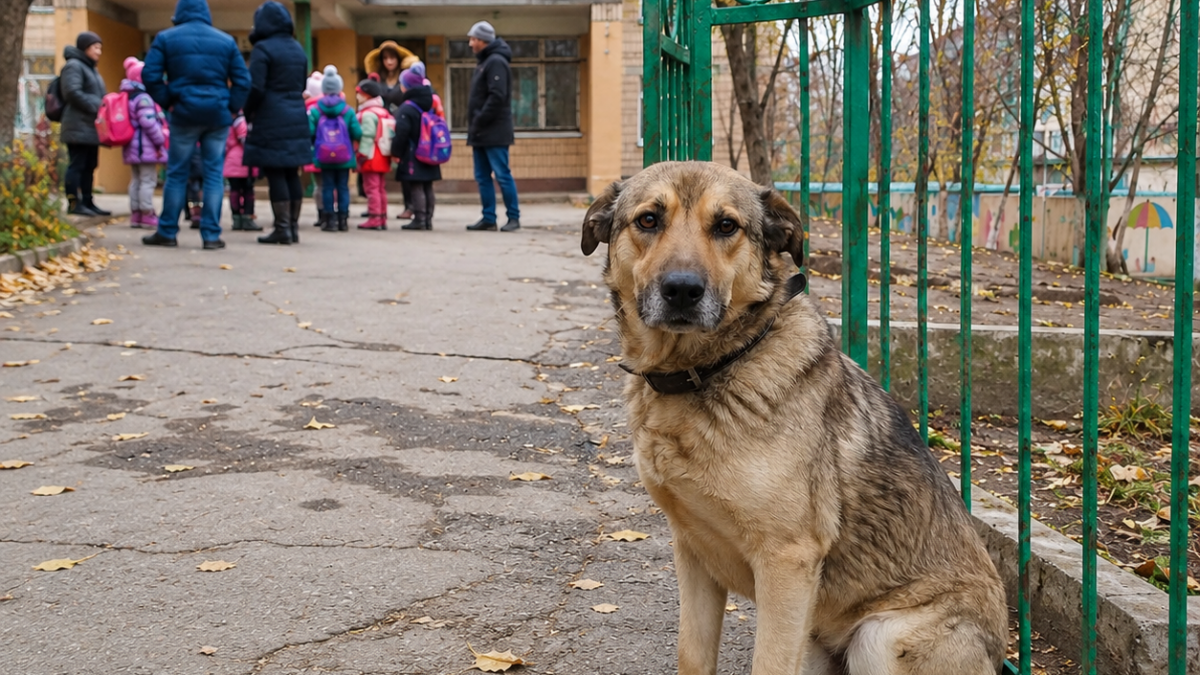
PART 2
I crouched and began gathering the papers that had scattered across the snow.
The old man did not seem to notice.
Druzhok was beside himself.
For months, I had never seen him jump on anyone.
Never heard more than a quiet huff from him.
Now he whined like a puppy.
His whole body trembled as he pushed against the old man, licking his hands and face, circling him, then returning as if he needed to make sure the man was still there.
The old man buried both hands in the thick fur around Druzhok’s neck.
“You’re alive,” he kept saying. “You’re alive.”
I finally touched his shoulder.
“Sir, you need to come inside. It’s freezing.”
He seemed to remember where he was.
“Yes.”
He wiped his face with his sleeve.
“Of course.”
Galina Petrovna had watched the entire scene through the window.
She opened the front door before we reached it.
“What happened?”
“This man knows Druzhok.”
Her eyebrows rose.
“The dog?”
The old man looked at her.
“That’s his real name.”
Galina and I exchanged a glance.
The children had chosen the same name.
Neither of us knew what to say.
Inside the office, I made tea while the man sat on the old sofa near the radiator.
Druzhok lay pressed against his legs.
Every few seconds, the dog lifted his head and checked the man’s face.
“My name is Sergei Mikhailovich,” he told us.
His hands remained on Druzhok.
“My son was Andrei.”
I sat opposite him.
“You said Druzhok belonged to him?”
“To our family.”
He looked down at the dog.
“Andrei found him when he was barely three months old.”
A faint smile appeared.
“He was under a delivery truck at the depot where my son worked. Dirty, hungry, terrified of everyone. Andrei came home that evening with the puppy inside his jacket.”
Sergei gave a quiet laugh.
“My daughter-in-law almost threw both of them out.”
Druzhok lifted his head at the sound of Andrei’s name.
Sergei stopped smiling.
“You see?”
We did.
“He still knows.”
I looked at the dog.
“What happened to your son?”
Sergei’s fingers tightened in Druzhok’s fur.
For several seconds, he said nothing.
Then he looked through the office window toward the playground.
“Andrei was a driver. He delivered building supplies throughout the district.”
He paused.
“He also had a little boy.”
“Your grandson?”
“Yes. Misha.”
I felt a knot form in my stomach.
“How old?”
“Five.”
The same age as most of the children in my group.
Sergei took a sip of tea but his hand shook so badly that he put the cup down.
“Misha attended this kindergarten.”
I glanced toward the hall.
Suddenly the story of the dog changed.
This was not simply a familiar building.
This was his building.
“He used to come here?” I asked.
“Every afternoon.”
“Druzhok too?”
“Whenever Andrei could manage it.”
Sergei leaned back.
“Andrei would finish his last delivery, drive home, pick up Druzhok, and then come get Misha.”
He looked toward the front gate.
“The three of them would walk from there.”
I could see the scene in my mind.
A young father.
A little boy.
A large dog trotting beside them.
“And then?” Galina asked gently.
Sergei stared at the floor.
“Three years ago, there was an accident.”
No one interrupted.
“It happened on the old highway beyond the railway crossing.”
He rubbed one palm slowly over the other.
“Andrei had finished work early. He was going to pick up Misha.”
I thought of Druzhok sitting outside our gate.
Waiting.
Sergei continued.
“There was freezing rain that afternoon. A truck lost control coming downhill.”
He stopped.
His throat moved.
“The truck crossed the center line.”
Galina whispered, “Your son…”
“He died before the ambulance reached the hospital.”
The office went silent.
I had heard hundreds of sad stories in twenty-seven years of working with families.
Divorces.
Illness.
Fathers who disappeared.
Mothers who left.
Children being raised by grandparents.
But Sergei’s voice carried a kind of exhaustion that made the whole room feel heavier.
“What about Misha?” I asked.
“He was still here.”
I blinked.
“At the kindergarten?”
“Yes.”
That surprised me.
“Andrei hadn’t picked him up yet?”
“No.”
Sergei nodded toward the gate.
“The accident happened on the way here.”
Suddenly I understood.
Druzhok had not lost both of them at the same time.
He had lost Andrei before the afternoon routine could be completed.
“Who collected Misha that day?”
“My daughter-in-law, Lena.”
“And Druzhok?”
Sergei closed his eyes.
“That is the part I never understood.”
He explained that Druzhok had been with Andrei in the vehicle.
The police found dog hair and blood inside the damaged van, but no dog.
The passenger-side door had been torn open in the collision.
People searched nearby fields and roadside ditches.
Sergei searched for weeks.
“So did Lena,” he said. “Even after the funeral.”
They posted photographs.
Called shelters.
Asked veterinarians.
Spoke to road workers.
Nothing.
“It was winter,” Sergei said. “We eventually assumed he had died from his injuries somewhere we couldn’t find him.”
I looked down at Druzhok.
The dog’s scarred old collar was visible beneath his fur.
“How could he disappear for three years?”
“I don’t know.”
Sergei looked at me.
“That’s what I’ve been asking myself since I saw him.”
Galina folded her hands on the desk.
“And Misha?”
Sergei’s expression changed again.
“He stopped speaking for almost two weeks after his father died.”
I felt my chest tighten.
“How is he now?”
“Alive.”
He said it almost defensively.
“Healthy. Smart.”
Then his eyes dropped.
“But different.”
Sergei explained that Lena had taken Misha and moved away about six months after Andrei’s death.
She could no longer bear living in the same apartment.
Every room reminded her of him.
Every street held a memory.
Every time she passed the kindergarten, she saw the afternoon when Andrei had never arrived.
“She moved to her sister’s city,” Sergei said. “About four hundred kilometers away.”
“Do you see your grandson?”
“During holidays. Sometimes summer.”
He smiled sadly.
“He’s eight now.”
Something occurred to me.
“Does he know Druzhok was missing?”
“He cried for him almost as much as he cried for his father.”
Sergei looked down.
“They were inseparable.”
Druzhok pressed his chin against the old man’s knee.
Then I remembered something.
Artyom.
The way Druzhok stood every morning when he saw him.
The way he watched that child.
I leaned forward.
“Sergei Mikhailovich, I need to show you something.”
I found the class photograph from autumn.
Twenty-two children standing in two rows.
I pointed to Artyom.
“This boy.”
Sergei studied the picture.
His face changed.
“Why are you showing me?”
“Druzhok watches him every morning.”
Sergei lifted the photograph closer.
For several seconds, he said nothing.
Then he whispered, “He looks like Misha.”
I stared at him.
“Really?”
“Not exactly.”
His finger touched the photograph.
“The hair. The face.”
He swallowed.
“Especially when Misha was five.”
That explained part of it.
Perhaps Druzhok did not think Artyom was Misha.
Perhaps scent told him otherwise.
Dogs were not fools.
But maybe the shape of a small boy coming through that gate awakened something.
A pattern.
A memory.
An afternoon that had never been completed.
Galina was the first to say it.
“Maybe he’s been waiting for them.”
Sergei lowered the photograph.
“For three years?”
Nobody answered.
Druzhok had already answered in the only way he knew how.
Every morning.
Every evening.
By sitting at the gate.
Sergei wanted to take him home immediately.
That seemed obvious.
Then something strange happened.
He stood.
“All right, old friend.”
He picked up the end of a temporary leash we kept for stray animals.
“Let’s go.”
Druzhok stood happily.
Sergei led him toward the door.
The dog followed.
Across the hallway.
Down the steps.
Across the courtyard.
Then, ten feet from the gate, Druzhok stopped.
Sergei pulled gently.
“Come on.”
The dog did not move.
He looked toward the kindergarten building.
Then toward the gate.
Sergei crouched.
“Druzhok.”
The dog’s ears lowered.
“Come with me.”
He took another step.
Druzhok resisted.
Not aggressively.
He simply planted his feet.
Sergei looked at me.
I had no explanation.
He tried again.
Druzhok walked three steps.
Then turned around.
The old man’s face crumpled.
“He won’t leave.”
I walked closer.
“Maybe he’s frightened of the car.”
“I came on foot.”
Sergei tried coaxing him.
Food.
Soft words.
The dog refused.
Finally Sergei released the leash.
Druzhok immediately returned to his spot beside the gate.
And sat.
Sergei stood in the snow staring at him.
I saw something terrible in the old man’s expression.
Not anger.
Recognition.
“He’s still waiting for Misha,” he said.
I did not know what to say.
That evening, Sergei stayed until the kindergarten closed.
At six fifteen, the final child went home.
Druzhok watched the gate.
At six thirty, I locked the front door.
Only then did he stand.
He walked around the building once.
Returned.
Lay beside the gate.
Sergei had watched all of it.
“He used to wait exactly like this,” he said.
“When?”
“When Andrei was late.”
My throat tightened.
“The same place?”
“Almost.”
He pointed.
“Back then the gate opened farther to the left.”
We stood silently for a while.
Then Sergei said, “I have to call Lena.”
I knew who he meant.
Misha’s mother.
“Tonight?”
“Yes.”
“Do you think she’ll want to know?”
His mouth tightened.
“She needs to.”
He walked home without Druzhok.
I worried we had made a mistake.
Maybe the dog should have been taken regardless of whether he wanted to leave.
Maybe waiting at the kindergarten was not loyalty anymore.
Maybe it was trauma.
An animal trapped inside a routine he could not understand.
The next morning, Druzhok was there before me.
Snow dusted his back.
I sat beside him.
“You stubborn old fool.”
He looked at me.
“You found your family yesterday.”
His tail moved once.
“And you’re still here.”
Nothing.
I scratched behind his ear.
“What are you waiting for?”
His eyes went toward the road.
At seven forty-five, Artyom arrived holding his mother’s hand.
Druzhok stood.
His tail began moving.
“Druzhok!”
Artyom ran toward him.
His mother called, “Careful!”
The boy wrapped his arms around the dog’s neck.
Druzhok licked his cheek once.
I watched more closely than ever.
The dog was happy.
But it was not the same reaction he had shown Sergei.
That had been recognition.
This was something else.
Comfort.
Habit.
Maybe memory.
Artyom looked at me.
“Maria Ivanovna, why are you sad?”
“I’m not sad.”
“You look sad.”
Children are mercilessly observant.
I forced a smile.
“Druzhok found someone who knows him.”
Artyom’s expression changed.
“His owner?”
“Someone from his family.”
“Will he go away?”
I hesitated.
“He might.”
Artyom immediately tightened his arms around the dog.
“But he lives here.”
His mother gave me an apologetic look.
“Artyom.”
“He does.”
I knelt.
“Druzhok had a home before he came here.”
The boy considered this.
“Did he forget it?”
“No.”
I looked at the dog.
“I think he remembers it very well.”
That answer seemed to satisfy him less than I hoped.
During breakfast, I told the staff what Sergei had said.
By lunchtime, every teacher knew.
By afternoon, half the parents knew.
I regretted that immediately.
Villages spread stories faster than any newspaper.
Some parents thought Druzhok should be taken away at once.
“He can’t live by a kindergarten forever.”
Others argued that the dog had chosen his place.
“Why force him?”
Galina wanted veterinary advice.
That evening she drove Druzhok to a clinic.
I went with her.
The veterinarian, a woman named Dr. Orlova, estimated that Druzhok was around nine or ten years old.
His heart sounded strong.
His joints showed age.
He had an old healed injury near his right shoulder.
When Sergei later showed us photographs from before the accident, there had been no scar there.
“That could be consistent with trauma from the crash,” Dr. Orlova said.
She scanned him for a microchip.
Nothing.
She examined the collar.
On the underside, almost completely worn away, were two faint letters pressed into the leather.
A.
M.
Andrei Mikhailovich.
Sergei had not been mistaken.
Druzhok was his dog.
That night, Sergei called me.
“Lena answered.”
I sat at my kitchen table.
“And?”
“She cried.”
I waited.
“Does Misha know?”
“Not yet.”
“Why?”
“Lena doesn’t know whether telling him is kind.”
I understood.
An eight-year-old boy had rebuilt some kind of life after losing his father and dog.
Now one of them had suddenly returned.
“What does she want to do?”
“She asked for photographs.”
I had dozens.
Parents had taken pictures of Druzhok with the children.
I sent Sergei several.
Twenty minutes later, he called again.
His voice was different.
“Misha saw one.”
“What happened?”
“Lena didn’t mean for him to.”
He took a shaky breath.
“He walked into the kitchen while she was looking at her phone.”
“And?”
“He screamed his name.”
I closed my eyes.
“Druzhok?”
“Yes.”
Sergei started crying.
I waited.
Finally he said, “They’re coming.”
“When?”
“This weekend.”
I looked at the calendar.
Four days.
“They’re driving here?”
“Yes.”
I should have felt only happiness.
Instead, I felt nervous.
Three years had passed.
Misha had been five.
Druzhok was old.
What if the dog did not recognize him?
What if he recognized him and still refused to leave the gate?
What if a reunion everyone imagined would heal something only opened wounds that had barely closed?
The next four days moved painfully slowly.
I told no one except Galina.
We decided Misha should not arrive in front of a crowd.
Friday evening, I called Artyom’s mother.
“I need to ask you something unusual.”
“What happened?”
I explained the situation.
She was silent for a moment.
Then she said, “You think Druzhok watches Artyom because he reminds him of the other boy?”
“Possibly.”
“Does Artyom know?”
“Not the details.”
“Should he?”
“I don’t know.”
She surprised me.
“I think he should meet Misha.”
“Why?”
“Because Artyom thinks Druzhok belongs to him a little.”
She paused.
“And maybe he needs to understand who Druzhok has been waiting for.”
So Saturday morning, although the kindergarten was closed, five of us stood in the courtyard.
Galina.
Sergei.
Artyom and his mother.
And me.
Druzhok sat at the gate.
Sergei had arrived early.
The dog greeted him warmly again.
Licked his hands.
Pressed against him.
Then returned to his spot.
At nine twenty, a dark blue car appeared at the end of the road.
Sergei stopped breathing.
“That’s them.”
The car slowed.
Druzhok’s head lifted.
His body became completely still.
The vehicle stopped across the road.
A woman got out first.
Lena.
She looked younger than I expected.
Maybe thirty-five.
Her face was pale.
She stood with one hand on the car door.
Then the back door opened.
A boy stepped out.
Tall for eight.
Dark winter coat.
Blue hat.
He looked toward the gate.
Druzhok stood.
Nobody moved.
The dog’s ears lifted.
His nose worked rapidly.
Then he made a sound I had never heard from him before.
Not a bark.
Not a whine.
Something raw.
Almost human.
Misha froze.
“Druzhok?”
The leash slipped from Sergei’s hand.
Druzhok ran.
I had seen him run toward Sergei.
This was different.
The old dog crossed the snow so fast that I was terrified he would slip.
Misha began running too.
They met beside the road.
Druzhok jumped up.
The boy wrapped both arms around him.
They fell together into the snow.
Misha screamed his name again.
Then he began sobbing.
“Druzhok! Druzhok! Druzhok!”
The dog licked his face frantically.
Circled him.
Jumped again.
Pressed his body against the boy.
Misha held his collar with both hands.
“I thought you were dead!”
Lena turned away.
Sergei covered his mouth.
Beside me, Artyom stood absolutely silent.
Misha buried his face in the dog’s neck.
“I looked for you.”
Druzhok trembled.
“I looked for you everywhere.”
Those words broke whatever control Lena had left.
She walked toward them and dropped to her knees.
Druzhok stopped.
For one moment he stared at her.
Then his tail moved.
Lena put both hands on his face.
“I’m sorry.”
Her voice cracked.
“Oh, Druzhok, I’m so sorry.”
The dog leaned into her.
Sergei joined them.
Three people kneeling in the snow around an old dog who had spent months sitting at our gate.
I looked at Galina.
She was crying openly.
So was I.
Then Artyom pulled on my sleeve.
“Maria Ivanovna?”
I wiped my face.
“Yes?”
“Is that his boy?”
There are questions children ask that adults complicate unnecessarily.
I decided not to.
“Yes.”
Artyom watched Misha.
“The one he was waiting for?”
“I think so.”
The little boy looked at Druzhok.
Then he nodded.
“Good.”
I expected jealousy.
Instead, he said, “Then he waited right.”
I nearly started crying again.
Misha eventually noticed us.
Sergei introduced everyone.
When he reached Artyom, he hesitated.
“This is the boy Druzhok became friends with here.”
Misha looked at Artyom.
Artyom looked at him.
Children can handle moments adults turn into ceremonies.
Artyom simply said, “I gave him sausage.”
Misha nodded seriously.
“He likes sausage.”
“I know.”
“He steals socks too.”
Artyom’s eyes widened.
“Really?”
“Always.”
Within five minutes they were talking like they had known each other for weeks.
Lena walked over to me.
“You’re Maria?”
“Yes.”
“My father-in-law told me everything.”
She looked toward Druzhok.
“Thank you.”
“I didn’t do much.”
“You fed him.”
“The children mostly did.”
“You let him stay.”
I looked at the gate.
“We tried not to at first.”
She smiled faintly.
“That sounds like Druzhok.”
I wanted to ask something but felt it might be cruel.
She saw it anyway.
“Ask.”
“How did he get here?”
Lena looked toward the dog.
“We don’t know yet.”
“Three years is a long time.”
“I know.”
She folded her arms against the cold.
“Sergei and I started making calls after he found Druzhok.”
“What kind of calls?”
“Old shelters. Veterinary clinics. Rescue groups.”
“Anything?”
“Maybe.”
That word caught my attention.
“What?”
“A woman from a village about seventy kilometers from here remembers a dog that looked like him.”
“When?”
“Two and a half years ago.”
I leaned closer.
“What happened?”
“She said a truck driver brought in an injured dog found near the highway.”
My heartbeat quickened.
“After the accident?”
“Probably weeks later.”
“Did they keep records?”
“Some.”
That afternoon, Lena showed me photographs on her phone.
One was blurry.
A large gray-and-rust dog lay inside a makeshift kennel.
There was a bandage around his right shoulder.
The face was thinner.
Younger.
But it was Druzhok.
“I think that’s him,” I said.
“So do I.”
The rescue group had treated the injured stray.
He stayed there almost four months.
Then someone adopted him.
An elderly couple who lived near a small town farther east.
“What happened to them?”
“The husband died.”
“And the wife?”
“Moved in with her daughter.”
“What happened to Druzhok?”
Lena’s expression tightened.
“That’s where the records stop.”
For the first time, we had part of an answer.
After the accident, Druzhok had survived.
Injured and disoriented, he had wandered miles from the crash site.
Someone found him.
Someone saved him.
Someone else gave him a temporary home.
Then, somehow, that home disappeared too.
But there was still a gap of more than two years.
The mystery bothered Sergei.
For Misha, it did not seem to matter.
He spent Saturday afternoon with Druzhok.
They walked through the old neighborhood.
Visited Sergei’s house.
Sat together near the kindergarten gate.
At four, Lena approached me.
“We have to decide what to do.”
“What do you mean?”
“Druzhok.”
I understood.
“You want to take him home.”
“Misha does.”
“Of course.”
She looked worried.
“But Sergei says he wouldn’t leave yesterday.”
“With him.”
“Yes.”
“Misha may be different.”
“That’s what we’re hoping.”
Misha clipped the leash to Druzhok’s collar.
“All right, buddy.”
The dog stood.
Misha started toward the car.
Druzhok followed.
Ten feet.
Twenty.
They reached the sidewalk.
I held my breath.
Druzhok glanced back at the gate.
Stopped.
Misha turned.
“Come on.”
The dog looked between him and the kindergarten.
My stomach tightened.
Then Misha walked back.
He knelt.
“You don’t have to wait anymore.”
Druzhok stared at him.
Obviously, I cannot know what a dog understands from human language.
But I know what I saw.
Misha put his forehead against Druzhok’s.
“You found me.”
The dog licked his nose.
Misha stood.
This time, when he walked toward the car, Druzhok followed.
He did not stop.
At the open door, the old dog hesitated only briefly.
Then he jumped inside.
Artyom ran toward the car.
“Wait!”
Everyone turned.
He reached into his coat pocket.
Pulled out a wrapped piece of sausage his mother had clearly told him not to carry around all day.
He handed it to Misha.
“For Druzhok.”
Misha smiled.
“Thanks.”
Artyom scratched the dog behind one ear.
“Bye.”
Druzhok licked his fingers.
The car door closed.
I expected the dog to panic.
Instead, he sat beside Misha.
As the car pulled away, Druzhok looked through the rear window.
I raised my hand.
Artyom waved with both arms.
The car disappeared around the corner.
For the first time in months, the space beside the gate was empty.
Monday morning felt wrong.
I arrived at seven fifteen.
No Druzhok.
I unlocked the door.
Looked back.
Nothing.
Parents noticed immediately.
“Where’s the dog?”
“His family found him.”
The children asked too.
Some were happy.
Some cried.
Artyom seemed quiet.
During free play, I found him standing near the window.
“You miss him?”
“Yes.”
“I do too.”
He thought for a moment.
“But he’s with Misha.”
“Yes.”
“So it’s okay.”
“I think it is.”
He looked at me.
“Will he visit?”
“I don’t know.”
That afternoon Sergei came.
Alone.
“How is he?” I asked immediately.
He smiled.
“Sleeping on Misha’s bed.”
That made me laugh.
“Lena allows that?”
“She gave up within ten minutes.”
He showed me a picture.
Misha lay asleep beneath a blue blanket.
Druzhok was curled beside him with his head across the boy’s legs.
I stared at the photograph.
Three years.
However Druzhok had survived those three years, he had ended up exactly where every part of him seemed to want to be.
With Misha.
But the story still had another turn.
Two weeks later, Lena called.
“We found the woman who adopted Druzhok.”
I sat down.
“You did?”
“Her name is Valentina.”
“Where is she?”
“Living with her daughter now.”
“And?”
“She remembers everything.”
Valentina had adopted Druzhok from the small rescue after her husband, Pavel, saw his photograph.
They named him Rex because nobody knew his real name.
He lived with them for nearly two years.
“They loved him,” Lena said.
“How did he get away?”
“Pavel died suddenly.”
I closed my eyes.
Another loss.
“Afterward, Valentina couldn’t manage the house alone. Her daughter came to move her.”
“What about Druzhok?”
“They planned to bring him.”
“Planned?”
“The day before the move, he disappeared.”
“Just disappeared?”
“Yes.”
Lena paused.
“Valentina thinks he became frightened because they were packing everything.”
Maybe the boxes and emptied rooms had told him something.
Another home was disappearing.
Another person was gone.
“He ran?” I asked.
“They searched for weeks.”
“How far was that town from here?”
“Almost ninety kilometers.”
I stared at the wall.
“Ninety?”
“Yes.”
“And he came back here?”
“Apparently.”
“How?”
“I don’t think anyone will ever know.”
That journey became the part of Druzhok’s life we could never fill in.
Maybe he followed roads.
Maybe scents.
Maybe memory.
Maybe he traveled with people for stretches.
Maybe kind strangers fed him.
Maybe he slept beneath barns.
Maybe he simply moved in the direction that felt familiar until something finally looked right.
The remarkable thing was not that a dog could walk ninety kilometers.
Dogs have traveled farther.
The remarkable thing was where he stopped.
Not at Sergei’s house.
Not at Andrei’s old apartment.
Not near the accident site.
The kindergarten.
The place where Andrei’s unfinished journey had been headed.
The gate where Druzhok had watched his family reunite hundreds of ordinary afternoons.
I started thinking about all the days we had tried to chase him away.
“Go home,” I had told him.
He had been trying.
He just had a different definition of home.
Three months passed.
Winter loosened.
Snow melted along the fence.
One Friday morning, a familiar blue car pulled up outside.
Artyom was arriving at the same time.
The rear door opened.
Misha jumped out.
Then Druzhok.
The kindergarten yard exploded.
Children ran toward the fence.
“DRUZHOK!”
He looked older.
Or maybe healthier.
His coat had been brushed.
He wore a new harness instead of the old leather collar.
But his reaction was exactly the same.
His tail swung wildly.
He greeted Artyom first.
Artyom threw his arms around him.
“You came back!”
Misha grinned.
“He wouldn’t let us drive past.”
Lena laughed.
“We were visiting Grandpa Sergei. The moment we turned onto this road, he started whining.”
I crouched beside Druzhok.
“So you remember us too?”
He pushed his head beneath my hand.
I scratched behind his ear.
Misha walked over.
“We found his old collar.”
“The leather one?”
He nodded.
“Mom kept it.”
“Why?”
Misha shrugged.
“Because it has Dad’s initials.”
I looked at Lena.
She nodded.
“We cleaned it, but he doesn’t wear it anymore.”
“Good.”
“It’s in a box with Andrei’s things.”
Misha watched Druzhok playing with the children.
Then his face became serious.
“Can I ask you something?”
“Of course.”
“Did he really come every day?”
“Yes.”
“Even when it snowed?”
“Yes.”
“Even when it was really cold?”
“Yes.”
“Did he wait until everybody left?”
I knew what he was asking.
Not about weather.
Not really.
He was trying to understand the shape of his dog’s loyalty.
“Yes.”
Misha stared at the gate.
“What if I never came?”
The question hurt.
I knelt so we were eye level.
“But you did.”
“Three years later.”
“Yes.”
He looked toward Druzhok.
“He didn’t know that.”
“No.”
Misha’s eyes became wet.
“Then why did he keep waiting?”
I thought carefully before answering.
“I don’t know what Druzhok understood.”
That was true.
“But sometimes animals remember routines better than explanations. Your father used to come here. You used to come through that gate. Maybe this was the last place where everything in his world still made sense.”
Misha wiped his cheek.
“So he kept coming back.”
“Yes.”
The boy nodded slowly.
Then he said something I have remembered ever since.
“Maybe he thought if he waited long enough, one normal day would happen again.”
I had no answer.
Because suddenly I understood that Misha had not only been talking about the dog.
After Andrei died, a five-year-old child had probably wanted exactly the same thing.
One normal afternoon.
His father at the gate.
Druzhok beside him.
The walk home.
Dinner.
A voice in the next room.
Something ordinary enough that nobody else would have thought to treasure it.
I put my arm around Misha.
He did not pull away.
Druzhok visited us several times that year.
Not constantly.
He no longer waited.
That distinction mattered.
When Lena brought him to the kindergarten, he played with the children, accepted treats, lay in the sun, and eventually left willingly with Misha.
Every time.
The first few visits, he looked back at the gate.
Later, he stopped.
Artyom and Misha became friends too.
Their mothers exchanged phone numbers.
In summer, Artyom spent a weekend at Sergei’s house while Misha was visiting.
The boys slept in sleeping bags in the living room.
Druzhok slept between them.
Sergei sent me a photograph.
Three heads.
Two human.
One dog.
All asleep.
For months, that picture sat on my desk.
But age does not pause because a story finally becomes happy.
The following autumn, Druzhok began having trouble with his back legs.
At first, Misha noticed he was slower on stairs.
Then he stopped jumping into the car.
Dr. Orlova examined him when they visited Sergei.
“Arthritis,” she said.
Nothing surprising for a dog his age.
Medication helped.
Misha became fiercely protective.
“No long walks.”
“No slippery floors.”
“No jumping.”
Lena bought a ramp for the car.
Sergei joked that Druzhok now had better transportation than he did.
For a while, things stabilized.
Then one January morning, I received a call from Lena.
Her voice told me immediately something was wrong.
“Maria Ivanovna?”
“Yes?”
“Druzhok collapsed last night.”
I sat down.
“What happened?”
“His heart.”
I closed my eyes.
“Is he alive?”
“Yes.”
She said it quickly.
“He’s home.”
“Should he be in a hospital?”
“The veterinarian says there isn’t much they can do there that we can’t do here.”
I understood what that meant.
“How is Misha?”
Silence.
Then:
“Not good.”
I looked out my kitchen window.
Snow was falling.
The same kind of thick winter snow that had once covered Druzhok while he waited outside our gate.
“What does the veterinarian think?”
“Days.”
Lena’s voice broke.
“Maybe a week.”
I had spent most of my adult life around children.
I knew parents often believed our job was teaching letters, numbers, songs, table manners.
Much of the real job was different.
We helped children encounter things they could not control.
Fear.
Separation.
Failure.
Sometimes death.
But Misha was no longer my student.
He had never been my student, technically.
Still, I asked, “Does he understand?”
“Yes.”
The next afternoon, Sergei came to my apartment.
He carried the old leather collar.
I recognized it immediately.
“What are you doing with that?”
“Misha asked for it.”
“Why?”
“He wants to put it beside Druzhok.”
I touched the worn leather.
The letters A.M. were clearer now because someone had cleaned the grime from them.
Andrei Mikhailovich.
Sergei sat.
“I thought I’d lost both of them that day.”
“Your son and Druzhok.”
“Yes.”
He rubbed his thumb across the initials.
“Then Druzhok came back.”
His voice grew quieter.
“For a while, it felt like Andrei had sent something home.”
I did not tell him that was sentimental.
Grief earns certain freedoms from logic.
Sergei looked at me.
“Would you come?”
“Where?”
“To Lena’s.”
“That’s four hundred kilometers.”
“We’re leaving tomorrow.”
I did not even need to think.
“Yes.”
Galina covered my shift.
Sergei and I drove almost six hours.
When we arrived, Misha opened the apartment door.
He was ten now.
Taller.
His face had changed.
But grief made him look five again.
“Maria Ivanovna.”
He hugged me.
Behind him, Druzhok lay on a thick blanket beside the couch.
I almost did not recognize him.
His fur was gray around the muzzle.
His body looked smaller.
His breathing was shallow.
But when I knelt, his eyes opened.
“Hello, old friend.”
His tail moved.
Once.
I laughed and cried at the same time.
“You remember me.”
Misha sat beside him.
“He remembers everybody.”
Lena brought tea.
Nobody drank much.
The apartment was quiet.
That evening, Misha showed me Druzhok’s things.
Photographs.
A worn rubber ball.
The new harness.
The old collar.
There was also a photograph of Andrei holding a much younger Druzhok beside a five-year-old Misha.
They were standing outside our kindergarten gate.
I stared at it.
“That’s the place.”
Misha nodded.
“Grandpa found it.”
Andrei was smiling.
One hand rested on his son’s shoulder.
Druzhok sat beside them.
The gate behind them looked almost exactly as it did now.
“Do you remember that day?” I asked.
“No.”
He hesitated.
“I remember Dad’s jacket.”
“That’s something.”
“And his hands.”
I looked at him.
“What about them?”
“They were always cold when he picked me up.”
He smiled a little.
“He’d put them on my face to annoy me.”
Small memories.
Those are often the ones that survive.
Not birthdays.
Not important speeches.
Cold hands.
A jacket.
A dog waiting beside a gate.
That night, Druzhok refused to sleep unless Misha stayed on the floor beside him.
So Misha brought a pillow and blanket.
I helped him arrange them.
“You’ll be uncomfortable.”
“I don’t care.”
Druzhok placed his head across Misha’s arm.
The boy looked at me.
“He waited for me.”
I knew what he meant.
“So I can stay with him.”
“Yes.”
I touched his shoulder.
“You can.”
Druzhok died shortly before dawn.
Quietly.
Misha was asleep beside him.
Lena was sitting in a chair nearby.
Sergei and I had gone into the kitchen for coffee.
We heard nothing.
Lena came to the doorway.
One look at her face was enough.
Misha woke when she touched his shoulder.
For several seconds, he did not understand.
Then he did.
He put both hands around Druzhok’s face.
“No.”
Lena knelt.
“Misha.”
“No.”
“Misha…”
“No.”
He pressed his forehead against the dog.
“You just came back.”
Nobody tried to tell him not to cry.
Nobody told him Druzhok was “in a better place.”
Nobody told him to be strong.
He had already been strong long enough.
We simply stayed.
After a while, Misha reached for the old collar.
He placed it beside Druzhok’s front paws.
Then he looked at Sergei.
“Can we bury him near Dad?”
Sergei’s mouth trembled.
“Yes.”
Andrei was buried in our village cemetery.
So two days later, we brought Druzhok home one last time.
Word spread.
Again, villages do that.
I expected a few people.
There were dozens.
Parents.
Teachers.
Former kindergarten children.
Dr. Orlova.
Galina.
Artyom and his mother.
Even the cook who used to sneak Druzhok warm meat during winter.
Misha looked overwhelmed.
“This many people knew him?”
I smiled.
“More than you think.”
They buried Druzhok on Sergei’s property, beneath an apple tree overlooking the road toward the cemetery.
Not directly beside Andrei.
The rules did not allow that.
But close enough that Sergei could see both places from his front yard.
Misha put the old collar in the grave.
At the last second, he changed his mind.
“Wait.”
Sergei stopped.
Misha reached down and picked it up.
“I want this.”
Nobody questioned him.
Instead, Artyom stepped forward.
He held a small rubber ball.
“He can have mine.”
Misha looked at him.
“For Druzhok?”
Artyom nodded.
The ball went into the grave.
No speeches.
No grand ceremony.
Just people who had known an old dog at different parts of his life.
Some as Rex.
Some as Druzhok.
Some only as the quiet dog outside the kindergarten.
Spring came late that year.
One morning, I noticed something strange beside our gate.
A small metal plaque had been fixed to the fence.
I called Galina.
“Did you do this?”
She smiled.
“No.”
The plaque read:
DRUZHOK
HE WAITED HERE FOR SOMEONE HE LOVED.
I knew immediately who had arranged it.
Sergei.
Later that afternoon, Artyom found me standing beside it.
“Did Druzhok really wait here because of Misha?”
“I believe so.”
“How did he know Misha would come?”
“He didn’t.”
Artyom frowned.
“Then why wait?”
I looked toward the road where Druzhok had watched hundreds of children arrive and leave.
“He remembered.”
“That’s different?”
“Yes.”
The boy thought.
Then he ran off to play.
Years passed.
Children moved through our kindergarten.
New groups.
New parents.
New teachers.
Some knew Druzhok’s story.
Others only saw the plaque.
I retired at sixty-four.
On my final afternoon, I stayed after everyone left.
Galina had retired before me.
The new director handed me the keys and laughed.
“Last chance to change your mind.”
“No.”
“You’ll be bored in a week.”
“Probably.”
I locked the front door.
The yard was quiet.
I walked toward the gate.
For a moment, memory did something strange.
I could almost see him.
The big gray-and-russet dog sitting beside the fence.
Head raised.
Eyes on the road.
Waiting.
Then I heard someone call my name.
“Maria Ivanovna!”
I turned.
A young man was walking toward me.
Tall.
Dark-haired.
For a second, I did not recognize him.
Then he smiled.
“Misha?”
He laughed.
“You remember.”
“Of course I remember.”
He was nineteen.
Almost the age Andrei must have been in some of the photographs Sergei had shown me.
“What are you doing here?”
“Grandpa told me you were retiring.”
Sergei was older now and did not travel easily.
Misha had come in his place.
He carried something beneath his arm.
A framed photograph.
He handed it to me.
It showed that Saturday morning years before.
Misha kneeling in the snow.
His arms around Druzhok.
The dog’s face buried against his chest.
Behind them stood the kindergarten gate.
I had never seen that particular photograph.
“Your mother took it?”
“Yes.”
He pointed to the bottom of the frame.
A small engraved plate read:
HE FOUND HIS WAY BACK.
My eyes blurred.
“Misha…”
“I wanted you to have it.”
“You should keep this.”
“We have copies.”
He smiled.
“Many copies.”
We stood beside the old gate.
The metal had been repainted twice.
The plaque for Druzhok remained.
Misha touched it.
“I used to think he spent those years looking for me.”
“Maybe he did.”
He shook his head.
“I don’t think so anymore.”
“What do you think?”
“I think he spent those years trying to find the last place where Dad was supposed to be.”
I looked at him.
He continued.
“And when he found it, he waited because that was all he knew how to do.”
I remembered what Misha had said when he was eight.
Maybe he thought if he waited long enough, one normal day would happen again.
“You know,” I said, “he did find you.”
Misha smiled.
“Eventually.”
“And you found him.”
“Eventually.”
We walked to the road together.
Before leaving, Misha stopped exactly where Druzhok used to sit.
He looked toward the entrance.
“Grandpa says Dad stood here too.”
“He probably did.”
“And me.”
“Yes.”
“I wish I remembered.”
I thought about all the years I had spent watching children.
Adults often believe memory is a record.
It is not.
It is fragments.
A smell.
A voice.
A hand.
A gate.
A dog.
“You don’t need to remember every afternoon,” I said.
Misha looked at me.
“You only need enough to know they happened.”
He stood there quietly.
Then he nodded.
We said goodbye.
He walked toward his car.
I stayed beside the fence.
Before getting in, he turned.
“Maria Ivanovna?”
“Yes?”
“Thank you for not chasing him away.”
I laughed softly.
“Oh, I tried.”
“I know.”
“He was stubborn.”
“I know that too.”
Misha opened the car door.
Then he added, “He always was.”
He drove away.
I touched the little plaque one last time.
For years, whenever I thought about Druzhok, I remembered him sitting in the snow.
But that afternoon, another memory came instead.
A dark blue car beside the road.
An eight-year-old boy stepping out.
An old dog suddenly realizing that the person he had been waiting for was standing right there.
Druzhok running.
Misha running toward him.
And the empty place beside our gate afterward.
Not abandoned.
Not lonely.
Just empty because, at last, there was no reason to wait anymore.
Years passed, but Druzhok never truly disappeared from the kindergarten.
The children changed.
The parents changed.
Some of the teachers retired, and younger women took their places. The faded yellow walls were repainted. The old sandbox was replaced. A safer plastic slide appeared where the rusted metal one had stood for as long as I could remember.
Even the front gate was repaired twice.
But the small plaque beside it remained.
DRUZHOK
HE WAITED HERE FOR SOMEONE HE LOVED.
Every September, when a new group of children arrived, sooner or later one of them would notice it.
“Maria Ivanovna, who was Druzhok?”
Sometimes the question came during recess.
Sometimes while I was helping someone button a coat.
Once, a little girl stared at the plaque for nearly five minutes before tugging on my sleeve.
“Was he a person?”
“No,” I told her. “He was a dog.”
Her eyes widened.
“They made a sign for a dog?”
“Yes.”
“Why?”
I looked toward the place where he used to sit.
“Because he was very good at waiting.”
That answer always led to more questions.
So, little by little, the story became part of the kindergarten.
I never told it dramatically.
There was no need.
I simply explained that years earlier, a dog had appeared at our gate and returned every morning. Nobody knew where he came from. He waited through rain, cold, and snow until one day we learned that he had once belonged to a family whose little boy had attended our kindergarten.
“And did he find the boy?” children always asked.
“Yes.”
“Was the boy happy?”
“Very.”
“Was Druzhok happy?”
I would smile.
“I think that was the happiest day of his life.”
I never told the youngest children how Druzhok’s story eventually ended.
Not unless they asked.
To them, it was enough that he had waited and that Misha had come back.
As the years passed, I began to understand something about children that I should have understood much earlier.
They do not need every story to end without sadness.
They only need the sadness to mean something.
Misha continued visiting his grandfather every summer.
At first Sergei would bring him to the kindergarten whenever he was in town.
Then, when Misha was old enough, he began coming by himself.
He would walk through the gate, stand beneath the trees, and look around at a place that had once been central to a childhood he barely remembered.
Sometimes Artyom joined him.
The two boys remained friends long after I expected them to.
Their friendship began because of Druzhok, but it did not depend on him.
By the time they were teenagers, they communicated mostly through phones and computer games, complaining about school and sending each other ridiculous photographs.
Whenever Misha visited, Artyom usually appeared within an hour.
I once watched the two of them sitting on the kindergarten wall after sunset, both nearly sixteen, arguing about motorcycles.
It made me smile.
The first time they had met, Artyom had handed Misha a piece of sausage for an old dog.
Neither boy remembered that moment as clearly as I did.
But perhaps they did not need to.
Some friendships begin because two lives briefly touch the same wound.
Sergei aged more quickly after Druzhok died.
He never became seriously ill all at once.
It was smaller things.
His walk slowed.
Then he began using a cane.
His hearing weakened.
Driving became difficult, so he stopped.
Whenever I visited, I usually found him sitting near the window facing the apple tree where Druzhok was buried.
A simple wooden marker stood beneath it.
Nothing elaborate.
Just one word burned into the wood.
DRUZHOK
On warm days, Sergei carried a chair outside and sat there.
One afternoon, I brought him pastries.
He looked at the bag.
“From Alina’s bakery?”
“No. Different story.”
He laughed.
“Good. I’m too old to keep track of all your dogs.”
“You only had to keep track of one.”
“One was enough.”
We sat beneath the apple tree.
The leaves moved softly above us.
Sergei stared toward the grave.
“You know,” he said, “I used to feel guilty.”
“For what?”
“For giving up looking.”
I knew immediately what he meant.
After Andrei’s accident.
After Druzhok disappeared.
Sergei had searched for weeks.
Then months.
Eventually life forced him to stop.
“I told myself he was dead,” he said.
“You had no reason to think otherwise.”
“I know.”
“But?”
He rubbed the head of his cane.
“But when he came back, I kept thinking about all those years.”
His voice weakened.
“Where was he? Was he hungry? Was he frightened? Did he look for us?”
“We know people helped him.”
“For some of it.”
“Yes.”
He nodded.
“But there are gaps.”
“There will always be gaps.”
“That bothers me.”
I looked at the wooden marker.
“It used to bother me too.”
Sergei turned toward me.
“What changed?”
“I realized the missing years are not the most important part.”
He waited.
“He came back.”
Sergei looked toward the road.
“Yes.”
“He could have ended up anywhere.”
“Yes.”
“But he found the kindergarten.”
Sergei smiled faintly.
“And waited like an idiot.”
I laughed.
“Exactly.”
He wiped beneath one eye.
“And then Misha came.”
“Yes.”
For a while, we sat silently.
Then Sergei said, “Andrei would have loved that.”
“What?”
“That Druzhok remembered where to go.”
I had met Andrei only through photographs and stories.
But I answered anyway.
“I think so too.”
When Misha turned eighteen, he came to the kindergarten on the anniversary of his father’s death.
He had never done that before.
I was outside sweeping wet leaves from the walkway.
At first, I did not recognize him.
Teenagers change quickly when you do not see them for several months.
He was taller than Sergei had ever been.
His shoulders had broadened.
But when he smiled, I saw the five-year-old from the photographs.
“Maria Ivanovna.”
“Misha?”
“Hi.”
“What are you doing here?”
He shrugged.
“Walking.”
“You walked four hundred kilometers?”
That made him laugh.
“No. Mom drove me to Grandpa’s.”
I leaned the broom against the fence.
“You okay?”
He looked toward the plaque.
“Yeah.”
Then, after a pause:
“Not really.”
We sat on the bench near the playground.
For a while he said nothing.
I had learned long ago that if a child—or even a nearly grown child—said he wanted to talk, the worst thing an adult could do was fill the silence for him.
Finally he said, “I barely remember my dad.”
I looked at him.
“I remember things people told me.”
He picked at a loose thread on his sleeve.
“I know what his favorite food was because Grandpa told me. I know what music he liked because Mom told me. I know he hated waking up early because everybody says that.”
He looked frustrated.
“But I don’t know which memories are actually mine anymore.”
That was a harder problem than grief itself.
Memory borrowing.
When people tell you a story often enough, it starts to feel like something you witnessed.
“I remember his jacket,” Misha continued.
“You told me that.”
“And his hands.”
“The cold hands.”
He smiled.
“Yeah.”
He looked toward the gate.
“And Druzhok.”
“That one is yours.”
“I think so.”
His eyes became wet.
“I remember sitting in the back seat and holding his collar.”
I did not interrupt.
“I remember Dad saying, ‘Leave him alone, he’s trying to look out the window.’”
He laughed once.
“That’s such a stupid memory.”
“No.”
“It’s nothing.”
“It’s not nothing.”
“He was just driving.”
“Yes.”
“Druzhok was just looking out a window.”
“Yes.”
“Why is that what I remember?”
“Because ordinary things are what life is mostly made of.”
Misha stared at his hands.
“I’m scared I’ll forget more.”
“You will.”
He looked at me sharply.
Most adults would have reassured him.
I did not.
“You will forget things,” I repeated. “Everybody does.”
“That doesn’t help.”
“I’m not finished.”
He waited.
“You will forget the sound of some conversations. You will forget what shirt your father wore on certain days. You may forget the exact shape of his hands.”
Misha looked away.
“But forgetting details does not mean you are losing him.”
“How not?”
“Because some things stay without photographs.”
“Like what?”
“The way you react to people. The things you find funny. The way you treat an animal.”
I nodded toward the plaque.
“Druzhok remembered a route even after almost everything else in his life changed.”
Misha was silent.
“You may carry pieces of your father that you cannot identify,” I continued. “That does not make them less real.”
He looked toward the gate.
“Grandpa says I stand like him.”
“There you go.”
“Mom says I argue like him too.”
“I’m sure she appreciates that.”
He laughed.
The heaviness in his face eased.
Before leaving, he touched Druzhok’s plaque.
“I think I’m going to keep Dad’s old photographs.”
“You should.”
“And the collar.”
“You still have it?”
“Of course.”
That surprised me.
After Druzhok died, Misha had kept the old leather collar with Andrei’s initials.
“I keep it in my desk.”
He smiled.
“Mom says it smells terrible.”
“She’s probably right.”
“I don’t care.”
Then he walked away.
Watching him go, I realized that Druzhok had given that boy something much larger than a reunion with a lost dog.
He had returned carrying a connection to a father Misha was too young to remember clearly.
Not a perfect connection.
Not a magical one.
Just something physical.
A collar his father had touched.
A dog his father had loved.
A living creature that had once walked beside them both.
Years later, when Sergei died, Misha called me himself.
It was early spring.
I recognized his voice immediately.
“Maria Ivanovna?”
“Yes.”
“It’s Misha.”
“I know.”
A pause.
“Grandpa died last night.”
I sat down.
“I’m sorry.”
“He was sleeping.”
“That’s something.”
“Mom was there.”
“Good.”
Another silence.
Then he said, “We’re coming back for the funeral.”
“I’ll be there.”
Sergei was buried near Andrei.
After the service, Misha did not leave immediately.
He walked alone to Sergei’s property.
I followed at a distance.
He stood beneath the apple tree.
Druzhok’s wooden marker had faded badly.
The letters were barely visible.
Misha crouched.
He touched the wood.
Then he noticed me.
“Looks terrible.”
“It’s old.”
“I should replace it.”
“Your grandfather kept saying that.”
“Why didn’t he?”
“Because every time someone offered, he said the old one was fine.”
Misha smiled.
“That sounds like him.”
A month later, a new marker appeared.
Simple stone this time.
No dates.
No sentimental inscription.
Just:
DRUZHOK
Below it, in smaller letters:
HE CAME HOME.
I stood looking at those words for a long time.
They were better than anything I could have written.
When I finally retired, I had worked at the kindergarten for more years than I wanted to calculate.
The new director organized a small celebration.
The staff bought flowers.
Parents I barely knew brought cake.
Former students appeared with children of their own.
Someone made a slideshow of photographs.
I hated almost all of it.
Not because I was ungrateful.
Because I dislike being watched while people say emotional things about me.
At one point Galina, who had already been retired for years, raised a glass.
“Maria Ivanovna spent most of her career pretending she wasn’t sentimental.”
Everyone laughed.
“I am not sentimental.”
“You cried over a dog for ten years.”
“That was different.”
“Of course.”
Then one photograph appeared on the screen.
Druzhok outside the gate.
Snow on his back.
Head raised.
Watching the entrance.
The room went quiet.
I had seen the image before.
But that day it affected me differently.
Perhaps because I was leaving too.
Not dying.
Not disappearing.
Simply leaving a place where I had spent most of my adult life.
I suddenly understood why routines become so powerful.
Morning keys.
Children arriving.
Parents calling from the doorway.
Lunch trays.
Nap time.
Winter coats.
The gate closing in the evening.
You repeat something long enough, and it becomes part of how you know where you belong.
Druzhok had lost everything at once.
Andrei.
Misha.
His home.
His routine.
Years later, when he found one piece of that old routine—the kindergarten gate—he held onto it.
Maybe because it was the only thing that had not moved.
On my final afternoon, I waited until everyone left.
The new director handed me the keys.
“Last chance.”
“No.”
“You’re going to call us tomorrow.”
“Absolutely not.”
“Day after tomorrow?”
“Possibly.”
She hugged me.
I pretended not to enjoy that either.
Then she left.
The kindergarten became quiet.
I walked through the rooms one final time.
Tiny chairs pushed under tiny tables.
Drawings taped to walls.
A forgotten red mitten beneath a radiator.
Half a block tower still standing in one corner.
I turned off lights as I went.
At the entrance, I stopped.
For years, Druzhok had sat just beyond those doors.
Waiting.
I locked the building.
Then walked toward the gate.
That was when someone called my name.
“Maria Ivanovna!”
I turned.
A young man was walking toward me carrying a framed photograph.
Tall.
Dark hair.
Familiar smile.
“Misha?”
“You remember me.”
“Of course I remember you.”
He was nineteen.
Almost twenty.
He had driven down because Sergei had told him months earlier when my retirement was scheduled.
“My grandfather wrote the date down,” Misha said.
“Of course he did.”
“He said if he forgot, I wasn’t allowed to.”
“That also sounds like him.”
We stood beside the gate.
Misha handed me the frame.
The photograph showed the reunion.
That winter Saturday.
Misha at eight years old kneeling in the snow, arms wrapped around Druzhok.
The dog pressed against him.
Lena had taken it seconds after they found each other.
Beneath the photograph was a small engraved plate.
HE FOUND HIS WAY BACK.
My vision blurred.
“Misha…”
“There’s something else.”
He reached into his coat.
For a second, I thought he might bring out the old collar.
Instead, he handed me a small envelope.
Inside was a second photograph.
Andrei.
Young.
Smiling.
Standing beside our kindergarten gate.
Five-year-old Misha held one of his hands.
Druzhok sat on the other side.
I looked from one photograph to the other.
Same gate.
Same family.
Separated by years.
In the first image, everything was ordinary and nobody knew how precious the moment would become.
In the second, almost everything had been lost and one piece had somehow returned.
“I found that in Grandpa’s things,” Misha said.
“I’ve seen something similar.”
“Not this one.”
He pointed toward the corner.
Behind Andrei was an old wall calendar visible through the window.
The date matched a week before the accident.
“One of the last pictures of all three of us together.”
I handed it back.
“You keep this.”
“I have the original scanned.”
He pushed it toward me.
“I want you to have this copy.”
I looked at Druzhok sitting proudly beside them.
“He always looked serious.”
Misha laughed.
“He hated pictures.”
“So did your grandfather.”
“Runs in the family.”
We both looked at the plaque.
Misha touched it.
“I used to think he spent those years looking for me.”
“Maybe he did.”
He shook his head.
“I don’t think that’s exactly what happened.”
“What do you think now?”
He considered.
“I think he was trying to find the last place Dad was supposed to go.”
I listened.
“The accident happened while Dad was coming here.”
“Yes.”
“Druzhok survived. Then everything after that must have been confusing.”
“Probably.”
“He lived with other people. Lost them too.”
“Yes.”
“Then somehow he came back here.”
Misha touched the fence.
“Maybe this was the last unfinished thing in his head.”
That was exactly how I had come to think about it too.
“And then you arrived,” I said.
“Years late.”
“You still arrived.”
He smiled.
We stood there quietly.
Then Misha moved to the exact spot where Druzhok used to sit.
He looked toward the entrance.
“Grandpa said Dad stood here almost every afternoon.”
“Yes.”
“And I came through that gate.”
“Yes.”
“I wish I remembered more.”
I thought about the young father’s photograph.
Cold hands.
A jacket.
A dog looking out a car window.
“You remember enough.”
“Do I?”
“Yes.”
“How do you know?”
“Because you’re still asking.”
He looked at me.
I continued.
“People who remember nothing don’t spend years trying to understand what they lost.”
That made him quiet.
After a while, Misha asked, “Do you think Druzhok knew why Dad never came back?”
“No.”
“Do you think he knew Dad died?”
“I don’t know.”
“Do dogs understand that?”
“I don’t know that either.”
He nodded.
I appreciated that he was old enough now to accept an answer that was simply true.
Then he asked, “Do you think he was unhappy all those years?”
That question hurt more.
“I think parts of those years were probably hard.”
Misha looked down.
“But I also think people cared for him.”
“The rescue shelter.”
“Yes.”
“Valentina and Pavel.”
“Yes.”
“And everybody here.”
“Yes.”
I smiled.
“Especially children carrying illegal sausages in their pockets.”
He laughed.
“Artyom still talks about that.”
“How is he?”
“In college. Claims he’s studying.”
“Claims?”
“I’ve seen his grades.”
“That bad?”
“Worse.”
We laughed.
The sound echoed softly across the empty yard.
Then Misha became serious again.
“I’m glad Druzhok didn’t spend every day miserable.”
“So am I.”
“He found people.”
“Yes.”
“But he still came back.”
“Yes.”
Misha touched the plaque again.
“That’s what gets me.”
I knew.
Not that Druzhok remembered.
That he returned.
Not that he waited.
That after everything, he still believed waiting was worth doing.
Misha walked toward his car.
I remained at the gate.
Before opening the door, he turned.
“Maria Ivanovna?”
“Yes?”
“Thank you.”
“For what?”
“For letting him stay.”
I smiled.
“We tried to chase him away.”
“I know.”
“We brought him inside during a blizzard. He escaped the next morning.”
“I know.”
“We gave him food. He preferred the gate.”
“I know.”
“He was extremely stubborn.”
Misha laughed.
“He always was.”
He started to get into the car.
“Misha.”
He looked back.
“I’m glad you came that Saturday.”
His expression softened.
“So am I.”
He drove away.
I watched until the car disappeared around the corner.
Then I turned back toward the kindergarten.
The sun had dropped lower.
Long shadows stretched across the yard.
For a moment, memory placed Druzhok beside the fence again.
Not old and dying.
Not weak.
Not lying on his final blanket.
The Druzhok I remembered most clearly was the one sitting in snow.
Head raised.
Watching the road.
For years, I had thought the saddest part of his story was that he waited so long.
That afternoon, I realized I was wrong.
The saddest part would have been if nobody had ever come.
But someone did.
A blue car stopped beside the road.
A boy stepped out.
An old dog lifted his head.
And after three years of uncertainty, distance, strangers, shelters, another home, another loss, and a journey none of us would ever fully understand, Druzhok finally saw one familiar piece of the life he had been trying to find.
He ran.
Misha ran too.
They met in the snow.
And eventually, when the time came to leave, Druzhok walked away from our gate willingly.
That was the image I wanted to keep.
Not a dog waiting forever.
A dog who no longer needed to.
I touched the plaque.
The metal had warmed in the late afternoon sun.
Then I picked up the two photographs Misha had given me and walked toward home.
Behind me, the kindergarten gate stood empty.
Children would fill it again the next morning.
Parents would hurry through it.
Teachers would unlock doors.
Someone would cry because they did not want their mother to leave.
Someone else would laugh too loudly.
A mitten would be lost.
A cup would spill.
Life would continue with all the ordinary things people rarely understand are precious until years have passed.
And beside that gate, there would be no gray-and-russet dog waiting anymore.
There had not been for a long time.
But for once, the emptiness did not feel sad.
It meant Druzhok had finished waiting.
It meant Misha had come.
It meant an old dog had finally found the way home.
[END OF STORY]








