PART 2: The Dog Had a Red Tag and 45 Minutes Left—Then an Old Man Walked Into the Shelter and Said One Word
PART 2
“Otto.”
The dog’s entire body changed.
Not gradually.
Not cautiously.
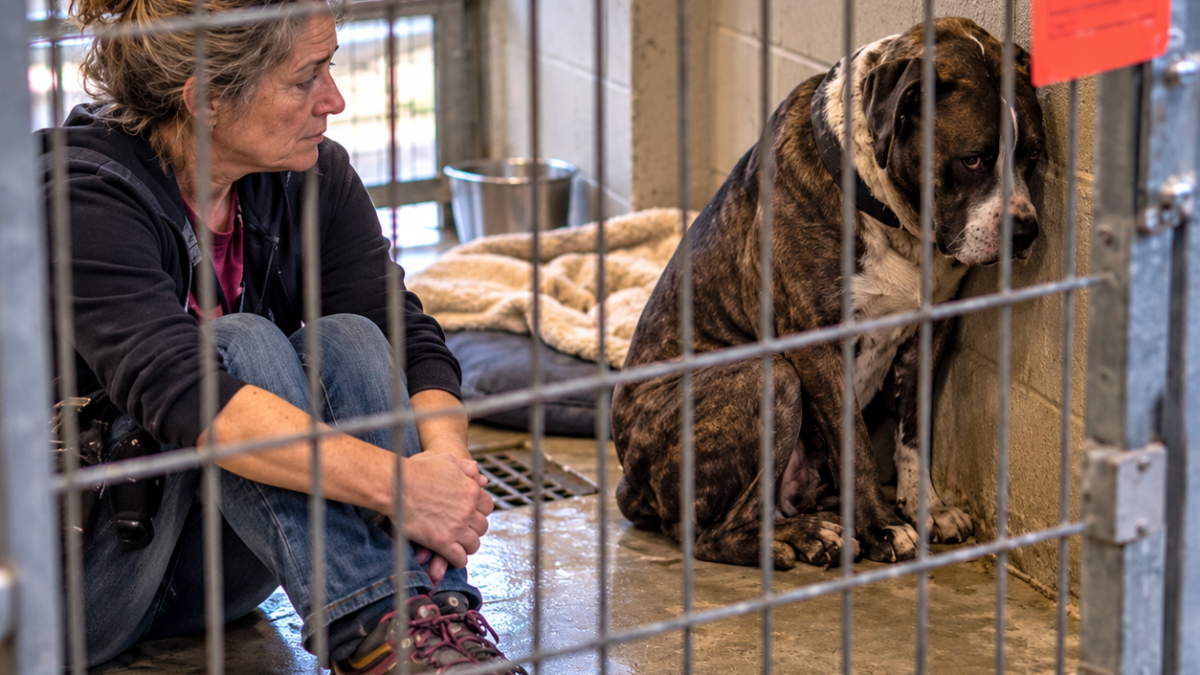
One second, he was sitting rigid beside me, every muscle held tight under his brindled coat. The next, he made a sound I had never heard from a dog that size—a cracked, almost puppy-like whine that seemed to come from somewhere deep inside his chest.
His head snapped toward the corridor.
“Otto,” the old man said again.
The dog launched himself toward the gate.
The attendant beside me jumped backward.
“Claire!”
But Otto was not charging anyone.
His tail had come alive.
It struck the wall so hard it sounded like someone slapping a rug against concrete. He scrambled at the kennel door, whining, twisting, pressing his shoulder against the bars.
The old man stood maybe thirty feet away.
He was thin, slightly stooped, wearing a brown wool coat that looked too large for him. One hand gripped a wooden cane. The other covered his mouth.
For a moment neither of us moved.
Then the cane slipped from his fingers.
“Otto.”
That was when the old man started crying.
I had seen owners reunited with lost dogs before. Usually there was barking, jumping, laughter, somebody kneeling on the floor.
This was different.
The old man looked as though someone had handed him back a piece of his life he had already buried.
Otto shoved his nose between the bars.
The man tried to walk faster.
His right leg dragged slightly, and he nearly stumbled.
I stood.
“Wait,” the attendant said.
I turned toward him.
“Open the gate.”
“We don’t know who he is.”
“The dog does.”
“That doesn’t mean—”
“Look at him.”
The employee looked.
Whatever argument he had been preparing disappeared.
Otto was trembling again, but not the way he had been trembling against the wall. His whole body shook with excitement. His claws scraped uselessly against the concrete as he tried to squeeze closer to the old man.
The man reached the gate.
He did not put his fingers through.
That detail mattered to me later.
He knew better.
Instead, he placed his palm flat against the metal.
Otto pushed his forehead against the same spot from the other side.
The old man closed his eyes.
“There you are,” he whispered. “There you are, boy.”
I glanced at the clock.
4:39.
Twenty-one minutes.
“Who are you?” I asked.
The man opened his eyes.
“My name is Henri Delorme.”
He swallowed.
“And that is my dog.”
The attendant, Marc, looked from him to Otto.
“You’re sure?”
Henri gave him a stare so wounded that Marc immediately regretted the question.
“I raised him from eight weeks old.”
“How long has he been missing?”
“Twelve days.”
My stomach tightened.
Otto had been at the shelter for nine.
“Did you report him missing?”
“Everywhere.”
Henri’s voice sharpened.
“To the police. To the municipal services. To shelters. My daughter posted his photograph online. We called here twice.”
Marc frowned.
“When?”
“My daughter called Monday. Then Wednesday.”
“This dog came in Tuesday.”
“She called Wednesday.”
Marc’s expression changed.
I could almost see him mentally searching through a week of overcrowding, missed calls, intake forms, messages scribbled on pads.
Henri reached inside his coat.
Marc’s body immediately tensed.
“It’s all right,” I said.
Henri pulled out a worn plastic folder.
Inside were veterinary records, photographs, and a folded sheet of paper.
He held up a picture.
A younger Otto sat beside him in a garden.
Same square head.
Same white shield on his chest.
Same scar across the bridge of his muzzle.
But the dog in the photograph did not look frightened.
He looked magnificent.
His shoulders were straight. His coat shone. His gaze was fixed on Henri.
And around his neck was a wide dark leather collar.
The pale mark I had seen beneath the shelter collar suddenly made sense.
I looked at Marc.
“Stop the euthanasia.”
His face tightened.
“I can’t make that call.”
“Then get someone who can.”
“It’s already authorized.”
“Then unauthorize it.”
“Claire—”
“Marc, it’s 4:40. Get the director.”
He stared at me for half a second.
Then he ran.
Henri leaned closer to the gate.
“Platz.”
Otto dropped immediately.
Not cowering.
Working.
His front legs stretched forward. His chest touched the floor. His eyes remained locked on Henri.
“Bleib.”
Stay.
Henri took one step backward.
Otto stayed.
Henri stepped forward again.
Otto’s tail swept across the floor.
I felt sick.
Not because the dog was trained.
Because the evidence of who he was had been sitting inside his behavior the entire time, and nobody had known how to read it.
“You trained him?” I asked.
Henri nodded.
“My wife and I did.”
His mouth trembled slightly.
“She died three years ago.”
He looked back at Otto.
“After that, it was just the two of us.”
There was no time to ask more.
Quick footsteps came down the corridor.
Sophie Martel, the shelter director, appeared with Marc behind her.
Sophie was in her mid-forties, practical, quick, and normally calm under pressure. That day, she looked as exhausted as everyone else.
“What happened?”
Henri lifted the photograph.
“You have my dog.”
Sophie looked at Otto, then at the photo.
Her eyes moved immediately to the white chest marking.
“What’s his name?”
“Otto Delorme.”
“Microchip?”
“Yes.”
Henri opened his folder.
“I have the number.”
Sophie turned toward Marc.
“His intake sheet says no chip.”
“I scanned him.”
“Once?”
Marc hesitated.
“I scanned the neck and shoulders.”
Sophie’s jaw tightened.
“Get Dr. Lefèvre.”
Marc left again.
Sophie looked at me.
“Why are you inside the kennel?”
“We can discuss that later.”
“Oh, we will.”
“Fine.”
I pointed toward the red card.
“But first we discuss that.”
Sophie pulled the plastic sleeve from the gate.
Her eyes landed on the euthanasia authorization.
Then she checked her watch.
“Nothing happens until we verify ownership.”
Henri gripped the gate.
“You mean you were going to kill him?”
Sophie did not answer quickly enough.
His face changed.
“You were.”
“He was assessed as a safety risk.”
“He’s terrified.”
“Sir, I understand you’re upset.”
“No.”
Henri’s voice stayed quiet.
That made it hit harder.
“You understand paperwork. I am asking whether my dog was going to die twenty minutes from now.”
Sophie looked him directly in the eyes.
“Yes.”
The corridor seemed to become quieter even though dogs were still barking all around us.
Henri’s fingers tightened around the metal gate.
“For what?”
Sophie glanced at the behavior note.
“He lunged at a staff member during feeding.”
“Did he bite?”
“No.”
“Did he injure anyone?”
“No.”
“Then for what?”
“This facility is overcrowded. We have to consider the safety of staff, volunteers, adopters, and other animals. A large dog showing defensive aggression—”
“He is not available for adoption.”
“I understand that now.”
“He belongs to me.”
“I understand that now.”
Henri stared at her.
“And if I had arrived twenty-two minutes later?”
Sophie had no answer.
Dr. Amélie Lefèvre arrived carrying a handheld scanner.
She was the shelter’s part-time veterinarian, a small woman with cropped dark hair who had the rare ability to stay calm around both frightened animals and frightened people.
She stopped when she saw me inside the kennel.
“Claire.”
“I know.”
“You can get yelled at later.”
“Thank you.”
She looked at Otto.
“Can I come in?”
I turned toward Henri.
He nodded.
“Otto. Sitz.”
Otto sat.
Amélie entered slowly, sideways rather than directly facing him. She let him smell the scanner.
His ears flattened.
Henri spoke through the gate.
“Ruhig.”
Easy.
Otto’s body softened.
Amélie passed the scanner along the left side of his neck.
Nothing.
Across the shoulders.
Nothing.
Marc folded his arms.
“That’s what I got.”
“Keep going,” I said.
Amélie did.
Down the right shoulder.
Across the upper back.
Then the scanner beeped.
Everyone froze.
Amélie moved it back.
Beep.
Again.
Beep.
She looked at the display.
“Found it.”
Henri had already opened his veterinary booklet.
His hand shook so badly that Sophie had to hold the page flat.
Amélie read the number aloud.
The digits matched.
For several seconds, nobody spoke.
Sophie removed the red euthanasia card from Otto’s kennel.
She folded it once.
Then again.
“Cancel it,” she said.
Marc nodded.
Sophie looked at him.
“Not verbally. Go to treatment. Remove him from the list in the system. Tell whoever is preparing medications. I want confirmation.”
Marc left at a run.
The clock showed 4:46.
Fourteen minutes.
Henri sagged against the gate.
I opened it only after Sophie nodded.
Otto walked out.
He did not rush toward Henri this time.
He approached slowly, almost cautiously, as though twelve days of confusion had taught him not to trust good things when they appeared.
Henri sank to his knees.
His bad leg folded awkwardly beneath him.
“Come here.”
Otto stopped inches away.
Henri touched both sides of his face.
The dog smelled his sleeves, his hands, his coat.
Then Otto pressed forward so suddenly that Henri almost fell backward.
He wrapped both arms around the dog’s neck.
Otto buried his head against the old man’s chest.
And I heard Henri whisper something into his fur.
“I’m sorry.”
Not “I missed you.”
Not “I found you.”
“I’m sorry.”
That told me there was more to the story.
Sophie heard it too.
“What happened when he disappeared?”
Henri kept one hand on Otto.
“I fell.”
“A fall?”
“In my kitchen.”
He tapped the side of his head.
“Small stroke, they told me later. I remember reaching for the counter. After that, I remember waking up with two paramedics over me.”
His fingers worked slowly through Otto’s fur.
“He was beside me when they came. Barking, of course. Not attacking. Barking.”
“Was he secured?”
“My neighbor put him in the utility room.”
Henri stared down at the floor.
“Someone opened the back door while they brought the stretcher through. Nobody noticed until later.”
“And he ran?”
Henri nodded.
“I was in the hospital for four days.”
His daughter, Camille, had been nearly three hours away when the neighbor called her. By the time she reached Lyon, Otto was gone.
They searched the neighborhood.
They contacted municipal animal services.
They sent photographs to clinics.
They called shelters.
But one problem had followed another.
The telephone number attached to Otto’s microchip belonged to Henri’s old landline, disconnected after he moved the previous year. The address on the registration was also outdated.
That was Henri’s mistake, and he admitted it without excuse.
“My wife handled all of that before she got sick,” he said. “After she died, I kept telling myself I would update everything. I didn’t.”
But that should not have been the end of the trail.
Not when his daughter was actively searching.
Not when the shelter had a dog matching the photographs.
Not when the microchip was still physically inside him.
Sophie rubbed her forehead.
“We need to check the call log.”
Henri looked up.
“You need to give me my dog.”
“I intend to.”
“Then do it.”
“Dr. Lefèvre needs to examine him first. He came in thin, dehydrated, and extremely stressed. I also need the release paperwork.”
Henri started to argue.
Amélie stepped closer.
“Mr. Delorme.”
He turned.
“I want him home too. Give me fifteen minutes to make sure there isn’t something you need to know medically before you leave.”
His anger faltered.
“Fifteen?”
“Fifteen.”
He looked at Otto.
Then nodded.
The examination happened in a quiet room at the end of the medical corridor.
I should not have been there.
Technically, after the kennel incident, I probably should have collected my camera and gone home.
But Henri asked me to stay.
So I did.
Otto had lost nearly five kilograms.
The pads of his feet were scraped from being on the road.
He had an irritated patch under one foreleg and a healing cut behind his ear.
Otherwise, he was remarkably healthy.
His heart sounded good.
His temperature was normal.
No sign of infection.
And with Henri beside him, the dog who had supposedly been too dangerous to live let Amélie examine his mouth, ears, paws, abdomen, and injured pad.
At one point she lifted his lip to inspect his teeth.
Otto sighed and leaned against Henri’s leg.
Sophie watched from the doorway.
I watched Sophie.
Her expression bothered me.
Not because she looked defensive.
Because she looked scared.
“What?” I asked.
She glanced at me.
“Nothing.”
“That’s not a nothing face.”
“Claire.”
“What are you thinking?”
She lowered her voice.
“I’m thinking I signed that form.”
That stopped me.
Until then, I had been angry at the system, at Marc, at whoever had written the red line, at the whole anonymous machinery that had brought Otto within minutes of death.
But the authorization had a signature.
Sophie’s.
“You signed it?”
“Yes.”
“Did you meet him?”
“No.”
“Did you watch him?”
“No.”
“Did anyone do a second behavior evaluation?”
Her eyes shifted toward the examination table.
“No.”
I felt heat rise into my face.
“Then what exactly did you sign?”
“A risk determination.”
“Based on what?”
“A staff report.”
“One report?”
“And intake behavior.”
“What intake behavior?”
“Growling. Retreating. Refusal to allow handling.”
I stared at her.
“You just described a terrified stray.”
“I know what I described.”
“Apparently you didn’t three hours ago.”
Her expression hardened.
“Be careful.”
“Why? He almost died.”
“And you entered a restricted kennel alone after being warned not to. Had your interpretation been wrong, we could be discussing your reconstructive surgery instead of his release.”
She was right.
I hated that she was right.
But it did not make the other thing less wrong.
“I broke a safety rule,” I said. “Write me up.”
“I probably will.”
“Good. Then after that, explain why a dog can be sentenced to death here without anyone qualified spending ten quiet minutes with him.”
Her jaw tightened.
Before she could answer, Henri spoke from the examination table.
“Both of you.”
We turned.
He was sitting with Otto’s head resting across his knee.
“Not in front of him.”
For a second I nearly laughed.
Not because anything was funny.
Because in the middle of all that anger, Henri was worried our argument might upset his dog.
I looked away first.
“Sorry.”
Sophie exhaled.
“So am I.”
At 5:12 p.m., twenty-seven minutes after Otto was supposed to die, Henri signed the reclaim paperwork.
Sophie waived the boarding and intake fees.
Henri did not thank her for that.
I carried his folder while he held Otto’s leash.
At the front entrance, Otto stopped.
His body went rigid.
Automatic doors.
Cars.
Voices.
The world beyond the shelter suddenly seemed too large.
Henri waited.
He did not pull.
“Otto.”
The dog looked up.
Henri touched his own thigh.
“Fuß.”
Heel.
Otto moved beside him.
They walked through the doors together.
I stood outside and watched them cross the parking lot.
Henri’s daughter had arrived while the paperwork was being finished. Camille was in her forties, still wearing the dark blue medical scrubs from the clinic where she worked as a physiotherapist. She jumped out before the car had fully stopped.
When Otto saw her, he nearly pulled Henri off his feet.
Camille dropped her handbag on the pavement.
“Oh my God.”
She fell to her knees.
Otto climbed halfway into her lap.
She laughed and cried at the same time.
Then she looked up at the building behind me.
The laughter disappeared.
“Is it true?”
Henri did not answer.
Camille looked at me.
“My father said they were going to euthanize him.”
I nodded.
“At five.”
She checked her watch.
It was 5:16.
Her face lost color.
She held Otto tighter.
“Sixteen minutes.”
“No,” Henri said softly.
She looked at him.
“What?”
“You got here sixteen minutes after.”
He glanced toward me.
“She got to him before.”
Camille stood.
“I want copies of everything.”
Sophie had followed us outside.
“You can request his full intake record.”
“I’m not requesting it.”
Camille’s voice was controlled, but only barely.
“I’m telling you that I want every document connected to my dog’s intake, identification scan, behavior notes, euthanasia decision, and every telephone contact my father or I made to this shelter.”
Sophie looked at her for a long second.
“That is your right.”
“Yes.”
Camille picked up her handbag.
“And I want it in writing that he was found with a microchip.”
“He was.”
“Then why did you record him as unchipped?”
“We are reviewing that.”
Camille stepped closer.
“I suggest you review it very carefully.”
Then she put Otto into the back seat.
Henri started to follow.
I touched his sleeve.
“Mr. Delorme.”
He turned.
“I’m glad you came.”
He looked at me.
There was gratitude in his face, but something else too.
Something heavy.
“I almost didn’t.”
“What do you mean?”
“My daughter had called here.”
“I know.”
“They said there was no dog matching Otto.”
My stomach dropped.
“Who told her that?”
“I don’t know.”
He looked back at the shelter.
“She had to go to work this morning. I told her I would check places myself.”
He gave a small, tired shrug.
“This was the last one.”
Then he climbed into the car.
I watched them leave.
I should have gone home.
Instead, I walked back inside.
Sophie was waiting.
Her arms were folded.
“You’re suspended.”
I stopped.
“For entering the kennel?”
“For entering a red-status kennel alone after a staff member explicitly warned you.”
“How long?”
“Until I review it.”
I wanted to argue.
Then I remembered Otto’s head against my shoulder and how easily that moment could have been different.
“All right.”
She seemed surprised.
“All right?”
“I was wrong to go in alone.”
Some of the tension left her shoulders.
Then I added, “But I wasn’t wrong about him.”
“No.”
She looked down the corridor where kennel 402 now stood empty.
“You weren’t.”
I picked up my camera.
“Find the phone calls.”
She said nothing.
“Please.”
This time she nodded.
“I will.”
I drove home angry.
Then, halfway there, anger gave way to something worse.
Doubt.
It is easy to feel brave when the ending proves you right.
Otto had turned out to be somebody’s beloved, trained dog. The elderly man had arrived. The microchip had been found. Everything lined up in the neatest possible way.
But I kept thinking about the moment I opened that kennel.
What if Otto had bitten me?
What if Marc had been right?
What if my need to rescue one frightened animal had put staff in danger?
I sat in my parked car outside my apartment for almost fifteen minutes without going inside.
Finally, I took out my phone.
There was a message from Sophie.
The call log shows two contacts from Camille Delorme. We are investigating why they were not linked to 402. Do not share anything publicly while review is underway.
I read it three times.
Two calls.
Not one.
Two.
I typed back:
Understood.
Then another message appeared.
This one was from a number I did not know.
A photograph loaded.
Henri was sitting in a faded armchair.
Otto lay across his feet, asleep.
Underneath, Camille had written:
First real sleep either of them has had in twelve days. Thank you.
I stared at that picture until my eyes blurred.
That should have been the end of it.
A terrible mistake narrowly avoided.
A dog returned home.
A shelter correcting a failure.
Instead, three days later, Sophie called me.
“Can you come in?”
“I’m suspended.”
“I know.”
“So?”
“So I’m asking you to come in as part of the review.”
Her voice sounded strange.
“What happened?”
A pause.
“We found another red tag.”
I sat up.
“What do you mean?”
“Another dog scheduled for behavioral euthanasia based on one staff incident.”
My hand tightened around the phone.
“Did he bite someone?”
“No.”
“Second assessment?”
“No.”
“How many?”
“That’s what I’m trying to find out.”
I was silent.
Then Sophie said something I had never heard from her before.
“I need help.”
I went in that afternoon.
Not as a volunteer.
As a witness.
Sophie met me in the small conference room beside the administrative office. Amélie was already there. So was Marc.
The shelter’s operations manager, Luc Bernard, sat at the far end of the table.
I knew Luc mostly by sight.
He was fifty-something, broad-shouldered, always in a pressed shirt even when everyone else was covered in dog hair. His job was not animal care in the emotional sense. He handled capacity, staffing, municipal contracts, intake numbers, insurance requirements, and the budget.
In other words, he lived in spreadsheets.
I had once heard him tell someone that compassion without capacity was “just another form of negligence.”
At the time, I thought the phrase sounded cold.
After years in an overcrowded shelter, I had also understood what he meant.
Now there were three red folders on the table.
Not one.
Three.
Luc tapped them with two fingers.
“Before this becomes a witch hunt, we need to establish facts.”
Sophie sat across from him.
“That’s exactly what we’re doing.”
“The Delorme dog was reclaimed. The owner’s chip information was outdated. Staff followed the information available.”
Amélie shook her head.
“No. Staff performed an incomplete scan.”
“The chip had migrated.”
“That’s why you scan the entire animal.”
Luc looked at her.
“Under ideal conditions.”
“Under standard conditions.”
“We had fourteen intakes that day.”
“That does not change where microchips migrate.”
His mouth tightened.
Marc stared at the table.
Sophie opened Otto’s file.
“Two things failed. Identification and behavior review.”
Luc leaned back.
“The dog lunged at an employee.”
Marc finally spoke.
“I wrote that.”
Everyone looked at him.
He swallowed.
“I wrote that he charged.”
Luc nodded.
“Exactly.”
Marc looked uncomfortable.
“I want to change my statement.”
The room went still.
Luc’s chair creaked.
“Why?”
Marc rubbed both palms over his knees.
“Because I watched the camera footage.”
Sophie glanced at me.
I had not known there was footage.
Luc frowned.
“What footage?”
“Corridor camera.”
“It doesn’t show inside the kennel.”
“It shows part of it through the gate.”
Marc took a breath.
“I went in with the bowl. He moved behind the bed. I stepped forward. He growled.”
“That sounds consistent.”
“I stepped forward again.”
Marc’s voice had become quieter.
“I should have backed off.”
Nobody interrupted.
“The bucket handle hit the gate. It made a loud bang. He came forward.”
“Charged,” Luc said.
Marc shook his head.
“No.”
“You said—”
“I know what I said.”
For the first time since I had met him, Marc looked genuinely ashamed.
“He came forward maybe a meter. I jumped back. He stopped at the kennel threshold.”
“Because you left.”
“Maybe.”
Marc looked at Amélie.
“But he didn’t pursue me. He didn’t snap. He didn’t hit the gate. He didn’t bare his teeth.”
Luc’s face hardened.
“You were frightened.”
“Yes.”
“That matters.”
“It does.”
Marc nodded.
“But fear isn’t the same as accuracy.”
That sentence changed the room.
Sophie pushed the other red folders toward Amélie.
“Two more dogs were placed on the same pathway this week. Neither has a documented bite.”
My stomach tightened.
“Where are they?”
“Still here.”
I exhaled.
One was a shepherd mix named Nala who had snapped at a leash after being dragged from underneath a bench.
The other was a nine-year-old terrier listed as Pip who had bitten through a catch pole—not a person—during intake.
Luc spread his hands.
“What exactly are we proposing? That every defensive display gets weeks of evaluation? We have no empty kennels.”
“No,” Sophie said.
“Then say what you mean.”
“I mean the escalation pathway has become automatic.”
“It exists for a reason.”
“I helped write it. I know why it exists.”
“Then you know our insurance carrier expects documented response to dangerous behavior.”
Amélie cut in.
“Dangerous behavior and fear behavior overlap. That is why assessment exists.”
“And who performs these assessments while you’re here two days a week?”
No one answered.
Luc nodded once.
“Exactly.”
He turned toward me.
“And this is where volunteers misunderstand the problem.”
I stiffened.
“I’m sitting right here.”
“I know.”
“Then talk to me, not about me.”
His eyes settled on mine.
“You saw one dog.”
“Yes.”
“I see intake totals.”
“Otto wasn’t a total.”
“No. He was one kennel. And on the day he arrived, we had one kennel available and six animals waiting.”
His voice remained calm.
“That is the reality you get to leave at six o’clock.”
It hit because there was truth in it.
Luc continued.
“People abandon untrained dogs. People fail to neuter animals. People move and leave them behind. Municipalities send us strays. Owners don’t update microchips. Then everyone expects this building to absorb the consequences indefinitely.”
I did not answer immediately.
Finally I said, “None of that makes a wrong assessment right.”
“No.”
He leaned forward.
“But if we extend every hold, some other animal waits outside.”
“So the answer is killing frightened dogs faster?”
“The answer is that there is no answer that saves every animal.”
Sophie held up a hand.
“Enough.”
The room went quiet.
She looked at Luc.
“I signed Otto’s authorization. I am not shifting that onto you.”
Then she looked at Marc.
“And I am not shifting it onto Marc.”
Finally she looked at all of us.
“But a procedure that allows a scared employee, an incomplete scan, and an exhausted director to produce an irreversible decision without a second review is a bad procedure.”
Luc’s expression changed slightly.
Not anger.
Fear.
I recognized it because I had seen the same emotion on Otto, only hidden better.
“What are you suggesting?” he asked.
“Immediate temporary suspension of behavioral euthanasia decisions that do not involve a documented bite causing injury or a qualified assessment.”
Luc stared at her.
“You cannot do that unilaterally.”
“For forty-eight hours, I can.”
“And where exactly do the animals go?”
“We figure it out.”
“That is not a plan.”
“No.”
Sophie closed Otto’s folder.
“It’s forty-eight hours to make one.”
Luc pushed his chair back.
“You’re gambling the shelter’s operation on one emotional incident.”
Sophie’s voice stayed quiet.
“No. I’m responding to three files.”
He looked at me once before leaving.
I knew immediately what he saw.
The volunteer who had started it.
By that evening, my suspension became almost irrelevant.
The shelter had a larger problem.
Every behavior-based euthanasia decision from the previous six months had to be reviewed.
Not reversed.
That was impossible.
Some involved severe injuries, repeated attacks, or animals in profound medical suffering. Nobody in the room pretended otherwise.
But Sophie wanted to know how often the accelerated procedure had been used without a second behavioral opinion.
The answer was eleven.
Eleven.
Nine of those dogs were already dead.
I still remember the first time I saw the list.
No photographs.
Just intake numbers.
Age estimates.
Dates.
Behavior codes.
Outcomes.
A line of administrative language where living animals had once existed.
I stared at it longer than I should have.
Amélie noticed.
“Claire.”
I looked up.
“You cannot decide what those nine dogs were from this paper.”
“I know.”
“You cannot assume they were all like Otto.”
“I know.”
“And you cannot assume they weren’t.”
That was the part that stayed with me.
We did not know.
That was the failure.
Not that every euthanasia decision had necessarily been wrong.
That some had become irreversible before anyone gathered enough information to know.
The next morning, Camille Delorme submitted a formal complaint.
She also requested Otto’s complete record.
By noon, she had found the entry that made the situation worse.
Owner search: negative.
She called Sophie.
Then she called me.
“How can they write negative?”
“I haven’t seen the file.”
“I called them twice.”
“I know.”
“They had his photograph.”
That was new.
“What?”
“I emailed it.”
I sat down.
“When?”
“Wednesday morning.”
“Are you sure?”
“Claire, I have the sent email in front of me.”
“What address?”
She read it.
It was the general lost-and-found inbox.
“Did anyone respond?”
“Yes.”
Another pause.
“What did they say?”
“That there was no matching animal in intake.”
My stomach tightened.
“Forward it to Sophie.”
“I already did.”
I could hear Otto moving in the background.
Then Henri’s voice.
Camille lowered hers.
“My father hasn’t slept properly since we learned about the five o’clock order.”
“I’m sorry.”
“He keeps looking at clocks.”
I closed my eyes.
“Is Otto okay?”
“That’s the strange part.”
“What?”
“He’s almost completely himself.”
I heard a soft laugh.
“He stole half a slice of ham this morning. My father called him a criminal. Otto looked very pleased with himself.”
I smiled despite everything.
Then Camille said, “My father wants to come back.”
“To the shelter?”
“Yes.”
“Why?”
“He says there’s something he needs to do.”
Henri returned two days later.
Without Otto.
He carried his cane in one hand and a cardboard box in the other.
I met him in reception.
“What’s that?”
“His things.”
My heart jumped.
“Otto’s?”
“Old things.”
He set the box on a chair.
Inside were photographs, training certificates, veterinary bills, competition papers from a local working-dog club, and a battered leather collar.
The collar.
I picked it up.
Wide.
Dark brown.
Softened by years of wear.
“Why did you bring this?”
“Because someone asked whether I could prove how he behaved before he came here.”
“Who?”
“The director.”
Sophie emerged from the office.
“I asked for history.”
Henri looked at her.
“You got history.”
We spent nearly an hour going through it.
Otto had never been a police dog.
Never military.
Never an attack dog.
Henri and his wife, Elise, had simply loved working dogs.
Years earlier, they had belonged to a training club whose instructor used German commands for obedience exercises. Otto had learned them as a puppy.
Sit.
Down.
Stay.
Heel.
Come.
Release.
That explained what I had seen.
The old scars on his muzzle had a less dramatic explanation too. Otto had pushed through a broken garden fence chasing a squirrel when he was two and cut himself on wire.
Nothing about his real life matched the story we had unconsciously built from his appearance.
Massive dog.
Scarred face.
No owner.
Defensive behavior.
Each fact was true.
Together, interpreted badly, they had almost killed him.
Henri pulled out a photograph of a woman with silver hair.
Elise.
She was sitting on a garden bench with Otto pressed against her legs.
“She picked him,” Henri said.
I smiled.
“He looks enormous even there.”
“He was ten months old.”
“Why him?”
Henri stared at the photograph.
“My wife had cancer.”
I looked at him.
“She had finished treatment the first time. We thought it was over.”
His thumb moved across the edge of the picture.
“She said the house was too quiet. We went to see a litter. Eight puppies ran to us.”
He smiled faintly.
“Otto went the other direction and hid under a chair.”
I laughed.
“That sounds familiar.”
“Yes.”
Henri’s smile disappeared slowly.
“Elise sat on the floor. She waited.”
I knew what he was telling me before he finished.
“He came to her?”
“After almost twenty minutes.”
Henri looked directly at me.
“She always said frightened animals should be allowed to make one decision for themselves.”
My throat tightened.
“That’s why you apologized to him.”
He frowned.
“When?”
“At the shelter. When you got him back.”
He looked away.
For several seconds he said nothing.
Then he nodded.
“When the ambulance came, he did not want to leave me. My neighbor shut him away because the paramedics needed space.”
Henri rubbed the handle of his cane.
“I remember hearing him scratching at the door.”
His voice became rough.
“And I remember telling him, ‘Stay.’”
I said nothing.
“That was the last command I gave him before I woke in the hospital.”
Now I understood.
For twelve days, Henri had been carrying the belief that Otto had obeyed him until somebody opened the door.
Then the dog ran into a world he did not understand.
“I know it wasn’t your fault,” I said.
Henri shook his head.
“I’m not interested in fault.”
He tapped the box.
“I’m interested in making sure the next dog gets more than one frightened person’s opinion.”
That afternoon, we finally discovered what had happened to Camille’s email.
The answer was not dramatic.
No conspiracy.
No malicious employee deleting evidence.
Something much more ordinary.
The general lost-animal inbox received hundreds of messages.
A receptionist named Léa had searched the intake database using the description Camille provided: male Cane Corso mix, brindle, white chest, approximately six years old.
Otto’s intake record described him as:
male mastiff mix, dark brown/black, approximately eight years old.
No photograph had been uploaded to the internal system yet.
Léa searched by breed and age.
No match appeared.
She replied that no matching dog had been found.
Then she moved to the next email.
It took less than four minutes.
Four minutes.
A breed guess.
A two-year age difference.
A color description.
A search filter.
That was all it took to make Otto disappear while sitting in a kennel less than fifty feet from the computer.
When Sophie explained this to Henri, he did not raise his voice.
“That’s worse.”
Léa flinched.
Sophie asked, “Why?”
“Because if someone had hated my dog, I could understand the mistake.”
He looked at the computer monitor.
“But nobody hated him.”
Nobody answered.
Henri continued.
“He almost died because everyone did one small thing quickly.”
Léa started crying.
Henri noticed.
Immediately, his expression softened.
“I’m not blaming you.”
“I answered your daughter.”
“Yes.”
“I told her he wasn’t here.”
“You made a mistake.”
“I could have—”
Henri raised a hand.
“No.”
Léa looked at him.
“You are not going to carry my dog around your neck for the rest of your life.”
I watched him carefully.
That was the first moment I understood why Otto trusted him so completely.
Henri could be angry without needing someone else to be destroyed by it.
He turned toward Sophie.
“The mistake is only unforgivable if you build the same machine again tomorrow.”
That sentence spread through the shelter.
Not online.
Not publicly.
Through us.
Someone repeated it in the medical room.
Someone wrote it on a whiteboard in the staff kitchen.
Luc erased it.
Then someone wrote it again.
The conflict with Luc became worse.
From his point of view, Sophie’s forty-eight-hour pause had created exactly the problem he predicted.
Kennels filled.
Municipal pickups kept arriving.
One emergency surrender involved two dogs removed from a domestic violence situation.
Another was an elderly spaniel whose owner had died.
There was nowhere to put them.
Temporary crates went into the laundry area.
Noise increased.
Stress increased.
Staff tempers shortened.
On the third morning, Luc cornered Sophie near reception.
I happened to be there because my volunteer suspension had officially ended—with a written warning and mandatory safety retraining.
Luc did not care that I could hear.
“Your pause ends today.”
Sophie did not look up from the clipboard in her hand.
“The review isn’t finished.”
“Capacity is at one hundred and eighteen percent.”
“I know.”
“We have animals in non-designated holding areas.”
“I know.”
“The municipality called.”
“I spoke to them.”
“They are not interested in your internal review.”
“They will be.”
That made him stop.
“What does that mean?”
Sophie looked up.
“Camille Delorme filed a complaint with the regional animal welfare office.”
Luc stared at her.
“And you know this how?”
“They contacted me this morning.”
His face changed.
“When?”
“Eight thirty.”
“What did you tell them?”
“The truth.”
He lowered his voice.
“Sophie.”
“What?”
“You should have involved legal counsel.”
“For what? To explain why I shouldn’t tell an inspector we nearly euthanized an owned dog after failing to locate his microchip?”
“That isn’t what I said.”
“It’s what you meant.”
“No. I mean there are procedures.”
She laughed once without humor.
“Yes, Luc. Procedures. That’s why we’re here.”
He looked toward me.
“This should not be discussed in front of volunteers.”
I crossed my arms.
“I can leave.”
“No,” Sophie said.
Luc’s eyes returned to her.
“You’re letting one incident dictate policy.”
“Three pending cases. Eleven retrospective cases. Two missed owner contacts.”
“And thousands of successful intakes.”
“Yes.”
Her voice softened.
“Both things can be true.”
That silenced him for a moment.
Then Luc said, “You want another evaluator? Hire one. With what money?”
“I’m working on it.”
“You want forty-eight-hour decompression before behavior decisions? Where do those animals physically go?”
“I’m working on it.”
“You want two-person chip verification? That doubles intake labor.”
“For approximately ninety seconds.”
“Across thousands of intakes.”
“Then we spend the ninety seconds.”
He stared at her.
“You get to be morally pure because I manage consequences.”
Sophie’s face went still.
“That’s unfair.”
“Is it?”
He pointed down the kennel corridor.
“You know why the accelerated risk policy exists. You approved it.”
“I did.”
“After Émilie got bitten.”
That name changed the conversation.
I knew vaguely that a staff member had been seriously injured the previous year.
I had never heard the full story.
Luc looked at me.
“A dog was brought in after threatening two neighbors. No bite history documented. Staff called him scared. They gave him more time.”
Sophie closed her eyes briefly.
Luc continued.
“Émilie entered with a second handler on day five. He bit her forearm and would not release.”
I felt my stomach turn.
“She needed surgery,” Luc said. “Nerve damage. Four months out of work.”
Sophie opened her eyes.
“I remember.”
“We all remember.”
His voice cracked for the first time.
Not anger.
Something older.
“You think I enjoy these decisions?”
Sophie said nothing.
Luc stepped back.
“Every rule you’re angry about was written after someone got hurt.”
Then he walked away.
I looked at Sophie.
“Is that true?”
“Yes.”
“Why didn’t you tell me?”
“Because Otto’s assessment can be wrong even if the policy came from a real tragedy.”
She rubbed her temple.
“That’s the problem with this place. Almost every bad decision started as a solution to some other bad thing.”
For the first time, I understood Luc.
I still disagreed with him.
But I understood him.
He was not trying to kill dogs.
He was trying to make sure no employee went home with permanent damage because management ignored a warning sign.
The problem was that fear had hardened into a shortcut.
And shortcuts are most dangerous when they begin as reasonable precautions.
The regional inspector arrived the following Monday.
Her name was Nadine Fournier.
She did not storm through the building or make dramatic threats.
She carried a laptop, asked precise questions, and took notes.
That made everyone more nervous.
She reviewed Otto’s intake.
The scan procedure.
The call log.
Camille’s email.
Marc’s incident report.
The corridor video.
Sophie’s euthanasia authorization.
Then she asked to see the written behavioral euthanasia policy.
Luc placed it in front of her.
Nadine read for nearly twenty minutes.
Finally she asked, “Who qualifies as a behavioral assessor under this procedure?”
Luc answered.
“Senior animal-care staff, veterinarian, operations manager, or director.”
“Specific behavior certification required?”
“No.”
“Minimum observation period?”
“Case dependent.”
“Second opinion?”
“For ambiguous cases.”
Nadine looked up.
“Who determines whether a case is ambiguous?”
Luc hesitated.
“The initial assessor.”
Nadine stopped typing.
Nobody spoke.
Then she said, “So the person making the first judgment also decides whether that judgment requires review.”
Luc shifted.
“In practice, yes.”
Nadine typed something.
I looked at Sophie.
Sophie looked sick.
Nadine continued.
“How many behavior-based euthanasias in the previous twelve months?”
Luc gave her the number.
“How many involved documented human bites?”
He gave another.
“How many involved severe bites?”
Another.
“How many involved no physical contact?”
Silence.
“I’ll need the records,” she said.
Luc’s face tightened.
“All of them?”
“All of them.”
The review lasted three days.
During those three days, Nala and Pip—the two dogs whose red-tag decisions had triggered the internal audit—were moved into quieter temporary housing.
Neither suddenly became a perfect dog.
That mattered.
Nala was still difficult.
She barked at strangers.
She guarded food.
She hated being cornered.
Pip screamed whenever someone put pressure on his neck and tried to bite the leash.
Amélie spent time with both.
So did a behavior consultant Sophie brought in from a rescue organization outside the city.
On the second day, the consultant discovered that Pip had severe cervical pain.
An X-ray later showed advanced arthritis in his neck.
The “aggression” toward the catch pole had been pain.
Treat the pain, change the handling method, and his behavior changed dramatically.
Nala was more complicated.
She needed management.
She had poor impulse control and a history nobody knew.
But after several structured sessions, the consultant wrote something that stayed with me:
Defensive behavior present. Risk manageable in an experienced adult home. Current shelter environment amplifies response. Euthanasia not recommended solely on observed behavior at this time.
At this time.
Not “safe forever.”
Not “misunderstood angel.”
A real assessment.
Qualified.
Limited.
Honest.
That was what Otto had never received.
The inspector’s preliminary findings came the next week.
The shelter was not shut down.
Nobody was arrested.
There was no dramatic government raid.
Reality rarely gives you that kind of clean theater.
Instead, Nadine issued a corrective action notice.
Identification procedures were inadequate.
Owner-contact matching procedures were inadequate.
Behavior documentation lacked sufficient standardization.
The euthanasia review process needed clearer safeguards.
Staff training had to be updated.
A second chip scan had to be documented before any unclaimed identified animal could move to a final disposition.
Behavior-based euthanasia without a severe documented incident would require review by two qualified people, one independent of the initial incident whenever practicable.
Luc read the report in silence.
Then he put it down.
“This will slow intake.”
“Yes,” Sophie said.
“It will cost money.”
“Yes.”
“We still don’t have space.”
“No.”
He looked at her.
“So nothing is solved.”
Sophie shook her head.
“No. Something is improved.”
Luc laughed bitterly.
“You think that distinction matters to the dog waiting outside because we have no kennel?”
Sophie did not answer.
Henri did.
He had come for the meeting at Camille’s request.
“It matters to the dog already inside.”
Luc turned toward him.
Henri sat near the wall with his cane between his knees.
He looked smaller than everyone else in the room.
But when he spoke, people listened.
Luc sighed.
“Mr. Delorme, with respect, your dog was one case.”
“Yes.”
“A terrible error.”
“Yes.”
“But policy cannot be built around the assumption that every frightened dog is Otto.”
Henri nodded.
“I agree.”
Luc seemed surprised.
Henri continued.
“And it cannot be built around the assumption that every frightened dog is the one who injured Émilie.”
The room went silent.
Luc stared at him.
“How do you know about that?”
“Claire told me.”
I stiffened.
Luc looked at me.
I lifted a hand.
“He asked why you disagreed.”
Henri leaned forward.
“You are afraid of making the same mistake twice.”
Luc’s jaw tightened.
“You don’t know what I’m afraid of.”
“No.”
Henri nodded.
“But I know what fear does when you let it make every decision afterward.”
For a moment I thought Luc would walk out.
Instead he sat down.
Henri looked at his hands.
“My wife died of cancer.”
No one moved.
“The first treatment worked. When the cancer returned, we became afraid of losing time.”
He rubbed one thumb against the other.
“We started saying yes to everything. Every treatment. Every procedure. Every possibility. We stopped asking what kind of days she wanted because we were only counting how many days remained.”
His voice stayed steady.
“At the end, Elise told me something I did not want to hear.”
He looked at Luc.
“She said fear had become the loudest person in our house.”
Luc’s eyes dropped.
Henri continued.
“I am not telling you to ignore dangerous dogs.”
He tapped his cane gently against the floor.
“I am telling you that being afraid of missing danger can make you miss everything else.”
Nobody answered.
A week later, Luc resigned as operations manager.
At least, that was what I initially believed.
Then Sophie corrected me.
“He didn’t resign from the shelter.”
“What?”
“He asked to step down from operations.”
“Why?”
“He wants to return to animal care.”
I stared at her.
“He used to work kennels?”
“Fifteen years.”
I had never known.
“What changed?”
Sophie smiled tiredly.
“Apparently an old man annoyed him into reconsidering his life.”
Luc stayed.
For several months, he worked shorter shifts while completing updated behavior training.
The first time I saw him sitting outside a kennel with his back turned to a frightened dog, I nearly walked into a cart.
He noticed me.
“Don’t.”
“I didn’t say anything.”
“Your face did.”
“What did my face say?”
“That you’re about to become unbearable.”
I smiled.
“How’s the dog?”
“Scared.”
“Dangerous?”
He gave me a look.
“Ask me tomorrow.”
That was probably the moment I knew the shelter had actually changed.
Not because we stopped euthanizing animals.
We didn’t.
I wish I could tell the story that way.
I wish I could say Otto ended euthanasia at our shelter and every frightened dog lived happily ever after.
That would be a lie.
There were dogs with catastrophic injuries.
Dogs suffering from incurable disease.
Dogs with neurological problems.
Dogs whose documented behavior presented risks that no available placement could safely manage.
There were still decisions that broke people.
But we stopped pretending that speed and certainty were the same thing.
A frightened dog received decompression time when medically and operationally possible.
A reported lunge had to be described behaviorally, not emotionally.
Distance.
Trigger.
Body posture.
Contact or no contact.
Recovery time.
A word like “aggressive” by itself was no longer enough.
Microchips were scanned twice.
Once at intake.
Again before any irreversible decision.
The second scan had to cover the whole body.
Lost-animal reports were matched using photographs whenever available rather than relying only on breed labels.
And if an animal was scheduled for behavioral euthanasia without a severe bite history, a second qualified review was required.
The staff began calling the changes the Otto Protocol.
Sophie hated the name.
“It makes it sound like we’re running a television drama.”
Marc loved it.
“That’s because ‘Updated Identification and Behavioral Risk Verification Procedure’ sounds like a dishwasher manual.”
Eventually even Sophie gave up.
Henri pretended to be embarrassed when he heard.
He was not very convincing.
Otto, meanwhile, recovered.
The first week home, he followed Henri everywhere.
Bathroom.
Kitchen.
Bedroom.
Garden.
If Henri closed a door between them, Otto sat outside until it opened.
Camille worried.
Amélie told her not to force independence too quickly.
“He lost him once,” she said. “He needs evidence that people come back.”
That sentence affected me more than I expected.
Maybe because I understood it.
Maybe because many shelter dogs did.
Maybe because people did too.
Three weeks after the reunion, Henri invited me for coffee.
His house was small, warm, and crowded with books.
Otto met me at the door.
For one humiliating second, he stared at me without recognition.
Then I said, “Sitz.”
His ears came forward.
His whole body changed.
He pushed his head against my stomach so hard I almost dropped my bag.
Henri laughed from the kitchen.
“Traitor.”
Otto ignored him.
I knelt and wrapped my arms around the dog’s neck.
The last time I had touched him, his ribs had felt too prominent beneath his coat.
Now he was gaining weight.
His eyes were different too.
Still watchful.
But not empty.
I ran my fingers over the white shield on his chest.
“You caused a lot of trouble.”
Henri entered carrying two cups.
“He says the same about you.”
“I saved his life.”
“He says he was managing perfectly well until you interfered.”
I laughed.
Otto walked over and leaned against Henri’s leg.
There it was again.
That bond.
Quiet.
Automatic.
I asked the question I had been holding since the shelter.
“Why did you come in that afternoon?”
Henri set down the coffee.
“What do you mean?”
“You had already been told he wasn’t there.”
“Yes.”
“Why check anyway?”
He took a long breath.
“The photograph.”
“What photograph?”
“Your photograph.”
I stared at him.
“I never photographed Otto.”
“You did.”
“No. I put my camera down before I entered.”
“Not that day.”
He went to a desk and opened a folder.
Inside was a printed image.
I recognized the shelter wall immediately.
The photograph showed only part of a dog.
A broad brindled shoulder behind the bars of kennel 402.
I frowned.
“I didn’t take this.”
“No?”
Then I remembered.
Two days before Otto’s scheduled euthanasia, I had photographed a young beagle in the kennel opposite him.
In one rejected frame, the beagle had moved out of focus.
Behind him, through the corridor, kennel 402 was visible.
I had uploaded several contact sheets to the shelter’s shared volunteer folder.
Apparently one of the shelter’s social-media volunteers had used the failed beagle photograph in a collage about overcrowding.
Otto appeared in the background.
Barely.
Henri pointed to the white patch on his chest.
“Camille saw this.”
My skin prickled.
“That’s why you came?”
“She sent it to me that afternoon. Asked if I thought it could be him.”
“You recognized his chest from that?”
Henri looked offended.
“I recognized my dog.”
I laughed.
Then I stopped.
“What time?”
He thought.
“About four.”
I looked at him.
“The shelter is twenty minutes from here.”
“Twenty-five when an old man drives.”
My throat tightened.
He had seen a blurry piece of Otto’s shoulder in the background of somebody else’s photograph.
That was all.
He had grabbed his folder, taken his cane, gotten into his car, and driven across town.
If he had stopped for fuel.
If traffic had been worse.
If Camille had not noticed the photograph.
If I had left kennel 402 when Marc told me to.
If Otto had not placed his head against my shoulder.
If I had not remembered the German command.
If Henri had arrived when the red line said he was supposed to—
I stopped myself.
That path had no end.
Henri seemed to know what I was thinking.
“Claire.”
I looked at him.
“He is here.”
Otto lifted his head at the sound of his own existence being discussed.
Henri scratched behind his ear.
“He is here.”
So I let that be enough.
For a while.
But the shelter story was not finished.
The next problem arrived in the form of a lawyer.
Not a lawyer representing Henri.
A lawyer representing Émilie—the staff member who had been badly bitten the year before.
She had heard about the policy review.
More specifically, she had heard employees discussing changes to behavioral-euthanasia procedure and believed the shelter was minimizing safety concerns.
Sophie received a formal letter.
I was not allowed to read it, but she told me the central issue.
Émilie had a workers’ compensation claim that was still unresolved.
Her attorney was concerned that internal statements describing the previous policy as flawed might affect the case.
Luc looked devastated.
“I knew this would happen.”
Sophie rubbed her eyes.
“No one is saying Émilie caused anything.”
“That’s not the point.”
“What is the point?”
“The shelter responded to her injury. Now we’re publicly saying the response was wrong.”
“We’re saying parts of the procedure need better safeguards.”
“Tell that to attorneys.”
For the first time since Otto’s rescue, the reforms seemed genuinely vulnerable.
The municipality did not want additional liability.
The shelter’s insurer asked for documentation.
The governing board scheduled an emergency meeting.
And suddenly Otto’s case was no longer simply about whether a scared dog had been misjudged.
It became a fight over two competing failures.
Fail to take dangerous behavior seriously, and people could get hurt.
Treat every defensive act as proof of future violence, and animals could die unnecessarily.
Anyone who pretended the answer was simple was not paying attention.
Sophie asked the behavior consultant, Dr. Isabelle Roche, to review both Otto’s case and the incident involving Émilie.
She spent two weeks gathering records.
Then she gave us a conclusion nobody expected.
“The cases are not opposites,” she said.
We were sitting in the conference room again.
Luc frowned.
“How can they not be opposites?”
“Because the failure in both cases was inadequate assessment.”
She opened Émilie’s file.
“The dog who injured her had multiple documented warning behaviors before the bite.”
She turned pages.
“Hard staring. Repeated barrier charging. Escalating reaction to handling. Redirected biting toward equipment.”
Sophie looked uncomfortable.
“We knew some of that.”
“Some. But the notes were inconsistent.”
Isabelle continued.
“One handler wrote ‘nervous.’ Another wrote ‘aggressive.’ Another wrote ‘difficult.’ Those labels are almost useless without observable behavior.”
She opened Otto’s file.
“Here, we have the same problem in reverse. ‘Defensive.’ ‘Aggressive.’ ‘Charged.’ Again, insufficient description.”
Luc leaned back.
“So what are you saying?”
“I’m saying your system failed Émilie and Otto for the same reason.”
Nobody moved.
“You substituted labels for behavior.”
She looked around the table.
“In one case, warning signs were softened because people hoped the dog would improve. In the other, fear behavior was escalated because staff feared a severe bite.”
She closed both files.
“Good behavioral assessment protects people and animals. Those goals are not enemies.”
Luc stared at the files.
I watched his face.
Something in him finally released.
Not completely.
But enough.
At the board meeting the following Thursday, Émilie came herself.
I recognized her immediately because she held her left arm differently.
The scar ran from below her wrist toward her elbow.
She was younger than I had imagined.
Thirty, maybe thirty-two.
She sat in the second row and did not speak to anyone.
When the chair invited public or staff comment, she stood.
The room became very still.
“I heard people are using what happened to me as the reason these old rules existed.”
Luc looked down.
Émilie continued.
“That’s true.”
She swallowed.
“After I got bitten, I wanted every dog that scared me gone.”
No one interrupted.
“I couldn’t sleep. A dog barked behind a fence near my apartment and I crossed the street.”
Her fingers curled slightly against her injured arm.
“I had physical therapy for months.”
She looked toward Isabelle.
“When this review started, I was angry. I thought people cared more about a dog than the employee who had to live with the damage.”
Her voice shook.
“I still think shelters sometimes ask staff to take stupid risks because everyone is afraid of looking cruel.”
Sophie nodded slowly.
Émilie looked at her.
“But I read my incident file last week.”
She paused.
“That dog gave us warnings.”
Luc lifted his eyes.
“We called him anxious because we wanted him to be anxious.”
No one moved.
“He was not Otto.”
She looked toward Henri, who sat at the side of the room.
“And Otto was not him.”
Henri nodded.
Émilie took a breath.
“If you use my injury to justify skipping proper evaluation, then you learned the wrong lesson from what happened to me.”
Luc closed his eyes.
For maybe two seconds.
Then he opened them again.
That statement decided the meeting.
Not because Émilie forgave everyone.
She did not.
Not because the board suddenly had unlimited funding.
It did not.
But the argument that improved assessment weakened staff safety no longer held.
The person whose injury had inspired the accelerated policy was asking for better assessment too.
The board approved the reforms.
Two qualified reviews for behavioral euthanasia when there was no catastrophic medical emergency or severe documented attack.
Full-body microchip scanning at intake and before final disposition.
Photo-based lost-pet matching.
Standardized behavior language.
A decompression period whenever conditions allowed.
A formal process for staff to report fear or safety concerns without those concerns automatically becoming a death recommendation.
And one more change that mattered almost as much as any of them:
After a serious animal incident, staff received debriefing and behavioral review instead of being expected to turn fear into paperwork alone.
Marc read that section twice.
“So if I get scared, I can just say I got scared?”
Isabelle nodded.
“You should say it.”
“And that doesn’t mean the dog automatically—”
“No.”
She smiled.
“Fear is information. It just isn’t the whole assessment.”
Marc sat back.
“I could have used that sentence six months ago.”
The reforms did not fix overcrowding.
That required money.
So Sophie went after money.
Camille helped her assemble records showing how identification failures increased holding costs.
I supplied photographs for a foster recruitment program.
Luc used his operations experience to calculate how many kennel-days could be saved by faster reunification with known owners.
Henri, surprisingly, became our best speaker.
He hated microphones.
He hated meetings.
He especially hated anyone calling him inspiring.
But put him in front of a municipal committee and ask why a second microchip scan mattered, and he became impossible to ignore.
At one meeting, a council member asked him whether the shelter really needed more funding for scanners when it already owned scanners.
Henri stared at him.
“Do you own a fire extinguisher?”
The council member blinked.
“Yes.”
“Then I suppose the fire department is unnecessary.”
I bit the inside of my cheek to keep from laughing.
Henri continued before anyone could stop him.
“A tool is not a procedure. A scanner in a drawer does not identify a dog.”
The shelter received a modest grant three months later.
Not enough.
Never enough.
But enough to increase veterinary coverage and pay for outside behavioral consultations in difficult cases.
Nala eventually went to an experienced foster.
She stayed there seven weeks.
Then the foster adopted her.
Pip went home with a retired couple who had no children and understood that his neck hurt.
The first week after adoption, they sent us a picture of him asleep under a blanket with only his nose showing.
Marc printed it and taped it above the intake desk.
Underneath he wrote:
Tried to murder a catch pole. Currently losing war against blanket.
Even Sophie laughed.
My own warning remained in my personnel file.
Volunteer file, technically.
One afternoon I asked Sophie if she planned to remove it.
“No.”
“Really?”
“You entered a red-status kennel alone.”
“I saved Otto.”
“You still entered a red-status kennel alone.”
“He put his head on my shoulder.”
“He could have put your hand in his stomach.”
“That is anatomically ambitious.”
She stared at me.
I sighed.
“Fine.”
“Good.”
Then she slid another paper toward me.
“What’s this?”
“Updated volunteer role.”
I read it.
Photography and Behavioral Observation Support.
I looked up.
“You’re joking.”
“No.”
“I’m not a behaviorist.”
“It doesn’t say behaviorist.”
“What does observation support mean?”
“It means you are irritatingly good at noticing when a dog is telling us something.”
I smiled.
“You could have written that.”
“I considered it.”
My new role came with training.
Real training.
Body posture.
Thresholds.
Trigger stacking.
Resource guarding.
Fear responses.
Barrier frustration.
Redirected behavior.
Recovery time.
The difference between a freeze and relaxation.
The difference between a dog approaching because he wants contact and one approaching because he wants you to leave.
I learned how much I had not known.
That was humbling.
It also made me realize how lucky I had been with Otto.
I had interpreted him correctly.
But I had also broken a safety rule based partly on instinct.
Those are not the same as professional judgment.
Months later, I told Henri that.
He shrugged.
“You were right.”
“I could have been wrong.”
“Yes.”
“That doesn’t bother you?”
“Of course.”
He poured coffee.
“But being right once does not make you an expert, and being wrong once does not make you useless.”
He handed me the cup.
“You Americans like everything to become an identity.”
I stared at him.
“I’m not American.”
He frowned.
“You talk like one when you argue.”
I laughed so hard Otto woke from his nap.
By then, Henri had started volunteering.
Nobody had asked him.
He simply appeared one Tuesday morning with a book.
Sophie found him sitting outside kennel 317 reading aloud to a frightened hound.
“What are you doing?” she asked.
Henri looked up.
“Reading.”
“I can see that.”
“Then why ask?”
The hound stayed in the back corner.
Henri returned to his book.
The following Tuesday, he came again.
Then Thursday.
Eventually Sophie made him fill out the volunteer forms.
Henri complained about the bureaucracy for thirty minutes.
Then completed every page in block capitals.
He became particularly useful with dogs who were afraid of men.
He did not look at them.
Did not reach.
Did not whistle.
Did not slap his legs and say, “Come on, buddy.”
He sat.
Read.
Waited.
Sometimes nothing happened.
He was perfectly comfortable with that.
“People always want frightened animals to prove something,” he told me once. “Why?”
We were watching a young shepherd circle the far side of a kennel.
“Prove you’re friendly. Prove you won’t bite. Prove you deserve another day.”
He turned a page.
“Sometimes I think we should be the ones proving things.”
“Like what?”
“That we can sit quietly for ten minutes.”
I smiled.
“You’re becoming philosophical.”
“No.”
He adjusted his glasses.
“I’m becoming old. People confuse the two.”
Otto occasionally came with him.
Not into the kennel wing.
The shelter remained too stressful.
Instead he stayed in the courtyard or office with Camille.
The first time Otto returned to the building, he stopped at the parking-lot entrance.
His ears flattened.
Henri did not pull him.
He waited.
I stood twenty feet away.
Otto looked at the doors.
Then at Henri.
Then at me.
I crouched.
“Hey, troublemaker.”
His tail moved once.
Then again.
He came toward me.
He never loved the shelter.
I was glad.
Some places should not become normal to a dog.
But he stopped being terrified of it.
So did Henri.
The strangest change happened almost a year after the five o’clock incident.
I was photographing a terrified young dog named Milo.
He had arrived after being found tied near a train station.
Thin.
No chip.
No collar.
No reliable history.
He reminded me painfully of Otto—not physically, but in the way he faced the wall.
I sat outside his kennel.
Not inside.
I had learned something.
Henri lowered himself into the chair beside me.
“Progress?”
“None.”
“Good.”
I looked at him.
“How is none good?”
“He hasn’t bitten you.”
“He hasn’t looked at me.”
“Also good.”
We sat.
Ten minutes passed.
Then fifteen.
Milo turned his head.
Barely.
Just enough that one eye found us.
Henri kept reading.
Twenty minutes later, the dog crossed half the kennel.
He stopped.
Henri closed his book.
He did not reach.
Milo took another step.
Then another.
Finally he lay down near the gate.
Not touching us.
Just near.
I whispered, “That’s something.”
Henri nodded.
“That’s everything for today.”
As we stood, I glanced toward the old kennel numbers.
402 was occupied again.
Of course it was.
Kennels do not become memorials.
Dogs come.
Dogs leave.
Sometimes they go home.
Sometimes they go to new homes.
Sometimes the ending is harder.
That afternoon, kennel 402 held a nervous brown spaniel whose owner had entered the hospital unexpectedly.
But this time there was a name on the card.
LOLA.
Underneath:
OWNER LOCATED. TEMPORARY HOLD.
No red ink.
I stood there for a moment.
Henri noticed.
“What?”
I pointed.
He read the card.
Then he gave one small nod.
That was all.
We walked outside.
Otto was waiting in Camille’s car with his face pressed dramatically against the rear window as though he had been abandoned for several years rather than twenty minutes.
Henri opened the door.
Otto climbed out and immediately inspected him from shoes to coat, making sure all essential pieces of his human had returned.
“You’re ridiculous,” Henri told him.
Otto leaned against his leg.
Henri looked at me.
“Do you remember what I said that day?”
“Which part? You said a lot once you got angry.”
“The first thing.”
I smiled.
“His name.”
Henri looked down.
“Funny, isn’t it?”
“What?”
“All those reports. All those labels. Male. Six years. Stray. Defensive. Dangerous.”
He scratched Otto beneath the chin.
“And the most important information was one word nobody had.”
Otto.
A name.
Not a diagnosis.
Not a guarantee.
Just a piece of history large enough to stop a clock.
I thought about the red line that had once been taped to kennel 402.
Euthanasia scheduled: 5:00 p.m.
I thought about 4:39, when an elderly man at the end of a noisy corridor had spoken one word.
I thought about how Otto had lifted his head.
How his whole body had recognized home before any scanner did.
Henri opened the passenger door.
Otto jumped inside, turned around twice, and settled onto the seat.
Before closing the door, Henri leaned in.
“Ready?”
Otto watched him.
Henri smiled.
“Home.”
The dog’s tail struck the seat once.
Henri closed the door.
And this time, when they drove away from the shelter, there was no red tag waiting behind them.
[END OF STORY]








