FULL STORY: The Doberman Wouldn’t Let Anyone Touch the Soaked Blanket—Then the Vet Heard Something Cry Beneath Him
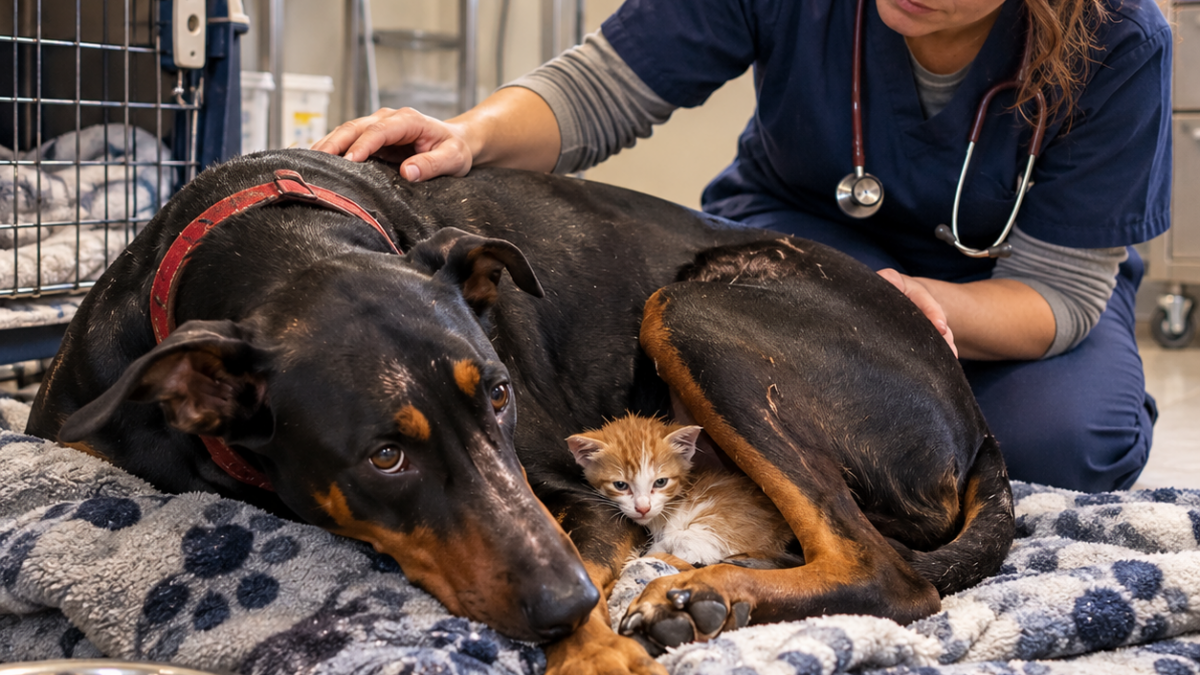
FULL STORY
The kitten made another faint sound.
The Doberman immediately lowered his muzzle toward it.
The movement was astonishingly gentle.
A dog powerful enough to knock any one of us off our feet touched the kitten with nothing more than the tip of his nose.
Then he looked at Élodie.
Not at me.
Not at Julien.
At her.
I still remember that look.
It wasn’t simple fear.
It looked more like exhaustion mixed with calculation.
He had spent the entire night making decisions.
Where to hide.
When to move.
Whether to trust the delivery driver.
Whether to accept food.
Whether we were dangerous.
Now he seemed to be facing one more impossible choice.
Let us take the kitten—or keep trying to save it himself.
Élodie didn’t reach forward.
Instead, she whispered, “I know. You’ve done your job.”
The Doberman’s ears shifted slightly.
“You kept him warm.”
He stared at her.
“We’re going to help now.”
Of course, he couldn’t understand the sentences.
But animals understand tone far better than people sometimes realize.
Élodie placed one warm towel beside his front paws.
Then another.
We waited.
Nothing happened.
She moved the heated pad another inch beneath the blanket.
The Doberman stiffened, but he didn’t warn her.
That was progress.
“Claire,” she said softly, never taking her eyes off him, “can you bring me the small oxygen box?”
I went to the adjoining treatment room.
By the time I returned, Julien had moved back against the wall to give the dog more space.
Élodie was still sitting on the floor.
The kitten had stopped making noise.
That scared me more than the crying had.
“Is it breathing?”
“Yes,” Élodie said. “Barely.”
She put two fingers against the kitten’s chest without lifting it away.
The Doberman watched every movement.
“Heart rate is slow.”
“How bad?”
“Very cold.”
The kitten was likely only a few weeks old.
Maybe four.
Possibly younger.
At that age, hypothermia can become fatal quickly.
A kitten that small cannot regulate its body temperature effectively.
Cold slows the heart.
It slows digestion.
It drains strength until the animal becomes too weak even to cry.
Élodie needed to warm him gradually.
But first she needed access to him.
She looked at the Doberman again.
Then she did something I would never have thought to do.
She showed him the towel.
Not metaphorically.
She physically held it out where he could see it.
Then she placed her own hand on the warm fabric.
She lifted the towel.
Put it down.
Lifted it again.
Slow movements.
No surprises.
The Doberman watched.
Élodie slid the towel closer to the kitten.
The dog’s muscles tightened.
She stopped.
A few seconds passed.
Then the Doberman lowered his head.
Not quite permission.
But not refusal.
Élodie moved the towel another inch.
Then another.
Finally, she wrapped it around the kitten without lifting him completely away from the dog.
The Doberman began panting.
“He’s stressed,” Julien said.
“I know.”
Élodie kept one hand on the kitten and one where the dog could see it.
“Easy.”
The Doberman leaned forward and sniffed her wrist.
Then he sniffed the towel.
That was the first time he voluntarily moved away from the old gray blanket.
Only three inches.
But all three of us noticed.
Élodie carefully lifted the kitten.
The Doberman stood.
Immediately.
Julien instinctively moved toward the door.
I raised one hand.
“Stay still.”
The dog’s legs were shaking.
He was bigger standing than he had looked curled in the corner, but he was also thinner.
Painfully thin.
His waist seemed almost carved inward.
Water still dripped from his belly.
He took one step toward Élodie.
She did not back away.
Instead, she lowered the towel enough for him to see the kitten.
The Doberman pushed his nose against the fabric.
The kitten gave a tiny squeak.
The dog exhaled.
Then, unbelievably, he sat down.
Élodie looked at me.
“Now.”
I opened the oxygen box.
She placed the kitten inside on a warmed pad with dry towels.
The Doberman rose again and followed.
He walked right beside her.
Whatever suspicion he had of us was apparently less important than staying near the kitten.
We positioned the oxygen box on the floor instead of the examination counter.
The Doberman immediately lay beside it.
His nose remained inches from the clear wall.
“That solves one problem,” Julien said.
“Which one?”
“How we convince him not to climb onto the exam table.”
I almost laughed.
Almost.
But then Élodie looked at the kitten’s temperature reading.
Her expression changed.
“How low?”
She hesitated.
“Too low.”
She didn’t give us the exact number at first.
She didn’t need to.
Her face said enough.
The kitten had likely been cold for hours.
Maybe much longer.
“We warm slowly,” she said. “Not too fast.”
I nodded.
“And him?”
Élodie looked at the Doberman.
“Him too.”
The dog was shivering so hard now that we could see it from several feet away.
The strange thing was that he seemed to have held himself together until the kitten was taken out of the blanket.
Now that someone else was protecting it, whatever strength had been keeping him upright appeared to disappear.
His head dropped toward the floor.
“Élodie.”
“I see it.”
She moved carefully toward him.
This time, he didn’t lift his lip.
She touched the side of his neck.
Nothing.
She placed the stethoscope against his chest.
He watched her but didn’t move.
Then she checked his gums.
“Pale.”
“Dehydrated?”
“Definitely. Possibly anemic.”
She ran her hands gently along his ribs.
The dog flinched near his left side.
Élodie stopped.
“There.”
“What?”
“Pain.”
She pressed very lightly.
The Doberman’s head turned sharply.
No growl.
Just pain.
She felt again, more cautiously.
“Could be bruising.”
“From what?”
“I don’t know yet.”
We would soon find out.
At the time, all we could do was stabilize them.
We brought in dry blankets.
Not the old gray one.
That stayed exactly where it was.
The Doberman seemed calmer as long as he could see both the blanket and the oxygen box.
Élodie started fluids beneath his skin.
Normally, I would have expected resistance.
There was almost none.
He was simply too tired.
I sat beside him while Julien went to find canned recovery food.
Up close, the dog looked older than I had first thought.
Not elderly.
Maybe five or six.
The pale scar across his muzzle was old.
There were smaller marks along one ear.
His red collar had once been good quality leather, but it was badly worn and darkened by rain.
A metal ring hung from it.
No tag.
At least that was what I thought.
I reached toward the collar.
The Doberman opened his eyes.
I stopped.
“Just looking.”
He watched me.
I touched the edge of the leather.
No reaction.
Slowly, I turned the collar.
There was something stamped on the inside.
Not a traditional identification tag.
Just faded writing pressed directly into the leather.
Most of it had nearly disappeared.
I leaned closer.
There were numbers.
And several letters.
“Élodie?”
She came over.
“What?”
“I think there’s a phone number.”
We dried the collar with a towel.
The leather was cracked, and several digits were difficult to read.
Julien found a flashlight.
Together, we managed to make out ten numbers.
A French mobile number.
Below it was one word.
MARCEL.
“Owner?” Julien asked.
“Maybe.”
I looked at the Doberman.
“Or the dog’s name?”
Élodie shook her head.
“Could be either.”
There was only one way to find out.
I took my phone from my pocket.
Then I stopped.
It was barely seven in the morning.
Under ordinary circumstances, I might have waited.
These were not ordinary circumstances.
I dialed.
The phone rang.
Once.
Twice.
Three times.
No answer.
Then voicemail.
A man’s recorded voice said his name.
Marcel Dufour.
So Marcel was not the dog.
I left a message.
“Mr. Dufour, my name is Claire Martin. I work with the municipal animal service outside Lille. We’ve found a Doberman wearing a collar with your number inside it. He’s safe, but we need to speak with you as soon as possible. Please call me.”
I hung up.
The Doberman had lifted his head when the voicemail played.
That caught my attention.
“You know that voice?”
His ears shifted.
I played the message again.
The reaction was immediate.
He stood.
Not quickly.
His legs nearly failed beneath him.
But he stood.
His tail—cropped short years before we ever met him—moved once.
Then again.
Élodie and I looked at each other.
“Well,” Julien said quietly. “He definitely knows Marcel.”
The phone rang less than five minutes later.
Unknown number.
I answered immediately.
“Claire Martin?”
The man on the other end sounded breathless.
“Yes.”
“You have him?”
“Are you Marcel Dufour?”
“Yes. Is it Atlas?”
Atlas.
The Doberman lifted his head at the sound of the name through the phone.
I looked down at him.
“Yes,” I said. “I think it is.”
The man made a sound somewhere between a laugh and a sob.
“Oh, thank God.”
Atlas pushed himself upright.
His ears were forward.
“Mr. Dufour, Atlas is alive. He’s exhausted and dehydrated, and our veterinarian is examining him.”
“How did you find him?”
“Behind a garden center in the commercial zone.”
Silence.
“That far?”
Something in his voice changed.
“How far did you expect him to be?”
Marcel did not answer immediately.
Then he said, “I’ve been looking for him since yesterday afternoon.”
“What happened?”
Another pause.
And then the story began.
Marcel was sixty-eight years old.
He lived alone in a small house roughly nine miles from where Atlas had been found.
He had owned the Doberman for almost six years.
Atlas had originally belonged to Marcel’s son, Thomas.
When Thomas died suddenly from an aneurysm three years earlier, Atlas became Marcel’s dog.
“He was the last living thing in that house that had known my son,” Marcel said.
I looked at Atlas lying beside the kitten.
“I understand.”
“No,” Marcel said softly. “You probably do.”
There was no anger in it.
Only exhaustion.
He explained that Atlas had escaped during the previous afternoon’s storm.
At least, that was what Marcel had believed.
The back gate had been standing open when he noticed the dog missing.
He assumed the wind had blown it loose.
Marcel spent most of the evening searching.
Neighbors helped.
He drove every road nearby until the rain became too heavy to see.
“What about the kitten?” I asked.
“The what?”
I looked at Élodie.
She looked back at me.
“Atlas was found protecting a kitten.”
There was complete silence on the line.
“A kitten?”
“Yes.”
“I don’t own a cat.”
“Could there be kittens near your house?”
“Not that I know of.”
Atlas shifted closer to the oxygen box.
Marcel heard the movement through the phone.
“Is he hurt?”
“We’re still checking him.”
“Can I come?”
“Yes.”
“I’m leaving now.”
He arrived twenty-three minutes later.
I know because I watched the clock.
Atlas noticed him before any of us did.
We heard the front door open.
Then a man’s voice speaking to our receptionist.
Atlas’s head shot up.
Every bit of exhaustion vanished from his expression.
He scrambled to his feet.
“Atlas?”
The voice came through the hallway.
Atlas barked.
It was the first sound we had heard from him.
One bark.
Deep enough to echo off the walls.
Then Marcel appeared in the doorway.
He was a tall, narrow man with wet silver hair and a brown coat buttoned incorrectly, as if he had dressed while running.
For one second, neither of them moved.
Then Marcel covered his mouth with one hand.
“Atlas.”
The Doberman tried to run.
His rear legs slipped.
Marcel dropped to his knees.
Atlas reached him and pushed his entire head into the man’s chest.
Marcel wrapped both arms around him.
I had seen hundreds of reunions.
Some loud.
Some joyful.
Some dramatic.
This one was almost completely silent.
Marcel pressed his face into Atlas’s wet neck.
The dog leaned into him so hard I thought they might both fall over.
“You idiot,” Marcel whispered.
Atlas licked his chin.
“You absolute idiot.”
The old man began crying.
“You scared ten years off my life.”
Atlas pushed his forehead against Marcel’s chest.
For several minutes, we let them have each other.
Then the kitten made a tiny noise from inside the oxygen box.
Atlas turned immediately.
Marcel followed his gaze.
“That’s the kitten?”
“Yes.”
Marcel stood slowly and walked closer.
Atlas remained between him and the box.
Not aggressively.
Protectively.
“Easy,” Marcel said. “I’m not taking him.”
He looked through the clear panel.
The kitten was wrapped in a towel with only his tiny head visible.
Marcel stared.
“I’ve never seen that cat.”
“That’s what makes this strange,” I said.
Atlas sat beside his owner.
For the first time since arriving, he seemed almost relaxed.
Élodie continued examining him while Marcel kept one hand on his neck.
That was when she found the deeper bruising.
There was swelling along Atlas’s left side.
Two abrasions ran across his shoulder.
Not cuts.
More like he had scraped against something rough.
Élodie parted the fur.
“He didn’t get those lying under a garden center.”
Marcel frowned.
“What happened to him?”
“We don’t know.”
Élodie gently moved Atlas’s front leg.
He winced.
She checked again.
“I want X-rays.”
Marcel nodded immediately.
“Whatever you need.”
Atlas was taken into imaging while I stayed near the kitten.
Marcel sat beside the oxygen box.
He didn’t touch it.
Atlas had apparently taught all of us the rules.
After several minutes, Marcel asked, “Is the kitten going to live?”
“I don’t know yet.”
He looked down.
“Atlas doesn’t even like cats.”
That surprised me.
“He doesn’t?”
Marcel almost smiled.
“My neighbor has one. Atlas ignores it as if it doesn’t exist. If the cat comes into our yard, he walks away.”
I looked at the orange kitten.
“Then something happened.”
“Yes.”
Atlas’s X-rays gave us the next piece.
No fractures.
That was the good news.
The bad news was significant bruising around the chest and shoulder.
The pattern suggested impact.
“A car?” I asked.
“Possibly,” Élodie said.
Marcel’s face went pale.
“He was hit?”
“Maybe clipped. Maybe something struck him. I can’t say for sure.”
There were no internal injuries visible.
His lungs looked clear.
His ribs were intact.
But whatever had happened would have hurt badly.
And Atlas had continued moving anyway.
The question was why.
Then my phone rang.
It was the delivery driver who had found him.
His name was Rémi.
He had called earlier asking whether the dog survived, and I had given him my number.
“I remembered something,” he said.
“What?”
“The blanket.”
I glanced toward it.
It still lay in the corner where Atlas had guarded it.
“What about it?”
“I think I saw one like it yesterday.”
“Where?”
“At the garden center?”
“No. Across the road.”
There was an abandoned storage lot behind several commercial buildings, enclosed by an old wire fence.
Rémi delivered to businesses in that area regularly.
The previous afternoon, he had noticed a pile of broken cardboard boxes and discarded gardening materials dumped beside the fence.
On top of the pile was a gray blanket.
“Are you sure?”
“No,” he said. “But it looked like that one.”
“Could there have been animals there?”
“I wouldn’t know.”
I turned toward Marcel.
“When did Atlas disappear?”
“Around three-thirty.”
“What direction would he have gone if he left your yard?”
Marcel pointed mentally through the geography.
“If he went east, eventually toward the commercial zone.”
The storm had intensified shortly after four.
I asked Rémi another question.
“Are there security cameras behind the garden center?”
“Definitely. Loading dock cameras. And there’s one facing the road.”
That changed everything.
Not because we were investigating a crime.
At that point, we had no reason to think there was one.
But because we might finally understand how Atlas and the kitten had found each other.
The garden center manager was cooperative.
Very cooperative, once he heard about the kitten.
By late morning, he had sent us several video clips.
The footage was grainy.
Rain streaked across the lens.
But it showed enough.
At 5:41 p.m., Atlas appeared at the edge of the frame.
Alone.
He was running.
Not wandering.
Running.
Thirty seconds later, he disappeared behind a row of storage sheds.
At 5:48, he reappeared.
Something had changed.
He was carrying fabric.
The gray blanket.
He dragged it by one corner.
He stopped every few yards.
Dropped it.
Looked behind him.
Then picked it up again.
Marcel watched the footage over my shoulder.
“What is he doing?”
I didn’t answer.
Atlas dragged the blanket toward the loading awning.
Then stopped.
He dropped it.
Circled it.
Lay down.
Stood again.
Nudged it with his nose.
Then curled his body around it.
The camera had no audio.
But at 5:51, Atlas suddenly lifted his head and looked toward the road.
A car passed.
Atlas stood.
For a moment, we could see the blanket clearly.
Something moved inside it.
Marcel inhaled sharply.
“That was the kitten.”
“Yes.”
Atlas turned toward the road.
And that was when the second camera captured something the first had missed.
A small orange shape was visible near the curb.
Not one kitten.
Two.
Atlas moved toward them.
One disappeared from view behind a stack of pallets.
The second did not move.
Atlas reached it.
Sniffed it.
Then stood over it in the rain.
He remained there for nearly a minute.
Finally, he returned to the blanket.
“There were more,” I whispered.
Marcel looked at me.
“How many?”
“We need to go back.”
Within twenty minutes, Julien and I were driving toward the commercial district.
Élodie stayed with Atlas and the surviving kitten.
Marcel stayed too.
The storm had passed, but the sky remained gray.
Water filled the gutters.
Broken branches lay along the roads.
The abandoned lot was worse than it looked on video.
The fence had been bent open in one section.
Trash and wet cardboard were scattered everywhere.
We found the blanket’s original location almost immediately.
There was another piece of gray fabric caught on wire.
Several empty cat-food containers sat nearby.
Then Julien crouched.
“Claire.”
He pointed beneath a wooden pallet.
Tiny paw prints.
We followed them toward a stack of plastic plant trays.
Behind the trays, we found a cardboard produce box turned on its side.
Inside were tufts of orange and white fur.
No kittens.
I felt my stomach tighten.
“Look around.”
We separated.
I checked beneath bins.
Julien searched behind a drainage pipe.
Then I heard him call my name.
Not loudly.
That told me everything before I reached him.
One kitten lay beneath the edge of a pallet.
Orange.
Still.
I knelt.
There was nothing we could do.
The cold had gotten there first.
Julien removed his cap and looked away.
“Damn.”
I wrapped the little body in a clean towel from our van.
Then we kept searching.
We found another kitten near the fence.
Also gone.
Now the security footage made more sense.
Atlas had found a litter.
Somehow, in the middle of a freezing storm, he had discovered kittens abandoned or born in that storage lot.
One had apparently still been alive.
Maybe more than one at first.
But he could not carry them all.
So he had done something remarkable.
He had found the blanket.
Pulled it toward shelter.
And carried or pushed at least one kitten into it.
Then he had used his own body as the heat source.
Still, one question remained.
Why had Atlas been there at all?
We found the answer beside the broken section of fence.
A strip of red leather was caught on the wire.
Atlas’s collar had a fresh tear in exactly the same place.
Beside the fence were tire tracks.
And something else.
Blood.
Not much.
A few dark drops washed almost completely away by rain.
Julien stared at the road.
“He got hit here.”
That was our best reconstruction.
Atlas had likely escaped—or been frightened out of Marcel’s yard—during the storm.
He traveled east.
Near the commercial district, something clipped him or forced him into the fence.
Injured and frightened, he reached the abandoned storage lot.
That was where he heard the kittens.
Instead of continuing toward shelter, Atlas stayed.
But the story still wasn’t complete.
A worker from a neighboring warehouse saw us searching.
He walked across the lot.
“You looking for the dog?”
I turned.
“You saw him?”
“Yesterday.”
My heart jumped.
“What happened?”
The man pointed toward the road.
“I was leaving around five. There was a black dog near that fence.”
“Did you see a car hit him?”
“No. But I heard brakes.”
“What time?”
“Maybe a little before five.”
That fit.
“He ran into the lot. I thought he was gone.”
“Did you see kittens?”
The worker frowned.
“No.”
“Did you hear anything?”
He thought for a moment.
“Actually… yes.”
“What?”
“Cats.”
He pointed toward the pile of pallets.
“Something crying back there.”
“Did anyone know they were there?”
“Probably. People feed strays around here.”
Then his expression changed.
“Wait.”
“What?”
“Yesterday morning there was an adult cat.”
“Orange?”
“White with orange patches.”
“Where?”
“Near the fence.”
“Did you see her later?”
“No.”
We searched the roadside.
Two hundred yards away, near thick shrubs beside a drainage ditch, we found her.
The mother cat.
Alive.
Barely.
She was soaked, weak, and terrified, but alive.
When Julien lifted her into a carrier, she fought with surprising strength.
“That’s good,” he said.
“Being angry?”
“Being alive enough to be angry.”
We rushed her back to the clinic.
The moment she began vocalizing from inside the carrier, something extraordinary happened.
The kitten in the oxygen box responded.
A tiny cry.
The mother cat went wild.
She pressed herself against the carrier door.
Élodie looked at me.
“That’s Mom.”
We reunited them only after warming and examining the mother.
She was dehydrated.
Thin.
One paw was injured.
But otherwise she was stable.
When we finally placed her beside the kitten, she immediately began licking him.
Atlas stood nearby.
His entire body became rigid.
For a second, Marcel held his collar.
Not because Atlas looked aggressive.
Because none of us knew what he would do.
The mother cat hissed.
Atlas stopped.
She hissed again.
The Doberman took one step backward.
Then another.
And lay down.
He rested his head between his paws and watched her care for the kitten he had spent the night protecting.
Marcel rubbed Atlas’s shoulder.
“There,” he whispered. “You can retire now.”
Atlas closed his eyes.
For the first time since we had met him, he slept.
Deeply.
No guarding.
No trembling.
No watching the door.
He slept because somebody else had taken over.
The orange kitten survived that first day.
Then the first night.
The second day was harder.
He refused food.
Élodie worried that the hours of hypothermia had weakened him too badly.
The mother cat, whom we temporarily called Amber, had milk but not much.
We supplemented the kitten carefully.
Atlas remained at the clinic because his dehydration and bruising required observation.
Marcel visited for hours.
Technically, Atlas could have gone home sooner.
Marcel refused.
“He stays until you say he’s ready.”
He paused.
Then looked at the kitten.
“And I’m guessing he’d refuse to leave anyway.”
He was probably right.
Whenever Atlas was taken outside for a short bathroom break, he returned directly to the room containing Amber and the kitten.
Every time.
He did not crowd them.
He had apparently accepted that Amber was in charge now.
But he always checked.
A sniff through the barrier.
A look.
Then he lay down.
The staff began calling the kitten Sunny.
It started as a joke because he was orange and had arrived during one of the coldest, darkest nights of the month.
The name stuck.
On the third morning, Sunny drank properly.
Élodie walked into the staff room holding the feeding chart.
“He gained twelve grams.”
Julien raised both hands.
“Twelve?”
“Twelve.”
I laughed.
We were celebrating twelve grams as if somebody had won a championship.
Maybe we had.
Marcel arrived with a paper bag of pastries.
“What happened?”
“Sunny gained weight.”
His face lit up.
“How much?”
“Twelve grams.”
Marcel stared at us.
“That’s good?”
“Today,” Élodie said, “that’s excellent.”
He put the pastries on the table.
“Then these are celebration pastries.”
Atlas came in behind him.
By then, he was walking more comfortably.
His appetite had returned.
His coat looked better.
The hard lines around his eyes had softened.
But the biggest change came when we placed the original gray blanket into a plastic evidence bag to discard later.
Atlas saw us lift it.
He stood immediately.
His body stiffened.
I stopped.
“Easy.”
He approached the bag.
Sniffed it.
Then looked toward Sunny.
Sunny was sleeping against Amber.
Atlas sniffed the old blanket one more time.
And walked away.
That was the moment I knew he understood.
Whatever responsibility he had assigned himself that night was finished.
Sunny was safe.
A week later, Atlas went home.
Marcel knelt beside him in our lobby and clipped on a brand-new collar.
This one had a metal tag.
ATLAS.
MARCEL DUFOUR.
Two phone numbers.
And, because Marcel was suddenly extremely cautious, a GPS tracker.
“I’m never going through that again,” he said.
Atlas stood beside him, looking toward the treatment-room door.
Marcel noticed.
“You want to say goodbye?”
We brought him in.
Amber had recovered quickly.
She was much friendlier than we expected once she felt safe.
Sunny, meanwhile, had transformed from a cold bundle barely capable of squeaking into a loud, demanding little animal who appeared personally offended whenever food was five seconds late.
Atlas walked toward the enclosure.
Amber watched him.
No hiss this time.
Atlas lowered his nose.
Sunny waddled toward the barrier.
Their noses touched through the mesh.
Marcel swallowed hard.
“Well,” he said, “now I feel terrible.”
“For what?”
“I’m taking him away.”
“You’re taking him home.”
“But look at him.”
Atlas sat.
Sunny stuck one paw through the mesh.
It landed on Atlas’s nose.
Atlas blinked.
Julien burst out laughing.
Marcel looked at me.
“Don’t.”
“Don’t what?”
“Whatever you’re about to say.”
“I wasn’t going to say anything.”
“You have the face.”
“What face?”
“The animal shelter face.”
“I do not have an animal shelter face.”
Élodie walked past us.
“You absolutely have an animal shelter face.”
Marcel pointed at her.
“Thank you.”
Then he looked at Sunny.
“No.”
Nobody spoke.
“I am sixty-eight.”
Still nobody spoke.
“I have never owned a cat.”
Silence.
“I don’t even know what cats need.”
Julien shrugged.
“Food.”
Marcel glared at him.
“A litter box,” Julien added.
“Stop helping.”
We laughed.
But none of us pushed.
Amber and Sunny still needed time.
And technically, they belonged to nobody yet.
We posted notices.
Checked local lost-pet groups.
Contacted nearby residents.
No owner came forward.
There was no microchip.
The warehouse workers believed Amber had been living around the commercial area for months.
Three weeks later, she was medically cleared for adoption.
Sunny needed longer.
By then, Atlas had visited twice.
Marcel claimed this was accidental.
It was not.
The first time, he said he happened to be passing nearby.
He lived nine miles away.
The second time, he arrived carrying a bag of cat treats.
“For Amber,” he insisted.
“Of course,” I said.
“And maybe something for the small one.”
“Of course.”
Sunny had become obsessed with Atlas.
The moment the Doberman entered the room, the kitten hurried toward him.
Atlas would lie on the floor.
Sunny would climb onto his front leg.
Sometimes he attacked Atlas’s ear.
Sometimes his paw.
Once, he fell asleep between Atlas’s front legs.
Marcel stared at them for several minutes.
Then he sighed.
“I know what all of you are doing.”
“We’re standing here.”
“You’re manipulating an elderly man.”
“You came voluntarily.”
“I came to bring treats.”
“To a cat you say you don’t want.”
“I never said I don’t want him.”
We all went silent.
Marcel realized what he had said.
His eyes narrowed.
Julien smiled.
“Oh.”
“Not one word.”
Nobody said one word.
We didn’t need to.
Two weeks later, Marcel adopted Sunny.
Not Amber.
Amber was adopted by one of the garden-center employees who had helped feed Atlas the morning he was found.
She went to a quiet home with another adult cat and a screened patio.
Sunny went home with Atlas.
Marcel arrived carrying a brand-new carrier.
Inside his car were toys.
A litter box.
Kitten food.
A scratching post.
A bed.
And something so ridiculous I still tease him about it.
A tiny heated blanket.
“You bought him a heated blanket?”
Marcel looked defensive.
“He gets cold.”
“He lives indoors.”
“He was nearly frozen to death.”
“That was weeks ago.”
“He gets cold.”
I looked at Atlas.
The Doberman looked back as though he wanted no involvement in the argument.
Sunny rode home in the carrier.
Atlas sat beside it.
Marcel later sent us a photograph from that evening.
Sunny was asleep on Atlas’s stomach.
Atlas looked exhausted.
The message beneath the photo read:
Apparently I have two animals now.
For several months, we received updates.
Sunny grew.
And grew.
And grew.
Not into a large cat.
Just into an increasingly confident one.
He followed Atlas everywhere.
If Atlas went to the kitchen, Sunny went to the kitchen.
If Atlas went into the yard, Sunny sat at the glass door screaming until Marcel brought him back.
If Atlas slept in his bed, Sunny slept on him.
Marcel bought Sunny three expensive cat beds.
Sunny ignored every one.
His bed was the Doberman.
Atlas tolerated things from that cat I would never have believed possible.
Sunny climbed over his head.
Bit his ears.
Attacked his tail.
Stole pieces of kibble from his bowl.
Atlas would simply sigh and move.
But the relationship wasn’t entirely one-sided.
Atlas became anxious during thunderstorms after the night he was injured.
Before, storms had never bothered him.
Afterward, heavy rain made him pace.
He would stand near the back door and whine.
Marcel believed the sound of rain reminded him of the commercial lot.
One night during a summer storm, Marcel woke and found Atlas trembling beside the sofa.
Sunny was curled against his chest.
The cat remained there until Atlas fell asleep.
Marcel sent me that story the next morning.
“He saved Sunny in winter,” he wrote. “I think Sunny returned the favor.”
I printed the message.
It stayed pinned to our staff noticeboard for months.
But the story had one final turn.
Almost a year after Atlas and Sunny arrived at our facility, I received a call from Marcel.
His voice was different.
Weak.
“Claire?”
“Yes?”
“I need some help.”
My stomach tightened.
“What happened?”
“I’m in the hospital.”
Marcel had collapsed at home.
A neighbor found him after noticing that his curtains had not opened that morning.
Doctors discovered a heart rhythm problem.
Treatable.
But serious.
He would be hospitalized for several days.
Atlas and Sunny were still at the house.
A neighbor was feeding them, but Marcel was worried.
“Atlas doesn’t understand.”
“We’ll take care of them.”
“No shelter.”
“Of course not.”
We arranged temporary foster care with one of our staff members.
Atlas resisted leaving Marcel’s house.
He planted his feet beside the front door and refused to move.
Then Sunny was placed in a carrier.
Atlas followed immediately.
That cat had become his compass.
For five days, they stayed together in foster care.
Atlas slept beside Sunny’s carrier the first night.
By the second, they shared a room.
By the third, Atlas seemed to understand that Marcel was not gone forever.
When Marcel returned home, we took both animals back.
I went along.
Atlas saw him through the open front door.
The reaction reminded me of their first reunion at the clinic.
He ran.
Marcel had been warned not to let Atlas jump on him, so I grabbed the dog’s harness before he could launch himself.
“Easy!”
Atlas whined.
Not barked.
Whined.
Marcel crouched as much as his doctor had allowed and wrapped his arms around the Doberman’s neck.
Sunny escaped his carrier.
He ran straight past both of them into the house.
Marcel laughed.
“Well, one of them missed me.”
Sunny reappeared thirty seconds later, leaped onto the couch, and began yelling.
“He missed his furniture,” I said.
Marcel laughed harder.
Atlas pressed his face against Marcel’s chest.
Then Sunny jumped onto the arm of the couch and rubbed against Marcel’s shoulder.
For a moment, all three were touching.
The old man.
The Doberman.
The orange cat.
I stood in the doorway thinking about the freezing morning when none of us had even known what lay beneath that gray blanket.
If Atlas had chosen differently that night, Sunny would almost certainly have died.
If the delivery driver had ignored the black shape under the awning, Atlas might have collapsed from exposure.
If we had punished his warning instead of listening to it, we might have separated him from the kitten too quickly.
So many tiny decisions had mattered.
A driver stopping.
An employee bringing water.
Julien respecting a raised lip.
Élodie sitting on the floor instead of forcing the dog away.
Atlas refusing to leave.
People often like to describe dogs like Atlas as heroes.
Maybe that word fits.
But after twelve years working with animals, I’m cautious about turning them into something human.
Atlas did not make a speech.
He did not know anyone would praise him.
He did not understand photographs, social media, rescue stories, or the strange fascination people later had with what he had done.
He simply heard a living thing in distress.
And he stayed.
That was enough.
Several years have passed since that freezing morning.
Atlas is older now.
His muzzle has begun to turn gray.
His running days are shorter.
His naps are much longer.
Sunny is no longer a tiny orange kitten.
He is a healthy adult cat with a personality far larger than his body.
According to Marcel, he believes the entire house belongs to him.
Atlas apparently agrees.
When I visited them last winter, Marcel opened the door and pointed toward the living room.
“You need to see this.”
Atlas was asleep beside the radiator.
Sunny was stretched across his ribs.
Not beside him.
Across him.
The Doberman’s eyes opened when I entered.
His tail tapped the floor.
I knelt.
“Hello, old man.”
Atlas lifted his head and pushed his nose into my hand.
Sunny opened one eye.
He looked annoyed that I had disturbed his bed.
Marcel stood behind me.
“You know he still does it?”
“Does what?”
“Guards him.”
I looked back.
“How?”
“If Sunny goes outside into the enclosed yard and doesn’t come in immediately, Atlas waits at the door.”
Marcel smiled.
“If Sunny is at the vet, Atlas lies beside the carrier.”
He paused.
“And whenever we get heavy rain, they sleep together.”
I stroked the gray fur along Atlas’s muzzle.
“You remember that night, don’t you?”
His eyes stayed on mine.
Of course, I can’t know what Atlas remembers.
Maybe the storm.
Maybe the pain of being struck.
Maybe the cries from behind the pallets.
Maybe the cold concrete.
Maybe nothing in the way humans understand memory.
But I know what I remember.
I remember a large black Doberman curled around something none of us were allowed to touch.
I remember his ribs showing through his wet coat.
I remember the slight lift of his lip when Julien’s hand moved too close.
At first, that warning made him look dangerous.
Later, I understood it completely.
Atlas wasn’t telling us that he wanted to hurt anyone.
He was telling us there was something more vulnerable than he was beneath him.
He was saying:
You can take me.
You can examine me.
You can move me.
But you are not touching this little life unless I know you mean to save it.
And beneath a soaking gray blanket, pressed against the last warmth left in an injured dog’s body, a tiny orange kitten was still breathing because Atlas had decided that walking away was not an option.
People often ask me which animal rescue I remember most.
After twelve years, there are hundreds.
Dogs pulled from canals.
Cats found inside engines.
Puppies abandoned beside highways.
Old animals reunited with families who had searched for months.
But when somebody asks which one changed the way I understand animals, I always think of Atlas.
Not because he was fearless.
He wasn’t.
He was frightened.
Not because he was uninjured.
He was in pain.
Not because he trusted people.
That morning, he trusted almost nobody.
What stays with me is that none of those things stopped him from protecting something smaller and weaker than himself.
He was cold.
He stayed.
He was hurt.
He stayed.
He was hungry.
He stayed.
Strangers approached.
He stayed.
Cars passed.
Rain fell.
The temperature dropped.
And Atlas stayed.
Until somebody else was finally ready to take over.
That is what I remember every time I see the photograph Marcel keeps framed in his living room.
It was taken months after the rescue.
Atlas is lying in a patch of afternoon sunlight.
Sunny is stretched across his chest, one orange paw resting on the old scar along the Doberman’s muzzle.
Atlas’s eyes are closed.
Sunny’s are too.
The filthy gray blanket is long gone.
The freezing loading dock is far behind them.
But the position is almost exactly the same.
A large dog curved around a small cat.
Only now, neither of them is fighting to survive.
They are simply home.
The photograph stayed on Marcel’s mantel for years.
Every time I visited, I found myself looking at it before I looked at anything else.
Atlas was stretched out in a square of sunlight near the living-room window. His muzzle was already beginning to gray, his once-sharp black coat softened by age. Sunny lay across his chest like he had done since he was small enough to fit in two hands, one orange paw resting over the pale scar on Atlas’s muzzle.
Neither animal was looking at the camera.
Neither needed to.
The picture wasn’t beautiful because someone had staged it.
It was beautiful because no one had.
That was simply how they lived.
What none of us knew when the photograph was taken was that it would eventually become one of the last images of Atlas while he was still strong enough to climb the stairs by himself.
Age came quietly at first.
Marcel noticed Atlas hesitating before jumping into the car.
Then he began taking longer to stand after naps.
His walks shortened from forty minutes to twenty.
Then fifteen.
Sunny adjusted before anyone asked him to.
If Atlas stopped halfway down the garden path, Sunny stopped too.
If the Doberman lay in the grass, Sunny settled beside him.
On cold mornings, Sunny would wait near the back door rather than running into the enclosed yard alone.
It was as though some invisible rule had been established between them.
Where Atlas went, Sunny went.
Where Atlas stopped, Sunny waited.
Marcel called me one evening in early November.
“Claire?”
I recognized immediately that something was wrong.
His voice was too careful.
“Yes?”
“It’s Atlas.”
I sat up straighter at my kitchen table.
“What happened?”
“He couldn’t get up this morning.”
My stomach tightened.
“Is he standing now?”
“Yes. Eventually. But…”
Marcel stopped.
I knew that kind of silence.
People who love animals often know the moment the story begins changing, even before a veterinarian confirms it.
“But what?”
“He looked at me like he was embarrassed.”
That sentence nearly broke me.
Dogs don’t feel embarrassment exactly as we do, but I understood what Marcel meant.
Atlas had always been the strong one.
The dog who dragged a soaked blanket through freezing rain.
The dog who stood between strangers and a dying kitten even while injured himself.
The dog who once refused to collapse until someone else took over.
For a dog like that, losing control of his own body must have felt confusing.
“We’ll have Élodie look at him,” I said.
Marcel exhaled.
“Tomorrow?”
“First thing.”
When Atlas arrived at the clinic the next morning, Sunny came too.
Marcel didn’t even ask.
He simply carried Sunny in a carrier with one hand while holding Atlas’s leash with the other.
The moment the carrier touched the floor, Sunny began complaining loudly.
Marcel sighed.
“He’s been doing that since we left.”
“He hates the carrier?”
“He hates being separated from Atlas by six inches of plastic.”
We let him out.
Sunny immediately walked over to Atlas and pressed himself against the Doberman’s front leg.
Atlas looked down at him.
His tail moved once.
Élodie examined him carefully.
Arthritis had settled into his hips.
There were changes in his spine.
Nothing catastrophic.
Nothing immediately fatal.
But enough to tell us that Atlas had entered a different chapter of his life.
Medication could help.
Pain management could help.
A ramp beside Marcel’s back steps could help.
Rugs over the slippery floors could help.
But nothing could reverse time.
Marcel listened to everything without interrupting.
Then he asked the question almost every loving owner eventually asks.
“Is he suffering?”
Élodie answered honestly.
“Not constantly. But he has pain.”
“Can we control it?”
“I think so.”
Marcel nodded.
“Then we control it.”
And they did.
For almost another year, Atlas did surprisingly well.
His walks became slower but remained important.
Marcel bought a padded harness with handles so he could help lift Atlas’s hips when needed.
He installed a ramp outside.
He covered half the house in nonslip mats.
Sunny treated every new mat as though Marcel had purchased it specifically for him.
There were good months.
Very good months.
Atlas still waited by the kitchen when Marcel cooked chicken.
He still growled softly at delivery trucks.
He still insisted on checking every person who entered the house.
And he still watched Sunny.
Always Sunny.
One afternoon, I visited Marcel after finishing work.
Atlas was sleeping in the garden.
Sunny was nowhere in sight.
“Where’s the little tyrant?” I asked.
Marcel pointed upward.
“Fence.”
Sunny was sitting on top of the low wooden divider around the flower bed, staring at a bird.
Atlas opened one eye.
Sunny moved toward the bird.
Atlas raised his head.
Sunny took another step.
Atlas stood.
Slowly.
Painfully.
But he stood.
“Watch,” Marcel whispered.
Sunny crouched.
Atlas gave one quiet bark.
The cat froze.
Then turned around.
I stared.
“Did Atlas just tell him to come back?”
Marcel smiled.
“He’s been doing it for years.”
Sunny jumped off the divider and trotted toward Atlas with the irritated expression of someone deeply offended by supervision.
Atlas sniffed him.
Sunny head-butted his chest.
Then both lay down.
I laughed.
“He still thinks Sunny is that kitten under the blanket.”
Marcel’s smile faded into something softer.
“Maybe he always will.”
That sentence stayed with me.
Maybe love does that.
Maybe once we have seen someone helpless, some part of us remembers forever.
Even after they become strong.
Even after they no longer need saving.
Winter returned.
And with it came rain.
Heavy rain always changed Atlas.
No matter how many years passed, storms brought something back.
He paced.
He listened at doors.
Sometimes he stood staring toward the garden as if another cry might come through the darkness.
Sunny learned the pattern.
When rain struck the windows hard enough, he found Atlas.
Every time.
Sometimes he slept beneath Atlas’s chin.
Sometimes against his stomach.
Once, Marcel sent me a photograph at two in the morning.
Atlas was lying on a blanket beside the couch.
Sunny was completely buried against his chest.
The message read:
Storm outside. Same rescue, different direction.
I stared at that sentence for a long time.
Because Marcel was right.
People talked about Atlas saving Sunny.
And he had.
There was no question about it.
But over the years, Sunny had saved Atlas too.
Not from freezing rain.
Not from starvation.
From something quieter.
Fear.
Loneliness.
Aging.
The uncertainty that comes when a body that once seemed invincible begins to fail.
Sunny made Atlas feel useful long after Atlas needed help himself.
And I sometimes wondered whether that was one of the greatest gifts the cat could have given him.
The following spring, Marcel called again.
This time there was no hesitation in his voice.
Only fear.
“Claire, something’s wrong.”
“What happened?”
“Atlas collapsed.”
I was already standing.
“Is he conscious?”
“Yes.”
“Breathing normally?”
“I think so.”
“Bring him now.”
I called Élodie before Marcel arrived.
Atlas came through the doors on a blanket.
Two neighbors had helped carry him from the car.
Sunny’s carrier was placed beside him.
The cat was screaming.
I had never heard Sunny make that sound.
Not once.
He clawed at the carrier door.
“Let him out,” Élodie said.
Marcel opened it.
Sunny rushed directly to Atlas’s face.
He sniffed his mouth.
His eyes.
His ears.
Then he sat beside him.
Perfectly still.
Atlas lifted his head a fraction.
Sunny rubbed against his cheek.
The Doberman’s eyes closed.
Tests showed that Atlas had developed a serious heart condition.
It wasn’t entirely unexpected at his age.
But it was advanced.
We stabilized him.
Medication helped.
By evening, he could stand.
Marcel sat on the floor beside him for nearly six hours.
Sunny never left.
When Élodie finally came to speak with Marcel, I stayed.
There are conversations nobody should have to hear alone.
“We can treat the symptoms,” she said.
Marcel nodded.
“For how long?”
“We don’t know.”
“A month?”
“Maybe.”
“Six months?”
“Possibly.”
“A year?”
Élodie didn’t answer immediately.
Marcel looked at Atlas.
“I don’t want him kept alive for me.”
Nobody spoke.
“If he can still enjoy being home, eating, sitting outside, being with Sunny… I want that.”
“That’s reasonable.”
“But when that changes…”
His voice broke.
Élodie leaned closer.
“We’ll tell you.”
Marcel wiped his eyes.
“No. I need you to promise me.”
“I promise.”
Atlas went home that night.
For a while, he surprised us again.
Three months passed.
Then four.
He had bad days.
But he had more good ones than bad.
He ate.
He slept in the sun.
He demanded pieces of Marcel’s breakfast.
He walked to the end of the garden and back.
Sunny slept with him every night.
Marcel started keeping a notebook.
GOOD DAY.
BAD DAY.
GOOD DAY.
GOOD DAY.
TIRED.
GOOD MORNING, HARD EVENING.
Ate chicken.
Watched birds with Sunny.
Walked to gate.
Didn’t want breakfast.
Slept all afternoon.
Chased Sunny away from his water bowl.
GOOD DAY.
He later showed me the notebook.
“I don’t trust myself,” he said.
“What do you mean?”
“I love him too much. I’m afraid I’ll only see what I want to see.”
The notebook helped.
It made love measurable when emotion became too powerful.
Then came the September morning I had always known would come and still wasn’t prepared for.
My phone rang at 6:17.
Marcel.
I answered before the second ring.
“It’s time,” he said.
Only two words.
I closed my eyes.
“What happened?”
“He didn’t sleep.”
His voice trembled.
“He can’t stand. He tried because Sunny walked into the kitchen.”
I pressed my fingers against my forehead.
“Is he in pain?”
“Yes.”
“Bring him.”
“No.”
I understood immediately.
“You want Élodie to come there?”
“Please.”
We arranged everything.
Élodie and I drove to Marcel’s house together.
Neither of us spoke much.
The sky was pale gray.
Not raining.
I was grateful for that.
When Marcel opened the front door, he looked ten years older.
Atlas was lying in the living room.
In the sunlight.
Exactly where the photograph had been taken years earlier.
Sunny lay across his front legs.
I had expected the cat to move when we entered.
He didn’t.
Atlas lifted his head when he saw me.
His tail tapped the floor once.
That one movement almost destroyed me.
I sat beside him.
“Hello, old man.”
Atlas pushed his nose weakly into my palm.
The same greeting he had given me for years.
Marcel sat opposite me.
“I cooked chicken.”
“Did he eat?”
“One piece.”
Élodie examined Atlas.
She took her time.
Listened to his heart.
Checked his gums.
His breathing.
His legs.
His eyes.
Then she looked at Marcel.
There was no need for a speech.
Marcel understood.
He nodded.
Sunny stood.
He sniffed Élodie’s hand.
Then he moved closer to Atlas.
Marcel whispered, “Can he stay?”
Élodie looked at Sunny.
“Yes.”
We placed a soft blanket beneath Atlas.
Not gray.
Blue.
Clean.
Warm.
For some reason, seeing a blanket beneath him brought me all the way back to that freezing morning.
The soaked fabric.
The lifted lip.
The tiny cry underneath him.
I wondered whether Marcel was thinking the same thing.
Then he said quietly, “Funny, isn’t it?”
“What?”
“He started this story on a blanket.”
My throat tightened.
Marcel stroked Atlas’s head.
“And now…”
He couldn’t finish.
I moved beside him.
Atlas received a sedative first.
Slowly, the tension left his body.
His breathing softened.
Marcel held his head.
Sunny sat against his ribs.
At one point, Atlas opened his eyes.
He looked at Marcel.
Then at Sunny.
His nose moved.
Sunny leaned forward.
Their noses touched.
Just once.
Atlas closed his eyes again.
Marcel began crying silently.
“Good boy,” he whispered.
“You were such a good boy.”
Atlas breathed out.
His chest rose.
Fell.
Rose again.
Élodie waited.
Nobody rushed.
Nobody needed to.
Then came the final injection.
Atlas’s body relaxed completely.
His breathing slowed.
Sunny remained pressed against him.
And then the dog who had once refused to surrender a dying kitten to the cold finally let go.
Peacefully.
At home.
With Marcel’s hand on his head.
With Sunny beside him.
Afterward, no one moved for several minutes.
Sunny was the first.
He stood.
Walked toward Atlas’s face.
Sniffed his nose.
Then his mouth.
Then his chest.
He waited.
Sniffed again.
Finally, he sat.
I had seen animals react to death before.
Some walked away.
Some became restless.
Some appeared confused.
Sunny simply sat.
Five minutes.
Ten.
Marcel whispered, “Does he understand?”
“I think he understands Atlas isn’t responding.”
Sunny eventually lay down beside him.
Not on him.
Beside him.
That difference hurt more than I expected.
When it was time for us to leave with Atlas, Sunny followed the stretcher to the front door.
Marcel picked him up.
Sunny struggled once.
Then stopped.
He watched us carry Atlas toward the car.
I looked back.
Marcel stood in the doorway holding the orange cat against his chest.
The same cat who once fit beneath Atlas’s ribs.
Now fully grown.
Alive because of him.
That evening, Marcel called me.
“I keep expecting to hear his nails on the floor.”
I understood.
“The house sounds wrong.”
“It will for a while.”
“Sunny is looking for him.”
I closed my eyes.
“Where?”
“Everywhere.”
Sunny checked Atlas’s bed.
The garden.
The kitchen.
The place beside the radiator.
For several nights, he slept by the front door.
Then he stopped eating properly.
That worried us.
Élodie examined him.
Physically, he was healthy.
But grief affects animals too.
Routine changed.
Scent disappeared.
A lifelong companion was gone.
Marcel sat with him constantly.
On the fourth night, a storm arrived.
Rain hammered the windows.
Thunder rolled across the neighborhood.
For years, that sound had sent Atlas searching for Sunny.
Now Sunny began walking through the house.
Room after room.
Calling.
Marcel later told me he couldn’t bear it.
“I picked him up,” he said.
“I sat exactly where Atlas used to sleep during storms.”
Sunny fought him at first.
Then something changed.
He smelled Marcel’s shirt.
Marcel had deliberately worn the old sweater he often used while brushing Atlas.
Maybe the scent remained.
Sunny stopped struggling.
“He curled against me,” Marcel said.
“Right here.”
He touched his chest.
“And he slept.”
It became their new routine.
Not a replacement.
There are no replacements for certain relationships.
But a continuation.
Marcel needed Sunny because Atlas was gone.
Sunny needed Marcel for the same reason.
Months later, I visited again.
The house was quieter.
Atlas’s bed was gone.
But his collar hung from a small hook beside the mantel.
The original red collar—the cracked one with Marcel’s number stamped inside—had been cleaned and placed beneath the framed photograph.
Beside it was the newer collar.
And between them sat something I recognized instantly.
A square of faded gray fabric.
I stared.
“You kept it?”
Marcel nodded.
“The blanket?”
“Not all of it.”
Before we discarded the original soaked blanket years earlier, Marcel had quietly cut away one clean corner after it was washed.
I hadn’t known.
“Why?”
He looked toward Sunny, who was sleeping on the couch.
“Because that was where it started.”
I touched the fabric.
It was ordinary.
Cheap.
Frayed.
Nobody looking at it would have understood.
Marcel did.
I did.
Sunny probably did in his own way.
“Come outside,” Marcel said.
He led me into the garden.
Near the back fence was a young tree.
A small plaque sat beneath it.
No dramatic inscription.
No grand statement.
Only:
ATLAS
HE STAYED.
I stared at those two words.
He stayed.
Of all the things we could have written about him, none would have been more accurate.
He stayed beside Sunny in freezing rain.
He stayed beside Marcel after Thomas died.
He stayed beside the kitten through recovery.
He stayed at doors during storms.
He stayed as his own body weakened.
Again and again, Atlas’s life had been defined not by aggression, strength, or bravery in the way people usually imagined those things.
It was defined by presence.
By refusing to leave.
Sunny walked outside while we stood there.
He sniffed the base of the tree.
Then sat in the grass.
Marcel smiled.
“He likes that spot.”
Sunny looked toward us.
Then toward the house.
He was older too now.
Not elderly.
But no longer the reckless kitten who attacked Atlas’s ears.
There was a calmness in him I had never noticed before.
“Do you regret adopting him?” I asked Marcel.
Marcel gave me a look as though the question were absurd.
“Every day.”
I laughed.
He smiled.
Then his expression softened.
“No.”
He watched Sunny.
“I think Atlas chose him before any of us had a vote.”
I knew exactly what he meant.
People sometimes imagine rescue as a single moment.
A door opens.
A hand reaches down.
An animal is pulled from danger.
The end.
But that isn’t how it works.
The rescue itself is often only the first sentence.
Atlas saved Sunny beneath a soaked blanket.
But Sunny gave Marcel a reason to laugh after losing Thomas.
He gave Atlas companionship through old age.
He gave Marcel something warm to hold after Atlas died.
And Marcel gave both of them a home.
The delivery driver who stopped gave Atlas a chance.
Élodie gave Sunny medical care.
Julien respected a frightened dog’s warning.
Every person added one small piece.
Years after Atlas died, I still think about that.
Especially when someone brings us a frightened animal and says:
“He’s aggressive.”
Sometimes they are right.
Sometimes an animal truly is dangerous.
But sometimes I look at the rigid body.
The warning eyes.
The raised lip.
And I remember Atlas.
I remember how easy it would have been to misunderstand him.
Had someone dragged him away from the blanket, he might have bitten.
Then people might have called him vicious.
Dangerous.
Unpredictable.
Nobody would have known what he was trying to protect.
That lesson changed me.
Behavior has context.
Fear has history.
And sometimes the most important thing an animal is trying to tell you is hidden beneath what looks frightening.
A few winters after Atlas was gone, I received a Christmas card from Marcel.
On the front was a photograph of Sunny.
He was sitting beneath the tree planted for Atlas.
Snow dusted the grass.
Sunny’s orange coat looked almost impossibly bright against the white ground.
Inside, Marcel had written:
He still waits near the door when it rains.
So do I.
I kept that card.
I still have it.
People occasionally ask whether Sunny remembers Atlas.
I don’t know.
Science can tell us many things about animal cognition, scent memory, attachment, and grief.
But there are places science doesn’t give us a neat answer.
Does Sunny remember being almost frozen?
Does he remember the warmth of Atlas’s body?
The sound of that heartbeat above him?
The wet fur surrounding him?
Does he remember the dog refusing to move?
Maybe.
Maybe not.
But I know this.
For the rest of Atlas’s life, Sunny chose him.
When there were softer beds, Sunny chose Atlas.
When there were warmer places, Sunny chose Atlas.
When storms frightened the old dog, Sunny chose Atlas.
And when Atlas could no longer stand, Sunny lay beside him.
Maybe memory isn’t always a picture kept inside the mind.
Maybe sometimes memory becomes behavior.
A place you return to.
A person you trust.
A body you sleep beside.
A door you wait near when rain begins falling.
The last time I visited Marcel, Sunny was sleeping beneath the photograph on the mantel.
Atlas looked young in that picture.
Strong.
His black coat shining.
Sunny looked tiny across his chest.
I stood there for several seconds.
Marcel noticed.
“You always stare at that photograph.”
“I know.”
“Why?”
I thought carefully before answering.
“Because we thought Atlas was guarding the kitten.”
Marcel raised an eyebrow.
“He was.”
“Yes.”
I looked toward Sunny.
“But I think eventually they were guarding each other.”
Marcel was quiet.
Then he nodded.
Outside, rain began tapping softly against the window.
Sunny opened his eyes.
For a second, he listened.
Then he stood, stretched, and looked toward the empty place beside the radiator where Atlas once slept.
He walked there.
Circled once.
And lay down.
Marcel and I said nothing.
We didn’t need to.
Some stories end when a life ends.
Others leave something behind.
A habit.
A scar.
A photograph.
A cat who still listens when the rain comes.
And a sentence I have never been able to forget.
He was cold.
He stayed.
He was injured.
He stayed.
He was frightened.
He stayed.
He had every reason to save himself.
Instead, he curled his body around something smaller and waited until help finally came.
Atlas never knew people would remember him.
He never knew anyone would tell his story.
He never knew that years later, an orange cat would still sleep beneath his photograph or that an old man would plant a tree in his name.
He knew only one thing that freezing night.
There was a tiny heartbeat beneath him.
And while that heartbeat continued, he was not leaving.
In the end, maybe that is the simplest definition of love I have ever seen.
Not grand gestures.
Not perfect courage.
Not promises spoken out loud.
Just staying when leaving would have been easier.
And every time heavy rain begins against my own windows, I still think of a soaked loading dock outside Lille.
I see the gray blanket.
I see the exhausted black dog wrapped around it.
And beneath his ribs, almost too weak to make a sound, I hear a tiny orange kitten breathe.
One more time.
Because Atlas stayed.








