PART 2: The Cleaner Refused to Leave the Abandoned Dog at 2:43 A.M.—Then His Cut Leash Exposed the Truth
PART 2
Michel stared at me like I had just announced I was moving into the depot.
“You can’t stay here all night over a stray dog,” he said.
“He’s not just a stray.”
“You don’t know that.”
I pointed through the glass.
“That leash didn’t break. Someone cut it.”
Michel looked again.
The red collar sat loose around the dog’s neck, and the short piece of leash hanging from it swayed every time he trembled. Even from inside, under that ugly fluorescent light, the cut end looked too clean to be an accident.
Michel rubbed the bridge of his nose.
“Nathalie, I called it in. That is what we’re supposed to do.”
“I know.”
“And if he bites you?”
“I’m not touching him.”
“And if he runs into the yard and gets hit by a bus?”
“Then I’ll stay near the door so he doesn’t feel alone enough to panic.”
Michel gave me the look he usually saved for drivers who turned in paperwork late.
“You’re impossible.”
“No,” I said quietly. “I’m tired. There’s a difference.”
He didn’t answer right away.
Behind us, the depot hummed in its strange nighttime rhythm: the distant clank of tools, the air brakes sighing from a parked bus, the buzz of lights above the tiled hallway. It was a hard place, all metal and concrete, not the kind of place where tenderness looked natural.
But outside that door, tenderness was the only useful thing left.
I went to the break room and filled a paper bowl with water. Then I found half of a chicken sandwich someone had left in the refrigerator. I peeled away the bread and broke the meat into small pieces.
Michel watched me from the office doorway.
“You planning to feed him from the good dishes too?”
“I’m planning to keep him alive.”
The sarcasm left his face.
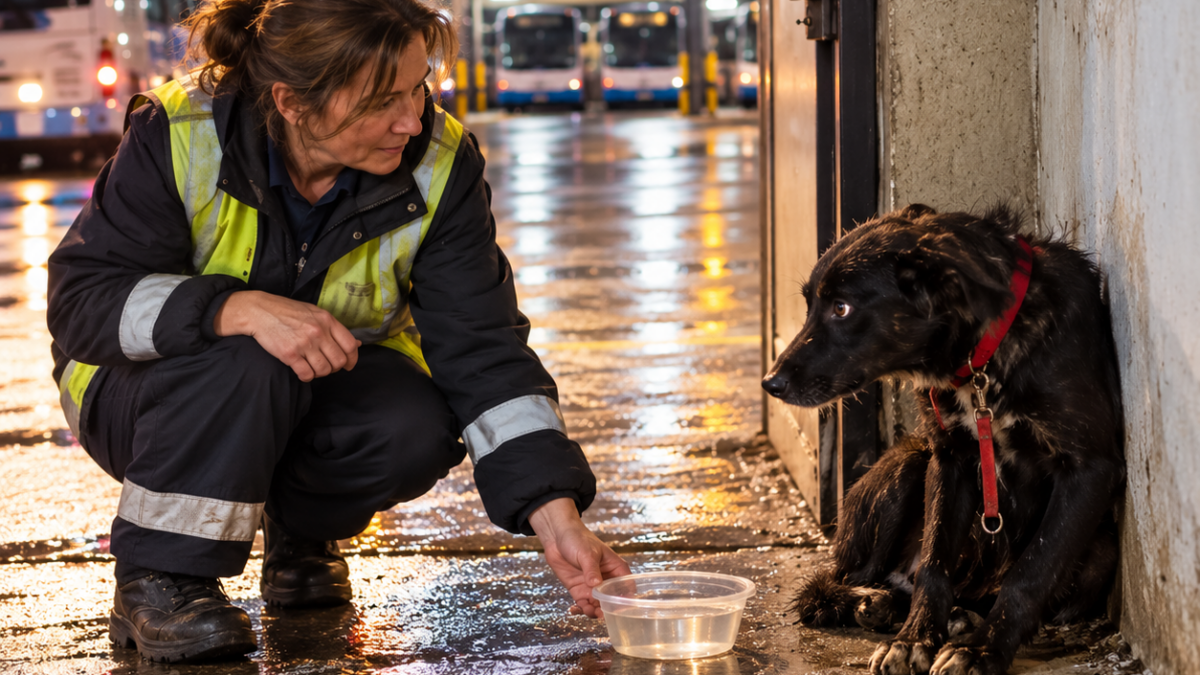
I carried the bowl and chicken to the service door. I opened it slowly and sat on the inside threshold with my legs still inside the building.
The dog raised his head.
“It’s okay,” I whispered. “I’m putting this down. That’s all.”
I slid the water bowl out first.
He didn’t move.
Then the chicken.
His nose twitched.
For several minutes, nothing happened.
I stayed exactly where I was. I didn’t stare directly at him. I kept my body turned slightly sideways, the way my father had taught me when I was a girl and we brought home a frightened farm dog who had spent his first year chained to a shed.
“Don’t face fear head-on,” my father used to say. “Give it a door to walk through.”
So I gave this dog a door.
He crawled one inch.
Stopped.
Looked at me.
I looked down at my hands.
Another inch.
Then another.
His movements were painfully slow, like he expected punishment for wanting food.
When he reached the chicken, he sniffed it once, then snapped it up so fast he almost choked.
“Oh, sweetheart,” I whispered.
He froze at my voice.
I lowered my head.
“Sorry. I’m quiet now.”
He ate the rest in three desperate bites, then backed away from the bowl as if food might be a trick.
The water took longer.
He wanted it. I could see that. His tongue slipped out and touched his dry nose. But the bowl was closer to me than the chicken had been.
So I reached out carefully and pushed it another foot toward him.
He flinched, but he didn’t run.
Finally, he lowered his head and drank.
The sound was soft.
Small.
Normal.
And somehow it made my eyes burn.
Michel came up beside me with a blanket from the lost-and-found bin.
“Don’t make a speech,” he muttered.
“I wasn’t going to.”
“You were thinking one.”
I took the blanket from him.
“Thank you.”
“It smells like a wet umbrella.”
“He won’t care.”
I slid the blanket out, not too close. The dog watched every movement. When the fabric touched the ground, he pulled back. Then, after a few seconds, he leaned forward and sniffed it.
Michel folded his arms.
“You naming him too?”
“No.”
But I was already thinking about it.
A dog that turned up at a bus depot with a cut leash at nearly three in the morning deserved more than “the dog.”
For now, though, a name felt too much like a promise.
And I was already afraid of how many promises had been broken before he came to that door.
At 3:18, one of the mechanics, Alain, walked in from the repair bay wiping his hands on a rag.
“What’s going on?”
Michel jerked his chin toward the door. “Nathalie adopted a wolf.”
“I did not.”
Alain peered out.
The dog had curled beside the wall again, but he had pulled one corner of the blanket close enough to rest his chin on it.
“That’s not a wolf,” Alain said. “That’s a baby.”
“He’s young,” I said.
“Collar?”
“Red. Cut leash.”
Alain’s face changed.
He stepped closer to the glass.
“Wait.”
I looked at him.
“What?”
He narrowed his eyes. “I saw a black dog with a red collar two nights ago.”
“Where?”
“Near the north gate. I thought he belonged to one of the drivers. He was standing by a gray van.”
My stomach tightened.
“What gray van?”
Alain frowned, trying to remember.
“Old one. No company logo. Back window cracked. I only noticed because it was parked where visitors aren’t supposed to park.”
Michel straightened.
“At what time?”
“Maybe one-thirty. I was outside smoking.” Alain glanced at me. “The dog looked nervous. A man was holding the leash.”
The hallway seemed to grow colder.
“What man?” I asked.
“I don’t know. Big jacket. Cap pulled low. He wasn’t here long.”
Michel walked back into his office.
“What are you doing?” I asked.
“Checking cameras.”
The depot had security cameras at the main gate, the fuel pumps, the bus yard, and the service entrance. Most nights, they recorded nothing more dramatic than tired drivers and delivery trucks. But that night, as Michel clicked through the footage, I stood behind him with my hands pressed together so hard my knuckles hurt.
He found the gray van at 1:27 a.m.
It rolled slowly past the north gate without turning its headlights fully on.
The image was grainy, black and white, but it was clear enough to see a man get out with a dog on a leash.
My breath caught.
The dog’s body was low. His tail tucked. He did not walk willingly. The man pulled him toward the side of the building, outside the range of the next camera.
For four minutes, nothing happened.
Then the man came back.
Alone.
He climbed into the van and drove away.
Michel stopped the video.
Nobody spoke.
Alain whispered, “He dumped him.”
“No,” I said, staring at the frozen screen. “He didn’t just dump him. He made sure he couldn’t follow.”
Michel looked at me.
“The leash.”
He replayed the clip and zoomed in as much as the old system allowed. In one frame, the man’s hand moved near the dog’s neck before they disappeared off-camera.
Then the video cut to empty pavement.
My mouth went dry.
A dog did not cut his own leash.
A young, terrified dog had been brought to the depot in the middle of the night, led to a wall, and left there in a place full of engine noise, diesel smells, and moving buses.
Someone had chosen that place.
Someone had wanted him frightened.
Someone had wanted him gone.
At 3:41, the emergency animal service called back.
Michel answered on speaker.
“We don’t have an available unit yet,” a tired woman said. “Earliest estimate is after six unless the animal becomes aggressive or injured.”
“He is scared and abandoned,” I said.
“I understand, ma’am.”
“No, you don’t.”
Michel gave me a warning look.
The woman sighed softly. “I know it’s upsetting. Keep distance. Don’t try to capture him. If he leaves, call again with direction of travel.”
“If he leaves?” I said.
“That can happen.”
I stared through the glass.
The dog had fallen asleep sitting up.
As if even rest could not be trusted.
“He’s not leaving,” I said.
After the call ended, Michel said, “Nathalie.”
“I’m not leaving either.”
He leaned back in his chair.
“You know you’re not getting paid for this.”
That almost made me laugh.
As if everything worth doing had ever shown up on a paycheck.
“I know.”
“Your mother?”
“I’ll call her later.”
“You look exhausted.”
“I am.”
He looked at the screen again, at the frozen gray van, then at the dog outside.
Finally, he opened a lower drawer and pulled out an old thermos.
“Coffee?”
I blinked.
He shrugged. “If you’re going to be stubborn, be awake.”
By 4:20, word had spread through the depot.
Night workers came quietly to the service hall, one at a time, like people visiting a hospital room.
A driver named Samira brought two slices of ham from her lunch bag.
A mechanic found an old rubber mat and placed it near the threshold to block the cold draft.
Another driver, Jérôme, said, “My cousin works at a shelter. I can text her.”
The dog watched all of it from outside, tense but no longer shaking.
He had not come in.
He had not let me touch him.
But he had stopped looking like he expected me to disappear.
That felt like a beginning.
At 4:37, I gave him a name.
“Ryder,” I whispered.
Michel turned from the camera monitor. “What?”
“His name is Ryder.”
“Because of the buses?”
“Because he survived the ride here.”
No one made fun of me.
Maybe they all felt it too—that once a living creature had been deliberately thrown away, naming him became a kind of witness.
Ryder.
Not trash.
Not problem.
Not stray.
Ryder.
At 5:12, rain started.
A light, cold rain that turned the concrete dark and made the air smell like wet dust and diesel.
Ryder pressed closer to the wall.
The blanket was already damp at the edges.
I opened the service door wider and slid another piece of chicken inside the doorway, just behind the threshold.
He looked at it.
Then at me.
Then back at the food.
“You can come in,” I said. “Nobody will close the door on you.”
He stood.
Slowly.
His legs shook.
He took one step toward the doorway.
Then a bus hissed behind him.
He bolted sideways and slammed into the wall.
I jumped up.
Ryder yelped and crouched again, panting hard, eyes wide.
“No, no, no,” I said, freezing in place. “I’m sorry. I’m sorry.”
His body trembled so violently I thought he might collapse.
That was when I saw the dark mark behind his front leg.
At first, I thought it was mud.
Then he shifted under the light, and I realized his fur was stuck together.
Not with mud.
Blood.
“Michel,” I said.
He heard it in my voice and came immediately.
“What?”
“He’s hurt.”
Michel crouched beside me, careful not to cross the threshold.
Ryder turned slightly, and we both saw it then: a shallow wound near his ribs, half-hidden under his black fur. Not fresh enough to be pouring blood, but not old either.
Alain swore under his breath.
“What kind of person does this?”
Nobody answered.
Because we all knew there were plenty of answers, and none of them would make us feel better.
Michel called the emergency service again and said the dog had a visible injury.
This time they promised to send a team.
Estimated arrival: forty minutes.
Forty minutes can feel like nothing when life is normal.
It can feel like forever when a scared animal is bleeding in the rain.
I sat on the floor just inside the doorway and talked to Ryder.
Not constantly. Just enough so he knew where I was.
I told him about my mother, who would scold me for skipping sleep but secretly save scraps of roast chicken if she met him. I told him about the old dog I had as a child, Miro, who used to sleep under my bed during thunderstorms. I told him that buses were loud but not all loud things were dangerous.
He listened.
Or maybe he just liked the sound of a voice that did not demand anything from him.
At 5:58, headlights swept across the yard.
A white van pulled in near the service entrance.
Ryder’s head snapped up.
The van door opened.
Two people stepped out wearing dark jackets with reflective strips.
The woman carried a catch pole.
Ryder saw it and panicked.
He scrambled backward, nails scraping the wet concrete. His shoulder hit the wall. His injured side twisted, and he cried out.
“Wait!” I shouted.
The woman stopped.
The man beside her frowned. “Ma’am, please move away from the door.”
“No. Put that pole down.”
“It’s standard procedure.”
“He’s terrified of being pulled.”
“Nathalie,” Michel warned softly.
But I did not move.
The woman studied me, then looked at Ryder.
“What’s his name?”
“Ryder.”
“You named him?”
“Yes.”
She lowered the catch pole.
The man looked annoyed. “Sophie—”
“He’s fear-reactive,” she said. “Not aggressive.”
Ryder crouched low, panting, eyes moving between the van and the strangers.
Sophie knelt in the rain.
“Hi, Ryder,” she said quietly. “Bad night, huh?”
He did not come to her.
But he stopped trying to run.
That was enough.
It took almost an hour to get him safely inside the depot hallway.
Not caught.
Not dragged.
Invited.
A trail of chicken pieces. A blanket barrier to block the sight of the yard. All of us silent except for Sophie and me, speaking gently from opposite sides.
When Ryder finally placed both front paws across the threshold, nobody cheered.
We barely breathed.
Then his back paws followed.
He was inside.
I closed the door slowly behind him.
Ryder looked at the door.
Then at me.
Then he sank to the floor like all the strength had gone out of him.
Sophie examined him without rushing.
“He’s dehydrated,” she said. “Underweight. Wound on the side. Bruising near the shoulder. Rope burn under the collar.”
I knelt nearby, close enough for Ryder to smell me but not close enough to trap him.
“Will he be okay?”
Sophie’s mouth tightened.
“He has a chance.”
A chance.
That was the word people used when they did not want to promise hope too early.
The man with her scanned Ryder’s collar with a handheld reader.
“No microchip,” he said.
Sophie carefully removed the red collar.
The skin underneath was raw.
Ryder flinched, but he did not bite.
Something fell from the collar and tapped against the tile.
A small metal tag.
I picked it up.
It was scratched, dirty, and bent at one corner.
On one side was a phone number.
On the other side, one word.
Not Ryder.
MAX.
I stared at it.
His name had been Max.
Somewhere, at some point, someone had called him that.
Maybe with love.
Maybe not.
I closed my fingers around the tag.
Sophie saw my face.
“What is it?”
“He had a name.”
She nodded.
“They usually do.”
That sentence hurt more than I expected.
Because abandoned dogs are too often spoken of like they came from nowhere. As if they simply appeared beside roads, in alleys, behind buildings, under bridges.
But they came from kitchens.
Yards.
Apartments.
Families.
Hands.
Someone had once chosen that red collar.
Someone had once attached that tag.
And someone had later cut the leash and left him shaking behind a bus depot at 2:43 in the morning.
Sophie stood.
“We need to take him to the clinic.”
Ryder’s head lifted at the word take, or maybe at the movement of the leash in her hand.
His eyes found me.
Not Sophie.
Not Michel.
Me.
The look was so direct it felt like a hand around my heart.
Sophie noticed.
“You can ride along if you want.”
Michel said, “Nathalie, you’ve been here all night.”
“I’m riding along.”
He did not argue.
I called my mother from the animal service van while Ryder lay on a blanket behind a safety gate, trembling every time the vehicle turned.
“Maman, I won’t make it by noon.”
“What happened? Are you sick?”
“No. I found a dog.”
There was a pause.
Of course there was.
Then she sighed.
“Nathalie.”
“I know.”
“No, you don’t. You always do this.”
“Do what?”
“Stay when others leave.”
I looked at Ryder through the gate.
His eyes were half-closed, but one ear remained turned toward my voice.
“This time he needed someone to stay.”
My mother’s voice softened.
“Is he very hurt?”
“Yes.”
“Then call me after the vet.”
“I will.”
“And Nathalie?”
“Yes?”
“Eat something.”
That was her way of saying she loved me.
At the clinic, Ryder refused to walk out of the van.
The parking lot was too bright with morning. Cars moved too close. A man laughed somewhere near the entrance, and Ryder flattened himself against the blanket.
Sophie looked at me.
“Try your voice.”
I climbed into the van and sat beside the gate.
“Ryder,” I said softly.
His ear moved.
“I’m here.”
He crawled toward the door inch by inch.
The vet techs waited without rushing him.
When his paws finally touched the ground, he leaned so hard against my leg that I almost lost my balance.
It was the first time he touched me on purpose.
I did not move.
I did not even breathe normally.
His body was warm, trembling, alive.
“Good boy,” I whispered.
At the clinic, the veterinarian confirmed what Sophie had suspected.
Ryder was underweight by several pounds. The wound on his side was likely from scraping against metal or being dragged. His shoulder was bruised. The raw ring around his neck came from a collar left too tight or pulled too hard. He had no microchip. His paws were scuffed as if he had tried to resist on rough pavement.
“He’s young,” the vet said. “Maybe ten months. A year at most.”
A baby, Alain had said.
He was right.
The vet cleaned the wound, gave antibiotics, fluids, and pain medication. Ryder tolerated all of it with a heartbreaking kind of surrender. He did not fight. He only watched me whenever he could, as if the room made sense only if I stayed inside it.
When they finally moved him into a quiet kennel, I stood outside the door feeling suddenly hollow.
Sophie touched my arm.
“You should go home.”
“I know.”
“He’ll sleep now.”
“I know.”
“You can call later.”
I nodded.
But Ryder lifted his head from the blanket.
His eyes found me.
And just like at the depot, his body began to tremble.
The vet tech looked from him to me.
Sophie exhaled.
“Oh, boy.”
I whispered, “I can sit for a little while.”
So I did.
A little while became two hours.
Two hours became four.
I sat in a plastic chair outside Ryder’s kennel with vending machine coffee and a sandwich I didn’t taste. Every time I shifted, he opened his eyes. Every time I spoke, he relaxed.
By noon, I knew the truth.
This dog had not just been abandoned.
He had been trained by abandonment to believe every departure was permanent.
That afternoon, Officer Martin from the municipal police came to take a statement because Michel had reported the security footage.
He was polite, tired, and clearly expected the case to be simple.
“Animal abandonment,” he said, writing in his notebook. “Possibly neglect. We’ll circulate the van image.”
“He didn’t just abandon him,” I said.
Officer Martin looked up.
“The leash was cut.”
“Yes.”
“The dog is injured.”
“Yes.”
“The man chose a bus depot in the middle of the night. That’s not panic. That’s planning.”
His pen stopped.
I could see the moment he decided whether I was an emotional cleaning woman making too much of a stray dog or a witness who had noticed details.
To his credit, he chose the second.
“Tell me everything from the beginning.”
So I did.
The scratching. The whimper. The trembling when I walked away. Alain’s memory of the gray van. The footage. The cut leash. The tag with the name Max.
At the name, Officer Martin’s expression shifted.
“Max?”
“Yes.”
“May I see the tag?”
I handed it over in a small plastic bag the vet had given me.
He read the number.
Then he frowned.
“What?”
“I’ve seen this number.”
My pulse jumped.
“Where?”
“I’m not sure yet.”
He took a photo of the tag and stepped into the hallway to make a call.
When he returned, his face was different.
More serious.
“The number belongs to a disconnected prepaid phone,” he said. “But it appears in a prior report.”
“What report?”
“A woman filed a complaint six months ago. Her dog was stolen from outside a bakery.”
I gripped the edge of the chair.
“A black dog?”
“I need to verify.”
“With a red collar?”
His eyes met mine.
“I need to verify.”
But his voice already told me.
Ryder—Max—had not only been abandoned.
He may have been stolen first.
The woman’s name was Elise Caron.
Officer Martin would not give me her address, but he called her from the clinic hallway. I watched through the glass as he spoke. At first his face remained neutral. Then he turned slightly away, lowered his voice, and looked back toward Ryder’s kennel.
A few minutes later, he came back.
“She’s on her way.”
“Is he hers?”
“She believes he may be.”
My stomach twisted.
That should have made me happy.
Maybe it did, somewhere under everything else.
But Ryder had just started trusting me. The thought of him being handed to another stranger, even a rightful owner, made me ache in a way I was ashamed to admit.
He was not mine.
I had met him less than twelve hours earlier.
Still, when he heard my chair scrape and lifted his head in panic, some foolish part of me thought, But he thinks I am.
Elise arrived forty minutes later.
She ran through the clinic door with her coat unbuttoned, hair falling out of a loose bun, and eyes already red. A man came behind her, holding the hand of a little girl about seven years old.
The girl clutched a worn blue dog toy shaped like a star.
Officer Martin stepped in front of them.
“Slowly,” he said. “He’s frightened and injured.”
Elise covered her mouth.
“Where is he?”
The vet led her down the hall.
I stood.
I did not know whether to move closer or step away.
Ryder lifted his head as the group approached.
The little girl saw him through the kennel glass and gasped.
“Max?”
Ryder froze.
The name entered the room like a key turning in an old lock.
“Max,” Elise whispered, falling to her knees.
Ryder stared.
His nose twitched.
The little girl pressed the blue star toy against the glass.
“Max, it’s me. It’s Lili.”
For one long second, nothing happened.
Then Ryder made a sound I had not heard before.
Not fear.
Not pain.
A broken, rising whine.
He struggled to stand.
The vet opened the kennel door carefully.
Elise did not rush in. She stayed low, sobbing into one hand.
“Max, my baby. Oh God, my baby.”
Ryder took one step.
Then another.
Then he pushed his head against her chest.
Elise folded around him and cried so hard her whole body shook. The little girl dropped beside them, reaching one careful hand toward his shoulder.
Ryder smelled the toy.
Then he licked the girl’s wrist.
“Mommy,” Lili sobbed. “He remembers.”
The man behind them turned away, wiping his face with his sleeve.
I stood there with my heart breaking and healing at the same time.
This was what I should have wanted.
This was the miracle.
He had a family.
He had not been unwanted by everyone.
Someone had searched for him.
Someone had cried his name for months.
Elise looked up at me from the kennel floor.
“You found him?”
I nodded.
Her face crumpled.
“Thank you.”
Those two words carried six months of grief.
I could barely answer.
“He found the door.”
Elise reached one hand toward me, and I took it.
“He was stolen outside a bakery,” she said. “I tied him for two minutes. Two minutes. I could see the door from the counter, but there was a line, and when I came back…”
She looked down at Ryder.
“He was gone.”
Lili held the blue star against Ryder’s chest.
“I told everyone he didn’t run away,” she whispered.
Elise closed her eyes.
“She did. Everyone said maybe the leash came loose. But Max would never leave her.”
Officer Martin stepped closer.
“Madame Caron, do you recognize this collar?”
Elise nodded immediately.
“Yes. That’s his.”
“And the leash?”
“They cut it,” she said. “The piece left on the bike rack was cut.”
The room went silent.
There it was again.
A cut leash.
Not once.
Twice.
Officer Martin wrote quickly.
“Did anyone contact you after Max disappeared?”
Elise hesitated.
Her husband answered.
“Yes.”
The officer looked up.
“A man called from a blocked number three days later,” he said. “He said if we wanted the dog back, we had to pay.”
My skin went cold.
“How much?”
“Eight hundred euros.”
Elise hugged Ryder tighter.
“We thought it was a scam. The police said not to engage unless he proved he had Max.”
“Did he?”
Her husband swallowed.
“He sent a photo.”
Officer Martin’s face sharpened.
“Do you still have it?”
Elise pulled out her phone with shaking hands.
The photo showed Max sitting on a concrete floor. He looked younger, cleaner, terrified. A man’s boot was visible at the edge of the frame.
Elise said, “After that, nothing. The number stopped working.”
Officer Martin sent the photo to himself.
Then he looked at me.
“This is no longer simple abandonment.”
No.
It was theft.
Extortion.
Neglect.
And now deliberate dumping.
Max had survived a nightmare none of us had fully seen yet.
But someone had.
Someone had taken him, used him, hurt him, and then thrown him away when he became inconvenient.
That person had not expected a cleaning woman to stay past her shift.
That was his first mistake.
The clinic kept Max for medical observation, and Elise’s family stayed with him for several hours. I tried to leave quietly because I thought they deserved privacy, but Max lifted his head the moment I stepped toward the hallway.
His body stiffened.
Lili noticed.
“He wants you too,” she said.
I froze.
Elise looked at me with wet eyes.
“Please don’t go yet.”
So I stayed.
That was how I became part of a family’s reunion I had no right to need but somehow did.
Over the next week, the investigation widened.
Officer Martin obtained the bus depot footage from Michel. He collected statements from me, Alain, Michel, Sophie, and the vet. Elise provided the old theft report, ransom messages, and the photo. The police traced the gray van through traffic cameras near the depot.
The license plate had been partially covered with tape.
But not well enough.
A toll camera caught two clear numbers and one letter. A gas station camera five miles away caught the cracked rear window Alain had remembered. Another street camera caught the van turning into a neighborhood of low warehouses and storage units outside the city.
The van was registered to a man named Renaud Vasseur.
I first heard his name from Michel.
He called me three days after Max was reunited with Elise.
“Nathalie,” he said, “you sitting down?”
“No.”
“Sit.”
I sat on the edge of my bed.
“The police came by again. They showed me a photo of a man. Asked if I’d seen him near the depot.”
“Was it him?”
“It looked like the man from the video. Cap, jacket, build. Name is Renaud Vasseur.”
I didn’t know the name.
Michel did.
“He used to work around transport yards,” he said. “Temporary contracts. Loading, cleaning, security. Got fired from two places. Bad temper.”
“Why would he steal a dog?”
Michel was quiet for a moment.
“People steal dogs for all kinds of reasons.”
I hated the answer because it was true.
Some steal to sell.
Some steal to breed.
Some steal for ransom.
Some steal because cruelty makes them feel powerful.
Max had been stolen outside a bakery.
Held somewhere for months.
A ransom call had been made.
Then, when he was too thin, too scared, too injured, or too recognizable, he was dumped at a depot by a man who knew exactly where the cameras did not see clearly.
Except he had underestimated the people who worked nights.
Night workers notice what daylight people miss.
They notice doors left open, engines idling too long, strangers walking where they shouldn’t, animals crying behind concrete walls.
They notice because darkness teaches you to pay attention.
Elise called me every evening with updates on Max.
At first, he stayed at the clinic. Then he went home with strict instructions: quiet space, medication, small meals, no sudden visitors.
The first night home, he refused to sleep unless Lili lay on a mattress beside him.
The second night, he panicked when Elise picked up her car keys.
The third day, he hid under the table when a delivery truck stopped outside.
Trauma had followed him home like a shadow.
But so had love.
Lili read to him after school.
Elise cooked chicken and rice.
Her husband, Marc, built a small ramp for the back steps so Max would not strain his shoulder.
And every other day, I visited for ten minutes.
Only ten.
That was what we decided with the vet. Max needed stability, not confusion. Elise was his family. I was not there to replace her.
But when I came in, Max would press his face into my coat and breathe like he was checking that the woman from the depot had not vanished.
I always told him the same thing.
“I came back.”
After two weeks, Officer Martin called us all to the police station.
By “all,” I mean Elise, Marc, Michel, Alain, Sophie, and me. Lili stayed with her grandmother because no child needed to hear every detail.
We sat in a small conference room with bad coffee and a table scarred by years of elbows and folders.
Officer Martin came in with a woman from the prosecutor’s office.
Her name was Claire Dubois, and she had the calm, sharp manner of someone who did not waste words.
“We believe Renaud Vasseur is connected to at least six dog thefts in the region,” she said.
Elise gripped Marc’s hand.
I felt the room shift around us.
Six.
Not one stolen dog.
Six.
“Two families paid ransom,” Dubois continued. “One recovered their dog after payment. One did not. Three dogs remain missing. Max is the first recovered dog connected to a suspect vehicle.”
I looked at Max’s collar tag lying in an evidence bag on the table.
That small red collar had become a thread.
And when pulled, it had begun to unravel something much larger.
“Why dump him at the depot?” Michel asked.
Officer Martin answered.
“Vasseur worked temporary security near the depot years ago. He likely knew the blind spots.”
“He knew enough to avoid the cameras,” Alain said.
“Most of them,” Martin replied.
A dark satisfaction moved through me.
Most of them.
Not all.
Dubois opened a folder.
“We searched a storage unit rented under Vasseur’s name.”
Elise inhaled sharply.
“Was Max kept there?”
“We found dog hair, old bowls, cable ties, leashes, and prepaid phones. Forensics is ongoing.”
“Other dogs?” I asked.
“No live animals were found.”
That answer did not comfort anyone.
Marc’s voice was low. “Where are the missing dogs?”
“We don’t know yet.”
The words landed heavily.
I thought of the families still waiting. Still calling names into yards. Still checking shelters. Still hoping and fearing every unknown dog photo online.
For them, Max’s survival was not the end.
It was a warning.
Dubois continued.
“We are preparing charges, but we need strong testimony and clear timelines. Vasseur’s attorney will argue that he found Max as a stray and abandoned him only because he could not care for him.”
Elise made a sound of disbelief.
Marc’s jaw tightened.
I spoke before I could stop myself.
“He cut the leash.”
Dubois looked at me.
“He cut it when Max was stolen. Then he cut another piece when he dumped him. That’s not care. That’s control.”
The prosecutor studied me for a moment.
Then she nodded.
“That is exactly the pattern we intend to show.”
The arrest happened the next morning.
Police found Renaud Vasseur at a repair garage where he had been doing off-the-books work. He tried to walk away when officers approached. Then he tried to run.
He did not get far.
A mechanic filmed part of it on his phone.
In the video, Vasseur shouted, “It’s just a dog!”
That sentence spread faster than any official report.
It’s just a dog.
People say that when they want to shrink cruelty into something ordinary.
But cruelty never starts huge.
It starts when someone decides another living thing’s fear does not count.
By the end of the day, two more families came forward with messages from prepaid numbers demanding money for missing dogs. One recognized the cracked gray van from a neighborhood camera. Another identified Vasseur as a man who had asked too many questions at a dog park weeks before their Labrador vanished.
The case became news.
Not national at first.
Local.
Then regional.
People wanted to know how stolen pets could disappear so easily. Why previous reports had not been connected. Why families had been told their dogs probably ran away. Why it took a cleaning woman refusing to leave a bus depot for anyone to see the pattern.
I did not like being interviewed.
Reporters called me “the cleaning lady who cracked the case,” which made Michel laugh so hard he spilled coffee on his report sheets.
“You’re famous,” he said.
“I’m tired.”
“You were tired that night too.”
“Yes.”
“And still impossible.”
I smiled.
A little.
Max improved slowly.
His wound healed.
His weight came back.
His coat grew glossy again.
But some injuries did not show under fur.
He still froze when he heard a van door slam. He still panicked if Elise left through the front door without letting him see where she went. He still would not walk near the bakery where he had been stolen.
The first time they tried, Lili held his leash with both hands and whispered, “It’s okay, Max. Nobody’s taking you.”
But Max planted his paws on the sidewalk and shook until Elise turned them around.
Progress is not a straight line.
It is a staircase built in the dark.
You feel for each step with your foot and hope it holds.
One Saturday, Elise invited me over for lunch.
I almost said no. I worried I was becoming too attached, or making Max’s adjustment harder. But Elise insisted.
“You are part of his story,” she said. “You don’t get to disappear from it.”
When I arrived, Max met me at the door with a cautious wag.
Not frantic.
Not trembling.
A wag.
I bent down, and he pressed his forehead against my chest.
“I came back,” I whispered.
Lili heard me and said, “You always say that.”
“I think he likes it.”
“He does.”
She handed me the blue star toy.
“He sleeps with this again now. When he was gone, I kept it under my pillow so it wouldn’t forget him.”
I looked at her small, serious face and had to swallow before answering.
“That was a good job.”
She nodded, as if this had indeed been important work.
During lunch, Elise told me more about the day Max disappeared.
“He was tied outside for less than three minutes,” she said. “I keep replaying it. If I had gone earlier. If I had taken him inside. If I had—”
Marc put a hand over hers.
“Elise.”
She looked down.
“I know. But I still do it.”
I understood.
Guilt loves empty spaces. It fills them with impossible versions of the past.
“If I had walked faster to my car that night,” I said, “I might not have heard him.”
Elise looked at me.
“If Michel had not checked the cameras. If Alain had not remembered the van. If Sophie had not listened and put down the catch pole. If Lili had not kept telling everyone Max would never run away.”
Lili sat up straighter.
“I did.”
“Yes,” I said. “You did.”
Elise wiped her eyes.
“So what do we do with all the ifs?”
I looked at Max sleeping under the table, his paw resting on Lili’s shoe.
“We use the ones that saved him.”
The trial was scheduled five months later.
Five months is a long time when you are waiting for justice.
It is long enough for people to forget the first wave of outrage.
Long enough for excuses to grow.
Long enough for the accused to become, in some mouths, “a man whose life was ruined over a dog.”
Vasseur’s defense attorney leaned hard into that.
He gave interviews without saying too much directly.
“My client is being judged by emotion, not evidence.”
“There is no proof he stole this particular animal.”
“People find stray dogs and make poor decisions.”
“An online mob has already convicted him.”
I learned to stop reading comments after the first week.
Elise did too.
But Lili heard something at school.
A boy told her, “My dad says your dog was probably bad, and that’s why the man dumped him.”
Lili came home crying.
The next day, Max refused breakfast because she was upset.
That was the thing people like Vasseur never understood.
Cruelty does not end with the act.
It ripples.
It enters kitchens, classrooms, clinic rooms, marriages, sleep, childhood memories. It teaches a little girl that love can be stolen outside a bakery. It teaches a mother to blame herself for three minutes. It teaches a dog to tremble when someone reaches for keys.
And then, if the world is decent, justice has to ripple too.
So we prepared.
Officer Martin met with us twice. Prosecutor Dubois met with us separately. She warned us the defense might be harsh.
“They may suggest Max was neglected by his real family before disappearing,” she told Elise.
Elise went pale.
Marc slammed his hand on the table.
“That’s disgusting.”
“It is,” Dubois said. “But I need you ready.”
She turned to me.
“They may also suggest you exaggerated his condition because you wanted attention.”
I laughed once, bitterly.
“At 2:43 in the morning? In a bus depot uniform?”
“They will try to make kindness look suspicious.”
That sentence stayed with me.
Because it was true in more places than court.
People who do nothing often distrust those who do.
Not because kindness is wrong.
Because it makes their excuses harder to live with.
A week before trial, Max returned to the bus depot.
It was not my idea.
It was Lili’s.
“He should see it when it’s not scary,” she said.
Elise called the vet, who said a controlled visit might help if Max was not pushed. Michel gave permission, grumbling that the depot was becoming “a sentimental tourist attraction.”
But when we arrived on a Sunday afternoon, he had set out water, treats, and a clean blanket by the service door.
No buses were running nearby. The yard was quiet.
Max stepped out of the car slowly.
His ears moved in every direction.
He recognized the place.
I saw it in the way his body lowered.
Lili knelt beside him.
“This is where Nathalie found you,” she said softly. “This is where you got saved.”
Max leaned against Elise’s leg.
I stood near the service door, the same place I had sat that night.
“Hey, Ryder,” I whispered.
His head turned.
Elise smiled through tears.
“You still call him that sometimes?”
“Only here.”
Max took one step toward me.
Then another.
He sniffed the threshold.
The old fear passed through him like a shadow crossing sunlight.
Then he walked inside.
Michel, standing behind the glass office, turned away quickly.
Alain pretended to inspect a tool cabinet.
Lili whispered, “He did it.”
Yes.
He did.
That night, Michel sent me a photo from the security camera.
In it, Max stood in the doorway with me kneeling in front of him and Lili beside him. The image was grainy, but there was something beautiful about that. The same cameras that had caught his abandonment had now caught his return.
Michel’s message said:
Thought you’d want the better ending.
I saved the photo.
The trial began on a rainy Tuesday.
The courthouse was smaller than I expected and colder than it should have been. People filled the benches: families of missing dogs, reporters, shelter volunteers, depot workers, neighbors, and strangers who had followed the case online.
Vasseur sat at the defense table in a gray suit that did not fit him well. He looked thinner than in the security footage, but his eyes were the same when he glanced back at us.
Flat.
Annoyed.
Not ashamed.
Elise sat with Marc on one side of me and Michel on the other. Lili stayed with her grandmother. Max stayed home too. The prosecutor did not want him used as a prop, and Elise agreed.
But she wore his red tag on a chain around her neck.
Not the collar.
Just the tag.
MAX.
Bent corner and all.
Prosecutor Dubois opened with the timeline.
Max stolen outside a bakery.
A cut leash found at the scene.
Ransom contact.
Photo proof.
Months of silence.
A gray van at the bus depot.
A frightened injured dog with a cut leash.
Security footage.
Storage unit evidence.
Prepaid phones.
Other victims.
The defense opened with doubt.
No witness saw Vasseur take Max from the bakery.
No witness saw Vasseur injure him.
No DNA had yet tied every piece of evidence to every missing dog.
Max could have changed hands.
Max could have been found.
Max could have been abandoned by someone else before Vasseur ever saw him.
The defense attorney said, “The prosecution wants to turn coincidence into conspiracy because everyone loves a sad dog story.”
I felt Michel stiffen beside me.
Under the table, he muttered, “I hate that man.”
“Which one?”
“Both.”
The first witnesses were technical.
Camera experts.
Phone records.
A forensic analyst who explained how the prepaid phones connected to cell towers near the bakery, the storage unit, and the depot.
Then came Elise.
She walked to the stand with Max’s tag around her neck and her hands trembling.
Dubois asked her to describe the day Max disappeared.
Elise spoke slowly at first.
She described the bakery. The morning routine. Lili choosing a chocolate pastry. Max tied outside where she could see him through the window. The line moving slowly. The sudden emptiness outside.
Then her voice broke.
“I ran out with my daughter behind me. The leash was still tied to the rack. It had been cut. Not chewed. Cut.”
Dubois showed the court a photograph of the cut leash from the bakery.
Elise covered her mouth.
The defense attorney stood for cross-examination.
“Madame Caron, you left your dog unattended on a public street, correct?”
Marc’s hand clenched beside me.
Elise answered, “For a few minutes.”
“Yes or no?”
“Yes.”
“And the dog was outside your direct control?”
“He was tied where I could see him.”
“But outside your direct control?”
“Yes.”
“Isn’t it possible that someone thought he had been abandoned?”
Elise stared at him.
“In three minutes?”
“It is possible, isn’t it?”
“No.”
The attorney smiled faintly.
“Madame Caron, you are emotional because you love your dog. That is understandable. But love does not prove theft.”
Elise touched the tag at her throat.
“No,” she said. “The cut leash does.”
A few people in the courtroom shifted.
The attorney moved on quickly.
Then came my turn.
I had cleaned bus depot floors for years. I had dealt with drunk passengers, broken glass, clogged toilets, angry managers, and men who thought women in reflective vests were invisible.
But nothing had prepared me for walking to that witness stand.
I placed my hand on the Bible, swore to tell the truth, and sat down.
Dubois began gently.
“Please state your name.”
“Nathalie Moreau.”
“What is your occupation?”
“I clean the night facilities at the Perrache bus depot.”
“And were you working during the early morning hours of March 14?”
“Yes.”
“What time did your shift end?”
“2:43 a.m.”
“What happened as you were leaving?”
I told them.
The scratching.
The whimper.
The service door.
The black dog under the light.
The red collar.
The cut leash.
The way he trembled when I walked toward my car.
I tried to keep my voice steady, but it shook when I described that part.
“Why did you stay?” Dubois asked.
I looked at the jury.
“Because when I turned away, his whole body started shaking. And when I turned back, he stopped. I knew he thought I was leaving him too.”
The courtroom was very quiet.
Dubois let the silence sit.
Then she asked, “Did you touch him?”
“No.”
“Did you force him inside?”
“No.”
“Why not?”
“Because someone had already used force on him. He needed one person not to.”
The defense attorney objected.
The judge told the jury to consider only what I had personally observed.
But I did not regret saying it.
Dubois showed the security footage from the depot.
Watching it in court was different from watching it in Michel’s office.
On the big screen, under the sterile courtroom lights, the gray van looked ghostly. The man stepped out. Max resisted. The leash tightened. They disappeared into the blind spot.
Then the man came back alone.
The prosecutor paused the video.
“Is this the area where you later found Max?”
“Yes.”
“Is this the service door?”
“Yes.”
“Was the dog present before this van arrived?”
“Not that I saw.”
The defense attorney approached for cross-examination.
“Madame Moreau, you were tired that night, correct?”
“Yes.”
“You had worked a full shift?”
“Yes.”
“It was dark?”
“The area was lit.”
“You were emotional?”
“When I found him, yes.”
“So your memory may not be perfect.”
“My memory of that dog shaking is perfect.”
He gave me a thin smile.
“You named him Ryder, didn’t you?”
“Yes.”
“Even though he already had a name.”
“I didn’t know that yet.”
“Would it be fair to say you became attached very quickly?”
I looked at him.
“Yes.”
He seemed pleased, as if I had stepped into a trap.
“So attached that you might interpret ordinary things as more dramatic than they were?”
“No.”
“You don’t think naming a strange dog at three in the morning suggests emotional involvement?”
“Of course it does.”
He blinked.
I continued.
“But emotional involvement didn’t cut his leash. It didn’t bruise his shoulder. It didn’t steal him from a bakery. It didn’t drive that van.”
The judge warned me to answer only the question.
Michel coughed into his hand to hide what might have been a laugh.
The attorney’s face tightened.
“No further questions.”
Alain testified next.
He identified the gray van, the cracked rear window, and the man he had seen holding the leash. He could not identify Vasseur’s face, and the defense pressed him hard on that.
But Alain stayed calm.
“I fix buses,” he said. “I notice vehicles. That van was there.”
Sophie testified about Max’s condition when she arrived.
The vet testified about the injuries.
Officer Martin testified about the investigation and how the van led them to Vasseur.
Then the other families testified.
That was the hardest part.
A man named Robert described paying ransom for a stolen spaniel named Milo, who came back thinner and terrified of basements.
A young couple described receiving a photo of their missing terrier with a demand for money they could not pay. They never saw their dog again.
An elderly woman brought a collar in a plastic bag.
Her dog, Sacha, was still missing.
She did not cry on the stand.
That somehow made it worse.
“I am eighty-two,” she said. “Sacha slept beside my bed. Whoever took him did not steal property. He stole the last living thing that waited for me to come home.”
Even the judge looked down at that.
The prosecution presented evidence from the storage unit: leashes, collars, bowls, hair samples, prepaid phones, and printed maps of neighborhoods with dog parks and bakeries circled.
One map had the Caron bakery marked with a red X.
Elise gripped my hand so hard it hurt.
The defense tried to argue that the storage unit had been used by multiple people.
Then Prosecutor Dubois introduced the receipt.
It was found in Vasseur’s van.
A receipt from a hardware store for cable ties, cheap dog food, and a utility knife.
Purchased the morning Max disappeared.
The utility knife was never found.
But the receipt was enough to make the cut leashes feel even colder.
On the third day, Vasseur testified.
His attorney clearly thought it was necessary. Too much evidence had piled up without his explanation.
Vasseur walked to the stand and took the oath.
He claimed he found Max wandering weeks before the depot.
He claimed he tried to care for him.
He claimed the dog was aggressive, destructive, impossible.
He claimed he abandoned him at the depot because he “didn’t know what else to do.”
Dubois stood for cross-examination with a folder in one hand.
“You found him wandering?”
“Yes.”
“With his red collar and tag?”
“Yes.”
“Did you call the number on the tag?”
“It didn’t work.”
Dubois held up phone records.
“Then why did a prepaid phone connected to you send a ransom message to that same family three days after Max disappeared?”
Vasseur shifted.
“That wasn’t me.”
“The phone was later found in your storage unit.”
“Other people had access.”
“Who?”
He shrugged.
“People.”
Dubois looked at the jury, then back at him.
“You testified that Max was aggressive.”
“He was.”
She clicked a remote.
A photo appeared of Max from the ransom message. He was crouched on concrete, ears low, eyes frightened.
“This dog?”
“He could turn.”
Dubois clicked again.
The depot footage appeared.
Max resisted walking with the man beside the van.
“This dog?”
Vasseur’s jaw tightened.
Dubois said, “You testified that you abandoned him because you could not handle him. Why cut the leash?”
“I didn’t.”
She showed the collar recovered from Max at the clinic, the severed leash still attached.
“Then how did this happen?”
“I don’t know.”
“You found a lost dog wearing a tag, did not return him, held him for months, used a prepaid phone connected to your storage unit to contact his family, and then he somehow appeared injured at a depot where your van was recorded, wearing a collar with a cut leash you cannot explain.”
Vasseur said nothing.
Dubois stepped closer.
“Did you choose the depot because you knew the camera blind spots?”
“No.”
“You worked security near that depot in 2019, correct?”
“For a few weeks.”
“You knew the service wall was outside the main yard camera?”
“No.”
Dubois played the footage of him leading Max exactly into that blind spot.
She let it run.
Then she stopped it on the empty pavement after he returned alone.
“You expected him to disappear, didn’t you?”
“No.”
“You expected a bus to scare him off or worse?”
“No.”
“You expected night workers to ignore him.”
“No.”
Dubois’s voice sharpened.
“But one of them didn’t.”
For the first time, Vasseur looked toward me.
There was no remorse in his eyes.
Only resentment.
As if my staying had been the real crime.
That look should have frightened me.
Maybe it did.
But beneath the fear was something stronger.
I thought of Max trembling when I walked away.
I thought of Lili holding the blue star toy.
I thought of Elise replaying three minutes outside a bakery for six months.
I looked back at Vasseur and did not lower my eyes.
Dubois asked the final question.
“Mr. Vasseur, when officers arrested you, did you say, ‘It’s just a dog’?”
His attorney objected.
The judge allowed the question.
Vasseur leaned toward the microphone.
“I don’t remember.”
Dubois played the arrest video.
His voice filled the courtroom.
It’s just a dog!
Dubois stopped the clip.
Then she asked quietly, “Is that your voice?”
Vasseur’s mouth tightened.
“Yes.”
“No further questions.”
The jury deliberated for nine hours.
Nine hours of sitting in a courthouse hallway under lights that made everyone look sick.
Elise barely spoke.
Marc paced.
Michel brought coffee no one wanted.
Alain stepped outside every twenty minutes to smoke, then came back smelling of rain and nerves.
I kept looking at the photo Michel had sent me of Max returning to the depot. I had saved it on my phone, and every time fear rose in me, I opened it.
The better ending.
At 7:18 p.m., the jury returned.
We filed back into the courtroom.
Vasseur stood.
The foreperson read the verdicts.
Theft of a companion animal.
Guilty.
Extortion.
Guilty.
Animal cruelty.
Guilty.
Abandonment causing injury.
Guilty.
Fraud related to ransom demands.
Guilty.
Possession of equipment used in criminal confinement of animals.
Guilty.
For charges connected to two missing dogs where evidence was weaker, the verdict was not guilty.
The elderly woman with Sacha’s collar closed her eyes.
Her pain was a reminder that justice can be real and still incomplete.
But for Max, the truth had been heard.
Elise bent forward and sobbed into her hands.
Marc wrapped his arms around her.
Michel whispered, “Good.”
I looked at Vasseur.
He stared straight ahead, face pale, jaw clenched.
For months, he had treated fear like a tool.
Now the room had taken it away from him.
Sentencing came three weeks later.
The courtroom filled again.
This time, Lili was allowed to come for part of it, though Max stayed home. She wore a blue dress and held the star toy in her lap.
The prosecutor spoke about patterns.
Not one mistake.
Not one desperate choice.
A pattern.
Stalking places where people briefly left dogs outside.
Cutting leashes.
Using prepaid phones.
Demanding money.
Keeping animals in fear.
Dumping Max when he became a risk.
The defense asked for leniency.
Vasseur’s attorney said prison would ruin his life.
Elise squeezed my hand.
I wanted to stand up and say, He ruined lives that could not speak.
But Dubois did not need me to.
She had the evidence.
Then the judge asked if the victims wanted to speak.
Elise went first.
She stood with Max’s tag around her neck.
“My daughter asked me every night if Max was cold,” she said. “Every night. I had no answer. I had to watch my child leave food by the door for a dog she believed was trying to find his way home.”
Lili cried silently beside Marc.
Elise continued.
“When Max came back, he was alive, and I thank God for that. But he did not come back untouched. He came back afraid of vans, doors, keys, men’s voices, and being left. You did not just steal him once. You made him relive being stolen every day after.”
She looked at Vasseur.
“You called him just a dog. To us, he was family.”
Then she sat.
The elderly woman whose dog had not been found stood next.
She held the collar in both hands.
“I do not know if Sacha is alive,” she said. “That is the sentence I live with. Every morning. Every night.”
No one moved.
Then Dubois called my name.
I had not planned to speak.
I had written something the night before, then torn it up because every version sounded too neat.
But I walked to the front.
“My name is Nathalie Moreau,” I said. “I clean floors for a living. That means I know something about messes people leave behind and expect someone else to handle.”
A few people shifted.
I kept my eyes on the judge, not Vasseur.
“That night, I was told I could go home because someone else would come for the dog. That was reasonable. That was procedure. But Max did not understand procedure. He understood footsteps leaving. He understood another person turning away.”
My voice shook, but I did not stop.
“I stayed because he trembled when I left. That is all. I did not solve this because I am special. I solved nothing alone. I stayed, Michel checked the cameras, Alain remembered the van, Sophie listened, Officer Martin followed the evidence, Elise never stopped searching, and Lili never stopped believing her dog had not left her.”
Lili looked up at me.
I finally turned toward Vasseur.
“You thought you were throwing away a problem. But you left him at a place full of night workers. People who know what it feels like to be unseen. That was your mistake.”
His face hardened.
Good.
Let him hear it.
“Max was never just a dog. He was the witness you failed to silence.”
The judge sentenced Vasseur to prison.
Not for as long as some people wanted.
Long enough to matter.
He was banned from owning, keeping, transporting, or working with animals. He was ordered to pay restitution to the families. The storage unit evidence opened new investigations. Police departments across the region began reviewing unsolved pet theft reports together instead of treating them as isolated incidents.
And because of Max’s case, the city announced new procedures for stolen animal reports involving ransom demands, camera collection, and linked cases.
That part mattered to me almost as much as the conviction.
Because revenge, real revenge, was not Vasseur sitting in a cell.
It was every door closing behind him.
Every excuse failing.
Every missing dog report taken seriously because Max had survived.
Every family told, “We will look,” instead of, “Maybe he ran away.”
Two months after sentencing, the bus depot held a small gathering.
Michel insisted it was not a ceremony.
“It’s a workplace safety meeting,” he said.
But there were balloons.
And a table of pastries.
And a framed photo of Max standing in the service doorway.
So it was absolutely a ceremony.
Elise brought Max.
He walked into the depot slowly, wearing a new blue collar with his old red tag attached beside a new one. The red tag was still bent, still scratched, but cleaned until it shone.
Lili held his leash.
Not tightly.
Trust does not need a tight grip.
The drivers gathered around, careful to give him space. Alain crouched down and offered a treat. Max sniffed it, then accepted.
Alain looked like he had just won the lottery.
Michel cleared his throat.
“I have something to say.”
Everyone went quiet.
He hated speeches, so this alone was historic.
He looked at me first.
“Nathalie was off the clock that night.”
“Oh, here we go,” I muttered.
He ignored me.
“She could have left. Any of us might have left. We tell ourselves that if a thing is reported, it is handled. But sometimes being handled is not the same as being cared for.”
His voice grew rough.
“So from now on, this depot has a policy. If an animal or person in distress is found on-site, one staff member stays until help arrives. Not watching from far away. Not assuming. Staying.”
He looked at Max.
“We’re calling it Max’s Rule.”
Elise covered her mouth.
Lili looked at me with wide eyes.
“Max has a rule?”
“Yes,” I whispered. “A very important one.”
Michel handed Elise a printed copy of the policy in a simple frame.
She cried.
Michel pretended not to.
Max sniffed the frame.
Everyone laughed.
That was the first time I heard Elise laugh without sadness underneath it.
After the gathering, Lili asked me to walk with them to the service door.
The same door.
The same wall.
The same patch of concrete where I had first seen him.
Only now it was daylight. The wall had been cleaned. The outside light had been replaced. A small camera had been added above the corner, angled directly toward the blind spot.
Max stepped outside.
He paused.
His ears lifted.
A bus engine started somewhere far across the yard.
He tensed.
Lili knelt.
“It’s okay,” she said. “We can go slow.”
I stood on his other side.
Elise waited behind him, letting him choose.
Max looked at the wall.
Then at the door.
Then he walked past the place where he had once crouched in terror.
One step.
Two.
Three.
No trembling.
No collapse.
He reached the edge of the lot, turned around, and looked back at us like he could not understand why the humans were crying again.
Lili threw her arms around his neck.
“You’re so brave,” she whispered.
Max licked her cheek.
That was his answer.
Life did not become perfect after that.
It never does.
The missing dogs were not all found. Some families kept waiting. Some answers never came.
Max still had difficult days. There were nights when thunder sent him under the table. There were mornings when Elise had to sit on the floor with him before leaving for work, repeating, “I’m coming back,” until his breathing slowed.
But he healed.
Not all at once.
Not like in stories where one act of love erases everything.
He healed in pieces.
He learned the sound of Marc’s car meant family, not danger.
He learned that Lili’s school bag by the door meant she would leave and return.
He learned that the bakery sidewalk was scary but survivable. The first time he walked past it again, the baker came outside with tears in his eyes and placed a bowl of water by the door.
Max sniffed it.
Drank.
Then kept walking.
Elise sent me the video three times because she said once was not enough.
She was right.
I watched it over and over.
A dog stolen from that sidewalk had walked past it again with his tail raised.
That was another kind of verdict.
A year after the night at the depot, I was working the late shift again.
Same hallway.
Same mop bucket.
Same ache in my shoulders.
At 2:43 a.m., my phone buzzed.
It was a message from Elise.
A photo.
Max was asleep on Lili’s bed, his head on the blue star toy, his paws relaxed, his body stretched out in complete trust.
Under the photo, Elise had written:
One year ago, you stayed.
I sat down on the hallway bench and cried quietly into my sleeve.
Not from sadness.
From the weight of what almost did not happen.
If I had ignored the scratching.
If Michel had not checked the cameras.
If Alain had not remembered.
If Sophie had not put down the catch pole.
If Elise had stopped searching.
If Lili had believed the adults who said Max ran away.
If Max had given up.
So many ifs.
But the one that mattered was simple.
I stayed.
People often ask me why.
They expect a grand answer.
There isn’t one.
I stayed because a frightened dog looked at me like he had run out of chances.
I stayed because leaving would have been easier, and I was tired of easy things being mistaken for right ones.
I stayed because sometimes the whole difference between lost and found is one person refusing to take the next step away.
The depot is quieter now at night.
Or maybe I hear it differently.
The engines still rumble. The brakes still hiss. The lights still buzz overhead. The floors still need mopping, and people still leave coffee cups where they shouldn’t.
But near the service door, there is a small framed copy of Max’s Rule.
Under it hangs a photo.
Not the sad one.
Not the one from the night he was found.
The better ending.
Max standing in the doorway in daylight, Lili beside him, Elise smiling through tears, Michel pretending not to cry, and me kneeling with one hand resting gently near his shoulder.
Every time I pass it, I remember the red collar.
The cut leash.
The trembling body.
The moment I put down my keys.
And I remember what my mother said when she finally met Max.
She stood in Elise’s living room, watching him sleep with his head on Lili’s foot.
Then she looked at me and said, “You were late to help me with groceries.”
“I know.”
She nodded toward Max.
“You had a better reason.”
Max opened one eye at her voice, then went back to sleep.
My mother smiled.
“He knows you.”
I looked at him.
“Yes,” I said. “And I know him.”
I know that he was stolen but not erased.
Abandoned but not forgotten.
Frightened but not broken.
I know that the man who called him “just a dog” learned too late that a dog can carry a truth powerful enough to bring a criminal down.
I know that a child got her best friend back.
A mother got to stop imagining the worst.
A depot full of tired night workers became witnesses.
And one cleaning woman, who almost went home, learned that sometimes your life changes not when something calls your name, but when something makes the smallest sound on the other side of a door.
A scratch.
A whimper.
A reason to stay.
[END]








