PART 2: The Blind Mother Dog Had Stopped Fighting Beside Her Five Puppies—Then We Learned Who Had Left Her There
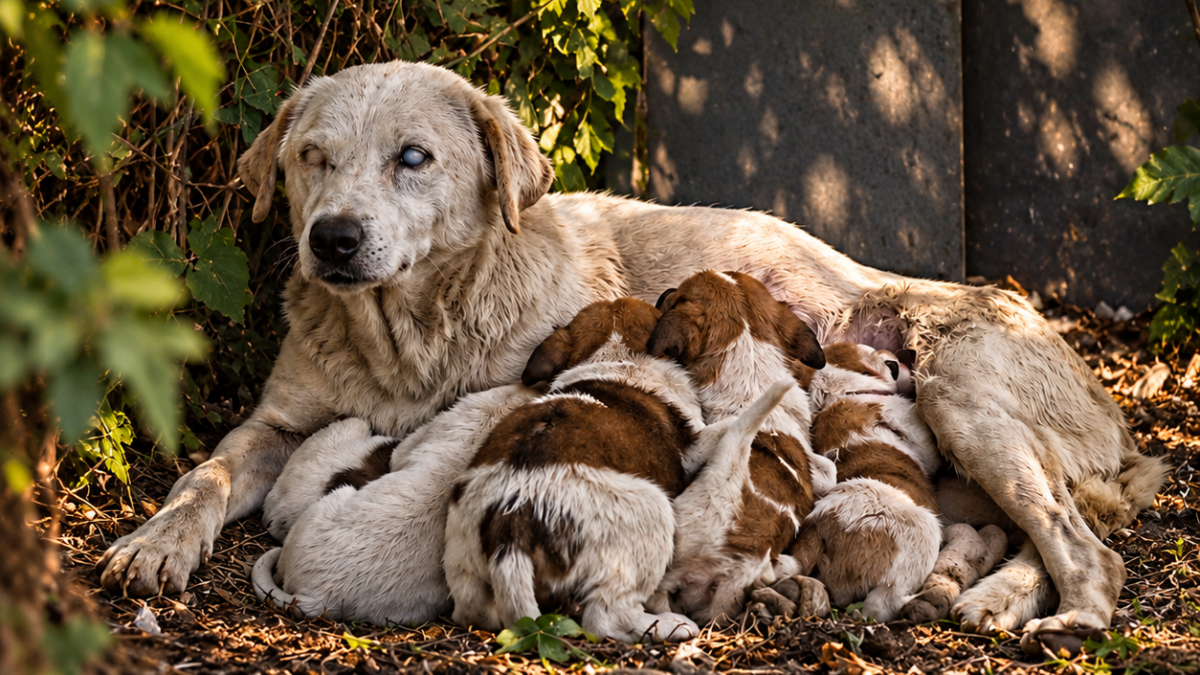
PART 2
I took a photograph of the tag before we removed the collar.
The nylon had tightened into Lucy’s fur so badly that parts of it had almost disappeared beneath the matting. It was not cutting deeply into her neck yet, but another few months would have created an entirely different medical problem.
Karen clipped it away carefully.
Lucy did not react.
She was too tired.
The phone number remained readable.
I stared at it for almost a minute before dialing.
Karen looked up.
“You calling now?”
“Yes.”
“Sarah.”
“What?”
“Maybe let animal control handle it.”
“I’m just checking whether the number works.”
“That is exactly the sentence you always say before creating extra work for everyone.”
I pressed call.
The number rang.
Once.
Twice.
Three times.
A man answered.
“Hello?”
I put the phone on speaker but did not identify Lucy immediately.
“Hi. Is this Nathan Cole?”
Pause.
“Who’s asking?”
“My name is Sarah. I’m with Second Chance Animal Rescue.”
Longer pause.
“What’s this about?”
“We found a dog with a tag carrying this number.”
Silence.
Then:
“What kind of dog?”
The question bothered me.
If someone told me they had found an animal wearing my phone number, I would have asked whether the animal was alive.
Nathan asked what she looked like.
“White dog,” I said. “Rust-colored patches. Female.”
Nothing.
“Does that sound familiar?”
“No.”
I looked at Karen.
She had stopped working and was watching me.
“The tag says Lucy.”
Nathan exhaled.
Not loudly.
But I heard it.
“No,” he said. “I don’t know any Lucy.”
“You’re sure?”
“Yes.”
“Your number is engraved on her tag.”
“Then it’s old.”
“How old?”
“I don’t know. Maybe she belonged to somebody I knew.”
“Who?”
“I said I don’t know.”
His voice sharpened.
I kept mine calm.
“She’s in very poor condition.”
“That’s not my problem.”
Karen’s expression changed.
I asked, “When did she stop being your problem?”
He hung up.
For several seconds, neither of us spoke.
Then Karen said:
“Please tell me you recorded that.”
“I did.”
“Good.”
“Do you believe him?”
“No.”
“Neither do I.”
But belief was not evidence.
That became the first lesson of the next several weeks.
Officer Melissa Grant from county animal control arrived that afternoon.
I knew Melissa from other neglect cases.
She listened to the call.
Photographed the tag.
Scanned Lucy for a microchip.
We got a hit.
That was the moment the case changed.
The chip was registered to Nathan Cole.
Not somebody he knew.
Not an old friend.
Nathan himself.
The record listed:
**LUCY — female mixed breed — white/rust — spayed: no — owner: Nathan Cole.**
The registration had been updated eighteen months earlier.
Melissa stared at the screen.
“Well.”
I folded my arms.
“He doesn’t know her.”
“Apparently his microchip account does.”
Karen looked toward Lucy.
She was sleeping beneath two blankets while the puppies nursed formula from tiny bottles in the next room.
“What happens now?” I asked.
Melissa copied the registration details.
“I talk to him.”
“Can I come?”
“No.”
“Why?”
“Because you are incapable of keeping your face neutral.”
“That is unfair.”
Karen said, “It’s extremely fair.”
Melissa ignored us.
“I also want the warehouse area photographed properly.”
“We took pictures.”
“I want location shots, tire tracks if any remain, trash, bedding, everything.”
“You think she was dumped there?”
“I think a completely blind, lactating dog with five puppies did not successfully navigate miles of county roads by herself unless something extraordinary happened.”
That was obvious.
Still, hearing an officer say it made the suspicion feel heavier.
Lucy remained hospitalized.
The puppies were estimated at five to six weeks old.
Old enough to survive with bottle and slurry feeding.
Young enough that they still needed their mother.
But Lucy’s mastitis made nursing painful and medically risky until treatment took effect.
The first night, she barely moved.
Every time a puppy squeaked in the nursery, her head lifted.
That was it.
No standing.
No searching.
Just listening.
We placed a small speaker near her bed that carried sound from the puppy enclosure.
I thought Karen would laugh when I suggested it.
She didn’t.
“That might actually help.”
It did.
Lucy slept more deeply when she could hear them.
On the second morning, I sat beside her while Karen checked the swelling around her mammary glands.
Lucy’s eyes were milky gray.
She turned her face toward my voice but not toward movement.
“Can she see anything?”
“Maybe light.”
“Can her vision come back?”
Karen was quiet.
“Some?”
“That’s not an answer.”
“It’s the only honest one.”
The infection had been present too long.
There was severe corneal scarring and damage inside both eyes.
One eye was worse.
The other showed faint response.
Karen consulted a veterinary ophthalmologist.
Best case: Lucy might retain limited light perception and vague shapes.
Worst case: she was permanently blind.
I crouched beside her.
“That’s okay.”
Lucy sniffed my sleeve.
“You don’t need eyes to boss five puppies around.”
Her tail did not wag.
Not yet.
On the third day, one of the puppies began crying during a feeding.
A little rust-colored male we called Copper had pushed himself behind a folded blanket and apparently decided the world was ending.
He screamed.
Lucy heard him from the adjacent treatment room.
Her head shot up.
Then something happened none of us expected.
She stood.
Not well.
Not for long.
But she stood.
Her front legs straightened.
Her back legs trembled violently.
Karen reached for her.
“Easy.”
Lucy took one step toward the sound.
Then another.
Her back legs collapsed.
I caught her chest.
“Okay, okay.”
But her tail moved.
Once.
Copper screamed again.
Lucy whined.
We brought him over.
I held him close to her face.
Lucy smelled him.
Then licked the top of his head.
Copper instantly stopped crying.
Karen looked at me.
I looked at her.
Neither of us said anything for a moment.
Then Karen whispered:
“That’s the first time she’s chosen to move.”
People later described that moment as Lucy deciding to live.
I never liked that wording.
She had never decided to die.
Her body had simply run out.
There is a difference.
What changed was that her body had enough fuel again to answer what her heart had been trying to do all along.
She wanted her puppies.
On day four, Melissa called.
“Nathan admits he owned Lucy.”
I put down the food syringe I was washing.
“What happened to ‘I don’t know any Lucy’?”
“He says he panicked.”
“Why?”
“He claims Lucy disappeared three weeks ago.”
“Did he report her missing?”
“No.”
“Shelters?”
“No.”
“Microchip company?”
“No.”
“Online?”
“No.”
“Neighbors?”
“He says he asked around.”
“Do you believe him?”
Melissa sighed.
“I believe he knows what a missing-dog flyer looks like and apparently did not make one.”
“Did he explain the puppies?”
“He claims he didn’t know she was pregnant.”
I nearly dropped the syringe.
“She was living with him.”
“According to him, she spent most of her time outside.”
“That makes it worse.”
“Maybe.”
“No, definitely.”
“Sarah.”
I knew.
Evidence.
“What else?”
“He says he has not seen her in almost a month.”
“What about the blindness?”
“Says her eyes were ‘a little cloudy’ but she could see fine.”
“She cannot.”
“I know.”
“What are you doing?”
“Checking his property.”
“Can you just do that?”
“With consent.”
“He agreed?”
“He did.”
That surprised me.
It shouldn’t have.
People who believe they have cleaned up often cooperate confidently.
Melissa called again three hours later.
Her voice was different.
“We found dogs.”
I stopped.
“How many?”
“Eight.”
“Lucy?”
“Obviously not Lucy.”
“You know what I mean. More like her?”
“Several females. Two pregnant.”
My stomach dropped.
“What condition?”
“Not emergency level.”
That phrase did very little for me.
“But?”
“Outdoor kennels. Poor sanitation. Minimal shelter. One dog underweight. One with skin disease.”
“Is he breeding?”
Nathan had told Melissa he occasionally raised puppies “as a hobby.”
A hobby with eight dogs.
Two pregnant.
No kennel license.
Online listings under multiple names.
Melissa found printed sale agreements in the garage.
Nothing illegal by itself.
Then she found an old veterinary invoice.
Lucy’s name.
Eleven months earlier.
Diagnosis:
**chronic keratoconjunctivitis, suspected immune-mediated disease; follow-up recommended within 30 days.**
No follow-up.
Medication prescribed.
The bottle found in Nathan’s garage was almost full.
Expired.
He had known Lucy’s eyes were sick.
He had treatment.
He stopped using it.
The blindness did not arrive overnight.
It progressed.
Slowly.
Painfully.
Preventably, at least in part.
I sat beside Lucy after Melissa told me.
She was eating softened food from a shallow dish.
Carefully.
Slowly.
I stroked her shoulder.
“He knew.”
Lucy continued eating.
“He knew your eyes hurt.”
She lifted her face.
A smear of food clung to her nose.
I wiped it.
“Sorry.”
I was not sure whether I was apologizing for Nathan or for every human being who had seen her before we did.
The next piece came from an online listing.
One of our younger volunteers, Priya Shah, was better at finding things online than I was.
She searched Nathan’s phone number.
Within an hour she found puppy advertisements going back almost three years.
Different accounts.
Same number.
Same backyard fence.
Same plastic dog houses.
Then she found Lucy.
Photograph from eight months earlier.
Standing beside a litter of six puppies.
Healthy weight.
Eyes already cloudy.
Description:
**Beautiful family-raised puppies. Mother is calm, excellent temperament.**
Priya turned her laptop toward me.
“Look at the second photo.”
Lucy stood beside the litter.
A man’s hand held her collar.
Nathan.
Same tattoo visible on his wrist as in a public social-media photo.
“She was breeding stock,” Priya said.
I hated the phrase.
But that was how Nathan appeared to see her.
Another listing four months later advertised a different litter from another female.
Then Priya found a deleted post recovered through a cached marketplace screenshot.
Nathan complaining in a local pet group:
**Need gone ASAP. Adult female, eyesight getting bad, no longer useful for breeding. Free to good home.**
No name.
But the photograph was Lucy.
Date:
Six weeks before we found her.
I stared at the screen.
“No longer useful.”
Priya’s mouth tightened.
“Send it to Melissa.”
We did.
Nathan changed his story again.
Lucy had not “disappeared.”
Now he said he had given her to someone.
Who?
A man named Ray.
Last name unknown.
Phone number lost.
No messages.
No transfer records.
No description beyond “older guy in a pickup.”
Melissa asked when.
Nathan gave a date.
That date became very important.
Because Harold Finch—the man who found Lucy behind the grain warehouse—had a trail camera on his nearby property.
He used it for deer.
The camera faced a dirt access road leading past the old warehouse.
Melissa asked to see the footage.
At 9:14 p.m. on the night Nathan claimed he gave Lucy to “Ray,” a dark blue Ford pickup drove down the access road.
At 9:26, it drove back out.
The plate was partially visible.
Enough characters matched Nathan’s truck.
Not proof alone.
Then a second camera belonging to a farm across the county road captured the truck more clearly.
Same vehicle.
Nathan’s plate.
The warehouse was a dead end.
There was no reason to drive there at night unless you meant to go there.
Melissa asked Nathan why his truck had been at the warehouse.
He said he sometimes dumped yard waste there.
Illegal.
Also probably a lie.
Then she asked what kind of yard waste he had been carrying.
Nathan stopped answering questions.
Lawyer.
That was the moment the investigation became formal.
The eight dogs on his property were placed under veterinary inspection.
Some were temporarily seized.
The two pregnant females went into licensed foster care.
One dog with skin disease had untreated mange.
The underweight male had intestinal parasites.
None were as critical as Lucy.
But the pattern mattered.
Minimal veterinary care.
Repeated breeding.
Animals becoming less valuable as they became sick.
Then a former employee came forward.
His name was Derek Sloan.
He had done landscaping work with Nathan the previous year.
Derek contacted us after seeing Lucy’s photograph in a local news story.
“I know that dog,” he said.
We met with Melissa present.
Derek recognized Lucy immediately.
“She used to follow Nathan everywhere.”
“Before she went blind?” I asked.
“Yeah.”
“Did Nathan care about her?”
Derek paused.
“Before the breeding thing got big, maybe.”
“What changed?”
“Money.”
Simple.
Nathan discovered he could sell mixed-breed puppies for several hundred dollars each by describing them as “family raised.”
At first, maybe one litter.
Then two females.
Then more.
Derek had helped repair outdoor kennels.
“Lucy had good puppies,” he said.
That sentence made me wince.
He noticed.
“Sorry.”
“Just tell us.”
“She was easy. Good with people. Good mother. Buyers liked the puppies.”
“When did her eyes get bad?”
“Last year.”
“Did Nathan know?”
“Everybody knew.”
“Did he treat her?”
“He had drops.”
“Did he use them?”
“At first.”
“Then?”
Derek rubbed his jaw.
“Said they cost too much.”
The bottle had cost forty-three dollars.
I knew because the invoice listed it.
Forty-three dollars.
Nathan had sold one of Lucy’s puppies for six hundred.
Melissa asked:
“Did you ever hear Nathan discuss getting rid of Lucy?”
Derek looked uncomfortable.
“Yes.”
“What did he say?”
“That blind dogs were hard to sell.”
Lucy was not for sale at the time.
The puppies were.
But Nathan was already thinking of her as inventory.
Derek continued.
“He tried giving her away.”
“Did anyone take her?”
“A woman wanted her until she found out she might be pregnant again.”
My head lifted.
“He knew she was pregnant.”
Derek nodded.
Nathan had claimed otherwise.
Another lie.
“Then what?”
“He got mad.”
“Why?”
“Said nobody wants a blind dog with a litter coming.”
Melissa leaned forward.
“When was that?”
“About a week before I stopped working for him.”
“Why did you stop?”
Derek hesitated.
“Because we argued.”
“About Lucy?”
“Partly.”
“What happened?”
Derek had arrived one morning and found Lucy tied outside in heavy rain.
No shelter within reach.
He brought her into the garage.
Nathan yelled at him.
Told him not to “baby the dogs.”
Derek said Lucy had become difficult because she bumped into kennel panels and knocked over bowls.
“That’s what blind dogs do when nobody helps them map the space,” I said.
Derek nodded.
“I didn’t know.”
“At least you moved her.”
He stared at his hands.
“Not enough.”
I knew that feeling.
Derek had one more piece.
Two days before he quit, he heard Nathan tell another man:
“If she has those puppies before I get rid of her, I’m dumping the whole problem somewhere.”
Melissa became very still.
“Exact words?”
“As close as I remember.”
“Who was the other man?”
“His brother, Jason.”
Jason Cole initially refused to speak.
Then investigators showed him the trail-camera photographs.
His loyalty weakened.
People imagine courtroom cases turn because of brilliant detectives.
Often they turn because one person realizes another person has already left them holding the lie.
Jason agreed to an interview.
Nathan had called him the evening Lucy disappeared.
Asked to borrow a large crate.
Jason asked why.
Nathan said:
“I’m moving Lucy.”
“Where?”
“Doesn’t matter.”
Jason loaned the crate.
Later that night, Nathan returned it dirty.
“Did you know she had puppies?” Melissa asked.
Jason swallowed.
“Yes.”
The room went silent.
“You knew they were in the crate?”
“I heard them.”
My hands tightened.
“What did you do?”
Jason looked at me.
“I asked where he took them.”
“And?”
“He said somebody would find them.”
That phrase again.
Somebody.
Always somebody.
The imaginary compassionate stranger who exists to clean up another person’s cruelty.
“Did you report it?”
“No.”
“Why?”
“He’s my brother.”
Melissa’s voice stayed calm.
“Were the puppies alive when Nathan left your property?”
“Yes.”
“And Lucy?”
“Yes.”
“Could she see?”
Jason looked down.
“No.”
That statement closed the biggest remaining gap.
Nathan knew Lucy was blind.
Knew she had five puppies.
Loaded them deliberately.
Drove to an abandoned warehouse.
Left them.
Then returned.
The reason Lucy had been seen wandering through multiple villages confused us at first.
If she was dumped at the warehouse, how did witnesses see her miles away?
The answer emerged when we mapped the sightings.
Lucy had not stayed where Nathan left her.
She had spent days trying to move.
Blind.
Nursing five puppies.
Searching.
For what?
Food?
Water?
People?
Maybe home.
We would never know.
But the trail formed an enormous uneven loop through fields and farm roads before she finally returned near the warehouse area and collapsed.
She might have been following scent.
Traffic sounds.
The puppies.
Instinct.
The idea of it haunted me.
Nathan left her in one place.
Lucy spent nearly a week trying to save them anyway.
The puppies survived because she did.
Her body told the story.
She had lost enormous weight during lactation.
The pups were relatively strong.
She had transferred nearly everything she had into them.
Karen explained it during the medical case conference.
“A nursing mother’s body will sacrifice itself to a shocking degree.”
“So she literally fed them from her own reserves.”
“Yes.”
“Until there was nothing left.”
Karen looked at Lucy.
“Pretty much.”
By the second week, Lucy could walk across the treatment room.
Slowly.
We used rugs with different textures to help her orient.
Blind dogs often map the world through smell, sound, surface, memory.
Lucy learned fast.
Door mat meant exit.
Rubber runner meant water.
Soft rug meant bed.
My voice meant treats.
Karen’s voice meant medical nonsense and possible indignity.
The puppies recovered even faster.
We named them Copper, June, Scout, Benny, and Rose.
Copper was loud.
June climbed everything.
Scout followed Lucy constantly.
Benny slept through chaos.
Rose, the smallest, had one rust-colored patch around her eye exactly like her mother.
When Lucy was strong enough to spend supervised time with them again, we brought the puppies into the recovery room.
They exploded toward her.
Lucy froze.
Five little bodies climbed her legs, belly, neck.
She sniffed frantically.
One.
Two.
Three.
Four.
Five.
Then she lay down.
The puppies piled against her.
Lucy released a long breath.
Her tail began moving.
Not once.
Not weakly.
A real wag.
Back and forth against the blanket.
I cried.
Priya cried.
Even Karen removed her glasses and pretended something was in her eye.
Lucy could not see her puppies.
She counted them by smell.
By movement.
By sound.
Whenever one wandered too far, her ears tracked it.
Whenever a puppy squeaked, her nose lifted.
She never lost one.
The blindness changed how she mothered.
It never stopped her.
Nathan’s attorney, meanwhile, started fighting the seizure of his remaining dogs.
He argued the animals were property and that several had not been found in critical condition.
That was legally relevant.
Emotionally infuriating.
The county sought forfeiture based on the overall cruelty case and licensing violations.
A hearing was scheduled.
Nathan attended.
I was there because Lucy’s medical record was part of the evidence.
It was the first time I saw him.
He was forty-one.
Medium build.
Work boots.
Clean button-down shirt.
Nothing about him looked like the villain people had built online.
That disturbed me more than if he had.
He looked ordinary.
People often do.
His attorney argued:
“My client acknowledges poor judgment concerning Lucy, but the state is attempting to use one disputed incident to permanently deprive him of animals that are currently healthy.”
Melissa’s attorney produced photographs.
Kennels.
Mange.
Feces.
Pregnant dogs.
Then records showing repeated unlicensed sales.
Nathan’s attorney countered:
“None of those conditions approach the severity of Lucy’s presentation.”
True.
That was the strategy.
Not good care.
Just not catastrophic care.
Then Karen testified.
The attorney asked:
“Doctor, can you prove Lucy’s blindness was caused by my client?”
“No.”
“Can you prove every day of malnutrition occurred while she was in his possession?”
“No.”
“Can you determine exactly how long she was wandering after leaving his property?”
“No.”
“So multiple factors contributed to her final condition.”
“Yes.”
He looked satisfied.
Then Karen added:
“But a blind, pregnant dog with untreated ocular disease should never have been transported to a remote location and abandoned.”
The attorney frowned.
“I did not ask—”
The judge allowed the statement because medical risk was relevant.
Karen continued when questioned by the county.
Lucy’s blindness made abandonment uniquely dangerous.
She could not locate thrown food reliably.
Could not navigate roads safely.
Could not protect puppies from vehicles or predators visually.
Could not easily locate water.
“She was dependent,” Karen said.
“More dependent than an average adult dog.”
Nathan stared straight ahead.
Then the trail-camera footage played.
His truck.
The timestamps.
Then Jason’s statement.
Then the online listing:
**No longer useful for breeding. Free to good home.**
Nathan’s attorney objected to interpretation.
The words spoke well enough on their own.
The judge upheld temporary seizure and later the county secured permanent forfeiture of the dogs through the cruelty proceedings.
The pregnant females delivered safely in foster care.
All adult dogs were sterilized when medically appropriate.
The backyard breeding operation ended.
Nathan lost the animals before the criminal trial even began.
That was the first consequence.
The second came from the state tax department.
This was not some clever revenge plot of mine.
It was far more mundane.
Investigators had documented years of puppy sales during the animal case.
Hundreds of dollars each.
Multiple litters.
Little formal business reporting.
The financial records generated questions.
Nathan received an audit.
Priya called me when she heard.
“Now that is karma.”
“No.”
She stared at me.
“No?”
“That is accounting.”
She laughed.
“Less poetic.”
“Much more terrifying.”
The audit uncovered unreported income.
Penalties followed.
His landlord also discovered that he had been running a commercial breeding operation from property zoned against that use.
Lease terminated.
Again, not dramatic revenge.
Consequences stacking because the original behavior had required lies in multiple directions.
Buyers.
Landlord.
County.
Animal control.
Tax authorities.
His own family.
Nathan tried to blame me publicly.
He posted my name online.
Called our rescue “animal thieves.”
Claimed we had exaggerated Lucy’s condition to raise money.
That was dangerous because people believed him.
Some did, anyway.
Messages arrived.
“You stole his dogs.”
“Rescues are scams.”
“Blind dogs should be put down.”
That last one made me furious.
I started typing a response.
Deleted it.
Typed another.
Deleted that too.
Melissa had warned us not to litigate online.
The rescue released one statement containing only documented facts.
Lucy had been found critically ill.
Medical records existed.
Ownership had been verified by microchip.
A court had ordered seizure.
No dramatic language.
No insults.
Facts are less emotionally satisfying than retaliation.
They are also harder to destroy.
Nathan escalated.
One evening, someone cut the lock on our rescue supply shed.
Nothing valuable was stolen.
Only bags of dog food slashed open.
Could have been random vandalism.
Police took the report.
Two nights later, my car tire was punctured in the clinic parking lot.
Again, maybe coincidence.
Then I received a voicemail.
No caller ID.
A man’s voice:
“You should’ve left somebody else’s dog alone.”
I saved it.
Melissa listened.
“Do you recognize the voice?”
“No.”
She did not speculate.
Police documented.
No arrest.
I became angry at uncertainty itself.
I started checking mirrors.
Looking behind me at gas stations.
Hating every unknown pickup truck.
Then Nathan made the mistake people like him often make.
He wanted credit for the fear.
Without credit, intimidation is emotionally unsatisfying.
He called directly.
My phone recorded automatically because of a rescue-line app.
“Sarah Mitchell?”
“Yes.”
“Nathan Cole.”
I stood in my kitchen.
“Why are you calling me?”
“You know why.”
“No.”
“You ruined my life.”
There are sentences so absurd they make anger briefly disappear.
I almost laughed.
“I ruined your life?”
“You took my dogs. You got my family involved. You dragged my business through the dirt.”
“I found Lucy behind a warehouse.”
“You made it into a case.”
“You made it a case.”
Silence.
Then:
“She would have died anyway.”
My hand tightened around the phone.
“What?”
“She was blind. Sick. Those puppies were draining her.”
“You could have surrendered her.”
“Nobody wanted her.”
“We did.”
“After there was attention.”
I took a breath.
“Why did you call?”
“Because this needs to stop.”
“What?”
“The posts. The court. All of it.”
“I don’t control court.”
“You started it.”
“No. You loaded a blind dog and five puppies into a truck.”
Silence.
I continued.
“You drove them to the warehouse.”
Another silence.
“You left them.”
His voice dropped.
“You can’t prove what happened out there.”
I went still.
He had moved from denial to wording.
Careful wording.
“What exactly happened out there, Nathan?”
“Nothing.”
“You just said I can’t prove it.”
“I mean your version.”
“My version is your truck going in, your brother giving you the crate, Lucy’s microchip, your listing, your vet record, your messages, and five puppies found nursing from a dog who couldn’t stand.”
Nathan breathed heavily.
“You think you’re smart.”
“No.”
I looked out my kitchen window.
“I think Lucy survived.”
That silenced him.
Then he said:
“You better hope those dogs stay safe.”
My entire body went cold.
“What did you say?”
He hung up.
I called police.
The recording mattered.
A lot.
Nathan’s pretrial conditions already prohibited harassment of witnesses.
He had just called one.
Threatened animals connected to the case.
His attorney argued the statement was vague.
The judge disagreed enough to tighten conditions dramatically.
Nathan was ordered to have no contact with rescue staff, witnesses, fosters, or locations housing seized animals.
After another violation—driving past one foster property despite the order—his bond was revoked until a later review.
That was the moment the intimidation stopped.
Not because I outsmarted him.
Because he could not stop creating evidence against himself.
Lucy continued recovering.
By month three, she weighed almost fifty pounds.
Her healthy target was around fifty-five.
The ophthalmologist confirmed what we had suspected.
Left eye: no functional vision.
Right eye: limited light perception.
Surgery could remove the most painful scarred tissue if needed, but her eyes were comfortable now.
No reason to put her through more.
Blindness was permanent.
Lucy did not care.
That sounds strange.
People care about blindness because we imagine losing our own vision.
Dogs adapt differently.
She mapped our foster facility within days.
Then memorized the yard.
She learned the sound of the gate.
The position of the water.
The distance from porch to grass.
She used her whiskers, nose, ears, paws.
The first time she ran, I panicked.
Actually ran.
Not fast.
But joyful.
Across the fenced training yard.
Marcus Reed, a trainer who worked with disabled dogs, had tied small bells near fixed obstacles.
Lucy trotted toward my voice.
I clapped.
“Come on, girl.”
She accelerated.
My heart stopped.
“Slow down!”
Marcus laughed.
“Don’t teach her to be afraid.”
“She’s blind.”
“She knows.”
“She could hit something.”
“So can sighted dogs.”
Lucy reached me.
Stopped perfectly.
Tail wagging.
Marcus folded his arms.
“You’re the nervous one.”
“I’m aware.”
“She needs information, not pity.”
That became the rule.
Information, not pity.
We did not carry Lucy everywhere.
We taught routes.
We did not prevent exploration.
We made exploration safe.
We did not speak about her like she was broken.
She was blind.
Specific.
Manageable.
Real.
The puppies reached adoption age.
That was harder than I expected.
Lucy had nearly died for them.
Now we were separating them.
Karen reminded me:
“That’s what mothers do eventually.”
“Human mothers get phone calls.”
“Would you like us to give the adopters Lucy’s number?”
I glared.
The puppies were adopted carefully.
Copper went to a family with two teenagers.
June to a retired couple.
Benny and Scout went together to a young couple with a fenced property.
Rose attracted dozens of applications because of the patch over her eye.
I disliked people wanting her because she looked cute in photographs.
Then a woman named Margaret Ellis applied.
Sixty-eight.
Retired elementary-school librarian.
Widowed.
Owned one elderly beagle until he died the previous year.
Her application said:
**I am interested in Rose, but if her mother needs a home too, I would like to meet both.**
I called immediately.
“You know Lucy is blind.”
“Yes.”
“You understand she may always need predictable furniture placement, secure outdoor space, and verbal cues.”
“Yes.”
“You only applied for a puppy.”
“I read their story.”
I waited.
Margaret continued:
“It seems wrong that everyone wants the babies and nobody asks what happens to the mother.”
That line stayed with me.
We arranged a meeting.
Margaret sat on the floor.
Did not reach for Lucy.
Just talked.
“Hello, Lucy. My name is Margaret. Apparently I have been interviewed more thoroughly to meet you than I was to teach second grade.”
Lucy’s ears moved.
Margaret laughed.
“I hear you’re judgmental.”
Lucy approached.
Sniffed her shoes.
Her knees.
Her hands.
Then rested her head against Margaret’s chest.
I looked at Priya.
Priya whispered:
“Oh, no.”
“What?”
“You’re crying.”
“I am not.”
“You absolutely are.”
Rose climbed into Margaret’s lap.
Lucy remained pressed beside her.
Margaret adopted both.
That was the first ending.
Not the final one.
Just the first.
Nathan’s criminal trial began five months later.
The prosecution did not need every emotional detail.
They needed elements.
Ownership.
Knowledge.
Intent or recklessness.
Abandonment.
Condition.
Causation.
Evidence.
The case was stronger than I had imagined the morning we found Lucy.
Nathan’s own records hurt him.
His own calls hurt him.
His own brother hurt him.
His own advertisement hurt him.
His own veterinarian invoice hurt him.
The former employee hurt him.
His truck cameras hurt him.
Most of all, his changing stories hurt him.
First he did not know Lucy.
Then she disappeared.
Then he gave her away.
Then he had visited the warehouse only for yard waste.
Then someone else had taken her.
Each story required the jury to forget the one before it.
They didn’t.
I testified about the search.
The sightings.
Finding Lucy.
The puppies.
The collar.
The phone call.
Nathan’s attorney tried to turn my rescue work into bias.
“You wanted a cruelty case.”
“No.”
“You are involved professionally in animal rescue.”
“Volunteer.”
“You oppose backyard breeding.”
“I oppose neglect.”
“Would you describe my client’s operation as ethical?”
“I am not qualified to define his ethics.”
That seemed to surprise him.
“Do you dislike him?”
“Yes.”
The prosecutor looked at me.
So did the jury.
The defense attorney almost smiled.
“Thank you. So you admit bias.”
“I disliked him after learning what happened.”
“Still bias.”
“Yes.”
I let the word sit.
Then he asked:
“You personally did not witness Mr. Cole place Lucy at the warehouse.”
“No.”
“You did not see him drive there.”
“No.”
“You do not know what happened between him and Lucy that evening.”
“Not from personal observation.”
“So your belief is based on what others told you.”
“Partly.”
“Thank you.”
He sat down.
The prosecutor stood for redirect.
“What did you personally find?”
“A blind dog who could not stand, five nursing puppies, a collar with Nathan Cole’s phone number, and later a microchip registered to him.”
“Did Mr. Cole deny knowing Lucy when you called?”
“Yes.”
“Was that denial true?”
“No.”
“How do you know?”
“His ownership records.”
No speech needed.
Jason testified.
He looked sick with guilt.
Nathan stared at him the entire time.
Jason described the crate.
The puppies crying inside.
Nathan saying somebody would find them.
The defense attacked his memory.
“You were drinking that night?”
“One beer.”
“You dislike your brother?”
“Right now? Yes.”
“Did police threaten to charge you?”
“They told me I could be investigated for helping.”
“So you had a motive to blame Nathan.”
Jason looked at the jury.
“I had a motive to lie for him too. That’s what I did first.”
That answer destroyed the question.
Derek testified next.
Then the veterinarian records.
Then the trail cameras.
The defense’s strongest argument was that Nathan had tried to rehome Lucy and made a desperate mistake when nobody would take her.
A bad decision.
Not cruelty.
That might have worked better without the threatening call.
Without the online phrase:
**No longer useful for breeding.**
Without the medical neglect.
Without proof he knew she was pregnant.
Without the warning from Derek.
Without the false stories.
Then Nathan testified.
Against his attorney’s apparent preference.
I watched the attorney’s face.
He did not look happy.
Nathan said he had loved Lucy once.
I believe that may have been true.
He described getting her as a young dog.
Teaching her to fetch.
Taking her camping.
Letting her sleep on his bed.
This was difficult to hear.
Because cruelty is easier when love never existed.
Nathan said breeding began accidentally.
Lucy had one litter.
People offered money.
He realized puppies could help with bills.
Then another litter.
Then other dogs.
Then money became necessary.
He lost his construction job after a back injury.
Medical debt.
Divorce.
Mortgage problems.
He described the eye medication.
“I couldn’t keep paying for specialists.”
The prosecutor later showed he had spent hundreds on sports betting during the same period.
But in that moment, Nathan’s story sounded almost sympathetic.
That was his attorney’s goal.
Then he described Lucy’s last pregnancy.
“She was difficult.”
The prosecutor later repeated that word.
But on direct examination, Nathan said:
“She knocked things over because she couldn’t see. The other dogs stressed her. Buyers didn’t want her.”
His attorney asked:
“What did you intend when you transported her?”
“To find someone who would take her.”
“Did you intend to kill her?”
“No.”
“Did you leave food?”
Nathan hesitated.
“A bag.”
My head lifted.
No bag had been found.
“Water?”
“I think so.”
No container had been found.
His attorney asked:
“Why the grain warehouse?”
“I knew people used the road.”
At night.
An abandoned building.
Miles from town.
With a blind dog.
Even his sympathetic version sounded bad.
Then the prosecutor stood.
“Mr. Cole, when Sarah Mitchell called you, did you know Lucy?”
Nathan looked toward me.
“Yes.”
“You said no.”
“I panicked.”
“Why?”
“I knew it looked bad.”
“You testified you intended to rehome her. Why would rehoming a dog make you panic?”
Silence.
The prosecutor showed the listing.
**No longer useful for breeding.**
“Your words?”
“Yes.”
“Was she useful for breeding before she became blind?”
Nathan’s attorney objected.
Overruled.
Nathan said:
“She had good puppies.”
I saw jurors react.
The prosecutor nodded.
“How many litters?”
“I don’t remember.”
“Records suggest four.”
“Maybe.”
“How much revenue?”
“I don’t know.”
“Approximately eleven thousand dollars from Lucy’s litters alone?”
“I didn’t keep track.”
The notebook appeared.
“You did.”
Silence.
“Did you purchase the prescribed eye medication?”
“Yes.”
“Did you administer it as instructed?”
“At first.”
“Why did you stop?”
“She fought me.”
Derek had said cost.
Nathan now said behavior.
Another contradiction.
“Did you return to the veterinarian?”
“No.”
“Why?”
“Money.”
There it was.
“Did you spend four hundred sixty dollars on online sports betting during the month the veterinarian requested Lucy’s follow-up?”
Defense objected.
Records admitted after foundation.
The judge allowed the question.
Nathan’s face reddened.
“Yes.”
“Did you know Lucy’s vision was deteriorating?”
“Yes.”
“Did you know she was pregnant?”
Pause.
“Yes.”
“Did you know she had delivered five puppies before you took her to the warehouse?”
“Yes.”
“Could she see when you left her?”
“No.”
The courtroom became still.
“Was there anyone waiting at the warehouse to take her?”
“No.”
“Did any rescue agree to meet you?”
“No.”
“Did any shelter tell you to leave her there?”
“No.”
“Did you call animal control?”
“No.”
“Did you call the humane society?”
“No.”
“Did you call the veterinarian who previously treated her?”
“No.”
“Did you post that she needed emergency foster placement?”
“No.”
“Then who exactly did you believe was going to help her?”
Nathan’s jaw moved.
No answer.
The prosecutor waited.
“Mr. Cole?”
“Someone.”
That word again.
“Someone.”
Nathan nodded.
The prosecutor walked back to the table.
“Was Sarah Mitchell that someone?”
Nathan looked at me.
“I didn’t know her.”
“Was Harold Finch?”
“No.”
“The farmers who reported Lucy wandering?”
“No.”
“The people who threw bread she could not see?”
Nathan’s attorney objected.
Sustained.
The prosecutor changed direction.
“You did not identify a person.”
“No.”
“You left a blind nursing dog and five puppies and relied on an unidentified stranger.”
Nathan said nothing.
Then came the phone recording.
His own voice:
**She would have died anyway.**
Then:
**You better hope those dogs stay safe.**
Nathan stared at the floor.
His attorney asked to limit interpretation.
The recording played anyway within the allowed scope.
After closing arguments, the jury deliberated.
Not long.
Nathan was convicted on felony aggravated animal cruelty related to Lucy, multiple neglect counts involving animals at his property, and several licensing/documentation offenses.
Not every charge resulted in conviction.
Some were merged.
Some reduced.
Real justice rarely arrives as a perfect list.
Sentencing happened six weeks later.
Margaret asked whether she could bring Lucy.
The prosecutor said no need.
I was glad.
Lucy had already attended enough human failure.
Instead Margaret brought a photograph.
Lucy lying in sunlight beside Rose.
Both asleep.
At sentencing, Nathan spoke.
He apologized.
Not perfectly.
He still used phrases like:
“I was overwhelmed.”
“I didn’t see another option.”
“I never wanted her to suffer.”
Then he said something different.
“I treated her value like it ended when she stopped making me money.”
The courtroom became quiet.
His attorney looked at him.
Nathan continued.
“I don’t know when I became that person.”
I believed him.
That did not make the consequences unnecessary.
Sometimes recognizing the person you became is the beginning of accountability, not the end of it.
The judge imposed jail time followed by supervised probation, restitution, a substantial prohibition on owning, breeding, selling, or caring for animals, and compliance with mental-health and financial-counseling requirements.
The court also incorporated the prior forfeiture.
His breeding operation was finished.
His tax penalties remained.
His lease was already gone.
His reputation in the local selling community was destroyed by his own records.
People who had previously bought puppies from him began comparing veterinary histories.
Three civil claims followed from buyers whose animals had congenital or untreated illnesses.
I did not celebrate that.
Priya did.
Quietly.
I told her to stop smiling in court.
“I’m not.”
“You are.”
“It’s my neutral face.”
“Terrible neutral face.”
Outside the courthouse, Jason approached me.
“I need to tell you something.”
I braced myself.
“What?”
“I saw Lucy last week.”
My heart jumped.
“Where?”
“Margaret let me visit.”
That surprised me.
“Why?”
“I asked.”
“What happened?”
Jason swallowed.
“She came right up to me.”
“Lucy?”
“Yeah.”
“She can’t see you.”
“I know.”
“She probably smelled you.”
“I know.”
His eyes filled.
“She remembered something.”
“Maybe.”
He looked away.
“I heard those puppies in the crate.”
I said nothing.
“I should’ve taken them out.”
“Yes.”
“I should’ve stopped him.”
“Yes.”
Jason nodded.
“Thank you for not making that easier.”
“I’m not the person who can.”
“I know.”
He left.
That conversation stayed with me.
Forgiveness is sometimes treated like the final requirement of every emotional story.
It isn’t.
Some people need accountability more than comfort.
Some relationships do not need repair.
Some guilt belongs to the person carrying it.
Lucy did not need Jason forgiven.
She needed safe.
Margaret gave her safe.
I visited two weeks after sentencing.
Margaret lived in a small ranch-style house at the end of a quiet street.
The yard was completely fenced.
Wind chimes hung near the back door so Lucy could locate it.
A textured rubber mat marked the steps.
Different scented herbs grew along safe edges of the garden.
Lavender near the porch.
Rosemary near the water station.
Mint near the far fence.
“Does that really help?” I asked.
Margaret smiled.
“Marcus suggested it.”
Lucy came trotting from the hallway.
Trotting.
Not crawling.
Not stumbling.
Trotting.
“Lucy!”
Her ears lifted.
She turned toward my voice.
Then ran.
I crouched.
She hit me directly in the chest.
“Okay!”
Her tail whipped side to side.
She smelled my face.
Hair.
Hands.
Then Rose appeared behind her.
Almost adult size.
The little rust-colored patch around her eye had deepened.
Lucy turned immediately toward the sound of Rose’s nails on the floor.
Even after all those months, she tracked her puppy.
Margaret said:
“She does that every morning.”
“What?”
“Counts.”
I looked at her.
“Counts?”
“Not five anymore.”
Margaret smiled sadly.
“She checks Rose’s bed. Then mine. Then the kitchen.”
The other puppies were gone.
Adopted.
Lucy adjusted.
But some nights, Margaret said, if a puppy cried on television, Lucy woke instantly.
Maternal memory lived somewhere beyond sight.
We kept in contact with all five adoptive families.
At the six-month reunion, we brought them together.
Copper arrived first.
Then June.
Benny and Scout.
Rose already lived there.
Lucy stood in the middle of Margaret’s yard.
Five young dogs rushed toward her.
Chaos.
She froze.
Then sniffed.
One by one.
Copper licked her face.
June crawled underneath her neck.
Scout bounced.
Benny found food.
Rose stayed closest.
Lucy’s tail began moving.
I stood behind the fence with Karen.
“You think she knows them?”
Karen watched.
“I think she knows something.”
“That’s annoyingly scientific.”
“I’m a veterinarian.”
Lucy lowered herself into the grass.
Five nearly grown puppies crowded around her like they were tiny again.
Margaret cried.
All the adopters cried.
I cried.
Karen did not.
She claimed allergies.
Nobody believed her.
A year passed.
Then two.
Lucy never regained vision.
She gained everything else.
Weight.
Muscle.
Confidence.
Preference.
She hated rain.
Loved rotisserie chicken.
Refused to sleep on the expensive orthopedic bed Margaret purchased and instead chose an old quilt beside the couch.
She learned twelve verbal cues.
“Step.”
“Left.”
“Right.”
“Wait.”
“Door.”
“Water.”
“Easy.”
She learned Margaret’s daily routine so well that at 7:30 every evening she walked to the kitchen before Margaret even stood to prepare dinner.
“Blind, not stupid,” Margaret said.
Lucy knew my car too.
Not visually.
Engine sound.
The first time I pulled into the driveway and heard barking before opening the door, I laughed.
Margaret came outside.
“She knows.”
“That could be anyone.”
“No.”
Lucy pushed past Margaret and found me.
Information, not pity.
She had mapped the world.
Nathan served his sentence.
I heard through Melissa that he completed substance-use evaluation even though alcohol had not been central to his case, then financial counseling, then community service that specifically excluded animal-related work.
He was not allowed near shelters.
That made sense.
Years later, after probation, he sent our rescue a letter.
No return request.
No demand to pass it to Margaret.
Just a letter.
I almost threw it away.
Then read it.
He did not ask forgiveness.
That helped.
He wrote:
**I keep thinking about the word “someone.” I said someone would find her because saying “someone” meant I didn’t have to picture the actual person who would have to carry what I left. I didn’t picture the woman who drove village roads for a week. I didn’t picture the veterinarian feeding puppies at midnight. I didn’t picture the woman who would adopt a blind dog. I certainly didn’t picture Lucy walking around hungry trying to keep five puppies alive. “Someone” was how I made my responsibility disappear.**
I folded the letter.
Priya asked:
“You sending it to Margaret?”
“No.”
“Why?”
“It’s not for Lucy.”
“For him?”
“Yes.”
“Then why did he send it?”
“Maybe accountability needs a witness.”
We filed it.
No public post.
No redemption campaign.
No reunion.
Some stories do not need those.
Margaret eventually learned about the letter because I told her months later.
She asked one question:
“Did he ask to see Lucy?”
“No.”
“Good.”
That was all.
Four years after the rescue, Lucy developed a new habit.
She stopped sleeping beside Margaret’s bedroom door.
At first Margaret worried.
Then found her every night in the living room beside Rose.
Rose had developed epilepsy.
Mild at first.
Then more frequent seizures.
Lucy could sense something before some episodes.
Not magic.
Dogs detect changes we do not.
When Rose became restless before a seizure, Lucy stayed near her.
Blind mother.
Adult daughter.
Roles changing.
During one seizure, Margaret sat on the floor beside Rose while Lucy pressed herself against her daughter’s back.
Afterward, Rose slept with her head across Lucy’s paws.
Margaret sent me a photograph.
No caption.
None needed.
Rose’s seizures eventually came under control with medication.
Lucy became older.
Gray crept into the rust patch around her ear.
Her hips stiffened.
Her hearing softened.
Blindness, once the defining fact in every introduction, became almost irrelevant.
“She’s blind,” strangers would say.
Margaret would answer:
“Yes.”
Then move on.
Because Lucy also stole socks.
Snored.
Barked at the vacuum.
Knew the sound of cheese wrappers from two rooms away.
Got offended if dinner was late.
Loved children.
Disliked men wearing heavy cologne for no reason anyone understood.
Liked exactly one kind of dog biscuit and spit out the cheaper substitute.
Blindness was true.
It simply wasn’t the whole truth.
At age ten, Lucy began slowing significantly.
Her past malnutrition had probably contributed to early arthritis, though Karen could never prove a direct line.
We gave joint medication.
Rugs.
A ramp.
More sleep.
Margaret called one afternoon.
“Can you come?”
My stomach dropped.
“What happened?”
“Nothing happened.”
That tone.
“Margaret.”
“She’s okay.”
I drove anyway.
Lucy was lying in the yard.
Sunlight warmed her white coat.
Rose slept nearby.
Margaret sat on the porch.
“I wanted you to see her like this.”
I looked at her.
“Why?”
“Because I think we’re entering the last part.”
I sat beside her.
Lucy’s kidney values had begun worsening.
Not crisis.
Not yet.
Age.
Damage.
Time.
“She’s happy,” Margaret said.
“Yes.”
“I’m afraid I’ll wait too long.”
“You won’t.”
“How do you know?”
“Because you’re already worrying about it.”
Margaret looked at Lucy.
“When I adopted her, I thought I was giving her a home.”
“You did.”
“She gave me one too.”
I smiled.
“That sounds sentimental.”
“I’m seventy-six. I’m allowed.”
Lucy lifted her head at our voices.
I called:
“Lucy.”
She stood slowly.
Walked toward me.
No hesitation.
No searching.
Her map remained.
She placed her head in my lap.
I stroked the same neck where we had found the embedded collar years earlier.
No scar visible now.
Only thick soft fur.
“You did pretty well, girl.”
Tail.
One slow wag.
Lucy lived another eleven months.
Rose’s seizures remained controlled.
The other puppies, now older dogs themselves, still came to occasional reunions.
The last reunion Lucy attended was quiet.
No chaotic pile.
Everyone had gray around the muzzle.
Copper moved slowly.
June had arthritis.
Benny remained obsessed with food.
Scout had gained too much weight.
Rose stayed beside Lucy.
Five puppies who had once survived on the last reserves of a starving blind mother were now senior dogs.
That was difficult to comprehend.
Time had done what the warehouse almost prevented.
It let them grow old.
Lucy’s final decline came in winter.
She stopped finishing breakfast.
Margaret called Karen.
Bloodwork.
Kidneys.
Anemia.
We could hospitalize.
Fluids.
Maybe weeks.
Maybe months.
Margaret sat on the clinic floor beside Lucy.
“What would you do?”
Karen’s eyes filled.
“I would choose based on Lucy, not on the calendar.”
“What does Lucy say?”
None of us could answer literally.
But we knew her.
She still enjoyed food.
Some.
Still wagged for Margaret.
Still walked into the yard.
Still slept comfortably.
Not time yet.
We treated conservatively.
Lucy had three more good months.
Then one morning, Margaret called me at 5:42.
“She can’t get up.”
I drove through snow.
Karen came to the house.
Lucy lay on the old quilt beside the couch.
Rose pressed against her.
Margaret sat on the floor.
Lucy’s breathing was calm.
Weak.
She had refused chicken.
That told us enough.
Karen examined her.
Looked at Margaret.
Margaret nodded before Karen spoke.
“I know.”
I sat on Lucy’s other side.
Her eyes had been blind for years.
Still cloudy.
Still beautiful.
I remembered the warehouse.
Those same eyes staring at nothing.
Back then, she had not lifted her head when we approached.
Now she lifted it slightly when she heard me.
“Hey, girl.”
Her nose moved.
Found my hand.
Margaret cried.
“She knows you.”
“Probably the treats.”
That made her laugh through tears.
Rose whimpered.
Lucy turned her head toward her.
Even now.
Still checking.
Margaret brought Rose closer.
Lucy smelled her.
Licked her once.
Then rested.
Karen prepared the sedative.
Margaret put one hand on Lucy’s chest.
I held her paw.
Rose lay against her back.
“You don’t have to listen for everybody anymore,” Margaret whispered.
That destroyed me.
Lucy’s ears moved.
Margaret continued.
“They’re safe.”
One slow breath.
“Copper’s safe.”
Another.
“June’s safe.”
“Benny and Scout are safe.”
Her voice broke.
“Rose is right here.”
Lucy exhaled.
“You did it.”
The sedative took effect.
Her body relaxed.
For years she had listened constantly.
Footsteps.
Doors.
Puppies.
Voices.
The world had always arrived to Lucy through sound.
So we kept talking.
Not dramatic words.
Ordinary ones.
“Good girl.”
“We’re here.”
“You’re home.”
“You can rest.”
Karen administered the final medication.
Lucy’s heart stopped beneath Margaret’s hand.
No warehouse.
No weeds.
No hunger.
No puppies crying because there was no milk.
Her last map was the living room she knew perfectly.
The woman who had adopted her.
The daughter she had saved.
The voices of people she trusted.
Margaret had Lucy cremated.
She scattered part of the ashes beneath the lavender near the porch.
Kept the rest in a small wooden box.
Months later, Rose would lie beside that lavender patch in the sun.
Whether she knew anything, I don’t know.
I stopped needing to know.
The following spring, Second Chance Rescue held a fundraiser for visually impaired animals.
Margaret agreed to speak.
She hated public speaking.
Did it anyway.
She did not show Lucy’s warehouse photograph.
Instead, she showed Lucy at age eight.
Standing in her backyard.
Head lifted.
Tail high.
Then she said:
“People used to ask me whether adopting a blind dog was difficult.”
She paused.
“The difficult part was convincing everyone else that blindness was not the tragedy.”
The room became quiet.
“The tragedy was that someone decided blindness made her disposable.”
I looked down.
Margaret continued.
“Once she was safe, being blind became logistics.”
That sentence eventually went onto the rescue’s training materials.
**Blindness is logistics. Abandonment is danger.**
The Lucy Fund was created later that year.
Not at my suggestion.
Margaret donated seed money.
The fund paid for emergency treatment and temporary foster care for pregnant, nursing, senior, and disabled dogs at risk of abandonment.
We never used Nathan’s name.
Lucy deserved the name.
Over the next five years, the fund helped forty-three animals.
One was a deaf pregnant beagle.
One was a senior shepherd with one eye.
One was a three-legged pit bull whose owner died unexpectedly.
Several were perfectly healthy animals whose families simply needed temporary help.
That mattered.
Not every surrender had to become abandonment.
Sometimes people needed one reachable door.
We wanted to make sure “someone” had an address.
A phone number.
A real person.
Not an imaginary stranger beside a warehouse.
Years passed.
Copper died first at thirteen.
Cancer.
Loved until the end.
June followed the next year.
Benny at fourteen.
Scout a few months later.
Rose lived longest.
Fifteen.
Margaret was eighty-two by then.
She called me when Rose’s heart began failing.
I sat with them.
Rose had the same rust patch around one eye that Lucy had carried.
Her muzzle completely white.
Margaret stroked her.
“Last one.”
I knew what she meant.
Last puppy.
The tiny litter behind the grain warehouse had reached the end of its natural life.
No one had expected that when we found them.
We had been trying to get through the next hour.
Then the next day.
Nobody thinks fourteen years ahead during an emergency.
That is the miracle people miss.
Not rescue itself.
Time afterward.
Birthdays.
Arthritis.
Gray fur.
Medication.
Quiet afternoons.
Getting old enough to die from old-dog diseases instead of abandonment.
When Rose died, Margaret asked me to take her somewhere.
The old grain warehouse.
I had not been back in years.
The building had mostly collapsed.
The county planned to demolish what remained.
We parked near the road.
Weeds filled the field.
I knew the exact area anyway.
The spot where Lucy had lain was impossible to identify precisely, but memory supplied it.
Margaret carried a small envelope.
Inside were a few of Lucy’s ashes and a few of Rose’s.
“You sure?”
“Yes.”
We walked as far as we safely could.
Margaret scattered them into the grass.
Wind caught the dust.
For a moment, neither of us spoke.
Then Margaret said:
“She spent all that time trying to lead them somewhere better.”
I looked across the field.
“Maybe.”
“She did.”
“You don’t know that.”
Margaret smiled.
“I’m eighty-two. I’m allowed to decide some things.”
Fair.
We stood there until the wind grew cold.
Before leaving, I looked back toward the weeds.
The first time I had seen Lucy there, she had not believed our footsteps meant help.
Too many people had passed.
Too many voices had faded.
Too many pieces of bread had landed where her blind eyes could never find them.
When I touched her, she searched for her puppies before food.
Before water.
Before herself.
For years, I thought that was the most important thing about Lucy.
Her sacrifice.
Her motherhood.
Her determination.
Now I think something else mattered just as much.
Eventually, she learned she did not have to do it alone.
She learned bowls stayed full.
Doors opened.
People came back.
Five puppies could leave the room and still be safe.
A blind dog could walk through a house without fear because furniture remained where it belonged.
A person could touch her without taking something away.
And after a life spent listening for danger, Lucy got to fall asleep for the final time surrounded only by voices she trusted.
That was the part Nathan could never take back.
He abandoned a blind mother and her five puppies because he decided they had become somebody else’s problem.
He was right about one thing.
They did become somebody else’s responsibility.
Ours.
Margaret’s.
Five adoptive families.
Veterinarians.
Fosters.
Neighbors.
A rescue.
Dozens of people who chose, one by one, not to keep walking.
And Lucy lived long enough to learn what “somebody” was supposed to mean.
[END OF STORY]








