PART 2: The Blind Mother Cat Had Stopped Crying for Help—Then I Found Her Four Kittens Under Her Body
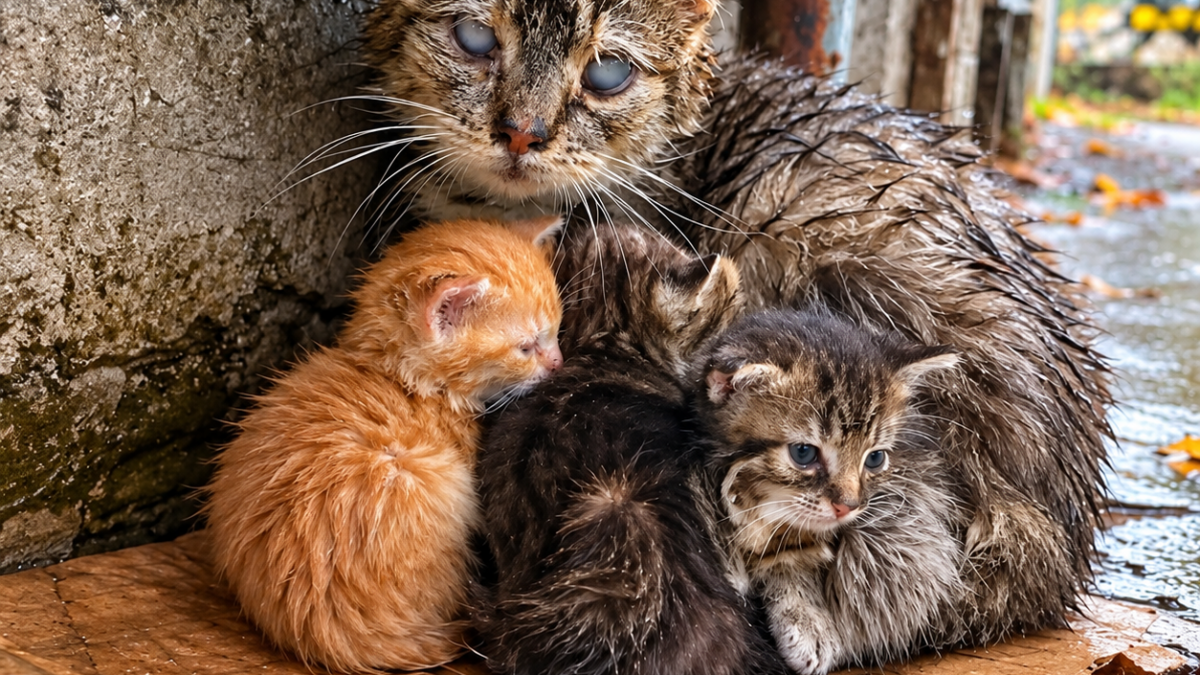
By the time I found the blind gray cat curled beneath a crooked wooden awning with four newborn kittens pressed against her stomach, she had already spent three cold October days crying whenever she heard footsteps—and apparently learning that footsteps did not always mean help was coming.
Her fur was soaked, her ribs trembled beneath her skin, and her cloudy eyes stayed wide open even though she could not see me, but when one of her kittens squeaked she immediately pulled the tiny body closer as if protecting them was the only job she still understood.
What happened after I sat down beside her made me realize that she had not stopped asking because she no longer wanted help—she had stopped because, somewhere during those three days, she had begun believing nobody was going to answer.
I still remember that evening because of the rain.
It wasn’t a violent storm.
Just cold, steady drizzle that had been falling since morning, the kind that works its way into your sleeves and makes every empty building look even more abandoned.
I was walking past an old commercial property near the end of the block when I heard something underneath the wooden awning attached to its side.
A kitten.
At least that was what I thought.
Then I heard another.
I stopped.
“Hello?”
For a second, there was nothing except rain tapping against warped boards.
Then a tiny cry came from the darkness.
I stepped closer.
The mother cat was lying on a collapsed cardboard box.
She was small.
Gray.
Painfully thin.
Her fur was matted with dirt and moisture, and her eyes had the milky, unfocused appearance I recognized immediately.
She wasn’t looking at me.
She was listening.
Four kittens were tucked beneath her chest.
One was orange.
Two were gray-and-white.
The smallest was nearly black.
They were old enough to crawl but not old enough to protect themselves from anything.
The orange kitten lifted his head as I approached.
The mother’s ears moved.
Her body tightened around them.
“Hey, sweetheart.”
She did not run.
She did not hiss.
That scared me.
I crouched several feet away.
“You hear me?”
Her head lifted slowly.
Then one front paw moved outward.
Not toward me exactly.
Into the empty air.
Searching.
I stared.
She extended it again.
Her claws opened slightly, touching nothing.
I moved my hand closer.
Her paw found my palm.
The contact lasted maybe one second.
But I felt how badly she was shaking.
I turned my hand over and let her smell my fingers.
She froze.
Then I touched the top of her head.
Her whole body went rigid.
For a terrible second, I thought I had frightened her.
Then she lowered her head into my palm.
I swallowed hard.
“You’ve been waiting for somebody, haven’t you?”
One of the kittens cried.
The mother immediately turned toward the sound.
She couldn’t see where he was, but she found him by smell and touch, pulled him beneath her chest, and began licking his face.
That was when I realized how impossible her situation had been.
She could not see traffic.
Could not safely search for food.
Could not leave four helpless kittens behind while she explored unfamiliar streets.
Whatever little energy she had was being spent keeping them warm and nursing them.
I called a local rescue volunteer named Elena.
“I found a blind mother cat with four kittens.”
“Are they exposed?”
“Yes.”
“Wet?”
“Yes.”
“Any food there?”
I looked around.
An empty cardboard food container.
Nothing else.
“No.”
“Stay with them. I’m coming.”
I removed my jacket and held it over part of the opening to block the wind.
The mother listened to every movement.
But each time I spoke, her ears relaxed slightly.
Ten minutes later, an older man from the convenience store across the street came over carrying an umbrella.
“You finally found them,” he said.
I looked up.
“You knew they were here?”
His face changed.
“I saw the cat two days ago.”
“Two days?”
He hesitated.
Then looked at the kittens.
“No. They’ve been here longer.”
My stomach tightened.
“How much longer?”
He pointed toward a security camera above his store entrance.
“I checked the footage this afternoon.”
I stood.
“What did you see?”
The man looked at the blind mother curled around her babies.
Then he said quietly,
“Someone brought that box here three nights ago.”
PART 2
For a moment, I thought I had misunderstood him.
“Brought the box?”
The man nodded.
“With the cat?”
“And the kittens.”
My hand tightened around the edge of my jacket.
“You saw the person?”
“Not clearly enough.”
“What happened?”
He looked toward the convenience store.
“My camera catches part of this side of the street. Not the whole area. Whoever it was stopped near the building sometime after midnight.”
“A car?”
“Yes.”
“What kind?”
“Dark sedan, maybe. The image isn’t good.”
I looked at the mother cat.
She had tucked her face against the orange kitten.
“They left her here?”
“It looks that way.”
“With nothing?”
“There might have been something in the box. I couldn’t tell.”
I looked around again.
Rainwater.
Collapsed cardboard.
No bowl.
No blanket.
No food.
No water.
The older man rubbed one hand over his mouth.
“I should’ve checked sooner.”
“Did you hear them?”
“Yesterday morning.”
“And?”
He looked ashamed.
“I thought they belonged to somebody staying nearby.”
There was nobody staying nearby.
The building had been empty for months.
But I understood what he meant.
People make assumptions because assumptions allow life to keep moving.
Someone else will handle it.
That animal probably belongs to someone.
Maybe the mother is coming back.
Maybe they are being fed.
Maybe it isn’t as bad as it looks.
Until suddenly three days have passed.
The man looked at the mother again.
“She used to cry.”
“What?”
“First day.”
He pointed.
“When customers walked past, she meowed. Loud. You could hear her across the street.”
My stomach turned.
“And today?”
“Almost nothing.”
I looked down.
The cat’s ears were moving with every voice.
But she remained silent.
The man continued.
“Yesterday she crawled toward the sidewalk when people passed.”
“She left the kittens?”
“Just a little. Maybe a couple feet. Then she went back.”
“And nobody stopped?”
His silence answered me.
I turned away.
Anger came fast.
Not just at the person who had left them.
At everyone.
At the camera.
At the street.
At myself for happening to arrive only on the third evening instead of the first.
Then one of the kittens cried again.
The mother immediately curled around him.
That pulled me back to what actually mattered.
“Can you save the footage?” I asked.
“Yes.”
“Please do.”
Headlights turned onto the street.
A small rescue van stopped at the curb.
Elena jumped out wearing a rain jacket and carrying a hard plastic carrier.
She took one look beneath the awning.
“Oh, no.”
I moved aside.
“Mother’s blind.”
Elena crouched slowly.
“Completely?”
“I think so.”
“We’ll find out.”
The cat’s ears rotated toward Elena.
“Hi, Mama.”
No hiss.
No growl.
Elena looked at me.
“How long?”
“Three days. Apparently someone dumped them.”
Her jaw tightened.
“Of course.”
The older man said, “I have footage.”
Elena glanced at him.
“Save it. We’ll contact animal control.”
Then she focused on the family.
That was one of the first things I learned from watching experienced rescuers.
Anger can wait.
Cold kittens cannot.
Elena touched the smallest kitten.
“He’s chilled.”
The mother immediately lifted her head.
“It’s okay.”
Elena let her sniff her glove before lifting him.
The mother reached blindly toward the sound.
Her paw moved through empty air.
My chest tightened.
“Keep him where she can hear him.”
Elena nodded.
She tucked the kitten beneath her jacket for a moment, warming him against a heat pack wrapped in cloth.
“We need to move them together.”
The mother tried standing.
Her back legs shook.
Then she collapsed.
Elena’s face changed.
“Okay. We’re not asking you to walk.”
We placed the kittens inside the carrier first on warmed towels.
One at a time.
Every time one cried, the mother turned her head toward the carrier.
Then we moved her.
She weighed almost nothing.
Her wet fur made her body look larger than it was.
Underneath, every bone was easy to feel.
As Elena lifted her, the cat struggled for the first time.
Not to escape.
Toward the kittens.
“They’re right there,” I said.
The mother stretched her paw toward the carrier.
Elena immediately lowered her close enough to touch the edge.
The kittens cried.
Her body softened.
“She needs them,” I whispered.
“They need her too.”
Inside the van, we placed her beside them.
The transformation was immediate.
The mother tucked herself around all four kittens.
One crawled beneath her chest.
The orange one found a nipple.
The smallest pushed between his siblings.
Within seconds, despite everything, she was nursing them.
Elena stared for a moment.
“That’s where all her calories are going.”
“What?”
“Into them.”
I looked at the mother.
“She’s starving herself?”
“Not intentionally. Nursing takes enormous energy. If she isn’t eating enough, her body pulls from its own reserves.”
“So they’re surviving because she’s getting thinner.”
“Basically.”
I climbed into my car and followed the rescue van to the clinic.
The rain continued.
At one red light, I could see the carrier through the back window of the van.
The mother’s gray body curved around four smaller shapes.
I thought about the store owner saying she had cried whenever people passed.
First day.
Loud.
Second day.
Still trying.
Third day.
Almost nothing.
She had not stopped needing help.
She had simply adjusted her expectations.
That thought stayed with me long after the light changed.
At the veterinary clinic, the family went directly into an examination room.
The mother was scanned for a microchip.
Nothing.
She was weighed.
Too light.
Her body condition was poor enough that the veterinarian, Dr. Patel, frowned before saying anything.
“Dehydrated.”
“How bad?”
“Moderate.”
“And the blindness?”
“We’ll examine that separately.”
She checked gums.
Teeth.
Heart.
Lungs.
Temperature.
Abdomen.
The mother tolerated everything quietly.
Too quietly.
“What do you think happened to her eyes?”
Dr. Patel leaned closer with an ophthalmoscope.
“Hard to say yet.”
The cloudy appearance involved both eyes.
There was evidence of old damage.
Possibly chronic infection.
Possibly congenital abnormalities.
Possibly untreated disease from earlier in life.
We would need further examination.
“Can she see anything?”
Dr. Patel moved a hand carefully through different positions.
No visual tracking.
She checked pupil responses.
Then looked at me.
“I’d treat her as fully blind unless further evaluation shows otherwise.”
My stomach sank.
“So she really couldn’t find food out there.”
“Not safely.”
Elena said, “And she stayed with the kittens.”
Dr. Patel nodded.
“Which probably saved them.”
The kittens were weighed.
All four were underweight.
The smallest one worried everyone most.
He was a dark charcoal-gray male.
We called him Tiny for the first hour because nobody had chosen names.
His body temperature was low.
The clinic warmed him gradually.
The other three were dehydrated but stronger.
Dr. Patel asked, “Has she been producing milk?”
“They were nursing.”
“Good.”
She gently examined the mother.
“She’s producing, but we’ll need to support her aggressively.”
“Can she keep nursing?”
“For now, yes, assuming her health remains stable.”
“What does she need?”
“Fluids. Nutrition. Parasite treatment as indicated. Testing. Eye evaluation. Safe housing. And a lot of food.”
The mother’s ears moved toward the kitten basket.
One squeaked.
She immediately lifted her head.
Dr. Patel smiled faintly.
“She knows exactly where they are.”
“She can’t see them.”
“She doesn’t need sight for that.”
We needed a name for the medical chart.
Elena looked at me.
“You touched her first.”
“That doesn’t qualify me.”
“Name her.”
The cat was lying on a towel now.
Gray.
Small.
Listening to every movement.
I thought of the way her paw had reached through empty air until it found my palm.
“Luna.”
Elena smiled.
“Luna.”
Dr. Patel wrote it down.
The kittens became Maple, Oliver, Poppy, and Ash.
The orange kitten was Maple.
A gray-and-white male became Oliver.
The other gray-and-white was Poppy.
The smallest dark kitten became Ash.
For the next forty-eight hours, every part of our attention narrowed around survival.
Luna’s bloodwork showed anemia, dehydration, and signs of poor nutrition.
Thankfully, there was no immediate evidence of catastrophic organ failure.
She had intestinal parasites.
Her coat and skin showed the effects of prolonged poor care and exposure, though nothing as severe as the skin cases I had seen in dogs.
Her paws were irritated from wet ground.
Her mammary glands needed close monitoring.
The kittens needed frequent weighing.
Ash needed supplemental feeding because he tired easily at the nipple.
I learned more about kitten weights in two days than I had known in my entire life.
“Elena.”
“What?”
“Ash lost three grams.”
She didn’t even look up.
“Since when?”
“Last feeding.”
“Give me the chart.”
I handed it over.
She scanned the numbers.
“Not panic territory.”
“He lost weight.”
“Small fluctuations happen.”
“He’s tiny.”
“I know.”
“He can’t afford fluctuations.”
She looked at me.
“You are going to have to learn not to emotionally react to every gram.”
“I don’t think I can.”
“You will.”
I did not.
I reacted to every gram for at least a week.
Luna, meanwhile, cared about exactly one thing.
The kittens.
We tried giving her a small meal several feet away.
She refused to leave them.
We moved it closer.
Nothing.
Finally, we placed the dish next to her front paws.
She ate while two kittens nursed.
Elena laughed.
“Multitasking.”
Luna finished the food.
Licked the dish.
Then sniffed around it.
“She wants more.”
“She can have more on schedule.”
“She has been starving for three days.”
“Probably longer than that.”
That sentence stopped me.
Of course.
Three days was only how long she had been abandoned near the building.
Her body condition had not developed in three days.
Whatever her life had been before, Luna had been struggling long before that car stopped at midnight.
The abandonment had not created the problem.
It had simply made the danger immediate.
Animal control collected the security footage.
The video was bad.
I watched it once with an officer.
12:43 a.m.
A dark sedan stopped near the old building.
Headlights went off.
A figure stepped out.
The person removed a cardboard box.
Set it beneath the awning.
Returned to the vehicle.
Drove away.
That was it.
Maybe forty seconds.
No visible license plate.
No identifiable face.
The officer paused the footage.
“You recognize the car?”
“No.”
“Anyone else nearby?”
“No.”
The convenience store owner had already given a statement.
The timestamp confirmed Luna and the kittens had been there almost exactly three days before I found them.
“Can you find who did it?”
The officer was careful.
“We can try. But this footage alone may not be enough.”
“That person left a blind cat with newborn kittens in the rain.”
“I understand.”
“No food.”
“I know.”
“Then what?”
“We look for additional cameras. We check reports. If somebody recognizes the vehicle or admits ownership, we follow that.”
I hated the uncertainty.
“Could they be charged?”
“Depends on what we can prove and local statutes.”
Everything depended on proof.
Luna did not care.
That became a strange lesson.
While I was angry at a grainy car on a screen, Luna was learning that food appeared regularly.
While I wondered whether someone would ever answer for abandoning her, Luna was beginning to sleep.
Really sleep.
Not lying still while listening.
Sleep.
Her first deep nap happened on the second evening.
I entered the room quietly.
Luna was on her side.
Four kittens piled against her.
Normally, when the door opened, her ears moved immediately.
This time they did not.
I stopped.
For one irrational second, panic hit.
“Luna?”
Nothing.
I stepped closer.
Her chest moved.
Slow.
Regular.
Sleeping.
I let out a breath.
Elena appeared behind me.
“What?”
“She didn’t hear me.”
“Maybe she did.”
“She always reacts.”
Elena looked inside.
“She’s exhausted.”
I whispered, “She looks dead.”
“Don’t say that.”
“I know.”
We watched.
After almost a minute, Luna stretched.
One paw extended.
Poppy squeaked.
Luna woke instantly and turned toward her.
Elena smiled.
“There she is.”
I thought about the first three nights outside.
How lightly must she have slept?
Blind.
Unable to see threats.
Four kittens beside her.
Cold.
Hungry.
Every footstep potentially danger or rescue.
No wonder her body had eventually stopped calling out.
It had been doing too many jobs already.
The eye specialist came on day three.
Dr. Carolyn Webb.
She examined Luna for nearly an hour.
Afterward, we sat in a small consultation room while Luna stayed with the kittens.
“What do you think?” I asked.
Dr. Webb folded her hands.
“The blindness is longstanding.”
“Since birth?”
“Possibly. But I can’t say with certainty.”
“Can anything be repaired?”
She shook her head.
“Not in a way that would restore functional vision.”
The answer hurt even though I had expected it.
“So permanent.”
“Yes.”
Elena asked, “Pain?”
“That’s the important part. I don’t see evidence that her current ocular condition is causing significant ongoing pain. We’ll continue monitoring.”
I looked through the small window toward Luna.
“What kind of life can a blind cat have?”
Dr. Webb smiled slightly.
“A very normal one.”
“Really?”
“Cats adapt extremely well. Sight is important, but so are scent, hearing, whiskers, spatial memory. In a stable indoor environment, a blind cat can navigate furniture, litter boxes, food, people.”
“Stairs?”
“Can learn them.”
“Other cats?”
“Depends on temperament.”
“Outside?”
“I would not allow her unsupervised outdoors.”
That seemed obvious.
Then Dr. Webb said something I remembered for years.
“Her blindness is not the tragedy here.”
I looked at her.
“Being abandoned without resources while nursing four kittens—that’s the tragedy.”
I nodded.
Luna did not need fixing into a sighted cat.
She needed a safe life designed around who she already was.
That changed how I saw her.
I stopped speaking around her as though she were fragile because she was blind.
She was medically fragile.
Temporarily.
Blindness was simply part of her.
And Luna was better at navigating it than I was.
Within a week, she had mapped the clinic room.
Food bowl left side.
Water bowl right.
Bed against the wall.
Kitten nest center.
Litter tray near the far corner.
If someone moved the water bowl six inches, Luna would search briefly and find it.
After we learned that, we stopped moving things unnecessarily.
Consistency became respect.
Her hearing amazed me.
I could enter wearing different shoes, and she seemed to know when it was me.
At first, I thought I imagined it.
Then one afternoon Elena walked in before me.
Luna lifted her head.
Elena spoke.
“Hey, Mama.”
Luna listened.
Then I entered behind her.
“Hi, Luna.”
Luna immediately stood and walked toward my voice.
Elena put a hand on her hip.
“Rude.”
I laughed.
“She likes me.”
“You found her.”
“Exactly.”
“You smell like the first person who brought food.”
“Love has many forms.”
“Apparently yours smells like canned chicken.”
Luna reached my leg.
She rubbed her face against it.
That was the first time she initiated affection.
I crouched.
She found my hand with her whiskers.
Then pressed her forehead into my palm.
The same place her paw had searched for under the awning.
I swallowed hard.
“You know where I am now.”
Her purr started quietly.
I froze.
“Elena.”
“I hear it.”
“She’s purring.”
“Yes.”
I smiled.
“That counts.”
“Definitely.”
The kittens developed faster than Luna recovered.
Their eyes opened.
First Maple.
Then Oliver.
Poppy.
Ash last.
The irony did not escape us.
Four kittens learning to see while their mother navigated without sight.
Luna cleaned every one.
If a kitten crawled too far, she located the sound.
If they were silent, she used smell.
She could reach them faster than some sighted mothers I had watched.
Ash remained smallest.
He needed extra feeding.
That meant removing him briefly from Luna.
The first few times she hated it.
The second I lifted him, her ears followed.
She walked toward the sound.
I kept talking.
“He’s here.”
Ash squeaked.
Luna answered with a low chirp.
I had never heard that sound from her before.
She used it repeatedly.
The kittens responded.
They learned their mother’s voice.
Eventually, if we had to move them for cleaning, Luna would chirp and all four began crawling toward her.
It was one of the most beautiful things I had ever seen.
The first real setback came during the second week.
Luna developed gastrointestinal upset from a combination of parasites, dietary changes, and a body adapting to regular nutrition.
She stopped eating one meal.
I panicked immediately.
Elena did not.
“Give her time.”
“She always eats.”
“She feels sick.”
“She needs calories.”
“I know.”
Dr. Patel examined her.
No emergency.
Medication adjusted.
Diet temporarily simplified.
Hydration monitored.
Luna stayed with the kittens.
That night, I sat beside her.
“You cannot stop eating.”
Her ears turned toward me.
“I’m serious.”
Maple crawled over her front leg.
Luna licked him.
“You have employees.”
No response.
“They’re terrible employees.”
Poppy squeaked.
“See?”
Luna’s paw reached toward my voice.
I offered my fingers.
She touched them.
Then, unexpectedly, she stood.
Walked to the food bowl.
Ate three bites.
I almost laughed from relief.
“Good.”
She ate another.
Then returned to the kittens.
Not much.
Enough.
By morning, she was better.
The rescue moved Luna and the kittens into foster care once they were medically stable.
Their foster was a woman named Grace.
She had converted a spare bedroom into a nursery for cat families.
Low furniture.
No open stair access.
Stable feeding stations.
A quiet house.
Perfect for Luna.
The first visit showed us how different a real home would be.
Luna entered the room inside a carrier.
Grace opened the door.
Luna stayed inside.
The kittens were in a separate secure carrier beside her.
I sat on the floor.
“Take your time.”
Luna listened.
Her nose moved.
She reached one paw forward.
Touched the carrier threshold.
Then pulled back.
Grace said nothing.
Five minutes passed.
Then Luna stepped out.
Slowly.
One paw at a time.
She walked in a cautious line, whiskers forward.
Touched the wall.
Turned.
Followed it.
Mapped the bed.
Found the litter box.
Found the water.
She didn’t need us to carry her.
She needed us not to rearrange the world while she learned it.
Within thirty minutes, she had explored the entire room.
Grace stared.
“That’s incredible.”
“She’s good at this.”
“I was expecting her to bump into everything.”
I shook my head.
“So was I originally.”
Luna found the kittens.
Lay beside them.
Grace whispered, “She’s more confident than I am.”
That became true in many ways.
By the end of the first week, Luna knew the foster room perfectly.
She could move at nearly normal speed.
When Grace entered, Luna went toward the door.
When I visited, she recognized my voice.
The kittens became chaos.
Maple was first to climb.
Oliver was first to attack shoelaces.
Poppy liked sleeping inside blankets.
Ash, once the weakest, developed an absurd obsession with food.
“He survived being tiny just to become a thief,” Grace told me.
Ash had dragged a piece of chicken from Luna’s plate.
Luna heard the movement.
Turned.
Ash ran.
I laughed.
“She can’t see him stealing.”
“No.”
“But she can hear him.”
Luna walked straight toward Ash.
He dropped the chicken.
Grace gasped.
“She caught him.”
“Motherhood gives special powers.”
Luna ate the stolen piece.
Justice.
The kittens began eating independently.
That freed Luna physically.
Nursing decreased gradually.
Her weight finally climbed more reliably.
Her coat improved.
The tremor I had felt beneath her ribs disappeared.
She began spending time away from the kittens.
At first, only a few feet.
Then she discovered Grace’s lap.
That changed everything.
Grace sat on the floor reading one afternoon.
Luna approached.
Touched Grace’s knee.
Then climbed slowly into her lap.
Grace texted me:
HELP. I CANNOT MOVE.
Photo attached.
Luna curled against her stomach.
I replied:
YOU LIVE THERE NOW.
Later, Grace called.
“She’s purring so loudly.”
“Good.”
“I don’t think she knows she’s supposed to be traumatized.”
I paused.
“Maybe don’t think about it that way.”
“What do you mean?”
“She was traumatized. But that doesn’t mean every moment afterward belongs to trauma.”
Grace was quiet.
“You’re right.”
I had learned that from other rescues.
Animals do not exist to perform their suffering for us.
Luna could have a terrible history and still enjoy a warm lap.
The kittens reached adoption age.
Applications came quickly.
Predictably, people loved them.
Maple, the orange one, had the most applications.
Grace said, “Orange-cat propaganda.”
“It’s powerful.”
Ash was adopted by a couple who had experience with shy cats.
Poppy went to a family with a calm adult cat.
Oliver went to a graduate student who spent most evenings at home.
Maple was adopted by a retired couple.
We screened carefully.
No outdoor homes.
No impulse applications.
No separating animals before medically appropriate ages.
No shortcuts because people were impatient.
Luna watched the kittens leave one by one.
That worried me.
Would she search?
Call?
Become distressed?
The first departure, she explored the room afterward.
Sniffed the carrier.
Chirped twice.
Then settled.
Second departure, similar.
When only Ash remained, Luna spent more time with him.
He slept against her chest.
On the final day, Grace distracted Luna in another room while Ash left.
When she returned, the nursery was quiet.
Luna stopped.
Her ears moved.
She sniffed.
Walked toward each familiar sleeping spot.
Then chirped.
Nothing answered.
My chest hurt.
“She’s looking.”
Grace knelt.
“Yes.”
Luna chirped again.
I sat on the floor.
“Your babies are okay.”
She walked toward my voice.
Pressed against my leg.
That evening, Grace stayed with her.
The next morning, Luna ate breakfast.
Then something unexpected happened.
She played.
Not maternal play.
Not interacting with kittens.
For herself.
Grace rolled a crinkly ball across the floor.
The sound caught Luna’s attention.
Her head turned.
Grace rolled it again.
Luna crouched.
I whispered, “No way.”
Grace rolled.
Luna pounced.
Missed by six inches.
Stopped.
Listened.
The ball crinkled when Grace touched it.
Luna tried again.
This time she found it.
She hit it with one paw.
The ball moved.
Luna followed.
Within minutes, she was chasing sound across the floor.
Blind.
Fast.
Happy.
Grace looked at me with tears in her eyes.
“She never got to be a kitten.”
We didn’t know that.
Maybe she had.
Maybe not.
But watching her play after weeks of motherhood and survival felt like witnessing a door open.
Luna learned other toys.
Bells.
Crinkle tunnels.
Anything that produced sound.
She ignored silent balls.
Loved cardboard scratchers.
Discovered catnip and became briefly ridiculous.
Grace filmed her rolling on a toy mouse.
I laughed until I cried.
A blind mother cat once left in the rain had become intoxicated by catnip in a warm bedroom.
That was progress.
Her adoption, however, took longer than the kittens’.
Some people were frightened by blindness.
“Does she need constant supervision?”
No.
“Will she use a litter box?”
Yes.
“Can she jump?”
Absolutely.
“Does she bump into walls?”
Not once she knows the room.
“Is she sad?”
That question irritated me.
“Why would she be sad?”
“Because she can’t see.”
I learned to answer calmly.
“She has never told us she considers that a problem.”
The right person appeared almost two months after the last kitten left.
Her name was Rebecca.
Thirty-six.
Worked from home as a copy editor.
Lived alone in a one-story house.
No children.
One elderly cat named Juniper.
Rebecca’s application said:
I am not applying because Luna is blind. I am applying because the foster description says she is affectionate, vocal, likes lap time, and prefers noisy toys. The blindness is simply something I need to accommodate responsibly.
I liked her immediately.
At the first meeting, Rebecca did something smart.
She spoke before approaching.
“Hi, Luna.”
Luna’s ears turned.
Rebecca sat on the floor.
Did not reach.
Luna approached.
Whiskers forward.
Sniffed Rebecca’s shoe.
Then leg.
Rebecca said softly, “Take your time.”
Luna rubbed against her.
I watched.
“You’ve been around blind cats?”
“No.”
“You’re doing well.”
“I read.”
That made me smile.
“What did you read?”
“Don’t move furniture constantly. Announce yourself. Use texture and sound cues. Avoid unsafe open windows. Introduce rooms gradually. Keep resources predictable.”
“Good.”
“And don’t treat her like she’s helpless.”
“Very good.”
Luna climbed into Rebecca’s lap.
Rebecca froze.
“Am I allowed to breathe?”
I laughed.
“Yes.”
“Great.”
The meeting with Juniper happened later.
Juniper was fifteen and had no interest in becoming anyone’s friend.
Luna approached slowly.
Juniper hissed once.
Luna stopped.
Sat.
Rebecca looked worried.
“That’s bad?”
“Not necessarily.”
Juniper walked away.
Luna stayed.
No chasing.
No fight.
Second meeting went better.
Third, Juniper sniffed Luna without hissing.
Good enough.
The home visit sealed everything.
Rebecca had placed small textured mats near Luna’s food and water stations.
Different texture near the litter box.
A low scratching post.
Bell toys.
She had removed one unstable shelf.
Covered a sharp furniture edge.
I looked around.
“You did all this before approval?”
“If you say no, Juniper gets new accessories.”
Fair.
Luna entered.
Rebecca let her explore.
One room at a time.
Luna mapped the living room.
Found the sofa.
Jumped onto it with shocking accuracy.
Rebecca gasped.
“She can do that?”
I laughed.
“She’s blind, not made of glass.”
Luna walked across the cushion.
Found Rebecca.
Sat beside her.
Decision made.
Adoption day came in early spring.
No rain.
Sunlight.
Luna wore a soft purple collar with a tiny bell—not because she needed it, but because Rebecca said Juniper might appreciate knowing where the newcomer was.
I held Luna one last time.
She placed a paw on my chest.
“You have any idea how many people ignored you?”
Her ears moved.
“Never mind.”
I pressed my forehead lightly to hers.
“That part’s over.”
Rebecca took the carrier.
“I’ll send updates.”
“I will absolutely bother you if you don’t.”
“I assumed.”
Luna went home.
The first update came within an hour.
She found the couch.
Photo.
Luna sprawled across one cushion.
Second update:
She found the kitchen.
Third:
She found Juniper’s bed. Juniper has filed a complaint.
Within a week, Luna knew the whole house.
She navigated from bedroom to food.
Food to litter.
Litter to sunroom.
Sunroom to couch.
Rebecca added tiny bells to a few toys but discovered Luna could track even subtle scraping sounds.
Her hearing was extraordinary.
One evening, Rebecca called laughing.
“She stole Juniper’s treat.”
“How?”
“I gave one to each. Juniper walked away. Luna heard her crunching, followed the sound, and took the rest.”
“Blind-cat helplessness confirmed.”
“Clearly.”
Juniper eventually accepted her.
Not warmly.
But honestly.
They slept several feet apart.
Then closer.
By winter, Rebecca sent a photograph of Luna curled against Juniper’s back.
Caption:
Diplomatic relations established.
Luna’s former kittens grew.
Their families sent updates.
Maple became huge.
Oliver learned to fetch.
Poppy slept under blankets.
Ash remained food-obsessed.
On the first anniversary of the rescue, Elena arranged a small reunion in a controlled indoor space.
Not because we thought Luna needed to “see her babies.”
She couldn’t.
And adult offspring do not necessarily preserve human-style family roles.
We simply had cooperative adopters who wanted to meet.
Luna entered first.
She listened.
Maple arrived.
Sniffed her.
Luna sniffed back.
No dramatic recognition.
Then Ash appeared.
He immediately found the snack table.
“Some things never change,” I said.
Rebecca laughed.
Luna heard him crunching.
Walked straight toward him.
Stole part of his treat.
Everyone laughed.
Maybe she remembered.
Maybe not.
It didn’t matter.
They were alive.
Healthy.
Loved.
That was the reunion.
The security case never produced a prosecution.
Additional footage was too poor.
The vehicle could not be definitively identified.
No one came forward.
For a while, that made me furious.
I wanted the ending where someone answered for those three days.
Where the person who left a blind nursing cat in cold rain had to explain the decision.
Real life did not give me that.
It gave me something quieter.
Luna stopped crying for help because people taught her the wrong lesson.
Then one evening, somebody sat down.
Touched the paw she extended.
From there, other people did the next thing.
Elena came.
The clinic treated.
Grace fostered.
Four families adopted kittens.
Rebecca adopted Luna.
No single act erased the abandonment.
But the abandonment stopped being the largest chapter.
Years passed.
Luna became famous among Rebecca’s friends for greeting people by sound.
Door opened.
Luna’s ears rotated.
Voice.
Footsteps.
She learned individuals.
Rebecca’s brother wore heavy boots.
Her neighbor shuffled slightly.
The mail carrier had keys that jingled.
I visited one afternoon without announcing myself.
I opened the door after Rebecca called for me to enter.
Luna was sleeping on the sofa.
I stayed silent.
Rebecca whispered, “Say something.”
I smiled.
“Hey, Luna.”
Her head snapped up.
She jumped down.
Walked directly toward me.
I crouched.
“You remember me?”
She found my hand.
Head pushed into palm.
Same gesture.
Again.
Years later.
I laughed.
Rebecca said, “She absolutely remembers you.”
Maybe.
I chose to believe it.
Luna aged beautifully.
Her gray coat thickened.
She filled out.
The trembling ribs disappeared.
Her face became rounder.
She developed a habit of sleeping on Rebecca’s desk while Rebecca worked.
This created conflict.
“If I move her, she comes back.”
“Buy a second desk.”
“I hate that your solution makes sense.”
Eventually Rebecca placed a small heated cat bed beside the keyboard.
Luna accepted the compromise.
During thunderstorms, Luna became restless.
Not terrified.
Alert.
Rebecca played soft music and stayed nearby.
Luna sometimes climbed into her lap.
Rain carried meaning for me.
Probably more than for Luna.
Every October, when cold drizzle began, I thought about the awning.
Rebecca knew.
One anniversary she sent a photo.
Luna asleep in a heated bed.
Blanket.
Juniper beside her.
Outside the window, rain.
Message:
She refused to get up for breakfast until I moved the bowl closer. She has become extremely demanding.
I laughed.
That was the best update imaginable.
The cat who once had no food now expected room service.
Normal problems.
Good problems.
Juniper died when Luna was around middle age.
She was very old.
Rebecca called me afterward.
“Luna keeps looking for her.”
I sat down.
“How?”
“She checks Juniper’s bed. Stops outside the bedroom.”
“Eating?”
“Yes.”
“Using litter?”
“Yes.”
“Then give her time.”
Rebecca did.
Luna slept in Juniper’s bed for almost a week.
Then stopped.
Months later, Rebecca fostered another cat.
A young male named Theo.
Sighted.
Nervous.
Theo hid behind a bookshelf.
Luna heard him.
Approached.
Theo hissed.
Luna stopped.
Sat.
Waited.
Rebecca texted:
Your blind cat is teaching my sighted foster how to use the house.
Over the next week, Theo began following Luna.
She knew the route to food.
He followed.
Route to litter.
Followed.
Favorite window.
Followed.
One night, Rebecca sent a video.
Luna walking through a dark hallway.
Theo behind her.
I watched it twice.
The cat once described as helpless because she could not see was now confidently leading another animal through a house.
Life has a sense of irony no writer could improve.
Theo was adopted.
More fosters came occasionally.
Luna tolerated some.
Loved others.
Ignored several.
She was not a saint.
That mattered.
She stole food.
Hissed if another cat stepped on her.
Woke Rebecca before dawn.
Knocked water glasses from the desk even though she couldn’t see them.
Nobody understood how she found them so reliably.
Rebecca said, “She uses sonar for crime.”
Luna also learned to open one cabinet.
The cabinet contained treats.
This was not coincidence.
Rebecca installed a child lock.
Luna spent several evenings investigating it.
“She’s planning something.”
“Sleep with one eye open.”
“I only have two and they both need rest.”
Normal life again.
When Luna became a senior, arthritis changed her movement.
She could still navigate.
Jumping became harder.
Rebecca added steps to the couch and bed.
Luna learned them in a day.
Later, she developed early kidney disease.
Diet.
Monitoring.
More water stations.
Regular veterinary checks.
Nothing dramatic at first.
Then, one winter, her appetite decreased.
Rebecca called.
“She’s eating, but less.”
We both knew what aging meant.
I went to visit.
Luna was thinner than before.
Not like the awning.
Never like that.
But older.
Her fur had silvered.
She moved more slowly.
I spoke from the doorway.
“Hey, little girl.”
Her ears turned.
She stood.
Walked toward me.
Not straight at first.
She touched the couch with whiskers.
Adjusted.
Found my legs.
I sat on the floor.
Luna climbed into my lap.
Her body fit differently now.
Heavier in memory.
Lighter in age.
She purred.
Rebecca sat beside us.
“She still does that every time you come.”
I scratched Luna’s head.
“Maybe I smell weird.”
“You probably do.”
Luna placed one paw on my hand.
I looked at it.
Small.
Gray.
The first contact returned instantly to my memory.
A paw reaching into empty space beneath the awning.
Trying to find something.
Anything.
My palm meeting it.
I closed my fingers gently around hers.
“You found me first.”
Rebecca looked at me.
“What?”
“Nothing.”
Luna slept.
Kidney disease progressed over the next year.
Slowly enough for good months.
Then bad weeks.
Medication.
Subcutaneous fluids.
Appetite stimulants.
Special food.
Rebecca learned everything.
Luna hated fluids at first.
Then discovered treats followed.
Cooperation improved dramatically.
Blindness was never the problem.
Age was.
That distinction stayed important.
Luna had lived for years without sight.
She had navigated.
Played.
Mothered.
Stolen.
Loved.
Grieved.
Grown old.
If anything shortened her life, it would be the same things that eventually affect many senior cats.
Time.
Organs.
Age.
One autumn, very close to the anniversary of the rescue, Rebecca called.
Her voice was quiet.
“Can you come?”
I knew.
I drove over.
Rain was falling.
Not heavy.
Cold drizzle.
The exact kind I remembered.
Luna lay in her heated bed.
Rebecca had moved it beside the couch.
She was awake.
Her breathing looked tired.
I sat.
“Hi.”
Ears moved.
Her paw extended slightly.
I placed my hand there.
She touched my palm.
I started crying immediately.
Rebecca sat beside me.
“We saw the vet this morning.”
“What did she say?”
“Her kidneys are failing. She’s nauseated despite medication. Weak. Dehydrated even with fluids.”
“Can they adjust anything?”
“We’ve adjusted everything.”
Silence.
Rebecca looked at Luna.
“I don’t want her last night to become frightening.”
I nodded.
That was the same decision so many loving families eventually faced.
Not how long can the body continue.
What kind of time are we asking for?
A home veterinarian arrived that afternoon.
Luna stayed in her bed.
No clinic.
No carrier.
No stress.
Rebecca placed one of Luna’s favorite crinkle balls beside her.
It barely made sound anymore.
Years of teeth had flattened it.
Luna touched it with one paw.
The veterinarian examined her.
Then explained the process.
Rebecca listened.
I kept my hand near Luna’s face.
Before the first medication, Rebecca whispered,
“You never needed eyes to know where home was.”
I looked away.
That line broke me.
The sedative made Luna sleepy.
Her body relaxed.
Purr.
Very faint.
Still there.
I remembered the first night.
Her body rigid beneath my hand.
Not trusting.
Not understanding.
Then the slow lowering of her head into my palm.
Now she did the same thing.
Her chin rested against my hand.
Full circle without needing to be announced.
Rebecca stroked her back.
“No rain tonight, okay?”
Rain tapped softly against the window.
But Luna was inside.
Warm.
Dry.
Full bowl nearby even though she no longer wanted it.
The four kittens she had protected were adults in homes of their own.
Maple.
Oliver.
Poppy.
Ash.
No one needed her body as a shield anymore.
She had done enough.
When the final medication was given, Luna’s breathing slowed.
Then stopped.
No struggle.
No fear.
She died in the house she knew so well that she could cross it in darkness faster than visitors with perfect vision.
Afterward, Rebecca and I sat on the floor.
Rain continued.
Neither of us moved.
Then Rebecca said,
“She stopped asking for help before you found her.”
I nodded.
“That’s what the store owner told me.”
“And now?”
I looked at Luna.
“At some point she stopped needing to.”
That was the difference.
The first silence had been resignation.
The last silence was rest.
Luna’s former kittens’ families received the news.
Maple’s family sent a picture of him sprawled across a kitchen table where he absolutely did not belong.
Poppy slept beneath a blanket.
Oliver was beside a window.
Ash was overweight enough that his veterinarian had put him on a diet.
I laughed through tears.
The tiny underweight kitten had become too heavy.
Perfect.
Rebecca made a small memory box.
Purple collar.
Crinkle ball.
One photograph.
Not the abandonment photo.
A picture of Luna on Rebecca’s desk, lying across paperwork while Rebecca tried to work.
Eyes cloudy.
Expression content.
Below it:
LUNA
No labels.
No “blind rescue.”
No “abandoned mother.”
Just Luna.
I liked that.
For years, strangers had wanted to define her by what had happened.
Blind.
Abandoned.
Helpless.
Mother.
Survivor.
All true.
None complete.
Luna was also demanding.
Funny.
Food-motivated.
Excellent at stealing Juniper’s treats.
A surprisingly accurate jumper.
A foster-cat guide.
A lap monopolist.
A desk obstruction.
A senior cat who hated kidney food.
A mother whose kittens outgrew needing her.
A cat who learned an entire house without ever seeing it.
That was the life I preferred to remember.
One year after Luna died, Ash’s family brought him to visit.
He was a large dark-gray cat.
Nothing tiny about him anymore.
The smallest kitten.
The one we worried about every gram.
He sat inside his carrier and complained loudly.
I laughed.
“You certainly found your voice.”
His adopter opened the carrier.
Ash stepped out.
He had good vision.
Healthy eyes.
He looked around the room.
Then immediately found the treat container.
Some personality traits were eternal.
I scratched his head.
“Your mother would have stolen that first.”
Ash ate.
No idea what I was talking about.
That was okay.
He did not need to carry her story.
He had his own.
Later that evening, I walked past the old abandoned building.
The wooden awning had been removed.
The property had been renovated.
New windows.
Fresh paint.
A small business had opened inside.
People walked through the same doorway where Luna once waited for someone to stop.
Nobody there knew.
At first, that bothered me.
Then it didn’t.
Places move on too.
Suffering does not need a permanent monument everywhere it occurred.
Sometimes the best evidence that a terrible chapter ended is that life eventually becomes ordinary again.
I stood across the street.
Cars passed.
People carried coffee.
Someone laughed near the entrance.
I remembered the cardboard box.
Four kittens.
The mother’s ears moving at my footsteps.
Her paw stretching into empty air.
I remembered how surprised she seemed when it finally touched a hand.
For three days, people had passed.
Luna had cried.
Then cried less.
Then almost stopped.
When I first heard that story, I thought she had given up.
Years later, I see it differently.
She had not given up on her kittens.
She had not stopped feeding them.
Had not stopped cleaning them.
Had not stopped wrapping her body around them.
She had only stopped believing people would answer.
That belief turned out to be wrong.
Not because every person stopped.
Most didn’t.
It only required one.
Then another.
Then another.
The man who saved the camera footage.
Elena.
Dr. Patel.
Grace.
Four kitten adopters.
Rebecca.
No single person created Luna’s second life.
We simply handed responsibility forward until Luna no longer needed rescue at all.
The last photo Rebecca ever sent me before Luna died remains on my phone.
Luna asleep in a heated bed.
Cloudy eyes closed.
Gray paw stretched across a blanket.
Rain against the window.
The caption:
She can hear the storm. She just doesn’t care anymore.
That may be the most beautiful update I ever received.
Because on the first stormy night I knew about, every sound mattered.
Footsteps meant possible help.
Cars meant possible danger.
Rain meant cold.
Kittens crying meant work.
By the end, rain was simply something happening outside.
Luna had learned there were walls between her and the weather.
A roof overhead.
Food nearby.
A person she could find by voice.
Nothing left to ask strangers for.
I still think about the moment her paw touched my palm.
At the time, it felt tiny.
Almost accidental.
One blind cat reaching toward a sound.
One human hand placed where she could find it.
But every part of her life afterward started there.
Not because my hand saved her.
It didn’t.
A whole chain of people did.
The importance of that moment was simpler.
For the first time in three days, Luna reached out—
and something reached back.
For a long time after Luna died, I thought that was where her story ended.
I was wrong.
Not because anything supernatural happened.
Not because her kittens somehow carried pieces of her personality in ways I could prove.
And not because another abandoned blind cat appeared in exactly the same place.
Life is rarely that neat.
What happened was quieter.
Luna kept showing up in the choices people made after knowing her.
The first person I noticed it in was Rebecca.
About six months after Luna died, she called me one Saturday morning.
“I need you to tell me if I’m being ridiculous.”
“That depends.”
“I’m serious.”
“So am I.”
There was a pause.
Then she said, “There’s a blind cat at the county shelter.”
I closed my eyes.
“Of course there is.”
“I’m not saying I’m adopting him.”
“You called me before breakfast.”
“That proves nothing.”
“What’s his name?”
Another pause.
“Benny.”
“You know his name.”
“It was on the website.”
“You memorized it.”
“I read.”
I smiled.
Rebecca had once used exactly that defense when I asked how she knew so much about caring for blind cats before meeting Luna.
“What do you know about Benny?”
“Six years old. Blind from untreated glaucoma. Eyes were removed a few months ago. Owner surrendered him after moving.”
“Temperament?”
“Shy. Apparently affectionate once he knows you.”
“Other cats?”
“Unknown.”
“And why are you calling me?”
“Because I don’t want to adopt another blind cat just because I miss Luna.”
That answer made me sit down.
There was the real question.
Grief can disguise itself as urgency.
Sometimes we try to replace the exact shape of what we lost because the empty space feels unbearable.
I had seen it happen with dogs, cats, even foster families.
People think another animal of the same breed, same color, same age, same medical condition will somehow reopen the life they had.
It never works that way.
“Do you want Benny?” I asked.
“I don’t know.”
“Do you want Luna back?”
Rebecca did not answer.
That was enough.
I softened my voice.
“Go meet him.”
“And then?”
“Meet him as Benny.”
She breathed out slowly.
“Not as Luna.”
“Exactly.”
Three days later, she visited the shelter.
Benny did not climb into her lap.
He did not walk toward her voice.
He hid inside a covered bed and refused to come out for almost twenty minutes.
Rebecca sat on the floor.
Waited.
Eventually, Benny stuck his nose through the opening.
Then one paw.
Rebecca sent me a photograph afterward.
Only half of Benny’s face was visible.
No eyes.
Just scars where the surgeries had healed.
Underneath she wrote:
Definitely not Luna.
I replied:
Good.
She did not adopt him that day.
Or the next.
She visited three more times.
On the fourth visit, Benny walked into her lap.
Two weeks later, he went home.
Rebecca called me from the car.
“I did something.”
“You adopted him.”
“How do you know?”
“You always sound guilty when you’re happy.”
“I do not.”
“You absolutely do.”
Benny’s adjustment was nothing like Luna’s.
Luna had mapped new environments quickly.
Benny moved slowly.
Luna loved noisy toys.
Benny was afraid of bells.
Luna had climbed onto furniture almost immediately.
Benny preferred staying on the floor.
Luna stole food.
Benny was a cautious eater.
Rebecca kept waiting for similarities.
Then stopped.
That was the moment Benny truly became hers.
A month later, she sent a photograph.
Benny was asleep inside the same heated bed Luna had once used.
I stared at it.
For a second, grief punched through me.
Then I noticed something.
Benny was lying completely differently.
Luna used to curl tightly, nose under her tail.
Benny sprawled upside down with all four paws pointed in different directions.
I laughed.
Rebecca called.
“You saw it?”
“Yes.”
“He has no dignity.”
“None.”
“He snores.”
“Luna didn’t.”
“Exactly.”
There was joy in her voice.
Not replacement.
Expansion.
That mattered.
Luna had taught Rebecca how to create a home a blind cat could navigate.
Benny benefited from knowledge Luna had made necessary.
But he got to be himself.
That felt like the right kind of legacy.
The kittens’ lives kept moving too.
Maple’s family sent photographs every Christmas.
He became enormous.
Not overweight.
Just a huge orange cat with the confidence of someone who had never once considered that furniture rules applied to him.
One photo showed Maple stretched across a dining table beside a centerpiece.
His adopter wrote:
He believes he is decorative.
Poppy remained the quietest.
She slept under blankets and disliked visitors.
Her family learned never to pull her out.
If she wanted company, she came.
If not, they left her alone.
Oliver became strangely obsessed with retrieving toys.
His adopter would throw a small felt mouse down the hallway.
Oliver brought it back.
Again.
Again.
Again.
For years.
When people told me cats could not play fetch, I showed them Oliver.
Then there was Ash.
Tiny Ash.
The kitten we weighed obsessively.
The one whose every gram once felt like a medical event.
Ash eventually became such an enthusiastic eater that his veterinarian put him on a calorie-controlled diet.
The first time his adopter told me, I laughed so loudly she thought the call had disconnected.
“What?”
“I’m sorry.”
“You’re laughing at him.”
“I remember when we celebrated him gaining four grams.”
“Well, now we’re celebrating him losing a pound.”
“Life is weird.”
“Very.”
Ash was not amused by his diet.
He learned to open a kitchen cabinet.
His family installed a latch.
He then learned that waking people at four thirty in the morning occasionally produced breakfast earlier.
His adopter described it as “organized crime.”
Every update made the rainy awning feel less powerful.
Not less real.
Just smaller.
That became important.
For years, when I thought of Luna’s family, the first picture in my mind was suffering.
Wet cardboard.
Cloudy eyes.
Four cold kittens.
Eventually, another picture replaced it.
Not one picture.
Five.
Luna on Rebecca’s desk.
Maple on a dining table.
Poppy buried in blankets.
Oliver carrying a toy mouse.
Ash sitting angrily beside a diet-food bowl.
That was the family.
Not the cardboard box.
One evening, Elena and I were cleaning cages at the rescue after a long intake day.
She handed me a stack of towels.
“You know what I realized?”
“That we own too many beige towels?”
“We definitely do.”
She leaned against the counter.
“I don’t remember what car dumped Luna.”
I stopped.
“What?”
“The security footage. I used to remember it clearly. Dark sedan. Shape of the lights. Everything.”
“And now?”
“I remember Luna playing with that crinkle ball.”
I understood exactly what she meant.
For months after the rescue, the grainy footage had lived in our heads like evidence we failed to turn into justice.
We watched a person carry a box.
Set it down.
Drive away.
Forty seconds.
That action had felt enormous because we could not identify the person responsible.
Years later, it had shrunk.
The person in the video had given Luna three terrible days.
Rebecca gave her years.
There was no comparison.
“I think that’s good,” I said.
Elena nodded.
“Me too.”
Then she threw a towel at me.
“Fold.”
Beautiful conversation over.
Rescue work rarely allows long philosophical pauses.
A cat is usually vomiting somewhere.
A dog needs medication.
Laundry remains eternal.
About two years after Luna died, I received an email from the owner of the renovated building where I had first found her.
I didn’t know him.
He had bought the property after Luna’s rescue.
The email said a customer had mentioned hearing a story about a blind cat abandoned near the building and asked whether it was true.
The owner wanted to know if he could put up a small plaque.
My immediate reaction surprised me.
No.
I stared at the email.
Why did I dislike the idea?
It sounded kind.
Respectful.
Then I understood.
I did not want the place where Luna suffered to become the place that represented her.
I called him.
He was a thoughtful man named Daniel.
“I hope I didn’t overstep,” he said.
“No. Not at all.”
“I just thought people might like to know something good came out of that spot.”
“Something good did.”
“So you’d rather not?”
I looked at the photograph of Luna above my desk.
“Could the plaque be somewhere else?”
“Where?”
“Inside.”
He waited.
I explained.
“She was outside because someone left her there. I don’t want the alley to become her identity. If you want to remember her, put something somewhere warm.”
Daniel was quiet.
Then he said, “I like that.”
A month later, I visited.
The building had become a small neighborhood café and bookstore.
Near the front window was a wooden shelf.
On it sat a framed photograph of Luna.
Not the rescue picture.
Rebecca had given permission to use one of Luna sleeping on a stack of papers while she worked.
Eyes cloudy.
Paw over the edge of the desk.
Looking extremely comfortable.
Beside it was a small card.
LUNA
Nothing else.
No tragic explanation.
No description of abandonment.
Just her name.
I smiled.
Daniel walked up.
“Good?”
“Perfect.”
People who knew the story would understand.
People who didn’t would simply see a cat.
That was exactly what I wanted.
A year later, I stopped for coffee and saw a child looking at the photograph.
“Why are her eyes like that?” he asked his mother.
“She was blind.”
“Was she okay?”
His mother read the short note on the back of the frame that Daniel had eventually added.
It explained only that Luna had been rescued nearby and later adopted into a loving indoor home.
“She was okay,” the mother said.
The child looked at Luna’s photo.
Then went back to his muffin.
Simple.
No pity performance.
No horror.
She was blind.
She was okay.
Dr. Webb’s words came back to me.
Her blindness was not the tragedy.
Eventually I began helping the rescue create better information for adopters considering blind cats.
Not because I was an expert.
I wasn’t.
But Luna had exposed how many people misunderstood blindness.
We wrote practical guidelines.
Keep furniture consistent at first.
Use scent, sound, and texture cues.
Speak before touching.
Protect stairs or hazards until the cat maps them.
Keep blind cats indoors.
Do not assume hesitation means unhappiness.
Do not carry them everywhere if they can navigate independently.
Let them learn.
Let them fail safely.
Let them be cats.
One Saturday, we held an adoption event.
A young couple stopped in front of a blind tabby named Marcus.
The woman whispered, “I’d feel so bad for him.”
I heard myself say, “Why?”
She looked embarrassed.
“Because he can’t see.”
Marcus was at that exact moment climbing the side of his enclosure because he had heard a bag of treats open.
I pointed.
“He doesn’t seem particularly devastated.”
The man laughed.
Marcus reached through the bars.
“Does he need special care?”
“Some accommodations.”
I explained.
They stayed almost an hour.
Two weeks later, Marcus went home with them.
Months afterward, they sent a video of him racing through a hallway, turning perfectly around furniture he had memorized.
I forwarded it to Rebecca.
She replied:
Luna would approve.
I almost wrote back that we had no idea what Luna would approve of.
Then I stopped.
Sometimes sentimentality is allowed.
Years passed again.
The kittens aged.
Maple developed thyroid disease and needed medication.
Oliver lost several teeth.
Poppy became more affectionate in old age.
Ash remained perpetually convinced he was underfed.
Their families stayed in contact less frequently, which was normal.
People live.
Move.
Change jobs.
Have children.
Lose phones.
The rescue is the center of the animal’s story only briefly.
Then, ideally, we become irrelevant.
That is success.
One autumn afternoon, however, I received a message from Ash’s adopter, Melissa.
Can I bring him by?
I replied immediately.
Of course. Something wrong?
No. He’s old. I just thought you might want to see him.
That sentence tightened my throat.
Ash arrived in a soft-sided carrier.
When Melissa opened it, a large gray senior cat stepped out slowly.
His muzzle had lightened.
His movements were stiff.
But he was still Ash.
He walked directly toward the treat cabinet.
I laughed.
“You remember this place?”
Melissa said, “He remembers food.”
“Fair.”
I gave him an approved treat.
He ate it.
Then another.
Melissa raised an eyebrow.
“Diet.”
“He’s elderly.”
“That is exactly how he got fat the first time.”
I stopped.
“Fine.”
Ash sat beside me.
I touched his back.
For a second, my fingers remembered the tiny cold body inside my jacket.
He had once fit almost entirely between my two hands.
Now he was old.
That still felt impossible.
Melissa sat in the chair across from me.
“He’s slowing down.”
“I can see.”
“Kidneys are starting to change.”
I nodded.
“Manageable?”
“For now.”
We sat quietly.
Ash began washing one paw.
Melissa looked at him.
“You know, I used to think adopting him meant we were giving him a second chance.”
“People say that a lot.”
“Now I think he just had a life.”
I looked at her.
“What do you mean?”
“Not a second life. Not a rescue life. Just his life.”
That was better than most of the things I had spent years trying to articulate.
Ash did not wake each morning as a former abandoned kitten.
He woke as Ash.
Hungry.
Annoying.
Aging.
Loved.
“I like that,” I said.
Melissa smiled.
“He’d like another treat.”
“No.”
Ash immediately meowed.
We both laughed.
Before they left, I took a photograph.
Ash on the floor.
Gray face lifted toward the camera.
He could see.
Luna never could.
He had inherited none of her blindness.
Maybe some of her stubbornness.
Or maybe stubbornness is simply common in cats.
I sent the picture to Rebecca.
She responded with one of Benny.
Also gray now.
Also old.
Two cats connected only because Luna’s life had once brought their humans together.
I saved both pictures.
That winter, Maple died.
Cancer.
His family contacted me because they still remembered the rescue.
He had been deeply loved.
The news hurt.
Not because it was unfair.
Maple had lived a long life.
But he was the first of Luna’s kittens to go.
The orange kitten who had lifted his head beneath the awning.
Gone old.
That was the part I focused on.
Old.
He got to become old.
His family sent a final photograph.
Maple asleep in a patch of sunlight.
I remembered him wet and crying.
The distance between those images was an entire life.
Poppy died two years later.
Oliver after that.
Ash was last.
Melissa called me before his final appointment.
“I thought you’d want to know.”
“I do.”
“He had breakfast.”
I smiled.
“Of course.”
“He yelled because it was late.”
“Also of course.”
“He’s tired now.”
My eyes filled.
“Thank you for giving him such a good life.”
Melissa corrected me.
“He gave us one too.”
That line stayed with me.
Ash died at home.
Warm.
Very old.
Extremely loved.
And just like that, every member of the little family I had found beneath the awning was gone.
Luna first.
Then Maple.
Poppy.
Oliver.
Ash.
For a few days, that realization felt heavier than I expected.
There was no living animal left who had physically been there that October evening.
No cat who had heard that rain.
No kitten whose body had touched the wet cardboard.
Only people remembered.
I went back to the café.
Luna’s photograph was still by the front window.
Daniel had replaced the frame once.
The picture remained.
I ordered coffee.
Sat near it.
A woman was working on a laptop.
Two teenagers shared a pastry.
Someone opened the front door and cold air moved through the room.
Ordinary.
I looked outside toward the place where the crooked awning had once stood.
Nothing remained.
And strangely, I felt relieved.
Memory did not need architecture.
Luna’s life had moved far beyond that corner.
Rebecca still had Benny.
Older now.
Slower.
He slept in Luna’s old heated bed.
Grace still fostered.
She had helped dozens of mothers and kittens since.
Elena was still rescuing animals at impossible hours.
Dr. Webb still treated blind cats.
Families who had adopted Luna’s kittens had years of memories.
And I still had one sensation I could recreate perfectly whenever I closed my eyes.
A trembling paw touching my palm.
That tiny moment had become the center of the story for me.
Not the car.
Not the abandonment.
Not even the rescue van.
Contact.
Luna could not see me.
I could not explain who I was.
She heard footsteps after three days of learning that footsteps usually kept going.
Then she reached anyway.
I used to think that meant she trusted people despite everything.
Now I’m not sure.
Maybe she didn’t trust me at all.
Maybe it was desperation.
Curiosity.
Instinct.
A search for information.
It doesn’t matter.
Trust came later.
Under fluorescent clinic lights.
In Grace’s home.
In Rebecca’s lap.
The paw beneath the awning was only an opening.
The important part was what happened after.
Years of people answering.
That is what changed her expectations.
Not one touch.
Repetition.
Food appearing again tomorrow.
Water still being there.
A voice returning.
Furniture staying where she remembered.
Hands announcing themselves before contact.
Doors leading to familiar rooms.
Rain remaining outside.
Trust is built from predictability.
Luna taught me that more clearly than any animal before her.
Near the anniversary of the rescue, I found the old security footage saved on a hard drive.
I had forgotten I still had a copy.
I hovered over the file.
For years, I would have opened it immediately.
Studied the dark sedan.
Paused every frame.
Tried to find something everyone else missed.
A plate.
A face.
A clue.
This time I didn’t.
I deleted it.
Not because what happened no longer mattered.
Because I no longer needed forty seconds of cruelty to compete with years of life.
Then I opened another folder.
Rebecca had once sent me hundreds of Luna photos.
I found one I had forgotten.
Luna was sitting on the windowsill.
Cloudy eyes facing sunlight she could feel but never see.
Her ears were forward.
Head lifted.
Behind her, rain streaked the glass.
She looked peaceful.
I printed it.
Placed it beside my desk.
Underneath, I wrote one sentence.
Not for visitors.
For me.
She reached out, and this time someone was there.
Years later, that is still how I remember her.
Not abandoned.
Not blind.
Not helpless.
Reaching.
And finally finding something on the other side.
[END OF STORY]








