PART 2: The Beagle Kept Escaping His New Home and Returning to Our Shelter—Then We Followed Him Inside
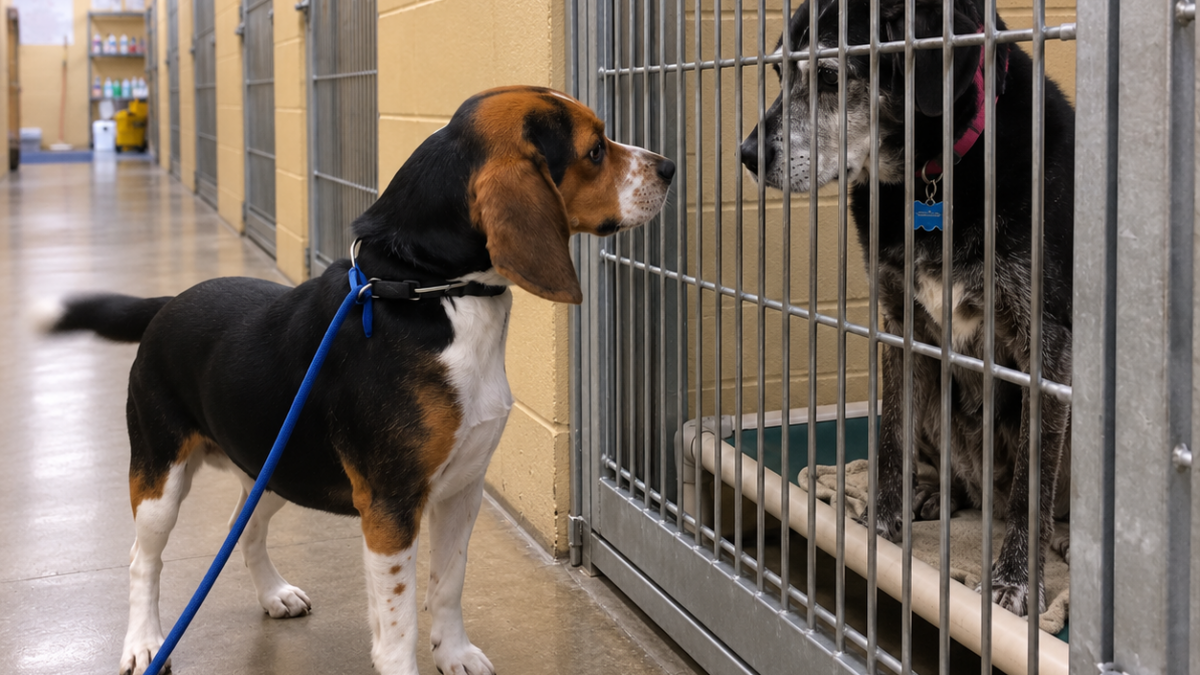
Two days after I watched Rusty leave our Springfield rescue with a brand-new collar, a soft bed waiting at home, and a family so excited they could barely stop taking pictures of him, I unlocked the shelter one morning and found the little Beagle sitting calmly outside the front door as if his adoption had never happened.
His new family rushed over embarrassed and frightened, fixed the gate they believed he had slipped through, and took him home again—only for Rusty to appear on our doorstep the very next morning, muddy, exhausted, and somehow even more determined.
By the third escape, I stopped believing we were dealing with a loose latch, because Rusty wasn’t wandering randomly through Springfield at all—he was coming back to us for something specific, and none of us had figured out what it was.
I had worked at the rescue long enough to recognize the usual reasons adopted dogs came back.
Sometimes the match simply wasn’t right.
A dog turned out to be too energetic for an apartment.
A child developed allergies.
A resident dog refused to accept the newcomer.
Sometimes people underestimated how much patience a frightened animal needed.
But Rusty’s situation made no sense.
His adopters, Sarah and Ben, had done nearly everything we asked.
They had a fenced yard.
Someone was home most of the day.
They bought the food he already knew, gave him his own bed, and filled a basket with more toys than he had ever seen in our shelter.
Their nine-year-old daughter, Emma, had spent almost an hour sitting on the floor during the adoption meeting because Rusty seemed more comfortable approaching her that way.
When they came to collect him after his first escape, Sarah crouched beside him outside our entrance.
“Rusty,” she whispered, wrapping both hands around his face, “you scared me half to death.”
Rusty licked her chin.
That was what bothered me.
He clearly liked her.
He wagged when Ben approached.
He climbed willingly into their car.
Nothing about him looked like a dog desperate to avoid his new family.
I checked the backyard myself that afternoon.
Ben walked me around the fence.
“I found this loose board,” he said. “I reinforced it.”
“What about the gate?”
“New latch.”
“Any digging?”
“Not that we saw.”
Sarah stood on the patio with Rusty beside her.
“He sleeps in Emma’s room,” she said. “He follows me into the kitchen. Yesterday he stole half a sandwich off the counter.”
I smiled.
“That sounds like Rusty.”
“So why does he keep leaving?”
I didn’t have an answer.
The next morning, I got one more phone call.
It was my coworker Jenna.
“You’re going to want to come in early.”
“Why?”
A pause.
“He’s here again.”
I sat upright.
“Rusty?”
“Front steps.”
“How?”
“No idea.”
When I reached the shelter, Rusty was lying beside the door with his nose resting between his paws.
His paws were dirty.
His breathing was fast.
He had clearly traveled some distance.
But when he saw me, his tail thumped against the concrete.
I crouched.
“What are you doing?”
He stood and walked toward the entrance.
Not toward me.
Toward the door.
That detail stayed in my head.
Sarah arrived fifteen minutes later looking exhausted.
“I don’t understand.”
Neither did I.
For the first time, I raised the possibility nobody wanted to hear.
“Maybe he isn’t adjusting.”
Sarah looked at me.
“You mean he doesn’t want us?”
“I don’t know.”
Emma had come with her that morning.
At those words, the girl’s face fell.
Rusty walked directly over and leaned against her legs.
Emma dropped to her knees.
“He likes me.”
“I know he does.”
“Then don’t make us give him back.”
Sarah put a hand on her daughter’s shoulder.
“No one said that.”
But I saw the fear in her eyes too.
We agreed to try one more time.
This time, Ben installed a camera in the backyard.
They began supervising every outdoor break.
For three nights, nothing happened.
Then on the fourth morning, Rusty vanished again.
Ben called before sunrise.
“I don’t know how he did it.”
I drove straight to the shelter.
Rusty was already there.
But this time I didn’t immediately call the family.
Instead, I unlocked the front door and stepped aside.
Rusty hurried inside.
He passed his old kennel without even looking at it.
That stopped me.
“Jenna,” I called.
She came from the office.
Rusty trotted down the main hallway.
Not confused.
Not sniffing around.
He knew exactly where he was going.
Sarah and Ben arrived minutes later, and I held up my hand before they called his name.
“Wait.”
Rusty reached the end of the hall.
Then he stopped in front of a kennel belonging to an old mixed-breed dog named Murphy.
Murphy lifted his head.
And the instant their eyes met, both dogs began whining.
Sarah stared at me.
“What is this?”
I didn’t answer.
Because Rusty was pressing his nose through the kennel bars—and Murphy was doing the same thing from the other side.
PART 2
For a few seconds, nobody moved.
Rusty’s entire body was wagging.
Not just his tail.
His hips swung from side to side, his paws danced against the concrete, and a high, breathless whine came from somewhere deep in his throat.
Murphy had been asleep when we entered.
Now the old dog was standing.
That alone surprised me.
Murphy was probably ten or eleven, although nobody knew his exact age. He had a gray face, one ear that folded strangely, and the stiff back legs of a dog who no longer saw much point in wasting energy.
Most mornings, Murphy took his time getting up.
Not now.
He pushed himself toward the kennel door.
Rusty shoved his nose between the bars.
Murphy pressed his against it.
Then both dogs began making those soft, ridiculous noises dogs sometimes make when emotion is too big for their bodies.
Sarah looked from them to me.
“Do they know each other?”
I felt something inside me drop.
Of course they knew each other.
The moment I saw them together, I was embarrassed that none of us had understood sooner.
“They were here together,” I said slowly.
“For how long?”
I looked at Jenna.
She already knew where my thoughts had gone.
“Almost eight months,” she said.
Ben frowned.
“Together meaning what?”
I opened Murphy’s kennel.
Rusty immediately pushed inside.
Murphy stepped toward him.
Rusty licked the old dog’s face.
Murphy leaned his chest against Rusty’s shoulder.
Then, as if they had rehearsed it, the two dogs turned in a circle and settled side by side on Murphy’s bed.
Sarah covered her mouth.
“Oh.”
That one sound carried everything.
Jenna leaned against the wall.
“I can’t believe we missed this.”
Neither could I.
It wasn’t that we hadn’t known Rusty and Murphy were friendly.
We knew.
Everyone at the shelter knew.
They had arrived during the same week.
Rusty had been picked up as a stray near a neighborhood on the south side of town.
Murphy had been surrendered after his elderly owner entered assisted living and nobody in the family could take him.
Their kennels happened to be next to each other.
The friendship started slowly.
At first, Rusty barked constantly.
Beagles can have opinions.
Rusty had all of them.
He barked at feeding carts.
At doors.
At volunteers carrying leashes.
At other dogs walking past.
Murphy barely reacted.
He would lie on his bed and watch Rusty perform.
Then one afternoon, a volunteer put them in the exercise yard together.
Rusty sprinted in circles.
Murphy stood in the center looking offended.
Rusty ran toward him.
Stopped.
Play-bowed.
Murphy turned away.
Rusty tried again.
Nothing.
Again.
Murphy finally chased him for about six feet.
That was apparently enough.
From that day on, they were almost always together.
They played outside.
They walked together when volunteers had time to take both.
At meals, Rusty would finish first and stare through the fence while Murphy ate slowly.
At night, their beds ended up pushed toward the shared kennel wall.
We joked about them.
“The brothers.”
“The odd couple.”
“The old man and the troublemaker.”
But shelters are busy places.
Dogs arrive.
Dogs leave.
Medical cases appear.
Adoption applications need processing.
Laundry never ends.
What seems obvious later can somehow hide in routine.
Rusty was younger.
Smaller.
Friendlier with strangers.
He received more adoption interest.
Murphy did not.
When Sarah’s family chose Rusty, we celebrated.
We took his adoption picture.
Emma knelt beside him holding the little sign we used for departure photos.
ADOPTED
Rusty looked happy.
He was happy.
That was the complicated part.
Nothing about his new home was wrong.
We had simply removed half of his world and expected him to understand.
Sarah stood in the hallway staring at the two dogs.
“How long have they been like this?”
“Since shortly after they arrived.”
“And nobody told us?”
There was no accusation in her voice at first.
That somehow made it worse.
“I’m sorry.”
Ben folded his arms.
“You knew they were bonded?”
I hesitated.
“Not officially.”
“What does that mean?”
“We knew they were close.”
“How close?”
Jenna answered quietly.
“Very.”
Ben looked toward the kennel.
Rusty had put his chin across Murphy’s front leg.
Murphy’s eyes were closed.
“What happened after we adopted Rusty?”
That question hurt.
Because now I knew exactly what had happened.
I had noticed Murphy becoming quieter.
I had simply interpreted it as age.
After Rusty left, Murphy stopped greeting people at the front of his kennel.
He stopped getting excited when volunteers carried leashes.
He spent more time lying against the side wall—the wall that had once separated him from Rusty.
His food intake dipped for a couple of days.
Nothing dramatic enough to trigger a medical emergency.
Just enough to make us say, “Murphy seems off.”
We checked him.
His vitals were fine.
His arthritis was unchanged.
He ate eventually.
So we moved on.
Now the explanation was lying beside him.
Sarah crouched outside the kennel.
“Rusty wasn’t running away from us.”
“No.”
Emma stood beside her.
“He was coming to Murphy.”
“Yes.”
The girl stared through the bars.
Then she whispered, “Because Murphy was alone.”
Nobody answered.
We didn’t need to.
Ben looked at me.
“How far is our house from here?”
“About two miles by road.”
“He crossed all that?”
“Apparently.”
Sarah’s face changed.
Traffic.
Intersections.
Dark streets.
Suddenly Rusty’s repeated escapes were not only mysterious.
They were dangerous.
“He could’ve been hit.”
“I know.”
She stood.
“Then we cannot let this happen again.”
Ben nodded.
“We need to figure out how he’s getting out.”
He was right.
Understanding Rusty’s reason did not remove the practical problem.
A dog who repeatedly escaped could die.
So we began there.
The family took Rusty home again that afternoon.
But this time, Murphy mattered in every conversation.
Jenna pulled Murphy’s file.
I pulled Rusty’s.
We went through eight months of volunteer notes.
Little details appeared everywhere.
Rusty refused yard until Murphy came out.
Murphy more active when paired with Rusty.
Both slept beside fence after evening walk.
Rusty shared toy with Murphy.
Murphy barked when Rusty taken to vet.
We had documented the evidence without understanding what it added up to.
That made me feel worse.
Later that evening, I called Sarah.
“I owe you an apology.”
She was quiet.
“We should have told you more clearly how attached they were.”
“You didn’t know he’d do this.”
“No.”
“But?”
“But we knew enough that you deserved the information.”
She sighed.
“I’m not angry.”
“You’re allowed to be.”
“I’m mostly worried.”
“So am I.”
Rusty was sitting beside her, she told me.
Emma was doing homework on the floor.
Rusty kept walking to the front window.
“Looking toward the shelter?”
“I don’t know.”
We talked about practical steps.
No unsupervised yard time.
Check every section of fence.
Use a leash temporarily even inside the fenced yard.
Microchip information confirmed.
ID tag always on.
Ben added wire along the bottom of the fence.
For two days, Rusty stayed home.
On the third night, the camera caught the answer.
At 2:13 in the morning, Rusty walked into the backyard.
He inspected the fence.
Then moved behind a shed.
There, almost hidden by shrubs, a small gap existed where the fence met uneven ground.
Rusty flattened himself.
Pushed his head through.
Twisted sideways.
And disappeared.
The entire escape took less than thirty seconds.
Ben sent me the video.
Found it.
He repaired the gap immediately.
That solved one problem.
It created another.
Rusty could no longer leave.
For the first time, we saw what happened when he couldn’t return to Murphy.
He became restless.
He paced at night.
He whined near the back door.
He ate, but without enthusiasm.
He still played with Emma.
Still followed Sarah.
Still slept on the soft bed.
But something in him seemed unfinished.
Sarah called after four days.
“He’s not miserable.”
“I understand.”
“That’s what makes this hard.”
“What is he doing?”
“Waiting.”
“For what?”
“I think you know.”
I did.
At the shelter, Murphy was worse.
Without Rusty appearing unexpectedly every couple of days, Murphy stopped waiting at the front entrance.
He stayed in bed.
Volunteers tried encouraging him.
He would walk.
Briefly.
Then turn toward the building.
The exercise yard no longer interested him.
One afternoon, I sat in his kennel.
Murphy didn’t get up.
I scratched his neck.
“You know he has a family now.”
His eyes remained closed.
“That’s supposed to be good news.”
Nothing.
“You could at least pretend you’re happy for him.”
Murphy sighed.
I laughed despite myself.
“You two are making my life difficult.”
The next day, Sarah brought Rusty for a scheduled visit.
We had decided to see whether regular playdates might help both dogs.
The result was immediate.
Rusty jumped out of the car.
His nose hit the ground.
He pulled Sarah toward the entrance.
Inside, Murphy heard him before he saw him.
The old dog stood.
Rusty rounded the corner.
Murphy barked.
I had not heard Murphy bark in weeks.
We took them to the yard.
Rusty ran circles around him.
Murphy managed half a lap.
Then Rusty slowed.
That mattered.
He adjusted his pace to Murphy.
They walked together along the fence.
Rusty sniffed something.
Murphy sniffed the same spot.
Rusty found a stick.
Murphy took it.
Rusty allowed him.
Emma sat on the grass watching.
“They really are brothers.”
Sarah looked at me.
“Yeah.”
For the next week, we arranged two more visits.
Each one helped.
Each goodbye hurt.
The first time Sarah tried leading Rusty toward the parking lot, he planted all four paws.
“Come on.”
Rusty pulled backward.
Murphy stood behind the fence.
Rusty whined.
Emma started crying.
“Mom.”
Sarah crouched.
“Sweetheart.”
“He doesn’t want to leave.”
“I know.”
“Then why are we making him?”
That question stayed in the air.
Sarah looked at me.
I had no authority to answer it.
Rusty was their dog now.
Murphy remained ours.
Later, after they left, Jenna sat beside me in the office.
“You’re thinking it.”
“So are you.”
“Bonded adoption.”
“Maybe.”
“We should’ve placed them together from the beginning.”
“Maybe.”
Jenna frowned.
“Stop saying maybe.”
“We didn’t have evidence they couldn’t function separately.”
“We do now.”
That was true.
“But Sarah’s family adopted one dog.”
“So?”
“So adding a second dog is not a small request.”
Murphy was older.
He had arthritis.
His medical needs would likely increase.
He was larger than Rusty.
Double food.
Double veterinary bills.
Double responsibility.
You do not guilt a family into another adoption because a story feels emotional.
That would be unfair to everyone.
Especially Murphy.
So we did not ask.
That became important later.
Sarah asked us.
It happened on a Tuesday evening.
She called after the shelter had closed.
“I need information.”
“About?”
“Murphy.”
I sat up.
“What information?”
“Everything.”
I tried not to react.
“Age estimate?”
“Yes.”
“Medical?”
“Yes.”
“Temperament?”
“Yes.”
“Adoption fee?”
“Yes.”
I smiled.
“Sarah.”
“Don’t.”
“Don’t what?”
“Sound excited yet.”
“Okay.”
“We’re only discussing it.”
“Understood.”
“Ben is not convinced.”
“Also understood.”
“Emma is extremely convinced.”
“That I believe.”
Sarah exhaled.
“Can you send me his file?”
“Not the internal file, but I can give you his medical summary and adoption information.”
“Do that.”
I sent everything.
Then I waited.
Two days.
Nothing.
Murphy had no idea his future was being debated in a house two miles away.
But later, Sarah told me what happened there.
Not because I witnessed it.
Because she described the conversation when everything was over.
She and Ben sat at the kitchen table after Emma went to bed.
Rusty was beneath the table.
Sarah placed Murphy’s medical summary between them.
Ben read it.
“Arthritis.”
“Manageable.”
“For now.”
“I know.”
“He’s older.”
“I know.”
“He may cost us a lot.”
“I know.”
“We just adopted a dog.”
“I know.”
Ben leaned back.
“So say something besides ‘I know.’”
Sarah looked toward Rusty.
“What if this is part of adopting Rusty?”
Ben frowned.
“We did not adopt Murphy.”
“No. But Rusty did.”
That sentence apparently ended the conversation for a while.
Ben had practical concerns.
Reasonable ones.
Could Murphy handle the stairs?
Would the dogs compete over food?
Would two dogs change their travel plans?
What if Murphy required expensive treatment?
What if Rusty eventually stopped caring and they had adopted a senior dog they had never originally chosen?
Sarah answered the only way she could.
“We don’t know.”
The next morning, Emma found the paperwork on the kitchen table.
She read Murphy’s name.
Then woke her parents before six.
“Are we getting him?”
“No.”
“Then why is his paper here?”
“We’re considering it.”
That was enough.
For the next three days, Emma apparently conducted the least subtle campaign in family history.
She drew a picture of Rusty and Murphy together.
Placed it on the refrigerator.
She wrote a list titled:
REASONS MURPHY SHOULD LIVE HERE
- Rusty loves him.
- Murphy loves Rusty.
- We have a couch.
- Old dogs are good.
- Rusty will stop escaping.
- I will help.
- He looks sad.
- PLEASE.
Ben added beneath number six:
Define “help.”
Emma wrote:
EVERYTHING.
Sarah took a picture and sent it to me.
I did not respond beyond a laughing face because this had to be their decision.
At the shelter, Murphy continued waiting.
Then one Saturday morning, Sarah, Ben, and Emma walked through our door.
Without Rusty.
That immediately caught my attention.
Sarah held a folder.
Ben looked resigned.
Emma looked as if she might explode.
I came around the desk.
“Everything okay?”
Sarah placed the folder in front of me.
Inside was a completed adoption application.
Murphy’s name was written at the top.
I looked at Ben.
He raised one hand.
“I have conditions.”
Emma groaned.
“Dad.”
“What?”
“He’s acting like we’re negotiating with a bank.”
Ben ignored her.
“I want Rusty and Murphy evaluated together in a home-style room first.”
“Absolutely.”
“I want to understand Murphy’s medications.”
“Of course.”
“I want to know what his future medical costs might realistically look like.”
“We’ll go over that.”
“And if the dogs don’t settle together outside the shelter environment—”
Sarah interrupted.
“Ben.”
“No. This matters.”
He was right.
“If it isn’t a good match, we stop.”
I nodded.
“That’s exactly what we would recommend.”
Emma looked horrified.
“But it is a good match.”
“We believe so,” I said. “We still do it correctly.”
The adoption process took another week.
First, we brought Rusty back.
The reunion was almost embarrassing in its enthusiasm.
Rusty barked.
Murphy barked.
Rusty rolled onto his back.
Murphy stepped on him.
Neither cared.
Then we placed them together in our family meeting room.
No kennel bars.
No yard fence.
Just two dogs in a quiet room with Sarah, Ben, Emma, and me.
Rusty explored.
Murphy sniffed the couch.
Emma sat on the floor.
Within ten minutes, Rusty lay down.
Murphy walked toward him.
Rusty shifted slightly.
Murphy lowered himself beside him.
Their backs touched.
Then both fell asleep.
Ben stared.
“That’s it?”
I whispered, “What were you expecting?”
“I don’t know. More drama.”
“Beagles can provide that later.”
Sarah smiled.
Then Murphy snored.
Emma covered her mouth to stop herself laughing.
Next came the medical discussion.
Murphy’s arthritis required an anti-inflammatory plan as needed and joint support.
His bloodwork was good for his age.
His heart sounded normal.
Dental work might be needed eventually.
Nothing was urgent.
But senior dogs are senior dogs.
We did not minimize it.
Ben appreciated that.
“What if something happens six months from now?”
“It might.”
“A year?”
“It might.”
“How long do you think he has?”
I hated that question.
Not because it was wrong.
Because it had no honest answer.
“We don’t know.”
Ben looked through the glass at Murphy.
“I don’t want Emma destroyed.”
Sarah answered before I could.
“She’s going to lose pets eventually.”
Ben looked at her.
“She’s nine.”
“And Murphy is alive now.”
That silenced him.
Sarah continued.
“I don’t want us choosing not to love him because we might have to grieve him sooner.”
Ben rubbed his face.
“I hate when you say reasonable things.”
“I know.”
He looked at me.
“How soon can we take him?”
Emma screamed from the hallway.
Apparently she had been listening.
The adoption happened on a Friday afternoon.
No big event.
No reporters.
No crowd.
Just the people who mattered.
I fitted Murphy with a new collar.
Emma had chosen dark green.
Rusty arrived wearing blue.
“Matching?” I asked.
Emma shook her head.
“Brothers don’t have to match.”
Fair enough.
Murphy stood near the exit.
For eight months, that doorway had meant walks.
Vet appointments.
Visitors.
Never permanence.
I clipped the leash to his collar and handed it to Ben.
Ben looked down.
“You ready?”
Murphy stared up at him.
Rusty was already beside the door.
Sarah opened it.
Both dogs stepped outside.
Murphy paused.
Sunlight hit his face.
He sniffed the air.
Rusty pulled forward.
Murphy followed.
We took the adoption photograph on the front steps.
This time there were two dogs.
Emma knelt between them holding the sign.
ADOPTED TOGETHER
Rusty would not sit still.
Murphy sat perfectly.
Ben tried holding Rusty.
Rusty licked his face.
Sarah laughed.
The picture ended up slightly blurry.
It remains one of my favorites.
Before they drove away, Sarah hugged me.
“Thank you.”
“I should be thanking you.”
“For what?”
“For listening to him.”
She looked toward Rusty.
“He wasn’t subtle.”
“No.”
Rusty had spent several nights making a two-mile argument.
Finally, we understood.
The first night at home went better than anyone expected.
Sarah sent me a picture at 9:43 p.m.
Murphy was lying in the expensive orthopedic bed they had bought for him.
Rusty was squeezed beside him.
Half of Rusty’s body hung off the edge.
The message read:
We bought two beds. Apparently that was unnecessary.
The next morning came another photo.
Empty beds.
Both dogs were on the couch.
Ben was sitting on the floor.
I’ve lost my furniture.
I responded:
Adoption successful.
But not everything was perfect.
That mattered.
Murphy had lived in a shelter for eight months.
Before that, he had lived with one older man in a quiet house.
Sarah’s home was different.
Doors opening.
School backpacks.
Television.
Neighbors.
Kitchen noises.
Emma running upstairs.
The first time the dishwasher started, Murphy left the room.
Rusty followed him.
The first time Ben dropped a pan, Murphy hid behind the couch.
Rusty stood beside him.
The first thunderstorm brought another problem.
Murphy became restless.
Rusty did too.
Not frightened exactly.
Just alert because Murphy was.
Sarah sat with both.
By the third week, Murphy knew the household routine.
Breakfast.
Morning walk.
Emma leaving for school.
Sarah working from home.
Afternoon nap.
Emma returning.
Dinner.
Evening yard time.
Bed.
Rusty never tried escaping.
Not once.
The repaired fence mattered.
But everyone knew that wasn’t the only reason.
There was nowhere he needed to go.
Murphy was already there.
A month after adoption, Sarah brought both dogs to the rescue for a check-in.
Rusty bounded through the door.
For half a second, I wondered.
Would he try to stay?
He ran down the hallway.
Murphy followed.
They sniffed their old kennels.
Rusty looked inside.
Then turned around.
That was all.
No whining.
No pacing.
No desperate attempts to reach anything.
Murphy walked toward the front.
Rusty went with him.
Emma laughed.
“He wants to leave.”
I opened the door.
Rusty trotted straight toward their car.
That moment mattered more to me than I expected.
The shelter had once been the place he needed to return to.
Now it was simply somewhere he had lived.
His home had moved.
Several months passed.
Sarah sent occasional updates.
Murphy gained a little weight.
We had to remind them not to overfeed.
Rusty taught Murphy to bark at squirrels.
Murphy taught Rusty the strategic value of sleeping most of the afternoon.
Emma kept her promise to help.
Mostly.
She walked them with her parents.
Filled water bowls.
Brushed Murphy carefully because he liked it.
She also tried dressing Rusty in a Halloween costume.
Rusty escaped from the costume.
Not the yard.
Ben sent me that distinction in capital letters.
HE ESCAPED THE HOT DOG SUIT. NOT THE PROPERTY.
Progress.
Then winter arrived.
Murphy’s arthritis became more noticeable.
Cold mornings were difficult.
Sarah called.
“He hesitates at the back steps.”
“Have you talked with your vet?”
“Yes.”
They adjusted his management.
Ben built a shallow ramp from the deck.
Rusty refused to use it at first.
Murphy used it immediately.
Three days later, Rusty used it because Murphy did.
“Apparently Murphy is the trainer now,” Sarah said.
He always had been, in a way.
Rusty’s confidence at the shelter had hidden something.
He had depended on Murphy.
Not because Murphy was younger.
Stronger.
Faster.
He wasn’t.
Murphy was steady.
When the shelter got loud, Murphy slept.
When Rusty became overstimulated, Murphy ignored him until he settled.
When volunteers took them outside, Rusty checked where Murphy was.
The older dog gave structure to the younger one.
At home, that relationship continued.
Sarah described one night when fireworks started unexpectedly somewhere nearby.
Rusty became agitated.
He paced near the window.
Murphy stayed on his bed.
After several minutes, Rusty walked over.
Circled.
Lay beside him.
Stopped pacing.
No human training session could have reproduced it that cleanly.
They understood each other.
A year after Murphy’s adoption, Sarah’s family came to our annual fundraiser.
Rusty and Murphy arrived wearing bandanas.
Rusty immediately recognized half the volunteers.
Murphy accepted attention like an elderly politician.
At one point, a new volunteer asked Sarah, “Which one did you adopt first?”
“Rusty.”
“And then Murphy?”
“One week later.”
“Why?”
Sarah pointed toward Rusty.
“He refused to leave his brother behind.”
The volunteer laughed, assuming she meant it metaphorically.
Sarah smiled.
“No. Literally.”
Then she told the story.
By then, we had told it many times.
But hearing Sarah tell it felt different.
She didn’t describe Rusty as difficult.
She didn’t say he rejected them.
She said:
“He kept trying to show us we had forgotten someone.”
That became the sentence I remembered.
We had forgotten someone.
Not intentionally.
Nobody wanted Murphy hurt.
Nobody had decided he didn’t matter.
We had simply treated Rusty’s adoption as an individual success.
One dog got a home.
Good news.
Move on.
Rusty disagreed.
His idea of home included Murphy.
He was willing to cross dark streets repeatedly to make that point.
At the fundraiser, Murphy grew tired early.
He lay beneath the table.
Rusty stood nearby.
A puppy came bouncing over.
Rusty wanted to play.
He looked toward Murphy.
Then toward the puppy.
Murphy stayed asleep.
Rusty played for about a minute.
Then returned to Murphy.
That small choice caught my attention.
Their relationship had changed.
At the shelter, Murphy had been Rusty’s anchor.
As Murphy aged, Rusty became his.
When Murphy struggled standing, Rusty waited.
When walks slowed, Rusty slowed too.
Sarah once sent a video from their backyard.
Rusty ran toward the far fence.
Stopped.
Looked back.
Murphy was halfway across the yard.
Rusty waited until he caught up.
Then both continued together.
I watched the clip several times.
The young dog who once raced two miles to reach Murphy now refused to walk fifty yards without him.
Time passed.
Murphy’s face became whiter.
Rusty developed a little gray around his muzzle too.
Emma grew taller.
The couch acquired permanent dog-shaped dents.
Life became ordinary.
That was the best possible result.
Most rescue stories are dramatic at the beginning.
Abandonment.
Injury.
Fear.
Adoption.
People love the moment a dog walks through the shelter doors for the last time.
But what happens afterward is usually quieter.
Morning walks.
Vet bills.
Mud on the floor.
Food bowls.
A chewed shoe.
A dog waking you at 5:30 because he has decided breakfast exists.
That quiet part is the real life we hope they get.
Rusty and Murphy got it.
Then, almost three years after Murphy’s adoption, Sarah called me.
Her voice told me something was wrong before she said anything.
“It’s Murphy.”
I sat down.
“What happened?”
“He collapsed this morning.”
My hand tightened around the phone.
“Is he at the vet?”
“Yes.”
“What are they saying?”
“They found a mass.”
There are sentences that divide a day.
Everything before them feels normal.
Everything after does not.
“Where?”
“Near his spleen.”
I closed my eyes.
“What are the options?”
“We’re waiting on more information.”
“Is he stable?”
“For now.”
I heard Rusty whining in the background.
“Is Rusty there?”
“We brought him.”
That mattered.
The veterinary clinic allowed Rusty into the room once Murphy was stable.
Sarah later told me Rusty walked slowly toward him.
No wild greeting.
No bark.
He sniffed Murphy’s face.
Then lay down beside the treatment table.
For hours, he stayed.
The diagnosis was serious.
Murphy was old.
The mass had likely been growing for some time.
Surgery was possible but carried significant risk.
The family faced the kind of decision every pet owner fears.
Ben called me that evening.
“I don’t know what the right choice is.”
“You’re talking to the vet?”
“Yes.”
“What does the vet recommend?”
“She says we should consider his age, his arthritis, recovery, quality of life.”
“That sounds right.”
Ben was quiet.
“I don’t want to quit on him.”
“Choosing comfort isn’t quitting.”
“What if we have more time?”
“What kind of time?”
He didn’t answer.
That was the real question.
Days?
Months?
Pain?
Recovery?
No one could promise.
They took Murphy home while they considered options.
Medication kept him comfortable.
His appetite returned slightly.
For several days, Murphy seemed almost like himself.
That made the decision harder.
He ate chicken.
Walked into the yard.
Slept beside Rusty.
Emma lay on the floor with both of them.
Then Murphy had another collapse.
This one was worse.
The family knew.
They called the veterinarian.
They chose to say goodbye before Murphy’s final hours became frightening.
Sarah asked me if I wanted to come.
I did.
I drove to their house on a cold Saturday afternoon.
The home was quiet when I entered.
No television.
No music.
Murphy lay on his orthopedic bed near the living-room window.
Rusty lay beside him.
Emma sat on the floor.
She was twelve now.
Not the nine-year-old who had written PLEASE on an adoption list.
But when she looked at me, I saw the same child.
“Hi.”
I sat beside her.
“Hi.”
Murphy lifted his head.
I scratched beneath his chin.
“Hey, old man.”
His tail moved once.
Rusty sniffed my sleeve.
Then rested his head on Murphy’s side.
Sarah brought coffee nobody drank.
Ben stood by the window.
The veterinarian arrived about thirty minutes later.
She explained everything.
Gently.
Clearly.
Nobody rushed.
Murphy ate one last piece of chicken.
Ben laughed through tears.
“He still wants food.”
“Of course,” Sarah whispered.
Emma kissed Murphy’s forehead.
“You’re a good boy.”
Rusty stayed against him.
When the medication began making Murphy sleepy, something happened that broke every person in that room.
Murphy shifted his head.
Rusty moved closer.
Murphy rested his muzzle across Rusty’s front paws.
Exactly the way Rusty had once rested his chin across Murphy’s leg in the shelter.
No kennel bars.
No concrete floor.
No separation.
Just the two of them on the same bed in the home Rusty had fought so hard to share.
Murphy died there.
Quietly.
His family touching him.
Rusty beside him.
He did not die alone.
That mattered because for months after Rusty’s first adoption, that had been my biggest hidden fear.
What if Murphy spent the rest of his life waiting beside an empty kennel?
He didn’t.
He got nearly three years in a home.
Three years of couch naps.
Backyard sun.
Emma brushing his fur.
Ben building ramps.
Sarah adjusting medicine.
Chicken he probably shouldn’t have eaten.
And Rusty.
Always Rusty.
Afterward, Rusty struggled.
Of course he did.
For several days, he searched.
He checked Murphy’s bed.
The backyard.
The hallway.
He would stand near the front door when cars arrived.
At night he whined.
Sarah moved Murphy’s bed but did not remove it.
Rusty slept on it.
Emma began sleeping downstairs beside him for the first week.
“He helped Murphy when Murphy needed him,” she told her mother. “Now he needs us.”
That sentence sounded older than twelve.
Slowly, Rusty adjusted.
He ate normally again.
Started carrying toys around the house.
Barked at squirrels.
Stole sandwiches.
But something about him became calmer.
Maybe age.
Maybe grief.
Maybe both.
A few months later, Sarah brought Rusty to visit the shelter.
He walked inside.
Sniffed the hallway.
When we reached Murphy’s old kennel area, Rusty stopped.
The kennels had been reorganized long ago.
Another dog lived there now.
Rusty stood quietly.
I wondered what he remembered.
Dogs do not grieve in words.
They do not explain memories.
They simply carry changes in routine, scent, and absence.
Rusty sniffed the floor.
Then walked toward me.
I crouched.
He leaned against my legs.
“You did good.”
His tail moved.
“You were a pain.”
Another wag.
“You nearly gave all of us heart attacks.”
Sarah laughed.
“He still does.”
We walked toward the front entrance.
Outside, Emma waited beside the car.
Rusty saw her.
His ears lifted.
He ran.
Not back toward the kennels.
Forward.
Toward his family.
That image stayed with me.
Years earlier, Rusty had repeatedly run away from that same family.
At least that was what we thought.
Now I understood the truth more clearly than ever.
He had never been running away from anyone.
He had been running toward someone.
There is a difference.
Sarah’s family gave Rusty a home.
Rusty made sure Murphy got one too.
And when Murphy’s life eventually ended, it ended in the home they had shared.
Not behind kennel bars.
Not waiting for the sound of his friend returning down a shelter hallway.
He had Rusty beside him until the end.
Today, Rusty is older.
His face has begun turning gray.
He no longer tries escaping fences.
Ben jokes that Rusty now prefers the couch too much to consider adventure.
Emma is a teenager.
She still keeps the original adoption picture in her room.
The blurry one.
Rusty on one side.
Murphy on the other.
Emma between them holding the sign.
ADOPTED TOGETHER
After Murphy died, the family had a small wooden frame made for his collar.
They placed it near the photograph.
Rusty sometimes sleeps beneath it.
Not because anyone taught him to.
That just happens to be his favorite corner of the room.
There are still two dog beds in the house.
One belongs to Rusty.
The other was Murphy’s.
Sarah once considered removing the second.
Ben stopped her.
“Leave it.”
“For Rusty?”
“For us.”
So it stayed.
Some nights, Rusty chooses his own bed.
Some nights, the couch.
And every now and then, Sarah finds him curled tightly in Murphy’s old bed, despite having more room anywhere else in the house.
The first time she sent me a picture of that, I stared at it for a long time.
Rusty was asleep.
His nose tucked beneath his tail.
One paw stretched into the empty half of the bed.
Years earlier, at the shelter, Rusty and Murphy had pushed their beds against the fence separating their kennels so they could sleep as close together as possible.
Later, in their home, they squeezed into the same bed even when two were available.
Now only Rusty remained.
But he still slept the same way.
Close to where his brother used to be.
I used to think Rusty’s repeated escapes were a behavioral problem we needed to solve.
A loose fence.
Separation anxiety.
Failure to adjust.
I was wrong about all of it.
Rusty knew exactly what he was doing.
He had been adopted.
He had a bed.
Toys.
A child who loved him.
A safe backyard.
Food.
Warmth.
Everything we thought a shelter dog could possibly want.
But Rusty understood something the rest of us had missed.
Home was not only a place.
It was who was waiting there.
And until Murphy came with him, Rusty’s new home was still missing someone.
Two days after I watched Rusty leave our Springfield rescue wearing a brand-new collar and sitting proudly between the family who had just adopted him, I unlocked the shelter one morning and found the little Beagle sitting alone on our front steps as if the adoption had never happened.
His new family rushed over terrified, repaired the gate they believed he had slipped through, and took him home again—only for Rusty to return the following morning, muddy, exhausted, and stubbornly waiting outside the exact same door.
By the fourth escape, I knew he wasn’t getting lost, because Rusty was crossing nearly two miles of Springfield with such purpose that the question was no longer how he kept getting back to us—it was who, or what, he believed he had left behind.
I had worked at the rescue for seven years, and I thought I understood dogs.
I knew fear.
I knew separation anxiety.
I knew the confusion that sometimes followed adoption when an animal went from a noisy kennel to a quiet living room overnight.
But Rusty didn’t look frightened.
That was what bothered me.
When Sarah pulled into our parking lot after his first escape, she jumped out before the car had completely settled into park.
“Rusty!”
The little Beagle stood.
His tail started wagging.
Sarah dropped to her knees and wrapped her arms around him.
“You scared me to death.”
Rusty licked her face.
Ben came around the other side of the car.
“How did he get here?”
“I was hoping you could tell me.”
Ben stared toward the road.
Their home was almost two miles away.
Rusty had crossed several neighborhood streets and at least one intersection.
“We think he slipped under the fence,” Sarah said.
“We’ll fix it.”
Their nine-year-old daughter, Emma, opened the back door.
“Rusty, come here.”
He ran straight to her.
That was important.
Rusty clearly liked them.
He climbed willingly into their car.
He sat beside Emma.
He even looked back through the window with that ridiculous Beagle smile before they drove away.
So I told myself it was simple.
Loose fence.
Curious dog.
Problem solved.
The next morning, my coworker Jenna called me before seven.
“You’re going to think I’m joking.”
“What?”
“Rusty’s here.”
I sat up in bed.
“What do you mean, here?”
“Front door.”
When I arrived, he was sitting exactly where I had found him the day before.
This time his paws were muddy.
His tongue hung from the side of his mouth.
But his tail started wagging when I approached.
“Rusty,” I said, crouching in front of him. “What are you doing?”
He stood.
Then walked toward the shelter door.
Not toward me.
Toward the building.
I noticed it.
I just didn’t understand it yet.
Sarah came back.
She looked embarrassed.
“I swear we watched him.”
“Don’t be embarrassed.”
“He slept in Emma’s room. He ate breakfast. He played with the stuffed fox we bought him. He follows me everywhere.”
“So he isn’t avoiding you.”
“I don’t think so.”
Emma stood beside her mother.
Her eyes were wet.
“Does he hate our house?”
“No.”
“How do you know?”
Rusty answered for me.
He walked over and leaned against Emma’s legs.
She immediately hugged him.
“He likes you,” I said.
“Then why does he leave?”
I had no answer.
After the third escape, Ben reinforced the entire fence.
He replaced the latch.
Added wire along the bottom.
Checked every board.
They installed a camera.
For three nights, Rusty stayed home.
Then, at 5:40 on the fourth morning, my headlights swept across the shelter parking lot and caught a familiar shape sitting near the entrance.
Rusty.
Again.
I got out.
This time, I didn’t call Sarah immediately.
I unlocked the door.
Rusty shot past me.
“Jenna.”
She came from the office.
“What?”
“Watch him.”
Rusty hurried through the lobby.
He passed his old kennel without slowing.
That stopped me.
If he missed the shelter itself, I expected him to return to his familiar space.
He didn’t even look at it.
Instead, he continued down the hall.
Past the medical room.
Past laundry.
Past three rows of kennels.
Then he stopped.
Inside the enclosure in front of him was an older mixed-breed dog named Murphy.
Murphy lifted his gray head.
Rusty whined.
Murphy stood so quickly his arthritic back legs almost slipped.
Then Rusty pushed his nose through the bars.
Murphy pressed his face against him from the other side.
Both dogs began crying.
Behind me, Sarah’s voice suddenly said,
“What am I looking at?”
I turned.
She, Ben, and Emma had just entered.
I looked back at Rusty.
And for the first time, I understood that he had never been trying to get away from his new family.
He had been trying to get back to his old one.
[END OF FACEBOOK OPENING]
[FULL STORY CONTINUATION]
I unlocked Murphy’s kennel.
Rusty pushed past my leg before the door was fully open.
“Easy.”
He ignored me.
He ran straight to Murphy.
The reaction was immediate.
Rusty licked Murphy’s face.
Murphy pushed his head against Rusty’s chest.
Rusty circled him.
Murphy tried to follow.
Within seconds, the two dogs were moving around each other as if the previous days apart had never happened.
Then Rusty climbed onto Murphy’s bed.
Murphy lowered himself beside him.
Rusty put his chin over the older dog’s shoulder.
Silence fell in the hallway.
Emma was the first to speak.
“They’re friends?”
Jenna gave a short laugh.
“More than friends.”
Sarah looked at me.
“How long?”
That question hurt.
“Almost eight months.”
Ben stared.
“Eight months?”
I nodded.
“They came in around the same time.”
“And you knew?”
I hesitated.
That hesitation told him more than any answer.
“You knew,” he said.
“We knew they were close.”
“How close?”
I looked through the kennel door.
Rusty had one front paw draped over Murphy.
Murphy’s eyes had closed.
“Closer than we realized.”
That was the truth.
But it still felt like an excuse.
Rusty arrived at our shelter as a stray.
Animal control had picked him up near a shopping center after employees reported a Beagle running through the parking lot for two days.
He had no microchip.
No collar.
Nobody claimed him.
Rusty was young, probably around three.
Healthy.
Energetic.
Loud.
Very loud.
He barked at the food cart.
Barked at volunteers.
Barked when another dog went outside.
Barked if someone walked past without greeting him.
Barked sometimes for reasons known only to Rusty.
Murphy arrived four days later.
His story was different.
He had lived with an elderly man named Mr. Peterson for most of his life.
When Mr. Peterson suffered a stroke and moved into assisted living, his family tried finding someone to take Murphy.
Nobody could.
One relative lived in an apartment that did not allow dogs.
Another had three animals already.
Someone else lived several states away.
Eventually, Murphy was surrendered to us.
He was around ten.
Maybe eleven.
Quiet.
Gentle.
Confused.
The first week, Murphy spent most of his time facing the kennel door.
Every time footsteps approached, he stood.
Every time the person passed, he lay down again.
He was waiting for the man who had raised him.
That man never came.
We placed Murphy in the kennel beside Rusty because it happened to be available.
At first, their personalities seemed completely incompatible.
Rusty barked.
Murphy ignored him.
Rusty bounced around during feeding.
Murphy ate slowly.
Rusty wanted attention.
Murphy wanted sleep.
Then one afternoon, one of our volunteers named Casey decided to put them in the exercise yard together.
I remember watching from the office window.
Rusty ran three circles around the yard.
Murphy stood in the middle.
Rusty rushed toward him.
Front legs down.
Rear end in the air.
Classic play bow.
Murphy turned his head away.
Rusty tried again.
Murphy ignored him.
Again.
Nothing.
Rusty finally barked directly in Murphy’s face.
Murphy chased him.
Maybe five seconds.
That was apparently enough.
From then on, Rusty followed Murphy everywhere.
Murphy became more active.
Rusty became slightly less insane.
If Rusty became overstimulated in the yard, Murphy would walk away.
Rusty followed.
If Murphy refused a walk, Rusty would wait beside him until he moved.
During thunderstorms, Rusty sometimes became restless.
Murphy slept.
Eventually Rusty would settle beside him.
They balanced each other.
Our volunteers noticed.
We all did.
We joked about them.
“The brothers.”
“The old married couple.”
“Rusty and his babysitter.”
But we never officially labeled them a bonded pair.
That mattered.
If dogs are formally considered bonded, we typically try to place them together.
Rusty and Murphy still functioned independently.
They ate separately.
They could walk separately.
Neither had a medical crisis when the other left the building.
So when Sarah’s family applied for Rusty, we treated his adoption like any other.
They met him twice.
Emma adored him.
Rusty adored Emma.
Their home passed every check.
And because Murphy was a senior dog who had already been overlooked for months, nobody seriously believed the younger, more adoptable Rusty should wait indefinitely for a joint placement that might never come.
So we let him go.
We took pictures.
Emma held the ADOPTED sign.
Everybody clapped.
I remember Murphy standing behind his kennel door when Rusty left.
At the time, I thought he was simply watching the commotion.
Now that image came back differently.
Sarah touched my arm.
“What happened to Murphy after Rusty left?”
I looked at her.
“I think you already know.”
Her face changed.
Murphy had withdrawn.
The first day, he waited near the kennel divider.
Rusty’s empty kennel was cleaned.
New bedding went in.
Murphy remained pressed against the fence.
When volunteers tried taking him outside, he walked but showed little interest.
He stopped approaching potential adopters.
He ate, but slowly.
One morning, Casey wrote in his notes:
Murphy seems depressed today. Missing Rusty?
I remembered reading it.
I had smiled sadly.
Then kept working.
Now I hated myself for that.
Sarah crouched in front of the kennel.
“Murphy.”
The old dog opened one eye.
Rusty’s head remained across his back.
Emma knelt beside her mother.
“He was sad?”
“Yes.”
“Because Rusty left?”
“Probably.”
Emma looked at Rusty.
Then at Murphy.
“That’s why Rusty kept coming back.”
Ben folded his arms.
“But how?”
That was still a problem.
Emotion did not change the fact that Rusty had repeatedly escaped a fenced property and crossed public roads.
“We need to know how he’s getting out,” I said.
Ben nodded.
“And stop it.”
“Yes.”
Emma immediately looked alarmed.
“But then he can’t see Murphy.”
Sarah put an arm around her.
“We’ll figure that part out.”
We took Rusty and Murphy into the exercise yard before the family left.
I wanted to observe them without bars.
Rusty exploded into motion.
Murphy tried following.
After about twenty feet, the old dog slowed.
Rusty noticed.
He stopped.
Turned.
Went back.
Then walked beside Murphy instead.
Sarah saw it too.
“Oh, my God.”
“What?”
“He’s slowing down for him.”
He was.
Rusty, who normally ran like he had somewhere urgently important to be, was deliberately matching Murphy’s stiff pace.
They walked along the fence together.
Stopped at the same tree.
Sniffed the same patch of grass.
Murphy moved toward the shade.
Rusty followed.
Emma sat cross-legged nearby.
“Can Murphy come home with us?”
Nobody answered immediately.
Sarah looked at Ben.
Ben looked at me.
I said carefully, “That’s not a decision anybody needs to make today.”
“But he could?”
“Murphy is available for adoption.”
Emma’s eyes widened.
Sarah immediately said, “Emma.”
“What?”
“We came here for Rusty.”
“Murphy is Rusty’s friend.”
“I know.”
“So?”
“So adopting another dog is a big decision.”
Emma looked toward Murphy.
“He’s already old.”
That sentence caught everyone off guard.
Ben crouched.
“What does that have to do with it?”
“If nobody takes him because he’s old, he’ll stay here.”
Ben’s jaw tightened slightly.
Children sometimes say the exact thing adults are trying not to think about.
Sarah stroked Emma’s hair.
“We are going to take Rusty home today.”
Emma looked disappointed.
“But we’re going to keep talking.”
That was enough.
For now.
Rusty resisted leaving.
The moment Ben clipped on his leash and headed toward the gate, Rusty pulled backward.
Murphy remained beneath the tree.
Rusty stared at him.
Whined.
Murphy lifted his head.
“Come on, buddy,” Ben said.
Rusty did not move.
Emma crouched beside him.
“We’ll come back.”
Rusty stared at Murphy.
Emma touched his ear.
“I promise.”
Eventually, Rusty allowed them to lead him out.
Murphy stood.
He watched Rusty disappear through the shelter door.
Then he slowly lay down.
That night, Ben reviewed the backyard camera footage.
At 2:13 a.m., he found the answer.
Rusty had walked behind a storage shed where the fence crossed uneven ground.
There was a narrow gap beneath one section.
Too small for most dogs.
Not too small for a determined Beagle.
Rusty flattened his body.
Pushed his head through.
Twisted.
Disappeared.
Ben sent me the clip.
Found his highway.
The next morning, he installed buried wire and reinforced the section.
Then he checked every other inch.
Rusty was no longer escaping.
That should have solved everything.
Instead, his behavior changed.
Sarah called four days later.
“He’s pacing.”
“At night?”
“Mostly.”
“Eating?”
“Yes.”
“Playing?”
“Yes.”
“Sleeping?”
“Eventually.”
She paused.
“He goes to the back gate.”
“Frequently?”
“Every evening.”
“And?”
“He sits.”
That image hurt more than I expected.
At the shelter, Murphy was doing something similar.
He spent long periods near the front of his kennel.
Whenever the entrance door opened, his head came up.
He had learned that sometimes Rusty returned through it.
Now he waited.
So we arranged a visit.
When Sarah’s car entered the parking lot, Rusty began barking before the engine stopped.
Ben opened the back door.
Rusty launched himself out.
“Rusty!”
Ben barely caught the leash.
The Beagle pulled toward the shelter.
Inside, Murphy heard him.
The old dog stood.
Rusty reached the kennel.
The reunion was even more intense than before.
We moved them immediately to the yard.
Murphy barked.
That shocked me.
Murphy rarely barked at anything.
Rusty ran.
Murphy tried chasing.
Rusty slowed again.
They circled the yard.
Then lay together beneath the shade.
Sarah stood beside me.
“This is not normal friendship.”
“No.”
“You knew that now.”
“Yes.”
“What do we do?”
I looked at her.
“You have options.”
“Tell me.”
“Regular visits.”
She nodded.
“Maybe that’s enough.”
“Maybe.”
“You don’t sound convinced.”
“I don’t know.”
That was the only honest answer.
We tried visits.
Two that week.
Then another the next.
Both dogs improved immediately after seeing each other.
But the good effect faded.
Murphy became withdrawn again.
Rusty began waiting at the gate.
Then came the goodbye that changed Sarah’s mind.
After one visit, Ben called Rusty toward the parking lot.
Rusty refused.
He dropped onto his belly.
Ben pulled gently.
Nothing.
“Rusty.”
The Beagle whined.
Murphy stood behind the yard gate.
Rusty stared at him.
Emma started crying.
Sarah crouched beside her.
“It’s okay.”
“No, it isn’t.”
“Sweetheart—”
“He thinks we’re taking him away again.”
Sarah looked toward Rusty.
Emma wiped her face angrily.
“Why do we keep doing this?”
Nobody had a good answer.
Eventually Rusty walked to the car.
But the entire way, he looked backward.
Two days later, Sarah called.
“I need Murphy’s information.”
I smiled before I could stop myself.
“All of it?”
“Everything.”
“Age?”
“Yes.”
“Medical history?”
“Yes.”
“Behavior?”
“Yes.”
“Adoption requirements?”
A pause.
“Yes.”
I tried not to sound too excited.
“Are you considering something?”
“We are discussing something.”
“Understood.”
“Ben is worried about his age.”
“That’s reasonable.”
“He’s worried about medical costs.”
“Also reasonable.”
“And two dogs.”
“Reasonable again.”
Sarah sighed.
“You’re not making this easier.”
“I’m not supposed to.”
That surprised her.
“We want Murphy adopted because somebody truly wants Murphy. Not because they feel guilty for Rusty.”
She went quiet.
“That’s fair.”
“If you take him, you need to understand he may need more veterinary care. His arthritis will probably progress. He may never be as active as Rusty.”
“I know.”
“He’s a senior dog.”
“I know.”
“And senior dogs sometimes don’t give us as many years as we want.”
That silence lasted longer.
Finally Sarah said, “Send everything.”
That evening, Sarah and Ben sat at their kitchen table with Murphy’s medical summary between them.
Sarah later told me about the conversation.
Ben read the first page twice.
“He’s probably ten.”
“Maybe older.”
“Arthritis.”
“Managed.”
“Dental work eventually.”
“Yes.”
“Two dogs doubles everything.”
“Not literally everything.”
“Food.”
“Yes.”
“Vet bills.”
“Yes.”
“Boarding.”
“Yes.”
“Travel.”
“Yes.”
He leaned back.
“Do you actually want Murphy?”
Sarah looked toward Rusty, who was lying near the back door.
“I don’t know him yet.”
“Exactly.”
“But Rusty does.”
“That’s not the same.”
“No.”
Ben waited.
Sarah continued.
“But maybe that matters.”
He looked down at the paperwork.
“We adopted Rusty.”
Sarah nodded.
“Rusty adopted Murphy.”
Ben almost smiled.
“That sounds like something Emma would say.”
“She probably will.”
The next morning, Emma found the paperwork.
Within thirty seconds, subtle family discussion became a campaign.
She made a list.
Sarah sent me a photograph.
At the top:
WHY MURPHY SHOULD LIVE WITH US
- Rusty loves Murphy.
- Murphy loves Rusty.
- Murphy is old and deserves a house.
- We have enough room.
- I will walk both.
- Rusty will stop trying to go back.
- Murphy looks nice.
- We already have dog food.
- Two dogs are better than one.
- PLEASE PLEASE PLEASE.
Ben had written beside number five:
EVERY DAY?
Emma had replied:
YES.
Ben wrote:
RAIN?
Emma:
MOSTLY.
At least she was honest.
Three days later, all three walked into the shelter.
Rusty wasn’t with them.
Sarah carried an application.
She placed it on the desk.
Murphy’s name was written across the top.
Emma was vibrating with excitement.
Ben pointed at her.
“She thinks this is finished.”
“It isn’t?”
“I want proper introductions.”
“Absolutely.”
“I want the vet records reviewed.”
“Of course.”
“I want to see how Murphy handles being around Rusty outside this building.”
“Good.”
Emma groaned.
“Dad.”
Ben looked at her.
“We do this right.”
I liked him for that.
Emotional decisions can still be responsible decisions.
The following Saturday, we scheduled a home-style introduction in our family room.
Rusty arrived first.
Murphy came in through the opposite door.
Rusty’s reaction was immediate.
He ran to Murphy.
Murphy sniffed him.
No tension.
No guarding.
No conflict.
They explored the room.
Rusty found a squeaky toy.
Murphy found the couch.
Rusty brought the toy to Murphy.
Murphy ignored it.
Rusty squeaked it directly beside his ear.
Murphy got up and moved.
Rusty followed.
Ben laughed.
“So he annoys him.”
“Constantly,” I said.
“And Murphy still likes him?”
“Apparently.”
After twenty minutes, Murphy lay on the rug.
Rusty circled.
Then dropped beside him.
Their backs touched.
Within minutes, both slept.
Ben stared.
“I expected something more dramatic.”
“Rusty has already supplied the drama.”
That was the moment Ben softened.
Not completely.
But enough.
We reviewed Murphy’s medical situation again.
Arthritis.
Senior bloodwork.
Nutrition.
Dental monitoring.
Future unknowns.
I did not hide anything.
At the end, Ben looked through the window.
Murphy was sleeping.
Rusty’s paw rested across his back.
“How long do you think Murphy has?”
It was the question everybody eventually asks about senior dogs.
“I don’t know.”
“One year?”
“Could be.”
“Three?”
“Could be.”
“Five?”
“Possible.”
Ben nodded slowly.
“I hate that answer.”
“So do I.”
Sarah touched his hand.
“We didn’t know how long Rusty would live when we adopted him either.”
“That’s different.”
“Why?”
“He’s younger.”
“Still no guarantee.”
Ben said nothing.
Sarah continued.
“If Murphy gives us two years, does that make those two years less worth having?”
Emma had been pretending not to listen.
She turned immediately.
“No.”
Ben looked at her.
“I know your vote.”
“Good.”
He laughed.
Then looked back at Murphy.
“All right.”
Emma gasped.
“All right what?”
“We finish the process.”
She screamed.
Murphy lifted his head.
Rusty barked.
I laughed.
“Congratulations. You’ve already frightened your senior citizen.”
The adoption happened the following Friday.
We gave Murphy a dark green collar.
Rusty wore blue.
Emma insisted they were “brother colors,” although nobody understood what that meant.
Murphy stood near the front entrance.
For months, that doorway had represented temporary outings.
Walks.
Vet visits.
Visitors.
That day was different.
Ben held the leash.
Sarah opened the door.
Rusty stepped outside first.
Murphy hesitated.
Rusty turned around.
For several seconds, the dogs looked at each other.
Then Rusty walked back.
He touched his nose to Murphy’s face.
Murphy stepped forward.
Together they crossed the threshold.
Emma held the adoption sign between them for the photograph.
ADOPTED TOGETHER
Rusty refused to sit.
Murphy sat perfectly.
Rusty tried licking Emma.
Emma fell sideways laughing.
Ben tried controlling the leash.
Sarah was crying.
The photograph was crooked.
It was perfect.
That evening, Sarah sent me the first update.
They had purchased two beds.
A large orthopedic one for Murphy.
A smaller soft bed for Rusty.
The picture showed both dogs squeezed together into Murphy’s bed.
Rusty’s back legs hung off the edge.
Message:
Apparently we wasted money on the second bed.
The next morning came another.
Both dog beds were empty.
Rusty and Murphy were stretched across the couch.
Ben sat on the floor drinking coffee.
Update: I no longer own furniture.
I wrote back:
Successful adoption confirmed.
The first weeks were not completely smooth.
Murphy had lived in a quiet house before the shelter.
Sarah’s home was active.
Emma ran up and down stairs.
The dishwasher made noises he did not understand.
A neighbor used a leaf blower.
Ben dropped a skillet one evening.
Murphy disappeared behind the couch.
Rusty followed.
He did not drag Murphy out.
Did not bark.
He simply lay beside him.
Twenty minutes later, Murphy emerged.
Rusty emerged too.
Murphy struggled with the back steps.
Ben built a shallow ramp.
Rusty initially refused to use it.
Murphy walked up.
Rusty watched.
The next trip outside, Rusty used it too.
“He learns from him,” Sarah told me.
“He always has.”
Rusty stopped trying to escape.
Completely.
No digging.
No fence checking.
No waiting by the gate.
Ben kept the security camera running for months.
Most footage showed Rusty and Murphy lying in the sun.
One day, Ben sent me a clip.
Rusty ran toward the far side of the yard.
Murphy followed more slowly.
Halfway there, Rusty noticed Murphy was behind.
He stopped.
Waited.
Murphy caught up.
Then Rusty continued at Murphy’s pace.
That video affected me more than all the dramatic escapes.
Because now I could see their relationship without the fear.
Rusty no longer had to cross two miles to find his friend.
He only had to turn around.
A few months later, they returned to the rescue for a routine check-in.
Rusty recognized the building immediately.
He pulled toward the entrance.
For a moment, I felt nervous.
What if he wanted to stay again?
Inside, he sniffed the lobby.
Ran down the hallway.
Checked his old kennel.
Checked Murphy’s old kennel.
Then he turned around.
Murphy stood near Sarah.
Rusty walked back to him.
After ten minutes, Ben jingled the car keys.
“Ready?”
Rusty ran toward the front door.
I opened it.
He crossed the parking lot.
Stopped beside their car.
Looked back at Murphy.
Murphy came slowly.
Rusty waited.
Then both climbed inside.
The shelter was no longer the place Rusty needed to return to.
It was simply a place he remembered.
His home had moved.
A year passed.
Emma kept her promise to help.
Not perfectly.
She complained about early morning walks.
Conveniently forgot poop bags.
Discovered that “I will brush both dogs every day” becomes less exciting after the first three weeks.
But she loved them.
Murphy especially.
He slept beside her while she did homework.
Rusty occasionally stole pencils.
Murphy did not participate.
On Halloween, Emma dressed Rusty as a hot dog.
He escaped from the costume within forty seconds.
Ben texted me:
IMPORTANT DISTINCTION: HE ESCAPED THE COSTUME. NOT THE YARD.
Murphy wore no costume.
Ben claimed Murphy had “earned retirement from nonsense.”
Winter was harder.
Murphy’s arthritis worsened.
Some mornings, he struggled standing.
Rusty began doing something Sarah noticed repeatedly.
He waited.
If Murphy was slow getting up, Rusty stayed by the door.
If Murphy walked slowly across the yard, Rusty stopped running.
If Murphy needed rest during a walk, Rusty sat beside him.
The younger dog had once depended on Murphy for emotional stability.
Now Murphy depended on Rusty for companionship.
Their roles were shifting.
But the bond remained.
At our annual rescue fundraiser, Sarah brought both dogs.
Rusty immediately greeted every volunteer he remembered.
Murphy walked in like an elderly celebrity.
A new volunteer asked Sarah,
“Which dog did you adopt first?”
“Rusty.”
“And Murphy later?”
“One week.”
“Why?”
Sarah smiled.
“Because Rusty refused to accept an adoption that didn’t include him.”
The volunteer laughed.
Sarah shook her head.
“I’m serious.”
Then she told the story.
By then, Rusty’s escapes had become something everyone could laugh about.
But I still remembered the fear.
The dark roads.
The muddy paws.
The possibility that one car could have ended the story before we understood what he was doing.
When I said that to Ben, he nodded.
“I used to be angry.”
“At Rusty?”
“At myself. Every time he escaped, I thought we were failing him.”
“You weren’t.”
“I know that now.”
He looked at Rusty.
“I thought he was saying our home wasn’t good enough.”
“What was he actually saying?”
Ben smiled.
“That we forgot somebody.”
That sentence stayed with me.
We forgot somebody.
Not maliciously.
Not because Murphy didn’t matter.
Because adoption is usually treated as a story about one animal.
One dog gets selected.
One family signs papers.
One photograph.
One happy ending.
But Rusty’s idea of a happy ending included another dog.
Years passed.
Murphy got grayer.
Rusty got calmer.
Emma became a teenager.
The family replaced the couch.
The dogs immediately claimed the new one.
Ben threatened to buy “human-only furniture.”
Nobody believed him.
Murphy still had his orthopedic bed.
Rusty still had his own.
They still frequently chose the same one.
Sarah once sent me a photograph taken early in the morning.
Murphy was sleeping.
Rusty’s head rested across his back.
Exactly as it had inside Murphy’s kennel years earlier.
The location had changed.
The behavior hadn’t.
Behind them was a window overlooking the backyard.
No kennel bars.
No concrete hallway.
No empty enclosure waiting beside them.
Just sunlight.
Home.
One spring afternoon, I visited.
Murphy was older now.
Getting up took effort.
Rusty had gray hairs around his mouth.
Emma opened the door.
“They’re outside.”
We walked into the backyard.
Murphy was lying beneath a tree.
Rusty lay beside him.
I crouched.
“Remember me?”
Rusty immediately stood and climbed halfway into my lap.
“Yes,” Emma said. “He remembers anyone who ever fed him.”
“That’s probably true.”
Murphy raised his head.
I rubbed his chest.
“Hey, old man.”
His tail moved slowly.
Emma sat beside him.
“You know, Mom says Rusty used to run all the way back to the shelter.”
“He did.”
“Four times?”
“More than I wanted.”
She looked at him.
“That’s kind of crazy.”
“Yes.”
“You think he knew the roads?”
“Apparently.”
“What if he got hit?”
I looked at her.
“We were all afraid of that.”
Emma stroked Murphy’s ear.
“Good thing we got him.”
I knew which dog she meant.
Murphy.
“Yeah.”
She was quiet for a moment.
Then she said,
“I thought we saved Murphy.”
I looked at her.
“What changed your mind?”
She nodded toward Rusty.
“I think Murphy saved Rusty first.”
That was probably true too.
We never knew everything dogs carry into shelters.
Rusty had been found wandering.
No history.
No explanation.
Maybe he had known abandonment before.
Maybe not.
Maybe Murphy’s calm presence simply became the first dependable thing in Rusty’s uncertain life.
Whatever the reason, the older dog had become his anchor.
And Rusty refused to leave his anchor behind.
Today, both dogs are older.
Murphy’s walks are shorter.
Rusty still has more energy, although not nearly as much as when he used to turn a two-mile escape into a personal mission.
They share the backyard.
The couch.
The sunlight near the kitchen window.
And, despite having multiple beds, they still frequently sleep pressed together.
Sarah once joked that the most expensive thing they bought after adopting Murphy was unnecessary square footage.
“The dogs use about four feet of the whole house.”
Ben corrected her.
“Three.”
Their adoption photograph still hangs near the entryway.
Emma between the dogs.
Rusty moving.
Murphy sitting.
The sign in her hands:
ADOPTED TOGETHER
Every time I see that picture, I think about the first morning Rusty returned.
I had looked at him sitting outside our shelter and assumed something had gone wrong.
I thought his new home had failed.
I thought maybe he was afraid.
Maybe he was confused.
Maybe Sarah’s family simply wasn’t right for him.
Rusty was trying to tell us something much simpler.
He liked the house.
He liked the family.
He loved Emma.
He loved his new bed.
He loved the food.
He wanted to stay.
He just didn’t want to stay without Murphy.
That was the part we missed.
Rusty never rejected his adoption.
He was trying to complete it.
And in the end, he did.
The last time Sarah sent me an update, it wasn’t dramatic.
No escape.
No emergency.
No reunion.
Just a photograph taken late in the afternoon.
Murphy was asleep on the couch.
Rusty was curled against his side.
Emma, now much taller than the little girl who once begged us not to take Rusty away, was sitting beside them reading.
Sunlight came through the window.
On the floor were two empty dog beds nobody was using.
Sarah wrote:
Still inseparable.
I looked at that picture for a long time.
Then I thought back to the shelter hallway.
Rusty pressing his nose through the bars.
Murphy pushing forward from the other side.
Two dogs whining because they had finally found each other again.
There were bars between them then.
There aren’t any now.
Rusty no longer needs to escape.
Murphy no longer needs to wait.
And every night, when the house becomes quiet, they still sleep the way they always wanted to.
Side by side.
Neither one wondering where the other went.
Neither one waiting for a kennel door to open.
Neither one sleeping alone.








